Tag Archives: Jewish

My Hope Comes From The Lord

Worry is self-humiliation. Trust is dignity.

To worry is to worship the world. To fall on your knees in dread and grovel before it.

To trust is to lift up your eyes and stand as tall as the heavens. To live with nothing else but the bond between G‑d above and you below.

-Rabbi Tzvi Freeman
“Just the Two of You”
Based on letters and talks of the Rebbe, Rabbi M. M. Schneerson
Chabad.org

OK, I need to review my own lessons on trust. Being human, I sometimes forget that reality exists on more than just a human level. As a person of faith, I believe in God, but it takes a person of trust to actually rely on God to do, if not the impossible, then the highly improbable. I speak of the topic I chronicled recently as Vain Hopes.

Yes, it’s no fun when your spouse tells you that the most important single aspect of your existence, your faith, is embarrassing to her, but that’s hardly something I can change. So what’s next?

Understanding. I can’t change who I am (well, I can, but that would involve not being a Christian anymore and I’m not willing to do that), but I can try to better understand who she is. Maybe that will be some comfort.

So who is she? Expanding on the question somewhat, what is being “Jewish?”

In a very real sense, I’m totally unqualified to answer that question since I’m not Jewish. Even if I received documentation tomorrow that proved beyond a shadow of a doubt that my mother was Jewish (which I’m sure would come as a complete shock to her) and that all of her ancestors were Jewish in a long line going back as far as could be recorded, thus establishing that I’m Jewish, it still wouldn’t give me something I would sorely lack: an actual, lived, experiential, Jewish life. So how can I describe something I’m not and that I have no experience in being?

Really, I can’t. You would think Jewish people could, but actually, it’s more complicated than it seems.

I’m just out of college and struggling to forge my identity. I have strong Jewish feelings, but am meeting some really nice non-Jewish women and am having trouble articulating why Judaism is so central to my identity.

Can you tell me why I should hang in there with the Jewish people?

“Why be Jewish?”
Ask the Rabbi
Aish.com

Please click the above link and read the Rabbi’s answer, but personally, I found his response rather disappointing. What the Rabbi outlines as the advantages of Judaism, living a moral life, specific Jewish values, and so on, could as well be applied to just about any person who follows the lessons of what God gave to the world, “a set of ‘instructions for living’ – the Torah.”

However, the answer to another Ask the Rabbi question may prove more illuminating.

To categorize Judaism “only” as a religion is a misunderstanding. The Jewish people are a nation, who share a common land (Israel), a common religion (Judaism) and a common history (dating back to Abraham).

What is amazing is how the Jews have maintained their distinct national identity having been scattered to the four corners of the globe. This achievement was possible only because of our adherence to the Torah, the “constitution” of the Jewish people. The Torah lays out the scope of personal rights and obligations, as well as laws covering lifecycle, business practice, medical ethics, parenting, married life, etc. Observance of the Torah was thus the thread which kept the Jewish people alive, and thriving, in every place and time.

Judaism cannot be classified as a race, because anyone can become a Jew by converting. The convert is considered a Jew in every regard, and his relationship with God is the same level as that of every other Jew. Come to Israel and you will find black Jews, oriental Jews, Indian Jews, etc.

This is what Christianity lacks. We can enter into a covenant relationship with God through Jesus Christ, and draw close to his covenant community Israel, but we don’t become what the Rabbi describes above; a nation, a people, a unified whole that transcends the boundaries of religion, and if you include those few who convert, ethnicity and race.

Well, that’s not quite true. Anyone, regardless of national origin, race, color, ethnicity, gender, or any other attribute, can come to Christ and worship the God of Israel. But we are of the many nations and the Jews, regardless of where they were born, what secular citizenship they may possess, and whether or not they were born of a Jewish mother or converted from the nations, are uniquely of Israel, and though scattered across the planet, form a united nation before God.

Chief Rabbi Lord Sacks, in his commentary on Torah Portion Nitzavim, said:

As the commentators point out, the phrase “whoever is not here” cannot refer to Israelites alive at the time who happened to be somewhere else. That cannot be since the entire nation was assembled there. It can only mean “generations not yet born.” The covenant bound all Jews from that day to this. As the Talmud says: we are all mushba ve-omed me-har Sinai, foresworn from Sinai (Yoma 73b, Nedarim 8a). By agreeing to be God’s people, subject to God’s laws, our ancestors obligated us.

Hence one of the most fundamental facts about Judaism. Converts excepted, we do not choose to be Jews. We are born as Jews. We become legal adults, subject to the commands and responsible for our actions, at the age of twelve for girls, thirteen for boys. But we are part of the covenant from birth. A bat or bar mitzvah is not a “confirmation.” It involves no voluntary acceptance of Jewish identity. That choice took place more than three thousand years ago when Moses said “It is not with you alone that I am making this sworn covenant, but with … whoever is not here with us today,” meaning all future generations including us.

But how can this be so? Surely a fundamental principle of Judaism is that there is no obligation without consent.

Please read the full commentary by clicking the link above, but the reality of the Jewish people and Judaism, is that it exists and is obligated to God beyond the simple will of the individual. When you are born a Jew, the mitzvot are yours, whether you want them or not. In the best of all possible circumstances, you are taught to live a Jewish life and you learn to love that life as a Jew before the Throne of Hashem. Judaism chooses the Jew, not the other way around (apart from converts).

In Exodus 4:22, God directly refers to Israel as “My child, my firstborn, Israel.” Whoever and whatever we are as Christians, we do not enter into the presence of God except through Israel.

You worship what you do not know; we worship what we know, for salvation is from the Jews.

John 4:22 (ESV)

If we consider the Jewish Messiah as the firstborn of Israel, this point becomes even more specific.

Jesus said to him, “I am the way, and the truth, and the life. No one comes to the Father except through me.

John 14:6 (ESV)

The irony for me is that my closest Jewish relative is my wife, and not for a split second would she consider Jesus as the Jewish Messiah, nor see herself and her people as the authors of my salvation through Christ.

More’s the pity, and I pray that it won’t always be that way.

None of this is doing a very good job of defining who a Jew is or what Judaism is, at least down to the finest details. In fact, it gets a little more confusing when you consider the Ask the Rabbi answer to Definition of a Jew:

Torah methodology is universal – for Jews and non-Jews, religious and secular, Israel and the Diaspora, left and right. The Torah is alive and relevant for today. And for the Jewish people, the ability to effectively communicate this message is our single most important undertaking.
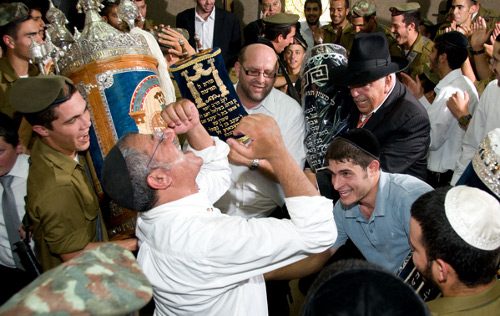
Simchat TorahThis makes it seem like what the Torah contains, at least at its core, is a set of instructions that applies to all of humanity, not just the Jewish people, but it is the responsibility of the Jews to “effectively communicate this message.” That sounds almost evangelical, until you realize the mission of Judaism isn’t to make the people of the nations into Jews, but to teach them/us about the One true God of Israel. In modern traditional Judaism, that extends no further than the level of the Noahide, but from Christianity’s point of view, we enter a whole new world when we know God by accepting Christ.

Where that world takes us is a journey beyond imagination, and one that is unique, in many ways, to each individual. In some ways, as is in my case, it actually leads somewhat away from its source; away from Judaism, at least at the personal level, since most Jews cannot tolerate a great deal of Christianity in their lives. But while faith is easy, trust comes very hard, especially in the presence of disappointment.

However, as Rabbi Freeman stated at the beginning of this “meditation,” “To trust is to lift up your eyes and stand as tall as the heavens. To live with nothing else but the bond between G‑d above and you below.”

Please forgive me if I take the liberty of applying those words of wisdom to all of us and not just to the Jewish people.

I lift up my eyes to the hills. From where does my help come? My help comes from the Lord, who made heaven and earth.

Psalm 121:1-2 (ESV)

When you’re in the middle of the journey and it all seems so futile and hopeless, then the path has reached its end, regardless of what actually lies before you. But when there is hope, when you lift your gaze out of the dust and darkness and raise your head up to see the light, the journey begins again as if you had just taken your first step.

Vain Hopes

“Cast your burden upon Hashem, and He will sustain you.”

Psalms 55:23

Everyone in the world has burdens. Some are heavier than others – some are lighter. You cannot always tell how heavy someone else’s burden is; you only have the subjective experience of your own. But know, with clarity, that just as you have burdens, so does everyone else.

Here we have the ultimate advice on how to handle your burdens: do not do it alone. You never have to do it all yourself. As a matter of fact, it’s impossible to do it all yourself. You can call upon the Almighty, your Father, your King, Creator and Sustainer of the universe to help you. Our verse tells us that you can give over your entire load of baggage to Hashem, and He will sustain you.

-Rabbi Zelig Pliskin
Casting Your Burdens, Daily Lift #595
Aish.com

I had a most illuminating conversation with my wife a few weeks ago. Actually, it wasn’t so much illuminating as it was confirming. I don’t know how we got on the subject. We were home alone, just the two of us. We were talking at the kitchen table. I can’t remember exactly the words that were used but I discovered, or rather confirmed, the reasons that I will never be part of my wife’s Jewish life. She’s embarrassed that I’m a Christian.

I guess that’s why she never invites her friends over to our house. She always meets them for coffee or something. I think it’s just awkward to acknowledge me in front of other Jews. She said during our conversation, “What am I supposed to do? Introduce you as my ‘Messianic husband’?”

I corrected her and said that I’m a Christian and that I walked away from the “Messianic” life, in part, just for this reason. I don’t think it helped. I think, in her eyes, it’s just as bad for a Jew to be married to a Christian as to a “Messianic Gentile.”

At any rate, the end result, which is now finally in the open, is that I will not be attending shul with her, nor any classes at synagogue, nor any public festivals such as Sukkot. I even wonder if this is why she stopped lighting the Shabbos candles in our home. For all I know, she doesn’t go to synagogue anymore because people there know she’s got a Christian husband. For all I know, tongues wag about this misfortune of my wife’s.

That last part is my imagination, but again, who knows?

I never wanted my faith to come between us. For over a year, I’ve done everything I could think of to minimize the “impact” of my Christian faith in her Jewish life. Now I know that nothing I did worked. I’m embarrassing. I recall a situation that happened some months ago when my wife and I were shopping at our local Costco. We had just checked out and were about to leave when my wife ran into a friend from synagogue. They chatted for several minutes and then parted. All during their conversation, at no time did my wife pause to introduce me to her friend. It was as if I wasn’t even there. I guess I know why now.

“I came to cast fire on the earth, and would that it were already kindled! I have a baptism to be baptized with, and how great is my distress until it is accomplished! Do you think that I have come to give peace on earth? No, I tell you, but rather division. For from now on in one house there will be five divided, three against two and two against three. They will be divided, father against son and son against father, mother against daughter and daughter against mother, mother-in-law against her daughter-in-law and daughter-in-law against mother-in-law.”

Luke 12:49-53 (ESV)

This compares to Matthew 10:34-39 which also quotes Micah 7:6. I thought I recalled a variant on the Gospel verse that specified “husband against his wife,” but I can’t find it.

Close enough, I guess.

But I don’t want to be against my wife, nor do I want her to be against me.

Tough luck, eh?

I used to say that “in a created universe, there’s no such thing as luck,” but just how closely does God control circumstances? Were my wife and I truly fated to be married, or did God allow random chance to take charge? What about our decisions of faith? I might never have become a Christian if not for a long and what seemed to be, highly orchestrated and unlikely series of events that occurred over several month’s time. My wife became a Christian at almost the same time and for a while, we had similar ways of looking at God, Christ, faith, and marriage.

Then, through another set of long, unlikely occurrences, we have found ourselves where we are now: at opposite ends of the identity of the Messiah, a Jew and a Christian searching for God while living in two very different worlds. And thereby hangs our tale. I could stand to have the rest of the world be the enemy of my faith as long as my wife was by my side. Now, I realize that such a wish is vain and foolish. If “God is in control” as the Christians like to sing in church on Sundays, then what he’s planning to do with all of His control is beyond my comprehension.

Or, as Paul Simon sings:

God only knows
God makes his plan
The information’s unavailable
To the mortal man
We work our jobs
Collect our pay
Believe we’re gliding down the highway
When in fact we’re slip slidin’ away

Or is that too cynical?

And he said, “Naked I came from my mother’s womb, and naked shall I return. The Lord gave, and the Lord has taken away; blessed be the name of the Lord.”

Job 1:21 (ESV)

I suppose that could be coupled with:

Though he slay me, I will hope in him; yet I will argue my ways to his face.

Job 13:15 (ESV)

Argue? Argue about what? Shall I adopt Adam’s argument?

He said, “Who told you that you were naked? Have you eaten of the tree of which I commanded you not to eat?” The man said, “The woman whom you gave to be with me, she gave me fruit of the tree, and I ate.”

Genesis 3:11-12 (ESV)

No, that’s as ridiculous now as it was the minute Adam said it. There’s no blame to be assigned, either to God or to my wife. I can’t even blame myself for being a Christian, since I must be convinced that this part of my experience was and is within the purposeful will of God.

So what do I do? Of late, I had been considering going back to a church. My son David told me he’d talked to a Pastor of a local Baptist church who had lived in Israel for fifteen years (not as a Pastor, but before being called into the ministry). No, he’s not Jewish, but this Pastor did tell my son that he didn’t consider himself “usual” for a Baptist Pastor.

But now I don’t know if it’s a good idea. The wedge is there between my wife and I and if I cannot bridge the gap and heal the wound that gapes wide and bleeding between us, I certainly don’t want to rip it open any further. Right now, I’m just one Christian alone in our house with no direct connection to any larger group of Christians. If I started going to church, how much worse would it be for the both of us?

My wife doesn’t invite her Jewish friends over because she’s embarrassed by me. She removed any pictures and other items from our home that were obviously communicating a faith in Christ (we once had a framed copy of the Lord’s Prayer written in Hebrew on the wall of our formal dining room), but unless she’s willing to give me the boot, my very presence (though I wouldn’t speak a word) is a glaring inconsistency to her faith and her life as a Jew.

Conversely, I couldn’t bring any Christian friends home, couldn’t host a Bible study, couldn’t have a few church friends around for coffee, not because I’m embarrassed that my wife is Jewish, far from it. No, but because it would be very difficult for her to tolerate.

Of course, she would say that I’m within my rights to practice whatever faith I choose in whatever manner I choose. She would never deny me that. But exercising my rights is still an embarrassment to her, at least in the presence of anyone she knows who is Jewish. Add this to my list of reasons why I can’t go to church.

I cannot do what logic would suggest, though, even for the sake of peace in the home:

So everyone who acknowledges me before men, I also will acknowledge before my Father who is in heaven, but whoever denies me before men, I also will deny before my Father who is in heaven.

Matthew 10:32-33 (ESV)

I sometimes envy those Christians out there in the “Messianic” space for whom faith is just an intellectual exercise. Those folks who are almost obsessed with their sometimes unique take on “Judaism” in terms of personal doctrinal statements, systematizing theologies, categorizing the Jewish mitzvot, and other arcane pursuits, and yet who never actually feel and live a life immersed in pools of infinitely deep faith, transcending the written word and living between life and death, between love and despair, between God and the emptiness of the abyss.

There are all manner of interfaith marriages and many are able to make their way across the differences and to share the commonalities. My wife and I too share many commonalities between us, but our lives of faith and our vision of God are not among them.

As I was “mentally composing” this missive some hours ago (as I write this), I couldn’t help but be reminded of Solomon and Ecclesiasties:

For what happens to the children of man and what happens to the beasts is the same; as one dies, so dies the other. They all have the same breath, and man has no advantage over the beasts, for all is vanity.

Ecclesiastes 3:19 (ESV)

(My son and I built the sukkah in my backyard on Sunday afternoon, just hours before Sukkot began and I suppose the experience is what brought all this to the surface with such force…after all, what business do I have performing the mitzvah of building a sukkah…and notice that I’m blogging during the first two days of Sukkot…however, my son is Jewish so I guess that covers it)

With all of this in mind, I have been examining time, the past, the future, marriage, life, faith, as if they were all in a sealed box that I am turning over and over in my hands. God made the box, inserted all that it contains, locked it tight, and gave it to me. No, that’s not fair. I’ve certainly contributed the vast majority of the items the box contains. We all take the basic materials God gives us at birth and make them into what we are today. I can’t blame God or argue with Him, tempting though that might be.

Maybe that’s why Solomon wrote Ecclesiasties…because no matter what we do, we’re born, we live through whatever happens, and then we die. In the end, what will it matter? Why do some of us who are unworthy live, and others who are very worthy die? (you’ll need a Facebook account to open that last link). It’s a mystery. Who can know the vastness of the mind of God?

I quoted Psalms 55:23 at the beginning of this blog post, but as I’ve been reminded periodically, not everything that is written in the Jewish texts, including the Psalms, can automatically be applied to we non-Jewish Christians. Perhaps my desire to cast my burdens on God is merely vanity as well.

If you are ever feeling sad or dejected, there is a faster and better way to create a more positive feeling that to simply wait until the feelings change through happenstance. There are a few basic choices with a multitude of variations. You can take positive actions. Perform a mitzvah and experience joy for the good deed you are doing. Also, you can remember the good in your life and the positive things that have happened to you in the past. If need be, you can find a positive lens through which to see your present distress.

-Rabbi Zelig Pliskn
Creating Positive Feelings, Daily Lift #594
Aish.com

Alone in silenceI can’t stop being a Christian and so I can’t stop being an embarrassment in the home. If I can’t openly express my faith, except in the blogosphere where she never travels to, then the mitzvah I must perform is to try to stay out of the way of her being Jewish. That’s kind of hard since we live in the same home, but I can only encourage her to do all that she can and must do as part of her Jewish community.

And as for me? I originally created this blog, this “morning meditation,” to chronicle my anticipated journey of faith with my wife into her Jewishness. Now that I realize my ambitions were only vanity and foolishness, what is there left to accomplish?

I have several projects related to this blog that are in process. Once those processes have reached their conclusion, the results may well dictate the continuation or dissolution of this experiment. As always, you’ll be the first to know of my decision.

Sukkot: The Man Who Had No Coat

There was once a man, whom we will call Andy, who was diagnosed with a rare and severe illness. Unique conditions often call for unconventional treatments, and he was advised to try psycho-physical therapy: he was told to find someone who lives in complete joy with no worries, ask him for his coat, and wear that man’s coat for seven days. Hopeful that he would soon feel healthy again, Andy embarked on his mission to find such a person. He searched everywhere, asking everyone he met if they or someone they knew was completely happy without worries. Unfortunately, after many months he still hadn’t found anyone who fit the description.

Finally, with the debilitating illness still progressing, Andy was referred to a man named Sam who, he was told, was happy and had no worries at all. It was winter, yet Andy anxiously trudged through the snow to a park bench where he was told Sam could be found. Andy sat down next to Sam and began his inquiry.

“Are you Sam, the man they say is filled with joy, who has no worries?” Andy asked.

“Yes, indeed I am,” Sam replied with a smile.

“Wonderful! May I borrow your coat for seven days? It would really mean a lot to me.”

“Of course! I would love to lend you my coat, but there’s just one problem.”

“What’s that, Sam?”

“I have no coat.”

-Rabbi Mordechai Dixler
Program Director, Project Genesis/Torah.org
“The Party That Never Ends”
ProjectGenesis.org

This lesson from Rabbi Dixler somewhat reminds me of something that the Master taught:

“Do not lay up for yourselves treasures on earth, where moth and rust destroy and where thieves break in and steal, but lay up for yourselves treasures in heaven, where neither moth nor rust destroys and where thieves do not break in and steal. For where your treasure is, there your heart will be also. –Matthew 6:19-21 (ESV)

But what does all this have to do with Sukkot? Plenty.

As Rabbi Dixler points out in his commentary, during Yom Kippur, observant Jews immerse themselves in prayer and supplication before God, turning aside from physical pleasures and imploring their Creator to help them build a new future. Immediately after such a time of plunging into the intense personal and spiritual depths, emerging after the fast and knowing that Sukkot is immediately upon them, the soul rebounds and rises into great joy.

Interestingly enough, Jews are to leave their regular dwellings and reside in “simple huts with deliberately poor roofing” for this week-long holiday, entertaining their guests including, traditionally, Abraham, Isaac, Jacob, Joseph, Moses, Aaron, and David…a different guest each night. It would be like welcoming a different king on each successive night, and entertaining them in a makeshift lean-to. After the personal deprivation of Yom Kippur, why eat and drink and sleep in, what for some of us, might be a small, damp, cold, flimsy shelter?

I think the secret is in what we read from Matthew’s account of the teachings of Jesus. With the roof of the tent purposefully incomplete, allowing in rain and letting us see the stars above us at night, we are trading our physical, secular home for one which Rabbi Dixler calls a “new spiritual home” which “serves to inject the spiritual, genuine, joy experienced on Yom Kippur into common daily activities.”

But what about Andy and Sam?

One does not need a coat to be the happiest man alive. In fact, if we rely on non-spiritual pursuits for our joy, we’ll never be satisfied. As the Sages say, “a person does not leave this world with even half of what he wanted” (Koheles Raba, 1:34). Nothing in this world can live up to our dreams, and a non-spiritual focus ultimately ends in disappointment.

The answer is not asceticism. As one of my teachers, Rabbi Berel Wein, used to say in this context, “this is not a plea for poverty, my friends!” We do learn, however, that for any material pursuit or attainment to last, it must at least be rooted in spirituality. If we buy delicious food to share with others, buy a house to raise a family and welcome guests, or pursue a lucrative career to have money to help those in need, we’ll experience the spiritual joy along with the physical joy, and then it is guaranteed to last. (Based on Nesivos Shalom)

Under the sukkahI suspect that Andy was relieved of his disorder, not by wearing Sam’s non-existent coat for the next seven days, but by understanding why he didn’t have one. Although you and I might consider spending seven days and nights living, eating, and sleeping under the clouds and the sky as a bit uncomfortable (one or two nights might seem like a camp out), there is joy in relying on God. Our immediate surroundings may seem poor, but we are inundated by the boundless treasures of Heaven. By living in a flimsy structure and yet decorating it elaborately, often with lights, trinkets, pictures and such, and then, inviting guests, from the poorest to the richest, into our hovel, and feeding them abundant food and drink, we are experiencing the reality of our existence. We live on earth and are able to enjoy all that it has to offer, but we are also dependent on the blessings of Heaven above us to shelter our heads from the harsh elements of this life.

One can take pleasure in what the world has to offer and this, God approves of. But the world will not be our lasting joy. Only God can give that.

Sukkot begins tonight, September 30th, at sundown. Here’s an infographic that will tell you everything you ever wanted to know about Sukkot.

Chag Sameach and Good Sukkos.

Ha’azinu: Between Heaven and Earth

Why did Moshe address the earth as well as the heavens? And why did Yeshayahu address the heavens as well as the earth? Why did they not confine themselves to speaking to the realm closest to them?

The answer to these questions depends on a fundamental tenet of Judaism: we must relate to both earth and heaven. For material and spiritual reality are meant to be connected, instead of being left as skew lines. Judaism involves drawing down spiritual reality until it meshes with worldly experience (Moshe’s contribution), while elevating worldly experience until a bond with the spiritual is established (Yeshayahu’s contribution). (see Rambam, Commentary to the Mishnah (Sanhedrin 10:1), the seventh and eighth of the Thirteen Principles of Faith)

Indeed, the two initiatives can be seen as phases in a sequence. By revealing the Torah, Moshe endowed every individual with the potential to become “close to the heavens.” Yeshayahu developed the connection further, making it possible for a person to experience being “close to heavens” while “close to the earth” involved in the mundane details of material life.

-Rabbi Eli Touger
“Close To The Heavens”
From the “In the Garden of Torah” series
Commentary on Torah Portion Ha’azinu
Chabad.org

This is something like what I’ve been trying to say in my Jesus, Halakhah, and the Evolution of Judaism series. There is a dynamic tension in Judaism between Heaven and earth; between God and man, between the Spiritual ideal and the practicality of performing the mitzvot in the secular world. Heaven never changes, but the world in which we live in changes all the time. As we see from Rabbi Touger’s commentary on this week’s Torah portion, we might very well say that a Jew has one foot anchored in Heaven and the other planted firmly on earth.

The Master said it this way:

But now I am coming to you, and these things I speak in the world, that they may have my joy fulfilled in themselves. I have given them your word, and the world has hated them because they are not of the world, just as I am not of the world. I do not ask that you take them out of the world, but that you keep them from the evil one. They are not of the world, just as I am not of the world. Sanctify them in the truth; your word is truth. As you sent me into the world, so I have sent them into the world. And for their sake I consecrate myself, that they also may be sanctified in truth. –John 17:13-19 (ESV)

Just as Jesus was, at that time, in the world but not of the world, this is how he characterized his disciples, who were set apart; sanctified for holy service to God. This is also a good understanding of what I see in Rabbi Touger’s commentary on what the Song of Moses was and is trying to teach the descendents of Jacob and the children of Israel.

And as Christians, this is a lesson we must learn as well.

But it isn’t easy. There’s a very delicate balance going on here. It would be very simple to slip too far one way or the other. If we go too far into the spiritual realm, we might have to leave the world altogether. More often than not though, we would probably just lose our way, walking off of the true path and into realms that involve excessive, arcane spiritual and mystic philosophies that are often mistaken for “mysterious truths” by people who are never satisfied with what God has given them. To go too far in the opposite direction (and this is the mistake most of us make) is to become too much of the world, bending our theologies and philosophies to the demands of a politically correct western culture, and believing that God has not prepared for us His enduring principles and values.

But how do you know if you’re biased too far in one direction or another? How can you tell if you’ve struck the right balance between adhering to eternal truths and adapting your religious practice to the needs of the current generation?

You almost never can tell until you, or someone around you, has gone to one extreme or the other, and then it becomes all too obvious.

How do you steady yourself on the path? That’s not easy, either. But it’s done by surrounding yourself with stable companions in the faith; men and women who are “grounded in the Word” and who have spent much time with God, men and women of prayer, grace, compassion, and acts of charity and kindness. Think of them as there to assist you in the occasional “course correction” that must be made during your journey between birth and God.

Unfortunately, there are always wrong communities that will support and encourage problems:

For the time is coming when people will not endure sound teaching, but having itching ears they will accumulate for themselves teachers to suit their own passions, and will turn away from listening to the truth and wander off into myths. As for you, always be sober-minded, endure suffering, do the work of an evangelist, fulfill your ministry. –2 Timothy 4:3-5 (ESV)

This is a well used and well-abused set of verses because almost everyone in every type of Christian denomination, sect, and variant believes their group is the only one that possesses “sound teaching” and that everyone else who differs from them have “itching ears.” Indeed, the Messianic Jewish and Gentile Hebrew Roots movements are often characterized in the latter category by the mainstream Christian churches, since the focus on Hebraic and Jewish thought is contrary to what most churches teach.

So what do you do? How can you be so sure of yourself?

The scary answer is that, if you are at all honest with yourself and with God, you can’t be too sure. In fact, a little self-doubt is probably healthy. Taking other people’s criticisms to heart, at least temporarily, lets you look at yourself from a different point of view and ask the question, “what if I’m wrong?” I spent about a year on a different blog asking myself that question in many different ways, and my current perspective on this blog is the result. Just two weeks ago, I admitted I was wrong in response to a critic’s complaint, and I started a journey to investigate what the Bible really says about a Christian’s covenant connection to God.

If you assume that you’re never wrong, then you are almost certain to be walking away from God. I’ve met people like that, both in the blogosphere and face-to-face and believe me, they’re scary.

But what can we do when information overload hits, when the words and the texts and the spiritual pronouncements get to be too much? What do you do when you feel like you are about to fall off the tightrope, or that you are running on the edge of a razor blade, in imminent danger of being sliced to ribbons? As the saying goes, you need to “get back to basics.”

My soul thirsts for You; my flesh pines for You.

Psalms 63:2

One Yom Kippur, after the Maariv (evening) services that ended the 25-hour fast, Rabbi Levi Yitzchok of Berdichev exclaimed, “I am thirsty! I am thirsty!” Quickly someone brought him water, but the Rabbi said, “No! I am thirsty!” Hastily they boiled water and brought him coffee, but again he said, “No! No! I am thirsty!” His attendant then asked, “Just what is it you desire?”

“A tractate Succah (the volume of the Talmud dealing with the laws of the festival of Succos).” They brought the desired volume, and the Rabbi began to study the Talmud with great enthusiasm, ignoring the food and drink that were placed before him.

Only after several hours of intense study did the Rabbi breathe a sigh of relief and break his fast. The approaching festival of Succos with its many commandments – only five days after Yom Kippur – had aroused so intense a craving that it obscured the hunger and thirst of the fast.

It is also related that at the end of Succos and Pesach, festivals during which one does not put on tefillin, Rabbi Levi Yitzchok sat at the window, waiting for the first glimmer of dawn which would allow him to fulfill the mitzvah of tefillin after a respite of eight or nine days.

Today I shall…

try to realize that Torah and mitzvos are the nutrients of my life, so that I crave them just as I do food and water when I am hungry or thirsty.

-Rabbi Abraham J. Twerski
“Growing Each Day, Tishrei 11”
Aish.com

The “Torah and mitzvos;” Heaven and earth are the nutrients of life. We crave them like food and water. To extend the metaphor, we need a “balanced diet” to stay healthy. I adopted the name and philosophy for my blog from something written by Rabbi Tzvi Freeman that was based on the letters and talks of the Rebbe, Rabbi M. M. Schneerson:

When you get up in the morning, let the world wait. Defy it a little. First learn something to inspire you. Take a few moments to meditate upon it. And then you may plunge ahead into the darkness, full of light with which to illuminate it.

When you find yourself poised between Heaven and earth, try to balance yourself as much as possible, and then pick up a Bible or perhaps some text produced by a learned sage. Learn one thing that inspires you, that fills you with energy, and prompts you to seize the day…meditate upon it, question it, question your own understanding of it and of yourself for a time. Then start walking forward on your path toward the dawn and let yourself be the light that provides illumination.

I am gratified that this lesson has extended outward a little from my humble blog.

Good Shabbos.

Longing for Yom Kippur

Because the day has passed, shield us by the merit of [the Patriarch Abraham] who sat [at the door of his tent] in the heat of the day [to welcome wayfarers].

Genesis 18:1 (Ne’ilah prayer)

Just prior to Ne’ilah (the concluding service of Yom Kippur), one of the Chassidic masters ascended the bimah (platform) and said tearfully, “My dear brothers and sisters! God in His infinite mercy gave us the entire month of Elul to repent, but we failed to take advantage of it. He gave us the awesome days of Rosh Hashanah, when our standing in judgment before the heavenly tribunal should have stimulated us to repent, but we neglected that opportunity. He gave us the special grace of the Ten Days of Penitence, but we let these pass too. All we have left now are a few precious moments that are propitious for forgiveness.

“The Sages of the Talmud tell us that if a person enters a marriage contract on the condition that he is a perfect tzaddik, then it is binding even if he is known to be a complete rasha (wicked person). Why? Because he may have had one moment of sincere contrition that transformed him from a complete rasha to a perfect tzaddik. “Do you hear that, my dear brothers and sisters? All it takes one brief moment of sincere contrition! We have the opportunity of that moment now. In just one moment we can emerge totally cleansed of all our sins, in a state of perfection akin to that of Adam in the Garden of Eden.”

The rabbi wept profusely and uncontrollably. “Could we be so foolish as to overlook such a rare opportunity? Let us assist one another and join in achieving sincere repentance!”

Today I shall…

…take advantage of the Divine gift of forgiveness, and make my resolutions of repentance sincere, so that the new person that emerges will be unencumbered by the burdens of the past.

-Rabbi Abraham J. Twerski
“Growing Each Day, Tishrei 10”
Aish.com

I’m not going to be fasting for Yom Kippur this year. I’ve fasted in the past. Further in the past, I’ve fasted and attended religious worship, although only elements of the Yom Kippur service were involved. A Jewish friend emailed me last night and asked if I were going to fast in solidarity with the Jewish people. I had thought about it, but I know that my family won’t be fasting and it seemed a little presumptive for me to fast, since I’m the only non-Jewish member of my immediate family.

I suppose you could say that if I fasted, I would be leading by example, but it could also boomerang back and make me look like I’m being critical of them and taking on a “holier than thou” attitude. I’m not taking the day off of work, either. I think my family will be working tomorrow as well. I suppose this is a problem, since they are Jewish and choosing not to observe the Yom Kippur fast nor going to shul to repent with the community of Israel.

Last spring, I wrote an article called “Redeeming the Heart of Israel” (Part 1 and Part 2) in which I defined the Christian relationship to the Jewish people as one of encouragement and support for Jews to return to Torah and to the ways of their fathers. That’s easier said than done when it’s your own family.

Oh, I’ve dropped subtle and not-so-subtle hints, but ultimately, the choice isn’t mine to make. It’s theirs. Each individual, Jew, Christian or anyone else, negotiates their own relationship with God. For me, my atonement is in Jesus Christ. Frankly, I believe that’s true of everyone, but not everyone perceives that truth in their lives. There are elements of both the Abrahamic and New Covenant that link both Jews and Christians, through the Messiah, to God, so Messiah is the hope for all of us.

But since I am not Jewish, the particulars of the Sinai covenant do not have blessings for me. Without a Jewish “lived” experience, I’m unsure how to encourage my family to be who they are and maybe it’s not my place to try. But then, when you love someone, you want what’s best for them; you want what will make them happy.

God opens His Hand and satisfies the desires of every living thing (Psalm 145:16). My desire is for my family to return to the mitzvot; return more fully to the Torah, and to be the people God made them to be; Jewish people. I apologize and regret anything I may have said or done that has been to the contrary. I pray to God that in the coming year, He may help turn the hearts of all His Jewish children back to Him and help we Christians be more compassionate of His Chosen People, that we may stand at their side and together, all acknowledge that God is One. On that day, may all Christians fast on Yom Kippur in solidarity with their Jewish friends and family.

May the Messiah come soon and in our days, and may you be sealed for a good year in the book of life.

To honor the most Holy day for the Jewish people, I will not present a “morning meditation” on Wednesday which is Yom Kippur (begins at sundown on Tuesday). My next blog post will be Thursday morning.

Jesus, Halakhah, and the Evolution of Judaism, Part 3

The title I have chosen for this study is a “tongue-in-cheek” attempt to highlight something that seems to be missed by many, namely, that the Mishnah did not exist as a written document in the pre-destruction era, so it is quite obvious that no one, including Paul, could have possibly read what is known in our day as the Mishanh (sic). In fact, as we shall see, the Mishnah was not widely read by Jewish communities in the centuries immediately following the destruction of the Temple (70 CE) either, for the Mishnah was not “published” as a written document until much later.

Along the same lines, it is a methodological error to speak of “1st Century Judaism,” for no such monolithic Judaism existed. We must rather speak of “Judaisms” (plural) in the pre-destruction era. Granted that a variety of Judaisms extant in the 1st Century surely had some things in common (Shabbat, circumcision, Tanach, etc.), it was nonetheless their clear and (in some cases) radical differences that produced the variegated Judaisms of that era.

Unfortunately, the presupposition of some in the Messianic movement is that the later corpus of rabbinic literature presents a monolithic, historically accurate description of “the Judaism” practiced by Yeshua and His disciples.

-Tim Hegg
from the Introduction (pg. 1) of
“What Version of the Mishnah did Paul Read?” (2012)
TorahResource.com

Since writing Part 2 of this series, I’ve been pondering how to proceed, since, as I’m sure you’ve gathered if you read the questions I’ve been posing, the scope of my inquiry is rather ambitious. Then the answer landed firmly in my lap. I’m indebted to Peter at Orthodox Messianic Judaism (something of a misnomer given the theological nature of his blog) for providing a link to Tim Hegg’s article. I read it through once, meaning to go over it again and eventually write something about it, but as I was getting into the shower, I had an “epiphany” and quickly rushed to my computer (I put a robe on first) to compose the paragraphs that are the heart of this missive (we’ll get to those by the by).

I should say at this point that I like Tim Hegg. He has been very gracious to me. I’ve spent Erev Shabbat in his home, I’ve been treated well by his family and his congregation, and I admire and respect him as a leader and a scholar. All of which added to my surprise when I realized in reading the Introduction to the above-quoted paper, that he had made some glaring and erroneous assumptions.

I can’t think of anyone in Messianic Judaism who believes that the Mishnah we have today is a direct reflection of how Judaism (or “Judaisms”) functioned back in the late Second Temple period, when Jesus walked among his people Israel. I have no idea, even after reading Tim’s paper in full, where he got that idea. Certainly my drive to investigate the evolution of Judaism as it relates, both to the ongoing authority of Judaism to define itself across time, and whether or not First Century halakhah and modern halakhah can be considered equally valid for the Judaism of their times, doesn’t assume a fixed, static, and non-adaptive set of applications of Torah over a 2,000 year span.

Also, his point that in the day of Jesus, that there were multiple “Judaisms” (Pharisees, Essenes, Sadducees, and so on) is hardly a revelation. Again, I don’t know anyone in the Messianic Jewish movement who would deny the “multi-sect” nature of First Century Judaism. On the other hand, if we look at modern Judaism or modern Christianity, we could say the same thing. If there was no, one unified “Judaism” in the day of Jesus, there must certainly be no one, monolithic, unified modern Christianity either. The fact that the Christian church exists as perhaps hundreds of denominational models and their variants, (including One Law or, if you will, “One Torah”) establishes this firmly. Nevertheless, no one balks at talking about “Christianity” or “Judaism” in the 21st Century as if they were specific, unified entities, since at their cores within each individual religion, they contain a basic, common set of theologies, doctrines, dogma, and the like that identify them as either “Christian” or “Jewish.”

It’s as if Tim constructed a very well written and organized paper based on faulty assumptions about Messianic Judaism. It’s never been about the Judaism of late Second Temple times being one unified entity, and it certainly has nothing to do with the belief that the Talmud, (which is comprised of Mishnah, Baraita, Gemara, Halakhah, and Aggadah) as we understand it, having existed as the same body of information in the days of Jesus and the Apostles as it does today.

(The evolution of the Oral Torah and halakhah of Christ’s day into what eventually became known as the Talmud is well beyond the scope of this article, but the seeds of what became Talmud certainly must have existed in some form in the Second Temple period and before. What we know of Hillel and Shammai is recorded in Pirkei Avot, which is the “ethical teachings and maxims of the Rabbis of the Mishnaic period,” and yet both Hillel and Shammai pre-dated Jesus by a generation, and the formalization of Mishnah by centuries.)

In the Conclusions section of Tim’s paper (pg. 23, point 5), he states:

We see, then, that there is no historical nor biblical case for accepting oral Torah as divinely sanctioned. Even the suggestion itself is ill-founded, for it both presumes a monolithic “oral Torah” and that the rabbinic authorities who formulated and compiled the current corpus of rabbinic literature did so by the leading of God.

Point 7 of his Conclusions (pp 23-4) states:

As we avail ourselves of the wealth of rabbinic literature and gain value from the study of it, we must also keep in mind that it is the product of men and not that of divine revelation. It does not come to us with any sense of divine imprimatur nor should the rabbinic literature be considered as having sacred value greater than the works of non-rabbinic authors or sources. All the writings of men must be equally scrutinized in the light of the eternal word of God, the Bible.

There’s a certain irony in Tim’s statements if you fix your gaze, not on the Rabbinic writings that are encapsulated in Talmud, but on another “Rabbi’s” writings, which we find in “the light of the eternal word of God, the Bible.”

We take it on faith that the Bible, the Holy Scriptures of God, are Divinely inspired and not merely the writings of human beings, but even then, most of us don’t believe that God simply dictated the Bible to myriads of human beings over several thousand years of history, and that the authors involved were only human word processors. In fact, how much of the personalities and viewpoints of all of these authors made their way into our Holy Scriptures is a hotly debated point among religious scholars and worshipers.

Add to that the suggestion that the New Testament Epistles, which make up the majority of the Christian texts, were actually letters written mostly by Paul, with smaller contributions by a handful of others, to various early Christian churches, and you begin to wonder about the nature of “Divine inspiration.” More than one source has said that the New Testament letters could be of a “lesser authority” than the Torah, for example, and may indeed be Paul’s midrashim or commentaries on Torah, the Messiah, and on the Abrahamic, Mosaic, and New Covenants. If this is true, then the barrier between “Divine authority” and “human agency” in many of our holy writings is a lot thinner than most Christians (perhaps including Tim Hegg) would be comfortable with.

What if there’s merit to the idea that the Talmudic writings and subsequent commentaries, judgments, and rulings have a “Divine authority” involved, at least to a degree? If we can say that Paul’s letters are “Divine” in some manner or fashion, and yet were written by Paul with his mind and emotions fully engaged, (and who knows how “Divine inspiration” does and doesn’t work) then in Galatians, Ephesians, or Colossians, where does Paul leave off and God begin? There’s no way to know. Maybe God just “wired” Paul’s brain to write letters in a way that reflected His will and intent within the context of Paul’s personality, the place and time in which Paul was writing, who he was writing to, and the issues at hand that prompted the letter in the first place.

How is that different from the acknowledged and legitimate Rabbinic authorities issuing rulings, based on and extrapolating from Torah ideals and principles, and then applying them to their local populations?

Who can say if the Mishnaic Rabbis were Divinely inspired or not. How do you measure “Divine inspiration?” I suppose you can, as Tim says at one point, compare the Rabbinic rulings to the canon of Scripture and where they agree, you can say the Rabbis have produced value. Where they disagree, you can say they produced error. Detractors of the Talmud, as applied to Messianic Judaism, say that since “Rabbinic Judaism” does not recognize Yeshua (Jesus) as the Jewish Messiah, it invalidates everything produced by that “Judaism” including the Talmud as a whole (as far as Messianic Jews are concerned, anyway). On the other hand, as my friend Gene Shlomovich said recently in this blog comment:

If you want to believe, as much of Christianity and Islam does, that G-d has virtually abandoned the Jewish people by leaving them to fend for themselves without authoritative leaders and teachers because “they rejected Jesus”, that the Jewish people corrupted the interpretation of scriptures and have lost their right to interpret them, that G-d has removed his Spirit from my people, it’s your prerogative. You would not be the first or the last.

Traditional supersessionism states that God withdrew His Spirit from the Jewish people and transferred it to “the Church” because Judaism rejected the Messianic claims of Jesus. Not only do I believe that theology represents a tremendous error in thinking, but it is a gross simplification of a very complex set of events that occurred over decades and even centuries.

The paper Matthew 23:2-4: Does Jesus Recognize the Authority of the Pharisees and Does He Endorse their Halakhah? written by Noel Rabbinowitz, which I introduced in Part 1 of this series, suggests that not only did Jesus acknowledge the legitimate authority of the Pharisees, but also of the scribes, who, as Carl Kinbar explains, were:

…an independent group affiliated not only with the Pharisees, but also with the Sadducees, Chief Priests, and elders. In fact, in Matthew, a quick check shows that 10 references to the scribes relate them to the Pharisees and 10 to other groups!

As soon as we grant the scribes the same place that Yeshua does in Mt. 23:2, it seems that Yeshua was not promoting the idea that one group should be in control of the halakhic process. Rather, he acknowledges the vital role of Torah teachers but criticizes them as part of his teaching on humility (read to verse 12).

In essence, it seems Jesus, to some degree, acknowledged the legitimate authority of the religious leaders in the various “Judaisms” of his day to have the right to establish halakhah for their communities. Of course the Mishnah as we have it today didn’t exist when the events in Matthew 23 were happening and later recorded, but if Jesus could recognize (and still criticize) Jewish religious leaders as having the right to establish religious practice for the First Century Judaisms, and if that authority was maintained across time as granted by God (I know…a big “if) and perhaps even as a function of an evolutionary process occurring within global Judaism and the local “Judaisms,” then maybe we can say that Jewish authority to legitimately define itself and it’s practice didn’t come to an abrupt end when it was “nailed to the cross with Jesus.”

No one is saying that the Mishnah existed in the days of Jesus, Peter, and Paul. But even Tim Hegg must acknowledge that some sort of halakhah did exist as established by the Pharisees and scribes. Factor in Rabbinowitz, and you have established that Jesus agreed in principle, that the Jewish religious authorities were legitimate and he acknowledged much of their halakhah. We can build on this to explore the possibility that God did not turn His back on all of His people Israel across the last twenty centuries, and that He maintained His presence among them. If God abandoned Judaism totally, and completely “threw in” with Christianity, then whatever the Rabbis came up with was inspired by human imagination alone. But if God is with all of His people, those of the Covenant of Abraham and Sinai, as well as those of us who benefit from some of the blessings of the New Covenant, then both Christianity and Judaism have a place in God’s heart and in God’s plan.

Have God’s blessings continued to be with the Jews as well as the Christians? Considering the fact that Jews even exist today, let alone retain the faith, practices, and traditions of their Fathers, with some teachings stretching back over 3,300 years, it would seem the answer is “yes.” Has He let them spin out of control, creating laws, rules, and statutes that are made up of wishful thinking and pipe dreams, while only showering His “Divine inspiration” on the laws, rules, and statutes of the unified Christian church (I hope you’re picking up on my attempt to be ironic)? I seriously doubt it.

Tim Hegg, in point 6 of his Conclusions (pg. 23) states:

Our conclusion is that, while rabbinic literature does have much value, it is not to be received as having divine authority in matters of our faith and halachah.

Tim may esteem Rabbinic literature in terms of its historic value, as well as for its insights into “the perspectives, beliefs, and worldview of modern Judaisms,” which “aids Messianic believers in appreciating and understanding the religious perspectives of observant Jews in our own day,” but for those “observant Jews,” Messianic and otherwise, the meaning of Mishnah is a great deal more. It doesn’t have to mean the same thing to us, including me or Tim, as it does to observant Jews, since the vast majority halakhah does not apply to Christianity.

Will Jesus Christ, upon his return and when he establishes his reign over the earth and his throne in Holy Jerusalem, recognize the authority of the Jews of that day as he recognized the authority of the Jews of 2,000 years ago? I don’t know for sure. But as we’ve seen, Jesus didn’t reject the Jewish authorities of ancient days out of hand, though he didn’t completely agree with them, either. Perhaps we shouldn’t dismiss the possibility of Jesus seeing modern Judaism in the same light, particularly because God doesn’t seem to have dismissed His Jewish people…ever.

Part 4 in this series will examine another aspect of the authority of the Talmudic sages and of modern Judaism. Does Judaism have the right to define itself, including Messianic Judaism? Find out in tomorrow’s “morning meditation.”