Tag Archives: Judaism

Book Review of Paul Within Judaism, “The Question of Terminology: The Architecture of Contemporary Discussions on Paul”

Over the last decade or so, more and more scholars of the New Testament have pointed to the need to re-think the terminology we use in our analyses as well as our teaching. Several terms have been asked to retire, as Paula Fredriksen has phrased it, and leave room for new words and expressions that may help us to better grasp what was going on in the first-century Mediterranean world, a time and culture very distant from our own.

Anders Runesson
from the beginning of his essay
“The Question of Terminology: The Architecture of Contemporary Discussions on Paul”
Paul within Judaism: Restoring the First-Century Context to the Apostle (Kindle Edition)

George Orwell’s famous novel 1984 demonstrates very well that when you control a people’s language, you control how they think. If a population has no word for “riot” or for “liberty,” they will be unlikely to be able to conceive of, let alone operationalize those ideas.

So the words we use in understanding Paul affect how we think of Paul, his writing, his teaching, and how we conceptualize our Christian faith. Even the term “Christian faith” summons particular thoughts and ideas that Paul may not have (and probably didn’t have) in his possession at any time in his life.

It is said that interpretation begins at translation, the words in English (or whatever other language) we use to translate Biblical Hebrew, Aramaic, and Greek. How we translate the Bible and what terms we use to express “Christian” ideas are part of what Runesson calls the “politics of translation.” This suggests that any attempt to disturb the status quo of how the Bible is translated now and what terms and phrases are included will encounter resistance. If you change the term “Paul the convert to Christianity” to “Paul the Jewish emissary to the Gentiles,” the accompanying image of Paul immediately and dramatically changes.

In his article, Runesson focuses on two terms in English used in Biblical translations: “Christians” (including “Christianity”) and “church.”

He further states:

It will be argued that “Christians,” “Christianity,” and “church” are politically powerful terms that are inadequate, anachronistic, and misleading when we read Paul…

These terms serve the needs of the 21st century church but in doing so, wholly misrepresent Paul the Apostle and everything he ever wrote or taught. Both modern Christianity and modern Judaism receive the same image of the Apostle from this mistaken illustration of Paul, and while the Church hails the story of a Jewish Pharisee who converted to Christianity and taught new disciples to replace the Law with Grace, Judaism reviles him for the same reasons.

In discussing “translating history,” Runesson asks if we are “colonizing the past or liberating the dead?” America is a colonial nation and as we know from our own history, and that of other such empires, one colonizes a “new world” and an indigenous people by subjugating what was there before and reforming it to resemble the colonizing nation and the colonizing people.

If we (Gentile Christianity) have done so with the past, with Paul, with the Bible, then we aren’t interpreting Paul in any accurate manner. Rather than employing exegesis, or taking our meaning of the Biblical text from the original context of that text, we are performing eisegesis or overwriting the text by inserting our own meaning anachronistically and erroneously.

Luther
Martin Luther

I mentioned in my previous review some of the historical events surrounding men like Augustine and Luther in terms of their probable motives for rewriting Paul’s history and they aren’t all pretty. In that review, you will recall, I quoted Magnus Zetterholm as saying that it is the Christian Church that must change, that must adjust how it chooses to understand Paul, to be more historically accurate and Biblically sustainable.

Runesson states:

New insights are thus dependent on our willingness to de-familiarize ourselves with the phenomena we seek to understand…

We think we know Paul. We think we know Jesus (Yeshua). We think we are intimately familiar with the late Second Temple period in Roman occupied Judea, not because we read the Bible, but because we listen to the prevailing Christian doctrine about the Bible as preached from the pulpit and taught in Sunday school class.

We don’t truly comprehend how alien that ancient world really was, how few historical facts have survived from that time and place. We want to believe that if Paul miraculously appeared in one of our Evangelical churches today, he would immediately feel at home and provide us with a sermon of unparalleled insight (assuming he spoke a language we understood). In fact, even if he understood our language, he would have absolutely no idea what was going on and probably wouldn’t even understand that we are the descendants of the Gentile disciples he taught.

We need to learn to experience Paul as someone we’ve never met. We need to learn about him from that view. We need to stop creating Paul in our own image and cease colonizing the ancient near east of the Apostolic Scriptures.

As Runesson puts it:

Reconstructing and translating history inevitably begins and ends with language. When we defamiliarize ourselves with texts and other artifacts, we engage in a process of decolonizing the past, liberating the dead from the bondage of our contemporary political identities.

This he calls the “reconstruction of silenced voices.”

So how are we going to change the “architecture of the conversation?”

Terminological edifices are built slowly over time and are not easily torn down. Now-unsustainable scholarly ideas from previous eras influence current discourses…

It might be easier for you to pick up your car with your bare hands and lift it over your head than it would be to change a Christian’s time-honored and “sacred” traditions about the words they/we use to describe Paul.

We need, therefore, to reconsider and discuss not only the conclusions we draw, but also the “architecture” within which we formulate them.

Terminology is pregnant with meaning that often goes unnoticed in the analytical process, which it nevertheless controls from within.

The minute we use a term or set of terms to describe an idea, we have shaped the meaning of that idea, even unknowingly, into something that might be completely foreign to the person who originated that concept.

When we talk about New Testament scholarship in general and Paul in particular, it has been the convention to say that one is studying (earliest) “Christianity” and/or (the early) “Christians.” Already at this point we have framed the shape and thus the likely outcome of the discussion…

new testamentEven the term “New Testament” as contrasted with another term, “Old Testament” creates a dichotomy that doesn’t necessarily exist. I’ve known intelligent, learned, well-read Christian clergy who actually believe the New Covenant (which we find in Jer. 31 and Ezek. 36) is actually synonymous with New Testament. I choose to think of the Bible as being divided into four basic parts: Torah, Prophets, Writings, and Apostolic Scriptures. None of those classifications is designed to divorce one part of the Bible from the other as the terms “Old Testament” and “New Testament” do. They simply classify different areas of emphasis for different sections of our Holy text. If we must “carve up” the Bible, let’s do it without setting one part in direct opposition to another.

Runesson asks if the earliest followers of Messiah would have recognized the “umbrella term” we’ve assigned to them: “Christianity” and their own identity as “Christians” as we comprehend the term today? Would they have understood that when they gathered to fellowship and to worship, they were going to “church?”

Christianity is a religion. But up until a couple of centuries ago or so, “religion” wasn’t a distinct entity that could be wholly separated from other societal functions. So to call the “religion” of Paul “Christianity” or even “Judaism,” as such, is to impose a modern concept on an ancient people. Although there was not one uniform practice of Judaism in the first century world (although according to Rabbi Carl Kinbar, there was a core Judaism that all branches of Judaism agreed upon and variations were then applied), if one was a Jew, one’s lifestyle included the mitzvot in devotion to God (apart from the periodic heretic or two).

Calling Paul a Christian and saying he practiced Christianity is totally anachronistic and forces modern Church concepts on an ancient Jewish Pharisee who saw himself quite differently.

Even acknowledging the existence of the Greek word “christianos” (translated into English as “Christian”) does not mean that how “christianos” was thought of and lived out nearly two-thousand years ago has very much or even anything to do with how Christians think of and live out their faith today. What would a modern Evangelical think if he took a trip in Mr. Peabody’s “Wayback Machine” and found himself in Paul’s “church” in Antioch? How would that Christian navigate through what would (in my mind) undoubtedly be a Jewish synagogue prayer service on Shabbat rather than a Sunday church fellowship?

The most natural point of departure for renewed terminological reflection around who Paul was and how he self-identified would be to speak not of “Paul the Christian” but of “Paul the Jew”; of Paul as someone who practiced “Judaism,” not “Christianity.”

Simply put, “Christianity” didn’t exist while Paul lived in the world. Paul taught about and wrote about and lived out a Judaism called “the Way,” and he applied it to his Gentile disciples as it was relevant to them as Gentiles. He himself was a Jew, a Pharisee, a devout Hebrew, dedicated to the mitzvot, the Temple, the Torah, and Hashem, God of his fathers.

If anyone else has a mind to put confidence in the flesh, I far more: circumcised the eighth day, of the nation of Israel, of the tribe of Benjamin, a Hebrew of Hebrews; as to the Law, a Pharisee; as to zeal, a persecutor of the church; as to the righteousness which is in the Law, found blameless.

Philippians 3:4-6 (NASB)

And as Runesson says:

…that speaking of Paul as a Jew practicing a form of Judaism is a more historically plausible point of departure for interpreting his letters…

And given all that, how do we read and interpret Paul’s letters if we employ this drastically changed paradigm?

Actually, it’s harder than that.

This does not mean, of course, that we should understand “Jewish” in essentialist terms as ahistorically referring to specific characteristics completely untouched by time and culture.

And…

…the observer needs to focus on how “a society understands and represents Jews at any given time and place…”

synagogueSo dropping Paul in a modern Orthodox Jewish synagogue on Shabbat might not be a particularly familiar experience for him either, though he’d have something more in common with the other Jews present than he would a Christian congregation.

We have to answer the question of what kind of Judaism Paul practiced. Only then can we gain a better understanding of what he was writing about in his letters. If we could only view them through his own interpretive lens or through the eyes of his immediate audience, what revelations would we see?

Runesson said that he and Mark Nanos have coined the term “Apostolic Judaism” to refer to the sort of Judaism Paul practiced and taught. How that Apostolic Judaism was lived out by Jews and by Gentiles is our mission of discovery.

Moving on to his discourse on the term “church,” Runesson brings up a point that I’ve written about on more than one occasion. The Old English word which eventually became “church” and originated in earlier Germanic languages wouldn’t be coined for many, many centuries after Paul penned letters mentioning the “Ekklesia” of Messiah. Translating the word “Ekklesia” as “Church” in our English Bibles is not only anachronistic, it is misleading and probably even dishonest.

Ekklesia, at least in Paul’s mind, was probably more closely associated to the Hebrew word “Kahal” than “Church”. It would be better, if we need to use an English word, to translate “Ekklesia” as “Assembly,” which more accurately maps to the first century Greek meaning of the term. Paul didn’t invent “Church,” either the word or the attendant concept. Later Christian Gentiles did that.

Paul never uses the word synagoge, but since ekklesia as a term was applied also to Jewish synagogue institutions at this time, it is instructive to compare how translators work with synagoge in relation to ekklesia.

In modern Bible translations and modern Christian thought, we have created a separate and opposing relationship between church and synagogue. Christians think of synagogue as the polar opposite and negative reflection of church. But this “anachronistic dividing line” is a manufactured artifact of later Church history and has nothing to do with Paul. Paul would have more closely associated Ekklesia and Synagoge in his thoughts than this thing called “church” which had no existence in his era.

Nevertheless…

Ekklesia occurs 114 times in the New Testament. The NRSV translates all but five of these with “church”…

What Runesson says next supports what I said above:

…the English translation “church” is inappropriate and misleading…

It is more accurate to say:

Paul’s use of ekklesia indicates that as the “apostle to the nations” he is inviting non-Jews to participate in specific Jewish institutional settings, where they may share with Jews the experience of living with the risen Messiah, of living “in Christ.”

Maybe that can be said to be true also of Gentiles who find themselves in fellowship within modern Messianic Jewish community. We are invited to share in a Jewish institutional setting while remaining Gentiles, and “share with Jews the experience of living with the risen Messiah.”
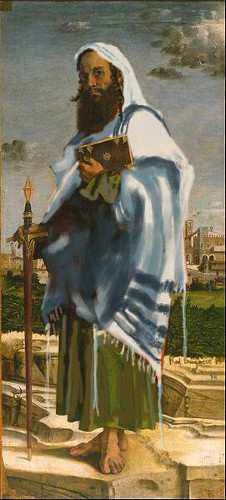
The Jewish PaulWe can dispense with colonizing the past and instead participate in giving a voice to the dead, letting them speak to us again, letting them…letting Paul use his own voice, or as close to it as we can manage.

Runesson concludes his essay with:

The terminology used by the sources themselves invites us to understand Paul as practicing and proclaiming a minority form of Judaism that existed in the first century. Such an invitation is, however, not the end of the research project; it is its very beginning.

I’ll continue my review soon.

Book Review of “Paul within Judaism,” The Introduction

A new perspective in Pauline scholarship is represented in this volume. This perspective is readily distinguishable from other interpretations of the apostle, including the collection of views now formally recognized as “the (!) New Perspective on Paul” and, all the more, the views mounted in opposition to it because of the New Perspective’s challenge to major tenets of traditional Christian interpretation.

Mark D. Nanos
from the Introduction to
Paul within Judaism: Restoring the First-Century Context to the Apostle
Edited by Mark D. Nanos and Magnus Zetterholm

I’d known for sometime that Nanos and Zetterholm were collaborating on a new book about Paul, but it wasn’t until I read Toby Janicki’s brief review of the book in the current issue of Messiah Journal that I discovered it had already been published (back in January, actually). Throwing caution and my credit card to the winds, I quickly purchased it at Amazon and downloaded it to my Kindle Fire.

There are nine individual contributors to this volume, including Nanos and Zetterholm, and while they all operate within what has been termed the New Perspective on Paul (more on that in a minute), they aren’t in total agreement with each other. So much the better. Generally within any discipline there is not unanimous agreement on all points, which invites discussion to hone what we can learn in said-discipline. I’m optimistic that because of this “honing,” “Paul within Judaism” will bring into sharper focus who Paul was within his first century Jewish framework as the emissary to the Gentiles.

Since I’m facing nine separate essays inspired by “a session entitled ‘Paul and Judaism’ at the Society of Biblical Literature in 2010” plus an Introduction, I intend to review each essay as a stand-alone presentation. That means yet another multi-part review for me to write and offer to anyone who wishes to read them.

I mentioned above something about “The New Perspective on Paul,” but considering the diverse group of scholars whose work we will be evaluating, Nanos states:

The diverse expressions of their research have been variously described in recent years collectively as the “Radical New Perspective,” “Beyond the New Perspective,” and “Post-New Perspective.” Yet these monikers do not fully communicate the major emphases of this research paradigm, since it is not primarily a new development within the New Perspective…

See what I mean?

This volume marshalls the talents of “an international group of scholars” in challenging “major tenets of traditional Christian interpretation” of Paul, using an “alternative approach, for which the phrase the ‘Paul within Judaism’ perspective seems most appropriate.”

Nanos argues that the current prevailing understanding of Paul anachronistically places him within Christianity rather than Judaism, and what keeps Paul within a Christian context is the Church’s long history of tradition regarding the Apostle. The result is:

…profound discontinuities arise between the Paul constructed in this new paradigm and the theological traditions constructed around Paul in the past.

Paul within JudaismI should say these past-constructed traditions about Paul are equally applied by Christianity and normative Judaism, the former to justify reinventing an ancient branch of Judaism as Gentile Christianity, and the latter to condemn that invention and Paul along with it.

However, a Christianity and Judaism that clings to such erroneous and yet enduring traditions on the Apostle results in their failure to see Paul as perhaps he truly was: a Jew operating within a Judaism that was devoted to the revealed Messiah and that had a remarkably liberal view of Gentile admission into their community.

Speaking of the contributors to the New Perspective, Nanos writes:

It also draws deeply from the scholars responsible for the so-called “Sonderweg” trajectory, which detects in Paul’s letters the belief in a “special way” for non-Jews to be included in salvation through Christ alongside the historical Sinai covenant with Israel. (emph. mine)

I bolded “alongside” above to notify anyone who may be concerned that this perspective on Paul defines Jewish and Gentile roles and responsibilities within the ancient (and modern) Ekklesia of Messiah differently. How differently, we will discover as we proceed through the various reviews including this one.

I mentioned above about Christianity’s and Judaism’s anachronistic view of Paul as a “Christian.” To clarify that point of view, the Introduction says in part:

He (Paul) is often enough described simply as a “Christian,” as are his “churches”; he is a “missionary.”

…because it is built on the conviction that there is something fundamentally, essentially “wrong” with, and within Judaism. Further, what is wrong with Judaism is generally analogized with what Paul is understood to have found wrong with “paganism”…

In other words, Nanos shows us that the traditional interpretation of Paul is that he found both Judaism and paganism to contain the same sorts of “wrongs,” necessitating that he create a separate religious stream called “Christianity” that departs from both, taking both Jewish and non-Jewish adherents with him. Paul then ceased the practice of Judaism and identifying himself as a Jew through his “conversion” to “Christianity.”

In this light, it’s small wonder that most non-Jewish (and Jewish) Christians in the Church revere Paul while most Jews consider him a traitor and revile him.

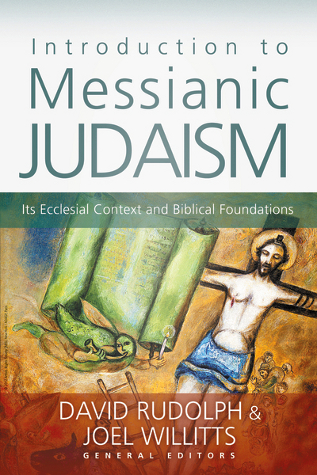
introduction to messianic judaismI’d love to send a copy of this book to every Christian Pastor, Preacher, Minister, and Priest in America but I suppose it would do no good. As the old saying goes, “you can lead a horse to water…” I tried that on a much smaller scale some time ago by purchasing a copy of Rudolph’s and Willitts’ volume Introduction to Messianic Judaism: Its Ecclesial Context and Biblical Foundations and giving it to the Head Pastor of the church I used to attend, in the (vain) hope that such an august collection of scholars writing on the merits of a Messianic Jewish perspective would at least get him to consider changing some of his views.

It didn’t work. He clung too tightly and too dearly to his Fundamentalist Christian “hashkafah,” as Boaz Michael puts it, and was unable to travel the distance necessary to view God, Messiah, and the Bible from a distinctly different, and in my opinion, a more Biblically sustainable, vantage point.

Nanos speaks to this:

If one might say that the latter oppose the New Perspective for being too new for their traditional theological positions to embrace, the contributors to this volume oppose it for being not new enough.

And…

…and the consistency of their answers with the fundamental views attributed to Paul in various traditional Christian theologies, not least the way that Jewish identity and Judaism are portrayed.

…some oppose the New Perspective because it undermines the traditional view that what Paul found wrong with Judaism was its works-righteousness and legalism.

This view of how Christianity sees Paul in relation to the “wrong” in Judaism is contrasted with:

Judaism was characterized by “covenantal nomism,” which recognizes the initial role of divine grace and of faith to initiate the relationship, but also perceives the consequent responsibility to behave according to the terms of the agreement into which participants have entered.

More simply put, the Jewish people entered into a relationship with God by grace and faith and from that, agreed to a set of covenant conditions requiring a specific set of responses, that is, observance and performance of the Torah mitzvot.

Unfortunately, “the ineluctable sin of arrogance at least since Augustine” has resulted in a radical distortion and refactoring of Paul, wholly removing him from his original context, and placing him in one that would have been completely foreign to a first century Jew, that is, Christianity.

And yet, the Church continues to insist that those of us who view Paul as a Jew within Judaism are guilty of:

…the supposed sin of ethnic particularism, variously described and named. On the premises of the New Perspective, this “wrong” is assumed to be the necessary sin involved in celebrating and guarding the boundaries of Jewish identity and behavior, as if claiming to be set apart for God was inherently arrogant, mistaken , and evidence of bigotry.

Not only does larger Christianity hold this viewpoint against those various streams of modern Messianic Judaism, but so does much of the Gentile Hebrew Roots movement. In Part 1 of a recent blog post, I quoted Carl Kinbar as stating he has hesitated to express such views of Jewish particularism for fear of inadvertently offending non-Jews in Messianic Judaism and the wider body of faith in Yeshua (Jesus).

Speaking to the presence of Jews and non-Jews in the ancient Ekklesia, Nanos writes:

This also means that the “assemblies” that he (Paul) founded, and to which he wrote the letters that still provide the major basis for this research…were also developing their (sub)culture based upon their convictions about the meaning of Jesus for non-Jews as well as for Jews within Judaism.

Magnus Zetterholm
Magnus Zetterholm

Of course, it needs to be understood that non-Jews finding the meaning of Messiah within a Judaism does not mean they become Jews nor does it mean, even remaining Gentiles, that they (or we) inherit the obligation of the Sinai covenant to observe the mitzvot.

…even though many if not most of those who were joining these subgroups were and remained non-Jews.

Nanos spent the remainder of the Introduction briefly describing each contributor to the volume and summarizing each of their articles. I won’t go into this portion of the Introduction except to draw something from what Nanos says of the first essay, written by Magnus Zetterholm, the co-editor of this work:

Moreover, if one postulates that Paul still observed Torah, as do Zetterholm and several contributors, then the idea that Paul dismissed it as obsolete or antithetical to the goals of Christ-following Jews is illogical. Zetterholm explains that Paul was not against Torah observance for Jews, including himself; rather, he was adamantly against the observance of Torah by non-Jews who became followers of Christ.

We’ll have to wait until I read and review Zetterholm’s essay to get the full details of his perspective, but this statement does address what I mentioned above about a central view in much of Messianic Judaism, that there remains a distinctiveness between Jew and non-Jew in the Ekklesia of Yeshua relative to the Torah mitzvot and our specific responsibilities to each other and to God.

This next part also needs to be expressed:

However, since this Jewish “faction” drew in many non-Jews, who would naturally be thereafter practicing the Jewish norms of communal life, even if not under Torah technically as non-Jews, this led to various conflicting views about the standing and behavior to be expected of these non-Jews from within the movement and from those outside of it, to which Paul’s letters attest.

And this is exactly what we find happening in Messianic Jewish communities today, particularly those containing a non-Jewish majority membership (which is the vast majority of Messianic Jewish synagogues in the United States today). This is another excellent reason to radically revise how we read Paul. If he knew the answer to the problems vexing non-Jewish participation in modern Messianic Judaism, we need to find out what they are.

Next time, I’ll begin my review of the first essay out of nine, written by Magnus Zetterholm called “Paul within Judaism: The State of the Questions.”

Next Year in Jerusalem

With Pesach beginning this Friday, April 3rd at sundown, I thought I’d interrupt my reviews of Pastor Chris Jackson‘s book Loving God When You Don’t Love the Church, and say something about how I’m experiencing the approach of Passover and Easter this year.

Last year, I called the association of Easter and Passover a collision, although I did urge Hebrew Roots and Messianic people not to throw Christianity under a bus for celebrating Easter as their most Holy day.

However, this year, I’m getting nervous. No, I’m not feeling anxiety about Passover or even Easter, but about how the status of the state of Israel is changing. A few days ago, The Jewish Press published an op-ed piece called “Obama Declares War on Israel”. Unfortunately, they’re not wrong. American President Barack Obama’s negative attitude toward Benjamin Netanyahu and his recent victory in winning the election in Israel, coupled with Obama’s disastrous policies toward a near-nuclear Iran, indicate that the relationship between the U.S. and Israel is at its weakest point ever.

We are about to join the ranks of those nations who are enemies of Israel, and we know from scripture that all the nations that will go up against Israel in war will be defeated by God, and their survivors will be compelled to pay homage to Israel and her King.

On a much smaller scale, I read a story about some comedian named Trevor Noah, who is taking over Jon Stewart’s job as host of “The Daily Show”, making a number of anti-Semitic and anti-Israel “tweets” on twitter.

Here’s two of his more vitriolic tweets:

Almost bumped a Jewish kid crossing the road. He didn’t look b4 crossing but I still would hav felt so bad in my german car!

South Africans know how to recycle like Israel knows how to be peaceful.

Fortunately, according to the story, he suffered a strong and immediate backlash for his comments. However, his tweet in response was hardly repentant:

To reduce my views to a handful of jokes that didn’t land is not a true reflection of my character, nor my evolution as a comedian.

So far, I don’t find him particularly funny.

I’m just listing two examples of a much wider body of information indicating how the world is continually turning away from the nation of Israel and is being willing to victimize Jewish people up to and including murder. Even American Vice President Joe Biden publicly admitted that Jews in this country can only rely on Israel and not on the U.S. As anti-Semitism continues to rise in our nation, are we going to start looking like Europe in how we treat our Jewish citizens?

It may not be too soon for American and European Jews to start making Aliyah. That gives the statement “Next Year in Jerusalem,” which we say at the conclusion of every Seder, a new and poignant meaning.

burning star of davidIt’s not just President Obama who has declared war on Israel and the Jewish people, it’s the entire world.

Yesterday, Derek Leman posted (or re-posted) a blog called Passover, Resurrection, Constantine which is a fabulous history of how Easter came to be in the Christian religious calendar.

In the second century, the congregations of Yeshua-believers were dissociating themselves from Jewish origins. Ignatius of Antioch famously said, “It is monstrous to talk of Christ and practice Judaism” (Letter to the Magnesians 10:3). The Jews had been in two wars with Rome (66-70 and 130-132 CE). Yeshua-believers, who had originally been seen as a sect of Judaism, had originally been protected under Roman law — free from obligation to show devotions to Roman gods and Caesars under the Jewish exemption — by being regarded as Jews and proselytes to Judaism. Now being Jewish carried with it the worst social stigma possible in Roman society.

But a controversy arose between the main congregations and some Asian bishops (the Roman province of Asia, in modern Turkey). Specifically Polycrates, claiming to be keeping up the practice handed down to him from Polycarp, kept a fast (vigil) until the 14th day of the month (apparently the Jewish month, Nisan) and then held a feast (likely a Passover Seder). But the other congregations at this point held a vigil on Saturday followed by a feast on Easter Sunday. The people in this dispute like Polycrates, who kept their feast on the 14th day, were called Quartodecimanists (http://en.wikipedia.org/wiki/Quartodecimanism).

They were some of the last hold-outs, Yeshua-followers who kept some of the Jewish customs of the early believers. There would be philo-Semitic (Jewish friendly) Christians well into the fifth century (as Chrysostom preached sermons against them). But in the second century such friendliness with Judaism was already well on its way to being considered a departure from true faith.

I think we still suffer under the legacy of those days and, even in the secular world, Jews and Judaism have historically endured the disfavor and displeasure of the people of the nations (to put it mildly).

Recently, the Sojourning with Jews blog posted a missive called One New Man-ity challenging the traditional Christian belief that God’s “Old Testament” particularity toward Israel was replaced by a “New Testament” universalism that exchanged the Jewish people for the Church. As a non-Jewish wife married to a Jewish husband, she defines the Gentile role in relation to the Jewish people thus:

God also says He will discipline His people and that they will be scattered out of the land and suffer terribly from the nations for a very long time. They will “dwell many days without king or prince, without sacrifice or pillar….” But “Afterward the children of Israel shall return and seek the Lord their God, and David their king, and they shall come in fear to the Lord and to his goodness in the latter days.” Hosea 3:4-5. Other places say He will rescue Jacob from “hands that were too strong for him.” I juxtapose that with Jesus saying his followers are to love and care for even the least of his brothers and so, I see that I have a calling of my own and the overarching purpose is to love God, and my neighbor as myself.

According to the historical record, if all Christians had understood this, there would have been more to stand in-between the Jews, and the nations that repeatedly sought their blood.

As far as I’m concerned, she is definitely “preaching to the choir.”

Passover and the Week of Unleavened Bread commemorates the liberation of the Israelites from under the harsh slavery of Egypt and God, through Moses, leading His nation to Sinai to establish them as the head of the nations, giving them His Torah.

In his commentary on Passover this year, Rabbi Kalman Packouz says:

People think they are free when they throw off the yoke of the Torah. However, unless one has the revealed wisdom of the Torah, he is at risk at becoming a “slave” to the fads and fashion of his society. Slavery is non-thinking action, rote behavior, following the impulse desires of the body. Our job on Pesach is to come out of slavery into true freedom and to develop a closer relationship with the Almighty!

passoverWhat has kept the Jewish people free and united them as a people for over 3,500 years when an entire world continually tries to destroy them, is cleaving to God’s Torah and maintaining their Covenant distinctiveness from the nations around them.

Passover, for the Jewish people, is a time to celebrate freedom, not just from slavery and tyranny, but from the spectre of annihilation, assimilation, and dissolution.

Several days ago, my wife and I were discussing the sad state of America and how our President seems all too willing to throw Israel to Iranian wolves. In a fit of pique, she said she’d consider giving up on the U.S. and making Aliyah.

A momentary surge of joy welled up in me at the thought, but I realize she wasn’t making a serious suggestion. According to my spouse, Israel is looking for younger families to make Aliyah, not a couple approaching retirement.

But this made me realize that while I would hate leaving my children, my grandchildren, and my parents behind, it’s more important to me to support the Jewish nation and the Land of Promise than to tolerate my own country, which seems to be in a moral and ethical nosedive destined to crash and burn at the conscience of the King.

The weight of anti-Israeli and anti-Semitic hate weighs heavily upon my shoulders as I contemplate this year’s seder, just a day away as you read this (and as I consider Easter as well). But if I have faith in God at all, then I know what He has promised Israel, to be the head of all the nations, to be a Land of everlasting peace and prosperity, will come to pass. And not all the Barack Obamas, Trevor Noahs, or anyone else can stop Him from ushering in the Messianic Era and blessing the Jewish nation of Israel.

At my family Seder tomorrow night, when we all declare “Next Year in Jerusalem,” may that “next year” come soon. May it come soon for all Jews living in the diaspora and for all those who love them.

Freedom is the responsibility to fill our lives with meaning.

-Rabbi Shimon Apisdorf

The Return of the Pesky Challenge

Every other Sunday, a friend of mine and I have coffee together and talk about whatever. Some of what we discuss is religion (his beliefs are close but not exactly the same as mine), but we talk about everything else under the sun, too. So, as he reminded me, we can’t strictly define our conversations as “fellowship” in the Christian (or Messianic) sense.

And that concerns him.

Many of you know that after a two-year experiment in attending a local church, I found it necessary to leave church again. For sometime now, I’ve pondered joining some sort of virtual religious community via the Internet, but I know that virtual relationships can’t take the place of face-to-face connection and communication with human beings. It’s just not fellowship in the truly realized sense of a community of faith.

A few weeks ago, out of the blue, my wife (who is Jewish, not Messianic, and who does have community) asked if I missed having a congregation to go to (and I am pleased that she seems to be making attending services at Chabad on Shabbat a regular thing). I have no idea what brought that comment up, but I played it off like it wasn’t an issue. Most of the time it’s not, at least consciously, and I relegate the idea to some dark closet in the back of my mind. But then Sunday before last, my friend challenged me over coffee.

He really, really thinks I should be in religious community. He isn’t the only one. I receive emails occasionally from people who believe I should not set aside fellowship indefinitely. In principle, I agree, but as a matter of practicality, I have nowhere to turn for two basic reasons:

  1. I have no idea how to go “church shopping” and the very idea of randomly visiting churches in my area hoping to get lucky and find a theological match is not even slightly attractive.
  2. The effect of my going to church has on my wife.

infinite_pathsI sometimes receive what I feel are mixed signals from her. I know that she believes I should be in community too, but she’s already embarrassed by having a Christian husband, and my being in Christian community only makes it worse. I used to struggle within myself every Sunday morning as I got ready to leave for church while she was staying at home and being uncomfortable with the thought of my going (not that she’d say anything about it, of course).

And the one time I went to Easter services just about crushed her. I could see it on her face, in her eyes, as I walked out the door. I guess it would do that to any Jewish wife of a Christian husband.

I’m not doing that to her again.

Which led me to download a book (it was a special deal from Amazon so I got it for free) called Loving God When You Don’t Love The Church by Chris Jackson. Jackson is a Pastor who uses his book as a forum to talk about how damaging church experience can be to some people (including him), and damaging to the degree that people don’t (necessarily) leave the faith, but they do leave their churches in droves.

I can relate.

But I don’t relate to most of the reasons these people are leaving. I wasn’t kicked out, scorned, called a “sinner” or “demonic” or anything like that. The Pastor, who I had become friends with and who knew exactly what my doctrinal position on the Bible was (and is), directly contradicted everything I believe and called a Messianic faith a “misuse of the Law“.

He had to have known how I’d feel listening to his sermon.

(I should note at this point that I have no ill feelings for the Pastor, leadership, or members of the church I used to attend. I met many genuinely kind and caring people, all of whom were serving God and other people in their walk of faith with Christ. But in the end, I was an elephant in a roomful of gazelles. I was never going to fit in.)

I’m only about a quarter of the way through Pastor Jackson’s book, but it’s an easy read. At the end of each chapter there are study questions, so I guess the book can be used in small groups of people who have all felt alienated by their local churches (or “the Church” with a big “C”).

I guess I’m looking to see how others have responded to this situation and I’m finding that (of course) I’m not a typical Christian. It’s not just a matter of being burned by some snobby clique at one local church (although that also happened to me back when I first came to faith). If that were the case, I could just go to another church, since the theological dissonance between me and other Christians would be slight (if it existed at all since I’d be blissfully ignorant of everything I know now).

But standing on the foundation of the Jewish Bible and declaring myself a Messianic Gentile (in two parts), means that my theology and doctrine differs significantly from the vast majority of people you’ll find in most churches on any Sunday morning.

chris jackson
Pastor Chris Jackson

However, for lack of any other course of action for the reasons I specified above, I’m going to work my way through Pastor Jackson’s book and see if there’s anything he presents that I can somehow adapt. Jackson seems sincere, reasonably transparent, friendly, and approachable. But knowing myself as I do and getting a sense of who he is in his writing and on his blog, I suspect he’d drop me like a hot rock if we ever entered into conversation and I told him exactly what I believe about the New Covenant, the Bible in general, God’s promises to Israel, and the specific sort of “connectedness” we Gentiles have to all that through Messiah (Christ).

I suppose it’s not a coincidence that Derek Leman recently wrote a blog post called How to Read the Bible if You’re Not Jewish, highlighting the focus of scripture on national Israel and the Jewish people and not so much the rest of the world (that is, the goyim).

The uncomfortable truth of the Bible in general and my faith in particular is that I continue to find myself where I left off at the end of this missive. Both church and synagogue (and I would be fine with Jewish community if it could be with my wife) of any variety are out-of-bounds for me and as concerned as some people are for me because of that, I simply see no viable option.

I’m sorry to keep revisiting old ground. It’s not like I’m the only person without community. Both Gentiles and Jews find themselves in this situation as part of the consequence of being Messianic. I’ll keep reading Pastor Jackson’s book and post my thoughts about it here in the coming days, but this is as much in God’s hands as it is mine. I’m still trying to decide of He’s painting me into a corner or if I’m the one doing it.

Here’s the link to Part One of my book review.

Messianic Jews and the Torah

I know I’m probably opening up a big can of worms here, but I’ve read a couple of things online today (yesterday as you read this) that really have me scratching my head (in puzzlement, not because I have an itch).

The first was from the “Ask the Rabbi” column at Aish.com. Someone asked:

I get upset when I see different Jewish denominations at odds with each other. Why doesn’t everyone just accept everyone else? Or perhaps is there a way to know which of the denominations is the most correct?

I’ll only quote part of the Rabbi’s answer:

Historically, any Jewish group which denied the basic principles of Jewish tradition – Torah and mitzvah-observance – ultimately ceased to be part of the Jewish people. The Sadducees and the Karites, for instance, refused to accept certain parts of the Oral Law, and soon after broke away completely as part of the Jewish People. The Hellenists, secularists during the Second Temple period, also soon became regarded as no longer “Jewish.” Eventually, these groups vanished completely.

Early Christians were the original “Jews for Jesus.” They accepted the Divine revelation of the Torah, but not the eternal, binding nature of the commandments. Initially, these Jews were reliable in their kashrut, and counted in a minyan. But the turning point came when Paul, realizing that Jews wouldn’t accept the concept of a dead Messiah, opened up membership to non-Jews. At that point, these “Jews” experienced a total severing of Jewish identity.

My understanding of the early Jewish disciples of Yeshua (Jesus) puts me at odds with this Rabbi. The Rabbi pre-supposes that Paul “opened up” membership into the First Century CE Jewish religious stream once called “the Way” to the Gentiles because “Jews wouldn’t accept the concept of a dead Messiah.” Except the record in the Apostolic Scriptures shows that Yeshua (Jesus) commanded his apostles to make disciples of the Gentiles (Matthew 28:19-20), and that he later commanded Paul to be an emissary to the Gentiles (Acts 9). The Biblical record also doesn’t present the issue of a “dead” (resurrected) Messiah as one of the objections some synagogues had to Paul’s message.

In fact, based on the following, a great many Jews initially accepted devotion to Messiah:

Now when they heard this, they were pierced to the heart, and said to Peter and the rest of the apostles, “Brethren, what shall we do?” Peter said to them, “Repent, and each of you be baptized in the name of Jesus Christ for the forgiveness of your sins; and you will receive the gift of the Holy Spirit. For the promise is for you and your children and for all who are far off, as many as the Lord our God will call to Himself.” And with many other words he solemnly testified and kept on exhorting them, saying, “Be saved from this perverse generation!” So then, those who had received his word were baptized; and that day there were added about three thousand souls.

Acts 2:37-41

As Paul and Barnabas were going out, the people kept begging that these things might be spoken to them the next Sabbath. Now when the meeting of the synagogue had broken up, many of the Jews and of the God-fearing proselytes followed Paul and Barnabas, who, speaking to them, were urging them to continue in the grace of God.

Acts 13:42-43

You see, brother, how many thousands there are among the Jews of those who have believed, and they are all zealous for the Law…

Acts 21:20

The Jewish PaulI don’t perceive that Paul switched his emphasis of going first to the Jews with the good news of Messiah and then only to the Gentiles (Romans 1:16), nor that he was encouraging Jews to abandon the Torah (as he was falsely accused of). And yet these seem to be common themes that run through most Jewish objections to Yeshua and particularly to Paul.

I do think the Rabbi is somewhat correct in saying that the large influx of Gentiles into the ancient Messianic movement ultimately resulted in a messy Jewish/Gentile schism that did not remove Jewish identity from Jewish Yeshua believers, but did transform the movement into the new Gentile religion of Christianity (which was done by the early Gentile “church fathers,” not by Paul). Jewish participation in Yeshua-devotion as a Judaism subsequently dwindled and finally was extinguished for many centuries.

But the Aish Rabbi said something else that is interesting if not entirely accurate:

Early Christians were the original “Jews for Jesus.” They accepted the Divine revelation of the Torah, but not the eternal, binding nature of the commandments. Initially, these Jews were reliable in their kashrut, and counted in a minyan.

My opinion based on scripture is that the early Yeshua-believing Jews very much did accept the Divine revelation of the Torah and the eternal and binding nature of the commandments.

There was no dissonance between Jewish identity and performance of the mitzvot and the revelation of the resurrected Messiah.

(I suppose I should say that yet another typical misconception many Jewish people make is equating the specific organization Jews for Jesus with both the ancient and modern Messianic Jewish communities.)

That was pretty much going to be my point for today’s missive, but then I read an article on the Rosh Pina Project’s blog called Rabbi Telushkin: If Jews believed Messiah has come, they wouldn’t keep Torah. The title alone is baffling and I hope I’m reading this wrong, but I truly don’t understand what’s being said here:

Here at RPP, we very much believe that Messianic Jews are free to observe the Torah, or not to, according to their consciences. There is certainly no obligation to keep Torah.

Some Messianic Jews still keep Torah as a “witness” to other Jews. If we keep Torah, the logic goes, Orthodox Jews will realise that it’s okay to be Jewish and believe in Jesus. When it comes to “witness”, however, we think that continued Messianic Jewish Torah observance has the opposite effect.

It sends a mixed message to the Jewish community. According to Judaism, when Messiah comes the Torah is abolished. Messiah’s followers now keep to a new law, not Torah.

So when Jews see us claiming the Messiah has come, but we should still keep the Torah, we are sending a mixed message. We are saying Messiah has come already, but we’ll act as if nothing has changed by continuing to keep Torah.

According to Judaism, when Messiah comes, there is no more Torah.

In order for Messianic Judaism to act consistently with the values of Judaism, Messianic Jews would have to abandon Torah.

TorahUm…since when have Jews believed that when Messiah comes they will stop observing the mitzvot? I’ve never heard of such a thing before. In fact, according to this Jewish source…

The King Messiah and the Sanhedrin will restore the Sabbatical system and the Jubilee (which involve seven-year counts and a fifty-year count), as well as all other Commandments that we are unable to fulfill today. He will uphold and restore complete performance of the commandments and complete obedience to Hashem and His Torah. He will cause all Jews in the entire world to fulfill the Commandments of the Torah, and to uphold and strengthen the one and only true Judaism. Likewise, he will succeed in getting all the nations of the world, everyone alive, to acknowledge and serve the One True G-d, Hashem. This does not mean that they will convert and become Jews. It means that they will keep the Seven Laws that Hashem commanded the children of Noah.

The King Messiah will be extremely learned in Torah and absolutely observant of all the Commandments as taught and explained in the Oral and Written Torah.

The Messiah will not need to perform any miracles to prove who he is. Nor would the miracles be very significant. The Messiah’s purpose is to bring about the return of the Jews from exile, to restore our united practice of the Commandments of the Torah, to raise our conciousness to a high level of fear and love of Hashem, and to reinstate the Jewish kingdom in the Holy Land of Israel as Hashem originally established it under King David. Those are the Messiah’s essential purposes. Even bringing peace and affluence to the world will be only so that the world will be able to peacefully pursue our purpose of serving Hashem through Torah study and prayer — Jews as Jews, and Gentiles as Gentiles. Performing miracles is not particularly meaningful, since the Messiah will be an obviously righteous man, and the Torah commands us to obey the righteous.

What I’m driving at here is that all the miracles in the universe do not make someone Messiah, if he is not righteous. jesus, who contradicted the Torah, could not have been the Messiah, no matter how many miracles they claim he performed. The real Messiah, when he comes, may or may not perform miracles, but he will certainly not contradict the Torah in any way, shape or form.

-from the article “What the Messiah is Supposed to Do”
BeingJewish.com

Sorry about the really long quote, but I wanted to make sure that I got the point across (and to that end, I bolded the word “Torah” above) that the Jewish understanding of Messiah does not require the removal of Torah observance and in fact, Messiah and Torah are inexorably intertwined. The RPP writer is entitled to their opinion, but I really don’t see that such a viewpoint is sustainable based on the Tanakh, Apostolic Scriptures, or Jewish traditions.

Jews, Messianic or otherwise, are required to observe the mitzvot because the mitzvot are eternal. Even the Master is famously quoted as saying so:

“Do not think that I came to abolish the Law or the Prophets; I did not come to abolish but to fulfill. For truly I say to you, until heaven and earth pass away, not the smallest letter or stroke shall pass from the Law until all is accomplished. Whoever then annuls one of the least of these commandments, and teaches others to do the same, shall be called least in the kingdom of heaven; but whoever keeps and teaches them, he shall be called great in the kingdom of heaven.”

Matthew 5:17-19

Restoration
Photo: First Fruits of Zion

You should also watch this thirty-minute episode of First Fruits of Zion‘s television program The Torah is not Canceled (free to be viewed online).

I say all this in support of Jewish Torah observance, whether Messianic, Orthodox, or otherwise. Messianic Jewish observance of the mitzvot isn’t a “witness,” it is obedience based on covenant obligation. The Jewish view of the New Covenant makes this plain.

I’m forced to disagree with both the Aish Rabbi and the RPP author that Jewish devotion to Yeshua results in loss of Jewish identity and abandoning Jewish covenant responsibilities to Hashem (or making Torah observance optional for Jews). Granted, in the long history of Christianity, the Church has required that Jews surrender their identity when coming to faith in Messiah, but all that has changed. Gentile Christianity no longer is the sole keeper of the Keys to the Kingdom, and Jews now have an avenue by which they can reclaim their own King and their own Kingdom and remain Torah observant Jews.

I realize that I’ve most likely really offended a bunch of people by writing and publishing this and certainly that’s not my intention. I am quite aware that opinions differ widely within Messianic Judaism as to just how “Jewish” Jews in Messiah should be. I suppose some would see me as a radical for my belief that Messianic Jews should remain firmly rooted in Jewish identity, Jewish community, and Jewish devotion to Torah and to keeping and guarding the commandments. Yes, I’m speaking of an ideal state of the movement rather than the fractured reality of today’s Messianic Judaism, but I believe there will come a time when all Jews will be drawn back to the Torah by Messiah.

If anything, and I’ve said this just recently, the job of Gentiles in Messiah is to help facilitate Jewish observance of the mitzvot. A Christianity (or Messianic Judaism) that preaches otherwise denies the New Covenant promises God made to Israel.

Renewing Her Relationship with Shabbos and Hashem

And the Lord said to Moses: Speak to the Israelite people and say: Nevertheless, you must keep My sabbaths, for this is a sign between Me and you throughout the ages, that you may know that I the Lord have consecrated you.

Exodus 31:12-13 (JPS Tanakh)

The Talmud (Shabbos 10b) describes Shabbos as a special gift the Almighty gave to the Jewish people.

-Rabbi Zelig Pliskin
from “Observing Shabbos is a sign of your relationship with the Almighty,” p.218
Commentary on Torah Portion Ki Tisa
Growth Through Torah

My wife is continuing to renew her relationship with Hashem. Today (Shabbos, as I write this), she went to the Chabad for Shabbat services. I couldn’t be more delighted.

Why? Let me explain.

I’ve mentioned before that I believe the duty of non-Jews in Messiah and particularly those of us who identify as Messianic Gentiles, is to support, and if possible, inspire a return to greater Torah observance for Jewish people, and frankly, whether they’re disciples of Yeshua or not.

But without me doing a thing, something remarkable happened this morning. My wife (who is not Messianic in the slightest) went to Shabbat services. As I said above, I couldn’t be more delighted. She’s been lighting the Shabbos candle in our home somewhat intermittently over the past few months, but this is the first time in a long time when I’ve found her all dressed up and heading out the door to go to the Chabad to worship.

Shabbat candlesI’ve tried my hand at personal Shabbat observance and let’s say the results weren’t spectacular. Shabbat observance for anyone requires a great deal of discipline and preparation and really, I think it can only be done when it is fully integrated into your lifestyle. It would probably be best if you grew up in an observant home, but short of that, practicing and striving to observe Shabbos over the course of months, ideally with a knowledgable Jewish person guiding you, would certainly be effective.

But after my own “experiment,” and especially knowing my wife would not support me observing Shabbat (my “honey do” list has certain duties I must perform on Saturday), I decided that if it’s more important for her to observe Shabbat than it is for me, then my observing Shabbat, in the grand scheme of things, doesn’t really matter all that much. I think Rabbi Pliskin would probably agree:

The Chofetz Chayim gave two parables to illustrate how Shabbos serves as a sign of the relationship between the Jewish people and the Almighty. When two people are engaged to be married they send each other gifts. Even if difficulties arise between them, as long as they keep the gifts that they received from each other we know they still plan to get married. But if we see that they have returned the gifts, then we know that the relationship between them is over. Similarly, as long as a person observes Shabbos we see that he still has a relationship with the Almighty.

-ibid

Granted, she drove to services and it’s possible she will perform other melachah today, but this is still a powerful leap forward.

The effect of observing the Sabbath properly has another dimension. The Midrash (Shemos 25) states: R’ Levi said, “If the Jews will observe Shabbos properly, even one day, the son of David will arrive (i.e. we will return to Eretz Yisrael).” Why? For it is considered the equivalent of all the mitzvos, as the verse states (Tehillim 95:7): “For He is our God and we are the flock He pastures and the sheep in His charge — even today, if we but heed His call!”

from A Mussar Thought for the Day
Sunday’s commentary on Torah Portion Vayakhel
A Daily Dose of Torah

Yes, this is midrash so we might not be able to take it literally, but I believe there is a certain truth involved in Jews performing the mitzvot with Kavanah, the return of Messiah, and the New Covenant promises of God to Israel, the Jewish people, being realized.

Then I will sprinkle pure water upon you, that you may become cleansed; I will cleanse you from all your contamination and from all your idols. I will give you a new heart and put a new spirit within you; I will remove the heart of stone from your flesh and give you a heart of flesh. I will put My spirit within you, and I will make it so that you will follow My decrees and guard My ordinances and fulfill them. You will dwell in the land that I gave to your forefathers; you will be a people to Me, and I will be a God to you.

Ezekiel 36:25-28 (Stone Edition Tanakh)

No, I’m not discounting the Messiah, and I know that no one comes to the Father except through the Son:

I am the bread of life. Anyone who comes to me will not be hungry, and one who believes in me will not thirst again.

John 6:35 (Delitzsch Hebrew Gospels)

MessiahI don’t believe that Yeshua-devotion and the New Covenant promises of God to Israel are mutually exclusive. In fact, they are inexorably tied to one another, since Messiah is the mediator of the New Covenant and he came the first time to lay the foundation and to make the first down payment of the New Covenant.

This may be for some of you as was said in the synagogue in Kefar Nachum (John 6:59-60), “This word is difficult. Who is able to hear it?”

Rabbi Derek Leman has been spending the past several weeks on his blog laying out his theological perspective on a Jewish understanding of the Bible including the Apostolic Scriptures, as it describes Hashem’s relationship with the ancient and modern Jewish people. One of the things he said, and I agree with him, is that God didn’t abandon the Jewish people, and switch to the Christian Church at the end of the Biblical narrative. He can be found just as commonly in the Synagogue as in the Church (and having worshiped in a synagogue setting in years past, I can attest that His Presence was there).

So I don’t believe that God has abandoned my Jewish wife anymore than He has abandoned me for being a Christian (or Messianic Gentile if you prefer). I do believe that God expects my wife, as a Jew, to observe the mitzvot, including the Shabbat, since they were given specifically to the Children of Israel (as opposed to all mankind) at Sinai. The existence of a large number of “grafted in” Gentiles does not take away uniquely Jewish obligations and duties to God, and if my being a disciple of Yeshua means anything at all, then it should mean that I will do everything in my power to support and encourage my wife to observe the mitzvot associated with Shabbos.

The first of the zemiros that many people sing on Friday night begins with the words: “Whoever hallows Shabbos as befits it, whoever safeguards Shabbos according to the law [and refrains] from desecrating it, his reward is exceedingly great, in accordance with his deed.”

from A Closer Look at the Siddur
Sunday’s commentary on Torah Portion Vayakhel
A Daily Dose of Torah

So even if she didn’t light the Shabbos candles last night but she davened at shul (today) on Shabbos, then in accordance with her deeds, may Hashem reward her.

Of course, this should only be the beginning:

Rashi comments on this that rest on Shabbos should be a permanent rest and not merely a temporary rest. I heard from Rabbi Chayim Shmuelevitz the following explanation: A temporary rest means that a person has not really changed his inner traits, but he merely controls them on Shabbos. He still has a bad temper and has a tendency to engage in quarrels, but because of the elevation of Shabbos he has self-discipline and these traits are not manifest. But the ultimate in Shabbos observance is that a person should uproot those negative traits which are contradictory to peace of mind on Shabbos. One needs to uproot such traits as anger and the tendency to quarrel with others. Only then is your rest on Shabbos a complete rest.

-Rabbi Zelig Pliskin
from “To have peace of mind on Shabbos you need to have mastery over your traits,” p.220
Commentary on Torah Portion Ki Tisa
Growth Through Torah

intermarriageI’m choosing to interpret this a bit differently than I think Rashi and Rabbi Pliskin have in mind. I think that when a Jewish person observes some portion of Shabbos but not others, they are achieving a sort of temporary rest. Only when a Jewish person observes all of the aspects of Shabbos do they achieve the permanent rest they find in the complete acceptance of Hashem’s gift to Israel.

I’m keenly aware that my wife very likely sees me as an obstruction to her Shabbos observance since, after all, not only am I not a Jewish husband, I am in fact, a Christian husband, and like most Jews, she sees Christian theology, doctrine, and practice as the antithesis to religious Judaism and Torah observance.

More’s the pity.

I probably embarrassed her this morning, though I didn’t mean to. I spent about an hour and a half at the gym and when I got home covered in sweat, she was just coming out of our bedroom dressed quite nicely. I was startled and although I thought I knew the answer, I asked where she was going.

“Where do you think?” she responded.

I was thrilled she was going to services but she said I was “acting weird about it.” I guess I didn’t get my actual emotions across, but then I know she doesn’t want me to comment too much about her observance or relationship with Jewish community.

In the end, if my staying home and doing chores on Shabbat somehow frees her to go to synagogue, daven with Jewish community, and to observe more of the mitzvot, then I am content to be in that role. This is the role, at least from my tiny viewpoint, that I believe God has assigned me as a Messianic Gentile. The rest is in Hashem’s hands.