Tag Archives: Judaism

FFOZ TV Review: Treasure in Heaven

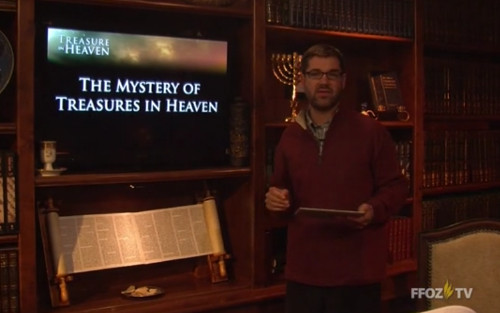
FFOZ TV episode 24Episode 24: What did Jesus mean when he told his disciples to store up treasures in Heaven? Episode twenty-four will take a look at the phrase “treasures in Heaven” through a Jewish lens. “In Heaven” in this phrase does not mean “in the sky” but rather “with God.” Jesus tells us that God rewards his children openly for what they do in secret. Viewers will learn that being disciples of Jesus means being a generous person, giving to the needy, doing the work of the kingdom, and not focusing on earthly gain.

-from the Introduction to FFOZ TV: The Promise of What is to Come
Episode 24: Treasure in Heaven (click this link to watch video, not the image above)

The Lesson: The Mystery of Treasure in Heaven

This episode went pretty much the way I expected with just a few small question marks. First Fruits of Zion (FFOZ) educators and authors Toby Janicki and Aaron Eby based today’s teaching on the following verses:

Do not store up for yourselves treasures on earth, where moths and rottenness consume them, and thieves break in and steal. But store up for yourselves treasures in heaven, where moths and rottenness do not consume them, and thieves do not break in and steal. For in the place where your treasure is, there your heart will be also.

Matthew 6:19-21 (DHE Gospels)

Toby asked about how one can actually store a treasure in Heaven? Is there some sort of cosmic retirement plan in the Afterlife? Is it possible to do something to store treasure in Heaven now so we’ll have it to spend after we die?

These seem like silly questions but throughout much of the episode, Toby kept returning to these points. I started to wonder what the traditional Christian teaching must be about this passage? Does the Church or some part of it believe that there is a literal treasure in Heaven that we get when we die?

For viewers who have been regularly watching this show, it should be apparent that the reference to “Heaven” doesn’t have to literally be the place where God lives. The Hebrew word for “Heaven” can also mean “sky”. However, given the general theme of this first season of the FFOZ TV show, “Heaven” is more likely being used as a circumlocution to avoid saying the most personal Name of God. For instance, the phrase “Kingdom of Heaven” actually means “Kingdom of God” as in the coming Messianic Era.

That would mean storing up “treasure in heaven” means something like storing up “treasure in the Messianic Kingdom.” But that’s still mysterious if you don’t understand certain Rabbinic concepts and idioms.

“So when you give to the poor, do not sound a trumpet before you, as the hypocrites do in the synagogues and in the streets, so that they may be honored by men. Truly I say to you, they have their reward in full. But when you give to the poor, do not let your left hand know what your right hand is doing, so that your giving will be in secret; and your Father who sees what is done in secret will reward you.”

Matthew 6:2-4 (NASB)

Toby JanickiThis should help provide clarity. Toby links “storing up treasure in heaven” to these earlier verses in the chapter. Jesus teaches a direct link between giving to charity in secret and being openly rewarded by God. This is also a Rabbinic concept, but one where Christianity treads lightly, since we are taught that salvation is a free gift and not tied to anything we can do, such as give to charity. Also, Isaiah 64:6 defines “righteous acts” as “filthy rags” so it would seem as if this interpretation of Jesus’ teaching contradicts not only older scripture but Christian doctrine as well.

We aren’t talking about “buying our way into Heaven” with our “filthy” righteous deeds, though. We are however, talking about a relationship between our giving to charity and some sort of reward from God. More specifically, we are talking about giving in secret, without using our “generosity” to draw attention to ourselves, and that is what God rewards openly.

As a side note, this makes me wonder why some churches today have listings on their walls or in some public document of the names of their larger contributors if Jesus taught to give in secret?

If you say, “See, we did not know this,”
Does He not consider it who weighs the hearts?
And does He not know it who keeps your soul?
And will He not render to man according to his work?

Proverbs 24:12 (NASB)

It looks like Jesus isn’t contradicting this older portion of scripture and in fact, he seems to be teaching the same lesson. “And will He not render to man according to his work?” So what we do here in this life does seem to matter to God and God responds to our actions by giving back to us in the manner we’ve given (or not given) to others.

This brings us to the first clue for this episode:

Clue 1: When Jesus tells us to “store up treasures in heaven,” he is not telling us to store up treasures in the Afterlife, but to store up credit with God.

Storing up “credit with God” still makes it sound like we’re opening up a credit line at the Bank of Heaven and then drawing against it, but that makes no sense at all. There’s got to be more to this lesson.

As it turns out, there is:

The lamp of the body is the eye, and if your eye is whole, your entire body will be illuminated. But if your eye is evil, your entire body will be darkened — and if the light within you is darkened, how great is the darkness.

A man is not able to serve two masters. For he will hate the one and love the other, or he will cling to one and despise the other. You are not able to serve both God and mamon.

Matthew 6:22-24 (DHE Gospels)

OK, maybe that didn’t clear everything up. To get a better handle on what Jesus is saying, the scene shifts to Aaron Eby in Israel for a Hebrew lesson on the term “the evil eye.”

So what is the “evil eye” and the “whole” or “good eye”? Aaron tells his audience that one interpretation of an “evil eye” is a description of what happens to a believer who looks at forbidden things. Another tells of a believer who is not spiritually perceptive. But in the overall context of these verses, which seem to be addressing money, that doesn’t make sense.
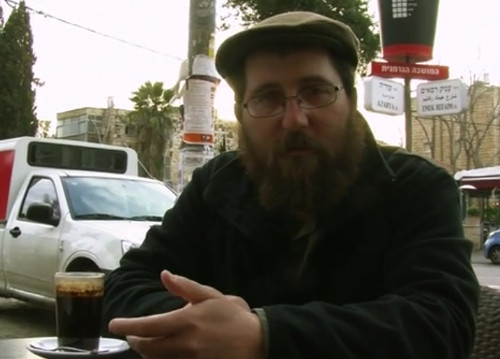
Aaron EbyAs it turns out, having an “evil eye” in Jewish idiom means being stingy. Also, the words translated as “whole eye” or “good eye,” given the idiomatic meaning being referenced, are better translated as “beautiful eye,” meaning generous. But how does it make sense that your “eye” can indicate stinginess or generosity? According to Aaron, it has to do with how you look at or perceive others. If you look at someone with good intent or in order to see the good in them, you are looking at them with a “beautiful” eye and are inclined to be generous toward them. However, if you look at people with poor intent or in a negative manner, you are inclined to be withholding from the needy and thus have an “evil” eye.

Returning to Toby in the studio, we come to the next clue:

Clue 2: Jesus’ words about storing up treasures with God are directly linked to “beautiful eye” and “evil eye.”

Now we seem to be zeroing in on the solution to today’s mystery. But if God rewards believers for giving generously and in secret to charity, what sort of reward is provided? Toby said that it is not along the lines of prosperity theology. It’s not a matter of giving large amounts of money to certain charities or churches in order to get back a boatload of cash in this world.

So what is the answer?

“For this reason I say to you, do not be worried about your life, as to what you will eat or what you will drink; nor for your body, as to what you will put on. Is not life more than food, and the body more than clothing? Look at the birds of the air, that they do not sow, nor reap nor gather into barns, and yet your heavenly Father feeds them. Are you not worth much more than they?

Do not worry then, saying, ‘What will we eat?’ or ‘What will we drink?’ or ‘What will we wear for clothing?’ For the Gentiles eagerly seek all these things; for your heavenly Father knows that you need all these things. But seek first His kingdom and His righteousness, and all these things will be added to you.

“So do not worry about tomorrow; for tomorrow will care for itself. Each day has enough trouble of its own.”

Matthew 6:25-26, 31-34 (NASB)

In a nutshell, this means that we shouldn’t worry about the basic necessities of life such as food, clothing, and shelter, because God knows we need these things and will provide. Instead of devoting our resources to accumulating material possessions, we should seek first the Messianic Kingdom, and “the basics” will take care of themselves.

By being generous, we come closer to entering the Kingdom of Heaven. Conversely, a stingy person is removed or retreating from entering the Messianic Kingdom.

This sort of reminds me of what I wrote about the FFOZ TV episode on The Golden Rule. How we treat others brings us closer or places us further away from entering the Messianic Kingdom. But as I said before, although we’re not talking about buying our way into Heaven, how can being generous or stingy admit or inhibit living in the Era of the Messiah?

Unless it’s somehow related to the lesson of the “sheep and goats” we find in Matthew 25:31-46, which is also talking about generosity and stinginess. Even a believer who is stingy or has exhibited the “evil eye” may be rejected by the King upon his return. What we do does matter. This reading of the Bible makes that inescapable, although it’s not always easy to understand.

The final clue is:

Clue 3: Storing treasure in heaven is the same as seeking the Kingdom of God.

It doesn’t mean that God will provide a one-to-one system of giving vs reward whereby if you give a certain amount to your church or to charity, that you’ll automatically get back the same or more than you “invested.” In fact, that sort of theology goes against what Jesus taught, since he commanded giving in secret, which at least implies the idea of giving generously with no thought of reward.

What Did I Learn?

I actually knew the vast majority of what was taught today, but some of what was said got me to thinking. As I see it (and this is just my opinion), by being generous in the here and now, we are somewhat foreshadowing the coming Messianic Kingdom, which will be characterized by kindness, generosity to all, and peace. Just as each weekly Shabbat is a foreshadow and a preview of the lasting Shabbat of Messiah, so too every mitzvah of giving we commit, each act of tzedakah, is a momentary snapshot of how all humanity will behave toward each other one day.

tzedakah-to-lifeI have a better “feeling” about this being part of the “reward” rather than necessarily admittance into or rejection from the Messianic Era, but as the passage from Matthew 25 indicates, there will be those believers who get in and those who are given the boot.

Also, as I said above, I don’t see any sort of formula being developed out of these scriptures and this lesson whereby the more you give, the more you get in cash or material goods. There have been far too many saints or tzaddikim who have lived and died in poverty, even though they were abundantly generous with whatever they had, to make me believe that giving to charity is some sort of insurance against poverty or some other bad things happening to me. “The Lord gives and the Lord takes. Blessed be the Name of the Lord” (Job 1:21). God does as He wills. Sometimes, even the most devout servants of God don’t have access to even the basics of food, water, clothing, or shelter, even though this seems to contradict the words of the Master.

But we don’t see this so much in the West because most of us can at least make ends meet if not live rather well, especially when compared to the kind of abject poverty we see in what we call “third-world countries.”

And He looked up and saw the rich putting their gifts into the treasury. And He saw a poor widow putting in two small copper coins. And He said, “Truly I say to you, this poor widow put in more than all of them; for they all out of their surplus put into the offering; but she out of her poverty put in all that she had to live on.”

Luke 21:1-4 (NASB)

I thought this deserved an honorable mention, since we are talking about giving generously. OK, so it’s not giving in secret if Jesus and his disciples can see how much everyone is giving, but we do see a woman living in great poverty, probably a state of lacking most of us have never experienced, giving all she had to live on for the sake of God and the Temple. I don’t think I could advise a person to do that, holding nothing back for themselves, but then again, maybe she was not worrying about her next meal, what clothes she was going to wear, or the place she was going to rest her head, just as Messiah taught.

It’s a hard lesson in this world of 401Ks, Medical Savings Accounts, and saving up to send the kids to college.

I seem to remember, probably from something Dave Ramsey said, that families should include charitable giving in their budgets in the same way as we budget for car repairs, groceries, clothing, and so on. This isn’t giving all we’ve got, but it is giving what we can if we are so inclined.

Only two more episodes in season one left to review.

The Mystery of Romans: Apostolic Decree and the Obedience of Faith

Apostolic DecreeIt is important to note that the major tenets of the decree were practiced by the early Christian gentiles for several centuries, although this fact is not considered by most scholars to demonstrate that Paul accepted or taught it in his gentile mission. Somehow it is assumed that Paul was generally unaware of the decree, or that if he was aware of it he did not accept it. Why has Christianity so overlooked this feature of Paul’s missionary teaching?

-Mark Nanos
“Chapter 4: The Apostolic Decree and the ‘Obedience of Faith,'” pp 201-2
The Mystery of Romans: The Jewish Context of Paul’s Letters

I’m finally able to get back to my series of reviews on this landmark book of Nanos’. I’m not going to pick through the entire chapter, but the section of Chapter 4 called “The Apostolic Decree and the Message of Romans” caught my attention. I’m rather interested in the legal decision of the Council of Apostles and Elders in Jerusalem (Acts 15) that established binding halachah on the Gentile disciples of the Jewish religious stream known as “the Way.” My opinion is that Paul very much had to know about this decree and certainly, if he considered himself under the authority of the Council, an authority established by Messiah, then agree or not, Paul had to accept it and even teach it.

And how could Paul not be aware of this decree?

Some men came down from Judea and began teaching the brethren, “Unless you are circumcised according to the custom of Moses, you cannot be saved.” And when Paul and Barnabas had great dissension and debate with them, the brethren determined that Paul and Barnabas and some others of them should go up to Jerusalem to the apostles and elders concerning this issue.

Acts 15:1-2 (NASB)

So Paul, Barnabas, and their Jewish opponents traveled to Jerusalem together to seek out the Council’s authority on the matter in dispute (whether or not Gentiles had to convert to Judaism and take on the full yoke of Torah as an obligation in order to enter into the Messianic religious order), which would include giving testimony and being present for the final verdict. I have no idea how any New Testament scholar could miss so obvious a passage of scripture.

As I did previously, I’m going to review my notes and “brain dump” the data here with just a bit of polishing. Hopefully, this will carry the meaning of this section of the chapter and my impressions of the information presented.

In stark contrast to this consensus, however, I see the apostolic decree operating in the background of Paul’s bold “reminder” to Rome. In addition to his clear agenda to explain the new status of the gentile believing in Jesus Christ as equal, though governed by the principles of behavior outlined for the “righteous gentile” in the Council’s apostolic decree, several specific references suggest that his addressees share with Paul the knowledge of the decree in its original, though certainly fluid format. We have seen how central the issue of accommodating the dietary concerns of the “weak” were in order to win them to faith in Christ. Further, I find traces in the formal feature of the opening and closing of the letter, in the rhetorical structure, and in several key phrases and concepts that Romans is actually Paul’s exposition, by way of reminder, of the apostolic decree in view of his intended visit, and yet necessary delay.

-Nanos, pp 206-7

My commentary on Chapter 3 mentioned that the “reminder” was Paul to the Gentile believers in Rome, reasserting the form and function of the Gentile’s role in “the Way” in relation to the Jewish believers in specific and Jewish people in general. The “weak” were not the Jewish believers who felt they had to continue observing the Torah mitzvoth as opposed to accepting the grace of Christ, but rather the Jewish non-believers who were struggling with accepting faith in Yeshua as Messiah. A large part of the apostolic decree was designed to allow a basic relationship between the believing Gentiles and Jewish people. The so-called “strong” were over-emphasizing their “freedom” from Torah at the expense of the Jewish non-believers they associated with in the synagogue, damaging the reputation of Messiah and “the Way” as a Judaism.

King Priest TorahWe see from the general message in Galatians that Paul did not support Gentile conversion to Judaism as a requirement for justification before God, and that he stated point-blank that if the Gentiles were to allow themselves to be circumcised and convert, they would be obligated to the full yoke of the Torah, and the sacrifice of Messiah would become useless (Galatians 5:1-2). Applying that to Romans, Paul knew that the Gentiles were not obligated to the Torah in the manner of the Jews and also knew that the apostolic decree established an alternate set of behavioral constraints and requirements that defined the role of the Gentile disciple, not only in relation to God, but to the Jewish people as well.

He is responsible for the “obedience of the Gentiles” that results from his apostolic preaching of the gospel (15:18-19, 20ff.) and he will not be satisfied with the situation in Rome until he has arrived to fulfill this obligation (1:14-15)…

Within this context, Paul is expecting the “obedience of the Gentiles” to conform to the apostolic decree for the sake of the unbelieving Jews that they may not be further alienated from Messiah, but drawn nearer. It was within the power of the Gentiles in Rome to “thumb their noses” as it were to the Jewish people, but that would result in pushing Jews who were already doubtful that the crucified Rabbi from Nazareth was the Messiah into complete rejection.

The key statement in this part of Chapter 4 is this:

It is Paul’s hope that the Romans will receive him and his message of their obligations with respect to the decree in the same positive way as we find Luke describes (Acts 15:30-31) Paul’s earlier missionary reception. For the decree was not an unwelcome burden, but a powerful declaration of the inclusion of gentiles as equals, by faith and without becoming Jews, in the people of God. It was a sign of the fulfillment of the eschatological promise of the blessings for all the world in Israel’s Christ. And it was understood to be a minimal demonstration of appropriate purity behavior for association with the Jewish community (Israel, the historical people of God), on the part of the gentiles who maintained they had become equal coparticipants in the promised blessings. Indeed, it bore witness to their indebtedness to Israel for her present suffering on their behalf.

-Nanos, pg 211

The apostolic decree was the minimum set of standards required of the Gentiles to honor their indebtedness to the Jewish people and Israel as a whole for the realized blessings that resulted in Gentiles being equal coparticipants in salvation and reconciliation with God without having to be circumcised (convert) and be obligated to the full Torah.

My understanding is that the Gentiles could accept more than the minimum requirements up to and including the full “yoke of the Lord,” but this was entirely voluntary. In Paul’s letter to the Romans, we see the opposite happening. The Gentile believers in Paul’s readership were not even achieving the minimums set out in the apostolic decree and failing to acknowledge the Jewish people as the source of the blessings they were so comfortably operating within.

Gentile obedience to the decrees of the Council would result in the proper display of the relationship between non-Jewish believers and the general Jewish community, and disobedience sacrifices the “weak” among the Jews in the Roman synagogue to a failure of faith in Messiah.

I find an interesting parallel in Paul’s writing in how the Church approaches the Jewish people today. Christianity in the modern era also flaunts its “freedom” to the Jews and conversely denigrates the Torah, claiming that Jews are now “free from the Law” as if that would be some great relief to Jewish people. Gentile Christians would blithely eliminate the Torah from the lives of Jewish converts to Christianity, ignoring the destruction of Jewish identity and ultimately the Jewish people as a separated and called out nation before God.

Today, we “gentilize” the Jews as well as the modern incarnation of Jewish religion of “the Way” (i.e. “the Church) in the same manner as the Gentiles Paul was addressing in Rome. We in the Church are just as disobedient to the binding decrees of those whom Jesus assigned authority to as were the Roman Christians in Paul’s letter. Granted, much has changed since the apostolic era, and the body of Christ is totally separated from its “Jewish roots,” but that condition is not permanent.

The programmatic “obedience of faith” echoes the spirit of the Jerusalem Council’s intentions in setting forth the need for the Christian gentiles of Rome to obey the particulars outlined in the apostolic decree. Paul was concerned to remind them boldly of proper monotheistic behavior for “righteous gentiles” in their association with non-Christian Jews, and specifically halakhic matters of dietary and sexual conduct (12:1-15:3).

…Whatever grammatical construct one might prefer, the “obedience of faith” articulated Paul’s uncompromising commitment to the deeper intentions of the Shema, embracing both the election of Israel and the inclusion of gentiles equally — for God is One! The contours of Paul’s argument have been overlooked because interpreters have misunderstood his focus on gentile inclusion through faith alone, ostensibly dismissing Torah obedience as obsolete. However, if we recognize that Paul was addressing Christian gentiles tempted to consider themselves as having supplanted Israel and thus no longer obligated to obey “the teaching” of the apostolic decree (for why would they need to be concerned with the “acceptance” of the “stumbling” of Israel and their “opinions” of the proper purity behavior for “righteous gentiles”; if Israel had been cut off they are free to eat all things!), then we can readily follow Paul’s nuanced discussion of circumcision and Torah.

-Nanos, pp 237-8

going-to-church-sketchesGentiles who consider themselves as having supplanted the Jewish people in the blessings of God due to their faith in Messiah do not enhance Jewish desire to approach Messiah-faith, but inhibit it. By considering the apostolic authority to bind the Gentile disciples to a set of principles as obsolete, along with the Torah, these Roman Gentile Christians were sowing the first seeds of dissention that would eventually lead to complete restructuring of “the Way” from one Jewish religious stream among several in the late Second Temple period, to a completely separate Gentile religion in the first decades of the common era, totally divorced from its origins and its apostolic Jewish mentors.

And “the Church” hasn’t stopped being disobedient yet. In fact, we’ve compounded the problem by insisting that the only proper response to the Jewish Messiah for a Jew is to abandon the Torah, abandon Judaism, and abandon being a Jew, convert to being a Gentile, and to also thumb their noses at the eternal relationship between God and Israel.

The Children of Israel shall observe the Sabbath, to make the Sabbath an eternal covenant for their generations. Between Me and the Children of Israel it is a sign forever that in a six-day period Hashem made heaven and earth, and on the seventh day He rested and was refreshed.

Exodus 31:16-17 (Stone Edition Tanakh)

Thus says the Lord,
Who gives the sun for light by day
And the fixed order of the moon and the stars for light by night,
Who stirs up the sea so that its waves roar;
The Lord of hosts is His name:

“If this fixed order departs
From before Me,” declares the Lord,
“Then the offspring of Israel also will cease
From being a nation before Me forever.”

Thus says the Lord,

“If the heavens above can be measured
And the foundations of the earth searched out below,
Then I will also cast off all the offspring of Israel
For all that they have done,” declares the Lord

Jeremiah 31:35-37 (NASB)

No amount of exegetical “tweaking” of the Bible can delete God’s promises of an eternal relationship with Israel, the Jewish people. Reading Paul as is done traditionally in Christianity requires a great deal of “retrofitting” of the older texts to somehow make God seem to be saying the exact opposite of what we read in Exodus 31 and Jeremiah 31. Mark Nanos and other New Testament scholars like him are boldly forging ahead into territory that restores the “Judaism” back to the Jewish text of the Bible. Paul is not praising the Gentiles for their “lawlessness” and castigating the believing Jews for their continued “addiction” to the Torah. Quite the opposite.

In this chapter, we see Paul continuing to urge the Gentile believers to cleave to the “obedience of faith,” the standards established by the Council in Jerusalem, for the sake of the Jewish people, particularly those Paul was desperate to have come to faith in Messiah.

Mark NanosI can only hope that books like The Mystery of Romans and ministries such as First Fruits of Zion (FFOZ) will eventually, and by the will and grace of God, restore the balance, even as Paul was attempting to restore the balance between the Gentile believers and the Jews in Rome. Paul’s efforts ultimately failed, as I think he suspected they would, but as the time of the Messiah’s return approaches, the Spirit is helping us to get out the message of restoration and renewal as God originally planned. Much has been lost to the believers in Jesus over these last twenty centuries. I believe that the time has come for us to take it back.

I hope to continue with my review of the Nanos book soon.

Vayechi: The King’s Scepter

LionLast week I shared with you four Torah prophecies charting Jewish history: 1) that the Jewish people will be eternal though 2) we will be few in number and 3) scattered to the four corners of the earth and that 4) the host nations were ultimately inhospitable to us. This week, 2 more prophecies!

One would think, if the Jewish people were so reviled to be persecuted and killed, that we would have little impact upon those nations persecuting and killing us. Yet, the Torah prophesies that we will be…

-Rabbi Kalman Packouz
“Shabbat Shalom Weekly”
Commentary on Torah Portion Vayechi
Aish.com

You may be wondering what this has to do with this week’s Torah portion, with the blessings Jacob confers on his children and his grandchildren and his subsequent death, or with the burial of Jacob in Canaan, or with the death of Joseph and the end of the book of Genesis. Consider the following:

The scepter shall not depart from Judah, nor the ruler’s staff from between his feet; so that tribute shall come to him and the homage of peoples be his.

He tethers his ass to a vine, his ass’s foal to a choice vine; he washes his garment in wine, his robe in blood of grapes. His eyes are darker than wine; his teeth are whiter than milk.

Genesis 49:10-12 (JPS Tanakh)

These are the blessings Jacob set upon Judah before Jacob’s death. From a Christian standpoint, we see an obvious image of the Messiah, of Jesus in this blessing.

But now we have to find the connection I’m making between Rabbi Packouz’s commentary and the Torah reading:

“I will make you into a great nation. I will bless you and make your name great. You shall become a blessing. And I will bless those who bless you, and curse those who curse you. Through you all the communities of the earth shall be blessed” (Genesis 12:2-3). The prophet Isaiah (42:6) states, “I, the Lord, have called you in righteousness, and will hold your hand and keep you. And I will establish you as a covenant of the people, for a light unto the nations.”

Which, of course, reminds Christians of this:

Then Jesus again spoke to them, saying, “I am the Light of the world; he who follows Me will not walk in the darkness, but will have the Light of life.”

John 8:12 (NASB)

Immediately after the Master said these words, the Pharisees he was speaking to objected and accused him of false testimony. These men could not have failed to recall the prophecy of Isaiah that it was Israel who was the light to the nations. How could this one man claim to be such a thing, to represent all of Israel as it were, unless he were their King?

Interestingly enough, Rabbi Packouz referenced Genesis 12:2-3 which ends with, “through you all the communities of the earth shall be blessed.” All the nations of the earth are blessed through Abraham’s seed, through Messiah (Galatians 3:16), through the light to the nations, the firstborn son of Israel.

And so Jacob passed on the blessings to his sons, including the Messianic blessing onto Judah, the scepter shall not depart from Judah, nor the ruler’s staff from between his feet.” Judah’s descendant is Messiah, the ruler, the King, the light, and as he was born into humility as Yeshua ben Yosef, he will return in power and might as Yeshua ben David, and ascend the throne of David in Jerusalem, and rule with justice and with peace over his people Israel, and over the entire population of the world.

In next week’s “Shabbat Shalom Weekly,” Rabbi Packouz will finish his series with “the final prophecy — the return from Exile — and what does it all mean.”

As you might have guessed, today’s Torah commentary is an extension of the one I wrote last week, the “cautionary tale” to the Christian Church to not take the ancient Messianic Jewish prophecies too lightly, and especially not to refactor them in such a way that favors the Gentile Christians over God’s chosen people and nation.

Many peoples and strong nations shall come to seek the Lord of hosts in Jerusalem and to entreat the favor of the Lord. Thus says the Lord of hosts: In those days ten men from the nations of every tongue shall take hold of the robe of a Jew, saying, ‘Let us go with you, for we have heard that God is with you.’”

Zechariah 8:22-23 (ESV)

up_to_jerusalemFirst Fruits of Zion (FFOZ) author and teacher Toby Janicki, in the episode Fringes of the Garment of the television series The Promise of What is to Come said that the Jewish man in question is the Messiah, as he interprets this verse.

Toby further said that those ten men from the nations were not just a random group of non-believing Gentiles, but are Gentile believers from “the Church” who, in my estimation, must recognize the Savior as the Jewish Messiah King, fully the King of Israel and the Jewish people, and that grasping his tzitzit, as it were, is a recognition of that fact, a representation of the profound paradigm shift required by Christians in order to even recognize Yeshua ben David as our “Jesus,” and the desperate attempt to heal the tremendous wound that separates Christianity from the Jewish Messiah.

If Toby’s interpretation of Zechariah is correct, and my interpretation of Toby is correct, then many in the Church today are laboring under a needless burden placed upon our shoulders by a long history of misunderstanding, anti-Semitism, and supersessionism. Much was lost after the apostolic era ended and the Gentile majority of the Messianic followers took over and reformed the “Church of Christ.” We have a lot of work to do to repair the damage and prepare the road for the return of the King.

But why wait for Messiah to return to take hold of his tzitzit? Let’s do it now by humbling ourselves before the King and studying his ways as expressed through the Jewish prophets and the Jewish apostles.

For from Zion shall come forth the Torah…

Isaiah 2:3

Salvation is from the Jews.

John 4:22

For Moses from ancient generations has in every city those who preach him, since he is read in the synagogues every Sabbath.

Acts 15:21

Come, let us go up to the mountain of Hashem, and to the house of the God of Jacob.

Peace and Good Shabbos.

Why the Jews in Thessalonica Were Jealous of Paul

Apostle Paul preachingThink of Paul in a city like Pisidian Antioch or Thessalonica. He goes into the synagogue where he speaks to a mixed audience of Jews and Gentiles. What? Jews and Gentiles? You bet. The synagogues of the first century had something in common with modern Messianic Jewish congregations. (No, I don’t mean they played Paul Wilbur songs, I mean there was a significant Gentile presence in the Jewish service).

Paul spoke to the “men of Israel” (Jews) and “you who fear God” (Gentiles) and “sons of the family of Abraham” (converts to Judaism, a.k.a. proselytes, no longer counted as Gentiles). Typically the God-fearing Gentiles were so ready for a message that would bring them closer to God and Paul’s news was well-received as God hearing their prayers at last.

-Derek Leman
“Paul Was Too Jewish for the Synagogue, Part 1”
AncientBible.net

I don’t really need another blog to follow, but Derek does mention AncientBible.net on his own blog from time to time, so I peeked in. And, of course, the title of his blog post was too interesting to resist.

Then I started reading what he wrote and it reminded me of my own recent church experience:

So when the question about “the jealousy of the Jews” came up and teacher said this caused “the Jews” to reject Paul’s message about Christ, I piped up and said, “Not all the Jews.” And things went downhill from there.

Even accepting that it was the Jewish leadership of the synagogue and not every individual Jewish person in attendance, one woman in class said that the leadership represented the people, pretty much painting all “the Jews” with a broad brush. Actually, I was thinking of the synagogue in Berea but I figured that I’d missed my window of opportunity in explaining my point and wasn’t going to get another one…that is unless I wanted to start a riot.

I’m not worried that my exposure to traditional Christian doctrine at church is going to change or warp my current opinions, but it was nice to read Derek’s blog post and see that New Testament scholars are discussing these issues and coming to conclusions that are similar to my own.

The genesis of this post was an unexpected adventure at SBL (Society of Biblical Literature) in November in Baltimore. My young friend, David Matthews, and I were there catching all the papers we could in our main fields of interest (his = the Temple, mine = Isaiah). But we couldn’t resist a few “Paul and Judaism” sessions. And one of them was like a Rock Festival of Pure Pauline Goodness . . . an unbelievable chance to hear Paula Fredriksen, Mark Nanos, Magnus Zetterholm, and Pamela Eisenbaum all in one room. It was one of the larger session rooms at SBL, probably with room for 400 people, and it was standing room only.

I know you don’t have to be impressed and certainly I’d like to explore the materials of Fredriksen et al in more detail (although I am reading Nanos’ book The Mystery of Romans right now), but it’s nice to know that “little ol’ me” in Southwestern Idaho isn’t completely off base. It’s easy to get that feeling when you’re the only one in your church who has such “goofy ideas” as Paul being “too Jewish” for the diaspora synagogues.

What is the biggest difference between Paul’s approach with Gentiles and the liberal, laid-back approach of the synagogues? Paul demands that Gentiles who enter into the congregation of Messiah Yeshua should abandon all honor to the gods. These are the last days. The Name of God will be one and the Lord will be king over all the earth (Zech 14:9). The Gentiles will be called by his Name (Amos 9:12). It is time to go up to the mountain of the house of the Lord and learn his ways (Isa 2:2-4). The eschaton (next age) is about to come with Yeshua’s return as the Divine Messiah who brings it all to pass.

CohenI had actually read (I think in Cohen’s From the Maccabees to the Mishnah) that the Gentile God-fearers in the late Second Temple era synagogues may not have entirely abandoned their devotion to the other “gods” in Greek and Roman culture. It presents them in a different light and maybe not as divorced from their pagan worshipping peers as is otherwise believed.

But Paul’s gospel was a kind of conversion, not making Gentiles into Jews, but bringing Gentiles into the covenant promises of Abraham, as citizens of Greater Israel but not Israelites, branches grafted into the Israel tree. And these Gentiles did not have to have their foreskins cut off, but they had to do something much harder — reject the family and city gods and become non-Romans.

This gives new meaning to the words of the Master:

“Do not think that I came to bring peace on the earth; I did not come to bring peace, but a sword. For I came to set a man against his father, and a daughter against her mother, and a daughter-in-law against her mother-in-law; and a man’s enemies will be the members of his household.

Matthew 10:34-36 (NASB)

Since Jesus’ audience at that moment was Jewish, it’s easy to get the impression that he was only saying that believing (in Messiah) Jews would be rejected by their unbelieving (but still faithful to God) Jewish relatives, but when applied to what Derek wrote, the meaning expands to the experience of diaspora Gentile believers as well.

You see, Paul was too Jewish for the synagogue. He turned the world upside down. And he scared the be-Jesus out of the synagogues. Their liberal status-quo with Gentile adherents to the God of Israel had been working. They were good neighbors with the Greco-Roman city. But this crazy, end-times zealot who demanded that Gentiles forsake the city gods and worship one Lord other than Caesar, well, he was going to get the Jews in trouble by making them seem like bad neighbors. And Jewish blood would be spilt. Couldn’t Paul just be a little less like a Pharisee with his zeal for Torah and prophets?

Now let’s go back to the “problem text” I encountered last Sunday:

Now when they had traveled through Amphipolis and Apollonia, they came to Thessalonica, where there was a synagogue of the Jews. And according to Paul’s custom, he went to them, and for three Sabbaths reasoned with them from the Scriptures, explaining and giving evidence that the Christ had to suffer and rise again from the dead, and saying, “This Jesus whom I am proclaiming to you is the Christ.” And some of them were persuaded and joined Paul and Silas, along with a large number of the God-fearing Greeks and a number of the leading women. But the Jews, becoming jealous and taking along some wicked men from the market place, formed a mob and set the city in an uproar; and attacking the house of Jason, they were seeking to bring them out to the people.

Acts 17:1-5 (NASB)

And now, filter that through the paragraph of Derek’s I quoted just above. What were “the Jews” becoming jealous of? Could it be that they were jealous, not just out of concern that too many pagan Gentiles were invading Jewish religious space, but because Paul and his radical teaching of Messiah which included a more strict and absolute rejection of the pagan gods in the diaspora, was rattling too many cages and upsetting the status quo?

When they did not find them, they began dragging Jason and some brethren before the city authorities, shouting, “These men who have upset the world have come here also; and Jason has welcomed them, and they all act contrary to the decrees of Caesar, saying that there is another king, Jesus.” hey stirred up the crowd and the city authorities who heard these things. And when they had received a pledge from Jason and the others, they released them.

Acts 17:6-9 (NASB)

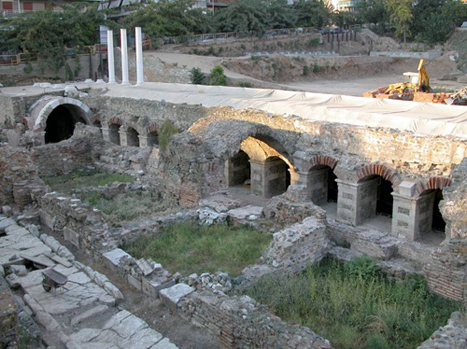
ThessalonicaViewing Acts 17 through the handy filter provided by Derek (and thanks to Paula Fredriksen, Mark Nanos, Magnus Zetterholm, Pamela Eisenbaum, and their presentation on Paul), the blurry, fuzziness of the image of the Jewish leadership of the synagogue in Thessalonica (that you see in Church teachings) and the motives for their jealousy comes into sharp focus.

Of course, this is just one short blog post and a very brief summary of what must have been a very rich and densely packed SBL conference session presented by some of the world’s most outstanding experts on Paul. How much can we read into it?

On the other hand, it’s also adding a link to an ever-strengthening chain of evidence that re-frames Paul as zealous for the Torah, zealous for the Messiah, and uncompromising in his devotion to God as a Jew. A man and a Jewish apostle who demanded no less of others what he expected from himself, especially in the rejection of any compromise with pagan gods and the lifestyle surrounding them.

No wonder Paul was always being beaten, jailed, and thrown out of town by both the Jewish and Roman establishments.

Looking forward to Part 2 of this series written by David Matthews.

Snow and Shabbos

shoveling-snowMaimonidies explains our midrash by reference to the related instance of rabbinic religious psychology: “God’s presence is never felt in a state of sadness or lethargy or levity or conversation or distractedness, but only amid the joy of performing a mitzvah.”

-Ismar Schorsch
quoting Bavli Shabbat 30b.
“The Seedbed of Prophecy,” pg 165 (December 21, 1996)
Commentary on Torah Portion Vayigash
Canon Without Closure: Torah Commentaries

I read this on Shabbat after shoveling snow off of my driveway and sidewalk. Actually, I also shoveled the snow off of the sidewalks of my two next door neighbors. It was a mitzvah of a sort. I try to do a little more than required because I know it’s the right thing to do. I think it’s something God built into me for some reason.

But I was performing one mitzvah (I don’t think the Bible says to specifically shovel your neighbor’s sidewalk, but it does say to love your neighbor, so I figure helping them with shoveling snow qualifies as “love”) but I was breaking another, well, sort of. It depends on whether or not you believe that non-Jewish believers are obligated to observe Shabbos in the manner of the Jews. I know that the Didache, an early document dated to the second or even first centuries and purportedly used to train new Gentile disciples of the Jewish Messiah entering the Jewish religious stream of “the Way,” states that even a Gentile may keep the entire “yoke of the Lord” (i.e. Torah commandments) if they (we) are able, but if not, to keep what we can, so keeping the Sabbath in some manner is on my radar screen as an option.

On the other hand, the two Jewish members of my household (and the other two Jewish family members who have their own households) don’t observe Shabbos, though I believe they are obligated to do so.

But I’m not the religious police. Each person must negotiate their own relationship with God. Past efforts of mine suggesting to my family that they take a more observant path have resulted in a rebuke and a reminder that they themselves must make those sorts of decisions.

And so they must. My remaining option for the sake of peace in the family is to pray and to rely on God to lead His own back to Him, even as Messiah will lead all the Jewish exiles back to redemption in the Land of Israel.

In reading the quote from Schorsch (and Maimonidies), I tried to recall if I felt joy when shoveling snow and if I felt the Presence of God. I have to admit that I didn’t experience either state. There was a sense of satisfaction at the realization that I was exceeding my property lines and doing what wasn’t expected of me, but I can’t say I had any sort of religious revelation. I don’t think living a life before God or doing the right thing is magic. I think it’s just what we’re supposed to do.

I also believe that no one “does it” perfectly, and I’m a living example of that.

If anything, I have a greater sense of the presence of God when I reading the Bible, when I’m studying the Torah Portion, when I’m contemplating a Psalm, even when I’m writing a blog post about God and the mitzvot.

I know people (online) who do a much better job at observing Shabbos. Some of them live in places like Colorado and Wisconsin, places that get a lot of snow. What do they do on the Shabbat when it’s snowing, just let it sit on their driveways and sidewalks?

I live in a suburban neighborhood that has a homeowner’s association (whether I like it or not) and the association has a covenant which states that each homeowner is responsible for keeping the sidewalks in front of their homes free (reasonably) of snow. We are also legally responsible if we fail to do so and a pedestrian falls and is injured as a result. So I have a duty to protect my neighbors by keeping my sidewalks clean, even on the Shabbat.

I know some people who would be rather rigid and dictatorial about such a suggestion, saying God’s commandment to observe Shabbat trumps any law or other responsibility assigned by human beings, but let’s look at that. I have a duty to love my neighbors which could be interpreted as protecting them from harm. I know there’s a Torah commandment that specifies if you see someone drowning in a body of water and you do nothing to help save their life, you have sinned against that person and against God (Rabbinic interpretation does say however, that if you are a poor swimmer and would be likely to drown too, you are absolved of this responsibility).

So what’s the higher duty, to perform an act on the Shabbat that at least in potential, could prevent a neighbor from being harmed, or to observe the Shabbat and ignore my neighbors by playing the “I’m keeping the Shabbat, look at how holy I am” card?

It’s an interesting question.

Of course, returning to my lack of actual obligation to observe a strict Shabbat, at least in the present age, I am not in quite the same bind as a Jewish person. I also believe the commandment to love one’s neighbor is universal, particularly since we see it occurring not only in Leviticus 19:18, but issuing from the mouth of Jesus (see Matthew 22:39, Mark 12:31).

I know there is a part of Shabbat observance that is also universal, since such observance acknowledges God’s Creative Sovereignty, but I will have to be satisfied with acknowledging God’s creation of human beings by doing something, even on Shabbat, that is of service to some of those “creations.”

I try to spend most of my Saturdays in prayer, in study, in recording my contemplations on God, but it’s not perfect. In fact, it’s very far from perfect. But what I desire and am unable to accomplish today, may God grant me a life in the world to come where I may observe His peace and His perfection.

And as I write this, it’s still snowing outside.

What I Learned in Church Today: The Jealous Thessalonian Jews

zealous-torah-studyThe brethren immediately sent Paul and Silas away by night to Berea, and when they arrived, they went into the synagogue of the Jews. Now these were more noble-minded than those in Thessalonica, for they received the word with great eagerness, examining the Scriptures daily to see whether these things were so. Therefore many of them believed, along with a number of prominent Greek women and men. But when the Jews of Thessalonica found out that the word of God had been proclaimed by Paul in Berea also, they came there as well, agitating and stirring up the crowds. Then immediately the brethren sent Paul out to go as far as the sea; and Silas and Timothy remained there. Now those who escorted Paul brought him as far as Athens; and receiving a command for Silas and Timothy to come to him as soon as possible, they left.

Acts 17:10-15 (NASB)

This was the topic of today’s sermon and Sunday School class teaching. I thought it would be a nice, friendly, benign topic, and the Sunday School teacher is very supportive of Jewish people and Israel. But then, when reviewing the notes teacher sent me for class, I saw this question:

In verse 13 of Acts 17 we see that the jealousy (emph. mine) of the Jews in Thessalonica continued to boil over into trying to destroy the work of God in Berea also. Can and do Christians today oppose the work of God? How?

That’s a loaded question but before continuing, let’s take a look at the “jealousy” of the Thessalonian Jews.

Now when they had traveled through Amphipolis and Apollonia, they came to Thessalonica, where there was a synagogue of the Jews. And according to Paul’s custom, he went to them, and for three Sabbaths reasoned with them from the Scriptures, explaining and giving evidence that the Christ had to suffer and rise again from the dead, and saying, “This Jesus whom I am proclaiming to you is the Christ.” And some of them were persuaded and joined Paul and Silas, along with a large number of the God-fearing Greeks and a number of the leading women. But the Jews, becoming jealous (emph. mine) and taking along some wicked men from the market place, formed a mob and set the city in an uproar; and attacking the house of Jason, they were seeking to bring them out to the people.

Acts 17:1-5 (NASB)

The question is, why did “the Jews” become jealous in the first place? Jealous of what? I remember the question was covered by First Fruits of Zion (FFOZ) author and scholar D. Thomas Lancaster in the Torah Club series, Volume 6: Chronicles of the Apostles. In fact, this type of jealousy was first observed by Paul in the synagogue in Pisidian Antioch (Acts 13) when he was evicted, not because of his declaration that Yeshua was Moshiach, but because his sermon on one Shabbat brought a huge number of pagan Gentiles into shul on the following Shabbat. The Jewish leadership was “jealous,” not because Paul brought in record numbers of people, but because record numbers of pagan Gentiles were invading their religious space…all because of Paul and his “inclusive” teachings.

I confirmed this by looking at Lancaster’s commentary on Acts 17. Lancaster referenced the following to support his opinion:

… who both killed the Lord Jesus and the prophets, and drove us out. They are not pleasing to God, but hostile to all men, hindering us from speaking to the Gentiles (emph. mine) so that they may be saved; with the result that they always fill up the measure of their sins. But wrath has come upon them to the utmost.

1 Thessalonians 2:15-16 (NASB)

BereansWe see in Acts 17:2 that Paul had been preaching in the Thessalonian synagogue for three Shabbats, so it couldn’t have been that his message about Messiah was immediately offensive. We do see that some of the Jewish people were persuaded along with “a large number of the God-fearing Greeks and a number of the leading women” (Acts 17:4). That in and of itself might have been the problem if the “God-fearing Greeks” and “leading (Greek) women” were bringing in large numbers of their friends, relatives, and business associates who regularly patronized pagan temples. The Jewish leadership of the synagogue probably felt threatened and outraged and finally (and wrongly) staged a violent upheaval to attack Jason, who had been hosting Paul and his party, forcing Paul and his companions to flee into the night.

I was somewhat heartened when the teacher asked the question about God’s purpose for the Jewish people. Well, not his question, since that could go either way, but his answer:

I am telling the truth in Christ, I am not lying, my conscience testifies with me in the Holy Spirit, that I have great sorrow and unceasing grief in my heart. For I could wish that I myself were accursed, separated from Christ for the sake of my brethren, my kinsmen according to the flesh, who are Israelites, to whom belongs the adoption as sons, and the glory and the covenants and the giving of the Law and the temple service and the promises, whose are the fathers, and from whom is the Christ according to the flesh, who is over all, God blessed forever. Amen.

Romans 9:1-5 (NASB)

So when the question about “the jealousy of the Jews” came up and teacher said this caused “the Jews” to reject Paul’s message about Christ, I piped up and said, “Not all the Jews.” And things went downhill from there.

Even accepting that it was the Jewish leadership of the synagogue and not every individual Jewish person in attendance, one woman in class said that the leadership represented the people, pretty much painting all “the Jews” with a broad brush. Actually, I was thinking of the synagogue in Berea but I figured that I’d missed my window of opportunity in explaining my point and wasn’t going to get another one…that is unless I wanted to start a riot.

I thought about answering the question, “Can and do Christians today oppose the work of God? How?” but I didn’t think it would go over very well. The class ended up answering that question by talking about Strange Fire and got into how Christian apathy is a big problem, how we gave up “school prayer” but the Muslims haven’t caved in as we did, and so on.

I did actually learn something though. If the Thessalonian synagogue leaders became jealous because of the vast number of pagan Greeks Paul attracted into their space, why didn’t this happen in the Berean synagogue? Paul’s message was the same and neither group objected to a visiting Rabbi sharing his theological opinion about Moshiach (even if they didn’t agree necessarily) so the issue could have been Gentile inclusion.

Let’s compare two verses about these two synagogues:

And some of them were persuaded and joined Paul and Silas, along with a large number of the God-fearing Greeks and a number of the leading women. But the Jews, becoming jealous and taking along some wicked men from the market place, formed a mob…

Acts 17:5-6 (NASB)

Now these were more noble-minded than those in Thessalonica, for they received the word with great eagerness, examining the Scriptures daily to see whether these things were so. Therefore many of them believed, along with a number of prominent Greek women and men.

Acts 17:11-12 (NASB)

In both examples, we see a population of Jews along with Greek men and prominent Greek women, so it looks like the base population of both synagogues is very similar (to the best of our ability to discern given the brevity of detail). I learned that Berea was off the beaten path, so to speak, which was probably a good place to hide out from the Thessalonians, some forty or fifty miles away from the scene of Paul’s previous troubles.

churchesThere could have been something different about the general population of Berea. Maybe not as many pagan Greeks were attracted to the message of the Jewish Messiah King. Maybe the Jews in Berea had a better relationship with or at least didn’t mind the general non-Jewish people of their small town so much. Maybe being more “noble-minded” means that these Jews were more accepting of Gentile inclusion in a Jewish religious space, especially since they diligently searched the Tanakh (Old Testament scriptures) and possibly discovered scriptural evidence supporting such inclusiveness.

I had never considered any of that before, so I’m indebted to today’s Sunday School class for inspiring these thoughts.

I know a large part of Boaz Michael’s book Tent of David is the message of healing relationships between more “Hebraically-minded” Christians like me and the normative Church. Part of this process is to have folks like me me make a traditional Christian venue my “church home.” I get to see the positives of how church really does “teach Torah” and I get to share something of my pro-Judaic views on the Bible.

My Sunday School class identified one of the big problems in the Church as apathy, especially with people who were raised in the Church. People take hearing and reading the Word for granted. They go with the flow. They don’t let themselves be engaged by the Bible, either in hearing or reading. They don’t kick up a fuss when the rights of Christians are surrendered by Christians who don’t want to make waves in the larger secular society (which is probably why liberal churches are popular at the moment).

I agree that “going with the flow” can lead to large problems, but the “flow” I have a problem with, even among Christians who are generally pro-Jewish people and pro-Israel (but not necessarily pro-Judaism) is the difficulty in entertaining even a slight deviation from their general assumptions about “the Jews” they read about in Acts or in Paul’s epistles.

If I’m going to make an impression, I have to speak up, but if I speak up too much, I’ll make the wrong impression. I kept silent for the most part in class except for a few words here and there, but I could have literally taken over class with all that was bubbling between my ears.

preachPastor’s Ph.D program has expository preaching as an emphasis (and I notice from this reference that the “practice originated from the Jewish tradition of the rabbi giving a ‘Dvar Torah’, explaining a passage from the Torah, during the prayer services”. Pastor encouraged us from the pulpit to engage in “expository listening” which generally means actively engaging God’s Word, allowing it to be applied and integrated into our lives, and then responding out of that application.

But that probably also means generally agreeing with the rest of the people in church, sharing only very small differences of opinion.

I really wanted to ask what the Thessalonians were jealous of in Sunday School class, but I knew if I did, it wouldn’t end well. I’m grateful for what I did learn in class today but unfortunately, as much as I like and admire the teacher (and he is a wonderful person and even a tzaddik), it wasn’t what he was actually teaching.

Addendum, 12-9-2013, Monday: I just read a blog post at a place called AncientBible.net called Paul Was Too Jewish for the Synagogue, Part 1 written by Derek Leman. It makes several points that speak to this particular “meditation” of mine, so I thought I’d include it here.