Tag Archives: Judaism

Terumah: Why Do You Do Good?

menorah“Take for Me an offering from everyone whose heart impels him to give.”

Exodus 25:2

Rashi, the great commentator, tells us that “Take for Me” means that all donations for the Tabernacle should be given for the sake of the Almighty. The question: What difference does it make what a person’s intentions are as long as he does a good deed?

Rabbi Yehuda Leib Chasman clarifies the role of intentions with an illustration. Suppose there is a man who wants to ensure that every child in the community has wholesome milk for breakfast. Rain or shine he delivers milk every morning. What would you say about that man? Likely you would count him amongst the great tzadikim, righteous people, a person of great kindness.

However, what would be your opinion of the man if you knew he delivered the milk only because he was getting paid? No longer is he a great tzadik, now he is just a plain milkman.

Similarly, in everything we do. If we keep in mind that we are fulfilling the Almighty’s command to do kindness, even the mundane interactions at work can be elevated to a higher spiritual level. The bus driver is no longer just driving the bus, he is helping people get to work or to shop for their families. The deed may be a good deed with or without one’s intention, but our growth in character and spirituality depend on our intentions!

-Rabbi Kalman Packouz
“Shabbat Shalom Weekly”
Commentary on Torah Portion Terumah
Aish.com

I suppose you could link this back to commentary on last week’s last week’s Torah portion. In the Aish.com commentary for that week, we looked at the story of a young Jewish woman who was seeking spirituality and felt actually insulted that her Jewish teachers suggested she could find it in “the (Torah) laws regarding returning a lost item.” She abandoned her pursuit of spirituality within the context of Torah and Judaism and proceeded to India. But she found that the behavior of her guru in response to his finding a lost wallet containing a large sum of money showed her that spirituality, responsibility, justice, and mercy must all go together.

In this week’s commentary, we see that even doing what is good may not be enough if the motivation of the person performing the action is less than stellar.

But let’s take two people performing an identical mitzvah. Say both of our hypothetical people are donating food to a local food bank. They both give abundantly in money and goods and many people are fed through their efforts. The first man is primarily motivated by the desire to do good to the people of his community and to serve God. The second man is primarily motivated by the tax break he’ll receive and the recognition he’ll get from his friends and family as a “good guy.”

Which one would you say is the more “spiritual” man? Obviously the first one. But regardless of motivation, people are still fed. Even the man whose motivation is only for his self-interest is doing better to serve others than the person who has “nice, warm, fuzzy” spiritual feelings toward his neighbor but donates not even a single hour, dollar, or can of chicken soup to the food bank (or any other mitzvah).

So speak and so act as those who are to be judged under the law of liberty. For judgment is without mercy to one who has shown no mercy. Mercy triumphs over judgment.

What good is it, my brothers, if someone says he has faith but does not have works? Can that faith save him? If a brother or sister is poorly clothed and lacking in daily food, and one of you says to them, “Go in peace, be warmed and filled,” without giving them the things needed for the body, what good is that? So also faith by itself, if it does not have works, is dead.

But someone will say, “You have faith and I have works.” Show me your faith apart from your works, and I will show you my faith by my works. You believe that God is one; you do well. Even the demons believe—and shudder! Do you want to be shown, you foolish person, that faith apart from works is useless? Was not Abraham our father justified by works when he offered up his son Isaac on the altar? You see that faith was active along with his works, and faith was completed by his works; and the Scripture was fulfilled that says, “Abraham believed God, and it was counted to him as righteousness”—and he was called a friend of God. You see that a person is justified by works and not by faith alone. And in the same way was not also Rahab the prostitute justified by works when she received the messengers and sent them out by another way? For as the body apart from the spirit is dead, so also faith apart from works is dead.

James 2:12-26 (ESV)

charity-tzedakahJesus said that you shall know a tree by its fruit (Matthew 7:20) and every tree that does not bear good fruits will be cut down and thrown in a fire (v19). James, the brother of the Master, connects faith with actions, the latter arising from the former. Jesus tells us that our very nature is revealed by our behavior. In this week’s Torah reading, God commands Moses to “accept gifts for Me from every person whose heart so moves him,” (Exodus 25:2) connecting the nature and amount of the gift with the nature of the giver. Rabbi Packouz says that regardless of motivation, an act that helps others is still of value to those being helped, “but our growth in character and spirituality depend on our intentions!”

If all we want is a tax break and to look good to others, we can perform acts of charity and help many people…as long as we are unconcerned about our relationship with God and growing within that relationship spiritually. On the other hand, if we are trying to take our relationship with God seriously, it’s not just what we do but why we do it that matters. Human beings can only see our behavior but God sees the heart.

This should be a no-brainer, but I find that in the community of faith, we are just as vulnerable to bad motivations, bad attitudes, the desire for self-righteousness rather than God’s righteousness, and the need to “be right,” as anyone operating in the secular world. Just look at the various religious blogs and discussion boards on the web and you’ll see what I mean.

Even a casual reading of the New Testament should tell any Christian who is having trouble with this concept of what to do and why to do it. It really isn’t hard to pick a mitzvah representing “the weightier matters of the Torah,” such as donating a couple of cans of soup of chili to the food bank, shoveling snow off your neighbor’s driveway and sidewalk, or holding the door open for someone who is entering the same place right behind you because it’s what Jesus has commanded us to do.

If you find yourself paying more attention to a belief that certain “ceremonial” mitzvot are your “right” while neglecting matters of “justice and mercy and faithfulness,” (Matthew 23:23), or worse, performing no acts of charity and kindness at all thinking your “faith” is all the covering you’ll need, then you might earn the same ire from the Master as did the scribes and Pharisees Jesus was originally addressing.

There is much in the Torah of Moses for everyone and it acts as the rock upon which the Prophets, the Writings, and the Apostolic Scriptures firmly rest. However, as we see, application isn’t meaningful in a spiritual sense unless we are actually using what we know to do good to others and for the right reasons.

The words of Torah should be as fresh to you as if you first heard them today.

-Rashi, Deuteronomy 11:13

Excitement often comes from novelty, but novelty is exciting only as long as it is new. Someone who buys a car fully loaded with options may feel an emotional high, but after several weeks, the novelty wears off and it is just another vehicle.

Spirituality, too, suffers from routine. Human beings may do all that is required of them as moral people and observe all the Torah’s demands in terms of the performance of commandments, yet their lives may be insipid and unexciting because their actions have become rote, simply a matter of habit. The prophet Isaiah criticizes this when he says, “Their reverence of Me has become a matter of routine” (Isaiah 29:13). Reverence must be an emotional experience. A reverence that is routine and devoid of emotion is really no reverence at all.

Path of TorahThus, the excitement that is essential for true observance of Torah depends upon novelty, upon having both an understanding of Torah today that we did not have yesterday and a perception of our relationship to God that is deeper than the one we had yesterday. Only through constantly learning and increasing our knowledge and awareness of Torah and Godliness can we achieve this excitement. Life is growth. Since stagnation is the antithesis of growth, it is also the antithesis of life. We can exist without growth, but such an existence lacks true life.

Today I shall…

…try to discover new things in the Torah and in my relationship to God.

-Rabbi Abraham J. Twerski
“Growing Each Day, Adar 4”
Aish.com

“And in the end, the love you take is equal to the love you make.”

-Lennon/McCartney
The End (from the Abbey Road album)

Good Shabbos.

Larry Hurtado on “A Muslim Reads Galatians”

paul-editedIn the course of the presentation, he drew contrasts between the more negative and even caustic references to “the circumcision party”, “Judaizers” and the Torah in Galatians (and also Philippians), and the more positive references to “Israel” and the Jewish people in Romans (esp. chaps. 9-11). But, of course, as I pointed out in the ensuing discussion, in Galatians (and Philippians too) Paul seems to be critical of fellow Jewish Christians, not because they were Jews, but because they were apparently seeking to impose Torah-observance (including male-circumcision) on Paul’s (former pagan) converts as an additional requirement for full recognition as co-religionists with them. It was this “Judaizing” stance, i.e., the view that baptized pagans had to become Jewish, that Paul opposed, and his opponents (I repeat) were Jewish believers in Jesus. So, because their stance seemed to Paul to call into question the sufficiency of Jesus, and because it also represented to him an interference in his gentile-mission (the terms of which he believed he had received directly from God), he went at the matter with full force (and in places some serious vituperation).

But in Romans (esp. 9-11), his subject is the Jewish people and their future in God’s redemptive plan, an altogether different subject.

-Larry Hurtado
Scholar of the New Testament and Christian Origins
“Paul, ‘Judaizers’ and Jews” (February 13, 2013)
from Larry Hurtado’s Blog

I don’t know what I can add to what Dr. Hurtado wrote on his blog yesterday (today, as I write this). I wanted to share it because it confirms everything I believe about what Paul was trying to say to us, especially in Romans and Galatians. Long time readers of my blog know that I am a staunch critic of traditional supersessionism in the church (also called “replacement theology,” “completion theology,” and “covenant theology”), and believe that the church did not replace Israel in God’s covenant promises, but rather that Israel and the Jewish people continue to have a vital role in God’s plan for humanity, both in this world and the world to come.

I also believe that God never intended the “grafted in” Gentile Christians to ever take on a Jewish identity by converting to Judaism (or to “Israel” if you prefer) en masse, and thus being compelled to perform the full list of Torah mitzvot in a Jewish manner as God requires of His people Israel.

PrayingDr. Hurtado, in the above-mentioned blog post, was describing a presentation he attended recently entitled, “A Muslim Reads Galatians,” given by Dr. Shabbir Akhtar (read Dr. Hurtado’s blog for the details). I suppose I should thank Dr. Akhtar in addition to Dr. Hurtado for providing a short and concise description of Paul’s views on the distinctions between Jewish and Gentile believers relative to conversion, Judaism as a religious practice, and Torah observance. Traditionally, Christians have believed that Paul abandoned Torah observance and encouraged both Jews and believing Gentiles (not that believing Gentiles had a history of Torah observance prior to coming to faith in Jesus) to abandon Torah as well. Hebrew Roots Christians (at least in some variants of the tradition) believe the opposite, that Paul continued to observe Torah, and encouraged both Jews and Gentile believers to observe the full yoke of Torah, and that all Christians today are obligated to Torah observance.

Dr. Hurtado ends his brief blog post with this statement:

Paul’s only critique of the Torah (Jewish Law) was when some fellow Jewish believers tried to impose it as an additional requirment (sic) for salvation upon his pagan converts. He had no problem with fellow Jews observing Torah, Jewish Christians included, so long as they didn’t try to impose full Torah-observance upon baptized pagans. He certainly seems to have insisted that Jews as well as pagans must recognize Jesus as God’s Son/Messiah, and held that Jewish failure to do so was a kind of unbelief and “hardening”. But he also believed that God would ultimately deliver fellow Jews from this stance (Romans 11:25-32), showing “mercy” to all, both pagans and Jews.

Wow! Hurtado, commenting on Akhtar, states that “he (Paul) had no problem with fellow Jews observing Torah, Jewish Christians included, so long as they didn’t try to impose full Torah-observance upon baptized pagans.” That’s exactly what I’ve been saying for a while now. That’s what much of Messianic Judaism (especially the articles and books published by First Fruits of Zion [FFOZ]) have been saying for years.

HeavenBoth Hurtado and Akhtar agree that Paul’s letter to the Romans (esp. Chapters 9-11) addresses God’s redemptive plan and the future of the Jewish people, which is not the same subject as Paul’s objections to “Judaizers” attempting to induce formerly pagan Gentiles to convert to Judaism and be bound to the full yoke of Torah as a condition of salvation. Paul held out a bright hope for Israel’s future redemption for the “fullness” of “all Israel.” We should grasp onto that hope as well.

I can’t think of a better way to start my day, especially after the last few days on the blogosphere, than to read this message of hope and encouragement for both Jewish and Gentile believers, including our roles and identities in God’s plan for the present and future, written in a blog post by this eminent New Testament scholar.

Kudos Dr. Hurtado and thank you.

“Try not to become a man of success but rather to become a man of value.”

-Albert Einstein

Afraid of Church

leaving-the-churchNot a word is said in the “olive tree” passage (see Romans 11:11-24) or anywhere else in Scripture about splitting the promises into earthly ones for the Jews and heavenly ones for the Church. However, God has made two kinds of promises. In regard to the promises which relate to individual salvation, there is neither Jew nor Gentile (Galatians 3:28), no distinction between them (Romans 10:12), no dividing wall of hostility (Ephesians 2:14-19). On the other hand, there remain promises to national Israel, the Jewish people, in which Gentile nations corporately and Gentile believers individually have no direct share – although it is worth noting that there are also promises to certain Gentile nations…

-David H. Stern, Ph.D
Restoring the Jewishness of the Gospel: A Message for Christians
Chapter 2: “Restoring the Jewishness of the Gospel,” pg 25.

The only reason I’m reading this book is because one of the Associate Pastors at my church asked me to read it and evaluate it for him. He’s obviously read it a number of times himself, because there is evidence of a great deal of note taking and underlining in its pages, so he must know its contents well. And yet, this charming, older gentleman from Oklahoma asked me if I’d read Stern’s small book and give him my opinion on how we can restore the Jewishness of the Gospel. Of course, I told him I’d be glad to.

But I was a little worried. My first introduction to Dr. David Stern was through his best known work, The Complete Jewish Bible and it was presented to me as a “real” Jewish Bible (New Testament, actually) within a Hebrew Roots (advertising itself as Messianic Judaism) congregation. I didn’t know any better and so I was thoroughly enthralled with what I read. Real “Hebrew” words were sprinkled among the English. Later, I found some Yiddish also anachronistically inserted within its pages. Ultimately though, I discovered that I desired a Bible that focused on accurate translation with no specific audience in mind.

Don’t get me wrong. I understand what Dr. Stern was trying to do, but there were already a number of New Testaments translated into Hebrew and many other Christian Bibles in English that would have served as well. Also, since I have separated myself from the “One Law” expression of the Hebrew Roots movement, Stern’s “Complete Jewish Bible” is a painful reminder of how incredibly naive I was once upon a time.

So in approaching Restoring, I was a little timid and figured what I was going to be reading would be “old school” Hebrew Roots at its finest.

Wow, was I surprised. The book is about 76 pages long, minus an appendix or two and I’m just on page 26 so far, but I was completely impressed. The writing and teaching is basic (but after all, Stern was trying to reach the widest possible Christian audience), but the ideas he documents are very close to what I’ve been trying to express. Given that I associate him with “One Law” and that his New Testament translation is still well-regarded in some Hebrew Roots circles, I just naturally believed his stance was in support of Hebrew Roots Christians rather than Messianic Jews.

Man, was I wrong.

I’m not writing this in any way as my response to the aforementioned Pastor, since he probably isn’t interested in this aspect of Stern’s book, but in recent conversations on Acts 15 commentary and why I go to church, I’ve entered a debate or two on why I believe (though it’s not as if I haven’t stated my reasoning many times before) that there are fundamental differences between Jewish and Gentile believers in Christ relative to identity and covenant obligation.

But theologically, the Jews are unique because God chose them as the vehicle for bringing salvation to the world. The entire Hebrew Bible attests to that, as does the New Testament (see Yochanan [John] 4:22; Romans 3:2, 9:4-5). The Jews are God’s people in a sense that applies to no other people on earth. Because of this, the New Testament abounds with theological Scyllas and Charybdis rocky places that offer dangerous passage. What other people is faced with Galatians 3:28 (“there is neither Jew nor Greek”) or Ephesians 2:11-22 (“the middle wall of the partition”)?

-Stern, pp 12-13

praying_jewNotice what Stern doesn’t say. He doesn’t say that the Jews are theologically unique and identical to the Gentile Christians who have joined their ranks. He doesn’t obliterate Jewish identity and, from the quote above, Stern supports a view that God made unique promises to the Jews that are not shared with Gentile believers just because Christ performed a unique service in the plan of God and allowed the Gentiles to also be saved.

Some of the debates I’ve been having in the comments sections of some of my other blog posts lately have to do with the following:

But many believers feel uneasy about restoring Jewishness to the Gospel and encouraging Messianic Jews to express their Jewish identity. They fear an elitism will arise in which Gentile Christians will be made to feel like second-class citizens of the Kingdom. This is a real pitfall, and Scripture warns against division between Jew and Gentile in the Body of the Messiah. However, the New Testament also gives assurance that both are one in Yeshua, serving one God by one Spirit. Therefore, let all believers, both Jewish and Gentile, work together to avoid invidious comparisons, which only serve the Adversary. Let every Messianic Jew and every Gentile Christian demonstrate in his own life those elements of Jewishness which arise from his own spiritual consciousness and identity, without feeling condemned for expressing either too much or too little.

-Stern, pg 14

That last paragraph might seem ambiguous in terms of how Stern sees the differences between believing Jews and Gentiles, but put together with the other quotes, we see his opinion develop. Both Jews and Gentiles are unique in God’s plan but not in identical ways. They are united in salvation but do not share a uniform identity. There is danger in forgetting the uniqueness of the Jews, especially in light of how some Christians interpret scriptures such as Galatians 3:28 and Ephesians 2:11-22, as if the aforementioned uniqueness of the Jews was cast aside. Jewish believers must be allowed and encouraged to express a wholly lived Jewish identity by we Gentile Christians. To do that, we Christians must set aside our fears that the Jews will “take over” somehow, and cast the Gentiles out of their midst and “back into the churches.” Stern doesn’t seem to object to both Jews and Gentiles expressing “elements of Jewishness” (which should be a given for Jewish believers) but that which arise from “his own spiritual consciousness and identity (emph. mine).”

Recently I was chastised for my support of Boaz Michael’s book Tent of David (TOD), particularly as it inspired my own return to church. One of my (and Boaz Michael’s) especially passionate critics is Judah Himango, a long time blogger in the Messianic Judaism and Hebrew Roots space.

My interpretation of his response to me and particularly to Michael’s TOD book seems to be precisely what Stern predicts when he says, “…they fear an elitism will arise in which Gentile Christians will be made to feel like second-class citizens of the Kingdom.” Coupling TOD with the philosophy of “bilateral ecclesiology” presented in Mark Kinzer’s book Postmissionary Messianic Judaism: Redefining Christian Engagement with the Jewish People, a portrait of a Messianic Judaism that is plotting the expulsion of all Gentile Christians from their ranks disguised as a benign attempt to reconnect “Messianic” non-Jewish believers to their counterparts in the “Church” begins to emerge.

Or is it what Stern wrote about in 1988 and earlier; that the fear of Jewish elitism by Gentile Christians in the Messianic/Hebrew Roots realm, is still very much alive and kicking (and I’ve got the metaphorical boot prints on my backside to prove it)?

But do Hebrew Roots Christians really have anything to be afraid of?

Yes and no.

kinzer-postmissionaryOK, let’s be fair. The people and groups within the expression of Messianic Judaism I’m discussing very much support Jewish unique identity and distinction within the larger body of Messiah. Much of Stern’s book addresses this in an attempt to help its Christian audience understand that when a Jew becomes a disciple of Jesus, they are not only allowed, but obligated to remain a Jew relative to Torah and halachah (although again, to be fair, Stern hasn’t addressed halachah as of page 26). Messianic Judaism walks a fine line in terms of Stern, because on the one hand, he encourages Jews to continue living as Jews and as having the right to be a unique people chosen by God, but on the other hand, he is insistent that uniqueness and distinction absolutely not get in the way of unity between Jewish and Gentile believers.

So far, he hasn’t outlined his vision for how believing Jews and Gentiles are supposed to be separate and unique and yet also united, except to say that we share equality in salvation but the Jews are unique in certain national promises from God.

I’m not offering this as a solution, but as an explanation and a reminder that this problem has been around for at least a few decades and it’s not going away anytime soon. But we are talking about relationships and identity that are based on fear and on who your group is opposed to and struggling against. Both Hebrew Roots and Messianic Judaism feel victimized by the other. Hebrew Roots fears Jewish elitism and that the Jewish believers will seize sole possession of the Torah mitzvot, and Messianic Jews see the encroachment of Gentile Christians who demand a “Jewish identity” identical to the Jews as a form of replacement resulting in the obliteration of everything it means to be Jewish.

It’s fear that is at the very heart of Hebrew Roots opposition to Michael’s TOD book, as if somehow elitist Messianic Judaism will “force” or “trick” the Hebrew Roots Christians back into their “church ghettos.”

I’m not afraid because I’ve already come to terms with who I am in Christ and what it all means. I have also come to terms with what (to the best of my ability to comprehend) it means for a Jew to possess a unique Jewish identity and role, mainly just because I live with a Jewish wife and have three Jewish children (although their apprehension of their lived Jewish identity varies from one child to the next). I’ve learned what it is to be a Christian living with Jews without having to worry about the distinctions between their identity and mine. I can go to church and not lose anything and in fact, I actually gain quite a bit…and I still get to live with my Jewish family…and they still get to be Jews…and my Christianity doesn’t have to inhibit or interfere with that in any way.

What some of the “fine bloggers” who are deeply concerned with the implication of Michael’s TOD book are missing are the myriads of voices across the Internet who here and there are saying that TOD is changing their lives for the better. TOD is helping people overcome their “fear of church.” People who I’ve known for years and who I never thought would see the inside of a church again are seeking out Christian Bible studies and worship services…largely because they read or are reading TOD and listening to the voice of reconciliation and restoration.

David Stern speaks of restoring the original Jewishness of the Gospel so that both Jews and Christians can hear the voice of the Jewish Messiah King. Boaz Michael speaks of healing the vision of the “Messianic Gentile” or the Christian who has become or is in the process of becoming aware of the “Jewishness of the Gospel;” Stern’s primary message to us. Michael may as well have written the sub-title of his book as restoring the vision of the Christian and the Church. If minds and hearts and relationships really, really are being healed because of this book and the overarching vision it presents, who are you or I to say that’s a bad idea. People are perfectly free to reject the message of healing if they so choose because of fear, because of prejudice against Christians (and sometimes against Jews), or for whatever reason.

But for every blogger who protests, how many people who we may never see or hear from are beginning a journey that will transform isolation, loneliness, broken fellowship, and sometimes, broken families, into a path leading to reunification and reconciliation? Most likely (though I only have anecdotal information to go by), a lot more of them are out there than there are bloggers who oppose those Christians and their mission.

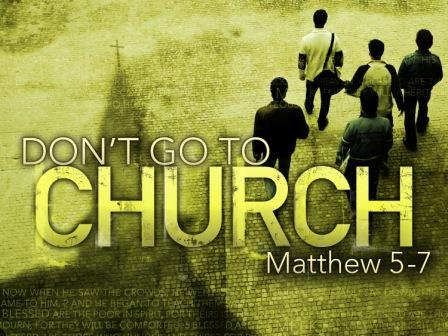
dont-go-to-churchI’ve said this before, but I’ve seen that it’s gone unnoticed, so I’ll repeat the message. Author Boaz Michael and his wife Amber are “walking the walk,” so to speak. For the past several years, Boaz and Amber have been attending a small Baptist church in their community in Missouri. To the best of my knowledge, this church is their only regular worship venue, so they infrequently are able to visit a Messianic (or otherwise) Jewish synagogue. Again, to the best of my knowledge, Boaz and Amber haven’t lost a thing by attending this church, and in fact they’ve gained fellowship and belonging and have shared their unique vision with the Church.

If they aren’t afraid of losing who they are by “going to church,” how should the rest of us feel? I suppose anyway we want. But if we are afraid of church, then we should be honest and ask ourselves why. I was certainly afraid of what returning to church would mean to me, but with a lot of help, I set those feelings aside. And in returning to church, I found that I could also encounter God within its walls and with other Christians. That doesn’t have to be you if you don’t want it to be, but please, don’t let it be fear, animosity, or hostility that stops you from walking that path or causes you to disdain those of us who do.

If you are confident that G‑d will help you, why is anxiety written all across your face? If you are truly confident, show it and celebrate!

-Rabbi Tzvi Freeman
“Celebrate”
Based on letters and talks of the Rebbe
Rabbi M. M. Schneerson
Chabad.org

Oh, and I’ll let you know how the rest of Stern’s book turns out.

Return to Jerusalem, Part 6

strangers-in-israelThis is the sixth and final part of the Return to Jerusalem series where I’ve been examining the Torah Club, Vol. 6 commentary on Acts 15. I trust you’ve been following along since Part 1, but if not, please go back and read the previous submissions including Part 5 before continuing here.

Last time I asked, so what are the four prohibitions for Gentiles in the apostolic decree and what are their implications for the Christians in ancient times and today? To try to render a complete and detailed answer would invite simply copying and pasting everything in Lancaster’s lesson into this blog which, as I’ve said before, I’m not prepared to do. However, and this is particularly interesting to me, Lancaster borrows the status of the “resident alien” (“Ger” in Hebrew) from various portions of the Torah and applies it to the “resident alien” Gentile disciples worshiping the Messiah and the God of Israel in the midst of the Jewish community.

If indeed it is the case that in Christ these Gentiles have a portion in [Israel’s covenant membership and national eschatology], i.e. that they are saved as Gentiles, then it suffices to apply to them the same ethical principles that would in any case apply to righteous Gentiles living with the people of Israel, i.e. resident aliens.

-Markus Bockmuehl
“Jewish Law in Gentile Churches:
Halakhah and the Beginning of Christian Public Ethics”
(Grand Rapids, MI: Baker Academic, 2000), 165

But in citing Bockmuehl, Lancaster reintroduces a problem that flies in the face of his and FFOZ‘s official theological stance on Gentiles and the Torah. While the gerim in the days of Moses were not Israelites as such and did not obtain full membership status in the nation due to lack of tribal affiliation, they did observe a large number (majority? nearly-full obligation?) of the Torah mitzvot in the days of Moses and beyond. The argument of some branches of the Hebrew Roots movement is that the gerim status can be wholly transferred to the Gentile disciples of Jesus and be used to justify Gentile Christian obligation to the full yoke of Torah. Lancaster has spent considerable effort in his commentary to illustrate how James and the Council exempted the Gentiles from the full yoke of Torah because they were not born Jews or converts. Now, he apparently brings in an element in explaining the four prohibitions that could reverse his argument.

It doesn’t help that he explains the four prohibitions, which go well beyond the confines of the Noahide laws, as derived from Leviticus 17-18.

In those chapters, the Torah describes the sins of the Canaanites, warns the people of Israel against imitating their ways, and prescribes four prohibitions which both the Israelite and the stranger who dwells among the nation much keep. “These correspond to the four prohibitions of the apostolic decree, in the order in which they occur in the apostolic letter.” [Richard Bauckham, “James and the Jerusalem Church,” in “The Book of Acts In Its Palestinian Setting, (Grand Rapids, MI: Wm. Eerdmans Publishing Co., 1995), 459]

-D. Thomas Lancaster
Torah Club, Volume 6: Chronicles of the Apostles
from First Fruits of Zion (FFOZ)
Torah Portion Mishpatim (“Judgments”) (pg 461)
Commentary on Acts 15:20-31

How was this all supposed to be lived out by the Gentile disciples of that day and what are the implications for modern Christians? As I’ve said in previous parts of this series, you’ll have to access the Torah Club (Vol. 6) studies relevant to Acts 15 for the full details, but it seems as if the four prohibitions were a significant subset of the Torah that was to be applied to Gentile believers above and beyond the Noahide laws of their day. That said, there is another source besides Lancaster who also discusses the same material and provides further illumination.

Toby Janicki wrote an article called The Gentile Believer’s Obligation to the Torah of Moses for issue 109 of Messiah Journal (Winter 2012), pp 45-62, and it provides a great amount of detail on the application of the four prohibitions.

I reviewed Toby’s article over a year ago and at the time, I recall being quite surprised when he suggested that our (i.e. Christians) obligation to the Torah of Moses went much further than I imagined, based on his analysis of the aforementioned prohibitions of the apostolic decree.

Toby’s article is still available in full in either print or PDF versions of Messiah Journal, 109 and I consider it required reading when attempting to delve into an understanding of the message of the Council to the Gentiles among the disciples of Messiah, both in the days of the Council and now.

As I’ve said, this message and how it was arrived at, remains very controversial in Christian/Hebrew Roots circles, but before attempting any sort of conclusion to today’s “meditation” and to this series, I want to remind you of how the Gentiles of that day received the “Jerusalem Letter” (Acts 15:22-29).

So when they were sent off, they went down to Antioch, and having gathered the congregation together, they delivered the letter. And when they had read it, they rejoiced because of its encouragement. And Judas and Silas, who were themselves prophets, encouraged and strengthened the brothers with many words.

Acts 15:30-32 (ESV)

the-joy-of-torahIn other words, it was really good news from the point of view of the Gentile God-fearing disciples. After what some of the Gentile believers may have experienced as “mixed messages” from different factions within “the Way” and/or between “the Way” and other sects of Judaism, it must have been a relief to have a final, definitive decision rendered by the Apostolic authority. Further, assuming we can accept Lancaster’s interpretation, it must also have been a relief to the Gentiles that they were not automatically required to convert to Judaism (some may have done so but many or most obviously did not) and thus come under the full weight of Jewish Torah observance and halachah. James had established a halachah for the Gentiles that “raised the bar” as far as behavioral expectations and observances of the Gentile believers, and was well above what was expected of the God-fearers who were not disciples of Messiah or members of universal humanity, but that bar was still not as high as the one God had set for the Jews that, according to Peter’s testimony, “neither our fathers nor we have been able to bear.”

One of the functions of the four prohibitions acted to allow Jewish/Gentile fellowship and interaction within the Messianic community of believers “by abolishing the law of commandments expressed in ordinances.” (Ephesians 2:15) Jewish believer Gene Shlomovich puts it this way:

“Where in the written Torah does it prohibit Jews from eating with Gentiles?”

Nowhere! However, many of the Torah laws, including kashrut, were designed, in part, to make Israelites “kadosh”, “separated” or “set aside” from the nations. Since nations all around them ate “treif” or idol-sacrificed food, no devout Israelite would sit down with idol worshippers at the same table, if only because of the appearance of sin. Not only that, eating with idolaters implied fellowship with them, and perhaps taking on their customs and even religions.

However, with the coming of Messiah, G-d reached out to the Gentiles without requiring them to take on the full Yoke of Torah and live in the manner of Jews. Jews, for their part, had to overcome their Torah and culture ingrained aversion to sharing (no doubt still kosher) food with former idolaters-turned followers of the Jewish Messiah. It is said that the leader of the Jerusalem community and brother of Jesus, Yaakov (James) never drank wine or ate meat, but only ate vegetables. This may be because he wanted to fellowship with Gentile disciples of Jesus around their tables without violating the laws of kashrut, to which Gentiles were not obligated nor were expected to be versed in.

I can’t say that Gene has “solved” the conundrum of Ephesians 2 and how the Messiah created “one new man” out of two (without obliterating the Torah and Jewish identity), but it is a nice summary that seems to lead in an interesting direction. We are “one in Christ,” just as men and women, and just as slaves and freemen are “one in Christ,” though obviously still possessing many differences.

If Jesus did reconcile the Jewish and Gentile believers “to God in one body through the cross, thereby killing the hostility,” (Ephesians 2:16) then the apostolic decree of James delivered to the body of faithful disciples of Messiah from among the Gentiles by letter and by emissaries, may have been the means to bring down “the dividing wall.”

The net result of my study of Acts 15 using the Torah Club, Vol 6 materials seems to be that we Gentile Christians owe a great debt to our Jewish “forefathers” and share a great heritage with our believing Jewish brothers and sisters. The most exciting part though, is that we are walking side-by-side together toward a future where we are united by a resurrected and returned Messiah King who will finish what we have been commanded to start: rebuilding the fallen tent of David, and restoring the glory of God on earth among both the Jews and the nations.

white-pigeon-kotelHow do we resolve the matter of the ancient Ger as applied to the late Second Temple Gentile God-fearing disciple? Lancaster doesn’t make that clear, but based on my own reading, particularly of Cohen, the full role of a Ger as it existed in the days of Moses was to allow a non-Israelite to live among the people of God as permanent resident aliens without being able to formally become national citizens due to lack of tribal affiliation. After the Babylonian exile, a tribal basis for Israelite society was lost and affiliation by clan was emphasized. By the time of Jesus, this clan affiliation basis was too lost, and thus the rationale for the status of Ger as it was originally applied no longer was valid. A Gentile in the days of Jesus or later, who wanted to join the community of Israel, in most cases, would convert to Judaism, since becoming a Ger was not an option.

I can only conclude that James (and this is speculation), in establishing halachah for Gentile entry into the Way as Gentiles and equals to the Jewish disciples, was taking some aspect of the Ger status as the best method available to forge an identity of “alien” Gentile disciples living and worshiping among the Jews in their religious sect. I realize your opinion (and for all I know, Lancaster’s) may vary.

The Jewish role in serving God as we see it in the Bible seems all too clear, but we in the church must always remember that our blessings only come by fulfilling our own unique role as “Gentiles called by His Name.” We are not Jews and we are not expected to “act Jewish,” at least to the degree that we appear to be what we’re not. In fact, we rob ourselves of the path God has laid before us by adopting an identity that is not our own. Acts 15 was the starting point on that path and the beginning of that journey for the early Gentile disciples. It is also where we begin today to understand who we are as Christians and what we must do if we are to be considered faithful disciples of our Master and worthy sons and daughters of God.

I know this series has been challenging for some, largely because going against established doctrine (regardless of the doctrine to which you’re adhered) suggests change and nobody likes change. Maybe none of this will result in anyone thinking any differently, but I hope I at least got some people to think about what they believe and consider that there may yet be something new we can discover about ourselves in the Bible.

“If you want to make enemies, try to change something.”

-Woodrow Wilson, 28th U.S. president

So concludes the series Return to Jerusalem. I hope you enjoyed it. Please feel free to (politely) tell me what you think.

Blessings.

Return to Jerusalem, Part 4

teshuvahTherefore my judgment is that we should not trouble those of the Gentiles who turn to God…For it has seemed good to the Holy Spirit and to us to lay on you no greater burden than these requirements: that you abstain from what has been sacrificed to idols, and from blood, and from what has been strangled, and from sexual immorality. If you keep yourselves from these, you will do well.

Acts 15:19, 28-29 (ESV)

After presenting the proof text, James placed Simon Peter’s decision before the council. He declared, “It is my judgment that we do not trouble those who are turning to God from among the Gentiles.” That is to say, “We should not require circumcision and conversion as the criteria for salvation.” James referred to the God-fearing believers as those “turning to God from among the Gentiles.” The word “turning” corresponds to “repentance.” The Gentile believers responded to the gospel message, “Repent, the kingdom is near.”

The decision exempted the Gentiles from circumcision and the particular commandments that pertain specifically to Jewish identity. It prohibited the Jewish believers from forcing those issues on Gentiles. Nevertheless, the apostles did not forbid the Gentiles from voluntarily participating in the Sabbath, the dietary laws, or any aspect of Torah-life.

-D. Thomas Lancaster
Torah Club, Volume 6: Chronicles of the Apostles
from First Fruits of Zion (FFOZ)
Torah Portion Yitro (“Jethro”) (pg 442-3)
Commentary on Acts 15:1-20

This is a continuation of the “Return to Jerusalem” series and I recommend that, unless you’ve done so already, you read part 1 through part 3 before continuing here.

We’ve seen the problem of whether or not Gentile disciples of Jesus should be compelled to convert to Judaism and conform to the full yoke of Torah brought before James and the Jerusalem Council. Each side of the debate has made its case and it appears that the testimony of Peter and his experiences with the Roman Cornelius and his household (see Acts 10) have weighed the debate heavily in one direction. James has presented Amos 9:11-12 as his proof text for allowing Gentiles to receive salvation and access to the Messianic promises without converting to Judaism and in accordance with Peter’s position on the matter.

And now we see what James is going to do about it.

For the Jewish disciples and apostles, the crux of their argument was if or how the Gentiles were to be admitted into discipleship. Should they convert and take on the full yoke of Torah or be allowed to remain Gentiles (not convert) and perhaps follow some other or abridged set of behavioral standards? It was the mechanism for admission that was the point for them, not whether or not Gentiles could/should follow the Torah.

However, I’ve received some comments lately on the earlier parts of this series about whether or not we non-Jewish disciples are obligated to the full list of Torah mitzvot (and arguably, all or much of the subsequent Rabbinic commentary on just how one performs the mitzvot) based on Acts 15 among other New Testament scriptures. Further, the question of whether or not the Jerusalem Council “cancelled the Torah” for Gentile and Jewish disciples of Jesus came up. To me, and especially after reading Lancaster, this is a no-brainer, but I keep forgetting that for most Christians, this raises a tremendous conflict in terms of what they’ve (we’ve) been taught (and as you can tell from my writing, I don’t always think like most Christians).

But I want to continue with my review/analysis of Lancaster’s Acts 15 commentary because I think it has a lot to say to both believing Gentiles and Jews. I won’t say that I believe every word Lancaster writes is undying Gospel (you should pardon the expression), but I do think we should take a serious look at what he says and see if there’s merit in what he’s teaching. I think we can learn much.

For instance, while Lancaster has said that Gentile believers are not obligated to the full yoke of Torah, and especially those mitzvot that have to do with Jewish identity (since they aren’t going to be converting to Judaism), he also says that “the apostles did not forbid the Gentiles from voluntarily participating in the Sabbath, the dietary laws, or any aspect of Torah-life.” But then how are we to separate Gentiles being limited to voluntarily participating in only certain elements of “a Torah-life” and “any aspect of Torah-life?”

I’ll address the specifics of what Lancaster defines as “Torah-life” for the Gentile later parts of this series. That said, Lancaster does give us a bit of a picture of what the “early Christians” were up to relative to the Torah, and maybe even a beginning of the answer to the question I just asked.

The God-fearing Gentile believers of the apostolic era were more Torah observant than most Messianic believers (Blogger’s note: or traditional Christians) today. They worshipped in synagogues in the midst of the Jewish community. They had no other days of worship or holidays other than those of the synagogue. They did not drive vehicles to get to their place of fellowship. To share table-fellowship with Jewish believers in the community, they maintained the biblical dietary laws. For all practical purposes, they looked Jewish already.

PaulTo support this claim, Lancaster quotes from Le Cornu’s and Shulam’s “A commentary on the Jewish Roots of Galatians” (Jerusalem, Israel: Akademon, 2005), 835:

This principle has obvious bearing on the language of “troubling” and “burdening” the Gentile believers. James’ ruling for the “majority” of the Gentiles who are now turning to God through Jesus: The Jewish community in Jerusalem will not impose anything on them which they will not be able to bear as a whole. This does not preclude their taking upon themselves additional observances according to their respective abilities and desires.

This lends a great deal of support to Lancaster’s and FFOZ’s position on Gentile Christians and the Torah. While obligation to all of the mitzvot is not imposed on the Gentile disciples as a whole, individuals among the Gentiles may choose to follow the path of Torah more fully and to varying degrees.

I’m going to skip over the “Four Essential Prohibitions” until next time and focus on how the Torah in general is applied to Jewish and Gentile believers. We see that, according to Lancaster and the Jews present at this debate, it was abundantly clear that Gentiles, if they do not convert to Judaism, are not obligated to the full yoke of Torah as a group. But what about the Jews? Did James really abolish Jewish observance of Torah in one fell stroke?

The apostles agreed that Gentile believers did not need to undergo circumcision and full obligation to the Torah as Jews. The obvious corollary requires that Jewish believers are obligated to observe the Torah. The thought that a Jewish believer might also be exempt from the whole yoke of Torah did not enter the minds of the apostles.

Traditional Christian interpretation, however, often assumes that Acts 15 releases both Jews and Gentiles from keeping the Torah’s ceremonial laws of circumcision, Sabbath, calendar, dietary laws, etc. On the contrary, the entire argument of the chapter presupposes that those obligations remain incumbent on the Jewish believer.

-Lancaster, pg 443

Lancaster then finishes off this point by citing some (to Christians, anyway) rather unusual authorities: both a believing Jewish commentator from the 19th century and two unbelieving Rabbis from the 15th and 18th centuries who also wrote scholarly opinions (amazingly enough) on Acts 15. For the full content of their writings as presented in the Torah Club, I encourage you to purchase Vol. 6, but I will briefly quote one source.

And it is forbidden for us to say: “If we have the righteousness of the Messiah unto eternal life, why do we need to observe the Torah, if this is not required for eternal life, for we are only saved by faith?” We are forbidden to speak this way, for who are we to annul it? The Messiah was not made the servant of sin. This is similar to what the Christians said: “Why do I need any longer to give alms to the poor or to do any other good deed, according to the New Testament? Is not my faith enough for me?” It is forbidden to speak like this, for he is a sinner who closes his fist, and the Messiah was not made the servant of sin. Therefore faith does not benefit him, as it says in the epistle of James 2:13, 1 John 3:3, and Paul himself in Romans 6:15. And James says (4:17): “One who knows to do good and does not do it, it is a sin for him,” for the omission is a sin. For when he repents and regrets the wickedness of his heart, then the faith by its power saves him, as Paul also says in Acts 26:20: “Return to God and perform deeds in keeping with repentance.” Then the faith is beneficial.

-Yechiel Tzvi Lichtenstein
“Commentary on the New Testament: The Acts of the Apostles”
(Unpublished, Marshfield, Mo: Vine of David, 2010),
on Acts 15; originally published in Hebrew: Beiur LeSiphrei Brit HaChadashah
(Leipzig: Professor G. Dahlman, 1897).

jewish-prayer-israelI am positive that this is the single most difficult message from Acts 15 for the vast majority of Christians to absorb. We have been taught that when it says Jesus is the goal of the Torah, it means the finale as opposed to the “gold standard” of obedience to God that the (Jewish) believers were to unservingly strive for. It is extremely acceptable to most Christians that we in the church are not subject to the “slavery” of the Law, but to believe that any Jewish person who is also a believer continues to be obligated to the Torah teachings is almost too much for us to bear.

I admit that given the scope of Lancaster’s commentary and the limitations of my already lengthy summary of his work, that I cannot indisputably prove that Gentiles have no obligation to Torah while Jews still do (although I think the point regarding Gentiles and Torah is reasonably well made). But in my meager attempts at study and to try to put myself in the place of the people witnessing the council debate this hotly contested (both then and now) issue, I think that Lancaster has made a good case for his conclusions. Again, space and time limitations prevent me from offering a more complete analysis and I don’t want to simply transcribe two weeks of Torah Club lessons into my blog (I’m already guilty of replicating a large portion of the two Acts 15 teachings from TC Vol. 6). Again, if you want to read the entire content of the work supporting these conclusions, you’ll have to consult the Torah Club Volume 6 lessons.

The remainder of this series will address the “Four Essential Prohibitions” and what they mean for Gentile believers, both in ancient and modern days. That’s where we’ll start in Part 5 of “Return to Jerusalem.”

Mishpatim: Law and Spirit

tzitzit1There was once a Jewish girl who stopped in Israel on her way to India to seek spirituality. Friends suggested that she go to Neve Yerushalayim to take a class and give Judaism one last shot before seeking other pathways to spirituality. The one class happened to be studying the laws regarding returning a lost item — when is an item considered lost, what if the person gave up hope of its return, what constitutes a legitimate identifying mark to claim the item, to what extent and cost of time and money are you obligated for returning the item… The girl was furious! This is NOT spirituality. She left in a huff and headed off to India.

Six months later she and her guru were discussing a philosophical matter while walking through the village. They came upon a wallet filled with rupees. The guru picked it up, put it in his pocket and continued with his point. The girl interrupted him and asked, “Aren’t you going to see if there is identification in the wallet to return it?” The guru replied, “No. It was his karma that he lost it; it’s my karma that I found it. It’s mine.” The girl implored, “But, he might have a large family and that might be his monthly earnings … they could starve if you don’t return it!” The guru responded, “That is their karma.”

-Rabbi Kalman Packouz
“Shabbat Shalom Weekly”
Commentary on Torah Portion Mishpatim
Aish.com

You may be wondering what all this has to do with this week’s Torah study. Consider that, according to Rabbi Packouz, Mishpatim is one of “the most mitzvah-filled Torah portions, containing 23 positive commandments and 30 negative commandments. Included are laws regarding: the Hebrew manservant and maidservant, manslaughter, murder, injuring a parent, kidnapping, cursing a parent, personal injury, penalty for killing a slave, personal damages, injury to slaves, categories of damages and compensatory restitution, culpability for personal property damage, seduction, occult practices, idolatry, oppression of widows, children and orphans.”

For most Christians and probably many Jewish people, reading Mishpatim can seem like not only an incredible bore, but completely irrelevant to leading a life of spirituality and holiness…

…until you read the commentary about the Jewish girl seeking spirituality, which I quoted above. Let’s “cut to the chase” and see what the Jewish student in India concluded about her experiences.

The young lady then remembered the class she took in Jerusalem — and realized that spirituality without justice, kindness and concern for others is just a false spiritual high, corrupt emotion. She returned to Jerusalem and ultimately returned to her Torah heritage.

I imagine there are a lot of people who believe spirituality is a rather “warm and fuzzy” and “feel good” state of being where one contemplates self, God, and the nature of the universe, and through this, the wear and tear of daily living can be put to the side as if it were a cast off garment. And yet, as the Jewish student learned, it is nothing of the sort. Spirituality is a “lived” experience that permeates our day-to-day lives. There is not one aspect of what we do, from the moment we wake up until the instant our heads hit our pillows at night where God is not present (and He’s present when we sleep as well) and we are not acting either within his will our outside of it.

This past week, I’ve been commenting extensively on Acts 15 and the implications of admitting non-Jewish disciples of the Messiah into a wholly Jewish religious sect. There is a single sentence within that chapter which has caused much confusion among Christian and Jewish commentators and scholars.

For from ancient generations Moses has had in every city those who proclaim him, for he is read every Sabbath in the synagogues.”

Acts 15:21 (ESV)

I’ll give that statement more treatment in my Return to Jerusalem series in the next few days, but we can take a look at it now from the perspective of this Torah Portion commentary. What did James and the rest of the Apostles expect the Gentile God-fearing disciples to learn by going to the synagogue each Shabbat and hearing the Torah read, especially if, as I’ve said previously, the Apostles never desired that the Gentiles convert to Judaism and thus be obligated to the full yoke of Torah?

karmaWhat was the Jewish student supposed to learn by “studying the laws regarding returning a lost item?” When she was in India following the path she thought she really wanted, she discovered the answer.

While there is much in the Torah that has to do with the specifics of living a Jewish life, there is also much more that teaches us, all of us, how to live an ethical and moral life within a spiritual and material world context. The student in India didn’t have to be Jewish to learn that lesson, it could have been learned by anyone. Hopefully, it is being learned by everyone who reads the Bible and studies the mitzvot delivered by God to humanity through Moses and the Prophets.

The “Law” isn’t boring (unless you let it be). It’s all “God-breathed and is useful for teaching, rebuking, correcting and training in righteousness, so that the servant of God may be thoroughly equipped for every good work.” (2 Timothy 3:16-17)

Studying scripture is like spending time with God in prayer. It is an act of intimacy. It is like this:

On the seventh day He called to Moses from the midst of the cloud. Now the Presence of the Lord appeared in the sight of the Israelites as a consuming fire on the top of the mountain. Moses went inside the cloud and ascended the mountain; and Moses remained on the mountain forty days and forty nights.

Exodus 24:16-18 (JPS Tanakh)

Good Shabbos.