Tag Archives: Kabbalah

Light and the Lucid Crystal

Inner lightWhen a ray of light strikes a crystal, it gives a new quality to the crystal. And when God’s infinitely disinterested love plays upon a human soul, the same kind of thing takes place. And that is the life called sanctifying grace.

The soul of man, left to its own natural level, is a potentially lucid crystal left in darkness. It is perfect in its own nature, but it lacks something that it can only receive from outside and above itself. But when the light shines in it, it becomes in a manner transformed into light and seems to lose its nature in the splendor of a higher nature, the nature of the light that is in it.

So the natural goodness of man, his capacity for love which must always be in some sense selfish if it remains in the natural order, becomes transfigured and transformed when the Love of God shines in it. What happens when a man loses himself completely in the Divine Life within him? This perfection is only for those who are called the saints – for those rather who are the saints and who live in the light of God alone. For the ones who are called saints by human opinion on earth may very well be devils, and their light may very well be darkness. For as far as the light of God is concerned, we are owls. It blinds us and as soon as it strikes us we are in darkness. People who look like saints to us are very often not so, and those who do not look like saints very often are.

-Thomas Merton
Part Two, Chapter One, “With a Great Price,” pg 186
The Seven Storey Mountain

This explains a lot. It explains how people who have no faith in God in any manner and no apparent external moral compass (at least from a religious person’s point of view) can still do good and great things for others and uphold noble causes. It also explains how some “religious people,” even though they seem to have faith in God and to uphold the teachings of His prophets and apostles, can harbor evil thoughts and feelings for others and say and do heinous things, all supposedly in the name of God.

Merton further illustrates that a person who is perfect in his or her nature because he or she was made in God’s image and who allows themselves to accept and reflect and refract the light of God as does a crystal, can be perfected beyond human standards and be elevated in a relationship with God and man. This is what it is to be holy.

I was struck with these passages in Merton’s book and remembering this was written when he was a young Trappist monk, I was astonished at how closely some of his ideas and images paralleled those of the Rebbe, Rabbi M. M. Schneerson, as I often quote them from the interpretation of Rabbi Tzvi Freeman. These quotes, of course, are an extension of Chasidic and even Kabbalistic thought and belief, which seems an even stranger comparison for me to make to the observations and reflections of a Catholic monk writing his autobiography in the 1940s.

I wonder if men from such different cultural and religious backgrounds aren’t on some level joined together by the light of God?

But if this unlikely and wonderful parallel between two men of such divergent faiths exists, how much more tragic that there are so many others in the religious and spiritual arena (and particularly in the blogosphere) who claim the title “saint” or “prophet” but who Merton would definitely classify as “devil?”

When it comes to accepting God’s own authority about things that cannot possibly be known in any other way except as revealed by His authority, people consider it insanity to incline their ears and listen. Things that cannot be known in any other way, they will not accept from this source. And yet they will meekly and passively accept the most appalling of lies from newspapers when they scarcely need to crane their necks to see the truth in front of them, over the top of the sheet they are holding in their hands.

For example, the very thought of an imprimatur on the front of a book – the approbation of a bishop, allowing the book to be printed on the grounds that it contains safe doctrine – is something that drives some people almost out of their minds with indignation.

-Merton, pg 187

I’m not a big fan of censorship and I’m probably one of those people who would be driven out of my mind with indignation if someone should hand me a book that was declared “safe” by the Catholic church. But in reading these sentences and the ones that followed, I began to draw a comparison to what Merton could not possibly have anticipated – the proliferation of information on the world wide web.

The Internet isn’t filtered and in my humble opinion, it never should be, but the danger in this is that anyone who can create a website or blog (and this includes everyone nowadays) will create a website or blog, and they’ll spew their opinions all over the Internet so that anyone with web access can find them and read them.

If you are reasonably well educated from other sources, (such as books and reliable teachers) you can probably make your way through the maze of good content and bad, but there are so many would-be “saints” in the world who unknowingly fall into the teachings of a “devil” out of sheer ignorance.

I was once teaching a class at a congregation and was confronted with a strange thought by one of the students. In the course of the conversation, she said the oddest thing. I believe we were talking about the Tetragrammaton; the most holy and unpronounceable name of God, which many people express as “YHWH,” and she said that the reason the Jewish people were exiled was that they refused to reveal the pronunciation of “the Name” to the world and thus, lost all knowledge of the pronunciation as an additional punishment.

What?

Yes, that sounds crazy to me, too.

I don’t remember all of the details and I probably wouldn’t publish them if I did, but apparently, there was some sort of “teacher” on the Internet who was spreading this kind of information. She gave me the URL to his site and I looked him up.

Oh my!

There were years and years and years worth of articles on his site (I really don’t remember his name) and it would have been impossible to go through all of his stuff. I searched for the information on the “Sacred Name” but didn’t find it. I looked through some random web articles and some of it was relatively sane and a lot of it wasn’t. The guy seemed like he was intelligent and even educated, but his conclusions were highly suspect.

With that memory fully recalled and in reading Merton’s book, I’m beginning to develop a new respect for the “imprimatur” concept. Not in terms of consuming data that is only acceptable to the Catholic church, but with the idea of separating the “wheat from the chafe” relative to sound versus unsound religious “research”. If I want to buy a book, I can always go to Amazon and read the reviews to get some sort of idea if the book is any good or not (although sometimes even that litmus test fails). For random craziness on the web, there often is not litmus test except keeping yourself educated with valid sources and knowing when something looks suspicious.

Even with that, some otherwise reliable and well-educated blog authors can become overly-enamored with their own self-importance, just because they get a lot of attention and some local notoriety. The curse of even marginally “famous” believers is that the temptation to forget that God is the focus can be really strong.

I occasionally get “spammed” by folks who tell me that they’ve got a direct line to the Holy Spirit of God who whispers in their ears and helps them not rely on their own intellectual prowess. That kind of makes it hard for me to say that God should be our final litmus test on information when any sort of supernatural revelation is, by its very nature, totally subjective. We can say that revelations of the Spirit should only be considered on the up and up if they jive with Scripture, but interpretation of Scripture is also extremely variable, depending on who you read, who you talk to, and who you believe. Seems like a vicious circle.

Ultimately, we each take some sort of stand and say that “this religion” or “this denomination” or “this sect” or “this viewpoint” is what we consider foundational, and we proceed from that point. None of us have it completely “right” but then perhaps none of us have it completely “wrong” either. In the intellectual “holy wars” on the web, regardless of our differing opinions, we can still rely on the words of the Master that are not ambiguous:

And one of the scribes came up and heard them disputing with one another, and seeing that he answered them well, asked him, “Which commandment is the most important of all?” Jesus answered, “The most important is, ‘Hear, O Israel: The Lord our God, the Lord is one. And you shall love the Lord your God with all your heart and with all your soul and with all your mind and with all your strength.’ The second is this: ‘You shall love your neighbor as yourself.’ There is no other commandment greater than these.” And the scribe said to him, “You are right, Teacher. You have truly said that he is one, and there is no other besides him. And to love him with all the heart and with all the understanding and with all the strength, and to love one’s neighbor as oneself, is much more than all whole burnt offerings and sacrifices.” And when Jesus saw that he answered wisely, he said to him, “You are not far from the kingdom of God.” And after that no one dared to ask him any more questions. –Mark 12:28-34 (ESV)

I am also reminded of the Prophet Micah:

He has told you, O man, what is good; and what does the LORD require of you but to do justice, and to love kindness, and to walk humbly with your God? –Micah 6:8 (ESV)

And although not a prophet as we understand the term, Thomas Merton managed to crystallize something important:

So the natural goodness of man, his capacity for love which must always be in some sense selfish if it remains in the natural order, becomes transfigured and transformed when the Love of God shines in it.

If we open ourselves to Him, we are the breath of God. When we love others, then we are breathing, then we are alive.

Develop your awe of heaven and you will diminish your fear of human beings.

-Rabbi Tzvi Freeman
from the Rebbe, Rabbi M. M. Schneerson
to a Jewish activist in a dangerous Arab land
Chabad.org

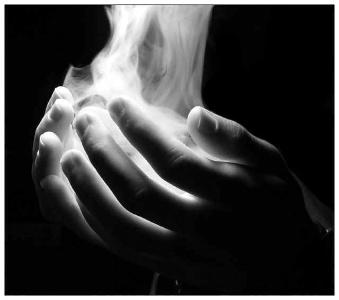
Learning to Breathe

Breath, the inhale and exhale, marking life itself. From the first breath to the last, the constant inhale and exhale signifies vitality.

Take a moment to experience it. Breathe deeply. Fill your lungs with the fresh, pure oxygen. This inhale represents your very inner, core essence; your very being in life. It signifies who you are.

Now, release it; let it all out. Witness your breath exiting and meshing with your surrounding. This represents your doing in life, your impacting on the outside world and accomplishing. Your inhale is self-preservation, defining your own boundaries of self. Your exhale is your universal imprint on the society and world around you.

All beings and any life force experience this duality of inner and outer; inner parameters and boundaries versus outer affects and imprints. Who it is and what it does. The protection of its inherent boundaries, and its reaching out to the world.

The greater a life force the more evident is its inhale and exhale.

-Chana Weisberg
“In and Out”
Chassidic Thought
Chabad.org

I’ve been looking for ways to unload my surplus stress and to reorganize my life around life, rather than around anxiety, depression, and despair. (OK, things aren’t quite that bad, but still…) After “plumping up” over the past few months, I’ve returned to the gym in a (vain) attempt to dump my belly fat and to fit more comfortably in my jeans.

I’m also trying to fit more comfortably inside my skin and my skull and my being.

It’s no secret that I’ve been struggling a bit lately, as evidenced by my family’s Passover Seder as well as other recent events. Although I know that the struggle with mortality and humanity is unavoidable, it’s still difficult to let go and to integrate all of the ugly little bits and pieces of reality into my life, rather than shunning them. I need some way to reminding myself, even at the worst of times, that God has not disappeared down the cosmic rabbit hole and escaped my angst and anguish.

I’m trying to learn how to breathe.

Obviously, I know how to breathe and I’m not talking about some esoteric or mystic breathing technique used during deep meditation. Well, not exactly. I was remembering a quote from a few episodes of Star Trek Voyager, where the character Tuvok (played by Tim Russ) in assisting another member of the crew to meditate. Tuvok would say something like, “Turn your attention to the white light that is your breath..”

I can’t remember the exact quote and my Googling skills have failed me. (but thanks to the helpful commenter (see below) for supplying the correct link and quote) However, I try to imagine my breath as a white light as I breathe in and out during exercise. This image is especially helpful during the last five minutes of an aerobic workout, when I’m trying to reduce my heart rate back to some semblance of normalcy, rather than trying to go from 156 to 70 in a single, sudden stop. I’m actually able to close my eyes and visualize the light as it goes in and out of my mouth and lungs.

With my legs still moving on the machine, I can imagine myself on a trail. It is narrow, with the forest on either side of me. The trail is going up and I can see the crest of the hill ahead of me. There’s a point where the sky meets the ground that is a bright, white light. My breath seems to go to and come from that light. I realize that I’m getting closer to the top and the light is getting brighter. And yet, I’m not able to get too close.

I know that the light is God and that, in those few short moments as I’m encouraging my body to go from working very hard to beginning to calm down, I’m also approaching that calm with my mind, my feelings, and my spirit.

Indeed all creation, say the Kabbalists, is characterized by this to and fro movement, called ratzo v’shuv (running forth and drawing back) or mati v’lo mati (reaching and retreating).

The heart contracts and expands; the lungs exhale and inhale. On a deeper level, the body sleeps, extinguishing its active faculties in order to rejuvenate. The earth enters an interlude of night and winter in order to vivify itself with the necessary energies for its more outward oriented dawn of spring.

The same is true of the flow of vitality from G-d to His creation. This flow also comes in flashes of running forth and drawing back, reaching and retreating.

Furthermore, each breath of life — each protective withholding of boundaries as well as each outer exertion — reflects the Divine balance and flow to creation.

-Weisberg

Each breath we take, each beat of our heart, separates us from eternity and yet joins us with the infinite at the same time. God breathed life into the first man and something of that breath exists within all of the living. When we think of ourselves as being “created in the image of God,” we (OK, I) tend to imagine that image as static and unchanging. I can’t really picture what that “image” must look like, but when I’m breathing in and out the light of God’s breath, the Spirit of God and man are dynamically being interchanged, interwoven, and stirred together. I have no way to truly understand God, but in those few minutes, as a strive to approach the top of the trail and to reach the light, I am able to touch something and to share something with God.

And He shares a little something with me.

Come and see! G-d made the world by a breath and by the breath of the mouths of those who study Torah it is preserved.

-Translated and annotated by Rahmiel-Hayyim Drizin
from the Zohar selection in Hok L’Yisrael
Based on Zohar Bereishit 47a
Chabad.org

It is common for us to try to understand God and who we are in Him, by studying the Bible as well as other learned texts. We read and we attend classes and we ask knowledgeable teachers our questions and attempt to touch the edge of great mysteries.

It is also common to pray and to reach out with our thoughts and feelings to God, calling across the bridge that stands between the earthly and the Divine in the hopes that we can reach Him and in some way, connect with something that is part of our Creator.

But for all that effort, and none of it is wasted, sharing something with God may be as simple as taking a deep breath, letting it out, and visualizing that light going in and out of us as the breath we share with God. His light fills us every time we take a breath, and He wills every beat of our heart.

We are alive because He is the Living God.

There will come a time, very soon, when we will be shown miracles so great, they will make the Ten Plagues and the splitting of the Red Sea appear as ordinary as nature itself.

So great, no mind can begin to fathom them;
so powerful, they will transform the very fabric of our world, elevating it in a way that the wonders of the Exodus never did.

For then, our eyes will be opened and granted the power to see the greatest of miracles: Those miracles that occur to us now, beneath our very noses, every day.

-Rabbi Tzvi Freeman
“Greater Miracles”
Based on letters and talks of the Rebbe
Rabbi M. M. Schneerson
Chabad.org

Every moment we’re alive, and each time we breathe in and breathe out, is a miracle.

The Finger of God is Writing

Once, Rav Elchonon Wasserman explained the greatness of those who learn Torah which touched upon a famous statement of Rava: “How foolish are those who stand for a sefer Torah but not for people great in Torah!”

Rav Elchonon related a story to illustrate the point: “Once, the Netziv of Volozhin, was carrying a sefer Torah to the bimah when he slammed into a bench and fell down, and the sefer fell with him. As the bnei yeshivah rushed to pick them up, the Netziv’s son-in-law, Rav Itzel Volozhiner, gave an astounding order, “First pick up the Rosh Yeshiva, then the sefer Torah!”

Rav Elchonon explained, “This is what Rava means in Makkos 22. It is only people’s foolishness that causes them to respect a sefer Torah more than a true Torah scholar. After all, why should one respect a sefer Torah inscribed on parchment more than a sefer Torah housed in living flesh and bone?”

The Divrei Shmuel explains this statement similarly, “Tzaddikim are themselves holy like a sefer Torah. A sefer Torah is merely the Torah written on parchment; how much more is it incumbent upon us to honor a sefer Torah inscribed on one’s heart! As the verse states: ‘Write them on the tablet of your heart.’”

`But Rav Reuven Margolios points out that this distinction does not apply to just any scholar. “The gemara uses the expression ‘gavra rabbah’—‘a great man’—rather than the more common ‘tzurba d’rabanan,’ which implies an ordinary scholar. This teaches that this halachah only applies if the scholar in question is one of the gedolei hador. It is only in such a case that it should be obvious to any thinking person that it is fitting to treat him with more honor than a sefer Torah. But if one is a regular talmid chacham, he is not to be more respected than a sefer Torah.”

Mishna Berura Yomi Digest
Stories to Share
“A Living Sefer Torah”
Simin 136, Seif 1

And the Word became flesh and dwelt among us, and we have seen his glory, glory as of the only Son from the Father, full of grace and truth.John 1:14 (ESV)

You shall therefore lay up these words of mine in your heart and in your soul…Deuteronomy 11:18 (ESV)

For when Gentiles, who do not have the law, by nature do what the law requires, they are a law to themselves, even though they do not have the law. They show that the work of the law is written on their hearts…Romans 2:14-15 (ESV)

Sorry for the lengthy list of quotes, but they were all necessary to create the foundation for today’s “morning meditation”. If you’ve been reading my blog lately, you know that I’ve written a four-part series on Exploring Messianic Divinity which investigates the idea that Jesus is God. As part of that investigation, I took a look at the various mystical and metaphorical writings that point to the Messiah as The Living Word of God. In my quote from the commentary on Simin 136, Seif 1, we see that such a concept is applied, not necessarily to the Messiah, but to a Torah scholar who is “gavra rabbah” or “a great man”. And yet, can we find any greater tzaddik in all the world than the Master and redeemer of our souls? Who else but the most exalted Messiah could redeem the world with his blood?

The murder of Rabbi Elazar Abuhatzeira, the “Baba Elazar,” on Thursday night saved the people of Israel from other tragedies, leading rabbis said Friday.

“Harsh punishments were decreed on the people of Israel, and he wanted to nullify them,” said the slain rabbi’s brother, Rabbi Baruch Abuhatzeira, also known as the Baba Baruch, speaking at Rabbi Abuhatzeira’s funeral.

by Maayana Miskin
“Rabbi Abuhatzeira Bore the Burden of Evil Decrees”
IsraelNationalNews.com

I’ve quoted this article before to establish that in traditional Judaism, it is conceivable that the death of a great tzaddik can atone for the sins of Israel. If the holiness of the tzaddik were great enough, could his death not atone for a world?

…so Christ also, having been offered once to bear the sins of many, will appear a second time for salvation without reference to sin, to those who eagerly await Him. –Hebrews 9:28

In Judaism, as we saw in my aforementioned quote, a scholar becomes great, very great, through intense Torah study such that he imbues his heart with the same holiness attributed to the Sefer Torah, because Torah is written on the tablet of his heart. We also see in Deuteronomy, that the Children of Israel have been commanded to write words of Torah on their hearts. From Paul, we see that though the Gentiles did not (and do not) have the commandments of Torah given to them (us) at Sinai, nevertheless, our actions show that the Torah is written on our hearts when we “do what the law requires”. In other words, when we do what our “living Sefer Torah” does, like any good disciples, we are imitating the works of our Master and living out his lessons. Having the Torah “written on our hearts” is like a spiritual overlay of righteousness upon the physical nature of our lives; a “Tree of Life” superimposed on a living tree with its grafted in branches.

I suppose we could be tempted to say that if the Law is written on the hearts of Gentiles who follow the teachings of Jesus, that we are obligated to “do what the law requires” in the same manner and fashion as the Jewish people, but that would be taking Paul out of context. We do see a bridge of sorts between Deuteronomy 11:18 and Romans 2:14-15 in terms of the law being upon our hearts, but does that really mean that any Gentile disciple of Jesus must respond to the mitzvot in precisely the same manner as the Jews who inherited Sinai?

I believe I’ve already answered that question, at least to my own satisfaction. The Word, but not the Jewish identity, is what is being actively written on our hearts. Jews and Christians are united under the Messianic covenant as “one new man” (Ephesians 2:15) in our ability to approach the Throne of God as adopted sons, with the Jews being adopted at Sinai and we Christians being adopted at the foot of the cross. However, while the “Covenant of the Cross” accepts the Jew as an extension of Sinai because of the promise of the Moshiach, it does not link the Gentile back to what was already given to Israel through the tablets of Moses. We non-Jews, like Abraham, access God by faith alone, through Jesus, without the requirement of Moses.

What then shall we say was gained by Abraham, our forefather according to the flesh? For if Abraham was justified by works, he has something to boast about, but not before God. For what does the Scripture say? “Abraham believed God, and it was counted to him as righteousness.” –Romans 4:1-3

One of the things (and I’ve mentioned this earlier) about being a disciple, is that we learn from our Master by imitating him. Traditionally, Jewish disciples studying under a great Rabbi and tzaddik, will imitate everything about him, including how he dresses, his vocal inflections, his physical mannerisms, even how he eats; every little detail. All this is in addition to memorizing his teachings, learning his teaching style, and living out his understanding of Torah. I’m not suggesting we try to imitate Jesus down to such a specific level, if for no other reason than most of that kind of information is unavailable.

However, I am suggesting we imitate him in the most important aspects of his life and learning.

But when the Pharisees heard that he had silenced the Sadducees, they gathered together. And one of them, a lawyer, asked him a question to test him. “Teacher, which is the great commandment in the Law?” And he said to him, “You shall love the Lord your God with all your heart and with all your soul and with all your mind. This is the great and first commandment. And a second is like it: You shall love your neighbor as yourself. On these two commandments depend all the Law and the Prophets.” –Matthew 22:34-40 (ESV)

I believe that it is this teaching more than any other, that is written on our hearts if we are his true disciples and followers of “the Way”. If the Torah were written perfectly on the heart of Jesus Christ, should we not imitate him and continually allow the “finger of God” (Exodus 31:18, Luke 11:20) to write the Word on our hearts? Is this not what it means to be Holy? But how is this done?

We never got used to Egypt. We never felt we belonged there. We never said, “They are the masters and we are the slaves and that’s the way it is.” So when Moses came and told us we were going to leave, we believed him.

Everyone has their Egypt. You’ve got to know who you are and what are your limitations. But heaven forbid to make peace with them. The soul within you knows no limits.

-Rabbi Tzvi Freeman
“No Limits”
Based on letters and talks of the Rebbe
Rabbi M. M. Schneerson
Chabad.org

The biblical slavery of Egypt represents bondage to your own self. Every day, every moment, must be an exodus from the self. If you’re not leaving Egypt, you’re already back there.

-Rabbi Tzvi Freeman
“Leaving Egypt”
Based on letters and talks of the Rebbe
Rabbi M. M. Schneerson
Chabad.org

I’ve heard it taught in certain circles, that Egypt represents the realm of sin. This isn’t traditionally taught in Judaism and we see from the Chassidic perspective, that whatever bondage Egypt represents spiritually and emotionally, is our bondage not to sin, but to our egos, and whatever suffering we may have brought upon ourselves. This can include our sins and shortcomings, but Egypt represents less of an external force for evil and more of our internal capacity for pain, suffering and harm. In order to imitate our Master, we must learn to erase whatever “script” that is currently scribbled within us and replace it with Words of true holiness.

These are Words that can only be written with the power of the “finger of God” and we cannot do it alone. We must open our hearts and be willing “tablets” so that the finger can write. Though the final Words of Torah (which means “teaching” as I’m using it here) will never be completely written before the Messiah returns to us, we can allow the ongoing transforming of our minds and our hearts and our spirits so that we become more and more like the one we follow. In this, we continue to travel the path and draw ever nearer to God who is our goal.

The finger continues to write. There’s still time. Open your hearts.

The Mystic Mirror Darkly: Messianic Divinity Part 3

I’ve said numerous times before in other blog posts, that I’m becoming convinced that we cannot understand the teachings of the Jewish Messiah and his early disciples without some ability to look at those teachings through a Jewish mystical lens. This goes beyond an understanding of Torah and Talmud (and possibly flies in the face of Judaism’s more “rational” understanding of God), but there are “mysteries” exposed in the Apostolic scriptures that suddenly become more comprehensible if we don’t examine them only with a literal and practical microscope. Seeing that Jewish mysticism can trace its origins to the first century B.C.E. (and perhaps before even that), makes it all the more likely that such a tradition found its way into the early Jewish writings describing the person and mission of the Jewish Messiah. How the divine could become a man and dwell among human beings requires belief beyond the physical realm and mysticism is the door that leads to the world where the mysterious can, in some fashion, become known.

-James Pyles
“Search for the Messiah in Pools of Unknowing”
Searching for the Light on the Path

Levertoff believed that the Gospels and Chasidic Judaism merged seamlessly, and he dedicated his scholarship to demonstrating that conviction. He is said to have best developed his ideas in his major life work, a manuscript on the subject of Christ and the Shechinah. Unfortunately, the book was never published and the manuscript has been lost; however, he presented a lecture titled “The Shekinah Motif in the New Testament Literature” to the Society of the Study of Religions that we may assume represented something of an abstract of the larger work. This short paper provides a glimpse into a compelling and radical attempt to reconcile Jewish mysticism and faith in an exalted, divine Messiah.

Commentary on Paul Philip Levertoff and
Love and the Messianic Age

This is the third part in my Messianic Divinity series. If you haven’t done so yet, please go back and read part 1, Exploring Messianic Divinity and part 2, The Living Word of God before continuing I here.

In yesterday’s “meditation”, I attempted to forge a connection between the Divine Presence inhabiting the Tabernacle in the desert, the Kabbalistic understanding that God somehow “clothes” His Divine will and wisdom as the actual Torah scroll and “the Word becoming flesh and dwelling among us” (John 1:14). I admit, to make all of that fit, compelling as the imagery is to me, takes more than a little sleight of hand. But then, none of us has a completely unclouded view of the meaning behind the Biblical text, and so we manage to use various “tools” to help us interface with the Word, sometimes including mysticism.

Although Christianity enjoys as much of a historical mystic heritage as Judaism, most modern-day Christians (as well as Gentile Messianics) tend to take a dim view of anything that strays outside of standard theological boundaries, and especially anything that might even vaguely suggest the occult. Kabbalah has more than its fair share of “magical” practices that appear to directly contradict certain portions of the Torah, but on the other hand, mysticism isn’t exactly a stranger in the Bible either.

I must go on boasting. Although there is nothing to be gained, I will go on to visions and revelations from the Lord. I know a man in Christ who fourteen years ago was caught up to the third heaven. Whether it was in the body or out of the body I do not know—God knows. And I know that this man—whether in the body or apart from the body I do not know, but God knows— was caught up to paradise and heard inexpressible things, things that no one is permitted to tell. I will boast about a man like that, but I will not boast about myself, except about my weaknesses. Even if I should choose to boast, I would not be a fool, because I would be speaking the truth. But I refrain, so no one will think more of me than is warranted by what I do or say, or because of these surpassingly great revelations. Therefore, in order to keep me from becoming conceited, I was given a thorn in my flesh, a messenger of Satan, to torment me. –2 Corinthians 12:1-7

I must also point out two other major areas of the Bible that are written with strong mystical themes are Ezekiel 1:4-26, referencing the Prophet’s vision of the Third Temple, and John’s amazing visions recorded in the book of Revelations. It’s also been suggested by some New Testament scholars that the Gospel of John is strongly mystical in its descriptions of the Messiah compared with the other three Gospels. We can hardly dismiss mysticism as “unBiblical” when we find many examples produced directly in the text.

I’m saying all of this to propose that it may well be impossible to begin to grasp the nature and character of the Messiah and his teachings, unless we are prepared to consider Jewish mysticism as one of our interpreters. We already have seen in my quote of Levertoff above, that he saw a connection between Christ and the Divine Presence. Not only may the “explanation” for matters of the Divine nature of the Messiah be found along mystic paths, but it seems more than likely that there was some mystic tradition in the Judaism of the Apostles that allowed sections of the New Testament to be created with a distinctly mystic flair.

Author Gershom Scholem in his book Major Trends in Jewish Mysticism “connects the dots” of Jewish mystic tradition back before the birth of Christ.

The first phase in the development of Jewish mysticism before its crystallization in the mediaeval Kabbalah is also the longest. It’s literary remains are traceable over a period of almost a thousand years, from the first century B.C. to the tenth A.D., and some of its important records have survived…Between the physiognomy of early Jewish mysticism and that of mediaeval Kabbalism there is a difference which time has not effaced.

For those of you who disdain all things mystic and cannot possibly see how I, or anyone, can apply such material to a straightforward understanding of the Bible, I want to say that we might not always be able to understand what God is telling us if we confine ourselves within traditional Christian interpretations. I say that with the understanding that Judaism considers it impossible to interpret the Bible except through their traditions. I’m not one to toss tradition under a bus, so to speak, but it is possible that Christians miss something when we box ourselves in to our own little world of canned teachings and cardboard cutout explanations.

He read the Gospels in German. Then he obtained a Hebrew version and reread them. Though he was in the midst of a Gentile, Christian city where Jesus was worshiped in churches and honored in every home, Feivel felt the Gospels belonged more to him and the Chasidic world than they did to the Gentiles who revered them. He found the Gospels to be thoroughly Jewish and conceptually similar to Chasidic Judaism. He wondered how Gentile Christians could hope to comprehend Yeshua (Jesus) and His words without the benefit of a classical Jewish education or experience with the esoteric works of the Chasidim.

Taken from Jorge Quinonez:
“Paul Philip Levertoff: Pioneering Hebrew-Christian Scholar and Leader”
Mishkan 37 (2002): 21-34
as quoted from Love and the Messianic Age.

I took the above-quote from my review of this First Fruits of Zion (FFOZ) material on Levertoff, and if we accept them, and Levertoff, at their word, then we have a direct, eyewitness account of how the Gospels seem to have a distinctly Chasidic flavor. Perhaps we in Christianity are only educated in a single dimension of how to understand Jesus, including what he taught and more importantly, who he was and is as the Messiah and “the Word made flesh.”

Studying TorahI know what you’re thinking. How can we apply mystic traditions and interpretations to the New Testament when these traditions didn’t take form for a dozen centuries after the Apostles lived and died? Isn’t that a little bit like the Talmudic Sages performing Rabbinization on Abraham? Perhaps. I’m not saying the writers of the New Testament had an understanding of mysticism that mirrored Kabbalah or the Chasidic traditions, but I am saying that maybe we can use later mystic understandings as a sort of tool to deconstruct earlier writings. We may not get the absolute meaning, but we at least get to take a momentary peek under the Divine veil at the Messianic mysteries that lie underneath.

If little Feivel Levertoff could read a scrap of paper with bit of scripture from the Gospels on it and recognize something of himself and his Chasidic Jewish life in it, then perhaps there’s something there that can speak to us about who the Messiah is as well.

In 1887 a nine-year-old Chasidic Jew named Feivel Levertoff was trudging home from cheder (a Jewish day school) when a discarded scrap of paper caught his eye. It was printed with Hebrew text. Supposing it was a leaf from a prayer book or other sacred volume, Feivel picked it out of the snow.

He quickly read the piece of paper. It was a page from a book he had never read before. It told the story of a boy like himself – not much older either – whose parents found him in the Holy Temple in Jerusalem, expounding the Scriptures and learning with the great sages of antiquity.

That boy found “in the Holy Temple in Jerusalem, expounding the Scriptures and learning with the great sages of antiquity” was of course, twelve-year old Jesus.

After three days they found him in the temple courts, sitting among the teachers, listening to them and asking them questions. Everyone who heard him was amazed at his understanding and his answers. –Luke 2:46-47

The Gospels spoke to a late 19th century Chasidic Jewish boy in a voice we Christians could scarcely recognize. We need to adjust our hearing and our thinking to be able to listen to that voice as well. It is the voice of the Jewish Messiah and the voice of God speaking to His chosen people. It’s a voice that can speak to us as well, and whisper fascinating stories that we thought we knew, but don’t.

For my next and (probably) last part in this series, I’m going to step outside of my old “Searching” blog and discuss other sources of material on mysticism that just might shed more illumination on a Messiah who we view only “through a glass darkly.” (1 Corinthians 13:12)

In Tomorrow’s “Morning Meditation” comes the fourth and final part in this series: Waiting for Spring.

The Living Word of God: Messianic Divinity Part 2

According to this concept, God’s unknowable and divine will and wisdom (which are inseparable from His being) descended to be clothed in the corporal substance of commandments of Torah and ink in a book. This is not to say that a Torah scroll is God, but that the Torah scroll is an earthly container for His will and wisdom. It is similar to the concept of the Shechinah, the “Dwelling Presence of God.” Just as the Shechinah took residence and filled the Tabernacle, the Spirit of God fills the words of the Torah.

-from the Love and the Messianic Age Commentary

The deepest longing, therefore, of the genuine Chasid is to become a “living Torah.” The keeping of the Law is to him only a means to an end: union with God. For this reason he tries to keep the Law scrupulously, for “God’s thoughts are embodied in it.”

-Paul Philip Levertoff
Love and the Messianic Age

The Word became a human being and lived with us, and we saw his Sh’khinah, the Sh’khinah of the Father’s only Son, full of grace and truth.John 1:14 (CJB)

For my second part of the “Divinity” series, I’m mining my old “Searching” blogspot again, particularly the articles We Are Living Torahs and Descent of God to Man. In my first part of this series, Exploring Messianic Divinity, I challenged the general assumption of the church that Jesus is co-equal with God the Father and is literally God in the flesh. I proposed an alternate view that some “essence” of the Divine, related to how the Divine Presence occupied the Tabernacle in the desert without actually becoming the Tabernacle, made manifest in the human form of Jesus, allowing the Divine essence to express itself as a human being without God literally becoming a man.

I know, it sounds confusing, even to me, but probably no more confusing than trying to understand how God could simultaneously be the all-powerful God of Heaven, a Spirit within our hearts, and a human being teaching during the Second Temple period in Roman-occupied Judea. All I’m really changing here is the lens we use to look at the Messiah in order to get a picture of who he is. It’s like changing the prescription of your glasses or contact lenses from one set of values to another, keeping in mind that both prescriptions don’t give us a very clear image.

For now we see in a mirror dimly, but then face to face. Now I know in part; then I shall know fully, even as I have been fully known. –1 Corinthians 13:12 (ESV)

Chasidic Jew and late 19th century Hebrew believer Paul Philip Levertoff has presented us with a different view of the Torah, not as a document containing a collection of laws to be followed by Jews, but as the conduit by which a Jew (and to some degree a Christian) may interface with God, drawing closer to Him and His thoughts and purposes. This image of the “living Torah” is then applied to any Jew who desires a relationship with God. How much more can it be applied to the Jewish Messiah Jesus who often in “Messianic” circles is referred to as “the living Torah” and who was the only human to ever reach a perfect fidelity with God’s standards and will. We do say “the Word became flesh”, after all.

Levertoff also presents us with a very encouraging picture of the Torah as the will of God descended from Heaven and physically “clothed” in Torah, as if Torah had a divine “life” of its own. It’s difficult to imagine imbuing life and will to a scroll, but applying the very familiar John 1:14 to Levertoff’s ideas, we can much more easily perceive the human being Jesus as “an earthly container for His will and wisdom” rather than the Torah scroll. Look at the comparison of the functions of the Shekhinah descending from Heaven to occupy the Tabernacle at the end of the Book of Exodus, the Word becoming a flesh and blood human being as our living Torah, and the Chasidic concept of God’s will embodying the “non-living” Torah. The symbolism and imagery matches up amazingly well and gives us something to “hang our hat on” as far as the relationship between the human Messiah Jesus and his Divine nature and character.

In my Descent blog published last spring, I used Levertoff’s writings to show further the relationship between the “will and wisdom” of God contained in the Torah scroll (according to Chasidic thought) and that same “will and wisdom” of God contained in Jesus.

“that the Torah is the divine expression of God’s will and wisdom, placed within the physical limitations of this world and translated into terms comprehensible to human beings. However, God’s will and wisdom cannot be separated from HaShem Himself. If the Torah contains HaShem’s will and wisdom, then it contains something of HaShem Himself; they are ‘one in the same’.”

This is sort of like saying that Jesus is and isn’t God at the same time. If God’s will and wisdom cannot be separated from who God is, then the container for those qualities possesses something of the Divine inside. At the same time, we cannot picture a Torah scroll as literally God, anymore than we picture the Tabernacle being literally God, so how can we view the human Jesus in any different manner? I also want to point out what the Master said in Mark 14:22-24 to show how matzoh and wine can symbolize Jesus and represent his spiritual nature in physical objects without actually being the literal body and blood of Jesus Christ.

Let me provide you with one more picture that I’ve taken from another blog I previously wrote called The Hovering Dove, but first allow me to lay a bit of scriptural groundwork.

Then Jesus came from Galilee to John at the Jordan, to be baptized by him. John would have prevented him, saying, ‘I need to be baptized by you, and do you come to me?’ But Jesus answered him, ‘Let it be so now; for it is proper for us in this way to fulfill all righteousness.’ Then he consented. And when Jesus had been baptized, just as he came up from the water, suddenly the heavens were opened to him and he saw the Spirit of God descending like a dove and alighting on him. And a voice from heaven said, ‘This is my Son, the Beloved, with whom I am well pleased. –Matthew 3:13-17 (NRSV)

And he set up the enclosure around the Tabernacle and the altar, and put up the screen for the gate of the enclosure. When Moses had finished the work, the cloud covered the Tent of Meeting, and the Presence of the Lord filled the Tabernacle. Moses could not enter the Tent of Meeting, because the cloud had settled upon it and the Presence of the Lord filled the Tabernacle. When the cloud lifted from the Tabernacle, the Israelites would set out, on their various journeys; but if the cloud did not lift, they would not set out until such time as it did lift. For over the Tabernacle a cloud of the Lord rested by day, and fire would appear in it by night, in the view of all the house of Israel throughout their journeys. –Exodus 40:33-38 (JPS Tanakh)

I’m not necessarily suggesting that these two events are direct parallels. If I were to say that, then I’d have to say that Jesus was not actually aware of his being the Messiah until God’s Spirit came to him after being immersed by John in the Jordan river. We have some indication that Jesus was aware of his status before this, at least by age 12, when he was debating the Sages at the Temple after Passover (Luke 2:41-52). But from this brief episode, we don’t know if he was really conscious of being the Messiah or “merely” aware of his amazing “natural Torah aptitude.” Traditional Judaism believes that the Messiah will be born fully human of a human mother and father and he will not be initially aware of his “Messiahship”. In fact, there is the idea that in every generation, a person is born who could potentially be the Messiah if God so designates his age as the time of the Messianic coming. Using that as a basis, we can conceive of a Jesus who did not become fully aware of his Divine and Anointed status until he was indeed anointed by the Spirit as we see in Matthew 3:13-17.

Impossible? Outrageous? Crazy? Perhaps. As I’ve mentioned before, I’m not saying this theory of mine has any foundation in reality or that this is actually how the process of Divine and Human have met in the Messiah, but it is food for thought and discussion. It also is a way to reintegrate Judaism back into the Jewish Messiah as we experience him in Christianity. If Jesus, like Joseph, can completely disguise himself from his brothers, the Jews, so that he is unrecognizable in the body of a foreigner, we will also leave a path of discovery so that the Jewish people can find him again. Kabbalah and Chasidic mysticism could be such a path. All we need to do is learn to walk it and see where it leads and to who it leads.

She is a tree of life to those who lay hold of her;
those who hold her fast are called blessed. –Proverbs 3:18 (ESV)

Tomorrow, the series continues with part 3: The Mystic Mirror Darkly.

Exploring Messianic Divinity

Lion of JudahThus says the LORD: “Heaven is my throne, and the earth is my footstool; what is the house that you would build for me, and what is the place of my rest?Isaiah 66:1

Then the cloud covered the tent of meeting, and the glory of the LORD filled the tabernacle. And Moses was not able to enter the tent of meeting because the cloud settled on it, and the glory of the LORD filled the tabernacle.Exodus 40:34-35

And the Word became flesh and dwelt among us, and we have seen his glory, glory as of the only Son from the Father, full of grace and truth.John 1:14

Great indeed, we confess, is the mystery of godliness:
He was manifested in the flesh,
vindicated by the Spirit,
seen by angels,
proclaimed among the nations,
believed on in the world,
taken up in glory.1 Timothy 3:16

Have you ever wondered who Jesus is? I know. You think you have the answer, but maybe you don’t. If you’re a Christian, you’re probably really sure who he is. The Son of God. The “Son” part of the Trinity. The Word made flesh (whatever that might mean). If you’re Jewish and you don’t “believe”, then at best, you think he was a little known, itinerant teacher who said a few good things and came to a bad end (most Jews I’ve met don’t believe Jesus was trying to start a new religion that hated Jews and they blame Paul for that part of it).

Christians believe that Jesus is the Christ, the Messiah prophesied in the Old Testament. Jews don’t. One of the big reasons Jews don’t believe Jesus could be the Messiah is that no where in modern Jewish thought is it required that the Messiah must be God. In fact, a man claiming to be God is a heretic. People who worship a man as if he were God are pagan idol worshipers. It’s a really big problem and one of the major reasons (which many Christians don’t get) that Jews don’t even consider “converting to Christianity” (and there are lots of other reasons besides this one).

What gets me is that Jews have been radically monotheistic back to the days of Abraham and Christians don’t seem to understand the depth of this feeling. The very idea that there could be more than one God is just insane from a Jewish perspective. Christians, of course, say they are not polytheistic but in fact worship God as “three-in-one”. This doesn’t make a lot of sense to a Jew who would just see the argument as a cheap way to get around worshiping three gods. Christians don’t have a problem believing that God can exist in His heaven (God the Father) and still exist as a human being on earth (God the Son).

I’ve spent a lot of time trying to get some small handle on the nature of the Messiah, and to somehow reconcile the Jewish and Christian viewpoints on who the Messiah must be. It isn’t easy. Christians have long since (as far as I can tell) given up on any attempt to solve the mystery, and just accept that the God-nature of the human Jesus and his co-existence with the Father are simply beyond human understanding.

And yet people have tried to understand it. People have written about it. We can find those writings today. I’ll try to pull some of that stuff together into one (hopefully) short series so we can wrestle around with it, starting with this blog.

I should say that I’ve posted a number of blogs on my old “Searching” blogspot on the topic of the nature of the Messiah. The reason I’m revisiting the material is that all of that stuff is scattered across half a dozen blog posts or more and I’d like to pull it together. For the record, the main source of information, which includes a ton of comment responses, is at a blog I wrote called The Deity Problem. There are 89 comments (as of this writing) posted in response to my original blog and we still didn’t resolve anything. I think there is a resolution somewhere or perhaps just a theory that offers one. Here’s part of it.

Warning! My theory is based on ideas proposed in Kabbalah, so some people are going to be automatically put off by what I’m going to say. If that’s really going to bother you, stop reading now and find a blogspot that’s more politically correct. Also, my source is a site called hebrew4christians.com. I’m not crazy about using this site as a source, not because there are inaccuracies involved necessarily, but I’d prefer to use a non-Messianic site or at least a non-Gentile oriented site as a source for strictly Jewish and Kabbalistic information. But this is what came up when I started looking. OK, here we go.

How did God create the universe according to Kabbalah? Yes, this is relevant to how I understand the nature and character of the Messiah. Be patient. Keep reading.

In the beginning there was only God… and nothing else. God, or Ein Sof, was an all-encompassing Divine Presence/Light called Or Ein Sof (the Light of Infinity). Since nothing but God existed before creation, when God decided to create yesh (i.e., “something”) from its Ein (i.e., “nothing”), God needed to “make a space” or to “provide room” for that which was not God (i.e., otherness). God therefore “emptied himself” by contracting his infinite light to create a conceptual space for the creation of the universe. In a great cosmic flash, God then “condensed” into a point of infinite density and infinite energy called tzimtzum (“contraction”) and “exploded out” in all directions (i.e., the cosmic “Big Bang”). In a sense, this self-imposed “contraction”of the Infinite Light is a picture of God “sacrificing” Himself for the sake of creation.

You can use the link I previously provided to get all of the content, but the key for me is that God had the ability to contract or “humble” Himself, so He could cease to be “infinite” and allow room for the universe (I know all this is highly symbolic and I’m not saying this is really how God made the universe, but bear with me…the method I’m using to try and understand the Messiah has significant mystic elements…I don’t think you can understand the Messiah otherwise).

The next part has to do with how an infinite God (Isaiah 66:1) could occupy a finite container in our universe (Exodus 40:34-35)

Kabbalah suggests different aspects or natures to God. The concept of an infinite, unknowable God, as previously mentioned, is often referred to as Ein Sof in Kabbalah. I suppose if I were to translate that into a Christian concept, I would call it “God the Father”. However, Ein Sof cannot occupy a tent in a desert or a Temple in Jerusalem. Ein Sof is infinite, unknowable, cosmic, unfathomable in an absolute sense. So just what was it that took up residence in the Tabernacle at the end of the Book of Exodus?

ShekhinahJews believe that the Shekhinah or the “Divine Presence” occupied the Tabernacle and later, the Temple. This is an aspect of God that is able to manifest itself in our universe and something that we can experience, sometimes in an extremely powerful way (think about the burnt off top of Mt Sinai when God spoke to the Children of Israel). The root word in Hebrew for “Shekhinah” literally means “to settle”, “to inhabit”, or “to dwell”. It’s an aspect of God that is able to “condense” or “sacrifice” or “humble” itself to make itself physically finite in our finite universe so that we can have a direct interaction with the Divine.

Now remember about the root word in Hebrew for Shekhinah, and that the root literally means “to dwell”.

And the Word became flesh and dwelt among us, and we have seen his glory, glory as of the only Son from the Father, full of grace and truth. –John 1:14 (ESV)

OK, God’s Divine Presence was able to occupy a three-dimensional object in our universe: the Tabernacle. No one would ever suggest that the Divine Presence actually became a tent; it just inhabited the tent temporarily and when it was done living there, it left. Now, using all that as our foundation, let me suggest (and it’s just a suggestion, not a conclusion) that the “Presence” were able to manifest as a human being without God literally transforming himself into a person!

“Chassidic philosophy has added significantly to our understanding of the resurrection generally, and of Moshiach specifically. Moshiach’s case is somewhat different, since his soul comes from the Divine Essence (atzmus in Hebrew). At this level, life and death are equal. In fact this Essence transcends all limitations, for a soul of this Essence, the miraculous and the natural are equal and coexist. It follows that the life of Moshiach is completely above the laws of nature, which our Sages confirm.”

-from “The Greatest Challenge”
Chabad of Central New Jersey

This is actually really amazing to read from a Chabad source because it seems to support both my contention that the Messiah has a Divine nature as a human without literally being God and support many of Christ’s statements about himself such as “The Father and I are One” (John 10:30) and “I can do nothing but what I see the Father doing” (John 5:19).

There’s too much to talk about to contain in a single blog post, so I will continue the “Divinity” series, writing four articles over the course of time. Some of you may become upset that I’m challenging the long-accepted tenets of the church regarding the “Deity of Jesus” and I hope you understand that I mean no offense or disrespect, either to you or to God. I think it’s important to ask questions. I think the episode of Jacob wrestling with the angel (Genesis 32:22-32) can be a picture for us and permission to wrestle with God in our faith. I pray that you read my “Divinity” blogs in that light and respond accordingly. I pray for God’s understanding and guidance in this endeavor.

(To Elie Wiesel:)

Abraham, father of us all, questioned G‑d’s justice. So did Moses. So did Rabbi Akiva. So did many enlightened souls. You are not the first.

Of all those who questioned, there were two approaches: Those who meant it, and those who did not.

Those who wanted understanding gained understanding—a sense of nothingness encountering a reality far beyond our puny minds.

Those who asked but did not want to understand gained nothing.

-Rabbi Tzvi Freeman
“Questioning the Divine”
Based on letters and talks of the Rebbe
Rabbi M. M. Schneerson
Chabad.org

Look for Part 2 in this series on Sunday: The Living Word of God.

nightsky1