Tag Archives: mark nanos

The Spirit of God and the Jewish People

Lubavitcher Rebbe, Rabbi Menachem Mendel SchneersonMy father wrote that he heard in the name of the Alter Rebbe that all rabbinic authors until and including the Taz and Shach, composed their works with ruach hakodesh, the Divine Spirit. An individual’s ruach hakodesh, as explained by Korban Ha’eida in Tractate Sh’kalim (Talmud Yerushalmi), end of ch. 3, means that the mysteries of Torah are revealed to him. This comes from the aspect of chochma in its pre-revelation state.

-from the talks and letters of the sixth Chabad Rebbe, Rabbi Yosef Yitzchak Schneersohn, of righteous memory.
Compiled by the Lubavitcher Rebbe; Translated by Yitschak Meir Kagan

Moses received the Torah from Sinai and transmitted it to Joshua; Joshua to the elders; the elders to the prophets; and the prophets handed it down to the men of the Great Assembly.

Pirkei Avot 1.1

This isn’t going to resonate well with Christians who believe that God has abandoned the Jewish people. On the other hand, in reading the First Fruits of Zion book Gifts of the Spirit, I came across this:

We confuse ourselves regarding the giving of the Holy Spirit when we assume that, prior to the Shavu’ot even described in Acts 2, Jewish people did not have the Holy Spirit. That assumption also leads us to believe that non-Messianic religious Jews after that could not possibly receive inspiration from the Holy Spirit, act in any capacity of the Holy Spirit, or perform miracles by the Holy Spirit. These assumptions, I believe, are based squarely upon a misunderstanding of John 7:39 where it says, “He said this about the spirit that those who believe in him would receive, because the Holy Spirit was not given before Yeshua was glorified.”

-D. Thomas Lancaster
“Chapter 3: A Pledge of What is to Come,” pg 39
“Gifts of the Spirit”

That quote also won’t sit well with the vast majority of Christians, and I will comment more extensively on this quote and other chapters of the book next week.

But I got to thinking about the relationship between God and the Jewish people, all the Jewish people, not just those who profess a faith in Yeshua (Jesus) as the Messiah and Son of the Most High. Did God cut them off? Are Jews and Judaism “dead” to God and only those Jews who convert to Christianity (or alternately, enter into faith as a Messianic Jew) “alive” to God?

I say then, God has not rejected His people, has He? May it never be! For I too am an Israelite, a descendant of Abraham, of the tribe of Benjamin. God has not rejected His people whom He foreknew. Or do you not know what the Scripture says in the passage about Elijah, how he pleads with God against Israel?

Romans 11:1-2 (NASB)

Paul goes on to speak of a chosen remnant within Israel selected by God’s grace, which certainly makes it seem as if only a few Jewish people will “make it” and the rest are toast.

But there’s more to the story:

But I am speaking to you who are Gentiles. Inasmuch then as I am an apostle of Gentiles, I magnify my ministry, if somehow I might move to jealousy my fellow countrymen and save some of them. For if their rejection is the reconciliation of the world, what will their acceptance be but life from the dead?

Romans 11:13-15 (NASB)

JudaismIt seems the “stumbling” and “partial hardening” (v 25) of the Jewish people is for the benefit of the Gentiles, and this was Paul’s warning to the Gentile believers in Rome, as I discussed in my reviews of the Mark Nanos book The Mystery of Romans, to not create additional “stumbling blocks” between the Jewish people and faith in the Messiah by the arrogance of the Gentiles in the Roman synagogues.

How can we say that God abandoned all or even most of the Jewish people if Paul never did?

I am telling the truth in Christ, I am not lying, my conscience testifies with me in the Holy Spirit, that I have great sorrow and unceasing grief in my heart. For I could wish that I myself were accursed, separated from Christ for the sake of my brethren, my kinsmen according to the flesh, who are Israelites, to whom belongs the adoption as sons, and the glory and the covenants and the giving of the Law and the temple service and the promises, whose are the fathers, and from whom is the Christ according to the flesh, who is over all, God blessed forever. Amen.

Romans 9:1-5 (NASB)

One of the Nanos papers (PDF) discusses a translation of the Greek we read in Romans 11:25 as “partially hardened” and renders it as “callused,” indicating that what separates most Jewish people from the knowledge of Messiah is a temporary condition, one which can be healed so that “all Israel will be saved” (Romans 11:26).

If this is God’s intention for Israel, the Jewish people, the chosen nation of Hashem, then who are we, the non-Jewish disciples of the Jewish Messiah, to stand in the way for the sake of our own “self-superiority,” which is the same condition Paul was chastising the believing Gentile believers in Rome for exhibiting?

And yet, how are we to believe that the Holy Spirit continues to be with the Jewish people, even as they are “temporarily calloused” toward the identity of the Messiah, when in the Church, we believe someone receives the indwelling of the Spirit only when we come to faith in Jesus Christ?

Has the Holy Spirit of God abandoned the Jewish people or does the Spirit guide the “rabbinic authors” in composing their works? It’s difficult to imagine that one unifying Spirit is guiding all the Jewish people when the various sages across history and the different streams of Judaism today all seem to disagree with each other. But then again, examining the different denominations of the Christian Church, we see the same phenomenon: multiple streams of Christianity which are theoretically all guided by the same, unifying Spirit and yet all disagree with each other on a number of important theological and doctrinal details.

But every once in a while in Christianity and Judaism, we see evidence of the presence of the Spirit of God working in interesting and surprising ways:

A few months before he died, one of the nation’s most prominent rabbis, Yitzhak Kaduri, supposedly wrote the name of the Messiah on a small note which he requested would remain sealed until now. When the note was unsealed, it revealed what many have known for centuries: Yehoshua, or Yeshua (Jesus), is the Messiah.

With the biblical name of Jesus, the Rabbi and kabbalist described the Messiah using six words and hinting that the initial letters form the name of the Messiah.

-Aviel Schneider
“The Rabbi, the Note and the Messiah,” May 30, 2013
Reprinted from Israel Today Magazine, April 2007
israeltoday.co.il

You can click the link I provided to read the full article and also, go to YouTube to view a brief (4:48 minutes) video on Rabbi Kaduri’s revelation.

Rabbi Yitzchak KaduriThe yartzeit of Rabbi Yitzchak Kaduri was observed last December 31st (the 29th of Tevet), which is why this information has been recently re-published in magazines and social media.

I’ve been writing a great deal on whether or not the “gifts of the spirit” have ceased or continued past the closure of Christian Biblical canon. To listen to John MacArthur of Strange Fire fame and other “cessationists,” the answer is that no human being has been granted specific gifts of prophesy, speaking in tongues, having visions, or healing in nearly two-thousand years. He and his colleagues have plenty of opposition to this idea.

My reading of the “Gifts of the Spirit” book, named for a conference I attended last May, tells me that the Holy Spirit continues to be active in our world today in very observable ways, but doesn’t really emphasize particular individuals continually exercising specific “gifts” provided by the Spirit of God. After all, we aren’t the apostles, so how can we expect to operate at their level of spirituality and holiness? Maybe there are a few tzaddikim (Christianity would call them “saints”) or exceptionally righteous individuals who can apprehend such gifts, but I’d have to say they’re few and far between in our religious and historical landscape.

I consider it nothing less than miraculous that Rabbi Kaduri could come to such a startling conclusion, which certainly has sent ripples of interest and shock across the body of his disciples and across the span of religious Judaism.

There’s a great deal that I don’t know about the Spirit and how He chooses to move among those who pray to the God of Abraham, which includes Christians, Jews, and Muslims, but I believe God can do exactly as He desires to do without the consent of human beings. I choose to believe Rabbi Kaduri had a vision. I choose to believe God did not abandon the Jewish people or Judaism. There is still wonder, and awe, and amazement, in our world as God is present among His people and speaking to us in many voices. I’m glad Rabbi Kaduri chose to listen and obey. It’s a message of hope for all believers and for all Jewish people that the gospel message of Moshiach is indeed good news for the Jews, and also for the people of the nations who are called by His Name.

Why did I write all this now? I read the quote I put at the top of this blog post today and everything else fell into place.

The Consequences of Gentile Identity in Messiah

Soon after, Minister Flores made the decision to convert to Judaism. But he struggled to find a way to tell us, as he didn’t want to tear down Christianity without being able to offer us an alternative. So he kept teaching Torah, but in a way that was as subtle as possible. He gradually peeled away the things that were wrong and got us closer to Torah. Our church started replacing Jesus’ name with Jewish, Hebrew names of God, and the songs became Hebrew songs. We began to incorporate real Jewish traditions into our festivals, and we even got a Torah scroll for the church.

At that point we resembled more of a Jews for Jesus group, in the sense that we were Christians with a lot of Jewish traditions. The difference, of course, was that we were moving in the direction toward authentic Judaism, not the other way around.

-Yosef Juarez
“The Torah in Our Church”
Aish.com

Ever since I published Nanos, Paul, and the Consequences of Jewish Identity in Messiah as well as witnessed/participated in the subsequent online discussion, I’ve spent a great deal of time pondering the idea of exactly how the early non-Jewish disciples of the Messiah entered into what was originally a wholly Jewish religious stream. Up to the time of Paul, the only way for a non-Jew to formally enter into any form of religious Judaism was to convert via the proselyte process and become “a Jew by choice,” to use the modern parlance.

In the aforementioned blog post inspired by an article written by New Testament scholar and historian Mark Nanos, one blog commenter asked (tongue-in-cheek):

Then what were gentiles converting to? Christianity?

No, of course not. Christianity, as we understand it today, did not exist when Paul walked the earth. But the Gentiles were not converting to Judaism either…well, not exactly.

Or were they?

No, I’m not suggesting that the early Gentile believers actually converted to Judaism and took on all of the obligations and identity markers of their Jewish mentors, but they did join “the Way” as fully equal co-participants in Yeshua-faith with the Jewish disciples.

But how can you convert to Judaism and not be a Jew?

It gets complicated from here on in, but that’s the mystery we struggle with twenty centuries later as we look through the lens of scripture, history, archeology, and any other tool at our disposal, and try to apprehend not only the intent of Paul and the Council of Apostles in Jerusalem, but of Messiah and God the Father.

That Gentiles were always intended to be reconciled with the Creator and to worship the One God alongside Israel is a foregone conclusion based on many of the Messianic prophesies chronicled in the Tanakh (Old Testament), but exactly how it was to happen is still somewhat hidden in the shadows of time.

Well, maybe.

The only conclusion I can come to with my present understanding of Paul is that he did “convert” non-Jews into a Jewish religious space, not by the proselyte rites, or as “guests” in the manner of the God-fearers, but into a life within Judaism specifically developed for Gentiles in Messiah, and lived out as non-Jewish co-participants, equal in the blessings of reconciliation, justification, and salvation, but not identical to Jewish participants in identity or responsibility.

Not that the Gentiles didn’t have responsibilities. We can start to see the skeleton of their (our) duties in the apostolic decrees (see Acts 15) and fleshed out just a bit more in many of Paul’s letters.

I wrote a number of detailed reviews of the Nanos book The Mystery of Romans including this one that described a sort of mutual dependency Paul characterized between the believing Gentiles and believing and non-believing Jews in Rome.

For the believing Gentiles, their duties to their Jewish hosts did not end at complying with principles designed to avoid offending Jewish sensitivities and facilitating fellowship, but also included provoking jealousy by showing themselves to be the first fruits of the prophecies of the Tanakh that speak of Gentiles “taking hold” of Jews, and going up to the House of the Lord, the House of Prayer, with the devout Jewish people in order to worship the God of Jacob.

That would mean separating from their former lifestyle, from paganism, and in most cases from family, leaving civic cult practice to honor God within the context of a Jewish worship designed for Gentile identity and legal status, but remaining non-Jews in order to clearly show themselves to be the fulfillment of prophesy rather than proselytes or some form of “pseudo-proselytes”.

Mark NanosIn my previous blog post, I characterized Nanos’ opinion on Paul relative to Gentile conversion to Judaism within the framework of “the Way” as being firmly against such a proselyte conversion, but subsequent reading has brought up some questions. It’s very possible Paul was convinced that the Messianic return was only decades away and as such, he felt there just wasn’t time to do anything but spread the gospel message to the rest of the known world as quickly as possible. He may have thought that issues of conversion or even marital status (1 Corinthians 7:8 for example) were of a lesser priority than the imminent return of the Moshiach, so there was no need to develop rulings that would cover the requirements of later generations of Gentile believers.

However, history as shown us that the window for Messiah’s return is a rather lengthy corridor and we still have yet to reach the end. That being said, and keeping a Jewish perspective in mind, since Judaism is adaptive and halachah is continually or at least periodically in a state of development, is the issue of Gentile conversion to Judaism within the modern Messianic Jewish movement something that is, while Paul may not have pre-supposed it, nevertheless completely valid in the present, given the requirements of Jewish and non-Jewish disciples within the context of a Jewish faith in Yeshua the Messiah some two-thousand years down the road?

That question (and it was a long one) might not make sense to Christians who state they observe the “commandments” of the New Testament as a closed canon and an unchangeable decree, but that actually isn’t the case. While Christians sometimes criticize the various modern streams of Judaism for maintaining a quasi-open canon via the Talmudic rulings of the Rabbinic sages, in reality, the Protestant church in all its incarnations, more closely follows a 16th century (and even later) set of interpretations of the New Testament, rather than the original, apostolic understandings and teachings of the people who participated in spreading the good news from Jerusalem to Judea, Samaria, and to the diaspora nations of the first century of the common era.

Both Christianity and Judaism have their own methods of keeping one foot firmly rooted in the Bible and the other one wandering up and down the passageways of time.

This idea of how Paul, James, and the apostles of the council conceptualized the role of Gentiles in their Jewish religious world has profound implications, not only on how we read and understand the New Testament, but how we view the role of the Church today, as well as modern Christian/Jewish relations.

We may have it all wrong when we think of the exact mechanism by which Gentiles entered “the Way,” and that, in a sense, they were not “converted” to Judaism or became citizens of Israel (and thus “Israelites” as opposed to “Jews”), but entered a unique legal status that at once made them equal relative to certain covenantal blessings without being identical, for the sake of fulfilling Messianic promises, to the Jewish people in identity and obligation, but still actually practicing Judaism as a way of life specifically crafted for the Gentiles by legal decree and the will of the Holy Spirit. I’ve heard it said that the short definition of a Jew is one who has rejected idolatry (obviously the long definition contains a lot more details). In that manner, while we can’t count the Gentiles in Messiah as Jews, they (we) are practicing a form of Judaism styled for them (us), at least within the ancient “Way” and in modern Messianic Judaism.

Although Christianity and Judaism (in all their various flavors) have described quite different trajectories across history, it is foolish to imagine that One God and a returning Messiah King will allow such a state to remain as we have constructed it, through it’s within the realm of possibility (considering the beginning verses of Matthew 23), that Messiah may allow a certain amount “halachah” to remain in place based on his giving the apostles the authority to make binding rulings in his name (assuming any of that trickled down to the Christian or Messianic movements of today as we imagine it has in parallel process to the modern, normative Judaisms).

Prophesy states that Messiah will return all of the Jewish exiles to their Land and their place, but it may be that he will also return the Gentile disciples to an understanding of who we are and where our duties lie in relation to the King of Israel, the nation of Israel, and the Jewish people.

I have a lot more reading to do in order to more completely explore this concept, but it’s heading in a direction I’ve been approaching for a while now.

jewish-traditionI think there are a number of Christians and Christian groups who are feeling the pull of prophesy, but in most cases, such as in the above-quoted article written by Yosef Juarez, there’s been a terrible misunderstanding. Messiah never meant for us to believe that we had to choose between him and our devotion to Jewish people and Israel, rather he desires that we arrive at a proper understanding of our role in relation to Israel and her King, where King and Country are not mutually exclusive as most people believe is true of Jesus and Israel.

While we don’t see entire church groups converting to Judaism en masse very often (as Yosef Juarez describes in his article), we do see Gentile Christians entering into Hebrew Roots congregations and attempting to fulfill their roles (mistakenly in my opinion) by apprehending Jewish identity rather than their (our) own, or even more tragically, Gentiles in Hebrew Roots and Messianic Judaism leaving Messiah Yeshua behind and converting to one of the modern Judaisms of our day.

There are few things sadder than seeing a Christian begin to develop a sincere love of Israel and the Jewish people and then to allow misunderstanding and a misguided sense of purpose to cause them to completely overshoot the target, missing the point and mistaking the background for the goal.

“One who romanticizes over Judaism and loses focus of the kingdom of Heaven can be compared to a carpenter who is infatuated with the hammer, rather than the house it was meant to build.”

Troy Mitchell

It may not be entirely inappropriate to consider, under certain specific circumstances, Gentile conversion to Judaism within a Messianic Jewish venue, but again, in my opinion, this should be a rare occasion. Gentiles will never be able to take their (our) place in God’s Kingdom as the crowning jewels of the nations if we convert or quasi-convert to Judaism in significant numbers. To be “crowning jewels” we must remain among “the nations” or fail prophesy, Messiah, and God.

Nanos, Paul, and the Consequences of Jewish Identity in Messiah

PaulFor we hold that a person is justified by faith apart from works prescribed by the law. Or is God the God of Jews only? Is he not the God of Gentiles also? Yes, of Gentiles also, since God is one; and he will justify the circumcised on the ground of faith and the uncircumcised through that same faith. Do we then overthrow the law by this faith? By no means! On the contrary, we uphold the law.

Romans 3:28-31

The discovery of the Shema Israel as central to Paul’s theology was a profound moment for me, and has shaped my reading of him ever since. If I was writing a theology of Paul, it would be the center around which all other topics turned. Here we see it employed clearly and in a pivotal point in his argument in Romans for why non-Jewish believers in Christ must remain non-Jews and not become proselytes, and by the implication of his logic, why Jews remain Jews after faith in Christ: “since [if indeed] God is one.” Paul’s language here, and throughout Romans and Galatians, calls to mind the central prayer of Judaism, repeated twice daily, and the last words a pious Jew hopes to pass his or her lips, which begins: “Hear [shema] Israel, the Lord is our God, the Lord is one.”

-Mark D. Nanos
“A Torah Observant Paul?: What Difference Could it Make for Christian/Jewish Relations Today?” (pg 45)
May 9, 2005 (PDF Version Sent – Endnote Formatted)
marknanos.com

Since I completed my final summary of the classic Mark Nanos book The Mystery of Romans: The Jewish Context of Paul’s Letters, I’ve been wondering how Nanos’ research into and perspectives on Paul have progressed. After all, the “Romans” book was published in 1996, almost two decades ago. What’s Nanos been up to since then?

The paper I’m quoting from gives a compressed answer, though it is still almost nine years old. I find the same voice and the same perspectives in the “Torah Observant Paul” paper as I do in “Romans,” with just a hint of additional development. The paper, as a whole, addresses the more “troublesome” passages in Paul’s epistles as they appear to conflict with the life of a Torah-observant Jew in the late Second Temple period. Nanos points out the overwhelming body of Christian scholarship that paints Paul as a traitor to his own people and the “inventor” of Christianity, and seeks to refactor the Biblical record by deliberately viewing Paul as a devout Jew with a life-long devotion to Hashem, the Temple, the Torah, and Judaism.

I’m not going to review the entirety of this lengthy paper right now. I’m focusing only on a small portion of it so I can extend the Nanos commentary on Paul’s letter to the Romans, gleaning additional insights and sparkling bits of wisdom as they are scattered ahead of me on my path of faith.

In the “Romans” book, Nanos also mentions the Shema as the central element required in understanding the Jewish apostle’s message to the non-Jewish believers in Rome. Built on his commentary on Romans and Galatians, Nanos, in addressing Jewish and Gentile identity in Messiah, believes Paul is not only discouraging Gentiles from converting to Judaism as a means of justification before God, he’s forbidding its as contrary to prophesy and to the “oneness” testified to by the Shema.

Likewise, somewhere halfway between Paul’s time and our own Rashi wrote, to explain the repetition of the Name (Hashem, the Name, a rabbinic circumlocution for YHWH/Lord) in the Shema:

“The Lord who is our God now, but not (yet) the God of the (other) nations, is destined to be the One Lord, as it is said, ‘For then will I give to the peoples a pure language, that they may all call upon the name of the Lord, to serve Him with one consent’ (Zeph 3:9). And (likewise) it is said, ‘And the Lord shall be king over all the earth; on that day shall the Lord be One and His name One’ (Zech 14:9).”

Paul’s argument is that the God who now righteouses (sic) Israel is the same God who now righteouses (sic) non-Israelites who turn to Israel’s God in Jesus Christ as the Lord of all the Nations too. He is the one whom both the members of Israel and of the other nations within the Christ-groups choose—like the special one that someone falls in love with like no other, thereafter the only one for themselves. For Paul, if non-Jews in-Christ become Jewish proselytes, and thereby Israelites, they do not bear witness to the arrival of the day when representatives from all of the nations turn from idols to the worship of the One God, but simply to the truth that in the present age Israel represents the righteous ones of God, members of which they become by proselyte conversion. That identity transformation for non-Jews is available apart from the confession of faith in Jesus Christ in most other Jewish groups of the time, which provide for proselyte conversion to join the family of Abraham, of God, within the present age, and await with Israel the hope of the age of reconciliation of the nations, when the wolf (such as is Rome) will lie down with the lamb (Israel), without devouring her.

Nanos, pp 46-7

Mark NanosFor Nanos as well as for Paul, it was not a matter of Gentiles having the option to convert to Judaism within Yeshua-faith, it was strictly forbidden, for prophesy tells of both Jews and Gentiles worshiping alongside each other, Israel expressing devotion to Hashem beside all the other nations (i.e. non-Jewish people) of the Earth, acknowledging that God is One and His Name is One. Even if a Gentile converted, not for the purpose of justification (for only faith justifies) but for some other reason (the desire to take on the full beauty of the Torah, an intermarriage of a Gentile with a Jew), it contradicts God’s Word and intent for both Jewish and non-Jewish humanity.

Once again I testify to every man who lets himself be circumcised that he is obligated to obey the entire law.

Galatians 5:3

Many seek to phrase the issue of proselyte conversion for non-Jewish Christ-believers from Paul’s point of view thus: Paul sought to communicate that one did not “have to” become a Jew in order to become a Christian, or if a Christian, in order to be a good one, or some such thing. Paul in Galatians, especially 5:2-6, makes it plain that a non-Jewish Christ-believer “cannot” become a proselyte.

-Nanos, pg 30

Cannot? Why not? Or have I already tipped my hand?

However that may be, let each of you lead the life that the Lord has assigned, to which God called you. This is my rule in all the churches. Was anyone at the time of his call already circumcised? Let him not seek to remove the marks of circumcision. Was anyone at the time of his call uncircumcised? Let him not seek circumcision. Circumcision is nothing, and uncircumcision is nothing; but obeying the commandments of God is everything. Let each of you remain in the condition in which you were called.

1 Corinthians 7:17-20

The point Paul drives home is that regardless of which state one was in when called, their present state requires attending to obedience to God’s commandments—even guarding the interests of these commandments rather than the interests of identity as Jew or non-Jew. The noun (in Greek) can be translated as “keep,” or “obey,” and carries the sense of “guard” or “watch over.” There is no shadow of concern with works-righteousness, but rather, with failure to behave appropriate to the state of Christ-believingness…

Paul’s language here brings up a point that corresponds to several points in the previous discussion of Gal 5:3. In Paul’s propositional arrangement, a Jew — such as he was — remained in-Christ a Jew, and thus obligated to observe Torah. However, a non-Jew in-Christ remained a non-Jew, and thus not obligated to observe Torah on the same terms as a Jew, since not a Torah-person. Nevertheless, a non-Jew was now obligated to turn from slavery to sin to slavery to righteousness, which was defined in terms that embody an essentially Torah-observant life (cf. Rom 6:14-23; 13:8-14; Gal 5:6-6:10), the lifestyle incumbent upon a so-called righteous non-Jew (something of an oxymoron).

Nanos, pp 32-3

The ProphetNanos not only emphasizes that Paul forbids a Gentile in Yeshua faith from converting to Judaism as a contradiction to the prophets, but he sees the co-participation of righteous Jews and Gentiles in Messiah expressed relative to identity issues, with Jews who came to Christ as Jews remaining Jewish with continuing Jewish obligations to Torah observance, and Gentiles who came to Christ as Gentiles not assuming a Jewish obligation to Torah but nevertheless, requiring a behavioral as well as “heart change” relative to lifestyle (probably as defined, at least in part, by the Acts 15 letter to the Gentile believers).

All this certainly reiterates my own opinion that Gentiles coming to faith within the ancient (or modern) Jewish religious stream of “the Way” (or its modern expression, Christianity, including within the such groups as Hebrew Roots and Messianic Judaism and their variations) that we (Gentiles) are not obligated to the Torah of Moses, at least not in the manner of observant Jews (Messianic or otherwise).

Many ancient prophesies cite how the nations (i.e. non-Jewish people) in Messianic days will take hold of the tzitzit of a Jewish man (Zechariah 8:23) and go up to the Mountain of the God of Jacob (Isaiah 2:3) to worship, because the House of God, the Temple, is a House of prayer for all people (Isaiah 56:7). In Nanos’ opinion, how did Paul see this, since he was living out the first fruits of those prophesies?

At issue is not that most other Jewish groups would likely disagree with Paul’s proposition that such reconciliation will occur when that day arrives, so that members of other nations do not then join Israel to join with her in worship of the One Creator God of all humankind. Some may believe that day will be accompanied by the conversion of the nations, in the sense of proselyte conversion to Israel; others might await the destruction of those of the other nations as foremost in their hopes. These expectations and others can be gleaned from the Scriptures and other writings of Paul’s time.

But even those who hope for reconciliation with the nations and expect them to remain not-Israel would not agree with Paul that this moment had arrived in the resurrection of Jesus Christ, or even just begun to arrive and be witnessed in the life of the communities of believers in that proposition—unless sharing Paul’s faith in Christ. In their groups the distinction and membership that follows from it remains between Gentiles, however welcome as friends and guests, and Jews or Israelites, a category that includes (albeit with some variety among groups) proselytes, those who have turned from idolatry to worship the One God and have completed the rite of conversion signaling that they have joined the people of that God in full membership, so that they are no longer regarded as mere guests.

-Nanos, pg 47

Nanos continues with this point:

I do not agree with the view of many interpreters of Paul—Jewish as well as Christian—that Paul taught the dissolution of differences, that there were no longer Jews and Gentiles in Christ, but a kind of new, third race, as some have phrased it. I grant that he does sometimes write that there is neither this nor that. But it cannot be so. There remain fundamental biological differences between women and men, for example, and the male penis has either been circumcised or remains in its foreskinned state. Recognition of this reality is witnessed in his arguments, including about just this matter, and in his continued employment of this distinction to address and explain the composition of the world from an Israelite-based conceptualization of reality: he does not address anyone as “Christian,” but as Jew or non-Jew, circumcised or foreskinned, and within those categories, as having faith in/of Jesus Christ (Messiah), or not.

-Nanos, pg 48

Reading of the Torah at Beth ImmanuelEqual co-participation in the Messiah did not include obliteration of identity. Jews remained Jews and Gentiles remained Gentiles, with one primary indicator of distinction being relationship with Torah obligation. This did not, in Nanos’ opinion, inherently create class differentiations between Jews and Gentiles. Salvation, justification, intimacy, accessibility to God were all equally within the apprehension of Jewish and non-Jewish Yeshua-believers, but none of this required Jews to abandon Judaism and become Gentiles, nor Gentiles to convert to Judaism (or conversely not convert) and take on the Jewish obligatory observance of the Torah mitzvot.

In fact doing so, in Paul’s opinion (according to Nanos) would be an affront to God and a violation of the ancient prophesies of the Tanakh (Old Testament).

Today’s commentary is a mere subset of the Nanos paper and I hope you click the link to read the full contents of what he wrote. For me, this information is an affirmation of the original intent of God for both the Jewish people and the nations of the world, that He desires all to be reconciled before Him, and that the flow of prophesy from the earliest books of the Bible through the apostolic writings, proceed in a comprehensive, consistent, and additive manner, painting a unified portrait of the people of God moving forward through history, rather than a cosmic “bait-and-switch” whereby God attracts Israel to Himself, and then in the final act of his drama, summarily abandons his bride for a more “youthful” partner, as traditional Christian doctrine demands.

Nanos applies his research to the last part of his paper, suggesting what Christians and Jews can and should take away from this information and how it facilitates modern Christian/Jewish dialogue. Perhaps I’ll address this important issue at some future time. However, I do want to mention one important point:

In a slightly different direction, Michael Wyschogrod suggests that Christians should change the church policy that holds Jews to be no longer Jews upon becoming Christians, so that after baptism they cannot observe Torah, or if they do, that it cannot be respected as an act of faith, so that the difference between Jews and non-Jews in church is erased in the direction of Gentile-only identity. This posture infers that the election of Israel is superseded by that of the church and that the covenant with the Jewish people is regarded to be over. In other words, not urging Jews in Christ to remain Jews betrays disrespect for the place of empirical Israel.

-Nanos, pg 55

Even in churches that generally support the Jewish people and Israel, in expecting the “Jewish Christians” within their own walls to not have a continued obligation to the Torah is, in and of itself, “cryptosupersessionism” (a term I attribute to Rabbi Dr. Stuart Dauermann), which is a tragic consequence of nearly twenty centuries of anti-Jewish theology in the Church.

The irony of all this is that, from Nanos’ perspective (and mine), it may well be discovered that it is the duty of the Church to encourage its Jewish members, who have abandoned Jewish practice and assimilated within Gentile Christianity, to re-engage Judaism and Torah observance as an act of “Christian” faith.

Final Summary of The Mystery of Romans

up_to_jerusalemThroughout this study we have considered the contact of Paul’s apostolic ministry in the light of the two-step missionary pattern: “to the Jew first and also to the Greek” (Rom. 1:16; 2:10). His opening and closing address indicate that Paul must reach Rome to bring them within the two-step pattern God had appointed for the restoration of Israel and the salvation of the world, regardless of the fact that some gentiles in Rome had already believed in the good news before many of the Jews in Rome had even heard it (Rom. 1;5-17; 15:14-33; Acts 28:14-23, 24ff). They were struggling because their faith lacked a proper foundation (it was not “established”:Rom 1:11) — and they were ignorantly supposing that their new position in salvation history involved supplanting Israel (11:1, 11-32).

-Mark Nanos
“Chapter 5: Paul’s Two-Step Pattern And The Restoration Of ‘All Israel'”, pg 237
The Mystery of Romans: The Jewish Context of Paul’s Letters

As I write this, I’ve just finished reading this book, but before I move on, I want to offer my impressions and final summary of thoughts about what Nanos wrote. I realized that I’ve written a lot about this book so far, starting with Chapter One, the Nanos commentary on weak and strong, a presentation on the apostolic decree and how Paul applied it to the Gentile believers in Rome, as well as a comparison between Paul’s letter to Rome and his letter to the Galatians.

There’s a lot going on in this book but it rests on a few assumptions. It assumes that the Gentile and Jewish believers in Rome were regularly meeting in synagogues also commonly used by non-believing Jews. It assumes that non-believing Jews, believing Jews, and believing Gentiles all interacted with each other in these synagogues. It assumes that the Gentile believers thought, or were approaching the thought, that because of the grace of Christ and their freedom from Torah obligation, that the Torah was on its way out, along with a formal Judaism, and that the Gentiles would be supplanting the Jews in this religious stream.

Ironically, or should I say tragically, this last assumption has the ring of truth and indeed is exactly what has happened. It is also the prevailing thought in the Church today. We like to think a lot has changed in two-thousand years, but certain core ideas and prejudices haven’t gone away.

Nanos notes in Appendix 2 (pp 372-387) that there are some problems with the reading of Romans due to the edict of Claudius which suggests that all or most of the Jews were expelled from Rome during the relevant time period and that the Gentile Christians were meeting in small home churches, not Jewish synagogues. If this is true, then Nanos’ book falls apart. However, Nanos believes that the edict expired allowing the Jewish population to return to Rome or that perhaps not all of them were expelled (he estimates that the Jewish population of Rome at that time was between 20,000 and 50,000, which is a lot of people to move out).

I don’t have a historical background such that I can evaluate this issue, so I’m going to take it for granted (at this time) that Nanos is correct about his assumptions. I do however reserve the right to amend my opinion as more information comes my way.

In Chapter 5, Nanos continues to build his message that Paul’s letter to the Romans was a strong reminder to the Gentile Christians that they were under the authority of the apostolic decree and expected to exercise “obedience of faith” which would include restraining themselves from any behavior that would put a stumbling block in the way of their unbelieving Jewish co-participants in Roman synagogue life, and help them come to faith in Messiah.

The “two-step process” of Paul always first visiting the Jewish synagogue in any place he arrived at and then going to the Gentiles, was not just deference to the local Jewish population, but rather Paul’s and God’s plan of salvation. Jesus himself said “Salvation comes from the Jews” (John 4:22), and Paul believed that when he arrived in Rome, he could provoke Jewish “jealousy” of his mission to be a light to the nations (Isaiah 49:6), inspiring them to become part of Isaiah’s prophecy and God’s command.

But the door swings both ways. The Gentiles, by “obedience of faith” were to also “provoke” the non-believing Jews by revealing themselves as the “first fruits” of prophesy’s fulfillment:

On that day I will raise up the booth of David that is fallen, and repair its breaches, and raise up its ruins, and rebuild it as in the days of old; in order that they may possess the remnant of Edom and all the nations who are called by my name, says the Lord who does this. (emph. mine)

Amos 9:11-12 (NASB)

prophetic_return1The Tanakh (Old Testament) is replete with prophesies of Gentile participation in the national restoration of Israel and the return of Jewish exiles in the diaspora to their Land, so this assumption on Nanos’ part is certainly reasonable. But the prophetic promise was in danger of not being fulfilled among the Jews in Rome because of the Gentiles assuming a position that elevated the nations and diminished Israel, the Jewish people, and particularly Jewish Torah observance, reversing what God has decreed.

Paul, in the context of 11:1-29, 30ff., clarifies that while part of Israel may have “stumbled” it is not “so as to fall” but in order that they will be provoked to jealousy as the gospel brings salvation to the gentiles in fulfillment of prophecies. It is for this very reason that Paul magnifies “his ministry” as the “apostle of Gentiles” (v. 13). He hopes it will “move to jealousy my fellow countrymen and save some of them” (v. 14). Paul frames the purpose of his apostolic ministry with the vivid contrast between the present “riches” that have come to gentiles through the “stumbling” of some of his brothers and sisters (who have not believed in Christ or in the salvation of these gentiles) and the unfathomable success that will be realized by both the Christian gentiles and Israel when the apostolic ministry has at last fulfilled its destiny (see Rom. 11:12, 15).

-Nanos, pg 248

Paul’s two-step process placed Jews and believing Gentiles in complementary roles, whereby they needed each other to fulfill the prophetic promise that would be culminated upon Messiah’s return.

David Rudolph and Joel Willitts commented on this complementary relationship in terms of modern Messianic Judaism more than once in their book Introduction to Messianic Judaism: It’s Ecclesial Context and Biblical Foundations, and I used their material to comment to this point as well on my blog.

In Romans 11:18, Paul reminds the Christian Gentiles in Rome that the “root supports you” (Gentiles), not the other way around, thus, according to Nanos, Gentile salvation flows from Israel.

Rather than arrogantly assuming they have replaced fallen Israel, the gentiles are to recognize they must be servants of Israel’s salvation even as Paul is, for it is Israel’s success and not her failure that will bring the “revealing of the sons of God” for which the “creation” is anxiously longing (8:19).

-ibid, pg 255

Continuing to comment on Romans 11, Nanos says that the “mystery” is not if but how “all Israel will be saved” when it is stumbling.

I found Nanos less than completely revealing about who or what he thought “all Israel” was, whether a believing remnant of the Jewish people or miraculously, through the two-step process and the jealousy he provoked with his mission, literally all Israel would rise to become a light to the nations, as Paul had, and be the catalyst for a multi-national revival that would herald the return of Messiah.

tzitzitMany of my reviews of the First Fruits of Zion (FFOZ) television series The Promise of What is to Come, including Exile and Redemption and Ingathering of Israel address the process of the people of the nations taking hold of the Jewish people in order to join with them in learning of the God of Jacob, and praying in the Temple of Israel, so again, this idea of mutual dependence and participation in Israel’s national redemption and the restoration of the world is not without support.

According to Nanos, Jewish “hardness” (Romans 11:7) will end when the Gentiles enter in their fullness (Romans 15:29).

Chapter 6, the final chapter in the book, will likely make some Christians feel uncomfortable since it addresses “Christian Obedience to Synagogue Authority” based on Romans 13:1-7:

Let every person be subject to the governing authorities; for there is no authority except from God, and those authorities that exist have been instituted by God. Therefore whoever resists authority resists what God has appointed, and those who resist will incur judgment. For rulers are not a terror to good conduct, but to bad. Do you wish to have no fear of the authority? Then do what is good, and you will receive its approval; for it is God’s servant for your good. But if you do what is wrong, you should be afraid, for the authority does not bear the sword in vain! It is the servant of God to execute wrath on the wrongdoer. Therefore one must be subject, not only because of wrath but also because of conscience. For the same reason you also pay taxes, for the authorities are God’s servants, busy with this very thing. Pay to all what is due them—taxes to whom taxes are due, revenue to whom revenue is due, respect to whom respect is due, honor to whom honor is due.

The usual Christian interpretation of these verses is as Paul’s general injunction for believers to be subject to governmental authorities as well as employers and the like. However Nanos notes that it is an odd contextual diversion from the themes before and after, and he suggests that Paul is actually talking about the local synagogue authorities, advising the Gentile believers who are in the synagogue as to their proper response to the synagogue leadership (and the taxes being mentioned would be the Temple taxes, collected in diaspora synagogues and sent to Jerusalem).

This brings up the interesting question about whether or not believing Gentiles should respond to non-believing Jewish leadership in a Jewish synagogue setting while believers and non-believers are worshiping God in a common Jewish context. Citing verse 1 in Romans 13, Nanos quotes Paul saying that the “governing authorities” derive their authority from God. Again, the Church interprets this as saying any authority on earth in any capacity was given that authority by God, but in this context, Paul is saying that synagogue authority is from God and should be responded to as such by the Gentile believers present.

This is going to make many Christian readers bristle, but it at least implies that God was not done with even the non-believing Jews and indeed still recognized them as Israel, as His chosen and called out people, perhaps (my interpretation) due to the Mosaic covenant. That would mean the Mosaic covenant was still in force and that the beginnings of the New Covenant which, linked with certain conditions of the Abrahamic covenant, allowed Gentile entry into Jewish religious space without the requirement of conversion, was all additive rather than the later covenant replacing the earlier one (see Galatians 3:18).

Paul in his letter to the Romans, as Nanos frames its overall theme, is desperately concerned with bringing the non-believing Jews into Messiah faith and he wrote a strong warning to the believing Gentiles not to act as a stumbling block by disregarding Jewish sensitivities of Gentiles in their midst, but instead to comply with “obedience of faith,” which Paul defined as the apostolic decree. The apostolic decree established a legal status for the Gentile believers somewhat like “permanent alien residents” within national Israel, and draws the reader’s attention to the following:

and in order that the Gentiles might glorify God for his mercy. As it is written,

“Therefore I will confess you among the Gentiles,
and sing praises to your name”;
and again he says,

“Rejoice, O Gentiles, with his people”;
and again,

“Praise the Lord, all you Gentiles,
and let all the peoples praise him”;
and again Isaiah says,

“The root of Jesse shall come,
the one who rises to rule the Gentiles;
in him the Gentiles shall hope.”

Romans 15:9-12 (NASB)

To which Nanos responds:

Christian gentiles worshiping the One God in the midst of the congregation of Israel — my point exactly!

-Nanos, Chapter 6, pg 326

PaulPaul is urging the Gentile believers to take note of their position, their role, and their halachic status as “resident aliens” within the midst of corporate Israel, which here is the synagogue context in Rome.

Citing Romans 13:3-4, Nanos says that Paul did not believe the synagogue leaders were always right in their rulings (something of an understatement considering how many different leaders in many different synagogues in the diaspora had Paul thrown out, driven out, arrested, beaten, ridiculed, pursued, and so forth), but that they did have a right to administer their own religious and community space.

And there would be consequences for disobedience:

Therefore whoever resists authority resists what God has appointed, and those who resist will incur judgment.

Romans 13:2 (NASB)

I was somewhat reminded of a paper written by Noel S. Rabbinowitz called Matthew 23:2-4: Does Jesus Recognize the Authority of the Pharisees and Does He Endorse Their Halakhah (PDF). I invite you to read the paper yourself, but in short, Rabbinowitz concludes that while Jesus disagreed with the Pharisees (or some of them) on a number of issues, he did recognize that they did have the legal authority to establish binding rulings upon those who operated within the Pharisaic realm.

The implication is that the synagogue leaders of Rome also had the same God-assigned authority even if they didn’t always use it wisely (this also speaks to later Rabbinic Judaism and the authority of the sages in making halachah).

Looking back on the book as a whole, does Nanos make his point? I think so for the most part. As a non-scholar in New Testament studies, I’m obviously operating with certain weaknesses, but the benefit I see from Nanos’ research is that he shows us a Paul that acts like a sane human being; one who is consistent with his message across time (as measured by what we see of him in Luke’s Acts and Paul’s various letters). This is a serious refactoring of our typical understanding of Romans, so it deserves careful consideration, however, Church tradition about this letter, having been established many centuries ago, has not been given a serious “shake up” until now. I’m sure it’s time.

Just because the Church has had a tradition that typically interprets Romans in a certain way doesn’t make that tradition correct, especially as it was formed out of a long history in Christianity desiring to disconnect Judaism in all its forms from the Church and to establish the ascendency of the Church over the Jewish people and Judaism.

This “new perspective on Paul” has merit and seems to fit a perspective where God does not break, fold, spindle, or mutilate any of his former promises to Israel for the sake of Gentile admission. Rather, the first advent of Messiah and the beginning inclusion of Gentiles as co-participants in salvation and the restoration of Israel creates a seamless continuation “between the two testaments” rather than a jarring “jumping tracks” from the “Old” to the “New.” This is what you’d expect of a creative, all-powerful, always truthful, and organized God.

The Mystery of Romans: Apostolic Decree and the Obedience of Faith

Apostolic DecreeIt is important to note that the major tenets of the decree were practiced by the early Christian gentiles for several centuries, although this fact is not considered by most scholars to demonstrate that Paul accepted or taught it in his gentile mission. Somehow it is assumed that Paul was generally unaware of the decree, or that if he was aware of it he did not accept it. Why has Christianity so overlooked this feature of Paul’s missionary teaching?

-Mark Nanos
“Chapter 4: The Apostolic Decree and the ‘Obedience of Faith,'” pp 201-2
The Mystery of Romans: The Jewish Context of Paul’s Letters

I’m finally able to get back to my series of reviews on this landmark book of Nanos’. I’m not going to pick through the entire chapter, but the section of Chapter 4 called “The Apostolic Decree and the Message of Romans” caught my attention. I’m rather interested in the legal decision of the Council of Apostles and Elders in Jerusalem (Acts 15) that established binding halachah on the Gentile disciples of the Jewish religious stream known as “the Way.” My opinion is that Paul very much had to know about this decree and certainly, if he considered himself under the authority of the Council, an authority established by Messiah, then agree or not, Paul had to accept it and even teach it.

And how could Paul not be aware of this decree?

Some men came down from Judea and began teaching the brethren, “Unless you are circumcised according to the custom of Moses, you cannot be saved.” And when Paul and Barnabas had great dissension and debate with them, the brethren determined that Paul and Barnabas and some others of them should go up to Jerusalem to the apostles and elders concerning this issue.

Acts 15:1-2 (NASB)

So Paul, Barnabas, and their Jewish opponents traveled to Jerusalem together to seek out the Council’s authority on the matter in dispute (whether or not Gentiles had to convert to Judaism and take on the full yoke of Torah as an obligation in order to enter into the Messianic religious order), which would include giving testimony and being present for the final verdict. I have no idea how any New Testament scholar could miss so obvious a passage of scripture.

As I did previously, I’m going to review my notes and “brain dump” the data here with just a bit of polishing. Hopefully, this will carry the meaning of this section of the chapter and my impressions of the information presented.

In stark contrast to this consensus, however, I see the apostolic decree operating in the background of Paul’s bold “reminder” to Rome. In addition to his clear agenda to explain the new status of the gentile believing in Jesus Christ as equal, though governed by the principles of behavior outlined for the “righteous gentile” in the Council’s apostolic decree, several specific references suggest that his addressees share with Paul the knowledge of the decree in its original, though certainly fluid format. We have seen how central the issue of accommodating the dietary concerns of the “weak” were in order to win them to faith in Christ. Further, I find traces in the formal feature of the opening and closing of the letter, in the rhetorical structure, and in several key phrases and concepts that Romans is actually Paul’s exposition, by way of reminder, of the apostolic decree in view of his intended visit, and yet necessary delay.

-Nanos, pp 206-7

My commentary on Chapter 3 mentioned that the “reminder” was Paul to the Gentile believers in Rome, reasserting the form and function of the Gentile’s role in “the Way” in relation to the Jewish believers in specific and Jewish people in general. The “weak” were not the Jewish believers who felt they had to continue observing the Torah mitzvoth as opposed to accepting the grace of Christ, but rather the Jewish non-believers who were struggling with accepting faith in Yeshua as Messiah. A large part of the apostolic decree was designed to allow a basic relationship between the believing Gentiles and Jewish people. The so-called “strong” were over-emphasizing their “freedom” from Torah at the expense of the Jewish non-believers they associated with in the synagogue, damaging the reputation of Messiah and “the Way” as a Judaism.

King Priest TorahWe see from the general message in Galatians that Paul did not support Gentile conversion to Judaism as a requirement for justification before God, and that he stated point-blank that if the Gentiles were to allow themselves to be circumcised and convert, they would be obligated to the full yoke of the Torah, and the sacrifice of Messiah would become useless (Galatians 5:1-2). Applying that to Romans, Paul knew that the Gentiles were not obligated to the Torah in the manner of the Jews and also knew that the apostolic decree established an alternate set of behavioral constraints and requirements that defined the role of the Gentile disciple, not only in relation to God, but to the Jewish people as well.

He is responsible for the “obedience of the Gentiles” that results from his apostolic preaching of the gospel (15:18-19, 20ff.) and he will not be satisfied with the situation in Rome until he has arrived to fulfill this obligation (1:14-15)…

Within this context, Paul is expecting the “obedience of the Gentiles” to conform to the apostolic decree for the sake of the unbelieving Jews that they may not be further alienated from Messiah, but drawn nearer. It was within the power of the Gentiles in Rome to “thumb their noses” as it were to the Jewish people, but that would result in pushing Jews who were already doubtful that the crucified Rabbi from Nazareth was the Messiah into complete rejection.

The key statement in this part of Chapter 4 is this:

It is Paul’s hope that the Romans will receive him and his message of their obligations with respect to the decree in the same positive way as we find Luke describes (Acts 15:30-31) Paul’s earlier missionary reception. For the decree was not an unwelcome burden, but a powerful declaration of the inclusion of gentiles as equals, by faith and without becoming Jews, in the people of God. It was a sign of the fulfillment of the eschatological promise of the blessings for all the world in Israel’s Christ. And it was understood to be a minimal demonstration of appropriate purity behavior for association with the Jewish community (Israel, the historical people of God), on the part of the gentiles who maintained they had become equal coparticipants in the promised blessings. Indeed, it bore witness to their indebtedness to Israel for her present suffering on their behalf.

-Nanos, pg 211

The apostolic decree was the minimum set of standards required of the Gentiles to honor their indebtedness to the Jewish people and Israel as a whole for the realized blessings that resulted in Gentiles being equal coparticipants in salvation and reconciliation with God without having to be circumcised (convert) and be obligated to the full Torah.

My understanding is that the Gentiles could accept more than the minimum requirements up to and including the full “yoke of the Lord,” but this was entirely voluntary. In Paul’s letter to the Romans, we see the opposite happening. The Gentile believers in Paul’s readership were not even achieving the minimums set out in the apostolic decree and failing to acknowledge the Jewish people as the source of the blessings they were so comfortably operating within.

Gentile obedience to the decrees of the Council would result in the proper display of the relationship between non-Jewish believers and the general Jewish community, and disobedience sacrifices the “weak” among the Jews in the Roman synagogue to a failure of faith in Messiah.

I find an interesting parallel in Paul’s writing in how the Church approaches the Jewish people today. Christianity in the modern era also flaunts its “freedom” to the Jews and conversely denigrates the Torah, claiming that Jews are now “free from the Law” as if that would be some great relief to Jewish people. Gentile Christians would blithely eliminate the Torah from the lives of Jewish converts to Christianity, ignoring the destruction of Jewish identity and ultimately the Jewish people as a separated and called out nation before God.

Today, we “gentilize” the Jews as well as the modern incarnation of Jewish religion of “the Way” (i.e. “the Church) in the same manner as the Gentiles Paul was addressing in Rome. We in the Church are just as disobedient to the binding decrees of those whom Jesus assigned authority to as were the Roman Christians in Paul’s letter. Granted, much has changed since the apostolic era, and the body of Christ is totally separated from its “Jewish roots,” but that condition is not permanent.

The programmatic “obedience of faith” echoes the spirit of the Jerusalem Council’s intentions in setting forth the need for the Christian gentiles of Rome to obey the particulars outlined in the apostolic decree. Paul was concerned to remind them boldly of proper monotheistic behavior for “righteous gentiles” in their association with non-Christian Jews, and specifically halakhic matters of dietary and sexual conduct (12:1-15:3).

…Whatever grammatical construct one might prefer, the “obedience of faith” articulated Paul’s uncompromising commitment to the deeper intentions of the Shema, embracing both the election of Israel and the inclusion of gentiles equally — for God is One! The contours of Paul’s argument have been overlooked because interpreters have misunderstood his focus on gentile inclusion through faith alone, ostensibly dismissing Torah obedience as obsolete. However, if we recognize that Paul was addressing Christian gentiles tempted to consider themselves as having supplanted Israel and thus no longer obligated to obey “the teaching” of the apostolic decree (for why would they need to be concerned with the “acceptance” of the “stumbling” of Israel and their “opinions” of the proper purity behavior for “righteous gentiles”; if Israel had been cut off they are free to eat all things!), then we can readily follow Paul’s nuanced discussion of circumcision and Torah.

-Nanos, pp 237-8

going-to-church-sketchesGentiles who consider themselves as having supplanted the Jewish people in the blessings of God due to their faith in Messiah do not enhance Jewish desire to approach Messiah-faith, but inhibit it. By considering the apostolic authority to bind the Gentile disciples to a set of principles as obsolete, along with the Torah, these Roman Gentile Christians were sowing the first seeds of dissention that would eventually lead to complete restructuring of “the Way” from one Jewish religious stream among several in the late Second Temple period, to a completely separate Gentile religion in the first decades of the common era, totally divorced from its origins and its apostolic Jewish mentors.

And “the Church” hasn’t stopped being disobedient yet. In fact, we’ve compounded the problem by insisting that the only proper response to the Jewish Messiah for a Jew is to abandon the Torah, abandon Judaism, and abandon being a Jew, convert to being a Gentile, and to also thumb their noses at the eternal relationship between God and Israel.

The Children of Israel shall observe the Sabbath, to make the Sabbath an eternal covenant for their generations. Between Me and the Children of Israel it is a sign forever that in a six-day period Hashem made heaven and earth, and on the seventh day He rested and was refreshed.

Exodus 31:16-17 (Stone Edition Tanakh)

Thus says the Lord,
Who gives the sun for light by day
And the fixed order of the moon and the stars for light by night,
Who stirs up the sea so that its waves roar;
The Lord of hosts is His name:

“If this fixed order departs
From before Me,” declares the Lord,
“Then the offspring of Israel also will cease
From being a nation before Me forever.”

Thus says the Lord,

“If the heavens above can be measured
And the foundations of the earth searched out below,
Then I will also cast off all the offspring of Israel
For all that they have done,” declares the Lord

Jeremiah 31:35-37 (NASB)

No amount of exegetical “tweaking” of the Bible can delete God’s promises of an eternal relationship with Israel, the Jewish people. Reading Paul as is done traditionally in Christianity requires a great deal of “retrofitting” of the older texts to somehow make God seem to be saying the exact opposite of what we read in Exodus 31 and Jeremiah 31. Mark Nanos and other New Testament scholars like him are boldly forging ahead into territory that restores the “Judaism” back to the Jewish text of the Bible. Paul is not praising the Gentiles for their “lawlessness” and castigating the believing Jews for their continued “addiction” to the Torah. Quite the opposite.

In this chapter, we see Paul continuing to urge the Gentile believers to cleave to the “obedience of faith,” the standards established by the Council in Jerusalem, for the sake of the Jewish people, particularly those Paul was desperate to have come to faith in Messiah.

Mark NanosI can only hope that books like The Mystery of Romans and ministries such as First Fruits of Zion (FFOZ) will eventually, and by the will and grace of God, restore the balance, even as Paul was attempting to restore the balance between the Gentile believers and the Jews in Rome. Paul’s efforts ultimately failed, as I think he suspected they would, but as the time of the Messiah’s return approaches, the Spirit is helping us to get out the message of restoration and renewal as God originally planned. Much has been lost to the believers in Jesus over these last twenty centuries. I believe that the time has come for us to take it back.

I hope to continue with my review of the Nanos book soon.

Why the Jews in Thessalonica Were Jealous of Paul

Apostle Paul preachingThink of Paul in a city like Pisidian Antioch or Thessalonica. He goes into the synagogue where he speaks to a mixed audience of Jews and Gentiles. What? Jews and Gentiles? You bet. The synagogues of the first century had something in common with modern Messianic Jewish congregations. (No, I don’t mean they played Paul Wilbur songs, I mean there was a significant Gentile presence in the Jewish service).

Paul spoke to the “men of Israel” (Jews) and “you who fear God” (Gentiles) and “sons of the family of Abraham” (converts to Judaism, a.k.a. proselytes, no longer counted as Gentiles). Typically the God-fearing Gentiles were so ready for a message that would bring them closer to God and Paul’s news was well-received as God hearing their prayers at last.

-Derek Leman
“Paul Was Too Jewish for the Synagogue, Part 1”
AncientBible.net

I don’t really need another blog to follow, but Derek does mention AncientBible.net on his own blog from time to time, so I peeked in. And, of course, the title of his blog post was too interesting to resist.

Then I started reading what he wrote and it reminded me of my own recent church experience:

So when the question about “the jealousy of the Jews” came up and teacher said this caused “the Jews” to reject Paul’s message about Christ, I piped up and said, “Not all the Jews.” And things went downhill from there.

Even accepting that it was the Jewish leadership of the synagogue and not every individual Jewish person in attendance, one woman in class said that the leadership represented the people, pretty much painting all “the Jews” with a broad brush. Actually, I was thinking of the synagogue in Berea but I figured that I’d missed my window of opportunity in explaining my point and wasn’t going to get another one…that is unless I wanted to start a riot.

I’m not worried that my exposure to traditional Christian doctrine at church is going to change or warp my current opinions, but it was nice to read Derek’s blog post and see that New Testament scholars are discussing these issues and coming to conclusions that are similar to my own.

The genesis of this post was an unexpected adventure at SBL (Society of Biblical Literature) in November in Baltimore. My young friend, David Matthews, and I were there catching all the papers we could in our main fields of interest (his = the Temple, mine = Isaiah). But we couldn’t resist a few “Paul and Judaism” sessions. And one of them was like a Rock Festival of Pure Pauline Goodness . . . an unbelievable chance to hear Paula Fredriksen, Mark Nanos, Magnus Zetterholm, and Pamela Eisenbaum all in one room. It was one of the larger session rooms at SBL, probably with room for 400 people, and it was standing room only.

I know you don’t have to be impressed and certainly I’d like to explore the materials of Fredriksen et al in more detail (although I am reading Nanos’ book The Mystery of Romans right now), but it’s nice to know that “little ol’ me” in Southwestern Idaho isn’t completely off base. It’s easy to get that feeling when you’re the only one in your church who has such “goofy ideas” as Paul being “too Jewish” for the diaspora synagogues.

What is the biggest difference between Paul’s approach with Gentiles and the liberal, laid-back approach of the synagogues? Paul demands that Gentiles who enter into the congregation of Messiah Yeshua should abandon all honor to the gods. These are the last days. The Name of God will be one and the Lord will be king over all the earth (Zech 14:9). The Gentiles will be called by his Name (Amos 9:12). It is time to go up to the mountain of the house of the Lord and learn his ways (Isa 2:2-4). The eschaton (next age) is about to come with Yeshua’s return as the Divine Messiah who brings it all to pass.

CohenI had actually read (I think in Cohen’s From the Maccabees to the Mishnah) that the Gentile God-fearers in the late Second Temple era synagogues may not have entirely abandoned their devotion to the other “gods” in Greek and Roman culture. It presents them in a different light and maybe not as divorced from their pagan worshipping peers as is otherwise believed.

But Paul’s gospel was a kind of conversion, not making Gentiles into Jews, but bringing Gentiles into the covenant promises of Abraham, as citizens of Greater Israel but not Israelites, branches grafted into the Israel tree. And these Gentiles did not have to have their foreskins cut off, but they had to do something much harder — reject the family and city gods and become non-Romans.

This gives new meaning to the words of the Master:

“Do not think that I came to bring peace on the earth; I did not come to bring peace, but a sword. For I came to set a man against his father, and a daughter against her mother, and a daughter-in-law against her mother-in-law; and a man’s enemies will be the members of his household.

Matthew 10:34-36 (NASB)

Since Jesus’ audience at that moment was Jewish, it’s easy to get the impression that he was only saying that believing (in Messiah) Jews would be rejected by their unbelieving (but still faithful to God) Jewish relatives, but when applied to what Derek wrote, the meaning expands to the experience of diaspora Gentile believers as well.

You see, Paul was too Jewish for the synagogue. He turned the world upside down. And he scared the be-Jesus out of the synagogues. Their liberal status-quo with Gentile adherents to the God of Israel had been working. They were good neighbors with the Greco-Roman city. But this crazy, end-times zealot who demanded that Gentiles forsake the city gods and worship one Lord other than Caesar, well, he was going to get the Jews in trouble by making them seem like bad neighbors. And Jewish blood would be spilt. Couldn’t Paul just be a little less like a Pharisee with his zeal for Torah and prophets?

Now let’s go back to the “problem text” I encountered last Sunday:

Now when they had traveled through Amphipolis and Apollonia, they came to Thessalonica, where there was a synagogue of the Jews. And according to Paul’s custom, he went to them, and for three Sabbaths reasoned with them from the Scriptures, explaining and giving evidence that the Christ had to suffer and rise again from the dead, and saying, “This Jesus whom I am proclaiming to you is the Christ.” And some of them were persuaded and joined Paul and Silas, along with a large number of the God-fearing Greeks and a number of the leading women. But the Jews, becoming jealous and taking along some wicked men from the market place, formed a mob and set the city in an uproar; and attacking the house of Jason, they were seeking to bring them out to the people.

Acts 17:1-5 (NASB)

And now, filter that through the paragraph of Derek’s I quoted just above. What were “the Jews” becoming jealous of? Could it be that they were jealous, not just out of concern that too many pagan Gentiles were invading Jewish religious space, but because Paul and his radical teaching of Messiah which included a more strict and absolute rejection of the pagan gods in the diaspora, was rattling too many cages and upsetting the status quo?

When they did not find them, they began dragging Jason and some brethren before the city authorities, shouting, “These men who have upset the world have come here also; and Jason has welcomed them, and they all act contrary to the decrees of Caesar, saying that there is another king, Jesus.” hey stirred up the crowd and the city authorities who heard these things. And when they had received a pledge from Jason and the others, they released them.

Acts 17:6-9 (NASB)

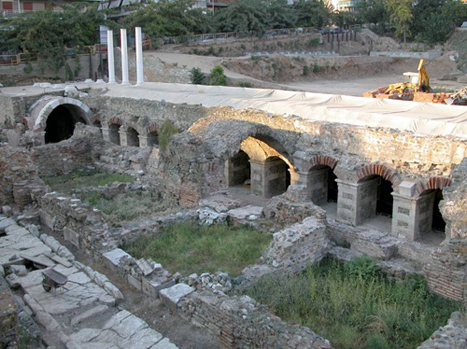
ThessalonicaViewing Acts 17 through the handy filter provided by Derek (and thanks to Paula Fredriksen, Mark Nanos, Magnus Zetterholm, Pamela Eisenbaum, and their presentation on Paul), the blurry, fuzziness of the image of the Jewish leadership of the synagogue in Thessalonica (that you see in Church teachings) and the motives for their jealousy comes into sharp focus.

Of course, this is just one short blog post and a very brief summary of what must have been a very rich and densely packed SBL conference session presented by some of the world’s most outstanding experts on Paul. How much can we read into it?

On the other hand, it’s also adding a link to an ever-strengthening chain of evidence that re-frames Paul as zealous for the Torah, zealous for the Messiah, and uncompromising in his devotion to God as a Jew. A man and a Jewish apostle who demanded no less of others what he expected from himself, especially in the rejection of any compromise with pagan gods and the lifestyle surrounding them.

No wonder Paul was always being beaten, jailed, and thrown out of town by both the Jewish and Roman establishments.

Looking forward to Part 2 of this series written by David Matthews.