Tag Archives: messianic judaism

FFOZ TV Review: Binding and Loosing

FFOZ Bind and LooseEpisode 17: Over the years numerous explanations have been given for what Jesus meant when he talked about binding and loosing, not the least of which is that it refers to restraining demons. In episode seventeen viewers will discover that the context of Jesus’ words is that of a legal nature. When the Jewish background to the terms “bind” and “loose” is examined, Christians can get a clearer understanding of what Messiah was teaching about. Binding and loosing in actuality refers to legal rulings in regards to the Scriptures and not spiritual warfare.

-from the Introduction to FFOZ TV: The Promise of What is to Come
Episode 17: Binding and Loosing

The Lesson: The Mystery of Binding and Loosing

I haven’t given much thought to the traditional Christian understanding of the concepts of “binding” and “loosing” since I only looked at them from a Hebrew Roots/Messianic Jewish driven perspective, however, First Fruits of Zion author and teacher Toby Janicki started with the Christian viewpoint of these ideas. He described a prayer meeting he attended when he was young where the following passage from scripture was read:

Truly, I say to you, whatever you bind on earth shall be bound in heaven, and whatever you loose on earth shall be loosed in heaven.

Matthew 18:18 (ESV)

Toby told his audience that immediately after this verse was read, the people began to pray, “We bind you Satan in the name of Jesus,” suggesting that Matthew 18:18 was a description of Jesus giving the disciples the power to “bind Satan.” I immediately thought of my recent commentary on John MacArthur as well as my conversation with my Pastor on the matter, and how both seem to take the point of view that people can’t really summon the power of the Holy Spirit to make any effective spiritual or physical changes in our world.

the mystery of binding and loosingToby brought up an interesting and useful point to this issue. If Jesus gave his disciples (i.e. “us”) the power to “bind Satan,” why would he give us the power to “loose” him as well? It doesn’t make sense.

Invoking “context is king,” Toby reads from the larger selection of scripture containing the key verse:

“If your brother sins against you, go and tell him his fault, between you and him alone. If he listens to you, you have gained your brother. But if he does not listen, take one or two others along with you, that every charge may be established by the evidence of two or three witnesses. If he refuses to listen to them, tell it to the church. And if he refuses to listen even to the church, let him be to you as a Gentile and a tax collector. Truly, I say to you, whatever you bind on earth shall be bound in heaven, and whatever you loose on earth shall be loosed in heaven. Again I say to you, if two of you agree on earth about anything they ask, it will be done for them by my Father in heaven. For where two or three are gathered in my name, there am I among them.”

Matthew 18:15-20 (ESV)

I’ve accused Christian Bible studies before about “cherry picking” specific verses in the Bible to create a particular picture or doctrine and Toby showed us how true this can be. He deconstructed this passage to show us what really seems to be happening here.

  1. “If a brother sins against you” indicates that an infraction has occurred within the congregational body, committed by an individual.
  2. The procedure of adjudicating the infraction is outlined in first the direct witness approaching the sinner, then with several witnesses, and finally the entire congregation.
  3. If the sinner continues to refuse to repent through each stage of adjudication, the congregational leaders have the authority to remove the sinner from their midst.

It’s no coincidence that it requires two or three witnesses to perform this function:

A single witness shall not stand up against any man for any iniquity or for any error, regarding any sin that he may commit; according to two witnesses or according to three witnesses shall the matter be confirmed.

Deuteronomy 19:15 (Stone Edition Tanakh)

The sequence of events described in Matthew 18:15-20 references a legal proceeding. If an infraction, error, or sin is committed, a set of legal steps is set in motion. First the individual who was offended may attempt to settle it privately, but if that isn’t effective, then two or three witnesses are brought in. Finally, if the matter cannot be settled, the entire congregation makes a decision to set the sinner out.

The two or three witnesses, according to Toby, are actually the authorities within the community who are acting as judges. Of three witnesses, at least two or all three must agree for any legal decision to be binding. This is how a Beit Din of Jewish Rabbinic court operates today. Jesus was giving his disciples the authority to make binding legal decisions for the Messianic community of “the Way.” This is also mirrored today in more than one Christian church system where the board of deacons, elders, or directors make authoritative decisions for the entire church.

Here we have the first clue:

Clue 1: Jesus’s words about “binding” and “loosing” occur in a legal context.
binding and loosing language lessonI was (again) struck by the fact that the church can (quite often) misunderstand the Bible in general and the New Testament writings in particular by ignoring the Jewish cultural, historical, and legal context of scripture. Even fundamentalist and literalist Christians will miss important and even critical details by failing to take the “Jewishness” of the Jewish scriptures (i.e. the Bible) into account.

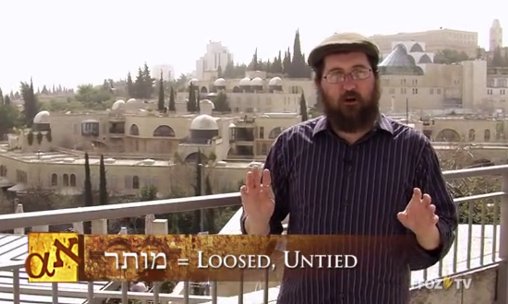
The scene shifts to FFOZ teacher and translator Aaron Eby in Israel in search of our second clue. He takes us through a small vocabulary lesson about the Hebrew words for “loose” and “loosed” as well as “bind” and “bound.” The Hebrew words for “loose” and “loosed” are understood as “prohibit” and “prohibited.” The Hebrew words for “loose” and “loosed” correspond to “permit” and “permitted” (Aaron’s actual description is more detailed and you’ll have to watch the episode to get all the information).

For instance, an Israeli “No smoking” sign in Hebrew can be literally translated as “Smoking is bound” or “prohibited.” Aaron also tells us that in religious Judaism, a particular Rabbi can prohibit or “bind” a particular activity as well as “loose” or permit an activity. A Jewish person unfamiliar with the rulings on a specific topic can consult a Rabbinic sage and receive a judgment on whether it is bound or loosed (prohibited or permitted) but it is bound (prohibited) to go from Rabbi to Rabbi in search of a favorable legal opinion.

While Toby used the English Standard Version of the Bible (purposely) from which to quote scriptures, Aaron backs up his point by referencing the Delitzsch Hebrew Gospels to read from Matthew 16:19 (a scripture we looked at just last week):

I will give you the keys of the kingdom of Heaven, and all that you forbid on earth will be forbidden in heaven, and all that you permit on earth will be permitted in heaven.

Back with Toby in the studio, he reads from the DHE Gospels, as Aaron did, but quotes Matthew 18:18 again:

Amen, I say to you, all that you forbid on the earth will be forbidden in heaven and all that you permit on earth will be permitted in heaven.

If a matter is legally decided by two or three judges or authorities within the congregation on earth, then it will be supported by the Heavenly authority as well (which makes me wonder how all that works today with so many different and contradictory Christian and Jewish groups, each issuing authoritative legal rulings for their congregations…which one(s) does/do Heaven support?).

We now have the second clue for this program:

Clue 2: “Bind” and “Loose” are figures of speech in the Hebrew.

I probably would have said that “Bind” and “Loose” are legal terms in ancient and modern religious Judaism, but you get the idea.

I was wondering why Toby needed a third clue since it seemed to me the point was well made, but he continued by quoting from the Mishnah an example of a legal ruling about fruit grown in Israel, which needs to be tithed, or grown outside Israel, which does not need to be tithed. I’ll skip the details because you will want to watch this episode without knowing everything it teaches ahead of time.

Toby also referenced Acts 15 where the Messianic community exercised their authority to bind or loose in relation to the question of whether or not Gentiles could be allowed into the community without converting to Judaism. Should Gentiles by bound or prohibited from formal entry until they legally converted, or should they be loosed or permitted to join without such a conversion?

An examination of the Acts 15 process (and remember, Luke only recorded a small summary of what was assuredly a much longer and involved proceeding) illustrates the matter of deliberations by those who possessed the authority given them by the Master, and the ultimate decision was to loose the Gentiles from conversion and full Torah obligation, although they were bound to what we refer to as the “four essentials” in order to enter (as an interesting exercise, you can try reading Acts 15 and see if you can determine the actual authorities involved [two or more judges] in making the legal ruling about the Gentiles).

Toby didn’t put it into these terms, but the Council of Apostles and Elders in Acts 15 established halachah or a legal ruling about the procedure of Gentile admittance into “the Way.”

Clue 3: Examples from Rabbinic literature and the New Testament support the two previous clues and their conclusion.

Toby further references Isaiah 11:3-4 to establish that Messiah will also “bind” and “loose” during his reign as King and Judge, as well as Isaiah 2:3-4 to make a similar illustration.

At the end of the episode, Toby made a point of trying to “smooth things over” for whoever in his traditional Christian audience might be disappointed that they didn’t really have the power to “bind Satan” based on Matthew 18:18. He reminded everyone that elsewhere in scripture, Jesus gave the disciples the power to cast out demons, and in Revelation 20:1-2, Satan will be literally bound. I again thought of MacArthur and my Pastor, both of whom probably never believed that Christians have had the power to bind or cast out demons after the close of Biblical canon.

What Did I Learn?

ancient_beit_dinI was again taken by the fact that without an understanding of the first century Jewish Rabbinic, legal, and religious context and comprehension of the words of Jesus, it is quite possible and likely that the Church misunderstands large portions of the Biblical text. This supports my ongoing discussion with my Pastor that we grossly misunderstand Paul in those sections of scripture where he seems to denigrate the Torah and call for its practice to be abolished or “put on hold” by Jewish and Gentile disciples (not that the Gentile disciples were ever “bound” to Torah in the manner the Jewish people were).

Without the Mishnah as well as a historical understanding of how Jesus’s immediate Jewish audience and the Jewish readers of Matthew’s gospel would have comprehended these words, we will fail to learn what Jesus (or any of his apostles or disciples) are trying to teach us today. We will anachronistically read the text and make it say what translates from the Greek to the English to support erroneous doctrine. We’ve seen over the majority of the Church’s supersessionistic history how making such errors has led to Christianity as a whole committing heinous atrocities, all in the “name of Christ.”

I also saw a minor but interesting point in Isaiah 2:3:

Many peoples will go and say, “Come, let us go up to the Mountain of Hashem, to the Temple of the God of Jacob, and He will teach us of His ways and we will walk in His paths. (emph. mine)

Since the word “halachah” refers to a way of walking, this also seems to link up to learning the legally binding methods of behaving in worship and devotion to the God of Jacob. In Messianic days, we, the “many peoples” from the nations, will go up to the “Mountain of Hashem,” the Holy Temple in Jerusalem, and learn the Torah of God from Messiah.

I’ve mentioned before that I believe the Acts 15 halachic decision binds Gentiles differently to the Torah than it does Jews, but it will be interesting to see how or if any of that changes once Messiah is ruling from the Throne of David in Jerusalem. I can’t wait to find out.


The Mystery of Romans: A Review of Chapter One

The Mystery of RomansMoreover, Paul does not seem to be confronting an inflated view of the Torah in Rome among the Christian gentiles (“judaizing”) as is often assumed. Instead, he confronts the failure of the Christian gentiles in Rome to respect the role of Torah in the life of Israel as God’s special gift; in fact, he emphatically elevates the status of the Torah. Note, for example, the great advantage of the Jewish people is “that they were entrusted with the oracles of God” (3:2), and elsewhere in the litany of Jewish privileges he includes “the giving of the Law” (9:4); that the “Law is spiritual” (7:14) and again, “the Law is holy, and the commandment is holy and righteous and good” (7:12); and further that “the gifts [which clearly included as central the Law; cf. 9:4] and the calling [Israel’s election] of God are irrevocable” (11:29). Paul refers to the “Law of faith (3:27) and asserts that he is not teaching that faith nullifies the Law: “Christ is the end [goal] of the Law” (10:4). In fact, he even regards the “love” he is calling for among his Christian gentile readers “the fulfillment of the law” (13:8-10; cf. 8:4), not a demonstration of its failure but the embodiment of its true aims.

-Mark D. Nanos
“Chapter 1: To the Jew First and Also to the Greek,” pg 22
The Mystery of Romans: The Jewish Context of Paul’s Letter

No, I haven’t given up on my serial review of the articles in First Fruits of Zion’s (FFOZ) periodical Messiah Journal issue 114, but I’m also reading the Nanos “Romans” book (his book on Galatians is waiting in the wings) and I want to discuss my impressions so far (just gotten through Chapter 1 at this point).

As I read, I usually keep some post-it notes and a pen handy to take notes and stick on the appropriate pages for later reference (beats marking up the inside of the book with my poor handwriting). All I’m going to do here is review my notes and do a “data dump” into this blog post, along with a few of my thoughts on the matters brought up. To start off, I can certainly see why Nanos is considered “Messianic Judaism-friendly”.

For instance, in footnote 5 on page 23:

I don’t mean to suggest the doing of the Law was an “entrance requirement” for salvation, but rather the application of the Law and Jewish customs to the lifestyle of those believing in Jesus as the Christ; for the Jew believing in Christ Jesus would continue to be a Jew and thus obey the Law, and the gentile believing in Christ Jesus would continue to be a gentile and thus not under the Law, however, the gentile would now through Christ Jesus have a new relationship with Israel that made it necessary to respect the “rules of behavior” that had been developed in Judaism to define the minimal requirements of Law and custom for the “God-fearing” gentile wishing to associate with God and his people. Thus the phrase “Law-respectful gospel” is offered here to contrast with the “Law-free gospel” usually assumed to represent Paul and Pauline Christianity, incorrectly in my opinion.

A lot is packed into that one short paragraph regarding Nanos and his opinions on the relationship Jews and Gentiles in Messiah have with Torah, the Gospel, and each other. He is definite that the “Messianic Jew” remains a Jew and thus fully bound to the Torah of Moses, while the Gentile is bound, not to Torah as such, but to the essentials of the Acts 15 legal ruling that authoritatively established the halachah for Gentile admission into “the Way.”

Nanos, in my opinion, is also correct in saying that much of Christianity believes that Paul established a “law-free gospel” for both Gentiles and Jews in Christ and that the Church’s viewpoint has largely ignored what Paul was really saying. The quote from page 22 of the Nanos book above shows multiple examples of how Paul had a high view of Torah for the Jewish people in Messiah (and all of Israel). We also see from the “footnote 5” quote that Gentiles were admitted into the community of Messiah but with a different legal status than the Jews, one that did not make them “Israel” but that affirmed the Jewish people as “Israel” and “God’s people”. Gentiles are “associating” with God and Israel within the Messianic body.

That’s disturbing language for some Christians and Hebrew Roots adherents as it appears to develop “classes” within the body of Messiah, with the Jews in the ascendant position and the Gentiles being subordinate to them. My Pastor is an example of a Christian who believes Jews and Gentiles are totally uniform in identity and status based on the absence of the Law, while many in Hebrew Roots believe in the same uniformity, but based on an identical binding of Jew and Gentile to Torah.

Nanos also associates “Law-respecting lifestyle” for the Gentile with the concept of halachah, which literally means “walking” and denotes rules of behavior, usually as legally defined within a Rabbinic Jewish court system. As Nanos says, “it denotes rules of behavior…and is a frequent idiom in the Bible as well for discussing proper behavior” (pg 22, footnote 6). This again harkens back to the Acts 15 decision for Gentile disciples, which Paul appears to be upholding in his letter to the Romans (chapters 5-16, according to Nanos, and particularly chapter 14).

Upon his arrival he would execute his customary two-step pattern to ensure the restoration of the dispersed of Israel in the synagogues of Rome first, thereafter bringing the good news to the gentiles also, which was, surprisingly, a necessary part of the process of Israel’s restoration, a “mystery” in which those addressed shared an extremely significant role.

-Nanos, pg 26

everlastingI’ve been writing about the “extremely significant role” of gentile Christians as “a necessary part of the process of Israel’s restoration” ever since I attended my first FFOZ Shavuot conference in May of 2012. I often include a link to my blog post Provoking Zealousness as an illustration of this principle. I originally wondered where Boaz Michael came up with such a concept, and I can see now that in part, it must have come from the research and writing of Mark Nanos.

In May 2012, this whole idea of the Gentiles exalted role in relation to Israel was as clear as “Mississippi mud” to me, but I chose to struggle with it rather than discarding it out of hand. I’m glad I did. Things are much clearer for me now.

Paul’s concerns are those of a Jewish missionary, and his message and framework of thinking are those of one who considers himself working within the historical expectations of Israel — the Savior of Israel has come to Zion to rebuild the tabernacle of David and to bring light to all the nations — for the One God of Israel is the One God of the whole world.

-ibid, pp 26-7

I don’t know if Boaz Michael was thinking of Nanos when he conceived of and authored his book Tent of David: Healing the Vision of the Messianic Gentile, but the connection seems very apparent, and dovetails well with Boaz’s message to the “Messianic Gentile” audience of the book in how we have a critical role in restoring Israel that must be communicated to our traditionally Christian brothers and sisters in the Church.

Notwithstanding the many historical concerns associated with harmonizing the Paul of Romans with the Paul of Luke-Acts (note the conclusion of Beker, “Luke’s Paul as the Legacy of Paul,” p. 511: “The history of research has made it abundantly clear that the attempt to harmonize the historical Paul with the Paul of Luke-Acts has come to a radical end”), features of Luke’s presentation of Paul’s view of Law-respectful behavior and his two-step missionary pattern are to be noted in the Paul we meet in the text of Romans (see particularly chapters 4 and 5 herein). Note the challenge of Jervell, “Retrospect and Prospect in Luke-Acts Interpretation,” on p. 403: “What made the Lucan Paul possible? We have at least three different Pauls: The Paul of the Pauline letters, the Paul of Acts, and the Paul of the deuteropauline letters and Pastorals…”

-ibid, pg 28, footnote 13

I include this note here to illustrate that the confusing image I get of Paul in different parts of the New Testament isn’t some failing on my part. New Testament scholars experience Paul this way too, and struggle to make sense of how one man can present himself or be presented in such contradictory ways. Just who the heck is Paul, anyway? If we are to accept that the New Testament is the inspired Word of God and therefore “profitable for teaching, for reproof, for correction, for training in righteousness,” (2 Timothy 3:16) then we must believe that all that we read of Paul and about Paul is correct and consistent with a single man, who himself was consistent in regard to his faith in Messiah and his approach to the Jewish people, the Torah, and God.

So if the fault in understanding Paul isn’t to be found in an inconsistent and flawed New Testament record, it must be found in ourselves and how we are reading that inspired record. Where is the Holy Spirit when we need Him the most?

These observations challenge the prevailing views of Paul’s purpose for writing to Rome and, necessarily, the hermeneutical assumptions that lie behind the interpretation of Romans. Was Paul opposed to the practice of the Law and Jewish customs in the church in Rome? Did he believe that the church needed to sever ties with Judaic notions of righteous behavior? Was legalism his central concern, that is, faith versus works or grace versus the law? Was the church a completely separate institution from the synagogue that must seek to assert a Law-free interpretation of salvation and Christian behavior over against Judaism?

-ibid, pp 28-9

My Pastor would probably say “yes” to answer all those questions and then move on as if nothing were wrong, but I can’t do that. Nanos can’t either.

This reading of Romans suggests that the traditional answers to these questions are inadequate and that the historical situation addressed in Romans should be approached in a vastly different light than it has been in the past. For example, the message derived from Paul’s letter to Galatia should not be allowed, as it has so often in the past, to dictate the probable interpretation of Paul’s intentions toward Rome. The implied audience and the circumstances are quite different, including the important fact that Paul had an instrumental role in the development of the community he wrote to in Galatia while he had never been to Rome. Galatians was written to confront Christian gentiles attempting to “judaize,” and thus, in the opinion of Paul, to compromise the universal application of the promised salvation to all people equally through faith in Jesus Christ, whether Jew or gentile, for Paul emphatically argued that the One God of Israel was also the One God of the nations equally accessible to gentiles through faith in Jesus Christ.

ibid, pg 29

Mark NanosTraditional answers are inadequate and we cannot apply the situation and circumstances that inspired Galatians to what we see in Romans. We cannot ignore the context of each letter, the period of time in which each one was written (in all likelihood, Galatians was written before the Acts 15 decision and Romans afterward), Paul’s intent, his state of mind, the identity of his audience, and how they likely would receive and comprehend Paul’s words within their historic, cultural, linguistic, educational, and national context…a context which we either largely lack or ignore in favor of our historical, cultural, and traditional interpretation of Paul within the Christian Protestant church.

Nanos goes on to give a smart summary of why Paul wrote Galatians and how his motivation was different in writing Romans based on different circumstances. The Gentiles in the Galatian churches were somehow led to believe that only by converting to Judaism and observing all of the Torah mitzvot in the manner of the Jews could they be justified before God. This may have been driven by Jewish ethnocentrism or the belief that the Jews and only the Jews had the inside track with God, the Messianic Gospel notwithstanding.

In Romans, the problem seemed to be the opposite among the Gentiles. They believed that the grace of Jesus Christ diminished if not extinguished the binding of the Jewish believers and non-believers to Torah and even watered down any Gentile sensibilities required for Gentile/Jewish fellowship within the synagogue. There seems to have been a dynamic play between the Gentile position and the Jewish “pushback”, with each population asserting that they had the upper hand, the Gentiles because of grace and the Jews because of the Law. Paul was trying to “balance both sides of the equation,” so to speak. No easy task as anyone from the modern Messianic Jewish movement has discovered in speaking with our more traditional Christian brothers in the Church.

These traces have survived in the texts of Romans and the Apostolic Fathers in spite of Roman Christianity’s later disregard for these Jewish roots as it developed into the thoroughly gentile organization (the “gentilization” of the church).

-ibid, pp 32-3

It wasn’t that long ago that I had my own gentilization experience in my Sunday school class, and I can tell you it was disturbing. According to Nanos, we see the first, encroaching shadows of this behavior among the Gentile disciples in the synagogue in Rome, and it has been “snowballing” ever since.

Nanos repeatedly declares in this chapter of his book that Paul’s letter to the Romans was a reminder to the church in Rome, a large group of Gentiles associating with Jews under the authority of the synagogue, “of the importance of their ‘obedience of faith’…to clarify just how important the halakhah that had been developed in the synagogues of the Diaspora to define the behavior incumbant upon righteous gentiles really was now for redefining the Christian gentiles…” (ibid, pg 34).

In modern Judaism, there is also the concept of righteous Gentiles usually associated with those non-Jews who served some role in rescuing Jewish victims of the Nazi Holocaust, but a Gentile can be considered righteous as a Noahide as well. I find it rather illuminating to classify the status of the early Gentile believers in Jesus the Messiah as “righteous Gentiles” seeing that no one, Jewish or Gentile, has any righteous standing before God apart from faith in Messiah.

On page 37, Nanos states that the Gentile believers were “equal coparticipants in the blessings of God through faith without the need to become Jews.” He goes on to say that the Gentile “coparticipants” possessed an “explicit obligation…to serve non-Christian Jews in love by subordinating themselves to the authority of the synagogue…” inserting the idea that the problem with the Jewish/Gentile relationship in the synagogue did not only involve believing Jews. Was this the first recorded occasion of (Gentile) Christians playing the “grace” and “salvation” card in a game with the Jewish people, asserting superiority over the ancient people of God? Many Christians have historically played that card and many Churches today continue to do so, much to their shame.

However, Romans includes the unmistakable caveat that while Israel’s historical place is preeminent it is not exclusive, and while Christian gentiles must practice the intentions of the apostolic decree they must not misunderstand this and assume, as some were being tempted to assume in Galatia, that they are thereby in need of placing themselves fully under the Law…in order to be equal coparticipants in the blessings God promised to Abraham and revealed in Jesus Christ for all who believe in Him.

-ibid, pp 38-9

returning-the-torahI know I continue to repeat myself, but how like the current difficulties we experience in the Messianic movement were the struggles of Paul and the “church” in Rome. Paul could see clearly their dilemma and ours, but in the final chapter of his life, he was helpless to stop the rift between Gentiles and Jews from forming and ultimately dividing them and us. The question is, can we succeed where Paul (apparently) failed? Paul knew the answers we struggle so hard to acquire and yet he still couldn’t stop destiny’s cruel hand. On the last page of this chapter (40), Nanos reiterates what he said before about the true role of the Gentile in the Jewish community of “the Way”:

…Paul’s intended trip to Rome to bring about in Rome the beginning of the “fulness of the Gentiles.” This procedure would mark, paradoxically, the end of the suffering of the part of Israel presently hardened as it triggered the saving jealousy of “some of them,” resulting in the eschatological restoration of “all” of Israel — for of at least one mystery Paul was certain: “all Israel will be saved.”

The only hope Christianity and the Messianic Jewish movement has of coming to terms and then to unity is in the realization of Paul’s goal for the Romans, the proper orientation of the Gentile believers, not only to Messianic Jews, but to Israel as a whole, and that by provoking Jewish “zealousness” to repentance and Torah, we will not only help in sealing that ancient and bleeding wound, but summon the coming of Messiah, Son of David, may he come soon and in our day.

If this is what only one chapter of the Nanos “Romans” book holds, I’m looking forward to reading (and reviewing) the rest of it.

What Church Taught Me About Jews and the Torah

paul-editedThen after an interval of fourteen years I went up again to Jerusalem with Barnabas, taking Titus along also. It was because of a revelation that I went up; and I submitted to them the gospel which I preach among the Gentiles, but I did so in private to those who were of reputation, for fear that I might be running, or had run, in vain. But not even Titus, who was with me, though he was a Greek, was compelled to be circumcised.

Galatians 2:1-3 (NASB)

Paul came also to Derbe and to Lystra. And a disciple was there, named Timothy, the son of a Jewish woman who was a believer, but his father was a Greek, and he was well spoken of by the brethren who were in Lystra and Iconium. Paul wanted this man to go with him; and he took him and circumcised him because of the Jews who were in those parts, for they all knew that his father was a Greek.

Acts 16:1-3 (NASB)

I know I’ve written in this before, but during Pastor’s sermon in church this morning (as I write this), I had a small revelation. Pastor was preaching on Acts 16:1-5 and in the course of his preaching, I had plenty of material to take notes on and plenty of points where I know Pastor and I don’t see eye to eye.

But of course, he had to bring up the issue of Paul’s circumcision of Timothy, even though he believes that after the crucifixion of Christ, the Jewish believers were no longer obligated to observe the Torah mitzvot. Fortunately, he contrasted the circumcision of Timothy with the following:

It was for freedom that Christ set us free; therefore keep standing firm and do not be subject again to a yoke of slavery. Behold I, Paul, say to you that if you receive circumcision, Christ will be of no benefit to you. And I testify again to every man who receives circumcision, that he is under obligation to keep the whole Law. You have been severed from Christ, you who are seeking to be justified by law; you have fallen from grace. For we through the Spirit, by faith, are waiting for the hope of righteousness. For in Christ Jesus neither circumcision nor uncircumcision means anything, but faith working through love.

Galatians 5:1-6 (NASB)

We are pretty sure Paul wrote his letter to the Galatians before the Acts 15 decision of the Jerusalem Council and thus before the events involving Timothy in Acts 16. But comparing these two statements makes Paul seem like a hypocrite, doesn’t it? If circumcision and non-circumcision mean nothing, why did he circumcise Timothy? Because he gave into Jewish peer pressure and was worried about what Jewish people would say of Timothy when he was accompanying Paul? That doesn’t sound like the no-nonsense, no compromises Paul that I know.

Remember, the question in Acts 15:1-2 was whether or not the Gentiles had to be circumcised in order to enter into the Jewish religious community of “the Way” as co-participants and disciples of Jesus. The Council’s final legal decision (Acts 15:19-22) which was recorded in a letter (Acts 15:23-29) that was later transmitted to the various Gentiles in different communities in the diaspora (Acts 15:30-32, Acts 16:4-5). Gentiles were allowed to enter the Messianic congregation without being circumcised.

It’s been said in some Christian commentaries that Paul also encouraged Jews to give up on circumcising their children. He was even accused (falsely) of this by other Jews (Acts 21:21). In trial after trial, Paul defended himself and said he had done nothing against Jewish or Roman law (Acts 25:8, 28:17). In his sermon today, my Pastor even agreed that it was right for Jewish believers to be circumcised as a requirement of the Abrahamic covenant (Gen. 17:9-14). However, he says that the Abrahamic and Mosaic covenants aren’t directly connected and while the Abrahamic covenant was meant to be permanent, the Mosaic was always intended to be temporary.

Except he’s got a few problems.

The first is that in the Tanakh (Old Testament), no where do I read that it was God’s intension to “expire” the Torah upon the entrance of Messiah (or at Messiah’s death). In fact, I get the very clear intension that God took the Torah and Torah observance by Jews quite seriously, and meant for Jewish Torah observance to be continual.

Also, there’s what Paul said in Galatians 5:3:

And I testify again to every man who receives circumcision, that he is under obligation to keep the whole Law.

Paul inexorably links circumcision (he was talking about ritual conversion to Judaism, but I’ll also read into it the circumcision of people born Jewish) to obligation to observe all of the Torah mitzvot.

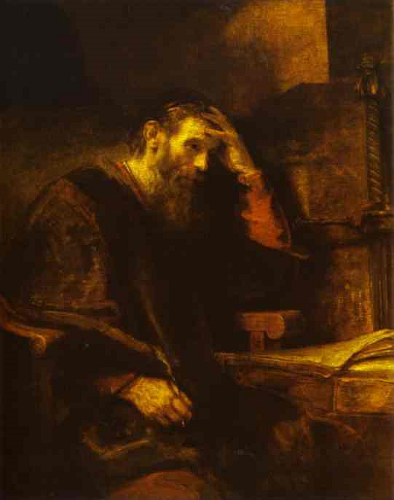
Paul by RembrantIn another blog post, I attempted to establish a continuing Jewish obligation to observe the mitzvot based on the past commands of God in the Torah and the future Messianic prophesies we read in the Tanakh. Dr. Stuart Dauermann, interestingly enough, posted something quite similar on Facebook (which I can’t find at the moment) making the same argument.

The “weakness” of my argument, if you will, was in not being able to locate support in the Apostolic scriptures, especially something written by Paul, that firmly establishes continued Torah observance for Jews during that time frame and extending into our present era…that is, until now. Ironically, I have my Pastor to thank for making the connection, not that he meant to.

In Galatians 5 and in other portions of that letter, Paul firmly links circumcision to Torah observance, warning the Gentiles (and presumably the Jews) in the churches in Galatia, that being ethnically Jewish or a Jewish convert does not justify you before God. Only faith and grace does that (salvation is not contingent upon being circumcised or not being circumcised). He also says that anyone who is circumcised (because they are a Jewish male or are a Gentile male undergoing conversion) is obligated to observe the entire Torah. So far so good.

Next, in Galatians 2, we see Paul deliberately using the Greek man Titus as an example of a Gentile believer who does not require circumcision (conversion to Judaism and obligatory Torah obedience) in order to be saved and be an equal co-participant in the community of “the Way.”

In Acts 15 and confirmed in Acts 21:25, we see a binding legal decision rendered by the authorities of the Apostolic Council in Jerusalem that the Gentiles do not have to be circumcised (convert) and obey the Law of Moses in order to be justified before God and to be co-equal community members.

And in Acts 16 Paul circumcises Timothy because he has a Jewish mother and, if we believe Paul in Galatians 5, then the act of circumcision (which is a covenant requirement for all Jewish males) must also confirm that Timothy is (and probably always was since he’s considered Jewish) obligated to keep all of the Torah.

We don’t know the reasons he wasn’t circumcised on the eighth day. Timothy’s mother married a Gentile. Perhaps his Greek father forbade it. Perhaps Timothy’s mother was an “assimilated” Jewish person, living in the Diaspora (was this a problem for many Jews living in the Diaspora in those days?), having fallen away from Jewish practices (which seems odd, even to me, because she was such a faithful believer and Jewish faith in Messiah at that point in history was a very Jewish way of life). We probably won’t know the answer to these questions this side of Messiah’s return, but we do know that Paul circumcised Timothy because his mother was Jewish and everyone knew Timothy’s mother was Jewish.

And this isn’t the only example of a Jewish man being circumcised “late in the game,” so to speak.

Now it came about at the lodging place on the way that the Lord met him and sought to put him to death. Then Zipporah took a flint and cut off her son’s foreskin and threw it at Moses’ feet, and she said, “You are indeed a bridegroom of blood to me.” So He let him alone. At that time she said, “You are a bridegroom of blood”—because of the circumcision.

Exodus 4:24-26 (NASB)

Moses too was living apart from his people. He married Zipporah, a Midianite woman, fathered a son by her, lived among Midianites, was a shepherd in Midian for forty years…

…and in all those years, he never circumcised his son. Even Zipporah knew better, at least in time to prevent a disaster.

So I’ll suggest that we can’t say Timothy not being circumcised on the eighth day was incredibly unusual, especially for Jewish people living away from the Jewish community (and according to some news articles, this is a problem among the Jewish people today).

I know, my Pastor isn’t likely to accept my arguments, but I think they’re good ones. I think they should be taken seriously. I think we can establish from the Biblical record, in Torah, in the Prophets, and in the Apostolic Scriptures, that the Torah was founded by God for the ancient Israelites and for all their descendants:

Now not with you alone am I making this covenant and this oath, but both with those who stand here with us today in the presence of the Lord our God and with those who are not with us here today…

Deuteronomy 29:14-15 (NASB)

Rolling the Torah ScrollVirtually all reliable commentators agree that the ones with whom the covenant was made, yet who were not there at Sinai, were all the future generations of Israel, the Jewish people, projected forward in time.

The Torah speaks of the expectation of Israel to observe the Torah of Moses from the point it was given at Sinai and into the future. The Prophets speak of the future Messianic Age, where Torah will be observed as it was in days of old, and Messiah, the Prince, will offer sacrifices at the Temple. And Paul says that anyone circumcised, which is definitely any convert to Judaism and any Jewish male under the covenant obligation to be circumcised, is also obligated to observe the entire Torah. James and the Council made a legally binding ruling that only the Gentiles in the Jewish movement of Messiah were exempt from circumcision and full Torah obligation.

It really doesn’t get more plain than that. We have witnesses in the ancient past at Sinai, in the day of Paul, and prophetic witnesses that speak to the future, all of them, every single one, telling us that those obligated to be circumcised because of Abraham, the Jewish people, must all perform the Torah mitzvot because of covenant requirements.

All of the physical descendants of Abraham, Isaac, and Jacob have a covenant obligation to be circumcised. The descendants of Jacob stood at Sinai and received the Mosaic covenant obligation. The later covenant adds to the earlier one. Paul understood that one leads to another. The Church must catch up with this understanding.

It’s all in the Bible. All you have to do is look.

Fidelity: Commentary on Haim and Dauermann in Messiah Journal 114

mj114Some years ago Dr. Mark S. Kinzer coined a term for the new and revolutionary approach that many Jewish followers of Yeshua have adopted in regard to their relationship with Judaism. The term “post missionary Messianic Judaism” (PMJ) initially caused ripples that have grown into waves and that we are bringing about a paradigm shift among Messianic Jews. The PMJ paradigm sets a new trajectory for the community of Jewish followers of Yeshua, establishing its role within Judaism and its partnership with the faithful among the nations. In this article, I will attempt to convey my understanding of PMJ, its crucial role, and its ramifications or the Messianic movement.

-Haim Ben Haim
“Postmissionary Messianic Judaism in Practice,” pg 42
Messiah Journal Issue 114/Fall 2013

The Jewish people are “us,” not “them.”

-Dr. Stuart Dauermann
“The Jewish People are Us — not Them,” pg 55
Messiah Journal Issue 114/Fall 2013

Both Haim and Dauermann have written long and densely packed articles on interlocking topics for First Fruits of Zion’s (FFOZ) current issue of their landmark periodical, Messiah Journal. I have to admit that with my busy work, writing, and reading schedule this past week, I’ve only had the opportunity to scan their write ups. I’m looking forward to giving them the attention they deserve and perhaps even composing a more detailed review.

However, I noted that Haim provided something that may be useful in my weekly meetings with My Pastor. Pastor has repeatedly asked what the current function and use of the Torah is in the lives of the Jewish people, particularly Messianic Jews. It is his opinion that the Torah, however it may be defined, has limited to no use in the current age thanks to the classic Christian interpretation of key passages in the letters of Paul.

Not being Jewish and certainly not being a Torah observant Messianic Jew, it’s difficult for me to articulate the lived experience between the Jewish people and the mitzvot. Pastor lived in Israel for fifteen years, so if either one of us should have the experience of observing the relationship between the Torah and the descendants of the children of Israel, it should be him. However, Orthodox Judaism and the myriad complexities of modern Torah observance, have become a major stumbling block. It’s time to make things a little more manageable.

The implementation of PMJ involves all parts of Jewish life. By way of example, we will briefly consider a few of those institutions that comprise the life of a healthy, vibrant Jewish community: Shabbat observance, festivals, kashrut, traditional prayer, the Torah service, gemilut chasidim, tikkun olam, solidarity within modern Israel, the bar/bat mitzvah ceremony, outreach, and Jewish education.

-Haim, ibid pg 48

In a nutshell, this list is a very good place to start in explaining the role of Torah in the life of a Messianic Jew who is facing his faith in Messiah as a Judaism rather than a Christianity.

jewish-christian-intermarriageI won’t attempt to replicate all of the details regarding each of these institutions and elements of Jewish life and community and encourage you to get a hold of a copy of Messiah Journal and pour over these intricacies yourself. Two-thousand years of Gentile Christianity in all of its forms have cemented the idea that the worship of the God of Israel and having faith in the Jewish Messiah King are completely non-Jewish for both Gentiles and the Jewish people, thus any Jewish disciple of the Jewish Messiah must, by (Christian) definition, renounce all of Judaism and being Jewish (with perhaps some lip service relative to being a “Hebrew Christian”) and emulate the Goyim.

This is not the way it was prior to the destruction of Herod’s Temple and it is my firm belief it will not be that way when Messiah returns. Christians will have much to repent of on the day Moshiach ascends the throne of David in Jerusalem.

To put a different slant on the topic, Dr. Dauermann (pp 55-6) offers seven core values designed to shape a mature Messianic Judaism:

  1. Messianic Judaism is a Judaism and not a cosmetically altered “Jewish-style” version of what is extant in the wider Christian community.
  2. God’s particular relationship with Israel is expressed in the Torah, God’s unique covenant with the Jewish people.
  3. Yeshua is the fullness of Torah.
  4. The Jewish people are “us,” not “them.”
  5. The richness of the rabbinic tradition is a valuable part of our heritage as Jewish people.
  6. Because all people are created in the image of God, how we treat them is a reflection of our respect and love for him. Therefore, true piety cannot exist apart from human decency.
  7. Maturation requires a humble openness to new ideas within the context of firmly held convictions.

Although Dr. Dauermann’s article focuses on the fourth principle in his list, I want to touch briefly on the third element: Yeshua (Jesus) is the fullness of Torah.

When My Pastor hears that Jesus fulfilled the Torah, he understands that to mean once Jesus arrived, the Torah was no longer necessary and thus was rendered inert, at least until such time as Ezekiel’s Temple is rebuilt and the numerous prophecies in the Tanakh require all of Israel to resume the Temple service and most if not all of the other mitzvot.

I’ve tried in different ways (unsuccessfully) to reframe “fulfilled” in this context, but the other night, unable to sleep, inspiration seized me.

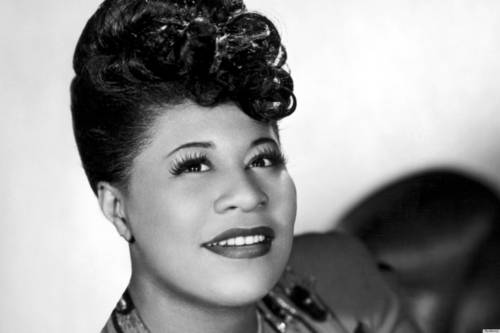
You may not be old enough to remember a television commercial for Memorex tape cassettes featuring the wonderful Ella Fitzgerald. The commercial played part of a song recorded by Ms. Fitzgerald and then the artist herself singing the same notes (I’m writing this from decades old memory and only later did I insert the link below to the actual video), apparently shuttering a glass in the process. The idea was to show that the fidelity of the recording was so near the original (Ms. Fitzgerald’s actual voice) that it too could shatter glass. The tagline for the commercial was, Is it live or is it Memorex (link to YouTube video).

If the recording of Ms. Fitzgerald singing is high fidelity, it is still not her. It is as if the recording “points” to her, the perfect original. In singing live, you might say Ms. Fitzgerald “fulfills” the recording, since she is the perfect and absolute embodiment of what was recorded on tape.

ella_fitzgeraldThis doesn’t render the recording useless and inert. After all, how many of us could simply accompany Ms. Fitzgerald around all of the time in the hopes she would burst into song? However, we can carry around a recording of her music so that we can access and enjoy her singing at will.

Like Ms. Fitzgerald (in a sense), Yeshua is the original, the perfect observer of Torah, the absolute firstborn Son of Israel, the goal all other Jewish believers aim toward in their lives, their righteousness, and their observance of the mitzvot. Like Memorex, no Jewish person is quite like the original, but the goal is to achieve as high a fidelity to that original as possible.

I like to compare our work at First Fruits of Zion and Vine of David to that of carpenters building a home. After all, we are disciples of a carpenter.

Our work can be compared to a building contractor who builds a “Spec” home. A “Spec” home is built on “speculation.” In other words, a builder builds a home with the features he believes will eventually appeal to buyers, but he has no guarantee of a sale. Years ago, on a conference call, my colleague D.T. Lancaster encouraged our staff to take a high view of Messianic Judaism. It is easy to get discouraged with the circus of mayhem and competing religious ideologies that calls itself Messianic Judaism. My colleague said, “When we speak of Messianic Judaism we always speak of the ideal — the way it should be. When we create our resources we create materials for a community that does not yet exist — but the materials will help to bring it into existence.”

-Boaz Michael from the Director’s Letter
“Unless the LORD Builds the House”
Messiah Journal 114, pg 8

When I speak in glowing terms of Messianic Judaism, either online or in person, I am sometimes accused of speaking to a fantasy rather than the lived reality we currently experience. This is not quite true however. I take some solace in Boaz’s words that in my attempting to uplift both the principles and practice of Messianic Judaism for Jewish believers, I am in some manner, summoning the future while living in the present. I am addressing the ideal as it will be when Messiah returns, rather than the imperfection we see in the world today.

But I have to start somewhere.

You’re on the right path. Dividing a mitzvah into small steps makes the goal much more attainable. Taking things slowly also adds the important element of stability to your journey towards living a Torah lifestyle.

But don’t look at it as a compromise. Here’s why:

Suppose an adult wishes to learn a new language. Would he be compromising his mission by beginning with basic simple words? What about a child beginning the study of math. Is he compromising by starting with simple arithmetic?

Of course not. It is quite clear that neither “c‑a‑t spells cat” nor 2 + 2 = 4 is the ultimate goal. But they are necessary steps in the right direction.

Mitzvahs are no different.

Regarding mitzvahs, there’s an additional component: Torah is not all or nothing. Each mitzvah is a full-blown relationship with the One Above. Each time we eat kosher, each time we put on tefillin, each time we observe Shabbat, something extraordinary occurs.

-Rabbi Yisroel Cotlar
“Can I Go Kosher at My Own Pace?”
Chabad.org

going_kosherI can only imagine that it may be rather daunting for a Jewish person attempting to improve his or her observance of the mitzvot. If you didn’t grow up in an observant home but you want to live a lifestyle more consistent with the Torah, how do you approach it? If you want to start keeping kosher, do you have to rush out and buy all new pots, pans, and dishes, learn the procedure for kashering your kitchen, and make an immediate and 100% transition between one day and the next?

Rabbi Cotlar’s advice is plain and comforting and it speaks of a Jewish believer’s approach to Messianic Judaism. You have to start somewhere. You don’t have to have perfect or even high fidelity to the original right away.

While Haim, Dauerman, and Boaz (and Rabbi Cotlar) are speaking to a primarily Jewish audience, I want to speak to the Christians (including those in the various branches of the Hebrew Roots movement) who have been critical of Messianic Judaism in general and the PMJ approach in particular. That Jewish people in the Messianic movement aren’t “perfect” in their observance is no grounds for throwing the baby out with the bath water, so to speak.

The Torah isn’t all or nothing (and I know someone is going to erroneously reference James 2:10 which only applies if you are attempting to justify yourself before God by your Torah observance, not if you are observing the mitzvot already “saved by faith”). Children growing up in a Jewish home are not expected to master all of the mitzvot by the time they’re toilet trained. Any learning is a slow, developmental progression.

And yet Christianity criticizes and judges Messianic Judaism for an imperfect Jewish lifestyle and thus deems the Torah obsolete, as if we have the right to make such a decision.

Twenty centuries ago, the Jewish religious stream of “the Way,” at the direction of Messiah and by approval of the Holy Spirit, commanded the Jewish disciples to do something that had never been done before. For the first time in history, Gentiles were allowed entry into a Jewish religious stream without having to convert to Judaism and accept the same Torah obligations as the Jewish disciples. Christianity wasn’t “Christianity,” it was one among many Jewish religious streams operating in Israel and the diaspora.

The Jewish disciples of the Master were Jewish and part of Israel. They related to other Jews as “us” not as “them.” The real challenge was to figure out how to bring the Gentiles, the “them” in the community, into salvation alongside the Jewish members of the body of Messiah. Ultimately, the fabric within the community of “the Way” frayed and unraveled, separating into the Christian “us” and the Jewish “them.” The Gentiles rewrote the rules in their (our) own image, only allowing Jews back into the worship of Messiah if they stopped being Jewish.

And here we are today.

up_to_jerusalem

But this is not the ideal, as Boaz points out. This is not where we’ll be tomorrow. Tomorrow, Messiah, Son of David, will take his place on the Throne in Jerusalem. He will redeem his people, the Jewish people. He will redeem his nation, the Jewish nation of Israel. And once again, our positions will be defined as they were before. Gentiles will be allowed to join the Jewish religious stream of the body of Messiah without having to convert to Judaism.

The Body of Messiah is the quintessential Israel, the original, the highest fidelity to the original: Messiah. Prophesy tells us that many Jews and many people from the nations will stream to Jerusalem and to the Mountain of the Lord to learn of Jacob’s ways and to walk his paths. In that day, the ideal being presented by Haim, Dauermann, and Boaz will be reality, and we will worship our fulfillment in the Holy City, and every knee shall bow to the King of the Jews.

FFOZ TV Review: Keys to the Kingdom

ffoz_tv16startEpisode 16: Jesus tells Peter that he gives him the keys to the kingdom of heaven. These words of Messiah have caused confusion and debate for almost two thousand years. Episode sixteen seeks to bring clarity to this controversy by examining the keys to the kingdom within their proper Jewish context. Viewers will discover that the keys to the kingdom are Jesus’ teachings about entering the kingdom and the revelation that he is the messiah. With these keys we can begin not only to prepare for the coming Messianic Era but we can begin walking in that kingdom right now.

-from the Introduction to FFOZ TV: The Promise of What is to Come
Episode 16: Keys to the Kingdom

The Lesson: The Mystery of The Keys to the Kingdom

Like many people addressing a large audience, First Fruits of Zion teacher and author Toby Janicki starts out with a joke. Actually, in this case, he starts out by describing a joke: the classic joke we see in many comics of a person who has just died standing at the gates of Heaven waiting for “Saint Peter” to use his keys to open up the gates…or not.

Interestingly enough, and you may already know this, the basis for this type of joke is actually in scripture:

And I also say to you that you are Petros, and upon this rock I will build my community, and the gates of she’ol will not overpower it. I will give you the keys of the kingdom of Heaven, and all that you forbid on earth will be forbidden in heaven and all that you will permit on earth will be permitted in heaven.

Matthew 16:18-19 (DHE Gospels)

Before going on to discover what the “Kings of the Kingdom” are, Toby tells us why Jesus gave them to Peter.

Shim’on Petros answered and said, “You are the Mashiach, the son of the living God!”

Matthew 16:16 (DHE Gospels)

It was because Peter was the one who correctly identified Jesus as the Messiah that Jesus gave Peter the Keys to the Kingdom. But what are these keys or for that matter, what is The Kingdom of Heaven?

Toby has told us in more than one prior episode that the phrases “Kingdom of Heaven” and “Kingdom of God” really mean the Messianic Age, the period of time when Messiah will rule, not only in Israel, but over the whole world. This is also our first clue.

Clue 1: Kingdom of Heaven does not mean “Heaven.”

The scene quickly shifts to teacher and translator Aaron Eby in Israel who tells us about the word “Heaven” in Hebrew: Shamayim. It took me a few moments to realize that this segment has been in a previous episode of FFOZ TV. Aaron gave us this “word study” before. I can only guess that someone at FFOZ made the decision that repurposing the “Shamayim segment” fit the requirements for this episode as well as a past one, or something else happened that prevented a unique segment of Aaron teaching from Israel to be videotaped.

The folks at FFOZ may also not be assuming everyone will be watching the episodes in order, and so all of the material that for me seems repeated or that comes across as a review, will be completely fresh and new to others. If Aaron’s teaching on “Shamayim” meaning “Heaven” and “Malkhut Shamayim” meaning “Kingdom of Heaven” is unfamiliar to you, watch the episode to get all of the details.

Back in the studio with Toby, we continue to get a review of the meaning of Kingdom of Heaven meaning God’s reign on earth, as opposed to Heaven as God’s supernatural realm or the court of Heaven.

ffoz_tv16_tobySo if the Keys to the Kingdom mean the keys to the Messianic Age, is it possible to be “locked out,” so to speak and to need a set of keys in some sense in order to gain entry? In previous episodes such as Seek First the Kingdom, Toby certainly gave the impression that even those people who are saved by grace can be locked out of entrance to the Kingdom, though I still don’t quite understand how that would work.

But in this case, that’s not what Toby’s talking about. The Keys to the Messianic Age, the keys that Jesus gave Peter, was the power and authority to pass on the teachings of Jesus to others, including subsequent generations. This dovetails into the central message of Jesus which is “repent, for the Kingdom of Heaven is at hand” and the core teachings of a number of other recent FFOZ TV episodes. You won’t really understand a lot of what Toby teaches unless you’ve seen those shows.

Up until now, I experienced almost everything in the episode as repeated information or a quick review of what has been taught before, but with the second clue, the show took on a very different direction.

Clue 2: The Key of David.

The key of what?

“And to the angel of the church in Philadelphia write:

He who is holy, who is true, who has the key of David, who opens and no one will shut, and who shuts and no one opens, says this:

‘I know your deeds. Behold, I have put before you an open door which no one can shut, because you have a little power, and have kept My word, and have not denied My name. (emph. mine)

Revelation 3:7-8 (NASB)

I’ve read the Book of Revelation just recently, but I never picked up on the key of David and certainly never made the connection to the Keys of the Kingdom. As Toby was talking, I thought again about where these connections in scripture come from. How do Toby and the other teachers at FFOZ arrive at some of their conclusions and associations? It would be helpful to have that information on tap, especially in order to study more in-depth.

But this isn’t enough to understand what these keys are supposed to be, especially relative to the second clue. To drill down further, Toby says we need to consult the ancient Jewish sages, something most Christians aren’t comfortable in doing. On the other hand, this is the third and final clue:

Clue 3: The traditional Jewish interpretation of Isaiah 22:22.

But what does this scripture say?

I will place the key to the House of David on his shoulder; he will open and no one will close, he will close and no one will open.

Isaiah 22:22 (Stone Edition Tanakh)

ffoz_tv16_aaronSo in Revelation 3:7-8, Jesus is quoting what Isaiah had to say about the Messiah and the Keys of David. In my Tanakh, there’s a note about this verse that simply says, “i.e. the affairs of the royal house will be arranged through him.” However, Toby cites a thousand-year old Jewish commentary (which he doesn’t specifically name, unfortunately) that reveals other details:

A teacher opens a discussion of scripture to fulfill that which is said in Isaiah 22:22.

This is interpreted to mean that the keys of the House of David are actually the power to teach God’s Word with authority, something that Jesus did and it was noticed more than once:

When Yeshua finished saying these words, the crowd was astonished by his teaching, for he was teaching them as a man of authority, and not like the scholars.

Matthew 7:28-29 (DHE Gospels)

Apparently, it was Jesus’s desire to pass that authority along to one of his disciples, Peter. That actually makes sense. In first century Judaism, the primary job of a disciple was to memorize the teachings of his Master in order to pass them along to the next generation and beyond. This job was specifically given to Peter, although all of the Master’s disciples would share in the responsibility.

How did Peter fulfill this task and wield the Keys of the Kingdom?

The most noteworthy answer is that Peter’s disciple John Mark wrote down everything Peter had to say about the teachings of Jesus. This is what comes down to us as the Gospel of Mark, which some Christian scholars say was the first Gospel written and the source for the Gospels of Matthew and Luke. Peter also used the Keys in other important ways:

  1. To be the first to preach the Gospel to Jews (Acts 2).
  2. To be the first to preach the Gospel to Gentiles (Acts 10).
  3. To participate in making important decisions for the body of believers (Acts 15).

Peter isn’t a gatekeeper passing in or locking out people from the Messianic Age. He was the first one responsible for passing on the teachings of Jesus. He was given power and authority to perform this task by receiving the Keys of the Kingdom from Jesus. It’s a task, Toby tells us, that all of us as believers must share; to learn, memorize, and teach what Jesus taught. Through the Holy Spirit, we too have been given power and authority…and responsibility.

What Did I Learn?

Pretty much everything from the second clue on was news to me. I’d have never made the association between Matthew 16:18-19, Revelation 3:7-8, and Isaiah 22:22. I also wouldn’t have known about the traditional Jewish interpretation of Isaiah 22:22 that folds back into what Jesus said to Peter and then later to John in Revelation.

I never thought of Peter as the major player in the New Testament much beyond the Gospels. Paul figures so prominently in so much of the Apostolic Scriptures, that the other apostles and disciples almost pale by comparison. Pretty much after his involvement in Acts 10 and Acts 15, Peter fades from the scene and Paul dominates the “passing on” of the teachings of Jesus, acting very much like he is the one to possess the Keys of the Kingdom of Heaven. Also, Paul’s rebuke of Peter recorded in Galatians 2:11-21 seems to even elevate Paul above Peter, at least in terms of an understanding of how the Gentiles were to integrate into the Jewish religious movement of “the Way.”

Toby showed me how important Peter’s early contributions were in setting the stage for everything that followed.

heurmenutic-keySomething else was made apparent to me (though of course, I always suspected it) in this episode as evidenced by the third clue. In using the traditional Rabbinic Jewish interpretation of Isaiah 22:22 (as opposed to the plain reading of the verse), part of what I think FFOZ is saying is that, in order to understand the Jewish perspective on the teachings of Jesus, the New Testament, as well as the rest of scripture, we have to be willing not only to look through that Jewish lens and accept what we see as accurate, we also must be willing to accept the whole of Judaism as a valid perspective in a Christian understanding of the Bible.

I know that would probably get the attention of my Pastor, and not in a positive way. He has a deep respect for the place of the Jewish people in history, prophesy, and in the future age of Messiah and beyond, but not necessarily modern Judaism with layer upon layer of Rabbinic custom, interpretation, and practice that seem, from his Christian point of view, to stray far and wide away from the text of the Bible. He believes the actual scriptures are the final authority as we can understand them through accepted exegesis, but factoring in traditional Judaism and it’s interpretation of that text by the Rabbis may be too far for him, and many Fundamentalists and Evangelicals to go.

I am drawn to and even fascinated by the Rabbinic sages and find many of their commentaries to be compelling guides to understanding God and a life of Holiness, but I will also be the first to urge caution in accepting all Rabbinic commentary as being unerring in its understanding and presentation of God and human beings.

It has been said to me before not to seek Christianity and not to seek Judaism, but to seek an encounter with God. It is with God that all truth resides. It is because human beings see so imperfectly that we require various lenses in order to examine God’s truth and God’s Word. I very much enjoy and appreciate looking through a Jewish lens in order to view Messiah better, but I will still use critical judgment in examining anyone’s commentary on Messiah and God, including the revered Jewish sages.

Transmissions from Church: The Missionaries

acts_isaac_maryAfter some days Paul said to Barnabas, “Let us return and visit the brethren in every city in which we proclaimed the word of the Lord, and see how they are.” Barnabas wanted to take John, called Mark, along with them also. But Paul kept insisting that they should not take him along who had deserted them in Pamphylia and had not gone with them to the work. And there occurred such a sharp disagreement that they separated from one another, and Barnabas took Mark with him and sailed away to Cyprus. But Paul chose Silas and left, being committed by the brethren to the grace of the Lord. And he was traveling through Syria and Cilicia, strengthening the churches.

Acts 15:36-41 (NASB)

I’m debating about whether or not to make “Transmissions from Church” a series, basically my “voice” about my experiences in Church worship and Bible study. I’ll make up my mind by the by, I suppose.

The above-quoted scripture was the basis for Pastor’s sermon last Sunday and the teaching in Sunday school. It’s always very interesting to me to see how Pastor can take a few verses that don’t seem to communicate a great deal theologically, and speak on them for ninety minutes.

But the sermon isn’t the first thing that happened in church last Sunday. The first thing that happened “officially” at the start of the announcements was an update about a missionary family that’s been serving in Papua New Guinea (PNG). What got my attention the most was the interaction the missionary had with one of the local Pastors, a man with only an elementary school education who on one Sunday, baptized twenty-two people. This Pastor lived and served in the mountains, a two-day walk from the nearest town. More than anything, he asked and even begged for more missionaries and more Pastors to speak the word of Christ to those people in the remotest parts of PNG who had never heard of Jesus.

I believe the Pastor’s name was David Livingston Tila. He was a man of great Spirit but his valiant heart was weak and he died not to long ago at too young an age.

I sometimes live in a very sheltered world in terms of my faith, and especially in terms of my theology and doctrine. I have a very narrow focus as far as what the Bible is trying to say, the identity of the Messiah, and how what God is trying to pass along to us may best be comprehended when viewed through a Jewish lens.

I was reminded recently that one of the primary functions of a disciple is to memorize the teachings of his Master and then pass those teachings along to the next generation, usually when that disciple has started to make his own disciples.

That’s also what missionaries do. They pass along the teachings of Jesus Christ to people who have never heard of Jesus before.

acts_messiah_ferret_visit_05Who are the missionaries? Except for A.C.T.S. for Messiah, the vast, vast majority of them are traditionally Christian Pastors and teachers, sent out by traditionally Christian churches and other organizations.

Within my own small set of connections across the blogosphere and occasionally in person, we debate about how movements such as Hebrew Roots and Messianic Judaism see things like the “message of salvation,” the identity of the Jewish Messiah, and what life will be like when the Son of David once again rules in Jerusalem.

I promise you that on a planetary scale, most people are not learning those things in the way Hebrew Roots and Messianic Judaism teaches them. They are learning those things the way the Church (big “C”) teaches them.

If you’re involved in Hebrew Roots or Messianic Judaism, that should make you feel kind of small.

Well, maybe not. I know that First Fruits of Zion (FFOZ) manages to get around, not only in the United States, but in the Middle East and South Africa (and probably other places I don’t know about). The most recent eye-opening announcement from FFOZ is that they will soon be going to Hong Kong. Bet you didn’t see that one coming. I know I didn’t.

My opinion is that stuff like this happens when Messianic Judaism approaches the Christian Church with an olive branch and an offer to partner on the mutual imperative (since we all serve one Messiah, and One God) to tell the world of the Messiah and make disciples of all nations.

But we have a long way to go.

Going back to last Sunday’s sermon, Pastor said that “the Church” in Antioch commended Paul and Sirus on their trip back to the churches in Galatia (no, there was no such thing as a “church” yet as we think of it in modern times). In Sunday school, it was noted that at one point Paul referred to himself as a “Father” to some of his disciples, and also that Peter called Mark his “son.” While everyone felt this expressed the love that Paul and Peter had for the “churches” and “Christians” they made, I reflected (silently) that it is common for a Rabbi to be considered the father of his disciples.

churchesA few weeks back, I wrote a blog post called The Christianization of Acts 15. I haven’t been to church again since I wrote that blog post until last Sunday. I had a legitimate reason on one Sunday, but on the other, I was just tired and I needed a break. I was even a little nervous about going back, but it all worked out. I even saw someone I hadn’t visited with in a long time. He was only there for that Sunday and I would have missed him if I hadn’t decided to go to services.

And I was reminded that the Church is still in charge of the Gospel of Jesus Christ, no matter what the Hebrew Roots and Messianic Jewish movements may think about that. As I write this, it is quite possible that Pastor David’s plea for Pastors and missionaries to be sent to the remote areas of PNG is being fulfilled by the Holy Spirit, and that men and women living in these areas, who have little education and who live very hard lives, are being taught about Jesus for the very first time. You and I can walk down any street in America and we can ask anyone we meet if they know who Jesus was and what a Christian is. Even if they are atheists, they’ll be able to give us an answer.

In PNG and many places on Earth like it, Pastors and missionaries are talking to people who have no idea who Jesus is but are more than eager to learn.

Pastor David baptized twenty-two people on a single Sunday. They worship in a church with no walls and they use wooden boards to sit on. Their biggest need until recently, was building materials so they could make a roof to keep out the rain.

In Acts 15:36-41, Paul and Barnabas, men who were friends and who had served God together for years, came to sharp disagreement, a violent argument, over whether or not Barnabas’s nephew John Mark should accompany them. The argument had an explosive ending when Paul chose Silas to go with him in his return trip to Galatia and Barnabas left with Mark for Cyprus.

Who was right and who was wrong? The “Church” in Antioch commended Paul and Silas, not Barnabas and Mark. Paul was always the point man for the mission to take the Gospel to the Gentiles, the function of any good disciple. Barnabas was in the background, supporting and encouraging Paul in his trials. Here, he supported Mark and the result was a splitting with Paul.

But something about that situation must have worked out. We learn later that Paul amended his opinion of Mark and considered him a valuable co-worker, helpful, and a comfort (Col. 4:10-11, 2 Tim 4:11, Philemon 1:24). Mark became Peter’s disciple and Peter (1 Peter 5:13) called Mark his “son.” And as Peter’s disciple, it was Mark’s responsibility to memorize everything Peter said about the teachings of Jesus (since Peter had been Messiah’s disciple), and he wrote everything down, which is where we get the Gospel of Mark.

We see that even situational arguments that seemingly end in disaster can have a good end, in part perhaps because of the situational arguments and other disasters.

broken-crossHow too is the body of Messiah currently carved up like a turkey on Thanksgiving, dark meat and light, giblets and gravy, drumsticks and wings, so many parts. On the one hand, we’re arguing and disagreeing on what we think the Bible is telling us and emphasizing why we’re right and the other folks are wrong (regardless of who “we” are and who the “other folks” are). On the other hand, we can see from Acts 15:36-41 and from the other scriptures I mined from my “church experience” last Sunday, that things didn’t turn out so bad for Mark down the road. Sure, he was accused of deserting Paul (in Acts 13:13) but for reasons we do not know, was able to restore himself in the community of “the Way” and specifically with Paul.

In the end for us, I don’t doubt that those problems we now have with each other, that we view as insurmountable barriers, will be smoothed down (or violently torn down) in Messiah’s reign, and every knee will bow to the King.

Some of those knees currently belong to people who live in the most remote areas of Papua New Guinea, who were brought to Christ as disciples by the now deceased Pastor David Livingston Tila, who are hungry to hear any Word of the Lord from whoever is willing to come as missionary or Pastor. The Master said, “the harvest is plentiful, but the workers are few.” (Matthew 9:37). That’s because too many workers are still arguing with each other over theologies and doctrines instead of actually working.