Tag Archives: One Law

Book Review of J.K. McKee’s “One Law for All,” Part 2

Much of this discussion has been focused around passages of the Torah detailing “one law” or “one statue” to be followed by the native Israelite and the sojourner (Exodus 12:48-49; Leviticus 24:22; Numbers 9:14; 15:15-16, 29-30). The majority of these passages actually pertain to specific legislation, where a uniform set of instruction needed to be followed. What these passages establish in a wider, theological and philosophical sense, has caused interpreters to draw a number of conclusions. Traditional Judaism widely interprets the “one law” passages as implying that the ger in Ancient Israel was only anticipated or expected to keep a minimum amount of Torah commandments, and this is followed by many of today’s Messianic Jews. Others in the broader Messianic community have held to the position that while the native Israelite and sojourner are not exactly the same, there are too many areas of equivalence, and that the sojourner was anticipated to keep the considerable bulk of the Torah’s commandments, which for many in ancient times would inevitably lead to circumcision and native status being granted.

-J.K. McKee
“Associated FAQs on the One Law Debate,” p. 130
One Law for All: From the Mosaic Texts to the Work of the Holy Spirit

This is the second part of my two-part review of McKee’s book (I published Part 1 yesterday). As I mentioned, his arguments regarding what he refers to as “Divine Invitation,” “Covenant Obligation,” and “Supernatural Compulsion” regarding how a non-Jewish disciples of the Jewish disciple should respond to the Torah mitzvot (at least within the community context of Messianic Judaism or Hebrew Roots) form the foundation of his book.

McKee advocates for the “Supernatural Compulsion” argument based on the New Covenant language found in Jeremiah 31 but, as I mentioned yesterday, since the Torah isn’t actually written on anyone’s heart yet and won’t be until the second advent, his stated motivation for a Gentile “keeping Torah” does not yet exist.

McKee dedicates about the first third of his book to explaining in great detail the passages in the Torah (listed above) related to “one law” and how the gerim or (Gentile) resident aliens among Israel were to be included and treated identically to the native Israelite in certain matters, usually related to ritual sacrifice. As McKee himself rightly states, all of the “one law” passages are conditional and do not describe a blanket commandment for Gentiles to simply enter ancient Israel and automatically be treated as a native in every single way.

I give “props” to McKee for his obviously detailed research and dedication to the topic of “one law” in ancient Israel but it almost doesn’t matter. Those passages cannot anachronistically be applied either to the Gentiles entering the Jewish worship stream of “the Way” in the first century C.E. or to we Gentile Christians, Messianic Gentiles, or Gentile One Law devotees today.

McKee even gives us the clue as to why:

…that the sojourner was anticipated to keep the considerable bulk of the Torah’s commandments, which for many in ancient times would inevitably lead to circumcision and native status being granted. (emph. mine)

I have long since asked and answered the question Whatever Happened to the Mixed Multitude and McKee has also just answered it. The commandments related to “one law” and the gerim (resident aliens) were originally created to deal with the “mixed multitude” of people (probably fellow slaves of various nationalities) who came with the Israelites out of Egypt. If they didn’t want to return to their own countries and desired to stay with Israel, what was to be done with them?

Eventual assimilation.

“You shall not detest an Edomite, for he is your brother; you shall not detest an Egyptian, because you were an alien in his land. The sons of the third generation who are born to them may enter the assembly of the Lord.”

Deuteronomy 23:7-8 (NASB)

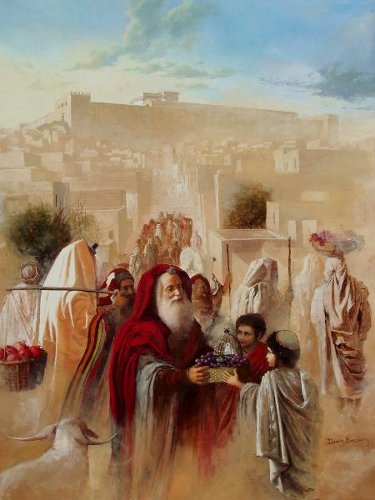
ancient_jerusalemThis is why the “one law” passages in the Torah can never be used to justify Gentile “obligation” to Torah observance in the manner of the Jewish people among Christians in Messianic Judaism or Hebrew Roots today. They do not apply. This method of assimilation was designed to allow the resident alien, who would never be an Israelite, to enter a path so that their grandchildren would be admitted into the Israelite nation as a native. There was never an intention of a sustained multi-generational presence of Gentiles who remained Gentiles and yet were otherwise treated exactly like Israelites including in their observance of all of the mitzvot.

With the passage of time, the gerim were assimilated culturally and religiously. Doeg the Edomite, for instance, was a worshiper of YHWH by the time of Saul (I Sam. 21:8), as was Uriah the Hittite in the reign of David (II Sam. 11:11). Hence, the ger, in contrast to the nokhri, was required in many cases to conform to the ritual practices of the native Israelite. Thus, gerim were subject to laws dealing with ritual purification (Num. 19:2–10), incest (Lev. 18:26) and some of the food taboos (Lev. 17:10–16; but cf. Deut. 14:21). They were expected to observe the Sabbath (Ex. 20:10; Deut. 5:14), participate in the religious festivals (Deut. 16:11, 14), and fast on the Day of Atonement (Lev. 16:29). They were permitted to offer up burnt offerings (Lev. 17:8; 22:18; Num. 15:14ff.) and, if circumcised, even to sacrifice the paschal lamb (Ex. 12:48–49; Num. 9:14). Indeed, they, no less than the Israelites, were expected to be loyal to YHWH (Lev. 20:2; cf. Ezek. 14:5–8).

-from “Strangers and Gentiles”
Jewish Virtual Library

If you click on the link I provided just above, you can read a more detailed treatment of the subject from a Jewish point of view, but as we can see in the above-quoted paragraph, there is a long history of gerim entering Israel as resident aliens and as they married and had children, eventually their descendants were assimilated into Israel and their Gentile past was forgotten.

In order for any “one law” portions of the Torah to apply to Gentiles today relative to their (our) status among Jewish believers and our duty to the Torah mitzvot, there would have had to have been a sustained presence of Gentiles among Israel who continued, generation by generation, to remain Gentiles and yet to observe the commandments in the manner of the Israelites…

…and that population never existed. It’s as if McKee wasted the first third of his book making an argument that in the end doesn’t matter.

The later part of the book has a section called The Torah Will Go Forth from Zion and specifically analyzes the impact of Micah 4:1-3 and Isaiah 2:2-4 on the Messianic and One Law communities today. McKee does well in his description of these nearly identical portions of scripture up to a point. Then he tries to force Ephesians 2:11-12 and 3:6 into the picture.

Let’s have a look. I’ll use the NASB translation:

Therefore remember that formerly you, the Gentiles in the flesh, who are called “Uncircumcision” by the so-called “Circumcision,” which is performed in the flesh by human hands—remember that you were at that time separate from Christ, excluded from the commonwealth of Israel, and strangers to the covenants of promise, having no hope and without God in the world.

…to be specific, that the Gentiles are fellow heirs and fellow members of the body, and fellow partakers of the promise in Christ Jesus through the gospel…

Ephesians 2:11-12, 3:6

Now here’s part of McKee’s commentary (pp. 112-13)

Later questions posed in the Apostolic Scriptures, such as whether or not the nations of the Earth are somehow made a part of Israel’s polity by acknowledging the Messiah…

IsraelThis does and doesn’t seem to say that the rest of the nations of the Earth somehow “become” part of Israel, as if national Israel expands to encompass those nations, eliminating their former identities (America, Canada, Japan, China, and so on) and simply all becoming “planetary Israel” if you will.

McKee spends a great deal of time in this part of his book, which supposedly addresses Micah 4:1-3 and Isaiah 2:2-4, on the effort of including the nations as part of Israel rather than vassal nations serving Israel and her King in the coming Messianic Age, and his most outrageous statement is this:

…but it forms the thrust of what it truly means for born again Believers to truly make up the “one new humanity” (Ephesians 2:15, NRSV/CJB) that the Lord wants to see emerge. Nowhere in the Bible do we ever see the implication that the community of Israel is to remain an exclusively Jewish entity… (emph. mine)

-p. 122

I thought I was done having to tolerate the Christ at the Checkpoint anti-Israel diatribes for this year. This is the worst possible example of anti-Semitic, anti-Jewish Israel in Christian rhetoric. It’s doubtful McKee meant to come off that way. He sometimes tries to bend over backward to establish mutual respect of Christianity and Judaism. But the implications of his statement are both startling and dismaying. It’s like finding the spirit of Haman in the Church. Even the Koran claims that Israel belongs to the Jews.

And just so you don’t think I’m exaggerating, here’s a quote from the Christ at the Checkpoint Conference About Us page:

Any exclusive claim to land of the Bible in the name of God is not in line with the teaching of Scripture.

Do you see the parallels between the two statements?

McKee seems to be invoking the Wesleyan philosophy of “mutual submissiveness” and any theology that makes one party in the Messianic Ekklesia somehow superior to or even different (though equal) from another violates this principle. The idea is that Jews and Gentiles in Messiah are mutually dependent upon each other.

I actually agree with that part of it as far as it goes and as was stated by Rabbi David Rudolph in the first chapter of his (and Joel Willitts’) book Introduction to Messianic Judaism: Its Ecclesial Context and Biblical Foundations, but equality does not mean uniformity. I think McKee is forgetting that Jesus is coming back as a King! As his subjects, we will serve the King of Israel, he won’t be as submissive to us as we are to him. Also remember:

For thus says the LORD, “Sing aloud with gladness for Jacob, And shout among the chief of the nations; Proclaim, give praise and say, ‘O LORD, save Your people, The remnant of Israel.’ (emph. mine)

Jeremiah 31:7 (NASB)

If Israel is the “chief” or the “head of the nations,” that means two things: 1). Israel is the leader of all the nations and the other nations of the Earth are subservient to Israel, and 2). There are other nations besides Israel in the Messianic Kingdom.

politeiaEven a quick reading of Micah 4:1-3 and Isaiah 2:2-4 lets us recognize language such as “the peoples” and “many nations” in contrast to national Israel. If we all become “Israel” and “every knee shall bow” (Romans 14:11; Philippians 2:10), then there can be no other nations, only Israel with a citizenry that is multi-ethnic containing the remnant population of the entire world all as Israelis. Too many Messianic prophesies, including those cited by McKee, specifically mention Israel and the nations.

All this hinges on a single word in ancient Greek: Politeia (πολιτεία). However, I refuse to create an entire theology based on one word that’s used once in only one of Paul’s letters.

McKee’s logic is typical of the one law argument:

  1. Politeia means “citizen”
  2. Gentile believers are citizens of Israel
  3. As citizens of Israel, Gentiles must obey the same national laws as the Jews, that is, the Torah

That’s probably too simple, but you get the idea. Except that the meaning of being separated from citizenship into (or the commonwealth of) Israel is assumed. Verse 13 states, ” But now in Christ Jesus you who formerly were far off have been brought near by the blood of Christ.” At least in English, being “brought near” is not the same as “being made identical to.”

Also, Ephesians 3:6 speaks of Gentiles as “fellow heirs and fellow members of the body,” but “body” is not the same thing as “nation”. What body?

…so we, who are many, are one body in Christ, and individually members one of another.

Romans 12:5 (NASB)

Now you are Christ’s body, and individually members of it.

1 Corinthians 12:27 (NASB)

Put together, what does it all mean? I believe it means we Gentiles, though our faith in Messiah and his atoning sacrifice for humanity on the cross, have been brought into the blessings of the promise of the New Covenant, which includes the forgiveness of sins, reconciliation before God, justification, receiving the Holy Spirit, and heirs of the resurrection and a life in the Messianic Kingdom.

If I have to define my citizenship, I’d have to say that it’s in the promise of what is yet to come in the Kingdom of Messiah, and this Kingdom encompasses the entire planet which will be made up of Israel as the head of all the nations, and then all of the vassal nations that serve Israel and her King.

In that light, I can either choose to let “politeia” be a sticking point or I can factor it in to the larger Biblical panorama and let the overarching plan of God for Israel’s redemption and through her, the redemption of the world tell its own story.

Conclusion

There’s a lot more I could say (I took very detailed notes when reading McKee’s book) but the bottom line is whether or not McKee convincingly made his point that the “one law” passages of the Bible can be applied to modern Christianity as viewed through the New Covenant lens, resulting in a fused or near-fused national identity of Jews and non-Jews as a “Torah-observant Israel”.

As I mentioned, McKee did not convince me that the “one law” passages of the Torah are in any way relevant to modern believers because they were applied in a historical and cultural context that no longer exists. Therefore, “one law” cannot be factored directly into the New Covenant promises and the inclusiveness of the nations in the blessings of those promises.

While I find McKee’s application of “one law” as a “supernatural compulsion” compelling, especially given my own attraction to Jewish studies and practice, I can’t accept that the Messianic Age has already arrived, which is what would have to occur for that “compulsion” to be a result of the “Torah written on the heart.” The best I can give him here is that it is quite possible we will all be living more jewishly in the age to come, but I don’t believe that drive can be seen in the majority of Christians today.

That said, even McKee admits that Christians in the Church today are obedient to eighty or ninety percent of the Torah commandments that can be obeyed today, so perhaps the “compulsion” to obey God’s Torah is more evident than I imagine. Add to that Gentiles like me who seem naturally attracted to Jewish practices and the study of Messianic Judaism as the proper lens for viewing the Bible, and I could even say that a sort of “one law” viewpoint is one way we see evidence of the approach of the Kingdom of Heaven and the Holy Spirit preparing us for the promises of what is yet to come (not, as you can imagine, that I am advocating for “one law” as the best possible application).

And remember, even McKee says he can’t really answer when or how Christians will turn toward the Torah of Moses and the ways of God or even what that will exactly look like.

McKee’s comparison of Micah 4:1-3 and Isaiah 2:2-4 to sections of Ephesians 2 and 3 somehow establishing a worldwide citizenship in national Israel made up of a multi-cultural population just doesn’t play. In order to make it work, his protestations aside, he has to diminish God’s promises to Jews as the exclusive citizenry and possessors of Israel.

J.K. McKee
J.K. McKee
Photo Credit: Congregation Netzar Torah Yeshua

McKee’s book is an interesting but ultimately disjointed “patchwork quilt” of Evangelical and Wesleyan Christianity and Jewish practice that just doesn’t fit together (and that said, I did enjoy reading it). In denigrating certain parties within Messianic Judaism, he also reduces Jewish influence on their own  sovereignty and history, both past and future. The idea that Israel was never meant to be the sole property of the Jewish people in perpetuity completely violates God’s promises to Abraham, Isaac, and Jacob. In imposing “mutual submissiveness” as a cardinal value in Gentile/Jewish Messianic community, he misses that Kings and Kingdoms are not “mutually submissive” but in fact, Kings rule subjects and we are his subjects.

I admire McKee’s apparent effort in his scholarly investigation into the topic and his willingness to challenge the established norms typically associated with One Law practitioners. I also, as I’ve said before, appreciate his high view of the Church and his respect for traditional Christians and the history of the saints, but his even-tempered viewpoint in these areas does not successfully make all the mismatched moving parts in this theory and theology work together.

A final note. Please understand that this doesn’t mean I don’t like McKee (I don’t even know him) or that I am saying Gentiles shouldn’t appreciate or even perform some practices that are typically considered Jewish (observing a form of Sabbath, dietary restrictions, building a sukkah). There are a variety of reasons for doing so (such as being intermarried). I’m just saying, as a reviewer, that I do not believe McKee made a sufficiently convincing case based on his research, interpretation, and presentation. Your mileage may vary.

Addendum: Pete Rambo just published Part 2 of his review of McKee’s book.
Book Review of J.K McKee’s “One Law for All,” Part 1

When I write a book review, I normally start at the beginning of the book and move through to the end. I don’t know why. I guess I’m just kind of linear that way. But J.K. McKee’s book One Law for All: From the Mosaic Texts to the Work of the Holy Spirit was organized in such a way that I decided to start in the middle and work my way out from there.

A little background. McKee in the center of his work, is comparing what has been called “Divine Invitation” (which is an unfortunate label for reasons I’ll address later in this review) with “Covenant Obligation”. These are difficult issues to discuss with a general audience since they require a great deal of specialized knowledge and tend to apply to only very small subgroups within both Christianity and Judaism, specifically movements called Hebrew Roots and Messianic Judaism.

The question, within those particular contexts, is whether non-Jewish believers in Jesus as the Jewish Messiah, are allowed to observe some, most, or even all of the commandments in the Five Books of Moses, also known as the Pentateuch in Christianity and the Torah in Judaism, or if Christians are actually under a covenant obligation to observe all of these commandments exactly or at least more or less like religious Jewish people?

I should say that even addressing what this sort of observance looks like, regardless of it being voluntary or mandatory, is highly variable. How the mitzvot (commandments) are to be observed aren’t always agreed upon even between different branches of Judaism. And particularly in Hebrew Roots, there’s a tendency to believe one can disregard any Jewish authority or opinion regarding how one is to perform a mitzvah and choose your own method based on whatever reason you want as long as you deem it “Biblical.”

In the introduction to the book (p. x), McKee states:

It can be definitely said that a ministry like Outreach Israel and TNN Online adheres to a One Law position, after a fashion.

Here’s where things start to get interesting. Unless otherwise stated, all emphasis in a quote from the “One Law” book belong to McKee.

A question that I have been asked by more than a few people is which option they are to choose: Is the Torah a Divine Invitation to non-Jewish Believers, or is it a Covenant Obligation upon non-Jewish believers? Is the Torah mandatory for Jews to follow, and an option for non-Jews to follow? Or is the Torah something mandatory for all of God’s people to follow?

-McKee, p. 83

First Fruits of Zion (FFOZ) Founder and President Boaz Michael coined the phrase “Divine Invitation” some years ago in explaining how FFOZ had shifted its theological stance from supporting a single standard of observance for both Jewish and Gentile Messianic believers to a viewpoint that advocated Jewish distinctiveness and the understanding that certain of the mitzvot are exclusively reserved for the Jewish people. He never intended it to become a theology all its own but unfortunately, the label stuck. The idea is better expressed as Gentiles in Messiah indeed being obligated, but to a certain subset of the Torah commandments (see Toby Janicki’s article “The Gentile Believer’s Obligation to the Torah of Moses” in the Winter 2012 issue of Messiah Journal for a detailed discussion on this matter) as opposed to a single, uniform application of the mitzvot for all human beings.

McKee’s commentary seems to assume that a Gentile is obligated to exactly zero Torah commandments or all of them, with no variability based on covenant role, identity, nationality, gender, geolocation, and so on.

McKee opposes the position of “divine invitation” which I expected, stating that it is bound to be confusing to non-Jewish Messianics relative to which parts of the invitation to accept, which parts to turn down, and just how one accepts the various invitations (do Gentiles have to perform an accepted mitzvah in exactly the same way as a Jewish person?). At one point in his criticism of this “theology,” he seems to attack Jewish Torah observance as well, replacing it with a more “Christian” concept of “Jewish identity”:

More importantly, though, if there is anything seriously being overlooked about the unique distinctiveness of Jewish people, it is that “salvation is from the Jews” (John 4:22), with Yeshua the Messiah Himself being the quintessential Jew. This is far more significant than Torah-keeping being what apparently makes the Jewish people distinct.

-ibid, p.85

Just a few paragraphs later however, he surprises me by saying something I more or less agree with.

For Messianic Believers today, our family has always emphasized the need to love people into this — rather than issue condemning and mean-spirited words. Much of the “pagan” rhetoric that one sees in fringe parts of the Messianic world has significantly impeded progress for the Kingdom of God, and is a major blight that is not spoken against enough. Yet at the same time, if Divine Invitation presents Shabbat, the appointed times, or kosher eating as entirely optional, what is keeping someone from turning it down?

-p. 86

one law bookThe only parts I didn’t agree with were McKee’s identifying the “pagan rhetoric” against the Christian Church as originating in the “Messianic world”. I organize Messianic Judaism and Hebrew Roots (One Law is a subset group within larger Hebrew Roots) as two separate movements with only a superficial overlap, usually at the level of the non-Jewish believer who is attracted to Judaism to some degree. I don’t typically hear Messianic Jews or Gentiles denigrate Christianity and find the “pagan rhetoric” confined to certain circles within Hebrew Roots (although, to be fair, as McKee said, they are “fringe parts” of the movement or even “fringe individuals”).

The other part I question is if something is considered an option, then there’s nothing preventing a person from saying, “No, I don’t feel led to do that.” That’s what optional means. You don’t have to. McKee’s commentary about Christians and Torah observance becomes confusing and even mysterious just a few pages later.

But before that, in addressing Covenant Obligation, McKee says:

If Believers are “obligated” to “keep Torah,” then this can quite easily lead to a few people thinking that their Torah-keeping will earn them their salvation, and can manifest itself in rather rigid and legalistic assemblies forming.

-ibid

Born again Believers are not required to keep God’s Torah as though it were some kind of debt or obligation (cf. Galatians 5:3); on the contrary, we are told, “Owe nothing to anyone except to love one another; for he who loves his neighbor has fulfilled the law” (Romans 13:8).

-p. 87

On the one hand, I was pleasantly surprised to see a supposed One Law proponent recognize some difficult truths about the movement, but on the other hand, he had to denigrate all Torah observance, even for Jewish believers, by saying loving one’s neighbor fulfills (abrogates, demolishes, deletes) the law. McKee seems to miss the nuances Paul is injecting into Romans 13 and how they connect back to what Jesus calls “the Two Greatest Commandments” (Matt. 22:35-40; Mark 12:28-31; Luke 10:25-28 citing Deut. 6:4-5 and Lev. 19:18).

But that can’t possibly be what McKee’s saying because of the major theme of the book, which is to advocate for Torah observance for Gentiles. I find this author to be a sometimes confusing blend of One Law and Wesleyan perspectives (McKee states that he had a Wesleyan upbringing to which he apparently still adheres) and as I was reading through the rest of this section, I started to think of him as a “One Law Wesleyan.”

McKee continued to defend the Church and to criticize One Law adherents for throwing Christianity under the bus, so to speak:

I have constantly asked various individuals who are “One Law” why they criticize elements of today’s Church who follow well over ninety-percent of the Torah that can be followed today, and why they treat our Christian brothers and sisters as some kind of perpetual “enemy.”

-p. 88

This is one of McKee’s confusing messages. He defends the Church as it is and states they are already observing most of the mitzvot, and yet he is pushing (apparently) for greater “jewishly” Torah observance by (One Law) Christians.

Further…

Our ministry has never advocated that today’s evangelical Christianity is some kind of illegitimate impostor religion, more in touch with accomplishing the objectives of the Adversary than in achieving the mission of God. We have advocated that the Church has flaws to be certain, but that it is the responsibility of Messianic Believers to build on a positive legacy of faithful Christian men and women who have preceded us in the faith…

p. 93

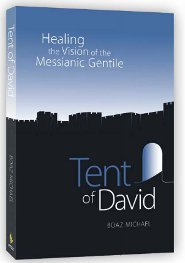
The last paragraph I quoted was startling to me because it reminded me of what Boaz Michael wrote in his book Tent of David: Healing the Vision of the Messianic Gentile:

The church is good but the church needs to change.

Tent of DavidI’ve written a number of different commentaries on his book including this one, and acknowledge that what Boaz produced challenged me personally to set aside my discomfort about going back to church and to “take the plunge,” which was nearly two years ago. Boaz was instrumental in getting me to see what is good in the Church, which is the same message McKee is delivering.

I applaud McKee for maintaining a high view of Christianity and the faithful men and women in the Church, which he acknowledges is practically unknown within One Law communities, but if he does not advocate for One Law anymore than “divine invitation,” and he apparently does not identify with mainstream Christian assembly (although he protects and defends Christians), what else is there that could be considered “One Law”?

As it turns out, McKee’s third viable option is:

Obeying the Lord is neither an optional invitation nor a mandated obligation, it is a supernatural compulsion enacted by the perfecting activity of the Holy Spirit on the human soul.

p.91

I’m disappointed. I expected a much stronger approach to his application of One Law. But this is like just redressing the One Law argument in spiritual rather than covenantal language. The Holy Spirit (supposedly) compels the individual to desire to observe the 613 commandments or something like them, give or take your opinion on the halachah established by the various Rabbinic sages in the numerous streams of Judaism across thousands of years of history.

Actually, I know where he’s getting this:

“Behold, days are coming,” declares the Lord, “when I will make a new covenant with the house of Israel and with the house of Judah, not like the covenant which I made with their fathers in the day I took them by the hand to bring them out of the land of Egypt, My covenant which they broke, although I was a husband to them,” declares the Lord. “But this is the covenant which I will make with the house of Israel after those days,” declares the Lord, “I will put My law within them and on their heart I will write it; and I will be their God, and they shall be My people. They will not teach again, each man his neighbor and each man his brother, saying, ‘Know the Lord,’ for they will all know Me, from the least of them to the greatest of them,” declares the Lord, “for I will forgive their iniquity, and their sin I will remember no more.”

Jeremiah 31:31-34 (NASB)

Unfortunately, McKee has a couple of problems. The first is that the New Covenant was made exclusively with the House of Judah and the House of Israel and does not presuppose any other nations or people groups at all (least of all he and me). Yes, there is a New Covenant application for Gentiles which I summarized here, but up to this point in the book, while McKee mentions various aspects of the New Covenant, he jumps from Jeremiah 31 straight to the Last Supper (Matt. 26:17-30; Mark 14:12-26; Luke 22:7-39; and John 13:1-17:26) without making the connection explicit. I know how it works (and it took me months of study to figure it out) but chances are many of McKee’s readers don’t (or they don’t understand it correctly).

The other major problem is that the New Covenant hasn’t been fully enacted yet. It’s not here. Jesus inaugurated it with his life, death, and resurrection, but until his return, we are only living in what you might consider the leading edge of the Messianic Age. What that means is until the resurrection and until Messiah returns to us here on Earth and ascends the Throne of David in Holy Jerusalem, we are still living in Old (Sinai) Covenant times!

So we don’t have the Torah supernaturally written on our hearts yet and thus, neither Jews and certainly not Gentiles have the Holy Spirit granted ability to naturally obey God and never sin, which is what the New Covenant is all about…the forgiveness of all sins and the ability to never sin again and obey God’s law (as it applies to each individual and each people group).

And yet he says:

A position of Supernatural Compulsion does advocate that a Torah obedient walk of faith is expected of all God’s people but it is to be found as an individual grows in holiness and spiritual maturity…

-McKee, ibid

While “expected” and “obligated” sound really similar to me, I like that, at least, McKee is acknowledging not everyone is going to adopt the various mitzvot at the same rate or to the same degree. It’s a matter of spiritual growth and maturity. Interestingly enough, I’ve heard many stories of secular Jews who became “religious” and this is more or less how they approach the vast body of mitzvot, taking a mitzvah at a time and growing into it.

But for a Christian, there are additional roadblocks, such as a lifetime of being taught that the law is dead.

ChurchMcKee said in his book that he advocates for a gentle, educational approach rather than going into a church and beating Christians over the head with a Torah scroll. In some sense, this is reminiscent of my own Tent of David experience. It’s sort of like evangelizing the church by encouraging them to consider a more Messianic perspective on the Bible, but where I desire to educate about how the New Covenant works and thus alter Christian perceptions on the primacy of national Israel and the Jewish people in the age to come, McKee is hoping to encourage more “Torah observant” behavior in normalized Christianity.

This is still refreshing because a lot of One Law people I’ve encountered in person and online hate the Church, call it “Babylon,” “pagan,” and “apostate,” and encourage Christians to abandon the Church. His attitudes about the Church are very similar to mine.

But here’s one more surprise I didn’t see coming:

Does a ministry like Outreach Israel and TNN Online think the Torah is for everyone? Yes. Does this include things like Shabbat, the appointed times, and kosher? Yes. But such an affirmative also needs to be tempered with another question: Are these aspects of God’s Torah for everyone right now in the 2010s? This is something that only God, in His plans for an individual’s or a family’s life, especially evangelical Christians, knows for sure — and I cannot fully answer.

-p.93

As I am reading McKee, I think he’s saying that believing non-Jews can and should observe the mitzvot in a more or less “Jewish” manner and to the same degree as Jewish believers (and Jewish unbelievers), but that such standards cannot be imposed from the outside by human agency. Even if one worships with other One Law advocates, that community has no right to direct a person or a family to observe this or that mitzvah. Such a directive will only come from the Holy Spirit and only in the way God’s plan is designed for the individual or family and through the process of spiritual growth and maturity.

I’m a little uncomfortable saying that Christians who don’t have a One Law or even a Messianic Gentile perspective are spiritually immature. I happen to know some people at the church I attend who are models of spiritual maturity and who I admire greatly. Just associating with such people is an honor. From a Jewish perspective, they could be referred to as tzaddikim (“righteous ones”). A Christian would say “saints”.

In the first century C.E. before the destruction of the Temple and the exile of the Jewish people from Israel, Paul’s Gentile disciples in Syrian Antioch and the various communities he established in the diaspora probably behaved in a distinctively Jewish manner, much more so than Christians would consider “normal” today, even acknowledging the “Jewish roots of the faith.” In those days there was no such thing as “the Church” or “Christianity,” there was only the Jewish movement of “the Way,” the “Ekklesia of Messiah” which included Jewish and Gentile members.

I suspect that after the resurrection and in the reign of King Messiah, we will have something similar, not a Church and then a Judaism but rather an Ekklesia with two distinct populations: Israel or the Jewish people, and the people of the nations who are called by His Name. This isn’t exactly what McKee is advocating because he believes Jesus-worshiping Jews and Gentiles are all citizens of Israel, but it’s kind of similar.

What McKee may be shooting all around but not quite hitting is the fact that the New Covenant age has yet to arrive (although we’re currently experiencing a foretaste of the promises yet to come) and that the Torah will only be written on our hearts in the future. While some non-Jews will acquire an apprehension of the centrality of the Jewish people in God’s redemptive plan prior to that time, many others, and probably most Christians, won’t.

white-pigeon-kotelI think the reason McKee can’t answer the question about when or how Gentile Christians will be drawn to naturally obey God is because it’s not going to happen until after we are resurrected and perfected in Messiah by the power of the Holy Spirit and in accordance to God’s New Covenant promises.

With the center of McKee’s book laid as a foundation, I’ll use it to build my review of the first and last parts of his text in part 2 of my “meditation” on One Law for All.

Addendum: My partner in this endeavor, Pete Rambo, just published Part 1 of his own review of McKee’s book.

A Book Review By Invitation

My recent post/review of Boaz Michael’s Tent of David has really fostered some good discussion. Probably one of the longest and best discussion thread on any post on this blog. At times it has been spirited, but peace and grace have been the general tenor. Thank you!!

Leaders in the discussion have been bloggers James Pyles of “My Morning Meditations” and Ruth of Sojourning With Jews. Both are friends I have gotten to know over the last year in the blogosphere and though we do not see eye to eye on all things Messianic, we all desire truth and enjoy the pursuit thereof. Each of us has publicly wrestled with thoughts and understandings as we search the Scriptures (though I envy both for being more open with their hearts than I have been…).

-Pete Rambo
“You are invited….”
natsab.com

Hebrew Roots (HR) blogger Pete Rambo has issued a challenge to me (Ruth had to back out) to read one or more leading HR books (since Pete and I have already discussed Boaz’s book Tent of David: Healing the Vision of the Messianic Gentile in the comments section of his review) and to “co-review” the book, he with his perspective on his blog and me on mine.

Pete generously sent me two books to choose from, both written by a gentleman named J.K. McKee who maintains a personal/professional website called TNN Online (Theology News Network Online). McKee’s rather lengthy Statement of Faith is also available on his site, so in addition to his About page, you should be able to find out all you need to know about him.

As far as Pete goes, he describes himself as a “46 [year old] recovering seminary trained pastor.” He also says:

During most of my life I have had a particular interest in eschatology (end times events/prophecy) and in understanding truth. (I used to be a conspiracy theorist… now, I am a conspiracy factualist… ) In my quest, I began to run into pieces of information that challenged my very conservative traditional Christian religious perspectives. Only when I began to pray earnestly for Yahweh to show me TRUTH did He move my focus from geopolitical events and onto a close scrutiny of what I now call ‘Churchianity.’ As I learned how far the Church had moved from the simplicity of the Book of Acts and the clear teaching of the Word, I became convicted of the need for a personal reformation.

Tent of DavidTo “bottom line” it, my understanding (and please correct me if I get this wrong, Pete) is that both Pete and Mr. McKee would fall into the theological/doctrinal category within Hebrew Roots of being One Law (and I’ve linked to a set of definitions created by Rabbi David Rudolph from his website MessianicGentiles.com).

The book Pete and I agreed upon (via email) to review first is McKee’s One Law for All: From the Mosaic Texts to the Work of the Holy Spirit. The book is about two-years old and so far has rather stellar reviews on Amazon with a total of nine reviews as I write this. Either the book is incredibly good, or the deck is stacked, or both.

Let me explain.

Since I’m also published author, though not in the religious or theological space, the publishers I’ve written for typically send me anywhere from five to ten “review copies” of my books once they go to market so I can pass them out to family and friends, asking them to write and publish reviews on Amazon.

This is a traditional marketing technique and the assumption is that the author’s family and friends or perhaps “fans” of his/her work will be more likely to write favorable reviews, elevating the book’s ranking at Amazon. Of course, at least from my experience, every time I’ve sent out review copies of one of my books and asked people I know to review it, it’s always a tad risky, since I want the reviewers to be honest and sincere, and there’s always a chance they’ll take exception to some portion of what I’ve written (if not the whole book). On the other hand, I don’t want anyone to be dishonest in writing their opinion of something I’ve created. If one of my books is to be praised, I want that praise to be authentic.

I say all this with the idea that the individuals who have reviewed McKee’s “One Law” book at Amazon may be those people who are already predisposed to like the content of McKee’s book (and his general theological bent) and thus write positive reviews.

I know one of the reasons I reviewed Matthew Vines’ book God and the Gay Christian: The Biblical Case in Support of Same-Sex Relationships is because I knew it would draw exactly two audiences: those who automatically supported his platform and those who automatically opposed it. I wondered if Mr. Vines would ever get a truly objective review of his work, so I made it my “mission,” so to speak, to do just that, setting aside as much of my own personal bias as was possible.

I intend to do the same thing here with the caveat (please pay attention to this part) that I am theologically and doctrinally opposed to the position that there is One Law, that is, a single and unified application of the Torah mitzvot that applies to all disciples of Jesus Christ (Yeshua HaMoshiach) whether they be Jewish or Gentile (that application would ultimately be applied to all human beings since the Bible refers to how “every knee will bow, see Romans 14:11; Philippians 2:10).

I have a history in “One Law,” and after coming to faith within the context of a Christian church nearly twenty years ago, I swiftly (long story) transitioned into a Hebrew Roots/One Law congregation (which billed itself as “Messianic Judaism”) and learned my basic understanding of the Bible and my faith there.

Without going into a long explanation, after some years, I finally was prompted to question all of the assumptions I naively accepted back in the day and spent nearly a year publicly exploring said-assumptions on my previous blog spot (to which I no longer contribute).

In the spirit of friendship and learning, I have agreed to Pete’s proposal but I could be considered what trial attorneys call a hostile witness in that my attitudes and beliefs regarding “One Law” are not supportive of the theological presuppositions it entails.

one law bookThe goal is as Pete states on his own blog:

In the process of our discussion, I mentioned to James via email that we ought to read and review/discuss a book at the same time…

One point to stress for all of us from the outset: the goal here is to learn and grow. We may be challenged, but we want to plan on good vigorous discussion that at the same time is peaceful and displays the fruit of the Spirit!!

That is, Pete and I will read McKee’s book and each of us will post our impressions/reviews on our respective blogs (and I also intend to post a review on Amazon). We will insert McKee’s book into a crucible and attempt, through our differing viewpoints, to tease out the essence of what’s been written, then present those findings to whoever chooses to read our blogs.

As Pete says, we both want to show that two people can discuss differing theological perspectives in a peaceful and cooperative manner, and avoid those emotional meltdowns that we all frequently have witnessed in the religious blogosphere. We aren’t (necessarily) trying to convince the other to change his mind, but rather are trying to provide clarity of thought and expression of our respective points of view.

I hope you will follow along on our two blogs and feel free to join in (politely and respectfully) on our discussions.

When Christians Aren’t Israel

In writing the review, I mentioned that I had gone back to J.K.McKee‘s A Part of Israel? as a resource for scholarly exposition of Scripture related to the place of non-Jews who come to Messiah. You’ll remember I lamented not having reviewed the book… Well, I started reading it again and couldn’t put it down! ‘Nuff said?

He is gracious in doing so, but is clear to demonstrate where there is error in various understandings of what the Kingdom of Israel looks like and who is in it! Example passages would be 30 pages dedicated to the predictably selected Ephesians 2:11-13 passage. He specifically addresses politeia, a Greek word we have looked at before, however, he understandably takes a much more coy approach as to whether non-Jews will have an inheritance in the land.

-Pete Rambo
from portions of his review of
JK McKee’s ‘Are Non-Jewish Believers Really A Part Of Israel?

I normally ignore these sorts of topics since historically in the blogosphere, debating the issues involved in Jewish/Gentile relationships in modern Messianic Judaism and/or the ancient ekklesia of “the Way” have, at best, proven unfruitful, and at worst, hostile and abusive.

But I’ve always had good, civil, and friendly conversations with Pete, including in the comments section on another of his blog posts,. So when I read his review, I was prompted to consider responding. After all, the legal and community status of the ancient Gentile disciples of the Jewish Messiah King relative to the synagogue, Jewish co-participants, and ultimately national Israel not only have applications in modern Christianity, but ultimately will be realized in the Messianic Kingdom when the New Covenant Age comes toward completion.

I requested a review copy of McKee’s book from the publisher and received a very nice and prompt reply stating that they do not honor such requests. Fair enough, since self-publication does not usually allow for such an option.

When I read Pete’s review last night, I got stuck on a single word: politeia. My commentary rather narrowly focuses on this word and how it is used since I can’t comment more generally on what McKee has written.

The word “politeia” is used in the following passages of scripture:

Then the commander said, “I had to pay a lot of money for my citizenship.”

Acts 22:28 (NASB)

…remember that at that time you were separate from Christ, excluded from citizenship in Israel and foreigners to the covenants of the promise, without hope and without God in the world.

Ephesians 2:12 (NASB)

I’ve bolded the English word corresponding to the Greek word “politeia” which is rendered as “citizenship” in both cases in the NASB translation.

However, this creates a number of questions.

  • Is Paul telling us (or his readers) that non-Jewish members of the Messianic ekklesia are now legally citizens of national Israel by faith in Messiah?
  • If so, then does such citizenship automatically require that the Gentile disciples adhere to, by obligation, the same Torah mitzvot in the same manner as the Jewish disciples/citizens?
  • Can “politeia” be translated in any other way besides “citizenship” and if so, what are the implications for the relationship of Gentiles and Jews belonging to Messiah in relationship to national Israel?

politeiaAs you can see from my source material, depending on the translation and in which part of scripture the word occurs, it can be translated differently. In Acts 22:28 using the KJV translation, it is rendered “freedom,” while in Ephesians 2:12, the NAS, KJV, and INT translations all present the word as “commonwealth”.

In fact, “citizenship” is only one of three major ways to translate”politeia”:

  1. the administration of civil affairs (Xenophon, mem. 3, 9, 15; Aristophanes, Aeschines, Demosthenes (others)).
  2. a state, commonwealth (2 Macc. 4:11 2Macc. 8:17 2Macc. 13:14; Xenophon, Plato, Thucydides (others)): with a genitive of the possessor, τοῦ Ἰσραήλ, spoken of the theocratic or divine commonwealth, Ephesians 2:12.
  3. citizenship, the rights of a citizen (some make this sense the primary one): Acts 22:28 (3Macc. 3:21, 23; Herodotus 9, 34; Xenophon, Hell. 1, 1, 26; 1, 2, 10; (4, 4, 6, etc.); Demosthenes, Polybius, Diodorus, Josephus, others).

I’m not a linguistic scholar, but I’ve known enough of them to understand that any sort of translation from one language to another is much more complicated than saying a particular word in language A always means another particular word in language B, especially when those languages are separated by nearly two-thousand years of history.

I am absolutely not saying McKee is making such a “rookie error,” but I will say that we all read and translate the Bible from a particular perspective, usually one that supports our own biases (everyone has biases, it’s not a dirty word). And yes, it’s easy to read those two verses in the New Testament and conclude that Paul must be making Israeli citizens out of Gentile believers in Jesus.

Tel Aviv
Tel Aviv

A lot of Evangelical Christians believe we’re “spiritual” citizens of Israel too, and expect to take over physical, national Israel when Jesus comes back. Naturally, Jewish people object to being kicked out of their own Land (even by allegory) and those teachers in Messianic Judaism who I follow do not believe we Gentiles will be moving to Jerusalem, or Tel Aviv, or Haifa once Messiah ascends the Davidic throne.

So where does that leave us? What’s the “differential diagnoses?”

If indeed it is the case that in Christ these Gentiles have a portion in [Israel’s covenant membership and national eschatology], i.e. that they are saved as Gentiles, then it suffices to apply to them the same ethical principles that would in any case apply to righteous Gentiles living with the people of Israel, i.e. resident aliens.

-Markus Bockmuehl
“Jewish Law in Gentile Churches:
Halakhah and the Beginning of Christian Public Ethics”
(Grand Rapids, MI: Baker Academic, 2000), 165

While the gerim in the days of Moses were not Israelites as such and did not obtain full membership status in the nation due to lack of tribal affiliation, they did observe a large number (majority? nearly-full obligation?) of the Torah mitzvot in the days of Moses and beyond. The argument of some branches of the Hebrew Roots movement is that the gerim status can be wholly transferred to the Gentile disciples of Jesus and be used to justify Gentile Christian obligation to the full yoke of Torah. Lancaster has spent considerable effort in his commentary to illustrate how James and the Council exempted the Gentiles from the full yoke of Torah because they were not born Jews or converts. Now, he apparently brings in an element in explaining the four prohibitions that could reverse his argument.

-from my blog post Return to Jerusalem, Part 6
based on my reviews of First Fruits of Zion’s (FFOZ) Torah Club series Chronicles of the Apostles

Up to JerusalemThe key to all this is in understanding what sort of decision the Council of Apostles and Elders made in Jerusalem about the legal status of Gentiles in “the Way”. The question was brought up (Acts 15:1-2) and after much debate, Paul and his detractors couldn’t make any headway toward a solution, so they took it to a higher authority in Jerusalem. After much deliberation, the Council rendered what amounts to a binding legal decision and issued halachah specific to the communal role and responsibilities of Gentile disciples of the Master. Did they have to undergo the proselyte rite and become wholly obligated to the Torah mitzvot? If not, how could they be included as equal co-participants in Jewish worship and community and yet not be Jewish? How could they be included in covenant?

How do we resolve the matter of the ancient Ger as applied to the late Second Temple Gentile God-fearing disciple? Lancaster doesn’t make that clear, but based on my own reading, particularly of Cohen, the full role of a Ger as it existed in the days of Moses was to allow a non-Israelite to live among the people of God as permanent resident aliens without being able to formally become national citizens due to lack of tribal affiliation. After the Babylonian exile, a tribal basis for Israelite society was lost and affiliation by clan was emphasized. By the time of Jesus, this clan affiliation basis was too lost, and thus the rationale for the status of Ger as it was originally applied no longer was valid. A Gentile in the days of Jesus or later, who wanted to join the community of Israel, in most cases, would convert to Judaism, since becoming a Ger was not an option.

-from my aforementioned blog post

To further cite Shaye J.D. Cohen:

Biblical law frequently refers to the “resident alien” (ger in Hebrew) who is grouped with the widow, the orphan, and the Levite. All of these are landless and powerless, and all are the potential victims of abuse. (An American analogy to the ger is the Chicano (specifically, undocumented alien) farmworker; a European analogy is the Turkish laborer in Germany.) The Bible nowhere states how a ger might ameliorate his status and become equal to the native born, because there was no legal institution by which a foreigner could be absorbed by a tribal society living on its ancestral land. Resident aliens in the cities of pre-Hellenistic Greece fared no better.

But there’s another authoritative source that should be considered:

and in order that the Gentiles might glorify God for his mercy. As it is written,

“Therefore I will confess you among the Gentiles,
and sing praises to your name”;
and again he says,

“Rejoice, O Gentiles, with his people”;
and again,

“Praise the Lord, all you Gentiles,
and let all the peoples praise him”;
and again Isaiah says,

“The root of Jesse shall come,
the one who rises to rule the Gentiles;
in him the Gentiles shall hope.”

Romans 15:9-12 (NASB)

To which Nanos responds:

Christian gentiles worshiping the One God in the midst of the congregation of Israel — my point exactly! (emph. mine)

-Mark D. Nanos
Chapter 6: Romans 13:1-7: Christian Obedience to Synagogue Authority, pg 326
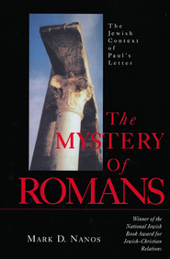
The Mystery of Romans: The Jewish Context of Paul’s Letters

Paul is urging the Gentile believers to take note of their position, their role, and their halachic status as “resident aliens” within the midst of corporate Israel, which here is the synagogue context in Rome.

-from my review of Nanos’s book

The Mystery of RomansThe alternative explanation, based Bockmuehl, Cohen, Lancaster, and Nanos, is that the Gentiles were included in the commonwealth of Israel but not as equal national citizens. It would be as if my wife, as a Jew, decided to make aliyah, become an Israeli citizen and live in Israel. As her husband, even though I’m not Jewish, I would be allowed a permanent status as a resident in Israel as well, but I do not have an automatic right to become a citizen, as does my wife, because I am not Jewish.

I would still have most or all of the same rights as Jewish Israelis and I would have most or all of the same obligations as Jewish Israelis, but none of that would make me Jewish, nor would the Chief Rabbis of Israel or any other Jewish religious authority expect me to observe Torah as they proscribe because I’m not Jewish.

I know you’re going to say that’s all secular law (with the exception of the authority of the Chief Rabbis) and has little or nothing to do with how God sees things, but I’m using the above example by way of analogy. When James and the Council issued their decision, it wasn’t some magical, spiritual event, it was a legal ruling on the same order as the authorities among the Pharisees made, and was binding halachah upon the community.

However, there is another citizenship I have and one in which I’m looking forward to living out in the age to come. It’s a status I currently possess since according to at least one interpretation of the New Covenant, I need to start living my life as if the world were already fully under the rule of Messiah, Son of David, as he is seated on his Throne in Jerusalem.

I consider myself a citizen of the worldwide Messianic Kingdom to come and many wonderful blessings come from this status. I will be resurrected from dead flesh and made immortal (assuming I die before Messiah’s return). I will have my sins fully, permanently cleansed from me. I will have the Holy Spirit poured into me to such fullness that I will have an apprehension of God in the same or even greater manner than the prophets of old. I will have my heart of stone turned to a heart of flesh and God will write His Word upon it so that it will be my natural inclination to always obey Him and not return to sin.

And as a Gentile of the nations, I will reside in a country that is a vassal state to national Israel, subservient to Israel which will be the head of all nations, and ultimately I and my nation of residence will be accountable to the King of Israel, Moshiach. I expect that I and everyone else like me will be planning our vacations around the festivals and making regular pilgrimages to Jerusalem to spend time with family and friends and pay homage and honor to our King.

The goyishness of Christianity is a sign of its success, not its failure!

-Rabbi Dr. Stuart Dauermann
“The Problem With Hebrew Roots, or, It’s Good to be a Goy”
Interfaithfulness.org

Stuart Dauermann
Rabbi Dr. Stuart Dauermann

R. Dauermann makes a compelling argument that Gentiles who attach themselves to the God of Israel are intended by God to remain Gentiles. The prophets of the Tanakh who spoke of the Messianic Age all seemed to share that belief. I’ll only quote two of them:

And foreigners who bind themselves to the Lord
to minister to him,
to love the name of the Lord,
and to be his servants,
all who keep the Sabbath without desecrating it
and who hold fast to my covenant—
these I will bring to my holy mountain
and give them joy in my house of prayer.
Their burnt offerings and sacrifices
will be accepted on my altar;
for my house will be called
a house of prayer for all nations.”

Isaiah 56:6-7 (NASB)

“In that day

“I will restore David’s fallen shelter—
I will repair its broken walls
and restore its ruins—
and will rebuild it as it used to be,
so that they may possess the remnant of Edom
and all the nations that bear my name,”
declares the Lord, who will do these things. (emph. mine)

Amos 9:11-12 (NASB)

And to quote verse 14:

and I will bring my people Israel back from exile. (emph. mine)

which can also be interpreted as:

will restore the fortunes of my people Israel. (emph. mine)

In both of these prophetic examples describing Jews and Gentiles in the Messianic Age, it is clear that Gentiles will become attached to the God of Jacob as Gentiles and as citizens of the nations. While Isaiah paints for us a portrait of Gentiles offering sacrifices at the Temple of God (something which was allowed during the time of Herod’s Temple), Amos 9:14 makes a clear distinction between the Gentiles of the nations who “bear my name” and Israel!

It is true that Isaiah describes Gentiles keeping to the covenant, but after all, we will receive blessings because of our Abrahamic faith under the New Covenant, and in Messianic Days, I expect it will be more common for even the citizens of vassal nations to have laws and observances that more closely mirror national Israel’s including Sabbath keeping.

I’m not even saying (with apologies to R. Dauermann) that Gentiles in Messiah shouldn’t observe Sabbath in the present age. I’ve met many who do.

What I am saying is that none of what I see in the Bible, particularly the use of a single Greek word, absolutely mandates that all non-Jewish people who are disciples of Jesus be made into citizens of Israel, either in the present age or in the Messianic future.

God made a covenant with Abraham that was specifically and narrowly passed down to Abraham’s son Isaac (but not to Ishmael or any of Abraham’s subsequent children) and then to Isaac’s son Jacob (but not to Esau) and then to Jacob’s twelve sons who became the heads of the twelve tribes, who became the nation of Israel (but not to any other people group or nations).

That Abraham would also become the father of many nations and that through his seed (singular) Messiah, the nations would be blessed, does not abrogate the part of the covenant that specifically promises Israel only to the direct biological offspring of Abraham, and Isaac, and Jacob.

Having not read his book, I can’t say for sure, but if  McKee comes to a different conclusion in his writing, then in spite of his stated education and scholarship, I’m forced to disagree with him.

I don’t write this against Pete or anyone else who holds to his views of scripture, but rather to illustrate that there are other valid and educated views of the Bible that come to other valid and educated conclusions.

I considered just making a few comments on Pete’s blog but as you see, the response requires a lot of words and it’s easier to write out my thoughts here and then just to share a link to my blog with him (and anyone else who is interested).

Beth Immanuel ShavuotConsidering all of the different viewpoints involved in this sort of discussion, I see the position of One Law/One Torah (OL/OT) as existing at one end of a continuum and what’s been called Bilateral Ecclesiology (BE) positioned at the opposite end. While I obviously am leaning closer to the BE end of the scale, I’m not sitting right on top of it.

Of those congregations I am aware of that I consider authentic Messianic Jewish synagogues, including Beth Immanuel, Tikvat Israel, and Ahavat Zion, they all have a majority membership/attendance of non-Jewish people worshiping the God of Israel and giving honor and glory to Yeshua HaMoshiach (Jesus Christ), with a smaller membership and usually leadership of Jews. In fact, the primary teacher at Beth Immanuel is a Gentile: D. Thomas Lancaster. And yet Beth Immanuel is a Jewish community and worship venue that adheres to specific standards of established halachah.

From my perspective, that’s the current state of Messianic Judaism, or at least those portions I know about in my little corner of the world.

That I don’t consider non-Jewish disciples to be literally citizens of national Israel does not exclude us from many incredible blessings or from association with our Jewish brothers and sisters in Messiah. I am quite comfortable inside of my own skin, so to speak, being a person among the nations who is called by His Name. Being married to a Jewish wife, I am content to recognize that she is among her people Israel and I’m dedicated to supporting her, and all other Jewish people I’m associated with, being and becoming closer to the God of Jacob as HIs people Israel through the mitzvot and within their unique community and nation which was established forever by Hashem.

Briefly Revisiting Gentiles and the New Covenant

I see this has gotten out of hand.

I debated a long time before putting my fingers on the keyboard, but in the end, I can’t allow this misunderstanding to go unanswered.

It has been said by one individual that I believe Gentiles (i.e. Christians) are excluded from the New Covenant. Frankly, as the kids say, “that’s crazy talk.” Nevertheless, my recent blog posts Unity in Messiah: A Commentary on One Law and the Gentiles and Walking in the Dust of the Footsteps of Moshiach have inadvertently made me and my blog something of a minor lightning rod. That was hardly my intent.

I wrote these blogs, first of all, to speak of and expand upon some of the concepts behind a recent commentary on Torah Portion Shelach published online by First Fruits of Zion (FFOZ). Actually, that was the motivation for the first blog post. I wrote the second in response to some online misinterpretation of my intent and motives, but that only made things worse.

It seems I need to restate my beliefs about the New Covenant and the place of the nations in relation to Israel. That won’t be easy to contain in a single blog post, since the information is vast. It took me eleven or twelve blog posts to work through my original investigation and D. Thomas Lancaster covered the New Covenant material in five sermons on four CDs in his What About the New Covenant series.

Here’s the “Reader’s Digest” version:

“Behold, days are coming,” declares the Lord, “when I will make a new covenant with the house of Israel and with the house of Judah, not like the covenant which I made with their fathers in the day I took them by the hand to bring them out of the land of Egypt, My covenant which they broke, although I was a husband to them,” declares the Lord. “But this is the covenant which I will make with the house of Israel after those days,” declares the Lord, “I will put My law within them and on their heart I will write it; and I will be their God, and they shall be My people. They will not teach again, each man his neighbor and each man his brother, saying, ‘Know the Lord,’ for they will all know Me, from the least of them to the greatest of them,” declares the Lord, “for I will forgive their iniquity, and their sin I will remember no more.” (emph. mine)

Jeremiah 31:31-34 (NASB)

The direct objects of the New Covenant are the House of Judah and the House of Israel, the descendants of the object of the Sinai Covenant, the Israelites. The nations are not mentioned in the New Covenant language so they (we) are not directly connected. Then how are we involved at all? Consider the Abrahamic Covenant:

  1. Genesis 12:1-3 – God promises to make Abraham into great nation, bless those who bless him and curse those who curse him, and all peoples on earth would be blessed through Abraham.
  2. Genesis 15:18–21 – God promises to give Abraham’s descendants all the land from the river of Egypt to the Euphrates, and this area is later referred to as the Promised Land or the Land of Israel.
  3. Genesis 17:2–9 – God promises to make Abraham a father of many nations and of many descendants and the land of Canaan as well as other parts of Middle East will go to his descendants.
  4. Genesis 17:9-14 – God declares that circumcision is to be the sign of the covenant for Abraham and all his male descendants and that this will be an eternal covenant.

Abraham and the starsNotice that only portions of the first and third condition have anything to do with any other people besides Abraham’s descendants through Isaac and Jacob. The first condition promises that “all peoples on earth” will be blessed through Abraham, and the third condition states that Abraham would be a father of many nations. Of course that last part speaks to the wives of Abraham and the children he had with them after Sarah died, so that condition doesn’t really figure into how all of earth’s people will be blessed.

Brethren, I speak in terms of human relations: even though it is only a man’s covenant, yet when it has been ratified, no one sets it aside or adds conditions to it. Now the promises were spoken to Abraham and to his seed. He does not say, “And to seeds,” as referring to many, but rather to one, “And to your seed,” that is, Christ.

Galatians 3:15-16 (NASB)

We have to go to the apostolic scriptures and Paul’s epistle to the Galatians to understand how to interpret Genesis 12:1-3, but we see that the blessing to the nations comes through Messiah. He is the “mechanism” by which we Gentiles may be “grafted in” to the promises, not making us Jewish converts without a bris, but beneficiaries of the blessings such that we too can approach God as sons and not strangers (Ephesians 1:4-5).

lightSome things have been said about me ignoring that Israel is to be a light to the nations (Isaiah 49:6). The idea is that the Gentiles were to be attracted to that light (Deuteronomy 4:6) and then be prompted to join the nation, assimilating into the tribes and clans and becoming one with Israel.

I refer you back to FFOZ’s One Law and the Gentiles article for the details about what it was to be a “Ger” both in the days of Moses and in the time of the apostles.

Well over a year ago, I wrote Building My Model, which was my prior attempt at summarizing Gentile inclusion in the New Covenant. I reduced everything down to five points:

  1. God creates a provision in his covenant with Abraham that allows the Gentiles to be blessed through Messiah (Abraham 12:1-3).
  2. The New Covenant (Jer. 31, Ezek. 36) renews, affirms, and amplifies all of the previous covenants God made with the people of Israel and the people of Judah which, by definition, includes the Abrahamic covenant.
  3. Messiah alludes that the (new) covenant is poured out in his blood (death), (see Mark 14:22-24, Luke 22:19-20) for all people.
  4. Paul interprets the Abrahamic covenant provision referring to Gentiles as Messiah being our connection to God (see Galatians 3:15-16).
  5. Paul describes the process of Gentiles being made co-heirs to the Messianic promises through Messiah as a mystery (Ephesians 3:1-13).

There are multiple portions of the Prophets that mention Gentiles, the Temple being a house of prayer for all peoples, Gentiles holding fast to observing the Shabbat and the Festivals, and ten men of the nations taking hold of the fringes of a Jewish man’s clothing to go with him and to be near to God.

All of those passages speak to Gentile involvement alongside Israel in being devoted to God in the future Messianic Age, but in sending the Messiah the first time, God sent a message and a gift, a foreknowledge and guarantee of the coming Kingdom and confirmation that God will fulfill all of the New Covenant promises.

The coming of the first Gentiles into relationship with God by receiving the Spirit (Acts 10) just as the Jews did (Acts 2) is one of the signs of that promise and guarantee. The prophesies of Joel (Joel 2:28) must have come to Peter’s mind as he saw Cornelius and his household receive the Spirit, and when Paul, as Messiah’s emissary to the Gentiles, brought vast numbers of former goyishe idol worshipers to the God of Israel through faith in Yeshua, it must have seemed as if the Messianic Age was close to fruition, and that the New Covenant times were about to burst into completion.

That hasn’t happened yet, but we are in the midst of that process. The fact that Gentiles continue to be drawn to Messiah by the Spirit and to desire to learn about the Jesus of the Jewish scriptures is clearly a sign. Of course, we Gentiles are involved in the New Covenant, but only through Israel for the Master said “salvation comes from the Jews,” (John 4:22).

I’ve tried to compress a great deal of information about a very complex topic into one short article and I hope I’ve been successful. For a more complete picture of my understanding of the New Covenant, go through my eleven part series, starting with part one: The Jesus Covenant: The Foundation, and then click through the subsequent parts until you get to the end. Afterward, you should also read Gifts of the Spirit Poured Out on all Flesh which filled in one last piece of my investigative puzzle.

early_morning_skyI hope this puts a few frenzied souls to rest. I also want to remind everyone reading my blog that my opinions are solely my own. I may quote from First Fruits of Zion and similar resources, but that doesn’t mean I work for them or am their “mouthpiece.” I also quote from Aish.com and Chabad.org but that doesn’t make me an Orthodox Jew or Chabadnik. Like any researcher, I utilize different sources to support my commentaries. You can bug organizations like the UMJC if you want, but I am not affiliated with them in any way so my comments should not be taken as representing them. Nor do they (or any other organization) have the ability to censor or repudiate me.

Now will people please calm down? It’s OK to disagree, but any level of adult emotional maturity should enable a person to have differences of opinion with others without personalizing conflict. Otherwise, all we’re doing is engaging in “spitting contest” and I hardly think that sort of behavior is for the sake of Heaven.

“The world doesn’t care how many times you fall down, as long as it’s one fewer than the number of times you get back up.”

-Aaron Sorkin, American screenwriter

Thanks.

Walking in the Dust of the Footsteps of Moshiach

This is the actual time of the “footsteps of Mashiach.” (the final age prior to Mashiach’s advent) It is therefore imperative for every Jew to seek his fellow’s welfare – whether old or young – to inspire the other to teshuva (return), so that he will not fall out – G-d forbid – of the community of Israel who will shortly be privileged, with G-d’s help, to experience complete redemption.

“Today’s Day”
Monday – Sivan 18 – 5703
Compiled by the Lubavitcher Rebbe; Translated by Yitschak Meir Kagan
Chabad.org

Previously, I wrote about how privileged Gentiles associated with the Messianic Jewish movement (and in theory, all Gentile Christians) are to be able to support and encourage increased Torah observance among the Jewish people united in Messiah, in order to bring nearer the coming (return) of the King. Although the small commentary above states that it is important for every Jew to seek his fellow’s welfare, I believe we can extend that sentiment to all of mankind.

There are two interrelated principles here. The first is for all disciples of Jesus to seek the welfare of any other person, as it is written, “love your neighbor as yourself” (Lev. 19:18, Mark 12:31). The second is like it in that we non-Jews should seek out the welfare of the Jewish people and the nation of Israel, as it is written, “And I will bless those who bless you, And the one who curses you I will curse. And in you all the families of the earth will be blessed” (Genesis 12:3).

As I also said, within the unity of the body of Messiah, we are all one and yet we are all distinct. Just as men and women are distinct, so are Jew and Gentile, for Paul in his various epistles, never stopped distinguishing between the Jew and the Greek (Gentile). Therefore, we have no excuse to fail to make such distinctions as well.

And yet, both within the larger body of the Christian Church and certain subsets of what is called Hebrew Roots, it is considered unfashionable and even offensive to continue to make such distinctions. However, if we fail to do so, either by eliminating the primacy of national Israel and replacing it with the Church, or forcibly inserting Gentiles into the nation of Israel, we violate God’s unique calling to the Jewish people to remain a set apart people before Him forever.

Thus says the Lord,
Who gives the sun for light by day
And the fixed order of the moon and the stars for light by night,
Who stirs up the sea so that its waves roar;
The Lord of hosts is His name:
“If this fixed order departs
From before Me,” declares the Lord,
“Then the offspring of Israel also will cease
From being a nation before Me forever.”

Jeremiah 31:35-36 (NASB)

For the New Covenant was made with the house of Judah and the house of Israel, not the people of the nations, and it is only by coming alongside Israel rather than replacing her or co-opting her unique relationship with God, that we can enjoy blessings of the covenants God made with the Jewish people.

To deny this on any level is to bring a curse upon yourself, but to bless and uphold the nation of Israel and the distinct nature and character of the Jewish people is to bring blessings upon yourself from God, who selected Israel for His own.

The early sages, who were like angels (may their merit protect us) have already determined that the healing of the soul is like the healing of the body:

The crucial first step is to identify the location of the illness, whether it is caused by the crassness, grossness and corruption of his physical body or by a failing in his soul-powers, the person being inclined to undersirable traits like arrogance or falsehood and the like. Or, the source of the malady may be habit – inadequate rearing or unwholesome environment having brought on bad habits.

“Today’s Day”
Shabbat – Sivan 16 – 5703
Compiled by the Lubavitcher Rebbe; Translated by Yitschak Meir Kagan
Chabad.org

This relates to another quote I cited before:

A person who worries about how others view him will have no rest. Regardless of what he does or does not do he will always be anxious about receiving the approval of others. Such a person makes his self-esteem dependent on the whims of others. It is a mistake to give others so much control over you. Keep your focus on doing what is right and proper.

-Rabbi Zelig Pliskin

Rabbi Zelig Pliskin
Rabbi Zelig Pliskin

Given the current context, applying R. Pliskin’s words to me, I see that those who disagree with my words are not in control of who I am. Those who disagree with the uniqueness, sanctity, and distinctiveness of the Jewish people; the nation of Israel before God, cannot affect the nature and character of the chosen people, even as they either seek to eliminate Israel in God’s plan or dilute Israel by inserting masses of Gentiles into her midst without continuing to uphold her distinction.

But R. Pliskin’s words can also be applied to those who oppose Israel in that these people and groups may see their self-esteem and self-assigned identity as being worthwhile only if Israel is diminished either by elimination from God’s plan, or by needing to be included and even fused with Israel, not allowing Israel to exist apart from Gentile inclusion.

To the Christians, including some groups within Hebrew Roots, it is important and even vital to realize that our distinctiveness apart from Israel does not diminish us. Quite the opposite. Our vital role in supporting Israel and heralding the return of Israel depends on our distinctiveness.

If a Gentile “keeps the Torah” in some manner or fashion, that may benefit the individual involved but it does nothing to summon the Messiah’s return. If, on the other hand, the Gentile were to support and encourage Jews in Messiah, including those in the Church referred to as “Hebrew Christians” in observing the mitzvot, then we are fulfilling our purpose and passion and performing a mitzvah “only Gentile disciples of Messiah may accomplish”.

As a young boy, Rabbi Yosef Yitzchak (the sixth Lubavitcher Rebbe) would go with his father on walks through the woods. One time, as they talked, the boy absent-mindedly plucked a leaf off a tree and began to shred it between his fingers. His father saw what his son was doing, but he went on talking. He spoke about the Baal Shem Tov, who taught how every leaf that blows in the wind—moving to the right and then to the left, how and when it falls and where it falls to—every motion for the duration of its existence is under the detailed supervision of the Almighty.

That concern the Creator has for each thing, his father explained, is the divine spark that sustains its existence. Everything is with Divine purpose, everything is of concern to the ultimate goal of the entire cosmos.

”Now,” the father gently chided, “look how you mistreated so absent-mindedly the Almighty’s creation.”

”He formed it with purpose and gave it a Divine spark! It has its own self and its own life! Now tell me, how is the ‘I am’ of the leaf any less than your own ‘I am’?”

-Rabbi Tzvi Freeman
“Purpose of a Leaf”
Based on the letters and talks of the Rebbe, Rabbi M.M. Schneerson
Chabad.org

Everything was created by God with a unique purpose, even a humble leaf, and must be treated with respect. How is the Jewish ‘I am’ any less than the Gentile (Christian) ‘I am’?

korahs-rebellionExodus 20 commands Israel not to covet the things that belong to a neighbor such as his house, his wife, his servants, or his animals. Far be it from me to add to or subtract from the Bible, but my personal “midrash” on coveting includes the “commandment” not to covet thy neighbor’s mitzvot. Just as Korach and his followers coveted the position and mitzvot associated with Moses, the Prophet of God, and Aaron, the High Priest and was judged in error by God, so we too will be judged as in error by coveting positions, roles, and mitzvot we do not merit because we are not Jewish.

And He began speaking a parable to the invited guests when He noticed how they had been picking out the places of honor at the table, saying to them, “When you are invited by someone to a wedding feast, do not take the place of honor, for someone more distinguished than you may have been invited by him, and he who invited you both will come and say to you, ‘Give your place to this man,’ and then in disgrace you proceed to occupy the last place. But when you are invited, go and recline at the last place, so that when the one who has invited you comes, he may say to you, ‘Friend, move up higher’; then you will have honor in the sight of all who are at the table with you. For everyone who exalts himself will be humbled, and he who humbles himself will be exalted.”

Luke 14:7-11 (NASB)

It is not shameful or diminishing to seek humility in the presence of God and in our daily lives. In fact, as we see from scripture, it is ultimately honoring, though we should not seek honor for ourselves, for in taking our proper place furthest away from the head of the table, how might the host of the banquet choose to honor us by placing us in a much better seat. But that selection of a better seat is not for us to make, it is for him, for Messiah, Son of David. For even he, though he deserves great honor and glory, chose to be humbled.

“For even the Son of Man did not come to be served, but to serve, and to give His life a ransom for many.”

Mark 10:45 (NASB)

The Master said that all those who choose to glorify themselves in this world already have their reward, but those who choose to humble themselves now will have great reward in the coming Kingdom:

“Beware of practicing your righteousness before men to be noticed by them; otherwise you have no reward with your Father who is in heaven.

“So when you give to the poor, do not sound a trumpet before you, as the hypocrites do in the synagogues and in the streets, so that they may be honored by men. Truly I say to you, they have their reward in full. But when you give to the poor, do not let your left hand know what your right hand is doing, so that your giving will be in secret; and your Father who sees what is done in secret will reward you.

“When you pray, you are not to be like the hypocrites; for they love to stand and pray in the synagogues and on the street corners so that they may be seen by men. Truly I say to you, they have their reward in full. But you, when you pray, go into your inner room, close your door and pray to your Father who is in secret, and your Father who sees what is done in secret will reward you.

Matthew 6:1-6 (NASB)

walking humblyServe God in all humility, placing the needs of others before your own. Realize that Paul always went to the Jew first, for the Good News of Messiah is the Gospel of Israel and only afterward the good news also to the nations.

If you seek to take what is not yours, when Messiah comes, will he not seek justice and remove from you that which you have usurped? Better to pursue nothing for yourself, and when Messiah comes, let him gift each of us with whatever we may merit according to his grace, kindness, and wisdom. Consider the parable of the talents (Matthew 25:14-30):

For to everyone who has, more shall be given, and he will have an abundance; but from the one who does not have, even what he does have shall be taken away.

Matthew 25:29 (NASB)

Also, the Master taught:

So do not worry about tomorrow; for tomorrow will care for itself. Each day has enough trouble of its own.

Matthew 6:34 (NASB)

To God be great honor and glory, and to Moshiach our King, let him be raised high above us. Let us walk in the dust of his feet (Nahum 1:3) and be satisfied with our lot.

Ben Zoma would say: Who is wise? One who learns from every man. As is stated (Psalms 119:99): “From all my teachers I have grown wise, for Your testimonials are my meditation.”

Who is strong? One who overpowers his inclinations. As is stated (Proverbs 16:32), “Better one who is slow to anger than one with might, one who rules his spirit than the captor of a city.”

Who is rich? One who is satisfied with his lot. As is stated (Psalms 128:2): “If you eat of toil of your hands, fortunate are you, and good is to you”; “fortunate are you” in this world, “and good is to you” in the World to Come.

Who is honorable? One who honors his fellows. As is stated (I Samuel 2:30): “For to those who honor me, I accord honor; those who scorn me shall be demeaned.”

-Pirkei Avot 4:1

May we make teshuvah and repent of our failings before God, then pursue the path of Messiah as he and he alone has set it before each of us. Amen and Amen.

For more on this topic, please see the Hebrew Roots section of the MessianicGentiles.com website.

Addendum: Sadly, this blog post did nothing to resolve conflicts and in fact seems to have added fuel to the fire. Thus, I’m forced to write a “part three” to this series. Please see Briefly Revisiting Gentiles and the New Covenant for details.