Tag Archives: pesach

Converging On the House of Prayer

Walking TogetherIn each one of us there is an Egypt and a Pharaoh and a Moses and Freedom in a Promised Land. And every point in time is an opportunity for another Exodus.

Egypt is a place that chains you to who you are, constraining you from growth and change. And Pharaoh is that voice inside that mocks your gambit to escape, saying, “How could you attempt being today something you were not yesterday? Aren’t you good enough just as you are? Don’t you know who you are?”

Moses is the liberator, the infinite force deep within, an impetuous and all-powerful drive to break out from any bondage, to always transcend, to connect with that which has no bounds.

But Freedom and the Promised Land are not static elements that lie in wait. They are your own achievements which you may create at any moment, in any thing that you do, simply by breaking free from whoever you were the day before.

Last Passover you may not have yet begun to light a candle. Or some other mitzvah still waits for you to fulfill its full potential. This year, defy Pharaoh and light up your world. With unbounded light.

-Rabbi Tzvi Freeman
“The Inside Story on Passover”
Based on letters and talks of the Rebbe
Rabbi M. M. Schneerson
Chabad.org

But thanks be to God, that you who were once slaves of sin have become obedient from the heart to the standard of teaching to which you were committed, and, having been set free from sin, have become slaves of righteousness.

Romans 6:17-18 (ESV)

Speaking of slavery and freedom, I debated a great deal within myself whether or not to continue posting blog meditations for Tuesday and Wednesday, considering that the first two days of Passover are considered Sabbaths of complete rest. After all, I don’t post a meditation on the Saturday Shabbat (although I often write for the following days) in order to honor the Sabbath rest. And yet there is so much going on that, if I don’t write about it now, it will be lost, thanks to my failing middle-age memory.

I had a brief transaction with Derek Leman on this blog about my “adventures:”

Derek: I will be looking for the most interesting blog posts, James, which I expect will come from your Passover-and-also-Easter experience.

James: Thanks, Derek.

It’s interesting because events like this are a natural consequence behind Boaz Michael’s book Tent of David and yet no one seems to talk about them. I’m sure I can’t be the only one and in fact, I would be willing to bet (well, not literally) that there are some Christian/Jewish intermarrieds who have these experiences. You’d think they’d turn up more in the Messianic realm, since it tends to be a haven for many intermarried couples.

In a sense, I walk on both sides of the street, being a “practicing Christian” and being married to a Jewish wife. As you read this, it’s Tuesday morning and my family will have had our Passover Seder last night (it hasn’t happened yet as I’m writing this, but I promise to give you all a full report soon). Next Sunday morning, I’ll be attending sunrise services for Easter at my church. I’ll try not to feel too schizophrenic as a process both experiences inside my one and only brain.

But the reality of my life is that I’m not Jewish. As I’ve said on numerous occasions, I believe that the halachah James and the Counsel of Apostles in Jerusalem established for the Gentile disciples of the Master (i.e. Christians) does not obligate us to live our lives in precisely the same manner as the Jewish believers. I suppose if I was more closely connected to the local Jewish population or even if my wife and daughter were more observant, I might interrupt my daily meditations for the sake of the mitzvah of Pesach, but then again, they won’t be observing a full Shabbat’s rest during the festival, and on Wednesday evening, before havdalah to mark the end of the first two days of Passover, I will be meeting with Pastor Randy.
intermarriageWhat is it to be intermarried and to experience the subtle as well as the overt patterns and colors of a life in (for me, anyway) mostly Christianity with some Jewish overtones? What is freedom and what is slavery, or do we simply exchange one master for another as Paul suggests (sin to righteousness)? I’ve already said that there is ample evidence in the Bible of the Messiah’s Gentile disciples being well versed in Passover, so there’s no excuse for me to not observe it in some reasonable fashion.

But then where does that leave Easter? Are Passover and Easter mutually exclusive or can they be complementary? Or in fact, should they both be mandatory?

There’s no “point-blank” commandment to celebrate Easter or “Resurrection Day,” but there is a firm tradition in Christianity to do so. Some Christians reading this may be shocked that I call Easter a tradition, since it is arguably the single most Holy Day on the Christian calendar.

But many Jewish believers probably feel uncomfortable with Easter because historically, after every Passion Play, there’s been a pogrom. To respond to this, First Fruits of Zion (FFOZ) suggested an alternative to Easter in the Meal of the Messiah. That doesn’t do me any good because the only people I’ll be commemorating Pesach with are my immediate (non-believing) Jewish family, and the only ones I’ll be celebrating the resurrection with are the people at my church.

As I continue to process my experiences, I find that they are less “Messianic” and based more on interfaith and intermarriage issues. They are the result of my being the Gentile head of a Jewish family for nearly thirty-one years (although we’ve only been “religious” for about a third of that time).

At the first seder my father would be brief, in order to eat the afikoman before midnight. On the second night, however, he would expound at length; he began the seder before 9 p.m. and ended at about 3 or 4 in the morning, dwelling at length on the explanation of the Haggada.

The Alter Rebbe declared: The matza of the first evening of Pesach is called the Food of Faith; the matza of the second evening is called the Food of Healing. When healing brings faith (“Thank you, G-d, for healing me”) then clearly there has been illness. When faith brings healing, there is no illness to start with.

“Today’s Day”
Tuesday, Nissan 15 (1st day of chag ha’matzot – Pesach), 5703
Compiled by the Lubavitcher Rebbe
Translated by Yitschak Meir Kagan
Chabad.org

I included that last quote to shake up any Christians reading this message. I want to remind you all of the unique and special purpose and experience Passover has for the Jewish people. I want to emphasize to you all just how “Jewish” it is. I want to make sure that Christians of any sort don’t think they (we) now “own” Passover and that it is no longer Jewish. In spite of Paul teaching some of the God-fearing Gentile disciples about the Seder, I want to make sure we all understand that especially in today’s world, Christianity and Judaism stand apart, traveling two independent trajectories through history, and that a Christian attending a Seder let alone leading it, is a wonderful but also a strange thing. It would be just as strange as a religious Jew attending Easter services (and I don’t know any who are planning to do that next Sunday).

two-roads-joinI want to make sure everyone understands that we are still in the middle of an incomplete process. As believers, we may be free from sin thanks for the grace of Jesus Christ, but we are still slaves to our humanity and also to the plan of God in that the time for the Gentile disciples to return to our Jewish mentors has not yet come, although many, including me, can see the signs of an impending approach.

Israel was intended to be a light to the world, to attract and gather the people of the nations to God. That light came into the world in the form of a human being who most people call Jesus. He said he was the light of the world (John 8:12) and he has attracted millions to the God of Jacob as Israel’s firstborn Son. The Jewish and Gentile believers were added as differing members of the same Body of Messiah (Romans 12:4-5) and so there were two, parallel streams of people existing within a single, living being, the Son of David.

But then the two streams within a single container became two separate and diverging streams of humanity, growing further apart and more opposed to each other with each passing decade and century, until now, the idea of one believing person celebrating both Passover and Easter doesn’t seem just like a minor anomaly, but actually a strange and discordant event.

Except that the discordance is temporary.

So I ask, did they stumble in order that they might fall? By no means! Rather through their trespass salvation has come to the Gentiles, so as to make Israel jealous. Now if their trespass means riches for the world, and if their failure means riches for the Gentiles, how much more will their full inclusion mean!

Romans 11:11-12 (ESV)

Paul tells us how much full inclusion in the body of Messiah will mean to not just the Jewish people, but to all people. It is the completion of a dream, the healing of the horribly painful wound, and gift of the returning King.

Lest you be wise in your own sight, I do not want you to be unaware of this mystery, brothers: a partial hardening has come upon Israel, until the fullness of the Gentiles has come in.

Romans 11:25 (ESV)

I can’t summon the future but I can try to preview a tiny portion of it in the present. I can be the Christian leading a Seder in my Jewish family, and I can be the Christian who lives with a Jewish family who also attends a sunrise Easter service. As great a difficulty as intermarriage is for Judaism, perhaps there is a benefit as well. Who else but an intermarried person actually lives in both divergent worlds? And as they slowly draw closer to each other again in Messiah, who else will be able to navigate their currents and negotiate their paths than someone who already walks upon them?

sukkoth-feastLast year for Purim, I wrote Hadassah and the King, a tale of two heroes, the Jewish Queen and Gentile King of an ancient land where only an intermarried couple could save all of the Hebrews from certain destruction.

I’m not heroic but I and those like me have our parts to play out in God’s drama for humanity and his plan for the return of King Messiah. Today, as I write this, the Christian and Jewish worlds exist mainly apart, with just a few tenuous bridges connecting this bit of land and that. But days are coming when we’ll need to have greater fellowship, when we will be expected to attend the celebrations at our Monarch’s throne in Jerusalem, when believing Jew and Gentile will sit together at the Passover Seder, “and recline at table with Abraham, Isaac, and Jacob in the kingdom of heaven.” (Matthew 8:11)

On all other nights we eat while sitting upright, but on this night we eat reclining.

-from the Four Questions

We are limited by the very fact that we have human form. There is no freedom in following our whim, only further slavery to our own limited selves. Freedom can only come by connecting to something infinite and beyond us.

And so Moses was told, “When you take the people out from Egypt, you shall all serve G‑d on this mountain.”

-Rabbi Tzvi Freeman
“The Freedom Connection”
Chabad.org

…these I will bring to my holy mountain, and make them joyful in my house of prayer; their burnt offerings and their sacrifices will be accepted on my altar; for my house shall be called a house of prayer for all peoples.

Isaiah 56:7 (ESV)

May we all one day come together and as our own different and unique parts in the body of Messiah, serve our God and celebrate together in the house of prayer of our King.

A Passover Seder in Philippi

passover-artBut we went out from Pilippi after the days of the Festival of Matzot.

Ma’asei HaShlichim (Acts) 20:6

Your boasting is not good. Do you not know that a little leaven leavens the whole lump? Cleanse out the old leaven that you may be a new lump, as you really are unleavened. For Christ, our Passover lamb, has been sacrificed. Let us therefore celebrate the festival, not with the old leaven, the leaven of malice and evil, but with the unleavened bread of sincerity and truth.

1 Corinthians 5:6-8 (ESV)

For I received from the Lord what I also passed on to you: The Lord Jesus, on the night he was betrayed, took bread, and when he had given thanks, he broke it and said, “This is my body, which is for you; do this in remembrance of me.” In the same way, after supper he took the cup, saying, “This cup is the new covenant in my blood; do this, whenever you drink it, in remembrance of me.” For whenever you eat this bread and drink this cup, you proclaim the Lord’s death until he comes.

1 Corinthians 11:23-26 (ESV)

D. Thomas Lancaster, in his Torah Club Vol. 6 commentary on Acts 20-21:14 states that Paul and his party had been trying to make it to Jerusalem for Passover, but various difficulties interrupted their trip.

Paul and the delegates immediately scuttled their plans. They did not dare board any vessel departing from Cenchrea together. They gave up hope of arriving in Jerusalem for the Passover. It was too dangerous.

-Lancaster, pg 651

But apparently, even in the days of the Second Temple, Jews in the diaspora commemorated the Passover in some fashion without traveling to Jerusalem to offer the sacrifice according to the Torah of Moses. So where was Paul for Passover that year?

Paul, Timothy, and Luke made their way backwards into Macedonia. They visited Berea and came to Thessalonica by Purim. They arrived in Philippi on (sic) time for Passover.

Paul decided to spend Passover with the believers of Philippi. The Philippians had far fewer Jews in their community than Gentiles. There simply were not many Jews in Philippi, so Paul decided to use the occasion of the feast to teach the Philippians the observances of Passover. He could teach them how to conduct a Seder according to apostolic custom in remembrance of the Master.

-Lancaster, pg 652

I’m not quite sure how Lancaster draws these conclusions, but it makes a wonderful picture of the Jewish apostle to the Gentiles teaching them a precious gift from the Master.

And when the hour came, he reclined at table, and the apostles with him. And he said to them, “I have earnestly desired to eat this Passover with you before I suffer. For I tell you I will not eat it until it is fulfilled in the kingdom of God.” And he took a cup, and when he had given thanks he said, “Take this, and divide it among yourselves. For I tell you that from now on I will not drink of the fruit of the vine until the kingdom of God comes.” And he took bread, and when he had given thanks, he broke it and gave it to them, saying, “This is my body, which is given for you. Do this in remembrance of me.” And likewise the cup after they had eaten, saying, “This cup that is poured out for you is the new covenant in my blood.”

Luke 22:14-20 (ESV)

It is unlikely that what we think of today as “taking communion” actually existed as a Christian practice in the days of Paul. It is far more likely that Paul and other apostles to the Gentiles, taught the believing God-fearing people of the nations of the Passover and the covenant of the Master that is commemorated in his body and blood on Pesach. We see in Paul’s first letter to the church at Corinth, that they also knew and understood the Passover language and symbolism, supporting the idea that at some point, it was relatively common for Jewish and Gentile believers to observe Passover in the diaspora together.

One can imagine the disciples in Philippi pressed in tightly around the triklinium table of Lydia the purple dealer. Over the seven days of Passover, they celebrated the resurrection of the Master together and began to count the days of the Omer leading to Shavuot.

-Lancaster, ibid

passover-art-slavery-to-freedomA few days ago, I wrote about my personal trepidation regarding the approach of Passover and the anticipation of leading a Seder with my family. I’m proceeding a little more optimistically, especially after discovering the sudden appearance of boxes of matzah in the kitchen pantry. But it’s the renewed realization of Paul and his Passover with the Gentiles in Philippi that reminds me that a Christian commemorating the Pesach isn’t just a “nice custom” for us, it’s a responsibility.

A Jewish person in Israel offered this comment on my blog:

But you have an opportunity for a fuller appreciation of it, for its additional implications for those who remember Rav Yeshua as reflected in its symbolisms. You may indeed identify with those few Egyptians who were willing to risk censure from their own people and join with the Jews who were eating lamb and matzah, and painting blood on doorposts, in order to flee with them in a mixed multitude. You may savor the metaphor of fleeing likewise from sin, having attached yourself to follow Rav Yeshua as an exemplar of Israel. If you choose not to remain in the Israeli camp throughout 40 years of desert wandering, you may settle somewhere along the way for a separate existence that nonetheless eschews idolatry and respects Torah values. I don’t really know if it was possible in that time to be intermarried, remain among Jews, and yet remain distinct by not becoming absorbed into the Jewish commonwealth. Ignoring Torah instructions in that era as some Jews did was a recipe for being destroyed in some quite unpleasant fashion. Thankfully today a non-Jew among Jews isn’t under quite the same pressure.

And today, there are believing Gentiles not only commemorating Passover with Jewish families, but leading Seders as well. I thought it appropriate to offer up this sort of “meditation” since tonight, as you read this, is Erev Pesach, and Jewish (as well as a few Christian and intermarried) families all over the world will be sitting at their tables, reciting from haggadahs, eating bitter herbs, asking four questions, and at the end of the evening, shouting with earnest desire, “Next year in Jerusalem!”

I have desired to visit Jerusalem and particularly to pray at the Kotel during my lifetime. If God is gracious and it is within His desire, then this will occur. If not, then one day in the world to come, I will offer a sacrifice at the Temple and eat at the feast of Abraham, Isaac, and Jacob in the presence of the King.

May this Pesach meal be in honor of my Master and may I give thanks that because he gave himself, his body, his blood, his suffering, that I can turn away from sin and turn to God as a partaker of salvation and redemption, and call myself a son of the Most High.

Chag Sameach Pesach!

The Unanticipated Passover Seder

passover-bitter-herbs-sederIf there are aspects of the Passover seder from which all people can learn, how much more so is this true for believers in Messiah? After all, our Master Yeshua chose the wine and the matzah of a Passover Seder to represent his body and blood. More than just learning about and celebrating the concept of freedom from oppression and exile, for disciples of Messiah, the seder celebrates Yeshua’s atoning death and resurrection while remaining firmly grounded and centered on God’s deliverance of the Jewish people from Egypt.

There is ample evidence that, for the earliest Gentile believers, the celebration of Passover was an important holiday celebrated by all believers in Messiah—both Jewish and Gentile. Paul wrote the book of 1 Corinthians to a predominately Gentile audience who attended both synagogue and weekly gatherings of believers. Additionally, the timing of the letter seems to have been sometime in early spring before the Passover season had begun. Many portions in the letter allude to Passover and seem to offer instructions for observing it properly with the right heart-attitude.

-Toby Janicki
“God Fearers: Passover and Non-Jews”
First Fruits of Zion (FFOZ)

Everything before the story is to prepare for the story.

Everything after the story is to celebrate the story.

The Leader is the guide on this journey. One of the challenges of the Leader is to keep the participants engaged from beginning to end. All the traditional directions (like covering and uncovering the matzah, for instance) are just devices to help participants, especially children, pay attention and ask: Why?

-Rabbi Alexander Seinfeld
“The Art of Leading an Amazing Seder”
Aish.com

I’m going to need all the advice I can get, especially Rabbi Seinfeld’s, given my memory of last year’s Passover seder. My wife reminded me that it wasn’t my fault that the seder came off so poorly. We had a relative in the hospital and our lives were at least in a mildly emotionally chaotic state. The year before that, my wife and daughter felt rather unappreciated because they believed my sons and I didn’t appropriately recognize the great effort they had put into preparing the meal. Needless to say, Passover has lost some of its appeal in my family.

This year, I promised myself I wouldn’t even bring up the topic of Passover. And since there isn’t so much as a feather in sight and sufficient amounts of rolls and bread continue to inhabit our home, I was firmly and calmly resolved to simply passing by Pesach and moving right on to Easter.

Then yesterday evening, my wife asked me to go with her to our son’s and his wife’s home for a short visit and she said on the way, we could talk about Monday. What’s Monday got to do with anything? In Boise, Idaho, Erev Pesach candlelighting is at 7:44 p.m. on this coming Monday.

Oh.

When she said that we needed to plan for Monday’s seder, it was like she suddenly said, “I’m pregnant.” Well, maybe it wasn’t quite that shocking, but it still came out of the proverbial clear, blue sky. I never saw it coming.

In a way, I was relieved that we weren’t going to celebrate Passover this year, at least as a family. In my quest to return the Torah scroll, so to speak, to my Jewish wife in particular and to the Jewish people in general, I have surrendered a number of practices and observances that I had once held dear, Passover being among them. After all, I cannot be considered as one of the members of humanity who marched out of Egypt and left behind my slavery, and certainly I cannot project myself into the masses who stood at the foot of Mount Sinai and personally received the Torah from Hashem, as does every person who is Jewish.

exodus-reed-seaSo as I processed my wife’s news about our impending family Passover seder, I found myself quickly dusting off Toby Janicki’s advice about Christians and the Passover (though he doesn’t phrase it that way).

I still feel like a fraud and I’m incredibly intimidated. I never used to feel this way, but then that’s the difference between historically celebrating Pesach among mostly non-Jews in a somewhat “Jewish-like” environment, and being the only non-Jew leading his Jewish family in the seder. Or as they say in the hood, “Sh*t just got real.”

There’s really only one difference between matzah and chametz.

They’re both made from flour and water, both baked in an oven, and both provide nourishment.

But one stays flat and humble, while the other fills itself with hot air.

That’s why matzah is a key ingredient for leaving your personal Egypt: As long as we are full of delusions of self-importance, there’s no way to break out and grow to a new level. Once we make ourselves small, we can fit through any bars and fly past any cloud.

-Rabbi Tzvi Freeman
“Between Matzah and Chametz”
Based on letters and talks of the Rebbe
Rabbi M. M. Schneerson
Chabad.org

On the other hand, as Rabbi Freeman suggests, maybe a healthy dose of humility is a good thing. But as it turns out, Rabbi Seinfeld’s advice won’t do me much good since it seems geared for a seder with lots of kids. My four-year old grandson will be the only child present (guess which child will find the afrikomen?) so the emphasis for the seder will have to go in a different direction.

Which direction I have no idea at this point. I’ll need to select a haggadah (after so many years, we have several tucked away in various drawers and cupboards around the house) and practice using it, so my leading doesn’t feel and sound so awkward and forced (and my Hebrew pronunciations are going to be traditionally poor).

I suppose if we were an actual Jewish family (in a traditional sense) and we all had grown up celebrating Passover every year, going to other homes where Passover was celebrated every year, and I, as “head of household,” had been leading family Passover seders for the past thirty years or so, it would seem like second nature by now.

But it isn’t, especially after “reinventing myself” a couple of years ago.

On the other hand, I’m approaching going to my first Easter service in well over a decade with an equal amount of dread if not horror. The one saving grace is that I won’t have to lead a thing…I just have to follow. I wonder where I’ll feel more “alien,” the seder or a sunrise Easter service? But I digress.

What am I really complaining about? Being a fish out of water? I’m certainly not afraid of co-opting Jewish identity or position since A) I’m not going to be very good at this, and B) as the husband and father in an intermarried family, it’s actually my place to lead the seder. Maybe I should play it safe and stick to the ABC’s of Passover, keep it simple (stupid), and just try to get by.

broken-matzah-passoverBut in all of my angst, I’m missing the reason for Passover. If it’s just an event and a performance, then it means nothing and all I’ll get out of it is anxiety in the anticipation and a guilty relief when it’s over. Still, it’s tough to get past what Rabbi Simmons says about “the Seder [being] designed to give each Jew the experience of “going from slavery unto freedom.”

But Christian/Jewish intermarried couples exist. We’re real. There must be some help out there for us…for me. Well, maybe not. I can find material on intermarriage and Purim, but that’s because at the heart of the Purim story is an intermarried couple. But what about intermarriage and Passover?

Shmuel Rosner at Slate Magazine says in part:

Being a pessimist on intermarriage is not easy these days. The Jewish community is tired of gloomy reports conveying what Steven Cohen titled “An Inconvenient Truth” in one of the most controversial studies of the last couple of years. The identity chasm between inmarried and intermarried is so wide, he wrote, as to suggest the imagery of “two Jewries.” One group attends Passover Seders in high percentage—namely, the inmarried—while the other, the intermarried, either refrains from doing so or attends these Seders in much lower numbers.

Rosner also says:

And there will be something different about their Seder itself, too. Passover, more than any other Jewish holy day, is the one in which Jews celebrate not their religion but this strange concept of becoming a people. This idea, of Jewish people-hood—the historic fact that Jews, for generations, didn’t see themselves as just sharing their faith, but also their national fate…

What part of that do I as a Christian share, if any?

But then, Tuvya Zaretsky writes:

“Either/or” thinking is a sadly limited perspective. For example, it sees only the Jewish religious aspects in Passover and misses the universal message of a redeemer God at the heart of Passover observance. Non-Jews who had sanctified themselves to the LORD were welcome to celebrate Passover, to eat unleavened bread and to give thanks to the LORD for His goodness. Gentiles, along with Jews, were welcome to the Lord’s table to eat the matzo and rejoice in the mercy of God. Followers of Y’shua (Jesus) see the message of the deliverer God prominently emphasized within the Passover story.

Although, by definition (my wife and children are not “believers”), our seder will not be “Messianic,” I must allow the seder to have a double meaning for me and not be solely focused on “the Seder [being] designed to give each Jew the experience of “going from slavery unto freedom.”

All this still has me feeling small and inadequate, and while not relative to Passover, I guess I’m not the only one. The following has nothing to do with Passover but everything to do with feeling small.

Blessings.

Should Our Children Imitate Us?

passover_seder_table_settingPesach is coming! Monday night, March 25th is the first Seder. What kind of Seder will you have for your family and friends? Will it be “Let’s hurry up and get to the food” — or something more meaningful, uplifting, impactful? There are 3 types of people: Those who make things happen, those who watch things happen … and those who ask, “What happened?” The kind of Seder you have is up to you and depends on what you do starting NOW! Make it more than — “They wanted to kill us. We won. Let’s eat.”

The Seder should help your children to feel positively about being Jewish. You cannot transfer feelings, but you can create the atmosphere and the experience which will engender positive feelings. Many people who love being Jewish, fondly reminisced about their Zaideh (grandfather) presiding over the Shabbat table and the Seder or their Bubbie (grandmother) lighting Shabbat candles … and their Seder! You are a link in that chain!

-Rabbi Kalman Packouz
“Shabbat Shalom Weekly”
Aish.com

All in all, this year’s Passover seder in my home was pretty lousy. There are a lot of reasons for this, most of which I am not at liberty to discuss. It’s wasn’t anyone’s fault. No one burned the roast, or behaved poorly, or arrived abysmally late to the event. But it certainly wasn’t the joyous occasion of freedom that I usually anticipate…at least not on the surface.

But I was disappointed and sundown at the end of Shabbat and the first full day of Passover was a sad relief. At least it was over.

-Me from my blog post
The Uninspired Passover Seder

Easter and Passover are coming and I’m dreading them both. I’m dreading Easter because I haven’t observed it in a very long time. But now that I’m going to church, I am faced with a sunrise Easter service followed by brunch (I can only imagine what’s on the menu), and then a more traditional service afterward. Don’t get me wrong. I have no problem with celebrating the resurrection of the Master, but the event seems so disconnected from the way I think and feel about God, Messiah, and the Bible. But then again, that’s how I felt about church before I let myself return.

I’m dreading Passover because of what happened last year. I recall that my wife and I decided on having a seder at home at the last possible second and everything came off just as we planned…that is, we had no plan. Everything was rushed. Everything was disorganized. I felt like I’d never even seen a haggadah before let alone held one in my hand and read from it. It was miserable and I blame myself for pushing it through. I should have left well enough alone.

But I have another reason for dreading these events as they are rapidly approaching. I’ve been complaining lately about the fussing, fighting, and turf wars in the Messianic and Hebrew/Jewish Roots movements and I know the whole “Easter is pagan” stuff is about to be spewed all over the blogosphere. It’s really a war about what’s more important to us, the death of Messiah or the resurrection of Christ. It’s really a war about the cultural context to which we prefer to be adhered. It’s really an opportunity to complain and kvetch about which religious expression is “better” and how we are all trying to justify our choices for worship and identification.

Face it. All of you. It all has very little to do with God and celebrating the Messiah. Why even bother?

Remember that the Seder is for the kids, to transmit our history and understanding of life. You’ve got to make it interesting and intrigue them to ask questions. If a person asks a question, he’ll be inclined to hear the answer! The only way to transmit your love and feeling for Judaism is through shared, positive experiences. You need to be excited about the Seder!

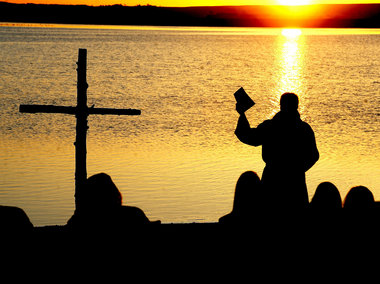
sunrise-easter-serviceIf I was a traditional Christian traveling along the usual Christian path, Easter would be one of the most important times of year for me. But if I strip away the cultural history and context that has built up over the long centuries, in celebrating the resurrection of Messiah, we’re celebrating the entrance of hope into the world for all of humanity. Watching the sun come up on Easter Sunday while praying and singing hymns and praising God for His Son must be like watching the dawn of an era of grace and illumination, the promise of peace to all mankind through our Lord Jesus Christ.

If I was a traditional religious Jewish person, Passover would be a time to be very excited. It’s yet another wonderful opportunity on our calendars to celebrate our liberation, our identity, our journey to the Torah, and the platform upon which we can pass what it is to be a Jew down to the next generation, participating in the continued survival and existence of the Jewish people, illustrating that against all odds, God cares about us and He is with us, and He is sufficient for us.

But I’m neither of those things. In spite of all my efforts, I’m still a person journeying between different worlds. My “traditions” aren’t set in concrete like those of most other Christians or Jewish believers. I exist in a molten plastic universe where I’m exploring concepts, ideas, realities, and existences. I can see the Shabbat from a direction of devotion and a rest in Messiah for human beings, and also from a direction where it appears exclusively Jewish. I can see the vital importance of Christians celebrating Passover as a connection to the seder of the Messiah, and I can also see it as a wholly Jewish experience.

And I’m still getting really, really tired of all of the bitching about who owns what and who is obligated to what and the perpetuation of the split between believing Gentiles and Jews that was already in progress, even as Paul was still preaching in the synagogues to the born Jews, the converts, and the God-fearing Gentiles at the beginning of his “missionary journeys.”

I’m convinced that if Jewish and Gentile believers in Messiah historically ever formed any sort of unified community, it must have been one that Paul didn’t write about, and the event probably lasted about forty-five seconds until someone found a reason to argue about whether or not Gentiles should be circumcised or if a Gentile should or shouldn’t be wearing tzitzit.

You shall converse in the words of Torah and not in other things.

-Yoma 19b

The Talmud explains “other things” as referring to idle, meaning less things.

The Hebrew language has words that mean rest, play, relaxation, and pleasant activities, while it has no word for “fun.” A “fun” activity has no goal, as is implied in the colloquial expression, “just for the fun of it.” In other words, the goal of the activity is within itself, and fun does not lead to or result in anything else.

This concept is alien to Judaism. Every human being is created with a mission in life. This mission is the ultimate goal toward which everything must in one way or another be directed. Seemingly mundane activities can become goal directed; we eat and sleep so that we can function, and we function in order to achieve our ultimate goal. Even relaxation and judicious enjoyable activities, if they contribute to sound health, can be considered goal directed if they enhance our functioning. However, fun as an activity in which people indulge just to “kill time” is proscribed. Time is precious, and we must constructively utilize every moment of life.

Furthermore, since people conceptualize their self-worth in terms of their activities, doing things “just for the fun of it” may in fact harm their self-esteem.

Today I shall…

…try to direct all my activities, even rest and relaxation, to the ultimate purpose of my life.

-Rabbi Abraham J. Twerski
“Growing Each Day, Adar 23”
Aish.com

rothschild-jewish-libraryThere are days when I think the perfect life of devotion would involve the destruction of the Internet and me with my nose buried in book after book in some vast library containing all of the great Jewish and Christian wisdom of the sages and tzaddikim. It would be an old-fashioned library where people would have to be quiet. I would have my little corner with my table and chair, my reading lamp and my stack of books. I could pray uninterrupted. I could even dream of the day of Messiah’s return when he would bring peace and abolish discord.

But that doesn’t work, because faith was never intended to exist in isolation which is why, in spite of the enormous risks of mixing with foreigners, Israel was meant to be a light to the nations.

More’s the pity.

What will my seder look like this year? I don’t know that I’m going to have one. If my wife expresses the desire, then of course, we shall have one and invite as many guests as want to attend. If my wife and daughter choose to attend the public seder at one of the local synagogues, then I hope they have a marvelous time. If we are invited to someone else’s home for a seder, assuming my wife wants to go and it’s appropriate for me to go with her, we’ll go and I presume it will be a wonderful time.

I can attend a sunrise Easter service. I feel that I somehow have to as part of my commitment to my church and my renewed “Christian walk,” though I still travel a rather unusual path. I just need to pull my head out of the computer and remember that despite all of the problematic people and problematic conflicts I encounter on the web, God is not on the web nor is he confined to someone’s pet theology, doctrine, or dogma. God is God and I am grateful each day that He is so far above all of the mucking around we mire ourselves in.

If there is a perfect seder or a flawless Easter, that is yet to come…perhaps at the feast of Abraham, Isaac, and Jacob.

I tell you, many will come from east and west and recline at table with Abraham, Isaac, and Jacob in the kingdom of heaven…

Matthew 8:11 (ESV)

I don’t desire that anyone be thrown into the outer darkness but rather that we all learn what is really important in the Kingdom of Heaven, and then we all choose to participate in that effort. Jesus said to the Roman centurion who had been pleading for his suffering servant, “let it be done for you as you have believed.” Remember, what we believe and how we act will also be done for us, for good or for ill.

Your future is whatever you make it. So make it a good one.

-Doc (played by Christopher Lloyd)
Back to the Future III (1990)

Children have never been very good at listening to their elders, but they have never failed to imitate them.

-James Baldwin

Remember, all of this isn’t just for us but for our children. Our children are watching us. Heaven help them if they should decide to imitate us.

The Radiance of the Light of Messiah

By day we take care to follow this order: Make Kiddush, then daven Mincha, and after that eat the festive yom tov meal.

The Baal Shem Tov used to eat three festival meals on Acharon Shel Pesach.

The Baal Shem Tov called the (third) meal of this day Mashiach’s s’uda (the “festival meal of Mashiach”). Acharon Shel Pesach is the day for Mashiach’s s’uda because on this day the radiance of the light of Mashiach shines openly.

In 5666 (1906) a new procedure was adopted for Pesach in the Yeshiva Tomchei  T’mimim in Lubavitch: The students ate the Pesach meals all together, in the study hall. There were 310 students present seated at eighteen tables. My father the Rebbe ate the festive meal of Acharon Shel Pesach with the yeshiva students. He ordered that four cups of wine be given each student, and then declared, “this is Mashiach’s s’uda.”

-Compiled and arranged by the Lubavitcher Rebbe
Rabbi Menachem Mendel Schneerson, of righteous memory, in 5703 (1943)
from the talks and letters of the sixth Chabad Rebbe
Rabbi Yosef Yitzchak Schneersohn, of righteous memory.
Translated by Yitschak Meir Kagan

In the seventeenth century the founder of the Chassidic movement, Rabbi Israel ben Eliezer (the Baal Shem Tov) instituted a new custom for the last day of Passover. He called it the Meal of Messiah (Seudat Mashiach). It consisted of a special, additional meal on the afternoon of the last day of Passover, paralleling the traditional third meal of Shabbat. The Baal Shem Tov emphasized that the main component of the meal was matzah. After all, it was the last meal on the last day of Chag HaMatzot, the feast of Unleavened Bread. A few generations later, the Rebbe Rashab (1860-1920) added the custom of four cups of wine, mirroring the seder of the first night. Some Chassidic Jews still celebrate this special Messiah seder on the last day of the festival. They gather together to end the festival with matzah, four cups of wine, and a special focus on the Messiah.

The entire theme of the meal focuses on the coming of Messiah and the final redemption. The meal is festive in spirit. Everyone wishes one another “L’chayim! (to life!)” while discussing their insights into Messiah and their dreams and hopes for the Messianic Era. The meal concludes with fervent singing and dancing in joyous elation over the promise of the Messianic redemption.

-Boaz Michael
“What is the Meal of Messiah? Part 2 of 3”
First Fruits of Zion

I’m sure that especially at this time of year with the Passover having just ended, we are all familiar with the redemption of Israel from their slavery in Egypt by the God of their fathers. Yet, redemption doesn’t always occur at a single point in history or in a single moment in time. Though the bodies of the Israelites were free, the minds and spirits of that first generation remained enslaved. In fact, almost none of that first generation, ironically including Miriam, Aaron, and Moses, would live to see the crossing of the Jordan and the fulfillment of the promise by inhabiting the land of Canaan.

One way we can look at the Meal of the Messiah, as instituted by the Baal Shem Tov and further described by Boaz Michael, is the further redemption of Israel and the celebration of that generation who would truly inhabit the land promised to Abraham, Isaac, and Jacob; the Land of Israel.

Walking TogetherBut what about those of us who are not their descendants? What of we, among the nations, who through our discipleship to the Master, we have become attached to the God is the Israelites? Does the Meal of the Messiah mean anything to us?

When they ate, Yeshua took the bread, made a brachah, broke it, and gave it to his disciples saying, “Take and eat it; this is my body.” He took the cup, made a brachah, and gave it to them saying, “Drink from this, all of you, for this is my blood, the blood of the new covenant, which is poured out on behalf of many for the forgiveness of sin.” –Matthew 26:26-28 (DHE Gospels)

Chassidim who keep the custom of celebrating the Meal of Messiah on the last day believe that by eating the matzah and drinking the wine, they are connecting with Messiah in both a tangible and spiritual way. God created us with our five senses, and he desires to bind us to him through our senses. To me, the parallels between this concept and the Master’s words at his last seder are astounding. It brings to my mind the Master’s words of “Take, eat; this is my body” and “Drink of it, all of you, for this is my blood.” Chassidim actually believe that when matzah is eaten at Passover that “we are eating G-dliness.” In fact:

Through eating at the time of … Moshiach’s Seudah we connect them with the physical world. In this manner, we create “a dwelling place” for G-d on the material plane. (Schneerson, Sichos in English, 3:20, 22-23)

-Boaz Michael, What is the Meal of Messiah? Part 2

Through the witness of the Master’s own words in Matthew’s Gospel, we can make a link between the imagery of the Chassidim and the Messiah’s final meal among his closest disciples. Through the words of the Master, we can also make a connection to us. Although we Gentile disciples cannot consider ourselves as having stood at the foot of Sinai or having crossed the Jordan into Canaan, on the final day of the Feast of Unleavened bread, we can partake of the bread of Jesus Christ, the bread of life.

Jesus said to them, “I am the bread of life; whoever comes to me shall not hunger, and whoever believes in me shall never thirst. –John 6:35 (ESV)

In fact, from ancient Jewish sources, “Bread” is one of the names of the Messiah:

Concerning the meaning of “in the sweat of your face you shall eat bread” (Genesis 3:19), the following explanation is given: “This hints about the Torah which is called bread, as it says, ‘Come, eat of my bread’ (Proverbs 9:5). Because of Adam’s sin, the Torah could not be fully explained until the days of Messiah” (Panim Yafot, Breshit 3). Accordingly, it is only Messiah who is able to reveal the full and complete meaning of the Torah, which gives life. In other words, inability to understand the Law brings about spiritual starvation. The perfect food, the “bread” of Messiah, therefore, is that which is able to ensure life.

-Tsvi Sadan
Lechem (Bread) pg 136
The Concealed Light: Names of Messiah in Jewish Sources

And yet, if the full yoke of the Law is not meant for the nations, but only the offspring of Jacob, what can this mean to us? Sadan continues (pp 136-7):

The “sign” performed inside the bodies of the people of Israel, according to Rabbi Shimon bar Yochai, was the nourishment of the manna. “How do we know that [this bread] did not come out of them [as excrement]? Because instead of reading ‘man ate of the bread of the angels [abbirim]’ (Psalm 78:24 ESV), you should read ‘man ate of the bread of the limbs [evarim]’ – bread that completely melts in the limbs” (Numbers Rabbah 7:4).

With this explanation, it is easy to see why the people of Israel were encouraged to eat from this Bread, as it says, “Oh, taste and see that the LORD is good” (Psalm 34:8). Wondering what the people should taste, Rashi concluded that Israel should taste the “Word” (Rashi to Psalm 34:9). For Rashi “Word” meant Law, but according to another explanation, “Word” is also the Messiah…

And we Christians also know this as it says:

And the Word became flesh and dwelt among us, and we have seen his glory, glory as of the only Son from the Father, full of grace and truth. –John 1:14 (ESV)

As you may know, my family’s Passover seder last week was something less than inspired. Also, it has never been our tradition to have a second meal at the end of the week of unleavened bread, so we have good reasons to not “tempt God” by trying to fulfill this custom.

But as we exit the week of matzah, we re-enter a life filled with the world in all it’s glories and disappointments. May God grant that we retain something of the radiance of the light of Mashiach, as we continue to progress in a world of darkness, with our path illuminated only by His Lamp.

Your word is a lamp for my feet and a light for my path. -Psalm 119:105 (Stone Edition Tanakh)

Find out more about the Meal of the Messiah at FFOZ.org.

Burning Alive

“…till you return to the ground, for out of it you were taken; for you are dust, and to dust you shall return.”

Genesis 3:19 (ESV)

As a father shows compassion to his children, so the Lord shows compassion to those who fear him. For he knows our frame; he remembers that we are dust. As for man, his days are like grass; he flourishes like a flower of the field; for the wind passes over it, and it is gone, and its place knows it no more.

Psalm 103:13-16 (ESV)

The Apostle Peter had a slightly different spin to Psalm 103:

Having purified your souls by your obedience to the truth for a sincere brotherly love, love one another earnestly from a pure heart, since you have been born again, not of perishable seed but of imperishable, through the living and abiding word of God; for:

“All flesh is like grass
and all its glory like the flower of grass.
The grass withers,
and the flower falls,
but the word of the Lord remains forever.”

And this word is the good news that was preached to you. –1 Peter 1:22-25 (ESV)

I write these “meditations” a day ahead, so who knows how I’ll be doing by the time you actually read this, but as I’m keyboarding this message, I am very much aware that “all flesh is grass,” (Isaiah 40:6) here one day and gone the next. I’m not feeling very “imperishable.” It’s not a perfect world. Today, it doesn’t even seem to be a particularly good one.

Prime Minister Binyamin Netanyahu issued another call Sunday to free Jonathan Pollard. His appeal came shortly after Pollard was rushed to a hospital.

“The time has come to free Jonathan Pollard. The Jewish people’s holiday of freedom should become his personal holiday of freedom,” the Prime Minister declared.

-by Maayana Miskin
“Esther Pollard: Don’t Make Me a Widow”
First Publish: 4/8/2012, 3:25 PM
Arutz Sheva News Agency

This is only one example of an injustice occurring during one of the most holy times on the Jewish calendar (and I suppose on the Christian calendar too, though Easter has just ended). My “calendar” isn’t exactly filled with joyous rapture these days either. Lots of reasons, though none that I’m prepared to disclose. I wonder if that’s the point, though. Is faith and trust in God, let alone in ourselves, supposed to be dictated in terms of circumstances? Not according to Rabbi Tzvi Freeman (appropriate last name for this Passover, don’t you think?):

Why do we kick ourselves so hard when we make a mess? Because we pat ourselves so nicely on the head when we succeed. As though success and failure is all in our hands.

Yes, we believe. We believe that it is not our talents, our brains, our good looks and hard work that brings success, that everything is in the hands of heaven.

But when we walk out the door into the cold, real world, we leave our faith behind in a world of fantasy.

If we would chew on it a little and allow it to digest before we went through that door, if we would let it sink into our minds and our hearts, then it would be more than faith — it would be a vision, an attitude.

It would be more real than even a dollar bill.

Although Freeman’s message is more oriented toward comparing the spiritual to the commercial (hence the “dollar bill”), the fact that we kick ourselves when we’re down and pat ourselves on the back when we’re up seems to show how the center of our reality is us rather than God. If, when life deals us harsh blows or when life grants us lush blessings, we were to consistently turn to God in praise, the condition of our lives wouldn’t really matter, would it?

Then why do we still feel pain and sorrow? Shouldn’t true people of faith be immune to “situationalism” by now? Is that why all the “real” religious bloggers only talk about their lives in upbeat, positive terms, because either nothing bad ever happens to them or bad things never affect them?

It’s often why I take inspirational blogs, religious or not, with a grain of salt.

But speaking of which, another of Rabbi Freeman’s messages states that, “In the heavens is G-d’s light. In the work of our hands dwells G-d Himself, the source of all light.” God is not (supposedly) hiding from us up in Heaven, but He’s right here with us, occupying everything we’re doing, every experience we are having, and perhaps even everything that we’re feeling.

But instead of listening to me kvetch, God has something to say, and He wants me to shut up long enough to hear Him.

There are questions to which G-d says to be quiet, to be still, to cease to ask. The quietness, the stillness, the abandonment of being, that itself is an answer.

-Rabbi Freeman
Be Quiet

It’s tough to abandon my being when the pain from the splinters in my soul and psyche keep bringing me back to myself.

All flesh is grass, especially mine.

Peter failed the Master by denying him three times publicly right before the crucifixion. The disciple upon whom the “church” would be built came to his lowest ebb at that time and in the days that followed. The resurrection of Christ still didn’t heal his wound, and Jesus himself added to Peter’s pain:

When they had finished breakfast, Jesus said to Simon Peter, “Simon, son of John, do you love me more than these?” He said to him, “Yes, Lord; you know that I love you.” He said to him, “Feed my lambs.” He said to him a second time, “Simon, son of John, do you love me?” He said to him, “Yes, Lord; you know that I love you.” He said to him, “Tend my sheep.” He said to him the third time, “Simon, son of John, do you love me?” Peter was grieved because he said to him the third time, “Do you love me?” and he said to him, “Lord, you know everything; you know that I love you.” Jesus said to him, “Feed my sheep. –John 21:15-17 (ESV)

Maybe you don’t see this transaction the same way as I do, but try to picture the scene. Peter is humbled and humiliated at having denied that he had anything to do with Jesus as the Master was undergoing his false trial. His betrayal and shame could only have gotten worse in the hours and days that followed, as Christ was tortured and then slowly murdered upon the cross. No wonder he and the others among the core disciples went into hiding.

Of course Peter ran to the tomb on even the slim hope that Jesus had been resurrected three days later, but that wasn’t going to fix the problem. Yes, the return of the Master from death was a joy beyond measure, but then, as we see recorded in John’s Gospel, Peter had to face his “accuser” again, the man he had horribly abandoned.

The Master asked, “Do you love me?” I wonder if Peter asked this question about his love of the Master. I wonder if he said, “How can I say I love him when I am so guilty?” How could Peter say, “Lord, you know that I love you” in response? How could he love even God when he must have so loathed himself?

Unlike Peter, in my current circumstance, I can’t say that I really failed. I only feel responsible because I’m involved. No one has failed, but when someone you love is hurt and in need, and you struggle to find a way to help and can’t, it still feels like failure. It also creates unbidden tension in other relationships, which serve as a reminder that after all, you’re only human.

I’m only human, and I am grass, cut and thrown into the fire, withering and turning to ash, even as I write.

I am on fire and soon the fire will be gone, and there will be only hot ash and smoke. And then that will cool, and the cold, dry ash that used to be me will be caught up in the breeze, become airborne, and scatter, carried by the four winds.

Even that would be a comfort, but I can’t let that happen because I’ve still got so much to do and have too many people who depend on me.

Though he slay me, I will hope in him… –Job 13:15 (ESV)

But God is gracious. As miserable as things can seem sometimes, He can also lighten the load. A little while ago, God relaxed the pressure He was putting on my skull with His thumb and I’m really grateful that He did. The fire is beginning to die down and I’m still here and in one piece. We may be living sacrifices (Romans 12:1), but there’s only so much we can take before we break, or God, in His mercy, takes us off the altar.

Like Icarus, my wings have melted and I’ve fallen to the ground, but my ashes are cooling and pretty soon, I feel like I might be able to rise up from them again.

Maybe this time I’ll get a new set of wings, or maybe God will just heal the old ones.