

It is appropriate for Gentile disciples of Yeshua to participate in Jewish prayer. After all, the Temple in Jerusalem is to be called “a house of prayer for all peoples” (Isaiah 56:7). Yeshua did not come to create a separate religion for Gentiles with different prayers.
-Aaron Eby
Chapter 2: Prayer in Jewish Space, p.33
First Steps in Messianic Jewish Prayer
I mentioned in my previous blog post My Personal Shabbos Project that I was planning an undertaking for two Sabbaths in November (the first is just a week away as you read this) to actually do my best to authentically observe Shabbos. The family will be away, so I’ll have the ability to construct my observance without offending anyone or intruding on “Jewish space” as a goy.
To that end, I mentioned a couple of resources I’d be studying: The Sabbath Table and Aaron Eby’s aforementioned First Steps in Messianic Jewish Prayer.
I’ve been looking through Eby’s book and in the second chapter, I came across a section called “Gentiles and Jewish Prayer”. The quote at the top of the page is taken from the first paragraph in that section. It sounds very supportive, encouraging, and inclusive. This is the second paragraph:
Nonetheless, there are issues and boundaries that must be considered when a Gentile chooses to participate in Jewish prayer services. In the same way, the “house of prayer for all peoples” had distinct areas through which men, women, Jews, Gentiles, and priests could enter and different ways in which they could participate.
-ibid
This was certainly true in the time of Herod’s Temple, and I can imagine, relative to Gentiles, it was also true in the time of Solomon:
Also a gentile who is not of Your people Israel, but will come from a distant land, for Your Name’s sake — for they will hear of Your great Name and Your strong hand and Your outstretched arm — and will come and pray toward this Temple — may You hear from Heaven, the foundation of Your abode, and act accordingly to all that the gentile calls out to You…
–1 Kings 8:41-43 (Stone Edition Tanakh)
The key phrase for me is “and will come and pray toward this Temple…” I don’t have any command of the Hebrew, so I don’t know really what “toward this Temple” is supposed to indicate. Were the gentiles to stand outside the Temple and pray in its direction? King Solomon doesn’t seem to be saying that gentiles anywhere on earth could just face Jerusalem, because he speaks of gentiles traveling to Israel because of God’s great reputation.
Most Christian English language Bibles use the word “toward” although the International Standard Version says “facing,” and both the Jubilee Bible 2000 and the Douay-Rheims Bible say “in this house” and “in this place” respectively. Put together, I get the definite impression that gentiles weren’t expected to enter any part of the Temple’s grounds when Solomon was King. At least in Herod’s Temple, there was a court of the Gentiles.
About the ninth hour of the day he clearly saw in a vision an angel of God…
Cornelius said, “Four days ago to this hour, I was praying in my house during the ninth hour; and behold, a man stood before me in shining garments…
–Acts 10:3, 30 (NASB)
Cornelius the centurion was the quintessential God-fearer. Luke says that he was a “devout” man, indicating some level of Torah observance.
-D. Thomas Lancaster
“Cornelius, the God-Fearer of Caesarea,” p.18
Messiah Magazine, Fall 2014 edition
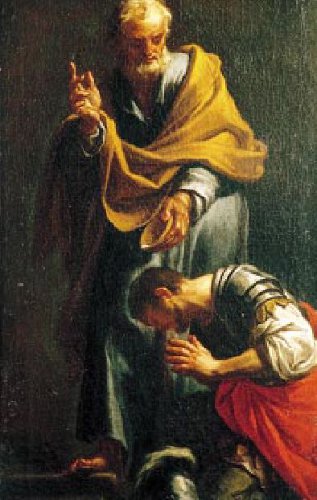
Clearly in the days of the apostles, the God-fearing Roman Cornelius had taken it upon himself to observe some of the mitzvot including the set times of prayer. Luke places the centurion praying at the ninth hour which corresponds to between two to three p.m., a time in both the ancient and modern worlds when devout Jews pray the Minchah or afternoon prayers. Exactly what and how Cornelius was praying we’ll never know, but his devotion to God and to the Jewish people got the attention of an angel and subsequently the apostle Peter.
So I agree that Gentiles were always meant to participate in the prayers, and both in the days of Solomon and Herod, we have indications that, as Eby says, there were distinctions regarding the placement of Gentiles in Jewish space, specifically the Temple.
I find this promising and more than a little daunting, which is why, even though ideally Shabbat observance is done in community, it is better for me to observe Shabbos alone, and particularly outside of Jewish space. Frankly, for me to have any sort of “thumbprint” placed upon my Sabbath practice, it’s just easier to do so in my own home.
Not that my home isn’t “Jewish space” since I live with a Jewish wife and daughter, but one of the requirements of my project is that I be alone so that, among other things, I don’t (metaphorically speaking) stomp all over their Jewish space with my big, fat feet. I have no desire to appear more “observant” than the Jewish people I live with, Heaven forbid. My role is supposed to be to encourage them to be more Torah observant.
It should be noted that until Peter and his party of Jewish companions entered Cornelius’s home, the centurion’s environment was composed exclusively of gentiles, so whatever Jewish observances he employed were not impinging on Jewish space. Of course God-fearing Gentiles regularly attended synagogue, but I can only imagine that they didn’t simply just “mix in” with the Jewish crowd but instead, had specific seating arrangements.
Eby in his book agrees with Lancaster and believes the “text implies that Cornelius prayed in what seemed to be a Jewish way” (p.33). Further, Eby says:
There is a delicate balance when it comes to the relationship of Gentiles to Jewish prayer. If the prayer of Messianic Gentiles is to be identical to Jewish prayer, it implies that these Gentiles have become Jews or that they fit into the same legal category as Jews. This is a type of replacement theology. On the other hand, if Messianic Gentile prayer is to be completely different from Jewish prayer, it denies the concept that it is through Israel that all nations connect with God.
-Eby, pp.33-4
Next, Eby speaks of “Blessings in Vain” and “Misappropriation of Identity,” both of which the Gentile (me) encounters in many of the blessings in a standard siddur, which, as Eby states, is “written from a first-person Jewish perspective.”
Fortunately, though I’m not terribly familiar with it yet, The Sabbath Table is written in such a way that it guides the Jewish and Gentile disciples along slightly different paths in the traditional liturgy, so the Gentile doesn’t have to “think fast on his/her feet,” so to speak, when reaching a part of the prayers where the reader is identified as Israel.
I remember encountering this issue in my “Hebrew Roots” days and I eventually learned to either avoid certain “problematic” areas of the siddur, or to broadly re-interpret them as meaning I supported Israel and her people rather than I was Israel.

Eby also suggests substituting “us” with “your people Israel” as a plea for Israel rather than as a request from Israel.
I know all this is going to rub some people the wrong way, but prior to the apostolic era, it was relatively rare for Gentiles to be in Jewish space and particularly to keep the Shabbat unless they were in the process of converting to Judaism or represented that equally rare phenomena (in those days) of being a Gentile married to a Jew.
Going back much further and into the time of Moses, any Gentile who wished to become attached to Israel and be considered a “resident alien” was actually obligated to a significant number of the mitzvot, including Shabbat observance, with the understanding that they would become permanent members of the community as Gentiles and that their descendents, starting at the third generation (grandchildren), would be absorbed into an Israelite tribe and clan (probably through intermarriage) and be considered Israelites; their ties to their Gentile ancestors obliterated.
But as Gentile disciples of Yeshua, we are not considered gerim as such (since Israel is no longer tribal), nor God-fearing Noahides, since all the nations of the earth are obligated to the basic laws of Noah, but we benefit from the blessings of the New Covenant, the promise of the resurrection, the giving of the Spirit (see Acts 10), and the life in the world to come.
Paul’s vision, his “gospel” included Gentiles in Jewish social and religious space and he staunchly defended his position, even in the face of James and the Apostolic Council (see Acts 15), and while his vision died with him, it has been reborn in modern Messianic Judaism.
Boaz Michael, President and Founder of First Fruits of Zion (FFOZ), defines Messianic Judaism in part by saying:
To me, Messianic Judaism is not just a Jewish-flavored version of Christianity. If I was asked to define Messianic Judaism, I would say, “Messianic Judaism is the practice of Judaism coupled with the realization that Yeshua of Nazareth is the Messiah, the New Testament is true, and the kingdom is at hand.”
-Boaz Michael
“Defining Messianic Judaism”
from the Director’s Letter, p.10
Messiah Journal, issue 117, Fall 2014
Boaz didn’t mention Gentiles in his definition of Messianic Judaism, but on pages 7 and 8, he states:
In many ways, the Messianic movement seems to be stuck in a rut, unable to resolve its most basic identity questions. Like one of those endless Messianic circle-dances, we are continually circling around the same sets of questions: Jewish identity, effective evangelism strategies, the role of tradition, the role of liturgy…and especially the role of Gentiles in the Messianic Jewish movement. (emph. mine)
I don’t know if the question of the role of the “Messianic Gentile” in Messianic Judaism is a problem in Messianic Judaism or just my own personal issue. I suppose I’m more sensitive to these matters than most because I’m intermarried, and particularly to a non-Messianic Jew. The divide between me being a Christian and her being Jewish is a well-defined line of demarcation.
Which brings me back to observing Shabbat individually and the “problem” of me being a Gentile and the Shabbat prayers being Jewish.
For example, one line in the traditional after-meal blessing offers thanks to God “for the covenant that [he] sealed in our flesh.” It seems problematic for a Messianic Gentile to say this. But should someone who is not Jewish then say “for the covenant that you have written on our hearts?” To do so would imply that Messianic Jews have only a fleshly covenant, whereas the new covenant that is written on hearts belongs only to Messianic Gentiles, God forbid.
-Eby, p.36
As my long-suffering wife would say, “Oy!”
Eby goes on to say that prayers in a Messianic Jewish synagogue should not be homogenized across the Jewish and Gentile population, and I agree, but that also would introduce a certain amount of “clashing” with one group saying one thing and another saying something completely different at the same time.
I can see the attraction of church only because it is homogenized. Everyone is the same, though I feel sorry for the “Christian Hebrews” in attendance since it is my firm belief that they aren’t “cookie cutter identical” to the Gentile Christian congregation in which they are embedded (I also can see the attraction of a homogenized [Jewish] synagogue environment for Messianic Jews and for the same reasons).
I don’t know how Paul did it. I wish he’d left more detailed instructions.
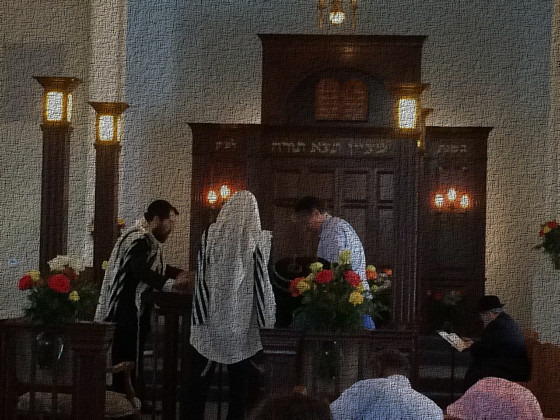
I remember feeling this sense of dissonance the second time I attended the Shavuot conference at Beth Immanuel Sabbath Fellowship. Although it advertises itself as “Messianic Judaism for the Nations,” within its walls, I experienced a severe case of identity confusion, probably because at that time, I had returned to regular church attendance and didn’t know if I was “fish or fowl”. How could I totally commit to church and still “feel” like a “Messianic Gentile?”
The dissonance damaged my Shavout experience and a few relationships along with it, much to my regret, and ultimately resulted in me bouncing back out of church since in the end, I didn’t have a single thing in common with the people there, at least in terms of theology and doctrine.
But “shoehorning” my way back into Messianic Judaism hasn’t proven particularly easy, either. When I’m just me, studying alone, praying alone (though I haven’t touched my siddur for months now), it’s just me and God and problems of identity and relationship aren’t a problem. God knows who I am and who I am created to be. I don’t know what He’ll think of all my preparations for Shabbat. Maybe He thinks they’re all foolish. I don’t know. If I’m doing this just for me, then I’m doing it in vain. Shabbat only means something if my intent is to honor God.
But dodging through this minefield of a Gentile and Jewish prayer and a Gentile and Jewish Shabbat observance makes me glad I’m doing all this in the privacy of my own home. If I slip or, Heaven forbid, get a little bit to “liberal” with the prayers, the only person who’ll be offended is God, and I’m hoping He’s more forgiving of me than I am of myself.
The Shabbat is supposed to be a delight. So why do I have a feeling of impending dread?
Actually, here’s part of the answer:
Don’t confuse God’s commandments with the traditions of men. Does God actually want such “extra effort” to do things He has never commanded?
Why was Jesus challenged so many times about what He did on the Sabbath? Was it because He was breaking God’s law? Or was it because His actions contravened the traditions men had ADDED to God’s commandments about the Sabbath?
What did Jesus actually mean by “The Sabbath was made for man, not man for the Sabbath”.
I just find something ludicrous in the fact that a refrigerator light can cause such concern and is that kind of thing REALLY what the Sabbath is about? Would applying duct tape to the switch (or disconnecting the light some other way) be pleasing to God or would leaving the light to shine displease Him ?
This is a recent comment on another blog post and it highlights one side of the argument. The other side is me trying to be sensitive to Jewish requirements as a non-Jew choosing to observe one or two Sabbaths using the only template I have available: a Jewish template. In trying to navigate the competing priorities of human beings, I’m letting them suck the joy out of what should be a joyous occasion. Really guys, I’m going to be alone so how I choose to observe Shabbos should be between me and God.
If I were in someone else’s house or in someone’s synagogue, I’d follow the requirements of my host, but in any real sense, my “host” will be God. Like I said, I’m following Jewish tradition to some degree because it’s the template I have available to me, and frankly, Jews have been observing the Shabbat for untold centuries before there were any Christians. You’d think we goyim would recognize by now that the Jewish people are the experts on Shabbat.
I probably won’t be perfect in my observance or meet everyone’s expectations, Jewish or Christian, but why should this be any different than anything else I’ve done or written about?








 Morning Meditations