Tag Archives: Tent of David

Healing the Enemy

healingIt is not incumbent upon you to complete the work.

Ethics of the Fathers 2:21

In economics, the bottom line measures success and failure. Someone who goes into a business venture with complete recklessness, yet makes a great deal of money, is considered a successful entrepreneur. Another person who was extremely cautious and applied sound business principles, yet went bankrupt, is considered a failure.

Unfortunately, we tend to apply these values to our personal, non-business lives. If things do not turn out the way we wish, we may think that we have performed badly. This is not true. If parents abuse and neglect their children, yet one child wins the Nobel Prize, or discovers the cure for cancer, they do not suddenly become good parents. On the other hand, if they did their utmost to raise their children well, yet one becomes a criminal, they are not necessarily bad parents.

We must understand that we have no control over outcome. All we can control is process, i.e. what we do. If we act with sincerity and with the best guidance available, then what we are doing is right.

Parents whose children turn out to be anti-social invariably fault themselves and may be consumed by guilt. Their pain is unavoidable, but their guilt is unjustified.

Humans do not have the gift of prophecy, nor do we always have the most accurate knowledge. We should hold ourselves responsible for that which we can control, but we should not hold ourselves responsible for that which is beyond our control.

Today I shall…

…try to realize that I must judge the correctness of my actions by how I arrive at them, and not by what results from them.

-Rabbi Abraham J. Twerski
“Growing Each Day, Adar 16”
Aish.com

There’s a lot going on here including the struggle to define what is good and what is bad, not only in our own actions, but in the actions of others. We all know our own intent when we say or do something, but even when that intent is good, especially on the Internet, our words can be taken in the wrong way and people can respond with offense and even hurt and anger, as if we had gone out of our way to try to injure them. On the web, that’s usually how we define an “enemy.”

“You have heard that it was said, ‘You shall love your neighbor and hate your enemy.’ But I say to you, Love your enemies and pray for those who persecute you, so that you may be sons of your Father who is in heaven. –Matthew 5:43-45 (ESV)

Bless those who persecute you; bless and do not curse them. Rejoice with those who rejoice, weep with those who weep. Live in harmony with one another. Do not be haughty, but associate with the lowly. Never be wise in your own sight. Repay no one evil for evil, but give thought to do what is honorable in the sight of all. If possible, so far as it depends on you, live peaceably with all. Beloved, never avenge yourselves, but leave it to the wrath of God, for it is written, “Vengeance is mine, I will repay, says the Lord.” To the contrary, “if your enemy is hungry, feed him; if he is thirsty, give him something to drink; for by so doing you will heap burning coals on his head.” Do not be overcome by evil, but overcome evil with good. –Romans 12:14-21 (ESV)

None of this is suggesting that Jesus or Paul wanted us to give a kiss on the cheek to someone who’s holding the barrel of a loaded handgun to our head. It’s not as if we are forbidden from defending ourselves in war or must allow ourselves to be beaten during a robbery attempt. We see Christ’s intent in his juxtaposing the words “neighbor” and “enemy.” Someone can be our “enemy” if they are our next door neighbor. Maybe we’re upset with them because they borrowed our favorite power tool six months ago and never gave it back, or they have a dog that barks half the night but refuses to quiet the animal. For whatever reason, our “neighbor” can become our bitter enemy and they can even say bad things about us and malign our character unjustly.

WrongThis happens a lot on the web and often in blogs and blog comments (and I’ve written about this many times before). While I haven’t been “stung” in a little while, in my readings this morning (as I write this), it occurred to me that misunderstanding and misinformation are rampant on the Internet, and disagreements or differences of opinion on a good many things, but particularly in the world of religion, have created many enemies from the body of our neighbors. Against my better judgment, I’m going to refer to a blog post by Judah Himango, his commentary on a sermon delivered at his wife’s church (Judah attends church with his wife on Sunday but considers his Hebrew Roots congregation, which meets on Saturday, to be his primary place of worship) which Judah calls My experience at church today, a friendly criticism of Pastor Troy Dobbs’ sermon on Jesus and the Sabbath.

In reading Judah’s commentary, I must say that I agree with him that the Pastor in question was not accurate, (in my humble opinion) and that his message from the pulpit reflected a very traditional supersessionist stance which we have often observed in the church historically. I have been fortunate to find a church and a Pastor who sees beyond the rhetoric and back into the Scriptures in a way that reflects what I believe to be the true intent of Jesus and the Apostles relative to Jews, Judaism, and the Torah (although we don’t agree on everything), but many other churches still have a long way to go. Does that make the particular Pastor at Judah’s church my “enemy” or any sort of enemy to those of us to disagree that “the Law was nailed to the cross and replaced by grace?”

Absolutely not. In fact, at one point in the comments section, Judah even defends this Pastor by saying, “Pastor Dobbs has much great teaching.” It’s only on certain points that Judah and Pastor Dobbs disagree; it’s not (I hope) a more general drawing of battle lines between Hebrew Roots and Christianity, as if they were mutually exclusive entities (although I’m disappointed to find out that Judah “posted [a] friendly criticism on the Church’s website, underneath their post for this particular sermon, and on the Church’s Facebook page, but they deleted both..”) I think we in the church should be big enough to take a few criticisms rather than assuming what we say will always be taken as “Gospel” by literally everyone hearing the message without question.

I don’t believe it Judah’s intent to say that only his perspective is correct and everything produced by any Christian Pastor is wrong (unfortunately, a number of people have commented on his blog who seem to have a more “adversarial” relationship with Christianity and the church), but it is all too easy for most of us to start making enemies between different factions of Christianity by pointing out where they (we) disagree and ignoring how much alike both sides actually are. It’s inevitable that we are going to disagree, particularly in the religious blogosphere, but then, what are we supposed to do about it? What did Jesus and Paul say to do in their words as I quoted them above? What did Rabbi Twerski say?

Today I shall try to realize that I must judge the correctness of my actions by how I arrive at them, and not by what results from them.

Said another way, perhaps we should try to realize that we must judge the correctness of the actions of others by how they arrive at them, not by what results from them. If we understand that our good intentions can be misunderstood, then we must certainly grant that same “grace” to others. No, it’s not like we have to agree with everything that everyone else says and we can certainly recognize and challenge error, but the fact that we disagree with someone and think they’re wrong about something doesn’t make them bad or evil, nor does it make them our enemy, unless we choose to decide that they are. churches
Pastor Dobbs isn’t Judah’s enemy and frankly, he isn’t mine, either. Extending that out from individuals to systems, it also doesn’t mean that the church is the enemy of Hebrew Roots or even Messianic Judaism (or any Judaism). Yes, there has been great enmity between Christians and Jews historically, and yes, sermons like those delivered by Pastor Dobbs have often been used to maintain the distance and to some degree, the hostility we sometimes experience between Christians and Jews. To deny the validity of Jews and Judaism within the confines of what once was a sect of Judaism is kind of crazy-making, especially if you think the scriptures support such a position.

But the answer to this problem isn’t to make enemies, to revile “the church,” or to believe that some other movement that exists outside of Christianity is the only valid expression of the worship of Messiah. The answer, or at least part of it, is communication, fellowship, and patience. This is why I thought it was rather poor form of whoever manages the church’s website and Facebook page to remove Judah’s commentary (assuming it was worded in a respectful manner). Of course, depending on the church’s policy on public communications, it might be a conversation that would better be conducted (initially) in private, but even that might not have yielded Judah a friendly and receptive audience.

What to do? There’s probably no one right answer for all people and all churches, but I think part of the answer is what Boaz Michael suggests in his book Tent of David. We need to persist in the church. We need to be present in the church. We need to be the change we want to see in the church, not by forcing our thoughts, feelings, and opinions down the church’s collective throat, but by living the sort of life we believe is right in relation to Jews, Judaism, and Israel. But this doesn’t mean we should act like Jews, Judaism, and Israel (and I said just yesterday, that the best way to preserve the safety and continuance of Judaism and the Jewish people is for we Christians to protect Jewish identity, especially from ourselves).

Paul says we must do our best, as far as it depends on our own behavior, to “live peaceably with all,” which includes those with whom we disagree. And when we disagree, our response is not to beat our “enemy” about the head and shoulders with a blunt instrument (such as a handy Torah scroll), but to “heap burning coals” on their heads by offering them acts of kindness, meeting their needs, and providing for their requirements. Part of that, for some of us anyway, is to show up at church every week, to attend Sunday School, to take a weekday evening class offered at church, to smile and be friendly, to make relationships.

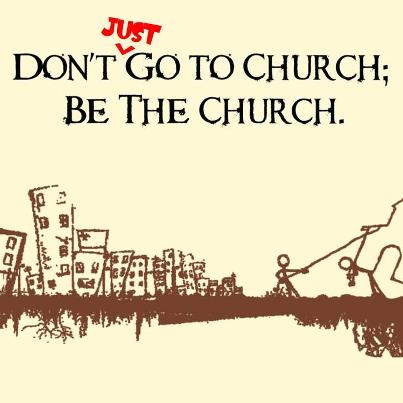
No one is going to listen to us, especially in a disagreement, unless we’ve first established a relationship with them and we’ve demonstrated that we are committed to being part of the church community. Even if we go on a more or less regular basis, if we are going as if we’re just guests and not part of the church, who will want to listen to us? Why will anybody care? They don’t think we care, so why should they?

If you want to inspire change, you have to demonstrate love. This isn’t just one group trying to convince another group to change their minds or to acknowledge that our group may have a valid point. The ability to commit and to show love has much wider and deeper implications.

The purpose of every human being is to serve his Creator, and that is a service of great joy: “I, puny mortal and decidedly finite being, serve with my deeds the Infinite Creator of All Worlds! I am bound to the Source of Life from birth, and all the many raging waters of this world cannot tear me away from that bond. Even if I sometimes fail, I may always return and in a single moment reconnect all my soul.”

-Rabbi Tzvi Freeman
“The Infinite Connection”
Based on letters and talks of the Rebbe
Rabbi M. M. Schneerson
Chabad.org

communityI disagree with Judah that it will always be a mistake to ask anyone who supports Jews, Judaism, the Jewishness of Messiah, and the centrality of Israel to become part of a traditional church (though I admit, it isn’t for everybody). After all, Judah and his wife are part of a church and yet that doesn’t seem to have inhibited his ability to express a differing opinion. I’m a part of my church, and the content of my blog posts should provide ample evidence that I haven’t been “brainwashed” or otherwise inhibited from holding and expressing my individual perspectives. Boaz Michael, who wrote Tent of David, and his wife Amber regularly attend a small Baptist church in their community and yet, he is not only able to write such a book, but his Pastor actually wrote the book’s introduction, endorsing Michael’s views.

The church isn’t a building or a denomination or even a theology. The church is people. The church is the body of Messiah, all of us, each and every individual who acknowledges that Jesus Christ is Lord and Yeshua HaMoshiach is ani or ha-olam (light of the world). Yes, the body of the Messiah seems hopelessly shredded, fragmented, scattered, and dismembered, with the bloody parts strewn to the four corners of the globe. But God has promised to gather the Jews who are called by His Name back to Israel (Zechariah 10:6-8, Micah 2:12) and He has also promised to gather the Gentiles from the nations who are also called by His Name (Zechariah 14:16-19, Amos 9:11-12).

One day the body of the Messiah will be One just as God’s Name is One. The body will still have “parts” even as an individual human body has many parts, but all of those parts must work together in harmony if the body is to live and to maintain good health. So to it will be for the body of Messiah. Yet, we in that body will only wither and die if we say that we reject another body part or that our own part is the only thing the body needs. Can a person live without a heart or a liver? Can the lungs say that they are the only body part the person needs and all of the other parts are “wrong?”

Even when Israel has behaved in total disobedience, God called her back to Him like a groom calls his virgin bride. How can we do any less when we perceive disagreement between ourselves and some other part of the church? I know the analogy is far from perfect, but to believe otherwise is to deny that Christ has a body of those who are called by his name or worse, it’s to say that in our own opinion, we have judged only ourselves to be the “true church” and that all congregations who don’t agree with us right down to the finest theological detail, are not part of the larger Messianic community.

Seize the vision of hope, healing, unity, and community. The beginning of restoration of the body of Christ starts with one person reaching out a friendly hand to another, even when they’ve disagreed, and calling him “brother.”

Imploring Unity

jewish-davening-by-waterAnd on the Sabbath day we went outside the gate to the riverside, where we supposed there was a place of prayer, and we sat down and spoke to the women who had come together.

Acts 16:13 (ESV)

They did not find any Jews. On that particular Sabbath only a small group of God-fearing Gentile women gathered to worship the God of Israel in the open air. The handful of God-fearers seems to be all that remained of the Jewish community in Philippi. The decree against the Jews had overlooked God-fearers. Even in the absence of the Jewish community, the women continued on with Sabbath observance and prayers.

-D. Thomas Lancaster
Torah Club, Volume 6: Chronicles of the Apostles
from First Fruits of Zion (FFOZ)
Torah Portion Terumah (“Heave Offering”) pg 488
Commentary on Acts 15:36-17:14

Yesterday’s extra meditation addressed the “Jewish oral traditions” as applied to the early Gentile disciples in the days of James, Paul, and the Council of Apostles. We saw, based on Lancaster’s commentary, that it is very likely Paul taught a sort of oral law or “halachah” to the Gentiles regarding the teachings of Jesus and how to implement those teachings using a basic understanding of Torah as a foundation.

I wrote that meditation because for the past week or so, I’ve been focused on Jewish halachah and the right of the Jews in the modern Messianic communities to establish and maintain a halachah for themselves that is substantially similar to halachot utilized by other streams of Judaism. But in defining Jewish identity through halachah, Gentile identity definitions have been neglected relative to the Bible. Based on that neglect, some Christians have opposed the maintenance of a unique Jewishness among the Jewish disciples of Messiah, defining it as “exclusivist” and even “racist.” There’s also a suggestion that “things of the flesh” and “things of the spirit” are mutually exclusive, and that God has ceased to apply a special spiritual identity and purpose to the Jewish people, the living inheritors of Sinai, particularly now that the Messiah has come and will (hopefully soon) come again.

Christianity and Judaism stand in stark contrast to each other, even within the context of Messianic Judaism where Jews and Gentiles share the same God and the same Messiah. However, as we saw in Lancaster’s commentary on Acts 16:13 above, in the days of Paul, the Gentile disciples and God-fearers probably looked more “Jewish” than we ever would look today, up to and including observing Shabbos. Lancaster quotes Ben Witherington’s The Acts of the Apostles : A Socio-Rhetorical Commentary (pg 491) to provide us with a bit more detail.

Presumably these women had assembled to recite the Shema, to pray the Shemoneh Esreh, and to read from the Law and the Prophets and perhaps to discuss its meaning, to hear from a teacher, and to receive a final blessing. In this case, Paul was the guest teacher.

This short paragraph provides us with a rich picture of a group of non-Jewish women, not yet disciples of the Messiah Yeshua, who came together in the absence of their exiled Jewish mentors and teachers, to continue to worship the God of Israel in the only way they knew how. If it had been the custom to light Shabbos candles in that day just before the arrival of Erev Shabbat, I can imagine these devout women doing so with humility and even a sense of awe and wonder, welcoming God’s rest into their homes as best they could.

LydiaMariaElkinsSome Christians, primarily those associated with the Hebrew Roots movement, have come under the mistaken belief that supporting Jewish identity uniqueness means abandoning what the women in Acts 16 were practicing and scurrying off to a Christian church, learning to be a “good goyishe” believer, and forgetting the rich history and imagery of worshiping God within the beauty of many of the mitzvot. Nothing could be further from the truth. Here we have a wonderful example of a small group of women who had devoted themselves to God within the Jewish traditions, but who were isolated from exploring and extending their faith until they met Paul and his small group by the water.

The women gladly welcomed the visitors. Paul, Silas, Timothy, and Luke sat down with the women and explained their errand to Philippi. They presented the women with the good news of the kingdom.

-Lancaster, ibid

There’s a certain simplicity in picturing such a scene and it makes me long for that sort of encounter with holy men of God and indeed with the good news of the Messiah. I can only imagine what it must have been like to sit by the river and listen to Paul and the others teach. One day, may we all be privileged to hear such words of integrity and holiness.

“Religion” has gotten so complicated and so divisive (not that religious divisiveness didn’t exist during the days of Paul). Even in my own little corner of Christianity/Hebrew Roots/Messianic Judaism, sparks fly, tempers flare, and opinions are bandied about as if they were the sacred texts themselves (well, in the blogosphere anyway…my face-to-face encounters are always very civil and friendly, even when some of my brothers and I don’t see eye-to-eye).

Derek Leman shared a link on Facebook, and I found the article written by Rabbi Dr. Nathan Lopes Cardozo called I am Taking Off My Kippah quite compelling.

Don’t be shocked. But I need to be honest. I am contemplating taking off my kippah. No, do not worry. I have no intention of becoming irreligious, or even less religious. Far from it. In fact, I want to become more religious and have come to the conclusion that my kippah prevents me from doing so.

All my life I am trying to become religious, i.e. genuinely religious, but so far I have bitterly failed. Oh yes, I am observant, even “very observant.” I try to live by every possible halacha. It’s far from easy and boy, do I fail!

But that is not my problem. My problem is that I don’t want to be observant. I want to be religious, and that is an entirely different story.

Please pause and read all of Rabbi Cardozo’s missive and capture the full flavor of his message and intent before proceeding here. You see, he makes a very good point. As I read his words, I am aware of a thought and a direction that has become my “traveling companion” for the past few years now. When I was involved in Hebrew Roots (and I still maintain friendships with my former colleagues), I originally fell into the “trap” of mistaking being “observant” for encountering God. It’s not that you can’t do both. It’s not that you can’t wear a kippah, don a tallit, lay tefillin, daven from a siddur and not still encounter God, it’s just that doing a bunch of “stuff” and wearing a bunch of “stuff” doesn’t guarantee the experience, nor does it make you better or more holy than the Christian who doesn’t do all that.

They do all their deeds to be seen by others. For they make their phylacteries broad and their fringes long…

Matthew 23:5 (ESV)

Don’t misunderstand me. I’m not saying that davening while wearing tzitzit and tefillin is a bad thing (particularly for a Jewish person), but it is a pit that some have fallen into, like the scribes and Pharisees Jesus was addressing. When the “stuff” becomes more important than what you’re trying to accomplish with the “stuff,” then it’s time to put it all in a box, put the box on a high shelf in your closet, and proceed to encounter God unfettered and exposed. Then maybe if you choose to pick some of that “stuff” back up in the future, it will actually mean something to you by then. If Rabbi Cardozo, who is Jewish and who is a child of the commandments can see this for himself, how much more should we who are not Jewish and who are “grafted in” only by faith and mercy see it for ourselves?Jewish_men_praying2

But even in acquiring this view, and returning to Paul and the Gentile God-fearers who have become disciples of the Master, there is a problem. While I do indeed support Jewish identity distinction within the body of Messiah, I’m not going to pretend that it doesn’t present a barrier to unity.

As Paul spoke about repentance, the Messiah, and the kingdom, “the Lord opened her heart to respond.” She declared her desire to become a disciple. She and her household (children, slaves, and husband if she had one) received immersion into Messiah.

After her immersion, Lydia implored the apostles to consider staying in her home. As a God-fearer, Lydia was aware that Jews did not ordinarily lodge in the homes of Gentiles. She attempted to persuade them, “If you have judged me to be faithful to the Lord, come into my house and stay.” Her request implies an appeal to judge her favorably on the basis of her observance to the Torah. The apostles expressed some reluctance, perhaps because of uncertainty about the Gentile home or perhaps because their lodging in the home of an unmarried woman (if she was) might appear unseemly. Luke says, “She urged us…and she prevailed upon us.” At last, the apostles agreed to accept her hospitality.

-Lancaster, pg 489

Some folks will jump on the phrase, “judge her favorably on the basis of her observance to the Torah” as an indication that Lancaster believes Lydia and her household were Torah observant in an identical manner to the Jews, and certainly in order for Paul and his party to stay in her household, a number of the mitzvot involving food and wine would have to be followed. We don’t have very many details regarding Lydia’s “Torah observance,” but putting everything together, we can see that she and the other devout God-fearing women in Philippi appeared to follow a number of the mitzvot, and from an outsider’s point of view, much of the behavior of these Gentile women may have been indistinguishable from Jewish women.

But there was a dynamic tension involved when Lydia asked Paul and his group to stay in her home because she wasn’t Jewish and because Paul and his party were Jewish (I believe Timothy was considered halalachally Jewish because Paul had him circumcised…Luke was arguably not Jewish but obviously was accepted as an appropriate traveling companion by his Jewish associates nonetheless). That dynamic tension has resurfaced in the Messianic realm today and for similar reasons…but not identical reasons.

In Paul’s day, being a disciple of Jesus and being Jewish was not at odds at all. While other Jewish sects may have disagreed with the identity of Jesus as Messiah, the Master’s Jewish disciples were unequivocably considered Jews. It was a no-brainer. No one gave it a second thought. But as we’ve seen in some of my previous blog posts, just who and what a Gentile disciple in the Messiah was presented quite a problem. The Apostolic Decree James issued in Acts 15 provided a basic starting point for Gentile disciples, but how far their observance and worship could be taken may have still been up for grabs.

Today, like it or not, the tradition of the church says that a person is only a Christian if they believe Jesus is Lord and died for your sins…and for Jews, they are only Christians if they give up “the Law” and rely on grace alone. No Jewish mitzvot are welcomed along on the journey of Christian faith. Yes, those attitudes are changing, but it’s completely understandable that Jewish Messianics are sensitive to any suggestion that they’ve “converted to Christianity” and are no longer observant Jews. Just as Paul was nearly lynched when it was even suggested that he took a Gentile into the Temple (Acts 21:28-29), a Messianic Jew associating with non-Jews who, for all intents and purposes, are also taking on board Jewish identity markers with apparent impunity, brings forth a lot of questions about just “who is a Jew?” Sometimes the answer to that question prompts “circling the wagons.”

Dr. David Stern in his book Restoring the Jewishness of the Gospel: A Message for Christians insists that Messianic Jews continue to observe the mitzvot and follow halachah as long as it doesn’t hinder unity with the Gentile believers. Paul, Silas, and the others were caught in a similar bind, desiring to observe halachah but also recognizing the need to be accepting of their fellow Gentile disciples.

Shechinah-Above-The-TownI don’t have an absolute answer for this puzzle, but we do see that Paul was able, in some manner or fashion, to overcome the struggle he was facing and allow his party to stay in Lydia’s home. The Bible text is silent about the specific arrangements involved so we don’t have a concrete map to use for our present situation. We also see that “Christian” women were acting a whole lot more “Jewish” than is typical in most churches today. That suggests it may be possible for completely Gentile churches or congregations to “recite the Shema, to pray the Shemoneh Esreh, and to read from the Law and the Prophets and perhaps to discuss its meaning.” That’s not “normal” in most churches today, but according to the Bible, it’s not exactly forbidden, either. I think this type of worship is at the heart of what the Hebrew/Jewish Roots movement is supposed to be all about.

But the goal isn’t for Gentile Christians to become “Jewish” or even to go out of their way to “act Jewish.” For that matter, the goal isn’t really for Jews to “act Jewish,” recalling the intent and purpose of Rabbi Cardozo’s blog post. The goal is to be who we are in our relationship with God and to seek His face always.

If your “stuff” is getting in the way of that or in the way of your relationships with the wider body of believers, including the church, then it’s time to reconsider what your goals are and who your Master is. It’s time to restore bonds between the different little “bodies” of Messiah that have been running around on this world, all proclaiming that they hold exclusive truth. Efforts are being made. Barriers are being lowered. Books like Tent of David are being written which embrace this vision of healing the shredded and fragmented body of Messiah. And amazingly, Boaz Michael and Toby Janicki from the Messianic Jewish educational ministry First Fruits of Zion (FFOZ) are being interviewed on Christian television (two-hour long video).

The world is changing. God is bringing us together. But that will only happen if the different parts of Messiah body know who we are and what we’re supposed to be doing, each of us with our special gifts and unique identities. Bring peace and unity. The barriers will fall. The fallen sukkah will be restored.

Afraid of Church

leaving-the-churchNot a word is said in the “olive tree” passage (see Romans 11:11-24) or anywhere else in Scripture about splitting the promises into earthly ones for the Jews and heavenly ones for the Church. However, God has made two kinds of promises. In regard to the promises which relate to individual salvation, there is neither Jew nor Gentile (Galatians 3:28), no distinction between them (Romans 10:12), no dividing wall of hostility (Ephesians 2:14-19). On the other hand, there remain promises to national Israel, the Jewish people, in which Gentile nations corporately and Gentile believers individually have no direct share – although it is worth noting that there are also promises to certain Gentile nations…

-David H. Stern, Ph.D
Restoring the Jewishness of the Gospel: A Message for Christians
Chapter 2: “Restoring the Jewishness of the Gospel,” pg 25.

The only reason I’m reading this book is because one of the Associate Pastors at my church asked me to read it and evaluate it for him. He’s obviously read it a number of times himself, because there is evidence of a great deal of note taking and underlining in its pages, so he must know its contents well. And yet, this charming, older gentleman from Oklahoma asked me if I’d read Stern’s small book and give him my opinion on how we can restore the Jewishness of the Gospel. Of course, I told him I’d be glad to.

But I was a little worried. My first introduction to Dr. David Stern was through his best known work, The Complete Jewish Bible and it was presented to me as a “real” Jewish Bible (New Testament, actually) within a Hebrew Roots (advertising itself as Messianic Judaism) congregation. I didn’t know any better and so I was thoroughly enthralled with what I read. Real “Hebrew” words were sprinkled among the English. Later, I found some Yiddish also anachronistically inserted within its pages. Ultimately though, I discovered that I desired a Bible that focused on accurate translation with no specific audience in mind.

Don’t get me wrong. I understand what Dr. Stern was trying to do, but there were already a number of New Testaments translated into Hebrew and many other Christian Bibles in English that would have served as well. Also, since I have separated myself from the “One Law” expression of the Hebrew Roots movement, Stern’s “Complete Jewish Bible” is a painful reminder of how incredibly naive I was once upon a time.

So in approaching Restoring, I was a little timid and figured what I was going to be reading would be “old school” Hebrew Roots at its finest.

Wow, was I surprised. The book is about 76 pages long, minus an appendix or two and I’m just on page 26 so far, but I was completely impressed. The writing and teaching is basic (but after all, Stern was trying to reach the widest possible Christian audience), but the ideas he documents are very close to what I’ve been trying to express. Given that I associate him with “One Law” and that his New Testament translation is still well-regarded in some Hebrew Roots circles, I just naturally believed his stance was in support of Hebrew Roots Christians rather than Messianic Jews.

Man, was I wrong.

I’m not writing this in any way as my response to the aforementioned Pastor, since he probably isn’t interested in this aspect of Stern’s book, but in recent conversations on Acts 15 commentary and why I go to church, I’ve entered a debate or two on why I believe (though it’s not as if I haven’t stated my reasoning many times before) that there are fundamental differences between Jewish and Gentile believers in Christ relative to identity and covenant obligation.

But theologically, the Jews are unique because God chose them as the vehicle for bringing salvation to the world. The entire Hebrew Bible attests to that, as does the New Testament (see Yochanan [John] 4:22; Romans 3:2, 9:4-5). The Jews are God’s people in a sense that applies to no other people on earth. Because of this, the New Testament abounds with theological Scyllas and Charybdis rocky places that offer dangerous passage. What other people is faced with Galatians 3:28 (“there is neither Jew nor Greek”) or Ephesians 2:11-22 (“the middle wall of the partition”)?

-Stern, pp 12-13

praying_jewNotice what Stern doesn’t say. He doesn’t say that the Jews are theologically unique and identical to the Gentile Christians who have joined their ranks. He doesn’t obliterate Jewish identity and, from the quote above, Stern supports a view that God made unique promises to the Jews that are not shared with Gentile believers just because Christ performed a unique service in the plan of God and allowed the Gentiles to also be saved.

Some of the debates I’ve been having in the comments sections of some of my other blog posts lately have to do with the following:

But many believers feel uneasy about restoring Jewishness to the Gospel and encouraging Messianic Jews to express their Jewish identity. They fear an elitism will arise in which Gentile Christians will be made to feel like second-class citizens of the Kingdom. This is a real pitfall, and Scripture warns against division between Jew and Gentile in the Body of the Messiah. However, the New Testament also gives assurance that both are one in Yeshua, serving one God by one Spirit. Therefore, let all believers, both Jewish and Gentile, work together to avoid invidious comparisons, which only serve the Adversary. Let every Messianic Jew and every Gentile Christian demonstrate in his own life those elements of Jewishness which arise from his own spiritual consciousness and identity, without feeling condemned for expressing either too much or too little.

-Stern, pg 14

That last paragraph might seem ambiguous in terms of how Stern sees the differences between believing Jews and Gentiles, but put together with the other quotes, we see his opinion develop. Both Jews and Gentiles are unique in God’s plan but not in identical ways. They are united in salvation but do not share a uniform identity. There is danger in forgetting the uniqueness of the Jews, especially in light of how some Christians interpret scriptures such as Galatians 3:28 and Ephesians 2:11-22, as if the aforementioned uniqueness of the Jews was cast aside. Jewish believers must be allowed and encouraged to express a wholly lived Jewish identity by we Gentile Christians. To do that, we Christians must set aside our fears that the Jews will “take over” somehow, and cast the Gentiles out of their midst and “back into the churches.” Stern doesn’t seem to object to both Jews and Gentiles expressing “elements of Jewishness” (which should be a given for Jewish believers) but that which arise from “his own spiritual consciousness and identity (emph. mine).”

Recently I was chastised for my support of Boaz Michael’s book Tent of David (TOD), particularly as it inspired my own return to church. One of my (and Boaz Michael’s) especially passionate critics is Judah Himango, a long time blogger in the Messianic Judaism and Hebrew Roots space.

My interpretation of his response to me and particularly to Michael’s TOD book seems to be precisely what Stern predicts when he says, “…they fear an elitism will arise in which Gentile Christians will be made to feel like second-class citizens of the Kingdom.” Coupling TOD with the philosophy of “bilateral ecclesiology” presented in Mark Kinzer’s book Postmissionary Messianic Judaism: Redefining Christian Engagement with the Jewish People, a portrait of a Messianic Judaism that is plotting the expulsion of all Gentile Christians from their ranks disguised as a benign attempt to reconnect “Messianic” non-Jewish believers to their counterparts in the “Church” begins to emerge.

Or is it what Stern wrote about in 1988 and earlier; that the fear of Jewish elitism by Gentile Christians in the Messianic/Hebrew Roots realm, is still very much alive and kicking (and I’ve got the metaphorical boot prints on my backside to prove it)?

But do Hebrew Roots Christians really have anything to be afraid of?

Yes and no.

kinzer-postmissionaryOK, let’s be fair. The people and groups within the expression of Messianic Judaism I’m discussing very much support Jewish unique identity and distinction within the larger body of Messiah. Much of Stern’s book addresses this in an attempt to help its Christian audience understand that when a Jew becomes a disciple of Jesus, they are not only allowed, but obligated to remain a Jew relative to Torah and halachah (although again, to be fair, Stern hasn’t addressed halachah as of page 26). Messianic Judaism walks a fine line in terms of Stern, because on the one hand, he encourages Jews to continue living as Jews and as having the right to be a unique people chosen by God, but on the other hand, he is insistent that uniqueness and distinction absolutely not get in the way of unity between Jewish and Gentile believers.

So far, he hasn’t outlined his vision for how believing Jews and Gentiles are supposed to be separate and unique and yet also united, except to say that we share equality in salvation but the Jews are unique in certain national promises from God.

I’m not offering this as a solution, but as an explanation and a reminder that this problem has been around for at least a few decades and it’s not going away anytime soon. But we are talking about relationships and identity that are based on fear and on who your group is opposed to and struggling against. Both Hebrew Roots and Messianic Judaism feel victimized by the other. Hebrew Roots fears Jewish elitism and that the Jewish believers will seize sole possession of the Torah mitzvot, and Messianic Jews see the encroachment of Gentile Christians who demand a “Jewish identity” identical to the Jews as a form of replacement resulting in the obliteration of everything it means to be Jewish.

It’s fear that is at the very heart of Hebrew Roots opposition to Michael’s TOD book, as if somehow elitist Messianic Judaism will “force” or “trick” the Hebrew Roots Christians back into their “church ghettos.”

I’m not afraid because I’ve already come to terms with who I am in Christ and what it all means. I have also come to terms with what (to the best of my ability to comprehend) it means for a Jew to possess a unique Jewish identity and role, mainly just because I live with a Jewish wife and have three Jewish children (although their apprehension of their lived Jewish identity varies from one child to the next). I’ve learned what it is to be a Christian living with Jews without having to worry about the distinctions between their identity and mine. I can go to church and not lose anything and in fact, I actually gain quite a bit…and I still get to live with my Jewish family…and they still get to be Jews…and my Christianity doesn’t have to inhibit or interfere with that in any way.

What some of the “fine bloggers” who are deeply concerned with the implication of Michael’s TOD book are missing are the myriads of voices across the Internet who here and there are saying that TOD is changing their lives for the better. TOD is helping people overcome their “fear of church.” People who I’ve known for years and who I never thought would see the inside of a church again are seeking out Christian Bible studies and worship services…largely because they read or are reading TOD and listening to the voice of reconciliation and restoration.

David Stern speaks of restoring the original Jewishness of the Gospel so that both Jews and Christians can hear the voice of the Jewish Messiah King. Boaz Michael speaks of healing the vision of the “Messianic Gentile” or the Christian who has become or is in the process of becoming aware of the “Jewishness of the Gospel;” Stern’s primary message to us. Michael may as well have written the sub-title of his book as restoring the vision of the Christian and the Church. If minds and hearts and relationships really, really are being healed because of this book and the overarching vision it presents, who are you or I to say that’s a bad idea. People are perfectly free to reject the message of healing if they so choose because of fear, because of prejudice against Christians (and sometimes against Jews), or for whatever reason.

But for every blogger who protests, how many people who we may never see or hear from are beginning a journey that will transform isolation, loneliness, broken fellowship, and sometimes, broken families, into a path leading to reunification and reconciliation? Most likely (though I only have anecdotal information to go by), a lot more of them are out there than there are bloggers who oppose those Christians and their mission.

dont-go-to-churchI’ve said this before, but I’ve seen that it’s gone unnoticed, so I’ll repeat the message. Author Boaz Michael and his wife Amber are “walking the walk,” so to speak. For the past several years, Boaz and Amber have been attending a small Baptist church in their community in Missouri. To the best of my knowledge, this church is their only regular worship venue, so they infrequently are able to visit a Messianic (or otherwise) Jewish synagogue. Again, to the best of my knowledge, Boaz and Amber haven’t lost a thing by attending this church, and in fact they’ve gained fellowship and belonging and have shared their unique vision with the Church.

If they aren’t afraid of losing who they are by “going to church,” how should the rest of us feel? I suppose anyway we want. But if we are afraid of church, then we should be honest and ask ourselves why. I was certainly afraid of what returning to church would mean to me, but with a lot of help, I set those feelings aside. And in returning to church, I found that I could also encounter God within its walls and with other Christians. That doesn’t have to be you if you don’t want it to be, but please, don’t let it be fear, animosity, or hostility that stops you from walking that path or causes you to disdain those of us who do.

If you are confident that G‑d will help you, why is anxiety written all across your face? If you are truly confident, show it and celebrate!

-Rabbi Tzvi Freeman
“Celebrate”
Based on letters and talks of the Rebbe
Rabbi M. M. Schneerson
Chabad.org

Oh, and I’ll let you know how the rest of Stern’s book turns out.

Return to Jerusalem, Part 3

ancient_beit_dinAfter they finished speaking, James replied, “Brothers, listen to me. Simeon has related how God first visited the Gentiles, to take from them a people for his name.

Acts 15:13-14 (ESV)

After Paul and Barnabas concluded their testimony, James the brother of the Master took the floor and addressed the assembly. He prepared to offer a formal declaration based upon the consensus that emerged around Simon Peter’s testimony

James summarized the arguments, both for and against, and then recapitulated Simon Peter’s testimony regarding Cornelius the Gentile. That story carried extra weight because it implied a halachic case precedent – something that had already been accepted and established by the assembly. Compelling Gentile believers to accept circumcision required overturning the endorsement they had granted the household of Cornelius.

-D. Thomas Lancaster
Torah Club, Volume 6: Chronicles of the Apostles
from First Fruits of Zion (FFOZ)
Torah Portion Yitro (“Jethro”) (pg 440)
Commentary on Acts 15:1-20

If you have read Part 1 and Part 2 of this series (and if you haven’t, I recommend you do so before continuing here), you know the direction this is taking. Paul and Barnabas brought with them some “opponents” from the synagogue in Syrian Antioch to the Council of Apostles in Jerusalem to settle a matter of great importance. In granting the Gentiles discipleship under the Messiah in the Jewish sect “the Way,” should the Gentiles be required to convert to Judaism and consequently, take on the full yoke of Torah, as do the people born as Jews?

Many arguments, for and against have been presented before James and the Council of Apostles and elders. Peter recounted his own experiences with the Roman Cornelius and his household of God-fearers and how they too received the Holy Spirit, just as the Jews had, but without first being circumcised and converting to Judaism. They were subsequently baptized in water. God had granted the Gentiles the Spirit as He did the Jews, but He did not require that the Gentiles convert to being Jews. And it absolutely never occurred to any of the Jewish witnesses present or the Apostles that any Gentile disciple must fulfill the full body of Torah mitzvot if they remained Gentiles and did not convert.

Now James, as head of the Council, is about to establish the official halachah on this matter, and it will become binding on the Messianic community from this time forth. It this decision a “slam dunk,” so to speak?

Simon Peter based his argument on the miraculous manifestation of the Spirit that accompanied the conversion of Cornelius and his household (Blogger’s Note: “conversion” is a poor word to use in my opinion, since Cornelius maintained his status as Gentile, but was accepted by the Holy Spirit as “a Gentile called by God’s Name,” see below). Paul and Barnabas added supporting anecdotes. Despite the weight of such stories, the sages do not determine halachah on the basis of miraculous signs. Before he could issue a ruling, James needed to provide a definitive proof text to support the decision. (b.Baba Metzia 59b.) In rabbinic disputation, a legal ruling is almost always paired with supporting proof text.

-ibid

At this point, some of your reading this may be crying “foul!” How can Lancaster use a Talmudic reference in defining the process by which James would make his determination, when the Talmud wouldn’t be documented for centuries? It is said that a significant portion of the process of rabbinic examination and judgment of issues predated even Jesus. For instance, we know that the teachings of Hillel and Shammai existed a generation or more before Jesus and those teachings are with us today in the Pirkei Avot. Lancaster may be taking a few liberties with his application, but it’s not entirely unreasonable to believe James was employing (even for that day) time-honored processes and traditions in the matter of judging halachah; traditions that were later recorded by the Rabbis and preserved for Jewish communities throughout the ages and until this day.

temple-of-messiahAssuming for the moment that Lancaster is correct in his description of what James is preparing to do (and a detailed discussion on Lancaster’s opinions regarding ancient halachah is beyond the scope of my blog post), what was the “proof text” to be used to establish the aforementioned halachah for allowing Gentile’s entry into the Way as disciples of the Master?

“After this I will return, and I will rebuild the tent of David that has fallen; I will rebuild its ruins, and I will restore it, that the remnant [rest] of mankind may seek the Lord, and all the Gentiles who are called by my name, says the Lord, who makes these things known from of old.”

Acts 15:16-18 (ESV)

In this case, James has chosen Amos 9:11-12 as his proof text, a passage of scripture that describes the re-establishment of the Davidic dynasty, placing Messiah, Son of David upon the throne of Israel, and the presence of the Gentiles from the nations in the Messianic age seeking the Lord.

But how does that prove anything?

The phrase “all the nations/Gentiles who are called by my Name” employs a common biblical Hebrew idiom for ownership. Ordinarily, Israel is the people “called by God’s name” (see Deut. 28:10, 2 Chron. 7:14, and Jer.14:9 for example). Ordinarily, the Gentiles are “those who are not called by your name” (Isaiah 63:19). Therefore, the Amos prophesy implies that in the Messianic Era, there will be Gentiles who belong to God in the same sense that the Jewish people belong to God.

-ibid, pg 441

Lancaster offers a very detailed analysis of Amos 9:11-12 in this Torah Club study, and I encourage you to get a copy and read it for the full details. More than that, Boaz Michael’s recent book, Tent of David: Healing the Vision of the Messianic Gentile, goes into exquisite detail about how James, his proof text, and the subsequent halalaic decision regarding the admission of Gentiles into the discipleship of the Messiah, applies to all Christians today, particularly those of us who are “hebraically-aware” and who find ourselves drawn to a Jewish perspective on the Bible, Messiah, and God.

From Lancaster’s perspective, James delivers a midrash on Amos 9, rather than simply quoting the text, that predicts Messiah rebuilding the fallen Temple in Jerusalem from where he will continue the Davidic dynasty, and where God will once again place His Presence. Once the fallen “sukkah” of David has been re-established, the Gentiles among the nations will seek out God in Jerusalem.

(References are numerous: Isaiah 2:2-3, 25:6, 56:6-7, 60:6-7, 66:23; Jeremiah 3:17; Micah 4:1-2; Zechariah 14:16, and also in many of the Psalms where the nations are called to worship God, according to Lancaster’s notes).

Lancaster further states that James’s words,  “After this,” or “After these things,” (Acts 15:16) utilize a prophetic formula that alludes to various prophesies of the Messianic Age (see Hosea 3:5 and Jeremiah 12:15-16; also Isaiah 45:20-22).

Based on what you’ve read so far, you may be convinced that God indeed allows Gentiles to enter into covenant relationship with Him through Messiah without converting to Judaism (and most Christians believe this), but some may be asking themselves, “What is it here that says the ‘Gentiles who are called by His name’ are not obligated to the same Torah mitzvot as the Jewish awareness-of-goddisciples?” Good question, though keep in mind that Part 1 and Part 2 of this series already established that only born Jews or converts to Judaism have an obligation to the “full yoke of Torah.” Lancaster asks something very similar.

Before proceeding with Lancaster, I should say at this point that we non-Jewish disciples of the Jewish Messiah are not completely “unyoked” from Torah, but rather not “yoked” fully in the manner of the Jews, or as Derek Leman recently said (scroll down to the comments section), The “Father’s instructions” might be different for Jews and non-Jews. Something to consider. Much of what Jesus taught and what is practiced in many churches today comes directly from the Torah, so we are not “lawless.” The law is simply applied differently to us, and I hope to describe that a little better later on in this series. Now, back to Lancaster’s commentary.

How does this passage legitimize the decision of James and the Jerusalem Council? In what way does this passage justify a Gentile exemption from circumcision, conversion to Judaism, and full liability to the laws of the Torah?

To James and the believers in Jerusalem, David’s restored booth represented Yeshua (Jesus), the Davidic king who comes to rebuild the monarchy of Israel. He is the repairer of the broken places, the restorer of the ruins, who will rebuild the house of David and establish the Temple in the Messianic Era. According to the Amos passage, the restored Davidic kingdom will include Gentiles who bear God’s name, i.e., they belong to God.

The God-fearing Gentile believers fit the description: Gentiles from the nations who identified themselves with God’s name and sought after God because of the revelation of the Davidic Messiah. If the apostles required those same Gentiles to become legally Jewish, however, they would cease to be “Gentiles who are called by God’s Name.” They would be Jews. They would fail to fulfill the prophesy because a literal fulfillment of the Amos prophesy requires that both Jews and Gentiles must exist in the Messianic Era.

-ibid, pg 442

If the Council required the Gentiles to all convert to Judaism as a condition of being called by God’s Name, they would all be Jews who are called by God’s Name, not Gentiles. Not only would the Council be frustrating the Amos prophesy, but they would be robbing the Gentiles of their (our) reward and their (our) destiny in the Messianic Age.

Notice there’s still a piece or two missing. The actual decision of the Council and how it was to be expressed (in this case, by writing a letter). But for the sake of space and not requiring you to read a “meditation” that is prohibitively lengthy, I’ll save that for Part 4 of “Return to Jerusalem.”

Collision and Recoil, Part 1

ancient-torahFor some days he was with the disciples at Damascus. And immediately he proclaimed Jesus in the synagogues, saying, “He is the Son of God.” And all who heard him were amazed and said, “Is not this the man who made havoc in Jerusalem of those who called upon this name? And has he not come here for this purpose, to bring them bound before the chief priests?” But Saul increased all the more in strength, and confounded the Jews who lived in Damascus by proving that Jesus was the Christ.

When many days had passed, the Jews plotted to kill him, but their plot became known to Saul. They were watching the gates day and night in order to kill him, but his disciples took him by night and let him down through an opening in the wall, lowering him in a basket.

Acts 9:19-25 (ESV)

And when the Gentiles heard this, they began rejoicing and glorifying the word of the Lord, and as many as were appointed to eternal life believed. And the word of the Lord was spreading throughout the whole region. But the Jews incited the devout women of high standing and the leading men of the city, stirred up persecution against Paul and Barnabas, and drove them out of their district.

Acts 13:48-50 (ESV)

This becomes a familiar refrain in Paul’s life. Always someone is condemning him for his message or what it implies in their lives. As you may recall from yesterday’s “morning meditation,” when, in Acts 9:23, it says that “the Jews plotted to kill him,” the word we read in English as “Jews” in Greek is “Ioudaioi,” which specifically refers to the Jewish religious leaders and those who support them, not the Jewish people in general (according to the commentary in my ESV Bible, anyway). We see the same word used in Acts 13:50 when it also says, “But the Jews incited the devout women of high standing and the leading men of the city, stirred up persecution against Paul and Barnabas…”

I’ve been reading D. Thomas Lancaster’s Torah Club 6: Chronicles of the Apostles, specifically his commentary on Acts 13 (pp 379-405) which is intended to be read during the week that Torah Portion Bo (“Come”) is studied. I really wish that all of you reading this blog (and everyone else) could read this particular lesson on chapter 13 of Acts, because it is illuminating in many ways, presenting the message of salvation to Jews, Jewish converts, and everyone else in such a clear manner. Space on this blog prevents me from replicating Lancaster’s arguments in full and besides, if I simply “copied and pasted” the lesson here, I would be depriving you of the pleasure of studying from the Torah Club.

Nevertheless, there is some important territory to cover. For instance, why does Chapter 13 end with the Jewish religious leaders of Antioch (and according to Lancaster,“thanks to the Seleucid dynasty, more than fifteen cities in the Roman world bore the name Antioch”), conspiring with “a few prominent, God-fearing, Gentile women who were friendly with the Jewish community” to drive Paul and Barnabas out of their area? I mean, the whole thing started out so well. After Paul’s brilliant teaching as we read in Acts 13:16-41.

When they went out [from the synagogue] they requested of them to speak these things to them the following Shabbat. When the assembly was dismissed, many individuals from the Yehudim and righteous converts followed Polos and Bar Nabba, who spoke to their heartfelt need and warned them to stand in the kindness of God

Ma’asei HaShlichim 13:42-43 (As quoted from Torah Club, vol 6, pg 393)

The above version of Acts 13:42-43 is taken from an unpublished translation based upon the work of the nineteenth-century Christian scholar Franz Delitzsch (a translation of the Gospels based on Delitzsch’s work is currently available). Let me present the same verses in a form that might be more familiar to you.

As they went out, the people begged that these things might be told them the next Sabbath. And after the meeting of the synagogue broke up, many Jews and devout converts to Judaism followed Paul and Barnabas, who, as they spoke with them, urged them to continue in the grace of God.

Acts 13:42-43 (ESV)

Now, according to Lancaster, here’s the Jewish reaction to what Paul had taught the Jews, converts, and Gentile God-fearers about the risen Messiah:

The synagogue of Pisidian Antioch received Paul’s message enthusiastically. The synagogue heads asked Paul and Barnabas to return the following Sabbath and present more teaching about the man from Nazareth, His messianic claims, His resurrection from the dead, and the evidence from the prophets. After the Sabbath services concluded, an excited group of Jewish people (both Jews and proselytes) gathered around Paul and Barnabas. They followed them back to where they were staying and asked for more teaching and stories about the Master. The apostles spent the remainder of the Sabbath instructing them further in the message of the gospel and the teaching of Yeshua. They “were urging them to continue the grace of God.”

-Lancaster, pp 393-4

I’m not sure where Lancaster found that level of detail about what happened between the Jewish and proselytes from the synagogue and Paul for the rest of the Shabbat, but I can see how it could be true. Certainly it is evident that Paul’s message sparked a tremendous amount of excitement from his audience, it was received enthusiastically, and they couldn’t wait to hear more. This hardly seems like the sort of atmosphere that would abruptly turn to the local Jews experiencing “the offense of the cross” as some modern Christians might put it.

What happened?

Well, let’s back up a little bit.

Brothers, sons of the family of Abraham, and those among you who fear God, to us has been sent the message of this salvation.

Acts 13:26 (ESV)

Before proceeding, let me present the same verse from the Delitzsch translation to give it a more Judaic context:

Men, brothers, sons of Avraham’s family and God-fearers who are among you: to [us] this word of salvation was sent.

Ma’asei HaShlichim 13:26

synagogueAnd now Lancaster’s explanation:

Paul finished his historical review with the prophecies of John the Immerser. Before going on to present the story of Yeshua, his suffering, and resurrection, he stopped to appeal directly to the people present in the synagogue. He declared, “To us the message of this salvation has been sent.”

Paul’s first person, plural pronoun “us” included all three types of people he addressed that day in the synagogue: “Brethren, sons of Abraham’s family, and those among you who fear God” (Acts 13:26). “Brethren” referred to his fellow Jews. “Sons of Abraham” referred to proselytes. (Proselytes take the patronymic “son of Abraham” at the time of their conversion.) “You who fear God” referred to the God-fearing Gentiles present that day in the synagogue. The God-fearing Gentiles were not accustomed to being acknowledged in such addresses, and they had never been included in the promises of Messianic redemption or covenant privilege.

-Lancaster, pg 390

That’s absolutely true. God-fearers, such as the Roman Centurion Cornelius and his household who we met in Acts 10, acknowledged the sole sovereignty of the God of Israel and denied all other Gods, but they had no covenant status to connect them to God as did the Jews. There was only the covenant God made with Abraham, but it was unrealized as far as the Jews and God-fearers who were listening to Paul knew.

I will bless those who bless you, and him who dishonors you I will curse, and in you all the families of the earth shall be blessed.” So Abram went, as the Lord had told him, and Lot went with him. Abram was seventy-five years old when he departed from Haran. And Abram took Sarai his wife, and Lot his brother’s son, and all their possessions that they had gathered, and the people that they had acquired in Haran, and they set out to go to the land of Canaan. When they came to the land of Canaan, Abram passed through the land to the place at Shechem, to the oak of Moreh. At that time the Canaanites were in the land. Then the Lord appeared to Abram and said, “To your offspring I will give this land.” So he built there an altar to the Lord, who had appeared to him.

Genesis 12:3-7 (ESV)

Now the promises were made to Abraham and to his offspring. It does not say, “And to offsprings,” referring to many, but referring to one, “And to your offspring,” who is Christ.

Galatians 3:16 (ESV)

For the first time, as Paul addressed all those present at that synagogue in Antioch, he “hot wired” the connection between the Abrahamic covenant and the Jewish Messiah who he revealed was Yeshua of Nazareth, Son of David, who was born, died, and resurrected, and who carried the promise of salvation to the Jew, the Jewish convert, and yes, even to the Gentiles of the nations who feared God.

We’ve already seen how the Jews and proselytes reacted with great joy, but what was the response of the Gentiles who heard this message?

We’ll pick up with the answer to that question and more in Part 2 presented in tomorrow’s “morning meditation.”

Va’eira: Is This Egypt?

hebrew_slaves_egyptSay, therefore, to the Israelite people: I am the Lord. I will free you from the labors of the Egyptians and deliver you from their bondage. I will redeem you with an outstretched arm and through extraordinary chastisements. And I will take you to be My people, and I will be your God. And you shall know that I, the Lord, am your God who freed you from the labors of the Egyptians.

Exodus 6:6-7 (JPS Tanakh)

G‑d reveals Himself to Moses. Employing the “four expressions of redemption,” He promises to take out the Children of Israel from Egypt, deliver them from their enslavement, redeem them, and acquire them as His own chosen people at Mount Sinai; He will then bring them to the land He promised to the Patriarchs as their eternal heritage.

from “Va’eira in a Nutshell”
Commentary on Torah Portion “Va’eira
Chabad.org

I had coffee with a friend after work on Wednesday. We see each other irregularly these days, but our conversations are always good. The main reason we met was because he wanted to borrow my copy of Boaz Michael’s book Tent of David: Healing the Vision of the Messianic Gentile. This, of course, was also one of the primary topics of our talk as I sipped my coffee and he sampled his tea.

One of the things I value about our relationship is that we don’t always see eye-to-eye. We never argue and conversations never become heated, but we do see things from different points of view. I think he’s interested if not intrigued about my return to church (although this could be projection on my part) and he struggles with the implications of going back into the church after having been “redeemed” from it. It’s an interesting metaphor.

In our discussion, he likened leaving the church to the Children of Israel leaving Egypt. It’s not a complementary picture of the church that he’s painting, but it’s one that I’ve encountered on numerous occasions during my sojourn in the Hebrew Roots movement. Egypt represents nothing good spiritually and morally and leaving Egypt is always seen as a positive action on the part of God toward the Israelites. But can non-Jewish believers leaving the church be seen in the same way? If the church equals Egypt, torment, and slavery, and being released from all that means coming closer to God, then when a Christian leaves church, where do they (we) go that is better and what do they (we) do when they get there?

Let’s back up a minute. In Judaism the process of God rescuing the ancient Hebrews from their slave status in Egypt and bringing them to Himself at Sinai involves what is called the “four expressions of redemption” based on the above-quoted Exodus 6:6-7. But what are these four expressions and what do they mean?

According to the Ask the Rabbi column at Ohr Somayach, they are:

  1. “I will take you out from under Egypt’s burdens – Vehotzeiti
  2. “And I will save you from their servitude – Vehitzalti
  3. “And I will redeem you – Vega’alti
  4. “And I will take you as My nation – Velakachti

This is actually a commentary on the four cups we see during a traditional Passover seder. The Ohr Somayach Rabbi further states:

We didn’t go from a slave nation to being the Chosen People at Mount Sinai overnight. There were different stages of redemption. The above phrases described these different stages. Each cup of wine represents one of these levels.

leaving_egyptThat’s fine as far as it goes, but to me, it’s not very revealing, especially if we are trying to compare these four expressions to how we might view a non-Jewish Christian leaving the church (which is being equated to Egypt).

OU.org expands on the meaning of the four expressions thus:

According to R. Bachya (Spain, 1263-1340), the explanations of the Four Expressions are as follows:

  1. “I will take you out” – Hashem would remove the slavery even before the Jews left Egypt, from all the Tribes of Israel, because of the growing perception by Egypt of Hashem, the G-d of Israel, as the One Almighty G-d.
  2. “I shall save you” – Hashem would take the Jews out of Egypt with plagues visited upon the Egyptians, their Pharaoh and their gods, “with a strong hand and an outstretched arm.”
  3. “I shall redeem you” – Hashem would perform the miracle of “Kriat Yam Suf,” the Splitting of the waters of the “Yam Suf,” and the creation of a dry path for the Children of Israel to walk upon as they crossed the Sea of Reeds. Then Hashem caused the piled-high waters to descend in a tidal wave upon the Egyptian Army, to permanently crush the World-dominating power of Egypt.
  4. “I shall take you” – Hashem took the Jewish People to Himself as a Kingdom of Priests and a Holy Nation. This was the spiritual component of the Redemption from Egypt. In fact, the spiritual Redemption was the Reason for the Physical Redemption.

The fifth expression, “I shall bring you to the land,” refers, of course, to the Land of Israel…

I must admit, I’m having a tough time mapping what I’ve been quoting from above to any image of why Christians should leave the church and where they are supposed to go. On the other hand, I’m kind of biased and truth be told, it wasn’t that many years ago that I might have accepted my friend’s metaphor relative to the Hebrew Roots movement.

But consider this. If Hebrew Roots is supposed to be the “Sinai” for Christians leaving the church, is it an attainable goal and is it right and accurate to say the church is Egypt in a spiritual (or any other) sense?

The Christians who, throughout the ages, have propagated this message and tried to soothe the hurting, feed the hungry, and speak to social injustice have been keeping the weightier matters of the Torah. Both Yeshua (Mark 12:31) and the Sages (Rabbi Hillel in b.Shabbat 31a and Rabbi Akiva in Sifra, Kedoshim 4:12) taught that love of neighbor is the essence of Torah. These are non-trivial accomplishments which speak to the robust, biblical ethical system which many devout Christians have embraced.

-Boaz Michael
“Chapter One: The Church is Good,” pg 49
Tent of David: Healing the Vision of the Messianic Gentile

You’ll have to read all of Boaz’s book to get the full flavor of why the church is good, but I believe he paints a very convincing picture of the modern “body of Christ” as it lives and breathes within the multitude of churches in our communities and around the world. Even today in the lives of people I know, Christians are doing wonderful acts of kindness in the name and spirit of Messiah.

We are seriously getting love aimed at us by a little church nearby. Out of the blue, the pastor had contacted me wanting to know if some of their members could do anything for us and he wouldn’t take no for an answer unless it really was no.

Today some amazingly nice folks showed up and hauled off to the dump our junk too big for our own vehicle, in one of the guy’s large truck.

Meanwhile, the ladies scoot in to do some cleaning while visiting with Heidi.

And meanwhile another great guy is walking me around our deck, explaining to me how he is going to prep the bannister and then paint it for us.

And they’re coming back tomorrow!

-Joe Hendricks

I originally quoted Joe in a blog I published last June. Sadly, since that time, Joe’s wife Heidi passed on, but the church he mentions continues to be a support in his life as he grieves and as he yet looks to the future by the grace of Christ.

afraid-of-churchThe church isn’t perfect. In fact, It’s taken quite awhile for me to overcome my own misgivings about going back to church (which can be reviewed in all their glorious details in my recent “Days” series, which culminated at Day Zero). In fact, I still periodically have to review Pastor Jacob Fronczak’s blog post Why I Go to Church to remind myself that a community can be imperfect and still be the will of God for the good.

So if the church isn’t Egypt, then do we have to be delivered from it? Is there someplace better to go to and what do we call it?

I can’t answer for every person out there who has once been in the church and, for whatever reasons, left it, either for some other religious organization or to pursue God as a solidary individual or family. I can only speak for myself and how I express my evolving understanding of God’s will for my life.

I don’t think we can get back to the “root” of our faith. I know that’s disappointing and maybe some of you disagree with me, but hear me out. At some point about 2,000 years ago, a sect  called “the Way” rose among the other movements in Judaism in the late Second Temple period. The Jewish disciples were devoted to a “dead Rebbe” rather than a living teacher, one who they said not only died, but rose again. He is the Mashiach, the Son of the Living God (Matthew 16:16), who sits at the right hand of the Father (Psalm 16:8, Psalm 110:1, Acts 2:33), and who is the High Priest in the Court of Heaven (Hebrews 4:14).

The “Christianity” of that moment in history was a wholly Jewish religious movement and it co-existed with numerous other Jewish movements in Roman occupied “Palestine” in those days. Acts 10 shows the first non-Jew who came into discipleship under Messiah within this sect without converting to Judaism, and the “ministry” of Paul, who as an emissary to the Gentiles, preached a Gospel not given by men but by Jesus Christ (Galatians 1:11-12). As more and more Gentiles in the diaspora began to hear the “good news” of the Jewish Messiah and apply it to their lives, slowly the Gentiles and Jews within the “Jesus movement” began to trace somewhat divergent trajectories. Those slight deviations in trajectory would later lead them on completely different paths through the progression of history, and for centuries now, they have both identified themselves as two completely different religions that once shared a common point.

Should Christians seek to leave the church and travel backward across the timeline, trying to recapture whatever idealized or “perfected” Christianity that may (or may not) have existed somewhere around the mid 40s CE? Is it even possible?

Or does the path that God has set before us lead forward into the future…a future that will summon the risen Messiah to come out of the sky in the clouds (Revelation 1:7), who will redeem his people Israel, and who will also gather his disciples from the nations? If this future-oriented path is the true one, then perhaps there is no “perfect Christianity” to go back into upon “leaving the church.” Regardless of whatever Christian or Jewish worship venue to which you are attached (including any form of Hebrew Roots or Messianic Judaism), chances are, you don’t belong to a perfect community. Chances are people in your congregation make mistakes. Chances are, when scrutinized by the King of All Glory, your theology may not be absolutely and totally 100% “kosher.”

Chances are, there is no perfect church, synagogue, community, or congregation for you or for any of us to join upon leaving “church.” Face it. All congregations that involve human beings and human relationships are “messy.” We have to start with where we are, not where we’d like to be.

Yes, the church could be improved. That’s the other very valuable (to me) chapter in Boaz’s book, “Chapter 2: The Church Needs to Change.” Frankly, we could also probably say, relative to God’s perfect understanding, that the synagogue needs to change as well. A better way to say it is that we all need to change, to be better, to draw nearer to God, to refine our understanding of who He is and who we are in Him, Jew and Christian alike. We travel upon our divergent trajectories but we have one Shepherd and one King, and God is One. Not that our ultimate unity under Him as His “peoples” means uniformity, but it does mean unity of devotion and fealty.

The Messiah will come. He will return Israel to its place as the head of all the nations, rebuild the Temple, defeat evil, and establish a reign of peace and tranquility for all peoples of the earth. All the Jewish people will be gathered unto him in their nation Israel, and we believers who reside across the four corners of the Earth will bow our knees to him and call him Lord over all (Romans 14:11, Philippians 2:10). That is our future.

But we’re not there yet.

two-roads-joinWe have to start where we are. If we are non-Jewish Christians in church, we should stay in church. We should bring our understanding of the Jewish Messiah King to where we are, not remove it from our fellow believers and hoard it for ourselves. If we are Gentiles in a Messianic community, then we should stay there (though there may be exceptions who will also attend a church) and use other platforms for communicating our understanding to the Christians we know or will come to know (compare to 1 Corinthians 7:18). For myself, I go to church not to change anything but to encounter God and His purpose for me, whatever it may be.

We may not always see the good in the church but it’s there. We may not see it because when we were introduced to the Hebrew Roots movement (for those of you reading this who are or were involved in Hebrew Roots), we were told the “church is Egypt.” However, if it’s been awhile since you’ve taken a look at the church, at the Christians in your community, at the believers you work with, live near, and consider friends, maybe it’s time you took another look. There are indeed two paths involved, but they’re not the two you have been imagining.

There are two paths:

One: Everything is for the good. Perhaps not immediately, but eventually good will come out from it.

The other: Everything is truly good—because there is nothing else but He who is Good. It’s just a matter of holding firm a little longer, unperturbed by the phantoms of our limited vision, unimpressed by the paper tiger that calls itself a world, and eventually we will be granted a heart to understand and eyes to see.

Eventually, it will become obvious good in our world as well.

-Rabbi Tzvi Freeman
“Believing in G-d”
Based on letters and talks of the Rebbe
Rabbi M. M. Schneerson
Chabad.org

To modify Rabbi Freeman’s commentary slightly, everything we encounter is for the good, and eventually good will be demonstrated by the church. We must be patient and help as we can. Also, everything in church is truly good because nothing else exists in our world but God who is Good (Mark 10:18). It’s just a matter of us holding on a little longer where we are, not allowing our limited vision of how we see Christianity to limit God’s work in the church.

Eventually, the good of God and of the body of Christ in our world will become obvious to us as the time for the return of our Master draws near.

Good Shabbos.