Tag Archives: The Holy Epistle to the Galatians

Four Questions, Part 4

tallit_templeThis is a continuation on the topic I started discussing in Lancaster’s Galatians: Introduction, Audience, and What Happened to the Torah? and continued in Broad Strokes. I asked the first three of these four questions in Part 1, Part 2, and Part 3 of this series. Part 4 presents the fourth and final question. Hopefully, the answer will be illuminating.

Just a reminder, all quotes from scripture will be from the ESV Bible unless otherwise stated.

Belief in the coming of the Messiah has always been a fundamental part of both Judaism and Christianity. The Hebrew word for Messiah, Mashiach or Moshiach, means anointed, as does the Greek word, christos. Thus in Christianity, Christ is just another word for the Messiah. Much has been written about Jesus as the Messiah within the Christian realm, but little information has been publicized to the uninformed Jewish community concerning the coming of a Messiah, whom all we know about is that he will be a direct descendant of king David. Although Jesus has been proposed by Christianity to be such a descendant, Judaism does not accept Christ as their savior or king. Because the Messiah cannot be separated from God’s Third Temple and because God’s Third Temple is destined for all people…

“Coming of the Messiah”
ThirdTempleInfo.org

“For thus says the Lord: David shall never lack a man to sit on the throne of the house of Israel, and the Levitical priests shall never lack a man in my presence to offer burnt offerings, to burn grain offerings, and to make sacrifices forever.”

Jeremiah 33:17-18

I’ve written about the Messiah and the Third Temple before, but this is a slightly different approach because of the fourth and last question.

What is the Future of the Torah and the Temple?

Pastor Randy and I both agree that there will be another Temple built in Jerusalem, and if the Jewish understandings of the prophesies about Messiah are accurate, then we know that Messiah will build the Temple.

Here’s a brief refresher about the Messianic prophesies courtesy of Judaism 101:

The mashiach will bring about the political and spiritual redemption of the Jewish people by bringing us back to Israel and restoring Jerusalem (Isaiah 11:11-12; Jeremiah 23:8; 30:3; Hosea 3:4-5). He will establish a government in Israel that will be the center of all world government, both for Jews and gentiles (Isaiah 2:2-4; 11:10; 42:1). He will rebuild the Temple and re-establish its worship (Jeremiah 33:18). He will restore the religious court system of Israel and establish Jewish law as the law of the land (Jeremiah 33:15).

The idea of a Third Temple gets a bad rap from a lot of Christians because it begs the question about future sacrifices. If the sacrificial system only existed to point to Jesus and Jesus has come, gone, and will come again, why would Jesus, upon his return, build another Temple and (supposedly) restart the sacrificial system? Weren’t our sins already paid for once and for all by Christ’s death on the cross?

What makes you think that the only sacrifices made in the Temple were for sin? Also, what makes you think that only Jews made sacrifices in the Jerusalem Temple of the past or that Gentiles won’t make sacrifices in the Third Temple?

That Gentiles as well as Jews brought sacrifices to the Temple is implied in the prayer of Solomon when he dedicated the Temple (I Kings 8:41-3) and in the declaration by the prophet that the Temple will be a house of prayer for all peoples (Isaiah 56:7).

-Rabbi Louis Jacobs
“Sacrifice”
MyJewishLearning.com

Within the Books of the Prophets, we find that in the past, Gentiles were welcomed to the First and Second Temples, and that they will participate even more at the Third Temple.

In his commentary on the Torah section beginning with Gen. 12:1, Ramban (Nachmanides) wrote:

“Even in the time of Joshua, … the Gentiles knew that this place was the most august of all, that it was at the center of the inhabited world; and Tradition had taught them that it corresponds in this world to the celestial Temple where Divine Majesty, called (righteousness), resides.”

When the First Temple was inaugurated by King Solomon, he beseeched G-d with an eloquent prayer that included the following words (Kings I, 8:41-43) (which show that in the past, Gentiles were welcomed to the First and Second Temples, and that they will participate even more in the Third Temple):

“If a foreigner who is not of Your people Israel comes from a distant land for the sake of Your name – for they shall hear about Your great name and Your mighty hand and Your outstretched arm – when he comes to pray toward this House, oh, hear in Your heavenly abode and grant all [!] that the foreigner asks You for. Thus all the peoples of the earth will know Your name and revere You, as does Your people Israel; and they will recognize that Your name is attached to this House that I have built.”

Torah Law holds that Gentiles are allowed to bring burnt offerings to G-d in the Temple when it is standing in Jerusalem. There is a specific commandment to let us know that an animal (sheep, goat or bullock) offered in the Temple by a Gentile must be unblemished, to the same degree as the offering of a Jew. (Leviticus 22:25)

-from “Will Gentiles be permitted to worship at the Third Temple in Jerusalem?”
AskNoah.org

messiah-prayerI know I’m borrowing heavily from my previous blog post and you may be wondering why I just didn’t reblog it as the answer to this fourth question. But here’s the new thought.

If there indeed will be a Third Temple that Messiah will build and if part, most, or all of the sacrificial system will be reinstated, then what is the role of the Torah in Messianic Days?

Pastor Randy and I talk a lot about what the role of Torah was in the days before the destruction of Jerusalem in 70 CE and what the role of Torah is now. He believes, using Orthodox Jewish halachah as a guide, that the Torah is too difficult to keep and has always been too difficult to keep. I’m pretty sure I spelled a lot of that out in my blog post about my last conversation with him a week ago.

“For this commandment that I command you today is not too hard for you, neither is it far off. It is not in heaven, that you should say, ‘Who will ascend to heaven for us and bring it to us, that we may hear it and do it?’ Neither is it beyond the sea, that you should say, ‘Who will go over the sea for us and bring it to us, that we may hear it and do it?’ But the word is very near you. It is in your mouth and in your heart, so that you can do it.”

Deuteronomy 30:11-14

Doesn’t sound like Moses (or God) intended the Torah to be too difficult to obey or too hard to access.

Here’s another reason why the Torah has a future in the days of Messiah.

Then everyone who survives of all the nations that have come against Jerusalem shall go up year after year to worship the King, the Lord of hosts, and to keep the Feast of Booths. And if any of the families of the earth do not go up to Jerusalem to worship the King, the Lord of hosts, there will be no rain on them. And if the family of Egypt does not go up and present themselves, then on them there shall be no rain; there shall be the plague with which the Lord afflicts the nations that do not go up to keep the Feast of Booths. This shall be the punishment to Egypt and the punishment to all the nations that do not go up to keep the Feast of Booths.

Zechariah 14:16-19

I could draw from more scriptural quotes but chances are you know them all and they’re referenced above anyway. If a Third Temple will be built by Messiah, and if sacrifices and festivals that require sacrifices will be reinstated, and if Gentiles will not only be allowed to worship at the Temple and make sacrifices but in some cases, required to do so, then how will all that be possible if the Torah is not observed, at least as far as the Temple is concerned?

It seems clear that the Torah had a vital role in the existence of the Jews of ancient Israel and it will have a vital role in future, Messianic Israel. But what happens to Torah in the meantime? Does it just vanish temporarily from existence, put in cold storage until it’s needed, and then brought out, thawed out, and then be put back into service when Messiah starts his construction work?

Well, no. First of all, religious Jews observe the Torah every day. For that matter, Christians observe substantial portions of the Torah (ideally) every day. Every time a Christian performs any act of kindness in the name of Jesus, he or she is observing one of the mitzvot. They (we) just don’t call it that. Every time a Christian donates money, food, or some other good or service to the poor, they are observing a mitzvah (probably more than one). Every time a Christian comforts a person who is grief-stricken at the loss of a loved one, performs an act of kindness that assists the successful wedding of a bride, visits a sick person in the hospital, visits someone in jail, shovels snow off of a neighbor’s driveway and sidewalk unasked…they are performing Torah mitzvot.

The Torah is hardly obsolete. The Law isn’t dead. In fact, if Christians and Christianity are functioning properly, the Torah is alive and well and being performed in churches around the world and in the lives of Christians and their neighbors every day. The Torah is also alive and well and being performed in synagogues around the world and in the lives of Jews and their neighbors every day. No, not all Christians and not all Jews are doing what God expects of them (us), but some are. Not everything that some Christians think of as “the Word of God” and not everything that some Jews think of as “Torah” is really God’s Word and Torah.

Some Christians have some pretty funny ideas about how they’re supposed to judge people who don’t comply with their personal political and social agenda, and some Jews have some pretty funny ideas about how far to take all of the massive compilation of halachah that has become attached to Torah. I suspect when Messiah returns, he’s going to help us all out by teaching us what God’s expectations are really all about and what the Torah is supposed to mean as applied to Gentile Christians and as applied to Jews.

But be that as it may, the Torah has a past, a present, and a future. It has to, otherwise what even traditional Christians understand about the Bible doesn’t make sense, and many specific passages of scripture don’t make sense.

I have no idea exactly how we are to apply the Torah in the lives of Jews or Christians today except in a general, common sense way. As I’ve said numerous times before, based on Acts 15, Acts 21 and various other scriptures, I don’t believe that Gentile, God-fearing believers in Messiah are expected to observe the mitzvot in the manner of the Jews. I do believe we are to observe it as taught by Messiah, and what he taught focused on the acts of kindness and charity I mentioned above. I also believe that Jewish people, believers in Messiah Yeshua and otherwise, remain under all of the covenants that God made with Israel. The New Covenant extends the part of the Abrahamic covenant that allows the Messiah to bless the nations to the rest of us, providing salvation and relationship to God for the Gentiles who are called by Messiah’s name, and providing reaffirmation of all of the previous covenants to the Jewish people.

renewalWhat’s New about the New Covenant, as I was recently reminded, is that it will be written on our hearts. The actual content of the writing won’t change but how we will perceive it and live it out will be different. I say “will be” as opposed to “is” because if the “writing” were a done deal, we all would be leading very different lives, rising above sin, rising above the cares of the world, all “knowing God” in a way that currently escapes us.

Messiah opened the door and he holds all the keys, but he’s not done yet and until he is, the finger of God is still in motion, slowly inscribing “Torah” on the hearts of Christians and Jews everywhere.

But that Torah is and will be about the Temple, Sukkot, Pesach, Shavuot, and many more things most Christians don’t consider important anymore. That Torah will be a pure product, freed from our biases, our interpretations, our confusion, and our controversies.

But there was a Torah. There is a Torah. And there will be a Torah. Our current understanding is not very good, and like Paul said, we are seeing the Bible and the things of God as through a mirror dimly (1 Corinthians 13:12). We’re all still going to mess up a “free lunch” until Messiah returns. Until then, we still have to eat that lunch, so to speak, even if we do so poorly. At least we’re mindful of God and His will and His Word.

For truly, I say to you, until heaven and earth pass away, not an iota, not a dot, will pass from the Law until all is accomplished.

Matthew 5:18

Do we then overthrow the law by this faith? By no means! On the contrary, we uphold the law.

Romans 3:31

I hope you enjoyed going over these four questions with me. As you read this, it is Wednesday morning, and tonight, I’ll have another conversation with Pastor on Lancaster’s “Galatians” book. May I continue to be inspired and illuminated by my relationship with Pastor Randy and may God grant both of us the eyes to see and the ears to hear what our Master is teaching us all.

Addendum, March 21: My wife emailed me a link to Rabbi Shlomo Yaffe’s article The Dynamic of Sacrifices. Rabbi Yaffe tells a wonderful story about the meaning of the Olah offering, the fire from God, and how the sacrifices in the Third Temple, built by Messiah, will provide the means for a unity between all people.

“I will bring them to My holy mount, and I will cause them to rejoice in My house of prayer; their burnt offerings and their sacrifices shall be acceptable upon My altar, for My house shall be called a house of prayer for all peoples.”

Isaiah 56:7

Amen and may it come soon and in our days.
Four Questions, Part 3

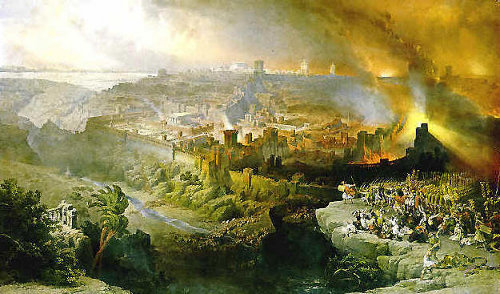
fall-of-jerusalemThis is a continuation on the topic I started discussing in Lancaster’s Galatians: Introduction, Audience, and What Happened to the Torah? and continued in Broad Strokes. I asked the first two of these four questions in Part 1 and Part 2 of this series. Part 3 presents the third question. Hopefully, the answer will be illuminating.

Just a reminder, all quotes from scripture will be from the ESV Bible unless otherwise stated.

Were the Jewish Apostles of Jesus Supposed to Remain in Jerusalem During the Fall?

History records that the Romans destroyed Herod’s Temple and exiled the Jews from Israel in the year 70 of the Common Era (CE). Israel was renamed “Palestine” by the Romans as in insult to the Jews. We also know that there was always a small remnant of Jewish people in “Palestine” from that time until the formation of the modern state of Israel in 1948. But of those who remained in Jerusalem and in the Land during and just after the destruction of the Temple, how many were disciples of the Master?

The destruction of the Second Temple in 70 CE and the subsequent expulsion of the majority of Jews from what would be called Palestine marked a disastrous shift in the Jewish authority over the Messianic community. Up until that time, the head of the Jerusalem leadership of the Messianic community, otherwise referred to as “the bishop of the church”, had always been Jewish. Once the Jews were expelled from Jerusalem by Hadrian, for the first time a Gentile had to be elected into the role. As events moved forward from that point in time, the Gentile presence in the Messianic community grew dramatically while the Jewish leaders and worshipers of Yeshua struggled under the heartbreak of the loss of the Temple and the ejection from their land.

-James Pyles
“Origins of Supersessionism in the Church”
Part one in a four-part series
published in Messiah Journal
Issue 109/Winter 2012

I bring all this up because one of the topics Pastor Randy and I discussed was whether or not the Jewish disciples of the Way “abandoned ship,” so to speak, when the rest of the Jews were expelled from Israel at this point in history. It’s Pastor’s opinion that they did and that it was definitely the wrong thing for them to do. In his opinion, they should have stayed.

Should they have fought the Romans like the zealots? Should they have died like the Jews at Masada?

I don’t know if Pastor is suggesting such a thing. Dying, down to the last man as martyrs, may have been a dramatic move and even a faithful one, but it would not have allowed the apostles to survive and to spread the word of Moshiach to the Jews and Gentiles of the diaspora.

I remember when Pastor was delivering a sermon on the death of Stephen (see Acts 7:54-60) and the consequences that followed his demise.

And there arose on that day a great persecution against the church in Jerusalem, and they were all scattered throughout the regions of Judea and Samaria, except the apostles.

Acts 8:1

According to Pastor, one of the effects of the scattering of devout Jewish believers away from Jerusalem was to allow the spreading of the gospel message throughout Judea and Samaria. This is how I see one of the results of the destruction of Jerusalem and the great exile of the Jews to the diaspora. Not that Paul had been unsuccessful in taking the message of the Messiah to much of the then civilized world, but this “allowed” (though it was a terrible thing) all or most of the believing Jews in the Land to take who they were and extend that into the galut to other Jewish and probably Gentile communities.

That’s one thought, anyway.

Did Jesus ask or require the believing Jews to stay in Jerusalem during this time of great tragedy?

“But when you see Jerusalem surrounded by armies, then know that its desolation has come near. Then let those who are in Judea flee to the mountains, and let those who are inside the city depart, and let not those who are out in the country enter it, for these are days of vengeance, to fulfill all that is written. Alas for women who are pregnant and for those who are nursing infants in those days! For there will be great distress upon the earth and wrath against this people. They will fall by the edge of the sword and be led captive among all nations, and Jerusalem will be trampled underfoot by the Gentiles, until the times of the Gentiles are fulfilled.

Luke 21:20-24

It seems clear that Jesus was telling those who are in Judea to flee to the mountains. Also, those who are inside the city depart, and let not those who are out in the country enter it. He knew that many [would] fall by the edge of the sword and be led captive among all nations. Nowhere in that short narrative do I hear the Master telling anyone to stay and die. In fact, it was necessary for Jerusalem to be trampled underfoot by the Gentiles, until the times of the Gentiles [were] fulfilled.

I don’t know if the times of the Gentiles are fulfilled yet, but the modern nation of Israel has been in existence for over sixty years now, so if our time isn’t yet up, it soon will be.

I mentioned before, in quoting from my “supersessionism” article, that up until the destruction of Jerusalem, every leader of the Council of Apostles had been Jewish. When the Jews were expelled, the first “bishop of the church” had to be a non-Jew since at that time, they were “flying below the radar” of the Romans, so to speak. It’s not unlike the situation with Lydia and the devout God-fearing women in Philippi.

So, setting sail from Troas, we made a direct voyage to Samothrace, and the following day to Neapolis, and from there to Philippi, which is a leading city of the district of Macedonia and a Roman colony. We remained in this city some days. And on the Sabbath day we went outside the gate to the riverside, where we supposed there was a place of prayer, and we sat down and spoke to the women who had come together. One who heard us was a woman named Lydia, from the city of Thyatira, a seller of purple goods, who was a worshiper of God. The Lord opened her heart to pay attention to what was said by Paul. And after she was baptized, and her household as well, she urged us, saying, “If you have judged me to be faithful to the Lord, come to my house and stay.” And she prevailed upon us.

Acts 16:11-15

jerusalem-at-nightThe Jewish population in that area had been expelled at some earlier point, but the God-fearing Gentiles were “under the radar,” and not included in the exile from Philippi because they had not been counted as Jews, even through they had been worshipping in the synagogue with Jews, praying with Jews, discussing Torah with Jews, and otherwise having fellowship with Jews. When Paul and his party came upon Lydia and her companions by the river, he must have understood that these Gentile women were all who were left of those devoted to Hashem to keep the worship of the God of Israel alive in that community. Perhaps the same can be said of the Gentile believers in Jerusalem after 70 CE, but it’s hard to tell.

There has always been a Jewish remnant in Israel for the past 2,000 years. When the Temple was utterly destroyed, when the golden menorah melted and flowed like water, when Jerusalem herself moaned in agony like a woman in hard labor, after all these things, who is to say if, among the Jewish remnant, there were followers of Yeshua HaMashiach or not. There’s no way to know.

I don’t think the Messianic Jews had a specific mandate to stay and endure the incredible suffering of Israel’s downfall under the Romans. If some did stay, so much the better, but I believe what happened was supposed to happen. I think God knew. I think the words of Jesus tell us that he expected it and expected those who listened to him to flee. The time of the Gentiles was upon them.

But that time is running out fast.

Only one more question left. Be here for Part 4 in the conclusion of this series in tomorrow’s “morning meditation.

Four Questions, Part 2

Apostle-PaulThis is a continuation on the topic I started discussing in Lancaster’s Galatians: Introduction, Audience, and What Happened to the Torah? and continued in Broad Strokes. I asked the first of these four questions in Part 1 of this series (please read it if you haven’t yet) but quickly discovered that I’d never get all four questions and their answers in a single blog post. Hence, Part 2 presents the second question. Hopefully, the answer will be illuminating.

Why Did Many Jewish People Reject Paul and the Message of the Messiah?

Let’s face it. Paul received a tremendous amount of opposition during his journeys as he spoke of Christ, not only from the Greeks and Romans, but from many individual Jews and Jewish communities as well. This is exquisitely documented in Luke’s Book of Acts and often gives support to the traditional Christian doctrine that the Jews rejected Jesus but the Gentiles accepted him, thus Jews are now universally without salvation and a place in Heaven, and the Gentile Christians have inherited all of the covenant promises that once belonged to the Jews, replacing them as God’s chosen, splendourous people.

Did the Jews reject Jesus? We’ve already seen in Part 1 of this series (link above) that not all of them did and actually, thousands upon thousands of Jews completely accepted the Christ and were devoted disciples of the Messiah. In fact, in one of my conversations with Pastor Randy, he said he believes that the Jewish population of “the Way” very likely outnumbered, and by a substantial amount, the population of any of the other sects of Judaism, most principally, the Pharisees. This is just conjecture on my part, but as Pastor Randy mentioned this, I couldn’t help but wonder if the Pharisaic sect as well as the Essenes, Sadducees and others, saw that their power bases would erode into eventual extinction should “the Way” take over the Jewish religious landscape by sheer weight of numbers in Jewish membership.

We’ve also seen within the borders of ancient Israel that the apostles and disciples of Messiah were considered a threat to the corrupt and compromised Jewish religious leadership streams (particularly the Priesthood) that were firmly in the pocket of the occupying Romans. Herodian rule was also threatened for similar reasons. The Son of God accused them all of falsehood and usurping the rightful place of the valid Priests and Kings of Israel. These false rulers had every reason to want to silence a small but rapidly growing group who might one day soon incite the people to overthrow them.

But that doesn’t explain the immense amount of resistance Paul experienced in the Jewish synagogues of the diaspora, who were outside the flow of those political currents.

And he entered the synagogue and for three months spoke boldly, reasoning and persuading them about the kingdom of God. But when some became stubborn and continued in unbelief, speaking evil of the Way before the congregation, he withdrew from them and took the disciples with him, reasoning daily in the hall of Tyrannus.

Acts 19:8-9

After three months, opposition to Paul’s message surfaced. It may have taken that long for the Jews of Ephesus to realize that Paul’s gospel invited Gentiles into the fold.

-Lancaster, Torah Club Vol 6, pg 620

This, I think, is the key to much (but not all) of the Jewish opposition to Paul and the Way. Besides announcing the salvation from sin and the life in the world to come promised through the Messiah, the number one thing that set Paul’s sect apart from all of the other Judaisms of that day was the inclusion of Gentiles as equal covenant members without the requirement that Gentiles undergo circumcision and convert to Judaism. This was unprecedented in ancient Judaism and in my opinion, the single largest stumbling block for Jews hearing the Messianic message of Paul and the other apostles.

Remember the Jews of Pisidian Antioch who, in Acts 13:42-43 couldn’t get enough of Paul, Barnabas, and the message of Messiah, and begged them to return to their synagogue on the following Shabbat to speak more about the Kingdom and the Son of David?

The next Sabbath almost the whole city gathered to hear the word of the Lord. But when the Jews saw the crowds, they were filled with jealousy and began to contradict what was spoken by Paul, reviling him. And Paul and Barnabas spoke out boldly, saying, “It was necessary that the word of God be spoken first to you. Since you thrust it aside and judge yourselves unworthy of eternal life, behold, we are turning to the Gentiles.

Acts 13:44-46

This doesn’t mean, as we saw in Part 1 of this series, that Paul never again preached the good news to the Jews, but only on that occasion, when the Jewish leadership of the Pisidian Antioch synagogue spoke against him and reviled him. So what happened? On one Shabbat, the Jews couldn’t get enough of Paul and his teaching and exactly one week later, they can’t wait to shut him up and get rid of him. What changed?

But when the Jews saw the crowds, they were filled with jealousy…

Crowds? Crowds of who?

The Jews of Antioch were not jealous that Paul and Barnabas has such appeal or that their message was so popular. They were jealous that the message of the apostles compromised theological ethnocentrism. The message of the apostles seemed to throw the doors of Judaism wide open to the Gentile world.

This is the “jealousy” to which Paul referred in his epistle to the Romans.

-D. Thomas Lancaster’s commentary on Acts 13:1-51 read with Torah Portion Bo (“Come”) Torah Club 6: Chronicles of the Apostles, pg 394

prayer-synagogue-riga-latviaI commented extensively in a previous meditation regarding this “jealousy” that the huge influx of Gentile God-fearers and pagans elicited from the Jewish synagogue leaders in Pisidian Antioch and you are invited to click the link above and read the full analysis of that event. Lancaster supports my understanding that the thing about the Way that summoned such a passionate and even hostile response from some Jewish communities was the unfettered admittance of non-Jews into what was once a wholly Jewish religious and community space.

Here’s more.

When the seven days were almost completed, the Jews from Asia, seeing him in the temple, stirred up the whole crowd and laid hands on him, crying out, “Men of Israel, help! This is the man who is teaching everyone everywhere against the people and the law and this place. Moreover, he even brought Greeks into the temple and has defiled this holy place.” For they had previously seen Trophimus the Ephesian with him in the city, and they supposed that Paul had brought him into the temple. Then all the city was stirred up, and the people ran together. They seized Paul and dragged him out of the temple, and at once the gates were shut. And as they were seeking to kill him, word came to the tribune of the cohort that all Jerusalem was in confusion.

Acts 21:27-31

Two major points must be considered here. The first is the fear and hostility elicited at the very thought that Paul would allow admission of a non-Jew into the Temple past the court of the Gentiles. After all, such a thing was not done. True, Paul hadn’t actually taken Trophimus into the Temple, but just seeing the two of them together inspired all sorts of terrifying fantasies in many of the Jerusalem Jews. The very thought of Gentiles having full and equal membership into a Jewish religious sect without first having to convert to Judaism and being compelled to obey the complete body of Torah mitzvot and halachah was unthinkable. For many Jews, access to the God of Israel was located in a “Jews-only” zone, which is understandable, given that Israel was a nation then occupied by a brutal Gentile army. Only the apostles and disciples of Jesus understood differently and even some of them would never completely reconcile themselves to Gentile admission.

Here’s the second major speed bump.

And when they heard it, they glorified God. And they said to him, “You see, brother, how many thousands there are among the Jews of those who have believed. They are all zealous for the law, and they have been told about you that you teach all the Jews who are among the Gentiles to forsake Moses, telling them not to circumcise their children or walk according to our customs.

Acts 21:20-21

To the Jews in Jerusalem who were both devout disciples of Jesus the Messiah and zealous for the law, even the rumor that Paul was teaching the Jews in the diaspora, who were living among and worshiping with the Gentile God-fearing disciples, to forsake Moses, telling them not to circumcise their children or walk according to [their] customs was a horrible and virtually unthinkable idea. It was completely and totally against everything the Messianic Jews in the Land understood about the life and character of a devout Jew.

Again, this rumor was completely untrue. Paul totally denied ever teaching such a thing to the Jews in the diaspora, so we can believe that Paul and the other devoted Jewish disciples of Messiah fully understood that there was no contradiction between their faith in Jesus and their lives as Torah-obedient Jews. The only thing that may have given the Jerusalem Jews the idea that Paul was teaching against the Torah to diaspora Jews is this.

Thus all will know that there is nothing in what they have been told about you, but that you yourself also live in observance of the law. But as for the Gentiles who have believed, we have sent a letter with our judgment that they should abstain from what has been sacrificed to idols, and from blood, and from what has been strangled, and from sexual immorality.

Acts 21:24-25

Paul-ArrestedApparently, there was some confusion about the instructions James and the Council of Apostles issued to the believing Gentiles (see Acts 15) involving the limits of their obligation to the Torah as opposed to what Paul was and wasn’t saying to his Jewish audience. If word got back how Paul was instructing the Gentile disciples within the context of the “Jerusalem Letter,” it may have been assumed that such was Paul’s general message to everyone he encountered, including diaspora Jews (for a more complete treatment of the Council’s ruling of “Gentile halachah,” see my six-part series on Lancaster’s Acts 15 commentary, Return to Jerusalem).

I’m firmly convinced that among all the various reasons why individual Jews and Jewish communities rejected Paul’s message of Messiah, the number one “biggie” was the admission of unconverted Gentiles. Sadly, this was a problem that was never resolved and the cracks and fissures that developed between the Jewish Way and the rest of the Jewish sects eventually spawned a total split, ultimately resulting in a Gentile Christianity, and a stream of Judaisms moving forward in history that, by definition, were compelled to consider just about anyone a possible Messiah except Jesus Christ.

Rabbinic literature also reluctantly admits the reality of the miracles performed in Yeshua’s name but forbids it all the same. Some sages maligned the Master as a sorcerer, and they accused him of using a secret name of God to perform His miracles. By the second century, the sages forbade using the Master’s name for healing. They also forbade Jews from accepting the prayers of Yeshua’s disciples (b. Avodah Zarah 27b.)

-Lancaster on Acts 19:13-14, Torah Club Vol. 6, pg 623

Happily, there is a small but growing movement of Jewish people today who are rediscovering the Messiah Yeshua and who are devoted disciples of the Master within a completely Jewish worship, cultural, and lifestyle context. It is my belief that Messiah will continue to call the Jewish people who are his own back to him and back to the Gospel promise of personal salvation and national redemption of Israel.

Part 3 of this meditation will address the third question that came up as a result of my “Pastor Randy conversations” and I encourage you to return here and read the continuation of this series in tomorrow’s “morning meditation.”

Four Questions, Part 1

jerusalem_templeA song of Asaph; God, God the Lord, spoke and called to the earth, from the rising of the sun until its setting. From Zion, the finery of beauty, God appeared. Our God shall come and not be silent; fire shall devour before Him, and around Him it storms furiously. He shall call to the heavens above and to the earth to avenge His people. Gather to Me My devoted ones, who made a covenant with Me over a sacrifice. And the heavens will tell His righteousness, for He is a God Who judges forever.

Hearken, My people, and I will speak, Israel, and I will admonish you; God, even your God am I. I will not reprove you concerning your sacrifices, neither are your burnt offerings before Me constantly. I will not take from your household a bull, from your pens any goats. For all the beasts of the forest are Mine, the behemoth of the thousand mountains. I know all the fowl of the mountains, and the creeping things of the field are with Me. If I were hungry I would not tell you, for the world and its fullness are Mine. Will I eat the flesh of bulls or do I drink the blood of he-goats? Slaughter for God a confession and pay the Most High your vows. And call to Me on a day of distress; I will rescue you and you will honor Me…One who slaughters a confession sacrifice honors Me, and [I will] prepare the way; I will show him the salvation of God.

Psalm 50:1-15,23 (JPS Tanakh)

This is a continuation on the topic I started discussing in Lancaster’s Galatians: Introduction, Audience, and What Happened to the Torah? and continued in Broad Strokes. These blogs were created as a reflection of my conversation with Pastor Randy in his church office on the evening of Wednesday, March 13th as we discussed the Introduction and Sermon One of D. Thomas Lancaster’s book The Holy Epistle to the Galatians: Sermons on a Messianic Jewish Approach (First Fruits of Zion, 2011).

I mentioned in Broad Strokes that it was impossible to include the entire content of Pastor Randy’s and my conversation in a single blog post, and now I find that it has been impossible to include it in only two. However, this third “meditation” (and what has developed into a series) is also an extension of topics Pastor and I have talked about during previous Wednesday night visits, and I find that the questions and comments continue to circulate through my thoughts as I read the Bible, ponder the Acts of the Apostles, and consider the past, present, and future of Jews and Judaism in the plan of the Kingdom of God, including the nature and continuation of Torah, and the future Temple and the sacrifices.

Four questions have come up (no, not those four questions, although Passover is rapidly approaching) that encapsulate what I’ve been thinking about and hopefully and prayerfully, I think I’ve come up with four satisfactory answers. Question one:

Did All Jews Reject Paul’s Message of the Gospel and Jesus Christ?

One of the issues that has come up more than once in my conversations with Pastor Randy is how quickly and thoroughly the Jewish people rejected Jesus as the Messiah during Paul’s “missionary journeys.” It is completely true that Paul received a “mixed response” from both the Jews and Gentiles he encountered, but I sometimes get the impression that Pastor believes the Jews almost universally rejected the teachings of the risen Messiah simply because they spoke of the risen Messiah (and Easter is fast approaching, too), and that almost no Jewish people anywhere actually embraced the knowledge of and teachings of Christ and became devoted disciples of the Master.

In an effort to counterbalance this opinion, I’m going to provide a series of quotes from scripture, exclusively from Acts, that indicates how many Jewish people did indeed accept the words of hope and salvation about the Messiah who came and died, who rose, and who will one day return as King. Note that this list is not comprehensive and yes, I acknowledge that I am deliberately not including an equal number of quotes regarding how many Jewish people and synagogues also rejected Paul and faith in Messiah. All quotes, unless otherwise stated, are from the ESV Bible.

All these with one accord were devoting themselves to prayer, together with the women and Mary the mother of Jesus, and his brothers.

Acts 1:14

Let all the house of Israel therefore know for certain that God has made him both Lord and Christ, this Jesus whom you crucified.”

Now when they heard this they were cut to the heart, and said to Peter and the rest of the apostles, “Brothers, what shall we do?” And Peter said to them, “Repent and be baptized every one of you in the name of Jesus Christ for the forgiveness of your sins, and you will receive the gift of the Holy Spirit. For the promise is for you and for your children and for all who are far off, everyone whom the Lord our God calls to himself.” And with many other words he bore witness and continued to exhort them, saying, “Save yourselves from this crooked generation.” So those who received his word were baptized, and there were added that day about three thousand souls.

Acts 2:36-41

Now the full number of those who believed were of one heart and soul, and no one said that any of the things that belonged to him was his own, but they had everything in common.

Acts 4:32

Now many signs and wonders were regularly done among the people by the hands of the apostles. And they were all together in Solomon’s Portico. None of the rest dared join them, but the people held them in high esteem. And more than ever believers were added to the Lord, multitudes of both men and women, so that they even carried out the sick into the streets and laid them on cots and mats, that as Peter came by at least his shadow might fall on some of them. The people also gathered from the towns around Jerusalem, bringing the sick and those afflicted with unclean spirits, and they were all healed.

Acts 5:12-16

And he gave her his hand and raised her up. Then calling the saints and widows, he presented her alive. And it became known throughout all Joppa, and many believed in the Lord. And he stayed in Joppa for many days with one Simon, a tanner.

Acts 9:41-42

As they went out, the people begged that these things might be told them the next Sabbath. And after the meeting of the synagogue broke up, many Jews and devout converts to Judaism followed Paul and Barnabas, who, as they spoke with them, urged them to continue in the grace of God.

Acts 13:42-43

Now these Jews were more noble than those in Thessalonica; they received the word with all eagerness, examining the Scriptures daily to see if these things were so. Many of them therefore believed, with not a few Greek women of high standing as well as men.

Acts 17:11-12

And he entered the synagogue and for three months spoke boldly, reasoning and persuading them about the kingdom of God.

Acts 19:8

Apostle-Paul-PreachesAs I mentioned, this is only a partial list. You can also consider Acts 17:1-4, 18:7-8, 19:17, and 21:20. I only read up through Acts 21 in my inventory, so I imagine there are more examples of Jewish people enthusiastically accepting Paul and his message. D.Thomas Lancaster in his commentary on Acts 19:8 from Torah Club Volume 6: Chronicles of the Apostles for Torah Portion Vayikra (pp 619-20) says this:

He (Paul) spent three months in the synagogue, every Sabbath arguing persuasively about the kingdom. When Luke says Paul was “reasoning and persuading,” he refers to the standard rabbinic mode of teaching. The rabbis framed their discourses as arguments. Rabbinic argumentation does not imply acrimony or hostility toward opponents. It employs a legal discussion of proof-texts with back-and-forth dialogue, questions, counter-arguments, and logical deductions driving toward a conclusion. The mere fact that an Ephesian synagogue gave Paul a platform for his teaching for three months implies tht the congregation received his message and respected his opinions.

So did virtually all Jews everywhere who Paul came in contact with dismiss him and the Gospel message of Jesus Christ out of hand; the Jews rejecting their own Messiah so that Paul had no choice but to cut loose his own people from the words of salvation and give them only to the Gentiles? No. Of course not. A more complete reading of Acts reveals that Paul’s message almost always received a “mixed response” from both Jews and Gentiles, with some accepting it and some violently opposing it. I’ll address some of the reasons why Jewish populations may have experienced “the offense of the cross” in my next question, but I think we see that “the Jews” did not universally reject Moshiach and in fact, many came to accept and love the Messiah to the point of great suffering and death.

I foolishly thought I could “shoehorn” two questions into a single blog post but that would have made this missive well over 3,000 words long. To make these questions and answers more digestible, I’m creating this as yet another series. Thus Part 2 of this meditation will address the second question that came up as a result of my “Pastor Randy conversations,” and I encourage you to return here and read the continuation of this series in tomorrow’s “morning meditation.”

Lancaster’s Galatians: Introduction, Audience, and What Happened to the Torah?

Apostle-Paul-PreachesThe Apostle Peter said that the writings of “our beloved brother Paul” contain “some things hard to understand.” If that was true in Peter’s day, how much more so today. Paul was a prodigy educated in the most elite schools in Pharisaism. He wrote and thought from that Jewish background.

-D. Thomas Lancaster
from the Introduction (pg 1) of his book
The Holy Epistle to the Galatians: Sermons on a Messianic Jewish Approach

I know I’m going to regret this, but if I wait until tomorrow or later in the week to write this, I’m going to forget something about my conversation with Pastor Randy. I have to get up at an insanely early hour tomorrow, but I need to make a record of what we discussed tonight.

As I write this it’s Wednesday night. I left Pastor’s office just about fifteen or twenty minutes ago after discussing the Introduction and first chapter of Lancaster’s Galatians book with him. You’ll recall I mentioned a few days ago our intention to make a study of Lancaster’s Galatians chapter-by-chapter, week-by-week as the subject of our Wednesday night discussions. I wasn’t sure what to expect when I agreed to focus our weekly talks on this book, but I never thought I’d be involved in such a densely packed conversation. Actually, I was afraid that we would run out of material, since Chapter One (really, Sermon One) is very introductory. However, we barely made it out of the Introduction section and into the first chapter before time ran out.

I finally confessed to Pastor Randy tonight that I’m more than a little in awe that we’re having these conversations. Debating theological topics with him, given his intellect, education, and his fluency in languages, makes me feel like a five-year old trying to discuss the Grand Unified Theory with Albert Einstein. OK, maybe it’s not quite that extreme, but I’m definitely out of my depth. To his credit, Pastor Randy said the benefit he receives is that I am well versed in the New Testament from a Messianic Jewish point of view.

I’m sure there are a few people out there who would disagree with that assessment or me, but such is life.

Did Paul convert to Christianity? That question came up rather abruptly.

No, not from my point of view and Pastor Randy agreed but he believes that Paul changed direction 180 degrees from his former life as a Pharisee, not just in turning from persecuting believing Jews to supporting them and evangelizing the Gentiles, but in his entire conceptualization and attitude about Judaism (as opposed to “Jewishness” which is the quality of a person being a Jew without the religious and halalaic implications) and the Torah.

Acts 15 came into the conversation very quickly and I realized that Pastor Randy believes that not only did James and the Council absolve the Gentiles from having to observe Torah, but the Jewish believers as well. As I’ve said before when addressing Acts 15, I don’t believe James made a decision that extended beyond the Gentile disciples of Messiah.

This all goes back to our previous conversations about the purpose of the Torah, which we’ve been having for many weeks. While Pastor Randy doesn’t believe Jews and their “Jewishness” ended with Jesus, ultimately, he believes the Torah pointed to Jesus as a sort of culmination and that it’s not Judaism but the message of the Gospel that saves. He believes that if Jews had continued in the “Messianic faith” (i.e. Christianity) beyond the first century or two after the ascension, the observance of Torah would have largely fallen away. Certainly the vast majority of what we think of as Rabbinic Judaism wouldn’t have gained traction and evolved and expanded to what we see today, particularly in Orthodox Judaism.

I know more than a few Jews reading my blog post probably just winced or gasped a bit. when reading the last few sentences.

On the other hand, looking at the opposite end of history, we both agree that the Jewish Messiah King will return and sit on the Throne of David in Jerusalem. There will be a Third Temple. The festivals will be reinstated. Gentiles as well as Jews will observe the festivals but, according to Pastor Randy, the Messiah will be the focus, not simply observance for its own sake.

But will “Judaism” disappear? Should “Judaism” (as opposed to “Jews” and “Jewishness”) disappear?

I didn’t hear Pastor say that Jews should disappear, quite the opposite, but we did discuss, and discuss, and discuss what is a Jew, what is Jewishness, and what is Judaism. My argument is that, whether you agree with everything that the Rabbis said, did, and wrote over the past twenty centuries, for right or for wrong, it was the necessary element and organizational structure for the preservation of Jews as a people and without that ethnic, traditional, legal, corporate structure, with only a string of DNA identifying the Jewish people as Jewish , they would ceased to exist as an identifiable people group in the world a very long time ago.

Both Pastor Randy and I agree that God will not allow the Jewish people to perish.

But what then are the distinctions between Jewish believers and Gentile believers in Messiah, both in ancient times and now? That was a hotly debated discussion. No, we didn’t get “hot under the collar,” but we did go around and around the point, orbiting it like two comets chasing each other’s dust trails.

judaismIf the Torah is to be observed in Messianic Days during the time of the Third Temple and if God meant for the Torah to be obeyed by the Jewish people prior to the first coming of Messiah and even during his lifetime, what was supposed to happen to it between the ascension and the return? Granted, we have no Temple today, but does that mean the entire Torah is in cold storage awaiting a spring thaw? And what about the sages? Are none of their interpretations, rulings, and judgments valid? Even in Yeshua’s day, he agreed with some of the halachah of the Jewish authorities (PDF) and indeed, he agreed they had authority to make such rulings.

At one point in the conversation, Pastor Randy said that he believes both Jews and Gentiles in Messiah in today’s world should look and behave in substantially similar ways, if not identically based on his understanding of the New Testament. His issue is that Torah was always impossible to keep and was put in place primarily to point to that impossibility and why we all need the Messiah. My point is that such an act looks like God just set the Jews up to try to obey an impossible set of rules for the sake of eventually pointing to Jesus. Those hundreds of generations of Jews who lived and died struggling to obey Torah would have led lost lives if the only reason for Torah’s existence was to make a point. What saved those ancient, devout Israelites?

“Grace,” says Pastor Randy.

My point exactly. Torah never, ever was intended to save. It was always faith and grace.

I think he can agree with the value of the Jewish traditions if they’re viewed as traditions and not behaviors one must do in order to please God. “But what about feeding the hungry and visiting the prisoner,” says I? The Torah didn’t stop, particularly the parts that clearly are a responsibility for Christians and Jews today. And if “Rabbinic Judaism” was God’s mechanism for preserving the Jewish people as a people since the fall of Jerusalem in 70 C.E., then who is to say that it’s wrong? After all, what systems have been put into place to implement and sustain Christianity over the long course of history?

One of the big stumbling blocks in the discussion was “Rabbinic Judaism” which could be defined as relying on a “system” instead of what the Bible says. I countered that a Christian denomination is a system and that Pastor Randy operates within one. He countered that he can and has existed outside a denomination before and that what the Bible says is ultimately more important than a denomination or any other system of religious practice.

But do we have unfiltered access to the Bible and to God? Don’t we use “systems” as the means by which we implement what the Bible tells us to do in our daily lives? Yes, if we take all of the incredible detail involved in living life as an Orthodox Jew, for example, those “implementations” are vast, multi-layered, and frankly, there are many that seem to go too far (I know I’m going to catch heck for that), but it’s still fits my definition of what humans do to “operationalize” a life of faith. Christian denominations do this to a lesser or greater degree, but without the same level of formalization (after all, what is Christmas, what is Easter, and what is Lent?).

Can we live a life of just the Bible without a system (be careful how you answer that)? Are there portions of both the modern Christian and the modern Jewish “systems” that are valid interpretations of a Biblical life, even if Messiah would (and will) have “issues” with other portions?

Jesus made distinctions between halachah he supported and did not support (is it lawful to heal on the Shabbat?) when he was first here and I suspect that he’ll “straighten out” both Jews and Gentiles when he returns. Some Jewish authorities write that one of the things Messiah will do when he comes (returns) is teach Torah properly and I believe it, too.

Shofar as sunrisePastor Randy says he believes that Gentiles should and will observe Pesach, Shavuot, and Sukkot along with the Jews but you can’t do that without the Torah not only being intact, but valid, and able to be applied in our world.

You can see why we almost didn’t make it out of page 1, let alone the Introduction of the book, and this is where we spent most of our discussion time. Sermon One runs from page 9 to page 19. It’s where we’ll have to pick up next week, but we did encounter an interesting question in the Sermon One material, and one I thought I knew the answer to. To whom did Paul write the Galatians letter? Yes, the churches in Galatia, but who in those churches? On page 19, Lancaster says it’s to the “God-fearing Gentile believers in Galatia” specifically.

But get this:

For I would have you know, brothers, that the gospel that was preached by me is not man’s gospel.

Galatians 1:11 (ESV)

Would Paul have called Gentles “brothers?” Wouldn’t it have made more sense for him to call his fellow Jews by that name?

We ourselves are Jews by birth…

Galatians 2:15 (ESV)

Paul is obviously talking to Jewish people at this point.

To give a human example, brothers…

Galatians 3:15 (ESV)

Brothers, I entreat you…

Galatians 4:12 (ESV)

I could go on. There’s 4:28, 4:31, 5:11, 5:13, and 6:1 to consider, but according to these references, there’s every reason to believe that Paul was addressing both a Jewish and a Gentile audience in this letter. That being the case, Pastor Randy suggests that Paul is explaining to both Jewish and Gentile believers that obedience to the Law is not necessary if one is in Christ. Is obedience to the Law unnecessary for either the Jew or the Gentile if Messiah is your Master?

Salvation is through Jesus but does that obliterate the Sinai covenant for the Jews? Pastor Randy and I agree that it is through Abraham and the New Covenant that we Gentiles are “grafted in.” We know that the Hebrew for the word “New” in “New Covenant” really means “new” and not “renewed,” even though the wording of the New Covenant (see Jeremiah 31 and Ezekiel 36) largely confirms and expands all of the covenants that God previously made with Israel.

Something I didn’t remember to bring up during my conversation with Pastor Randy is the question of whether or not the New Covenant is already completely written on our hearts or if God is in the process of doing the writing? If the latter, then God may be rather slowly (from a human perspective) doing away with the old (yes, the Torah will go away when heaven and earth go away) and replacing it with the new, but that such a thing has not been accomplished yet (Hebrews 8:13). As I alluded to a moment ago, Jesus also said that “until heaven and earth pass away, not an iota, not a dot, will pass from the Law until all is accomplished,” (Matthew 5:18) and I don’t think that “all is accomplished” yet. After all, the Messiah hasn’t returned, we don’t have universal peace on earth, the Temple hasn’t been rebuilt, and Israel is not yet the head of the nations.

You can see why I didn’t want to wait until later to get this all down. I’m tired but energized at the same time. I’m fighting well out of my weight class, so to speak, but I have to keep going. I agreed to have these conversations in order to learn and I know that Pastor Randy is both teaching and learning as well.

There’s nothing better to show you what you truly know and believe than to have your belief’s challenged and be asked to give a “ready defense.”

western-wall-jerusalem-dayThe funny thing is, after the conversation was over and Pastor Randy was walking me to the door of the church (by the time we’re done talking, just about everyone is gone and he wants to make sure all the doors are securely locked for the night), he continued to share with me his love for the Jewish people and his fascination with Judaism. Listening to him talk about his life in Israel and his relationship with his Jewish friends, it is abundantly apparent that he adores the texture, fabric, and essence of living among Jews. But at that moment, his words and emotions seemed so inconsistent with his beliefs on the Law and Judaism relative to our conversation. And yet in every other way, he confirms my own belief in the exceptional “specialness” of what it is to be Jewish and to live a fully realized Jewish life. The Jewish Jerusalem is where we feel the beat of God’s heart.

If ten thousand religious Jewish people came to faith in Yeshua as Messiah tomorrow, should we really ask them to give up everything in their lives that defines them as Jewish and that allows them to worship God as Jews? It sure didn’t sound like Pastor Randy was saying that in those last seconds we had together before I walked out into the night. I know he agrees that we Christians haven’t gotten it all right and we’ve built up our “systems” that help us understand how to obey God. Someday, Messiah will show us what we did right and what we didn’t do right, what we should have included, and what we should have let go.

In examining the vast body of Jewish practice, particularly the complexities of Orthodox Judaism, can we say that much of it is right and necessary now but that when Messiah returns, he will also say what is proper and what is not? Will there be a distinction in Torah for Jews that will be Jewish and will be a Judaism but will not look quite the same as Judaism looks right now?

Incredibly tough questions. I don’t have the answers. Messiah does but he’s not here yet.

This series of conversations and my blogs about them are controversial by design and I don’t expect all of my readers to accept everything I’m documenting here. I have no idea what kind or how much “blowback” I’m going to receive, but I expect there will be some.

Please be patient and exercise kindness and even some restraint in your responses, should you choose to respond. This is a journey of exploration into what for me is an undiscovered country. If you know the territory and would like to share some details about the road ahead, you are welcome to participate.

The journey continues next week.

Addendum, March 15: After reading all of the comments and continuing to struggle with the conversation and the issues involved, I have produced another reflection of my thoughts in an “extra meditation,” Broad Strokes.

Following the Galatian Letter

paul-editedPaul, an apostle—not from men nor through man, but through Jesus Christ and God the Father, who raised him from the dead—and all the brothers who are with me,

To the churches of Galatia:

Grace to you and peace from God our Father and the Lord Jesus Christ, who gave himself for our sins to deliver us from the present evil age, according to the will of our God and Father, to whom be the glory forever and ever. Amen.

Galatians 1:1-5 (ESV)

In the Holy Epistle to the Galatians, the Apostle Paul argues against Gentile believers in Yeshua (Jesus) of Nazareth undergoing conversion to become Jewish. Paul maintained that Gentile believers attained salvation and inherited the blessings promised to Abraham through faith, not conversion.

The Apostle Peter said that the writings of “our beloved brother Paul” contain “some things hard to understand.” If that was true in Peter’s day, how much more so today. Paul was a prodigy educated in the most elite schools in Pharisaism. He wrote and thought from that Jewish background. Unfortunately, that makes several key passages of his work almost incomprehensible to readers unfamiliar with rabbinic literature. I invite Christians to use this book as an opportunity to study Paul’s epistle to the Galatians from a Jewish perspective.

-D. Thomas Lancaster
from the Introduction (pg 1) of his book
The Holy Epistle to the Galatians: Sermons on a Messianic Jewish Approach

I reviewed Lancaster’s book the better part of two years ago, but I never thought my write-up did the book justice. Normally, Lancaster writes in an easy to follow manner, making complex theology accessible to laypeople and non-scholars such as me, but Galatians was probably a bit of a stretch to try to get to fit into a comfortable mold. I’m sure I missed a lot along the way, although when I pulled the book out of my closet (my wife allows me exactly one closet for all of my books…she’s trying to train me not to be a “pack rat”), I saw that I have voluminous notes scribbled all over a mass of bits and scraps of paper like so much ticker tape parade confetti. I was obviously trying to “get it.”

And count the patience of our Lord as salvation, just as our beloved brother Paul also wrote to you according to the wisdom given him, as he does in all his letters when he speaks in them of these matters. There are some things in them that are hard to understand, which the ignorant and unstable twist to their own destruction, as they do the other Scriptures.

2 Peter 3:15-16 (ESV)

That’s Peter’s description of and probably experience with the writings of Paul, as Lancaster quoted from in his introduction, and we can see from the full quote that not only can Paul’s meaning be misunderstood, but it can be deliberately “twisted” with the potential result of “destruction” by people Peter refers to as “ignorant and unstable.”

I don’t think you have to be “unstable” to misunderstand Paul and especially his letter to the churches in Galatia, but a lot of us are ignorant (I don’t mean that in a pejorative manner) of what it was to think, write, and live as a highly educated Pharisaic Jew in the middle of the first century, a mere decade or two before the destruction of the Holy Temple in Jerusalem. It may be ignorance, at least in part, that makes Paul’s Galatians letter so difficult to grasp. I’m sure it’s my ignorance that resulted in me not fully comprehending Lancaster’s book back in the summer of 2011.

But that’s about to change.

This coming Wednesday evening, my weekly conversations with Pastor Randy at my church are taking a left turn at Albuquerque, so to speak, and following Paul’s classic letter into Galatia. This time, Pastor Randy and I will be pursuing Paul’s letter together. Frankly, I can’t wait.

study-in-the-darkI wish Pastor would put his bio on the church’s website (which needs serious help, but I’m working on it) so I could access more than just my failing middle-aged memory to describe him. He’s not only been a missionary and a Pastor, but he also has a history as an educator in a scholarly setting. I’ve seen what he studies and reviews just to get ready for a single sermon, and it usually involves anywhere between twelve and twenty books. In our discussions we may not always agree on everything, but my respect for his knowledge and insight continues to grow geometically with each encounter. Admittedly, it’s an honor to just sit in the same room with him for ninety minutes or so once a week and be able to access his thoughts and experiences, especially since his education and background are a great deal of what I lack.

Lancaster repurposed twenty-six sermons on Galatians, which he delivered to his congregation, Beth Immanuel Sabbath Fellowship in Hudson, Wisconsin in 2008, to create this book I’m about to revisit. That’s twenty-six weeks and twenty-six opportunities for me to not just re-read Lancaster’s book, but to study it and to learn from two fine scholars and devoted believers in Christ.

Along the way, I’m hoping not only to learn a lot more about Paul’s letter, but more about the nature of how Paul saw non-Jewish God-fearing believers within a Jewish worship and faith context, who they were in the Jewish Messiah King, and how he saw their role, and our role, in the Kingdom of Heaven. I’m hoping to learn a little something more about myself as a Christian, too.

I was able to talk with Pastor Randy briefly just before services began this morning (as you can imagine, Sunday is his especially “busy” day) and confirmed our meeting for this coming Wednesday and the plan to cover Sermon 1: Letter to the God-Fearers (Galatians 1:1-5). I’m planning on taking notes as I read through the book and during my discussions with Pastor Randy so that I can collect the results of this experience, not just for my own edification, but hopefully for yours.

I invite you to come along with Pastor Randy and me on this weekly adventure as we return to the churches of Galatia by way of Lancaster’s The Holy Epistle to the Galatians. May we all learn the wisdom and message of our Master together through the voice of his Apostle to the Gentiles, Paul, and through this, may we all draw ever closer to God.