Tag Archives: Torah Portion

Mishpatim: Law and Spirit

tzitzit1There was once a Jewish girl who stopped in Israel on her way to India to seek spirituality. Friends suggested that she go to Neve Yerushalayim to take a class and give Judaism one last shot before seeking other pathways to spirituality. The one class happened to be studying the laws regarding returning a lost item — when is an item considered lost, what if the person gave up hope of its return, what constitutes a legitimate identifying mark to claim the item, to what extent and cost of time and money are you obligated for returning the item… The girl was furious! This is NOT spirituality. She left in a huff and headed off to India.

Six months later she and her guru were discussing a philosophical matter while walking through the village. They came upon a wallet filled with rupees. The guru picked it up, put it in his pocket and continued with his point. The girl interrupted him and asked, “Aren’t you going to see if there is identification in the wallet to return it?” The guru replied, “No. It was his karma that he lost it; it’s my karma that I found it. It’s mine.” The girl implored, “But, he might have a large family and that might be his monthly earnings … they could starve if you don’t return it!” The guru responded, “That is their karma.”

-Rabbi Kalman Packouz
“Shabbat Shalom Weekly”
Commentary on Torah Portion Mishpatim
Aish.com

You may be wondering what all this has to do with this week’s Torah study. Consider that, according to Rabbi Packouz, Mishpatim is one of “the most mitzvah-filled Torah portions, containing 23 positive commandments and 30 negative commandments. Included are laws regarding: the Hebrew manservant and maidservant, manslaughter, murder, injuring a parent, kidnapping, cursing a parent, personal injury, penalty for killing a slave, personal damages, injury to slaves, categories of damages and compensatory restitution, culpability for personal property damage, seduction, occult practices, idolatry, oppression of widows, children and orphans.”

For most Christians and probably many Jewish people, reading Mishpatim can seem like not only an incredible bore, but completely irrelevant to leading a life of spirituality and holiness…

…until you read the commentary about the Jewish girl seeking spirituality, which I quoted above. Let’s “cut to the chase” and see what the Jewish student in India concluded about her experiences.

The young lady then remembered the class she took in Jerusalem — and realized that spirituality without justice, kindness and concern for others is just a false spiritual high, corrupt emotion. She returned to Jerusalem and ultimately returned to her Torah heritage.

I imagine there are a lot of people who believe spirituality is a rather “warm and fuzzy” and “feel good” state of being where one contemplates self, God, and the nature of the universe, and through this, the wear and tear of daily living can be put to the side as if it were a cast off garment. And yet, as the Jewish student learned, it is nothing of the sort. Spirituality is a “lived” experience that permeates our day-to-day lives. There is not one aspect of what we do, from the moment we wake up until the instant our heads hit our pillows at night where God is not present (and He’s present when we sleep as well) and we are not acting either within his will our outside of it.

This past week, I’ve been commenting extensively on Acts 15 and the implications of admitting non-Jewish disciples of the Messiah into a wholly Jewish religious sect. There is a single sentence within that chapter which has caused much confusion among Christian and Jewish commentators and scholars.

For from ancient generations Moses has had in every city those who proclaim him, for he is read every Sabbath in the synagogues.”

Acts 15:21 (ESV)

I’ll give that statement more treatment in my Return to Jerusalem series in the next few days, but we can take a look at it now from the perspective of this Torah Portion commentary. What did James and the rest of the Apostles expect the Gentile God-fearing disciples to learn by going to the synagogue each Shabbat and hearing the Torah read, especially if, as I’ve said previously, the Apostles never desired that the Gentiles convert to Judaism and thus be obligated to the full yoke of Torah?

karmaWhat was the Jewish student supposed to learn by “studying the laws regarding returning a lost item?” When she was in India following the path she thought she really wanted, she discovered the answer.

While there is much in the Torah that has to do with the specifics of living a Jewish life, there is also much more that teaches us, all of us, how to live an ethical and moral life within a spiritual and material world context. The student in India didn’t have to be Jewish to learn that lesson, it could have been learned by anyone. Hopefully, it is being learned by everyone who reads the Bible and studies the mitzvot delivered by God to humanity through Moses and the Prophets.

The “Law” isn’t boring (unless you let it be). It’s all “God-breathed and is useful for teaching, rebuking, correcting and training in righteousness, so that the servant of God may be thoroughly equipped for every good work.” (2 Timothy 3:16-17)

Studying scripture is like spending time with God in prayer. It is an act of intimacy. It is like this:

On the seventh day He called to Moses from the midst of the cloud. Now the Presence of the Lord appeared in the sight of the Israelites as a consuming fire on the top of the mountain. Moses went inside the cloud and ascended the mountain; and Moses remained on the mountain forty days and forty nights.

Exodus 24:16-18 (JPS Tanakh)

Good Shabbos.

Yitro: Walking with Israel

Har_SinaiOn the third new moon after the Israelites had gone forth from the land of Egypt, on that very day, they entered the wilderness of Sinai. Having journeyed from Rephidim, they entered the wilderness of Sinai and encamped in the wilderness. Israel encamped there in front of the mountain, and Moses went up to God. The Lord called to him from the mountain, saying, “Thus shall you say to the house of Jacob and declare to the children of Israel: ‘You have seen what I did to the Egyptians, how I bore you on eagles’ wings and brought you to Me. Now then, if you will obey Me faithfully and keep My covenant, you shall be My treasured possession among all the peoples. Indeed, all the earth is Mine, but you shall be to Me a kingdom of priests and a holy nation.’ These are the words that you shall speak to the children of Israel.” Moses came and summoned the elders of the people and put before them all that the Lord had commanded him. All the people answered as one, saying, “All that the Lord has spoken we will do!” And Moses brought back the people’s words to the Lord.

Exodus 19:1-8 (JPS Tanakh)

Did you ever get angry about what someone did and say, “I would have never done that if I were him!”? Probably most of us have said that one time or another.

I’ve got news for you! You would have done EXACTLY what he did if you were him. If you had his genes, his upbringing, his education and philosophy on life along with his desires and attitudes … you would have done precisely what he did. The proof is … that’s what HE did! The difference is that you are not him and you think that with all that you are, that you would have acted differently. Hopefully, if you were in his situation, you would not do what he did.

What we have here is a failure to judge our fellow human being favorably.

-Rabbi Kalman Packouz
“Shabbat Shalom Weekly”
Commentary on Torah Portion Yitro
Aish.com

This week’s Torah Portion is kind of a big deal. It’s the parashah where we see the Children of Israel “as one man” receiving the Torah from God! This is the defining moment when Israel truly becomes a nation before God and it also is what, more than any other single event, defines the Jewish people today, in spite of what some people may say about Jews, Judaism, and Israel.

But we have a problem, at least on the surface. The Children of Israel stood before Moses and before God and said as a single group, as a nation, that “All that the Lord has spoken we will do!” That response is not only the agreement of all the people who were actually there, but for all of their descendants across the ages as well. Israel said that they would do everything that God had spoken, all of His laws, all of His ordinances, everything.

Did they? Do they?

I won’t go through a lengthy list of quotes from the Tanakh, but the simple answer is “no.” That first generation out of Israel did not enter the Land and take it at the command of God. Forty years of wandering in the wilderness was also forty years of struggling with God as well as Moses and Aaron struggling with God to preserve the People from their own disobedience and grumbling.

Even after Joshua led the next generation to take the Land (and Moses was also disobedient and as a consequence, was not allowed to enter Israel), there were problems. In fact, reading through the Tanakh reveals a significant history of Israel and her Kings, even David and Solomon, disobeying God and failing to do all that the Lord had said.

joshua-in-israelNo, I’m not going out of my way to “Jew bash,” simply stating what we all know. Does that mean the Torah is useless, the Israelites weak and disobedient, and the modern Jewish people are followers of a “dead religion?”

Absolutely not. What it means is that they are human.

I’ve sat in a Bible study in church (not the church I go to now…this was many years ago) and heard a man, a retired Pastor (normally a very nice guy) say point-blank that “we Christians” would never disobey God the way the Israelites did.

Oh really?

Remember what Rabbi Packouz said above?

If we were living in those days, had experienced what they experienced, had lived through slavery, were suddenly thrust into a brand new world, even experienced the amazing, awesome, unimaginable presence of God among us, yes we too would have said and done all the things the Children of Israel did.

Sorry to say.

There is a saying in Pirke Avos 2:5 (“Ethics of the Fathers”), “Hillel says, ‘Don’t judge your fellow human being until you have been in his place.” It is upon us to try to put ourselves in someone else’s situation before passing judgment.

Also in Pirke Avos 4:3, Ben Azai says, “Do not scorn any person, nor be disdainful of any thing for there is no person who does not have his hour and no thing which does not have its place.”

The Torah source for this mitzvah, commandment, is “You shall judge your fellow human being with righteousness” (Leviticus 19:15). This verse obligates us to give someone the benefit of the doubt when we see him performing an action that could be interpreted in his favor.

The Torah also teaches us, “Love your fellow human being as yourself …” (Leviticus 19:18). The Baal Shem Tov used to say, “Love others as yourself. You know that you have many faults, nevertheless, you still love yourself. That is how you should feel toward your friend. Despite his faults, love him” (Likutai Abraham, p. 221).

Setting aside Rabbi Packouz, what can we learn from another “Rav” with whom we Christians might be more familiar?

“Judge not, that you be not judged. For with the judgment you pronounce you will be judged, and with the measure you use it will be measured to you. Why do you see the speck that is in your brother’s eye, but do not notice the log that is in your own eye? Or how can you say to your brother, ‘Let me take the speck out of your eye,’ when there is the log in your own eye? You hypocrite, first take the log out of your own eye, and then you will see clearly to take the speck out of your brother’s eye.

Matthew 7:1-5 (ESV)

old-city-jerusalemAll week long, I’ve been writing blog post after blog post presenting some rather unusual ideas about the Torah, the instructions to the Israelites from God, and how it is lived out in Judaism and sometimes within Christianity. My friend Boaz Michael says that the weightier matters of the Torah are also taught in church, such as love of kindness, feeding the hungry, compassion for the widow, and so on. Granted when we get into the area of halachah and how the Jewish community will walk before God, things become complicated, but lately, I’ve been encouraged to see halachah as the communal conversation and response of the Jewish people to the Torah and to God. It’s a living, interactive process by which Jews seek to obey God and live their lives before God as Jews. By definition, Christians, who are taught to conceptualize God and the Bible in fundamentally different ways, are going to have a tough time with this (even some Jewish people have a tough time with this).

But do we judge the ancient Israelites, the more recent Jewish population who lived in the days of Jesus, Peter, and Paul, and the modern Jewish community, particularly those in the Messianic space, by our own Gentile Christian standards, given that those standards do not have much of a basis in common with Judaism? Have we walked a mile in the shoes of a Jew?

Even if you are a Christian who has spent a lot of time with the Jewish community, either here in the U.S. or even in Israel, while you may have some insights into Jews and Judaism that many Christians lack, there’s still a long road between living with Jews and being Jewish. Even converts to Judaism will struggle to make up the distance, the lack of a Jewish childhood, the lack of Jewish parents and growing up in a Jewish community.

There’s a lot of judgement and disdain of Jews by Christians, including those in the Hebrew Roots community, but upon what is it based? It is especially surprising and disappointing that a Gentile Christian can say they are “observing Torah,” wear a kippah and tallit katan in their daily lives, daven with a siddur while wearing a tallit gadol and laying tefillin, keep Leviticus 11 “kosher,” and claim to love Israel and the Jewish people, and yet still judge and reject everything it is to be Jewish and to live as a Jew. Sometimes, I think it’s even worse for some of those same Gentiles who style themselves as “academic” or “resource institute” experts to treat the Jewish people as a “thing” or an “object” for study (and it’s easier to throw away an object than a human being), rather than as living, breathing, people.

You don’t have to agree with how Jewish people conceptualize their world, but then again, you don’t have to attempt to live as a Jew either, if that is your opinion.

It’s been a busy and difficult week in this little corner of the blogosphere. I don’t usually spend so much time and effort on a single topic across an entire week, but this theme took over my thoughts and emotions and I had to write (and write and write) about it.

I don’t claim to bear any great wisdom or insights, but writing is what I do when I want to explore and I’m trying to understand. Blog comment contributor “ProclaimLiberty” has suggested that halachah is akin to the Jewish communal conversation with God and the sages. Writing is part of what I do as an individual when I’m trying to talk to God. I just share the conversation (my end of it, anyway) with the Internet.

PleadThe Children of Israel failed God because we all fail God! If God’s grace wasn’t with humanity from the very beginning, we never would have survived, and there would be no human population in the world today. God is gracious and we know this, but we cannot even begin to comprehend the extent, scope, and vastness of His graciousness to us all, and especially to Israel, the apple of His eye, His treasured, splendorous people.

The Lord said to Moses: Thus shall you say to the Israelites: You yourselves saw that I spoke to you from the very heavens…

Exodus 20:19 (JPS Tanakh)

And Jesus said, “Father, forgive them, for they know not what they do.”

Luke 23:34 (ESV)

God speaks to us all but we don’t always understand. It would have been amazing if we could have been there among Israel to actually see and hear God speak from the very heavens, but God gives us enough. And yet we don’t always know what we’re doing, including when we curse rather than bless Israel. We should try to understand Israel and understand God.

The first positive mitzva is, in the words of Rambam, (Maimonides: Mishneh Torah, Yesodei haTorah 1:1.) “To know that there is a First Being, who caused the existence of all beings…The knowledge of this principle is a positive command, as it is said, I am the Eternal your G-d.”

This is a Mitzva relating to mind and intellect. True, every one of Israel believes in G-d with a simple faith, and his heart is whole with G-d; still it is the duty of the mind and intellect to bring this faith to a level of knowledge and comprehension. This is the meaning of “To know that there is a First Being;” the Mitzva specifies comprehension and intellectual grasp, as written in Torah: “Know the G-d of your father and serve Him with a whole heart” (Divrei Hayamim I, 28:9.) and it is also written, “know this day etc.” (Devarim 4:9.)

“Today’s Day”
Monday, Sh’vat 19, 5703
Compiled by the Lubavitcher Rebbe
Translated by Yitschak Meir Kagan
Chabad.org

If we don’t understand Israel perhaps it is because we don’t really understand God, and we should spend some time in Jewish shoes; standing in their place. Failing that, we should seek God’s wisdom and particularly, we should repent and seek His forgiveness.

Erev Shabbat is coming. This would be a good time.

Good Shabbos.

Beshalach: Traveling to Meet God

train-october-expressAround the turn of the twentieth century, Vladimir, an illiterate and unworldly Siberian peasant, struck it rich. One day he was offered a very lucrative business proposition. Closing the deal, however, required his presence in Moscow.

Moscow. He was pretty sure that a horse—even the sturdiest his village had to offer—would not be able to make the trip of several thousand kilometers . . . Some of the more sophisticated residents of the town came to his rescue, advising him about the existence of a new mode of transportation, a “train.” If he were to travel to Novosibirsk, the closest large city, he would be able to catch a train to Moscow.

Thus, one fine day found Vladimir in the central train station of Novosibirsk. When he informed the lady behind the ticket counter of his intended destination, she asked him what sort of ticket he wished to purchase. Observing his confusion, she told him that he could purchase a first-, second- or third-class ticket. A third-class ticket, she explained, offered absolutely no amenities, and didn’t even guarantee a spot on the train. If the arriving train was already filled to capacity, he would have to wait for the next one. A second-class ticket offered a greater chance of a spot on the train, along with more comfortable accommodations. A first-class ticket came with a guaranteed seat, and all amenities necessary to ensure a luxurious and comfortable journey.

Money was hardly an issue, so first class it would be. The ticket lady explained to her consumer that the ticket was non-refundable, and should be guarded carefully…

-Rabbi Naftali Silberberg
“First-Class Stowaway”
Chabad.org

At this stage of reading the Rabbi’s fable, I was anticipating disaster at any second. While Vladimir had certainly done well for himself in a material sense, anyone who didn’t know what a train was and needed one as a mode of transportation was certainly bound to get into trouble. I guess that’s what happens when you have too much of one thing but not enough of another. Money minus common-sense or experience equals what?

But before getting to the answer, you may be asking yourself what Vladimir’s predicament has to do with Torah Portion Beshalach?

That’s a very good question.

And the Lord said to Moses, “I will rain down bread for you from the sky, and the people shall go out and gather each day that day’s portion — that I may thus test them, to see whether they will follow My instructions or not. But on the sixth day, when they apportion what they have brought in, it shall prove to be double the amount they gather each day.” So Moses and Aaron said to all the Israelites, “By evening you shall know it was the Lord who brought you out from the land of Egypt; and in the morning you shall behold the Presence of the Lord…

So they gathered it every morning, each as much as he needed to eat; for when the sun grew hot, it would melt. On the sixth day they gathered double the amount of food, two omers for each; and when all the chieftains of the community came and told Moses, he said to them, “This is what the Lord meant: Tomorrow is a day of rest, a holy sabbath of the Lord. Bake what you would bake and boil what you would boil; and all that is left put aside to be kept until morning.” So they put it aside until morning, as Moses had ordered; and it did not turn foul, and there were no maggots in it. Then Moses said, “Eat it today, for today is a sabbath of the Lord; you will not find it today on the plain. Six days you shall gather it; on the seventh day, the sabbath, there will be none.”

Yet some of the people went out on the seventh day to gather, but they found nothing. And the Lord said to Moses, “How long will you men refuse to obey My commandments and My teachings? Mark that the Lord has given you the sabbath; therefore He gives you two days’ food on the sixth day. Let everyone remain where he is: let no one leave his place on the seventh day.” So the people remained inactive on the seventh day.

Exodus 16:4-7, 21-30 (JPS Tanakh)

I suppose the Children of Israel couldn’t be blamed. After all, no one had ever seen or heard of such a thing as manna before. I mean, food that rained out of the sky? C’mon! And once they got used to the idea that they could gather food that had rained right on the ground every morning, they had to get past the idea that it would be there tomorrow and the next day. They didn’t have to save up. But then, on top of all that, they had to get used to the idea that a double-portion would fall on only Friday morning, and that double-portion they could save overnight, so that they’d have food for Shabbat. No food was going to rain from Heaven on Shabbat.

waiting-for-mannaToday, it is typical that we have jobs, earn money, and go to the store when we want food. We don’t expect, nor has God promised that our food will literally fall out of the sky and into our backyards. And yet, we are expected to know when to make an effort in order to meet our needs as God provides, and when to wait for God alone to fulfill our requirements.

It’s not easy.

Part of it has to do with experience. The Children of Israel eventually became quite accustomed to manna and how to manage it, including its “gathering schedule.” But at first it was quite awkward and difficult to figure out, even after Moses told them what God had to say about manna. That takes us back to Vladimir and his predicament.

The train arrived. After his initial shock at seeing such a monstrously large caravan of cars, Vladimir regained his composure and scanned the terminal to see what to do. As it was early, most of the passengers had not yet arrived, but he noticed three passengers boarding the very last car on the train. He followed them into the car, and when each one climbed beneath one of the benches in the car, he did the same. Unfortunately, he wasn’t fully familiar with proper stowaway protocol, and his feet jutted out across the aisle of the third-class car.

It was dark and lonely beneath the bench, and Vladimir quickly dozed off. He didn’t feel the train start to move, and didn’t hear the conductor entering the car. He did, however, feel a sharp kick to his shins, and the startled peasant was expertly hoisted out by the burly conductor.

“You moron, you think this is a free ride?” he bellowed. “You need a ticket to ride this train!”

“What’s the problem, sir,” Vladimir meekly responded. “I have a ticket.”

The other travelers on the train car burst out laughing at this ludicrous claim. Their laughter only intensified when he started peeling off layer after layer of clothing, starting with his expensive fur coat and ending with his undergarments. But, much to their astonishment, he pulled out a ticket—a first-class ticket, no less!

After verifying that the ticket was indeed authentic, the conductor, in a distinctly humbled tone of voice, asked the obvious: “Sir, you have an expensive first-class ticket; pray tell me why you are lying under a bench in the third-class car?!”

“Because that’s what the others were doing . . .” was the embarrassed response.

What is it about being a Christian that’s so difficult? Lots of things. What is it about being a person who hasn’t been a Christian for very long that’s so difficult? Lots of things. Like Vladimir, we have been given a tremendous gift, something of great value, but we have no experience with it.

In some ways, this is a very enviable position, because we don’t come with years or decades of dogma riding on our shoulders and getting in the way. It’s just the new Christian and God. Probably some of the most honest prayers a person will ever utter will be when he or she has just come to faith.

But there are liabilities attached. When you don’t know much about the God you’re supposed to have a relationship with, you don’t know what to expect, you don’t know how to act, you are like a person who has a ticket for a first-class train ride, and you’ve just seen your first train that morning. So, when you don’t know what to do, you do like everyone else is doing, even if they’re exactly the wrong people to emulate.

transcendenceBut how do we know who to imitate?

I could get on my soapbox about mentorship and discipleship and the responsibility of experienced believers to help teach “newbies,” but I suppose you’ve heard all that before. Vladimir learned an embarrassing but not disastrous lesson (he didn’t lose his expensive ticket as I imagined when I read just the first half of the tale).

But what about you and me?

I suppose Vladimir eventually learned the ins and outs of rail travel and probably became quite good at it, but the moral of this particular story is that we will be held accountable by God, not for just what we did in the first days and weeks after becoming a believer, but what we did with our “first-class ticket” for our entire lives. Experience is only valuable if we learn from it and let it modify our behavior. We have to grow spiritually or we get stuck doing the moral equivalent of sneaking on board a train for which we have a ticket. We waste what God has given us (reminds me of Matthew 25:14-30). This too is the lesson of the manna. We can use it wisely, learning when to gather and when not to, when to save and when to use it all in the evening, or we can waste what God has provided.

The Children of Israel were on a journey to go and meet God. So are we. The manna was just one of the lessons they needed to learn along the way in order to get ready to encounter God. What lessons is God giving us that we need to learn before our encounter?

When God calls for an accounting of what you did with your first-class ticket, your life as a believer, what will you say?

Good Shabbos.

Bo: I Will Betroth You to Me Forever

Laying Tefillin “And so it shall be as a sign upon your hand and as a symbol on your forehead that with a mighty hand the Lord freed us from Egypt.”

Exodus 13:16 (JPS Tanakh)

The Children of Israel are commanded to consecrate all firstborn, and to observe the anniversary of the Exodus each year by removing all leaven from their possession for seven days, eating matzah, and telling the story of their redemption to their children. They are also commanded to wear tefillin on the arm and head as a reminder of the Exodus and their resultant commitment to G‑d.

“Bo in a Nutshell”
Summary of Torah Portion Bo
Chabad.org

It isn’t easy for most Christians to understand many aspects of Jewish religious and ritual life. We can comprehend the need to pray, to gather together in worship, and to acknowledge God as King over all, but the way that Jews express their faith is often alien to Christians, especially Protestants, since we don’t have a strong ritual component (relative to Judaism) in our private and corporate worship lives.

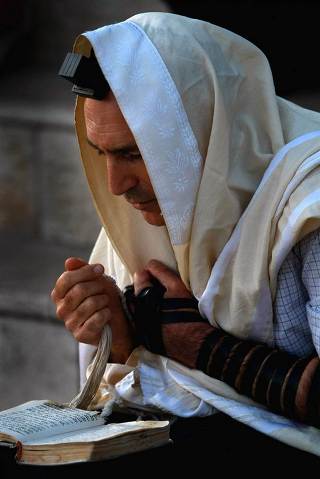
Take Tefillin (phylacteries) for example. Why should a man have to wrap straps around one arm and the forehead with little boxes attached in order to pray to God? In this case, modern Jews are obeying a very ancient commandment from God as quoted above.

Here’s the commandment again as expressed in scripture that is also a part of the Shema:

“Hear, O Israel: The Lord our God, the Lord is one. You shall love the Lord your God with all your heart and with all your soul and with all your might. And these words that I command you today shall be on your heart. You shall teach them diligently to your children, and shall talk of them when you sit in your house, and when you walk by the way, and when you lie down, and when you rise. You shall bind them as a sign on your hand, and they shall be as frontlets between your eyes. You shall write them on the doorposts of your house and on your gates.

Deuteronomy 6:4-9 (ESV)

I don’t believe it’s a coincidence that this is also part of what Jesus referenced when asked about the two greatest commandments.

And one of the scribes came up and heard them disputing with one another, and seeing that he answered them well, asked him, “Which commandment is the most important of all?” Jesus answered, “The most important is, ‘Hear, O Israel: The Lord our God, the Lord is one. And you shall love the Lord your God with all your heart and with all your soul and with all your mind and with all your strength.’ The second is this: ‘You shall love your neighbor as yourself.’ There is no other commandment greater than these.”

Mark 12:28-31 (ESV)

If you put the commandment of tefillin within the context of loving God and loving your neighbor, then obeying this mitzvot is a sign of that love and adoration, not only of the Creator above, but of your fellow human being, because you cannot say you are performing the former if you do not perform the latter.

daven-tefillin-siddurOne of the First Fruits of Zion (FFOZ) commentaries for Torah Portion Vaetchanan (Deuteronomy 3:23-7:11) specifically addresses the commandment of tefillin.

There is some argument over whether the commandment of tefillin was meant to be taken literally, or if it is just a figurative language. In the Near East, it was once common for blood covenant partners to exchange amulet-like pouches which contained tokens, or even full copies, of their covenant obligations to one another. These were worn as bracelets or necklaces. The commandment of tefillin is consistent with that ancient ritual, especially when one considers the rabbinic tradition that God Himself wears tefillin with Israel’s name on them. In that sense, the tefillin are similar to wedding rings. In fact, while a Jew winds the black leather straps for tefillin of the hand about his middle finger like a ring, he recites the betrothal passage from the book of Hosea:

“I will betroth you to Me forever; Yes, I will betroth you to Me in righteousness and in justice, in lovingkindness and in compassion, I will betroth you to Me in faithfulness. Then you will know the LORD.” (Hosea 2:19–20)

The binding on of tefillin is a tangible, ritual reminder of our obligation to bind God’s commandments on our very lives. God’s Word is to be between our eyes, filtering all that we see and think. It is to be bound on our hands, weighing all that we set our hands to do.

As you can see, the love and marital symbolism is unmistakable and in reciting the blessings for donning tefillin, the Jewish heart is drawn in affection and adoration toward God…

…and toward each other.

As we were saying goodbye, I said to the man who had been asking the questions: “I suppose that you have a special interest in tefillin; is that was why you were asking those questions about them?”

“I haven’t put on tefillin for over 20 years!” was his reply.

“But you should!” I responded.

He then said: “Everyone here is now going home to sleep, but I am going to work. I own a bakery, and we work all through the night. If you want me to put on tefillin, you can come to my bakery at about 6:30 AM. At that time we are between bakes, and I’ll put on tefillin.”

I must admit that this was not my style, but I could not refuse, so at 6:30 Wednesday morning I arrived at his bakery with tefillin, prayerbook and skullcap, and amongst the sacks of flour he put on tefillin. What surprised me was that he needed no help—he knew exactly what to do and what to say.

After he finished, I said to him: “You obviously know how to put on tefillin, and you know the blessings and the prayers. Why don’t you do it regularly?” He told me that he didn’t own a pair of tefillin, and it was not one of his priorities to buy a pair—but if someone gave him a pair of tefillin, he would put them on regularly. I answered that I was returning to England via New York, but I expected to be back in Detroit in about six weeks, and that I would bring him a pair of tefillin.

-Benzion Rader
“Another Day Without Tefillin?”
Chabad.org

This is part of a rather lengthy story about one Jew going well out of his way (much more than the segment above indicates) to make sure another Jew could fulfill the commandment of tefillin. You might ask yourself if it was so important to the baker to daven with tefillin, why didn’t he just purchase some for himself?

jews-praying-in-the-snowI don’t know. Regardless of his reasons or circumstances, once the other man became aware of the situation, he became obligated to help his fellow Jew. You can click the link I provided to read the entire article, but in short, here’s the rest of the story. The transaction between the businessman and the baker happened in Detroit. The businessman stopped in New York on his way back home to London to consult with the Rebbe in Crown Heights (Brooklyn), and the Rebbe convinced the businessman to make sure the baker had acquired tefillin immediately, before going back home rather than waiting six weeks. With great difficulty due to limited time and finances, the businessman was finally able to purchase tefillin and had them shipped to Detroit so that the baker would not go one more day without being able to pray with tefillin.

I left for London only after advising the Rebbe what had been arranged, and after waiting to hear that they had been collected and delivered in Detroit.

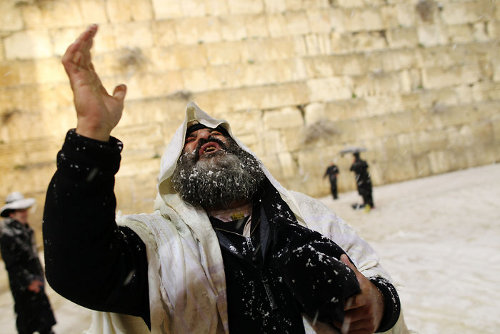
A few months later, I met this person again in Detroit, and asked him how he was doing with the tefillin. He told me that he had not missed a day—even walking home in the snow one day when his car broke down so that he put on the tefillin before sundown. He said: “Because of the trouble you went to in order that I should receive the tefillin the very next day, they are especially important to me.”

Again, this might seem rather a strange thing to a Christian since we do not experience any circumstance or situation that would inhibit or diminish our prayers, and certainly nothing like a physical object or device used in prayer.

Nevertheless, from a Jewish point of view, everything that happened was the performance of a single act of love in order to help one Jewish man perform another act of love…by davening with tefillin.

The results are obvious.

Good Shabbos.

Silent Faith at the Sea

exodus-reed-seaWhen the king of Egypt was told that the people had fled, Pharaoh and his courtiers had a change of heart about the people and said, “What is this we have done, releasing Israel from our service?” He ordered his chariot and took his men with him; he took six hundred of his picked chariots, and the rest of the chariots of Egypt, with officers in all of them. The Lord stiffened the heart of Pharaoh king of Egypt, and he gave chase to the Israelites. As the Israelites were departing defiantly, boldly, the Egyptians gave chase to them, and all the chariot horses of Pharaoh, his horsemen, and his warriors overtook them encamped by the sea, near Pi-hahiroth, before Baal-zephon.

As Pharaoh drew near, the Israelites caught sight of the Egyptians advancing upon them. Greatly frightened, the Israelites cried out to the Lord. And they said to Moses, “Was it for want of graves in Egypt that you brought us to die in the wilderness? What have you done to us, taking us out of Egypt? Is this not the very thing we told you in Egypt, saying, ‘Let us be, and we will serve the Egyptians, for it is better for us to serve the Egyptians than to die in the wilderness’?” But Moses said to the people, “Have no fear! Stand by, and witness the deliverance which the Lord will work for you today; for the Egyptians whom you see today you will never see again. The Lord will battle for you; you hold your peace!”

Then the Lord said to Moses, “Why do you cry out to Me? Tell the Israelites to go forward.

Then Moses caused Israel to set out from the Sea of Reeds. They went on into the wilderness of Shur; they traveled three days in the wilderness and found no water. They came to Marah, but they could not drink the water of Marah because it was bitter; that is why it was named Marah. And the people grumbled against Moses…

Exodus 14:5-15; 15:22-24 (JPS Tanakh)

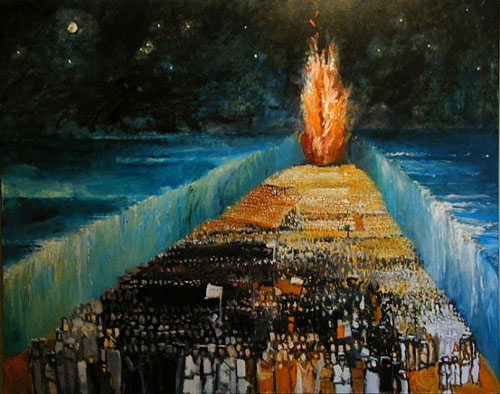
The miracle of the splitting of the Red Sea is the culmination of the Exodus. One week after the calamitous plague of the First Born, once again Pharaoh is chasing after the Jews to enslave them. As he advances, the Jews are trapped between the sea and the advancing Egyptian army.

Groups of Jews suggest a variety of responses to the impending disaster. God tells Moses to cease praying and travel toward the sea. In a heroic act of faith, Nachshon, prince of the tribe of Judah, throws himself into the sea, and it splits. (Talmud – Sotah 37a)

-Rabbi Dave Rudman
“Chumash Themes #11: Splitting of the Sea”
Commentary on Torah Portion Beshalach
Aish.com

One of the arguments I sometimes hear (though fortunately, not lately) about how Christians are ultimately superior to the ancient Israelites, has to do with faith. Basically, I’ve heard that Christians have an abundance of faith in God through Jesus Christ and the Israelites had none. The “proof” of the latter has to do with the continual grumbling of the Israelites (as I’ve tried to illustrate above) and how it seems to be a characteristic of them for the next forty years. That first generation out of Egypt never seems to get it right. It appears amazing after all, since they witnessed miracles of God that would stagger the senses. They saw the plagues against Egypt. They saw the parting of the Reed Sea. The entire population of Israel directly encountered God at Sinai and received the Torah “as one man.”

How could they not know that God is was with them?

The response to that question is much bigger than I’m able to answer, particularly in a blogging format, but through metaphor, midrash, and a little Chasidic mysticism, I want to use a tiny bit of the Exodus narrative to tell a story about us…about you and me…about people of faith.

When the Jewish people left Egypt, they were the spiritual equivalent of children. Their active participation in the Ten Plagues and the Exodus was negligible. The plagues were accomplished in a completely miraculous way through the agency of Moses and Aaron. The Exodus itself was predicated on the covenant that God promised Abraham to redeem his descendants from slavery. (Genesis 15:13-14)

Therefore, the Jewish people needed to mature and interact with God on their own.

-Rabbi Rudman

And he said to them, “Do you not understand this parable? How then will you understand all the parables? The sower sows the word. And these are the ones along the path, where the word is sown: when they hear, Satan immediately comes and takes away the word that is sown in them. And these are the ones sown on rocky ground: the ones who, when they hear the word, immediately receive it with joy. And they have no root in themselves, but endure for a while; then, when tribulation or persecution arises on account of the word, immediately they fall away. And others are the ones sown among thorns. They are those who hear the word, but the cares of the world and the deceitfulness of riches and the desires for other things enter in and choke the word, and it proves unfruitful. But those that were sown on the good soil are the ones who hear the word and accept it and bear fruit, thirtyfold and sixtyfold and a hundredfold.”

Mark 4:13-20 (ESV)

sower-seedThe full “Parable of the Sower” can be found in Mark 4:1-20 and I find it an interesting parallel to what Rabbi Rudman said about the Children of Israel being “spiritual children” at the point when they’re leaving Egypt. They were a people but not yet a nation. Their bodies had been freed from slavery but not their minds and hearts. They moved forward with joy but were terrified at every setback.

Here’s another way of looking at the choices we make as cited in a more “mystic” source:

A king had lost a costly pearl. He sent his three sons to look for it. The first son was of the opinion that his father did not need him anymore, and he did not return to him. The second son did not think about the pearl at all, he only wanted to be back home with his father. The third son understood that he had been sent out for this purpose: to become completely independent. So he searched for the pearl and found it and brought it to his father.

It is very much like that with humanity. One person is deeply involved in this world. For him it would have been better if he had never been born. Another strives his whole life to get back home to his Source, to his Father; but he is thereby thinking only about himself. Still other men seek after and find the precious pearl. They return the holy sparks of God which have been scattered in the world back to their original Source again. Such men are the true redeemers of mankind.

Paul Philip Levertoff
“Repentance and Redemption”
Religious Ideas of the Chasidim
Chapter 1, Sections 12 and 13
as quoted from Messiah Journal, Issue 112 (Fall 2013/5773), pp 79-80

Now how does all that compare to us?

young-levertoffYou may have been a Christian for so long that you’ve forgotten what it was like to be a brand new believer. You may have initially come to faith as a child within the context of a Christian family, so you may never have encountered God without the support of a church and loved ones, just you and Him alone and unfiltered. Taking the Master’s parable as a model, and given all that I’ve just said, you may have never faced nurturing a new and fragile faith that just about anything could blow away if you let it…like when the Adversary comes to take the word back out of your heart, or when you don’t allow the word to take root, or when you let the problems and worries of the world around you distract you and choke your faith to death. The challenge of letting faith and the word grow in good soil is to protect it long enough to become strong.

I suppose that’s one of the advantages I have in coming to faith later in life, although it comes with many disadvantages as well. Faith is something I’ve had to fight for within myself and it remains a struggle, sometimes between me and God.

Therefore, the Jewish people needed to mature and interact with God on their own. This was the purpose of the second phase of the Exodus, the splitting of the sea. In order to bring the Jews to this degree of independence, God directs them on a specific journey…

-Rabbi Rudman

I frequently refer to a life of faith as a journey taken along a path and I think the metaphor serves quite well. I sometimes feel that the first generation out of Egypt were never meant to enter the Holy Land of Israel, and that the trial of slavery in Egypt was just too much for them to overcome on the journey, even though God was with them.

But what was Egypt to them and why would it have left such an indelible brand on its slaves, at least as certain “mystic” viewpoints in Judaism see it today?

Mitzrayim (Egypt) expresses constriction, limitation. The spiritual Egyptian exile is the animal soul’s restricting and concealing the G-dly soul so severely that the G-dly soul is compressed to the degree that it is diminished and obscured. “Exodus from Egypt” is the removal of the constriction and bounds; i.e. the intellect in the brain illuminates the heart, bringing about fine character traits translated into actual practice.

“Today’s Day”
Sunday, Sh’vat 4, 5703
Compiled by the Lubavitcher Rebbe
Translated by Yitschak Meir Kagan
Chabad.org

They had been slaves all their lives, their parents, their grandparents, and all of their people had been slaves in Egypt for almost as long as their collective memory could recall. I sometimes feel as if they existed to prepare their children to inherit the promises God made to Abraham, Isaac, and Jacob.

But I’ll never know, I suppose. That’s just my imagination. I’ll never know if the journey was for the sake of the children who left Egypt and the children who were the first generation of Israelites born in freedom after several hundred years of enthrallment. The journey had a purpose, but it may not have been the one that we think of when we read of the forty years of wandering.

But what about us? It would be an immense tragedy to try to apply the forty years of wandering and the ultimate death of that first generation as a metaphor of us as individual believers. It would mean that the lives of some Christians who don’t quite make it in their faith are only illustrations for the witnesses to their lives. That sounds unfair to them and maybe I’m being unfair to the first generation to leave Israel as well. I don’t know.

But I do know that the journey has a purpose, even when it doesn’t appear that such a purpose exists. Each miracle, each tragedy, each meal of manna, each harsh encounter with Moab or the Amalakites…all of that shaped and molded the journey and shaped and molded the Israelite faith in the presence and purpose of God who was among them.

It is just the same with our journey as well. In reading and re-reading the Torah cycle each year, we are witnesses to the Israelite journey and as witnesses, we can try to learn the lessons their path is teaching us about our own trip through life. As we see their struggle, it is one of human beings contending with God. Can God save them from the latest calamity or must the Israelites take matters into their own hands and return to Egypt? Can Moses and Aaron be trusted to lead the people, or should Korach and his associates take over?

As far as we’re concerned, when difficulties happen to us, who should we trust and what should we do?

Sometimes you see that things have been taken out of your hands and are following a supernatural order. At this point, just do your best at what you have to do—and stay out of G‑d’s way.

-Rabbi Tzvi Freeman
“Getting Out of the Way”
Based on letters and talks of the Rebbe
Rabbi M. M. Schneerson
Chabad.org

WateringThis doesn’t mean we have no responsibility to act on our own behalf or on the behalf of others as circumstances require, but on the other hand, it doesn’t mean we have license to always drive ourselves into each problem as if God doesn’t exist, either. There is a time to act and a time to let God act and have faith that, even though things seem hard or even impossible, He will prevail.

Moses said to the people, “Do not fear. Stand still, and see the salvation of G-d that He will show you today: for the Egyptians whom you have seen today, you shall never see them again. G-d will fight for you, and you shall be silent.”

Exodus 14:13-14

Talmud Yerushalmi – Ta’anit 2:5 explains:

  • One group felt they could not win this battle. So rather than be captured alive, they wanted to commit suicide by casting themselves into the sea. To this, the response was “stand still.”
  • Another group of Jews desired to return to Egypt and surrender. To them, the response was, “the Egyptians whom you have seen today, you shall never see them again.”
  • A third group desired to go to battle. But Moses told them, “God will fight for you.”
  • For those who wanted to pray, Moses said, “Be silent.”

I told you midrash would be involved.

Listen to God and do what you are required, as best as you can comprehend, to address your life as it exists each day because it is faith in God that gives us courage to act. This helps us to mature and interact with God on our own. But remember that it is also faith and courage to “stand still” and to “be silent” and let God take care of you as well.

Va’eira: Is This Egypt?

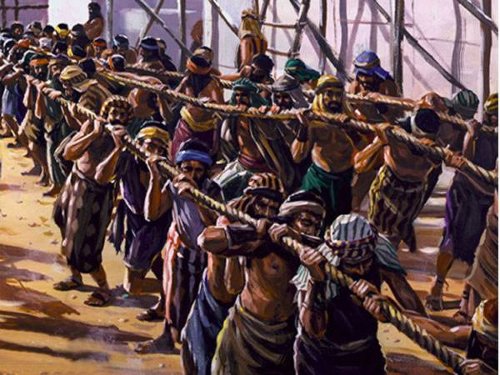
hebrew_slaves_egyptSay, therefore, to the Israelite people: I am the Lord. I will free you from the labors of the Egyptians and deliver you from their bondage. I will redeem you with an outstretched arm and through extraordinary chastisements. And I will take you to be My people, and I will be your God. And you shall know that I, the Lord, am your God who freed you from the labors of the Egyptians.

Exodus 6:6-7 (JPS Tanakh)

G‑d reveals Himself to Moses. Employing the “four expressions of redemption,” He promises to take out the Children of Israel from Egypt, deliver them from their enslavement, redeem them, and acquire them as His own chosen people at Mount Sinai; He will then bring them to the land He promised to the Patriarchs as their eternal heritage.

from “Va’eira in a Nutshell”
Commentary on Torah Portion “Va’eira
Chabad.org

I had coffee with a friend after work on Wednesday. We see each other irregularly these days, but our conversations are always good. The main reason we met was because he wanted to borrow my copy of Boaz Michael’s book Tent of David: Healing the Vision of the Messianic Gentile. This, of course, was also one of the primary topics of our talk as I sipped my coffee and he sampled his tea.

One of the things I value about our relationship is that we don’t always see eye-to-eye. We never argue and conversations never become heated, but we do see things from different points of view. I think he’s interested if not intrigued about my return to church (although this could be projection on my part) and he struggles with the implications of going back into the church after having been “redeemed” from it. It’s an interesting metaphor.

In our discussion, he likened leaving the church to the Children of Israel leaving Egypt. It’s not a complementary picture of the church that he’s painting, but it’s one that I’ve encountered on numerous occasions during my sojourn in the Hebrew Roots movement. Egypt represents nothing good spiritually and morally and leaving Egypt is always seen as a positive action on the part of God toward the Israelites. But can non-Jewish believers leaving the church be seen in the same way? If the church equals Egypt, torment, and slavery, and being released from all that means coming closer to God, then when a Christian leaves church, where do they (we) go that is better and what do they (we) do when they get there?

Let’s back up a minute. In Judaism the process of God rescuing the ancient Hebrews from their slave status in Egypt and bringing them to Himself at Sinai involves what is called the “four expressions of redemption” based on the above-quoted Exodus 6:6-7. But what are these four expressions and what do they mean?

According to the Ask the Rabbi column at Ohr Somayach, they are:

  1. “I will take you out from under Egypt’s burdens – Vehotzeiti
  2. “And I will save you from their servitude – Vehitzalti
  3. “And I will redeem you – Vega’alti
  4. “And I will take you as My nation – Velakachti

This is actually a commentary on the four cups we see during a traditional Passover seder. The Ohr Somayach Rabbi further states:

We didn’t go from a slave nation to being the Chosen People at Mount Sinai overnight. There were different stages of redemption. The above phrases described these different stages. Each cup of wine represents one of these levels.
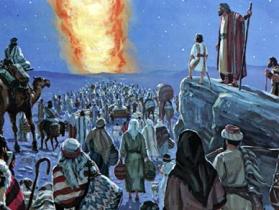
leaving_egyptThat’s fine as far as it goes, but to me, it’s not very revealing, especially if we are trying to compare these four expressions to how we might view a non-Jewish Christian leaving the church (which is being equated to Egypt).

OU.org expands on the meaning of the four expressions thus:

According to R. Bachya (Spain, 1263-1340), the explanations of the Four Expressions are as follows:

  1. “I will take you out” – Hashem would remove the slavery even before the Jews left Egypt, from all the Tribes of Israel, because of the growing perception by Egypt of Hashem, the G-d of Israel, as the One Almighty G-d.
  2. “I shall save you” – Hashem would take the Jews out of Egypt with plagues visited upon the Egyptians, their Pharaoh and their gods, “with a strong hand and an outstretched arm.”
  3. “I shall redeem you” – Hashem would perform the miracle of “Kriat Yam Suf,” the Splitting of the waters of the “Yam Suf,” and the creation of a dry path for the Children of Israel to walk upon as they crossed the Sea of Reeds. Then Hashem caused the piled-high waters to descend in a tidal wave upon the Egyptian Army, to permanently crush the World-dominating power of Egypt.
  4. “I shall take you” – Hashem took the Jewish People to Himself as a Kingdom of Priests and a Holy Nation. This was the spiritual component of the Redemption from Egypt. In fact, the spiritual Redemption was the Reason for the Physical Redemption.

The fifth expression, “I shall bring you to the land,” refers, of course, to the Land of Israel…

I must admit, I’m having a tough time mapping what I’ve been quoting from above to any image of why Christians should leave the church and where they are supposed to go. On the other hand, I’m kind of biased and truth be told, it wasn’t that many years ago that I might have accepted my friend’s metaphor relative to the Hebrew Roots movement.

But consider this. If Hebrew Roots is supposed to be the “Sinai” for Christians leaving the church, is it an attainable goal and is it right and accurate to say the church is Egypt in a spiritual (or any other) sense?

The Christians who, throughout the ages, have propagated this message and tried to soothe the hurting, feed the hungry, and speak to social injustice have been keeping the weightier matters of the Torah. Both Yeshua (Mark 12:31) and the Sages (Rabbi Hillel in b.Shabbat 31a and Rabbi Akiva in Sifra, Kedoshim 4:12) taught that love of neighbor is the essence of Torah. These are non-trivial accomplishments which speak to the robust, biblical ethical system which many devout Christians have embraced.

-Boaz Michael
“Chapter One: The Church is Good,” pg 49
Tent of David: Healing the Vision of the Messianic Gentile

You’ll have to read all of Boaz’s book to get the full flavor of why the church is good, but I believe he paints a very convincing picture of the modern “body of Christ” as it lives and breathes within the multitude of churches in our communities and around the world. Even today in the lives of people I know, Christians are doing wonderful acts of kindness in the name and spirit of Messiah.

We are seriously getting love aimed at us by a little church nearby. Out of the blue, the pastor had contacted me wanting to know if some of their members could do anything for us and he wouldn’t take no for an answer unless it really was no.

Today some amazingly nice folks showed up and hauled off to the dump our junk too big for our own vehicle, in one of the guy’s large truck.

Meanwhile, the ladies scoot in to do some cleaning while visiting with Heidi.

And meanwhile another great guy is walking me around our deck, explaining to me how he is going to prep the bannister and then paint it for us.

And they’re coming back tomorrow!

-Joe Hendricks

I originally quoted Joe in a blog I published last June. Sadly, since that time, Joe’s wife Heidi passed on, but the church he mentions continues to be a support in his life as he grieves and as he yet looks to the future by the grace of Christ.
afraid-of-churchThe church isn’t perfect. In fact, It’s taken quite awhile for me to overcome my own misgivings about going back to church (which can be reviewed in all their glorious details in my recent “Days” series, which culminated at Day Zero). In fact, I still periodically have to review Pastor Jacob Fronczak’s blog post Why I Go to Church to remind myself that a community can be imperfect and still be the will of God for the good.

So if the church isn’t Egypt, then do we have to be delivered from it? Is there someplace better to go to and what do we call it?

I can’t answer for every person out there who has once been in the church and, for whatever reasons, left it, either for some other religious organization or to pursue God as a solidary individual or family. I can only speak for myself and how I express my evolving understanding of God’s will for my life.

I don’t think we can get back to the “root” of our faith. I know that’s disappointing and maybe some of you disagree with me, but hear me out. At some point about 2,000 years ago, a sect  called “the Way” rose among the other movements in Judaism in the late Second Temple period. The Jewish disciples were devoted to a “dead Rebbe” rather than a living teacher, one who they said not only died, but rose again. He is the Mashiach, the Son of the Living God (Matthew 16:16), who sits at the right hand of the Father (Psalm 16:8, Psalm 110:1, Acts 2:33), and who is the High Priest in the Court of Heaven (Hebrews 4:14).

The “Christianity” of that moment in history was a wholly Jewish religious movement and it co-existed with numerous other Jewish movements in Roman occupied “Palestine” in those days. Acts 10 shows the first non-Jew who came into discipleship under Messiah within this sect without converting to Judaism, and the “ministry” of Paul, who as an emissary to the Gentiles, preached a Gospel not given by men but by Jesus Christ (Galatians 1:11-12). As more and more Gentiles in the diaspora began to hear the “good news” of the Jewish Messiah and apply it to their lives, slowly the Gentiles and Jews within the “Jesus movement” began to trace somewhat divergent trajectories. Those slight deviations in trajectory would later lead them on completely different paths through the progression of history, and for centuries now, they have both identified themselves as two completely different religions that once shared a common point.

Should Christians seek to leave the church and travel backward across the timeline, trying to recapture whatever idealized or “perfected” Christianity that may (or may not) have existed somewhere around the mid 40s CE? Is it even possible?

Or does the path that God has set before us lead forward into the future…a future that will summon the risen Messiah to come out of the sky in the clouds (Revelation 1:7), who will redeem his people Israel, and who will also gather his disciples from the nations? If this future-oriented path is the true one, then perhaps there is no “perfect Christianity” to go back into upon “leaving the church.” Regardless of whatever Christian or Jewish worship venue to which you are attached (including any form of Hebrew Roots or Messianic Judaism), chances are, you don’t belong to a perfect community. Chances are people in your congregation make mistakes. Chances are, when scrutinized by the King of All Glory, your theology may not be absolutely and totally 100% “kosher.”

Chances are, there is no perfect church, synagogue, community, or congregation for you or for any of us to join upon leaving “church.” Face it. All congregations that involve human beings and human relationships are “messy.” We have to start with where we are, not where we’d like to be.

Yes, the church could be improved. That’s the other very valuable (to me) chapter in Boaz’s book, “Chapter 2: The Church Needs to Change.” Frankly, we could also probably say, relative to God’s perfect understanding, that the synagogue needs to change as well. A better way to say it is that we all need to change, to be better, to draw nearer to God, to refine our understanding of who He is and who we are in Him, Jew and Christian alike. We travel upon our divergent trajectories but we have one Shepherd and one King, and God is One. Not that our ultimate unity under Him as His “peoples” means uniformity, but it does mean unity of devotion and fealty.

The Messiah will come. He will return Israel to its place as the head of all the nations, rebuild the Temple, defeat evil, and establish a reign of peace and tranquility for all peoples of the earth. All the Jewish people will be gathered unto him in their nation Israel, and we believers who reside across the four corners of the Earth will bow our knees to him and call him Lord over all (Romans 14:11, Philippians 2:10). That is our future.

But we’re not there yet.
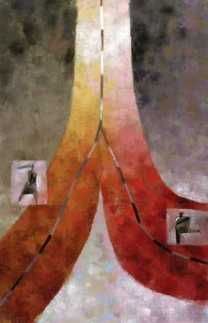
two-roads-joinWe have to start where we are. If we are non-Jewish Christians in church, we should stay in church. We should bring our understanding of the Jewish Messiah King to where we are, not remove it from our fellow believers and hoard it for ourselves. If we are Gentiles in a Messianic community, then we should stay there (though there may be exceptions who will also attend a church) and use other platforms for communicating our understanding to the Christians we know or will come to know (compare to 1 Corinthians 7:18). For myself, I go to church not to change anything but to encounter God and His purpose for me, whatever it may be.

We may not always see the good in the church but it’s there. We may not see it because when we were introduced to the Hebrew Roots movement (for those of you reading this who are or were involved in Hebrew Roots), we were told the “church is Egypt.” However, if it’s been awhile since you’ve taken a look at the church, at the Christians in your community, at the believers you work with, live near, and consider friends, maybe it’s time you took another look. There are indeed two paths involved, but they’re not the two you have been imagining.

There are two paths:

One: Everything is for the good. Perhaps not immediately, but eventually good will come out from it.

The other: Everything is truly good—because there is nothing else but He who is Good. It’s just a matter of holding firm a little longer, unperturbed by the phantoms of our limited vision, unimpressed by the paper tiger that calls itself a world, and eventually we will be granted a heart to understand and eyes to see.

Eventually, it will become obvious good in our world as well.

-Rabbi Tzvi Freeman
“Believing in G-d”
Based on letters and talks of the Rebbe
Rabbi M. M. Schneerson
Chabad.org

To modify Rabbi Freeman’s commentary slightly, everything we encounter is for the good, and eventually good will be demonstrated by the church. We must be patient and help as we can. Also, everything in church is truly good because nothing else exists in our world but God who is Good (Mark 10:18). It’s just a matter of us holding on a little longer where we are, not allowing our limited vision of how we see Christianity to limit God’s work in the church.

Eventually, the good of God and of the body of Christ in our world will become obvious to us as the time for the return of our Master draws near.

Good Shabbos.