Tag Archives: Torah

Vayigash: Are You Willing to Save Someone’s Life?

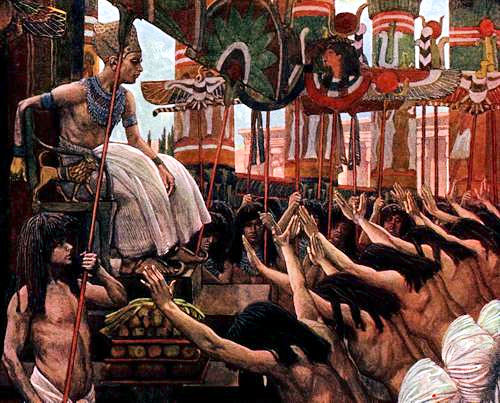
joseph-and-pharaoh“Now when the news was heard in Pharaoh’s house that Joseph’s brothers had come, it pleased Pharaoh and his servants.”

Genesis 45:16

Pharaoh was delighted when he heard that Joseph’s brothers had come to Egypt. He immediately made provision to bring the entire family to Egypt so they could survive the famine in safety and comfort. He provided wagons for the move. He promised them the best of the land of Egypt.

Pharaoh’s warm welcome of Joseph’s brothers reveals an important detail about Joseph’s time in Egypt.

“What Pharaoh Heard”
Commentary on Torah Portion Vayigash
First Fruits of Zion (FFOZ)

This commentary from FFOZ comes with the following “Thought for the Week:”

When we are wronged by someone, it is natural to tell others about it. We want to tell others about how it happened to garner their sympathy and support. Somehow it makes us feel better to know that others are aware of the injustice committed against us. We seek out sympathy and commit a small act of retaliation.

It’s very human that when we feel we’ve been wronged by someone, to want to get even in some way. Usually, we get even by doing the same to them as we believe they’ve done to us (whether the damage the other person has done to us is real of just perceived makes no difference apparently).

I write periodically on something called Lashon Hara or the Jewish concept of wronging someone in speech (which can be spoken, written, or any other form of communication). I’ve even based the Comments Policy for this blog on that principle.

As the FFOZ commentator writes, what we say and how it is perceived can have hurtful and even dire consequences:

Joseph loved his brothers and his family so much that he could not bear the thought of having them defamed. He did not want Egyptians saying to one another, “Did you hear about the nasty thing that Joseph’s lowlife brothers did to him?” Joseph kept the entire episode to himself. The only thing he ever said about his past was the vague explanation, “I was in fact kidnapped from the land of the Hebrews” (Genesis 40:15). His love for his brothers compelled him to protect their reputation.

Instead of emulating Joseph, who was concerned about protecting the dignity of his loved ones, it seems we do just the opposite. A husband and wife are eating out at a restaurant when the husband drops his cup, spilling his beverage on the table. Embarrassed, the wife rolls her eyes and says to the stranger sitting at the next table, “He is such a klutz.” A man is out with his friends when they begin discussing the foils of marriage. All in good fun, the man complains to the guys about his wife’s bad habits. Everyone laughs. Why would we sell out the people we love like this? The wife shows more concern for the opinion of a stranger in a restaurant than she does for the dignity of her husband. The husband has higher regard for a few laughs from his buddies than he does for the reputation of his wife.

It’s one thing to read about a “Bible principle” and another thing entirely to behave out of that principle with unerring consistency. Reading about Joseph and his brothers makes a nice story, but most of the time, we don’t think to apply what we’ve learned to our day-to-day living. Reading the story of the wife casually defaming her husband in public brings the principle home. If anyone you’ve loved has embarrassed you in front of your friends, family, or strangers, even if what they said is true about you, then you know what I mean.

Here’s another example:

“The Torah ideal is to greet each and every person with a pleasant facial expression.” (Tomar Devorah, ch.2) When you greet someone in a friendly way, you never know what a positive effect you will have. A certain individual who greeted everyone with a smile and kind words was approached by someone and told, “You saved my life.” The person went on to tell how he’d suffered a number of serious setbacks and was contemplating suicide. He felt totally alone and depressed and felt that no one cared about him. Then this fellow greeted him with a sincere smile and a cheerful voice. This immediately lifted up his spirits and he was resolved to continue living.

-Rabbi Zelig Pliskin
Quoted from Gateway to Happiness, pg 26
Found at Aish.com

whispererI don’t know what Joseph felt about his brothers or why he didn’t “spill the beans” about their attempt to kill him to Pharaoh, King of Egypt, or anyone else in his sphere of Egyptian companions. Maybe he really did continue to have love for them in his heart, in spite of how they felt about him. Perhaps he just didn’t want the Egyptians to harbor any more disdain for the Hebrews than they already did. Regardless of the reason, even though Joseph would have been telling the truth if he revealed the terrible acts of his brothers to Pharaoh, he chose not to do it, keeping the matter to himself, and even forgiving his brothers, though they hardly deserved it.

When a spouse says something to revealing about his or her “other half,” depending on what it is, the person being spoken of can at least feel embarrassed if not ashamed or humiliated. As we see from Rabbi Pliskin’s example, how we treat another person, even if it’s simply greeting a stranger with a smile, can make a tremendous impact.

There are more than enough “moral police officers” on the web and particularly in the blogosphere who choose to point accusing fingers at others rather than greeting them (virtually speaking) with a “smile.” Especially since we cannot actually face the people we address on the Internet, we have no idea what good or evil we are doing to them and how they will respond. Most of the time, all we know is that they remain silent or they “bark back” at us if we have insulted or embarrassed them in some way.

But like the man in Rabbi Pliskin’s commentary, we don’t know how far we can push someone, especially if they are already on an emotional brink. We can knock someone over or we can pull them back, just by how we speak to them or about them.

James, the brother of the Master, said (James 3:8) that the tongue is “a restless evil and full of deadly poison'” We have been given the gift of speech (and writing, and other forms of communication) to bless and not to curse. Paul said (1 Thessalonians 5:11) that believers should “encourage one another and build up one another”, and New Testament scholar and author Mark Nanos, in his book The Mystery of Romans said Paul expressed his heartfelt desire that believing Gentiles should support and encourage even the non-believing Jews in the synagogue, rather than denigrate them for being “weak” and “stumbling” in faith.

If it is true that we have a duty to support even unbelievers so that they should come to faith, then what we say and what we do becomes incredibly important. We can not only save someone’s life in this world by how we greet them, we can be an instrument to bless or curse their souls.

The FFOZ commentary for this week’s Torah portion ends this way:

A woman was having a hard time at the Messianic synagogue she attended in the southern United States. She was involved in a heated conflict with some other members. This went on for some time. Frustrated with her congregation, she told her unbelieving friend about the problems she was having. Eventually the leadership arbitrated the situation. She made peace with the people. Some time later, she invited her unbelieving friend to attend a service. Her friend said, “Are you crazy? After the way you talked about those people and that place, I wouldn’t set foot in there.”

Joseph never told the Egyptians about the incident with his brothers because it was none of their business. By maintaining discretion, he was protecting the name and reputation of God in Egypt. Had he told his sad story to everyone, the Egyptians would have had cause to say, “If that’s how the followers of your God behave, I want nothing to do with Him or your religion.”

FallingI’ve heard it said that “you can’t unring a bell.” Once you have said or done something harsh or hurtful to another human being, you can never take it back. Just imagine all of the regret buried within you for all of the things you’ve said and done to sin against other people and against God over the years.

Fortunately, God is in the business of forgiving, but it’s not certain that all of the people you and I have hurt in our lifetimes will be willing or able to forgive us. But while we can’t change the past, we can make a new future starting right now. Have a care what you say and what you do. Greet others with a smile. Withhold a harsh criticism, even if what you could say is factual. Consider that God loves even the sinner and the apostate.

You may never know whose life you may save by either speaking a good word or withholding one that is evil. One day we will all have to give an accounting for how we’ve lived our lives and every action we have committed. What will you say to the King when it’s your turn? Will you attempt to justify hurting others, or be blessed by him for your kindness and compassion?
Vayigash: Will the King Show Us Mercy?

king-davidAnd Joseph said to his brothers, “I am Joseph!”

Genesis 45:3

The Chofetz Chaim comments that from the time the brothers first came to Egypt to get food — when Joseph spoke with them roughly and accused them of being spies — they were puzzled about what exactly was happening and why it was happening. In both encounters with Joseph they had many questions about their experiences. As soon as they heard the words, “I am Joseph” all their questions were answered. The difficulties they had in understanding the underlying meaning of the events — why Joseph accused them of being spies, yet treated them well, accused them of lying and stealing, but gave them a banquet, insisted on bringing the younger brother to Egypt, etc. — were now completely clarified.

Similarly, says the Chofetz Chaim, when the entire world will hear the words “I am the Almighty” at the final redemption of the Jewish people, all the questions and difficulties that people had about the history of the world with all of its suffering will be answered. The entire matter will be clarified and understood. Everyone will see how the hand of the Almighty caused everything ultimately for our benefit.

Dvar Torah for Torah Portion Vayigash based on
Growth Through Torah by Rabbi Zelig Pliskin
Referenced by Rabbi Kalman Packouz
at Aish.com

The brothers of Joseph discover a startling reality. The ruler of the Egyptians who has been treating them harshly all of this time is really their brother Joseph. In an instant, all the cruelty they showed him, including trying to murder him, must have come to the forefront of their conscience.

Before this, the Egyptian ruler had the power to do anything to them, imprison them, make them slaves, even kill them, but “it wasn’t personal.” That is, the sons of Jacob were no more or less significant to an Egyptian ruler than anyone else.

Now they not only discover that this man has the power of life and death over them, but that he is their brother, who they left for dead, who almost surely has a personal motive for seeking revenge. The brothers knew they had no right to appeal to Joseph for mercy, for they had not showed him mercy. They could only hope that in the years he ascended from slavery and imprisonment to being a viceroy of Egypt, second only to Pharaoh in power and authority, that he had learned wisdom and compassion and would be willing to offer them something they did not deserve: mercy and the continuation of their very lives.

Now look at what Rabbi Pliskin had to say from the above-quoted text:

Similarly, says the Chofetz Chaim, when the entire world will hear the words “I am the Almighty” at the final redemption of the Jewish people, all the questions and difficulties that people had about the history of the world with all of its suffering will be answered.

How much of the non-Jewish world will tremble at the feet of God when they realize the Almighty has appeared at the final redemption and that He is not at all pleased with how His people Israel have been treated?

Over the long march of centuries since Abraham, Isaac, and Jacob, since Joseph confronted his brothers, since Moses, Aaron, and Miriam liberated the Israelites from Egyptian slavery and set them before God at Sinai, and on and on across history, every people, tribe, and tongue throughout the Earth has been seeking to kill the Jewish people, God’s splendorous treasure, the apple of His eye.

This includes the Church of Jesus Christ. How confusing it will be in those days to be a Christian who has harbored hatred toward Jewish people, Judaism, and Israel, and to be confronted by an angry Jewish King. How strange it will seem to many Christians who have loved Israel but continued to deny the validity of the Torah, the Temple, and the adherence of Jewish people to a Jewish way of life for those Gentile believers to be faced with a Jewish King who upholds the “Jewishness” of his people Israel.

“Then He will also say to those on His left, ‘Depart from Me, accursed ones, into the eternal fire which has been prepared for the devil and his angels; for I was hungry, and you gave Me nothing to eat; I was thirsty, and you gave Me nothing to drink; I was a stranger, and you did not invite Me in; naked, and you did not clothe Me; sick, and in prison, and you did not visit Me.’ Then they themselves also will answer, ‘Lord, when did we see You hungry, or thirsty, or a stranger, or naked, or sick, or in prison, and did not take care of You?’ Then He will answer them, ‘Truly I say to you, to the extent that you did not do it to one of the least of these, you did not do it to Me.’ These will go away into eternal punishment, but the righteous into eternal life.”

Matthew 25:41-46 (NASB)

Woman in the darkI used to think this was an injunction for believers to show kindness and compassion for all of the needy people around us (and I still think we should), but almost a year ago, I heard a good and kind Christian man in a Sunday school class interpret this statement as the duty we Gentile believers have to take care of all the needy of Israel.

And if that statement is true, then woe be to the many, many Christians past and present who have utterly failed to do so because those needy people were “just Jews.”

In the case of the brothers of Joseph, their kinsman who was also ruler and King over them was merciful after all:

Now do not be distressed or reproach yourselves because you sold me hither; it was to save life that God sent me ahead of you. It is now two years that there has been famine in the land, and there are still five years to come in which there shall be no yield from tilling. God has sent me ahead of you to ensure Your survival on earth, and to save your lives in an extraordinary deliverance. So, it was not you who sent me here, but God; and He has made me a father to Pharaoh, lord of all his household, and ruler over the whole land of Egypt.

Genesis 45:5-8 (JPS Tanakh)

But was it for Jacob’s sake that Joseph spared his brothers? And for whose sake shall the King of Israel spare those among the nations and particularly those among the Church who have treated his little ones poorly?

…but whoever causes one of these little ones who believe in Me to stumble, it would be better for him to have a heavy millstone hung around his neck, and to be drowned in the depth of the sea.

Matthew 18:6 (NASB)

Mark Nanos in his book The Mystery of Romans defines the “weak” and “stumbling,” relative to Paul’s letter to the Romans, as the Jews in the synagogues of Rome who had not yet come to faith in Messiah. I’ll write a detailed “meditation” on this topic in a few days, but Nanos understands Paul’s admonition to the “strong,” the Gentile believers, as failing to uphold their responsibility to encourage the stumbling Jewish people, resulting in them stumbling even further away from faith. Paul never gave up on the stumbling, and he would have sacrificed everything for them.

For I could wish that I myself were accursed, separated from Christ for the sake of my brethren, my kinsmen according to the flesh, who are Israelites, to whom belongs the adoption as sons, and the glory and the covenants and the giving of the Law and the temple service and the promises, whose are the fathers, and from whom is the Christ according to the flesh, who is over all, God blessed forever. Amen.

Romans 9:3-5 (NASB)

It was the Master himself who called his people Israel “lost sheep” (Matthew 10:6, 15:24) and who are we to disdain those “sheep,” for it is obvious that even in their unbelief, God loves them with a great intensity and will violently protect them, even from those of us who are so arrogant as to believe their Father has cut them off from His care and compassion.

bk_kotelPaul says that all of Israel will be saved (Romans 11:26), though we in the Church cannot fathom this. But though the Jews have always been few in number (Deuteronomy 4:27) and suffered exile and dispersion (Leviticus 26:33), yet they shall be redeemed and live in peace (Micah 4:1-4), for God has declared that Israel shall eternally be a nation before Him (Genesis 17:7, Leviticus 26:43, Deuteronomy 4:26-27, 28:63-64).

It is within the power of the Jewish Messiah King, Yeshua, Jesus, to judge his Gentile Church and to cast out those of us who have failed in our duty to his people Israel in opposition to the prophesies and the commandments. The patriarchs were terrified of their powerful and very human brother for the vengeance he could exact upon them. How much more should we be terrified of an infinitely powerful and eternal King?

It is a terrifying thing to fall into the hands of the living God.

Hebrews 10:31 (NASB)

Tremble and sin not, reflect in your hearts while on your beds, and be utterly silent. Selah.

Psalm 4:4 (from the Siddur, nighttime blessings)

Let the world that has always hated the Jewish people learn to repent before it’s too late, and let each Christian who has hated or dismissed the Jewish people lie in his or her bed and tremble and be utterly silent before their King whose hand will always uplift Israel and whose greatest desire is to save his precious nation and redeem her as he has promised.

Good Shabbos.

The Mystery of Romans: Who are the “Weak” and the “Strong”?

Apostle-Paul-PreachesWelcome those who are weak in faith, but not for the purpose of quarreling over opinions. Some believe in eating anything, while the weak eat only vegetables. Those who eat must not despise those who abstain, and those who abstain must not pass judgment on those who eat; for God has welcomed them. Who are you to pass judgment on servants of another? It is before their own lord that they stand or fall. And they will be upheld, for the Lord is able to make them stand.

Some judge one day to be better than another, while others judge all days to be alike. Let all be fully convinced in their own minds. Those who observe the day, observe it in honor of the Lord. Also those who eat, eat in honor of the Lord, since they give thanks to God; while those who abstain, abstain in honor of the Lord and give thanks to God.

We do not live to ourselves, and we do not die to ourselves. If we live, we live to the Lord, and if we die, we die to the Lord; so then, whether we live or whether we die, we are the Lord’s. For to this end Christ died and lived again, so that he might be Lord of both the dead and the living.

Why do you pass judgment on your brother or sister? Or you, why do you despise your brother or sister? For we will all stand before the judgment seat of God. For it is written,

“As I live, says the Lord, every knee shall bow to me,
and every tongue shall give praise to God.”

So then, each of us will be accountable to God.

Romans 14:1-12 (NASB)

I’ve just finished reading the third chapter in the Mark D. Nanos book The Mystery of Romans: The Jewish Context of Paul’s Letters. Yes, it did take me a long time and for two reasons. Nanos is quite erudite in his writing, packing each page densely with information. I have to take copious notes on all points of interest while I’m reading. Thus reading and writing while I’m reading makes for slow going.

But I’ve gotten through the eighty pages of “Chapter 3: Who Were the ‘Weak’ and the ‘Strong’ in Rome?” Hint: they aren’t who you think they are, at least according to Nanos.

But first things first.

There is almost universal agreement (it appears to be an almost unquestioned fact) that the “weak” were Christian Jews who still practiced the Law and Jewish customs (with most maintaining that this group would have included “God-fearing” gentiles as well), and that the “strong” were Christian gentiles (as well as Christian Jews like Paul who have supposedly abandoned Jewish practices).

-Nanos, Chapter 3, pg 87

Mark NanosIn my previous review of Chapter 1 of this book, I noted that Nanos takes a high view of Jewish Torah observance and a Gentile “Torah-respecting” lifestyle, meaning that, from a Pauline perspective (according to Nanos), Gentiles in the ancient Messianic Jewish communities were expected to support and uphold Jewish Torah observance while at the same time, conforming to the application of Torah to the Gentile believers as defined by the halakhic decision made by James and the Elders and Apostles in Acts 15 (which was probably supported and expanded by an oral teaching that accompanied the “Jerusalem letter,” the Didache being one possibility).

I mention this, because it must be taken into account in the current conversation, for this position is the template for everything that follows in Nanos’ analysis of Paul’s famous letter to the Romans.

Let’s cut to the chase:

Paul was not concerned with distinguishing between Christian Jews/gentiles who practiced (“weak”) or did not practice (“strong”) the Law and customs, with the hope that all would eventually abandon the Law and customers as they grew stronger in their faith in Christ. His concern was rather that all the non-Christian Jews (“stumbling” in faith toward Christ) in Rome would recognize that Jesus was the Christ of Israel, their Savior, and that they would thus believe in Christ and become Christians (“able” to have faith toward Christ) — Christian Jews. As Christian Jews they would indeed continue to be Jews in that they continue to practice the Law and Jewish customs in faith, not in order to justify themselves, but because they are Jews justified by the Jewish Savior/Messiah/Christ, thus joining with gentiles who are Christians in giving glory with “one accord” and thus “one voice” to the One Lord: “the God and Father of our Lord Jesus Christ” (15:6).

-Nanos, pp 154-5

In order to make that explanation work, the believing Gentiles and believing Jews must share a common synagogue or synagogues in Rome with the non-believing Jews. This isn’t as incredible as you might think. Most people assume that whenever Jews and Gentile God-fearers came to faith in Messiah, they left the synagogue and formed their own house churches. Sometimes that was true, but not always. Nanos and the resources he cites (you’ll have to see the book for the entire bibliography) support the idea that the believing body of Jews and Gentiles in Rome remained in their synagogue communities once they came to faith.

ancient-torahFor the Jewish believers, this probably seemed like a no-brainer at the time, since coming to faith in Yeshua as Messiah in the mid-first century was not particularly strange, and it certainly didn’t mean that the believing Jew was converting to a different religion as it would mean today if a Jew came to faith in Jesus and started going to Church (and for Messianic Jews today, they remain within Judaism as did Paul and the other Jewish believers in the apostolic era).

Also, Gentile God-fearers were commonly found in diaspora synagogues and although they had no covenant status reconciling them with God (unless some pre-Rabbinic status of “Noahide” were conferred upon them), nevertheless, they had come to believe that the God of Israel was the God over all. Once these Gentiles came to faith in Messiah, their was no requirement that their worship practices should change for after all, they were disciples of the Jewish Messiah King. Where else should they be but among Messiah’s people Israel? In fact, James and the Apostles in Jerusalem made this very point:

Therefore I have reached the decision that we should not trouble those Gentiles who are turning to God, but we should write to them to abstain only from things polluted by idols and from fornication and from whatever has been strangled and from blood. For in every city, for generations past, Moses has had those who proclaim him, for he has been read aloud every sabbath in the synagogues.”

Acts 15:19-21 (NASB)

Once coming to faith in Messiah, in order to fully comprehend and practice his teachings, it was necessary to continue accessing his “source material,” which, according to the ruling of the Council, were to be found in the Torah and the Prophets.

Those Jews and Gentiles in the local Roman synagogues who came to faith while davening and worshiping within those communities would still be attached to those communities, to their friends, to the Rabbis. And since Yeshua-worship wasn’t inherently “non-Jewish,” Nanos suggests the believing Gentiles and Jews would have remained in their original synagogues.

Why should we care about this?

Because we have several populations co-mingling within a single religious and community setting: non-believing Jews, believing Jews, and believing Gentiles.

Now this next point is important. As Gentile God-fearers, the non-Jews who regularly attended synagogue would have been observing a set of behaviors that would allow them to co-participate in the community without violating the requirements of Torah observant Jews. They would eat the same foods, probably pray the same prayers or prayers modified for non-Jewish people, and otherwise not interfere with the Jewish “ascendency” in their own synagogue.

In other words, they wouldn’t make waves.

But once the God-fearers became believers and realized, through Paul as well as through the halakhic ruling of the Apostles, that they were not obligated to convert to Judaism and take on the full yoke of Torah but they were still fully equal co-participants in salvation and justification before God, they got a little cocky.

ancient_jerusalemIn Paul’s letter to the Galatians, the primary problem population (say that three times real fast) were “judaizers,” Jews or Jewish converts who were attempting to convince the Gentile population in the Galatian faith-communities that they had to convert to Judaism to be saved (and probably to re-enforce the idea among the Jewish population that being ethnically Jewish and Torah observant was what justified them before God, not faith in Messiah). The target population of Paul’s letter to Rome had the opposite problem: “gentilizers.”

The believing Jews wouldn’t bat an eye about continued Torah observance. For them, it would be a given, and of course, for the non-believing Jews in the synagogue, why should they change the observance given to them by their forefathers? But for the believing Gentiles, who didn’t have the same set of standards (although they definitely had standard of obedience as disciples), they started to “bug” the non-believing Jews about how now the believing Gentiles were “equal” without having to conform to the full body of Torah mitzvot.

And Paul was taking these Gentiles, the so-called “strong,” to task for disrespecting the “weak” who he felt in time, would also come to faith in Messiah. By their behavior, the Gentile believers were actually in danger of inhibiting Jews from coming to faith in their own Messiah (the parallels between this situation and the modern Christian Church are undeniable).

Let us therefore no longer pass judgment on one another, but resolve instead never to put a stumbling block or hindrance in the way of another. I know and am persuaded in the Lord Jesus that nothing is unclean in itself; but it is unclean for anyone who thinks it unclean. If your brother or sister is being injured by what you eat, you are no longer walking in love. Do not let what you eat cause the ruin of one for whom Christ died. So do not let your good be spoken of as evil. For the kingdom of God is not food and drink but righteousness and peace and joy in the Holy Spirit. The one who thus serves Christ is acceptable to God and has human approval. Let us then pursue what makes for peace and for mutual upbuilding. Do not, for the sake of food, destroy the work of God. Everything is indeed clean, but it is wrong for you to make others fall by what you eat; it is good not to eat meat or drink wine or do anything that makes your brother or sister stumble. The faith that you have, have as your own conviction before God. Blessed are those who have no reason to condemn themselves because of what they approve. But those who have doubts are condemned if they eat, because they do not act from faith; for whatever does not proceed from faith is sin.

Romans 14:13-23 (NASB)

Nanos asks his readers to look at this passage in sort of the opposite direction than the way we’ve been taught. Also keep in mind that, just like the situation we see in Galatians 2, the issue is table fellowship and offensive treatment, not food. If your brother or sister (here, Paul has to be relating believing Gentiles to non-believing Jews as “brothers and sisters,” perhaps because they attend the same synagogue community) stumbles (in their faith) because you, as a Gentile, are not obligated to keep the kosher laws, you are no longer walking in love.

While the Gentiles were “mere” God-fearers, they were in a “one-down” position in the synagogue because of legal status and let’s face it, it is a Jewish synagogue. Once they became co-participants in salvation because of Abrahamic faith, the Gentile believers became a tad bit obnoxious to the non-believing Jews and stopped “walking in love.”

There’s a lot Nanos says about the halachah of “walking in love” and the two greatest commandments of Jesus (Matthew 22:36-40) that applies here. You can’t really love God if you are taunting your neighbor who is “weak” in faith and has not yet become reconciled to Messiah.

I have great sorrow and unceasing anguish in my heart. For I could wish that I myself were accursed and cut off from Christ for the sake of my own people, my kindred according to the flesh.

Romans 9:2-3 (NASB)

stuart_dauermannPaul was desperate to share the “good news” to every Jew and he desired, above all else, that his own people should come to faith and redemption. So much so, that he was willing to surrender his own salvation if it would save some of his non-believing Jewish brothers and sisters. Clearly, Paul didn’t see himself, as a believing Jew, in any way disconnected from the larger community of non-believing Jews in Israel or the diaspora or national Israel as a whole. In other words, to reference Rabbi Dr. Stuart Dauermann, all Jewish people for Paul were Us, not Them.

I had a tough time with this chapter. I knew that Nanos was going to reframe the “weak vs. strong” argument in Romans 14, 15, but his build up to even stating his point took a long time. I finally had to jump back to the last pages of the chapter so I’d have some idea of what Nanos was getting at. Once I did, I found it easier to make it through the intervening pages.

According to Nanos, the “strong,” the believing Gentiles in the synagogue, should have known better than to try to “gentilize” the non-believing Jews and thus damaging relationships not only with them, but with the believing Jews who were also continuing to observe Torah and the Jewish customs. The Gentiles were cheapening their own “freedom” in Yeshua-faith by suggesting that the Torah devotion of non-believing Jews was a “weakness” on their part. However, Paul was actually saying that where they were weak was not in their faith in God and observance of the mitzvot, but their faith in Yeshua as Messiah. The Gentile “strong” were greater in that faith but ironically, they weren’t that strong either, for they became arrogant in their new status and in lacking love, I suspect they were also “weak” themselves.

Nanos makes such a complex argument, I don’t know that I can completely apprehend all of the nuances in just one reading, but I don’t really have the time to pour weeks more of study into a single chapter. The Mystery of Romans is such a compact container for such a large amount of data that I have no doubt I’ll have to read it a second time (or more) to tease out additional understanding and meaning. For now, I’m willing to entertain the idea that the “weak” and the “strong” can conform to an alternate meaning and in fact, they must if Paul is to remain consistent as a personality and in his theology throughout his letters and as depicted by Luke in Acts.

Addendum: Having just finished Chapter 4, a number of the points Nanos made about “weak” and “strong” are clearer, especially in relation to Gentile behavioral responsibilities toward Jewish people in general (both believing and non-believing). My next “meditation” on the Nanos book should be a great deal more coherent.

Miketz and Chanukah: The Gift of Light

Joseph of EgyptThey said to one another, “Alas, We are being punished on account of our brother, because we looked on at his anguish, yet paid no heed as he pleaded With us. That is why this distress has come upon us.”

Genesis 42:21 (JPS Tanakh)

What lesson for our lives can we learn from their statement?

Rabbi Dovid of Zeviltov comments in the commentary Otzer Chaim: If a person did something wrong and recognizes that he has done wrong, he will be forgiven. However, if a person does something wrong and denies it, there is no atonement for him. When Joseph’s brothers previously said that they were innocent, Joseph responded by calling them spies. When they said that they were guilty, Joseph was full of compassion for them and cried.

Dvar Torah for Torah Portion Miketz
Based on Growth Through Torah by Rabbi Zelig Pliskin
Related by Rabbi Kalman Packouz
Aish.com

Rabbi Packouz also states that according to Rabbi Abraham J. Twerski in his book Twerski on Chumash, “there is no coincidence that Chanukah occurs during the week that we read about the epic of Joseph and his brothers.” But what can one have to do with the other? What can we learn about ourselves?

Well, for starters:

Many people deny their faults and the things that they have done wrong because they mistakenly think that others will respect them more. In reality people admire someone with the honesty and courage to admit his mistakes. It takes a braver person to say, “Yes, I was wrong.” This kind of integrity will not only build up your positive attribute of honesty, but will also gain you the respect of others. When you apologize to someone for wronging him, he will feel more positive towards you than if you denied that you did anything wrong. This awareness will make it much easier for you to ask forgiveness from others.

The Death of the MasterYesterday was Thanksgiving, an American national holiday dedicated to giving thanks to God for His bountiful goodness to us. All that we have, whether great or small, comes from the Holy One of Israel, the gracious and compassionate Provider and Creator. Even the ability to forgive and be forgiven by God is a blessing for which we should be thankful. Without such a gift, a single sin would forever separate us from God, and condemn us to our doom.

But as Rabbi Pliskin’s Dvar Torah states, we are only forgiven and freed from guilt, slavery, and destruction if we admit to our wrongdoings and ask for forgiveness. Our “free gift,” so to speak, actually comes with a price. True, as a Christian, I believe that the death of the greatest of all tzaddikim, Yeshua of Nazareth, paid that price, but forgiveness of sins is like a package wrapped in bright shiny paper decorated with a pretty bow. It just sits there until we accept it and open it up. To do that, we have to do something else. We have to admit our sins rather than deny them. For when we too say we are guilty, then the Father will welcome us back with open arms.

And the son said to him, ‘Father, I have sinned against heaven and in your sight; I am no longer worthy to be called your son.’ But the father said to his slaves, ‘Quickly bring out the best robe and put it on him, and put a ring on his hand and sandals on his feet; and bring the fattened calf, kill it, and let us eat and celebrate; for this son of mine was dead and has come to life again; he was lost and has been found.’ And they began to celebrate.

Luke 15:21-24 (NASB)

But what does any of this have to do with Chanukah?

“Rav Avraham Pam (former Rosh Yeshiva of Yeshiva Torah Vodaas) teaches us that we see this special love of God for the Jewish people regarding the many Jews at that time who had defected to Hellenism and then returned to Torah observance with the triumph of the Macabees — regarding their relationship with the Almighty after their return to the Torah. When a couple reconciles after a separation, the relationship often becomes one of peaceful coexistence, but the quality of love that they initially had for each other is rarely restored.

“Not so when Jews do teshuvah (repentance — returning to the Almighty and to the ways of the Torah). Rambam says that although a sinful person distances himself from God, once he does teshuvah he is near, beloved and dear to God. It is not that God “tolerates” the baal teshuvah (returnee), but rather that He loves him as He would the greatest tzaddik (righteous person). As the prophet says, “I will remember for you the loving-kindness of your youth, when you followed Me into the desert, into a barren land” (Jeremiah 2:2). The love of yore is fully restored.

“This is the significance of the miracle of the oil. It teaches us that with proper teshuvah our relationship with God is restored, as if we had never sinned.”

chanukah-candle-lightingAs believers, as disciples of Messiah, Son of David, the light of the world, the doorway to the Father, we too have been granted the ability to do teshuvah with the same results. It is not as if we are “damaged goods” that, once broken and dirtied, can only approach God just so far and no further. It’s as if we never left, as if we never sinned, as if we have always lived in the Father’s household as beloved sons and daughters. If I can extend the above commentary, God loves the baal teshuvah as He does His Son, His only Son, the one who saved us and redeemed us at the cost of blood and life.

During this week, people in Jewish homes will be lighting the Chanukah candles in remembrance of the miracle of the oil and the miracle of victory over the Greeks in battle. However, the Chanukah lights and the lesson learned by the brothers of Joseph should remind us of something more. As believers, when we light the menorah, we are reminded of God’s great forgiveness in our lives, and how He literally turned darkness into light in our hearts and souls.

In John 8:12, Jesus declared himself the light of the world. In Matthew 5:14-16 we discover that as his disciples, we too are the light to the world. In Jewish tradition, once the menorah is lit, it should be placed in a window for everyone to see. We too were encouraged to allow our own light to shine into the world, as a message of hope and peace, and as evidence that God does powerful miracles.

Love, hope, and redemption are powerful miracles indeed, and a tiny light shining in the darkness is evidence in our world of an overwhelming brightness shining from the Throne of Heaven.

Happy Chanukah and Good Shabbos.

The Didache in Retrospect, Part 1

Milavec's DidacheAny community that cannot artfully and effectively pass on its cherished way of life as a program for divine wisdom and graced existence cannot long endure. Any way of life that cannot be clearly specified, exhibited, and differentiated from the alternative modes operative within the surrounding culture is doomed to growing insignificance and gradual assimilation.

-Aaron Milavec
“A Brief Commentary,” pg 39
The Didache: Text, Translation, Analysis, and Commentary

I think it’s safe to say that this comes from the “Commentary” part of the book alluded to in Milavec’s title. This is also my second and last commentary on Milavec’s rendition of the Didache. My first impressions were published a little over a week ago.

I’ve suggested that the Didache represents the codification of an oral tradition that comes from the original apostles or those close to them, perhaps even as a verbal expansion on the Acts 15 letter and instructions to the new Gentile disciples in the Jewish religion of “the Way.” This is only supposition of course, but the known history of this document and opinions of various scholars makes it worthy of investigation. After all, relative to Acts 15 the so-called “four essentials” are hardly sufficient to describe the length and breadth of education non-Jewish Messianic disciples would require to adequately approach a life of holiness.

As the above-quoted statement of Milavec attests, any culture or community must sufficiently communicate the requirements of its way of life to the next generation in order to sustain said-way of life. How many cultures have assimilated into the larger societal milieu because either the values of the culture were not sufficiently passed along or the subsequent generation chose to ignore them?

And so it is with very early Christianity, dating from the late first century to the late second century of the common era. If the Didache is the instruction guide for early Gentile believers in Jesus, then maybe we should be paying attention to it, for it represents something we don’t often consider: a Christian life outlined by those who were closest to the apostles and possibly by the apostles themselves, those who were closest to Christ.

So much has happened across Christian history in the last nearly two-thousand years. Much of it is nothing to be proud of. The Church expended considerable resources in persecuting Jews and other “infidels,” feeling self-justified that each drop of blood spilled was for the greater glory of the Lord.

There are those in the Hebrew Roots movement who reject Christian history entirely and strive to achieve the original Biblical template of worship, reasoning that the only valid template is a complete imitation of our Jewish fore bearers in Messiah. But if that desire is to be realized, then maybe the Didache can serve as a roadmap. The caveat for many Hebrew/Jewish roots people is that the roadmap doesn’t seem to lead to a place where there are no behavioral distinctions between Jewish and Gentile Jesus-worshiper.

But how reliable is this roadmap?

The sole complete manuscript of the Didache that has come down to us was discovered in 1873 by Archbishop Bryennios in the library of the Jerusalem Monastery of the Most Holy Sepulchre in Istanbul…

…Therefore, the Didache needs to be regarded as an anonymous document. As with so many books in the Christian Scriptures, one must allow for the probability that it did not originate with a single individual. Furthermore, given the manifest clues of orality within the Didache itself, one can be quite certain that it was originally composed orally and that it belonged to an extended network of persons who cherished and preserved it because it served to specify the standards of excellence guiding their Way of Life.

-Milavec, pp 41-2

Didache CodexThere’s quite a bit of zeal in Milavec’s words but the oldest copy of this document we have, was discovered a mere 140 years ago. I’d like to believe that it is a very ancient text and that it was from a time when Paul was either still alive or had not long been deceased.

I’m going to go through my notes on Milavec’s commentary in linear fashion and see what nuggets we can uncover in this treasure.

Milavec’s analysis includes a description of the division of topics in the Didache:

  1. Training program in the Way of Life (Did. 1:1-6:2).
  2. Regulations for eating, baptizing, fasting, and praying (Did. 6:3-11:2).
  3. Regulations for hospitality / testing various classes of visitors (Did. 11:3-13:2).
  4. Regulations for first fruits and for offering a pure sacrifice (Did. 13:3-15:4).
  5. Closing apocalyptic forewarnings and hope (Did. 16:1-8).

The Didache, according to Milavec, describes two “ways,” the Way of Life, and the Way of Death.

The notion that there are two well-defined paths would have been familiar to a Jewish audience (#1b, #1h). Psalm 1, for instance, contrasts “the way of righteousness” with “the way of the wicked.” The first-named are defined as those who “delight…in the law [Torah] of the Lord” (Ps. 1:2). Standing in this tradition, it is no surprise that the Jesus movement was known in some circles as “the Way” (Acts 9:2; 19:9, 23; 22:4; 24:14, 22). This was undoubtedly due to the fact that its members were trained in “the way of salvation” (Acts 16:17), “the way of the Lord” (Acts 18:25), or “the way of God” (Acts 18:26)…

-ibid, pg 45

So we see a very close association with the wording in the Didache and the underlying concepts of “Ways” and Jewish history mapping to, though not completely mirroring, the Torah. Yet there’s no completely separating the Torah from the Didache’s training of Gentile disciples, although a difference of application is evidenced in its pages.

After defining the Way of Life using the dual definitions the Didache turns its attention to “the training [required for the assimilation] of these words” (1:3). As explained above, the definitions of the Way of Life and the Way of Death served to frame the main attraction, that is the training program…of the Didache…devoted to this “training,” it is not surprising that the entire manuscript was, at some point in time, given the title “didache” …the Greek word…makes reference to the training that a master trainer (didaskalos) imports to apprentices or disciples.

-ibid, pg 47

I suppose this is stating the obvious, but consider. The Didache is known to be a training manual for the Gentile disciples in “the Way,” a Jewish religious movement organized around the knowledge of Yeshua as the Messiah and his teachings of righteousness. In the Didache’s case, this training in righteousness is specifically crafted for Gentile audiences. If the Gentiles were supposed to merely mimic Jewish Torah observance, this document would hardly be necessary. The training for a Gentile in Messiah would have been the same as for any “righteous convert” to Judaism.

ancient-rabbi-teachingAnd yet, the Didache not only was written exclusively for Gentiles who were not converting to Judaism, but who were considered Gentile co-participants (with the Jewish disciples) in the Way, and these Gentiles required a somewhat Torah-based but nevertheless separate set of training instructions from those given to Jewish disciples.

On page 48, Milavec outlines the likely format for such training, which would match one teacher or trainer with one disciple. This is atypical of ancient and modern discipleship models in Judaism, which would have one Master or Rabbi who trained multiple disciples in their teachings and methods.

However, on page 49, a very Jewish discipleship concept is presented:

Those who trained novices were not transmitting something of their own creation. Rather, such masters were “speaking to you the word of the Lord” (4:1), hence something they themselves received.

Traditionally, a disciple memorized the teachings of his Master so that when the disciple was sufficiently trained, he would become a Master, attract his own disciples, and pass on what he had previously learned. This pattern was repeated generation by generation, and so the pattern is repeated here. This also suggests that Gentiles were passing on what they had previously learned to new Gentile disciples (hence “something they themselves received”).

As one would expect, the training included heavy references to the teachings of Jesus:

In terms of an orderly progression of topics, however, the initial section dealing with praying for enemies and turning the other cheek would appear to be placed at the head of the training program…(but) when examined in detail…the “enemies” in this case were not highway robbers or Roman soldiers, but relatives and friends who had become “enemies” due to the candidates new religious convictions.

-ibid pp 49-50

For I came to set a man against his father, and a daughter against her mother, and a daughter-in-law against her mother-in-law; and a man’s enemies will be the members of his household.

Matthew 10:35-36 (NASB)

Milavec states (pp 51-2) that the Decalogue or the Ten Commandments was adapted for a Gentile audience. This again supports the idea that portions of the Torah were adapted for or applied differently to the Gentile disciples rather than there being a single, identical application of Torah to both Jewish and Gentile members in the body of Messiah.

The framers of the decalogue (2:2) retained the linguistic structure in which the Lord delivered the Torah to his people on Mount Sinai (Ex. 20:1-17, Deut. 5:6-21)…

Since the novice could not have known what the Lord wanted him/her to be and do before this moment, the decalogue would not have been presented to the novice as a rebuke…no Gentile can be blamed for not having been raised as a Jew…On the other hand it can be presumed that the novice asked questions relative to the scope of each of the terms of the decalogue and reflected on his/her own life in contrast to the Way of Life.

JudaismSo how did the decalogue apply to the life of the Gentile novice? It’s outlined in the Didache’s “Way of Life” which interestingly enough, according to Milavec, omits the first Five of the Ten Commandments (pg 52). However, their omission wasn’t indicative of lack of application, but a difference in application based on status. For instance, the fourth commandment, the omission of Shabbat observance, is described this way:

For gentiles, the Sabbath rest (Ex. 20:8-9) would have imposed an unworkable expectation since the Roman lunar calendar governing public life made absolutely no provision for a cessation of work on the seventh day (#4a). The “days of rest” named in the Roman calendar only occasionally coincided with the Jewish Sabbath…Since members of the Didache community depended on the work of their hands, the fourth commandment would have imposed severe economic hardships.

-ibid pp 52-3

Although Judaism was a legally recognized religion in the Roman empire and thus any Jew was entitled by law to observe the Shabbat in accordance with their faith, Gentiles who had not converted to Judaism could not observe the Jewish religious rest days or festivals. The Gentiles in the Way would not be allowed to claim a legal right to the Shabbat as non-Jews, and thus it would be a crime for them to abstain from the work required of them on the Saturday Sabbath.

This is not to say that the Shabbat was and is not a valid expression of devotion to God for Gentiles, but the status assigned to Gentiles in the Way established in Acts 15 afforded them a less stringent set of obligations to God, so that Shabbat could be observed if possible, but if not (which was in most cases), it was not treated as a violation of a commandment.

On the other hand, Milavec notes six “new” commandments applied to the Gentiles such as prohibitions against child cruelty and child sexual molestation. These were necessary since, although child mistreatment was unheard of in ancient Judaism, it was terribly common in Greek and Roman culture in the first and second centuries. So these prohibitions had to be explicitly spelled out. Other prohibitions were commandments against drug use and magic as well as abortion and infanticide. Again, these were practices common in the ancient Roman world but would not have to be articulated in Jewish legal code.

Didache 3:1 serves as a fitting opening to the five illustrations of how to avoid major infractions by keeping guard against minor infractions that might not be serious in themselves, but that form a slippery slope toward great infractions. In Jewish circles this would be recognized as erecting a “fence” (#1v).

-ibid, pg 58

fence_around_torahAgain, erecting a “fence” around the Torah by constructing more stringent restrictions than the written Biblical text records is a Rabbinic practice that is apparently reflected in the Didache, further attesting to its Jewish origins. I find this certainly interesting given how modern Christianity actually criticizes the Jewish Rabbinic system for it’s “man-made laws” and yet the very earliest Gentile Christians were taught using identical principles, perhaps even at the behest of the original apostles of Christ.

As Milavec’s commentary goes on for a bit more, I’m going to split my response in two and present the second part in tomorrow’s morning meditation.

When the Jewish People are One

Rabbi Mendel TeldonI am not Orthodox.

There. I said it.

Yes, I look like I am. I have a full beard, I am the rabbi of a traditional synagogue and don’t eat anything not kosher. But I am finally comfortable enough with myself and my Judaism to come out and say what has been lying underneath the surface for so many years.

I just can’t classify myself anymore as an Orthodox Jew.

Truth be told, as I look at the membership list of my congregation here in suburban Long Island I feel that none of my community is really Orthodox either.

Please allow me to describe to you my journey on how I reached this conclusion.

-Rabbi Mendel Teldon
“I Am Not Orthodox”
Opinion piece written for
The Jewish Week

And so begins the (you should pardon the expression) “unorthodox” commentary of Rabbi Teldon about Jewish identity from his particular perspective. I must admit, when I read this article, the first thing I thought of was Rabbi Dr. Stuart Dauermann’s article in the most recent issue of Messiah Journal called “The Jewish People are Us – not Them” (read my review of the article for more details).

As his story progresses, Rabbi Teldon relates how, during one Erev Shabbat meal in his home, he asked his (Jewish) guests, “Do you consider yourself Conservative, Reform, Orthodox, None of the above or Other?”

The first guest thought for a few moments and said “I’m not sure. My parents were Conservative, we were married by an Orthodox rabbi, but our kids went to a Reform temple for nursery. I didn’t fast on this past Yom Kippur but my daughter’s upcoming Bat mitzvah is going to be done by an Orthodox rabbi.”

The next guy said he is Reform since currently he is not a member at any temple but he takes his family to a Reform temple in Westchester every year for the high holidays. Since his parents are on the board of directors they get a good price on tickets so it is worth the schlep. Also, while he hadn’t studied much lately, he feels that his beliefs are more in tune with the Reform movements ideas of Tikun Olam.

The third scratched his head and said, “My friends ask me this same question when they hear I am a member at an Orthodox congregation. My response is “Other” since I don’t fall into any of those categories.”

Not being Jewish, I have no real basis for evaluating the question much less the answer, except in relationship (perhaps) with Dr. Dauermann’s article. Dauermann also discusses the nature of Jewish identity and the vital necessity of Messianic Jews to relate first and foremost as Jews. That point dovetails quite nicely with what Rabbi Teldon says next:

That is when it suddenly hit me.

I am not Orthodox since there is no such thing as an Orthodox Jew. As there is no such thing as a Reform Jew or Conservative Jew.

These terms are artificial lines dividing Jews into classes and sub-classes ignoring the most important thing about us all. We share one and the same Torah given by the One and same God.

That is, from my point of view, the essence of what Rabbi Dauermann was communicating in his article. Jewish identity is more than just a label, it’s more than just whether or not you were Bar Mitzvahed by an Orthodox Rabbi, attend the High Holy Days in a Reform shul, and have your kids go to Hebrew school at a Conservative synagogue. Jewish identity is transcendent across all of these “labels.”

Of course, the Jewish people sharing affiliation across those different Jewish institutions or religious streams might have a problem with a Messianic Jew attempting to enter their spectrum of Jewish experience (and I just violated Rabbi Dauermann’s “Us, not them” emphasis).

I was also reminded of this:

We are on more solid ground if we attempt to define the term “Messianic Jew” – a Messianic Jew is simply a Jewish person who believes in Yeshua. Messianic Jews have all sorts of theological views, ranging from attending shul weekly and treasuring Yeshua in their hearts as a crypto-faith and living out a more Orthoprax Judaism, to attending a Pentecostal church every week, and simply maintaining an awareness of their Jewish identity.

-Dror
“The shape of the Messianic Jewish movement”
rosh pina project

IntermarriageBut all this introduces a level of complexity into the equation of Jewish identity and Jewish community. When trying to explain these concepts to my Pastor a few weeks ago, he asked me if Messianic Jews had more in common with Judaism or Christianity. He was getting at the idea that in Christ, we are all “one new man” (Ephesians 2:15) and are saved through Jesus on the cross, while most streams of Judaism deny Christ as Messiah and as the Son of God.

I don’t think I can adequately answer such a question without being Jewish. I don’t have a lived Jewish experience and a unique identity as a part of Israel. In Christianity, we are taught to revere Jesus above all else and our culture and identity is defined by our beliefs.

Jewish identity and covenant relationship with God is established at birth (with the exception of those who convert to Judaism, “Jews by choice”) and, as Rabbi Teldon said, are defined by the Torah and by God. Any Gentile can enter or leave Christianity, but a Jew is born a Jew and even if they reject that heritage, they can never leave and become an “unJew”.

Historically, as Rabbi Dauermann brought out in his article, Jews have always been required to make a choice when coming to faith in Yeshua as Messiah. Either surrender all Jewish identity, practice, and culture, or forget about becoming a disciple of Jesus and lose (or never attain) your salvation.

I seriously doubt that any Christian past or present has any idea what they were asking of Jewish people who desired to have a relationship with the Jewish Messiah. How can you ask a Jew to leave his covenant people in order to honor the capstone of Jewish history, the Messiah, Son of David, who is utterly devoted to his covenant people Israel?

Then we come to a recent debate in the blogosphere on Jewish apostasy, and by that, I mean Jews who previously were believers within a Messianic Jewish context, denouncing Jesus and re-entering another Jewish religious community. General Christian and Hebrew Roots consensus says that any Messianic Jew who desires to live a completely Jewish lifestyle in honor of his fathers, in honor of the Torah, and in honor of Messiah significantly risks leaving Yeshua-faith because, somehow, living as a completely observant Jew among completely observant Jews and focusing on Messiah are mutually exclusive experiences.

Rabbi Teldon’s commentary may seem heartwarming when applied to any other Jewish population, but Christians consider having Messianic Jews making transitions across multiple corridors of (non-Messianic) Judaism as a severe threat which will result in those Jews leaving Yeshua-faith for “dead” Jewish worship. Even many Gentiles in the Hebrew Roots movement who believe as non-Jews, they are obligated to “observe” Torah, are at least hesitant about if not actively critical of Jews in Messiah who want to actually live as Jews and among Jews. Go figure.

I wrote a review a few days ago on one of John MacArthur’s presentations at his Strange Fire conference, and at the end of my review, I brought into question who Christians should be focusing upon, God the Father, Jesus the Son, or the Holy Spirit? Christianity, including Hebrew Roots, insists that the only valid focus of Christian faith must be Jesus Christ, but if that’s true, do we simply disregard the God of Genesis, the God of Abraham,  the God of Jacob, and the God of Moses? Even at the end of all things, the Bible specifically mentions only “the throne of God and of the Lamb” (Revelation 22:3).

I don’t see how it can be reasonable to ask a Jew to stop being Jewish in order to worship the God of Israel and Messiah, Son of David, King of the Jews. What are Jewish families in Messiah supposed to do, shop at the mall on Saturday afternoon and serve shrimp at their daughter’s wedding?

Oh, not everyone thought Rabbi Teldon’s article was heartwarming. Here are a couple of comments from the blog post:

Dear Rabbi Mendel,

Will you daven in a shul that is not Orthodox? Will you sit next to a woman who is also davening, and consider yourself yotse? Will you pray in any shul, regardless of denomination? Do you recognize those with non-Orthodox smicha as rabbis? Do you count women in a minyan? Will you daven, in tefilla b’tzibur, if there are women forming the minyan of ten? Will you share a pulpit with a woman who is a Rabbi in doing a wedding, or leading a service? I imagine that you would say yes to all of the above, since you have publicly claimed you are not an Orthodox Rabbi. If you cannot say yes to all of the above, I encourage you to publish an apology and a detraction of your public statement about being not being an Orthodox Rabbi. If you cannot say yes to all of the above, to claim one is not Orthodox is both disingenuous and inaccurate.

Thank you.

And another comment…

What do you expect? He’s a Lubavitcher. For Lubavitchers, every other Jew from unaffiliated to Satmar is classified as either Lubavitcher or not-yet-Lubavitcher. Everyone is conversion fodder to them. If one regards O/C/R as affiliations, he’s not affiliated with any of the other Orthodox orgnaizations – Lubavitch institutionally does not join with other Jewish institutions.

Except that Orthodoxy, according to R’ Micha Berger, is not a movement, but an attribute a movement can have. OU, Agudah, Lubavitch organizations, they’re all Orthodox because of their adherence to certain ideas. IOW, this is a marketing move. Since R’ Teldon finds that his congregants eschew labels, he’ll eschew labels too. Doesn’t change what he believes.

judaismIn the Messianic Jewish and Hebrew Roots movements, the concept of Jewish identity is fiercely discussed, but it’s obviously a matter of concern among all of the other Judaisms as well.

I think Rabbi Teldon has the right idea. I think that the core of being Jewish must cut through all other distinctions. When the Nazis came for the Jews, it didn’t matter what the synagogue affiliation (if any) of their victims were. Jews were simply herded into cattle cars and taken away as slave labor or to the gas chambers.

While there may be some “bumps in the road” between different Jewish streams regarding who is or isn’t considered Jewish, no other form of Judaism attracts masses of non-Jews like Messianic Judaism. This has been a really BIG “bump in the road” for Jewish Messianics who desire a truly Jewish life and worship experience.

Derek Leman, who like many other congregation leaders in the Messianic movement, oversees a congregation of mostly non-Jews, and yet he also sees the need for “Jewish” Messianic Judaism, as he blogged recently. Naturally, his blog post generated a lot of discussion in the comments section, since many non-Jews associated with the movement and certainly most traditional Christians, are at least confused about why Judaism is such a big deal, to outright offended at the suggestion that Jews converting to Christianity is not God’s real plan for them.

Gentile involvement in Messianic Judaism, although well established historically, results in an interruption of Jewish community that Rabbi Teldon and those at his Shabbos table couldn’t possibly imagine. And yet, without Gentile Christian involvement and support, the vast majority of Messianic Jewish communities would not be able to exist. On top of that, most Jewish people I know in the Messianic movement originally came to faith within a Christian church context. It would seem that continued Christian Gentile involvement or crossover into Messianic Judaism is inevitable, regardless of the other problems this raises.

But God, one by one, calls back each of His Jewish children to stand before Him at Sinai and to recall the Torah of their fathers. God speaks to each Jewish person, reminding them of who He is and who they are in Him.

The apostle Paul probably understood this dilemma best. He was a Jew, a Pharisee, of the tribe of Benjamin, circumcised on the eighth day, zealous for the Torah, the Messiah, the Temple, and Hashem. And yet, he associated with many, many Gentiles. Yes, he always went to the synagogue first whenever he entered a town in the diaspora, and he told of the good news of Moshiach to the Jews first, and also to the Gentiles.

And yet, the Biblical record testifies that as Paul lived and eventually died among the Gentiles, he never compromised who he was as a Jew, nor was he required to make such a heinous compromise by Messiah in order to be an emissary to the Gentiles. If anything, Paul’s Jewish “credentials” underwent the most strenuous scrutiny and the apostle clung to who he was as a Jew with outstanding fidelity (see Acts 21 and subsequent chapters for multiple examples).

It was a difficult road to walk, and it is no wonder that Jews in the Messianic movement today struggle to find a path. If only it could be as Rabbi Teldon relates. If only the binding link between all Jews could be Hashem, and Torah, and the promise of Messiah, who is realized among Messianic Jews. A Messianic Jew living as a Jew among other observant Jews should never violate zealousness for Moshiach at all. It never once dimmed Paul, the Jewish emissary to the Gentile’s vision of the Messiah King.

I know both Christians and Jews will disagree with me in all that I’ve said. But when I read the Bible and factor in the historical, cultural, linguistic, and yes, Rabbinic (proto-Rabbinic) context of Paul’s world, that’s how I see him. I see Paul as a shining example that a Jew who is zealous for Torah does not have to compromise his observance or his Messianic faith in order to honor the King and to worship Hashem.

Messiah is the lynchpin, the capstone that holds all believers together, Jewish and Gentile alike, but there is a dimension possessed by Jews in Messiah that we non-Jewish disciples, by definition, cannot apprehend. God created at Sinai an identity and an experience of what it is to be Jewish in community with other Jews that is unique to the living descendants of Jacob. The Messiah means a great deal to Christians, and we would be hopelessly lost and separated from God without him. But he is even more than all that to the Jewish disciples.

Messiah is the culmination of the prophesies from the Tanakh which all speak of the personal, community, and national redemption of all Jews and of Israel. Messiah is the link that allows the people of the nations to come alongside Israel and share in the prophetic blessings. To demand that a Jew in Messiah stop being Jewish and stop participating in Judaism is to deny Biblical prophesy, deny God’s sovereign plan for Israel and the world, and frankly, when we are dumb enough to make such a silly demand, we Gentiles are shooting ourselves in the foot (remember, the Jews would offer sacrifices to God for the atonement of the nations of the Earth, and the Romans destroyed that atonement in 70 C.E.). Without Jewish Israel and Judaism, what links us to Messiah and to salvation at all?

Capstone archSomeday, Messiah will be the capstone, not only for the (mixed) body of Messiah, but for all Jews everywhere, as they flock to Jerusalem to celebrate the return of the King. We Gentile believers will also celebrate, but it is our job to help conduct the exiles back to their Torah and their Land in accordance to the will of our Master and the will of Hashem.

The party will be first and foremost for the Jewish people, the nation of Israel, the Holy people of God who He gathered to Himself at Sinai. We of the nations who are called by His Name are grafted in by a faith learned from Abraham and through the grace of Messiah and the providence of God.

Rabbi Teldon ended his article with these words:

When we are able to focus on the fact that while we have differences but a family truly remains connected eternally, it will reconfirm what we already knew: Am Yisroel Chai!

There must be a way for this to be accomplished also for Messianic Jews, because they too are part of the family, regardless of other differences. Paul is part of that family, as are James, Peter, John, and for that matter, Abraham, Isaac, and Jacob. Messiah is part of that family, and he leads that family and that nation, for he is, first and foremost, the Jewish King.

How can Gentile believers in the Church not understand that being Jewish is a gift and demand that Jews return that gift to their Father in Heaven in exchange for Gentile Christianity? Someday what Rabbi Teldon describes will become an overwhelming reality in a way we cannot possibly imagine. Someday Messiah will bring all of his people, all of Israel home. And on that day, I and my other non-Jewish brothers and sisters will line the highway leading up to Jerusalem and loudly, jubilantly applaud the return of the lost remnant of Judaism, and cheer in joy and gratitude that the will of God has finally come to pass…

…and  we will bless God that we among the nations were allowed to humbly be a part of it all.