Tag Archives: Torah

The Failing Light

Candle in ObsidianIn some naïve areas of Christian consensus people imagine that Jews obey Torah because they believe that this will save them. However, a simple conversation with the average religious Jew, or reading in books by religious Jews will demonstrate this to be a fantasy. And which of us has not heard the proposition that Judaism is a religion of law and Christianity a religion of grace, with Judaism being pictured as Mount Sinai covered in thunderbolts, and Christianity, the grace of Jesus dying on the cross. People forget, or never seem to get, that it was on that very same Mount Sinai that God revealed himself as “the LORD, the LORD, merciful and abounding in steadfast love and faithfulness.”

-Rabbi Dr. Stuart Dauermann
“The Foundational Reason Jews, Including Messianic Jews, Should Obey Torah”
Interfaithfulness.org

There are times when I think I’m going crazy. No, not hallucinating, voice-hearing, I-need-my-meds crazy, but when the world of Messiah that I see being constructed around me is roundly and soundly contradicted in every detail by people I respect and admire, I feel crazy.

I had the “crazy” experience last night in my weekly meeting with my Pastor. I had several weeks to “get my ducks in a row,” so to speak, to present my side of the story about why Jews remain obligated to Torah, but there’s a difference between walking into your Pastor’s office with half a dozen books in hand plus a bunch of notes, and being a Pastor who has decades of experience interpreting scripture, a Master’s degree in the subject, and someone in a Doctoral program in religious studies.

I’d need about twenty years to catch up and he’d always have the same amount of time to stay ahead of me.

I used to be amazed that I seemed to be able to “hold my own” in our little debates, but last night was proof positive that I’ve definitely been “fighting out of my weight class” all along.

As a “Messianic apologist,” I’m terrible.

But when I read commentaries such as Dr. Dauermann’s or many of the resources produced by First Fruits of Zion (FFOZ), what they say seems to make so much sense, and they don’t require “retrofitting” the Tanakh (Old Testament) with later interpretations to make the Messianic prophesies work alongside what the Apostolic Scriptures say about Yeshua (Jesus).

They answered and said to Him, “Abraham is our father.” Yeshua said to them, “If you are Abraham’s children, do the deeds of Abraham.”

John 8:39

Deeds are a natural response to faith. In fact, one can’t exist without the other. Messiah’s brother knew this all too well.

What use is it, my brethren, if someone says he has faith but he has no works? Can that faith save him? If a brother or sister is without clothing and in need of daily food, and one of you says to them, “Go in peace, be warmed and be filled,” and yet you do not give them what is necessary for their body, what use is that? Even so faith, if it has no works, is dead, being by itself.

But someone may well say, “You have faith and I have works; show me your faith without the works, and I will show you my faith by my works.” You believe that God is one. You do well; the demons also believe, and shudder. But are you willing to recognize, you foolish fellow, that faith without works is useless? Was not Abraham our father justified by works when he offered up Isaac his son on the altar? You see that faith was working with his works, and as a result of the works, faith was perfected; and the Scripture was fulfilled which says, “And Abraham believed God, and it was reckoned to him as righteousness,” and he was called the friend of God. You see that a man is justified by works and not by faith alone. In the same way, was not Rahab the harlot also justified by works when she received the messengers and sent them out by another way? For just as the body without the spirit is dead, so also faith without works is dead.

James 2:14-26 (NASB)

abraham-covenant-starsI see a completely clear line leading from Abraham to his physical son, the only son he had that was promised the inheritance, his son Isaac, and that line extends to Isaac’s son Jacob (but not Esau), and then to Jacob’s offspring, whose descendants are the twelve tribes of Israel, with that line extending out of Egypt, to Sinai, to the Torah, to the Mountain of God, to the Land of Israel, to the Messianic promises, to Messiah.

Unfortunately, I can’t verbally articulate that line and all of its details, at least not convincingly. Sure, I can write and write and write, but as you can see, over a thousand blog posts later, I’m still writing, I’m still exploring. I’m still trying to understand.

But I still can’t explain why it seems so simple and so reasonable and so Biblical that Jewish people, past, present, and future, and yes, Jewish people in Messiah, are obligated to observe the mitzvot, not as a condition of salvation, but because of the continual stream of ratified covenants God made with Israel and only Israel (name a covenant God made that wasn’t with Israel) and as a definition of the relationship Jewish people have with each other, with the Land of Israel, and with God.

The LORD appeared to Isaac just as He had appeared to Abraham. He told him, “I will establish the oath which I swore to your father Abraham” (Genesis 26:3). He restated the promise to multiply his descendants, to give them the land and to bless all nations through them “because Abraham obeyed Me and kept My charge, My commandments, My statutes and My laws” (Genesis 26:5). Isaac was inheriting the Abrahamic blessing because Abraham had merited God’s favor.

How did Abraham keep God’s charge, commandments, statutes and laws? The commandments of God’s Torah—His divine law—had not been given yet. Did Abraham know all the laws of the Torah given through Moses at Mount Sinai? If not, how could he be said to have kept them?

Rashi claims that this means Abraham kept the entire Torah and the oral traditional law of Judaism. That seems like a stretch, but what does it really mean? What laws did Abraham keep?

-from “Abraham’s Torah”
Commentary on Torah Portion Toldot
FFOZ.org

The Torah and the Prophets never really talk about salvation the way the New Testament does, so it’s hard to make comparisons. People like Abraham, Jacob, Moses, and Joshua didn’t seem to worry or fret over their own salvation or the personal salvation of others. They worried about listening to God, and obeying God, and encouraging others to obey God, lest they become disobedient and as a consequence, die physically (their ultimate spiritual fate was never discussed).

So how can I compare the importance of obedience as we see in the case of Abraham above, when we have to deal with Paul?

But now apart from the Law the righteousness of God has been manifested, being witnessed by the Law and the Prophets, even the righteousness of God through faith in Jesus Christ for all those who believe; for there is no distinction; for all have sinned and fall short of the glory of God, being justified as a gift by His grace through the redemption which is in Christ Jesus; whom God displayed publicly as a propitiation in His blood through faith. This was to demonstrate His righteousness, because in the forbearance of God He passed over the sins previously committed; for the demonstration, I say, of His righteousness at the present time, so that He would be just and the justifier of the one who has faith in Jesus.

Where then is boasting? It is excluded. By what kind of law? Of works? No, but by a law of faith. For we maintain that a man is justified by faith apart from works of the Law. Or is God the God of Jews only? Is He not the God of Gentiles also? Yes, of Gentiles also, since indeed God who will justify the circumcised by faith and the uncircumcised through faith is one.

Romans 3:21-30 (NASB)

practicing_faithFaith has to be the common currency for salvation, otherwise non-Jews could never be justified before God without converting to Judaism and observing the entire Torah. Faith was counted to Abraham as righteousness, and so it is with us, but then why does God commend Abraham, not for his faith, but for obeying God and keeping his “commandments, statutes, and laws?” (Genesis 26:5). In fact, in verse 3 of the same chapter, God says that it’s because of Abraham’s obedience that he re-established this promise with Isaac to multiply Abraham’s descendants, to give those descendants the Land of Israel, and “bless all nations through them.” It’s because of Abraham’s faith and obedience to God’s commandments, statues, and laws that we, the people of the nations, are blessed through Abraham’s seed, that is, Messiah.

I don’t want to quote from too much of Dr. Dauermann’s article, but commenting on the siege of Jerusalem by Babylon recorded in Jeremiah 35, he says:

What point is the Holy One Blessed be He making here? Just this: that the Jewish people have failed to show to Him the honor and respect due him. While the Rechabites show honor to their father Jonadab by obeying his rulings, the people of Israel dishonor God by not obeying his Torah.

And THAT is the reason we as a people, and as a movement, should be far more concerned with Torah living—because we honor God when we do so, and we dishonor him when we do not.

This very closely mirrors something the Master said to his disciples and his critics among the Jewish people:

Whoever then annuls one of the least of these commandments, and teaches others to do the same, shall be called least in the kingdom of heaven; but whoever keeps and teaches them, he shall be called great in the kingdom of heaven.

Matthew 5:19 (NASB)

Jewish people, and especially Jewish teachers, who annul (fail to obey or disregard) the least of the commandments of God (Torah), will be called the least in the Kingdom of Heaven, the Messianic Age. But those who keep and teach the commandments, statutes, and laws of the Torah will be called great in the Kingdom of Heaven. A Jew annulling the Torah is dishonoring God and as a result, will be least, but a Jew who keeps the Law and teaches other Jews to do so, is honoring God and as a result, will be great.

If this makes so much sense to me, why can’t I communicate that convincingly to someone else? Really, I’m not making all this up, it’s in the Bible. If the primary matrix with which you interact with God is your intellect, and your primary tool for doing so is the Bible, shouldn’t you at least consider the possibility that this explanation has merit, even if it conflicts with your current tradition of Biblical interpretation?

Sigh.

smallI’m ranting. It’s been a frustrating week. I have to keep reminding myself that no matter what happens to me, if I get tossed out on my ear into the street tomorrow, it won’t affect God or His promises to Jewish Israel in the slightest. The fate of the world doesn’t rest on my shoulders.

So why am I here? Why do I matter? Do I matter?

In principle, the Bible seems to say so, but in the face of an infinite God, I always feel so terribly small and insignificant.

After reading some commentaries written by Christian blogger Tim Challies about MacArthur’s Strange Fire conference, I posted this on Facebook and Google+:

I was just thinking of MacArthur and his “Strange Fire” conference again (reading a Fundamentalist blogger my Pastor recommended). It occurred to me that MacArthur would no doubt view the Messianic movement as “strange fire” as well. I got to thinking that if MacArthur were aware of my existence, he might “come after” me, too. Then I realized I’m just small potatoes and I would be totally beneath his notice. I also realized in the same moment that I am never beneath God’s notice. What an odd situation. I can be too small to be noticed by a big-time famous Christian Pastor but I’m never too small to escape the notice of God.

In the 1994 film True Lies, starring Arnold Schwarzenegger and Jamie Lee Curtis, the character Simon, played by Bill Paxton, delivers this line when he erroneously thinks he’s going to be killed by Schwarzenegger’s character:

Oh God, no, please don’t kill me. I’m not a spy. I’m nothing. I’m navel lint!

Compared to all the Christian Pastors, and Christian bloggers, and Christian theological instructors, a guy like me “on the ground,” just praying, and studying, and worshiping day by day is pretty much “navel lint.” Compared to an infinite and cosmic God, I absolutely am “navel lint,” and actually, far, far less.

So why am I here? Why do I matter? Do I matter?

Why do I feel like God expects something out of me and that I have some sort of job to do…and if I fail, it won’t be a good thing…it will matter if I fail?

There are two ways of spreading light: to be the candle or the mirror that reflects it.

-Edith Wharton, American writer

I don’t know what’s going to happen. I know that Israel was called to be a light to the nations by God (Israel 42:6). I know that Jesus, as Messiah, the firstborn son of Israel said he was the light of the world (nations) (John 8:12), and he said that his disciples (presumably including all future disciples such as me) are the light of the world (nations) (Matthew 5:14). If all that is true and it filters down to the level of the individual, that is to say, me, then I’m supposed to be a light to the world around me.

As Edith Wharton rather aptly states, I can be a candle or a mirror. I guess either will do. The worst thing that can happen is that I can go dark, either because I’ve been blown out or I’ve been shattered into tiny pieces.
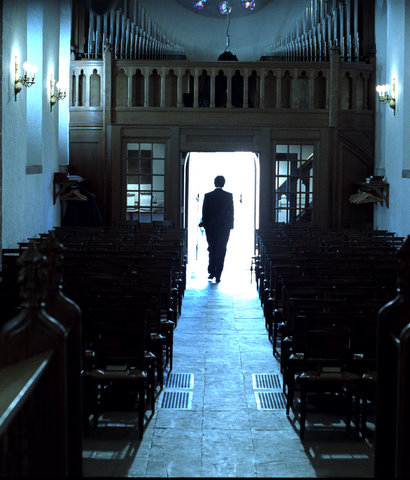
walking-into-churchFortunately, Messiah’s light can never go out, and his light isn’t dependent on me. In the parable of the ten virgins (Matthew 25:1-12), five let their lamps go out, so I guess it’s not impossible for my light to fail as well, at least while it’s in my charge.

But if I have failed, then what use am I? Of the billions of “second chances” God has already given me, does He have one more, or is it all over?

I don’t know. I guess all I can do is keep showing up until I find out one way or another.

FFOZ TV Review: Binding and Loosing

FFOZ Bind and LooseEpisode 17: Over the years numerous explanations have been given for what Jesus meant when he talked about binding and loosing, not the least of which is that it refers to restraining demons. In episode seventeen viewers will discover that the context of Jesus’ words is that of a legal nature. When the Jewish background to the terms “bind” and “loose” is examined, Christians can get a clearer understanding of what Messiah was teaching about. Binding and loosing in actuality refers to legal rulings in regards to the Scriptures and not spiritual warfare.

-from the Introduction to FFOZ TV: The Promise of What is to Come
Episode 17: Binding and Loosing

The Lesson: The Mystery of Binding and Loosing

I haven’t given much thought to the traditional Christian understanding of the concepts of “binding” and “loosing” since I only looked at them from a Hebrew Roots/Messianic Jewish driven perspective, however, First Fruits of Zion author and teacher Toby Janicki started with the Christian viewpoint of these ideas. He described a prayer meeting he attended when he was young where the following passage from scripture was read:

Truly, I say to you, whatever you bind on earth shall be bound in heaven, and whatever you loose on earth shall be loosed in heaven.

Matthew 18:18 (ESV)

Toby told his audience that immediately after this verse was read, the people began to pray, “We bind you Satan in the name of Jesus,” suggesting that Matthew 18:18 was a description of Jesus giving the disciples the power to “bind Satan.” I immediately thought of my recent commentary on John MacArthur as well as my conversation with my Pastor on the matter, and how both seem to take the point of view that people can’t really summon the power of the Holy Spirit to make any effective spiritual or physical changes in our world.

the mystery of binding and loosingToby brought up an interesting and useful point to this issue. If Jesus gave his disciples (i.e. “us”) the power to “bind Satan,” why would he give us the power to “loose” him as well? It doesn’t make sense.

Invoking “context is king,” Toby reads from the larger selection of scripture containing the key verse:

“If your brother sins against you, go and tell him his fault, between you and him alone. If he listens to you, you have gained your brother. But if he does not listen, take one or two others along with you, that every charge may be established by the evidence of two or three witnesses. If he refuses to listen to them, tell it to the church. And if he refuses to listen even to the church, let him be to you as a Gentile and a tax collector. Truly, I say to you, whatever you bind on earth shall be bound in heaven, and whatever you loose on earth shall be loosed in heaven. Again I say to you, if two of you agree on earth about anything they ask, it will be done for them by my Father in heaven. For where two or three are gathered in my name, there am I among them.”

Matthew 18:15-20 (ESV)

I’ve accused Christian Bible studies before about “cherry picking” specific verses in the Bible to create a particular picture or doctrine and Toby showed us how true this can be. He deconstructed this passage to show us what really seems to be happening here.

  1. “If a brother sins against you” indicates that an infraction has occurred within the congregational body, committed by an individual.
  2. The procedure of adjudicating the infraction is outlined in first the direct witness approaching the sinner, then with several witnesses, and finally the entire congregation.
  3. If the sinner continues to refuse to repent through each stage of adjudication, the congregational leaders have the authority to remove the sinner from their midst.

It’s no coincidence that it requires two or three witnesses to perform this function:

A single witness shall not stand up against any man for any iniquity or for any error, regarding any sin that he may commit; according to two witnesses or according to three witnesses shall the matter be confirmed.

Deuteronomy 19:15 (Stone Edition Tanakh)

The sequence of events described in Matthew 18:15-20 references a legal proceeding. If an infraction, error, or sin is committed, a set of legal steps is set in motion. First the individual who was offended may attempt to settle it privately, but if that isn’t effective, then two or three witnesses are brought in. Finally, if the matter cannot be settled, the entire congregation makes a decision to set the sinner out.

The two or three witnesses, according to Toby, are actually the authorities within the community who are acting as judges. Of three witnesses, at least two or all three must agree for any legal decision to be binding. This is how a Beit Din of Jewish Rabbinic court operates today. Jesus was giving his disciples the authority to make binding legal decisions for the Messianic community of “the Way.” This is also mirrored today in more than one Christian church system where the board of deacons, elders, or directors make authoritative decisions for the entire church.

Here we have the first clue:

Clue 1: Jesus’s words about “binding” and “loosing” occur in a legal context.

binding and loosing language lessonI was (again) struck by the fact that the church can (quite often) misunderstand the Bible in general and the New Testament writings in particular by ignoring the Jewish cultural, historical, and legal context of scripture. Even fundamentalist and literalist Christians will miss important and even critical details by failing to take the “Jewishness” of the Jewish scriptures (i.e. the Bible) into account.

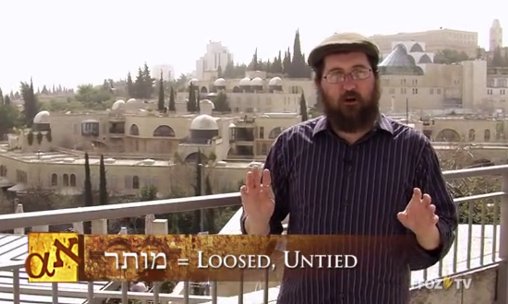
The scene shifts to FFOZ teacher and translator Aaron Eby in Israel in search of our second clue. He takes us through a small vocabulary lesson about the Hebrew words for “loose” and “loosed” as well as “bind” and “bound.” The Hebrew words for “loose” and “loosed” are understood as “prohibit” and “prohibited.” The Hebrew words for “loose” and “loosed” correspond to “permit” and “permitted” (Aaron’s actual description is more detailed and you’ll have to watch the episode to get all the information).

For instance, an Israeli “No smoking” sign in Hebrew can be literally translated as “Smoking is bound” or “prohibited.” Aaron also tells us that in religious Judaism, a particular Rabbi can prohibit or “bind” a particular activity as well as “loose” or permit an activity. A Jewish person unfamiliar with the rulings on a specific topic can consult a Rabbinic sage and receive a judgment on whether it is bound or loosed (prohibited or permitted) but it is bound (prohibited) to go from Rabbi to Rabbi in search of a favorable legal opinion.

While Toby used the English Standard Version of the Bible (purposely) from which to quote scriptures, Aaron backs up his point by referencing the Delitzsch Hebrew Gospels to read from Matthew 16:19 (a scripture we looked at just last week):

I will give you the keys of the kingdom of Heaven, and all that you forbid on earth will be forbidden in heaven, and all that you permit on earth will be permitted in heaven.

Back with Toby in the studio, he reads from the DHE Gospels, as Aaron did, but quotes Matthew 18:18 again:

Amen, I say to you, all that you forbid on the earth will be forbidden in heaven and all that you permit on earth will be permitted in heaven.

If a matter is legally decided by two or three judges or authorities within the congregation on earth, then it will be supported by the Heavenly authority as well (which makes me wonder how all that works today with so many different and contradictory Christian and Jewish groups, each issuing authoritative legal rulings for their congregations…which one(s) does/do Heaven support?).

We now have the second clue for this program:

Clue 2: “Bind” and “Loose” are figures of speech in the Hebrew.

I probably would have said that “Bind” and “Loose” are legal terms in ancient and modern religious Judaism, but you get the idea.

I was wondering why Toby needed a third clue since it seemed to me the point was well made, but he continued by quoting from the Mishnah an example of a legal ruling about fruit grown in Israel, which needs to be tithed, or grown outside Israel, which does not need to be tithed. I’ll skip the details because you will want to watch this episode without knowing everything it teaches ahead of time.

Toby also referenced Acts 15 where the Messianic community exercised their authority to bind or loose in relation to the question of whether or not Gentiles could be allowed into the community without converting to Judaism. Should Gentiles by bound or prohibited from formal entry until they legally converted, or should they be loosed or permitted to join without such a conversion?

An examination of the Acts 15 process (and remember, Luke only recorded a small summary of what was assuredly a much longer and involved proceeding) illustrates the matter of deliberations by those who possessed the authority given them by the Master, and the ultimate decision was to loose the Gentiles from conversion and full Torah obligation, although they were bound to what we refer to as the “four essentials” in order to enter (as an interesting exercise, you can try reading Acts 15 and see if you can determine the actual authorities involved [two or more judges] in making the legal ruling about the Gentiles).

Toby didn’t put it into these terms, but the Council of Apostles and Elders in Acts 15 established halachah or a legal ruling about the procedure of Gentile admittance into “the Way.”

Clue 3: Examples from Rabbinic literature and the New Testament support the two previous clues and their conclusion.

Toby further references Isaiah 11:3-4 to establish that Messiah will also “bind” and “loose” during his reign as King and Judge, as well as Isaiah 2:3-4 to make a similar illustration.

At the end of the episode, Toby made a point of trying to “smooth things over” for whoever in his traditional Christian audience might be disappointed that they didn’t really have the power to “bind Satan” based on Matthew 18:18. He reminded everyone that elsewhere in scripture, Jesus gave the disciples the power to cast out demons, and in Revelation 20:1-2, Satan will be literally bound. I again thought of MacArthur and my Pastor, both of whom probably never believed that Christians have had the power to bind or cast out demons after the close of Biblical canon.

What Did I Learn?

ancient_beit_dinI was again taken by the fact that without an understanding of the first century Jewish Rabbinic, legal, and religious context and comprehension of the words of Jesus, it is quite possible and likely that the Church misunderstands large portions of the Biblical text. This supports my ongoing discussion with my Pastor that we grossly misunderstand Paul in those sections of scripture where he seems to denigrate the Torah and call for its practice to be abolished or “put on hold” by Jewish and Gentile disciples (not that the Gentile disciples were ever “bound” to Torah in the manner the Jewish people were).

Without the Mishnah as well as a historical understanding of how Jesus’s immediate Jewish audience and the Jewish readers of Matthew’s gospel would have comprehended these words, we will fail to learn what Jesus (or any of his apostles or disciples) are trying to teach us today. We will anachronistically read the text and make it say what translates from the Greek to the English to support erroneous doctrine. We’ve seen over the majority of the Church’s supersessionistic history how making such errors has led to Christianity as a whole committing heinous atrocities, all in the “name of Christ.”

I also saw a minor but interesting point in Isaiah 2:3:

Many peoples will go and say, “Come, let us go up to the Mountain of Hashem, to the Temple of the God of Jacob, and He will teach us of His ways and we will walk in His paths. (emph. mine)

Since the word “halachah” refers to a way of walking, this also seems to link up to learning the legally binding methods of behaving in worship and devotion to the God of Jacob. In Messianic days, we, the “many peoples” from the nations, will go up to the “Mountain of Hashem,” the Holy Temple in Jerusalem, and learn the Torah of God from Messiah.

I’ve mentioned before that I believe the Acts 15 halachic decision binds Gentiles differently to the Torah than it does Jews, but it will be interesting to see how or if any of that changes once Messiah is ruling from the Throne of David in Jerusalem. I can’t wait to find out.


What Church Taught Me About Jews and the Torah

paul-editedThen after an interval of fourteen years I went up again to Jerusalem with Barnabas, taking Titus along also. It was because of a revelation that I went up; and I submitted to them the gospel which I preach among the Gentiles, but I did so in private to those who were of reputation, for fear that I might be running, or had run, in vain. But not even Titus, who was with me, though he was a Greek, was compelled to be circumcised.

Galatians 2:1-3 (NASB)

Paul came also to Derbe and to Lystra. And a disciple was there, named Timothy, the son of a Jewish woman who was a believer, but his father was a Greek, and he was well spoken of by the brethren who were in Lystra and Iconium. Paul wanted this man to go with him; and he took him and circumcised him because of the Jews who were in those parts, for they all knew that his father was a Greek.

Acts 16:1-3 (NASB)

I know I’ve written in this before, but during Pastor’s sermon in church this morning (as I write this), I had a small revelation. Pastor was preaching on Acts 16:1-5 and in the course of his preaching, I had plenty of material to take notes on and plenty of points where I know Pastor and I don’t see eye to eye.

But of course, he had to bring up the issue of Paul’s circumcision of Timothy, even though he believes that after the crucifixion of Christ, the Jewish believers were no longer obligated to observe the Torah mitzvot. Fortunately, he contrasted the circumcision of Timothy with the following:

It was for freedom that Christ set us free; therefore keep standing firm and do not be subject again to a yoke of slavery. Behold I, Paul, say to you that if you receive circumcision, Christ will be of no benefit to you. And I testify again to every man who receives circumcision, that he is under obligation to keep the whole Law. You have been severed from Christ, you who are seeking to be justified by law; you have fallen from grace. For we through the Spirit, by faith, are waiting for the hope of righteousness. For in Christ Jesus neither circumcision nor uncircumcision means anything, but faith working through love.

Galatians 5:1-6 (NASB)

We are pretty sure Paul wrote his letter to the Galatians before the Acts 15 decision of the Jerusalem Council and thus before the events involving Timothy in Acts 16. But comparing these two statements makes Paul seem like a hypocrite, doesn’t it? If circumcision and non-circumcision mean nothing, why did he circumcise Timothy? Because he gave into Jewish peer pressure and was worried about what Jewish people would say of Timothy when he was accompanying Paul? That doesn’t sound like the no-nonsense, no compromises Paul that I know.

Remember, the question in Acts 15:1-2 was whether or not the Gentiles had to be circumcised in order to enter into the Jewish religious community of “the Way” as co-participants and disciples of Jesus. The Council’s final legal decision (Acts 15:19-22) which was recorded in a letter (Acts 15:23-29) that was later transmitted to the various Gentiles in different communities in the diaspora (Acts 15:30-32, Acts 16:4-5). Gentiles were allowed to enter the Messianic congregation without being circumcised.

It’s been said in some Christian commentaries that Paul also encouraged Jews to give up on circumcising their children. He was even accused (falsely) of this by other Jews (Acts 21:21). In trial after trial, Paul defended himself and said he had done nothing against Jewish or Roman law (Acts 25:8, 28:17). In his sermon today, my Pastor even agreed that it was right for Jewish believers to be circumcised as a requirement of the Abrahamic covenant (Gen. 17:9-14). However, he says that the Abrahamic and Mosaic covenants aren’t directly connected and while the Abrahamic covenant was meant to be permanent, the Mosaic was always intended to be temporary.

Except he’s got a few problems.

The first is that in the Tanakh (Old Testament), no where do I read that it was God’s intension to “expire” the Torah upon the entrance of Messiah (or at Messiah’s death). In fact, I get the very clear intension that God took the Torah and Torah observance by Jews quite seriously, and meant for Jewish Torah observance to be continual.

Also, there’s what Paul said in Galatians 5:3:

And I testify again to every man who receives circumcision, that he is under obligation to keep the whole Law.

Paul inexorably links circumcision (he was talking about ritual conversion to Judaism, but I’ll also read into it the circumcision of people born Jewish) to obligation to observe all of the Torah mitzvot.

Paul by RembrantIn another blog post, I attempted to establish a continuing Jewish obligation to observe the mitzvot based on the past commands of God in the Torah and the future Messianic prophesies we read in the Tanakh. Dr. Stuart Dauermann, interestingly enough, posted something quite similar on Facebook (which I can’t find at the moment) making the same argument.

The “weakness” of my argument, if you will, was in not being able to locate support in the Apostolic scriptures, especially something written by Paul, that firmly establishes continued Torah observance for Jews during that time frame and extending into our present era…that is, until now. Ironically, I have my Pastor to thank for making the connection, not that he meant to.

In Galatians 5 and in other portions of that letter, Paul firmly links circumcision to Torah observance, warning the Gentiles (and presumably the Jews) in the churches in Galatia, that being ethnically Jewish or a Jewish convert does not justify you before God. Only faith and grace does that (salvation is not contingent upon being circumcised or not being circumcised). He also says that anyone who is circumcised (because they are a Jewish male or are a Gentile male undergoing conversion) is obligated to observe the entire Torah. So far so good.

Next, in Galatians 2, we see Paul deliberately using the Greek man Titus as an example of a Gentile believer who does not require circumcision (conversion to Judaism and obligatory Torah obedience) in order to be saved and be an equal co-participant in the community of “the Way.”

In Acts 15 and confirmed in Acts 21:25, we see a binding legal decision rendered by the authorities of the Apostolic Council in Jerusalem that the Gentiles do not have to be circumcised (convert) and obey the Law of Moses in order to be justified before God and to be co-equal community members.

And in Acts 16 Paul circumcises Timothy because he has a Jewish mother and, if we believe Paul in Galatians 5, then the act of circumcision (which is a covenant requirement for all Jewish males) must also confirm that Timothy is (and probably always was since he’s considered Jewish) obligated to keep all of the Torah.

We don’t know the reasons he wasn’t circumcised on the eighth day. Timothy’s mother married a Gentile. Perhaps his Greek father forbade it. Perhaps Timothy’s mother was an “assimilated” Jewish person, living in the Diaspora (was this a problem for many Jews living in the Diaspora in those days?), having fallen away from Jewish practices (which seems odd, even to me, because she was such a faithful believer and Jewish faith in Messiah at that point in history was a very Jewish way of life). We probably won’t know the answer to these questions this side of Messiah’s return, but we do know that Paul circumcised Timothy because his mother was Jewish and everyone knew Timothy’s mother was Jewish.

And this isn’t the only example of a Jewish man being circumcised “late in the game,” so to speak.

Now it came about at the lodging place on the way that the Lord met him and sought to put him to death. Then Zipporah took a flint and cut off her son’s foreskin and threw it at Moses’ feet, and she said, “You are indeed a bridegroom of blood to me.” So He let him alone. At that time she said, “You are a bridegroom of blood”—because of the circumcision.

Exodus 4:24-26 (NASB)

Moses too was living apart from his people. He married Zipporah, a Midianite woman, fathered a son by her, lived among Midianites, was a shepherd in Midian for forty years…

…and in all those years, he never circumcised his son. Even Zipporah knew better, at least in time to prevent a disaster.

So I’ll suggest that we can’t say Timothy not being circumcised on the eighth day was incredibly unusual, especially for Jewish people living away from the Jewish community (and according to some news articles, this is a problem among the Jewish people today).

I know, my Pastor isn’t likely to accept my arguments, but I think they’re good ones. I think they should be taken seriously. I think we can establish from the Biblical record, in Torah, in the Prophets, and in the Apostolic Scriptures, that the Torah was founded by God for the ancient Israelites and for all their descendants:

Now not with you alone am I making this covenant and this oath, but both with those who stand here with us today in the presence of the Lord our God and with those who are not with us here today…

Deuteronomy 29:14-15 (NASB)

Rolling the Torah ScrollVirtually all reliable commentators agree that the ones with whom the covenant was made, yet who were not there at Sinai, were all the future generations of Israel, the Jewish people, projected forward in time.

The Torah speaks of the expectation of Israel to observe the Torah of Moses from the point it was given at Sinai and into the future. The Prophets speak of the future Messianic Age, where Torah will be observed as it was in days of old, and Messiah, the Prince, will offer sacrifices at the Temple. And Paul says that anyone circumcised, which is definitely any convert to Judaism and any Jewish male under the covenant obligation to be circumcised, is also obligated to observe the entire Torah. James and the Council made a legally binding ruling that only the Gentiles in the Jewish movement of Messiah were exempt from circumcision and full Torah obligation.

It really doesn’t get more plain than that. We have witnesses in the ancient past at Sinai, in the day of Paul, and prophetic witnesses that speak to the future, all of them, every single one, telling us that those obligated to be circumcised because of Abraham, the Jewish people, must all perform the Torah mitzvot because of covenant requirements.

All of the physical descendants of Abraham, Isaac, and Jacob have a covenant obligation to be circumcised. The descendants of Jacob stood at Sinai and received the Mosaic covenant obligation. The later covenant adds to the earlier one. Paul understood that one leads to another. The Church must catch up with this understanding.

It’s all in the Bible. All you have to do is look.

Chayei Sarah: The Days of the Years of Life

abrahamic-covenantAnd these are the days of the years of the life of Avraham which he lived; a hundred years and seventy years and five years. And Avraham expired and he died in a good age, mature and satiated and was gathered to his people.

Genesis 25:7-8

Reb Avraham, the son of the Vilna Gaon, testifies about his father:

“For over fifty years he never slept more than half an hour at a time…Even when his health began to fail, he did not set aside his holy learning. Immediately, he would rise like a lion, in fear and dread of his Creator, wash his hands, and recite his morning blessings with a joy and awe which is beyond description. Afterwards, he would stand on his feet from before midnight until the first light of dawn learning Gemora and Poskim in a beautiful and awesome voice…Whoever heard it was moved with deep feelings of holiness.”

Arriving in Jerusalem, one summer, I immediately made contact with my good friend and study partner, Reb Reuven, and we agreed to get busy the next morning studying an hour or more before Davening. The next morning I made it on time but I was suffering from jet lag, sleeplessness, and exhaustion. I commented to my friend that I don’t know how the Vilna Gaon did it. I can’t imagine what it means to only sleep at half hour intervals four times per day for the course of a lifetime. He told me, “It’s not true!”

-Rabbi Label Lam
“Today!”
Commentary for Torah Portion Chayei Sarah
Torah.org

I periodically suffer from insomnia. Some nights are better than others. In extreme cases, I walk around like a zombie the next day, barely able to think. All the coffee in the world doesn’t turn me back into a human being. Yesterday (as I write this) was such a day. I finally collapsed into bed at 7:30 p.m. and fitfully drifted off. Only to wake up on several occasions during the night. Fortunately, on each occasion, I was able to go back to sleep. I chose not to go to the gym this morning in order to spend an extra hour in bed, finally getting up at a few minutes after five.

I feel much better today. I have my brain back.

Rabbi Lam’s commentary helps me realize though that it’s not just the number of hours you are awake or asleep, but how you use them. I was disappointed that, even in my dreams last night, I was focused on the mundane and ordinary rather than anything more lofty. The previous day, I could hardly concentrate on anything except what I absolutely had to get done, which tends to be mundane and ordinary.

Which was too bad, because I received some rather inspiring reading material that I wanted to dig into, but fatigue argued with my desire and fatigue won.

Vilna-Gaon-207x300I don’t know how the Vilna Gaon did it either. It seems like a physical impossibility. I’ve learned to take such tales of the great sages with a grain of salt, so to speak, which probably wouldn’t endear me to many in Orthodox Judaism. On the other hand, these tales often act as an inspiration for a more important principle that is to be grasped and applied to our day-to-day experiences.

Rabbi Lam comments:

How are living “the days of years of the life” different than living just the “years of the life”? What is the great advantage of living in units of days? It’s a nice aphorism, “One day a time!” but how does that translate into daily life? What does it mean to live each day as if it was the only day?

Which reminds me of this.

And He went a little beyond them, and fell on His face and prayed, saying, “My Father, if it is possible, let this cup pass from Me; yet not as I will, but as You will.” And He came to the disciples and found them sleeping, and said to Peter, “So, you men could not keep watch with Me for one hour? Keep watching and praying that you may not enter into temptation; the spirit is willing, but the flesh is weak.”

Matthew 26:39-41 (NASB)

This was perhaps the most important night in the Master’s short, human life, and his closest disciples and companions couldn’t keep their eyes open for even one small hour.

I know the feeling, although last night was hardly the most important night for anything in particular.

Or was it?

He told me, “It’s not true!” I insisted I had read an authenticated biography of the Gaon and that it was certainly true that he only slept two hours in total each day. He told me again that it was not true and so I argued my case again only to be countered with the “not true” claim. Eventually Reuven explained and I realized how right he was. He told me, “It’s not true that the Vilna Gaon only slept two hours each day! He learned Torah twenty-two hours each day!” I understood that he was not into sleep deprivation as we imagine but rather the sublime joy of learning Torah.

It’s not true that the Vilna Gaon slept only a total of two hours a night. It is true that he studied Torah twenty-two hours a day.

Well, maybe not. He had to eat sometime, and I don’t doubt that various biological, family, social, and other demands may have consumed some portion of those twenty-two hours.

intimate-prayerBut this is still an important lesson to be learned. It’s not the amount of time you have that’s so important but what you do with it. What are your priorities? For that matter, what are my priorities? It is true that the spirit is willing but the flesh is weak, but what about when you are well rested and the flesh is strong (or stronger)? Do you spend your time in Torah study or in watching TV? Do you spend your time in prayer or in surfing the web? Do you spend your time in service to others or by serving yourself?

I’m not saying that you shouldn’t enjoy life and indulge yourself as you are able to (within the will of God), but I am saying that how you spend your time, day by day, hour by hour, defines your priorities. If you pray to God to be of greater service to Him but spend most of your time being of service only to yourself, you betray what and who is really important to you.

“Beware of the false prophets, who come to you in sheep’s clothing, but inwardly are ravenous wolves. You will know them by their fruits. Grapes are not gathered from thorn bushes nor figs from thistles, are they? So every good tree bears good fruit, but the bad tree bears bad fruit. A good tree cannot produce bad fruit, nor can a bad tree produce good fruit. Every tree that does not bear good fruit is cut down and thrown into the fire. So then, you will know them by their fruits.

Matthew 7:15-20 (NASB)

It’s nice to have space and a little slack time to relax and appreciate life instead of being on the go, go, go, but space is there so you (and I) can grow into it. It’s like when I was a kid and my parents bought me shoes half to a full size bigger than my feet because they knew I’d rapidly grow into that space.

That is why we have the mitzvot, prayer, Bible study, volunteering for charitable services, visiting those who are sick. It’s what we do to fill the space and time God gives us in our lives.

Rabbi Lam asks, How are living “the days of years of the life” different than living just the “years of the life”? Each day of our life is a lifetime within itself.

Today I shall learn to better spend my time in the service of God, with Bible study, in prayer, in meditation on His Word, in seeking an encounter with the Divine.

Good Shabbos.

Without Faith and Grace

leaving_edenJudaism and Christianity parted company over how to read these few spare chapters in universal history. For the Church, the Garden of Eden became the soil for the doctrine of original sin. In their waywardness, Adam and Eve, and all their descendants, fell hostage to the domain of the devil. The narrative bespoke the immutably depraved condition of human nature. To know the Torah was not sufficient to do it. In the words of Paul, “In my inmost self I delight in the law of God, but I perceive that there is in my bodily members a different law, fighting against the law that my reason approves and making me a prisoner under the law that is in my members, the law of sin.” (Romans 7:22-23) Not human willpower then but divine grace alone in the person of God’s own Son who had died on the cross could hope to break this vicious cycle of human malice.

-Ismar Schorsch
“Teshuvah in Place of Original Sin,” pp 34-35 (October 16, 1999)
Commentary on Torah Portion Noah
from the book Canon Without Closure: Torah Commentaries

I know we’ve already read Torah portion Noah this year, but as I’ve been working through the commentaries in Schorsch’s book each week, I’ve been taking notes of the more compelling articles. For each Torah Portion, there is a small but powerful collection of Schorsch’s writings which he composed over a number of different years. Going over this collection is like opening his mind and listening to Schorsch musing on how he encountered each Parashat across each annual reading cycle over time.

I’m also grateful that this book includes his thoughts on Christianity and comparisons to Judaism, not because I’m trying to “shoot down” Christianity (or necessarily Judaism), but it’s helpful to have an intelligent mind discuss my faith from the “outside.” Like my conversations with my Pastor, it hones my ability to look at my own beliefs, especially when they’re challenged, and discover if I truly know and can explain why I have the faith I possess in Jesus as Messiah.

It’s a steep learning curve sometimes and I can hardly claim to have all of my ducks in a row, so to speak. However, I can say that the ducks are lining up in a somewhat more orderly fashion than they have in past years.

Original sin vs. the Jewish understanding of “the Fall” makes for interesting reading. Judaism in all its different modern streams, is not going to consider the need for a spiritual savior (though Moshiach is considered the redeemer of national Israel in Jewish thought, generally speaking). The Torah is accepted as sufficient, and always has been, to negotiate the Jewish relationship with a perfect God.

That’s hard for me to believe since no man can obey the commandments perfectly, and the Tanakh is a blatant record of that fact. The New Covenant promised in Jeremiah 31 starting in verse 27 promises that the covenant once written on stone tablets and scrolls made of animal skin will, in future times, be written on the heart, thus the “disconnect” between the desire for Holiness in man and the imperfection of living out that Holiness will cease to exist. Man and God will have a far more intimate relationship in those days than we enjoy in the present, or at any point in the past.

Gateway to EdenBut for Christianity, Jesus is the arbiter of that covenant, the gatekeeper, the doorway, and only by a profession of faith in him and the resultant transformed life, can man access the New Covenant of God. After that perfect writing of the Torah on a circumcised and human heart of flesh, can man perform the mitzvot with complete fidelity and with true justice and righteousness. Prior to that event, Christian or Jew, no man obeys God in the manner God desires, or for that manner, even in the manner we ourselves would wish.

In my own approach to a closer walk with God, I find myself slowly moving in a direction, but then, the tether that binds me to the habits of the past snaps me back like a rubber band that has been stretched just a little too far…and it stings.

It is not until we come to the late and marginal Book of Jonah that we first confront in full view the idea of teshuvah, repentance, as efficacious. Nor is it an accident that we read all of it in the synagogue on Yom Kippur afternoon, for Jonah encapsulates the essence of the day: that atonement, resolve, and initiative can get us beyond the impediments of our past and ourselves.

-Schorsch, pg 35

For all of the prophets of Israel we see in the Tanakh (Old Testament) who implored that nation of God to abandon her sin (which she regularly failed to do), only the Gentile city of Nineveh heeded a reluctant prophet and turned away God’s “evil decree.” It wasn’t permanent, of course, and later down history’s road, Nineveh sinned and fell, but consider how many times (if you can) that Israel too listened to the words of the prophets and averted disaster.

“Jerusalem, Jerusalem, who kills the prophets and stones those who are sent to her! How often I wanted to gather your children together, the way a hen gathers her chicks under her wings, and you were unwilling. Behold, your house is being left to you desolate! For I say to you, from now on you will not see Me until you say, ‘Blessed is He who comes in the name of the Lord!’”

Matthew 23:37-39 (NASB)

The Master’s commentary on the matter is plain and dismaying. And yet, I heard one person tell me that if Israel had turned away from their sins and returned to Torah and God in the days that Jesus walked the earth, the Messianic Age would have come and flourished even in that very instant.

The world is waiting for Israel’s national repentance, without it, Messiah will not come and both Israel and the nations continue to suffer from our own folly.

Schorsch would say that the story of Jonah and Nineveh tells us that human beings can, in and of ourselves, hear the warnings of God, repent in sincerity, and the result is that God’s promise of destruction will be averted. But without Messiah, how were Nineveh’s sins forgiven? They certainly weren’t Israelites. History doesn’t record that they sent representatives to Jerusalem to offer the appropriate sacrifices for guilt and sin (and we know that the sacrifices of Gentiles were accepted in the Temple, even in the days of Jesus).

Jonah's KikayonOnly God’s grace can explain why Nineveh survived when they repented. God is an “either-or” engine or sorts. “Either you repent and I will spare you, or you keep sinning and I will destroy you.”

This may also explain why, when they were faithful, when they did obey God, when they did perform the mitzvot, however imperfectly, and offered the required sacrifices, that is required by God, in the Temple in atonement for that imperfection, God chose to respond to sacrifices and the blood of goats and bulls, by sparing Israel, forgiving the apple of His eye, cherishing His often wayward bride.

On the basis of this small book, the Rabbis softened their understanding of the divine-human relationship with a large dose of compassion. God stood ready to forgive and humans had the capacity to grow. Thus Rabbi Eliezer ben Hyrcanus in the early second century proclaimed:

“Repent one day before your death.” When his students asked him how one might know that day, he replied: “Then repent today for you might die tomorrow.” (Avot DeRabbi Natan, ed. Schechter, page 62)

In other words, each and every day, and not just Yom Kippur, was suitable for repairing one’s ties to God.

-Schorsch, pp 35-36

Such is true of the Christian as well, and more so, since we do not have a traditional day in our religious calendar set aside specifically for repentance and “repairing one’s ties to God.” If anything, we are rather casual about the whole affair, for we are taught that once we were saved at some altar call or camp meeting, our place in Heaven is assured. We can never again fall from God’s hand.

My sheep hear My voice, and I know them, and they follow Me; and I give eternal life to them, and they will never perish; and no one will snatch them out of My hand. My Father, who has given them to Me, is greater than all; and no one is able to snatch them out of the Father’s hand. I and the Father are one.”

John 10:27-30 (NASB)

That’s quite a promise, but I still say we should not rest on our laurels so comfortably, for the Master also said this:

“Then they will deliver you to tribulation, and will kill you, and you will be hated by all nations because of My name. At that time many will fall away and will betray one another and hate one another. Many false prophets will arise and will mislead many. Because lawlessness is increased, most people’s love will grow cold. But the one who endures to the end, he will be saved.

Matthew 24:9-13 (NASB)

FallingTo “fall away” means we must have some place to fall from, in this case, from our faith in God (and I didn’t fail to notice that those “falling away” did so during the great tribulation). This does not seem to be the illusion of faith or describing those people who are not among the elect (for the Calvinists among you), but those who were in the Father’s hand at one point, who will fall away because lawlessness increased, their love grew cold, and they listened to false prophets.

We must always be alert and cautious. Like Nineveh, when we see the warning signs and hear the voice of God calling to us to beware lest we perish, we should respond immediately and “don sackcloth and ashes,” so to speak, declare a time of fasting and mourning, even if it is only with our own individual soul, and turn back to God, rather than risk falling from His hand down to the depths of despair.

In short, the rabbinic concept of teshuvah rested on deeds rather than on faith, on the discipline of Torah rather than on divine grace. Its implicit optimism about the correctability of human nature tempered the near fatalism that darkened the original meaning of Genesis.

-Schorsch, pg 36

I couldn’t disagree more.

First of all, Nineveh was redeemed for a specific time, but we have no indication whatsoever that it never returned to sin (and knowing the nature of human beings, I believe it must have returned to that dark place) and was forever redeemed as a city before God. Repentance, teshuvah, is not a single act that once accomplished, is accomplished forever. We have Christ’s warning that we can fall away. True, no one can snatch us out of the Father’s hands, but that doesn’t mean we can’t “bail out” on our own accord. We cannot be dragged unwillingly from the presence of God, but we can wantonly walk out of our own free will, thumbing our nose at the Divine in a suicidal gesture right before our final exit.

Schorsch says that human beings have pull themselves up by their own bootstraps and effectively refrain from sin, but again, the Tanakh is the witness against him (and against us all). Also, if the Covenant of Moses was sufficient forever in an unratified form, why does God promise a New Covenant, with the Torah not written externally, but inscribed internally across the fabric of our hearts (and please keep in mind that the content of the previous covenant remains unchanged, only the “material” upon which it is written does)?

I don’t know if I completely buy the classic Christian interpretation of the events in Eden, but I do believe that no amount of human effort, all by itself, will ever pay the debt we owe to God for our willful rebellion. From Adam in the beginning and down across each generation, we have failed God, and laughed at God, and denied God again and again. Even the best among us falls short, as Paul said (referencing Psalms 14 and 53), there is no one righteous, not even one of us…ever (Romans 3:10-12), apart from the Master himself.

dust-and-ashesWith much respect to Schorsch and his commentaries, which I enjoy very much, we cannot possibly walk the walk without both faith of the heart, and the grace of a most merciful God. Without both faith and grace, our repentance would be a faint and temporary glimmer in the dark, and we would all meet the ultimate fate of historical Nineveh well passed Jonah’s intervention, and the fate of all the “great cities” that have risen and crumbled to dust across the vast corridors of time.

Divine grace is certainly necessary, and no human being can even come close to “meeting God halfway,” so to speak. But we are still required to change directions, to face away from our sin and to turn toward God. Once that’s accomplished, often with God’s insistent “prodding,” then and only then do we have life, and the will to live it in obedience.

Vayeira: Those Whom God Has Blessed

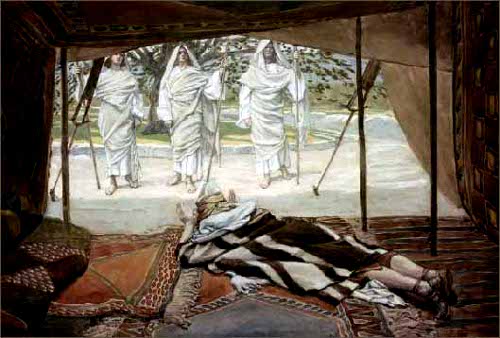
abrahams visitorsThe Lord appeared to him by the terebinths of Mamre; he was sitting at the entrance of the tent as the day grew hot.

Genesis 18:1 (JPS Tanakh)

The Lord took note of Sarah as He had promised, and the Lord did for Sarah as He had spoken. Sarah conceived and bore a son to Abraham in his old age, at the set time of which God had spoken. Abraham gave his newborn son, whom Sarah had borne him, the name of Isaac. And when his son Isaac was eight days old, Abraham circumcised him, as God had commanded him.

Genesis 21:1-4 (JPS Tanakh)

In this week’s Torah portion, Avraham is recovering from Bris Mila. Later, Isaac is born and has a Bris Mila. So, I thought to share a few insights on … Bris Mila!

-Rabbi Kalman Packouz
“Shabbat Shalom Weekly”
Commentary on Torah Portion Vayeira
Aish.com

The vast majority of people in the Church don’t imagine that baby boys born into Christian families must receive a ritual circumcision, called a Bris or Brit Milah, on the eighth day of life. It’s one of those things that we think of as uniquely “Jewish.”

But if we who are in the body of Christ are called the spiritual Sons of Abraham (Romans 9:8), and if we are “one body and one Spirit, just as you were called to one hope when you were called; one Lord, one faith, one baptism; one God and Father of all,” (Ephesians 4:4-6), then why are we too not obligated to be circumcised?

Then after an interval of fourteen years I went up again to Jerusalem with Barnabas, taking Titus along also. It was because of a revelation that I went up; and I submitted to them the gospel which I preach among the Gentiles, but I did so in private to those who were of reputation, for fear that I might be running, or had run, in vain. But not even Titus, who was with me, though he was a Greek, was compelled to be circumcised. But it was because of the false brethren secretly brought in, who had sneaked in to spy out our liberty which we have in Christ Jesus, in order to bring us into bondage.

Galatians 2:1-4 (NASB)

Paul came also to Derbe and to Lystra. And a disciple was there, named Timothy, the son of a Jewish woman who was a believer, but his father was a Greek, and he was well spoken of by the brethren who were in Lystra and Iconium. Paul wanted this man to go with him; and he took him and circumcised him because of the Jews who were in those parts, for they all knew that his father was a Greek.

Acts 16:1-3 (NASB)

A great deal has been made about why Paul did not have Titus circumcised but he did so for Timothy. The only obvious difference between them in scripture is that Timothy’s mother was Jewish but both parents of Titus were Greek (presumably, since Luke refers to Titus as “a Greek” in Acts 16).

Brit_MilahToday, it is common in the various streams of Judaism to consider anyone Jewish who was born of a Jewish mother, regardless of whether or not the father was Jewish. In the days of Paul, this may not have necessarily been the case, but if Timothy wasn’t Jewish, we are at a loss as to why Paul made such a distinction between he and Titus.

But getting back to what I was saying before, should any distinction be made between Jews and Gentiles in the body of Christ. Aren’t we all one in Messiah with ethnic differences swept away by the hand of God as a scorching sirocco sweeps over the desert sands?

But wait a second.

The Almighty commanded Abraham, “… My covenant you shall keep — you and your descendants after you for all generations. This is my covenant which you shall keep between Me and you and your descendants after you — circumcise all males. And you shall circumcise the flesh of the foreskin and it shall be the sign of the covenant between Me and you. And at eight days old every male shall be circumcised throughout all of your generations … My covenant shall be in your flesh for an everlasting covenant” (Genesis 17:9-13).

-Rabbi Packouz

This is the “ethnic” part of God’s covenant with Abraham and his physical descendants through Isaac, Jacob, the Children of Israel, and beyond. I previously said that in this portion of the covenant ratified by God with Abraham…

God promises to make Abraham a father of many nations and of many descendants and the land of Canaan as well as other parts of Middle East will go to his descendants. God declares that circumcision is to be the sign of the covenant for Abraham and all his male descendants and that this will be an eternal covenant.

But the blessings of the earlier portion of the Abrahamic covenant God makes with Abram are significant because that portion can be applied outside the ethnic, genetic, biological stream of Abraham and his offspring.

And I will bless those who bless you, and the one who curses you I will curse. And in you all the families of the earth will be blessed.”

Genesis 12:3 (NASB)

We have to access Paul’s midrash on Abraham to make better sense of this.

Now the promises were spoken to Abraham and to his seed. He does not say, “And to seeds,” as referring to many, but rather to one, “And to your seed,” that is, Christ. What I am saying is this: the Law, which came four hundred and thirty years later, does not invalidate a covenant previously ratified by God, so as to nullify the promise.

Galatians 3:16-17 (NASB)

infant-jesus-templeThe “seed” is Messiah, Christ. He is the blessing, and this promise and blessing was established before the covenant was ratified and God required circumcision of Abraham and his offspring through Isaac, and through Jacob, and through all of Jacob’s offspring, and so on across the ethnic linkage that ultimately becomes the Jewish people.

In his letter to the churches in Galatia, Paul is strongly discouraging the Gentile disciples from being circumcised because, by that point in history, circumcision was the “shorthand” expression for ritual conversion to Judaism. If the Gentiles, through the blessings of Abraham’s seed (singular) and faith in Messiah, were already justified before God, and received the one Spirit, just as the Jews received that same Spirit, then for the purposes of justification, nothing else is required of the Gentile disciples.

Therefore I, the prisoner of the Lord, implore you to walk in a manner worthy of the calling with which you have been called, with all humility and gentleness, with patience, showing tolerance for one another in love, being diligent to preserve the unity of the Spirit in the bond of peace. There is one body and one Spirit, just as also you were called in one hope of your calling; one Lord, one faith, one baptism, one God and Father of all who is over all and through all and in all.

Ephesians 4:1-6 (NASB)

One body, one Spirit, one justification, one salvation, a unity of Spirit still doesn’t have to mean a uniformity of identity.

There’s a saying that goes, “everyone’s unique but no one is special,” but I don’t know if I can buy into that. I’m all for equal access to job opportunities and equal pay for equal work, but God did some really unique things. He chose the ethnic Jewish people, that is, those who were physically descended from Abraham, and Isaac, and Jacob, and Jacob’s sons, and the children of Jacob’s sons, who were all of the people led by Moses to Mount Horeb in the Sinai to receive the covenant and ultimately all of the promises, including the Land of Israel.

We can discuss the “mixed multitude” who eventually assimilated into the tribes after several generations and disappeared from the face of history, a process that cannot be anachronistically applied to modern times or even the time of James, Peter, and Paul. We can discuss ritual conversion to Judaism which existed in the time of James, Peter, and Paul and which exists today. I agree that you can’t “convert” to a tribal affiliation (which is why the ancient “gerim” in Torah were not converts). Judaism has long allowed for a few, select outsiders to join them, not because of ancestry, but by choice. But then, one choses to go “all the way,” so to speak, not retaining Gentile identity while living as a Jew. If we accept that God granted the Jewish community the authority to establish legally binding customs since antiquity, then we can accept Jewish converts.

But according to Paul and ultimately the Jerusalem Council (Acts 15), circumcision (conversion) is not required of the Gentile disciples of Messiah. We are one in Spirit and “co-inhabit” the body of Messiah. The body of Messiah is like the human body, which has different organs and structures, all of which are required for a healthy living person, and just like the body of Messiah, actually requires different parts.

abraham1All of this was set into motion thousands of years ago with Abraham and it is a blessing that the whole world isn’t required to convert to Judaism in order to be reconciled to God. No stream of Judaism I’m aware of requires conversion and circumcision in order to be right with God. The Bible and God have always presupposed a world made up of Jews and Gentiles who are reconciled before our Creator. Messianic Judaism is the living example of a Judaism that recognizes the spiritual equality of Jews and Gentiles in Messiah without compelling circumcision and full Torah observance upon the Gentiles in the body (not that we can’t take on board more of the mitzvot voluntarily).

I know this won’t satisfy the Hebrew Roots Gentiles who believe in uniformity in the Messianic body, nor the traditional Christians who also require uniformity. But those alternatives either rob the uniqueness God gave to the Jewish people through circumcision, the Torah, and Israel by having Gentiles say “it belongs to us too,” or strips that uniqueness away, defying God’s will by Christians telling Jewish people they must cease their ethnic and religious uniqueness and performance of the mitzvot if they wish to worship Moshiach, requiring that Jewish believers live like the Gentiles in the Church.

Why has this mitzvah survived in strength while so many other mitzvot have fallen to the wayside by otherwise minimally observant Jews? Perhaps the answer is found in the 2,000 year old words of Rabbi Shimon ben Gamliel, “Every mitzvah that they (the Jewish people) accepted upon themselves with joy … they still perform with joy.” (Talmud, Shabbos 130a). Deep in our collective psyche we know that the Jewish people is eternal, that we have a mission to be a “Light Unto the Nations” and to perfect the world, that the Almighty loves us and watches over us — and that it is our great joy and privilege to be a part of that Covenant!

-Rabbi Packouz

However you choose to view this in terms of being Gentile members of the body of Christ, the creation of “the Church” didn’t eliminate the promises God made to Israel. Paul said (Galatians 3:17) that “the law, introduced 430 years later, does not set aside the covenant previously established by God and thus do away with the promise.” So too the work of Messiah did not annul the covenants previously established by God, but rather, Messiah was and is the crystallization of prophesy, the perfect expression of all of the covenants, the doorway allowing both people who are uniquely Jewish and those of us who are uniquely Gentile, to enter into relationship with God, co-inhabitants in a body that does require the heart, liver, lungs, spleen, stomach and many other organs, as opposed to being a single body, with a single organ, and a single identity, and a single function. A human being with only a stomach and no other parts couldn’t possibly live, so demanding absolute uniformity and canceling diversity within the body of Messiah kills the body.

Rabbi Packouz says the Jewish people are eternal. Circumcision is one of the signs of that eternal and unique existence before God. Opposing this is opposing God’s will. We can only be one in Messiah and possess the One Spirit of God by living in accordance with that One Spirit and that One God.

Therefore Jesus answered and was saying to them, “Truly, truly, I say to you, the Son can do nothing of Himself, unless it is something He sees the Father doing; for whatever the Father does, these things the Son also does in like manner.

John 5:19 (NASB)

I’ve often heard that we should imitate our Master, but I don’t think in this case it means so much what we eat or what we wear, but rather, how we treat those who God has uniquely blessed. If we bless the Jewish people, we too are blessed by Israel and by Messiah. Of course, there is the converse.

Good Shabbos.