Category Archives: Uncategorized

FFOZ TV Review: Jewish Prophecies

ffoz_tv4aEpisode 04: The land of Israel is a hot topic of debate not just amongst secular news but even in churches. It is key that Christians realize Israel is not just important because of what happened there in the past but also because of what is to take place in the future. In episode four viewers will learn that not only did the ancient Jewish prophets predict the coming of Messiah but they also predicted his second coming and the ingathering of the Jewish people back to their land. Israel thus becomes the stage on which the final redemption will happen.

-From the Intro to the episode Jewish Prophecies
FFOZ TV: The Promise of What is to Come

The Lesson: What Does Jewish Prophecy Say About Israel and the Jewish People?

The beginning of this episode, Jewish Prophecies seems to depart from the theme of the first three programs, which defined the basic concept of the gospels, the meaning of the word “Christ,” and the meaning of the name “Jesus” from a Messianic Jewish viewpoint. However, the focus, which is the specific Jewish prophecies that relate to the work of the Messiah and the gospel message, tie in very well, especially with the episode addressing The Good News.

This show is also different in that teacher Toby Janicki begins the program by discussing the modern nation of Israel within a political, social, and news media context (my review is timely given the current Israeli/Palestinian “peace talks”). However, he explains, we cannot really understand why the modern world is so focused on the tiny nation of Israel unless we look at it from a Spiritual and Biblical perspective.

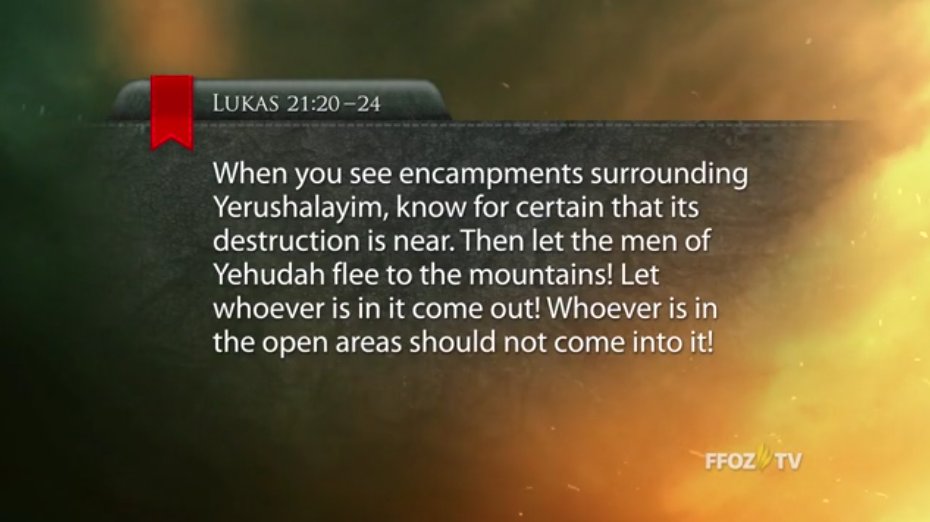
When you see encampments surrounding Yerushalayim, know for certain that its destruction is near. Then let the men of Yehudah flee to the mountains! Let whoever is in it come out! Whoever is in the open areas should not come into it! For they are days of vengeance to fulfill all of what is written. How terrible for those who are pregnant and for nursing mothers in those days! For there will be great distress in the land and wrath upon this people. They will fall by the sword and be exiled to all the nations. Yerushalayim will be a treading place for the Gentiles until the times of the Gentiles are fulfilled.

–Luke 21:20-24 (DHE Gospels)

This is Messiah speaking of the destruction of Jerusalem by the Romans, which would occur several decades after his earthly ministry had ended. And yet, it’s the very last sentence that tells us of today’s topic. When will the times of the Gentiles be fulfilled and what will happen next?

Jesus is a Jewish prophet talking to Jewish people. He is also, as Toby states in this episode, presenting The Mystery of the Jewish People and their Return to the Land of Israel. This mystery is directly associated with the Messiah and the gospel message and is illustrated for us in the ancient Jewish prophecies as well as in the prophecies of Messiah.

And then they will see the Son of Man coming in a cloud with power and great glory.

–Luke 21:27 (ESV)
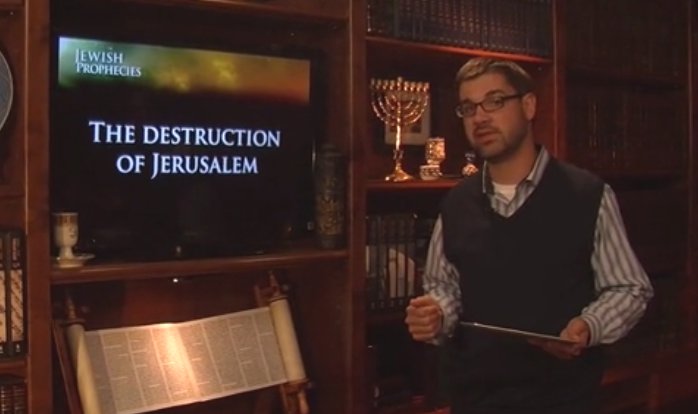
ffoz_tv4bAnd what will Messiah do upon his return. According to Jewish prophesy, as described later in the episode, he will redeem Israel by gathering the Jewish people back to their Land. This leads to the first clue.

Clue 1: The Good News is the restoration of the Jewish people back to the Land of Israel.

The gospel message is to the Jews first and foremost. Prophecies in Isaiah 11:11-12 and Isaiah 61:1-4 teach us that the Root of Jesse, that is Messiah, will gather the Jewish people and return them to their Land, back to Israel. He will also show favor to Zion by rebuilding and restoring Jerusalem and the rest of Israel.

The gospel isn’t about the church, it’s about Jewish national restoration to Israel.

But what’s interesting is that this work has been going on for quite sometime. Depending on your point of view, it began with the modern Zionist movement in the 19th century. You could also consider it starting, or at least really getting off the ground, in 1948 with the establishment of the modern state of Israel.

The Jews have been returning to their Land in droves. But that begs the question, What is a Jew?

For the answer, the scene shifts to Israel and to teacher and translator Aaron Eby.

Simply said, the word “Jew” is derived from the word “Judah,” which is one of the twelve tribes of Israel. Judah was also one of the sons of Jacob. But what about all of the other Israelites? How come we call all Israelite descendents “Jews” today?

According to Aaron, in the time of King Solomon, the twelve tribes were united in a single nation, the Kingdom of Israel. After that time, ten of the twelve tribes separated from Judah and Benjamin. They were the Kingdom of Israel while Judah and Benjamin had control of the Kingdom of Judah, which included Jerusalem.

ffoz_tv4cThe Assyrians conquered the Kingdom of Israel and the majority of its inhabitants went into exile. Those who were left of the inhabitants of Israel moved to the Kingdom of Judah, and along with whatever members of the ten tribes were able to eventually return to the Land, they all were subsequently assimilated and absorbed into Judah. In a literal, physical sense, Judah…the Jews, are the descendents of all twelve tribes in our modern-day world (This process is described in more detail in Boaz Michael’s book, Twelve Gates: Where Do the Nations Enter?).

This takes us back to Toby and the second clue:

Clue 2: The Jewish People are the descendents of Abraham, Isaac, and Jacob.

This would seem to be an “oh duh,” but it’s actually an important point. Both traditional Christianity and some branches of the Hebrew Roots movement have been attempting to lay claim to the Land of Israel as well (in fact, just about the entire Arab word is laying claim to Israel as “Palestine,” so you can see this is a popular activity). It’s vital for the church to understand who the Jewish people are and that Biblical prophecy clearly states that Messiah’s mission is to restore the Jewish people to their Land, the Land of Israel, and he is to restore and rebuild it.

The Jews and their nation Israel don’t go away…ever.

Thus says the Lord, Who gives the sun for light by day And the fixed order of the moon and the stars for light by night, Who stirs up the sea so that its waves roar; The Lord of hosts is His name: “If this fixed order departs From before Me,” declares the Lord, “Then the offspring of Israel also will cease From being a nation before Me forever.”

–Jeremiah 31:35-36 (NASB)

The offspring of Israel, that is, the Jewish people, will always be a nation before God forever as a nation, as Israel. Linking the verse from Jeremiah with Matthew 5:17-19, we plainly see that the Jewish people, national Israel, and the Torah will all continue to exist as long as the Earth and the “fixed order” of the Sun, the Moon, and the stars continue to exist. They are all tied together beyond any untying as declared by Messiah, by Jesus.

Really, the message doesn’t get any plainer than that. There are only two major themes in Jewish prophecy: Exile and Redemption. The story of the good news of Messiah is all about the redemption of the Jewish people to the Land of Israel and the restoration of Jerusalem.

But where does that leave the Gentiles? What about us?

Then in that day The nations will resort to the root of Jesse, Who will stand as a signal for the peoples; And His resting place will be glorious. Then it will happen on that day that the Lord Will again recover the second time with His hand The remnant of His people, who will remain, From Assyria, Egypt, Pathros, Cush, Elam, Shinar, Hamath, And from the islands of the sea. And He will lift up a standard for the nations And assemble the banished ones of Israel, And will gather the dispersed of Judah From the four corners of the earth.

–Isaiah 11:10-12 (NASB)

ffoz_tv4dYou can see that as part of the plan for restoring the Jewish people to Israel, there will be another effect. When the Gentiles see what Messiah is doing, we will “resort to the root of Jesse,” that is, we will be drawn to him. Messiah will “lift up a standard for the nations” and he will redeem us, too.

This is the final clue:

Clue 3: The Ingathering of Israel will have an international effect.

According to Zechariah 9:9-10, Messiah will not just rule over and bring peace to national Israel, but to all the nations of the world. Messiah’s Kingdom will be over all the earth.

What Did I Learn?

It’s actually taken me over a year to really grasp the meaning of redemption and restoration as a Jewish story focused on national Israel. When I first heard of it at the 2012 First Fruits of Zion Shavuot conference, I couldn’t make the Biblical connections. Now it seems so obvious.

I learned today that we might consider the Messiah already working “behind the scenes” somewhat, since the nation of Israel has been re-established and the Jewish people are being gathered back in. I don’t mean to say that Messiah has returned, that is yet to come. But the Messianic mission is definitely moving forward through the Spirit of God.

Toby and Aaron made other important points in this television episode (I left a clue in the last screen capture I posted above), so I hope that you’ll take the time to view this thirty minute program and be illuminated.

I’ll review the next episode very soon.

Where Does Faith Go When It Is Lost?

strange-landWhat happens when one day a rabbi discovers that he has lost his faith? Dr. Paul Shrell-Fox, a clinical psychologist and researcher asked himself that question – which turned into to a fascinating study.

Seven rabbis agreed to “talk about it” – three Conservative community rabbis in the United States, and four strictly Orthodox rabbis who live in Israel and have a double identity: Secretly atheists, and rabbis and believers openly.

-Tali Farkash
“Atheists in closet: Rabbis who lost God”
Published 07.28.13, 11:13, ynetnews.com

Over a year ago, I published a blog post on a very similar topic called When We’re Left Behind. It was based on an article written by Barbara Bradley Hagerty for NPR.org called “From Minister to Atheist: A Story of Losing Faith”.

How crushing would it be to love your Pastor or Rabbi, having attended his (or her) congregation for years and growing close to him (or her) as a model of faith, and then to discover that this “Holy person” has no faith in God at all and in fact is an atheist? What would that do you your faith (or mine)?

I don’t want to recycle something I’ve written before, but this brings up some new questions about the nature of religion (as opposed to faith) and how we live it out in our lives. While I certainly can’t deny the social role of church for Christians, we lack (in most cases) the connection to our religious community based on ethnicity, culture, and sometimes race. It is true there are churches that have such a basis, such as African-American churches and Korean churches, but for the most part, the Church as a social entity is just a group of people who (in theory) share the same theology and doctrine about God but who otherwise come from a wide spectrum of social, economic, educational, and employment backgrounds (this probably isn’t true in an absolute sense, but I’ll use it as a general principle for the sake of this essay).

Jewish synagogue life is a different thing because what is being shared is a lot of cultural, ethnic, traditional, religious, and even national and DNA components. It goes back to the difference between “What is a Jew?” and “What is a Christian?” You can’t just say people who have different religions. Being Jewish is enormously more complicated and in some ways, elusive in definition.

So I can see a Rabbi who becomes an atheist having a tougher time in leaving his/her community than a Pastor in the same situation (not that it wouldn’t be really hard on the Pastor as well). From a Rabbi’s point of view, if you are leading a shul in a small community, leaving the synagogue would be leaving behind your entire social, friendship, and possibly family circles. Your entire life, or most of it, probably flows through synagogue life. I suppose something similar could be said of a Pastor as well, but perhaps not quite to the same depth.

How about extending the topic beyond Rabbis and Pastors? My wife says that at our local Reform/Conservative synagogue, the Friday night service is aimed at more secular Jews who connect socially and through traditions, while the Saturday Shabbat service is more for “religious Jews.” The missus even says that some of the synagogue members wish that the current Rabbi would retire/move on (he’s still in his 40s, so is nowhere near retirement age) because he’s “too religious.”

At the opposite religious extreme are the Ultra-Orthodox or the Haredim, who seem to take the slightest infraction of the mitzvot, even among those Jewish people who are not Haredi, so, so seriously, to the point of being abusive and assaultive. It seems like something has gone horribly wrong in certain corners religious Judaism where, on the one extreme, God is all but ignored, and on the other, God is exceptionally tightfisted and punitive, and adherents experience no problem in actually attacking other human beings.

I don’t know if you get that exactly in Christianity, although to be sure, we have churches that are so extremely liberal that God seems like an afterthought and Biblical standards are as fluid as quicksand. We also have churches and groups so hyper-conservative that they too don’t care who they hurt or what damage they do to other human beings, even desecrating the funerals of military men and women for the sake of their distorted theology and need to push their weight around. I’d call that going horribly wrong, too.

It’s enough to make me lose my faith in religious people.

Waiting to danceBut what makes a person lose their faith in God? Of some of the folks and groups I’ve just mentioned, they probably didn’t have faith as such to begin with. Their religious venues are more a tradition-based, cultural, and social outlet, as opposed to a gathering where an encounter with God is sought. At the opposite extreme, it may not be God that anyone is looking for, but the need to impose internal punitive, restrictive, and ultra-conservative standards on the entire environment of human beings. As far as I can tell, God’s chosen method of operation isn’t to either ignore His standards or massively exaggerate them and then force them on others without so much as a by your leave.

I know my Pastor will disagree with me, but I believe we have a choice. I believe we have lots of choices in life, the first or at least the most important being whether or not we are going to have a relationship with God. After that, other choices follow. I believe God is like a Father or teacher (sometimes the roles overlap). Certainly if we act foolishly, we should fear Him, but fear isn’t the primary foundation upon which our relationship is built. Neither is hate. Neither is casualness and pandering to social agendas.

Once we have faith in God, and more importantly, trust, how can we lose that? Some folks say you can’t unless you never had it in the first place:

My sheep hear My voice, and I know them, and they follow Me; and I give eternal life to them, and they will never perish; and no one will snatch them out of My hand. My Father, who has given them to Me, is greater than all; and no one is able to snatch them out of the Father’s hand. I and the Father are one.”

–John 10:27-30 (NASB)

That creates a problem because here we see people, Pastors and Rabbis, who have lost their faith (although Jews, because they are born into covenant, are accountable whether they have faith or not). Did they have it in the first place or did something else happen? What if they actually have faith somewhere at their core, faith in God that is, but lost something else instead? What if they lost their faith in religious people or the mechanics of religion?

I don’t think I could lose faith in God but there are days I’d throw religion and religious people out the window, slam it shut, lock it, and never look out again. A life in community, whether in person or online, can be really frustrating at times. We have all of these high ideals about love, companionship, worship, and holiness, but our real lives are so messy by comparison. We don’t always treat each other well, even when we intend to.

Some people are cranky by their nature or because they have adopted a victim stance and out of that, are perpetually defensive (I know bloggers who write out of that position pretty much all the time). Some people are generally OK until you hit one of their “hot button topics,” and then watch out (I wonder if that’s how I’m going to be next week in Sunday school?). Being in community with religious people is like walking through a mine field or living in an alcoholic family. You never know when the peace will be shattered by an abrupt and devastating explosion.

If I ever lost my faith, it wouldn’t be in God, it would be in human beings.

“You must not lose faith in humanity. Humanity is an ocean; if a few drops of the ocean are dirty, the ocean does not become dirty.”

-Mahatma Gandhi

There are times when I think it’s the ocean that’s dirty and only a few drops are clean.

Until you can see the good within a person, you are incapable of helping him.

-Rabbi Tzvi Freeman
“Helping”
Based on letters and talks of the Rebbe, Rabbi M. M. Schneerson
Chabad.org

desert-islandAnd sometimes that’s an amazingly difficult thing to do. Reading quotes from Gandhi and Rabbi Freeman present a very pleasant picture, but life in the trenches of religion is anything but, at least for those folks who are struggling with faith (and don’t we all at some point).

I know why a Rabbi and Pastor (or probably just ordinary people) would stay in their religious communities after they’d lost faith in God…because of the continued social rewards. Most people who lose faith in people but not God would just leave the community and either try to find another or bail on community life entirely. But what if community life fails you but you still find God is present within the synagogue or church? What do you do then? Are you even aware that it’s God who’s holding you there? Maybe what feels like losing faith in God is just a protracted silence? God doesn’t always talk. But we’re supposed to have faith in the desert too.

I don’t have all the answers. Sometimes I don’t even know the right questions to ask. I just know that this religious life that is supposed to bring us closer to God isn’t pain-free, and it seems for some folks that the pain increases exponentially as we strive to approach Holiness. Maybe that’s why most religious people hit a comfortable plateau and just stay there, neither being too hot or too cold in their spirituality, but only lukewarm. Maybe that’s why some people quit completely, because being numb is better than being set on fire and writhing in the flames.

Where are the Gandhis and the Freemans with their soothing, supportive words? Where is the so called “community of faith?” Where is God?

The fault, dear Brutus, is not in our stars, but in ourselves…

-William Shakespeare
“Julius Caesar (I, ii, 140-141)”

The First and Second Shema

Jewish_men_praying2The most obvious difference between the two sections is that the first simply instructs the Jew to pursue his or her relationship with G‑d, without promising reward or threatening punishment. The second section, while enjoining us to do the very same things as the first, informs us of the benefits of doing so (“I will give the rain of your land in its due season . . . and you shall eat and be sated”; “In order that your days be multiplied . . . upon the land”) and warns us of the consequences of transgression (“He will stop up the heavens”; “You will soon perish from the good land”). Other than that, however, the second section seems a repetition of the first, with only minor differences in wording and syntax.

Rashi, in his commentary on these verses, cites several further examples of how the second section introduces a concept or injunction not included in the first.

In the second section, the commandment to love G‑d is given in the plural (“with all your hearts and with all your souls”) rather than the singular (“with all your heart, with all your soul”) employed by the first section. The first section, explains Rashi, is an injunction to the individual, while the second is an injunction to the community. (This difference is repeated throughout the two sections. The Hebrew language distinguishes between second-person singular and second-person plural, as Old English does with “thou” and “you.” The entire first section speaks in second-person singular, the second section in second-person plural.)

-Rabbi Yanki Tauber
“The Second Chapter of the Shema”
Based on the teachings of the Lubavitcher Rebbe, Rabbi Menachem Mendel Schneerson
Chabad.org

According to this commentary, a Jew is obligated to recite the Shema each morning and each evening of his life. Accepting that, why am I writing about the Shema? For that matter, as a Christian, why am I writing about the Torah and Judaism? Derek Leman recently wrote a blog post emphasizing lengthy and careful Torah study for Christians which I also commented upon. Nothing in the Bible is irrelevant, although some portions cannot be acted upon today by any Jewish person (or anyone else) and some portions can only be acted upon by Jewish people.

I’m also interested in the Torah pursuant to my desire to answer my Pastor’s question what is the purpose of the Torah, especially for Messianic Jews?

Reading Rabbi Tauber’s commentary, I was provided with a few clues about the application of the Shema and thus the Torah in the lives of observant Jewish people.

This isn’t going to be a scientific or academic response. I lack the educational “chops” for such an analysis and frankly, as I write this, I’m pretty tired, not having gotten enough sleep last night. My brain is foggy. Don’t expect a lot. I suppose I should delay in writing this, but the drive inside me has other ideas.

Rabbi Tauber lists many different ways to interpret the first and second sections of the Shema, but I want to focus on the emphasis between the text being directed at the individual Jewish person vs. the Jewish community.

Jewish individual vs. community devotion to God and observance of the mitzvot is a unique concept. Christianity doesn’t really have such a viewpoint. Oh sure, there’s the concept of what we do as individual Christians as opposed to Christian community activity, but it just doesn’t “feel” the same. Christianity doesn’t convey the same cohesive identity that Judaism does. Further, we don’t have a focused set of commandments that delineate the duties of individuals in the church in contrast to the body of believers as a whole.

According to Rabbi Tauber, there is such a thing for Jews and Judaism.

The most obvious difference between the two sections is that the first simply instructs the Jew to pursue his or her relationship with G‑d, without promising reward or threatening punishment.

The directive to the individual Jewish person relative to the Shema and the Torah is an instruction to pursue a relationship with God. Period. No mention of punishments or rewards. Is that supposed to tell us something about how God responds to the virtues or the failures of an individual Jewish person? Maybe not, but keep that in mind.

The second section, while enjoining us to do the very same things as the first, informs us of the benefits of doing so (“I will give the rain of your land in its due season . . . and you shall eat and be sated”; “In order that your days be multiplied . . . upon the land”) and warns us of the consequences of transgression (“He will stop up the heavens”; “You will soon perish from the good land”).

ancient_jerusalemThe second section seems to say more or less the same as the first except that it’s directed at the community of Israel as a whole and that it includes rewards and punishments for obedience or failure to obey (for length, I’m not quoting everything from the article that supports my points, so you’ll need to read the source to “fill in the blanks”).

The story of the Bible does mention individual Jewish people such as Abraham, Isaac, Jacob, Joseph, Moses, Aaron, and so on, but the grand, overarching epic is really the story of collective Israel. It’s Israel that is blessed by God, or Israel that is sent into exile. Solomon builds the Temple for Israel, or the Temple is destroyed to punish Israel. Individuals play their parts and individuals are blessed or suffer, but it’s really the consequences to the nation, for good or for ill, that are at stake.

Why?

In the second section, the commandments to don tefillin, study and teach Torah and affix mezuzot immediately follow the warning that “you will swiftly perish from the good land that G‑d is giving you.” This, says Rashi (citing Sifri), is to teach us that also after you are exiled, you must distinguish yourselves with the mitzvot: put on tefillin, make mezuzot, so that these not be new to you when you return.

Taken on its own, the first section implies a connection to G‑d only through the Torah and its mitzvot as observed in the Holy Land. We need the second section to tell that all this is equally applicable in exile.

The first section describes a relationship whose relevance we can assume only under conditions of closeness to G‑d: when we dwell secure in the land that “G‑d’s eyes are constantly upon,” and when He manifests His presence amongst us in His holy home in Jerusalem. But when He hides His face from us and banishes us like children exiled from their father’s table, our ability to love Him, to comprehend His truth and to implement His will can be questioned. Indeed, we cannot even assume that these precepts are meant to apply to such conditions of spiritual darkness.

Not so the second section. Because the relationship is one of our making, because it stems from within, it becomes ingrained in our very essence. Integrally us, it persists wherever and whenever we persist.

There seems to be differences in application between the first and second section of the Shema based on whether or not Israel, collective Israel, is in exile. To be sure, there is no collective Israel if there isn’t a response from the many, many individual Jewish people, but it’s Israel in exile. Some individual Jews have it better and some worse in the diaspora. Look at the differences in life for Jews in America vs. in the Arab nations or some European countries.

My Pastor lived in Israel for fifteen years and in his experience, when Jews made aliyah, they had one or two responses: either they became more religious or they stopped being religious completely. In Israel, as a Jew, you don’t have anything to prove. Of course you’re Jewish. You made aliyah. You live in Israel.

But the instruction from the Shema for Jews in exile is another thing.

In the second section, the commandments to don tefillin, study and teach Torah and affix mezuzot immediately follow the warning that “you will swiftly perish from the good land that G‑d is giving you.” This, says Rashi (citing Sifri), is to teach us that also after you are exiled, you must distinguish yourselves with the mitzvot: put on tefillin, make mezuzot, so that these not be new to you when you return.

daven-tefillin-siddurWhat has helped the Jewish people survive as the Jewish people throughout each long exile from their Land? For the last nearly two-thousand years, it’s been obedience to the mitzvot; carving out a uniquely Jewish lifestyle that separates them from the peoples of the nations. This may be one of the reasons why halachically Jewish people, particularly those who were born and raised in observant Jewish households, and who have the benefit of a Jewish education, object to non-Jews taking on behaviors reflective of the Jewish sign commandments (wearing tzitzit publicly and so on) and engaging in what one Christian blogger has referred to as Evangelical Jewish Cosplay.

“Messing around” with someone else’s survival mechanism is likely to result in a very strong and unpleasant response.

Which is what we often see in clashes between Jewish Messianic Judaism and Gentile Hebrew Roots. Often non-Jewish people fail to appreciate the collective historical “consciousness” of the Jewish people. I remember sitting in the local Reform synagogue around the time the film The Passion of the Christ (2004) was released. There was tremendous fear in that room about how the local Christian community, not to mention the worldwide Christian community, would respond to that film, particularly in their (our) interactions with Jews.

You wouldn’t imagine that one film would inspire so much anxiety, but historically, after every passion play, there has been a pogrom. It was as if their grandfathers and great-grandfathers and the elders of Israel were whispering in the ears of every Jewish person in shul that morning, telling them of the horrors they had experienced in decades and centuries past. “They’ll watch this film, then something terrible will happen,” they might have been saying to their grandchildren. “I’ve been through this before. I know,” said the plaintive voice.

There’s something woven into the subconscious and in the marrow of every Jew that responds to what has threatened the community of Jews across the ages.

The Torah and the collective lifestyle of Judaism has preserved individual Jews and the Jewish community for untold centuries all over the world. At the core, you can’t really completely separate a Jew from the Torah, anymore than you could take away a person’s eye color or blood type.

There’s a reason why Jews are obligated to recite the Shema twice daily. There’s a reason why there’s a tremendous amount of repetition built into Jewish observance of Torah and of prayer.

If you were to observe large numbers of individual Jewish people in their lives, you would see the scale of religious observance run the gamut from no observance at all as an atheist to an extreme attention to every tiny facet of halachah in Orthodox Jewish life.

That’s the life of an individual Jew as addressed by the first section of the Shema. Individual Jewish people can be observant to one degree or another or completely unobservant. They’re born into covenant, like it or not, but they make choices just like everybody makes choices. An individual Jew may live or die, old or young.

shoahBut collective Jewry has always survived perhaps because, especially at “crunch time,” when the world is doing its best to exterminate all Jews from the face of the earth, Jews rally, the Jewish community unites, they seek distinction and uniqueness, because being Jewish together insures that Judaism will survive, even if some individual Jewish people reject their heritage. Even if individual Jews die Jewish people and Judaism continue.

In Israel, a Jew may not have so much to prove because they are Jewish in the Jewish homeland, but everywhere else, in order to be Jewish, they must not take being Jewish for granted. Every time that’s happened, bad things have resulted.

If you want to see just how “Jewish” a Jewish person is, try to take that Jewishness away from them or claim it for your own as a non-Jew. What God built into the Jewish people from the beginning will erupt. Sometimes, such as when assimilation threatens, that’s not only a good thing, but it’s necessary for survival.

And God intends that Judaism should survive. If you want to know one of the purposes of the Torah and particularly the Shema, that’s a really being one.

Finishing Off Shabbat

extinguished_candleIn Judaism, Shabbos is a time to be especially careful not to become angry or to become involved in a quarrel. Quarrels spread like fire and destroy everything that is precious. The sanctity of Shabbos, if it is observed properly, enables people to feel a sense of unity. It promotes love and brotherhood. The sanctity of Shabbos can spread and enter the hearts of each individual and everyone can become as one.

-Rabbi Zelig Pliskin
“The Sanctity of Shabbos”
Aish.com

I’ve been trying to write a commentary for Torah Portion Re’eh (the reading for this coming Shabbat) but it’s not coming. I actually did write something, but I didn’t like it, so I deleted it (a rare thing for me). I know I’m forcing stuff into the text rather than just letting it flow. That’s not typical of how I write but then, it’s still Monday and maybe I’m just too far away from Shabbos mentally and spiritually.

Rabbi Pliskin says that we should not become angry or quarrel on Shabbos. It destroys peace. It’s destroys sanctity, not just the sanctity of the Shabbat, but the sanctity among God’s people (if we can call ourselves God’s people).

Here’s an example of Shabbos as described by Derek Leman in his blog post The Jewish Experience at UMJC 2013:

The highlight of the conference for me came in the Shabbat Shacharit service. While our crowd of 600 people that morning may not have been the largest crowd I have ever been in, it was the largest crowd of Jewishly knowledgeable and intensely spiritual people I have ever been in. I have worshipped in a stadium with 50,000 Christians before and found it to be powerful. But to be in ballroom meant for 474 people that has 600 Jews packed in with tallitot and kippot, all of whom know the calls and responses of the Hebrew liturgy, was something powerful on a level I can hardly explain.

Before reciting the Shema we sang a song about the Shema. It began with a haunting melody that we called out for several minutes just to the sound “oo.” Kavanah, they say, is the Hebrew word for inner intent, devotion and concentration upon an idea. I have never felt kavanah like that before.

When the Torah scrolls were being paraded around the ballroom, paraded throughout a dense crowd, standing room only, aisles packed, and being paraded slowly so all could touch their tallitot or books to it and bring the word to their lips, we recited the “Niggun Neshama,” by Neshama Carlebach. It must have taken at least ten minutes to complete the Torah parade, with the crowd facing it wherever it was in the room and a spirit of intensity of devotion on every face and joy that was overwhelming.

I truly experienced what God said about Shabbat, “It is a sign between you and me forever” (Exod 31:13).

I have to admit to being a little envious (sorry, Derek) at reading his description, but then again, even if I had the bucks to spend on going to a conference in Los Angeles, Derek did say it was “600 Jews packed in with tallitot and kippot,” so it’s not an experience that would be open to (Gentile) Christians.

no_kvetchingNo, I’m not kvetching. I understand and support worship venues that are specific to Jewish people in the Messiah. I realize I’m not part of the community of Messianic Jews (and I’ve calmed down since I wrote that last blog post). Last May, I expressed some concerns about worshiping in a Messianic Jewish context, based on my “transition” into a Christian religious space, but after about nine months in church, as much as I enjoy certain aspects of being in church, if I had my “druthers,” I’d probably worship at some place like Beth Immanuel.

But for lots and lots of reasons, I don’t have my “druthers” and probably never will. Frankly, I don’t think it’s about me getting my way. I think it’s about me being where I am and doing what God wants me to do. Anyway…

But as much as Derek enjoyed his time at the Union of Messianic Jewish Congregations (UMJC) conference, there are others who didn’t think it was so hot. I was going to quote from a certain Hebrew Roots blogger or one of the commenters on his blog as an example of their criticism, but after reading through the material, I just didn’t have the heart. It’s not Shabbos, but really, the words have been put online once. I don’t need to repeat them. Suffice it to say, there are those who find that the UMJC is disingenuous, or non-Biblical, or too Talmudic, or not enough apostolic scriptures, or whatever.

I’ve complained about religious people on more than one occasion. Really, it takes a lot of effort sometimes to remain religious, at least publicly, given the way some people express themselves, supposedly for the sake of Heaven.

From there they sailed to Antioch, from which they had been commended to the grace of God for the work that they had accomplished.

–Acts 14:26 (NASB)

Last Sunday, my Pastor preached on Acts 14:21-28 in his sermon, “What Makes a Good Missionary (Part 3)?” I’ll write more about it on Thursday, but as part of his description of the end of “Paul’s first missionary journey,” he said that Paul and Barnabas reported back to their “home church” at Syrian Antioch (I’m more inclined to believe it was a synagogue that included Jewish and non-Jewish disciples of Messiah) about everything they had accomplished. Reminded me of this:

The essence of Shabbos is peace of mind. Our attitude on Shabbos should be as if all the work we need to do has already been completed. If you need to travel or do any kind of work, on Shabbos you should try to feel as if you have reached your destination and every single job you have to take care of has already been completed.

All the laws of Shabbos serve as a recipe for attaining peace of mind. Not only are we to refrain from doing any form of work, but we are enjoined not to even discuss anything that has a connection with work.

-Rabbi Zelig Pliskin
“Let Shabbos Finish Your Work”
Aish.com

Absence of quarreling and peace of mind at the week’s work having been accomplished. Sounds good, but my view of the world of which I’m a part doesn’t provide for peace.

Derek ended his blog post this way:

I am encouraged. I am strengthened. I pray you, Jewish or non-Jewish reader, find your heart warmed as well. May God, as Solomon prayed, hear in heaven and forgive the sins of our people and bring them again to the land which was given to the Jewish people as an inheritance.

up_to_jerusalemThe Jewish people have a right to pray for the God of Israel to forgive their sins and to return them to their Land which was given to them as an eternal inheritance. If we Gentile believers can’t be a part of the solution, then we should at least get out of their way (and out of God’s way…not that we could ever inhibit His will). My generation used to have a saying: “If you aren’t part of the solution, then you’re part of the problem.”

We Gentile believers, whether we call ourselves “Christians,” “Hebrew Roots,” or anything else, need or consider our position and make a few adjustments. The fact that we are disciples of the Jewish Messiah does not give us vast authority to run roughshod over those people who were uniquely chosen by God at Sinai. If there was no Israel, there would be no method of attaching a Gentile through covenant to God. We vilify the Jewish people at our own peril. We should be wise. A blessing and a curse lay before us as well.

I’ve been writing about the Shabbat which I currently have no way to enjoy. I suppose that’s my fault for a lot of reasons, but it is no longer in my control. However there is an eternal Shabbat promised to all the faithful, if we can just maintain our strength until it comes. But in denigrating the Jewish people including Jews in Messiah (no, we don’t have to agree with all Messianic Jewish organizations about everything) are we unknowingly throwing away our place within that Shabbat? Are we in the process of finishing our work as the crown jewels of the nations or are we simply ending our opportunity for the final Shabbat rest because of our hostility and disrespect?

Sorry for another in a long line of “why can’t we play nice together” blog posts. I really wish the lot of us would take the advice of Thumper’s father (brief video) and just hush up and worry about perfecting our own spirituality. Let other people including Derek Leman and the various attendees of the UMJC conference attend to their own relationship with the Almighty.

Seeking Korach’s Peace, Part 2

homogenizedKorach apparently desired to bring “peace” by homogenizing all of the Levites with the Kohenim (Priests). However there were two things wrong with that plan. The first is that God did not desire to remove the distinctions between the Kohenim and the Levites. The second was the Korach’s motives were less than pure, both according to Midrash and by how God “reacted” to Korach and the other rebels.

This is the second part of this two-part series. If you haven’t done so already, please read Part 1 and then continue here.

Rabbi Yanki Tauber and Rabbinic commentary states that Korach and his co-conspirators objected to mattanot kehunah, or the “gifts to the Kohanim,” the giving to the Priests of a portion of each Israelite’s crop or the “first shearings” of his flock, as well as the other gifts. Korach felt that all the Levites should be included, and attempted to elevate himself and the rest of the Levites to a level that was never intended for them. While it is noble for anyone to desire to be elevated spiritually, we must do so within the plan of God for our lives. God determined that certain of the mitzvot, the wearing of tzitzit and tefillin, were signs for the Jewish people, so my performing those mitzvot as a non-Jewish Christian, even out of the desire to draw closer to God, won’t do me any good. In fact, if I do so out of ego and the desire to exalt myself before others, I am opposing the plan of God.

Rabbi Tauber continues:

Korach was right: our involvement with the material can be no less G-dly an endeavor than the most transcendent flights of spirit. Indeed, our sages consider man’s sanctification of material life the ultimate objective of creation. “G-d desired a dwelling in the lowly realms,” states the Midrash; “This,” writes Rabbi Schneur Zalman of Liadi in his Tanya, “is what man is all about; [this is] the purpose of his creation, and the creation of all worlds, supernal and terrestrial.” But Korach erred in his understanding of the nature of this “dwelling in the lowly realms” that G-d desires, and the manner in which man can indeed fashion a divine home out of his material self and world.

unworthyKorach’s underlying motivation was a feeling of inferiority and his response to that experience was to lead a “bloodless coup” (though eventually his own blood would be shed) against the Kohenim and against Moses (and against God) by artificially raising himself and the two-hundred and fifty rebels to a level they did not merit. But is it a bad thing to be “lowly?” In Jewish mystic thought, God actually desires to dwell among the lowly. There is no one so insignificant and so humble that God does not desire to dwell with them.

And the Master also taught humility:

“When you are invited by someone to a wedding feast, do not take the place of honor, for someone more distinguished than you may have been invited by him, and he who invited you both will come and say to you, ‘Give your place to this man,’ and then in disgrace you proceed to occupy the last place. But when you are invited, go and recline at the last place, so that when the one who has invited you comes, he may say to you, ‘Friend, move up higher’; then you will have honor in the sight of all who are at the table with you. For everyone who exalts himself will be humbled, and he who humbles himself will be exalted.”

–Luke 14:8-11 (NASB)

Imagine if I, as a Christian, attempted to adopt a role that God had never designed for me. How humiliating it would be for me to be chastised by the Master of the banquet, Messiah himself, and be told to take a lesser seat. Better that I should seek the most humble and unassuming place at the table and if he so desires, the King can invite me to a better place.

And it’s not like the King was not willing to humble himself. Messiah humbled himself in becoming an ordinary human being.

Do nothing from selfishness or empty conceit, but with humility of mind regard one another as more important than yourselves; do not merely look out for your own personal interests, but also for the interests of others. Have this attitude in yourselves which was also in Christ Jesus, who, although He existed in the form of God, did not regard equality with God a thing to be grasped, but emptied Himself, taking the form of a bond-servant, and being made in the likeness of men.

–Philippians 2:3-7 (NASB)

For even the Son of Man did not come to be served, but to serve, and to give His life a ransom for many.”

–Mark 10:45 (NASB)

servingThe King came to serve his subjects, even to the point of death. He left Heaven and became a poor human being, wearing flesh and blood rather than his rightful Divinity, even as the Divine Presence descended from Heaven to occupy an “ordinary” tent of earthly materials. It is said that even the Torah is Divine and must wear “garments” in order to become accessible to human beings.

Rabbi Tauber’s commentary says that, unlike modern progressive and inclusionist thought, spirituality within the human population and within the individual human being does take the form of a hierarchy of sorts. The Kohen Gadol (High Priest) does have duties that place him in closer proximity with the Holy, closer than the other members of the tribe of Levi or the rest of the Jewish people. So it is between the Jewish disciples of Messiah and the Gentile followers. No, it doesn’t mean that Jewish people are “better” or “more loved” by God than Gentile Christians, just that their “duties” are such that they have unique opportunities to perform Holiness by certain of the mitzvot that are not offered to the people of the nations who are called by Messiah’s name.

Conversely, as commentary has previously stated, God desires to dwell in the “lowly realm” and thus among the lowest levels of Creation. In that act, God descends to us, and in that very act, God allows us to ascend toward Him, particularly without requiring that we usurp mitzvot that are not our own.

Korach attempted to reverse the order by elevating himself first, imagining that such an act would “force” the Almighty to descend to him. The opposite happened and God “lowered” Korach quite literally into the earth, burying him alive. Whatever peace Korach had hoped to achieve by his defiance was a pipe dream, and whatever peace he had already been granted by God was buried with him.

Ironically, Korach, as a Levite, already possessed a special and “vertical” role as ordained by God, but that wasn’t good enough for him. Christians too have a special and ordained role but we must be diligent to fulfill that role, lest we also lose everything God has given us. If we can’t take care of even a little, how will we be granted greater blessings. Indeed, we’ll lose even what we’ve got.

“And the one also who had received the one talent came up and said, ‘Master, I knew you to be a hard man, reaping where you did not sow and gathering where you scattered no seed. And I was afraid, and went away and hid your talent in the ground. See, you have what is yours.’

“But his master answered and said to him, ‘You wicked, lazy slave, you knew that I reap where I did not sow and gather where I scattered no seed. Then you ought to have put my money in the bank, and on my arrival I would have received my money back with interest. Therefore take away the talent from him, and give it to the one who has the ten talents.’

“For to everyone who has, more shall be given, and he will have an abundance; but from the one who does not have, even what he does have shall be taken away. Throw out the worthless slave into the outer darkness; in that place there will be weeping and gnashing of teeth.

–Matthew 25:24-30 (NASB)

I’ve written on numerous occasions, including in Provoking Zealousness, about the special role we Christians have in relation to the Jewish people, to Israel, and to God. A role that no one else can fulfill. A role that is different from the Jewish believers, but one vital to them and to us. Rather than, like Korach, demanding a role that is not ours, we must give it back, take up our own “cross,” and follow the Master of our lives.

returning-the-torahWhen a Christian demands that a believing Jew give up a Jewish lifestyle, give up the Torah of Moses, and give up the mitzvot, it is as if Korach demanded that Moses and Aaron surrender their roles as Prophet and High Priest and join the other Levites or the other Jewish people in the “mundane”. When a Hebrew Roots person demands that they take possession of the specific “sign” mitzvot that uniquely identify the Jewish people as distinct from the rest of the nations, it is as if Korach demanded to become Prophet and High Priest, elevating himself to a level not given to him by God.

In either case, they are violating the purpose of Torah that provides for harmony between different and distinct groups of people while maintaining distinctions.

I know that the Pirkei Avot, the body of Midrash, and the Tayna are not likely to be viewed as having any authority in relation to the lives of Christians and Christian Hebrew Roots followers, but these sources illustrate important principles. We all travel on trails of spiritual enlightenment, following a path carved out for us by God, striving to become better today than we were the day before. This is praiseworthy and desirable, but we must remember that it is God who creates and defines the universe and everything in it, not us. We work in partnership with God but we are definitely junior partners. When we decide to elevate ourselves outside the plan of the Almighty, not only are we trying to become more important than other human beings, but to take the role of God as well.

Nor does Torah endeavor to create a uniform world society: its detailed laws delineate the many different roles (man and woman, Jew and non-Jew, Israelite, Levite and Kohen, full-time Torah scholar and layman, etc.) to comprise the overall mission of humanity.

-Rabbi Yanki Tauber

We are commanded to love the Lord our God with everything we’ve got and to love our neighbor as ourselves. To obey that Torah, we must be humble and servile to our fellows and particularly to our Creator. Everyone who seeks to exalt himself will be lowered, like Korach, and the most humble, like Moses, will be elevated.

A Christian Brings a Tanakh to Sunday School

jerusalem_templeSome people believe the 4 spring holidays (Passover, Unleavened Bread, Firstfruits, and Feast of Weeks/Pentacost) were fulfilled in Messiah’s 1st coming and that the 3 autumn holidays (Feast of Trumpets, Day of Atonement, and Feast of Booths/Tabernacles) will be fulfilled at his 2nd coming.

-from Sunday School study notes
for August 4th, “Leviticus 23, Feasts of Israel: God’s Picture of Things to Come”

Help.

I knew Pastor Randy was going to start giving a series of sermons on the Festivals to better educate folks about their past and future (and hopefully their present) meaning. I forgot that meant my Sunday School class would be teaching on them too, since my class “mirrors” the Pastor’s sermons.

I like my Sunday School teacher but in many ways he has a very “basic” approach to the Bible, that is to say, very basically Christian. I’ve had to bite my tongue on a few occasions during a study rather than open a can of worms that would not easily be closed again.

To his credit, the teacher came up to me before the start of class today and said he expected I’d have a lot to say about next week’s lesson. That’s something of an understatement. I plan to really do my homework this weekend, come prepared with a lot of notes, and bring my Stone Edition Tanakh for good measure.

What’s kind of scary is that the Festivals won’t be approached based on their own merit, but on their “symbolic meaning” relative to Jesus and all that “fulfilling” stuff.

Really, Passover has been “fulfilled?” I’m not sure what that’s even supposed to mean. Does that mean it’s over. No more Pesach seders? Then why did Jesus say “do this in remembrance of Me” (Luke 22:19)? Oh. Am I supposed to believe that the sacrament of communion replaced Passover? What happens when the Temple is rebuilt? Will there be no Pesach sacrifices because Jesus “fulfilled” Passover?

Actually, I told my teacher that I do sometimes keep my mouth shut and my opinions to myself in his class on various occasions. Our conversation was light-hearted but I know I’m going to have concerns over the next two months. I won’t be as quiet as I have been in the past. I can’t be.

Actually, in preaching on Acts 14:21-28, I encountered my Pastor’s opinion on Shabbat as applied to Christians. This section of Acts addresses the end of Paul’s “first missionary trip” and his return to Syrian Antioch. Although the text doesn’t actually say Paul and his team rested, it’s assumed that once they returned to their “home church,” they may have taken it easy for a bit.

Both Pastor and my Sunday School teacher emphasized the importance of taking a break from our duties to recharge our “spiritual batteries,” so to speak. Pastor went so far as to mention the Shabbat, “but not in a legalistic sense” (Oy). He did say that he felt it was important to take one day out of the week as a day of total rest. That day can’t be Sunday for him since it’s his busiest day, but every Monday, he and his wife spend the day at their cabin. No phone and no Internet. Just taking it easy and pursuing some personal activities and projects.

From the way he’s described it to me, it doesn’t sound like a “Jewish” Shabbat as such, but it is a day of rest. However, Pastor says we can choose whatever day we want. I don’t see that in the Bible, but then, he’s not going to be preaching a Saturday Shabbat to his congregation, either.

levites-aaronic-blessingAs an aside, in ancient times, the Kohenim (Levitical Priesthood) also worked on Shabbat and yet were held blameless (Matthew 12:5). I wonder when they rested? Of course, in the days of Jesus, the Priests worked on a rotational basis, so maybe it wasn’t as bad as all that. However, what about Rabbis working on Shabbat? But I digress.

I wonder if Pastor or anyone else at church would consider actually observing a Saturday Shabbat as “legalistic,” particularly if observed from sunset Friday to sunset Saturday and abstaining from some form of the Melachot or the thirty-nine types of work traditionally forbidden on Shabbos? Would it be legalistic to observe Shabbat because it honors God as the Creator rather than just because we need a rest?

Christianity didn’t switch Shabbat from Saturday to Sunday, they eliminated it altogether. Few Christians treat Sunday the way a religious Jew observes Shabbat, not even close. I think the church surrendering the Sabbath and its traditional observance was like Christianity shooting itself in the foot. Could you imagine the enormous relief and freedom we could experience if we didn’t choose to treat Sunday pretty much like any other day of the week?

That’s pretty much what I’m going to be addressing at church for the next two months. I’m actually kind of excited to hear what Pastor is going to say about the Festivals, but I’m also kind of dreading how it’s going to play in Sunday School. I’m going to go. In some ways, I really want to go. And I’m going to give input. People have become aware of my basic leanings and seem to be OK with it, but this will be the real test.

People are going to find out that in my own small way, I do observe the Festivals. My wife and kids being Jewish, we have a family seder each spring and I build a sukkah in our backyard each fall. I eat matzah instead of leavened products for the eight days of unleavened bread. And although I don’t always fast on Yom Kippur, I have done so periodically in solidarity with the Jewish people.

Too bad this didn’t come up before Tisha B’Av.

I’m sure I’ll have more to say after next Sunday’s message and Bible school study. This is where my real life experience and the mission illustrated in Boaz Michael’s book Tent of David intersect, hopefully not to forcefully, though.