8 Days: Critical Mass

Critical_Mass_by_sam2993How much better than fine gold is the acquisition of wisdom, and the acquisition of understanding is choicer than silver! The paved road of the upright is turning from evil; one who keeps his way guards his soul. Pride precedes destruction and arrogance comes before failure. Better [to be] lowly of spirit with the humble than [to be] sharing the spoils with the proud. One who undertakes a matter intelligently will find good [success]; and praiseworthy is he who trusts in Hashem. The wise of heart will be called an understanding person, and one whose speech is sweet will gain learning.

–Proverbs 16:16-21 (Stone Edition Tanakh)

Anyone who does not love does not know God, because God is love.

–1 John 4:8

James/haSatan: First of all I made sure to use the words of Messiah particularly because you don’t know them or understand them. The teaching I put in the comments here were all backed up by scripture and were HIS WORDS and there is NO GREATER LOVE THAN TO LAY DOWN ONES LIFE FOR HIS FRIENDS. What are you accusing Yeshua of…..hatred?

IF I don’t sit in a pity party with you guys reviewing all the past evils done to the Jewish people while at the same time “Bashing Christians” and attempting to lay all the responsibility at THEIR feet……you call my words hateful?

–A critic

I know. Taking verses out of context can sometimes create a false impression of what is really being said, but in my current reading from Proverbs, there seems to be an emphasis on controlling your speech, humility, understanding, and wisdom. No, I’m not trying to blow my own horn, but I am trying to understand why someone who feels they have a valid theological point to make must do so while spewing vitriol and hate. Certainly comparing me to the adversary is a little over the top, no matter how angry my fellow Christian brother may be with me.

But what started this mess, anyway?

What follows is a confession of faith for Jewish converts to Christianity, from the Church of Constantinople. While it seems extreme to us today and many Christians have regained their appreciation for Israel and Jewishness of Jesus, how many Christians truly disagree with a basic premise expressed in this swearing of allegiance to faith in Christ when it comes to their own attitudes toward Jews and especially their view of Judaism?

My friend Gene Shlomovich wrote a blog post called Confession of faith for Jewish converts to Christianity, from the Church of Constantinople. He wanted to draw attention to how Jews, during the early Christian period, were put in the position of having to renounce their entire Jewish identity, the Torah of Moses, all of the mitzvot, in order to be allowed to enter the community of faith in the Jewish Messiah…uh, that is Jesus Christ, our Lord. Here is the “confession of faith” a Jew was expected to make as quoted from Gene’s blog.

As a preliminary to his acceptance as a catechumen, a Jew ‘ must confess and denounce verbally the whole Hebrew people, and forthwith declare that with a whole heart and sincere faith he desires to be received among the Christians. Then he must renounce openly in the church all Jewish superstition, the priest saying, and he, or his sponsor if he is a child, replying in these words:

‘I renounce all customs, rites, legalisms, unleavened breads and sacrifices of lambs of the Hebrews, and all the other feasts of the Hebrews, sacrifices, prayers, aspersions, purifications, sanctifications and propitiations and fasts, and new moons, and Sabbaths, and superstitions, and hymns and chants and observances and synagogues, and the food and drink of the Hebrews; in one word, I renounce absolutely everything Jewish, every law, rite and custom, and above all I renounce Antichrist, whom all the Jews await in the figure and form of Christ; and I join myself to the true Christ and God. And I believe in the Father, the Son and the Holy Spirit, the Holy, Consubstantial and Indivisible Trinity, and the dispensation in the flesh and the descent to men of the Word of God, of the one person of the Holy Trinity, and I confess that he was truly made man, and I believe and proclaim that after the flesh in very truth the Blessed Virgin Mary bore him the son of God. and I believe in, receive, venerate and embrace the adorable Cross of Grist, and the holy images; and thus, with my whole heart, and soul, and with a true faith I come to the Christian Faith. But if it be with deceit and with hypocrisy, and not with a sincere and perfect faith and a genuine love of Christ, but with a pretence to a be Christian that I come, and if afterwards I shall wish to deny and return to Jewish superstition, or shall be found eating with Jews, or feasting with them, or secretly conversing and condemning the Christian religion instead of openly confuting them and condemning their vain faith, then let the trembling of Cain and the leprosy of Gehazi cleave to me, as well as the legal punishments to which I acknowledge myself liable. And may I be anathema in the world to come, and may my soul be set down with Satan and the devils.’ (From Assemani, Cod. Lit., 1, p. 105.)

That sounds very hateful and even kind of crazy, but it did reflect the reality of how Christians were thinking of Jews at that point in time. Unfortunately, something of an “echo” can still be heard among at least a few Christians these days.

With the merciful thou wilt show thyself merciful; With the perfect man thou wilt show thyself perfect; With the pure thou wilt show thyself pure; And with the perverse thou wilt show thyself froward. And the afflicted people thou wilt save; But thine eyes are upon the haughty, that thou mayest bring them down.”

Both the abusers of the Jewish people and those of the Jewish people who hate G-d, his son, and their neighbor will stand in judgment together. “I tell you, Nay: but, except ye repent, ye shall all in like manner perish.”

No repentance……no mercy!

No-MercyNo mercy. No mercy from God?

Doesn’t God have mercy upon us even before we repent? If He didn’t, He would never allow us the opportunity to do so…no matter how long it may take some of us.

Or how about this?

This post is not about anti-semitism. It is Christian bashing by way of blaming men who were never really followers of Yeshua for Israel’s lack of belief, faith, and transgressing the law and departing through disobedience. Israel needs to take some responsibility and stop blaming others. If you have unforgiveness in your heart and need to go through history to find someone to blame other than yourselves you missed the entire point of the Torah. Repentance begins by taking responsibility.

But how could the Jews historically accept a Messiah who was re-cast as the “Goyishe King” and was unrecognizable to his Jewish brothers?

Unfortunately, that point isn’t always understood in the church or at least by some of those in the church. But what really bothers me isn’t that some Christians have an idea that the Jews are to blame for their own hardships because “they rejected Jesus.” What really bothers me is the level of rage and hate that such individuals express in trying to “explain” their point of view. Even if they believe they can back up their position with scripture, doesn’t scripture also encourage us to love, to use measured and wise words, to feel compassion?

The really sad part of the conversation I’m referencing is just that day, I had written a memorial to the victims of the Sandy Hook school shootings. Among the victims was a 6 year old Jewish boy named Noah Pozner. It’s one thing to take “pot shots” at Jewish people in general as a Christian if you believe Judaism is thumbing its nose at Jesus Christ, so to speak. It’s another thing entirely to completely forget a national tragedy that occurred hardly a week ago and to disdain (though indirectly) a specific Jewish victim. No, my adversary never mentioned his name or referenced Noah in any way, but when you condemn all Jews who don’t renounce being Jewish for the cause of the Gentile Christ, you condemn each individual Jew, including a young Jewish boy who did no harm to anyone at all.

You can go to Gene’s blog and read everything there including all of the comments and judge for yourself whether or not I’m being unfair. I typically don’t like calling people out personally on their behavior, but it really bothers me that a Christian can not only condemn all Jewish people everywhere unless they renounce being Jewish, but I find it offensive that it is done in so callous and harsh a manner. Does God hate the Jewish people He calls His own? Did the Messiah hate us before we came to him?

Are we supposed to hate those who disagree with us, who don’t accept our faith, who believe bad things about us? This goes way beyond what one “loose cannon” Christian thinks about the Jewish people and considers how the church views the “unsaved,” i.e. the rest of the world. Are we only supposed to love people once they’re “saved?” Until then, is everyone who isn’t a Christian just “secular scum?”

I hope I’m only referencing a few random, infrequently occurring believers among a more compassionate and caring church, but it’s hard for me to tell. I guess the only way to find out is to keep going to church and to see how people treat not only me, but those who aren’t like “us.”

I wonder what I’ll discover?

Nobody Ought to be Alone on Christmas

aloneThings are different since you’ve been here last, Childhood dreaming is a thing of the past

Maybe you can bring us some hope this year, Visions of sugar plums have disappeared

I’m all grown up but I’m the same you’ll see, I’m writing you this letter ’cause I still believe

Dear Santa, I’ve been good this year, Can’t you stay alittle while, with me right here?

Nobody ought to be alone on Christmas

-from the song All Alone on Christmas (1992)
Written and arranged by Steve Van Zandt
Recorded by Darlene Love with members of
the E Street Band and the Miami Horns

This song is one of my guilty pleasures. I love it. I didn’t particularly like the film Home Alone 2 (1992) in which the song is featured, but it has a killer sax solo. No, I don’t celebrate Christmas, but I still like the song.

But I can’t listen to the song this year without tears welling up in my eyes (particularly embarrassing, since I’m at work as I write this). I can’t remember which news story I read it in, but I keep remembering something a reporter wrote about how some children’s Christmas presents will never be opened this year in Newtown, Connecticut because the light of those children’s lives was removed from the world last week. Because someone found it necessary to kill 26 children in Newtown, there will be parents, grandparents, brothers, sisters, and friends who will feel all alone this Christmas.

Imagine anticipating the “thumping” sound of little feet coming down the stairs before dawn on December 25th to see if Santa had brought the presents and then never hearing that sound. Imagine having wrapped each gift for your little boy or girl with care, decorating the package, and writing something loving and special on the Christmas card…but now there’s no one to rip open the wrapping paper and scatter it all over the living room in glee. As a parent, could you bear to unwrap the new toys and donate them to Toys for Tots? What would you do with them?

What would you do with “Christmas?” As a parent and a grandparent, the deaths of these 26 children tears me apart. In my imagination, I’d pull down the Christmas tree and burn it, rip all of the lights from my home and shatter them, eliminate any trace of this “festive season” from my environment, and perform the modern, moral equivalent of putting on sackcloth and ashes (whatever that might be).

But what if your small missing child has brothers and sisters? What do you say to them? How can you “celebrate” with them, or can you? Do you destroy their Christmas because of your grief? What about their grief? How can you comfort your other little ones and your spouse when pain and anguish crowd out everything else in your heart?

I’m normally pretty neutral about Christmas these days but this year, I hate it. I hate all of the expectations people have for “the season to be jolly.” In retrospect, I probably should always have hated it. Who is happy and cheerful now? Doesn’t every home know death? Don’t thousands of children die all over the world every day? Aren’t their tens of thousands, hundreds of thousands of hearts in the world right now who feel alone and empty for so many reasons? This “season” tells you that you must be happy and joyful and festive.

Eat heaping plates of turkey or ham on Christmas this year if you so choose. I’ll be dining on ashes.

No, that’s too cruel.

I don’t celebrate Christmas but maybe you do. Maybe you have many reasons to be happy and grateful (I’m grateful that my family is alive and safe this year). I have no right to take that away from you. I have no right to believe that the victims and mourners in Newtown haven’t come together to comfort and console each other. I have no right to believe that anyone will be alone this Christmas in Newtown, though I know without a single doubt that there will be an emptiness in each of those homes.

Today, we observed a moment of silence for the victims. Also, bells tolled 26 times, once for each child who died. On Christmas, if you celebrate Christmas, I don’t want to take away from your joy, but in the midst of your joy, take a moment, or two, or twenty-six, or twenty-eight.

And remember them.

Charlotte Bacon, age 6, Daniel Barden, age 7, Rachel D’Avino, age 29, Olivia Engel, age 6, Josephine Gay, age 7, Dylan Hockley, age 6, Dawn Lafferty Hochsprung, age 47, Madeleine Hsu, age 6, Catherine Hubbard, age 6, Chase Kowalski, age 7, Jesse Lewis, age 6, Ana Marquez-Greene, age 6, James Mattioli, age 6, Grace McDonnell, age 7, Anne Marie Murphy, age 52, Emilie Parker, age 6, Jack Pinto, age 6, Noah Pozner, age 6, Caroline Previdi, age 6, Jessica Rekos, age 6, Lauren Rousseau, age 30, Mary Sherlach, age 56, Victoria Soto, age 27, Benjamin Wheeler, age 6, Allison Wyatt, age 6.

You can find out more about each of them at wptv.com.

Not everyone on that list celebrated Christmas but that’s not really the point. The point is that each of them had the right to live. The point is that each of them was someone’s son or daughter and that each one of them was loved. The point is that there are people left behind to grieve and to mourn and to cry. And the point is that, in spite of all the multi-colored lights that sparkle on homes and businesses and trees right now, the little more darkness has entered our world and a little more light has been taken away from each of us.

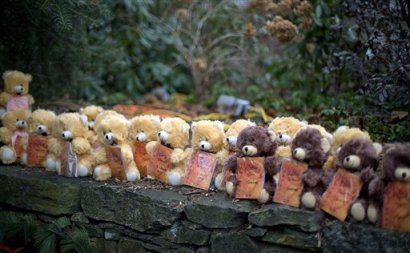
sandy-hook-victims

And nobody ought to be alone.

Vayigash: Settling Into Prosperity and Captivity

jewish-handsIn 468 CE, Rabbi Amemar, Rabbi Mesharsheya and Rabbi Huna, the heads of Babylonian Jewry, were arrested and executed 11 days later. The Jewish community of Babylon had existed for 900 years, ever since Nebuchadnezzar had conquered Israel, destroyed the Holy Temple, and exiled the Jews to Babylon. Seventy years later, when the Jews were permitted to return to Israel, a large percentage remained in Babylon — and this eventually became the center of Jewish rabbinic authority. Things began to worsen in the 5th century, when the Persian priests, fighting against encroaching Christian missionaries, unleashed anti-Christian persecutions which caught the Jews of Babylonia in its wake. Eventually the situation improved, and Babylon remained as the center of Jewish life for another 500 years.

-Rabbi Shraga Simmons
“Today in Jewish History, 7 Tevet”
Aish.com

Thus Israel settled in the country of Egypt, in the region of Goshen; they acquired holdings in it, and were fertile and increased greatly.

–Genesis 47:27 (JPS Tanakh)

It’s hard not to compare these two events. Both of them describe different points in the process of the Jewish people going down into a land not their own and then making themselves comfortable there and thriving. As we see in the Babylonian example, the “good times” don’t last forever, but from Jacob’s point of view, this isn’t readily apparent. In fact, he had assurances that dwelling in Egypt was the right thing to do.

So Israel set out with all that was his, and he came to Beer-sheba, where he offered sacrifices to the God of his father Isaac. God called to Israel in a vision by night: “Jacob! Jacob!” He answered, “Here.” And He said, “I am God, the God of your father. Fear not to go down to Egypt, for I will make you there into a great nation. I Myself will go down with you to Egypt, and I Myself will also bring you back; and Joseph’s hand shall close your eyes.”

So Jacob set out from Beer-sheba. The sons of Israel put their father Jacob and their children and their wives in the wagons that Pharaoh had sent to transport him; and they took along their livestock and the wealth that they had amassed in the land of Canaan. Thus Jacob and all his offspring with him came to Egypt: he brought with him to Egypt his sons and grandsons, his daughters and granddaughters — all his offspring.

–Genesis 46:1-7 (JPS Tanakh)

God’s blessing upon Jacob as we see above, is the beginning of the process of Israel dwelling in Egypt, multiplying greatly, and thriving there. However, the other end of the story is hardly so pleasant.

A new king arose over Egypt who did not know Joseph. And he said to his people, “Look, the Israelite people are much too numerous for us. Let us deal shrewdly with them, so that they may not increase; otherwise in the event of war they may join our enemies in fighting against us and rise from the ground.” So they set taskmasters over them to oppress them with forced labor; and they built garrison cities for Pharaoh: Pithom and Raamses. But the more they were oppressed, the more they increased and spread out, so that the [Egyptians] came to dread the Israelites.

The Egyptians ruthlessly imposed upon the Israelites the various labors that they made them perform. Ruthlessly they made life bitter for them with harsh labor at mortar and bricks and with all sorts of tasks in the field.

The king of Egypt spoke to the Hebrew midwives, one of whom was named Shiphrah and the other Puah, saying, “When you deliver the Hebrew women, look at the birthstool: if it is a boy, kill him; if it is a girl, let her live.”

–Exodus 1:8-16 (JPS Tanakh)

rabbi-prayingThe irony in making the above comparisons, is that the Fast of the Tenth of Tevet is just a few days away.

The Fast of the Tenth of Teves marks the day that Nevuzadran, the Babylonian general, laid siege to Jerusalem prior to the destruction of the first Holy Temple. The siege lasted almost three years until the city walls were breached and the Temple was destroyed. This was the beginning of a long line of disasters on the Jewish people, including the first exile, and the destruction of the second Temple.

This day is commemorated by refraining from eating or drinking from sunrise to nightfall.

While the last sentence of this week’s Torah portion is one of hope and prosperity for the Children of Israel, it is ominously foreshadowed by what we know will occur after the death of Joseph and his brothers. This is the fate of the Jewish people that we’ve seen enacted again and again across history since the destruction of Herod’s Temple in 70 CE and to this very day, when the Jews settle in an area, develop a robust and prolific community, and then are persecuted, robbed, maligned, murdered, and exiled.

On his blog, my friend Gene Shlomovich posted an extremely telling example of how Christianity in the “bad old days” expected and enforced Jewish conversion to Christianity. I invite you to click the link I just provided and read the whole story. It’s not a pretty picture, and many Jews chose to be tortured and die rather than to abandon the God of their Fathers and the Torah of Truth, and replace them with the “lure” of the “Goyishe Jesus.”

What am I saying here? That Christians are perpetually bad and that Jews should do anything in their power to blame the church for the hideous way it has historically treated Jewish people? Is that what the upcoming fast is all about? Not according to Rabbi Raymond Beyda

The purpose of fasting almost 2500 years after the events of the destruction took place is to awaken our hearts today to repentance. Our sages teach that anyone who lives at a time when there is no Bet Hamikdash must realize that had he or she lived when the Temple stood that his or her behavior would contribute to its destruction. Should we mend our ways and remove from our lives the behavior that brings destruction we will bring about the construction of the third Temple — the one that will never be destroyed — and the coming of Mashiah speedily in our days. May we all spend the day productively contributing to that end — Amen.

This is not to excuse the church for its crimes or to pardon any of the peoples and nations who have harassed and abused the Jewish people over the long centuries, but we must separate history from current events. Yes, hatred of Jews and hatred of Israel is still rampant in our world and there are many accounts in the media that indicate it is on the upswing. However, there are also many churches that have significantly revised and improved their (our) understanding of Jews and Judaism, and they (we) have repented and seek to understand our “Jewish roots,” while also honoring that God created a unique covenant people and nation in Israel who remain unique and special to the current day.

But the Jewish people have only one nation, Israel. While, in most parts of the world, Jews are welcome, and flourish, and are fully integrated within the countries and societies where they dwell, we see from history that there is such a thing as being too integrated, and certainly assimilation takes Jews to the point of no longer being recognizably Jewish. What the ancient church attempted and failed to do by force is now being accomplished voluntarily.

Judaism is being destroyed by assimilation and integration, which in effect, means Jews are, without realizing it, renouncing all that it is to be a Jew for the sake of national, social, and cultural belonging. But for those Jews who fully retain their unique ethnic, covenant, and halakhic identity as Jews, the danger they face living in the nations is the same danger the Jews faced in 468 CE in Babylon, and the same danger they faced in the 1930s in Germany.

joseph_egyptAnd it’s the same danger we find them facing this week as Jacob and his family settle comfortably in Goshen, which is in Egypt, and ruled by Pharaoh. Today, as we read Vayigash, Pharoah, King of Egypt knows Joseph and seeks to continue the profitable relationship between Egypt and Jacob’s family. Tomorrow, a new Pharoah will arise who does not know Joseph. That’s the way it’s always happened. Jews believe it will happen again.

According to the Talmud, as the Messianic era approaches, the world will experience greater and greater turmoil: Vast economic fluctuations, social rebellion, and widespread despair. The culmination will be a world war of immense proportion led by King Gog from the land of Magog. This will be a war the likes of which have not been seen before. This will be the ultimate war of good against evil, in which evil will be entirely obliterated. (Ezekiel ch. 38, 39; Zechariah 21:2, 14:23; Talmud – Sukkah 52, Sanhedrin 97, Sotah 49)

What is the nature of this cataclysmic war? Traditional Jewish sources state that the nations of the world will descend against the Jews and Jerusalem. The Crusades, Pogroms and Arab Terrorism will pale in comparison. Eventually, when all the dust settles, the Jews will be defeated and led out in chains. The Torah will be proclaimed a falsehood.

“End of Days”
from the “Ask the Rabbi” series
Aish.com

Israel and her people, the Jewish people, will be rescued when Moshiach comes. But until then, we in the church have a responsibility to make sure the Holocaust or anything like it does not happen again in our towns, in our cities, and in our nations. In solidarity, we can also fast on the Tenth of Tevet, which this year is on Sunday, December 23rd.

Peace be upon Jerusalem and may the Messiah come soon and in our day.

Good Shabbos.

Inspiring Hope

moshiach-ben-yosefThe Jewish people believe in what’s called the End of Days. This isn’t the final end of the world – but merely the end of history as we know it. After the End of Days the world will continue as usual, with the big exception that there will be world peace.

As the End of the Days approach, there are two paths that the world could take. The first is filled with kindness and miracles, with the Messiah “given dominion, honor and kinship so that all peoples, nations and languages would serve him; his dominion would be an everlasting dominion that would never pass, and his kingship would never be destroyed.” (Daniel 7:13-14) This scenario could be brought at any moment, if we’d just get our act together!

The other path is described as Messiah coming “humble and riding upon a donkey” (Zechariah 9:9). In this scenario, nature will take its course, and society will undergo a slow painful deterioration, with much suffering. God’s presence will be hidden, and his guidance will not be perceivable.

According to this second path, there will be a valueless society in which religion will not only be chided, it will be used to promote immorality. Young people will not respect the old, and governments will become godless. This is why the Midrash says, “One third of the world’s woes will come in the generation preceding the Messiah.” (Rabbi Aryeh Kaplan, “Handbook of Jewish Thought”)

“End of Days”
from the “Ask the Rabbi” series
Aish.com

This probably sounds a little different than how Christians understand the “end times,” particularly the interpretation of Zechariah 9:9, but if you click the link I provided and continue to read, you’ll see there are a lot of similarities between the Jewish and Christian “end times scenario.” One thing I’m particularly interested in is that, from the Jewish perspective, the “End of Days” isn’t the end of the world. Some Christians I’ve talked to believe that when Jesus comes, and after all of the stuff that happens in the Book of Revelation, the Earth will be destroyed, all the Christians will go to Heaven, and everyone else will burn eternally in Hell.

But the Jewish point of view reads more like how I understand John’s revelation. The people of God don’t go to Heaven, “Heaven” comes down to them (us).

Another interesting thing (for me, anyway) is how we seem to have a choice as to which road to take. A world filled with kind and just people who give Messiah “dominion, honor, and kinship” and with “all peoples, nations and languages” serving him, will merit a world of everlasting dominion by the Messiah, but only “if we’d just get our act together!”

That doesn’t seem very likely. The alternate choice seems to be the one we see unfolding before us at the moment:

According to this second path, there will be a valueless society in which religion will not only be chided, it will be used to promote immorality. Young people will not respect the old, and governments will become godless. This is why the Midrash says, “One third of the world’s woes will come in the generation preceding the Messiah.”

That is a very good description of the world we live in today…and it is also the world that we merit by our action or rather, our lack of action. However, the Aish Rabbi also provides a message of hope.

Despite the gloom, the world does seem headed toward redemption. One apparent sign is that the Jewish people have returned to the Land of Israel and made it bloom again. Additionally, a major movement is afoot of young Jews returning to Torah tradition.

By the way, Maimonides states that the popularity of Christianity and Islam is part of God’s plan to spread the ideals of Torah throughout the world. This moves society closer to a perfected state of morality and toward a greater understanding of God. All this is in preparation for the Messianic age.

The Messiah can come at any moment, and it all depends on our actions. God is ready when we are. For as King David says: “Redemption will come today – if you hearken to His voice.”

We have hope for the redemption yes, but what will rouse us out of our world of darkness and despair into that light and hope?

Just as when the world was created — it was first dark, followed by light.

-Shabbos 77b

Reb Tzadok HaKohen (.‫ (צדקת הצדיק – קע‬elaborates upon the theme of this Gemara. When Hashem wants to shower a person with goodness and blessings, He waits for the person to daven and to ask for this benefit. In order to motivate the person to call out in prayer, Hashem will direct a certain element of distress or some sort of fear in his direction in order for the person to call out to Him.

light-ohrDaf Yomi Digest
Distinctive Insight
Commentary on Shabbos 77b

It would certainly seem as if Hashem, as if God were directing elements of distress or fear into our world and waiting for us to daven, to pray, to call out to Him. How can we, as people of faith, conclude otherwise?

But a word of caution.

what does pres mean Gd has called the children home. their place is w/ their parents not at the heavenly throne. we must object 2 suffering

–Rabbi Shmuley Boteach
on twitter

Some Christians have given in to the temptation to use tragedies such as the Sandy Hook Elementary School shootings to say some hurtful things. They say these children were murdered to punish our nation for various sins, including some states allowing gay people to marry, that God “isn’t allowed in our schools,” and because abortion is legal in our country.

On the other hand, Rabbi Boteach is telling us that the death of innocent children makes no sense, is not desired by God, and must be resisted and objected to with every last bit of our strength, will, and compassion.

Frankly, given the choice, I’d rather go with Rabbi Boteach’s interpretation than what some of these Christians have said (including our President).

I was thrilled yesterday to get an email from my reclusive friend, Daniel Lancaster. Many of you know him from his books and especially as the author of the massively popular Torah Club volumes. He is a great writer and leader. His congregation, Beth Immanuel in Hudson, Wisconsin, has launched a new initiative acting with tangible love for Messiah to repair one broken place and assist in the lives of some people whose world is splintered and needs mending.

Beth Immanuel has adopted a worker, a Messianic Jewish woman who is putting her life on the line and her love into action in Uganda: Emily Dwyer.

They have launched a website and a plan to raise support to sustain Emily’s work in Uganda. They are baking challah bread, with Emily’s own recipe, as an ongoing fundraiser.

Recently, Emily spoke at Beth Immanuel and two of her messages are posted online. You can hear Emily Dwyer speak at this link (and be inspired — she is a speaker worth listening to).

You can see more about “Acts for Messiah,” the partnership between Beth Immanuel, some other affiliate congregations, and Emily Dwyer’s community in Uganda at ActsForMessiah.org.

-Derek Leman
“An MJ Congregation Acts for Messiah”
Messianic Jewish Musings

We can resist. We can fight back. We can strive for goodness in our world and promote hope in the people around us, regardless of where we may find ourselves. This message is also reflected in the commentary of the Aish Rabbi.

In many ways, the world is a depressing place. But life is like medicine. Imagine a person with a serious internal disease. Taking the right medication will detoxify the body by pushing all the impurities to the surface of the skin. The patient may look deathly ill – all covered in sores. But in truth, those surface sores are a positive sign of deeper healing.

The key is to maintain the hope of redemption.

How can we hasten the coming of the Messiah? The best way is to love all humanity generously, to keep the mitzvot of the Torah (as best we can), and to encourage others to do so as well.

HopeTo promote hope, we must have hope. To inspire the will to do good, we must possess that will and we must do good. This is the common heritage of Judaism and Christianity. God has allowed a world of darkness and we are responsible for lighting it up.

“Know the G-d of your fathers and serve Him with a whole heart.” (Divrei Hayamim I, 28:9) Every sort of Torah knowledge and comprehension, even the most profound, must be expressed in avoda. I.e. the intellectual attainment must bring about an actual refinement and improvement of character traits, and must be translated into a deep-rooted inward attachment (to G-d) – all of which is what the Chassidic lexicon calls”avoda”.

“Today’s Day”
Monday, Tevet 6, 5703
Compiled by the Lubavitcher Rebbe
Translated by Yitschak Meir Kagan
Chabad.org

I can’t tell you why bad things happen. Sure, sometimes God may be trying to get our attention, but my radar into God’s motivations isn’t particularly accurate or insightful. I also don’t think it’s particularly helpful to point fingers and place blame upon political parties, advocacy groups, or any other folks. Yes, I’ll probably still complain about politics and people from time to time, but when I actually want to do the will of my Father who is in Heaven, then I must actually do for other people.

James, the brother of the Master, famously said that faith without works is dead. If that’s true, then complaining about the inequities, hardships, and tragedies of life, with or without faith, is also deader than a doornail.

Choose doing. Choose life. Inspire hope. If we continue to help repair the world, the “end of days” and coming of Messiah will take care of themselves.

12 Days: Staring at the Clouds

staring-at-the-clouds“On the twelfth day of Christmas, my true love gave to me…”

OK, stop right there. It’s twelve days until the end of the year and less than a week until Christmas. There are only twelve days left in my arbitrary “countdown to oblivion” (yeah, I think it’s overly dramatic, too) or at least my countdown to “church or not church.”

I still haven’t made up my mind.

I didn’t go to church last Sunday. I suppose I could have gone, but every Sunday morning, I have to get up at around 4 a.m. so I can drive my daughter to work (she has to be there by 5 a.m.). Afterwards, I get to go back to sleep and last Sunday, sleep I did. I very deliberately didn’t set my alarm so I could get up in time to make it to church. I did periodically wake up, peek at the clock, briefly have an internal dialogue about whether to get up or not, and then I went back to sleep.

And I kept doing that until I determined that it was too late to make it to church on time.

Oh sure, I could have gotten there late. It’s not like anything depends on me being at church on time. But I decided that once it was too late to make it to church before services began, it was just plain too late.

And sleeping in was glorious. I enjoyed it tremendously.

My wife didn’t realize that I wasn’t going to church at first. At about 10 a.m. she mentioned it and I said I decided not to go that morning. That was the end of the conversation.

But I’ve been feeling guilty. I’m not exactly sure why, since my connection to anyone and anything at church is so tenuous. Of course, I already found out that if I miss a Sunday at church people notice. On the other hand, I also discovered that my primary (current) motivation for going to church is a sense of obligation. It’s sort of like the obligation I feel to go to the dentist for regular teeth cleaning. In fact, I’d prefer to go to the dentist to have my teeth cleaned than go to church because I only have to go to the dentist every so many months, and I at least have a long-standing relationship with my dentist and his staff, so we are very familiar with each other.

It’s only a community if you belong and as I also said recently, I don’t have that sense of belonging at church. If predictions are correct, any sense of belonging at all will take about a year.

365 days and counting?

Twelve days left. That’s two more Sundays, one right before Christmas and one right afterward.

I know I should go, I know I should go, I know I should go.

But I don’t want to.

There’s just nothing for me to do there. There’s no one to talk to, at least beyond a friendly, casual, and superficial conversation. The one sort of transaction that would engage me is exactly what I must avoid if I am to have any hope of establishing relationships at all.

More’s the pity, because without the ability to converse and interact, going to church is a really boring way to kill three hours or so.

I’m sure there are Christians out there who are shocked and appalled to read those words.

I started this series at 78 days, made the final determination to return to church at 62 days, and had a private meeting with Pastor Randy at the church I now attend at 57 days (you can see what a cautious fellow I am, slowly sneaking up on an objective).

And it was at 57 days that I went back to church…45 days ago.

Now I only have twelve days left, unless I choose to reset the clock once I reach zero days. I was hoping that I could have a chance to review Boaz Michael’s book Tent of David within the context of a church experience, but I don’t know now. Maybe this effort represents a failure on my part or maybe getting “cold feet” is part of the developmental process of returning to church.

I don’t know.

As I see it, I have two basic choices. One: I can let the twelve days elapse, with or without returning to church for one or both of the Sundays left. Then that is that. Church is no longer an option for fellowship and community. Endgame. Two: I can let the twelve days elapse, with or without returning to church for one or both of the Sundays left, then reset the clock to 365 days. That would mean letting 2013 be “the year of church.” I’d give myself a full calendar year to explore “the church experience.”

Option one seems like a relief and option two seems like a long haul to face, particularly alone. But if I haven’t been giving church a fair chance, then option two is the only one that lets me be fair.

When I look back boy I must have been green
Bopping in the country, fishing in a stream
Looking for an answer trying to find a sign
Until I saw your city lights honey I was blind

You better get back honky cat
Living in the city ain’t where it’s at
It’s like trying to find gold in a silver mine
It’s like trying to drink whisky from a bottle of wine

from “Honky Cat” (1972)
music by Elton John
lyrics by Bernie Taupin

I’ve got a scant twelve days to make up my mind. Until then, I’m staring up at the clouds looking for an answer.

A Human Heart…and Courage

vicki-sotoWhen a crazed gunman opened fire inside a Connecticut elementary school – murdering 26 children and adults – first grade teacher Vicki Soto responded with an astonishingly selfless act.

Upon hearing the first rounds of gunfire in an adjacent classroom, the 27-year-old teacher went into lockdown mode, quickly ushering her students into a closet. Then suddenly, as she came face to face with the gunman and the bullets flew, she used her body to shield the children.

Vicki Soto was found dead, huddled over her students, protecting them.

We all mourn this unspeakable tragedy.

Yet where did this young woman get the strength and conviction to perform such an extraordinary act of bravery?

-Rabbi Shraga Simmons
“A Hero in Connecticut”
Aish.com

The world we live in is certainly broken. This broken state is causing us to ask questions on ways to begin to fix it. The issues are complex and go way beyond single issues or problems like guns, video games, violence in movies, etc. The generational problems and patterns have brought us to this place. It will take new behaviors and patterns to eventually repair it. It will not come fast, or easy.

I think the world has become increasingly rude and mean. This has devastating effects on our culture—and leads to permanent scars and horrifying behaviors.

I recently read an article by Dr. Douglas Fields entitled, Rudeness is a Neurotoxin, where he states, “A disrespectful, stressful social environment is a neurotoxin for the brain and psyche, and the scars are permanent.”

-Boaz Michael
“Why are Some People so Rude?”
boazmichael.org

Boaz wrote about one of my “favorite themes” on his personal blog earlier today, but in light of the shootings at Sandy Hook Elementary School in Newtown, Connecticut (which he was obviously alluding to) and the resulting verbal response (onslaught) in the news media and on the web, he probably didn’t take it far enough.

I don’t mean to say that rude people are potentially dangerous and violent people, but on the other hand, the Master had this today about both situations.

“You have heard that it was said to those of old, ‘You shall not murder; and whoever murders will be liable to judgment.’ But I say to you that everyone who is angry with his brother will be liable to judgment; whoever insults his brother will be liable to the council; and whoever says, ‘You fool!’ will be liable to the hell of fire.

–Matthew 5:21-22 (ESV)

Does anger equal murder? Certainly anger and jealousy has led to murder, including the first one ever recorded, but in adding rudeness to this discussion, am I taking things too far? Am I exaggerating my issues with rudeness? And what does any of this have to do with Vicki Soto and her courageous and selfless act of heroism?

One of the definitions of “rude” or “rudeness” at The Free Dictionary is “Ill-mannered; discourteous.” When we think of a rude person, it’s difficult not to think of someone who is more focused on their own emotional gratification than on the well-being of others. A rude person shoves and cuts in line. A rude person at a shared meal, takes the largest portion. A rude person reveals an embarrassing detail about a friend in public.

In other words, a rude person cares more about themselves than about others.

Kind of the opposite of 27-year old teacher Vicki Soto who purposely put herself in harm’s way and gave her life for the care and safety of small children. She literally used herself as a human shield, taking the bullets that would have otherwise penetrated the bodies of the tiniest, most cherished ones; our children (and they are all our children).

Boaz says on his blog, Rude people are not godly people. Then he continues:

A reminder from a biblical source:

“Love is patient and kind; love does not envy or boast; it is not arrogant or rude. It does not insist on its own way; it is not irritable or resentful …” (1 Corinthians 13:4-5 ESV)

A reminder through Jewish wisdom:

It is a mitzvah for every person to love every Jew as himself, as it is written “And you shall love your neighbor as yourself.” Therefore we must relate his virtues. To be concerned about his property the way we are about our own, and about his honor the way we are about our own. If a person glorifies himself in the shame of his neighbor even if his neighbor is not there, and the shame does not reach him, and is not embarrassed, but he compared his good deeds and his wisdom to compare with the good deeds, and wisdom of his neighbor, so that from this it may appear that he is a very honorable person and his neighbor a despicable person. This person has no share in the world to come, until he repents with complete repentance. (Kitzure Shulchan Aruch 29:12)

A reminder through apocryphal literature:

Yeshua said, “Love your brother like your soul, guard him like the pupil of your eye.” Gospel of Thomas 25

Rabbi Simmons summed up the life of Vicki Soto and her inspiration to us in this way.

Vicki Soto’s great act of devotion should inspire us to take 10 minutes today and ponder: “What am I living for?”

Finding the answer is a big project. But there’s no better use of our time and energy. Because if we don’t know what higher purpose we’re pursuing, then we’re living like zombies, just going through the motions.

Vicki Soto was up to the challenge. “She didn’t call them her students,” her sister Carlee told NBC. “She called them her kids. She loved those students more than anything.”

She loved her students so much that she referred to them as her “little angels.” In reaching the ultimate level of devotion and saving their lives, Vicki Soto reached beyond the angels.

APTOPIX Connecticut School ShootingWhen we get into our little “Internet spats” in the blogosphere, in discussion boards, or in social networking applications such as Facebook, we often believe we are fighting for what is really important to us. Somehow, we use that as a way to internally justify our rudeness. But as Rabbi Simmons points out, when we find something or someone, some small collection of “little angels” who really are important, then exhibiting behaviors indicative of selfishness and self-gratification doesn’t even enter the picture. Quite the opposite. Courage, like love, is selfless, patient, and kind. Like Vicki Soto, love and courage bears all things and endures all things.

And it never ends even though life may end.

But everything else we do ends. As Paul says, “As for prophecies, they will pass away; as for tongues, they will cease; as for knowledge, it will pass away. For we know in part and we prophesy in part, but when the perfect comes, the partial will pass away. “ (1 Corinthians 13:8-10 ESV)

I have been trying to stop being so foolish as to participate in online interactions with human attack dogs. Vicki Soto’s remarkable self-sacrifice has provided me another reason not just to cease such fruitless activities, but to strive to become a better person, both in my private life and in my “blogging persona.”

Nothing I can say, no goal I could ever achieve, both professionally as a writer or in any personal sense could equal Vicki’s greatest qualities, which writer Archie Goodwin once described as:

“A human heart…and courage.”

Most of us will never find ourselves in a situation where we have to choose between our life and someone else’s, but as Rabbi Simmons suggests, we can take a few minutes out of our busy day to ask ourselves, “what am I living for?” If you want to give Vicki’s life and the lives of all who have suffered and died for the sake of love, caring, and compassion any sort of meaning, let your answer be to help another human being in some way, great or small.

And, to go Paul McCartney one better, in the end, may the love you make be greater than the love you take.

"When you awake in the morning, learn something to inspire you and mediate upon it, then plunge forward full of light with which to illuminate the darkness." -Rabbi Tzvi Freeman