
Overcoming Humanity

It is human nature. When someone wrongs us, we want to retaliate. We are infuriated and hold onto memories of these “wrongs,” and when given the opportunity, we respond in kind.

Taking revenge is prohibited in Judaism.

Maimonides writes about revenge in his code of Jewish law:

Taking revenge is an extremely bad trait. A person should be accustomed to rise above his feelings about all worldly matters; for those who understand [the deeper purpose of the world] consider all these matters as vanity and emptiness, which are not worth seeking revenge for.” (Paraphrased from Mishneh Torah, De’ot 7:7.)

Rather, Maimonides continues, if someone who has wronged you comes to ask a favor, you should respond “with a complete heart.” As King David says in the Psalms, “Have I repaid those who have done evil to me? Behold, I have rescued those who hated me without cause”(Psalm 7:5).

In addition, Jewish law forbids us to bear a grudge. Thus, the Talmud explains, you may not even say to the person who wronged you that you will act rightly, even though he or she did not. (Talmud, Yoma, ibid.)

Rabbi Schneur Zalman of Liadi in his code of Jewish law concludes that, “one should erase any feelings of revenge from one’s heart and never remind oneself of it.”(Shulchan Aruch Harav, end of 156:3 [in the new Kehot editions (2001) p. 393].)

-Dovid Zaklikowski
“What Does Judaism Say About Taking Revenge?”
Learning and Values
Chabad.org

You shall neither take revenge from nor bear a grudge against the members of your people; you shall love your neighbor as yourself. I am the Lord.

–Leviticus 19:18

I’m actually a lot more calm about this issue than I have been in previous days, but as I was studying this morning (as I write this), the topic came up and I thought I should continue with my commentary on the nature of human beings and our desire to strike back when someone causes us pain.

It’s difficult to not want to immediately hit back when someone does something to hurt or scare us. The sudden power surge of adrenaline hits our blood stream and our reflexes take over. The guy who cuts you off in traffic nearly hitting you, or the shock of someone accidentally bumping into you on the sidewalk and practically knocking you off your feet almost always produces a split second of tremendous emotion that we have to overcome with reason.

Of course, that isn’t really revenge as much as it is biochemistry. Once we get past the instant of emotion, we can stop ourselves before we go into a “road rage” or actually form a fist and hit the person who by now, is apologizing for walking into us and is trying to steady us on our feet. Revenge is longer lasting. Revenge is the desire to “get even” with whoever offended us and to, even days, weeks, or months later, make sure they “pay” for what they’ve done to us, whether the injury was real or imagined.

Here’s a classic Jewish example of revenge:

Taking revenge is when you ask someone, “Lend me your sickle,” and he says no. The next day he comes to you and asks you “Lend me your hatchet.” You respond, “I am not lending to you, just like you did not lend to me.”

This is an example of revenge.

—The Talmud, Yoma 23a

But revenge goes beyond what you actually do. It involves what you think and how you feel. How many people never actually “take revenge” but nurse it in their hearts, sometimes for years, letting it blacken not only that one relationship, but everything they are as a person, right down to the core of their soul?

Not taking revenge is not just about modifying one’s actual actions; it is also that the thought of revenge never even enter one’s heart. (See Rabbi Jonah Gerondi (1180-1263), Shaarei Teshuvah 3:38. See Nachmanides on Leviticus, ad loc.)

-Zaklikowski

That’s a tall order. It’s one thing to not act on the desire to take revenge or to even eventually put feelings of revenge aside, but it’s something else entirely to never experience thoughts or feelings of revenge in the first place when it would be otherwise expected to do so.

On the surface, the literal commandment we see in Leviticus 19:18 seems to address not acting on feelings of revenge and not carrying a grudge forward in time after the event, but how can you not have such thoughts and feelings in the first place? Zaklikowski’s response is this:

The verse prohibiting revenge ends with the famous maxim, “You should love your fellow as yourself.” Rabbi Moshe ben Nachman, “Nachmanides,” explains that erasing the event from your heart will guarantee that you will never come to transgress the commandment, allowing you to love your fellow, no matter what transpires between the two of you. (Igeret HaKodesh, Epistle 25.)

As I said before, that’s a tall order. It would mean that we would have to harbor love in our hearts for others as a matter of course and to learn to habitually forgive those who have wronged us. These are qualities that go beyond normal human experience, emotion, and reason. These are the lessons we learn from God and are the results of a life lived in faith.

“Be kind, for everyone you meet is fighting a hard battle.” -Plato

What would the world look like if we all internalized these lessons into our beings and committed to responding to our environment in this way all of the time?

When you look at a human being, you see his hands working, his feet walking, his mouth talking. You don’t see his heart, his brain, his lungs and kidneys. They work quietly, inside. But they are the essential organs of life.

The world, too, has hands and feet — those who are making the news and effecting change. The heart, the inner organs, they are those who work quietly from the inside, those unnoticed. Those who do a simple act of kindness without knowing its reward.

-Rabbi Tzvi Freeman
“Inside Workers”
Based on letters and talks of the Rebbe
Rabbi M. M. Schneerson
Chabad.org

Love is patient and kind; love does not envy or boast; it is not arrogant or rude. It does not insist on its own way; it is not irritable or resentful; it does not rejoice at wrongdoing, but rejoices with the truth. Love bears all things, believes all things, hopes all things, endures all things. –1 Corinthians 13:4-7 (ESV)
 

Hope in Hopelessness

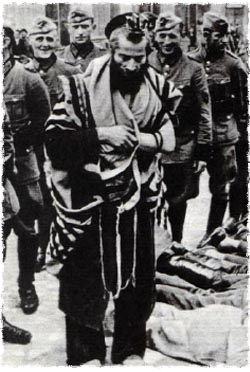
Last week at the Western Wall, I asked an elderly man to put on tefillin. He strongly refused.

I asked him, “When was the last time you put on tefillin?”

He smiled and proudly said, “72 years ago!” He held out his arm to show me the fading tattooed numbers. “1938,” he said. “It was the day of Kristallnacht. Do you know what Kristallnacht is?”

“Of course I do,” I told him.

“Two hundred and sixty-seven synagogues were burned down in one night. They burned down our synagogue, too. My tefillin were burnt up, and I have never put them on again,” he said.

“I have a friend who was in the camps, too,” I quickly said, “and he not only puts on tefillin today, but he even put them onto others inside the camp! Do you want to hear how he got tefillin into the camp?”

“Yes,” he said strongly. “How did he get them in there?”

-Gutman Locks
“Tefillin After 72 Years”
Stories of the Holocaust series
Chabad.org

I can’t even imagine what it would have been like to experience the horrors of the Holocaust. Like many Americans, I live a relatively comfortable life. I don’t really know what it’s like to go without adequate food, shelter, or clothing. I’ve been in the hospital before, but remain fairly healthy. I was once beaten by several men during a riot when I was 16 and spent some time recovering, but I was home and eventually after over a year, I began to let myself feel safe again. In short, I’ve faced a certain number of challenges over my lifetime, but none have been overly difficult.

I can’t even imagine what it would have been like to experience the horrors of the Holocaust.

I can’t even imagine what it would be like to have a wife who is struggling with cancer and who may die.

I can’t even imagine what it would be like to be the father of terminally ill child.

Frankly, I don’t want to imagine, let alone have to actually face such hideous tragedies in life. I don’t know how people do it and, I’m ashamed to say, I don’t even know how people of faith do it.

Where do you find hope in hopelessness? It’s one thing to say “I rely on my God for my strength,” and it’s another thing to actually live it out, one day at a time, one horrible, agonizing minute at a time. What can you do when someone delivers the terrible news and your courage melts like a plastic sandwich bag in the face of an inferno? What do you do when you’re a young, teenage boy and you and your mates are being herded into the gas chambers by the Nazis and you have only minutes to live?

“He began his story. The Nazis had come to the ghetto and grabbed 137 young boys. He told me that only five of them survived. Only five.

“He was thirteen and a half years old. He was wearing the high boots that his father had bought him, and when he saw them coming, he stuffed his tefillin into one boot and his prayerbook in the other.

“They pushed the boys into a cattle car and drove them to the death camp, not far from the ghetto. When the train stopped, they slid open the side of the cattle car and immediately began pushing them toward the open door of the gas chamber. The boys were frightened and cried out. They asked Laibel, ‘What should we do?’ He told them, ‘We’re going to stand in rows five across, and we’re going to march right into that gas chamber singing a song of faith, the “Ani Maamin.”’ And they did just that. They stood in rows five across, and started singing and marching right into the chamber.

“The guards became so confused that they did not know what to do. They screamed, ‘You can’t do that! No one has ever done such a thing before. Stop it! Stop it at once! Here! Go over there to the showers instead!’

“They pushed them over to the showers, and forced them to undress and throw their clothing into a pile in the middle of the floor. They made them empty their shoes, and the tefillin and prayerbook fell out onto the pile.

“After the shower, when they were dressed in camp clothes and were being pushed out, past the pile of their clothes, Laibel saw his tefillin and prayerbook lying there. He wanted so badly to run and pick them up, but terrifying guards were watching. He said to the boys, ‘I did something for you, so now you do something for me.’

“‘Whatever you want,’ they said. ‘You saved our lives.’

“He said, ‘When I give the signal, start a fight and scream out loud. Okay . . . now!’ The boys started to fight and scream. The guards ran over and tried to pull them apart, but they wouldn’t stop fighting. In the confusion, he ran over and grabbed his tefillin and prayerbook, and hid them under his arms.

Laibel not only managed to retrieve his tefillin but he wore them (clandestinely) in the camp and helped other Jews wear them, too. In the story commemorating his courage, we discover him as an old man today helping men wear tefillin at the Kotel.

And he looked me in the eye and said, ‘And I put tefillin on other men, too.’ I started to cry, and I kissed him on his yarmulke.

“The day after Laibel told me his story, there was a soldier at the Western Wall who wouldn’t put on tefillin. No matter what I said, he simply refused. Then I told him Laibel’s story, and he quickly said, ‘Okay, I’ll do it.’

“And you can do it, too,” I said to the elderly gentleman who hadn’t donned tefillin in 72 years, as I gently slid the tefillin I was holding onto his arm. He said the blessing and started to cry. We said the Shema, and he prayed for his family. He began to smile even while the tears were streaming down his face. A crowd gathered around and congratulated him on overcoming all those years of rejection.

You do not always succeed, but you always have to try.

If there has ever been a hopeless place on earth, it was in the Nazi death camps during the Holocaust. Even those who were not immediately killed expected to die a lingering and torturous death. Even those who survived and who were liberated didn’t expect to live any sort of “normal” Jewish life again. Who could after seeing what they saw and experiencing what they lived through? Even after more than seven decades, Holocaust survivors are suffering delayed post-traumatic stress disorder. The statement is so obvious, it’s almost laughable to report it in the media. Of course they’re suffering after seventy years? Who wouldn’t?

But after over seventy years, some have turned suffering and hopelessness into hope, not just for themselves but for each other. Laibel turns hopelessness into hope every time he helps another Jewish man don tefillin and pray at the Kotel. A Jewish man who hadn’t worn tefillin in seventy-two years because of the nightmare of Kristallnacht put on tefillin again because of Laibel’s inspiration, “said the blessing and started to cry.”

While most of us have never faced such horrendous, nightmarish, ghastly experiences as those of Holocaust survivors, as those who are battling desperately invasive cancer, as those who are anxiously trying to comfort a dying child, we still know the world is filled with hopelessness and despair. All of us face some sort of problem, some sort of challenge, something that makes us want to give up our fight to move forward or maybe even the fight to live.

I have no magic to give you. I have no secret formula with which you can overcome your hardships or worries or fears or tears. I can say “rely on God” but for even those men and women who do rely on Him with an almost superhuman faith and courage, the battle is hard and surrender to the darkness is a constant companion.

But amazingly there is still hope. Laibel must be well over eighty years old and for him, hope is helping just one more man put on tefillin, maybe for the first time in decades, and speak words of blessing to God. Hope is saying, “I love you” to a dying little boy. Hope is continuing to pray for your spouse, even though multiple organs are compromised by cancer and years of radiation and chemotherapy haven’t put the demon back in the bottle.

Hope is in the tears you cry. Hope is in your screams of anguish. Hope is being able to go on when life is impossible. Hope is a man learning how to pray again while crying after seventy-two years.

Hope is the faint light of a tiny candle holding the encroaching abyss at bay.

Hope is God.


The Best Within Us

If I speak in the tongues of men and of angels, but have not love, I am a noisy gong or a clanging cymbal. And if I have prophetic powers, and understand all mysteries and all knowledge, and if I have all faith, so as to remove mountains, but have not love, I am nothing. If I give away all I have, and if I deliver up my body to be burned, but have not love, I gain nothing.

Love is patient and kind; love does not envy or boast; it is not arrogant or rude. It does not insist on its own way; it is not irritable or resentful; it does not rejoice at wrongdoing, but rejoices with the truth. Love bears all things, believes all things, hopes all things, endures all things.

Love never ends. As for prophecies, they will pass away; as for tongues, they will cease; as for knowledge, it will pass away. For we know in part and we prophesy in part, but when the perfect comes, the partial will pass away. When I was a child, I spoke like a child, I thought like a child, I reasoned like a child. When I became a man, I gave up childish ways. For now we see in a mirror dimly, but then face to face. Now I know in part; then I shall know fully, even as I have been fully known.

So now faith, hope, and love abide, these three; but the greatest of these is love.

–1 Corinthians 13:1-13 (ESV)

In spite of the fact that this passage from Paul’s letter to the Corinthian church has often been read as part of the vows at innumerable weddings, it has nothing to do with romantic love. It is Paul’s message about a much greater love and, in my opinion, a love that it much more difficult to express consistently in a life of faith. In fact, I think the kind of love Paul is describing has a lot more to do with what he had to say to the church in Rome.

Bless those who persecute you; bless and do not curse them. Rejoice with those who rejoice, weep with those who weep. Live in harmony with one another. Do not be haughty, but associate with the lowly.Never be wise in your own sight. Repay no one evil for evil, but give thought to do what is honorable in the sight of all. If possible, so far as it depends on you, live peaceably with all. Beloved, never avenge yourselves, but leave itto the wrath of God, for it is written, “Vengeance is mine, I will repay, says the Lord.” To the contrary, “if your enemy is hungry, feed him; if he is thirsty, give him something to drink; for by so doing you will heap burning coals on his head.” Do not be overcome by evil, but overcome evil with good. –Romans 12:14-21 (ESV)

Interestingly enough, the Talmud seems to echo the same lessons that Paul teaches:

“They said of Rabbi Yochanan ben Zakai that no man ever greeted him first, even idol worshippers in the market” [i.e., Rabbi Yochanan ben Zakai was the first to greet every person, even idol worshippers] (Berachot 17). At the same location the sage Abaye advocated soft speech and words of peace to everyone, especially including idol worshippers.

“[it is proper to] support the idol worshippers during the sabbatical year… and to inquire after their welfare [commentators: even on the days of the holidays of their idols, even if they do not keep the seven Noahide commandments] because of the ways of peace.” (Shevi’it 4,3)

The rabbis taught: ‘We support poor Gentiles with the poor people of Israel, and we visit sick Gentiles as well as the sick of Israel and we bury the dead of the Gentiles as well as the dead of Israel, because of the ways of peace.” (Gitin 61a)

I suppose I’m belaboring the point I was trying to make last Friday afternoon, but this blog isn’t about presenting topicial commentary or clever scholastic mysteries, it’s about me writing what’s on my mind, my heart, and my spirit as I approach each new day. The sorry state of love among the human race, including those who claim faith in God is still consuming me. What makes it worse is the lack of love among people of faith seems not to bother them (us) at all. And I have to share the name “Christian” with some of these folks. No wonder the atheists accuse us of hypocracy.

I just recently saw the film The Avengers (2012) for the first time. I know that’s a strange statement for me to make given the context of today’s “meditation,” but I do have a point. As well as being a top notch action film and a lot of fun to watch, there were a few good lessons to be found about love, honor, and sacrifice. Ironically, it took a completely secular film to talk about the qualities we Christians are supposed to possess by definition.

Of all the characters in the film, Captain America (played by Chris Evans) is the epitome of those qualities I just named. He is what we think of, in old fashioned terms, as “the greatest American hero.” He’s the ideal of what we used to believe were the finest qualities about our nation and our citizens. National cynicism has since destroyed those ideals but maybe not completely. The film has more than a few reminders for us that not only does the character Captain America have a much needed place in our world today, but the ideals Captain America represents are what we most long for in our lives.

Cap is sometimes juxtaposed in the film against the character of Tony Stark/Iron Man, a person who at once has everything and nothing. A man who has wealth, position, power, and glamour, but at the expense of the finer qualities of Captain America, such as love of humanity, purpose, conviction, honor, and the ability to sacrifice even his own life if it will save others. Stark is always looking for the loophole. Steve Rogers, Captain America’s other identity, always faces his challenges head on.

Toward the climax of the film (and I’m sorry if I’m giving too much away), the only way for Stark to save New York City from nuclear destruction is to carry a nuclear missile through a dimensional rift out of our world, in order to destroy the attacking army. This is supposed to be a one-way trip, but there are no other options and no loopholes. Captain America’s example throughout the movie finally made an impression on Iron Man so that what began beating in his chest was not the electronic perfection of the machine keeping him alive, but a real human heart of compassion, even for millions of people who he’ll never know.

As in most fantasies, Stark is saved at the last minute and rewarded for his willingness to sacrifice his life by survival and the opportunity to appear in more movies, but what about the reality of this lesson? What can we learn about love and even about “heaping burning coals on the head of those who hate us?”

Remember, this lesson comes to us courtesy of a secular and atheist entertainment industry. It is however, an industry that does, within the context of the film, allow Captain American to utter one single line of dialog confirming his faith in God, which I found just amazing. This lesson in love, honor, and sacrifice (as opposed to raw vengence and self-satisfaction) comes to us from people who, in all likelihood, have never met the God of the Bible and perhaps never will this side of the Messiah.

Where is our lesson? Where is the lesson of the church?

I don’t doubt that many Christians do live up to the ideals of our Master. Many believers do not just speak, but live out the example of Jesus Christ. Many extend themselves to feeding the hungry, providing clothing to those who need it, welcoming strangers into their homes, visiting the sick in the hospital, and even extending a smile and a hand of friendship to those who revile them, even if they are other Christians.

The sad and sorry part of our faith is that there are those among us who use Christ as a blunt instrument with which to beat their perceived enemies about the head and shoulders until they’re bloody and bruised. And then these Christians congratulate themselves for aptly employing Jesus as an object of vengence and an example of “tough love” which is neither particularly “tough” in the sense of true strength and honor, or at all loving in the way Paul described love to the Corinthians.

More’s the pity.

What is the defining quality of Christianity, judgment or love? They both exist within our theology. We know a time of judgment is coming and most Christians feel immune to it, imagining that only their enemies the atheists will face such a terrifying fate. And yet the Master tells us this is absolutely not true. Just who do you think Jesus is talking to in Matthew 25:34-46? Why would athests be expected to give water to the thirsty and clothe the naked in Christ’s name? And why would the Master say this?

“Not everyone who says to me, ‘Lord, Lord,’ will enter the kingdom of heaven, but the one who does the will of my Father who is in heaven. On that day many will say to me, ‘Lord, Lord, did we not prophesy in your name, and cast out demons in your name, and do many mighty works in your name?’ And then will I declare to them, ‘I never knew you; depart from me, you workers of lawlessness.’ –Matthew 7:21-23 (ESV)

In Romans 12:19, Paul quoted Leviticus 19:18 to remind us that vengence belongs to God, not men. The Master gave us all a new commandment to love each other as a way of showing the world around us that we belong to him (John 13:34-35). If I have to err in the expression of my faith, I prefer to err on the side of love and to leave (to the best of my limited abilities) the vengence to God. God’s vengence, when He chooses to express it, does not contain our human faults, hositilities, and insecurities, but only His justice, which is neither ours to take or to give.

If secular films such as The Avengers can be an inspiration for us to be better people, to be “heroic” in the love we can show others, why doesn’t the church show the world that Christ brings out the best within each of us? If you want to carry the Gospel message to a desperate and unbelieving world and show other Christians “how it’s done,” I can think of no better way to do it than to show love especially toward your “enemies” because of the ways of peace.

“The whole problem with the world is that fools and fanatics are always so certain of themselves, and wiser people so full of doubts.”

-Bertrand Russell


The Messiah’s Lament

Someone once asked the Chozeh of Lublin, zt”l, an interesting question about a well-known statement found on today’s daf. “Our sages tell us that a person who says something in the name of the one who originally said it brings redemption to the world. It seem strange that after all these centuries that the Jewish people have learned Talmud—which quotes the original source for every statement—we have not yet been redeemed!”

The rebbe immediately supplied an excellent reply to this question. “We can understand this in light of what I have already said: that there are two types of redemption. Besides a general redemption for the Jewish people through our righteous redeemer, there is also a personal redemption for every Jew. So the redemption alluded to here is not the ultimate redemption at all. It refers to every Jew’s personal needs, both material and spiritual. When a Jew says something in the name of its originator, he affords this type of redemption to the world.”

Rav Shmuel, the student of the renowned Be’er Mayim Chaim, zt”l, gave a similar response. “It is clear from the very words of our sages themselves that this does not refer to bringing Moshiach. Firstly, it says that it brings גאולה , redemption, not the גואל , redeemer. Secondly, our sages learn this from Esther. When Esther revealed the assassination plot of Bigsan and Seresh to Achasverosh, she told him this in the name of Mordechai. Just as there we find that this led to a specific redemption for the Jews and it was not the actual arrival of Moshiach, the same is true at all times. When someone says something in the name of its originator, a Jew somewhere is saved from difficulty!”

Daf Yomi Digest
Stories Off the Daf
“Bringing Redemption to the World”
Shabbos, June 9, 2012
Niddah 19

“O Jerusalem, Jerusalem, the city that kills the prophets and stones those who are sent to it! How often would I have gathered your children together as a hen gathers her brood under her wings, and you were not willing! See, your house is left to you desolate. For I tell you, you will not see me again, until you say, ‘Blessed is he who comes in the name of the Lord.’” –Matthew 23:37-39 (ESV)

I’ve written about the connection between Jewish return to the Torah and Israel’s national redemption before, but I still don’t understand it very well. Our “story off the daf” for the previous Shabbat discusses what seems to be a related matter, but while I think it’s interesting and perhaps ultimately important, the ability to fully comprehend what it means against the larger backdrop of Israel, the Messiah, and humanity continues to elude me.

I usually “get in trouble” for two reasons when I opine in this direction. I am usually criticized for “buying into” the various arcane and mystic Jewish writings as if they are fact, and I am accused of applying midrash as if it can be directly attached to the Gospels. While none of this is necessarily true, I do believe it is important to illustrate that general Jewish thought and perspectives on matters such as redemption, the Messiah, and God can be bound by a single though slender thread as we weave our way from ancient to modern times. It’s the thread that’s important because it shows that the destruction of the Second Temple did not disconnect the Jewish people from their faith in or their covenant relationship with God.

What remains mysterious to me though, is how to connect the Jewish vision of Israel’s national redemption and the return of the Messiah back to what we see in the Scriptures. I think there is a clue, albeit a rather faint one, in the Master’s lament over Jerusalem from Matthew 23:37-39. Let’s consider a few things.

The general assumption in Christianity is that the Temple was destroyed and the Jews scattered because they had rejected Jesus as the Messiah. But is that true? Can we find anywhere in either Scripture or Rabbinic commentary that says the Jews will suffer exile for the rejection of the Messiah? If you know where this is found, please point me to it, because I have never seen such a pronouncement in the Bible.

Why do Jews believe the Temple was destroyed and the Jewish nation sent into exile?

Why was the Temple destroyed? One of the reasons given by our Sages was unwarranted hatred. The Jewish people, even during the siege of Jerusalem, remained fractionalized and divided. And on the individual level, there was a lack of concern, love, and respect for each other.

How can this be corrected? By showing unrestrained love. By reaching out to another person – any other person – and showing him care, consideration, and concern. Do a favor for someone else, not because there is a reason to do so, but because you care for him.

“Keeping In Touch: The Three Weeks”
Based on the teachings of the Lubavitcher Rebbe
Rabbi Menachem M. Schneerson
Adapted by Rabbi Eli Touger
Chabad.org

There are probably other traditional reasons but this is the one I encounter most often. Notice that a solution to the exile is also offered in showing “unrestrained love” toward your fellow. Our popular culture refers to “random acts of kindness” which sounds like a good idea, too.

Historically and in Scripture, we find that God has promised the destruction of the Temple and Israel’s national exile as consequences for disobedience to Torah and straying after “alien gods,” which of course, has little or nothing to do with a rejection of Jesus as Messiah (Post-Second Temple, the Jewish resistance to pursuing “alien gods” is one of the primary reasons why many Jews have rejected the Christian Jesus). Messiah, in Jewish thought, isn’t the cause of national exile, but the ultimate hope of its end.

Galut means exile. Nearly 2,000 years ago the Jewish nation was driven out of its homeland and sent off into a tear-soaked galut that lasts to this very day. We wait and yearn for the day when our galut and suffering come to an end, when we will be returned to the Holy Land, with the coming of our redeemer, the Moshiach.

-from “Moshiach 101”
Chabad.org

The mashiach will bring about the political and spiritual redemption of the Jewish people by bringing us back to Israel and restoring Jerusalem (Isaiah 11:11-12; Jeremiah 23:8; 30:3; Hosea 3:4-5). He will establish a government in Israel that will be the center of all world government, both for Jews and gentiles (Isaiah 2:2-4; 11:10; 42:1). He will rebuild the Temple and re-establish its worship (Jeremiah 33:18). He will restore the religious court system of Israel and establish Jewish law as the law of the land (Jeremiah 33:15).

–Judaism 101

Now let’s return to the Messiah’s lament over Jerusalem. What does he say is Israel’s “crime?”

O Jerusalem, Jerusalem, the city that kills the prophets and stones those who are sent to it! How often would I have gathered your children together as a hen gathers her brood under her wings, and you were not willing!

In every era of disobedience in Israel, those messengers of God, the prophets, were imprisoned or killed when they brought a message that was intended to turn them from their sins back to God. It wasn’t so much that the identity of the prophets were in doubt, Israel just didn’t want to hear the message. They were not “willing to be gathered.” So too in the time of Jesus. Many believed he was the Messiah and while history records that the level of religious observance during the late Second Temple era was rather high among the general Jewish population, baseless hatred and hostility between a Jew and his fellow was also present. The message of Jesus was to love one another (John 13:34) but largely, the message was rejected.

So what is the consequence for such a rejection of the message of love and repentance? There are actually two. The first is:

See, your house is left to you desolate.

This is exactly what happened when the vast majority of the Jewish population was forced out of Israel. The Land of Israel (“house”) was left desolate, not only of the Jewish people but of the blessings of God. This desolation would continue to be literally true in the land as long as there was not a substantial Jewish presence. The famous American author Mark Twain (Samuel Clemens) described such desolation:

“….. A desolate country whose soil is rich enough, but is given over wholly to weeds… a silent mournful expanse…. a desolation…. we never saw a human being on the whole route…. hardly a tree or shrub anywhere. Even the olive tree and the cactus, those fast friends of a worthless soil, had almost deserted the country.”

from The Innocents Abroad

The punishment it seems, not only affected the Jewish people, but the Land of Israel as well.

But what of the second consequence:

For I tell you, you will not see me again, until you say, ‘Blessed is he who comes in the name of the Lord.’

The common understanding of this is plain. Israel will not see the Messiah again until it declares him (i.e. Jesus) as Messiah and Lord.

I must admit, it’s difficult to connect the national redemption of Israel and return of the Jewish people to the Torah with not only the Messiah’s return, but in Israel’s specifically recognizing Jesus as the Jewish Messiah. So in general, when do Jews believe the Messiah will come. Opinions vary, but the Judaism 101 site offers a summary:

Although some scholars believed that G-d has set aside a specific date for the coming of the mashiach, most authority suggests that the conduct of mankind will determine the time of the mashiach’s coming. In general, it is believed that the mashiach will come in a time when he is most needed (because the world is so sinful), or in a time when he is most deserved (because the world is so good). For example, each of the following has been suggested as the time when the mashiach will come:

  • if Israel repented a single day;
  • if Israel observed a single Shabbat properly;
  • if Israel observed two Shabbats in a row properly;
  • in a generation that is totally innocent or totally guilty;
  • in a generation that loses hope;
  • in a generation where children are totally disrespectful towards their parents and elders;

None of those options seems to directly connect to, “you will not see me again, until you say, ‘Blessed is he who comes in the name of the Lord.'” I must admit to being at a loss, although the first three and particularly the first option seem somewhat promising.

So, either I am unaware of some vital scripture or other piece of information that ties the Messiah’s lament to how Jews understand national redemption of Israel, the Torah, and the coming of Messiah, or there is a really big disconnect between Jewish thought, even within Messianic Judaism, and how the record of the Gospels and the writings of the apostles describe redemption and the return of Jesus.

I’m not writing this “meditation” to offer answers but to pose questions. This is my continued exploration into this topic, and I’m trying to understand without summarily dismissing the Jewish perspective on their own national redemption (as perhaps many other Christians would). I offer this subject up for discussion and commentary, particularly to my friends in the Messianic Jewish movement who may actually have a unifying solution. If there is an answer to the mystery, where can it be found?

Why were we made so small, with such great heavens above our heads? Because He desired creatures that would know wonder.

-Rabbi Tzvi Freeman
“Why the Heavens?”
Based on letters and talks of the Rebbe
Rabbi M. M. Schneerson
Chabad.org

Forgive

“If your brother sins against you, go and tell him his fault, between you and him alone. If he listens to you, you have gained your brother. But if he does not listen, take one or two others along with you, that every charge may be established by the evidence of two or three witnesses. If he refuses to listen to them, tell it to the church. And if he refuses to listen even to the church, let him be to you as a Gentile and a tax collector. Truly, I say to you, whatever you bind on earth shall be bound in heaven, and whatever you loose on earth shall be loosed in heaven. Again I say to you, if two of you agree on earth about anything they ask, it will be done for them by my Father in heaven. For where two or three are gathered in my name, there am I among them.”

Then Peter came up and said to him, “Lord, how often will my brother sin against me, and I forgive him? As many as seven times?” Jesus said to him, “I do not say to you seven times, but seventy-seven times.

–Matthew 18:15-22 (ESV)

This is a unprecidented third “meditation” in one day, but I saw the accompanying photo on Facebook and it just fit. It’s been a tough week in the Messianic blogosphere and I’ve got the (virtual) bruises to prove it (It’s been a tough week anyway, but that’s beside the point). Most people who give me a hard time for my specific beliefs and their accompanying statements are actually really nice people who love God and want to do good to others. The vast majority of them, I consider my friends and for those who I’ve never met before, I’d love to get together over coffee or a beer and get to know you better. Most of them actually do perform deeds of lovingkindness and have extremely generous hearts.

Just a tiny few however, seem to have a tough time “letting go,” as if what I’m saying is a direct challenge to the doctrine of salvation and the grace of Jesus Christ. I’m not making any such challenge, but for some believers, any suggestion of change or deviation from the norm, particularly in the arena of supersessionism and anti-Jewish rhetoric, is to be feared and even shunned. I admit that there are moments when I want to snap back (more than I already do) but I don’t because I know it wouldn’t be the right thing. How can I exemplify the teachings of my Master if I allow myself to get caught up in the rapid volley, tennis match exchange of angry and upset comments?

Sometimes, along with everyone else, I get caught up in arguing all of the little minutia of religion; all of the arcane details that would make most Rabbis and Pastors go nuts and want to toss in the towel on the human race, but really, God is very simple.

At the end of the day, when you look back at who you are, who you claim to be, what you’ve done with your time, and how you’ve treated other people, you have to say to yourself, “Stop being a jerk and just forgive.” As someone commented on another of my blogs (this isn’t an exact quote), “it’s more important to do right than to be right.”

How can we enter a Shabbat’s rest with anger and frustration tying our hearts and souls into something that looks like a design by M.C. Escher? Let go. Tell the people who you love, “I love you.” Cup a small child’s face in the palm of your hand. Forget all the words and actions that have caused you pain. Remember what’s important.

Forgive.

If you’ve hurt me, I forgive you.

May God go with us all on our journey of faith.

nightsky1

Following the Footsteps of Messiah

It seems like every discussion on every Messianic blog, every “innovative” (I use the term somewhat pejoratively) theology in the Messianic movement, every controversy that I come into contact with currently boils down to the idea of Jewish and Gentile identity.

One Law/Divine Invitation isn’t really about Torah observance. Everyone on both sides of the argument is saying that Torah observance is good and it’s for everyone. People who characterize the argument along the lines of whether or not Gentiles are “supposed to” or “allowed to” observe Torah are completely missing the point (or, in some cases, deliberately and maliciously mischaracterizing the DI position).

Torah observance is not the issue. The only issue is whether or not God has a special covenant relationship with the Jewish people, and whether they continue to have the responsibility to guard that covenant (including the responsibility to admit or refuse proselytes to Judaism).

-Jacob Fronczak
“Getting Past Jewish and Gentile Identity”
Hope Abbey

In my opinion, Jacob’s blog post is spot on. There’s been this ongoing debate on the Messianic blogosphere for years now on the “One Law” topic and I think that Jacob’s correct when he says we’re focused on the totally wrong thing.

I was on the phone yesterday with a guy who lives in Tacoma. Our conversation was all over the map, but we eventually settled on discussing Gentile obligation to the Torah. We were talking about how non-Jewish people who have attached themselves to the Messianic Jewish/Hebrew Roots movement can become incredibly obsessed with “Gentile obligation to the Torah” to the exclusion of virtually all other considerations. What other considerations?

“You have a job. You can provide for your family.”

“You have a lovely wife and a wonderful little boy. Learn to love them and enjoy your time with them.”

“You not only are aware of God but you know Him and you love Him, thanks be to the Messiah whose Good News brought us into such a relationship and sustained us to see this time.”

“You may not know all of the answers to your questions, but you know what’s important. You can spend the rest of your life studying the Bible, but no matter what you end up knowing and not knowing, God is with you all of the time.”

I could go on. Frankly, the Messiah told us what’s important:

And one of the scribes came up and heard them disputing with one another, and seeing that he answered them well, asked him, “Which commandment is the most important of all?” Jesus answered, “The most important is, ‘Hear, O Israel: The Lord our God, the Lord is one. And you shall love the Lord your God with all your heart and with all your soul and with all your mind and with all your strength.’ The second is this: ‘You shall love your neighbor as yourself.’ There is no other commandment greater than these.” And the scribe said to him, “You are right, Teacher. You have truly said that he is one, and there is no other besides him. And to love him with all the heart and with all the understanding and with all the strength, and to love one’s neighbor as oneself, is much more than all whole burnt offerings and sacrifices.” And when Jesus saw that he answered wisely, he said to him, “You are not far from the kingdom of God.” And after that no one dared to ask him any more questions. –Mark 12:28-34 (ESV)

Then the King will say to those on his right, ‘Come, you who are blessed by my Father, inherit the kingdom prepared for you from the foundation of the world. For I was hungry and you gave me food, I was thirsty and you gave me drink, I was a stranger and you welcomed me, I was naked and you clothed me, I was sick and you visited me, I was in prison and you came to me.’ Then the righteous will answer him, saying, ‘Lord, when did we see you hungry and feed you, or thirsty and give you drink? And when did we see you a stranger and welcome you, or naked and clothe you? And when did we see you sick or in prison and visit you?’ And the King will answer them, ‘Truly, I say to you, as you did it to one of the least of these my brothers, you did it to me.’

“Then he will say to those on his left, ‘Depart from me, you cursed, into the eternal fire prepared for the devil and his angels. For I was hungry and you gave me no food, I was thirsty and you gave me no drink, I was a stranger and you did not welcome me, naked and you did not clothe me, sick and in prison and you did not visit me.’ Then they also will answer, saying, ‘Lord, when did we see you hungry or thirsty or a stranger or naked or sick or in prison, and did not minister to you?’ Then he will answer them, saying, ‘Truly, I say to you, as you did not do it to one of the least of these, you did not do it to me.’ And these will go away into eternal punishment, but the righteous into eternal life.” –Matthew 25:34-46 (ESV)

Really. Did anyone get “saved” or “lost” because of Gentile/Jewish identity confusion?

Becoming truly aware of God and His wonders and His graciousness is like entering a world of endless possibilities. You want to sample them all and in fact, you want to just jump into the “ocean” of God and “drown” in Him. However, sooner or later, you realize you still need to breathe and so you come to the surface. That’s the point where you start to ask yourself, “who am I now as a person of God?” Answers vary, but at some point you realize you can’t hog the whole ocean to yourself. Too much of anything can be overwhelming and even harmful:

Doctors tell us that it is better to eat food in small increments more frequently than to eat less frequently, but in larger amounts. It is a delight for those who manage this to find that they can manage on much less food than they had previously assumed that they required. But of course, one difficulty is how to manage with those very tasty foods that seem to compel some of us to eat more and more of them. What is one to do with such foods? One way is to simply abstain from such foods. Others do enjoy them, but still manage to eat a very small amount, “just to taste.”

Mishna Berura Yomi Digest
Stories to Share
“A Question of Moderation”
Siman 168 Seif 9

If I posted the entire missive, it wouldn’t make a lot of sense to most Christians and it certainly would seem irrelevant to a life lived under grace, but there’s an important lesson hidden here. At some point, someone told a lot of non-Jewish people in the Messianic Jewish/Hebrew Roots movement that “One Law fits all.” It’s a compelling thought that we who are Gentile Christians might have access to the wonders of the Torah just by believing so and for many, it’s almost magical the first time you don a tallit and look down at the tzitzit. It’s also kind of intoxicating in a way and many of us (including me at one point) get swept up in the “coolness factor.” In fact, we can be so swept away by the waves of “Jewishness” that we forget all about the “weightier matters of the Torah,” such as those the Master taught in the scriptures I cited above.

The Torah is like a room filled with an infinite selection of delectable morsels and the temptation is to eat them all in unlimited quantities. But has all of the food at the banquet been laid out for us and is eating every bit of everything we see really a good idea?

A wind from the Lord started up, swept quail from the sea and strewed them over the camp, about a day’s journey on this side and about a day’s journey on that side, all around the camp, and some two cubits deep on the ground. The people set to gathering quail all that day and night and all the next day — even he who gathered least had ten homers — and they spread them out all around the camp. The meat was still between their teeth, nor yet chewed, when the anger of the Lord blazed forth against the people and the Lord struck the people with a very severe plague. –Numbers 11:31-33 (JPS Tanakh)

Now he told a parable to those who were invited, when he noticed how they chose the places of honor, saying to them, “When you are invited by someone to a wedding feast, do not sit down in a place of honor, lest someone more distinguished than you be invited by him, and he who invited you both will come and say to you, ‘Give your place to this person,’ and then you will begin with shame to take the lowest place. But when you are invited, go and sit in the lowest place, so that when your host comes he may say to you, ‘Friend, move up higher.’ Then you will be honored in the presence of all who sit at table with you. For everyone who exalts himself will be humbled, and he who humbles himself will be exalted.” –Luke 14:7-11 (ESV)

The two sets of verses I quoted above really do go together. Both have to do with desiring something that is unmerited, unnecessary, and not particularly good for us. They both also have to do with what we want for us, that is, me, me, me. What are my rights? What do I get?

Is that what the Master taught? To put ourselves and our rights and what we want before all other considerations? Sure, you may say, but what about my “obligations?” Fine! What about your obligations to feed the hungry, visit the sick and the prisoner, welcome the stranger? Are you fulfilling those obligations to God? Are you as concerned about helping other people as you are about how your tzitzit are tied?

And what about this as quoted from Fronczak’s blog post?

Messianic Jews can work with Judaism to portray to them a Jesus who is fully Jewish, dealing with theological and cultural objections. This will only happen when Messianic Jews become well versed in their own literary heritage, and when they begin to take halacha seriously, and when someone can walk into a Messianic synagogue and actually reasonably expect a traditional synagogue service.

Messianic Gentiles can work with Christians on the traditional Christian misinterpretations of the Scripture. They can restore the image of Jesus the Jewish Messiah, the importance and centrality of Israel, and the continuing relevance and binding authority of the Torah (not coincidentally, three of First Fruits of Zion’s core values).

That is the big picture; it is what really matters. We need to get on with it so we can make that happen. We need to become who we are, and get on with our mission.

I suppose I’m not really saying anything different from Jacob is and I don’t know if my blog post adds anything to his already excellent statement, but I can’t help but want to support what he’s saying and to emphasize the fact that we do really need to “get on with it.” Continually arguing among ourselves about who is obligated to this and that doesn’t do jack, so to speak.

If you really want to know what your obligations to God are and then perform them, look around you, discover a need someone has, and then fulfill it. If you meet just one person’s need everyday, you will be doing the will of God and walking in the footsteps of the Messiah. Torah will take care of itself.

This is the actual time of the “footsteps of Mashiach.” (the age just before the Messiah comes) It is therefore imperative for every Jew to seek his fellow’s welfare – whether old or young – to inspire the other to teshuva (return), so that he will not fall out – G-d forbid – of the community of Israel who will shortly be privileged, with G-d’s help, to experience complete redemption.

-from “Today’s Day”
Monday, Sivan 18, 5703
Compiled and arranged by the Lubavitcher Rebbe
Rabbi Menachem Mendel Schneerson, of righteous memory, in 5703 (1943)
from the talks and letters of the sixth Chabad Rebbe
Rabbi Yosef Yitzchak Schneersohn, of righteous memory.

"When you awake in the morning, learn something to inspire you and mediate upon it, then plunge forward full of light with which to illuminate the darkness." -Rabbi Tzvi Freeman