For clarification, by the word “Torah,” I do not just mean the Torah, as in the Five Books of Moses, but to all Jewish religious texts such the Hebrew Bible, rabbinic and halakhic texts, and kabbalistic and hasidic texts.
-Rabbi Joel E. Hoffman
“Why I Learn Torah Daily” Aish.com
This somewhat dovetails with what I wrote in The Torah Without Judaism, and particularly the brief exchange I had in the comments section of that blog post with reader ProclaimLiberty.
The question for the Messianic and particularly the “Messianic Gentile” or “Talmid Yeshua” is what the word “Torah” means to us.
There’s probably no one answer, since depending on the given disciple, Jewish or Gentile, the perspective is going to vary.
What do I mean by “Torah?”
This is just my personal opinion. I’m not trying to tell anyone what to do. But I think it’s a helpful question we should all ask ourselves periodically, rather than just assume that our answer is “the answer.”
From my point of view, “Torah” includes the whole Bible, and by that I mean the Five Books of Moses, the Prophets, the Writings, and the Apostolic Scriptures. However, I also habitually read articles and commentaries found at Aish.com and Chabad.org, mainly to get a Jewish viewpoint on what I’m studying.
Granted, I am doing a lot of mental editing when I read content from those resources, since those sites and their information are written by and for Jews, not Gentiles, particularly not for Christians, and absolutely not for anyone with my unique conceptualization of scripture, Messiah, and Hashem.
Photo: sharonglasgow.com
I don’t typically read traditional Christian resources, even though they are far more Yeshua (Jesus) focused, because, frankly, I just don’t relate to them. I’ve always had a problem with “Christianese,” even when I first became a believer about twenty years ago.
I do read the occasional Christian-oriented book here and there, but either I don’t get very much out of them, or I actively criticize their content.
There have been other resources I have heavily consumed in the past, and they still guide the majority of my thinking and beliefs, but for a variety of reasons, I’ve chosen not to pursue them further, at least to any significant degree.
I have become aware that a debate somewhat like the one I previously mentioned is occurring at a Hebrew Roots blogspot, and the discussion there is very contentious.
However, the blog owner did provide a link to a brief review of a book by Rabbi Chaim Clorfene called The World of the Ger. You can learn more about it at the blog Soul Mazal.
I know that there are some “Messianic Gentiles” who at least suggest the path of the Noahide is an appropriate journey for them/us as well, and I’ve written on this before.
I think there are some things we might take from that example, but it’s also filled with trap doors and land mines. It’s far too easy for some of us to confuse our faith in Hashem and devotion to our Rav with the practice of Judaism or Noahidism. Hence the fact that we see some non-Jews in our communities as well as in churches leave Yeshua-faith and either join the ranks of the Noahide or convert to (Orthodox) Judaism.
It would almost be better for believing Gentiles to stay in their churches rather than take such a risk.
But then, in my opinion, their perspectives regarding what the Bible really says about Israel, the Jewish people, the redemption of the world, and yes, about Judaism, would remain limited if not misguided.
As with many other questions I bring up, I don’t have a hard and fast answer for you. Interestingly enough, this brings us back to Rabbi Hoffman’s brief essay:
I learn Torah every day because it gives me a cohesive set of answers to all of the ultimate questions.
I suppose, from Rabbi Hoffman’s perspective, it does, but it doesn’t work that way for me. I still have far more questions than I do “ultimate” answers.
But here’s another wrinkle R. Hoffman introduces:
I learn Torah every day because it connects me with the millions of other Jews worldwide who also learn Torah every day.
That works if you are a religious Jew, but not so much for we non-Jews, even Noahides, I suspect. After all, how Torah applies to the Ger is remarkably different from how it applies to the Jew, at least in the details, although keep in mind that I also previously mentioned a private Jewish school in Utah that teaches Jewish values to a student body made up of 75% non-Jews.
And that’s one of the reasons, maybe one of my top reasons, for studying the Torah as I understand it. To seek a common ground where I as a non-Jew can stand and learn who God is and who I am to Him through a Jewish lens.
But I craft that “lens” to fit more my particular “eyesight” requirements, since I’m not a Jew and I consider myself more than a Noahide.
The one advantage I have is that I stand outside of actual, face-to-face Jewish or Christian community. Neither one can have too strong a pull on me, although the Pastor at the church I attended for two years certainly tried as hard as he could to turn me into a good Baptist.
But since, as I’ve admitted, I find Jewish thought more appealing, I suppose if I were constantly exposed to Jewish community of the non-Messianic variety, I’d be putting myself at risk of being influenced to the point of challenging my faith. I don’t know if it would go that far, but why take the chance?
That may be why so many of us are unaffiliated, although there are plenty of other reasons.
If I study Torah as I understand it and don’t adopt the praxis of Judaism, I can’t be as strongly influenced to confuse Judaism with my identity and role as God created them for me. I also can’t be accused (as sometimes occurs) of misappropriating the things unique to the covenant relationship between Hashem and the Jewish people, such as Shabbat, Kosher, the prayers, donning a tallit gadol, or laying tefillin.
If I’m not Jewish and I don’t identify as a traditional Christian, all that’s left, assuming I retain my Yeshua-faith, is a journey to discover who I am uniquely in my relationship with my Rav.
If you confuse that with either Judaism or Christianity, you might already have lost your way.
The article got me thinking; why don’t we create a 30-Day Challenge for Jewish things like mitzvot to help Jewish people undertake a new level of commitment? After all, Judaism is not an all or nothing religion. Whatever steps a person takes to follow the mitzvot, no matter what level or station of life they are at, that is always a plus and to be applauded and celebrated. If you don’t observe Shabbat but decide to light candles, then good for you! That’s a great positive step. Doing that one thing is better than doing nothing. Judaism is a journey that is taken one step at a time.
-Rabbi Tzvi Nightingale
“The 30-Day Jewish Challenge” Aish.com
It’s Friday afternoon at the McGillis School in Salt Lake City, and students from the third through fifth grades are gathered for the weekly Shabbat celebration.
They read and discuss a passage about humility by former British Chief Rabbi Jonathan Sacks. Then a blond girl with braided hair prepares to light the candles. A hush falls over the room as the flames are kindled, and the students recite the practiced benediction in unison:
“As we bless this source of light, the warmth these candles bring reminds us of times we gave light and received light,” they sing, followed by a recitation of the traditional Shabbat candle-lighting blessing in Hebrew.
The ceremony is not dissimilar from weekly Shabbat celebrations held in Jewish schools across America.
Except for one thing: The student lighting the candles isn’t Jewish. Nor is the one who follows her to recite the kiddush blessing over grape juice. Nor the one after that who recites Hamotzi over the challah bread.
-Uriel Heilman
“With 75% non-Jewish students, Utah’s Jewish school seeks to universalize Judaism” Jewish Telegraphic Agency (JTA)
I had a good conversation with a friend of mine over coffee last Sunday. However, things became a bit “pointed” when the discussion turned to “Judaism vs. Torah.” I know that’s a strange thing to say, but bear with me.
I actually haven’t talked with anyone on this topic in quite some time…maybe for years. It’s the same old saw I used to see wheeled out when I was active in the Hebrew Roots movement; the idea that one can be obedient, or subservient, or compliant to the written Torah without having any sort of involvement with the Talmud or otherwise, the “oral Law”.
My friend referenced two groups of Jews in Israel he has some familiarity with…well, he’s familiar with one group more than the other.
He says one group is active in encouraging Messianic Jews in the Land to start attending synagogue services within normative (probably Orthodox) Judaism as opposed to meeting with Messianic Jewish congregations. I don’t know how true this is since I’m getting it third hand, but it’s something to consider.
The other group (I’m purposely not naming names), the one my friend is more familiar with, are Messianic Jews who live their lives observing the written Torah and only the written Torah as they understand it.
Granted, from an outsider’s point of view, many of the customs of say, the Breslovers may seem archaic and odd, but I just don’t see how one can observe the mitzvot without consulting the Rabbis, at least to some degree. This is because the written portion of the Torah doesn’t always describe how to perform the mitzvot. Apart from the Karaites, all religious Jews rely on Rabbinic rulings and traditions to help them navigate the Torah, although according to the Wikipedia page I just referenced:
Karaite Jews do not object to the idea of a body of interpretation of the Torah, along with extensions and development of non-Rabbinic Halakha (Jewish law) that strives to adhere to the Tanakh’s straightforward meaning. Several hundred such books have been written by various Karaite Ḥakhamim (sages) throughout the movement’s history, although most are lost today.
This begs the question of whether or not modern Rabbinic Judaism is an absolute requirement for Jewish (or non-Jewish) Torah observance. I’ll get back to that in a minute.
My friend has certain problems with modern Judaism, such as why the majority of religious Jews aren’t trying to be a light to the nations.
He says, “It is too small a thing that You should be My Servant To raise up the tribes of Jacob and to restore the preserved ones of Israel; I will also make You a light of the nations So that My salvation may reach to the end of the earth.”
–Isaiah 49:6 (NASB)
I did mention that The Chabad Rebbe, Rabbi Menachem Mendel Schneerson, actively promoted Noahidism among the Gentiles. Granted, this probably isn’t what my friend meant when he said Israel is commanded to be a light to the nations, but from the Rebbe’s point of view, that’s exactly what he was doing.
On the other hand, the article published by the Jewish Telegraphic Agency shows at least one Jewish school being that light:
“We have Muslims, Buddhists, atheists, Presbyterians, Lutherans and LDS students,” said head of school Matt Culberson, using the acronym for Latter-day Saints, or Mormons. “But this school takes Jewish culture as its foundational point. We start with Judaism first.”
The outgrowth of a JCC early childhood program that morphed into an independent K-8 school about 15 years ago, McGillis may be the only American Jewish school of its kind. The vast majority of its students – 75 percent – are not Jewish, by the administration’s reckoning. And though McGillis teaches Jewish values, Jewish holidays and Hebrew, it does not teach Judaism as a religion.
And what are Jewish values without the Jewish religion as such?
Practically everywhere you turn, identical blue posters advertise the school’s guiding Jewish values: tzedakah (translated as “giving to others”); tikkun olam (“repairing the world”); gemilut hasadim (“doing good and kind deeds”); derech eretz (“having respect for all”); limud l’shma (“learning for the sake of learning”), and kehillah (“our community”). Students, teachers and administrators constantly reference these values, albeit sometimes straining to pronounce the Hebrew.
Yes, I can certainly see those values being universal in scope and not restricted to the Torah, the Jewish people, and Judaism, although these values are exemplified in Judaism.
They probably are in Christianity as well, at least most of them, but I’m sure Christians would have different names for those values and activities.
And I did tell my friend that if he believes Judaism is a poor reflection of the Torah as it was originally understood and lived out by the ancient Israelites, then Christianity is just as poor a reflection of the teachings of Rav Yeshua (Jesus) and his emissary to the people of the nations, Rav Shaul (the Apostle Paul).
So should we attempt to reconstruct the Torah observance of the ancient Israelites and the devotion to Rav Yeshua of the very early non-Jewish disciples? I’m not sure how we could do it with any hope of accuracy. Too many Hebrew Roots people who think they have done so marshal a whole lot of chutzpah and much too little respect, and occasionally march into synagogues to tell the Rabbi that he is doing it all wrong.
I have a rather unique view of my local Jewish community through the eyes of my wife, so I’m quite aware of how Jewish people take to such bold intrusions into their space.
I tried to explain to my friend that after nearly two-thousand years of persecution, pogroms, maimings, and murder committed upon the Jewish people by their non-Jewish neighbors (most often Christians), I can see why Jews aren’t falling all over themselves to share their version of the “good news” of the Torah with the rest of the world. Jewish insularity and Talmud have gone a long way to preserve the Jewish people and Judaism, when the rest of us were trying to wipe both from the face of the Earth.
He reminded me that there have been groups of Christian missionaries who have been wiped out by indigenous people in far off corners of the world, at least historically, who have then been followed by more missionaries, risking their own lives, who eventually did share the salvation of Christ with the folks who had butchered their predecessors.
And while I admire the courage of these missionaries, and do not in the slightest demean their accomplishments, it’s one thing for a single, isolated people group to kill one party of missionaries, and another thing entirely for the vast majority of this planet’s population to continually attempt genocide against the Jewish people as a religion and a race.
And if God intends on judging the Jewish people along with the rest of us, that’s God’s privilege, not mine.
Apart from small groups of Messianic Jews (or non-Jews) who believe they can disregard Rabbinic Judaism out of hand and practice a greater fidelity to the Torah and to God by doing so, the majority of religious Jews, Messianic and otherwise, observe the mitzvot and serve Hashem within the religious, cultural, social, and historical context of Judaism.
As we saw in the JTA article, Judaism can successfully transmit universal moral values to non-Jews without necessarily transmitting Judaism as a religious construct.
When brings me back to Rabbi Nightingale’s 30-Day Jewish Challenge, as well as to the idea of a Torah observance without Judaism.
Whether you care to admit it or not, your worship of God operates within a specific religious, social, cultural, and community context. Even if you are alone in your faith as I am, you get your understanding and interpretation of the Bible from somewhere, and your praxis was probably not invented just by you.
Some sort of organized body or bodies imparted all that upon you, and you continue with it because it makes sense to you, even if your religion and practices don’t always make sense to others.
Within the various streams of mainstream Judaism, Judaism makes sense to religious Jews. The same can be said for the numerous denominations of Christianity. That an outside observer can criticize and point to portions of the Bible that seem to contradict the activities within those branches and denominations, doesn’t mean it’s seen the same way from the inside.
Head of School Matt Culberson says the McGillis School tries to inculcate the school’s guiding Jewish principles across the curriculum. (Uriel Heilman)
No system is perfect, and a lot of systems are dysfunctional, but when you say that Judaism is broken because it treats the Talmud as more authoritative than the Torah, you are making that statement from inside some system, not from a 100% objective understanding of the Torah.
If you say that Judaism is biased in a particular way, so are you. We all are. No one exists without bias, without a perspective, without an interpretation.
I’m not in any shape to be tilting at windmills. I’ve got enough to deal with in my own life. Sure, sometimes I take a stab at religious criticism, but I don’t like to make a habit of it.
If I have to judge, I guess I’ll start with myself. If, in any sense, I can be successful in practicing charity, repairing the world, doing good and kind deeds, having respect for all, and learning for the sake of learning (I don’t have a kehillah or community, so that one’s out), then maybe I’m not doing so bad (although a 30-day challenge or some other form of “upping my game” wouldn’t hurt).
If I look at other communities and they’re doing the same thing, maybe they’re not doing so bad either.
Final word. In case you’re wondering, I’m not trying to bang away at my friend. We don’t always agree on everything, but we do get along, and I cherish our relationship. He’s a kind, intelligent person who I believe is close to the Spirit of God and who walks in the footsteps of our Rav.
All this was started because a video snippet of Sproul’s teaching on “active obedience” was posted by someone I know on his Facebook page. He responded to my putting the above-mentioned link to my “Exploring” blog post in the relevant Facebook conversation thread thus:
Doesn’t bother me that you don’t agree entirely with how Reformed theology characterizes Israel… I don’t either. I was simply trying to point out that the objections to Sproul’s position–as expressed in the video snippet, and not expanded beyond it–was based on a misreading. I wish I had time to engage the two things you’ve written recently, as I believe there is much I could point to that would remove the necessity to see yourself as so “other.” B’ezrat HaShem, I may…
Frankly, I wish he would. I’d love to hear how Christianity and Judaism could be reconciled relative to the covenants and understand how he comprehends this process working out. But I just don’t see it in the Bible. I just don’t see how Church= Israel and Israel = Church, particularly without totally devaluing Hashem’s covenant relationship with national Israel and the Jewish people.
Reformed Theologians, as far as my meager understanding of them goes, don’t believe they are involved in Replacement Theology, the idea that the Church replaces Israel in all of God’s covenant promises. They believe, since Church = Israel and Israel = Church, that they simply become participants of those covenants equally with Israel. Israel doesn’t lose its identity as such, but if I comprehend what Sproul was teaching correctly, once Jesus “fulfilled” all of the Torah commandments perfectly, and had the righteousness he gained by doing so transferred to all of his believers, there was no need for Jews (or Gentiles for that matter) to make any further attempts at performing the mitzvot.
In other words, post-crucifixion, resurrection, and ascension, the entire Torah goes “poof” and vanishes in puff of metaphoric smoke.
The problem with that is the significance and uniqueness of Israel and the Jewish people goes “poof” as well. They either have to convert to Christianity in order to gain righteous standing before God, or they vainly continue Jewish religious practice after Jesus made it obsolete.
And as my regular readers will attest, I have a real problem with that idea.
Nearly three years ago, I wrote a multi-part review of David Rudolph’s and Joel Willitts’ book Introduction to Messianic Judaism: Its Ecclesial Context and Biblical Foundations (by the way, it’s a fabulous book offering up a wide variety of perspectives, both Christian and Jewish, on the Messianic Jewish movement, so if you haven’t read it yet, I highly recommend that you do).
Basically, it goes like this. Let’s say that I believe I am my next door neighbor and my next door neighbor is me. Keep in mind that my neighbors have different jobs, lead different lives, have a different family constellation, are of a different age, and aren’t a lot like me at all.
But if I believe I am them and they are me, then everything I have belongs to them and everything they have belongs to me.
Except they don’t know this, only I know this.
So one evening after work, instead of going back to my house, I go into their home. Without so much as a by-your-leave, I breeze into their kitchen, make myself a sandwich, grab a beer, plop myself on their sofa, and start channel surfing looking for a show I want to watch (they have Netflix and I don’t, so this should be a move up for me).
I’m barely acquainted with my neighbors in real life, so if I actually did all this, I’m sure they would be astonished and outraged. Imagine how you’d feel and what you’d do if you were on the receiving end of this “visitor” acting like he owned your place and believing that he did.
Remember, I’m not replacing my neighbors. I’m not evicting them from their house. This is still their home. I just believe Jesus also gave me everything he gave them because I and my neighbors are now one in the same. God said so.
But he failed to tell my neighbors that, and they’re probably on the point of physical violence or getting ready to call the police and have me arrested for trespassing.
Now imagine how Jewish people feel when Christian Reformed Theologians say that Jesus fulfilled the Law and made it so that the Church = Israel and Israel = Church, that it has always been that way going all the way back to the beginning of the Bible, and that everything that ever made the Jewish people distinct, unique, and precious to God has been watered down to the point of non-existence by a worldwide population of Christians being thrown into the bucket.
Is it any wonder that Christians make Jews nervous?
I decided to go back to Theopedia.com and look up Covenant Theology, since that seems to be at the core of Reformed Theology’s claim of total equivalency with Israel:
Covenant Theology (or Federal theology) is a prominent feature in Protestant theology, especially in the Presbyterian and Reformed churches, and a similar form is found in Methodism and Reformed Baptist churches. This article primarily concerns Covenant Theology as held by the Presbyterian and Reformed churches, which use the covenant concept as an organizing principle for Christian theology and view the history of redemption under the framework of three overarching theological covenants: the Covenant of Redemption, the Covenant of Works, and the Covenant of Grace. These three are called “theological covenants” because although not explicitly presented as covenants, they are, according to covenant theologians, implicit in the Bible.
Let’s take a look at part of the last sentence of that paragraph:
These three are called “theological covenants” because although not explicitly presented as covenants… (emph mine).
You can click the link I provided above to read the entire content (it’s rather long), but I’m going to cut to the chase:
Criticism of Covenant Theology
Several primary weaknesses that are often attributed to Covenant Theology as a system are that, first, it requires an allegorical interpretation of many Scripture passages, including prophecy that relates to God’s future plans for Israel. Second, critics claim it does not draw a sufficient distinction between the conditional Mosaic covenant of the Law, the other unconditional covenants established by God for Israel, and the “better covenant” established by Jesus (cf. Hebrews 7:22; 8:6-13). Third, it equates the nation of Israel with the New Testament Church. Fourth, the two (and possibly three) primary covenants of Covenant Theology are no where named in Scripture as such.
Again, let’s look at part of the last sentence in the above-quoted paragraph:
the two (and possibly three) primary covenants of Covenant Theology are no where named in Scripture… (emph mine).
In order to make this system work, you have to use a lot of imagination, first by applying allegorical interpretations on various portions of scripture, and also substituting your imagination for what’s missing in scripture, since the so-called Covenant of Redemption, Covenant of Works, and Covenant of Grace don’t exist in the Bible at all!
Now I want to take a look on what this theology says about the New Covenant:
The New Covenant, predicted by the prophet Jeremiah in the eponymous book, chapter 31, and connected with Jesus at the Last Supper where he says that the cup is “the New Covenant in [his] blood” and further in the Epistle to the Hebrews (chapters 8-10). The term “New Testament,” most often used for the collection of books in the Bible, can also refer to the New Covenant as a theological concept.
I went nuts when I realized there was no direct connection between the New Covenant language we find in Jeremiah 31 and Ezekiel 36 and the “Last Supper” (Mt. 26:17-30, Mk. 14:12-26, Lk. 22:7-39 and Jn. 13:1-17:26). None. I couldn’t figure out how to bridge the gap.
It took me months and months of studying and banging my head against a proverbial brick wall, but piece by piece, I finally put the puzzle together. I wrote nearly a dozen separate blog posts chronicling my journey of discovery, and how I finally came to a sort of peace about how non-Jews can at all participate in some of the blessings of the New Covenant.
I’ve summarized that journey in a number of places including in The Jesus Covenant: Building My Model (that’s what I called it, “The Jesus Covenant,” because it’s a covenant that, as much of the Church understands it, doesn’t exist).
Subsequent to all this, I got my hands on a copy of D. Thomas Lancaster’s sermon series What About the New Covenant on audio CD, which filled the few small gaps in my knowledge base but otherwise mirrored my conclusions pretty closely.
Bottom line is that although Hashem has always intended the non-Jewish people to be part of His Kingdom, to worship Him, to honor Him, and to serve Him, apart from the Noahide Covenant (see Genesis 9), all of the significant covenants He made were with the descendants of Abraham, and of Isaac, and of Jacob. Period.
The only connection the rest of us have is because of God’s grace and mercy upon the world. We can attach ourselves to Israel, specifically through Israel’s firstborn son, Rav Yeshua, and through faith, trust, and devotion, God allows us to benefit from some of the blessings of the New Covenant, without us actually being named participants in said-covenant.
That doesn’t make the Church equals with Israel, it makes believing non-Jews beneficiaries of Israel. Put bluntly, we are in the “one-down” position, subservient relative to the covenants, because we have no actual right to them. We benefit from God’s mercy upon us. We should be grateful.
So instead of just waltzing into someone else’s house, eating their food, drinking their beer, and taking over the TV remote, we should be thankful that we have been invited in as humble guests.
And He began speaking a parable to the invited guests when He noticed how they had been picking out the places of honor at the table, saying to them, “When you are invited by someone to a wedding feast, do not take the place of honor, for someone more distinguished than you may have been invited by him, and he who invited you both will come and say to you, ‘Give your place to this man,’ and then in disgrace you proceed to occupy the last place. But when you are invited, go and recline at the last place, so that when the one who has invited you comes, he may say to you, ‘Friend, move up higher’; then you will have honor in the sight of all who are at the table with you. For everyone who exalts himself will be humbled, and he who humbles himself will be exalted.”
–Luke 14:7-11 (NASB)
If God wants to exalt us, that’s God’s decision. We don’t get to exalt ourselves by taking a place that doesn’t belong to us.
I can only imagine that Reformed Theology gives its followers a great deal of emotional and spiritual comfort, but in a way, it also doesn’t take much mental exercise (except exercising your Biblical fantasy life). What do we get from God? Just look at all the covenants He made with Israel. That’s what belongs to the Church, too.
Except when you dig a little deeper, you come up with a tremendous mystery, especially if you don’t let allegory and imagination get in the way of what the Bible actually says.
I know that what I’m writing will make some people unhappy and maybe even angry. I know if you take what I’m writing seriously and you start your own exploration, you will find your faith challenged and your “comfort bubble” popped.
Every spiritual discovery of worth is preceded by a crisis of faith. It’s really uncomfortable. Sometimes it leads to apostasy and walking away from God altogether. Other times, Christians (of one variety or another) decide Judaism is the better option, because we know the Jewish people, all of them, are named participants of the covenants. No mystery there.
But if you just hang in there and keep digging, you’ll find there’s a lot more of value in understanding who we are as “people of the nations called by His Name” than you ever would have imagined.
James, a lot of effort went into your response to Sproul’s video, and I’m kind of bummed about that because it was all based on a misunderstanding. Sproul’s perspective, as in most of Reformed theology, is that, “…the church has always been the Israel of God and the Israel of God has always been the church.” Rather than replacement theology as they are so often accused of, this is a Super Covenant perspective that accords well with Scripture.
So in your article (and in your listening to Sproul’s video) you make an assumption that Sproul never does. You ask, “So what’s all that got to do with the rest of us, that is, we non-Jewish believers?” But Sproul takes for granted that what Jesus does for the Jews, He does for all who believe, because there is one people of God, whether Jew or Gentile.
In this blog post called “R.C. Sproul, Jesus, and the Doctrine of Active Obedience,” I mentioned that my interest in this teaching was spawned by reading a Facebook post from someone I know virtually and have met once face-to-face.
After putting a link to my review of Sproul’s small sermon (actually a sermon excerpt) into that Facebook discussion, he responded (I don’t want to use his name without his permission) by writing what I quoted above.
Dr. Keith A. Mathison is professor of systematic theology at Reformation Bible College in Sanford, Fla., and author of “From Age to Age.”
Apparently, there’s supposed to be something about Reformed Theology that has a leg up on Biblical exegesis compared to other Christian theologies.
Dr Keith Mathison
The link I provided just above leads to a rather extensive write-up, and if I’m curious enough, I may go through it one day. But I needed something a tad more concise for the present and came across this resource:
Reformed theology is generally considered synonymous with Calvinism and most often, in the U.S. and the UK, is specifically associated with the theology of the historic church confessions such as the Westminster Confession of Faith or the Three Forms of Unity.
I have a pretty dim view of Calvinism and consider the Calvinism vs. Arminianism duality (the link leads to part one of a four-part series) to be a totally artificial and false dichotomy. The Calvinism/Arminianism debate for me is literally a non-starter.
Nevertheless, the “theopedia” page provides a bullet point list of what it is to be “Reformed”:
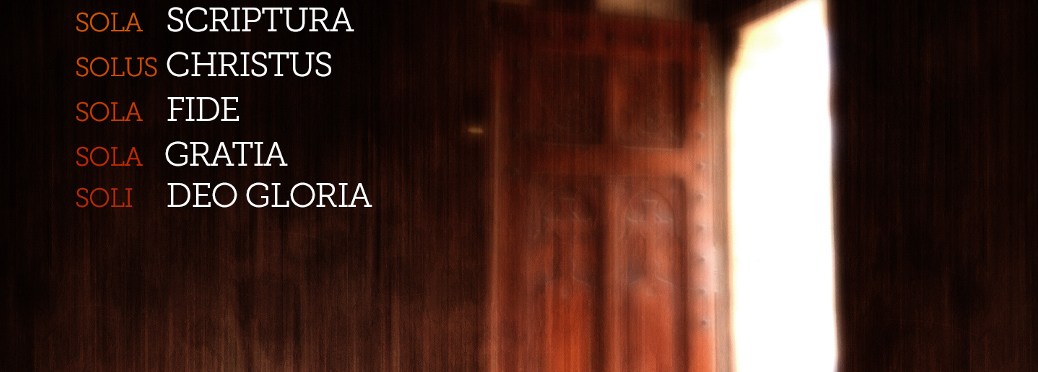
It means to affirm the great “Solas” of the Reformation. (See the Five Solas)
It means to affirm and promote a profoundly high view of the sovereignty of God.
It means to affirm the doctrines of grace. . . to see God as the author of salvation from beginning to end. (See Calvinism)
It means to be creedal. . . to affirm the great creeds of the historic, orthodox church. (See e.g. the Nicene Creed)
It means to be confessional. . . to affirm one or more of the great confessions of the historic orthodox church. (see e.g. the Westminster Confession)
It means to be covenantal. . . to affirm the great covenants of Scripture and see those covenants as the means by which God interacts with and accomplishes His purposes in His creation, with mankind. (see Covenant Theology)
It means to take seriously the Great Commission of Matthew 28:19-20. . . to affirm the primacy of mission and understand that mission.
It means to have a distinctly Christian worldview that permeates all of life.
Just on the surface, I don’t see that Reformed theology changed very much anymore than I think the Reformation 500 years ago changed very much about the basic anti-Israel, anti-Judaism platform of basic Christianity laid down by the “Church Fathers”.
Now let’s get to Dr. Mathison’s article:
The first to believe that Jesus is the promised Messiah are Israelites— Andrew, Peter, James, John. But in the Gospels, we also hear Jesus speak of building His church, and we see growing hostility between the leaders of Israel and Jesus. We hear Jesus speak of destroying the tenants of the vineyard and giving it to others (Luke 20:9–18). In the book of Acts, the spread of the gospel to the Samaritans and Gentiles leads to even more conflict with the religious leaders of Israel. So, is Israel cast aside and replaced by this new entity known as the “church”?
There are those who would say yes, but the answer is not that simple, for we also run across hints that God is not finished with the nation of Israel.
First of all, the word “church” is used anachronistically in this context, and the concept was completely unknown to Rav Yeshua (Jesus) or anyone else in First Century C.E. Israel. One night, nearly two years ago, in a bout of insomnia, I researched the word “church” and found, among other things, that the Greek word “ekklesia” cannot be directly translated as “church” within the context of the Bible. Anyone who does so is taking quite a few theological and linguistic liberties.
But we have a hint here that Mathison may not subscribe to “replacement theology,” at least as we commonly understand it.
Mathison goes through passages of scripture, focusing mainly on Rav Yeshua and Rav Shaul (the Apostle Paul), but then he takes a quick left-hand turn into the Twilight Zone:
During most of the Old Testament era, there were essentially three groups of people: the Gentile nations, national Israel, and true Israel (the faithful remnant). Although the nation of Israel was often involved in idolatry, apostasy, and rebellion, God always kept for Himself a faithful remnant—those who trusted in Him and who would not bow the knee to Baal (1 Kings 19:18). This remnant, this true Israel, included men such as David, Joash, Isaiah, and Daniel, as well as women such as Sarah, Deborah, and Hannah.
Wait! What? “National” Israel vs. “True” Israel? I can see this being abused pretty easily.
The problem is that nowhere in the Tanakh (Old Testament) is this distinction made. Mathison refers to Bible verses such as Luke 2:25-38, Romans 2:28-29, and Galatians 3:16, 29 to define the difference between these two “Israels.”
In a nutshell though, in the “Old Testament,” “true Israel” were those Israelites who did not succumb to idolatry, and in the “New Testament” (Apostolic Scriptures), “true Israel” are those Jews (and arguably Jews and Gentiles) who come to faith in Jesus.
I have a problem sub-dividing Israel into national and true, because when Israel was blessed by God, all of national Israel was blessed, and when Israel was cursed by God (such as being sent into exile), all of national Israel was cursed and sent into exile.
Consider the prophet Daniel and his companions. As he stated in a quote above, Mathison considers them to be part of “true Israel,” and yet, they were sent into exile along with all of the other Israelites.
Also, consider the destruction of Jerusalem and the razing of the Holy Temple by the Romans in 70 C.E. When the Jewish people were exiled from their Land, the “true Israelites” were not allowed to stay while the non-Jesus believing “national Israelites” were exiled to the diaspora.
Now let’s go to something that Mathison neglected to mention, the New Covenant:
“Behold, days are coming,” declares the Lord, “when I will make a new covenant with the house of Israel and with the house of Judah, not like the covenant which I made with their fathers in the day I took them by the hand to bring them out of the land of Egypt, My covenant which they broke, although I was a husband to them,” declares the Lord. “But this is the covenant which I will make with the house of Israel after those days,” declares the Lord, “I will put My law within them and on their heart I will write it; and I will be their God, and they shall be My people. They will not teach again, each man his neighbor and each man his brother, saying, ‘Know the Lord,’ for they will all know Me, from the least of them to the greatest of them,” declares the Lord, “for I will forgive their iniquity, and their sin I will remember no more.”
–Jeremiah 31:31-34 (NASB)
Notice, Hashem, through the prophet Jeremiah, doesn’t say that only “true Israel” will be participants in the New Covenant, but rather the house of Judah and the house of Israel. God calls them “My people” and says He will put “My Law within them” and that “they will all know Me” and that “I will forgive their iniquity.”
While God has interacted with specific individuals among His people Israel, He generally acts toward Israel corporately, as a unit, not cherry-picking this Jew and that one as “true Israel”.
Further…
“Therefore say to the house of Israel, ‘Thus says the Lord God, “It is not for your sake, O house of Israel, that I am about to act, but for My holy name, which you have profaned among the nations where you went. I will vindicate the holiness of My great name which has been profaned among the nations, which you have profaned in their midst. Then the nations will know that I am the Lord,” declares the Lord God, “when I prove Myself holy among you in their sight. For I will take you from the nations, gather you from all the lands and bring you into your own land. Then I will sprinkle clean water on you, and you will be clean; I will cleanse you from all your filthiness and from all your idols. Moreover, I will give you a new heart and put a new spirit within you; and I will remove the heart of stone from your flesh and give you a heart of flesh. I will put My Spirit within you and cause you to walk in My statutes, and you will be careful to observe My ordinances. You will live in the land that I gave to your forefathers; so you will be My people, and I will be your God.”
–Ezekiel 36:22-28
If you read the above-quoted passage carefully, you will see that God mentions two general populations: Israel and the nations. He doesn’t subdivide Israel into “true” and “national”. Again, He addresses Israel corporately and nationally. He will cleanse Israel of her “filthiness,” give Israel a new heart, and put His Spirit within Israel, so that they will walk in His statutes and observe His ordinances. That is, with God’s Spirit within Israel, they will observe the Torah mitzvot as second nature. Their sins will be forgiven. Israel will be perpetually obedient in New Covenant times (which haven’t fully arrived yet, by the way).
OK, Reformists believe that when God said “Israel” he also meant “the Church,” and that everything He promised Israel was also promised to the Church, once it (the Church) was created in New Testament times.
Mathison’s article is rather lengthy (but hey, who am I to talk?) so I’ll cut to the chase. When Paul writes in Romans 11:25 that “all Israel will be saved,” who is “all Israel?”
Charles Cranfield lists the four main views that have been suggested: (1) all the elect, both Jews and Gentiles; (2) all the elect of the nation Israel; (3) the whole nation Israel, including every individual member; and (4) the nation Israel as a whole, but not necessarily including every individual member. Since Paul repeatedly denies the salvation of every single Israelite, we can set aside option (3).
And of these options, which one does Mathison believe represents “all Israel?”
The interpretation of “all Israel” that best fits the immediate context is that which understands “all Israel” as the nation of Israel as a whole, but not necessarily including every individual member of ethnic Israel.
That’s good as far as it goes, but it also, in my opinion, somewhat misses the point. What makes Mathison think that this entity we refer to as “the Church” will exist as such upon the coming of King Messiah?
By stating that Israel and the Church are the same thing, Mathison denies the fact that the Sinai Covenant was made exclusively with the Children of Israel, that is, the biological descendents of Abraham, and of Isaac, and of Jacob, and that non-Israelites could only be admitted to that covenant by assimilating into Israel, typically by intermarrying into the tribes (in modern times, we’d say that they would have to convert to Judaism).
If Mathison believes that Israel = Church and that Church = Israel, then all of the covenants God made with Israel must, by definition apply to Jews and Christians equally.
That means he is either validating the “One Law” proposition, and all we believing non-Jews are obligated to the identical set of commandments of Torah as are the Jews, or that after Jesus “fulfilled” the Torah commandments, they became null and void, since putting your faith in Jesus made it as if you had already fulfilled the Torah and thus, Christ’s righteousness is transferred to you.
That basically destroys the Jewish people as a people group and nation unique to God and effectively, any believing Jew at that point converts to Christianity.
Except that’s not what the New Covenant language in Jeremiah 31 and Ezekiel 36 says. Re-read the text from those parts of the Bible I quoted above. They are worded such that Israel would literally observe the Torah commandments in the New Covenant era, an era which arguably was inaugurated with the life, death, and resurrection of Rav Yeshua, but one that will not be completely realized until our Rav returns as King Messiah.
In other words, this is all future tense. Israel will observe the Torah in the future when Moshiach rules Israel and the world from his throne in Jerusalem. If we are to live as if the King were already on his throne, even though he is still absent, a King in exile so to speak, then one might say Israel, national Israel, that is, the Jewish people, the objects of the Sinai and New Covenants, should observe the Torah commandments now.
This is especially true of Jews in Messiah since they have the “down-payment” of the Spirit, and thus there is greater emphasis to observe the mitzvot based on both Sinai and the New Covenant.
If Church = Israel, then it means Gentile believers in Yeshua should also observe the mitzvot in a manner identical to the Jews.
I don’t believe that’s true, of course, and I’ve written many times on why, including in this summary article about how it’s possible for we non-Jewish people of the nations who have joined ourselves to Israel through Rav Yeshua can benefit from some of the New Covenant blessings.
The conclusion of Mathison’s article reads like this:
The relationship between Israel and the church in the New Testament is not always easy to discern, but it can be understood if we remember the differences between national Israel and true Israel in both the Old Testament and the New, and if we keep in mind what Paul teaches in Romans 11. Israel’s present hardening has a purpose in God’s plan, but this hardening is not permanent. The future restoration of the nation of Israel will involve their re-grafting into the olive tree, the one people of God. The restoration of Israel will mean their becoming part of the “true Israel” by faith in Jesus Christ the Messiah.
In general, Mathison believes that national Israel (though not necessarily each and every individual Jewish person) will be “saved”, that is, merit a place in the world to come, along with the “Church”.
But if I don’t believe there will be a Church when Jesus returns, then who are we and what will we be?
“In that day I will raise up the fallen booth of David,
And wall up its breaches;
I will also raise up its ruins
And rebuild it as in the days of old;
That they may possess the remnant of Edom
And all the nations who are called by My name,”
Declares the Lord who does this.
–Amos 9:11-12
We will be the people of the nations who are called by His Name. OK, “Christian” is easier to say, but that term comes with a lot of baggage; a lot of anti-Semitic, anti-Jewish people, anti-Judaism, and anti-Israel baggage.
That’s why people who think, believe, and behave like me tend to refer to themselves/ourselves by some other “label” than “Christian,” such as “Messianic Gentile” or “Talmid Yeshua”.
Ultimately, Mathison and those Christians associated with Reformed Theology aren’t replacement theorists, and they do believe that in the end all (or most) of Israel will be saved, but I don’t agree that there’s a “true” Israel vs. a “national” Israel. That totally invalidates the vast majority of the Jewish people over the past nearly two-thousand years who have lived and died having true faith in the God of their forefathers and who have declared in the Shema that “Hashem is One.”
It also invalidates the covenants, since every single Jewish person who has ever lived was born into a covenant relationship with God. Every single Jew, not just Jesus-believing Jews.
Mathison doesn’t say it as such, but the feeling I got reading his article was that the Church was at the top of the heap and Israel, because nationally they’ll only come to faith in Jesus in the end, is somewhat “lesser”. I think causality was reversed.
Even Rav Yeshua said “Salvation is from the Jews” (John 4:22), so it is the attachment of the non-Jew to Israel through Rav Yeshua that leads to salvation. Without Israel and her King and without the grace of God, the nations of the world are destined for destruction because we have no covenant status before Hashem (unless you consider Genesis 9 as a binding covenant).
Mathison flirts with some pretty good ideas, he just doesn’t take them far enough. He doesn’t flip the paradigm so that non-Jewish disciples are dependent on our relationship with Israel and her King rather than the Jews being dependent on Jesus and the Church.
I don’t think any body calling themselves “Christian” or “the Church” will ever truly admit that reality this side of the Messianic Era. I think many of those Christians who “get it” finally have to leave their churches, go someplace else, and do something else, while they/we are waiting for the return of the King (though there are those who do hang in there and are able to maintain their balance).
No, I’m not “church-bashing”. During my two-year sojourn in a local, little Fundamentalist Baptist church, I met quite a few men and women who really did have the heart of Jesus, who were doing good, who loved God, who went out of their way to take care of the needy, the hungry, the lonely, and the lost.
I admire these people greatly and aspire to be more like them, because they are more like Rav Yeshua (although they wouldn’t think of him as such).
I just think Christianity needs to go further back into the Bible and completely rethink and reinterpret scriptures while setting aside anything that “the Church” has taught them. This is why I read and understand the Bible from a fundamentally Jewish point of view (as best as I am able, that is). It’s the only way that the overarching message of the Bible makes any sort of sense.
Gather together and I will tell you what will befall you at the end of days.
–Genesis 49:1
Prior to his death, the Patriarch Jacob wished to disclose to his children the future of the Jewish nation. We know only too well what those prophecies were, and Jacob knew that revealing the enormous suffering that the Jews were destined to experience would be devastating to his children. The only way they could hear these things was if they “gathered together” and, by virtue of their unity, could share their strengths.
What was true for our ancestors holds true for us. Our strength and our ability to withstand the repeated onslaughts that mark our history lie in our joining together.
Jacob knew this lesson well. The Torah tells us that “Jacob remained alone, and a man wrestled with him” (Genesis 32:25). Jacob discovered that he was vulnerable only when he remained alone.
-Rabbi Abraham J. Twerski
from the “Growing Each Day” column Aish.com
Someone recently commented in one of my blog posts wondering why I said that “Messianic Gentiles” had no active spiritual life.
I replied that it wasn’t that we didn’t have an active spiritual life, but that our praxis is ill-defined when in relation to Jewish community.
I’d actually read Rabbi Twerski’s commentary before the blog comment, but once I read and responded to the comment, my thoughts turned back to R. Twerski’s statements about Jewish community. Here’s some more about what he said from the same source (see the link above):
Some people feel that they must be completely independent. They see reliance on someone else, be it others or God, as an indication of weakness. This destructive pride emanates from an unhealthy ego. In my book Let Us Make Man (CIS 1987), I address the apparent paradox that a humble person is one who is actually aware of his strengths, and that feelings of inadequacy give rise to egocentricity and false pride.
Not only are we all mutually interdependent, the Torah further states that when we join together, our strengths are not only additive, but increase exponentially (Rashi, Leviticus 26:8). Together, we can overcome formidable challenges.
Of course, R. Twerski is writing to Jews about Jews, but I don’t think it’s much of a stretch to say that the principles he is highlighting apply to the rest of us as well.
However, the “rest of us,” or at least that subset who identify as “Messianic Gentiles,” “Talmidei Yeshua,” or something similar, are really only who we are in relation to (Messianic) Jewish community, or at least (Messianic) Jewish religious thought and teaching. Otherwise, who are we?
We are non-Jews who have chosen to understand and explore our faith by returning said-faith back (as best we can) to its original Jewish context rather than accept the Christian refactoring of the teachings of Rav Yeshua (Jesus) and his emissary to the Gentiles, Rav Shaul (the Apostle Paul), or for that matter, just about anything else in the Bible.
Granted, some writers and teachers within the Messianic Jewish religious and educational space are non-Jews, and they are very helpful in assisting us in understanding ourselves. However, by definition, we Gentiles cannot set aside the “Jewishness” of the context that defines us (although that definition isn’t clearly understood). That context is a large portion of who we are.
And that’s part of the problem.
Another part is that because we are so few in number, it’s pretty hard for a bunch of us to get together and “hobnob,” at least on a regular basis.
Every other Sunday afternoon, I get together with a friend of mine for several hours of coffee and conversation, however not everything we talk about has to specifically do with our common understanding of our faith and praxis.
Yet another part of the “community” difficulty is that although we all may share certain things in common, we are also divided by what we don’t have in common. I’ve probably met or at least know of most or all of the “Messianic Gentiles” in the greater southwestern Idaho area, and in the past, I would meet with a few of them periodically, but we weren’t and aren’t the same, and that lack of “sameness” (and sometimes a radical “differentness”) makes our “community” highly fragmented.
While Rabbi Twerski can reasonably expect to regularly gather with a large or at least significant number of Jews to worship with, study with, and to be in community with (not just religious community, but social, cultural, and national community), the same cannot be said of “Messianic Gentiles”.
It’s one of the things we have in common with Noahides, since there aren’t to many of them around either, and even if they can gather in community with other “righteous Gentiles,” they don’t always live near a significant number of Jews.
I’ve been reminded that Messianic Jews have the same problem, often swimming in a vast sea of secular and religious Gentiles, but without another Jew in sight.
One day, we will all find unity and “ekkelsia” in the Messianic Kingdom, but that day has yet to arrive.
Until then, we must focus on the hub that unites us all through the spokes of the wheel, so to speak, that is, Rav Yeshua. If we have no immediate community, although geographically (and often theologically) apart, we are spiritually united. Although our traditions and doctrine may not always line up with each other, the Messiah has one mind and one heart and after all, God is One.
We may not always see Him or each other in the same way, but He is One and when our Rav returns, our King will correct all of our misunderstandings about Messiah, God, ourselves, and each other.
Faith and trust means being patient, even in isolation, and holding onto the fact that this current world is not forever. The Bible states that all the Jewish people will be returned to their Land, national Israel. It’s one of the tasks of Messiah, and one in which the people of the nations will take part.
Those Jews who find themselves apart from their people and their Land will have unity as the covenant people of Hashem.
We Gentiles, though we live in many different lands and in Messianic Days we will continue to live in our nations, will have one King and one God, and we will also be brought to a place of unity and peace.
Rabbi Twerski ended his column by stating:
Today I shall…
…try to join with others in strengthening Judaism and in resisting those forces that threaten spirituality.
We should try to do the same thing in relation to our faith in God and in trusting our Rav, and if we can’t join with others in this mission, then at least we can do this within ourselves.
We are vulnerable when alone, but if we don’t have a body with which we can join, then as long as we turn to God, we can never be alone, and in Spirit, we are also with each other.
I don’t think there’s any more important text in all the New Testament that defines the work of Jesus than this one. That Jesus was sent to fulfill all righteousness. And what that meant to the Jew was to obey every jot and tittle of the Law. Because now Jesus is not acting in His baptism for Himself, but for His people. And if His people are required to keep the Ten Commandments, He keeps the Ten Commandments. If His people are now required to submit to this baptismal ritual, He submits to it in their behalf. Because the redemption that is brought by Christ is not restricted to His death on the cross.
-R.C. Sproul
“Jesus and His Active Obedience”
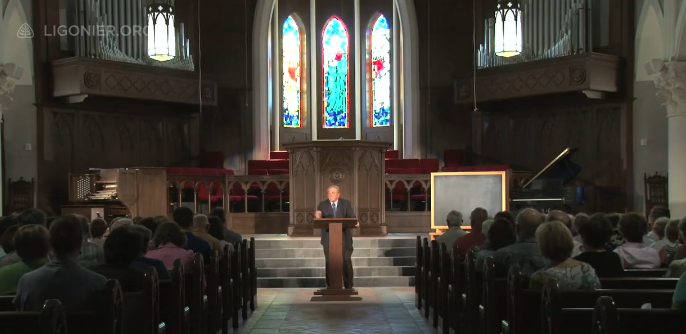
from an excerpt of his teaching series, “What Did Jesus Do?” Ligonier.org
The video and transcript (you can access both by clicking the link above) were posted online on February 16th, and a Facebook friend (amazingly, someone I’ve actually met once face-to-face) posted the video and some commentary on his own Facebook page (I’m sorry I can’t actually embed the video into this blog post, since I can only find code to do that compatible with YouTube).
I don’t normally weigh in on this sort of thing, and I’ve been trying to distance myself from constantly reviewing and criticizing Christian sermons and teachings, but I’ve heard of Dr. Sproul before in relation to John MacArthur’s “Strange Fire” conference of a few years back, and I even reviewed Sproul’s Strange Fire sermon, so naturally, I was curious.
Image: Ligonier.org
The video is less than four-and-a-half minutes long, so I figured it wouldn’t take up too much of my time to hear what he had to say. Besides, the people commenting on this snippet seemed mostly favorable of it.
Sproul offered two competing doctrinal positions as the core of his sermon: Passive Obedience and Active Obedience.
In Passive Obedience, all Jesus had to do was obey God by suffering the pain and curse of dying on the cross so that we would all be absolved of our sins. Our sins are transferred to Jesus, he takes on the penalty of death for all our sins so that we don’t have to die, and we become innocent before God.
Sproul says we would be innocent but not righteous, sinless but with no track record of obedience, and thus not able to become righteous.
So what has to happen to make us innocent and righteous?
Sproul doesn’t think Jesus had a three-year ministry for nothing. In those three years, post his baptism by water and the Holy Spirit, Jesus lived a life consistent with Jewish religious and lifestyle praxis, but doing so perfectly, observing all of the mitzvot that applied to him as a Jewish male living in Israel during the late Second Temple period with an active Levitical priesthood and Sanhedrin court system (a lot of the mitzvot can’t be obeyed by a Jew living outside of Israel or in the absence of the Temple, the priesthood, and the Sanhedrin).
Active Obedience, according to Sproul, is Jesus deliberately observing all of the relevant mitzvot perfectly and without fault, failure, or even an occasional omission. He did so because his Jewish people were unable to be perfectly obedient. Thus Jesus was obedient for his people. His righteousness transferred to the Jewish people making it as if they had been perfectly obedient.
So what’s all that got to do with the rest of us, that is, we non-Jewish believers?
Sproul skips over the impact to Jewish Israel and goes into what this does for the modern Christian:
What does Jesus do? He obeys the Law perfectly, receives the blessing, and not the curse. But there’s a double imputation that we will look at later at the cross, where my sin is transferred to His account, my sin is carried over and laid upon Him in the cross. But in our redemption, His righteousness is imputed to us—which righteousness He wouldn’t have if He didn’t live this life of perfect obedience. So what I’m saying to you is that His life of perfect obedience is just as necessary for our salvation as His perfect atonement on the cross. Because there’s double imputation. My sin to Him, His righteousness to me. So that, that is what the Scripture is getting at when it says Jesus is our righteousness.
So somehow, Christ’s perfect obedience of the mitzvot, which made him perfectly righteous, transfers to us, we non-Jewish believers in Jesus, while his death on the cross allows our sins to be transferred to him, and thus Jesus died in our sins so we wouldn’t have to pay the penalty ourselves.
A nice, neatly wrapped little package. However, the package has a few holes in it.
Sproul didn’t tie any of this back to the New Covenant, particularly the New Covenant language we find in Jeremiah 31 and Ezekiel 36, nor did he account for the fact that Jeremiah 31:31-34 states that the only two named participants of the New Covenant are the House of Judah and the House of Israel. The non-Jewish nations are not included (it takes a lot of study to actually find the connection, so you might want to review this summary for some of the details).
So how can Christ’s righteousness because of his Torah obedience have anything to do with us? At best, it would transfer to the Jewish people across all time because he perfectly obeyed the mitzvot when Jewish people aren’t always perfect (who is?).
Sproul also missed this definition of righteousness:
Then he believed in the LORD; and He reckoned it to him as righteousness.
–Genesis 15:6 (NASB)
Granted, the issue of righteousness is more complex than this, but it would seem that at its core, having full trust in God is the very essence of righteousness. Everything else flows from that trust.
Beyond all this, Sproul doesn’t say what happens to Torah obedience post-crucifixion, resurrection, and ascension. If Sproul is a traditional fundamentalist Christian Pastor, he most likely believes that once Jesus “fulfilled” (annulled) the Sinai covenant God made with Israel, it ceased to have any continued function for the Jewish people. Since no one but Jesus could keep the commandments perfectly, no one could earn perfect righteousness on his or her own.
Nor did they need to. All they had to do was come to faith in Jesus Christ, his obedience to God through the Torah, and his atoning death on the cross, and he or she would merit full righteousness and total forgiveness of sins (In other words, Jewish people would have to give up Jewish religious practice, stop being Jews, and convert to Christianity, all in order to worship their own Jewish King).
Sproul does weave a tale that has Jesus living the life of a totally obedient and observant Jew, but only for the purpose of attaining perfect righteousness that could then be transferred to his believers.
If you are a regular reader of this blogspot, I’m sure you realize that I disagree with Dr. Sproul about the nature of the covenants and the part the New Covenant plays in the ultimate redemption of the Jewish people and national Israel.
I told one of my sons the other evening (his mother is Jewish, so he’s Jewish) that Jews are the only people who are born into a covenant relationship with God whether they want to be or not.
I realize that, relative to Genesis 9 and the Noahide covenant, the same could be said for all humanity, but most of humanity doesn’t know and doesn’t care about the covenant God made with Noah and its presumed relevance to us today.
On the other hand, even a secular Jew is at least aware of the Mount Sinai event, the covenant made by Hashem, and the stated set of responsibilities and obligations the Jewish people have to God, to the Torah, to the Land of Israel, to humanity, and to the planet. They just choose to disregard those responsibilities (or most of them) for whatever reason.
Rav Yeshua (Jesus) is the mediator of the New Covenant. Yeshua’s coming was indeed a pivotal point in not only the history of the Jewish people, but human history. He came as a messenger to demonstrate that all of the New Covenant promises God made to Israel would indeed come to pass over the course of time. Hashem sent Yeshua to make a partial payment on those promises.
He also said that the sign of the New Covenant is the outpouring of the Holy Spirit, which we see famously in Acts 2 with the Jewish Apostles and Acts 10 with the Gentile Cornelius and his entire household. We also know from 2 Corinthians 3:3, 2 Corinthians 5:5, and Ephesians 1:13-14 that the Holy Spirit given to believers is but a down-payment, a token, a small deposit on the whole sum that will not be delivered in full until the resurrection.
Click the link above to find out more about the purpose of Rav Yeshua’s life in Israel, walking among his people, observing the mitzvot, and developing a following as a Rav.
I don’t mean to bang on Dr. Sproul. He’s probably a very nice man who really believes everything he says, but without the slightest thought to what it does to the Jewish people, the primacy of Israel in God’s redemptive plan, and all of the “Old Testament” prophesies that don’t happen to jibe with what he believes about Jesus.
I can’t allow myself to care about all of the different opinions out there that don’t agree with mine held by hundreds, thousands, or tens of thousands of Christian Pastors worldwide, whether their influence extends only to the four walls of their local church or, like Sproul, whose influence extends to anyone with Internet access. If I let all that bug me, I’d probably go nuts.
But some people who I know or at least am acquainted with, seem to think Sproul has the corner market on the purpose of Jesus relative to the Torah, to the Jewish people, and to the Christian Church. I don’t believe, for the reasons I stated above, that Sproul is teaching a Biblically sustainable doctrine in this short video excerpt (and that statement probably sounds astonishing to some).
I’m writing this to say there’s another way to look at scripture that I think is more sustainable and that takes all of the Bible into account as a single, unified document. No carving up or allegorical interpretations are required.
"When you awake in the morning, learn something to inspire you and mediate upon it, then plunge forward full of light with which to illuminate the darkness." -Rabbi Tzvi Freeman

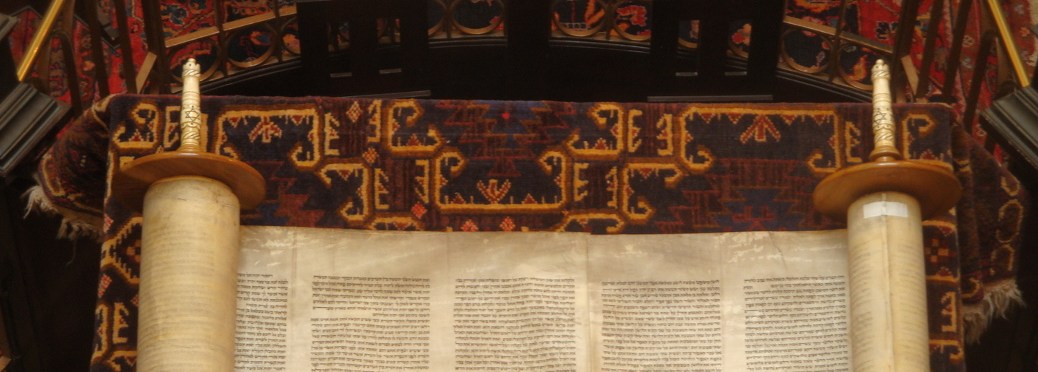

 As with many other questions I bring up, I don’t have a hard and fast answer for you. Interestingly enough, this brings us back to Rabbi Hoffman’s brief essay:
 If I study Torah as I understand it and don’t adopt the praxis of Judaism, I can’t be as strongly influenced to confuse Judaism with my identity and role as God created them for me. I also can’t be accused (as sometimes occurs) of misappropriating the things unique to the covenant relationship between Hashem and the Jewish people, such as Shabbat, Kosher, the prayers, donning a tallit gadol, or laying tefillin.














 Morning Meditations