Book Review of J.K. McKee’s “One Law for All,” Part 2

Much of this discussion has been focused around passages of the Torah detailing “one law” or “one statue” to be followed by the native Israelite and the sojourner (Exodus 12:48-49; Leviticus 24:22; Numbers 9:14; 15:15-16, 29-30). The majority of these passages actually pertain to specific legislation, where a uniform set of instruction needed to be followed. What these passages establish in a wider, theological and philosophical sense, has caused interpreters to draw a number of conclusions. Traditional Judaism widely interprets the “one law” passages as implying that the ger in Ancient Israel was only anticipated or expected to keep a minimum amount of Torah commandments, and this is followed by many of today’s Messianic Jews. Others in the broader Messianic community have held to the position that while the native Israelite and sojourner are not exactly the same, there are too many areas of equivalence, and that the sojourner was anticipated to keep the considerable bulk of the Torah’s commandments, which for many in ancient times would inevitably lead to circumcision and native status being granted.

-J.K. McKee
“Associated FAQs on the One Law Debate,” p. 130
One Law for All: From the Mosaic Texts to the Work of the Holy Spirit

This is the second part of my two-part review of McKee’s book (I published Part 1 yesterday). As I mentioned, his arguments regarding what he refers to as “Divine Invitation,” “Covenant Obligation,” and “Supernatural Compulsion” regarding how a non-Jewish disciples of the Jewish disciple should respond to the Torah mitzvot (at least within the community context of Messianic Judaism or Hebrew Roots) form the foundation of his book.

McKee advocates for the “Supernatural Compulsion” argument based on the New Covenant language found in Jeremiah 31 but, as I mentioned yesterday, since the Torah isn’t actually written on anyone’s heart yet and won’t be until the second advent, his stated motivation for a Gentile “keeping Torah” does not yet exist.

McKee dedicates about the first third of his book to explaining in great detail the passages in the Torah (listed above) related to “one law” and how the gerim or (Gentile) resident aliens among Israel were to be included and treated identically to the native Israelite in certain matters, usually related to ritual sacrifice. As McKee himself rightly states, all of the “one law” passages are conditional and do not describe a blanket commandment for Gentiles to simply enter ancient Israel and automatically be treated as a native in every single way.

I give “props” to McKee for his obviously detailed research and dedication to the topic of “one law” in ancient Israel but it almost doesn’t matter. Those passages cannot anachronistically be applied either to the Gentiles entering the Jewish worship stream of “the Way” in the first century C.E. or to we Gentile Christians, Messianic Gentiles, or Gentile One Law devotees today.

McKee even gives us the clue as to why:

…that the sojourner was anticipated to keep the considerable bulk of the Torah’s commandments, which for many in ancient times would inevitably lead to circumcision and native status being granted. (emph. mine)

I have long since asked and answered the question Whatever Happened to the Mixed Multitude and McKee has also just answered it. The commandments related to “one law” and the gerim (resident aliens) were originally created to deal with the “mixed multitude” of people (probably fellow slaves of various nationalities) who came with the Israelites out of Egypt. If they didn’t want to return to their own countries and desired to stay with Israel, what was to be done with them?

Eventual assimilation.

“You shall not detest an Edomite, for he is your brother; you shall not detest an Egyptian, because you were an alien in his land. The sons of the third generation who are born to them may enter the assembly of the Lord.”

–Deuteronomy 23:7-8 (NASB)
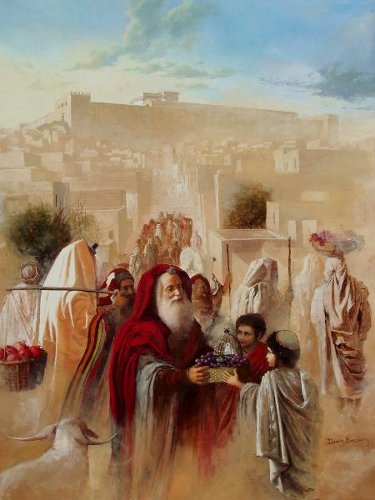
ancient_jerusalemThis is why the “one law” passages in the Torah can never be used to justify Gentile “obligation” to Torah observance in the manner of the Jewish people among Christians in Messianic Judaism or Hebrew Roots today. They do not apply. This method of assimilation was designed to allow the resident alien, who would never be an Israelite, to enter a path so that their grandchildren would be admitted into the Israelite nation as a native. There was never an intention of a sustained multi-generational presence of Gentiles who remained Gentiles and yet were otherwise treated exactly like Israelites including in their observance of all of the mitzvot.

With the passage of time, the gerim were assimilated culturally and religiously. Doeg the Edomite, for instance, was a worshiper of YHWH by the time of Saul (I Sam. 21:8), as was Uriah the Hittite in the reign of David (II Sam. 11:11). Hence, the ger, in contrast to the nokhri, was required in many cases to conform to the ritual practices of the native Israelite. Thus, gerim were subject to laws dealing with ritual purification (Num. 19:2–10), incest (Lev. 18:26) and some of the food taboos (Lev. 17:10–16; but cf. Deut. 14:21). They were expected to observe the Sabbath (Ex. 20:10; Deut. 5:14), participate in the religious festivals (Deut. 16:11, 14), and fast on the Day of Atonement (Lev. 16:29). They were permitted to offer up burnt offerings (Lev. 17:8; 22:18; Num. 15:14ff.) and, if circumcised, even to sacrifice the paschal lamb (Ex. 12:48–49; Num. 9:14). Indeed, they, no less than the Israelites, were expected to be loyal to YHWH (Lev. 20:2; cf. Ezek. 14:5–8).

-from “Strangers and Gentiles”
Jewish Virtual Library

If you click on the link I provided just above, you can read a more detailed treatment of the subject from a Jewish point of view, but as we can see in the above-quoted paragraph, there is a long history of gerim entering Israel as resident aliens and as they married and had children, eventually their descendants were assimilated into Israel and their Gentile past was forgotten.

In order for any “one law” portions of the Torah to apply to Gentiles today relative to their (our) status among Jewish believers and our duty to the Torah mitzvot, there would have had to have been a sustained presence of Gentiles among Israel who continued, generation by generation, to remain Gentiles and yet to observe the commandments in the manner of the Israelites…

…and that population never existed. It’s as if McKee wasted the first third of his book making an argument that in the end doesn’t matter.

The later part of the book has a section called The Torah Will Go Forth from Zion and specifically analyzes the impact of Micah 4:1-3 and Isaiah 2:2-4 on the Messianic and One Law communities today. McKee does well in his description of these nearly identical portions of scripture up to a point. Then he tries to force Ephesians 2:11-12 and 3:6 into the picture.

Let’s have a look. I’ll use the NASB translation:

Therefore remember that formerly you, the Gentiles in the flesh, who are called “Uncircumcision” by the so-called “Circumcision,” which is performed in the flesh by human hands—remember that you were at that time separate from Christ, excluded from the commonwealth of Israel, and strangers to the covenants of promise, having no hope and without God in the world.

…to be specific, that the Gentiles are fellow heirs and fellow members of the body, and fellow partakers of the promise in Christ Jesus through the gospel…

–Ephesians 2:11-12, 3:6

Now here’s part of McKee’s commentary (pp. 112-13)

Later questions posed in the Apostolic Scriptures, such as whether or not the nations of the Earth are somehow made a part of Israel’s polity by acknowledging the Messiah…

IsraelThis does and doesn’t seem to say that the rest of the nations of the Earth somehow “become” part of Israel, as if national Israel expands to encompass those nations, eliminating their former identities (America, Canada, Japan, China, and so on) and simply all becoming “planetary Israel” if you will.

McKee spends a great deal of time in this part of his book, which supposedly addresses Micah 4:1-3 and Isaiah 2:2-4, on the effort of including the nations as part of Israel rather than vassal nations serving Israel and her King in the coming Messianic Age, and his most outrageous statement is this:

…but it forms the thrust of what it truly means for born again Believers to truly make up the “one new humanity” (Ephesians 2:15, NRSV/CJB) that the Lord wants to see emerge. Nowhere in the Bible do we ever see the implication that the community of Israel is to remain an exclusively Jewish entity… (emph. mine)

-p. 122

I thought I was done having to tolerate the Christ at the Checkpoint anti-Israel diatribes for this year. This is the worst possible example of anti-Semitic, anti-Jewish Israel in Christian rhetoric. It’s doubtful McKee meant to come off that way. He sometimes tries to bend over backward to establish mutual respect of Christianity and Judaism. But the implications of his statement are both startling and dismaying. It’s like finding the spirit of Haman in the Church. Even the Koran claims that Israel belongs to the Jews.

And just so you don’t think I’m exaggerating, here’s a quote from the Christ at the Checkpoint Conference About Us page:

Any exclusive claim to land of the Bible in the name of God is not in line with the teaching of Scripture.

Do you see the parallels between the two statements?

McKee seems to be invoking the Wesleyan philosophy of “mutual submissiveness” and any theology that makes one party in the Messianic Ekklesia somehow superior to or even different (though equal) from another violates this principle. The idea is that Jews and Gentiles in Messiah are mutually dependent upon each other.

I actually agree with that part of it as far as it goes and as was stated by Rabbi David Rudolph in the first chapter of his (and Joel Willitts’) book Introduction to Messianic Judaism: Its Ecclesial Context and Biblical Foundations, but equality does not mean uniformity. I think McKee is forgetting that Jesus is coming back as a King! As his subjects, we will serve the King of Israel, he won’t be as submissive to us as we are to him. Also remember:

For thus says the LORD, “Sing aloud with gladness for Jacob, And shout among the chief of the nations; Proclaim, give praise and say, ‘O LORD, save Your people, The remnant of Israel.’ (emph. mine)

–Jeremiah 31:7 (NASB)

If Israel is the “chief” or the “head of the nations,” that means two things: 1). Israel is the leader of all the nations and the other nations of the Earth are subservient to Israel, and 2). There are other nations besides Israel in the Messianic Kingdom.

politeiaEven a quick reading of Micah 4:1-3 and Isaiah 2:2-4 lets us recognize language such as “the peoples” and “many nations” in contrast to national Israel. If we all become “Israel” and “every knee shall bow” (Romans 14:11; Philippians 2:10), then there can be no other nations, only Israel with a citizenry that is multi-ethnic containing the remnant population of the entire world all as Israelis. Too many Messianic prophesies, including those cited by McKee, specifically mention Israel and the nations.

All this hinges on a single word in ancient Greek: Politeia (πολιτεία). However, I refuse to create an entire theology based on one word that’s used once in only one of Paul’s letters.

McKee’s logic is typical of the one law argument:

  1. Politeia means “citizen”
  2. Gentile believers are citizens of Israel
  3. As citizens of Israel, Gentiles must obey the same national laws as the Jews, that is, the Torah

That’s probably too simple, but you get the idea. Except that the meaning of being separated from citizenship into (or the commonwealth of) Israel is assumed. Verse 13 states, ” But now in Christ Jesus you who formerly were far off have been brought near by the blood of Christ.” At least in English, being “brought near” is not the same as “being made identical to.”

Also, Ephesians 3:6 speaks of Gentiles as “fellow heirs and fellow members of the body,” but “body” is not the same thing as “nation”. What body?

…so we, who are many, are one body in Christ, and individually members one of another.

–Romans 12:5 (NASB)

Now you are Christ’s body, and individually members of it.

–1 Corinthians 12:27 (NASB)

Put together, what does it all mean? I believe it means we Gentiles, though our faith in Messiah and his atoning sacrifice for humanity on the cross, have been brought into the blessings of the promise of the New Covenant, which includes the forgiveness of sins, reconciliation before God, justification, receiving the Holy Spirit, and heirs of the resurrection and a life in the Messianic Kingdom.

If I have to define my citizenship, I’d have to say that it’s in the promise of what is yet to come in the Kingdom of Messiah, and this Kingdom encompasses the entire planet which will be made up of Israel as the head of all the nations, and then all of the vassal nations that serve Israel and her King.

In that light, I can either choose to let “politeia” be a sticking point or I can factor it in to the larger Biblical panorama and let the overarching plan of God for Israel’s redemption and through her, the redemption of the world tell its own story.

Conclusion

There’s a lot more I could say (I took very detailed notes when reading McKee’s book) but the bottom line is whether or not McKee convincingly made his point that the “one law” passages of the Bible can be applied to modern Christianity as viewed through the New Covenant lens, resulting in a fused or near-fused national identity of Jews and non-Jews as a “Torah-observant Israel”.

As I mentioned, McKee did not convince me that the “one law” passages of the Torah are in any way relevant to modern believers because they were applied in a historical and cultural context that no longer exists. Therefore, “one law” cannot be factored directly into the New Covenant promises and the inclusiveness of the nations in the blessings of those promises.

While I find McKee’s application of “one law” as a “supernatural compulsion” compelling, especially given my own attraction to Jewish studies and practice, I can’t accept that the Messianic Age has already arrived, which is what would have to occur for that “compulsion” to be a result of the “Torah written on the heart.” The best I can give him here is that it is quite possible we will all be living more jewishly in the age to come, but I don’t believe that drive can be seen in the majority of Christians today.

That said, even McKee admits that Christians in the Church today are obedient to eighty or ninety percent of the Torah commandments that can be obeyed today, so perhaps the “compulsion” to obey God’s Torah is more evident than I imagine. Add to that Gentiles like me who seem naturally attracted to Jewish practices and the study of Messianic Judaism as the proper lens for viewing the Bible, and I could even say that a sort of “one law” viewpoint is one way we see evidence of the approach of the Kingdom of Heaven and the Holy Spirit preparing us for the promises of what is yet to come (not, as you can imagine, that I am advocating for “one law” as the best possible application).

And remember, even McKee says he can’t really answer when or how Christians will turn toward the Torah of Moses and the ways of God or even what that will exactly look like.

McKee’s comparison of Micah 4:1-3 and Isaiah 2:2-4 to sections of Ephesians 2 and 3 somehow establishing a worldwide citizenship in national Israel made up of a multi-cultural population just doesn’t play. In order to make it work, his protestations aside, he has to diminish God’s promises to Jews as the exclusive citizenry and possessors of Israel.

J.K. McKee
J.K. McKee
Photo Credit: Congregation Netzar Torah Yeshua

McKee’s book is an interesting but ultimately disjointed “patchwork quilt” of Evangelical and Wesleyan Christianity and Jewish practice that just doesn’t fit together (and that said, I did enjoy reading it). In denigrating certain parties within Messianic Judaism, he also reduces Jewish influence on their own  sovereignty and history, both past and future. The idea that Israel was never meant to be the sole property of the Jewish people in perpetuity completely violates God’s promises to Abraham, Isaac, and Jacob. In imposing “mutual submissiveness” as a cardinal value in Gentile/Jewish Messianic community, he misses that Kings and Kingdoms are not “mutually submissive” but in fact, Kings rule subjects and we are his subjects.

I admire McKee’s apparent effort in his scholarly investigation into the topic and his willingness to challenge the established norms typically associated with One Law practitioners. I also, as I’ve said before, appreciate his high view of the Church and his respect for traditional Christians and the history of the saints, but his even-tempered viewpoint in these areas does not successfully make all the mismatched moving parts in this theory and theology work together.

A final note. Please understand that this doesn’t mean I don’t like McKee (I don’t even know him) or that I am saying Gentiles shouldn’t appreciate or even perform some practices that are typically considered Jewish (observing a form of Sabbath, dietary restrictions, building a sukkah). There are a variety of reasons for doing so (such as being intermarried). I’m just saying, as a reviewer, that I do not believe McKee made a sufficiently convincing case based on his research, interpretation, and presentation. Your mileage may vary.

Addendum: Pete Rambo just published Part 2 of his review of McKee’s book.
Book Review of J.K McKee’s “One Law for All,” Part 1

When I write a book review, I normally start at the beginning of the book and move through to the end. I don’t know why. I guess I’m just kind of linear that way. But J.K. McKee’s book One Law for All: From the Mosaic Texts to the Work of the Holy Spirit was organized in such a way that I decided to start in the middle and work my way out from there.

A little background. McKee in the center of his work, is comparing what has been called “Divine Invitation” (which is an unfortunate label for reasons I’ll address later in this review) with “Covenant Obligation”. These are difficult issues to discuss with a general audience since they require a great deal of specialized knowledge and tend to apply to only very small subgroups within both Christianity and Judaism, specifically movements called Hebrew Roots and Messianic Judaism.

The question, within those particular contexts, is whether non-Jewish believers in Jesus as the Jewish Messiah, are allowed to observe some, most, or even all of the commandments in the Five Books of Moses, also known as the Pentateuch in Christianity and the Torah in Judaism, or if Christians are actually under a covenant obligation to observe all of these commandments exactly or at least more or less like religious Jewish people?

I should say that even addressing what this sort of observance looks like, regardless of it being voluntary or mandatory, is highly variable. How the mitzvot (commandments) are to be observed aren’t always agreed upon even between different branches of Judaism. And particularly in Hebrew Roots, there’s a tendency to believe one can disregard any Jewish authority or opinion regarding how one is to perform a mitzvah and choose your own method based on whatever reason you want as long as you deem it “Biblical.”

In the introduction to the book (p. x), McKee states:

It can be definitely said that a ministry like Outreach Israel and TNN Online adheres to a One Law position, after a fashion.

Here’s where things start to get interesting. Unless otherwise stated, all emphasis in a quote from the “One Law” book belong to McKee.

A question that I have been asked by more than a few people is which option they are to choose: Is the Torah a Divine Invitation to non-Jewish Believers, or is it a Covenant Obligation upon non-Jewish believers? Is the Torah mandatory for Jews to follow, and an option for non-Jews to follow? Or is the Torah something mandatory for all of God’s people to follow?

-McKee, p. 83

First Fruits of Zion (FFOZ) Founder and President Boaz Michael coined the phrase “Divine Invitation” some years ago in explaining how FFOZ had shifted its theological stance from supporting a single standard of observance for both Jewish and Gentile Messianic believers to a viewpoint that advocated Jewish distinctiveness and the understanding that certain of the mitzvot are exclusively reserved for the Jewish people. He never intended it to become a theology all its own but unfortunately, the label stuck. The idea is better expressed as Gentiles in Messiah indeed being obligated, but to a certain subset of the Torah commandments (see Toby Janicki’s article “The Gentile Believer’s Obligation to the Torah of Moses” in the Winter 2012 issue of Messiah Journal for a detailed discussion on this matter) as opposed to a single, uniform application of the mitzvot for all human beings.

McKee’s commentary seems to assume that a Gentile is obligated to exactly zero Torah commandments or all of them, with no variability based on covenant role, identity, nationality, gender, geolocation, and so on.

McKee opposes the position of “divine invitation” which I expected, stating that it is bound to be confusing to non-Jewish Messianics relative to which parts of the invitation to accept, which parts to turn down, and just how one accepts the various invitations (do Gentiles have to perform an accepted mitzvah in exactly the same way as a Jewish person?). At one point in his criticism of this “theology,” he seems to attack Jewish Torah observance as well, replacing it with a more “Christian” concept of “Jewish identity”:

More importantly, though, if there is anything seriously being overlooked about the unique distinctiveness of Jewish people, it is that “salvation is from the Jews” (John 4:22), with Yeshua the Messiah Himself being the quintessential Jew. This is far more significant than Torah-keeping being what apparently makes the Jewish people distinct.

-ibid, p.85

Just a few paragraphs later however, he surprises me by saying something I more or less agree with.

For Messianic Believers today, our family has always emphasized the need to love people into this — rather than issue condemning and mean-spirited words. Much of the “pagan” rhetoric that one sees in fringe parts of the Messianic world has significantly impeded progress for the Kingdom of God, and is a major blight that is not spoken against enough. Yet at the same time, if Divine Invitation presents Shabbat, the appointed times, or kosher eating as entirely optional, what is keeping someone from turning it down?

-p. 86

one law bookThe only parts I didn’t agree with were McKee’s identifying the “pagan rhetoric” against the Christian Church as originating in the “Messianic world”. I organize Messianic Judaism and Hebrew Roots (One Law is a subset group within larger Hebrew Roots) as two separate movements with only a superficial overlap, usually at the level of the non-Jewish believer who is attracted to Judaism to some degree. I don’t typically hear Messianic Jews or Gentiles denigrate Christianity and find the “pagan rhetoric” confined to certain circles within Hebrew Roots (although, to be fair, as McKee said, they are “fringe parts” of the movement or even “fringe individuals”).

The other part I question is if something is considered an option, then there’s nothing preventing a person from saying, “No, I don’t feel led to do that.” That’s what optional means. You don’t have to. McKee’s commentary about Christians and Torah observance becomes confusing and even mysterious just a few pages later.

But before that, in addressing Covenant Obligation, McKee says:

If Believers are “obligated” to “keep Torah,” then this can quite easily lead to a few people thinking that their Torah-keeping will earn them their salvation, and can manifest itself in rather rigid and legalistic assemblies forming.

-ibid

Born again Believers are not required to keep God’s Torah as though it were some kind of debt or obligation (cf. Galatians 5:3); on the contrary, we are told, “Owe nothing to anyone except to love one another; for he who loves his neighbor has fulfilled the law” (Romans 13:8).

-p. 87

On the one hand, I was pleasantly surprised to see a supposed One Law proponent recognize some difficult truths about the movement, but on the other hand, he had to denigrate all Torah observance, even for Jewish believers, by saying loving one’s neighbor fulfills (abrogates, demolishes, deletes) the law. McKee seems to miss the nuances Paul is injecting into Romans 13 and how they connect back to what Jesus calls “the Two Greatest Commandments” (Matt. 22:35-40; Mark 12:28-31; Luke 10:25-28 citing Deut. 6:4-5 and Lev. 19:18).

But that can’t possibly be what McKee’s saying because of the major theme of the book, which is to advocate for Torah observance for Gentiles. I find this author to be a sometimes confusing blend of One Law and Wesleyan perspectives (McKee states that he had a Wesleyan upbringing to which he apparently still adheres) and as I was reading through the rest of this section, I started to think of him as a “One Law Wesleyan.”

McKee continued to defend the Church and to criticize One Law adherents for throwing Christianity under the bus, so to speak:

I have constantly asked various individuals who are “One Law” why they criticize elements of today’s Church who follow well over ninety-percent of the Torah that can be followed today, and why they treat our Christian brothers and sisters as some kind of perpetual “enemy.”

-p. 88

This is one of McKee’s confusing messages. He defends the Church as it is and states they are already observing most of the mitzvot, and yet he is pushing (apparently) for greater “jewishly” Torah observance by (One Law) Christians.

Further…

Our ministry has never advocated that today’s evangelical Christianity is some kind of illegitimate impostor religion, more in touch with accomplishing the objectives of the Adversary than in achieving the mission of God. We have advocated that the Church has flaws to be certain, but that it is the responsibility of Messianic Believers to build on a positive legacy of faithful Christian men and women who have preceded us in the faith…

p. 93

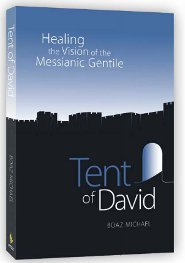
The last paragraph I quoted was startling to me because it reminded me of what Boaz Michael wrote in his book Tent of David: Healing the Vision of the Messianic Gentile:

The church is good but the church needs to change.

Tent of DavidI’ve written a number of different commentaries on his book including this one, and acknowledge that what Boaz produced challenged me personally to set aside my discomfort about going back to church and to “take the plunge,” which was nearly two years ago. Boaz was instrumental in getting me to see what is good in the Church, which is the same message McKee is delivering.

I applaud McKee for maintaining a high view of Christianity and the faithful men and women in the Church, which he acknowledges is practically unknown within One Law communities, but if he does not advocate for One Law anymore than “divine invitation,” and he apparently does not identify with mainstream Christian assembly (although he protects and defends Christians), what else is there that could be considered “One Law”?

As it turns out, McKee’s third viable option is:

Obeying the Lord is neither an optional invitation nor a mandated obligation, it is a supernatural compulsion enacted by the perfecting activity of the Holy Spirit on the human soul.

p.91

I’m disappointed. I expected a much stronger approach to his application of One Law. But this is like just redressing the One Law argument in spiritual rather than covenantal language. The Holy Spirit (supposedly) compels the individual to desire to observe the 613 commandments or something like them, give or take your opinion on the halachah established by the various Rabbinic sages in the numerous streams of Judaism across thousands of years of history.

Actually, I know where he’s getting this:

“Behold, days are coming,” declares the Lord, “when I will make a new covenant with the house of Israel and with the house of Judah, not like the covenant which I made with their fathers in the day I took them by the hand to bring them out of the land of Egypt, My covenant which they broke, although I was a husband to them,” declares the Lord. “But this is the covenant which I will make with the house of Israel after those days,” declares the Lord, “I will put My law within them and on their heart I will write it; and I will be their God, and they shall be My people. They will not teach again, each man his neighbor and each man his brother, saying, ‘Know the Lord,’ for they will all know Me, from the least of them to the greatest of them,” declares the Lord, “for I will forgive their iniquity, and their sin I will remember no more.”

–Jeremiah 31:31-34 (NASB)

Unfortunately, McKee has a couple of problems. The first is that the New Covenant was made exclusively with the House of Judah and the House of Israel and does not presuppose any other nations or people groups at all (least of all he and me). Yes, there is a New Covenant application for Gentiles which I summarized here, but up to this point in the book, while McKee mentions various aspects of the New Covenant, he jumps from Jeremiah 31 straight to the Last Supper (Matt. 26:17-30; Mark 14:12-26; Luke 22:7-39; and John 13:1-17:26) without making the connection explicit. I know how it works (and it took me months of study to figure it out) but chances are many of McKee’s readers don’t (or they don’t understand it correctly).

The other major problem is that the New Covenant hasn’t been fully enacted yet. It’s not here. Jesus inaugurated it with his life, death, and resurrection, but until his return, we are only living in what you might consider the leading edge of the Messianic Age. What that means is until the resurrection and until Messiah returns to us here on Earth and ascends the Throne of David in Holy Jerusalem, we are still living in Old (Sinai) Covenant times!

So we don’t have the Torah supernaturally written on our hearts yet and thus, neither Jews and certainly not Gentiles have the Holy Spirit granted ability to naturally obey God and never sin, which is what the New Covenant is all about…the forgiveness of all sins and the ability to never sin again and obey God’s law (as it applies to each individual and each people group).

And yet he says:

A position of Supernatural Compulsion does advocate that a Torah obedient walk of faith is expected of all God’s people but it is to be found as an individual grows in holiness and spiritual maturity…

-McKee, ibid

While “expected” and “obligated” sound really similar to me, I like that, at least, McKee is acknowledging not everyone is going to adopt the various mitzvot at the same rate or to the same degree. It’s a matter of spiritual growth and maturity. Interestingly enough, I’ve heard many stories of secular Jews who became “religious” and this is more or less how they approach the vast body of mitzvot, taking a mitzvah at a time and growing into it.

But for a Christian, there are additional roadblocks, such as a lifetime of being taught that the law is dead.

ChurchMcKee said in his book that he advocates for a gentle, educational approach rather than going into a church and beating Christians over the head with a Torah scroll. In some sense, this is reminiscent of my own Tent of David experience. It’s sort of like evangelizing the church by encouraging them to consider a more Messianic perspective on the Bible, but where I desire to educate about how the New Covenant works and thus alter Christian perceptions on the primacy of national Israel and the Jewish people in the age to come, McKee is hoping to encourage more “Torah observant” behavior in normalized Christianity.

This is still refreshing because a lot of One Law people I’ve encountered in person and online hate the Church, call it “Babylon,” “pagan,” and “apostate,” and encourage Christians to abandon the Church. His attitudes about the Church are very similar to mine.

But here’s one more surprise I didn’t see coming:

Does a ministry like Outreach Israel and TNN Online think the Torah is for everyone? Yes. Does this include things like Shabbat, the appointed times, and kosher? Yes. But such an affirmative also needs to be tempered with another question: Are these aspects of God’s Torah for everyone right now in the 2010s? This is something that only God, in His plans for an individual’s or a family’s life, especially evangelical Christians, knows for sure — and I cannot fully answer.

-p.93

As I am reading McKee, I think he’s saying that believing non-Jews can and should observe the mitzvot in a more or less “Jewish” manner and to the same degree as Jewish believers (and Jewish unbelievers), but that such standards cannot be imposed from the outside by human agency. Even if one worships with other One Law advocates, that community has no right to direct a person or a family to observe this or that mitzvah. Such a directive will only come from the Holy Spirit and only in the way God’s plan is designed for the individual or family and through the process of spiritual growth and maturity.

I’m a little uncomfortable saying that Christians who don’t have a One Law or even a Messianic Gentile perspective are spiritually immature. I happen to know some people at the church I attend who are models of spiritual maturity and who I admire greatly. Just associating with such people is an honor. From a Jewish perspective, they could be referred to as tzaddikim (“righteous ones”). A Christian would say “saints”.

In the first century C.E. before the destruction of the Temple and the exile of the Jewish people from Israel, Paul’s Gentile disciples in Syrian Antioch and the various communities he established in the diaspora probably behaved in a distinctively Jewish manner, much more so than Christians would consider “normal” today, even acknowledging the “Jewish roots of the faith.” In those days there was no such thing as “the Church” or “Christianity,” there was only the Jewish movement of “the Way,” the “Ekklesia of Messiah” which included Jewish and Gentile members.

I suspect that after the resurrection and in the reign of King Messiah, we will have something similar, not a Church and then a Judaism but rather an Ekklesia with two distinct populations: Israel or the Jewish people, and the people of the nations who are called by His Name. This isn’t exactly what McKee is advocating because he believes Jesus-worshiping Jews and Gentiles are all citizens of Israel, but it’s kind of similar.

What McKee may be shooting all around but not quite hitting is the fact that the New Covenant age has yet to arrive (although we’re currently experiencing a foretaste of the promises yet to come) and that the Torah will only be written on our hearts in the future. While some non-Jews will acquire an apprehension of the centrality of the Jewish people in God’s redemptive plan prior to that time, many others, and probably most Christians, won’t.

white-pigeon-kotelI think the reason McKee can’t answer the question about when or how Gentile Christians will be drawn to naturally obey God is because it’s not going to happen until after we are resurrected and perfected in Messiah by the power of the Holy Spirit and in accordance to God’s New Covenant promises.

With the center of McKee’s book laid as a foundation, I’ll use it to build my review of the first and last parts of his text in part 2 of my “meditation” on One Law for All.

Addendum: My partner in this endeavor, Pete Rambo, just published Part 1 of his own review of McKee’s book.

Sermon Review of the Holy Epistle to the Hebrews: The New Covenant

Discussion on Hebrews 8 and Jeremiah 31 regarding the New Covenant and its meaning from a Messianic Jewish perspective. Discover why the New Covenant is not the New Testament, the “Renewed Covenant,” nor the “Brit Chadashah.” Find out what the New Covenant really is and how the Torah is part of the New Covenant. A foundational teaching for everyone interested in Messianic Judaism and the role of Torah in the lives of disciples of Yeshua.

-D. Thomas Lancaster
Sermon Thirty: The New Covenant
Originally presented on November 9, 2013
from the Holy Epistle to the Hebrews sermon series

I suppose I could just point you to part 1 of my review of Lancaster’s lecture series What About The New Covenant and call it good since it seems he intends to repurpose that material in the next four “Hebrews” lectures, but that probably wouldn’t be fair. Also, I don’t think he presents the information in exactly the same way, so I should review today’s sermon on its own merits.

I’ll skip over Lancaster’s introductory section since I don’t think it adds very much, and cut to the chase. The Old Testament does not equal the Old (Sinai) Covenant and the New Testament does not equal the New Covenant. Christianity has very poorly named these two major sections of the Bible, or at least named them with the intent of misrepresenting what the Old and New Covenants really mean.

Christians really take this naming convention seriously, though. I remember having a conversation about this with the head Pastor at the church I currently attend, and when he said that the books of the New Testament really were the New Covenant, I could scarcely believe my ears. How could someone so intelligent, well read, and well-educated as Pastor Randy actually believe this?

D. Thomas Lancaster
D. Thomas Lancaster

And yet it is a common, though wholly illogical doctrine of the Church. Lancaster told a story of how years back, he had worked for some place called Master’s Institute, a Lutheran seminary, and on his first day, he taught that the New Testament wasn’t the New Covenant. He promptly lost his job without so much as a “by your leave.”

That’s how seriously Christianity takes the doctrine of New Testament = New Covenant. But as Lancaster establishes in his sermon, that doctrine is dead wrong.

Lancaster knocks down all of the standard Christian arguments and if you want to know what they are, you can listen to the audio recording. The link is at the top of the page. What we call the New Testament is really the writings of the Apostles or what I call the Apostolic Scriptures. They contain information about the New Covenant, but the actual covenant is found in the Old Testament writings or the Tanakh.

The writer of the book of Hebrews, just as he made a comparison between the Levitical and Melkizedekian priesthoods and between the earthly and heavenly Temples, is now introducing a new comparison. He compares the Old and New Covenants (see last week’s review: Sermon Review of the Holy Epistle to the Hebrews: Shadow and a Copy for more information).

But now He has obtained a more excellent ministry, by as much as He is also the mediator of a better covenant, which has been enacted on better promises. For if that first covenant had been faultless, there would have been no occasion sought for a second.

–Hebrews 8:6-7 (NASB)

Here’s one of the places Christians point to in the Bible and say, “See? The Old Covenant is bad and the New Covenant is better,” implying not only that grace is better than the Law (and that the two are mutually exclusive) but that it replaces the Law.

Except as we have heard in previous sermons, what was at fault with the Old Covenant priesthood wasn’t that the Law was bad or that the Temple or sacrifices were bad, but rather, all of that couldn’t grant resurrection and immortality. The Levitical priests were human, they were mortal, they died. They also had their own sins to deal with. But then again, as Lancaster has said already, that system was never designed to remove sins permanently and to make us sinless human beings.

New CovenantThat’s why we need a New Covenant and why God had it planned all along.

But what is a Covenant? I mentioned that the New Testament is not actually the New Covenant and thus the Old Testament isn’t the Old Covenant.

Guess what? The Old Covenant isn’t the Torah, it’s not the Law. Some of you, unless you already know or have read my commentaries on the New Covenant, are probably shocked that I had the nerve to say that. But it’s true.

Then Moses came and recounted to the people all the words of the Lord and all the ordinances; and all the people answered with one voice and said, “All the words which the Lord has spoken we will do!” Moses wrote down all the words of the Lord. Then he arose early in the morning, and built an altar at the foot of the mountain with twelve pillars for the twelve tribes of Israel. He sent young men of the sons of Israel, and they offered burnt offerings and sacrificed young bulls as peace offerings to the Lord. Moses took half of the blood and put it in basins, and the other half of the blood he sprinkled on the altar. Then he took the book of the covenant and read it in the hearing of the people; and they said, “All that the Lord has spoken we will do, and we will be obedient!”

–Exodus 24:3-7 (NASB)

That’s the Old Covenant, also called the Sinai or the Mosaic Covenant, in a nutshell. God makes a proposal.

Now then, if you will indeed obey My voice and keep My covenant, then you shall be My own possession among all the peoples, for all the earth is Mine; and you shall be to Me a kingdom of priests and a holy nation.’ These are the words that you shall speak to the sons of Israel.”

–Exodus 19:5-6 (NASB)

If the Israelites agree to obey God and keep the conditions of His Covenant, then He will be their God and make them into “a kingdom of priests and a holy nation.”

That’s the Sinai or Old Covenant. The Law or Torah are the conditions of the covenant but the not the covenant itself. The covenant is an agreement between two parties, in this case between God and the Children of Israel. The Torah contains the conditions that must be obeyed, what the Israelites agreed to do as their part of the bargain.

Here’s a news flash:

I call heaven and earth to witness against you today, that you will surely perish quickly from the land where you are going over the Jordan to possess it. You shall not live long on it, but will be utterly destroyed. The Lord will scatter you among the peoples, and you will be left few in number among the nations where the Lord drives you. There you will serve gods, the work of man’s hands, wood and stone, which neither see nor hear nor eat nor smell. But from there you will seek the Lord your God, and you will find Him if you search for Him with all your heart and all your soul. When you are in distress and all these things have come upon you, in the latter days you will return to the Lord your God and listen to His voice. For the Lord your God is a compassionate God; He will not fail you nor destroy you nor forget the covenant with your fathers which He swore to them.

–Deuteronomy 4:26-31 (NASB)

light of torahWhen Israel failed to hold up their end, that is, when they disobeyed God by not observing the conditions of the covenant, God had no intention of abandoning them (see verse 31). He swore never to fail the Israelites and never to destroy them. He swore that even if Israel was faithless, He would never “forget the covenant with [their] fathers which He swore to them.”

Here’s another news flash. We are still living in Old Covenant times. The New Covenant hasn’t arrived yet and it won’t until Jesus (Yeshua) returns. That means the covenant and all its conditions established at Sinai are still in effect. Jewish people, including Jews in Messiah (Messianic Jews), are still under a covenant obligation to observe the Torah mitzvot. Please Christians, don’t try to talk them out of it. That would be a mistake.

OK, if that’s the Old Covenant, what’s the New Covenant?

And when He had taken a cup and given thanks, He gave it to them, saying, “Drink from it, all of you; for this is My blood of the covenant, which is poured out for many for forgiveness of sins.”

–Matthew 26:27-28 (NASB)

No, that’s not the New Covenant, that’s Jesus in the process of inaugurating the New Covenant with those present at the Seder. By eating and drinking, they are entering the very leading edge of the New Covenant which is near but will not arrive until the return of the Master when he drinks the fullness of it:

“But I say to you, I will not drink of this fruit of the vine from now on until that day when I drink it new with you in My Father’s kingdom.”

–Matthew 26:29 (NASB)

The New Covenant will not reach fruition until the Master drinks the cup of the Covenant in the Messianic Kingdom to come.

But what is the New Covenant then? The writer of Hebrews quotes from it starting in Hebrews 8:8 but Lancaster directs his audience to the source of that quote, which is in Jeremiah 31:

“Behold, days are coming,” declares the Lord, “when I will make a new covenant with the house of Israel and with the house of Judah, not like the covenant which I made with their fathers in the day I took them by the hand to bring them out of the land of Egypt, My covenant which they broke, although I was a husband to them,” declares the Lord. “But this is the covenant which I will make with the house of Israel after those days,” declares the Lord, “I will put My law within them and on their heart I will write it; and I will be their God, and they shall be My people.”

–Jeremiah 31:31-33 (NASB)

There’s a lot more to it of course, but this is as far as Lancaster intends to go in his first sermon on the topic.

Torah at SinaiRemember, that a covenant is an agreement and the agreement contains certain terms and conditions that each party is supposed to uphold. In the Old Covenant, God’s part was He would be a God to Israel and make her a kingdom of priests and a holy nation. But that’s only as long as Israel did their part, which was obey the terms and conditions listed in the Torah. When Israel failed their end of things, God withdrew but not completely, sent the nation into exile, and applied any number of disciplinary measures. When Israel repented, God returned to them and returned them to their Land, the nation of Israel.

So what changes in the New Covenant?

“I will put My law within them and on their heart I will write it; and I will be their God, and they shall be My people.”

Isolating just that sentence, it seems that God intends to write His Law, that is, the Torah, on the hearts of the Israelites and He will continue to be their God and they will continue to be His people.

Here’s how Lancaster laid it out.

The Old Covenant

  1. God spoke the Torah
  2. Moses wrote it down and read it to the people
  3. The people said they would do everything in the Torah

The New Covenant

God puts the Torah inside of people rather than them accessing an external source and attempting to obey the covenant’s terms and conditions. The terms and conditions under the New Covenant are made internal for all the Jewish people so it’s natural for them to obey said-terms and conditions of the covenant.

But they are the same terms and conditions listed for the Old Covenant!

The only difference between the Old and New Covenants is where the terms and conditions are written.

The Torah isn’t bad or too hard to obey or a bait and switch to teach people that God’s standards are beyond our reach. In fact, the Torah is beautiful:

The law of the Lord is perfect, restoring the soul;
The testimony of the Lord is sure, making wise the simple.
The precepts of the Lord are right, rejoicing the heart;
The commandment of the Lord is pure, enlightening the eyes.
The fear of the Lord is clean, enduring forever;
The judgments of the Lord are true; they are righteous altogether.
They are more desirable than gold, yes, than much fine gold;
Sweeter also than honey and the drippings of the honeycomb.

–Psalm 19:7-10 (NASB)

There’s nothing wrong with the Old Covenant conditions except that human beings are faulty.

For if that first covenant had been faultless, there would have been no occasion sought for a second. For finding fault with them, He says…

–Hebrews 8:7-8 (NASB)

sinaiThe first covenant was not faultless, not because the covenant was at fault but they were at fault, that is the Israelites were at fault. They agreed to obey God but they repeatedly disobeyed. God’s solution to the problem of repeated disobedience wasn’t to annul the Old Covenant and its conditions but to make its possible for people to obey the covenant conditions by creating a New Covenant.

God didn’t change the Law, He changed, or rather, He will change the people.

The Church teaches that God did away with the Old Covenant and all of its terms and conditions completely and “dumbed down” the standards for human obedience. Instead of obeying God all we have to do is believe in Jesus Christ. Except that’s not what the Bible says the New Covenant is. But as I mentioned above, the Christian doctrine of the New Covenant is a dearly held assumption, even if it’s completely in error.

In Lancaster’s understanding of the New Covenant, it’s not here yet but it’s near. Jesus said repeatedly, “Repent for the Kingdom of God is at hand” (Matthew 3:2). That’s our job. To repent and to repent now! As much as we are able, we should try to live as if the New Covenant Era has already arrived, we should try to have as high a fidelity to the standards of God as we can in preparation for what is to come.

No, it’s not easy, but before it gets easier, it’s going to get a whole lot harder.

What Did I Learn?

As I’ve already said, I’ve gone over this material before so it’s not exactly a revelation, but as I was listening to the recording, I came up with an obvious problem.

We people of the nations are included in the New Covenant blessings. That is, by faith in Messiah, we too will be resurrected in the next age into immortal bodies and live in an era of total peace and tranquility.

But what will we have written on our hearts? The Torah? Will we be like the Jews? Will we be “grandfathered in” to Judaism? Will we be Jews?

Lancaster may cover all this in subsequent sermons, but it’s a compelling set of queries to consider now.

Remember though that the prophet Jeremiah was writing to the houses of Judah and Israel who were about to be sent into the Babylonian exile. Most of his writing was really bad news and he inserted the information about the future New Covenant times to give them hope. But Jeremiah wasn’t writing to Gentiles at all.

The writer of the epistle to the Hebrews was Jewish and he was writing to other Jews. He wasn’t writing to Gentile disciples, so he didn’t have to take them into account when he crafted the language of his letter.

Coffee and BibleWe Gentile Christians read Hebrews and the rest of the Apostolic Scriptures (and the rest of the Bible) as if it were written exclusively for us in the present age. But while the Bible certainly does have applications for us in our world today, that doesn’t mean every single page is addressing us and our issues. Maybe this epistle doesn’t present an explanation of the New Covenant that takes Gentile disciples into account.

I guess we’ll find out in the next few weeks or so.

Acting Jewishly But Not Jewish, Part 2

First things first. Mark Nanos graciously contacted me to let me know I didn’t quite grasp everything he was saying in his paper ‘Paul’s Non-Jews Do Not Become “Jews,” But Do They Become “Jewish”?: Reading Romans 2:25-29 Within Judaism, Alongside Josephus,’ which I highlighted in Part 1 of this two-part series.

Two clarifications:

  1. While many do hold that the Jews were expelled from Rome in mass or entirely, in the appendix to The Mystery of Romans Nanos explains why that is almost certainly mistaken historically, and not helpful for explaining Romans.
  2. More importantly, Nanos does not argue that Paul was actually criticizing Jews in Rome for being hypocritical; rather, he was using the ideal of Jews not being hypocritical as the backdrop for developing a diatribal character, not a real one or even a real accusation as if it is happening, but what it would be like and how obviously hypocritical if so, that one who would call himself a Jew would seek to teach non-Jews Torah if not also committed to keeping Torah, or to get circumcised if not living as one who is circumcised is, dedicated in heart to doing what one separated to God should do regardless of whatever anyone else does or thinks about him and what he does or does not do. That hypothetical character is used to challenge any incipient pride or temptation to judge or behave hypocritically among the non-Jews he addresses directly by way of this diatribal fiction.

I appreciate Dr. Nanos bringing this to my attention and correcting my misreading of his paper where I thought he was saying that Paul was criticizing the Jews in Rome for hypocrisy (and it should be obvious that I’m leveraging Nanos’s words in the numbered list above).

To quote Lt. Cmdr Data, “It is clear that I have much to learn.”

In reporting my impressions on Nanos’ paper last time, I deliberately left out some significant portions for the sake of space. I’m including them here for further discussion.

There are many striking elements in Josephus’s account about Izates, the king of the Parthian client territory of Adiabene, and his mother, Helena, who were not born Jews and ruled a non-Jewish/non-Judean people (Ant. 20.17-96). The events overlap with Paul’s ministry in the 40s and 50s CE (20.15-17), and include interesting parallels to elements of Paul’s approach to and instructions for non-Jews in the Roman Empire. Several scenes warrant discussion.

-Nanos, p. 13

Nanos relates the story of Izates who prior to being crowned King, was sent to Charax Spasini for his own protection. There, Izates encountered the Jewish merchant Ananias. Ananias had been teaching Jewish traditions and customs to several women in the royal family and Izates also became his student.

Or to quote Nanos:

…who taught several women of the royal family with whom Izates was staying to “worship God [the Deity] according to the Jewish ancestral traditions…” (20.34).

-ibid, p. 14

HelenaIt is doubtful there was a Jewish community or synagogue present in Adiabene and questionable if Izates and the “women of the royal family” were undergoing this training as part of the proselyte rite (at least at this point in the process), nevertheless, we have several Gentiles being taught to worship the God of Israel “according to the Jewish ancestral traditions.” This at least suggests that said-Gentiles were A) worshiping the God of Israel, and B) doing so “jewishly,” that is, employing Jewish traditions and methods in worshiping Hashem.

While it’s tempting to think that the Ananias in question is the same person who the Master sent to Paul to relieve him of his blindness (Acts 9:9-19) and thus believe that Izates and the “royal women” were being taught Judaism within the Messianic faith, there’s no evidence to support such a theory (see First Fruits of Zion’s Torah Club volume 6: Chronicles of the Apostles for a further discussion of Izates and Ananias in light of Acts 9).

By an amazing “coincidence,” when Izates returned home to assume the throne after the death of his father, he discovered in his absence, his mother had also been studying Judaism.

…he learned his mother had simultaneously begun to observe certain Jewish customs under the direction of a different Jew, who remains unnamed (20.35-38). Izates is described as becoming aware of Helena’s “rejoicing in the Jews’ customs,” (20.38), referred to also as “their laws/conventions” (20.35).

-ibid

It was at this point that Izates decided to extend his Jewish studies and undergo the proselyte rite, converting to Judaism. Here’s where it gets interesting.

It remains unclear whether Izates supposed heretofore that he had become a Jew, or if he was simply unaware of the distinction between adopting (some) Jewish behavior, most likely adding such behavior to the rest of the customs and cult practices of his people as well as those of the people among whom he was residing, and becoming a Jew. Since the matter of circumcision with its signification of identity transformation does not pertain to Helena, it is also unclear if she is still a non-Jew or is recognized to have become a Jew.

-ibid, p. 15

The Jewish PaulFrom Paul’s point of view relative to his teaching Jewish practices to Gentiles within the context of Messiah worship, the distinction between Jew and non-Jew in Messiah was clearer, at least to him. But from an outside observer’s perspective, would Paul’s disciples have been seen acting any differently than Izates and Helena? How closely can the two cases be compared, particularly when we realize that nothing called “Christianity” existed in those days as a stand-alone religious entity? Paul’s disciples and Izates and Helena as disciples of other Jewish teachers may have had a great deal in common in acting “jewishly” but not being Jewish (maybe).

Ananias strongly discouraged Izates from converting because of how he thought his non-Jewish royal subjects would react to being ruled by a Jew. But while both Ananias and Helena opposed Izates’ conversion, they “did not, however, oppose him observing certain Jewish beliefs and behavior!”

Tweaking that last statement just slightly, could I call Izates a (somewhat) Torah-observant non-Jew? Nanos asks a similar question:

…it is worth pausing to ask whether Helena and Izates at this point represent jewish non-Jews? They are behaving jewishly, and their jewishness is observably different from that of other nobles and their subjects…

Much of the Apostolic Scriptures record the struggle Paul had in integrating Gentile Jesus-believers into Jewish religious and community space as co-equal participants with the Jewish occupants, particularly in defining how unconverted Gentiles could still receive the covenant blessings that were promised by God to Israel alone. And yet in Paul’s conceptualization, he seemingly had a clear vision of who the Gentiles in Christ were relative to Jews in Messiah (and the wider body of Jewish people).

But in the persons of Helena and particularly Izates, we have a greater degree of ambiguity. Was Izates what we would call a God-fearing Gentile, was he a proselyte, or was he something in-between? He was certainly a Gentile (up to the point when he finally converted) who was practicing at least some aspects of Judaism. How far was he allowed to go?

If Paul’s Gentile disciples had a less ambiguous status in terms of Jewish practices and Judaism than Izates, how do we answer the same questions on their behalf? Can we, as Nanos asks regarding Izates and Helena (p. 17), consider them “jewish” Non-Jews who were gathering in Jewish assemblies or synagogues?

I’ve avoided asking the obvious question so far, but how does any of this apply to Gentile Christianity today, particularly to those of us who call ourselves Messianic Gentiles? Twenty centuries ago or close to it, we have a record of many non-Jewish people co-mingling with Jews within Jewish assemblies and communities and being treated as near-equals or equals in social and even covenant standing. The Gentiles were largely, and some probably fully entrenched in Jewish cultural practices. What does that say about Gentiles interacting and worshiping with Jewish Jesus-believers (Messianic Jews) in Jewish community space today?

Goyish is not bad. Goyish is good. It may not be good for Jews, but if you’re a Gentile—goy is good! It is what God made you. ENJOY!!! And realize that salvation has come to the Gentiles as Gentiles. You don’t have to discover your Jewish roots. You should not abandon or disparage the churches from which you came or where you still live, and move, and have your being. You should enrich them through engagement with the Bible, through discovering and expressing your spiritual gifts, and through your whole-hearted participation, but please please please: Don’t despise your roots or imagine that you have to abandon them to find God. God has come to find you and your people just as you are and where you are.

-Dr. Rabbi Stuart Dauermann
“The Problem With Hebrew Roots, or, It’s Good to be a Goy”
Interfaithfulness.org

Up to JerusalemThis might almost be seen as the same view from the opposite end of the telescope. It’s an expression (if I’m reading this right) of how the Gentile Jesus-believers do not have to adopt Jewish cultural traits and practices in order to be faithful Jesus-believers and benefit from the Jewish covenant blessings of salvation, justification, and the resurrection to come.

In Paul’s day, there was no template for integrating faith in the Jewish Messiah within the various Gentile cultures, so it was probably easier to bring the Gentiles into Jewish culture. Paul probably wouldn’t have known how to teach about Messiah and the God of Israel in any other way. But two-thousand years later, Christianity has a rich (and sometimes dark) history and culture of its own. Each church could be said to be its own cultural milieu with its traditions and mores and very little if any of it looks at all Jewish.

Some Gentile believers feel kind of ripped off by the Church, especially when they learn to read the Bible, and particularly the Apostolic Scriptures, as God encountering man within Jewish culture and community. It seems inviting to witness the first Gentile believers being taught by Paul and Barnabas at the “Synagogue of the Way” in Syrian Antioch (see Acts 11).

But can or should a Gentile’s faith in the Jewish Messiah be expressed within a Jewish community and cultural context today? From the above-quoted blog post of R. Dauermann, in answer to a comment, he replies:

Yes, right Chris, learning about the Jewish/Hebrew roots of what CHristians believe is instructive and helpful, but not when a Gentile is erroneously steered in the direction of seeking to establish their *own* alleged Jewish roots as a passport to greater spiritual authenticity. As I said above, “It is true that Christianity at its inception had Jewish roots, but this is not Not NOT and never to be understood as recommending that Christians think they have Jewish roots or that they need to find those roots in order to legitimize themselves and their faith.”

From my point of view, I think there are circumstances when Gentile believers can and even should appropriately express their faith within a Jewish cultural context. In fact, at least in the United States, most authentically Messianic Jewish synagogues contain a significant if not majority population of Gentiles in their membership. Like Izates, there will always be Gentiles who are inexorably drawn to Judaism for whatever reason and they will find their way into Jewish community. Further, there are numerous intermarried couples who would benefit from the Jewish spouse participating in Messianic Jewish community along with the Gentile spouse. This is particularly important if they have Jewish children who need to learn and preserve what it is to be Jewish and to be Messianic.

But I was thinking in church last Sunday about Christians (which I suppose isn’t surprising). What do we do about them?

The first thing to consider is that most Christians are more than overjoyed to be in their churches and couldn’t imagine any other venue for their worship of and devotion to Jesus Christ. From their viewpoint, they neither want nor need to engage Jesus within a Jewish cultural context and doing so would just make them feel uncomfortable if not downright alienated.

But that’s not to say that the Church is perfect nor that they cannot learn from what Messianic Jews and Gentiles teach. I was talking to a young fellow after Sunday school class the other day about Jewish traditions and the benefits they possess. We talked about the set times of prayer and the abundance of blessings a Jew recites on various occasions. I also told him that a Christian does not specifically have to adopt Jewish practices in order to gain the benefits of the values that lie behind the traditions.

ShabbatOn Erev Shabbat for example, it is traditional for Jewish parents to bless their children in a specifically proscribed manner. I told my young friend that he and his wife could also chose to bless their children, but they didn’t have to do it “jewishly”. The values behind Jewish traditions and culture provide context, identity, and meaning to Jewish families, and I think Christians can and sometimes do employ similar practices for the same reasons and can get similar results.

Two-thousand years of history have separated most Christians from even the idea that we could act “jewishly” and for most Christians, it would drive them crazy even to consider the possibility. But if someone like me, who has a few “jewish” ideas to relate to my Christian counterparts, can communicate those concepts in the Church, maybe it will build a bridge between the two worlds.

For those Christians who are drawn to a more “jewish” lifestyle, many of them either come from family and culture that melds into behaving more “jewishly” or they learn to do so through marriage or some other process.

The main takeaway for me is that it’s not a “have to,” that is, I don’t feel compelled by God that I must live “jewishly” and that it’s a sin not to. It may well have been acceptable for Izates and Helena to live “jewishly” and never to convert to Judaism, at least in a formalized manner. Certainly Paul’s Gentile disciples lived “jewishly” probably by default, since there was no other cultural pattern one could employ for a Gentile to live as a disciple of a Jewish teacher.

But that was then, and this is now. While some Gentiles elect to live “jewishly” as an expression of their faith, it doesn’t seem absolutely necessary, at least in the current age. I’ve seen some Christians in the Church observe more of the weightier matters of Torah than I have some Hebrew Roots Gentiles in One Law gatherings.

It isn’t the cultural or religious context that makes the person of faith, it’s the heart. One circumcised heart is worth ten-thousand kippot and tallitot wearing people with uncircumcised hearts (not that you can’t be a kippah and tallit wearing Gentile with a circumcised heart, of course).

To love him with all your heart, with all your understanding and with all your strength, and to love your neighbor as yourself is more important than all burnt offerings and sacrifices.”

–Mark 12:33 (NASB)

A friend of mine said it best: Don’t seek Christianity and don’t seek Judaism. Seek an encounter with God.

What I Learned In Church Today: The Devil Made Me Do It

I know the title is pretty inflammatory and I’m deliberately exaggerating this part of what was taught in Sunday school today because it’s one of those things about the Church that really bugs me.

Here’s what started it all off:

Give some ways Satan supplies us with reasons and circumstances to justify ignoring God’s counsel?

-from Sunday School class notes
for August 10th

The context of this teaching is Pastor Randy’s sermon on Acts 27:13-44 and particularly the circumstances leading up to the fateful shipwreck of Paul and his traveling companions on the island of Malta. Dean, the Sunday school teacher, is focusing on Acts 27:13-15 and the moment when everyone on board ship realized that they should have listened to Paul’s advice and not tried to push on from Fair Haven to Phoenix (Crete).

Coincidentally (or not), on Saturday I was reading Ismar Schorsch’s commentary on Torah Portion Vaethanan from his book Canon Without Closure: Torah Commentaries called “The Locus of Evil in Judaism.”

Schorsch wrote his small article in July 1996 and recorded two tragic events that had recently happened. The first one is:

On the first anniversary of the bomb blast that erased 168 lives in the Federal Building in Oklahoma City on April 19, 1995, the New York Times ran a front-page photograph of Jannie Coverdale, who had lost two grandsons. She posed between twin beds, each covered with stuffed animals, holding a portrait picture of each boy toward the camera. Beneath the photograph, the Times quoted her as saying: “A year ago this week, Satan drove up Fifth Street in a Ryder truck. He blew my babies up. He may have looked like a normal man, but he was Satan.”

-Schorsch, pg 592

And the second one is:

When Susan Smith in South Carolina sent her two small boys to their watery death strapped into the child safety seats inside her Mazda, her minister, Reverend Mark Long, speculated that she was witness to two presentations that night: “God made her a presentation and Satan made her a beautiful presentation.” After weighing them in her distraught mind, she opted for Satan’s.

-ibid

I don’t know about you, but when I read this, the “red alert” alarm started going off in the back of my head, but maybe not for the reason you think.

In moments of numbness, I envy the clarity and conviction of these statements. The explicit dualism seems able to account for the ubiquity of evil, that tragic aspect of human experience that defies comprehension — as in the words of the young Augustine before his conversion, “I sought whence evil comes and there was no solution.”

-ibid

I was caught somewhat off guard in Schorsch’s apparent agreement with such Christian sentiments, however understandable they may be, but then he added:

Yet this view is also thoroughly un-Jewish.

Christianity and Judaism have fundamentally different perspectives on the nature of the origin of good and evil, and Judaism does not embrace what Christians call “Original Sin” or “the Fall” in any aspect. I won’t try to present a detailed analysis here, but I do want to offer the part of Schorsch’s commentary I presented in class:

The Torah never speaks of Satan, for that would compromise its austere monotheism as affirmed by the Shema, but only of a heart that is hardened or uncircumcised. The culprit lies within.

-ibid, pg 594

The class became momentarily confused after I stopped talking but quickly reoriented around Dean’s original question and started describing all the bad things Satan has done to them. I even added the following for good measure but it didn’t help:

But each one is tempted when he is carried away and enticed by his own lust. Then when lust has conceived, it gives birth to sin; and when sin is accomplished, it brings forth death.

–James 1:14-15 (NASB)

Eve and the SerpentWhile other parts of the Apostolic Scriptures refer to the Adversary, here James (Jacob), the brother of the Master says “when he is carried away and enticed by his own lust,“ not by Satan or some evil external force that enticed him.

This was the only item in the Sunday school notes I intended on addressing and seeing how my point fell flat on its face, I decided to remain silent for the rest of the class time. But when discussing Acts 27:27-32, one of the questions was:

What proper role do our efforts play in God’s will for us?

Fortunately, people were able to articulate that we actually do have a role, we have things to do, we have stuff we must achieve, even though God doesn’t need our help. We are responsible.

That’s what I was trying to say. One of the fellows in class referred back to my comment when discussing “our efforts” and I was grateful. Someone got it.

It’s just that the Adversary gets a lot of credit, too much in my opinion, when things foul up in the life of a Christian.

I know this is a ridiculous example, but it appeared in my local newspaper and I think deserves a mention:

Last December, Alexander Gonzalez Garcia blamed Satan for causing him to molest a 12-year-old girl in a storage room at the Nampa Seventh-Day Adventist Church where he served as a deacon.

from “With church response: Ex-deacon in Nampa sentenced to prison for molesting girl”
The Idaho Statesman

No, I don’t think anyone at the church I attend would fail to hold this person responsible for his acts of sexual abuse and go directly to Satan, but I don’t doubt they’d see Satan as involved.

But whatever happened to personal responsibility? Whatever happened to being accountable for your own sins. Whether you are tempted by an evil supernatural entity or your own human character flaws are getting in the way, the result is the same. You have a choice to make. You either choose God’s will or your will.

Pastor Bill was in Sunday school class and when I mentioned looking at the guy in the mirror rather than pointing the finger at Satan when life turns to doggie doo, he looked momentarily startled and said we had three enemies: Satan, the world, and our sin nature. I popped right back that it was our own nature that’s our first and worst enemy. I think he nodded “yes,” but I’m not sure. Christianity pays a lot of attention to an entity we’re supposed to stay as far away from as possible. Maybe we’re giving him more credit (and along with it, more “glory”) than we ought to.

Instead of focusing on the author of evil in our lives, how about we cleave to the author of all that is good.

Blessed is a man who perseveres under trial; for once he has been approved, he will receive the crown of life which the Lord has promised to those who love Him.

–James 1:12 (NASB)

Hear, O Israel! The Lord is our God, the Lord alone. You shall love the Lord your God with all your heart and with all your soul and with all your might. Take to heart these instructions with which I charge you this day.

–Deuteronomy 6:4-6 (JPS Tanakh)

…but also the appearance of the Shema in this week’s parashah. I wish to draw your attention to but a single phrase — al levav’kha, “upon your heart” — at the end of verse 7 in chapter 6.

The function of the verse is to speak of the heart as the locus of our unbounded love for God. More concretely, we are instructed to articulate that love by embracing God’s commandments. Our lifelong challenge is to internalize a set of beliefs, values, and actions that is not self-generated, to take what feels alien and unnatural for us and make it our own. The words “upon your heart” identify the scene of battle. It is within the hidden confines of the human heart that our impulses frustrate our ideals. The blood-stained pages of history are but a mirror of our conflicted hearts. To quote Jeremiah, “Most devious is the heart; it is perverse — who can fathom it?” (Jeremiah 17:9)

-Schorsch, pg 593

I regret that it is not appropriate for me to recite the Shema daily or even on Shabbat because Schorch is describing a human battle, not just a Jewish battle. But God has promised the House of Judah and the House of Israel that one day it will be possible for them to win that battle.

“But this is the covenant which I will make with the house of Israel after those days,” declares the Lord, “I will put My law within them and on their heart I will write it; and I will be their God, and they shall be My people.

–Jeremiah 31:33 (NASB)

heart in the sandThrough a rather long and not easily understood process, I have learned that the New Covenant God will make with Israel, that is, the Jewish people, will also apply its blessings to the people of the nations who cleave to the God of Israel through faith in the Messiah who Paul called “rich root of the olive tree.” (Romans 11:17)

I look forward to that day when my heart will be circumcised and His Word will be written on it. I grow so very tired of having to deal with myself every day as the person I am. The battle is hard, and it’s been going on far too long, and I only have myself to blame.

The Mitzvah of Loving a Jew

The Alter Rebbe repeated what the Mezritcher Maggid said quoting the Baal Shem Tov: “Love your fellow like yourself” is an interpretation of and commentary on “Love Hashem your G-d.” He who loves his fellow-Jew loves G-d, because the Jew has with in himself a “part of G-d Above.” Therefore, when one loves the Jew – i.e. his inner essence – one loves G-d.

from “Today’s Day”
Friday, Menachem Av 12, 5703
Compiled by the Lubavitcher Rebbe; Translated by Yitschak Meir Kagan
Chabad.org

Of course, the scripture to love God and to love your fellow (Deut. 6:5 and Lev. 19:18 respectively) is rendered very “Jewish-oriented” by Chabad, but it made me ask myself that if one Jew loving another Jew is considered a mitzvah, what about a Gentile loving a Jew? No, not a Gentile Christian loving another Gentile Christian or generic human being, but specifically a Jew…is it a mitzvah?

I can’t find any Biblical corroboration except perhaps for the following:

“Then the King will say to those on His right, ‘Come, you who are blessed of My Father, inherit the kingdom prepared for you from the foundation of the world. For I was hungry, and you gave Me something to eat; I was thirsty, and you gave Me something to drink; I was a stranger, and you invited Me in; naked, and you clothed Me; I was sick, and you visited Me; I was in prison, and you came to Me.’ Then the righteous will answer Him, ‘Lord, when did we see You hungry, and feed You, or thirsty, and give You something to drink? And when did we see You a stranger, and invite You in, or naked, and clothe You? When did we see You sick, or in prison, and come to You?’ The King will answer and say to them, ‘Truly I say to you, to the extent that you did it to one of these brothers of Mine, even the least of them, you did it to Me.’

–Matthew 25:34-40 (NASB)

At first blush, that seems to be a directive for us to love people in need, feeding the hungry, giving water to the thirsty, and so on, but early in my return to church, Charlie, who is on the Board of Elders at the church I attend was teaching Sunday school one day, and he interpreted that scripture specifically as what Christians are supposed to do for the needy of Israel.

Up until that day, it had never occurred to me to read that passage in such a manner, but now it makes perfect sense. I read the Master’s words as a commandment to assist the hungry and thirsty and needy among the Jewish people.

Of course, Jesus (Yeshua) was talking to a completely Jewish audience, so from that perspective, he was issuing the commandment of one Jew to love another Jew, even as we see it from the Chabad’s point of view. But we also have this:

“A new commandment I give to you, that you love one another, even as I have loved you, that you also love one another.”

–John 13:34 (NASB)

Here again we have Jesus speaking to his Jewish disciples, so we can interpret this command as we have the one we have in Matthew 25, but I also believe we can extend the intent to include how we Gentile disciples are supposed to love other disciples, both Jewish and Gentile, with a love like the Master’s, with a love that includes the willingness to give our lives for our fellows in Messiah.

jewish charity
Photo: Reuters

But that doesn’t absolve us from our duty to love the Jewish people as well, particularly those who are in need, those who are suffering.

In my case, having a Jewish wife and children, I automatically fulfill the mitzvah on a daily basis, but that’s not an excuse to remove myself from loving the larger Jewish population, the people and nation of Israel.

Related to the recent observance of Tisha B’Av, Aish.com dedicated an article to the challenge of one Jew loving another. Jewish people come in all shapes and sizes and dispositions, and as you might imagine, it isn’t always easy for one Jewish individual to indiscriminately love all other Jewish people everywhere.

How much more difficult it is for us, who are not Israel and not Jewish, and especially we who in the Church have a history of disagreement and even enmity with the Jewish people, to express that indiscriminate love?

In trying to research the “mitzvah” of Gentiles loving Jews, I came across this:

I love the Jewish people and have enjoyed reading the many spiritual thoughts on your website. I want to draw closer to God, but from what I’ve read it is a very big commitment to convert. I don’t think I am up for this at this stage in my life. Is there some way to tap into the Torah wisdom without being part of the Jewish people?

-from Ask the Rabbi
“Seven Laws of Noah”
Aish.com

One of the ways that some non-Jews express their love for the Jewish people and Israel is to become Noahides, or people of the nations who observe the Seven Noahide Laws. This is about the best way to express such a love and attraction from a Jewish point of view, since it has the full support of Orthodox Judaism and allows Gentiles to enter into Jewish worship and community space, albeit with a radically different status than the Jewish leaders, mentors, and participants.

Of course, you have large groups of Evangelicals who love Jews and love Israel, but that love isn’t always returned. To be fair, sometimes Christian love for Israel is pretty shallow and very conditional, so Jews have a right to be hesitant about returning all the “love and support”.

in gratitude and hope
Photo: Aish media

There are, of course, those non-Jews who show love to Jewish people, even at great risk to themselves such as an Arab family protecting Jews during the Holocaust. Given the current world-wide criticism of Israel (and by inference all Jewish people) relative to Hamas and its terrorist attacks (and Israel’s response), it may come to a point, even very soon, when any non-Jew who supports the Jewish people will risk at least a verbal or print backlash if not actual violence. If not now, then eventually I believe it will come to that.

But what is it to love the Jewish people? Is it just a warm and fuzzy feeling? Is it giving money to Jewish causes and charities? Is it wearing t-shirts supporting the IDF? I suppose it could be all those things. But what about supporting Judaism?

What’s the difference between supporting Jewish people and causes and supporting Judaism? A big, fat, whopping one for some folks.

There are a lot of people in a great many religious venues who say they love the Jewish people. I’ve already mentioned Noahides and Evangelical Christians, but what about Gentiles in Messianic Judaism (Messianic Gentiles) and Gentiles in one of the expressions of the Hebrew Roots movement (One Law/One Torah, Two House, Sacred Name, and so on)?

That can get a little more dicey. Relative to Hebrew Roots, there, I believe, is an authentic love of the Jewish people and national Israel, but sort of a love-hate relationship with Rabbinic Judaism (no, there isn’t any other kind, even Messianic Judaism is Rabbinic Judaism). There’s a love of Torah as it is understood, and a love of the “roots of our faith” which is usually expressed in some sort of modern Jewish religious practice (wearing a tallit and kippah, praying from a siddur in Hebrew, reading from the Torah, practicing a form of Shabbat rest, and so on), but there is also often a disdain for Talmud, for the authority of the Sages in ordering how to perform the mitzvot, and how Torah is continually interpreted and reinterpreted across time to apply to later generations.

I was re-reading Dr. Rabbi Stuart Dauermann’s article The Problem With Hebrew Roots, or, It’s Good to be a Goy. It actually kind of reminded me of something Aaron Eby said on this Vine of David video about the unique calling of the Messianic Gentile:

We at Vine of David have composed an alternate form of the second paragraph of Kiddush for Messianic Gentiles that reflects their unique identity and relationship to the Sabbath. The blessing was culled from the most ancient strata of the prayers of early believers. This form of Kiddush is affirming, beautiful, and ancient, and represents a radical rebound from centuries of replacement theology. Messianic Gentiles would do well to use such prayers in order to instill in their children a sense that their identity and mission as Messianic Gentiles are important and meaningful.

jewishThe identity structures of Messianic Jews and Messianic Gentiles is, by definition, complementary and even vaguely reminiscent of the relationship between Orthodox Jews and Noahides in the synagogue.

However, the latter relationship can’t really be compared to the former, because in the former, at the end of the day, we are all disciples of the Master and we all share equal co-participation in the blessings of the resurrection and the life in the Messianic Age in accordance with the same covenant, the New Covenant. Of course there’s also differentiation because Jews additionally come under the Sinai Covenant, but relative to Noahides and Judaism, they have no common Covenant relationship with God at all.

That complementary relationship between Jew and Gentile in Messiah requires mutual respect, which includes respecting each other’s space. A comment and R. Dauermann’s response on his aforementioned blog post drew my attention:

Glenn – July 31, 2014
Splendidly written, Stuart! It is so in concert with Paul’s exhortation in 1 Cor. 7, and the larger message of Isaiah 56.

But I am a bit perplexed. On the very principle you articulate, shouldn’t we absolutely discourage the practice of converting Gentiles to Messianic “Jews”? It was my understanding that you support such conversions.

As always, thanks for your time!
Glenn

Stuart Dauermann – August 2, 2014
Well, Glenn, I so much appreciated your question that I devoted another blog to it. See it here: http://www.interfaithfulness.org/?p=2040

So I visited the link R. Dauermann posted, which led me to an article called Conversion, Yes; Confusion, No.

While Dauermann actually supports Gentile conversion specifically within Messianic Judaism on very rare occasions, he also made a number of statements relevant to the point I’m trying to make:

The problem nowadays is that Gentiles are being made to feel like second class citizens, or feel themselves to be second class citizens in the Kingdom of God because they are not Jewish. This is WRONG! Gentiles are NOT second class citizens and in no manner whatsoever do they or can they improve their citizenship in the Kingdom of God through “discovering their Jewish roots,” through deciding they are part of the lost tribes of Ephraim and Manasseh, or any such thing. In other words, not only are Gentiles not second class citizens, they also do not become in some manner super-citizens through discovering or creating some sort of Jewish identity.

This is pretty common of Christians who, for whatever reasons, have left formal church attendance and entered some form of Messianic Judaism or Hebrew Roots. I’ve attended some Hebrew Roots groups that were downright disrespectful of Christianity and used quite abusive language when referring to Churches. There was a real drive to do anything possible to separate themselves from anything having to do with “the Church” (i.e. “Babylon” or a thousand other insulting labels).

Beth Immanuel ShavuotAlong with that need to separate was the requirement to create a new identity, but since Judaism is the general template for Hebrew Roots, any statement that pointed to Jewish exclusiveness in the covenants tended to elicit two related reactions: a feeling of inferiority and a response of hostility (I should point out here that not all Hebrew Roots people exhibit this dynamic, particularly the Hebrew Roots congregation in which I once worshiped, but it’s been sadly common in my previous experience with other people and groups I’ve encountered). As R. Dauermann pointed out, Gentiles are not inferior to Jews. I’ve read many (non-Messianic) Jewish commentaries stating that Jews do not (ideally) see themselves as better or superior to Gentiles, just different.

The same is true in Messianic Judaism. The distinctions particular to Jews are not really rights so much as responsibilities and duties. Think how much more difficult it is to attend to the mitzvot as a Jew than those duties assigned to the Gentile in Messiah (Christian in Jesus). Is faith in Jesus supposed to be about our “rights?” Does God owe us rights? Does He owe us anything?

Even Paul called himself a slave (see Romans 1:1 for example). He didn’t complain about his rights.

Many people act like the Torah is a book they may apply any way they choose, and that by doing so, they are being more faithful to God than those who do not bother to do so. Some even imagine that by doing so, they become in some manner Jewish. Such people are naïve and in error.

The Torah is not a book we happened to find and which we may interpret as we choose, but rather it is the national constitution of a people. It must be understood as the community property of the Jewish people, and must be understood and interpreted in keeping with millennia of Jewish discussion and practice. It is not like the Koran, which allegedly came down entire from heaven, or like the Book of Mormon, allegedly found on golden plates hidden in the Hill Cumorah in Palmyra, New York. No, Torah is the way of life of the Jewish people, it enshrines the decorum appropriate to the Jewish people as a Kingdom of Priests and a Holy Nation, the way of life appropriate to this people serving in the courts of the King of Kings.

-R. Dauermann

This is where love of Jews and love of Judaism, particularly the Judaism(s) observed within the context of Messiah, begins to separate for some.

In my opinion, being a disciple of the Master and attaching ourselves to the God of Israel is not a matter of rights but a matter of service. We have duties and obligations and we have unique roles and identities that define those obligations. God made us who we are, and although He gave us free will, He didn’t give the leopard the ability to change his spots.

Nevertheless, each person should live as a believer in whatever situation the Lord has assigned to them, just as God has called them. This is the rule I lay down in all the churches. Was a man already circumcised when he was called? He should not become uncircumcised. Was a man uncircumcised when he was called? He should not be circumcised. Circumcision is nothing and uncircumcision is nothing. Keeping God’s commands is what counts. Each person should remain in the situation they were in when God called them.

–1 Corinthians 7:17-20 (NASB)

And by “Keeping God’s commands is what counts,” my interpretation is keeping the commands as they apply to the person, which isn’t the same for a Jewish believer as it is for a non-Jewish believer.

As both R. Dauermann said on this blog and Dr. Mark Nanos said in a recent paper, while Paul generally opposed Gentiles in Messiah converting to Judaism, he didn’t absolutely forbid it. He just felt (and rightly so) that converting to Judaism would not have any sort of impact on the person’s justification before God. You don’t become a better person by converting to Judaism, you just become Jewish.

If you feel a strong need and desire to live as a Jew and to observe the mitzvot as a Jew, then conversion is probably the right thing for you (there are a lot of other factors to consider that are beyond the scope of this blog post, but it’s not as simple as all that).

Restoration
Photo: First Fruits of Zion

However, as I mentioned, conversion isn’t necessary to serve God, because God expects the whole world to serve Him, both Israel and the nations. How we serve God is dependent on who we are, Israel or the nations. Rejecting this definition is where you may feel you love Jewish people and Israel, but it actually means you’re rejecting how they define themselves and frankly, you’re rejecting how God defines the Jews and Israel.

Judaism isn’t perfect, but it can be argued that Judaism, that is Rabbinic Judaism including Mishnah, Talmud, halachah, and the whole meal deal is what God gave the Jewish people to enable them to survive the last two-thousand years of exile, and to make it possible to re-establish the modern state of Israel.

You can’t love the Jewish people and the nation of Israel and also throw the Rabbis and their volumes of Talmud under a bus. You can’t say “I love you but I deny you the right to define yourself.”

That isn’t love. I don’t even know what to call that sort of behavior.

If it’s a mitzvah for a Christian and/or Messianic Gentile to love the Jewish people and Israel, you can’t hate Judaism at the same time. You can’t hate someone’s identity as it was assigned to them by God but say that somehow, you love that person anyway.

I know the people who need to hear this the most will reject it out of hand, but this message is the natural and logical extension of exploring the mitzvah of loving Jews. In order to love the Jewish people, we cannot hate ourselves. The mitzvah of loving our neighbor as we love ourselves (Lev. 19:18; Matthew 22:39) means we must love both our neighbor and ourselves. If we hate being a Gentile because we think (or have been taught) that it is inferior or pagan or some other ridiculous thing, then we have no basis or platform for loving someone else, anyone else, really.

Love starts with loving God (Deut. 6:5; Matthew 22:37), then (in my opinion), loving ourselves as God made us since we are created in His image (Gen. 1:27). Only then, realizing that God loves us with a powerful love and realizing we are lovable just as we are (which in my case is a Gentile), can we love another person. Only then can we love a Jew because God made the Jew just the way he or she is including the Jewish person’s covenant identity, which includes unique roles and responsibilities.

Once you are confident in God’s love for you, no matter who you are, then you have no reason to feel inferior to someone else and you should have no desire to covet their status and assume that it is your “right” to do so.

It’s only at that point where you are capable of fulfilling the mitzvah as a Gentile disciple of the Master of loving the Jewish people, Judaism, and Israel. God loves them. So should we.

"When you awake in the morning, learn something to inspire you and mediate upon it, then plunge forward full of light with which to illuminate the darkness." -Rabbi Tzvi Freeman