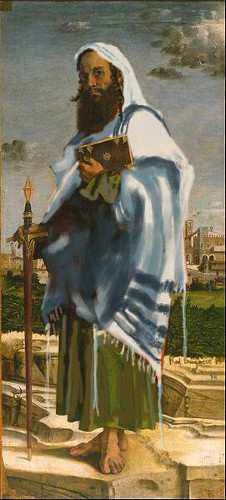
Walking in the Dust of the Footsteps of Moshiach

This is the actual time of the “footsteps of Mashiach.” (the final age prior to Mashiach’s advent) It is therefore imperative for every Jew to seek his fellow’s welfare – whether old or young – to inspire the other to teshuva (return), so that he will not fall out – G-d forbid – of the community of Israel who will shortly be privileged, with G-d’s help, to experience complete redemption.

“Today’s Day”
Monday – Sivan 18 – 5703
Compiled by the Lubavitcher Rebbe; Translated by Yitschak Meir Kagan
Chabad.org

Previously, I wrote about how privileged Gentiles associated with the Messianic Jewish movement (and in theory, all Gentile Christians) are to be able to support and encourage increased Torah observance among the Jewish people united in Messiah, in order to bring nearer the coming (return) of the King. Although the small commentary above states that it is important for every Jew to seek his fellow’s welfare, I believe we can extend that sentiment to all of mankind.

There are two interrelated principles here. The first is for all disciples of Jesus to seek the welfare of any other person, as it is written, “love your neighbor as yourself” (Lev. 19:18, Mark 12:31). The second is like it in that we non-Jews should seek out the welfare of the Jewish people and the nation of Israel, as it is written, “And I will bless those who bless you, And the one who curses you I will curse. And in you all the families of the earth will be blessed” (Genesis 12:3).

As I also said, within the unity of the body of Messiah, we are all one and yet we are all distinct. Just as men and women are distinct, so are Jew and Gentile, for Paul in his various epistles, never stopped distinguishing between the Jew and the Greek (Gentile). Therefore, we have no excuse to fail to make such distinctions as well.

And yet, both within the larger body of the Christian Church and certain subsets of what is called Hebrew Roots, it is considered unfashionable and even offensive to continue to make such distinctions. However, if we fail to do so, either by eliminating the primacy of national Israel and replacing it with the Church, or forcibly inserting Gentiles into the nation of Israel, we violate God’s unique calling to the Jewish people to remain a set apart people before Him forever.

Thus says the Lord,
Who gives the sun for light by day
And the fixed order of the moon and the stars for light by night,
Who stirs up the sea so that its waves roar;
The Lord of hosts is His name:
“If this fixed order departs
From before Me,” declares the Lord,
“Then the offspring of Israel also will cease
From being a nation before Me forever.”

–Jeremiah 31:35-36 (NASB)

For the New Covenant was made with the house of Judah and the house of Israel, not the people of the nations, and it is only by coming alongside Israel rather than replacing her or co-opting her unique relationship with God, that we can enjoy blessings of the covenants God made with the Jewish people.

To deny this on any level is to bring a curse upon yourself, but to bless and uphold the nation of Israel and the distinct nature and character of the Jewish people is to bring blessings upon yourself from God, who selected Israel for His own.

The early sages, who were like angels (may their merit protect us) have already determined that the healing of the soul is like the healing of the body:

The crucial first step is to identify the location of the illness, whether it is caused by the crassness, grossness and corruption of his physical body or by a failing in his soul-powers, the person being inclined to undersirable traits like arrogance or falsehood and the like. Or, the source of the malady may be habit – inadequate rearing or unwholesome environment having brought on bad habits.

“Today’s Day”
Shabbat – Sivan 16 – 5703
Compiled by the Lubavitcher Rebbe; Translated by Yitschak Meir Kagan
Chabad.org

This relates to another quote I cited before:

A person who worries about how others view him will have no rest. Regardless of what he does or does not do he will always be anxious about receiving the approval of others. Such a person makes his self-esteem dependent on the whims of others. It is a mistake to give others so much control over you. Keep your focus on doing what is right and proper.

-Rabbi Zelig Pliskin
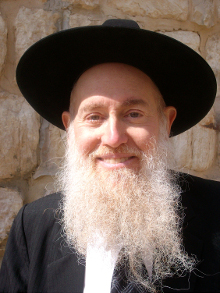
Rabbi Zelig Pliskin
Rabbi Zelig Pliskin

Given the current context, applying R. Pliskin’s words to me, I see that those who disagree with my words are not in control of who I am. Those who disagree with the uniqueness, sanctity, and distinctiveness of the Jewish people; the nation of Israel before God, cannot affect the nature and character of the chosen people, even as they either seek to eliminate Israel in God’s plan or dilute Israel by inserting masses of Gentiles into her midst without continuing to uphold her distinction.

But R. Pliskin’s words can also be applied to those who oppose Israel in that these people and groups may see their self-esteem and self-assigned identity as being worthwhile only if Israel is diminished either by elimination from God’s plan, or by needing to be included and even fused with Israel, not allowing Israel to exist apart from Gentile inclusion.

To the Christians, including some groups within Hebrew Roots, it is important and even vital to realize that our distinctiveness apart from Israel does not diminish us. Quite the opposite. Our vital role in supporting Israel and heralding the return of Israel depends on our distinctiveness.

If a Gentile “keeps the Torah” in some manner or fashion, that may benefit the individual involved but it does nothing to summon the Messiah’s return. If, on the other hand, the Gentile were to support and encourage Jews in Messiah, including those in the Church referred to as “Hebrew Christians” in observing the mitzvot, then we are fulfilling our purpose and passion and performing a mitzvah “only Gentile disciples of Messiah may accomplish”.

As a young boy, Rabbi Yosef Yitzchak (the sixth Lubavitcher Rebbe) would go with his father on walks through the woods. One time, as they talked, the boy absent-mindedly plucked a leaf off a tree and began to shred it between his fingers. His father saw what his son was doing, but he went on talking. He spoke about the Baal Shem Tov, who taught how every leaf that blows in the wind—moving to the right and then to the left, how and when it falls and where it falls to—every motion for the duration of its existence is under the detailed supervision of the Almighty.

That concern the Creator has for each thing, his father explained, is the divine spark that sustains its existence. Everything is with Divine purpose, everything is of concern to the ultimate goal of the entire cosmos.

”Now,” the father gently chided, “look how you mistreated so absent-mindedly the Almighty’s creation.”

”He formed it with purpose and gave it a Divine spark! It has its own self and its own life! Now tell me, how is the ‘I am’ of the leaf any less than your own ‘I am’?”

-Rabbi Tzvi Freeman
“Purpose of a Leaf”
Based on the letters and talks of the Rebbe, Rabbi M.M. Schneerson
Chabad.org

Everything was created by God with a unique purpose, even a humble leaf, and must be treated with respect. How is the Jewish ‘I am’ any less than the Gentile (Christian) ‘I am’?
korahs-rebellionExodus 20 commands Israel not to covet the things that belong to a neighbor such as his house, his wife, his servants, or his animals. Far be it from me to add to or subtract from the Bible, but my personal “midrash” on coveting includes the “commandment” not to covet thy neighbor’s mitzvot. Just as Korach and his followers coveted the position and mitzvot associated with Moses, the Prophet of God, and Aaron, the High Priest and was judged in error by God, so we too will be judged as in error by coveting positions, roles, and mitzvot we do not merit because we are not Jewish.

And He began speaking a parable to the invited guests when He noticed how they had been picking out the places of honor at the table, saying to them, “When you are invited by someone to a wedding feast, do not take the place of honor, for someone more distinguished than you may have been invited by him, and he who invited you both will come and say to you, ‘Give your place to this man,’ and then in disgrace you proceed to occupy the last place. But when you are invited, go and recline at the last place, so that when the one who has invited you comes, he may say to you, ‘Friend, move up higher’; then you will have honor in the sight of all who are at the table with you. For everyone who exalts himself will be humbled, and he who humbles himself will be exalted.”

–Luke 14:7-11 (NASB)

It is not shameful or diminishing to seek humility in the presence of God and in our daily lives. In fact, as we see from scripture, it is ultimately honoring, though we should not seek honor for ourselves, for in taking our proper place furthest away from the head of the table, how might the host of the banquet choose to honor us by placing us in a much better seat. But that selection of a better seat is not for us to make, it is for him, for Messiah, Son of David. For even he, though he deserves great honor and glory, chose to be humbled.

“For even the Son of Man did not come to be served, but to serve, and to give His life a ransom for many.”

–Mark 10:45 (NASB)

The Master said that all those who choose to glorify themselves in this world already have their reward, but those who choose to humble themselves now will have great reward in the coming Kingdom:

“Beware of practicing your righteousness before men to be noticed by them; otherwise you have no reward with your Father who is in heaven.

“So when you give to the poor, do not sound a trumpet before you, as the hypocrites do in the synagogues and in the streets, so that they may be honored by men. Truly I say to you, they have their reward in full. But when you give to the poor, do not let your left hand know what your right hand is doing, so that your giving will be in secret; and your Father who sees what is done in secret will reward you.

“When you pray, you are not to be like the hypocrites; for they love to stand and pray in the synagogues and on the street corners so that they may be seen by men. Truly I say to you, they have their reward in full. But you, when you pray, go into your inner room, close your door and pray to your Father who is in secret, and your Father who sees what is done in secret will reward you.

–Matthew 6:1-6 (NASB)

walking humblyServe God in all humility, placing the needs of others before your own. Realize that Paul always went to the Jew first, for the Good News of Messiah is the Gospel of Israel and only afterward the good news also to the nations.

If you seek to take what is not yours, when Messiah comes, will he not seek justice and remove from you that which you have usurped? Better to pursue nothing for yourself, and when Messiah comes, let him gift each of us with whatever we may merit according to his grace, kindness, and wisdom. Consider the parable of the talents (Matthew 25:14-30):

For to everyone who has, more shall be given, and he will have an abundance; but from the one who does not have, even what he does have shall be taken away.

–Matthew 25:29 (NASB)

Also, the Master taught:

So do not worry about tomorrow; for tomorrow will care for itself. Each day has enough trouble of its own.

–Matthew 6:34 (NASB)

To God be great honor and glory, and to Moshiach our King, let him be raised high above us. Let us walk in the dust of his feet (Nahum 1:3) and be satisfied with our lot.

Ben Zoma would say: Who is wise? One who learns from every man. As is stated (Psalms 119:99): “From all my teachers I have grown wise, for Your testimonials are my meditation.”

Who is strong? One who overpowers his inclinations. As is stated (Proverbs 16:32), “Better one who is slow to anger than one with might, one who rules his spirit than the captor of a city.”

Who is rich? One who is satisfied with his lot. As is stated (Psalms 128:2): “If you eat of toil of your hands, fortunate are you, and good is to you”; “fortunate are you” in this world, “and good is to you” in the World to Come.

Who is honorable? One who honors his fellows. As is stated (I Samuel 2:30): “For to those who honor me, I accord honor; those who scorn me shall be demeaned.”

-Pirkei Avot 4:1

May we make teshuvah and repent of our failings before God, then pursue the path of Messiah as he and he alone has set it before each of us. Amen and Amen.

For more on this topic, please see the Hebrew Roots section of the MessianicGentiles.com website.

Addendum: Sadly, this blog post did nothing to resolve conflicts and in fact seems to have added fuel to the fire. Thus, I’m forced to write a “part three” to this series. Please see Briefly Revisiting Gentiles and the New Covenant for details.

Unity in Messiah: A Commentary on One Law and Gentiles

As for the assembly, there shall be one statute for you and for the alien who sojourns with you, a perpetual statute throughout your generations; as you are, so shall the alien be before the LORD. There is to be one Torah and one ordinance for you and for the alien who sojourns with you.

–Numbers 15:15–16

But does the Torah really make different laws for Jews and Gentiles? According to Numbers 15:15–16, there is to be only one law for both Jews and Gentiles.

This seems simple enough. According to these verses, there is one law for both Jews and Gentiles. Therefore, Gentile believers should keep the whole Torah.

But wait. It’s not that clear.

“One Law and the Gentiles”
Commentary on Torah Portion Shelach
First Fruits of Zion (FFOZ)

I quoted from this article just the other day as an example of what sometimes provokes other believers to anger and how I want to avoid being excessively and needlessly provocative. While the “One Law” issue is a “non-event” for the vast majority of the Christian world, this is a “hot button” issue in certain small (relative to the overall body of believers worldwide) religious circles in the blogosphere.

But then, I’ve been thinking about an ad I received by email recently. Eichers.com has extended its annual Talis and Tzitzit sale to June 24th. As I read the advert, I found myself involuntarily pining for the days when I used to actually don a tallit to pray.

Then my reality check came in and I closed the ad, but not before I started pricing tallit gadolim (just “window shopping”).

Many years ago, my wife arranged for a friend who was visiting Israel, to purchase my first tallit at the Galilee Experience. It was a total surprise when it arrived from Israel by mail and my wife presented it to me.

But that was a long time ago, and to put it mildly, my wife’s attitude about Christians and tallitot has changed considerably. For that matter, so has mine.

I don’t really regret the “course correction” I’ve instituted in my life, but I do need periodic reminders of who I am and what I need to be doing that’s important to God in order to counterbalance my attraction to various aspects of Judaism as a worship practice. Really, if I had my “druthers” and it didn’t matter to God (or anyone else, especially the Missus) one way or the other, comparing evangelical Christian worship and study to a (Messianic) Jewish template, I’d probably choose Jewish practice.

In any conceivable way, nothing would be removed from my devotion to Yeshua (Jesus), but a richness in spiritual texture and connectedness to the people of God that extends all the way back to Sinai would be the platform and environment for that devotion.

I know that if any Hebrew Roots people with a bent for “One Law” ever read this, they’d probably say, “go for it!”

But, no. I have good reasons not to. It’s not my world and my practice. God chose the Jewish people for a reason and He gave them the Torah as the conditions of the Sinai covenant for a reason. Then He made it possible through the emergence of the New Covenant for Gentiles to be grafted in, and provided conditions for we grafted in Gentiles in a binding legal ruling that outlines a distinction in how Gentile disciples are obligated to the Torah.

I can live with that, knowing that we Gentiles have a unique role in supporting Messianic Jewish return to Torah and in perfecting the world in preparation of Messiah’s return.

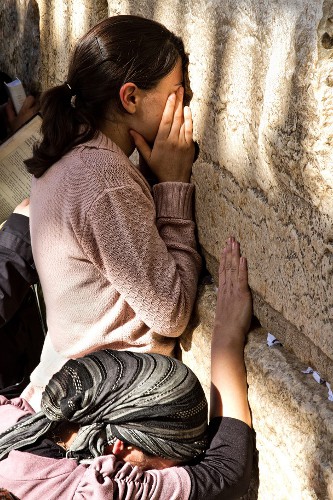
women_praying_at_the_wallAlso, living with a Jewish wife and daughter, I have a special appreciation for their own uniqueness as Jews and how my mimicking Jewish behavior in some sort of evangelical Jewish cosplay cheapens who they are and totally misrepresents me and all other Gentile disciples of the Master.

It was also no coincidence (in my opinion) that Chabad.org’s “mitzvah minute” email was on Tzitzit: Fringe Judaism this past week.

Most people don’t think of Judaism as a fringe religion. Yet that’s our uniform. Under their shirts, Jewish men and boys wear a poncho called a tallit katan (literally: small cloak), with fringes hanging from each corner, just as the Torah prescribes (Numbers 15:37–40), “They shall make fringes on the corners of their garments . . .”

That’s “Judaism,” not Christianity that wears the fringes. I’m not a thief. I don’t take things that belong to someone else. Donning a Tallit Gadol for prayer belongs to someone else…Jewish people.

Jacob Milgrom contends that in the ancient Near East the ornateness of the hem was a mark of nobility. Hence the wearing of tzitzit denoted that all Israelites were members of a priestly nation with a universal mission. That status and its attendant obligations rest on God’s deliverance of Israel from slavery, as the passage makes clear at the end: “I the Lord am your God who brought you out of the land of Egypt to be your God: I, the Lord your God.” (Numbers 15:41)

-Ismar Schorsch
“The Distinction between History and Memory,” pg 522 (June 16, 2001)
Commentary on Torah Portion Shelach
Canon Without Closure: Torah Commentaries

I assume D. Thomas Lancaster wrote the small article on “One Law and the Gentiles” and in referencing Numbers 15:15-16, he says:

First of all, the context deals not with the application of Torah as a whole, but specifically with the sacrifices. In other words, if an alien wanted to offer a sacrifice in the Temple he needed to follow the same Torah guidelines as the Israelite. The passage is not saying that all the laws of Torah apply equally to Jews and Gentiles.

Second, by the time of the apostles, the word translated as “alien” (ger, גר) was no longer understood as just a Gentile non-Jew. The Hebrew word had shifted its semantic value to refer specifically to a Gentile who had gone through a full, legal conversion to become Jewish, i.e., a proselyte. That conversion process included circumcision, immersion, and a sacrifice. That’s how the Greek version of the Torah (lxx) translates the word too. That’s probably how the apostles would have understood it.

Interestingly enough, Lancaster (I presume) says the Didache actually agrees with the surface reading of Numbers 15:15-16:

If you are able to bear all the yoke of the Lord [i.e., Torah], you will be perfect; but if you are not able, do as much as you are able to do. (Didache 6:2)

Wait a minute! What just happened? Did Lancaster say that the Didache supports an identical application of the Torah mitzvot on both Jewish and Gentile disciples of Jesus?

The Didache agrees with Numbers 15:15–16. There is not supposed to be a different Torah for Gentile believers. The Gentile believers are not supposed to have a different type of worship or religion. There is only one Torah for God’s people. The only question left open is to what extent the Gentile believer is obligated. Most of the laws of the Torah apply equally to Jewish and Gentile disciples of Yeshua.

On the other hand, Gentile believers are not obligated to keep all of the ceremonial laws as the Jewish believers such as circumcision and other distinct markers of Jewish identity like the calendar, the holy days, the dietary laws, and so forth. Despite that, the Bible does not create alternative Gentile versions of these institutions.

In the days of the apostles, the Gentile believers kept most of those things along with the Jewish believers as part of their participation in their shared religion.

The Torah, the conditions for the Sinai covenant, are the same conditions for the New Covenant. God didn’t re-write the conditions, just the material upon which they are written, on paper and tablets formerly, but later, on the human heart.

sefer-torahSo Torah applies to all who come under the New Covenant. The only question is how the roles and applications differ between those who entered into covenant with God at Sinai vs. those of us who were later grafted in, that is, between Jews and Gentiles.

Lancaster ended his small write-up by saying that in the apostolic era, it was likely the Gentile disciples, especially those embedded in Messianic Jewish synagogues in the diaspora, would have appeared much more Jewish than we Christians do today. Their practice and observance would have been modeled on their mentors, and as Lancaster mentioned, the Didache seems to support this view and was formally taught to newly-minted non-Jewish disciples.

So where does that leave me? Right where I am.

If I lived in a different environment, if my wife was Messianic, if a thousand other things were changed, how I outwardly worship God would probably not look the same as it does now. But there are no “what ifs” in God’s creation, there is only here and now and what is real.

What matters about discipleship and devotion to the Master is doing the will of God. I pray. I study. I worship in fellowship. I perform many of the mitzvot in the Torah such as giving charity to the poor, providing food for the hungry, visiting the sick, comforting those who grieve.

The message of the Good News of Messiah changes not at all for the Jew or the Gentile, and the coming of the Kingdom alters not one little bit for the descendants of Israel or the people of the nations. In fact, being a devoted Gentile who has fully apprehended a Messianic world view and perception of the Bible makes me a lot more valuable to the cause of Christ for Jewish and Christian people than if I felt that I would only be on God’s “approved list” if I looked and acted “Jewish”.

I know parts of what I’ve written will make certain people unhappy, but please remember, I’m not telling you or anyone else what to do, I’m just talking about who I am and what I need to do. I can’t allow how others view me to affect what I must do and refrain from doing before God.

The Kotzker Rebbe said that the mistake of the spies was in the words “and so we were in their sight.” It should not bother a person how others view him. (Otzer Chayim)

A person who worries about how others view him will have no rest. Regardless of what he does or does not do he will always be anxious about receiving the approval of others. Such a person makes his self-esteem dependent on the whims of others. It is a mistake to give others so much control over you. Keep your focus on doing what is right and proper.

-Rabbi Zelig Pliskin
from his commentary on Torah Portion Shelach (pg 330)
Growth Through Torah

There is “one law” but it is applied differently, even within formal Judaism, depending on who you are. It’s applied differently also for the Gentile. There is One God who is God of all. There is one Messiah who brings salvation to the world. There is one Kingdom waiting for the devoted to enter. There is one world to come where we will return to the Garden, because that’s where it all began.

If that’s not unity in Messiah, what is?

intermarriageFinal note: distinctiveness in identity and practice does not mean dissolution, disagreement, or disconnection. My wife and I are obviously different as man and woman, and we are different as Christian and Jew. Nevertheless, we are a family together with our children and grandson, and we share strong connections within that context. The same can be said for the Messianic community of Jews and Gentiles. We form a unity not in spite of our differences, but because of them. That is the beauty of “one new man” (Ephesians 2:15). You are changed, not in terms of ethnicity, nationality, or obligation, but because, men and women, Jew and Gentile, no matter how one differs from another, we are all interconnected in Messiah, may he come soon and in our day.

Addendum: See the “sequel” to this “meditation”: Walking in the Dust of the Footsteps of Moshiach.

What Would You Do If Your Child Was Gay?

John MacArthur was recently asked by a reader how they should respond to an adult child who has acknowledged they are gay. His parenting advice?

Alienate them.

Separate them.

Isolate them.

Refuse to have a meal with them.

Turn them over to Satan.

-Benjamin L. Corey
“John MacArthur on Having Gay Children: Alienate Them & Turn Them Over to Satan”
from “Formerly Fundie: The Official Blog of Benjamin L. Corey”
patheos.com

“Formerly Fundie” is listed as a “Progressive Christian Channel” at Patheos, so chances are Corey and I don’t have a lot in common, since I’m pretty socially and politically conservative. I don’t know who this gentleman is or why he needs an “official blog” for himself and his name (and based on many of the comments on his blog, I’m glad I don’t have his readership), but a link to his blog post was inserted into Facebook by a Facebook “friend” who is about as progressive as it gets (I have a wide variety of friends, virtual and otherwise).

If you are a regular reader of my blog, you know I almost universally disagree with just about everything Pastor MacArthur teaches, preaches, writes, and broadcasts. I found his treatment of Pentecostals at his Strange Fire conference to be typical of his highly confrontational style, and his perspectives on both ancient and modern Judaism, including Messianic Judaism, show, in my opinion, an extremely poor insight into the actual late second temple Jewish and apostolic cultural, religious, educational, and spiritual environment. He “Christianizes” every bit of scripture he touches as if he imagines Jesus and the twelve were good Baptist Preachers from the church right across the street in “Hometown, U.S.A.”

OK, that last bit might be something of an exaggeration, but you get the idea.

There’s a YouTube video of MacArthur that goes along with Corey’s article. I’ll post it at the bottom of today’s “meditation” so you can actually hear what MacArthur says. I was surprised that the tone of his voice was calm, soft, and almost friendly. MacArthur isn’t quite as harsh in his language (and possibly intent) as Corey makes him out to be. But that doesn’t disguise the massive disconnect I think MacArthur is trying to sell to Christian parents of gay children.

Matthew Vines
Matthew Vines

In case you haven’t read them, I’ve written numerous posts on the LGBT community within both Christianity and Judaism, the latest (before this one) missive being my review of Matthew Vines’ recent book God and the Gay Christian. I also commented on Dennis Prager’s understanding on why Judaism rejected homosexuality as well as on a number of other related topics.

Am I advocating for marriage equality in the church? No, I don’t think there’s a Biblical presupposition for it. But there’s a lot going on in this dialogue that we simply cannot ignore or dismiss.

Many of you may have read about Danny Cortez, a Pastor of a Southern Baptist church in La Mirada, California, who, after his fifteen year old son came out, decided to change his theological stance on homosexuality and became gay affirming, leading his church to officially become affirming of gays within their community as well.

Naturally, Christians on both sides of the issue made highly emotional pronouncements either supporting Pastor Cortez and his church or condemning them.

But what do you do when it’s your child? What happens if you’re a Christian and it’s your son or daughter who tearfully, painfully, comes out to you because he or she can’t stand holding it inside anymore, can’t stand lying, can’t stand hiding their feelings? What happens after they tell you and then they just stand there looking at you expectantly, fearing your anger but praying for your acceptance?

One of my sons has two male friends who came out within the last several years, and one of those young men comes from an Evangelical family.

What do you do?

At the church I attend, in Sunday school probably a year or more ago, the question came up of what the church would do if two lesbians came in and wanted to worship. A fellow, who is a member of the Board of Elders, responded, “Love ’em and learn ’em.” I don’t think that was overall support for acceptance of lesbian relationships in the church. He was likely communicating the idea that by welcoming them into the church community, over time, they would be influenced and understand the nature of homosexuality related to the expectations of God, as this church understands God and expectations.

women holding handsThe understanding, and I’m projecting my own conclusions into this scenario, is if this hypothetical lesbian couple chose not to accept the church’s interpretation of scripture in terms of their relationship and their lives, they’d be free to leave and seek a more accepting church or other house of worship.

But you can’t exactly do that with your kids…or can you? The quote from MacArthur above says that’s exactly what you have to do. If your gay kid won’t repent and continues to sin (presumably by just being gay), then you must do the whole Matthew 18:15-18 thing with them, confronting your child individually, and then with two or three other witnesses, and then finally in front of the whole church (I’ve heard of one set of parents who really did this). This is actually bad exegesis on MacArthur’s part, since the child, by being gay, doesn’t directly sin against his or her parents.

I don’t think I could stand to do that with any of my kids. Maybe I’m just a bad Christian. I’m sure John MacArthur would think so.

Of course, none of my children are religious let alone Christians, and from MacArthur’s point of view, if any of them were gay, they’d be sinners just like the rest of the secular world.

A church can make whatever official, doctrinal statement it wants relative to homosexuality in the covenant community and they’re within their rights to do so. I draw the line at being compelled to accept John MacArthur’s advice on how I should relate to my children and I imagine a lot of Christian parents feel similarly.

No, none of my kids are gay, but I’ve run that scenario through my head more than a few times. What if…

MacArthur made the video supposedly in response to a parent whose adult offspring did come out, and asked MacArthur what they should do, so in this case, MacArthur is responding to a real request for information. However, he felt it necessary to make a video and then to put it on YouTube, so his opinion entered the public realm and became fodder for response and reaction.

I can’t render a theological opinion but I can give you one based on my being a father and grandfather. I can’t “unlove” my children. Sure, they’ve each done things to make me pretty unhappy at different times over the years, but none of that made me want to stop being their Dad, to stop loving them, and certainly I never had any desire to “turn them over to Satan.”

in-the-dark2-blueResponding to a gay child by alienating them, separating from them, isolating them from family, and refusing even to eat with them won’t motivate them to “repent,” it will motivate them to never have a relationship with you again and to take their own course absent of your love, caring, compassion, and consultation. MacArthur’s advice is an iron-clad guarantee that even if the child somehow desired to “repent of being gay,” they would never do so. What’s their motivation? The (so called) love of Christ according to the “gospel” of MacArthur?

Even when Israel sinned grievously against God, God may have turned His face away for an instant, but He always, always took them back and He never, ever permanently abandoned or forsake them.

I know MacArthur feels he’s giving sound doctrinal advice based on scripture, but somehow he never factored in his own experience as a parent (and I imagine a grandparent, given his age) and how he would face his own children. Sadly, my experience (such as it is) with MacArthur is that he is so dogmatic and rigid, he very well could and would take his own advice and feed any child of his who came out as gay to the (proverbial) wolves.

If any of my kids (or my grandson someday) came out as gay, I’d end up having a very long talk with God about what this was supposed to mean for my relationship with the Almighty. What does God expect me to do, reject the very child He created to be a joy in my life? I couldn’t do that. Does that make me a bad Christian? I imagine a lot of people reading this will think so. Some of you may even condemn me (even if it’s within the privacy of your own hearts) for merely entertaining such an attitude.

But what would you do if it were your own son or daughter. Imagine your little boy or girl telling you they’re gay, scared to death of what it will mean, and wondering if you’ll stop loving them in the next ten seconds or so. Imagine that this is really happening. What would you do, not just your immediate reaction, but for the long run? How’s your moral certitude doing now?

I know I said in Is It For His Glory to avoid needless arguments (though I also quoted Pastor Michael Hidalgo as saying Christians need to get out of their protected enclaves and into the real world…perhaps good advice for John MacArthur), but I also said there are times to take a stand. I believe this is one of those times.

Here’s the video of MacArthur’s response to the Christian parent who asked what to do now that their child has come out as gay:

Believe in people and you will influence them to believe in themselves.

Your belief needs to be based on reality — so develop an eye for noticing sparks of potential in others. Be enthusiastic in selling a person to himself.

-Rabbi Zelig Pliskin
“Believe in People”
Aish.com

Addendum: June 19, 2013: Today I received an email from a person named Dennis who informed me of an error I made regarding my mention of Pastor Danny Cortez. According to Dennis, the news article states that Pastor Cortez changed his theological stance to be affirming of gays in the Church before his son came out. This change in Pastor Cortez allowed his son to feel safer in coming out to his father. I apologize for misreading the news article and hope this correction clears things up.

Is It For His Glory?

There is to be one law and one ordinance for you and for the alien who sojourns with you.

–Numbers 15:16

The Torah says there is to be only one law for both Jews and aliens sojourning with the Jewish people. On the surface, this appears to be a simple statement, but when we dig deeper into biblical studies and interpretations, it becomes a complicated issue.

“One Law and the Gentiles”
Commentary on Torah Portion Shelach
First Fruits of Zion (FFOZ)

Be careful not to become involved in quarrels with your friends. Arguments will only create distance between you and others.

The most effective approach to avoid needless arguments is to master the ability to remain silent. You don’t have to say everything you think of saying. At times there is an actual need to clarify a specific point and it’s appropriate to speak up. But a large percentage of arguments come from making comments that don’t need to be made.

-Rabbi Zelig Pliskin
quoted at Aish.com

When I read the commentary at FFOZ about “One Law and the Gentiles”, I immediately wanted to jump on it as yet another classic example of the ongoing debate within various branches of Messianic Judaism, Hebrew Roots, and Evangelical Christianity. Then I thought about how such debates can be damaging and when I should ignore such temptations. Then again, I’ve also learned that sometimes you have to speak up for what you believe is right.

The trick is to find the right topic and the right timing. That isn’t always easy and in fact, there are times when no matter how well you craft your message, it’s going to provoke a hostile if not violent response:

“And when the blood of Your witness Stephen was being shed, I also was standing by approving, and watching out for the coats of those who were slaying him.’ And He said to me, ‘Go! For I will send you far away to the Gentiles.’”

They listened to him up to this statement, and then they raised their voices and said, “Away with such a fellow from the earth, for he should not be allowed to live!”

–Acts 22:20-22 (NASB)

Of course, this is a pretty extreme example. Most of our online debates, arguments, and trolling don’t come anywhere near actual riot conditions. On the other hand, why do we fight at all?

A couple of weeks ago I spoke to several pastors and asked them, “How many of you have received a nasty email in the last six months?” Every single person in the room raised their hand—including me.

Let me be clear; I believe the majority of people are civil and respectful in their online dialogue. However, there remains a vocal minority who insist on remaining unpleasant both in tone and word. And these unkind words come from many who self-identify as Christians, who somehow believe that malice is an acceptable form of communication.

Which raises a question: Why do so many Christians persist in being mean?

-Pastor Michael Hidalgo
“When Did Christians Get So Mean?” June 9, 2014
Relevant Magazine

Pastor Hidalgo went on to say:

Many of us have the luxury of not having to look beyond the small world we create for ourselves. We attend churches, listen to talk radio and watch news programs that only serve to affirm our previously held beliefs. We have fallen asleep in the insulated comfort of accepted, collective thinking. We live among those who think like us, look like us, talk like us, and we assure ourselves we are right and others are wrong.

It may do us well to break out of these enclaves we create for ourselves.

churchI worship in an “enclave” where my “previously held beliefs” are not at all affirmed, so I can’t expect to be insulated within a comfortable cocoon as the Pastor suggests most Christians may be. In fact, I’ve tried to nudge some of my fellow-Christians out of that cocoon, and while they haven’t “gotten mean” or anything like it, some didn’t really understand that there could a life for a believer outside of their own highly-specific context, especially a valid and sustainable Christian life.

More’s the pity.

I think that’s what triggers a lot of the “yelling” online, because the blogosphere isn’t a cocoon, it’s the wild, wild west, where anything can and usually does happen, and any opinion can be expressed with impunity.

But an opinion may or may not be “truth”:

We forget that every venomous word we speak or write to others is an assault on the heart of a man or a woman made in the image and likeness of the Almighty.

Some, no doubt, believe they need to stand up for truth. A few believe standing up for truth demands they attack those who seek to distort the truth. But this is not the case. If the truth is spoken without grace it is not true at all. It turns out we can be right about a lot of things, but if we do not have love we are dead wrong.

So on the one hand, we must stand up for truth, but on the other hand, the way we do it is very important, for even if we are actually “right” about what “truth” is once in a while, if he have to do a hatchet job on another human being to defend that truth, then we’ve defended truth at the cost of denigrating a person created in God’s image.

Pastor Hidalgo suggests that our first response to another person with whom we disagree is to listen. That’s not easy to do when, particularly on the web, upon detecting something “wrong,” we’ve been conditioned to stop receiving information and to start sending it in abundance. We’ve been taught that we have free speech rights and that we possess the truth, and we have not only the right but the responsibility to shove that truth down everyone else’s throat until they choke on it.

Then we’ve won.

Hooray.

But why are we really supposed to share the truth of the Bible? To sanctify the Name of God, to spread His Name throughout all the earth, to illuminate people with the Good News of Messiah.

But as I said, Paul found out on an endless number of occasions, that no matter how you listen and how well you craft your message, there will always be times when you and your message will be rejected, and there will always be people who are so convinced of the truth and rightness of their own message, that they cannot possibly give you a fair hearing. In fact, the minute you start saying anything contrary to their version of truth, they’ll start bombarding you with their own, and eventually when they realize you’re never going to change your mind and agree with them, they’ll boot you out and start “badmouthing” you to all their (virtual) “friends”.

Well, that’s the classic scenario anyway. It doesn’t describe all of the possible responses to disagreements in the world of religious blogging, so please don’t start taking all this personally. I’m probably not even thinking about you at all.

graceThis is obviously a continuation of what I’ve been writing about for the past week or so. What is the answer to surviving not only a community of faith in the local church but the extended world of faith on the Internet? I’m sure there must be an answer. Pastor Hidalgo summarizes that answer with a single word: “grace.” I think in the ideal, that’s probably the right answer, but most of us aren’t “ideal”. That’s why this life is a journey of struggle, exploration, and experience, not just reading the Bible and being programmed to be Christ’s perfect little disciple.

The Bible isn’t a record of how people got “perfect” once they heard about God, it’s a chronicle of how God was and is gracious with a whole planet full of damaged, imperfect, grumpy human beings across thousands upon thousands of years of history. God has promised us a better way to be human beings, but dangles “perfection” in front of us like a carrot, with the guarantee of a good meal only if we faithfully hang on long enough:

“Behold, days are coming,” declares the Lord, “when I will make a new covenant with the house of Israel and with the house of Judah, not like the covenant which I made with their fathers in the day I took them by the hand to bring them out of the land of Egypt, My covenant which they broke, although I was a husband to them,” declares the Lord. “But this is the covenant which I will make with the house of Israel after those days,” declares the Lord, “I will put My law within them and on their heart I will write it; and I will be their God, and they shall be My people. They will not teach again, each man his neighbor and each man his brother, saying, ‘Know the Lord,’ for they will all know Me, from the least of them to the greatest of them,” declares the Lord, “for I will forgive their iniquity, and their sin I will remember no more.”

–Jeremiah 31:31-34 (NASB)

This stuff hasn’t happened yet, no matter how much some Christians believe it has (or wish it had). We are imperfect people living in an imperfect world. We want to “know God” perfectly and to have His Word written on our hearts (and not just in our Bibles), but the finger of God has only just started moving, and it’s having to chisel through lots of stone in order to get at the heart that’s supposed to be tender flesh.

The problem is, we don’t want to be tender, we want to be stony. Tenderness can be hurt but rocks are pretty tough. We like being tough. We like being right. We like making the other poor, dumb fool be wrong. It makes us feel better about ourselves.

No, I’m not saying you shouldn’t take a stand. I take a stand often enough, both here on this blog and at church in Sunday school. But it matters how you take your stand. If expressing truth, however you understand it, involves insulting or embarrassing another person, you’re probably doing it wrong. I know. I’ve gotten it wrong often enough, including quite recently.

light-in-my-graspI actually agree with FFOZ’s commentary on One Law and how Torah does and doesn’t apply to Gentile believers. I even agree that the FFOZ author wrote the article in a measured and respectful manner. I know that regardless of all that, the message will cause “all the wheels to fall off the cart,” so to speak, for a number of folks who have a very different opinion on the matter, and for some of them, their self-esteem and self-image are tightly dependent on believing their opinion is universally correct.

But that’s how most of us operate. We personalize disagreement and conflict rather than realizing God hasn’t called us to be the best bloggers in the religious world. He’s called us to be the best representatives of His Good News to the world, religious and otherwise. How do we do that? By arguing? By being right all the time? Most of us are wrong most of the time.

Truth is knowing when to speak and when to be silent. Truth is knowing when to talk and when to listen. Truth is the ability to hang on at the right times and to know when to let go.

Professor Henry Jones (Sean Connery): Junior, give me your other hand! I can’t hold on!

Indiana Jones (Harrison Ford): I can get it. I can almost reach it, Dad…

Professor Henry Jones: Indiana. Indiana… let it go.

Professor Henry Jones: Elsa never really believed in the grail. She thought she’d found a prize.

Indiana Jones: And what did you find, Dad?

Professor Henry Jones: Me? Illumination.

-from Indiana Jones and the Last Crusade (1989)

Professor Jones’ quest to discover the resting place of the Holy Grail ended up in the loss of the grail, yet he didn’t consider it a loss at all. What he found wasn’t a treasured object, a valued prize, or even immortality (by drinking water from the grail). He found illumination from God.

Yes, this is fiction and there was never such a thing as the “Holy Grail” but besides being a good adventure story, there’s a lesson in values here.

Kazim (Kevork Malikyan): [to Indy] Ask yourself, why do you seek the Cup of Christ? Is it for His glory, or for yours?

That should be a question we all ask ourselves before we speak up in Sunday school class, or put our fingers on the keyboard to either write a blog or respond to someone else’s.

Rabbi Avraham Mordechai of Gur explained that the nature of a person with humility is not to be stubborn about his own opinions and wishes. He is compliant and will easily give in to the opinions and wishes of others. The other spies were all very distinguished and important men. Moshe feared that Yehoshua might concede to their opinions and be swayed by them even though he felt differently. Therefore, Moshe especially prayed for Yehoshua not to be negatively influenced by the others.

Rabbi Zelig Pliskin
Rabbi Zelig Pliskin

When a question of Torah ideals is involved, one must not budge. That is when it is appropriate to resist. When dealing with basic principles, remain steadfast and do not allow others to sway you. One needs wisdom to know the difference between situations when it is proper to give in to others and when it is not. For this we need the Almighty’s assistance.

Dvar Torah for Torah Portion Shelach
based on Growth Through Torah by Rabbi Zelig Pliskin
quoted by Rabbi Kalman Packouz on Shabbat Shalom Weekly
Aish.com

Addendum: Yesterday, I read a commentary about Pastor John MacArthur’s parenting advice to a Christian parent of a gay child. In tomorrow’s “morning meditation,” I respond.

Sermon Review of the Holy Epistle to the Hebrews: Instructions About Washings

Therefore let us leave the elementary doctrine of Christ and go on to maturity, not laying again a foundation of repentance from dead works and of faith toward God, and of instruction about washings…

–Hebrews 6:1-2 (ESV)

Hebrews 6:1-3 identifies “instructions about washings” as one out of six fundamental, elementary teachings about the Messiah. Does this refer to Baptism? Learn about the Jewish practice of immersion in a mikvah and discover evidence of early, apostolic-era catechism prior to immersion.

Includes a short introduction to the Didache.

-D. Thomas Lancaster
Sermon Twenty-one: Instructions About Washings
Originally presented on June 22, 2013
from the Holy Epistle to the Hebrews sermon series

Instructions about washings (plural). After a brief summary of the first two elementary principles, “Repentance from dead works” and “Faith toward God,” Lancaster continues with the third, “Instructions about washings”. This is often considered in normative Christianity to refer to baptism and easily dismissed as such. The King James Version of the Bible even renders the phrase as “the doctrine of baptisms,” but…

The translators of the English Standard Version, like many Bible scholars, recognized that the Greek word “baptismon” does not sound as if it’s talking about Christian baptism, because it appears in the plural form, whereas Christians are baptized only once. Furthermore, in other places in the New Testament, the word “baptismos” refers to ceremonial purification rituals of immersion in a mikvah. Several scholars looked at this passage and said, “I don’t think he’s talking about Christian baptism. I think he’s talking about Jewish purity rituals.”

-D. Thomas Lancaster
“Chapter 5: Instruction About Washings,” pg 64
Elementary Principles: Six Foundational Principles of Ancient Jewish Christianity

This book leverages much of the material from Lancaster’s sermons on these elementary principles from his “Hebrews” series and is a good companion to use with these audio recordings.

Here we learn that it is highly likely that these “immersions” mentioned in Hebrews 6:2 do not reference the modern Christian concept of baptism, since a Christian is only baptized once and the Greek word used in the text is clearly plural. It is more likely that the writer of the Epistle to the Hebrews is talking about Jewish ritual purity rites using the mikvah, since the writer (according to Lancaster) is a Jew writing to other Jewish believers in Messiah Yeshua.

Lancaster presents some historical and archeological information regarding ancient immersion pools in the late Second Temple period to illustrate that it was extremely common for Jews to immerse on any number of occasions for the purpose of ritual purity, including participation in Temple sacrifices.

He also takes this opportunity to go on a small “rant” about how Christianity has fundamentally misunderstood the nature and character of baptism, and he ran through a litany of things that he believes the Church has gotten all wrong (he was talking too fast for me to take notes, so if you want to hear his reasons, you’ll have to listen to the recording). I don’t think Lancaster was trying to “diss” the Christian Church so much as he was being passionate about what he sees as the truth of the early history of Jesus-believing Judaism and how it’s been distorted by subsequent Gentile Christianity.

mikvahAs an aside, Lancaster has been lobbying to build a mikvah at Beth Immanuel for the last seven years (eight years as of this writing) but there hasn’t been much of a response. That reminded me of something I just read in Sue Fishkoff’s book The Rebbe’s Army: Inside the World of Chabad-Lubavitch. Often, when a Chabad family moves into an area without an Orthodox Jewish presence, their first and overriding priority is to build a mikvah, particularly for the use of the Rabbitzin in relation to the laws of ritual family purity. The reaction from the local Jewish community to the Chabad’s fundraising efforts to build a mikvah (and they’re not cheap) is just as lukewarm. What does Lancaster and the Chabad know about the mikvah that the rest of us don’t, or is that a sad question to ask as connected to “elementary principles” of our faith?

So, what were these “instructions about immersions?” How to build a mikvah? The mechanics of how to baptize? At one point, Lancaster might have said “yes”, but then he realized how “dumb” an answer that was…a typical “Goy” answer.

Jews would have been already well acquainted with the rituals surrounding the mikvah, the occasions when one had to engage in ritual purity rites and so forth. This wasn’t a mystery. While Gentiles may have needed those sort of instructions, they would have been less than useless to the Jewish believers.

Lancaster shared his own revelation. When reading a commentary on this part of the Book of Hebrews, he learned that these instructions about immersions could be referred to as “Catechetical Instructions for Conducting the Baptismal Rite.”

When I was a pre-teen and into mid-teens, my parents regularly took me to a Lutheran church. Lutheran churches, like Catholic churches, put their young people into a two-year Confirmation class where we studied Catechism, which according to Wikipedia is “a summary or exposition of doctrine and served as a learning introduction to the Sacraments traditionally used in catechesis, or Christian religious teaching of children and adult converts.”

That’s what Lancaster thinks these “instructions about immersions” are. Not directions on how to immerse or baptize, but the very basic instructions a new believer had to know before being immersed in the name of the Messiah as a full disciple.

Lancaster than referenced the best known ancient “catechism” we have access to: the Didache.

Last fall, I read and wrote about First Fruits of Zion’s (FFOZ) Toby Janicki’s article “The Didache: An Introduction” published in Messiah Journal. Since then, I purchased a copy of the Didache along with a commentary and wrote several blog posts on the topic which can be found here.

While Lancaster isn’t saying the Didache we have is the actual set of instructions being referred to in Hebrews 6:2, they may very well be related. It’s clear that the Didache was written for new Gentile “novices” in Yeshua-discipleship in order to prepare them to be immersed into Messiah by being initiated in the teachings of the Master. These instructions may have begun as oral instructions that accompanied the delivery of the Acts 15 “Jerusalem Letter” to the various Jesus-believing Gentile communities in the diaspora.

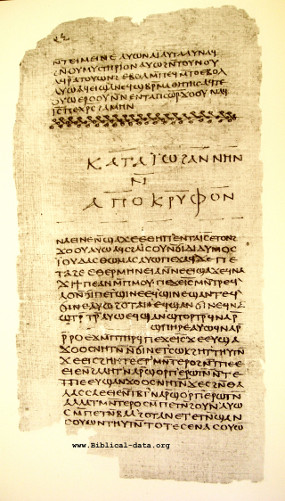
Didache CodexI should mention here that as Lancaster correctly states, the Didache’s initial discovery prompted accusations of forgery and fraud, since the document didn’t match the theology and doctrine of any Christian denomination and was seen as “too Jewish”. But today, most Christian scholars admit that the document most likely originated within one or two decades of the destruction of Herod’s Temple, written probably by Jewish disciples of Jesus for newly minted Gentile disciples. As I mentioned though, these written instructions could well have been preceded by an oral equivalent and could possibly have first come from the apostles themselves.

However, the Jewish disciples may have required a similar, parallel set of instructions to familiarize them with the teachings of Messiah and what it is to be a Jew preparing for a lifelong commitment to “take up their cross” and follow Moshiach, even unto death.

So look at it like this.

The newly initiated Jewish believers were first taught the very elementary principles of Yeshua-faith starting with repentance from dead works (sin) and then faith toward God as specific to Messianic devotion. Once they had mastered those first two principles, they were ready for the third, the basic instructions required for them to prepare to be immersed into the name of Messiah, which constitutes a vow of eternal fidelity.

Jewish people would immerse in the mikvah an untold number of times over the course of a lifetime, so immersing for ritualistic reasons was hardly novel. However, John specifically practiced an immersion of repentance (Matthew 4:17, Acts 19:4) and the Master commanded another specific immersion:

Go therefore and make disciples of all the nations, baptizing them in the name of the Father and the Son and the Holy Spirit, teaching them to observe all that I commanded you; and lo, I am with you always, even to the end of the age.” (emph. mine)

–Matthew 28:19-20 (NASB)

The immersion in the name of Messiah fits in perfectly with what the Church calls “the Great Commission” but put back into a Jewish context, the ritual immersion in Messiah’s name makes a great deal more sense.

Jewish ConversionFor Lancaster, and I agree with him, a serious time of preparation must have been thought necessary before formally becoming a disciple of the Master. This was probably quite similar to the proselyte ritual process Gentiles experienced when converting under other Jewish sects. Even today, a Gentile converting to Judaism, particularly Orthodox Judaism, undergoes a time of intense preparation and study under the supervision of a Rabbi, and must past several tests before becoming circumcised (for males) and immersing in the mikvah as the final rite in becoming a Jew.

It seems very reasonable to believe that in ancient Yeshua-faith, the Gentile “converts” were required to undergo a similar procedure, although I’m sure there were exceptions (Acts 8:25-40, Acts 10:44-48).

Whoever does not carry his own cross and come after Me cannot be My disciple. For which one of you, when he wants to build a tower, does not first sit down and calculate the cost to see if he has enough to complete it?

–Luke 14:17-28 (NASB)

What Did I Learn?

Actually, I felt there were things Lancaster only hinted at in his sermon. If he believes the Christian Church has gotten baptism all wrong, particularly as far as only being baptized once, what other applications might there be for immersion among the body of believers? I’m sure that Messianic Jewish disciples of the Master could and would immerse for the same reasons as other observant Jews, but what about the “Messianic Gentiles?” If we immerse in the name of Messiah once, on what other occasions should Gentiles enter the mikvah?

It had never occurred to me to apply Matthew 28:19-20 to Hebrews 6:2 but now it makes a great deal of sense to connect the two scriptures. I’m sure an entire study could be done applying what we think of as “baptism” in Christianity to ancient and modern concepts of immersion in the mikvah.

This also made me think of my own immersion. In August 1999, my entire family was immersed, under the auspices of a local Hebrew Roots congregational leader, in the Boise River. The following month, my life started to dramatically fall apart in such a spectacular manner that it would take years for me and my family to recover.

My interpretation is that God takes immersion into the name of Messiah quite seriously, even if the people being immersed don’t know what they’re doing (and I certainly didn’t). God delivered the consequences of my ill-conceived decision directly into my lap and it wasn’t pleasant at all. A lot of re-writing of my script had to be done and it’s not finished yet, not by a long shot. The finger of God is still writing on my heart and slowly converting it from a thing of stone to a heart of beating flesh and blood.

How many churches prepare their people with a dedicated set of instructions and tutelage before determining they are ready for this level of life-long commitment? I know in the church I attend there is some sort of formal preparation, but I fear for the sake of the children, some age nine and younger, who are deemed ready to understand what it is to count the cost, take up their crosses, and follow Jesus, even unto death. How could you be nine years old and possibly comprehend who you’re vowing to obey and what the consequences will be?

child baptismLancaster says he believes our churches are filled with “false converts,” people, like me, who consent to being baptized without any real idea of what that truly means. We have very few formal vows in Christianity left. The one you most likely think of is the wedding vow, but the staggering divorce rate in the Church indicates even that one is not well understood.

When we consent to being immersed in the name of the Father, the Son, and the Spirit of God, we had better know what we’re doing, and if we haven’t been prepared adequately for the commitment, then even though we are acting out of ignorance, God will hold us accountable.

Lancaster believes we should return to instructing new believers in the elemental principles of our faith which might include some familiarity with the Didache or something patterned after it. I think he’s right. People declare Christ as Lord and Savior and are baptized in his name far too casually in our day. I think thousands upon thousands of people in the Church are in a lot of trouble and don’t even realize it.

Putting a New Face on Sunday School

In verses 22-23 of Acts 22, Give the details of the “hissy fit” Paul’s Jewish audience threw when he used the “G” word.

Have you or I ever felt or expressed similar emotions when we didn’t get out way in church? (The “no” word) How does submission allow the Lord to bring about spiritual growth in our worthy walk with Him?

-from the Sunday school study notes
on Acts 22:22-29 for June 8th

My Sunday school teacher has a tendency to compare apples with oranges and believe he is actually comparing apples to apples. For instance:

“And He said to me, ‘Go! For I will send you far away to the Gentiles.’”

They listened to him up to this statement, and then they raised their voices and said, “Away with such a fellow from the earth, for he should not be allowed to live!” And as they were crying out and throwing off their cloaks and tossing dust into the air, the commander ordered him to be brought into the barracks, stating that he should be examined by scourging so that he might find out the reason why they were shouting against him that way.

–Acts 22:21-24 (NASB)

Teacher was comparing a near-riot situation not only to a “hissy fit” (which Urban Dictionary defines as a “sudden outburst of temper, often used to describe female anger at something trivial”) but to any relatively minor situation a person might experience in church that would cause them unhappiness or displeasure.

Either he thinks people’s problems in church border on crowd violence or he grossly minimizes the angst, frustration, fear, pain, and anger of the Jewish people whose land has been occupied by a pagan foreign army and who were highly sensitized to any offense by Gentiles during a moed such as Shavuot.

Since I published my previous blog post which merely anticipated last Sunday’s class, people have been asking me how class actually went. This is the answer.

Apostle Paul preachingI decided I could not remain completely silent and let what I considered to be unfair or inaccurate statements about Paul’s situation in particular or Christianity’s attitude about Judaism and Jewish people in general go unanswered. While I chose to ignore the “hissy fit” comment (though I was surprised at the number of people in class who agreed that the Jews in the above-quoted passage were merely “throwing a childish fit”), I did zero in on the humanity and the group dynamics of the situation.

I pointed out that presumably, some “Jews from Asia” (Acts 21:27) had been spreading rumors in Jerusalem that Paul had been “teaching all the Jews who are among the Gentiles to forsake Moses, telling them not to circumcise their children nor to walk according to the customs” (Acts 21:21), and also that he had “even brought Greeks into the temple and [had] defiled [the] holy place.”

It only takes a few agitators to stir up a large crowd and start a riot. Jerusalem’s population had swelled to millions of Jews in preparation of Shavuot, and it was always during the moadim that emotions ran especially high. Any upset or offense at all, particularly the thought that a pagan Gentile would be taken into the Temple by a Jew who was presumed to be sympathetic to pagans if not a Roman collaborator, would be cause enough for disaster.

Now the Passover and Unleavened Bread were two days away; and the chief priests and the scribes were seeking how to seize Him by stealth and kill Him; for they were saying, “Not during the festival, otherwise there might be a riot of the people.”

–Mark 14:1-2 (NASB)

We see even the Romans (not to mention the chief priests and scribes) could not execute the Master with impunity for fear of the crowds. In fact, in Acts 22, the Roman military authorities are doing all they can to prevent such a mass disturbance.

riotingSince none of that qualifies as a “hissy fit,” I decided to toss my two cents into the hat, so to speak, and explain all of this to the class. My teacher was in totally agreement and no one spoke up to suggest otherwise, though I can’t possibly know what anyone was thinking. My one regret was that the individual who previously made the Anti-Gentilism remark wasn’t present to either respond or not respond. But that was probably for the best since I can be more sure that my motivations were clear of the desire to make my own “response” to this person.

Earlier that morning, Pastor was extremely careful to point out that Paul’s troubles weren’t what we might consider in modern times to be “Jews persecuting a Christian.” At that moment in history, in Jerusalem, all of the people involved, apart from the Romans, are Jesus-believing Jews and Jews from other religious streams. The most accurate picture, in my personal opinion, we can paint, is that differing or opposing Jewish religious sects were engaged in “passionate” disagreement up to and including violent outbursts.

But perceiving that one group were Sadducees and the other Pharisees, Paul began crying out in the Council, “Brethren, I am a Pharisee, a son of Pharisees; I am on trial for the hope and resurrection of the dead!” As he said this, there occurred a dissension between the Pharisees and Sadducees, and the assembly was divided. For the Sadducees say that there is no resurrection, nor an angel, nor a spirit, but the Pharisees acknowledge them all. And there occurred a great uproar; and some of the scribes of the Pharisaic party stood up and began to argue heatedly, saying, “We find nothing wrong with this man; suppose a spirit or an angel has spoken to him?” And as a great dissension was developing, the commander was afraid Paul would be torn to pieces by them and ordered the troops to go down and take him away from them by force, and bring him into the barracks.

–Acts 23:6-10 (NASB)

Last week in one of my reviews of D. Thomas Lancaster’s Holy Epistle to the Hebrews sermon series, I wrote that Lancaster taught that the Pharisees and the Messianic Jewish believers all had virtually identical theology and doctrine. They both believed in the world to come, they both believed that God rewarded good and punished evil, both in this world and the world to come, they both believed in the resurrection of the dead, and they both believed in the Holy Spirit and in angelic beings.

But the Sadducees believed in none of that, which is what, according to Lancaster, resulted in the Sadducees barring the Messianic believers from the Temple prompting the Hebrews letter-writer to pen his epistle, and why the Sadducees and Pharisees sitting on the Sanhedrin argued so strenuously, putting Paul’s safety and even his life in danger.

That’s not the same as one religion persecuting another, dissimilar religion.

The Jewish PaulIn fact, in verse 6, Paul said, “ I am a Pharisee, a son of Pharisees…,” and Pastor pointed this out, not I was a Pharisee. There was nothing inconsistent with being a Pharisee and coming to the realization that Yeshua was the Messiah, Son of God. Yeshua-devotion seems to have been the natural, logical, Biblical extension of Pharisaism in late second-Temple Judaism.

So we might even say (though I could be stepping out on a limb here), that modern Messianic Judaism, in some sense, is the inheritor of first century Pharisaic/Messianic Judaism.

As Sunday school class ended, a gentleman who looked familiar to me, but not in that context, approached me and introduced himself. Actually, he reminded me that he’s the father of my son Michael’s best friend. Apparently, he and his wife had attended this church some years back but left to plant another church in the community. They’ve returned, presumably for some time, so it’s become a more interesting situation.

I recall the few times I’ve spoken with this person before. He’s always been personable and interactive. Very much a “traditional Christian” but willing to listen and discuss my “Jewish” ideas.

No one else in class (or in church) has any connection to my family or my family’s history (my son has known this gentleman and his family for well over a decade, though I’ve only met them just a few times over the years) so I wonder how or if this will affect my future contributions? The situation certainly puts a new face on Sunday school.

One more thing. Pastor did talk about Christians who are being persecuted in the world today, and specifically Pastor Sergey Kosyak of Donetsk in the Ukraine. Please pray for him and for all the Christians who are authentically in danger, being injured, being incarcerated, being murdered for the sake of their faith in Jesus Christ. May God be with them and protect them all.

"When you awake in the morning, learn something to inspire you and mediate upon it, then plunge forward full of light with which to illuminate the darkness." -Rabbi Tzvi Freeman