Reviewing the Meaning of Midrash, Part 2

Midrash, in many ways, is the opposite of peshat. Midrash screams out, “I am not what I appear to be!” Midrash purposely sets the foreground fuzzy so that the wise person will focus on the background—where the secrets lie.

-Tzvi Freeman and Yehuda Shurpin
“Midrash Is For Lovers:
Part 2 of Is Midrash for Real?”
Chabad.org

Actually, Part 2 of Freeman’s and Shurpin’s series should make a bit more sense to just about everyone, at least more than Part 1 of this review. There’s a minimum of anything mystical and a great deal of straightforward approach to what Torah and Midrash is and isn’t.

After the authors indulge in a brief review of Part 1, Part 2 starts out with “Does the Biblical Text Mean What It Says?” This is a question that should be relevant to Christians as well as Jews since Christianity has a rich history of allegory and symbolism. In fact, Christian allegory has been one of the most powerful tools of the early Church Fathers to promote supersessionism and the separation of faith in Jesus as Messiah from its Jewish origins.

The question the Freeman/Shurpin article asks is how much of the Bible can be taken literally and how much of it is symbolic. The writers present the reader with the scenario of the entire Bible being allegorical.

Historically, we’ve been there. Before Maimonides’ time and after, preachers flourished who expounded the entire written Torah exclusively as metaphor. Cain and Abel were representative of the struggle between matter and form. Moses and Pharaoh were really the good inclination versus the evil inclination. All the mitzvahs were interpreted similarly. Tefillin became passé for many, because that too was a metaphor. Jewish men saw nothing wrong with taking a non-Jewish wife, because the prohibition against such was also a metaphor.

That’s something like applying psychology to a problem in mathematics, or attempting a biopsy on quarks. You’re mixing up your departments.

You’ll recall from Part 1 that there are four levels or “departments” involved in interpreting Torah: Peshat (simplest meaning), Remez (hinted meanings), Derush (deeper meanings), and Sod (secret meanings), forming the easy-to-remember acronym pardes.

The Talmud provides us a simple principle: “A biblical text does not depart from its simple meaning.” Learn your midrash; find the secret meaning—but leave the simple meaning intact. Adam, Eve, Abraham and Sarah are all real people; Moses really did split the Sea of Reeds; and we all heard the voice of G‑d at Mount Sinai. Pork is off limits. Because that’s what it says. The first department, with any text of the Hebrew Bible, is the simple meaning.

In other words, the simple meaning of the text is its most straightforward and comprehensible meaning, but that doesn’t mean the same text can’t contain a more symbolic representation.

Outside of a Jewish context, we tend to believe that the Jewish sages assigned either a literal meaning or a symbolic meaning to the various texts of the Bible. Moreover, we tend to believe that the sages waxed more symbolic than literal, devaluing their teachings and by inference, religious Judaism as a whole. Here, we see this is not true and that (in my opinion) the early supersessionistic foundations of Christianity continue to color how we view Jewish education, philosophy, and history to this very day.

But there is one thing about the Peshat:

And yet, there’s a crucial caveat: Simple meaning is not synonymous with literal meaning.

Occam's RazorThis seems to fly in the face of Occam’s razor which loosely applied states that the simplest explanation for an observation or event which fits the facts is most likely to be the better explanation. I used to feel guilty applying Occam’s razor to Biblical interpretation, believing that it had its best home in the sciences, but then I found out “the origins of what has come to be known as Occam’s Razor are traceable to the works of earlier philosophers such as John Duns Scotus (1265–1308), Robert Grosseteste (1175-1253), Maimonides (Moses ben-Maimon, 1138–1204), and even Aristotle (384–322 BC).”

Additionally, “The Summa Theologica of Thomas Aquinas (1225–1274) states that ‘it is superfluous to suppose that what can be accounted for by a few principles has been produced by many’. Aquinas uses this principle to construct an objection to God’s existence, an objection which he in turn answers and refutes generally (cf. quinque viae), and specifically, through an argument based on causality.”

But then, how are we to understand the above-referenced caveat?

This is true with all human language. If I tell you I’m going to take a bath, that doesn’t mean I’ll be ripping out the plumbing and carrying the tub somewhere. If I tell you, “We gave the other team a beating!” don’t expect to find them bruised and bloody in the emergency ward. A dictionary does not a language make. There are idioms of speech.

So too, “an eye for an eye” is not talking about eyeballs—that’s an idiom of speech that refers to equitable monetary compensation. G‑d is real, but His hand is not a hand like your hand.

Idiom, contextual meaning, linguistic wordplay, and a number of other factors can and should be applied to what we read in the Bible so that even when we realize we are reading of a true and factual event, we don’t interpret the words and phrases with extreme literalism. The whole “eye for an eye” bit is used often by secularists to demonstrate the cruelty of God or at least His minions and to ridicule the Bible as a serious historical record of the relationship between human beings and God.

The commentary cites Rabbi Saadia Gaon of 10th-century Baghdad as the author of four basic principles of literal Biblical interpretation. This list is a small set of exceptions to the literal interpretation of the text. A loose translation of his work in presented in the Chabad article and I’ll reproduce that list in part here (for the details, see the Freeman/Shurpin write-up):

  1. Our perceived reality dismisses it, such as calling Eve (Chavah) the “mother of all life” when it is meant she is the mother of all human life.
  2. Our sense of reason dismisses it, such as when God is called “a consuming fire,” we realize this is metaphor to describe God’s emotions or expression rather than His literal nature being of fire.
  3. Another verse explicitly negates it, which in such a case, we must provide a resolution that is not explicitly stated in the text.
  4. We have a tradition that compromises the text in some way, in such a case, we must interpret the text to fit the authentic tradition.

The first two points seem to be obvious and not much of a problem and point three is common to Christian tradition, since Biblical scholars and translators typically “smooth over” apparent inconsistencies in the text (such as how the different Gospel versions of the death of Jesus depict different days for the crucifixion).

by Leon ZernitzkyThe last point presents a problem since it appears that tradition can compromise the meaning of the text and the fix for this is to apply “the authentic tradition.” Christian Biblical literalists would argue that it is not tradition that interprets the Bible is it the plain meaning of the text within the appropriate context. I don’t think I can find a way around this one, since Judaism accepts that the Rabbinic sages had the authority from Hashem to establish binding traditional interpretations of Torah. Christianity imbues something similar to its “sages” but does so covertly, thus when confronting Christian scholars on this matter, a denial is expected.

What we have so far is that the Biblical text indeed does have a simple meaning that is most likely the true and correct meaning of the scripture, but that is not necessarily the limit of the text. Midrash, as I understand it, can be considered a morality tale or other similar lesson derived from the text that while it may not have been intended by the original author of the scripture, nevertheless, can have practical application to the lives of those receiving the midrash.

Yet midrash, too, must have its boundaries. Yes, the sages speak in riddles. But they also often speak in normal, everyday language, telling you anecdotes that mean just what they mean. To complicate matters, sometimes they do both at once—telling you an anecdote through riddles. How are we supposed to know? And once we do know, how do we unlock the code?

When it comes to code, Maimonides was the great codifier. Not only did he codify Jewish law, he provided keys to decode midrash. But not before he first categorized three groups of those who read midrashic tales: Fools, bigger fools, and a handful of intelligent people.

This next section of the article may explain a great deal both about midrash and how it is understood outside of Jewish religious and educational circles (and specifically by Christianity). Fools, bigger fools, and a handful of intelligent people.

  • Fools: The largest group of the three and made up of those who “accept the teachings of the sages in their simple literal sense, and do not think that these teachings contain any hidden meaning at all. They believe that all sorts of impossible things must be.”
  • Bigger Fools: A group almost as large as the first who also take these stories as literal truth but who are actually worse than the first group because, according to Maimonides, “they believe that the sages intended nothing else than what may be learned from their literal interpretation. Inevitably, they ultimately declare the sages to be fools, hold them up to contempt, and slander what does not deserve to be slandered. They imagine that their own intelligence is of a higher order than that of the sages, and that the sages were simpletons who suffered from inferior intelligence.”
  • A few intelligent people: The smallest group of the lot, as you probably already knew, who realize that the sages are leading their audiences into a deeper or more metaphorical meaning involved in the text.

For me, the problem with how Maimonides sees this third group is that he seems to believe that the Midrash represents some intrinsically hidden but present meaning to the text, as opposed to the sages filtering the themes in the text through their interpretive imagination and creating a metaphorical interpretation to describe a moral or ethical principle.

They realize that the sages did not speak nonsense, and it is clear to them that the words of the sages contain both an obvious and a hidden meaning. Thus, whenever the sages spoke of things that seem impossible, they were employing the style of riddle and parable, which is the method of truly great thinkers. Why do they do this? Because they are dealing with supernal matters which can be expressed only in riddles and analogies.

There’s a difference between a fable or morality tale, a story that may be fictional but is intended to teach a principle, vs. a metaphor that is describing something that is actually supposed to objectively exist within the text but is not apparent on the surface. That means the sages, rather than using the text as a springboard for teaching morals or ethics, are intending to reveal something that they may believe is actually there.

Fools.Fools believe the sages believe that the only meaning to the text is the fanciful tale they’re relating and the fools accept such tales hook, line, and sinker. Bigger fools believe the sages believe that the only meaning to the text is the fanciful tale they’re relating but the bigger fools think the sages have completely “lost it” and brand them as fools themselves for entertaining these mystical or magical interpretations of scripture as the literal meaning of what is in scripture. The bigger fools think they are superior to the sages because they can see and understand (supposedly) the plain meaning of the text and believe the plain meaning is the only meaning.

I’ll accept that a few intelligent people can see that a Midrash or parable can have both a literal or plain meaning and a metaphorical meaning, but I need to draw the line at that metaphor or parable having a life of its own in some parallel reality.

All that said (and it’s a lot), I think some Church scholars and laypeople who are aware of midrash tend to fall into the category of “bigger fools” (I really am not trying to be unkind but I don’t think Christians always give the Midrash a fair shake) because they ridicule the sages for even uttering such “Chasidic Tales” and expecting them to have an application of any kind. It’s a way, not necessarily to dismiss the Jewish people, but to dismiss Judaism as a valid expression of Jewish faith and understanding of the Bible. If we are to criticize the use of Midrash, then we in the Church also need to dispense with any use of metaphor, symbolism, parable (and I remind you that Jesus commonly used parables as a teaching tool), and even children’s stories that include fiction and fantasy to tell colorful stories to pre-schoolers in order to remain consistent with what we say are our principles.

OK, maybe I’m overstating my point, but the door swings both ways.

That said:

Maimonides even embarked on an ambitious project to explain the allegorical meanings behind all these midrashic stories. Yet he had to abandon the project, as he found himself in an irresolvable bind.

Maimonides eventually had to conclude that the method of Biblical interpretation should fit the audience — fools, bigger fools, and a few intelligent people — with midrash reserved for the smallest and presumably the most sophisticated group.

Midrash is an exceptionally complex concept, especially for those of us who exist outside a Jewish educational framework. I’ve also previously mentioned that this set of reviews is examining Midrash within the narrow confines of the Chabad, which is a subset of Orthodox Judaism, which is one branch of observant Judaism, so even once we conclude with examining the list of articles on this topic, there is obviously a lot more that could be said.

The next part of the series is called “Midrash and Reality”. It’s where my personal limitations crash headlong into the “reality” of midrash. See the collision for yourself next week. Perhaps I am a “bigger fool.”

Does God Owe Us “Rights?”

“Being your slave, what should I do but tend
Upon the hours and times of your desire?
I have no precious time at all to spend,
Nor services to do, till you require.
Nor dare I chide the world without end hour
Whilst I, my sovereign, watch the clock for you,
Nor think the bitterness of absence sour
When you have bid your servant once adieu.
Nor dare I question with my jealous thought
Where you may be, or your affairs suppose,
But, like a sad slave, stay and think of nought
Save, where you are, how happy you make those.
So true a fool is love that in your will,
Though you do anything, he thinks no ill.”

-William Shakespeare
“Sonnet 57”

This is more of a question than a statement. Well, maybe it’s a statement and a question. I occasionally read commentaries on various blogs including several Hebrew Roots related blogs. One of the concepts that comes up repeatedly is the idea of “rights.” Specifically, whenever the topic of differentiation of identity between believing Jews and Gentiles within the Messianic Jewish or Hebrew Roots arenas comes up, and someone (like me) suggests that the Torah mitzvot are applied differently to Jewish people than to Gentile people, one of the classic responses from Hebrew Roots is “We have a right to observe the Torah in the same way as a Jewish person observes the mitzvot!”

It’s an odd thing to say that one has a “right” to be obligated. It’s like saying we have a “right” to be obligated to obey the speed limit while driving, or a “right” to be obligated to pay our taxes. Obligations and rights tend not to go hand in hand, even when we consider that obligation just and correct and even desirable. After all, when my children were young (they are all adults now), I had a legal obligation to provide a certain level of care for them, even though as a father who loves his children, I did so and more out of love, not legal obligation.

But the big question here is “does God grant us rights?”

According to the Declaration of Independence:

We hold these truths to be self-evident, that all men are created equal, that they are endowed by their Creator with certain unalienable Rights, that among these are Life, Liberty and the pursuit of Happiness.

But that’s the Declaration of Independence, which defines our rights as citizens of the United States of America, not the Bible which (among other things) defines our roles as human beings in relation to each other and in relation to God.

The Torah (in this case, I mean the Five Books of Moses) contains a large amount of law code that was to be applied to the ancient State of Israel, a state that existed as Earth’s only functioning Theocracy; the only nation ever to exist to be directly ruled by God as their King. Even after human Kings were anointed (first Saul, then David, and so on), the law code in the Torah was still valid.

the-divine-torahThe legal force and application of the various law codes and such have changed over the long centuries, in part because of the loss of the Temple, the Levitical priesthood, the Sanhedrin court system, the functional King, and the nation itself as Israel went into progressively longer exiles.

The modern State of Israel currently exists, but the vast majority of the Torah legal code is not applied to their laws, at least as originally intended in ancient days. They probably won’t be applied in that manner until the return of Messiah King, Son of David.

But be all that as it may, are any of the obligations to the citizenry of Israel considered “rights?” That is, does a Jewish person have a “right” to don tzitzit? Does a Jewish person have a “right” to daven with a minyan? Is it a “right” to recite the Modeh Ani upon awakening and the Bedtime Shema before retiring? Is it a “right” for a Jewish baby to have a bris on the eighth day of life?

I don’t see God so much as a “rights giver” but as a definer of identity and responsibility. According to the Master’s teaching:

“Teacher, which is the great commandment in the Law?” And He said to him, “‘You shall love the Lord your God with all your heart, and with all your soul, and with all your mind.’ This is the great and foremost commandment. The second is like it, ‘You shall love your neighbor as yourself.’ On these two commandments depend the whole Law and the Prophets.”

–Matthew 22:36-40 (NASB)

These don’t sound like rights to “life, liberty, and the pursuit of happiness,” but obligations to love God with the entire scope of our resources and our being and to love our neighbor just as we love ourselves. Where are the “rights” in all that, since it is a summation of all of the Torah and the Prophets?

It seems like the focus of God and what He’s trying to tell us in the Bible is that it’s not all about us, believe it or not. It’s all about God and it’s all about what we do for other people. It’s not about what we can get out of the deal.

I know the Christian interpretation of the Gospel of Christ can be summed up as “a plan of personal salvation.” That is, we just have to believe and we, I, me, are, am personally saved from hell and damnation and promised a life of pleasure and peace when I die and go to Heaven.

While that’s terrifically good news, it also seems kind of self-centered and even narcissistic. It says absolutely nothing about how Jesus presented the two greatest commandments. It says nothing about loving God, being in awe of God, deeply respecting God, being thankful to God, and out of all of that, responding to human beings around us with love, respect, generosity, compassion, and, employing a rather Jewish way of looking at it, being thankful to the poor, the needy, the orphaned, for giving us the opportunity to serve God by serving them.

rabbi-prayingNone of that sounds like “rights” and all of that sounds like “obligation,” but even though we know that obligation is right and true and valid and what we really need to be doing all of the time, it’s always directed outward, from who we are to other people and to God. We are, in response to God, directing everything that we are, all of our resources, even our very lives, to the service of God and the human beings He loves (and He loves all human beings, even the ones we don’t love).

I’m really not convinced that observant Jews have a “right” to wear tzitzit or even a “right” to feed the hungry. Those are obligations assigned to them by God because they are Jews and they were set apart at Sinai based on a set of laws and responsibilities they agreed to uphold in perpetuity. Whether the Jewish person wants those obligations or not, they’ve got ’em. Only converts ask to be Jewish. People who are born Jewish didn’t ask to be born into a covenant relationship. It just happened by God’s will.

So whatever obligations you may feel you have to the service of God and people around you, I don’t think you, or I have a lot of room to be talking about “rights.” That doesn’t strike a very respectful tone in relating to God. After all, do you really think God owes you something?

Particularly as non-Jewish people who are grafted in and who aren’t even original parts of the tree, so to speak, do we have a right to define our obligations to God and a right to respond to those obligations as we see fit as individuals or as religious groups? What do you think?

Or talk to Job. He knows the answer.

Sermon Review of the Holy Epistle to the Hebrews: Ten Testimonies

In the first two chapters of the Epistle to the Hebrews, the writer of the epistle employs ten proof texts drawn from the Torah, the Prophets, and the Writings to make his case that Messiah is more exalted than angels. In this teaching, D. Thomas Lancaster connects the dots between the ten passages to reveal the larger message. A fun exploration of apostolic methods of Bible interpretation.

-D. Thomas Lancaster
Sermon Six: Ten Testimonies
Originally presented on February 2, 2013
from the Holy Epistle to the Hebrews sermon series

Each of Lancaster’s sermons about Hebrews seems to have a different emphasis, sometimes radically different. Last week, we focused on a Judaic study of Christology, if we can say there is such a thing. This week, we use the “midrashic method of Bible study,” as Lancaster says, to prove a simple statement: Messiah is greater than the angels.

Actually, Lancaster’s explanation for the distinction between how Christians do Bible study and how Rabbinic Judaism approaches the same task is worth the price of admission alone. It’s the reason (or one of them) why I’m doing a review on the Meaning of Midrash, humble though it may be, based on a series written by Rabbi Tzvi Freeman. It’s not just the way religious Jewish people study the Bible, it is, according to Lancaster, the way the Bible was studied in the Apostolic era; it’s the way that the writer of the Book of Hebrews wrote the Book of Hebrews.

Thus, in order to understand the Book of Hebrews, we need not only to understand something about midrashic Bible study, but we need to apply that method when we read the Book of Hebrews. Otherwise, we’re going to sail right past the meaning and come up with (probably) some pretty goofy conclusions.

This is also why many, many Christians Pastors and scholars, people who are very smart, well-educated, and well-read can be firmly convinced, based on educated and rational grounds, that they know what the Book of Hebrews is saying and yet still (probably) be very, very wrong.

I should note at this point that the very first person to comment on part one of my “Reviewing the Meaning of Midrash” blog post took Christianity/Messianic Judaism to task, rather severely so, for our use of Rabbinic commentary to “prove” Yeshua was Messiah and that Messiah was/is Divine. I can only conclude that any further mention of Midrash from a Christian (me) is going to be viewed unfavorably among Jewish people. I mean no offense, though I understand (to the best of my ability) why you experience offense from me. However, this is the only way I can say what I’m trying to say right now.

Be that as it may…

This kind of goes back to what I said in The Two-Thousand Year Old Christian Mistake. If the most fundamental foundation by which we understand the Bible and our Christian faith is in error, then our theological and doctrinal conclusions are also very likely to be in error. In fact, it’s by the grace of God and the Holy Spirit that the Christian Church continues to serve God just as, I believe, observant Judaism continues to serve God, even though most Jewish people do not currently recognize the Messiah’s face or voice.

So what is the “midrashic method of Bible study” according to Lancaster?

    1. A Rabbinic dissertation or midrash attempts to solve some sort of identified “problem” or topic in the Bible.
    2. The solution is stated and then a series of proof texts are presented to support the solution.
    3. The proof text references assume that the audience has memorized large portions of the Bible, since typically only a short phrase or sentence from each proof text is presented.
    4. Keyword associations are used to link the proof texts whereby portions of scripture are deconstructed and then reconstructed to create new meanings (which can be terrifically unsafe).

And this is how Lancaster says that the Bible was studied in Apostolic times. If he’s right, then the traditional methods of Bible study we employ in our churches are nowhere near what is required to understand the apostolic texts including the Book of Hebrews.

Some of you think that’s a big “if.”

Talmud Study by LamplightLancaster presented ten proof texts along with their explanations and yes, they’re very involved. It would make a very long blog post if I were to try to replicate his commentary here, plus it would be very unfair, since such a detailed review might make it unnecessary for you to actually listen to his sermon.

Here’s the goal of these proof texts again: To prove the Son, that is Messiah, is superior to the angels…not necessarily in the world today, but in the world to come.

…having become as much better than the angels, as He has inherited a more excellent name than they.

–Hebrews 1:4 (NASB)

You’re probably thinking of Philippians 2:9-10 where it says, “God highly exalted Him, and bestowed on Him the name which is above every name, so that at the name of Jesus every knee will bow,” but according to Lancaster, you’d be wrong. The inherited name is the “Son of God.”

How do we know this? Start in Psalm 2.

Like I said, it would take a lot of space and be very complicated to go through all of these connections and compress a nearly fifty minute sermon into a few paragraphs (OK, more than “a few”).

But Lancaster uses the Rabbinic associative method to link Psalm 2 to 2 Samuel 7 where it speaks both literally of Solomon and prophetically of Messiah, Son of David, building a house, which can be both a house and a family or congregation.

The linkage got kind of tricky when we arrived at the third text Deuteronomy 32:43, because the writer of Hebrews used an alternate version found only in the Septuagint, and almost all of our Bibles use the Masoretic text. However, the quote references the joy of both the Jewish people and the Gentiles, which is important later in the study and important in general.

D. Thomas LancasterIt also speaks of the angels worshiping Messiah, which connects to the fourth text, Psalm 104 quoted in Hebrews 1:6. Lancaster was speaking fast and furious, so it was tough to take notes on everything he said (his speaking notes would be a great download to offer with the recording for people like me). This point goes back to point two when it speaks of a Throne and a Kingdom forever and is echoed in text five, which is Psalm 45, Solomon’s wedding song. This is also a Messianic prophesy since it addresses the Son of David. It also speaks of the Throne and the Scepter.

An apparent contradiction is revealed since Hebrews 1:10-11 states everything that God has made, both Heaven and Earth, will be destroyed so that only God remains, but the sixth proof text, Psalm 102 tells us that Hashem’s Throne will last forever, even when everything else perishes, as is stated in verse 12. Verse 18 of this Psalm says the words were recorded for a future generation, which Lancaster says is us, we who are servants and children who will also be eternal with God.

Proof text seven is Psalm 110 and the key in this scripture is not just that Messiah is sitting at God’s right hand but that the Throne we have been referencing is God’s Throne and is also the Throne of Messiah, which is how Messiah’s Throne can be forever.

The next referenced text is Psalm 8 which is quoted in Hebrews 2:5 and speaks of all things subjugated to the Son, but this is not apparent now because we are reading about the age to come.

Text nine is Psalm 22 which is the classic prophesy of the suffering and crucifixion of the Son. Verse 22 says the Son has brothers and verse 23 identifies some of those brothers, the congregation as “you who fear the Lord,” which is taken to mean God-fearing Gentiles. Verse 24 follows up with identifying the offspring of Jacob, the Jewish people also as that congregation.

While Psalm 22 says that God has not hidden his face from Messiah, the tenth proof text, Isaiah 8 says God has hidden his face, in this case, speaking of the current exile of the Jewish people…but the exile will not last forever.

The conclusion of the lesson ties everything up, but you need to listen to the sermon to get Lancaster’s summarized points in his own voice along with all of the details I had to leave out of my review. However, the big point, like in the last couple of sermons, is that the original audience of Hebrews as well as we modern readers, should place our hope and faith in Messiah, so that we will become part of the body of his servants, of his children, his congregation, and be built up into a house for Hashem.

What Did I Learn?

As I mentioned above, it wasn’t just Lancaster’s whirlwind tour of the Bible that I found illuminating, it especially was the method he used to open up the scriptures. I won’t pretend that there aren’t a lot of pitfalls, trap doors, and sinkholes in employing this method, especially when traveling at rocket-like speed through different parts of the Bible, but if indeed we can say this replicates how the apostles and disciples would have understood the New Testament (or all scriptures) in general and Hebrews in specific, then there are also many definite advantages.

Glasses on Open BibleAs I’ve said previously, this isn’t going to sit well with people who are used to studying the Bible through normative Christian processes. It’s not that Christians don’t have a rich and well-defined scholarly approach to Bible study, but the premise upon which Christianity builds that study may not lead down the path of the original author’s intent and what the original audience, especially a first century Greek-speaking Jewish audience, would have heard.

But what about the guidance of the Holy Spirit? I’ve said before that the Holy Spirit can guide us, but I don’t think He will overwrite our free will. If we are determined not to see a particular perspective, even if the Spirit is pointing our nose right at it, then we won’t see it. We have the Bible and we have the Holy Spirit, but we also have free will and the desire to confirm what we think we already know, rather than (sometimes) learn what God really has to say to us, especially if it is unexpected or contrary to long held belief and tradition.

As I also said above, this re-enforces my desire and intent to review the Midrashic approach to scripture as presented by Rabbi Tzvi Freeman and Chabad.org. That doesn’t mean that everything R. Freeman teaches and everything the Chabad believes completely or even greatly meshes with the study on Hebrews, but at least gaining some additional familiarity with how Rabbinic interpretation works, especially if indeed this is how Hebrews is written, may well give those of us who don’t have the benefit of a classic Jewish education a bit of a leg up.

What Galatians Means to Christians Today

Some men came down from Judea and began teaching the brethren, “Unless you are circumcised according to the custom of Moses, you cannot be saved.”

–Acts 15:1 (NASB)

Also, in the eyes of most Jews, the statement of Acts 15:1 seemed incredibly obvious. One does not come to Hashem except through Judaism.

-from Book Review: The Irony of Galatians

Even after I publish a particular blog post, I tend to obsess over it a little bit, searching for typos, finding a sentence that could be improved, that sort of thing. I try to do all this editing beforehand, but sometimes things slip by.

That includes the above-quoted statement. Today, religious Judaism is adamant that of the three monotheistic faiths in existence, they do not require others to convert to their religion in order to merit a place in the world to come. You can be a righteous Gentile and in obedience to the Noahide laws, you can have a place in the coming Kingdom. No need to actually convert to Judaism at all.

I realized that even in the days of the Apostle Paul, this was also true in some sense. It’s been suggested that some version or variation of what we call the “Noahide laws” today existed back then and was the operational guide for God-fearing Gentiles who populated the diaspora synagogues alongside the Jews and proselytes.

But I can only imagine that being a first-century God-fearer and seeing the awesome beauty of the Torah, watching Jewish men davening in a minyan, experiencing the joy of just hearing the prayers in Hebrew, contemplating the amazing link that each Jewish person had to thousands of years of the history of God’s interaction with Israel all the way back to Moses must have been an incredible lure. How many God-fearing Gentiles in response to their time in the synagogue started down the road of the proselyte ritual that culminated in converting to Judaism, so that they could say “My Fathers” rather than “their Fathers?”

I’ve been looking at Mark Nanos’ book The Irony of Galatians as it impacts my view of the actual epistle written by Paul and its intent toward the believing populations in the area of Galatia in that day. But what impact does it have on Gentile believers who worship among Jews today?

I’m specifically thinking of Messianic Jewish congregations, those few of which I’m aware that are “owned and operated” so to speak, by halakhic and observant Jewish people who are disciples of Yeshua as Messiah. What is it like to be a Gentile, a fully equal co-participant in Jewish worship and community life, and yet not to be Jewish?

For that matter, what is it like to be a Gentile believer in one of the variations of Hebrew Roots community life, be attracted to Jewish practice and the Torah, but find that the vast majority of people around you only have a so-so understanding of what that means and especially how to properly practice a Judaism (this isn’t absolutely true of all Hebrew Roots groups, but it is true of the majority of those I’ve personally experienced)?

A non-trivial percentage of those Gentiles have left either Messianic Judaism or Hebrew Roots and like some of the first century God-fearing Gentiles, proceeded with the proselyte ritual, usually within Orthodox Judaism, and converted to that identity and that faith.

They too have missed the warning that Paul was issuing to his Gentile addressees in his letter to the Galatians and allowed themselves to “desert Him who called them by the grace of Christ for a different gospel, which is really not another gospel at all.”

In a Jewish or Jewish-like worship venue, especially with the involvement of traditional Jewish worship, study, and community practices, it can be easy for some folks to confuse Judaism for faith.

That was the point of Paul saying in Galatians 2:3 that Titus, a Greek who came to faith in Yeshua, specifically wasn’t compelled to be circumcised (convert to Judaism). It’s why Paul cited Genesis 15:6 as recorded in Galatians 3:6 that it was by Abraham’s faith God reckoned to him as righteousness before Abraham was circumcised.

PaulAccording to most New Testament scholars, Paul likely wrote his letter to the Galatians before the events recorded in Acts 15 so it could appear that Paul was very much “shooting from the hip,” because the formal halakhic ruling regarding the legal status of Gentile Yeshua-believers within the Jewish worship and community context of “the Way” had not yet been issued. But Paul’s authority and assignment as the emissary to the Gentiles came directly from Messiah in a vision as we have preserved for us in Acts 9. If we can depend upon anyone to understand who the Gentiles were to be as worshipers of Messiah among the Jews, it is Paul.

His letter was a response to the confusion and dissonance that was occurring between believing Gentiles and non-believing Jews (this is according to Nanos in his “Irony” book) in the Jewish communities in the region of Galatia. The synagogue was the only proper setting for the new Gentile believers to learn Torah and thus begin to understand the teachings of the Master, and this decision was eventually confirmed in the words of Acts 15:21. But while being a Gentile God-fearer was most likely a reasonably well-defined role, being a Gentile believer of the Jewish Messiah was not, especially to those Jews who did not share in that faith and quite possibly for some who did (see Acts 15:1).

Several of D. Thomas Lancaster’s sermons in the Holy Epistle to the Hebrews series address a very simple message of the writer of Hebrews to his Jewish audience in Jerusalem. The message says to pay attention to what we have learned and not to drift away from our faith in Messiah, lest we grow cold in faith and distant from the lover of our souls. That distance can make us mistake who really loves us and like the addressees of Paul’s letter to the Galatians, we may think Judaism is our goal rather than Messiah, the living Word of God.

The traditional Christian interpretation of Galatians (I know I’m over-simplifying it) is that Paul was attempting to convince both believing Gentiles and believing Jews that the “Law was dead” and replaced for everybody by only faith in Christ Jesus, inventing a new identity in the Jewish Messiah for one and all, and eliminating Jewish identity for Jews entirely. That’s very much like throwing out the baby with the bath water.

Looking at the letter as Nanos sees it, it’s a cautionary tale specifically to the Gentiles not to confuse Jewish Torah observance and community life for the practices that accompany a Gentile faith in Messiah. Yes, many of the blessings and observances are identical for Jewish and Gentile disciples of the Master, but the identities are not. This is a warning we can heed today, especially those of us who though not Jews are still attracted to Jewish studies, the Torah, the Talmud, and the wisdom of the sages.

The main reason Nanos wrote his book was to publicize an apprehension of Paul’s “voice” that did not give rise to anti-Jewish, anti-Judaism, and anti-Torah sentiments, that enhanced the relationship between Christians and Jews rather than divide them, and in honor of all the Jewish people across the long centuries who have suffered and died because (directly and indirectly) of the historical and traditional interpretation of Paul’s letters by the Church.

Even as Nanos attempts to penetrate Christian history and tradition through scholarly means in order to contribute to righting many terrible wrongs, Boaz Michael, President and Founder of the educational ministry First Fruits of Zion (FFOZ) approaches the same goal through a more “grassroots” method as he writes in his book Tent of David. This sends people back into the church with the same message, that we have been misreading Paul for a very long time and the result has been disastrous on an epic scale.

leaving-the-churchWe can correct the course of history by the grace of God, but we need to be willing to change. We need to be willing to see Paul in a radically different way as compared to Church history and tradition. We need to grant ourselves the ability to set aside our long-held preconceptions about what the Bible is saying and we need to resist two things: the desire to stay “safe” by digging in our heels and not even considering that Christian interpretive traditions could be wrong and, for those Gentiles attracted to Judaism in some manner or fashion, to resist the desire to abandon the Church, Christianity, and even Christ and embrace a fully Jewish identity through conversion.

Neither option is correct. We cannot summon the Messianic future by holding on to an interpretive tradition that was born out of supersessionism and anti-Semitism, nor can we do so by exiting Christianity and the nations entirely and converting to Judaism as our only way of serving God.

I’ve referenced Rabbi David Rudolph in a number of blog posts including An Exercise in Wholeness, Twoness and Oneness: From Sermons by David Rudolph, and Oneness, Twoness and Three Converts to describe how observant Jews, particularly in the Messianic framework, and Christians, both within the Messianic community and in the local church need each other in order to fulfill prophesy and prepare the way for the return of the King.

In my opinion, no other avenue is going to work or is in accordance with the plan of God as we see, or as I see, in the Bible.

If you are a Gentile Christian in a church and you have an awareness of the Messianic plan as I often describe on this blog, you have an opportunity to help raise awareness among other Christians. It’s not easy as I can personally attest, and most of the time, people in the local church will not want to hear your/my message. Still, the effort must be made, for who can say that by starting the process, even if you don’t see its completion, that what you began was not effective?

If you are a Gentile believer in a Messianic Jewish or Hebrew Roots community, you do not have to apprehend Jewish identity in order to be an active and vital part of God’s plan. In fact, your Gentile identity is essential to bringing that plan to fruition. If the world was populated only with Jewish people (and that may seem attractive to many Jewish people), then the prophesies we have in our Bible about our role in bringing about the Messianic Age would be impossible to accomplish. Gentiles are absolutely needed, even as Jews are needed to be part of all that God said He would do.

jewish-prayer_daveningPaul didn’t go anywhere near what I’m saying in the Galatians letter, but as I continue to ponder this epistle and the book that Mark Nanos wrote about it, the implications are there. Paul was addressing Gentile believers existing and worshiping in a Jewish religious and community space. After a long absence, we are beginning to see that process and those relationships begin anew. The Apostolic Scriptures don’t paint a very plain portrait of how those relationships should work in an ideal manner. We only have examples of the struggle to find balance and harmony, which was probably never accomplished in Paul’s lifetime and which completely disintegrated in the decades and centuries after the Fall of Jerusalem.

Whether you are Jewish or Gentile, Messiah does not require that you give up who you are and become something you are not. Jewish believers make a mistake by “converting” to Christianity and assimilating into the Gentile mainstream because God never intended “the Church” to finish the job of eliminating the presence of Jews on our planet that Hitler’s Holocaust started (I know that sounds harsh, but that’s how some Jewish people see assimilation, especially into a normative Gentile Christian identity). Jewish believers serve God by retaining a lived Jewish identity, by observing the mitzvot, by davening with other Jews, by being who God made them to be.

Gentile believers make a mistake by thinking that being a member of the nations who are called by His Name means they/we aren’t good enough for God or somehow that status makes them/us insignificant in God’s plan. If you abandon your fellow Gentile believers and especially if you abandon Messiah and convert to Judaism, you defy one of the primary reasons for your existence. God has made all of the Jews He intends to make. For some few, conversion to Judaism may be valid, but for the majority of us, the only thing we’re trying to satisfy through conversion is our own desires or to smother feelings of inadequacy.

Only, as the Lord has assigned to each one, as God has called each, in this manner let him walk. And so I direct in all the churches. Was any man called when he was already circumcised? He is not to become uncircumcised. Has anyone been called in uncircumcision? He is not to be circumcised. Circumcision is nothing, and uncircumcision is nothing, but what matters is the keeping of the commandments of God. Each man must remain in that condition in which he was called.

Were you called while a slave? Do not worry about it; but if you are able also to become free, rather do that. For he who was called in the Lord while a slave, is the Lord’s freedman; likewise he who was called while free, is Christ’s slave. You were bought with a price; do not become slaves of men. Brethren, each one is to remain with God in that condition in which he was called.

–1 Corinthians 7:17-24 (NASB)

Whoever you are, don’t give up who you are, because God created you and the roles you fill for a reason, even if you can’t see what that reason is right now. Paul may have written his letter to a group of people who lived halfway around the world two-thousand years ago, but in this case, I can perceive very clearly how his “ironic rebuke” is addressed to us today. Perhaps you can hear this message, too.

Book Review: The Irony of Galatians

The Irony of GalatiansFinally, I want to acknowledge the victims of certain interpretations of Paul’s voice, especially those who have suffered the Shoah. Their suffering cannot be separated from the prejudices resulting from those interpretations any more than it can be wholly attributed to them. To them I dedicate the effort represented in this book.

-Mark D. Nanos
from the Acknowledgments, pg ix
The Irony of Galatians: Paul’s Letter in First-Century Context

I know I also began my blog post Prologue to the Irony of Galatians with this quote, but I think it’s important to remember a little bit about where Nanos is coming from in writing “Irony”. It’s not just another scholarly book addressing an interpretation of a New Testament letter, and it’s not even just presenting a new perspective on Paul. It’s aimed at correcting a nearly two-thousand year old injustice to the Jewish people by what eventually became the Christian Church, started by the so-called Church Fathers who reinvented the Bible to say that the Jewish people and Judaism became passé if not completely evil, perpetuated by the authors of the Reformation, and culminated in the most incredible evil of the twentieth century, an evil that still sends echos into this day and this hour: the Holocaust.

I know that some hard-core Evangelicals such as John MacArthur might say that the classic Christian interpretation of Galatians is the correct one and that the Church can hardly be blamed for how it’s been used against the Jewish people over the long centuries of exile, all the pogroms, all the torture, all the forced conversions, all the assimilation, all the deaths. He might say (I’m not saying he ever breathed a word of this, I’m just “supposing”) that most Jewish people have failed to “move on” and leave the Law behind, and that they should give up the past and embrace grace and Jesus Christ instead.

But what if that’s wrong? What if Paul never wrote something that he intended to be twisted into a declaration of condemnation against his own people, against the Torah, against the Temple, and even against himself? Christian apathy and the reluctance to overcome its own inertia (in most cases) has resulted in an almost total lack of desire, let alone any activity directed at reading Paul’s letters through fresh eyes, removing the “tradition” colored glasses and donning lenses more appropriate to how a first-century Jewish scholar would have seen the Messiah in context and how he intended his audience, in this case the Gentile believers in the various synagogues in the area of Galatia, to read his “ironic rebuke” of their apparent foolishness (I’m getting to all of that).

What if we’ve got Paul all wrong? What if that results in our having to re-examine and even to re-create what it is to be a non-Jewish worshiper of the God of Israel with the Son of God, the Moshiach, Yeshua of Nazareth as the doorway?

Nanos doesn’t go that far in his book, but it’s the logical consequence of his writing if we accept his conclusions.

Let’s dive in.

Before reading/hearing Paul’s polemical assault, the influencers appeared very differently to those he now addresses in Galatia, as trusted guides, likely even friends, who had their best interests in mind. Rather, I suggest that the influencers represented Jewish communities in Galatia that were concerned about the integration of these particular Gentiles, who were, through their involvement in the (still Jewish) Jesus subgroups, an integral part of the larger Jewish communities at this time. But their appeal to traditional norms maintained in the present age apart from Christ to modify the identity expectations of Paul’s children in Christ threatened the addressees’ interests in ways that neither the influencers nor the addressees perceived accurately–according to their parent, Paul. We have only his response.

This response implies that these Gentiles declared themselves to be identified with the Jewish communities in a new and disputable way, as righteous ones apart from proselyte conversion.

-Nanos, “Conclusion: The Irony of Galatians,” pg 317

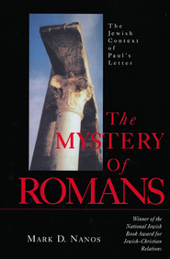
The Mystery of RomansI probably should have started with the Conclusion and then worked through the body of the book. Like Nanos’ Romans book, “Irony” is densely packed with details as Nanos first attempts to refute the traditional Christian interpretations of Paul in general and the Galatians letter in specific, and then presents his own evidence for the premise he suggests, that this letter is not Paul’s major attempt to torpedo the Torah, Judaism, and the Jewish people, but rather what he calls an “ironic rebuke” written to his Gentile disciples who frankly he believes should have known better than to listen to the Jewish (quite possibly proselytes themselves) influencers who neither had faith in Yeshua as Messiah nor believed that Gentiles could ever fully integrate and participate in Jewish worship and community life without undergoing the proselyte rite and converting to Judaism.

While reading this book, on more than one occasion, I felt I had gotten lost in the forest, unable to see the grand landscape for the trees, and there are a lot of “trees” in this book. I took an amazing number of notes that still riddle the pages of “Irony,” and could possibly form a small book themselves if bound between their own covers. However, this book is the result of Nanos’ doctoral dissertation so you can expect it to be tough reading (for most of us, anyway).

Like “Romans”, “Irony” presupposes that the Gentile believers in Galatia were involved in the local synagogues as the only likely venue for them to practice worship of Israel’s God and to learn more about the teachings of Messiah which after all, were contained in the Torah and the Prophets. Where else does one learn Torah than among Jewish teachers and students in a synagogue?

But as Nanos presents the situation, some of the Jewish people, “agents of social control” in the Jewish community, had a problem. As I stated above, how could they understand, since Nanos states these Jewish influencers were not disciples of Yeshua/Jesus, that these righteous Gentiles could be fully equal co-participants in Jewish worship and community without undergoing the proselyte rite? Apparently, these Gentiles, in the absence of Paul or any other Jewish believer and teacher, were being successfully convinced that faith in Messiah was not enough and that they must too undergo circumcision and take on the full yoke of Torah, as it applies to the Jewish people, in order to complete their devotion to God as “Messianic” disciples.

But the ideas Nanos presents in “Irony” aren’t exactly radical.

The next Sabbath nearly the whole city assembled to hear the word of the Lord. But when the Jews saw the crowds, they were filled with jealousy and began contradicting the things spoken by Paul, and were blaspheming.

–Acts 13:44-45 (NASB)

Some men came down from Judea and began teaching the brethren, “Unless you are circumcised according to the custom of Moses, you cannot be saved.”

–Acts 15:1 (NASB)

You may have to read all of Acts 13 for context, but as you may recall, on Paul’s first trip to the synagogue at Pisidian Antioch, his message of the good news of Messiah for all of the people present, born Jews, proselytes, and God-fearing Gentiles, met with great success. The Jewish members of the synagogue followed Paul and his companions after they left Sabbath services for the day, urging them to return the following Shabbat and to teach more. It was only when large numbers of pagan Gentiles who had heard of this good news invaded the synagogue that the synagogue leaders, threatened by their presence and the implications involved, turned against Paul and drove him out.

ancient-rabbi-teachingAccording to Nanos, something similar may have been operating among the influencers since how could they be sure these “righteous Gentiles” who in no way were progressing on the path to becoming proselytes, weren’t also involved in community pagan rites? The only way to be sure, would be to confirm their commitment to Hashem and the Jewish people by having them convert to Judaism.

Also, in the eyes of most Jews, the statement of Acts 15:1 seemed incredibly obvious. One does not come to Hashem except through Judaism.

Paul knew the truth, but he wrote his letter to the Galatians most likely before the Acts 15 legal decision handed down by the Council of Apostles that dictated the formal status and identity of the Gentile disciples within the Jewish community as something like “strangers living among us (Israel)”. Paul’s “gospel” was a radical idea at the time (and still is for most Jewish people today), that by faith could the Gentiles be grafted in to the community of Israel, coming to the Father by way of the Son.

As I mentioned in my previous review, according to Nanos, Paul was not a happy camper at hearing his students were defecting from their faith in Messiah and joining the more traditional path toward becoming proselytes. But rather than crafting a logical, dispassionate, and scholarly theological paper, he wrote a hopping mad “ironic rebuke,” whereby he took his Gentile followers to task for acting like inconsistent teenagers following after the “cool kids” in school rather than what they knew to be the truth.

But without understanding that Paul was being ironic, and sarcastic, and “snarky,” we could completely misunderstand what he was saying and who he was saying it to. If we believed that he was talking to Gentile and Jewish believers, and if we believed he was condemning circumcision, the Torah, and the Temple to that entire population, then we might conclude that Paul was himself “Law-free” and advocating for all Yeshua-believers, including Jewish disciples, that they become “Law-free” as well. Sounds like the exact accusations leveled against Paul in Jerusalem by Jewish people from the diaspora we find in Acts 21 (specifically from verse 17 onward), accusations that Paul steadfastly denied throughout a number of legal proceedings for the remainder of the book of Acts.

Assuming Paul wasn’t lying, then believing that Paul was against the Law, against the Temple, and against the formal practice of Pharisaic Judaism for believing Jewish people as most Christians interpret the Galatians letter just doesn’t make sense.

If approached as a theological tractate or an oration in a court of law, for example, or as a polemical attack on Jewish identity and Law observance as Galatians has often been read, then an entirely different set of expectations shapes the interpretive process than those suggested herein. But if Galatians exemplifies a letter of ironic rebuke designed to address the source they had been running when confident that their understanding of the meaning of Christ was legitimate–rightly so according to Paul’s revealed good news–then the guardians of the majority or dominant communities, who are guided in their sensibilities and responsibilities by long-standing membership and reference group norms, will no doubt consider it their rightful duty to obstruct such a course.

-Nanos, pg 319

It’s not a matter of changing a single word of the Galatians letter, but rather, shifting your perspective on what Paul was intending when he wrote it. We only have this letter to tell us what was going on with his addressees in Galatia and to suggest (Paul doesn’t tell us outright) who the influencers were. The method of interpretation makes all of the difference and as I’ve said before, Protestant Christianity has a very definite tradition about how to interpret Galatians and the rest of the Bible. The real challenge is getting the Church, from the average person sitting in a pew on Sunday morning, to the Pastoral staff, to the governing bodies of the various denominations, to the New Testament scholars and students in seminaries and universities, to set aside those traditions long enough to read what Paul is saying as a devoted disciple of Moshiach who was zealous for the Torah and never taught against the Law of Moses or the Temple of God.

Not an easy task to be sure.

The Jewish PaulBut if we read not just Galatians, but the rest of the record of Jewish and Gentile interactions in the Apostolic era with an eye on the tremendous social difficulties involved in even attempting to integrate these two populations in the synagogue under the radical notion that Gentiles did not have to adopt Jewish identities in order to be fully equal co-participants in the worship of God through Messiah, then we come up with a very different picture of the lives of the first Gentile believers and even what our lives as Christians should be today, particularly relative to the Jewish people and Judaism.

Which brings us back to Nanos’ statement about Shoah in the introduction to “Irony”.

The vast majority of the text, while it seems quite logical to me, would really require someone well-studied in New Testament scholarship to critically analyze. What Nanos writes makes sense to me primarily because it fits my own overarching view of the message of the Bible, but without traveling a similar educational path to Nanos or others like him, I don’t doubt I could miss quite a lot. But while I don’t have the ability to intimately examine each and every bit of research and evidence “Irony” presents, I can see that the final conclusion, at least generally, fits the portrait in which I have come to see the Apostle to the Gentiles, a Jewish man who was given the extraordinary task of bringing the good news of the Messiah to the pagan nations of the world; a man who centuries after his death, has been (in my opinion) falsely accused both by Christians and Jews, of being a traitor to his own people, of abandoning the Torah, abandoning the practice of his forefathers in the worship of God, and twisting the teachings of a humble itinerant Rabbi in the Galilee into a brand-new religious form that has no resemblance to the way Jesus taught the Torah of Moses to the “lost sheep of Israel.”

I’m glad I read this book but it certainly wasn’t easy. I consider myself educated but not in this field of study. However, this is a necessary book to work through for Christians because we must be shaken up and startled out of our complacency and our interpretive traditions. Even if you’re not willing to accept a view of Paul and his letter to the Galatians that exactly matches Nanos’ description, the very attempt should help convince you as it continues to convince me, that historic and modern Christianity has made a terrible mistake in how we see Paul. There’s a lot more to learn or relearn about Paul. “The Irony of Galatians” by Mark Nanos is but one step on that journey.

The Ironic Good News of Galatians

Commentators sense the need to argue this point to varying degrees, although none finds it necessary to go to any great lengths. In other words, this conclusion is apparently self-evident. James Dunn’s approach is representative: “The fact that Paul uses the Christian technical term for ‘the gospel’ also is clear indication that those whom he was about to attack were also Christian missionaries. He calls their message ‘another gospel’ because it was significantly different from his own; but he calls it ‘gospel‘ because that was the term they no doubt also used in their capacity as missionaries like Paul.”

-Mark D. Nanos
“Chapter 10: Paul’s ‘Good News Of Christ’ Versus The Influencers’ ‘News Of Good,” pg 285
The Irony of Galatians: Paul’s Letter in First-Century Context

As I write this, I have just finished reading this book (I know, it took a long time) and I really do intend to review it as a unit rather than chapter-by-chapter as I’ve historically reviewed other books. However, gathering my notes together for a comprehensive review will take a little more time and I have a good reason for pulling Chapter 10 out of the stream and devoting special interest to this topic.

As Nanos points out in this chapter and more generally in his book, the issue of what exactly the “gospel of Paul” vs. the “gospel of the influencers” indicates is of great importance in understanding Paul’s letter to the Galatian assemblies as well as the identity of the influencers.

I’ve commented before about how the word “church” (ekklesia) has taken on a life of its own in modern Christianity when the most general use of the word in the time of Paul simply meant “assembly,” as in any group of people coming together for a common purpose. This does not deny that the “ekklesia of Messiah” isn’t something quite a bit more specific, but the twenty-first century technical term “church” seems to be used in a way that we may not be able to anachronistically retrofit back into the first century text.

And so it goes with the word “gospel” (I can’t reproduce the original Greek here as Nanos does in his book). If we believe, as modern normative Christianity does for the most part, that Paul’s use of the word “gospel” in Galatians and his other letters must always specifically mean “the good news of salvation through the death and resurrection of Jesus Christ” and can never mean any other kind of “good news,” then we (Christianity or at least Christian doctrine and scholarship) may again be guilty of employing anachronistic retrofitting to force modern Christian theology back, two-thousand years in time and halfway around the world, into Paul’s thoughts, intentions, and writing when it may not have been what he meant at all or at least not all of the time.

I am surprised that you are so quickly defecting from him who called you in [the] grace [of Christ] for a different good news, which is not another except [in the sense] that there are some who unsettle you and want to undermine the good news of Christ.

–Galatians 1:6-7 (Nanos, pg 286)

In the original quote from the book, Nanos inserts the Greek text alongside the English words, which I’ve already indicated I am unable to duplicate here. But focusing on this bit of scripture, can the “good news” of the influencers be related to the “gospel message of Christ” and at the same time be “not another” and “different”? For that matter, what is Paul’s “good news” to the Gentiles and is it what we think of when we read our Bibles or listen to a message from a Pastor on Sunday morning?

Paul actually denies that this other “good news” should rightfully be considered “another.” Paul does not exactly say with F.F. Bruce that it is “no gospel,” but he gets thereby at the sense of Paul’s usage, for Paul does reverse himself in calling it that “which is not another…”

-ibid, pg 287

As I was reading this chapter, I was reminded of the First Fruits of Zion television series episode The Gospel Message which I reviewed last summer. According to the introduction to this episode:

The gospel message of Jesus is often simplified down to believe in Christ and your sins will be forgiven and you will go to heaven when you die. In episode eight this common misconception will be challenged. Viewers will discover that the main message of the gospel is one of repentance and entering into the kingdom of heaven. The kingdom of heaven is not the place we go to when we die but rather God’s kingdom coming down here on earth. The gospel message is about preparation for the Messianic Age.

Scot McKnight
Scot McKnight

Scot McKnight in his book The King Jesus Gospel: The Original Good News Revisited also produces strong evidence that the way “the Church” commonly understands the term “gospel” today does not entirely (or even mostly, sometimes) fit its original and intended meaning. Moreover, the term “gospel” meaning “good news” can mean different kinds of “good news” depending on context.

The good news of Jesus Christ is the centerpiece of Paul’s life and work. But the issue for identifying the influencers and their relationship with Jesus Christ is whether Paul’s use of…must be limited to the lips of believers in Jesus or even to a declaration about Jesus in a formal sense that it has come to have in the Christian tradition, with the results then applied to exegesis of Gal 1:6-7, as the conclusions of the prevailing views assume…

Because gospel is and has been for a long time used as a uniquely Christian term, it is anachronistic for our investigation, having lost the more fluid sense of good news or announcement or message of good originally communicated, and its verbal cognate is further limited by the lack of an English verbal form of “gospel” (i.e., “to gospel”), thus the translation “announcing” or “proclaiming the gospel.”

-Nanos, pg 288-9

Mark Nanos
Mark Nanos

This suggestion is bound to offend some Christians, and it’s certainly not my intention to do so. It is my intention to use what Nanos presents in his book to “shake the establishment” so to speak, and investigate an aspect of the writings of Paul that I think has been long neglected, especially at the level of the local community church: reading Paul specifically within the intent and context of his letters and letting Paul tell us what he meant rather than letting centuries old Christian tradition tell Paul and us what he meant. While I can’t promise that Nanos’ viewpoint is 100% correct in all respects, I think his approach shows much promise and has the ability, if we let it, to shake Christianity out of its apathy regarding our understanding of the Bible, and getting us to see the scriptures in a way that has been abandoned since the death of the last apostle.

On page 290, Nanos defines the usage of the plural of the word we translate as “gospel” in the time period of Paul and how it functioned within the “imperial cult for the announcement of significant event concerning the divine ruler: birth, coming of age, enthronement, speeches, decrees, and actions are ‘glad tidings’ of happiness and peace…” He also presents this by way of illustration:

How beautiful upon the mountains are the feet of the messenger who announces peace, who brings good news, who announces salvation, who says to Zion, “Your God reigns.” (emph. mine)

–Isaiah 52:7 (NRSV)

We can start to see the Greek word we read in English as “gospel” or “good news” having a somewhat more diverse or expanded meaning beyond what we consider in the Church, but lest I cast Nanos in an uncomplimentary role or misrepresent him, he did also say the following:

It should be clear by now that I do not intend to suggest that the usage of…in its various forms for the message or proclamation of the good news of Jesus Christ by Paul generally represented anything other than messianic eschatology, but at the same time I want to make it clear that this was not the only way in which it could be or was used by Paul or his Jewish or pagan contemporaries, to which I now turn.

-Nanos, pg 292

In other words, Nanos isn’t saying that “gospel” is never used by Paul to refer to “messianic eschatology”, only that Paul doesn’t always use the Greek word for “good news” in the same way. It isn’t a matter of either/or but depends on the immediate context of the message.

However…

That instance (2 Sam 4:10; 2 Kgdms 4:10 in LXX) also constituted an ironic twist on the double meaning of… (though in the plural): the messenger thought that he was “bringing” David “good news” … about the death of Saul, only to be killed, for the value of the news was perceived differently by David… (emph. mine)

-ibid

PaulThis brings up the point of how the difference in the good news of Paul vs. the good news of the influencers was intended. We know that Paul intended his good news to be good for the Gentile addressees of his letter, but what about the influencers (I’ll speak more about the identities of the addressees and influencers in my forthcoming general review of “Irony”)? On page 314, Nanos says that “it is not to say that the influencers did not regard their message as good news for these Gentiles. I think they did.” I’ll expand on this in my next review, but from the influencers’ point of view, as understood by Nanos, the Jewish influencers really did think they were doing the Gentile believers in Christ a big favor by “completing” their transition of identities from pagan worshiping goyim, to God-fearing Gentiles, and finally to fully integrated members into the Jewish community in which the Gentiles were then worshiping and participating through entry into the proselyte rite.

In other words, “good news” is in the eye of the beholder. While Paul may have referred to the message of the influencers as “good news” ironically and even sarcastically, Nanos maintains that the influencers were sincere in their intent to bring good to the Gentiles, not understanding or not wanting to understand that through Christ, the Gentiles would be equal co-participants in Messiah-devotion and worship of the God of Israel in a Jewish synagogue and community context.

But this flies in the face of how Nanos defines the following verse:

For those who are circumcised do not even keep the Law themselves…

–Galatians 6:13 (NASB)

While many Christians understand that piece of scripture to be Paul’s accusation that the Jewish people who were trying to entice the Gentiles to convert and to “keep the Law” hypocritically did not observe the mitzvot themselves, Nanos says that Paul had one very specific Law in mind:

…but you shall love your neighbor as yourself…

–Leviticus 19:18 (NASB)

While the Jewish influencers in the Galatian synagogues may not have been aware that Yeshua of Nazareth cited this as one of the two greatest commandments (see Mark 12:31 for example), they would have been quite aware of the commandment in Torah. Nanos says that Paul accuses the influencers of not observing this specific mitzvot by ignoring what was actually in the best interests of their Gentile neighbors in Christ for the sake of the influencers’ own interests. Again, I’ll speak more on this at a later time, but I mention it now only to draw attention to the seemingly contradictory motivations of the influencers as presented in the Nanos book.

Moreover, the association of the declaration to Abraham of the promise of a son with the label good news continued in the rabbinic tradition on Genesis, though obviously with no association with Jesus: Gen 18:1-15; b. Baba Mesia 86b; Mekita, Pischa 14; cf. Fragment Targum to Gen 21:7 and Gen. Rabbah 50:2.

-Nanos, pg 294

A Jewish person recently commented on one of my blog posts how Christians have sometimes erroneously misinterpreted the sages to support their (our) stance that Yeshua is the Messiah and that the Messiah is Divine. Further, in one of my reviews of D. Thomas Lancaster’s sermon series Holy Epistle to the Hebrews, I stated that there is a very real danger in reading Talmud and interpreting Midrash written well after the Apostolic Era as if it existed in the same form during the time of the apostles. On the other hand, Nanos is presenting his argument by establishing the usage of the Greek word for “gospel” at the time of Paul first, and then projecting it forward in time rather than trying to make the future apply to the past.

It occurs to me now that without saying so explicitly, what Nanos does in “Irony” may also be (though I say this rather provisionally) what Lancaster is doing in his lectures. That still doesn’t excuse deliberately reading into the Rabbinic sages what they never intended relative to the identity of the Messiah (which is something I’ll need to write about someday), but I think it’s valid to establish a method of reading the Apostolic scriptures “Jewishly” and then looking forward in time through Jewish literature at how that perspective has been maintained or evolved across history.

Another important aspect of Paul’s application of the broader semantic field of…comes to the front when we consider his usage of this language with regard to the figure of Abraham. Paul appeals to “the good news proclaimed beforehand…” to Abraham (i.e., before his circumcision). The content of this good news was that “In you shall all nations be blessed” (3:8). This good news was obviously proclaimed before Jesus or any message could be directly attributed to him or his followers…

-ibid

Certainly the scripture in the above-referenced quote is about Jesus as the Messiah, but said-good news was not delivered by the followers of Jesus (which would have been historically impossible) and thus while the good news does address a future Messiah who would be a blessing to the nations, it was not specifically describing the “mechanics” of the death and resurrection of Jesus Christ as a means of personal salvation, which is how the Church understands the “good news” today.

The Jewish PaulNanos continues to deliver additional examples of how “gospel” could have been meant differently by Paul in different contexts, and how “gospel” as attributed to the influencers could have been considered “good” to the Gentiles by them, even as Paul considered it “another gospel” which is “not a gospel” at all, for it undermined the good news of the Messiah for Paul’s Gentile students in the Galatian communities.

Nanos paints a portrait of the letter-writing Paul not as crafting a cold, calculated, and logical religious treatise as much as he was delivering a “snarky” commentary as an offended parent to misbehaving teenagers who were being led astray by a misinformed group of “agents of social control” in their local Jewish communities. While being “snarky” doesn’t mean Paul checked his brain at the door and was incapable of composing a complex and scholarly dissertation in letter form, it does mean that Paul was writing a letter in response to a specific event or set of events, and he was quite possibly hurt and angry as he addressed the error of the addressees and the troublesome actions, though possibly even well intended on some level, of the influencers.

My take away from this chapter is that we need to stop being married with the highly technical meanings we assign to certain words and phrases in Christianity, and instead, we should “get down in the mud” so to speak, with Paul as he’s writing his letters, get into his head, get into the situation, as much as history will allow, and experience, in this case, Paul’s Holy Epistle to the Galatians as a letter fired off by a fired up Paul trying to avert what he could only see as a disaster, if his Gentile protegés were led off the path of Paul’s “gospel” to believe in another “gospel,” one that said they would never be equal co-participants in the Jewish community of Messianic followers and worshipers of the God of Israel unless they were circumcised and converted through the proselyte rite into Judaism.

Paul had the good news of the Messiah for the Gentiles that through the covenant promises God made to Israel, by faith as Abraham exhibited before his circumcision, the people of the nations could be grafted in and be made part of the glorious hope that began with God’s elevating the Hebrews, continued with the first stirrings of the New Covenant in the life of Jesus and the Apostolic Era, and that will ultimately be realized with Messiah’s return, a promise of what is to come.

Addendum: The full book review is now online.

"When you awake in the morning, learn something to inspire you and mediate upon it, then plunge forward full of light with which to illuminate the darkness." -Rabbi Tzvi Freeman