Tag Archives: Bible

Reflections on Romans 1 and 2

For I am not ashamed of the gospel, for it is the power of God for salvation to everyone who believes, to the Jew first and also to the Greek. For in it the righteousness of God is revealed from faith to faith; as it is written, “But the righteous man shall live by faith.”

Romans 1:16-17 (NASB)

When I was preparing for last week’s Sunday school class for the study on Romans 10:1-13, I decided to read the entire Epistle to the Romans. I’ve studied Romans before, principally using the Mark Nanos book The Mystery of Romans, but there’s something to be said for just reading the Bible and letting it speak to you.

I prefer, when I can, to read entire books in the Bible rather than just a few verses at a time. Imagine reading your favorite novel three or four sentences at a time, then putting the book down for four days, picking it up and reading another few sentences.

First of all, it would take you forever to get through the novel and secondly, you probably would have a tough time keeping the book’s overarching narrative in your mind as a complete story.

But we think nothing of treating the Bible or any of the books it contains as if it were a large collection of “sound bytes”.

Paul wrote each of his letters to be read as a whole, including Romans. Why don’t we read them that way? The impression we get of the epistle (or any other single book in the Bible) will probably be different and perhaps yield a more complete impression in the mind of the reader.

Alas, I can’t review the whole epistle to the Romans in a single blog post, so I’ll have to break my own rule. But I can use a series of blog posts to communicate my overall impression of Romans a few chapters at a time? Hopefully, that will be sufficient.

None of this is scientific or scholarly. I don’t read Biblical Greek and I didn’t use any references or other study aids while reading Romans. I just read Romans and took notes on the margins of the pages as I was reading. That’s what I’m going to share with you.

Oh, these are just impressions. Little bits and pieces that I picked up in my overall read of the letter. I’m not going to comment on all the verses in each chapter. Just what prompted me to write a note down.

Take it for what it’s worth.

The first thing I noted in my reading of Romans was the above-quoted verses. Paul was not ashamed of the Good News of Messiah. That good news is the “power of God for salvation to everyone who believes, to the Jew first and also to the Greek.”

What is “salvation?” We like to think that it’s as simple as being saved from the consequences of our sins and being reconciled to God, but remember, for Jesus and for Paul, based on the New Covenant promises, having your sins forgiven is only the first step.

The New Covenant promises are aimed solely at the Jewish people and the nation of Israel, and include restoring national Israel to its former glory and elevating her as the head of all the nations of the world. It’s the promise that Israel’s Messiah King will rule with justice and mercy, not over just Israel, but the nations of the Earth. It’s the promise that Messiah will completely end the Jewish exile and return all Jews to their nation. It’s the promise to rebuild the Temple and to restore the sacrificial system in accordance to the commandments. It’s the promise to defeat all of Israel’s enemies and bring them (us) under subjugation. It’s the promise to establish a reign of worldwide peace and tranquility. It’s the promise of the resurrection for the just, that they (hopefully, we) will live in the resurrection under Messiah’s reign, for that is the hope of our faith. It is the promise…

You get the idea.

So when Paul says something as simple as “power of God for salvation to everyone who believes, to the Jew first and also to the Greek,” he’s really saying all of the stuff I put into the previous, large paragraph. That’s why it’s first to the Jew. Because promises were made to the Jewish people. Gentiles, by God’s mercy and favor, get to come along for the ride…but I’ll get to that in a subsequent blog post.

For even though they knew God, they did not honor Him as God or give thanks, but they became futile in their speculations, and their foolish heart was darkened.

Romans 1:21 (NASB)

balaam_israelI read this the same weekend I read Torah Portion Pinchas and hopefully you’ll see the connection. After Israel was spared being cursed and was in fact blessed by the Gentile prophet Balaam, Balaam had the “brilliant” suggestion to have Moabite and Midianite women seduce the men of Israel sexually to incite them to worship their (foreign) gods.

It worked. If not for the zeal of the Kohen Pinchas (Phinehas), the plague of Hashem might have consumed the whole nation:

The Lord spoke to Moses, saying, “Phinehas, son of Eleazar son of Aaron the priest, has turned back My wrath from the Israelites by displaying among them his passion for Me, so that I did not wipe out the Israelite people in My passion. Say, therefore, ‘I grant him My pact of friendship. It shall be for him and his descendants after him a pact of priesthood for all time, because he took impassioned action for his God, thus making expiation for the Israelites.'”

The name of the Israelite who was killed, the one who was killed with the Midianite woman, was Zimri son of Salu, chieftain of a Simeonite ancestral house. The name of the Midianite woman who was killed was Cozbi daughter of Zur; he was the tribal head of an ancestral house in Midian.

The Lord spoke to Moses, saying, “Assail the Midianites and defeat them—for they assailed you by the trickery they practiced against you—because of the affair of Peor and because of the affair of their kinswoman Cozbi, daughter of the Midianite chieftain, who was killed at the time of the plague on account of Peor.”

When the plague was over…

Numbers 25:10-19 (JPS Tanakh)

The Israelites knew God but they did not honor Him.

There’s also the corresponding Psalm for this Torah Portion:

But to the wicked God says,
“What right have you to tell of My statutes
And to take My covenant in your mouth?
“For you hate discipline,
And you cast My words behind you.
“When you see a thief, you are pleased with him,
And you associate with adulterers.
“You let your mouth loose in evil
And your tongue frames deceit.
“You sit and speak against your brother;
You slander your own mother’s son.
“These things you have done and I kept silence;
You thought that I was just like you;
I will reprove you and state the case in order before your eyes.
“Now consider this, you who forget God,
Or I will tear you in pieces, and there will be none to deliver.
“He who offers a sacrifice of thanksgiving honors Me;
And to him who orders his way aright
I shall show the salvation of God.”

Psalm 50:16-23 (NASB)

Even in the condemnation of the faithless and the wicked, God still offers a path back to salvation and redemption.

Or not…

And just as they did not see fit to acknowledge God any longer, God gave them over to a depraved mind, to do those things which are not proper, being filled with all unrighteousness, wickedness, greed, evil; full of envy, murder, strife, deceit, malice; they are gossips, slanderers, haters of God, insolent, arrogant, boastful, inventors of evil, disobedient to parents, without understanding, untrustworthy, unloving, unmerciful; and although they know the ordinance of God, that those who practice such things are worthy of death, they not only do the same, but also give hearty approval to those who practice them.

Romans 1:28-32 (NASB)

teshuvahGod always offers a way back, but you have to be willing to take it. You can only access the path of teshuvah and return to God if you repent of your sins. If you don’t, if you are guilty of what the above-quoted verses state, if you fail to acknowledge God, then God, according to how I read Paul, will give you enough rope to hang yourself with.

Or do you think lightly of the riches of His kindness and tolerance and patience, not knowing that the kindness of God leads you to repentance?

Romans 2:4 (NASB)

God doesn’t always “drop the hammer” the minute we stray from the path of light and into darkness. In fact, often he just lets us do what we want to do, and it’s easy to take that as a sign that God doesn’t seem to mind. No, that’s not it. He’s giving us the rope with which to hang ourselves, but he’s also giving us time to realize how badly we’ve messed up. He’s giving us time to repent. For when our time is up, then and only then will it be too late.

He thereupon says to them, “Permit me to go repent!” And they answer him and say, “You fool! Do you know that this world is like the Sabbath and the world whence you have come is like the eve of the Sabbath? If a man does not prepare his meal on the eve of the Sabbath, what shall he eat on the Sabbath?”

-from Ruth Rabbah 3:3
quoted by Young in
Chapter 15: Death and Eschatology: The Theology of Imminence, pp 281-2
The Parables: Jewish Tradition and Christian Interpretation

I quoted this yesterday and for the same reason. To illustrate that we have lots and lots of time, at least as humans measure time (but maybe not as much time as we think), but in the end, God’s justice prevails. Don’t take God’s patience lightly.

There will be tribulation and distress for every soul of man who does evil, of the Jew first and also of the Greek, but glory and honor and peace to everyone who does good, to the Jew first and also to the Greek. For there is no partiality with God.

Romans 2:9-11 (NASB)

I found this rather sobering. God puts the Jew first in both good and evil. If the blessings of the New Covenant come to the Jew first, so does tribulation and distress. There’s a definitely negative aspect to being at the center of God’s attention. I read “no partiality” both as God delivering consequences equally upon the Jew and Greek and as God not being partial to Israel giving her only good but not evil.

For all who have sinned without the Law will also perish without the Law, and all who have sinned under the Law will be judged by the Law…

Romans 2:12 (NASB)

under-law-torahIt seems that Jews will be held to a higher standard than Gentiles. But was Paul writing to believing and unbelieving Jews and to pagan Gentiles when he said “under the Law” and “not under the Law”? Paul was writing to the “church” in Rome, which Nanos said was more likely to the believing and non-believing Jews and the believing Gentiles in the synagogue. Paul had no audience with the pagans and his letter wasn’t addressed to them. So who is under the Law and not under the Law? Were the believing Gentiles under the Law?

…for it is not the hearers of the Law who are just before God, but the doers of the Law will be justified. For when Gentiles who do not have the Law do instinctively the things of the Law, these, not having the Law, are a law to themselves, in that they show the work of the Law written in their hearts, their conscience bearing witness and their thoughts alternately accusing or else defending them, on the day when, according to my gospel, God will judge the secrets of men through Christ Jesus.

Romans 2:13-16 (NASB)

This is getting very close to something like having the law “written on hearts,” for how would Gentiles who were not given the Law at Sinai “instinctively” know to do the things of the Law? And what did they do? Did Gentiles “instinctively” put tzitzit on their garments and lay tefillin? Did they “instinctively” start observing the Shabbat and keeping kosher? Or is being kind, gracious, and compassionate a more “instinctive” response in doing the Law?

If Paul is talking about Gentiles who are already disciples of Jesus, then they would possess the Holy Spirit and the finger of God would be just beginning to write the Law upon their hearts.

But the Jewish believers (and non-believers) already had the Law.

But if you bear the name “Jew” and rely upon the Law and boast in God, and know His will and approve the things that are essential, being instructed out of the Law, and are confident that you yourself are a guide to the blind, a light to those who are in darkness, a corrector of the foolish, a teacher of the immature, having in the Law the embodiment of knowledge and of the truth, you, therefore, who teach another, do you not teach yourself?

Romans 2:17-21 (NASB)

Is it possible to take a gift for granted. Were there Jews who relied on outward behavior alone to justify them before God. Yes, it is the “doer” of the Law who is made righteous, but only by faith. Performing the mitzvot without faith is not effective. See Psalm 50 above if you don’t believe me.

Hopefully, a believing Jew would not take the Torah for granted, but if Nanos is right, Paul was also writing to Jews who were not believers in Jesus as the Messiah, and some of them may have strayed from their faith, relying on behavior and ethnic identity alone to justify them before Hashem. This is Paul’s dire warning to his brothers.

…you, therefore, who teach another, do you not teach yourself? You who preach that one shall not steal, do you steal? You who say that one should not commit adultery, do you commit adultery? You who abhor idols, do you rob temples? You who boast in the Law, through your breaking the Law, do you dishonor God? For “the name of God is blasphemed among the Gentiles because of you,” just as it is written.

Romans 2:21-24 (NASB)

Hypocrisy? Jesus accused his brothers among the Pharisees of hypocrisy more times than I can count.

Then Jesus spoke to the crowds and to His disciples, saying: “The scribes and the Pharisees have seated themselves in the chair of Moses; therefore all that they tell you, do and observe, but do not do according to their deeds; for they say things and do not do them.”

Matthew 23:1-3 (NASB)

PhariseesI’ve quoted Noel S. Rabbinowitz’s paper Matthew 23:2-4: Does Jesus Recognize the Authority of the Pharisees and Does He Endorse Their Halakhah (PDF) more than once to illustrate while Jesus accused at least some of the Pharisees of not practicing what they taught, he confirmed that what they taught was correct, and that they had the proper authority to be teachers in Israel.

Applying that forward to Paul, he may well have accused some of the Jews in the Roman synagogues of hypocrisy but at the same time acknowledged what they taught was correct and that they had the authority to teach in the synagogues. Thus, Paul was criticizing the hypocritical practices of some of his audience, not their validity as Jews nor the validity of the Torah as a continued covenant obligation for Jews.

But someone may well say, “You have faith and I have works; show me your faith without the works, and I will show you my faith by my works.” You believe that God is one. You do well; the demons also believe, and shudder. But are you willing to recognize, you foolish fellow, that faith without works is useless? Was not Abraham our father justified by works when he offered up Isaac his son on the altar? You see that faith was working with his works, and as a result of the works, faith was perfected; and the Scripture was fulfilled which says, “And Abraham believed God, and it was reckoned to him as righteousness,” and he was called the friend of God.

James 2:18-23 (NASB)

Faith and works are required. They come as a set. You cannot properly separate them. Faith without works is dead but so is works without faith.

Make no mistake though. God fully intended (intends) for Jews to observe the mitzvot.

“For this commandment which I command you today is not too difficult for you, nor is it out of reach. It is not in heaven, that you should say, ‘Who will go up to heaven for us to get it for us and make us hear it, that we may observe it?’ Nor is it beyond the sea, that you should say, ‘Who will cross the sea for us to get it for us and make us hear it, that we may observe it?’ But the word is very near you, in your mouth and in your heart, that you may observe it.

Deuteronomy 30:11-14 (NASB)

That completely shoots down any Christian argument that God gave the Jews the Law to prove how impossible it would be to keep, thus showing them that they could only be “saved” by faith and grace alone, apart from the Torah.

For indeed circumcision is of value if you practice the Law; but if you are a transgressor of the Law, your circumcision has become uncircumcision. So if the uncircumcised man keeps the requirements of the Law, will not his uncircumcision be regarded as circumcision? And he who is physically uncircumcised, if he keeps the Law, will he not judge you who though having the letter of the Law and circumcision are a transgressor of the Law? For he is not a Jew who is one outwardly, nor is circumcision that which is outward in the flesh. But he is a Jew who is one inwardly; and circumcision is that which is of the heart, by the Spirit, not by the letter; and his praise is not from men, but from God.

Romans 2:25-29 (NASB)

If a Jew fails to perform a mitzvah, does he stop being a Jew? Does he become “uncircumcised?” This used to puzzle me. The whole “For he is not a Jew who is one outwardly, nor is circumcision that which is outward in the flesh” thing has been used to justify calling Christians “spiritual Jews” and to support the old, tired theology of supersessionism. But I don’t think that’s what Paul is saying.

Paul is trying to inspire zeal for the Torah and for faith in Messiah in his non-believing Jewish brothers in Rome. How would he do that by insulting them and rejecting them? Worse, how would he do that by denigrating the Torah? He couldn’t.

JewishBut he could be saying that a Jew is justified before God if he is outwardly a Jew, that is, if he is obedient to the commandments, and if he is inwardly a Jew, that is, if he has faith in God and that faith is the motivation for obedience. The two go together…faith and works.

I had intended to cover Chapter 3 as well in this first “reflection” but I can see this “meditation” is long enough as it is.

This is an experiment of sorts, so let me know what you think. Should I continue writing my reflections of Romans for the entire epistle?

Next up: Reflections on Romans 3.

Unity in Messiah: A Commentary on One Law and Gentiles

As for the assembly, there shall be one statute for you and for the alien who sojourns with you, a perpetual statute throughout your generations; as you are, so shall the alien be before the LORD. There is to be one Torah and one ordinance for you and for the alien who sojourns with you.

Numbers 15:15–16

But does the Torah really make different laws for Jews and Gentiles? According to Numbers 15:15–16, there is to be only one law for both Jews and Gentiles.

This seems simple enough. According to these verses, there is one law for both Jews and Gentiles. Therefore, Gentile believers should keep the whole Torah.

But wait. It’s not that clear.

“One Law and the Gentiles”
Commentary on Torah Portion Shelach
First Fruits of Zion (FFOZ)

I quoted from this article just the other day as an example of what sometimes provokes other believers to anger and how I want to avoid being excessively and needlessly provocative. While the “One Law” issue is a “non-event” for the vast majority of the Christian world, this is a “hot button” issue in certain small (relative to the overall body of believers worldwide) religious circles in the blogosphere.

But then, I’ve been thinking about an ad I received by email recently. Eichers.com has extended its annual Talis and Tzitzit sale to June 24th. As I read the advert, I found myself involuntarily pining for the days when I used to actually don a tallit to pray.

Then my reality check came in and I closed the ad, but not before I started pricing tallit gadolim (just “window shopping”).

Many years ago, my wife arranged for a friend who was visiting Israel, to purchase my first tallit at the Galilee Experience. It was a total surprise when it arrived from Israel by mail and my wife presented it to me.

But that was a long time ago, and to put it mildly, my wife’s attitude about Christians and tallitot has changed considerably. For that matter, so has mine.

I don’t really regret the “course correction” I’ve instituted in my life, but I do need periodic reminders of who I am and what I need to be doing that’s important to God in order to counterbalance my attraction to various aspects of Judaism as a worship practice. Really, if I had my “druthers” and it didn’t matter to God (or anyone else, especially the Missus) one way or the other, comparing evangelical Christian worship and study to a (Messianic) Jewish template, I’d probably choose Jewish practice.

In any conceivable way, nothing would be removed from my devotion to Yeshua (Jesus), but a richness in spiritual texture and connectedness to the people of God that extends all the way back to Sinai would be the platform and environment for that devotion.

I know that if any Hebrew Roots people with a bent for “One Law” ever read this, they’d probably say, “go for it!”

But, no. I have good reasons not to. It’s not my world and my practice. God chose the Jewish people for a reason and He gave them the Torah as the conditions of the Sinai covenant for a reason. Then He made it possible through the emergence of the New Covenant for Gentiles to be grafted in, and provided conditions for we grafted in Gentiles in a binding legal ruling that outlines a distinction in how Gentile disciples are obligated to the Torah.

I can live with that, knowing that we Gentiles have a unique role in supporting Messianic Jewish return to Torah and in perfecting the world in preparation of Messiah’s return.

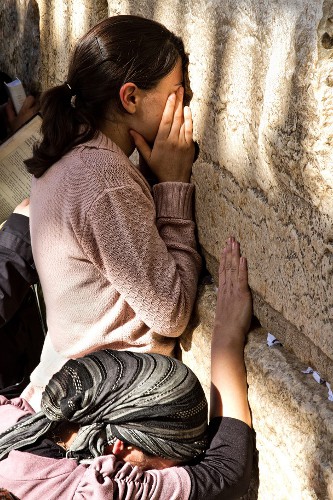
women_praying_at_the_wallAlso, living with a Jewish wife and daughter, I have a special appreciation for their own uniqueness as Jews and how my mimicking Jewish behavior in some sort of evangelical Jewish cosplay cheapens who they are and totally misrepresents me and all other Gentile disciples of the Master.

It was also no coincidence (in my opinion) that Chabad.org’s “mitzvah minute” email was on Tzitzit: Fringe Judaism this past week.

Most people don’t think of Judaism as a fringe religion. Yet that’s our uniform. Under their shirts, Jewish men and boys wear a poncho called a tallit katan (literally: small cloak), with fringes hanging from each corner, just as the Torah prescribes (Numbers 15:37–40), “They shall make fringes on the corners of their garments . . .”

That’s “Judaism,” not Christianity that wears the fringes. I’m not a thief. I don’t take things that belong to someone else. Donning a Tallit Gadol for prayer belongs to someone else…Jewish people.

Jacob Milgrom contends that in the ancient Near East the ornateness of the hem was a mark of nobility. Hence the wearing of tzitzit denoted that all Israelites were members of a priestly nation with a universal mission. That status and its attendant obligations rest on God’s deliverance of Israel from slavery, as the passage makes clear at the end: “I the Lord am your God who brought you out of the land of Egypt to be your God: I, the Lord your God.” (Numbers 15:41)

-Ismar Schorsch
“The Distinction between History and Memory,” pg 522 (June 16, 2001)
Commentary on Torah Portion Shelach
Canon Without Closure: Torah Commentaries

I assume D. Thomas Lancaster wrote the small article on “One Law and the Gentiles” and in referencing Numbers 15:15-16, he says:

First of all, the context deals not with the application of Torah as a whole, but specifically with the sacrifices. In other words, if an alien wanted to offer a sacrifice in the Temple he needed to follow the same Torah guidelines as the Israelite. The passage is not saying that all the laws of Torah apply equally to Jews and Gentiles.

Second, by the time of the apostles, the word translated as “alien” (ger, גר) was no longer understood as just a Gentile non-Jew. The Hebrew word had shifted its semantic value to refer specifically to a Gentile who had gone through a full, legal conversion to become Jewish, i.e., a proselyte. That conversion process included circumcision, immersion, and a sacrifice. That’s how the Greek version of the Torah (lxx) translates the word too. That’s probably how the apostles would have understood it.

Interestingly enough, Lancaster (I presume) says the Didache actually agrees with the surface reading of Numbers 15:15-16:

If you are able to bear all the yoke of the Lord [i.e., Torah], you will be perfect; but if you are not able, do as much as you are able to do. (Didache 6:2)

Wait a minute! What just happened? Did Lancaster say that the Didache supports an identical application of the Torah mitzvot on both Jewish and Gentile disciples of Jesus?

The Didache agrees with Numbers 15:15–16. There is not supposed to be a different Torah for Gentile believers. The Gentile believers are not supposed to have a different type of worship or religion. There is only one Torah for God’s people. The only question left open is to what extent the Gentile believer is obligated. Most of the laws of the Torah apply equally to Jewish and Gentile disciples of Yeshua.

On the other hand, Gentile believers are not obligated to keep all of the ceremonial laws as the Jewish believers such as circumcision and other distinct markers of Jewish identity like the calendar, the holy days, the dietary laws, and so forth. Despite that, the Bible does not create alternative Gentile versions of these institutions.

In the days of the apostles, the Gentile believers kept most of those things along with the Jewish believers as part of their participation in their shared religion.

The Torah, the conditions for the Sinai covenant, are the same conditions for the New Covenant. God didn’t re-write the conditions, just the material upon which they are written, on paper and tablets formerly, but later, on the human heart.

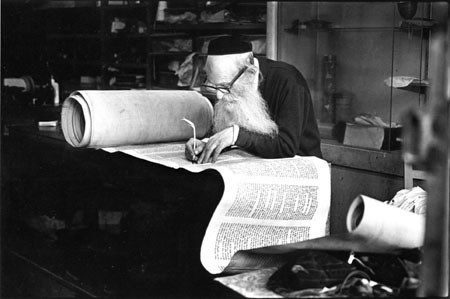
sefer-torahSo Torah applies to all who come under the New Covenant. The only question is how the roles and applications differ between those who entered into covenant with God at Sinai vs. those of us who were later grafted in, that is, between Jews and Gentiles.

Lancaster ended his small write-up by saying that in the apostolic era, it was likely the Gentile disciples, especially those embedded in Messianic Jewish synagogues in the diaspora, would have appeared much more Jewish than we Christians do today. Their practice and observance would have been modeled on their mentors, and as Lancaster mentioned, the Didache seems to support this view and was formally taught to newly-minted non-Jewish disciples.

So where does that leave me? Right where I am.

If I lived in a different environment, if my wife was Messianic, if a thousand other things were changed, how I outwardly worship God would probably not look the same as it does now. But there are no “what ifs” in God’s creation, there is only here and now and what is real.

What matters about discipleship and devotion to the Master is doing the will of God. I pray. I study. I worship in fellowship. I perform many of the mitzvot in the Torah such as giving charity to the poor, providing food for the hungry, visiting the sick, comforting those who grieve.

The message of the Good News of Messiah changes not at all for the Jew or the Gentile, and the coming of the Kingdom alters not one little bit for the descendants of Israel or the people of the nations. In fact, being a devoted Gentile who has fully apprehended a Messianic world view and perception of the Bible makes me a lot more valuable to the cause of Christ for Jewish and Christian people than if I felt that I would only be on God’s “approved list” if I looked and acted “Jewish”.

I know parts of what I’ve written will make certain people unhappy, but please remember, I’m not telling you or anyone else what to do, I’m just talking about who I am and what I need to do. I can’t allow how others view me to affect what I must do and refrain from doing before God.

The Kotzker Rebbe said that the mistake of the spies was in the words “and so we were in their sight.” It should not bother a person how others view him. (Otzer Chayim)

A person who worries about how others view him will have no rest. Regardless of what he does or does not do he will always be anxious about receiving the approval of others. Such a person makes his self-esteem dependent on the whims of others. It is a mistake to give others so much control over you. Keep your focus on doing what is right and proper.

-Rabbi Zelig Pliskin
from his commentary on Torah Portion Shelach (pg 330)
Growth Through Torah

There is “one law” but it is applied differently, even within formal Judaism, depending on who you are. It’s applied differently also for the Gentile. There is One God who is God of all. There is one Messiah who brings salvation to the world. There is one Kingdom waiting for the devoted to enter. There is one world to come where we will return to the Garden, because that’s where it all began.

If that’s not unity in Messiah, what is?

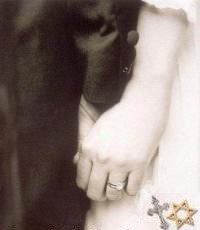
intermarriageFinal note: distinctiveness in identity and practice does not mean dissolution, disagreement, or disconnection. My wife and I are obviously different as man and woman, and we are different as Christian and Jew. Nevertheless, we are a family together with our children and grandson, and we share strong connections within that context. The same can be said for the Messianic community of Jews and Gentiles. We form a unity not in spite of our differences, but because of them. That is the beauty of “one new man” (Ephesians 2:15). You are changed, not in terms of ethnicity, nationality, or obligation, but because, men and women, Jew and Gentile, no matter how one differs from another, we are all interconnected in Messiah, may he come soon and in our day.

Addendum: See the “sequel” to this “meditation”: Walking in the Dust of the Footsteps of Moshiach.

What I Learned in Church Today: Anti-Gentilism and Crypto-Supersessionism

Before starting, I wish to apologize to Pastor Randy, everyone at his church,  and any Christians who may be offended by what I’m about to say. I’m sorry but the Church isn’t perfect. It’s full of flawed human beings (I know, I’m one of them). Last Sunday, one of those people proved it and I’m proving it again by even talking about it. I probably shouldn’t. I almost didn’t. But I decided in the end that this needs to be said, not to injure the Church but to help it improve.

Now to begin today’s “morning meditation.”

Two statements from the notes handed out in the church bulletin on Pastor’s sermon for last Sunday:

Paul’s Conversion in Damascus (22:2b-13)

  1. His Previous Conduct – How Judaism Once Controlled His Life (vs. 2b-5)
  2. His Present Conduct – How Jesus Now Controls His Life (vs. 6-13)

This was part of Pastor’s sermon on Acts 21:35-22:2a. For a little context, here are the relevant passage of scripture:

And when they heard that he was addressing them in the Hebrew dialect, they became even more quiet; and he said,

“I am a Jew, born in Tarsus of Cilicia, but brought up in this city, educated under Gamaliel, strictly according to the law of our fathers, being zealous for God just as you all are today. I persecuted this Way to the death, binding and putting both men and women into prisons, as also the high priest and all the Council of the elders can testify. From them I also received letters to the brethren, and started off for Damascus in order to bring even those who were there to Jerusalem as prisoners to be punished.

“But it happened that as I was on my way, approaching Damascus about noontime, a very bright light suddenly flashed from heaven all around me, and I fell to the ground and heard a voice saying to me, ‘Saul, Saul, why are you persecuting Me?’ And I answered, ‘Who are You, Lord?’ And He said to me, ‘I am Jesus the Nazarene, whom you are persecuting.’ And those who were with me saw the light, to be sure, but did not understand the voice of the One who was speaking to me. and I said, ‘What shall I do, Lord?’ And the Lord said to me, ‘Get up and go on into Damascus, and there you will be told of all that has been appointed for you to do.’ But since I could not see because of the brightness of that light, I was led by the hand by those who were with me and came into Damascus.

“A certain Ananias, a man who was devout by the standard of the Law, and well spoken of by all the Jews who lived there, came to me, and standing near said to me, ‘Brother Saul, receive your sight!’ And at that very time I looked up at him.”

Acts 22:2-13 (NASB)

I go over the notes for the sermon before services while everyone else is “schmoozing” and drinking coffee. Sometimes, I’ll even start writing down my impressions (I’m kind of a nerd that way). When I saw the two points above, my immediate response was “Judaism and the Jewish Messiah are not mutually exclusive.”

It’s doubtful Pastor meant to say they were, at least in a first century context (today is another story), but so many Evangelical Pastors believe that with the so-called “birthday of the Church” in Acts 2, God had declared Judaism (and possibly the Jewish people) obsolete and replaced by Christianity and the Church (neither of which existed as we understand them today at that point in history).

Actually, I really liked today’s (as I write this) sermon. Pastor really shines in his knowledge of Biblical history as well as the languages involved, and he brought out many details I thought were important and illuminating. At the same time, I could see the “lights” dim in the eyes of some of the people around me as Pastor may have (for them) gotten a bit too historical and scholarly.

He also delivered a welcome and rousing speech condemning anti-Semitism and the shocking fact that there are some two-hundred neo-Nazi organizations in the U.S. today that teach adults and children to hate and kill Jews and other minority populations. Anti-Semitism should not exist in our world, especially post-Holocaust.

ChurchThe only thing he left out was how for nearly all of the history of the Church, we have been one of the chief supporters of anti-Semitism, pogroms, forced conversions, torture, and murder of countless Jewish people, not to mention the numbers of synagogues, Torah scrolls, and volumes of Talmud we’ve destroyed “in the name of Jesus”.

Thankfully, Christians don’t participate in such actions today, but there’s an echo of that same sentiment toward Jewish people we can still hear in our churches right now, including in the Sunday school class I attended a few hours (as I write this) ago.

I’ll get to that in a bit.

In reading Paul recite his own history about how he so zealously opposed the Messianic Jewish movement of the Way, I realized the Bible never directly addresses why Paul embraced such murderous hate of the movement. What did it mean to him personally? Why did he make it his special mission to eradicate Jewish Jesus-believers?

Typically in the late second Temple period, the Way was opposed by other Jewish groups because of it’s unusually wide acceptance of Gentiles as equal co-participants in Jewish religious and social space without the requirement of the non-Jews undergoing the proselyte rite.

“And He said to me, ‘Go! For I will send you far away to the Gentiles.’”

They listened to him up to this statement, and then they raised their voices and said, “Away with such a fellow from the earth, for he should not be allowed to live!”

Acts 22:21-22 (NASB)

The Jewish crowd, that had previously assaulted Paul because of the mistaken belief that the apostle had taken a Gentile into the Temple, up to this point, was (presumably) calmly listening to Paul relate his first encounter with Messiah, even describing how Yeshua appeared to him in a vision of light, and that he heard a Bat Kol from Heaven. Seemingly, they did not object to Paul’s assertion that Yeshua was Messiah and even that he could speak from the Divine realm. They only became once again enraged when Paul mentioned the Gentiles.

But when Paul previously opposed the Way some thirty years before, it was early enough in history that there would have been few, if any Gentiles participating in the Messianic Jewish movement. Paul’s motivation couldn’t have been Gentile involvement. But what else could it have been?

But He kept silent and did not answer. Again the high priest was questioning Him, and saying to Him, “Are You the Christ, the Son of the Blessed One?” And Jesus said, “I am; and you shall see the Son of Man sitting at the right hand of Power, and coming with the clouds of heaven.” Tearing his clothes, the high priest said, “What further need do we have of witnesses? You have heard the blasphemy; how does it seem to you?”

Mark 14:61-64 (NASB)

PhariseesJewish objections to Jesus were never about claims of his being Messiah. Would-be Messiahs came and went in Judaism all of the time. The worst Jesus and his followers could have been accused of was being wrong, but being wrong is hardly blasphemy. What would have been considered blasphemy was a man declaring himself co-equal with God. This is why the High Priest tore his clothes. This is what got Jesus killed. This is what the Jewish people found so incredibly offensive and wanted to exterminate.

(As an aside, for more details about Jewish objections to Messiah as Deity, read Derek Leman’s new ebook The Divine Messiah as well as my book review on his work.)

Paul (Saul) was present at the defense of Stephen (Acts 7) and heard the disciple of the Master state, “Behold, I see the heavens opened up and the Son of Man standing at the right hand of God” (Acts 7:56), declaring Yeshua co-equal with God. Saul willingly held the cloaks of the men of the Sanhedrin as they drove Stephen outside the city and stoned him to death.

This may have been the genesis of Paul’s hatred of the Way, a sect of Judaism that went one step too far in not only following a (presumably) dead man as Messiah, but believing him to be co-equal with God and God Himself.

So in opposing blasphemy, from the point of view of most Jews of his day (or for that matter, ours), Saul was in the right (even though it turned out he was wrong). The only thing really questionable was how personal his hatred of the Jewish Messianics seemed to be. We can speculate as to Saul’s reasons, but the Bible is silent as to what they might have been.

So in Acts 9, Paul did not “convert to Christianity,” but he did have a supernatural and highly personal encounter with the Master, strong enough to override all of Paul’s previous motivation and set him on a new track. That track however, was one that was completely Jewish and might even be described as “Pharisaism with a Messianic twist”. By his own admission, Paul’s beliefs and practices were still totally consistent with being a Pharisee and a zealot for the Torah, but he was most of all a zealot for Messiah within a completely Jewish lived reality.

Although I thought Pastor’s sermon was very good with just a few slight wrinkles, Sunday school was another story. You may recall from a previous blog post how my wife had pointed out my arrogance, and as a result, I began to reevaluate my role in the church.

Out of that, I resolved, at least for a time, to remain silent in Sunday school. I mentioned to the teacher before class got started that I would be keeping quiet, and he honored that by not posing me with any questions.

There were more than a few times during class when I regretted my decision, although I still think it was for the best.

Oh sure, the non-believing Jews who opposed Paul were called “satanic” for their devotion to the Law and their rejection of Jesus (although nowhere in the narrative we were studying does it mention them rejecting Jesus at all). Teacher likes to label non-believing Jews as “influenced by Satan” from time to time, and I’ve called him on it in the past. He can’t seem to imagine the actual motivation and reasoning involved in first century Jews not understanding Gentile equality in a Jewish social and worship venue. I’ve noticed some Christians often treat the people they encounter in the Bible as “characters” playing out some sort of artificial role in a “Bible story,” as if they weren’t (and aren’t) real, live human beings in actual human situations.

Adult Sunday SchoolBut a number of people in class were sort of chuckling at the “ignorance” of the Jewish mob who had finally settled down and was listening to Paul’s words, and how they had a “hissy fit” upon Paul’s mention of the Gentiles.

At one point, a gentleman piped up complaining about all the accusations of “anti-Semitism” against Christians and wondering if there was some sort of opposite sentiment like Jewish “anti-Gentilism” (I suppose he was thinking along the lines of something like reverse discrimination, but depending on your point of view, that may or may not exist).

That’s when I started gritting my teeth. It’s incredible that anyone who has studied the Bible for any length of time (this person, by the way, seems well-read and intelligent) can miss why, especially on one of the three major pilgrim festivals on the Jewish religious calendar, Jews would be highly sensitive to Gentiles invading Jewish worship and social space in the Temple (which was what they were reacting to).

For cryin’ out loud, the Romans had invaded the whole blamed country and were occupying it. The Jewish nation was hip deep in oppressive, cruel, dictatorial Gentile Roman soldiers. Who responded to keep the peace when the Jewish mobs rioted? The Roman soldiers. Why? Because Rome had control of Israel and jurisdiction over Jerusalem, including on the Temple Mount where the riot occurred. Of course the crowds of Jews, both native to the Land and from the diaspora, millions of them inhabiting Jerusalem during the festival of Shavuot, would have been incensed at the very idea of Gentiles taking even more away from the Jewish people than they already had.

Believe me, if you were a Jew in that situation, you’d probably have “lost it,” too.

I stayed silent and no one else spoke up. Remember those echoes I mentioned before? This was one of them.

I’ve already got enough theological and doctrinal issues to address in church as it is. I don’t want to find something like this on top of it all.

I know it might seem like a small thing to some, maybe to most people. Maybe it’s just that I’m married to a Jewish wife and have three Jewish children. But the Church, including each and every individual in my little local church, won’t truly make Pastor’s dream of a world without anti-Semitism come true until we really start treating the ancient and modern Jews like real people with real concerns instead of caricatures or stereotypes used only as “bad examples” of religion without Christ.

My Sunday school teacher made a point several times in class to emphasize how, when we believe we don’t like someone, to look deeper and to find what is good in them rather than focus on what we dislike. In complaining about the Jewish crowd who opposed Paul as displaying “anti-Gentilism” and failing to see why they would feel and act as they did, one Christian gentleman overtly failed in that mission and by not speaking up, the rest of us silently agreed that we didn’t have to look past Jewish anger to see Jewish hurt, fear, and vulnerability.

Christian and JewishWe always read these “Bible stories” supporting Paul and the rest of the believing Jews and Gentiles, and imagining the Jews who were “persecuting the Church,” including Saul back in the day, as fools and villains. The Church exists in a post-missionary, crypto-supersessionist space, even now, relative to the Jewish people and Israel. If I would have called this gentleman on his comment, I don’t think it would have done any good. I’m an outsider, an anomaly in Christian religious and communal space. The rest of them had heard the Pastor’s plea to end prejudice against Jews in the Church. But at least one person didn’t think it applied to him.

Matters leading to sadness fall into two categories: matters that can be corrected and matters that cannot.

If something can be done to correct a situation, why feel sad? Simply take action to correct the matter!

On the other hand, if nothing can be done, what gain is there in feeling sad? Sadness will not improve matters. It is wiser to accept what cannot be changed.

-Rabbi Zelig Pliskin
Aish.com

Tonight at sundown begins the Festival of Shavuot which I commented on a few days ago. As long as even one believer thinks the “birthday of the church” completely overrides this moed’s meaning to God’s chosen people, the Jews, the Church will never be free of its anti-Jewish history.

One last thing. I’m often critical of the Church, not because I’m into “Christian-bashing” but because I believe that the Church, the Gentile Jesus-believing ekklesia, is good. But it could be a whole lot better. I’ve defended the Church more than once, and one of the defining qualities of Christianity is love of one’s neighbor and fellowship.  I know I’m only one man, but I can see this so clearly. We need to do better, a lot better. We need to see the Jewish people and Israel as God sees them. Only then can we fulfill our own purpose as the people of the nations who are called by His Name to be the crowning jewels surrounding and uplifting Israel and her King Messiah.

Why the Torah is the Tree of Life

I also raised My hand [in oath] against them in the Wilderness to scatter them among the nations and to disperse them among the lands, because they did not fulfill my laws, they spurned My decrees, desecrated My Sabbaths, and their eyes went after the idols of their fathers. So I too gave them decrees that were not good and laws by which they could not live.

Ezekiel 20:23-25 (Stone Edition Tanakh)

In a moment of great pique, God has the prophet Ezekiel tell his exiled brethren of the relentless misdeeds of their fathers, which brought about their loss of the land. God insists at one point: “Moreover, I have them laws that were not good and rules they could not live by.” The import of these harsh words is that God might just be the author of inadequate or even malevolent law, a proposition that flies in the face of God’s goodness, love, and perfection.

-Ismar Schorsch
“Divine Music in a Human Key,” pg 468 (May 14, 1994
Commentary on Torah Portion Bamidbar (Numbers)
Canon Without Closure: Torah Commentaries

The twenty-fifth verse in Ezekiel 20 relates a startling admission on the part of God through the prophet, that God gave Israel “decrees that were not good and laws by which they could not live.”

When reading those words, I was immediately reminded of the traditional Evangelical Christian reasoning about why God gave the Torah to Israel at Sinai in the first place. I mean, if God was going to cancel the Law with the death and resurrection of Jesus, or at least have it pass into obsolescence to be replaced by the much more “livable” grace of Christ, by what rationale did God require and demand that the Israelites keep the Torah mitzvot?

The answer, and I was also startled when I first heard the Pastor at the church I attend present it to me, is that God wanted to illustrate that no one could possibly keep the law and that we all need God’s grace to save us from sin.

So God sets forth a lengthy set of conditions associated with the Sinai covenant between Hashem and Israel, with a generous collection of blessings for obedience to God’s Torah (Deuteronomy 28:1-14) and an abundant list of curses for disobedience (Deuteronomy 28:15-68).

God, being faithful to His Word, has indeed blessed Israel when they cleaved to His Torah and cursed them when they strayed from obedience.

The haftarah reading for Bamidbar, Hosea 2:1-22, chronicles the course of God’s response to His covenant people, from wrath in response to Israel’s faithlessness when she “played the harlot” (v 7) by abandoning her “husband” (God) and chasing after foreign lovers (idols), to the promise of renewing the intimate relationship between Hashem and Israel when they returned to Him in obedience:

And I will espouse you forever: I will espouse you with righteousness and justice, and with goodness and mercy, and I will espouse you with faithfulness; then you shall be devoted to the Lord.

Hosea 2:21-22 (JPS Tanakh)

Laying TefillinAfter all of that, with generation after generation of Jews all striving, sometimes succeeding and often failing to willfully keep the commandments, yet in their heart, always loving and revering the Torah, they never suspected that God was just setting them up for a huge fall. And then, during the Roman occupation, just a few decades before the destruction of Herod’s Temple, God was going to yank it all away from them and abruptly declare that He had planned to have Israel fail and fail miserably all along, in some sort of demented preparation for the coming the Messiah and “the law of grace.”

I enjoy reading mystery books that have a creative and unanticipated plot twist to keep things interesting, but God, according to Evangelicals, is the undisputed master if “I didn’t see that one coming,” the ultimate jumping of the tracks where the train carrying all the exiled Jews back to Jerusalem becomes the carriages transporting endless hoards of formerly pagan Gentiles to Rome.

Ezekiel 20:25, especially when read out of its immediate context and outside the overarching plan of God for Israel, could be interpreted as supporting this “double-dealing” motivation of God except for this:

But note what has been accomplished by this exegetical twist: The holiness of the text has been preserved. Whatever blemish we may detect has nothing to do with the original power and beauty of the Torah, but derives solely from inferior mediation. Not the author, but the interpreter is at fault.

-Schorsch, pg 469

It is said that Biblical interpretation starts with translation but it obviously doesn’t end their. The value of our Holy Scriptures rises and falls with the correct understanding of what we’re reading. Putting on the supersessionism-colored glasses forged by the Gentile “Church Fathers” and polished by the men of the Reformation, we indeed do read the Bible “through a glass darkly” (1 Corinthians 13:12) rather than accessing the plain sight of God.

But how can man see with God’s vision? We probably can’t, though we are experts at saying we really can, and in saying that, we reveal ourselves to be deluded or liars.

This thing you call language though, most remarkable. You depend on it for so very much. But is any one of you really its master?

-Spock/Kollos (Leonard Nimoy)
Is There in Truth No Beauty? (1968)
Star Trek: The Original Series

Leonard Nimoy
Leonard Nimoy

The above quote references a “mind-meld” between Mr. Spock and a non-humanoid being named Kollos, an ambassador for his planet who is non-verbal and who can only communicate with people through telepathy. He experiences “humanity” for the first time seeing the world (or the bridge of the Enterprise) through Mr. Spock’s senses and communicating through spoken language which he never had done before. You and I like to think we are familiar and even (as I said above) “experts” on understanding the Bible, but an outside observer, if they could access our point of view, might accuse us of what Kollos accused the people on the Enterprise, depending on language for so very much without truly being its master.

We depend on the Bible for so very much, but who can say if anyone can be the master of a document that, while scripted in this world by human beings, was inspired by the mind and spirit of God?

But it’s just about all we’ve got, just like language is just about all we’ve got to communicate with one another, to learn about one another. We only have the Bible to teach us about God.

But no one of us being its master, how dare we say that any part of the Bible, down to even the tiniest jot or tittle, in any way has been cancelled, annulled, eliminated, replaced, folded, spindled, or mutilated?

“Do not think that I came to abolish the Law or the Prophets; I did not come to abolish but to fulfill. For truly I say to you, until heaven and earth pass away, not the smallest letter or stroke shall pass from the Law until all is accomplished. Whoever then annuls one of the least of these commandments, and teaches others to do the same, shall be called least in the kingdom of heaven; but whoever keeps and teaches them, he shall be called great in the kingdom of heaven.

Matthew 5:17-19 (NASB)

It is a Tree of Life for those who cling to it, and happy are those who support it.”

Proverbs 3:18

It’s not just a matter of poorly interpreting the Bible but in selectively reading it. Christians can “cherry pick” those scriptures that seem to support a classic supersessionist view of an expired Torah, but they can’t explain those portions that support a high view of Torah, a continued zealous observance of Torah by multitudes of believing Jews in New Testament times (when Acts 21:20 speaks of “how many thousands there are among the Jews of those who have believed, and they are all zealous for the Law,” the Greek word we translate into English as “thousands” is literally “tens of thousands,” and that Greek word is the basis for the English word “myriads,” telling us that vast numbers of Jesus-believing Jews were completely over-the-top zealous for the Torah), and since the Bible (in my opinion…and the Epistle to the Hebrews notwithstanding) doesn’t speak of the Torah expiring like an aging carton of milk in the back of the fridge, then I have no reason to believe that God intended to annul the Sinai Covenant and its conditions for the sake of the inaugurated but not yet arrived New Covenant…not until after Heaven and Earth pass away.

Tree of LifeUntil then, the Torah is a Tree of Life, first to the Jew and also to the Gentile, defining, among other things, who we are in relation to God and who we are to each other, Jewish believers remaining wholly and completely Jewish in identity, role, and responsibility, and grafted in Gentile believers taking on, not a Jewish role, but one that uniquely defines us as the people of the nations who are called by His Name, who have a calling that is not Israel but that supports Israel, for our salvation comes from the Jews (John 4:22).

The one mystery I have struggled with up until recently was why, after the crucifixion, resurrection, and ascension, is worshiping God “not enough” anymore?

Many, many years ago, long before my wife and I became religious, we attended a Passover Seder at a friend’s home. At one point during the reciting of the Haggadah, he stood up and joyously cried out, “No one comes between a Jew and his God!” Even as a non-believer, it was quite obvious to me that he was referring to Jesus and Christianity, perhaps viewing Jesus as a layer of abstraction that was thrust between people (or Jews) and God when no such separation existed before.

We can debate whether or not the Temple and sacrifices separated Jewish people from God or actually brought them closer and say that Jesus draws Jews (and everyone else who will believe) closer still rather than further away, but from a Jewish point of view (I can only assume, not being Jewish), being told you now can only come to God through Jesus rather than praying to Him directly with no intermediary, makes it seem as if the rules have changed and a brand new player was added to the game, one that the Jewish people never needed before.

“For this commandment which I command you today is not too difficult for you, nor is it out of reach. It is not in heaven, that you should say, ‘Who will go up to heaven for us to get it for us and make us hear it, that we may observe it?’ Nor is it beyond the sea, that you should say, ‘Who will cross the sea for us to get it for us and make us hear it, that we may observe it?’ But the word is very near you, in your mouth and in your heart, that you may observe it.

“See, I have set before you today life and prosperity, and death and adversity; in that I command you today to love the Lord your God, to walk in His ways and to keep His commandments and His statutes and His judgments, that you may live and multiply, and that the Lord your God may bless you in the land where you are entering to possess it.”

Deuteronomy 30:11-16 (NASB)

The Torah is the Tree of Life, the source of everything that is good and is from God for a Jew. It was never too far away and it was never intended to be impossible to observe. God did intend for the Jewish people to observe the mitzvot and by obedience, they would draw closer to God and receive good life and prosperity in the Land. Why would that ever change? Not through Jewish disobedience, because God always provided Israel a way back through repentance. Not because of the coming of Messiah, but I’ll get into that at a later time (see below).

the-joy-of-torahSo far we’ve seen that Judaism is a religion of joy, and hopefully, I’ve shown that this joy emanates from observance of the mitzvot and study of the Torah, and that the Tree of Life brings a Jew (and realistically, all of us who embrace the Word of God) nearer to God. But where does Jesus fit in?

I know that’s an odd question and I know many of you think you know the answer. In my next meditation, I’ll see if I can show you a new answer (new to me, anyway) and why God didn’t change the rules, just as the New Covenant was never intended to replace the Sinai Covenant. God doesn’t destroy anything He has created, but He does continually reveal Himself to us across the history of the Bible.

It’s revelation I’ll speak of next time.

Repentance and Resolution

The Torah teaches us that it is never too late to change.

Changing for the better is called doing teshuva. The Hebrew word teshuva, which is often translated as repentance, actually means to “return.” Return to God. Return to our pure self.

How do people become interested in self-improvement?

People have faults. The faults they have cause them to suffer in some way or another. This suffering limits an individual’s freedom and is often painful. Hence, people want to change… to improve. To be free once again.

How does one change for the better? How does one do teshuva?

There are four steps of teshuva.

-Rabbi Mordechai Rottman
“Four Steps to Change”
Aish.com

Resolution for the Future

There isn’t much to Rabbi Rottman’s last step in making teshuva, but I think it’s deceptively simple:

Make a firm decision not to repeat the negative behavior.
This step can be compared to stepping on the gas! Once you make this resolution, you’re really starting to move! Every minute that passes puts miles behind you and the negativity.

You’re on your way to becoming the “new you!”

After all of the regret, the struggle with negativity from yourself and others around you, and your agonizing confession to God and perhaps even to the people you have hurt, you come to this. You’ve gotten past the tough parts. You’re standing at the trailhead. The new journey is about to start, and it takes you in a different direction than you have previously traveled. The adventure begins.

But the spectre of sin is always following behind, perhaps at a great distance, perhaps right behind your shoulder.

I mean, it’s not like you’re never going to sin again, right?

We’ve been talking about teshuva or repenting of a single, habitual sin. This is something that’s been going on for years and that has consumed your life, made you a slave, and completely disrupted your relationship with God and with other people.

Now you’ve gone through three out of four steps of making teshuva and you stand at the threshold of that fourth step into freedom. Resolve not to return to the sins you have left behind.

walkingAlthough I’m a linear person (most guys are), I can still see or rather hear the echoes of the other steps, especially the negative self-talk. It may not be very strong at this stage, but I can’t say it’s completely absent, either. What if you move forward only to stumble again? What if you backslide? What if you make a mistake? What does that make you? If you screw this up after all you’ve gone through, does that mean all your work was for nothing?

Remember, we’re looking at sin and repentance from a fundamentally Jewish perspective.

Worse yet, biblical translation promotes misconceptions. For example, you’ll read a translation and come across the word “sin.” Uh-oh. Sin, evil, punishment. But the Hebrew word Chet does not mean sin at all. Chet appears in the Bible in reference to an arrow which missed the target. There is nothing inherently “bad” about the arrow (or the archer). Rather, a mistake was made – due to a lack of focus, concentration or skill.

From here we learn that human beings are essentially good. Nobody wants to sin. We may occasionally make a mistake, lose focus, and miss the target. But in essence we want to do good. This is a great lesson in self-esteem. Simply adjust your aim and try again!

-Rabbi Noah Weinberg
Written Instructions for Living
from the 48 Ways to Wisdom series

This certainly flies in the face of what we believe in Christianity; that human beings are essentially evil. But Rabbi Weinberg follows up with this statement:

In translation, the message is lost. In fact, entire religions have arose based on mistranslations. So get it straight. Learn Hebrew.

From a Jewish point of view, Christianity’s understanding of sin and evil is based on a misunderstanding of Hebrew.

In Christianity, guilt and sin define your identity before repentance. This is who you are. You are dead in your sins, lost, hopelessly separated from God.

And you were dead in your trespasses and sins, in which you formerly walked according to the course of this world, according to the prince of the power of the air, of the spirit that is now working in the sons of disobedience. Among them we too all formerly lived in the lusts of our flesh, indulging the desires of the flesh and of the mind, and were by nature children of wrath, even as the rest.

Ephesians 2:1-3 (NASB)

This is Paul’s description of pagan Gentiles before they became disciples of the Jewish Messiah and began to worship the God of Israel. Once they (we) make the transition, though:

But now in Christ Jesus you who formerly were far off have been brought near by the blood of Christ.

So then you are no longer strangers and aliens, but you are fellow citizens with the saints, and are of God’s household, having been built on the foundation of the apostles and prophets, Christ Jesus Himself being the corner stone, in whom the whole building, being fitted together, is growing into a holy temple in the Lord, in whom you also are being built together into a dwelling of God in the Spirit.

Ephesians 2:13, 19-22 (NASB)

newI’m deliberately leaving out the “one new man” language and the text that is commonly misinterpreted as Paul’s commentary on the Law being “nailed to the cross with Jesus” because it is not relevant here (and I’ll deal with those misunderstandings another time).

I’m quoting these verses to show that non-Jews can be grafted in and access the blessings of the covenants made between God and Israel, though of course, this doesn’t make us Israel. Paul was describing what we were before and who we are now.

But the writer of the Epistle to the Hebrews delivers a dire warning.

For in the case of those who have once been enlightened and have tasted of the heavenly gift and have been made partakers of the Holy Spirit, and have tasted the good word of God and the powers of the age to come, and then have fallen away, it is impossible to renew them again to repentance, since they again crucify to themselves the Son of God and put Him to open shame. For ground that drinks the rain which often falls on it and brings forth vegetation useful to those for whose sake it is also tilled, receives a blessing from God; but if it yields thorns and thistles, it is worthless and close to being cursed, and it ends up being burned.

Hebrews 6:4-8 (NASB)

You should recognize this if you’ve read my most recent review of D. Thomas Lancaster’s Hebrews sermon series Things that Belong to Salvation. If you haven’t read it, I highly recommend that you do, because Lancaster explains that this passage of scripture, while a critical warning against apostasy, is not an automatic “go to jail (hell) forever” card.

What happens when we come to faith as a Christian and continue to sin? If your faith hasn’t transformed your life at all, then it’s time to question whether you have any faith in God. If your life has changed for the better spiritually and morally, but you still struggle with sin, welcome to the club. I don’t know a single disciple of the Master, no matter how spiritually elevated, who has completely conquered sin.

In fact, we will continue to struggle between our old and new natures all of our human lives, until the Messiah comes, until the resurrection, until the Spirit is poured out on all flesh (Joel 2:28, Acts 2:17). The Acts 2 (for Jews) and Acts 10 (for Gentiles) events were only a down-payment, a guarantee that the promises of the future Messianic Age and that the coming of the Kingdom of God will indeed arrive.

WrestlingUntil then, we struggle with our humanity. Sin is what we do, not who we are. Sin is the influence of the world around us and of the spiritual world. Sin is a disturbance in our relationship with God, like a pool of water can be disturbed by dropping a stone into it.

Make no mistake. Disobedience and willfully defying God comes with horrible consequences. But God isn’t standing over us ready to drop the hammer at the first sign of a mistake. He wants us to succeed. He wants us to draw close to Him. He is our ultimate supporter, He’s always in our corner, cheering us on, calling us to run just a little harder, just a little faster, so we can get to the finish line and receive the trophies He has waiting.

For many of us, life is a very long and difficult road. We can let the hardships defeat us and permanently separate us from God, or we can expect to fall down periodically, so that we can learn to pick ourselves up. Don’t worry. Whether you realize it or not, God is there to lend a supportive hand and help us get back on our feet.

Some falls are worse than others. Sometimes the injuries are severe and leave scars and a limp. But God will not allow you or me to be completely broken and unable to continue the journey. That’s something only you can do to yourself by denying Him and failing to ask for His help.

The first sentence a Jewish child is taught is “Torah tziva lanu Moshe, morasha kehilat Yaakov” – “Torah was commanded to us through Moses and is the inheritance of every Jew.” Torah was meant for everybody. It is not the exclusive domain of some priestly class. Rather, it is a living, breathing document – the lifeblood of our Jewish nation. We are required at all times to involve ourselves in its study and practice. As it says, “You shall think about it day and night” (Joshua 1:8).

-Rabbi Noah Weinberg
Written Instructions for Living
from the 48 Ways to Wisdom series

Although the Torah in its fullness is the inheritance of every Jew, Rabbi Weinberg said it is also meant for everybody (not every Jewish person). I’ve said before that all believers, including Gentiles, have an obligation to the Torah of Moses as part of being a disciples of Jesus (Yeshua), and I’ve even revisited this opinion.

visualize successFor believers, not only is the Torah the written instructions for living, but so are all the scriptures, including the apostolic writings. The Torah is called a tree of life. Don’t just study the Bible, integrate its lessons into your entire lived experience. It’s never too late to begin studying the Bible, just as it’s never too late to make teshuva and return to God.

Visualize Your Success. Then Go And Do It.

-Arnold Schwarzenegger

Resolving not to return to sin is resolving to move toward God. Repent daily. Walk the path daily. Seek an encounter with God daily. Rabbi Zelig Pliskin has said that ”Whatever you focus your attention on, you increase.” Concentrate on the Spirit of God within yourself, focus on the Word of God, and God will increase within you and expand into the world around you.

Gifted souls enter this world and shine. All that surround them bathe in their light and their beauty. And when they are gone, their light is missed.

Challenged souls enter, stumble and fall. They pick themselves up and fall again. Eventually, they climb to a higher tier, where more stumbling blocks await them. Their accomplishments often go unnoticed—although their stumbling is obvious to all.

But by the time they leave, new paths have been forged, obstacles leveled, and life itself has gained a new clarity for all those yet to enter.

Both are pure souls, G‑dly in essence. But while the gifted shine their light from Above, the challenged meet the enemy on its own ground. Any real change in this world is only on their account.

-Rabbi Tzvi Freeman
“Gifted and Challenged”
Based on the letters and talks of the Rebbe, Rabbi M. M. Schneerson
Chabad.org

Blessings.

When is Church Not Church?

Long before the church was called the church, it consisted of an assembly of Jewish believers who practiced Judaism as part of their devotion to Yeshua of Nazareth.

In the days that followed the spiritual outpouring of Shavu’ot, the disciples found themselves shepherding a large community of new disciples in Jerusalem. Three thousand men and women received the message about Yeshua and immersed themselves for his name. Many of these joined themselves to the community of his disciples in the holy city.

By devoting themselves to the apostles’ teaching, the community of early believers continued in the Jewish mode of faith and practice, which prioritizes study above other pursuits. Judaism places a heavy emphasis on study, learning, and Torah education. Jewish life structured itself around study, and the study of Torah permeated every aspect of Pharisaic Judaism. Rabbinic literature frequently extols the virtues of study and praises the man whose “delight is in the Torah of the LORD, and on his Torah he meditates day and night” (Psalm 1:2). The sages had numerous axioms about the greatness of Torah study. Judaism regards the study of Torah as a mitzvah incumbent upon every Jew and the primary obligation of Jewish life.

-D. Thomas Lancaster
“Before the Church Was Called the Church,” pp 16-17
Messiah Magazine, Spring 2014 issue

I wanted to juxtapose the above statement with a definition of the Church as a spiritual body, but all I came up with was this:

noun
1. a building used for public Christian worship.
“they came to church with me”
synonyms: place of worship, house of God, house of worship; cathedral, abbey, chapel, basilica; megachurch; synagogue, mosque
“a village church”
the hierarchy of clergy of a Christian organization, esp. the Roman Catholic Church or the Church of England.
noun: the Church

Origin
Old English cir(i)ce, cyr(i)ce, related to Dutch kerk and German Kirche, based on medieval Greek kurikon, from Greek kuriakon (dōma ) ‘Lord’s (house),’ from kurios ‘master or lord.’ Compare with kirk.

This is an extension, a sort of “Part 2” to my prior blog post Notes on the Church from an Insomniac, except that I’m writing this wide awake after enjoying a reasonably good night’s sleep. But the concept I’m trying to explore is “the Church” as a unique entity of people from all walks of life, including Jews, who have converted to a religion called “Christianity” based on the worship of Jesus Christ as we find him in the Gospels, and because of their faith in Christ, are saved from eternal damnation and when they die, will go to Heaven to be with God in a realm of eternal peace.

OK, that’s an oversimplification and I’ve deliberately employed more than a little “tongue-in-cheek” in crafting that description. Let’s see what happens when I put “Christianity” in my Google search string.

noun
noun: Christianity
1. the religion based on the person and teachings of Jesus of Nazareth, or its beliefs and practices.
Christian quality or character.
“his Christianity sustained him”

Not much help there.

But consider, as I understand it from the teachings at the church I currently attend. “The Church” (big “C”) was “born” in Acts 2 by the Holy Spirit inhabiting, first the apostles of Christ in the upper room on Pentecost (Shavu’ot) and then a body of thousands of Jewish people coming to faith in Jesus. So far, that’s semi-consistent with Lancaster’s description, except that he doesn’t say something incredibly new and disconnected from prior Jewish and Biblical history was established on that occasion. As I read Lancaster and understand his teachings on the New Covenant, I can only interpret the Acts 2 event in terms of previous Biblical history and see it as the logical and natural extension of God’s plan going forward in time without the requirement to make the train “jump the tracks,” so to speak, and violently diverge from everything written in the Bible (in this case, Torah, Prophets [Navim], and Writings [Ketuvim] or “Tanakh”) up to this point in history.

Spirit, Torah, and Good NewsThe classic New Covenant texts in Jeremiah 31 and Ezekiel 36 clearly identify Israel as the focus of the New Covenant, a Covenant with identical conditions to those listed in the Old Covenant given at Sinai through Moses. The only difference, and I’ve said this before, is that the covenant would be written on the heart by the Spirit, not on tablets and scrolls, and internalizing the Torah makes it possible for the Jewish people, that is, the nation of Israel, and those who attach themselves to Israel through an Abrahamic faith in the Jewish Messiah, to wholly obey the instructions of God and live a life of holiness.

The New Covenant was inaugurated in the death and resurrection of Yeshua (Jesus) and the Holy Spirit was given as a pledge (2 Corinthians 1:22) that when Messiah returns, he will complete what he has started and the New Covenant will be fully enacted in our world.

Revisiting my quote of Lancaster regarding the vital importance of Torah study, even the Gentiles were required to do this (Acts 15:21) as the means by which they (we) could understand the teachings of our Master and learn to also strive to live holy lives in anticipation of the Messianic Era and the age to come.

So what happened? The original assembly or ekklesia (which also can be interpreted as synagogue) of Messiah was first wholly Jewish, and then it was legally determined that Gentiles had standing in the Jewish ekklesia of “the Way” without having to undergo the proselyte ritual (Acts 15). That is, we people of the nations who are called by His Name (Amos 9:11-12), can be equal co-participants in the blessings of the New Covenant without converting to Judaism and being obligated to the entire set of responsibilities in the Torah. Make no mistake, though. This does not make us absolved of great responsibilities and does not render us “Law-free,” and we indeed have a unique obligation to the Torah of Moses. If we repent of our sins, receive atonement through Messiah, and daily pick up our cross and seek our Master, we will become the crowning jewels of the nations, but only because “Salvation comes from the Jews” (John 4:22) through the centrality of Israel and her firstborn son, Yeshua of Nazareth, not because we convert to Christianity and join the Church.

Confused? Am I repeating myself?

What I’m asking is if this more “Judaic” viewpoint on the Bible is correct, and the ekkelsia, in terms of Messianic community simply means “assembly” rather than requiring the creation of a unique body called “the Church” which after being “raptured” to Heaven and subsequently returned with Jesus to Earth, remains separate from anyone who came to faith during the “tribulation” (which doesn’t make a bit of sense), then how did things get so messed up?

Whole books have been written trying to answer that question (including this one, which I will start reading soon), but something I read on New Testament scholar Larry Hurtado’s blog seems to (somewhat) apply.

In the article I note one or two “fashions” in NT studies of past decades, ideas or emphases that seem all the rage for a short while but then seem to have faded just as quickly as they appeared. In this case, I cite “structuralist exegesis.”

I also discuss a couple of “fallacies,” by which term I refer to ideas that obtained wide and long-lasting currency but have subsequently been shown to be errors. The question here is why this happens. How do a wide assortment of scholars take something as given when there never was adequate basis for it?

Finally, I explore very briefly some possible future emphases in the field, such as the growing internationalization of those who comprise NT scholars, the growing interest in “reception history,” and one or two other things.

Larry Hurtado
Larry Hurtado

A pre-publication version of Dr. Hurtado’s article Fashions, Fallacies and Future Prospects in New Testament Studies (PDF) is freely available for you to read. Hurtado spends much of this article describing how brief “fads” in certain New Testament studies gained traction momentarily, but then…

I turn now to consider some other approaches and ideas that had much more impact and much more “staying power,” but were subsequently shown to be erroneous. These ideas are much more important to consider precisely because they won such wide acceptance and over a goodly period of time. These were not passing fashions. They were firmly held and confidently asserted widely, in some quarters treated as solid truth, but are now clearly seen to have been fallacious.

-Hurtado, pg 4

Hurtado says nothing to discredit current Christian doctrine, but the fact that Christian scholarship had gained an attraction and wide adherence to theories and interpretations of the New Testament that have subsequently proven to be unreliable or just plain wrong is compelling to me. For one thing, it establishes that really anything we believe about the New Testament in specific and the whole Bible in general is up for examination, just like any other scientific endeavor. That’s actually pretty huge since from the point of view of sitting in a pew at church every Sunday morning and listening to the Pastor’s sermon, we are generally intended to take everything we hear at face value and consider the message as (mostly) unquestionable fact and truth.

I say “mostly” because I know Pastor doesn’t expect everyone to agree with him all the time, and because it’s possible to ask questions about the sermon in Sunday school class, but even within that context, there’s a limit and one does not cross the line of (so-called) “sound doctrine” or “solid truth” to consider perspectives that, from an Evangelical point of view, would be considered “cultic” and even “heretical.”

But while we may consider the Word of God as Holy, inerrant, and inspired by the Spirit of God, subsequent human interpretations don’t fall in those categories and therefore are “up for grabs.”

Judah Himango in his blog post Torah demands interpretation: an example from Deuteronomy 16, states:

My modus operandi for the EtzMitzvot.com project is to restate each command in the broadest, least-interpretive way possible, keeping faithful to the text without inferring or assuming what those words mean. As I came across Deuteronomy 16:16, I wrestled with this standard.

For some commandments, this standard is near impossible to apply without some creative interpreting/inferring/assuming.

For example, “just the facts, ma’am version of this mitzvah is, “Appear before God at the place he chooses for the 3 pilgrimage feasts.”

OK, that’s nice, how would you actually apply this in your life, today?

Judah also says:

You might think I am arguing for rabbinic or church interpretation; leaving the hard work of Bible interpretation to people smarter and more studied than us. But the take-home here should be: commandments are not always straightforward. Practicing them requires study and learning. Jewish and Christian traditions can guide us as a point of reference, but should not be elevated beyond the educated guesses they are.

So Biblical interpretation is not only normative in our studies, it’s unavoidable. It is impossible to understand everything we see in the Bible without running it through some sort of interpretive matrix yielding a hopefully accurate but undoubtedly biased set of conclusions. Bias isn’t necessarily bad and as I said, in any event, it’s unavoidable. The trick is to come to a set of conclusions that not only fits the immediate text being studied, but the underlying and comprehensive theme running through the entire body of the Bible. If isolated or “cherry-picked” bits of scripture contradict the overall tapestry of the Bible as a whole, chances are something’s wrong with your hermeneutics.

These musings are necessarily limited and selective, and others will no doubt offer observations additional to or even critical of mine. This is to be welcomed. But, if NT studies is to continue as a viable field, I suggest that the future approaches taken will have to demonstrate that they offer something substantial, something “value-added” to the study of the fascinating texts that comprise our NT and the remarkable religious developments that they reflect. Trying out this or that new speculation, or appropriating this or that methodological development in some other field will (and should) continue to be part of the ensuing discussion. But, I repeat, to amount to something more than a passing fashion, our approaches will have to be both well-founded and substantial in what they produce. And to avoid the sort of serious fallacies that we have noted, we will have to exercise both committed scholarly effort and self-reflective critique.

-Hurtado, pg 21

Carl Kinbar
Rabbi Carl Kinbar

This summons questions about the level of Messianic Jewish scholarship today, and I explored that question, thanks to another blog post by Dr. Hurtado, almost a year ago. Rabbi Dr. Carl Kinbar responded in part:

Here are a few thoughts about peer review. The “peer” in “peer review” is used in a very specific sense: it is someone who has recognized expertise in the subject. For example, the scholars who reviewed my doctoral dissertation are peers in the study of rabbinic texts rather than people “just like me” (since I was only a graduate student at the time). You cannot have a peer review process without experts. Although it is possible for someone to become an expert through self-study, such people are as rare as hen’s teeth and the reason is very simple: 99.9% of people who have never been discipled in their field have not learned the basic habits of scholarship and have not been exposed to the sort of critique that would help them to avoid errors of method and fact. With very few exceptions, even the best of the self-taught are like talented basketball players who have only played in pick-up games but have never been involved in organized basketball on any level and therefore have never been coached or received high-level input. I suspect that there are thousands of such basketball players, some of whom have a lot of talent but none of whom have learned the moves that are required even of entry-level NBA players. Becoming a professional player will depend on how others evaluate their talent, not on their own sense that they are NBA-quality. A true peer in “peer review” is someone who has been evaluated as an expert by existing experts.

As a Messianic Jewish scholar, I try to make up for the lack of peer review by submitting my work for review by a range of people, including both scholars and non-scholars. Before I received a significant amount of traditional and academic discipling, I thought that self-study was enough. I now know that it isn’t.

So on the one hand, we may conclude that the current state of Messianic Jewish scholarship would not yet meet the standards set in the realm of New Testament scholarship at the highest academic levels, but on the other hand, it’s headed in the right direction. Does that mean we are forced to accept Evangelical Christian interpretation as the de facto standard? I personally don’t think so, especially when, thanks to Hurtado’s aforementioned paper, we see that even long-standing and popular opinions on the New Testament can be subsequently discounted or discredited.

Am I right and you’re wrong? I can hardly say that and that’s not the point of this missive. My point is that Evangelical Christian theology and doctrine sits on its own laurels at its great peril, as does any position, system, or intellectual endeavor. Intellectual and spiritual honesty and integrity requires continuing investigation and study. The minute you stop questioning your own assumptions and take a position of static dogma, is the minute you lose a living relationship with the Word of God and perhaps even God Himself. That’s not intentional, of course, but it often is a sad result.

Just remember, at one point the Church thought the earth was the center of the universe based on the Bible. At one point, the Church burned people as witches (Europe) or pressed them to death under heavy stones (America) based on the Bible.

Now we are finally facing the idea that much of the Church’s “sound doctrine” and “solid truth” is based on a two-thousand year old mistake, and worse, that we’re taking our major cues, not from the Judaic understanding of the scriptures as they were viewed during the Apostolic Era, but from a group of European reformers who lived barely five-hundred years ago and who themselves may well have been anti-Judaism and anti-Jewish people.

Up to JerusalemIs that what Jesus taught? Is that how Paul interpreted the scriptures? Is that the way James the Just, brother of the Master, determined Gentiles should be included in the branch of Judaism then known as “the Way?”

When is Church not Church? When it’s the assembly of Messiah longing for the coming of the New Covenant, when God’s instructions are written on hearts, and the spirits of men and women, young and old, from the least to the greatest, know God.

We aren’t there yet, but we have a responsibility to strive to be better than we are and in spite of our assumptions and traditions, to continually “be in the Word” (to employ a Christian aphorism), and to realize that our perspective might not be the best vantage point from which to view the full panoramic scope of God’s overarching plan for His people Israel, who are absolutely necessary and central to the Way of salvation for the rest of the world.

To find out more about why the word “ekklesia” and the word “sunagōgē” which we translate into English as “synagogue,” could all be translated as “meeting place” or “assembly” and don’t have to be translated as “church,” read What does Synagogue mean in Hebrew? by Dr. Eli Lizorkin-Eyzenberg.

A final note. I’m quite aware that I’ve scheduled this “meditation” to automatically publish on the morning of Easter Sunday or Resurrection Day. This is probably the most holy day on the Christian calendar and I suppose my interpretation of “ekklesia” into something other than “Church” could be seen as an inappropriate criticism. And yet, who we are and to what body we belong is of vital importance, on this day as much as any other, for our Master is Risen, and he is returning. The Kingdom is at hand, and the New Covenant is unfolding. We must be ready, but to do that, we must understand the actual and authentic nature and character of King, Kingdom, and Covenant. It is to that purpose I have dedicated this blog post and all of my writing.