Tag Archives: Christian

What Defines The People of God?

Chosen People Racist?

What’s behind the whole concept of the Jews as the Chosen People? Isn’t this idea racist?

The Aish Rabbi Replies:

All human beings are God’s people, as it says that Adam and Eve were created in the image of God. Further, the great prophet Malachi said, “Have we not all one father? Has not one God created us?” (Malachi 2:10) The Talmud likewise points out that one reason the entire human race descends from a single set of parents, Adam and Eve, is so that no one would be able to claim his ancestors are greater than his fellow’s (Sanhedrin 37a). Judaism does not believe there is an inherently superior race of human beings.

-From the “Ask the Rabbi” column
Aish.com

Yesterday, I posted a blog article called Giving Up the Identity Crisis, which was based on material I reported on in Where Are All The Gentiles Who Are Drawn To The Torah?; a comparison between modern Noahides and their communities, and we “Messianic Gentiles” or, if you prefer, Talmidei Yeshua (Gentile Disciples of Jesus).

I’ve been pondering the ramifications of giving up the identity crisis and becoming more comfortable with who I am. Relative to our relationship with God, there’s only really one thought to consider: you’re either Jewish or you’re not.
new heartThe Jewish people, the modern inheritors of the covenants Hashem made with the Children of Israel, are the only named participants in those covenants. For the rest of us, by attaching ourselves to the Jewish Messiah, we attach ourselves to Israel and thus by God’s grace and mercy, we are allowed to benefit from some of the blessings of the New Covenant.

But as the quote from the Aish Rabbi states, if the Jewish people are not inherently superior to the rest of humanity, and if we’re all created in the image of the Almighty, then why are there distinctions between Israel and the people of the nations at all?

Historically, however, the world slipped away from its relationship with God, and eventually the entire world was worshipping idols. Approximately 4,000 years ago, Abraham re-discovered the one God, and chose to accept the challenge of spreading the ideas of monotheism and morality to the world. Through his dedication and willingness to give up everything for God, he was chosen – and his descendants after him – to become the guardians of God’s message.

In other words, Abraham chose God, and thus God chose Abraham.

Abraham then passed this responsibility to his sons Isaac and Jacob. That mission was formalized 3,300 years ago at Mount Sinai, when God put these ideas into a written form (the Torah).

Oh, that.

Yes, Israel became the keepers of the Torah of Moses for many, many centuries as well as the only nation on the planet that paid homage to God and obeyed His laws and statutes.

the crowdOf course, in that time, there were a number of non-Jews who, seeing the wisdom and beauty of the Torah, attached themselves to Israel and eventually, after the third generation, assimilated completely into Israel, leaving behind their non-Israelite lineage.

But God didn’t desire that humanity either have to convert to Judaism (which is how modern Jews view the ancient assimilation process) or be out of relationship with Him. And while modern religious Jews believe that humankind is born into a relationship with the God of Israel through the Noahide covenant (see Genesis 9 and AskNoah.org), God had a better plan.

That plan was absolutely not to replace Israel and Judaism with Gentile Christianity. That plan was and is for the people of the nations to benefit from God’s ultimate redemption of Israel by redeeming us as well, at least those of us who accept that Moshiach is the mediator of the New Covenant, trust in him and obey God’s commandments as they apply to the Goyim.

We aren’t born into this covenant relationship, but we are grafted in essentially as “alien residents” among Israel (symbolically, since most of us don’t live among the Jewish people in national Israel) so that the barriers that previously separated us from Israel have been resolved.

Of course, this doesn’t mean that all Christians and all Jews get along. Quite the opposite in some cases. But it does mean that the Gentiles and Jews who revere Rav Yeshua (Jesus) within the context of the ekklesia (which does not mean “church”), and trust in Hashem to save, are part of a larger Messianic community that will be fully realized upon Moshiach’s return.

I’ve said all this before in one way or another, so why am I repeating myself (yet again) now?

jew and gentile
Martin Luther King Jr. in the front line of the third march from Selma to Montgomery, Alabama with Rabbi Joshua Heschel, March 21, 1965

Because (and this is a gross oversimplification) once you learn that the only two identities you can have are “Jewish” and “Other” within the devotees to Israel’s God, there’s not much else to be concerned about.

But like I said, this is a gross oversimplification. People love labels and love to differentiate between groups by those labels and what they think those labels mean.

However, what we call ourselves and what we tell ourselves that means is probably less important than what we actually do about it. Is the non-Jew who says he or she “observes the Shabbat” any more or less loved by God or created in His image than the non-Jew who volunteers at the local food bank, donates clothing to the local homeless shelter, or who spends time with hospitalized friends and relatives because tzedakah (charity) was made part of our obedience to our Rav and thus to God?

Don’t get me wrong, I think the blessing of lighting the Shabbos candles is very beautiful, and so is inviting God into the home to share our rest, but the Shabbat is a unique sign of the Sinai covenant, a covenant Hashem made exclusively with the Children of Israel (and the mixed multitude present who would assimilate into the Israelites within three generations).

Once we acknowledge that we are either Jewish or not and we learn to be OK with that, our identity problems go away for the most part.

I am a (non-Jewish) disciple of my Rav.

Another person might say “I am a (non-Jewish) Christian,” and essentially mean the same thing.

OK, there are differences, but if I obey my Rav by donating to my local homeless shelter and the Christian obeys Jesus by donating canned goods to the local food bank, are we not both being obedient and following his commands? Are we not both being faithful in the same way to the same Master?

churchSure, you might say that Christians believe in supersessionism, or deny that the Jewish people are still attached to God through the commandments and the Torah, or that they believe that Jesus “nailed the Law to the cross,” but which of us has a theology and doctrine that is 100% correct from Hashem’s point of view?

Probably no one. And yet with an imperfect understanding of the Bible, our Rav, and our God, we can still do good in His Name. That very likely describes 100% of Christians and observant Jews.

One Christian denomination rails against another spending a lot of time and resources to do so. One branch of religious Judaism rails against another spending a lot of time and resources doing so. And good grief, just look at those of us who live, study, and worship “outside the box,” so to speak. We waste a lot of time arguing about distinctions this and distinctions that.

Isn’t there a better way to use our resources and to obey our Rav?

There is once you let go.

Someone on a closed Facebook group recently asked non-Jewish group members why they became Messianic Gentiles and what was the biggest obstacle they had to overcome in entering into Messianic Jewish community.

I know these are important questions and answering them facilitates a sense of community among those who participate, at least a virtual community since these people (potentially) live all over the world, but in some ways, making that distinction also facilitates the identity crisis.

Inner lightWho is a Messianic Gentile and what does that mean? What’s a Messianic Gentile’s relationship with Messianic Jewish community and how (or if) do we fit in? There are a bunch of other questions attached to those and there is no one unified answer.

But what if those aren’t the most important questions to ask and asking the right question gives us a better answer?

We are all created in the image of God. The Aish Rabbi said that the Jewish mission is to be a light to the nations. My interpretation is that Rav Yeshua is that light (John 8:12) and by becoming his disciple, we too become lights to the world (Matthew 5:14-16).

Maybe all we really have to answer is the question, “How can I better shine my light onto the world?” That’s a totally inclusive question because it applies to everyone, Jew and Gentile alike. Sure, the answer is somewhat different depending on whether you’re Jewish or not, but not as much as you think.

Both the Jew and the Gentile are commanded to do kindness and give charity. Both the Jew and the Gentile pray. Both the Jew and the Gentile give thanks to God for what He provides us from His grace, mercy, and generosity (Psalm 145:16).

I’ve stopped worrying about what to call myself (this is a lot easier for me because I’m not part of a religious community that has a label and expects that label to mean something specifically defining). I suppose there are any number of words that others use to define me. My Jewish wife for instance, considers me a Christian. From her point of view, she’s probably right.

Who am IBut what about God’s point of view? Maybe the identity He assigned us, the person He created each of us to be, is based less on some theological system of belief and more on what we do about it.

If you behave like the person God created you to be, and strive each day to become a truer realization of that person, who cares what people call you? Who cares what you call yourself? It matters most of all how God sees you and your (our, my) response to Him.

Who am I? What do I call myself? Why, I’m “me”. I’m doing my best to be the person God created me to be. Or like Batman said, “It’s not who I am underneath, but what I do that defines me.”

Giving Up the Identity Crisis

“Every human being on earth has a personal relationship with God – whether he knows it or not. The fact that he is alive or that he/she is breathing is God’s expression of love towards that individual. Some people accept it, acknowledge it, reciprocate, but some people don’t. The Jewish people, in addition to this personal relationship, stand in a communal relationship, in a national relationship. The Jewish people stand together as a community in a relationship with God. This is an inter-generational community that has a covenantal relationship with God. When the Torah says ‘you’ it addresses this national communal entity.”

–Rabbi Yisroel Chaim Blumenthal

The other day I wrote a blog post mentioning a community of Noahides in Texas (and elsewhere) called Netiv (Hebrew for “path” or so I’ve been told). I wrote the article to highlight the differences as well as the similarities between these Noahides and those “Judaicly-aware” non-Jews I sometimes call Talmidei Yeshua (which I think is a better name for them/us than “Messianic Gentiles”).

TrustWhile I was on the Netiv website, I had a look around and found a short article written by someone named Ida Blom called Pursuing Righteousness in the Nations.

The quote from Rabbi Blumenthal at the top of today’s “meditation” was taken from the opening words of Ms. Blom’s missive. In the span of a few short paragraphs (most of which I quote below), I discovered more interesting parallels between the world of Noahides and ours.

I quoted the above, to make a clear distinction between individual people (in the nations) and Israel. The individuals in the second group are part of the first group by default, but the reverse is NOT true. Looking at the first group, and focusing on the section of people in the nations who do in fact reciprocate with a deep longing to grow in righteousness and pursue this relationship, let’s focus on the ones who have taken the steps to come closer to the second group, and who desire to learn from them in how to be righteous in God’s eyes in the way that they (Israel) have been instructed by God to be a light unto these nations.

Ah, more distinctions between Israel (the Jewish people and nation) and the people of the nations who have attached themselves to Israel (Isaiah 14:1; Isaiah 56:6). These distinctions are easier to understand in the context Ms. Blom presents because it is clear that the relationship between Israel and the Noahides is distinguished by the effect of different covenants. The whole world is part of the covenant God made with Noah (Genesis 9) but only Israel is a named participant in the Sinai Covenant (Exodus 19-20), or for that matter, the New Covenant (Jeremiah 31:27).

Ms. Blom makes the point that the Jewish people are part of humanity, along with the people of the nations, but the people of the nations are not Israel. She goes on to say that we Gentiles look to Israel in order to learn the ways of righteousness. We must have a relationship with Israel to accomplish this.

Thus says the Lord of hosts, ‘In those days ten men from all the nations will grasp the garment of a Jew, saying, “Let us go with you, for we have heard that God is with you.”’

Zechariah 8:23 (NASB)

tzitzitThis verse is well-known among those people like me and it seems to be lived out in the relationship between the aforementioned group of Noahides and their Jewish mentors.

But it is a relationship that is also desired by the Talmidei Yeshua, those non-Jews who choose to learn about Hashem (God), the Bible, and Rav Yeshua (Jesus) through a Judaicly oriented, Israel central lens.

Sometimes that relationship works well and at other times it doesn’t.

Actually, in quoting this article, the relationship between Gentiles and Jews doesn’t always work very well either:

And when Noahides show up at Chabad houses or synagogues, saying they want to learn Torah, they’re frequently turned away at the door.

I suppose after thousands of years of enmity between the nations of the world and the Jewish people, things are bound to remain a bit tense, at least under certain circumstances.

This next part I found to be very telling:

Why do the people in the first group, after coming out of our past religions, almost try to reverse-engineer our relationships with God in our zeal to find some identity? Because nobody but us will understand from experience, how and to what degree and price we have lost any previous identity. We are prepared to let go because of our quest for truth. True, we have to re-learn and unlearn MANY things, but there are some foundations which remain. We want to start with a new, clean slate, but by doing that, we almost throw the proverbial baby out with the bath water. We ourselves create the void and then grab onto labels like noahide or ger or alternatively remain in the non-Jewish pool, feeling rudderless.

After leaving our former identity and context within normative Christianity, these Noahides struggle to establish a new identity in somewhat foreign territory and yet sometimes they “remain in the non-Jewish pool, feeling rudderless” to dodge being lost in the “void” while scrambling for a name and a label to call their own.

rudderlessSound familiar?

This is exactly what many non-Jews experience in their attempt to establish a place of belonging within Messianic Judaism, particularly those communities that really do function as a Judaism for Jews first and only afterward, a place for non-Jews to learn and worship as well.

See? We’re not alone. Noahides go through this, too. I suspect the non-Jewish disciples of our Rav that Rav Shaul (the Apostle Paul) made may have felt like this. Not quite fitting in. Not really understanding all of the prayers, all of the ceremonies and the praxis involved in a Shabbat service.

This is probably one of the reasons it was good with the Jerusalem Council and with the Holy Spirit not to lay the “burden” of all of the 613 commandments upon the shoulders of newly minted Gentile disciples of Rav Yeshua (Acts 15:24-29). It was enough for them to learn little by little, from one Shabbat to the next, hearing the Torah of Moses read and taught in the synagogues of the diaspora (Acts 15:21).

However, Ms. Blom has some good news for Noahides, and I believe for us as well:

Let’s forget the labels for a moment and try to ignore our desire for belonging and having an identity. Why work backwards? Don’t we belong already? Think bigger! See God’s hand in your life! He brought you this far! When reading the above quote, we fall perfectly into the first group AND have been drawn by Him to reciprocate. That is a huge blessing! Did we believe in the God of the Bible, the God of Israel? YES. Of course we deviated badly along the way, but did we ever deny His existence? Did we ever deny that He is our Father? NO.

belonging to GodShe believes the way for them/us to solve their/our “identity crisis” is not to worry about identity or belonging. We already belong. Yes, but to what or who?

To God, of course. Blom obviously “dings” Christianity in this paragraph saying that these former Christians had “deviated badly.” On the other hand, even people in the Church do not deny the existence of the Almighty and that He is our Father, the Father to all.

All we needed was a bit of a course correction, so to speak, a clearer vision of the goal we were pursuing.

According to Blom, we were loved by God and He was by our side when we were in our churches, and, again according to her, God is by the side of the Noahides as they have determined a better way of pursuing righteousness for the nations.

That might be a good lesson for we Talmidei Yeshua to learn as well, rather than banging and pounding away at the door of our identity screaming at the top of our proverbial lungs, “Let us in!”

Blom says we’re already in.

The LORD is near to all who call on Him, to all who call on Him in truth.

Psalm 145:8

If you want to tell people the truth, make them laugh, otherwise they’ll kill you.

-Oscar Wilde

The Day a Christian Wore a Hijab

A tenured Wheaton College professor who, as part of her Christian Advent devotion, donned a traditional headscarf to show solidarity with Muslims has been placed on administrative leave.

-Manya Brachear Pashman, December 16, 2015
“Wheaton College suspends Christian professor who wore a hijab”
Chicago Tribune

Hawkins
Photo: Chicago Tribune

Actually, she never wore a hijab, just a scarf, but her actions probably won’t endear her to a lot of Christians and Jews. However, it’s important to take a moment to understand why she did what she did.

Larycia Hawkins, a political science professor at the private evangelical Christian college in Chicago’s west suburbs, announced last week that she would wear the veil to show support for Muslims who have been under greater scrutiny since mass shootings in Paris and San Bernardino, Calif.

“I stand in religious solidarity with Muslims because they, like me, a Christian, are people of the book,” she posted on Facebook.

Hawkins, 43, planned to wear the hijab everywhere she went until Christmas, including on her flight home to Oklahoma, where voters in 2010 overwhelmingly approved a constitutional amendment banning Islamic Sharia law.

She said it’s “a time of real vitriolic rhetoric by fellow Christians sometimes and people who aren’t Christian who conflate all Muslims with terrorist — and that saddens me — so this is a way of saying if all women wear the hijab we cannot discriminate. If all women were in solidarity, who is the real Muslim? How is TSA going to decide who they really suspect?”

I’m probably going to take a lot of heat for even writing this blog post, but I think Hawkins may have a point. My wife periodically shops at a Muslim owned food store here in Boise. As a Jew, she says she has no reason to fear or be suspicious of the owner, who seems like a really nice guy, but there’s some part of her that’s wary anyway.

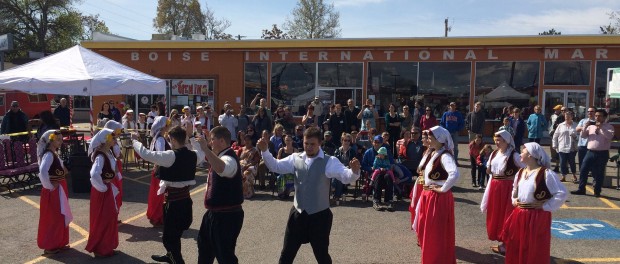
Before it burned down, my family and I used to frequent the Boise International Market, a collection of businesses maintained by various refuge families.

Kahve Coffee
Kahve Coffee

I particularly enjoyed having coffee with a friend periodically at Kahve Coffee, which if I’m correct, was owned and operated by two brothers who, in all likelihood, are Muslims.

Granted, I can’t read minds and automatically know the motivations of everyone I encounter, but as far as I could tell from casual conversation, Kahve Coffee and the other family owned businesses in the Market, represented people who came to this country to build a better life and become part of our community.

Of course, these refuges were from all over the Middle East, Africa, and Central America, so probably they weren’t all Muslims, but I’m not sure it really mattered one way or the other. What mattered, is that the Market wasn’t just a place to eat, drink coffee, and buy various other goods and services, it was a gathering place for all of these families and probably their second home.

There were always children playing between the shops, the kids of the business owners. Everyone watched out for everyone else’s kids. It wasn’t always a venue conducive to quiet conversation. It was more like having coffee or a meal in someone’s living room while their children were playing.

I’m writing all this to say that, religious and political differences aside, at the end of the day, the people who ran the Market were people, parents, uncles and aunts, grandparents, children. They were people just like we’re people.

I hear they’re rebuilding (website under construction). I hope so. Not just for the sake of some of the best coffee I’ve ever consumed, or the ability to have a meal that isn’t mass-produced American pap, but for the sake of people who, like all of our ancestors who came to this country at some point in the past, just want to make a living, support their families, and be friends and neighbors who happen to live in my little corner of Idaho.

interfaithAs far as Professor Hawkins is concerned, Wheaton College chose to look at things differently:

“While Islam and Christianity are both monotheistic, we believe there are fundamental differences between the two faiths, including what they teach about God’s revelation to humanity, the nature of God, the path to salvation and the life of prayer,” Wheaton College said in a statement.

Makes me wonder what Wheaton College would have done if Hawkins decided to dress frum to support Israel and the Jewish people.

Granted, Wheaton is a private Evangelical Protestant Christian liberal arts college, and they can make decisions based on their understanding of being Christian vs. being Muslim, but they might have handled this differently. Was what Hawkins did so radical and her reasoning so out-of-balance?

Wheaton administrators did not denounce Hawkins’ gesture but said more conversation should have taken place before it was announced.

“Wheaton College faculty and staff make a commitment to accept and model our institution’s faith foundations with integrity, compassion and theological clarity,” the college said in a statement. “As they participate in various causes, it is essential that faculty and staff engage in and speak about public issues in ways that faithfully represent the college’s evangelical Statement of Faith.”

The Wheaton College administrators are within their rights to take such an action, and after all, as faculty, Hawkins does represent the college, but not everyone agrees with Wheaton’s decision.

Last week, a coalition of student leaders at Wheaton drafted an open letter calling on evangelical Christian leaders to condemn recent remarks by Liberty University President Jerry Falwell Jr. that students armed with guns can “end those Muslims.”

Gene Green, a professor of the New Testament, said what motivated Hawkins is the same concern many faculty at Wheaton share about the unfair scrutiny facing the Muslim community.

(Renner) Larson (communications director for CAIR’s Chicago chapter), who attends a Unitarian Universalist church, said he was dismayed to hear that some view Hawkins’ gesture as compromising Christianity.

“It’s disappointing that showing solidarity means that you are somehow sacrificing your own identity,” he said. “I do what I do not to be closer to Islam but because it makes me closer to my identity as an American who believes in American ideals.”

Boise International Market

I can only imagine that what I’m expressing may seem radical to some of my readers, but as Larson pointed out, it’s an American ideal to accept people who are different from you into our local communities. The vast majority of American citizens have ancestors who came here from other parts of the world. That some Muslims have committed terrible crimes here and elsewhere on our planet doesn’t make your Muslim neighbor a terrorist.

In fact, having just read a story from Arutz Sheva, I discovered the most unlikely people (at least from my uninformed point of view) can be heroes or criminals.

You can’t tell by looking.

First they came for the communists, and I did not speak out – because I was not a communist;
Then they came for the socialists, and I did not speak out – because I was not a socialist;
Then they came for the trade unionists, and I did not speak out – because I was not a trade unionist;
Then they came for the Jews, and I did not speak out – because I was not a Jew;
Then they came for me – and there was no one left to speak out for me.

-attributed to Martin Niemöller

What Can You Do For The Land Of Israel?

I wanted to take a few minutes this morning to emphasize how important our presence is in the land to the Israelis. (By ‘our’ I mean people living outside the land – whether Jew or Gentile.) So many people I spoke with feel alone, that the world doesn’t care. And what they see the world saying is that all the trouble in Israel is their fault.

Now, I am saying we take the place of God. But aren’t we, as followers of the Messiah, called to be the hands and feet of Hashem in this world? Isn’t it part of our job to love his people and support them? Isn’t that what Paul emphasized?

-Ro Pinto
“We Must Let Them Know”
Journey to Messiah

I suppose you know by now that Israel is suffering from the latest plague of terrorist attacks against its Jewish citizens. I also suppose you aren’t surprised that the news and social media are saying (again) it’s all Israel’s fault.

Given the nature of my blog, I can only believe that most of my regular readers are pro-Israel and support the defense of the Jewish people against their aggressors. Ro, in the blog post I quoted from above, suggested that one of the things we can do in support of Israel is to visit the Land, just as she did a short time ago (and about which she blogged prolifically).

So what can we do? Most of us aren’t in a position financially or in terms of our schedules, to hop a transatlantic flight and vacation in Israel for a couple of weeks. How else can we show our support?

seven things israelI read Ro’s blog when she originally published it to the web, but didn’t consider passing along her message until today when I read an article from the Chabad with the title 7 Things You Can Do for Israel.

This list is definitely written for religious Jews, so not everything applies to the rest of us, but here it is (click the link I provided above to get the full details):

  1. Take Up a “Call to Arms”
  2. Share the Power of Light
  3. Check Your (Spiritual) Security System
  4. Pray
  5. Be Financially Supportive
  6. Nurture Your Faith
  7. Get a Letter

Some items on that list may seem pretty obscure so I’ll expand on them a bit.

The “call to arms” is to help any Jewish man or boy over age 13 put on tefillin. That’s not something we non-Jews get much of an opportunity to do, nor is it something non-Jewish males typically perform (with a few exceptions, or so I’m told).

Sharing the power of light is lighting the Shabbos and holiday candles and encouraging Jewish girls and women to do so. Again, not something most non-Jewish believers tend to perform and we typically aren’t in a position to suggest to Jews that they do so.

The “Jewish security system” is the mezuzah. Because my wife is Jewish, we have a mezuzah attached to pretty much every doorway in our home (bathrooms are the exception). I’ve been told that when a Jew sells his or her home, they leave the mezuzot (plural of mezuzah) in place if another Jew is buying the home, and remove them if a non-Jew is the buyer (because it won’t be a Jewish home anymore).

prayerPraying for Israel is the first item on the list that’s freely accessible to any religious person, and we can certainly encourage others to pray for Israel and the Jewish people as well.

The Chabad article has various links to charitable organizations anyone can donate to for the benefit of Jewish victims of terrorism. You can also do your own research and determine for yourself where you want to give your tzedakah (the word translates commonly as “charity” but also means “justice”).

Nurturing your faith has to do with a Jewish person encouraging more religious observance and acts of faith with their own family and friends, specifically as it relates to a Jew’s connection to Israel.

While we non-Jews don’t have the same connection to the Holy Land, it would be inaccurate to say we don’t have a connection at all. Hashem established Israel for the Jewish people but He also commanded the Jewish people to be a light to the world. That light comes most strongly from Israel and from our Rav, Yeshua (Jesus).

Further, in His grace and mercy, Hashem has extended the promise of the resurrection, eternal life, and the Holy Spirit even to the Goyim, so how could we not be attached to Rav Yeshua, whose symbolic, sacrificial death and miraculous resurrection have opened the door to redemption for any who would repent and come to faith.

We can encourage our own family and friends to embrace their faith in our Rav by expressing clear support of Israel in any manner we have available to us. No congregation that pays homage to Yeshua, which includes any Christian church, should fail to support the nation of the Jews in any way.

torah up closeGetting a letter is unique. Special Torah scrolls are being written in Israel, and the Chabad article says that any Jewish person may purchase a letter being written in a scroll. The way the form is set up, asking for the Jewish name of the person for whom the letter is being purchased, as well as the Jewish mother’s name and so on, I don’t think a non-Jew would be permitted to do this.

On the other hand, we can certainly pass along this information to any Jewish people we know who we believe would be interested.

The article finishes up with the suggestion that we pass this along in social media or anyplace else that Jewish people might see it and act.

I’m writing all this not to make any non-Jew reading it feel discouraged by what they can’t do for Israel. After all, Chabad is in the business of drawing Jewish people to Jewish faith and observance, not Gentiles (though I suppose they’d have an opinion on what a Noahide could do).

I’m writing today to show that we do have options in supporting the Land and the Jewish people. As Ro suggested, we could visit Israel and show our financial (by purchasing goods and services during our visit), emotional, and spiritual support. If we are in a position to do so, we can find some way to support any Jewish people in our local communities who we may know, to greater levels of Jewish observance. We can certainly pray, donate to Israeli charities helping terror victims, and encourage other believers to support Israel as an act of our faith (the last being a great way to educate others at your church or congregation).

Non-Jewish disciples of Rav Yeshua call ourselves Christians, or sometimes believers, followers, or even “Messianic Gentiles.” We are who we are. We are not Jews and we are not Israel. But we can stand by Israel, even if we don’t know a single Jewish person, and do something to support a Land under attack, not just by human terrorism and world-wide public condemnation, but by ancient forces of spiritual evil.

I don’t often write about “supernatural forces” but let’s face it. Our physical world is an extension of a spiritual reality and of powers and events long foretold by the Biblical prophets. We know that bad things are coming for the Jewish people, for Israel, and ultimately for the whole world.

IsraelThis is as good a time as any to stand up and be counted on the side of good…the side of God.

Tag. You’re it. Pass this along.

This is just the short list. For more, read 54 Ways You Can Help Israel and find out which ones you can do…and then do them.

Addendum: Just saw this link on Facebook about helping victims of terrorism and thought I’d share.

The Torah viewpoint is that the Almighty constantly creates the entire world and everything in it for each individual. This concept has the potential to give a person immense pleasure. Think about it for a moment. The Almighty — Creator and Sustainer of the universe — is constantly creating for you the sun, the moon, and all the other worldly phenomena. He is constantly bestowing upon you life, and every single second He supplies you with your needs.

(see Rabbi Noson Tzvi Finkel; Tnuas Hamussar, vol.3, p.202; Gateway to Happiness, p.36)

-Rabbi Zelig Pliskin
Aish.com

Lessons in Christian Repentance on Yom Kippur

Adam trudged past the gates of Eden, his head low, his feet heavy with remorse and pain.

Then he stopped, spun around and exclaimed, “Wait a minute! You had this all planned! You put that fruit there knowing I would eat from it! This is all a plot!”

There was no reply.

Without failure, we can never truly reach into the depths of our souls. Only once we have failed can we return and reach higher and higher without end.

Beyond Eden.

“Failure”
-Rabbi Tzvi Freeman
Based on letters and talks of the Rebbe, Rabbi M. M. Schneerson
Chabad.org

I previously said that in examining what the Bible says about how we non-Jews are to relate to God, I’d be staying mainly in the Apostolic Scriptures, since righteous Gentiles in the Tanakh (Old Testament) aren’t specifically oriented to Yeshua (Jesus).

However, since I’m writing this just before the start of Yom Kippur, and given that Adam, the first man, could not be considered Jewish but had a direct relationship with Hashem, I thought I’d write a little about how we Gentiles can fail and then return to God.

According to the above-quoted statement from Rabbi Freeman, God planned for Adam and Havah (Eve) to fail. Well, maybe He did and maybe He didn’t. However, if we believe God knows everything and is not bound by time or causality, then certainly before He “laid the foundations of the Earth,” He knew Adam and Havah would partake of the one thing in Eden that was forbidden to them.

So from Adam’s point of view, maybe it’s true that God “planned” for them to fail.

exileI can only imagine that, since they had nothing else to compare it to, Adam and Havah rather took their relationship and intimacy with God for granted…that is until it was severely damaged by their fall.

Is God as concerned about the sins of the Gentiles and their potential for repentance as He is for the Jews? A traditional Christian would automatically answer “yes,” but what would a Jew think? My opinion, based on a lot of years of study, tells me that most observant Jews would believe that God is more concerned about the spiritual state of the Jewish people than of Gentiles (and particularly Christians).

But is this true?

In an absolute sense, unless we can read God’s mind, so to speak, we can’t know.

However, we can take an educated guess and Yom Kippur sets the stage for this.

A day or so ago, I read an article called Jonah and the Whale: Why the Book of Jonah is Read on Yom Kippur. The question is why is this particular book read on Yom Kippur, the most Holy Day of the Jewish year?

The Book of Jonah is read in the synagogue on the afternoon of Yom Kippur, the holiest day in the Jewish calendar, the sacred Day of Atonement. Why, of all books in the Bible, this book this most holy day?

The answer is clear. The major themes of the book are singularly appropriate to the occasion—sin and divine judgment, repentance and divine forgiveness.

What is remarkable is that the work is not at all about Israel. The sinners and penitents and the sympathetic characters are all pagans, while the anti-hero, the one who misunderstands the true nature of the one God, is none other than the Hebrew prophet. He is the one whom God must teach a lesson in compassion.

JonahIt’s actually an astonishing revelation when you think about it. Almost without exception, only Jews observe Yom Kippur in any fashion at all, and yet, we see in the reading of the Book of Jonah, that the main objects of God’s concern for repentance, redemption, and reconciliation are a large group of pagan Gentiles. Further, the only Jew involved is reluctant to be an agent of redemption for these Gentiles, so much so that he literally “jumps ship” in attempting to get away from his responsibilities.

The brief article goes on to say:

It is precisely these aspects of this sublime prophetic allegory, and in particular the subthemes of the book, that inform Yom Kippur. These motifs attracted the ancient Jewish sages and led them to select Jonah as one of the day’s two prophetic lectionaries (The other is Isaiah 57:14–58:4). Its universalistic outlook; its definition of sin as predominantly moral sin (The “evil” of Jonah 1:2 is defined as injustice in Jonah 3:8); its teaching of human responsibility and accountability; its apprehension that true repentance is determined by deeds and established by transformation of character (Jonah 3:10), not by the recitation of formulas, however fervent; its emphasis on the infinite preciousness of all living things in the sight of God (Jonah 4:10–11); and, finally, its understanding of God as “compassionate and gracious, slow to anger, abounding in loving-kindness” (Jonah 4:2)—all these noble ideas of the Book of Jonah constitute the fundamentals of Judaism and the quintessence of Yom Kippur.

The “universalistic outlook” to how sin is defined as primarily moral, human responsibility and accountability to God, and how repentance is accessible to everyone through deeds and established by transformation of character.

So for the Gentile as well as the Jew, God is “compassionate and gracious, slow to anger, abounding in loving-kindness.”

While the essay’s author Nahum Sarna states that “these noble ideas of the Book of Jonah constitute the fundamentals of Judaism and the quintessence of Yom Kippur,” we also see (apparently) that these “noble ideas” are equally applied to Gentile repentance and reconciliation to God.

As I said some months ago, we aren’t so much chopped liver after all. Although God sent a Jewish prophet (yes, in the Bible, we do find a few non-Jewish prophets) to redeem Gentile Nineveh, God’s primary purpose was to redeem Gentile Nineveh.

And guess what? Everyone, from the King down to the lowliest commoner, mourned, fasted, and repented and were subsequently forgiven by God.

I was explaining to someone at work, a Christian (we were discussing Yom Kippur), how the process of repentance and forgiveness of willful sin was the same in the Tanakh (Old Testament) and in the days of the Temple as it is today. There was no sacrifice for willful sin. Psalm 51 teaches us that how we are to repent hasn’t changed over time.

praying aloneThe Book of Jonah teaches us that a Gentile is of just as much concern to God as a Jew and that He seeks repentance from all.

For God so loved the world, that He gave His only begotten Son, that whoever believes in Him shall not perish, but have eternal life.

John 3:16 (NASB)

The Lord is not slow about His promise, as some count slowness, but is patient toward you, not wishing for any to perish but for all to come to repentance.

2 Peter 3:9 (NASB)

So non-Jewish disciples of the Jewish Messiah can take heart and realize we too have our hope in the God of Israel, because, no matter how special Israel is to God, all people, even the lowliest from the nations, are special to Him (though probably not in the same way as Israel) as well.

One of the unintentional messages I think some non-Jews think they hear from Messianic Judaism is that in Israel’s specialness to God, we non-Jews who are “Judaically aware” are pretty non-special as well. I think that’s why some Gentiles have chosen to leave Messianic Judaism and either transition to Hebrew Roots, which they may see as more egalitarian, or return to Church, which is very much a “pro-Gentile” environment.

It’s also probably one of the reasons some Gentiles who have been involved in Messianic Judaism, have rejected Messiah and converted to (usually) Orthodox Judaism.

Jonah's KikayonHowever, the non-Jewish believer, whether they are Judaically aware or not (although such awareness gives we Gentiles, in my opinion, a better and more accurate understanding of the Bible), even isolated from community on some metaphorical deserted island, can be comforted by the fact that God wants us to return to Him, too.

In creating the whole of existence, G‑d made forces that reveal Him and forces that oppose Him—He made light and He made darkness.

One who does good brings in more light. One who fails, feeds the darkness.

But the one who fails and then returns transcends that entire scheme. He reaches out directly to the Essential Creator. Beyond darkness and light.

And so, his darkness becomes light.

“Returning Light”
-Rabbi Tzvi Freeman
Based on letters and talks of the Rebbe, Rabbi M. M. Schneerson
Chabad.org

The Convert and the Disciple: A Shavuot Lesson

Question:

I attended synagogue services on the holiday of Shavuot morning, and we spent a half-hour reading the Book of Ruth. Is there any special connection between Ruth and Shavuot?

The Aish Rabbi Replies:

The Torah and prophetic reading on Yom Tov always relate to a deeper theme of the day.

In this case, Ruth is the ancestor of King David, who was born on Shavuot, and died on Shavuot.

Another reason is because Ruth is the quintessential Jewish convert, and on the very first Shavuot – when the Torah was given at Mount Sinai – each Israelite essentially became a “Jew by Choice.” That’s why the Talmud and Code of Jewish Law use the Sinai experience as a basis for determining the requirements of all future converts:

1) Mikveh – All converts must immerse in a Mikveh (ritual bath), as the Israelites did at Mount Sinai (Exodus 19:14, 24:8).

2) Milah – Male converts must undergo circumcision, as the Israelites did before leaving Egypt (Exodus 12:48 and Joshua 5:5).

3) Mitzvot – All converts must accept to observe all 613 mitzvot of the Torah, as the Israelites did at Mount Sinai (Exodus 24:3).

Interestingly, the Torah intimates that the souls of eventual converts were also present at Sinai, as the verse says: “I am making [the covenant] both with those here today before the Lord our God, and also with those not here today.” (Deut. 29:13)

From “Ruth and Shavuot”
the Aish Ask the Rabbi column
Aish.com

In my recent review of the Mark Nanos essay “The Question of Conceptualization: Qualifying Paul’s Position on Circumcision in Dialogue with Josephus’s Advisors to King Izates” as found in the book Paul within Judaism: Restoring the First-Century Context to the Apostle (Kindle Edition), citing Nanos, I commented that the Apostle Paul was very much against the non-Jewish disciples of Yeshua (Jesus) converting to Judaism, frankly, because it was unnecessary. In Messiah, Gentiles have an equal communal status with the Jewish disciples, the same indwelling of the Holy Spirit, and the same promise of the resurrection.

mikvahThe other major reason that Paul discouraged Gentiles from converting is that it would undermine God’s promise to Abraham that he would be the father to many nations. If we all converted to Judaism as a means of accessing a covenant relationship with God, then God’s promise that not just the Jewish people but all peoples would bow to Him, would be null and void. And as I hope you realize, it’s impossible to thwart the plans and promises of Hashem, God of Israel.

So is there any good reason for a Gentile in Messiah to convert to Judaism? There must be, because some few such converts exist (I have no statistics as to exactly how many there are or where they can be found and only personally know of one such person).

I also know that some critics of Messianic Judaism in the Hebrew Roots space believe that the practice of conversion is not presupposed in the Torah and thus is unbiblical, not to be recognized by those Gentiles who believe the Torah applies equally to all, Jew and Gentile alike.

However, as we see above, the Jewish people certainly do believe there is a precedent in the Torah that allows for ritual conversion of Gentiles, bringing them into Israel as (Jewish) children of Abraham.

Neither Christianity nor any branch of Judaism believes that Gentiles must convert to Judaism and indeed, Christianity sees converting non-believers to themselves is the desirable outcome, not becoming a member of the tribes, so to speak.

I also mentioned before that both in the late Second Temple period and today, those of us, that is, non-Jews who have some sort of connection with Judaism in general and Messianic Judaism in particular, often suffer from an identity crisis. More than once, the dissonance of who I’m supposed to be and what I’m supposed to do given my rather unique outlook on the Bible, has stirred a great desire in me to “throw in the towel” and stop associating with religious people altogether, both face-to-face and over the web.

It’s not an easy life.

Orthodox JewsSome non-Jews entering Messianic community have shot out the other end, so to speak, and converted to (usually Orthodox) Judaism as a way to end that dissonance and secure a religiously and socially acceptable identity within Judaism. To do so however, they had to surrender all fealty to Yeshua as Messiah and King, thus, from Christianity’s point of view, becoming apostates.

I believe, both in ancient and modern times, that God gave the Jewish people the ability to be “gatekeepers” into their realm. Nanos spoke of a “chronometrical gospel”, that is, a time-related good news event or set of events, a good news that entered our world heralding the advent of the New Covenant promises with the birth, life, death, resurrection, and ascension of the Master, the Messiah.

Prior to Yeshua, there was a mechanism in place whereby Gentiles who were drawn to the God of Israel could undergo a ritual allowing them to join Israel and thereafter be considered indistinguishable from the born Israelite. It was the only real option for such Gentiles, apart from the status of God-Fearers who had no covenant status relative to God (unless you count the Noahide covenant).

The process of conversion seemed to morph over time and was likely different in some manner to the process we see Ruth undergoing to convert to Judaism and become the eventual ancestor to King David and ultimately, Yeshua.

No one should question the authenticity of David’s let alone Yeshua’s Judaism because a convert was their ancestor.

But as I said before, if converting to Judaism were the only way for Gentiles to apprehend the blessings of the New Covenant (let alone Sinai), then as I said above, God’s promise to Abraham would fail.

two pathsSo through Messiah, another avenue was created, one that does not require we convert and become Israel. We are permitted now to come alongside Israel, not being them but being at the same table with them, partaking in the same blessings without being responsible for the same obligations. This makes it possible for the whole world to come to God, to be blessed by God, to attain the companionship of the Holy Spirit of God, and to receive the promise of a life in the world to come, all without conversion and all while remaining fully Gentile citizens of the nations.

In another Aish Ask the Rabbi column, the Rabbi states in part:

Being culturally Jewish, without belief in God, is compared to a cut flower. While it still retains much of its vitality, the flower has been cut off from its source of nutrition, and within a short time will wither and die. The ideals which have kept the Jewish people alive and thriving over the millennia – despite all odds – can only be transmitted with the framework that the Torah provides.

I’ve mentioned in this blog post and several others including this one, that we “Messianic Gentiles” actually have a very specific duty, that of encouraging and supporting Jews in Messiah (any Jew we may encounter, actually) to return to Torah and to more fully observe the mitzvot.

Without Jewish devotion to Torah, as the Aish Rabbi states, what God has preserved in the Jewish people will eventually fade…and without Israel, we Gentiles have no hope, because 100% of the promised blessings we receive God made with Israel, not us!

That’s why Yeshua is the King to the Jews first and only after, the King of the nations of the world. Whether the realization is comfortable or not, Israel is the gatekeeper, it guards all the doors, it holds all the keys, all through God’s covenants with Israel, and all through the person of Israel’s King, King Messiah, Son of David.

There may well be some valid reasons for Gentiles converting to Judaism, but they are all minimized within the Messianic Jewish realm simply because, as Paul pointed out repeatedly, it’s not necessary in order for a Gentile to have an authentic relationship with God. Particularly for the Gentile but also for the Jewish people, the cornerstone, the lynchpin to that relationship is Messiah. He opened the door that let the Gentiles into a full relationship with God, and he brought the very beginnings of what will someday be the completion of God’s New Covenant promises to Israel, and only through Israel, to the world.

aloneWe non-Jews should not dismiss or denigrate converts to Judaism, regardless of which branch they convert into, but we should rest assured that it is not a requirement either. This may be confusing relative to Gentile identity in Messianic community (which is why I suspect such Gentiles either covert to Judaism, return to the Gentile Church, or just give up on religion completely), but what Jews and Gentiles don’t yet understand about the non-Jew’s role and function among Israel, is well understood by God.

If I, as a non-Jew who studies within a Messianic Jewish framework, am never accepted as who I am, either by Gentiles or Jews, I can take comfort that in the privacy of my prayers and studies, I am still accepted by God. I can be a disciple and a Goy. I can be who I am. I don’t have to become someone else or pretend to possess another’s responsibilities to stand in the presence of the Almighty.

Chag Shavuot Sameach!