Tag Archives: Christianity

Leviticus, Homosexuality, and Abominations

You shall not lie down with a male, as with a woman: this is an abomination.

כב. וְאֶת זָכָר לֹא תִשְׁכַּב מִשְׁכְּבֵי אִשָּׁה תּוֹעֵבָה

Leviticus 18:22

Ok wait, we know that Leviticus forbids men having sex with each other, and that the penalty is death. But does G-d give us a reason? Yes, She does. “You shall not lie with a man as with a woman, it is an abomination.” When I was growing up and reading those words, I had no idea what abomination meant, but I knew it must be bad. I had visions of the abominable snowman attacking me if I did any of the mentioned activities that were said to be ‘abominations’. This fearful obedience stopped me from challenging my church’s beliefs about homosexuality for many years.

What does this strange word mean? Well, in Hebrew, the word is ‘to-evah’ (or to-ebah), but that helps little. The word is difficult to translate succinctly, but picture someone or something that is wild and dangerous, highly addictive and contagious. Picture something radioactive, that once unleashed, will spread like wildfire and affect (and infect) everything nearby. It’s not only wild, but disgusting, and describes detestable religious orgies, or idolatrous practices. If you were confronted with that kind of enemy, what would you do? You’d have to destroy it–stop it dead in it’s tracts (sic). If you didn’t, it would soon infect the entire population, yourself included.

One interesting fact is that the first time ‘ABOMINATION’ is used in the Torah is to DESCRIBE WORSHIPPING G-D, when Moses is asking Pharoah to let the Israelites worship G-d in the desert. The Pharoah inquired, “Why can’t they worship right here?” and Moses answered that if the Israelites worshipped G-d in Egypt, their acts would be an ABOMINATION to the Egyptians. Can you believe it? Worshipping the one true G-d is considered an abomination! Why? Because it is the religious rite of a different religion (from the perspective of the Egyptians–the Israelites were going to sacrifice animals whom the Egyptians worshipped, so it was considered detestable). Still don’t believe that toevah is about idolatry? “Do not inquire concerning their gods, saying, ‘How did these nations worship their gods? I also want to do the same.’ You must not do the same for the L-rd your G-d, because every TOEVAH that the L-rd hates they have done FOR THEIR GODS” Deut.12:30-1. This makes it clear, the abominations of the Canaanites weren’t just a bunch of random detestable acts, they were FOR THEIR GODS. As a child I wondered what ‘abomination’ meant, now I have the answer. The Bible gives its own definition in Deut. 12:30-31; an abomination is a detestable religious rite of a religion different from your own.

-from the B’nai HaKeshet (Children of the Rainbow) website

My stated intent to review Matthew Vines’ book God and the Gay Christian has inspired a lot of attention and responses on my blog post, on Facebook, and via email. One such email message led me to the B’nai HaKeshet website from which I quoted above. That quote was taken from a much longer missive which attempts to explain that the Bible never speaks against Homosexuality or Homosexual acts in general.

AshtorethI Googled the definition of the Hebrew word “toevah” which is commonly translated as “abomination,” such as we see in Leviticus 18:22 and the search results returned a lot of the same information, basically saying that this portion of scripture is not a blanket prohibition against male on male sexual acts, but specifically addresses such sexual activity within the context of idolatrous worship. The issue supposedly isn’t a man having sex with another man, but a man having sex with another man (male temple prostitute) in association with worshiping an idol.

It’s difficult to find a source (at least by a quick Google search) that is objective or neutral and simply defines the word and its usage, but the closest I found was a newspaper opinion piece written by Rabbi Bruce Warshal called Lots of abominations in the Bible (Sept. 19, 2012).

Rabbi Silvers discussed the meaning of the Hebrew word toevah, which most English bibles translate as “abomination,” as in Leviticus, chapter 18, verse 22: “Do not lie with a male as one lies with a woman; it is an abomination. He pointed out that the Hebrew word toevah is used extensively in the Bible regarding food prohibitions, idolatrous practices, magic and ethical violations. His prime example is that eating shrimp (shellfish) is toevah. Yet today he knows plenty of Jews who eat shellfish.

I also found a word study written by someone named Skip Moen on the word to’evah:

With this in mind, we can turn to the word to’evot (abominations). What is an abomination? Do you think that it is something so hideous, so immoral, that it ranks among axe murder, rape and incest? Remember the cultural background of the ancient Near East. Something is to’evah’ when it is loathsome and detestable. It may be physical, ritual or moral. It is something offensive to values of the culture. That means to’evah is determined within the culture and community, just like mishpat. And that means God defines what He finds offensive within the community of Israel. The world may not find some of these actions offensive. That doesn’t matter. They are not regulations for the world. They are offenses to the Hebraic biblical way of life. If we want to demonstrate with our behavior the values that God expresses with His words to His chosen community, then these to’evot will not be part of our actions.

We must understand this perspective in order to understand why homosexuality, slander and human sacrifice are in the same category as dishonest business practices and the eating of unclean animals. When it comes to offenses to God’s values, eating pork is the same as child sacrifice; ritual prostitution is the same as cheating a man with false weights and measures; and homosexual behavior is just as repugnant as lying. Forget the arguments about morality. Put aside the nurture/nature nonsense. None of these matter when it comes to embracing the culture of the Kingdom. If you want to be in God’s community, then you behave in ways that honor Him. End of story.

Topical Index: abomination, to’evah, rule, mishpat, Proverbs 6:16-19, Leviticus 18:26

forbiddenThe sense I’m getting from all of this is that the word “toevah” can be applied to many different acts which God forbade the Israelites from performing, considering all of them “idolatry” or alternately “adultery” (I’ll get to that). But does that mean all of the forbidden acts (including sex with close relatives, see the wider text in Leviticus 18) are only forbidden when engaged within the context of idol worship?

(Remember, context, context, context. Leviticus 18:22 is included in the larger context of the Leviticus 18 “forbidden relationships and acts” list for a reason).

Saying that these various sex acts are only an “abomination” if performed as part of idol worship doesn’t make sense. That would mean it would only be forbidden for an Israelite to have sex with his sister or step-mother if that sexual act was performed as part of worshiping a foreign god.

The crux of the argument presented at B’nai HaKeshet is that for something to be an “abomination” it must be related to idol worship and cannot be a “stand alone” prohibition that crosses all contexts. Just read Leviticus 18:6-18 and you’ll see prohibitions against sexual acts all involving either incest or sex with other close relatives (mother-in-law, step-sister, and so on).

As far as Rabbi Warshal’s reference to Rabbi Silvers, just because some or many Jews today eat shellfish in violation of the Torah commandment doesn’t make it right. Disobedience to God is still disobedience regardless of how many people are engaging in the behavior.

Although on the surface, it seems as if the anonymous writer at B’nai HaKeshet has done her homework (she does state that she’s a woman), the logic she employs to come to at least some of her conclusions has “gaps”.

Here’s what I mean.

When the Lord began to speak through Hosea, the Lord said to him, “Go, marry a promiscuous woman and have children with her, for like an adulterous wife this land is guilty of unfaithfulness to the Lord.”

Hosea 1:2

Rebuke your mother, rebuke her, for she is not my wife, and I am not her husband.

Hosea 2:2

“Though you, Israel, commit adultery, do not let Judah become guilty.”

Hosea 4:15

God compared the intimate relationship He has with Israel as a husband to a wife, with God playing the role of husband. When Israel strayed and worshiped false gods instead of or in addition to Hashem, it was compared to committing adultery. But did Israel to the last man and woman cheat on their spouses? Is that what God is talking about? No. He’s employing a metaphor through the prophet Hosea (to the point where Hosea is commanded to marry Gomer, a promiscuous woman) in order to illustrate His point.

hosea and gomerAny act of disobedience committed by the Israelites is compared to idolatry and faithlessness. We can’t say that only an Israelite who cheats on his or her spouse is guilty of idolatry or that it is only forbidden for an Israelite to cheat on his/her spouse in performance of an idolatrous act is forbidden.

You have to look at the broader scope. It is my opinion that toevah can mean many different acts of disobedience to God, some directly related to idol worship but many others involving forbidden activities that are not or at least do not have to involve worshiping an idol. It was still forbidden of the Israelites to eat a ham sandwich, even if it had nothing to do with a pagan practice, just as eating ham (or shellfish) for observant Jews today is considered a forbidden act. That many secular Jews eat ham or shellfish doesn’t make it acceptable in God’s sight.

I’ll stop here rather than continue with my assessment of the B’nai HaKeshet author’s other assertions. I may address them at some other point, but I want to get this published quickly so any of my readers who goes offline for Shabbat can have a chance to respond before Saturday night/Sunday morning. Also, because I’m writing/editing very quickly, this missive isn’t as polished as I’d like it to be, so excuse the rough spots.

I’m not trying to be mean or insensitive and I hope I’m being objective, but it just seems as if a certain bias has entered how these texts are being read, especially in light of the larger context of the Bible and God’s relationship with Israel. I know this doesn’t specifically address Christianity and Homosexuality, but I have some ideas about how to consider that paradigm.

Last point. I wrote this as a way to get my head into the debate relative to Homosexuality and whether or not the Bible supports and endorses (or at least doesn’t outright condemn) homosexual acts in the community of faith. So far, I can’t say there’s overwhelming evidence that God is “cool” with such behavior. Your polite feedback, as always, is welcome.

Preparing to Review “God and the Gay Christian”

“God and the Gay Christian is a game changer. Winsome, accessible, and carefully researched, every page is brought to life by the author’s clear love for Scripture and deep, persistent faith. With this book, Matthew Vines emerges as one of my generation’s most important Christian leaders, not only on matters of sexuality but also on what it means to follow Jesus with wisdom, humility, and grace. Prepare to be challenged and enlightened, provoked and inspired. Read with an open heart and mind, and you are bound to be changed.”

—Rachel Held Evans, author of “A Year of Biblical Womanhood and Faith Unraveled”
found at Amazon.com

This isn’t the sort of book I’d normally read, and especially the sort of book I’d pay for, but I found a book review on this text, and it’s quite compelling to consider that someone would say there’s supportive data in the Bible for “loving same-sex relationships”. A surface reading of both the Old and New Testaments would seem to suggest otherwise, but the debate continues to rage regarding the accuracy (let alone “truth”) of this matter. One such debate can be found in the comments section of The Christian Post article Evangelicals Review Matthew Vines’ “God and the Gay Christian” Book, while LGBTQNation.com has a very different viewpoint.

Whenever I’m concerned that my conservative religious, social, and political bias is overwhelming my ability to fairly view an issue like this, I check in with my daughter who is supportive of marriage equality and equal rights for the LGBTQ community. Given her perspective, she continues to think that equality in secular society is one thing, but that it’s a step too far to say that the Bible actually supports and endorses homosexual behavior.

That’s been my perspective as well (for a representative but not exhaustive list of my blog posts on this matter, click on this link). I haven’t reviewed a book like Vines’ before, but I have reviewed a series of reviews of a book called Same-Sex Unions in Premodern Europe written by the late John Boswell. My conclusion of the author’s supposition that the Church performed same-sex marriages in antiquity and thus, the modern Church should perform same-sex marriages today, is that it was pretty much wishful thinking on Boswell’s part.

I will agree that the Bible generally does not speak of same-sex relationships in a negative light when they occur outside the community of faith. However, for those who are joined to God in a covenant relationship (i.e. the Jewish people) or those of us (i.e. Gentile Christians) who are grafted in and enjoy certain covenant blessings, the story (in my humble opinion) is different.

But I can’t get ahead of myself and I want to be fair. My concern is that this book will be reviewed almost exclusively along emotional, political, and social lines rather than based on an evaluation of the author’s research in comparison to scripture. That is, if you are a liberal Christian or Jew, you’ll love the book. If you’re a conservative Christian or Jew, you’ll hate it. It’s a knee-jerk response from either side of the aisle. You almost don’t even have to read the book in order to render a strongly held opinion.

I’d like the opportunity to look at Vines’ work while minimizing my “visceral response”. I should say that a lot of how one reviews such a book depends a great deal on the interpretative matrix used to understand the Bible. Evangelical Christians will use proof texts from the Old and New Testaments to speak against homosexuality while simultaneously saying the Old Testament laws (which by definition should include those laws that address homosexuality) are dead (for details about a Jewish viewpoint on homosexuality, read Homosexuality and Halakhah).

Liberal Christians and Jews won’t necessarily speak against the literal words of the Bible, but they will reinterpret them in ways that some of us might consider “creative” in order to say that the plain meaning of the text isn’t the true meaning of the text.

You shall not lie with a male as one lies with a female; it is an abomination.

Leviticus 18:22

If there is a man who lies with a male as those who lie with a woman, both of them have committed a detestable act; they shall surely be put to death. Their bloodguiltiness is upon them.

Leviticus 20:13

Matthew Vines
Matthew Vines

Strictly speaking, the New Testament doesn’t address homosexuality or homosexual behavior. It does address sexual immorality in a number of verses (Matthew 15:19, Romans 13:13, 1 Corinthians 5:11, Revelation 21:8, for example), but it’s a matter of opinion if the intent of the New Testament authors included “homosexuality” as a sexually immoral behavior, although according to this article:

Nearly every major Greek lexicon includes “fornication” as at least an aspect of the meaning of porneia. In addition to premarital sex, this term would also include such things as homosexuality, bestiality, adultery, et al The first definition given above sums it up well as “every kind of extramarital, unlawful, unnatural sexual intercourse.” We would also do well to remember Christ’s words from Matthew 15 which state that it is not only the actual intercourse that is prohibited, but also the sinful affection which lies behind the action (relate to Matthew 5:27-30). (emph. mine)

No doubt, the reviews of Vines’ book, pro and con, are going to be surging forth in the blogosphere, at least in the short run (public opinion is fickle and attention spans are limited), but I feel compelled to add my voice to the din because (hopefully) I can attempt to view what Vines wrote while restricting my reflexive response. If he can make his case based on scripture while avoiding an emphasis on emotional appeal, he should be heard out.

I just ordered the book. It will take some time to get here (five to fourteen business days), but I feel honor-bound to actually read Matthew Vines’ God and the Gay Christian: The Biblical Case in Support of Same-Sex Relationships before reacting to it in any definitive sense.

Sermon Review of the Holy Epistle to the Hebrews: The Source of Eternal Salvation

Follow the apostolic logic and discover the relationship between Psalm 2 and Psalm 110 and how the writer of the book of Hebrews derived the priesthood of Messiah. This teaching comes with a stern call to discipleship.

-D. Thomas Lancaster
Sermon Fourteen: The Source of Eternal Salvation
Originally presented on April 20, 2013
from the Holy Epistle to the Hebrews sermon series

So also Christ did not glorify Himself so as to become a high priest, but He who said to Him,

“You are My Son,
Today I have begotten You”;
just as He says also in another passage,

“You are a priest forever
According to the order of Melchizedek.”

In the days of His flesh, He offered up both prayers and supplications with loud crying and tears to the One able to save Him from death, and He was heard because of His piety. Although He was a Son, He learned obedience from the things which He suffered. And having been made perfect, He became to all those who obey Him the source of eternal salvation, being designated by God as a high priest according to the order of Melchizedek.

Hebrews 5:5-10 (NASB)

In today’s sermon, Lancaster starts out with a bit of review of earlier in this chapter of Hebrews and ends it by “getting Evangelical.”

We return to the concept of the High Priest, who Lancaster called “the Holiest man in the world.”

Now when these things have been so prepared, the priests are continually entering the outer tabernacle performing the divine worship, but into the second, only the high priest enters once a year, not without taking blood, which he offers for himself and for the sins of the people committed in ignorance.

Hebrews 9:6-7 (NASB)

The High Priest was the hope of the nation. Only he could enter the Holy of Holies on Yom Kippur and offer atonement for all of Israel. Every Jewish heart turned in repentance toward the Temple, the Most Holy Place, and the High Priest that their sins would be forgiven and atoned for, and they might be justified before God.

But as you might recall from previous reviews in this series, Lancaster believes the readers of the letter to the Hebrews were Hellenistic Messianic Jews who had been denied access to the Temple, the Priesthood, and the sacrifices, by the Sadducees who administered the Temple in those days. How heartbroken and anguished must these Jewish disciples of the Master have been, believing the High Priest on Yom Kippur was not atoning for their sins among the people of Israel.

James the Just and other apostolic figures had been martyred. The Messianic disciples were cut off from the Temple, their faith in the Master was wavering. And this epistle was sent to them as consolation and exhortation, and even as prophesy of a life when the Temple would be no more and all the Jewish people would suffer exile.

They needed a priest. But where did the writer of Hebrews get the idea that Yeshua (Jesus) of the tribe of Judah and the house of David was a High Priest? Wasn’t that only for the sons of Aaron?

And no one takes the honor to himself, but receives it when he is called by God, even as Aaron was.

Hebrews 5:4 (NASB)

In Judaism, no one chooses to be High Priest. Not even King David himself could perform the duties of the High Priest. Only the son’s of Aaron.

Hillel and ShammaiLancaster recalled a story from the Talmud, specifically Shabbos 31, about three converts, three pagan Gentiles who wanted to become proselytes, one on the condition that he could become the High Priest. I found a summary at the Saratoga Chabad website if you’d like to review the material.

The point is, no one, not even the anointed one of God, King Messiah, can demand to become High Priest.

However, in another priestly line, we find another High Priest of a different order, Melchizedek, King of Salem, who Abraham encounters in Genesis 14:18-20

But what does he have to do with Jesus?

Lancaster reads Psalm 2 and Psalm 110 and says that they are both Psalms about Messiah, depict God establishing Messiah as ruler in Zion, show God speaking directly to Messiah, declaring Messiah as both Son and Priest:

I will tell of the decree: Hashem said to me, “You are my Son; today I have begotten you.

Psalm 2:7

Hashem has sworn and will not change his mind, “You are a priest forever after the order of Melchizedek.”

Psalm 110:4

If you go to the web page for this lesson, you’ll find a PDF with the translations Lancaster uses for these two Psalms.

In short, it’s Lancaster’s opinion that the writer of the Book of Hebrews uses Psalm 2 as the foundation for Psalm 110 and that these are his proof texts establishing Yeshua as a High Priest who is able to make atonement for us.

But when did this happen?

In the days of His flesh, He offered up both prayers and supplications with loud crying and tears to the One able to save Him from death, and He was heard because of His piety. Although He was a Son, He learned obedience from the things which He suffered. And having been made perfect, He became to all those who obey Him the source of eternal salvation, being designated by God as a high priest according to the order of Melchizedek.

Hebrews 5:7-10 (NASB)

Messiah”In the days of His flesh.” In other words, in Christ’s earthly ministry he was established as a High Priest. How? Why?

Lancaster cites these verses as a wonderful, apostolic eyewitness about how the Master prayed. He prayed very loudly, with great supplications, with crying and tears, to God, the one able to save from death. Lancaster believes this tells of the night Jesus prayed at Gethsemane (Matthew 26:36-56, Luke 22:39-46).

And even though Jesus was a Son, he obeyed God, even as Isaac obeyed Abraham at the Akedah by allowing himself to be bound as the sacrifice, but in this case, no angel saved the son of promise from becoming the Lamb of God on the altar.

He suffered and was made perfect. Wasn’t he perfect before? What perfected him? The refiner’s fire? He was perfected as we shall be, by the resurrection. And having been made perfect, Jesus then became the one who is the source of eternal salvation for all who obey him.”

This is the part where Lancaster “gets Evangelical.” This is the part when he reminded me of the Head Pastor at the church I attend.

For the most part, we learn in the church that if we believe in Jesus, we will be saved from our sins, but the writer of Hebrews says Jesus is ”the source of eternal salvation for all who obey him.”

Obey Jesus by doing what?

“Repent, for the kingdom of heaven is at hand.”

Matthew 4:17 (NASB)

First Fruits of Zion’s television series A Promise of What is to Come has a number of episodes describing what “the Kingdom of Heaven” or “the Kingdom of God” means and you can take a look at those for the details. But Jesus is calling all who hear him to repentance.

“If anyone wishes to come after Me, he must deny himself, and take up his cross daily and follow Me. (emph. mine)

Luke 9:34 (NASB)

Nevertheless, the firm foundation of God stands, having this seal, “The Lord knows those who are His,” and, “Everyone who names the name of the Lord is to abstain from wickedness.” (emph. mine)

2 Timothy 2:19 (NASB)

Repentance isn’t a one time event and it’s not mere intellectual or even emotional ascension that “Jesus is Lord”. It’s one thing to call Jesus “Master” and quite another thing entirely for him to be your Master (or my Master) by a conscious act of our (my) will, allowing him to truly rule your (my) life.

Lancaster pleaded with his audience to examine themselves and to determine if they have truly repented, if they repent daily, if they really, continually do subjugate themselves to the Master’s will, if he really is King of their (our) lives. Lancaster isn’t selling cheap grace. Lives hang in the balance. Like the writer of the Epistle to the Hebrews, Lancaster is exhorting his flock to keep to the faith, not unsaved sinners somewhere outside the body, but living human beings and devotees of the Master within the ekklesia, the body of Messiah.

What Did I Learn?

I listened to this sermon the same day I wrote For Redemption is Not Yet Complete, a dedication to repentance, turning away from sin,  and back to God.

According to Aish.com, there are four steps to repentance or teshuvah:

  1. Regret. To regret what we have done wrong.
  2. Leaving the negativity behind. To stop dwelling on the transgression in thought and action.
  3. Verbalization. To verbally state the transgression.
  4. Resolution for the future. To be determined not to let the transgression happen again.

waitRepentance, true repentance must be humanly possible, otherwise, why would God call for repentance so much in the Bible? In my studies of the New Covenant, thanks to Lancaster’s What About the New Covenant lectures, I know that we are currently in the Old Covenant times, which means we don’t yet have the ability to automatically, naturally, easily obey the voice of our Master. And yet, as believers, we are also called to listen to the voice of our shepherd as if we were already in New Covenant times.

The Master gives us all a sober warning (Matthew 25:31-46) that we can be counted as sheep or goats, and many believe they truly have turned to our shepherd but in fact, they never really repented. And in their sins, even while calling Jesus “Master,” they were rejected (or will be rejected) and sent away.

Take care, brethren, that there not be in any one of you an evil, unbelieving heart that falls away from the living God. But encourage one another day after day, as long as it is still called “Today,” so that none of you will be hardened by the deceitfulness of sin. For we have become partakers of Christ, if we hold fast the beginning of our assurance firm until the end…

Hebrews 3:12-14 (NASB)

All shepherds cry out to their sheep, not to wander away, not to be foolish, not to fool ourselves that we are somehow “once saved, always saved,” that our “fire insurance” is all paid up.

The Bible is replete with warnings against human failure and exhortations and encouragement to maintain our faith, even in severe adversity, as did Paul, as did James, even to the death, for the sake of our lives, for the sake of the Master, for the sake of the Kingdom.

If we can do nothing else, cling to him, cleave to the shepherd, grasp the holy garments of the High Priest, repent with tears and anguish, and beg for him to provide your atonement, that you might be reconciled to God and enter His Kingdom.

Repentance and Regret

The Torah teaches us that it is never too late to change.

Changing for the better is called doing teshuva. The Hebrew word teshuva, which is often translated as repentance, actually means to “return.” Return to God. Return to our pure self.

How do people become interested in self-improvement?

People have faults. The faults they have cause them to suffer in some way or another. This suffering limits an individual’s freedom and is often painful. Hence, people want to change… to improve. To be free once again.

How does one change for the better? How does one do teshuva?

There are four steps of teshuva.

-Rabbi Mordechai Rottman
“Four Steps to Change”
Aish.com

I know an exploration of teshuva, which is commonly translated as “repentance,” seems more appropriate to Yom Kippur than Passover, but part of the inspiration to invest more in myself along this path and at this time comes from here:

The Midrash tells us that the Jewish people had the same problem in Egypt. Only 1/5 of the Jewish people were on a high enough spiritual level to leave Egypt — and they were on the 49th level of Tuma, spiritual degradation — and were within a hair’s breadth of being destroyed.

Yet, what is amazing is that in the next 49 days they raised themselves to the spiritual level to receive the Torah at Mt. Sinai! Each day we climbed one step higher in spirituality and holiness. Many people study one of the “48 Ways to Wisdom” (Ethics of the Fathers, 6:6 — found in the back of most siddurim, Jewish prayer books) each day in the Sephirat HaOmer period between Pesach and Shavuot — which will be explained below — as a means to personal and spiritual growth. This is a propitious time for perfecting one’s character!

Rabbi Kalman Packouz
Commentary on Passover (Shabbat Chol Hamo’ed) (Exodus 13:17-15:26)
Aish.com

I know this is midrash and for most people, especially Christians, the above statement cannot be reasonably derived from scripture. Roll with it, OK? The midrash teaches an important spiritual lesson.

Rabbi Packouz suggests Rabbi Noah Weinberg’s 48 Ways to Wisdom (there are actually 50 of them) series as the perfect companion to accompany the days between Pesach and Shavuot for those seeking to elevate themselves spiritually.

But the first step, at least in my way of thinking, is teshuva, turning away from sin, especially habitual sin, and turning back toward God.

In Judaism, repenting of sins is more than just praying “I’m sorry” to God and maybe saying “I’m sorry” to anyone you’ve hurt. It’s a four-step process:

  1. Regret. To regret what we have done wrong.
  2. Leaving the negativity behind. To stop dwelling on the transgression in thought and action.
  3. Verbalization. To verbally state the transgression.
  4. Resolution for the future. To be determined not to let the transgression happen again.

guiltyThat might seem like only a little bit more effort than what we’ve come to expect in the Church, but that short list can be unpackaged to represent a lot of depth. I plan to take each step and explore it as fully as I can, both for my edification and yours.

Regret

What is regret and how is it different from guilt?

Well , we all know what guilt is. That uneasy queasy feeling that we have done something terribly wrong that can never be fixed…

But how is regret different?

Here is an example of regret:

An eccentric but wealthy, elderly acquaintance tells you to meet him at 2:30 pm on Sunday afternoon at Starbucks for coffee.

At 2:00 pm you are busy watching a great movie and decide not to show up to the 2:30 meeting.

That evening you find out that this elderly gentleman made the 2:30 appointment with 10 people, you being one of the 10.

Only five out of 10 arrived at the meeting. To each of the five who showed up, your eccentric acquaintance gave a bank check for $50,000 dollars.

Now you know what regret is. The feeling of missed opportunity.

When you find out that you missed out on 50 grand for a stupid movie, you feel regret, not guilt.

When we go against the will of God, the feeling we are supposed to have is regret. What a lost opportunity! We lost a piece of eternity!

When we have done wrong, whether an impulsive and momentary act of unintentional sin or repeated acts of intentional sin, it is normal and expected to feel guilty. Some people only feel guilty when they are caught or confronted about their sin, while others wear guilt around their shoulders like a bitter shroud, clinging to its fabric day and night. Rabbi Rottman describes guilt as that ”uneasy queasy feeling that we have done something terribly wrong that can never be fixed,” but the first step in repentance isn’t guilt, it’s regret.

In the example above, we see the difference between the two, but of these two experiences, guilt is much easier because, unless our soul is completely unfeeling, experiencing guilt is almost automatic.

I blame myselfGuilt is a response to doing wrong and to thinking thoughts like, “I’m a no good filthy scumbag. I can’t do anything right. God must hate me because I keep sinning. What’s the use of trying to be better when it always boomerangs on me?”

As you can see, feeling guilty doesn’t lead one to initiate change, it does just the opposite. Feeling profound guilt can be paralyzing and actually perpetuate the cycle of sin rather than change it.

We regret, as in the example above, a golden opportunity to reap great rewards. Making teshuva yields great rewards. It’s an opportunity to reconcile with the Creator of the Universe. He holds wonderful gifts for us but we have to show up at the appointment He makes with Him. Guilt keeps us hiding inside our houses, under our beds, quivering in the shadows. Regret is the feeling we have when we’ve stupidly thrown away the chance to receive free money (citing the above example) and to otherwise enrich our lives. God is a wealthy benefactor who only wants to do good for us, not to punish us for every sin we commit.

God knows we’re imperfect. God is waiting to help us. But we have to regret our sins as events that have prevented us from receiving His kindness and generosity and see that if we continue to commit those sins, we continue throwing away all of those gifts.

God is a personal God. He is aware of us. We are in His presence. He is paying attention. God is communicating to us through His world of beauty and design. He is here and available. The Almighty Creator of this whole universe is saying: My child, I love you. I created you to give you pleasure. Come, let’s explore the world together.

The Creator of the universe loves you? Wake up! That’s exciting news!

-Rabbi Noah Weinberg
“The Power of Awe”
Step Four in 48 Ways to Wisdom

Look at your life as you’ve lead it up to this point. There are such a variety of people who may read this blog that I’m sure you represent all kinds of different experiences. Some of you may be very spiritually elevated, very close to the Creator through faith in the Master. Others may be barely hanging on to faith at all because of the seeming hopelessness of your lives, because of your apparent inability to shake off sin and guilt.

Feeling guilty is the lazy way of reacting. A guilty person resigns himself to keeping his faults and does not try to take actions to improve.

Don’t use guilt feelings to justify laziness and procrastination. If a person tends to think in terms of guilt, when he hears an idea he will say to himself, “How awful it is that I’m not following that idea.”

It is more productive to keep focus on what you can do to implement the principle or concept.

-Rabbi Zelig Pliskin
“Avoid Using Guilt to Justify Inaction”
from Today’s Daily Lift #358
Aish.com

jewish-repentanceWe have free will to choose obedience or disobedience to God. Even when we disobey, we have free will to allow our sin to inspire guilt or regret. We have free will to select inaction or action that will lead to change. You may have sinned for years in secret or in public and feel incapable of managing giving up that sin. You may have advanced in many other areas but still fail in one or two that hold you back from a closer relationship with God. You may say to yourself that if you’ve failed in the same way for so very long, that breaking the sin habit is impossible and you are a slave to it forever.

But guilt over missing previous opportunities, if turned to regret, doesn’t have to stop you from keeping future appointments and grasping the next opportunity offered to you by God:

In each one of us there is an Egypt and a Pharaoh and a Moses and Freedom in a Promised Land. And every point in time is an opportunity for another Exodus.

Egypt is a place that chains you to who you are, constraining you from growth and change. And Pharaoh is that voice inside that mocks your gambit to escape, saying, “How could you attempt being today something you were not yesterday? Aren’t you good enough just as you are? Don’t you know who you are?”

Moses is the liberator, the infinite force deep within, an impetuous and all-powerful drive to break out from any bondage, to always transcend, to connect with that which has no bounds.

But Freedom and the Promised Land are not static elements that lie in wait. They are your own achievements which you may create at any moment, in any thing that you do, simply by breaking free from whoever you were the day before.

Last Passover you may not have yet begun to light a candle. Or some other mitzvah still waits for you to fulfill its full potential. This year, defy Pharaoh and light up your world. With unbounded light.

-Rabbi Tzvi Freeman
“The Inside Story on Passover”
Chabad.org

Are you beginning to see why this is a good season to begin to make positive spiritual changes in your life?

You aren’t an innocent bystander in your own life, waiting on a street corner for God to drive up in a bus and offer you a ride. You don’t have to wait for God, God is waiting for you. Every time you are tempted to sin is an opportunity to keep an appointment with Him. Who knows what He has in store for you? You’ll never find out if you keep missing appointments, if you keep hiding from opportunities.

If you think I find all this easy, you’re wrong. I’m writing this in part to process my own experience and grasp the meaning of regret as a motivating force. This is only the first of four steps in the process of repenting to God. A single “I’m sorry for my sins” prayer just isn’t going to do it. Cheap grace is not sold in God’s storehouse. Salvation may be a free gift of God through grace, but you still have to show up to accept it and you need to be in a state of purity to get in the door.

purityThat state of purity, the mikvah process if you will, begins with teshuva and teshuva begins with experiencing authentic regret at having missed out on God’s blessings up until now. Seeing sin as a missed opportunity to draw nearer to God takes a lot of effort. Setting mind numbing guilt aside and allowing regret to enter your life is no easy task. If you stumble, that’s not really unexpected. But regret stumbling rather than letting it tell you some sad and sorry story about how lousy you are. Regret helps you get back up again. Guilt keeps you on the ground eating dust and ashes.

I hope to write about the second step in making teshuva soon.

The next step is Leaving Negativity Behind.

When is Church Not Church?

Long before the church was called the church, it consisted of an assembly of Jewish believers who practiced Judaism as part of their devotion to Yeshua of Nazareth.

In the days that followed the spiritual outpouring of Shavu’ot, the disciples found themselves shepherding a large community of new disciples in Jerusalem. Three thousand men and women received the message about Yeshua and immersed themselves for his name. Many of these joined themselves to the community of his disciples in the holy city.

By devoting themselves to the apostles’ teaching, the community of early believers continued in the Jewish mode of faith and practice, which prioritizes study above other pursuits. Judaism places a heavy emphasis on study, learning, and Torah education. Jewish life structured itself around study, and the study of Torah permeated every aspect of Pharisaic Judaism. Rabbinic literature frequently extols the virtues of study and praises the man whose “delight is in the Torah of the LORD, and on his Torah he meditates day and night” (Psalm 1:2). The sages had numerous axioms about the greatness of Torah study. Judaism regards the study of Torah as a mitzvah incumbent upon every Jew and the primary obligation of Jewish life.

-D. Thomas Lancaster
“Before the Church Was Called the Church,” pp 16-17
Messiah Magazine, Spring 2014 issue

I wanted to juxtapose the above statement with a definition of the Church as a spiritual body, but all I came up with was this:

noun
1. a building used for public Christian worship.
“they came to church with me”
synonyms: place of worship, house of God, house of worship; cathedral, abbey, chapel, basilica; megachurch; synagogue, mosque
“a village church”
the hierarchy of clergy of a Christian organization, esp. the Roman Catholic Church or the Church of England.
noun: the Church

Origin
Old English cir(i)ce, cyr(i)ce, related to Dutch kerk and German Kirche, based on medieval Greek kurikon, from Greek kuriakon (dōma ) ‘Lord’s (house),’ from kurios ‘master or lord.’ Compare with kirk.

This is an extension, a sort of “Part 2” to my prior blog post Notes on the Church from an Insomniac, except that I’m writing this wide awake after enjoying a reasonably good night’s sleep. But the concept I’m trying to explore is “the Church” as a unique entity of people from all walks of life, including Jews, who have converted to a religion called “Christianity” based on the worship of Jesus Christ as we find him in the Gospels, and because of their faith in Christ, are saved from eternal damnation and when they die, will go to Heaven to be with God in a realm of eternal peace.

OK, that’s an oversimplification and I’ve deliberately employed more than a little “tongue-in-cheek” in crafting that description. Let’s see what happens when I put “Christianity” in my Google search string.

noun
noun: Christianity
1. the religion based on the person and teachings of Jesus of Nazareth, or its beliefs and practices.
Christian quality or character.
“his Christianity sustained him”

Not much help there.

But consider, as I understand it from the teachings at the church I currently attend. “The Church” (big “C”) was “born” in Acts 2 by the Holy Spirit inhabiting, first the apostles of Christ in the upper room on Pentecost (Shavu’ot) and then a body of thousands of Jewish people coming to faith in Jesus. So far, that’s semi-consistent with Lancaster’s description, except that he doesn’t say something incredibly new and disconnected from prior Jewish and Biblical history was established on that occasion. As I read Lancaster and understand his teachings on the New Covenant, I can only interpret the Acts 2 event in terms of previous Biblical history and see it as the logical and natural extension of God’s plan going forward in time without the requirement to make the train “jump the tracks,” so to speak, and violently diverge from everything written in the Bible (in this case, Torah, Prophets [Navim], and Writings [Ketuvim] or “Tanakh”) up to this point in history.

Spirit, Torah, and Good NewsThe classic New Covenant texts in Jeremiah 31 and Ezekiel 36 clearly identify Israel as the focus of the New Covenant, a Covenant with identical conditions to those listed in the Old Covenant given at Sinai through Moses. The only difference, and I’ve said this before, is that the covenant would be written on the heart by the Spirit, not on tablets and scrolls, and internalizing the Torah makes it possible for the Jewish people, that is, the nation of Israel, and those who attach themselves to Israel through an Abrahamic faith in the Jewish Messiah, to wholly obey the instructions of God and live a life of holiness.

The New Covenant was inaugurated in the death and resurrection of Yeshua (Jesus) and the Holy Spirit was given as a pledge (2 Corinthians 1:22) that when Messiah returns, he will complete what he has started and the New Covenant will be fully enacted in our world.

Revisiting my quote of Lancaster regarding the vital importance of Torah study, even the Gentiles were required to do this (Acts 15:21) as the means by which they (we) could understand the teachings of our Master and learn to also strive to live holy lives in anticipation of the Messianic Era and the age to come.

So what happened? The original assembly or ekklesia (which also can be interpreted as synagogue) of Messiah was first wholly Jewish, and then it was legally determined that Gentiles had standing in the Jewish ekklesia of “the Way” without having to undergo the proselyte ritual (Acts 15). That is, we people of the nations who are called by His Name (Amos 9:11-12), can be equal co-participants in the blessings of the New Covenant without converting to Judaism and being obligated to the entire set of responsibilities in the Torah. Make no mistake, though. This does not make us absolved of great responsibilities and does not render us “Law-free,” and we indeed have a unique obligation to the Torah of Moses. If we repent of our sins, receive atonement through Messiah, and daily pick up our cross and seek our Master, we will become the crowning jewels of the nations, but only because “Salvation comes from the Jews” (John 4:22) through the centrality of Israel and her firstborn son, Yeshua of Nazareth, not because we convert to Christianity and join the Church.

Confused? Am I repeating myself?

What I’m asking is if this more “Judaic” viewpoint on the Bible is correct, and the ekkelsia, in terms of Messianic community simply means “assembly” rather than requiring the creation of a unique body called “the Church” which after being “raptured” to Heaven and subsequently returned with Jesus to Earth, remains separate from anyone who came to faith during the “tribulation” (which doesn’t make a bit of sense), then how did things get so messed up?

Whole books have been written trying to answer that question (including this one, which I will start reading soon), but something I read on New Testament scholar Larry Hurtado’s blog seems to (somewhat) apply.

In the article I note one or two “fashions” in NT studies of past decades, ideas or emphases that seem all the rage for a short while but then seem to have faded just as quickly as they appeared. In this case, I cite “structuralist exegesis.”

I also discuss a couple of “fallacies,” by which term I refer to ideas that obtained wide and long-lasting currency but have subsequently been shown to be errors. The question here is why this happens. How do a wide assortment of scholars take something as given when there never was adequate basis for it?

Finally, I explore very briefly some possible future emphases in the field, such as the growing internationalization of those who comprise NT scholars, the growing interest in “reception history,” and one or two other things.

Larry Hurtado
Larry Hurtado

A pre-publication version of Dr. Hurtado’s article Fashions, Fallacies and Future Prospects in New Testament Studies (PDF) is freely available for you to read. Hurtado spends much of this article describing how brief “fads” in certain New Testament studies gained traction momentarily, but then…

I turn now to consider some other approaches and ideas that had much more impact and much more “staying power,” but were subsequently shown to be erroneous. These ideas are much more important to consider precisely because they won such wide acceptance and over a goodly period of time. These were not passing fashions. They were firmly held and confidently asserted widely, in some quarters treated as solid truth, but are now clearly seen to have been fallacious.

-Hurtado, pg 4

Hurtado says nothing to discredit current Christian doctrine, but the fact that Christian scholarship had gained an attraction and wide adherence to theories and interpretations of the New Testament that have subsequently proven to be unreliable or just plain wrong is compelling to me. For one thing, it establishes that really anything we believe about the New Testament in specific and the whole Bible in general is up for examination, just like any other scientific endeavor. That’s actually pretty huge since from the point of view of sitting in a pew at church every Sunday morning and listening to the Pastor’s sermon, we are generally intended to take everything we hear at face value and consider the message as (mostly) unquestionable fact and truth.

I say “mostly” because I know Pastor doesn’t expect everyone to agree with him all the time, and because it’s possible to ask questions about the sermon in Sunday school class, but even within that context, there’s a limit and one does not cross the line of (so-called) “sound doctrine” or “solid truth” to consider perspectives that, from an Evangelical point of view, would be considered “cultic” and even “heretical.”

But while we may consider the Word of God as Holy, inerrant, and inspired by the Spirit of God, subsequent human interpretations don’t fall in those categories and therefore are “up for grabs.”

Judah Himango in his blog post Torah demands interpretation: an example from Deuteronomy 16, states:

My modus operandi for the EtzMitzvot.com project is to restate each command in the broadest, least-interpretive way possible, keeping faithful to the text without inferring or assuming what those words mean. As I came across Deuteronomy 16:16, I wrestled with this standard.

For some commandments, this standard is near impossible to apply without some creative interpreting/inferring/assuming.

For example, “just the facts, ma’am version of this mitzvah is, “Appear before God at the place he chooses for the 3 pilgrimage feasts.”

OK, that’s nice, how would you actually apply this in your life, today?

Judah also says:

You might think I am arguing for rabbinic or church interpretation; leaving the hard work of Bible interpretation to people smarter and more studied than us. But the take-home here should be: commandments are not always straightforward. Practicing them requires study and learning. Jewish and Christian traditions can guide us as a point of reference, but should not be elevated beyond the educated guesses they are.

So Biblical interpretation is not only normative in our studies, it’s unavoidable. It is impossible to understand everything we see in the Bible without running it through some sort of interpretive matrix yielding a hopefully accurate but undoubtedly biased set of conclusions. Bias isn’t necessarily bad and as I said, in any event, it’s unavoidable. The trick is to come to a set of conclusions that not only fits the immediate text being studied, but the underlying and comprehensive theme running through the entire body of the Bible. If isolated or “cherry-picked” bits of scripture contradict the overall tapestry of the Bible as a whole, chances are something’s wrong with your hermeneutics.

These musings are necessarily limited and selective, and others will no doubt offer observations additional to or even critical of mine. This is to be welcomed. But, if NT studies is to continue as a viable field, I suggest that the future approaches taken will have to demonstrate that they offer something substantial, something “value-added” to the study of the fascinating texts that comprise our NT and the remarkable religious developments that they reflect. Trying out this or that new speculation, or appropriating this or that methodological development in some other field will (and should) continue to be part of the ensuing discussion. But, I repeat, to amount to something more than a passing fashion, our approaches will have to be both well-founded and substantial in what they produce. And to avoid the sort of serious fallacies that we have noted, we will have to exercise both committed scholarly effort and self-reflective critique.

-Hurtado, pg 21

Carl Kinbar
Rabbi Carl Kinbar

This summons questions about the level of Messianic Jewish scholarship today, and I explored that question, thanks to another blog post by Dr. Hurtado, almost a year ago. Rabbi Dr. Carl Kinbar responded in part:

Here are a few thoughts about peer review. The “peer” in “peer review” is used in a very specific sense: it is someone who has recognized expertise in the subject. For example, the scholars who reviewed my doctoral dissertation are peers in the study of rabbinic texts rather than people “just like me” (since I was only a graduate student at the time). You cannot have a peer review process without experts. Although it is possible for someone to become an expert through self-study, such people are as rare as hen’s teeth and the reason is very simple: 99.9% of people who have never been discipled in their field have not learned the basic habits of scholarship and have not been exposed to the sort of critique that would help them to avoid errors of method and fact. With very few exceptions, even the best of the self-taught are like talented basketball players who have only played in pick-up games but have never been involved in organized basketball on any level and therefore have never been coached or received high-level input. I suspect that there are thousands of such basketball players, some of whom have a lot of talent but none of whom have learned the moves that are required even of entry-level NBA players. Becoming a professional player will depend on how others evaluate their talent, not on their own sense that they are NBA-quality. A true peer in “peer review” is someone who has been evaluated as an expert by existing experts.

As a Messianic Jewish scholar, I try to make up for the lack of peer review by submitting my work for review by a range of people, including both scholars and non-scholars. Before I received a significant amount of traditional and academic discipling, I thought that self-study was enough. I now know that it isn’t.

So on the one hand, we may conclude that the current state of Messianic Jewish scholarship would not yet meet the standards set in the realm of New Testament scholarship at the highest academic levels, but on the other hand, it’s headed in the right direction. Does that mean we are forced to accept Evangelical Christian interpretation as the de facto standard? I personally don’t think so, especially when, thanks to Hurtado’s aforementioned paper, we see that even long-standing and popular opinions on the New Testament can be subsequently discounted or discredited.

Am I right and you’re wrong? I can hardly say that and that’s not the point of this missive. My point is that Evangelical Christian theology and doctrine sits on its own laurels at its great peril, as does any position, system, or intellectual endeavor. Intellectual and spiritual honesty and integrity requires continuing investigation and study. The minute you stop questioning your own assumptions and take a position of static dogma, is the minute you lose a living relationship with the Word of God and perhaps even God Himself. That’s not intentional, of course, but it often is a sad result.

Just remember, at one point the Church thought the earth was the center of the universe based on the Bible. At one point, the Church burned people as witches (Europe) or pressed them to death under heavy stones (America) based on the Bible.

Now we are finally facing the idea that much of the Church’s “sound doctrine” and “solid truth” is based on a two-thousand year old mistake, and worse, that we’re taking our major cues, not from the Judaic understanding of the scriptures as they were viewed during the Apostolic Era, but from a group of European reformers who lived barely five-hundred years ago and who themselves may well have been anti-Judaism and anti-Jewish people.

Up to JerusalemIs that what Jesus taught? Is that how Paul interpreted the scriptures? Is that the way James the Just, brother of the Master, determined Gentiles should be included in the branch of Judaism then known as “the Way?”

When is Church not Church? When it’s the assembly of Messiah longing for the coming of the New Covenant, when God’s instructions are written on hearts, and the spirits of men and women, young and old, from the least to the greatest, know God.

We aren’t there yet, but we have a responsibility to strive to be better than we are and in spite of our assumptions and traditions, to continually “be in the Word” (to employ a Christian aphorism), and to realize that our perspective might not be the best vantage point from which to view the full panoramic scope of God’s overarching plan for His people Israel, who are absolutely necessary and central to the Way of salvation for the rest of the world.

To find out more about why the word “ekklesia” and the word “sunagōgē” which we translate into English as “synagogue,” could all be translated as “meeting place” or “assembly” and don’t have to be translated as “church,” read What does Synagogue mean in Hebrew? by Dr. Eli Lizorkin-Eyzenberg.

A final note. I’m quite aware that I’ve scheduled this “meditation” to automatically publish on the morning of Easter Sunday or Resurrection Day. This is probably the most holy day on the Christian calendar and I suppose my interpretation of “ekklesia” into something other than “Church” could be seen as an inappropriate criticism. And yet, who we are and to what body we belong is of vital importance, on this day as much as any other, for our Master is Risen, and he is returning. The Kingdom is at hand, and the New Covenant is unfolding. We must be ready, but to do that, we must understand the actual and authentic nature and character of King, Kingdom, and Covenant. It is to that purpose I have dedicated this blog post and all of my writing.

Review of “What About the New Covenant,” Part 5

Session Five: From Glory to Glory

“Behold, days are coming,” declares the Lord, “when I will make a new covenant with the house of Israel and with the house of Judah, not like the covenant which I made with their fathers in the day I took them by the hand to bring them out of the land of Egypt, My covenant which they broke, although I was a husband to them,” declares the Lord.

Jeremiah 31:31-32 (NASB)

This is the fifth and final lecture in the series What About the New Covenant presented by D. Thomas Lancaster and produced by First Fruits of Zion (FFOZ). This sermon is the one that wraps everything up, at least hopefully. We’ve gone through the other four lectures and I’ve offered my thoughts and opinions. Let’s see how everything ends.

Lancaster says the above-quoted text from the New Covenant language in Jeremiah reminds him of the incident with the Golden Calf (Exodus 32). Moses smashed the first set of tablets, symbolizing how Israel broke the covenant, rebuked the people, then went back up the mountain to make atonement. He came back down with another set of tablets, symbolizing the renewal of the covenant.

It came about when Moses was coming down from Mount Sinai (and the two tablets of the testimony were in Moses’ hand as he was coming down from the mountain), that Moses did not know that the skin of his face shone because of his speaking with Him. So when Aaron and all the sons of Israel saw Moses, behold, the skin of his face shone, and they were afraid to come near him. Then Moses called to them, and Aaron and all the rulers in the congregation returned to him; and Moses spoke to them. Afterward all the sons of Israel came near, and he commanded them to do everything that the Lord had spoken to him on Mount Sinai. When Moses had finished speaking with them, he put a veil over his face. But whenever Moses went in before the Lord to speak with Him, he would take off the veil until he came out; and whenever he came out and spoke to the sons of Israel what he had been commanded, the sons of Israel would see the face of Moses, that the skin of Moses’ face shone. So Moses would replace the veil over his face until he went in to speak with Him.

Exodus 34:29-35 (NASB)

There’s a lot going on in this paragraph in the Torah. The only time I’ve heard this passage explained before was on Christian radio, and the Pastor doing the teaching (I can’t recall who it was) used it as some sort of evidence to how bad the law was. I can’t remember his arguments, but it seemed more than a little allegorical and was yet another shot by the Church from its Replacement Theology arsenal. Lancaster gives this portion of scripture a fresh look.

When Moses was in the presence of God, his face took on the “radiance of the Divine Presence” but it eventually faded. The people were initially afraid of seeing the light of God’s Glory shining on Moses’ face but he called them back to him. When he was around people, he veiled his face, maybe to keep from scaring people, but maybe to keep them from realizing that the light eventually faded. Only when he was with God did he unveil his face and the shining glory returned to him. almost like Moses was being “recharged.”

This will all become important shortly as we get into Lancaster’s commentary on Paul’s midrash:

For we are not like many, peddling the word of God, but as from sincerity, but as from God, we speak in Christ in the sight of God.

2 Corinthians 2:17 (NASB)

Lancaster and the rest of the FFOZ staff typically default to the ESV Bible when writing or teaching, but this time Lancaster switched to the NASB, explaining that the ESV Bible does a poor job at translating the verses he’s going to teach from. This matches what Pastor Randy told me one time, saying that he found the ESV Bible in general to give a certain amount of support to Replacement Theology by how it translates the original languages.

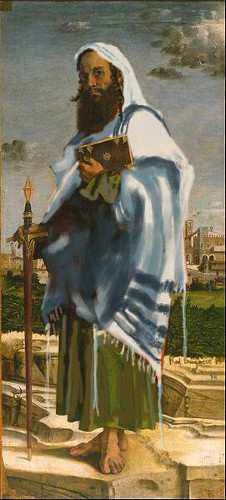
The Jewish PaulWe start with Paul defending himself from allegations that he is not really an apostle because he was not commissioned as were the other apostles, by Yeshua (Jesus) during the Messiah’s “earthly ministry.” Paul explains that he did not come “peddling the word of God,” that is, asking for money, but he worked to support himself. He also said “we speak Christ in the sight of God,” explaining that he and his companions were commissioned by God as it were.

Then Paul got a little sarcastic (an attitude New Testament scholar Mark Nanos called “an ironic rebuke” in his book The Irony of Galatians: Paul’s Letter in First-Century Context).

Are we beginning to commend ourselves again? Or do we need, as some, letters of commendation to you or from you? You are our letter, written in our hearts, known and read by all men; being manifested that you are a letter of Christ, cared for by us, written not with ink but with the Spirit of the living God, not on tablets of stone but on tablets of human hearts.

2 Corinthians 3:1-3 (NASB)

Without stealing Lancaster’s thunder by explaining everything, he describes Paul as sarcastically asking if his Master or the Council of Apostles in Jerusalem, should have sent him out with a letter or recommendation, sort of like asking, “Should I have brought a note from my Mother?”

But he also says something interesting. He says “you,” his audience, “are our letter of recommendation,” indicating that their behavior, their lives changed by the knowledge of and faith in Messiah, are what establishes Paul’s “cred” as an apostle. But a letter written on hearts by the Spirit of God? Where have we heard that before?

And I will give them one heart, and put a new spirit within them. And I will take the heart of stone out of their flesh and give them a heart of flesh, that they may walk in My statutes and keep My ordinances and do them. Then they will be My people, and I shall be their God.

Ezekiel 11:19-20 (NASB)

“But this is the covenant which I will make with the house of Israel after those days,” declares the Lord, “I will put My law within them and on their heart I will write it; and I will be their God, and they shall be My people.

Jeremiah 31:33 (NASB)

TorahLancaster says that Paul took those two passages, both of which end with the same declaration of Israel being His people and He being Israel’s God in New Covenant language, and leveraged them in this 2 Corinthians 3:1-3 commentary. Paul is continuing to establish himself as an apostle and emissary of the New Covenant, contrasting the Old Covenant and New Covenant, not that the conditions are different, because the Torah as the conditions, are the same between one covenant to the other, but that those conditions, written on stone tablets in the Old Covenant, are written on hearts by the Spirit of God in the New Covenant.

Such confidence we have through Christ toward God. Not that we are adequate in ourselves to consider anything as coming from ourselves, but our adequacy is from God, who also made us adequate as servants of a new covenant, not of the letter but of the Spirit; for the letter kills, but the Spirit gives life.

But if the ministry of death, in letters engraved on stones, came with glory, so that the sons of Israel could not look intently at the face of Moses because of the glory of his face, fading as it was, how will the ministry of the Spirit fail to be even more with glory? For if the ministry of condemnation has glory, much more does the ministry of righteousness abound in glory. For indeed what had glory, in this case has no glory because of the glory that surpasses it. For if that which fades away was with glory, much more that which remains is in glory.

2 Corinthians 3:4-11 (NASB)

Especially starting at verse 7, these scriptures are used by many Christian teachers and Pastors to substantiate the allegation that the Torah was “bad” and killed, and that it was replaced by the grace of Jesus which is “good” and gave life. I have to admit, if you had no context for interpreting Paul’s meaning, then “the ministry of death, in letters engraved on stones” sounds pretty grim. The Torah brings death, the ministry of Moses was (and is) deadly, he seems to say. But look at the full message from the point of view of a val chomer or from lighter to heavier argument. I’ll paraphrase somewhat:

But if the ministry of death, in letters engraved on stones, came with glory, so that the sons of Israel could not look intently at the face of Moses because of the glory of his face, fading as it was, how will the ministry of the Spirit fail to be even more with glory?

I guess this “ministry of death” thing needs some explanation. What brings death, obeying the Torah? That hardly seems likely since God gave Israel the Torah as the conditions of the Old Covenant at Sinai and, as we’ve seen these past several weeks, the Torah represents the conditions of the New Covenant as well. So how can the Old Covenant and the Torah be a “ministry of death?” What’s the difference between the Old and New Covenants?

Under the Old Covenant, if you disobey the conditions, thereby disobeying God, the consequences were exile and death. The wages of sin is death (Romans 6:23). It’s not the Torah that brings death, and it is not fidelity to the Torah and to God that brings death, the ministry of death is disobedience and sin, the consequences for which, under the Old Covenant, bring death.

gloryBut as we’ve previously seen, under the New Covenant, the Torah or the conditions don’t change, it’s the people who change. It becomes possible for people to not sin at all thanks to what God does in the New Covenant, writing the Torah on people’s hearts so obedience to God becomes part of human nature. It is the ministry of righteousness because the people become righteous.

Paul is saying something like:

If you thought the Old Covenant came in tremendous glory, just you wait. The New Covenant comes with even much more glory, so much in fact that, by comparison, the shining of the New Covenant will make the light and glory of the Old Covenant seem like a dim night-light!

Paul isn’t saying that the Old Covenant had no glory, only that by comparison, the New Covenant, because it makes it basically impossible for people to sin, will seem so much more glorious. In a val chomer argument, the second condition cannot be true unless the first condition is true, so if the New Covenant has tremendous glory, the Old Covenant is glorious as well (present tense), just not quite so much.

Like the glow on Moses’ face, it was brilliant in its illumination, but it had a tendency to fade and needed to be renewed. Something like the pattern of Israel under the glorious Old Covenant. Israel’s faith tended to fade and they sinned, requiring repeated renewal efforts. Christianity has a similar problem but then, we’re still living in Old Covenant times, too. We do however have a pledge of the coming New Covenant, just as all believers do, Jew and Gentile alike.

Lancaster previously talked about a Heavenly Torah that, in order to be understood and accessed by man, had to be “clothed” so to speak, to “translate” from Heaven to Earth. The Torah of the Lord is perfect, restoring the soul (Psalm 19:7), but since it exists in our world, it is also temporal. Basically, it’s glory “fades.” The Torah of Messiah in the New Covenant is the Supernal Torah and will never fade but instead, Messiah will reveal what is now concealed in the Torah, removing the veil, as it were, from the Torah and from in front of our eyes, so we can see the full glory, just as Moses saw God’s glory on the mountain.

Do not think that I came to abolish the Law or the Prophets; I did not come to abolish but to fulfill. For truly I say to you, until heaven and earth pass away, not the smallest letter or stroke shall pass from the Law until all is accomplished.

Matthew 5:17-18 (NASB)

heaven and earthThe Old Covenant does not change at all while Heaven and Earth are still here, but eventually, we get a New Heaven and New Earth, so the Old Covenant will eventually cease. Actually I had a problem with this example of Lancaster’s because what I see Yeshua (Jesus) saying is that the Torah, the conditions of the Old and New Covenants, don’t change as long as Heaven and Earth exist, so it seems that the conditions of even the New Covenant will change once we get a New Heaven and a New Earth. Of course, until then, we are living in Old Covenant times, holding only a pledge of the New Covenant through receiving the Holy Spirit, so the conditions are still with us under the Old Covenant and the emerging New Covenant.

When He said, “A new covenant,” He has made the first obsolete. But whatever is becoming obsolete and growing old is ready to disappear.

Hebrews 8:13 (NASB)

Sure, the Old Covenant is becoming obsolete, but that’s a long, drawn out process, and it won’t disappear until Messiah returns bringing the fully realized New Covenant with him.

Let’s finish up with chapter three of 2 Corinthians:

Therefore having such a hope, we use great boldness in our speech, and are not like Moses, who used to put a veil over his face so that the sons of Israel would not look intently at the end of what was fading away. But their minds were hardened; for until this very day at the reading of the old covenant the same veil remains unlifted, because it is removed in Christ. But to this day whenever Moses is read, a veil lies over their heart; but whenever a person turns to the Lord, the veil is taken away. Now the Lord is the Spirit, and where the Spirit of the Lord is, there is liberty. But we all, with unveiled face, beholding as in a mirror the glory of the Lord, are being transformed into the same image from glory to glory, just as from the Lord, the Spirit.

2 Corinthians 3:12-18 (NASB)

Lancaster goes through this line by line, but what I found important was how his interpretation of Paul redeemed Paul from the criticism of many Jewish people or for that matter, the mistaken understanding of many Christians, who saw Paul as anti-Torah and Law-free, and was teaching Jews and Gentiles to also forsake Torah and to believe the Torah was a “ministry of death”.

Lancaster describes why the Jewish people couldn’t simply obey the Torah as they had always done and have that be enough. It’s why there aren’t two paths to salvation, Moses for the Jews and Jesus for the Gentiles. Hear me out. I think this explanation makes sense.

Under the Old Covenant, as hard as a Jewish person might strive, being only human, sooner or later he would sin and require atonement under the conditions of that Covenant, that is, the Torah. When Israel sinned greatly and did not repent, the conditions of the Old Covenant required exile and death. Nothing in that Covenant made Jewish people “sin proof,” so to speak.

Look at Israel’s history. It’s glorious but it’s also terrible. How many exiles have there been? How many times has Jerusalem been destroyed? How many times has God (temporarily) withdrawn His presence from among Israel due to their “hearts of stone?”

tallit_templeBut under the New Covenant, God makes it possible for Israel not to sin at all and further, God promises to forgive all of Israel’s sins past and present. Apprehending the first fruits of the New Covenant through faithfulness to Yeshua HaMashiach, the conditions of the Old Covenant and New Covenant, that is, the Torah, don’t change, so Jews are still required to perform the mitzvot, but God starts writing on their hearts, starts softening hearts, begins to lead His people Israel into the better promises of the New Covenant.

The veil is lifted and the concealed Torah is revealed. Israel is liberated, not from the Torah but liberated from sin.

What does from glory to glory mean?

From the glory of the Old Covenant, which was and is glorious indeed, but to the greater glory of the New Covenant, which will be eternal and in which all men will know God face to face, the way Moses knows God, not dimly through a mirror, as we know God now.

The glory of the Old Covenant forgives sin but does not make people sinless. The glorious New Covenant forgives all sins past and present, and then makes it possible for people to naturally obey God so that we will never again sin. The Old Covenant was and is good, but the New Covenant really is the better deal. It’s incredibly fabulous.

I’m kind of sad to see this study end. I was really enjoying it. Of course, I’ve got about a year’s worth of Lancaster’s Epistle to the Hebrews study to still work through, so it’s not like I’m out of material to review.

I deliberately left out quite a bit of detail from my reviews, so if these “meditations” have piqued your interest, I’d recommend you order the full five-disc set of audio CDs What About the New Covenant. May you be as illuminated as I have been.