Tag Archives: Christianity

FFOZ TV Review: All Foods Clean

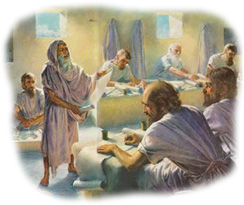
All Foods CleanEpisode 23: Most Christians believe that when Mark 7 tells us “thus he declared all foods clean,” that the biblical dietary restrictions were abolished once and for all. In Episode twenty-three viewers will learn that in order to understand these words, it is imperative to look into the Jewish context of the Mark 7 story, and in particular that the argument surrounded not food but ritual hand washing. It will be discovered that the dietary laws are indeed still in force for the Jewish people and will be the menu for the Messianic kingdom.

-from the Introduction to FFOZ TV: The Promise of What is to Come
Episode 23: All Foods Clean (click this link to watch video, not the image above)

The Lesson: The Mystery of All Foods Clean

This episode takes on the traditional Christian doctrine that teaches Jesus abolished the Kosher food laws during his earthly ministry based on the following scripture:

And he said to them, “Then are you also without understanding? Do you not see that whatever goes into a person from outside cannot defile him, since it enters not his heart but his stomach, and is expelled?” (Thus he declared all foods clean.)

Mark 7:18-19 (ESV)

I understand something of the background of these scriptures and why they don’t actually prove that Jesus abolished the Kosher laws, but First Fruits of Zion (FFOZ) teachers Toby Janicki and Aaron Eby did an excellent job at digging deeper and making points I had never considered before. After watching this episode, I challenge any Christian to continue believing that Jesus declared all foods “Kosher” based on the above quoted verses.

But first things first.

We find the basis for the Jewish Kosher laws in Leviticus 11 and Deuteronomy 14 which outlines the foods Jews can and cannot eat according to the commandments of God. Toby didn’t mention this, but the basis for how food animals are to be slaughtered is only briefly mentioned in the Torah and thus, a significant amount of Rabbinic interpretation is involved in expanding on this important issue, adding more dimension to what makes an animal Kosher in relation to the method of execution and preparation.

However, as you’re about to discover, the discussion in Mark 7 had nothing to do with Kosher foods at all. In fact, it would have been a contradiction for Jesus to have “declared all foods clean” (Kosher) since in Matthew 5:17 Jesus said he had not come to abolish any of the Torah laws, and in Isaiah 66:17 the prophet said that in the future Messianic Kingdom, it will be an abomination to eat pork or mice (non-Kosher animals).

So if Jesus and the Pharisees weren’t even talking about “keeping Kosher,” what were they talking about?

Now when the Pharisees gathered to him, with some of the scribes who had come from Jerusalem, they saw that some of his disciples ate with hands that were defiled, that is, unwashed. (For the Pharisees and all the Jews do not eat unless they wash their hands properly, holding to the tradition of the elders, and when they come from the marketplace, they do not eat unless they wash. And there are many other traditions that they observe, such as the washing of cups and pots and copper vessels and dining couches.) And the Pharisees and the scribes asked him, “Why do your disciples not walk according to the tradition of the elders, but eat with defiled hands?”

Mark 7:1-5 (ESV)

Toby has said in at least one prior episode that “context is King,” and we see that illustrated here. The beginning verses of this chapter show us that the Pharisees weren’t accusing Jesus and his disciples of eating pork chops with a side of shrimp scampi. It had to do with eating (bread) with defiled hands, that is, unwashed hands. It had to do with a particular practice that the Pharisees had of ritually washing not only their hands, but many other objects in order to achieve a level of ritual purity. This was completely irrelevant to the issue of Kosher or non-Kosher foods and was a tradition the Pharisees took upon themselves to honor God; a tradition of the elders.

The following is Jesus’ response to the allegations that his disciples didn’t keep the same ritual washing tradition as the Pharisees:

You leave the commandment of God and hold to the tradition of men.” And he said to them, “You have a fine way of rejecting the commandment of God in order to establish your tradition!

Mark 7:8-9 (ESV)

Jesus turns the conversation completely around and accuses the Pharisees of being so concerned about non-Biblical traditions involving excessive ritual purity, that they neglected the higher moral laws of the Torah.

That brings us to Toby’s first clue:

Clue 1: The context of Mark 7 is ritual handwashing before eating, not the dietary laws of the Bible.

Toby JanickiThat’s pretty much where I thought Toby was going to go, but what happens next, I didn’t expect and in fact, Aaron’s Hebrew language lesson opened up new information for me, and went a long way to “sealing the deal” that Jesus and the Pharisees weren’t discussing the Kosher laws on any level in Mark 7.

There’s a world of difference in talking about the Kosher food laws and the concept of ritual purity. In Hebrew, the word for ritually clean is “Tahor” and the word for ritually impure is “Tamai.” This has nothing to do with sinning, but it does require a little background to understand the concepts and their relevancy to this discussion.

Aaron told a sort of story in order to illustrate his point. You have to imagine yourself as a Jewish person in the days of Jesus when the Temple was still standing. You are having the Passover meal with a family in Jerusalem. The lamb you will be eating was sacrificed at the Temple and, in order for a Jewish person to eat a Temple Sacrifice, that person has to be Tahor or ritually pure. This isn’t a requirement for having any Kosher meal, only for eating a Temple Sacrifice.

Aaron said that if one of the guests at the meal were to suddenly pass away, just the presence of a corpse at the Passover meal would render everything, including the people in attendance, as Tamai. They would no longer be able to eat the Passover lamb because they would be in a state of ritual impurity.

Again, this has nothing to do with sin. No one did anything wrong. There are many conditions listed in the Torah that could make a person Tamai. A woman who gives birth or who has her monthly period is considered Tamai. A man who has had typical marital relations with his wife is considered Tamai. That doesn’t mean they’ve done anything wrong, and it doesn’t mean they can’t eat anything, but one thing it does mean is that until they perform the rituals listed in the Bible to again become Tahor, they can not eat any Temple Sacrifice.

Aaron describes the procedure for returning to ritual purity, which you can get from the episode, but comprehending the meaning of Tahor and Tamai is critical to understanding the discussion in Mark 7.

It’s important to note that cycles of being Tahor and Tamai were a typical part of a Jewish human experience and even Jesus would have been Tamai and Tahor depending on a variety of circumstances. It has nothing to do with sin and a great deal to do with involvement in Temple ceremonies in ancient Israel for a Jewish person. Normal Kosher food can either be Tahor or Tamai, but as long as it’s not part of a Temple Sacrifice, it’s OK for a Jewish person to eat Tamai bread. There’s no sin.

Aaron EbyThis next part is the key (and I’d love to see Toby and Aaron’s source material on this matter – – bibliography, please). The Pharisees who confronted Jesus and his disciples in Mark 7 kept a particular practice where they treated every meal as if it were a Temple Sacrifice. This required them to exist in a constant state of ritual purity or be continually Tahor. They had to enter the mikvah and otherwise practice many ritual purity washings in all aspects of their day-to-day existence. This was absolutely not required by the Torah and had nothing to do with the Kosher laws, but was their way of honoring God, though God didn’t obligate them or any Jew to do so.

To maintain a constant state of ritual purity, the Pharisees (I don’t know if all Pharisees kept this practice or only some) had to avoid all contact with other Jews who did not keep the same excessive level of purity (and contact with Gentiles on any level was completely out of the question). These Pharisees led very complicated lives where even having a meal involved a great deal of preparation and would have been very difficult to maintain.

Back in the studio, Toby uses Aaron’s teaching to produce the second clue:

Clue 2: Mark 7 involves a sectarian preference of the Pharisees and not a Biblical requirement.

At this point, it should be abundantly clear that Mark 7 can’t be used as a proof text for the extinction of the Kosher laws at the hands of Jesus, but we have a problem.

…since it enters not his heart but his stomach, and is expelled?” (Thus he declared all foods clean.)

Mark 7:19 (ESV)

We have a statement in parenthesis saying that Jesus declared all foods clean. Toby read from a variety of different Bible translations but only the King James Version translates this verse literally and omits any mention of Jesus declaring all foods or meats kosher or pure.

The words in parenthesis were added by the translators and are not in any of the original Greek texts. Toby was generous and said the translators were just trying to clarify the verse, but what they actually did was to impose their theology onto the Bible by adding words to it (which I think both the Torah and New Testament take a dim view of).

I’ll omit posting all of the different translation examples used by Toby except for the following:

He said to them, “Are even you lacking discernment? Do you not comprehend that whatever comes within a person from the outside of him does not contaminate him? For it does not come into his heart, but rather into his stomach, and it goes out to the toilet, which cleanses all that is eaten.”

Mark 7:18-19 (DHE Gospels)

Here, Jesus accuses the Pharisees of being completely out of balance, giving ultimate importance to a man-made standard of excessive ritual purity while neglecting the moral implications of the Bible. The Pharisees were nearly obsessed with avoiding eating anything Tamai which, for non-Temple Sacrificed food, would not affect their relationship with God and would literally pass into the toilet, as opposed to ignoring the Torah commandments and thus becoming morally impure, those things that enter the heart and result in “evil thoughts, sexual immorality, theft, murder, adultery, coveting, wickedness, deceit, sensuality, envy, slander, pride, foolishness” (Mark 7:21-22 ESV).

Clue 3: The words “Jesus declared all foods clean” are not in the original Greek text.

This should go a long way in establishing to everyone familiar with these verses that they cannot possibly be interpreted the way the Church as typically understood them. The phrase about Jesus declaring all foods clean is a tragic example of the Christian church in all it’s denominations across much of history favoring man-made traditions (traditions of the elders) and ignoring the actual words of the Bible in their proper context.

kosher eatingThis is an excellent example of why I’m a Christian who studies Messianic Judaism. The vast majority of Christian teachers would have not understood this point at all.

Toby quickly mentions that even though the Kosher laws were not done away with, that doesn’t mean Gentile Christians have to suddenly start separating their milk and meat products. The Kosher laws are applied to the Jewish people, while the only food restrictions for Gentile Christians are found in Acts 15 (and how the “Jerusalem letter” is understood would be a worthy study for a future episode of this show).

Toby also said that in the Messianic Era, the whole world (Jews and Gentiles alike) will be eating Kosher, which probably doesn’t sound like good news to most of the Christians who read my blog. How that works would also have to be covered in another FFOZ TV show since it represents another mystery.

What Did I Learn?

Aaron’s lesson and how Toby applied it was completely new to me. I had some understanding of the concepts of Tahor and Tamai, but I had no idea of the excessive levels of ritual purity practiced by the Pharisees of Mark 7 vs. Tahor and Tamai in relation to ordinary Kosher meals. I know most Christians will try to find a way around this, but for me, it was another example of how this show presents very tight arguments that help us correctly understand the Gospels from their original, apostolic perspective.

I found myself wishing Toby had tossed in a clue or two about Acts 10, since that’s the other major part of scripture used by Christians to “prove” that God did away with the Kosher laws. But then I remembered this:

You yourselves know that it is unlawful for a Jew to associate with or to visit a Gentile; but God has shown me that I should not call anyone profane or unclean (emph. mine).

Acts 10:28 (NRSV)

If you recall, earlier I said that the excessive level of ritual purity kept by the Pharisees in Mark 7 would make it impossible to have any sort of association with Gentiles, even to the point of entering their homes. Merely being in a non-Jewish home would pose a great risk of a Jew becoming Tamai for a number of reasons. Now this represents no sin, but for the Pharisees, who could not even eat a single meal in a state of Tamai, it would be exceptionally difficult to have relations with Gentiles.

But what about Peter? We already know that Jesus didn’t require his disciples to keep a level of ritual purity matching the Pharisees.

Now when the Pharisees and some of the scribes who had come from Jerusalem gathered around him, they noticed that some of his disciples were eating with defiled hands, that is, without washing them (emph. mine).

Mark 7:1-2 (NRSV)

The text says that only some of Jesus’ disciples ate with unwashed hands, not all of them. Was Peter one of the Jewish disciples of Jesus who did keep a higher level of ritual purity, treating all meals as if he had to be Tahor to eat them? Was this excessive standard of purity considered the de facto standard among Jews until Jesus taught his disciples otherwise?

I don’t know, but since I do know the Torah does not say that it is unlawful for a Jew to “associate with or to visit a Gentile,” the fact that Peter was saying those words and his Jewish companions seemed to be aligned with this belief tells me it’s quite possible Peter kept some of these excessive purity laws (and I should mention that the tradition of washing hands, called Netilat Yadayim, is practiced by some observant Jews today).

Now the apostles and the believers who were in Judea heard that the Gentiles had also accepted the word of God. So when Peter went up to Jerusalem, the circumcised believers criticized him, saying, “Why did you go to uncircumcised men and eat with them?”

Acts 11:1-3 (NRSV)

Here we see Peter being confronted by the apostles and elders in Jerusalem, the Jerusalem Council, which could very well have included James, the brother of the Master, and they were very surprised that Peter was associating with Gentiles. This confrontation seems to support that the apostles and brothers in Jerusalem also had adopted a higher set of standards of ritual purity than Jesus and the Torah required. This is very important in understanding the following:

But when Cephas came to Antioch, I opposed him to his face, because he stood self-condemned; for until certain people came from James, he used to eat with the Gentiles. But after they came, he drew back and kept himself separate for fear of the circumcision faction. And the other Jews joined him in this hypocrisy, so that even Barnabas was led astray by their hypocrisy. But when I saw that they were not acting consistently with the truth of the gospel, I said to Cephas before them all, “If you, though a Jew, live like a Gentile and not like a Jew, how can you compel the Gentiles to live like Jews?”

Galatians 2:11-14 (NRSV)

Apparently, Peter had become accustomed to eating and associating with Gentiles, that is, until some “certain people” showed up, probably important representatives from James and the apostolic council in Jerusalem. We can’t be certain of the sequence of events, but Galatians was probably written before Acts 15. However, did Peter already have his encounter with Cornelius in Acts 10? It seems likely if he initially was OK with associating with Gentiles, but he obviously struggled with the level of ritual purity and tradition he felt he needed to keep, and how it would look to James and the brothers in Jerusalem. He was influenced by peer pressure, unlike Paul, who was a lot more comfortable with being a Jewish man in close proximity to Gentiles, and knowing that did not make him unacceptable to God as a Jew.

DHE Gospel of MarkAgain and again, in all the so-called Christian “proof texts” which seem to abolish the Kosher laws, we see that the topic isn’t about Kosher foods at all, but rather how some Jews, including possibly Peter, kept a higher than necessarily level of ritual purity, and how that specific preference could be used to discriminate against the Gentile believers by “requiring” Gentiles in the body of Messiah not to be permitted to associate with believing Jews (at least those who kept this higher standard).

Sure, some of this is supposition on my part, but given all of the solid scriptural evidence of the maintaining of the Kosher laws for the Jewish people of the apostolic era (and by inference, among modern Jews today, including modern believing Jews), I think I make a good case in explaining the “food” issues of Acts 10 and Galatians 2. Some of my conclusions are also derived from the opinions and research of New Testament scholar and author Mark Nanos, which I’ve previously recorded on this blog.

I know some Christians who express great joy at not “being under the Law” and who would be pretty dismayed at my conclusions, but as Toby said, there’s nothing in the Bible that tells us non-Jewish Christians must keep the Kosher laws. The Didache, an early document dated to the second or even first centuries and purportedly used to train new Gentile disciples of the Jewish Messiah entering the Jewish religious stream of “the Way,” offers no requirement or even mention of the Kosher laws as applied to non-Jewish believers, and only stresses that the Gentiles should avoid meats sacrificed to idols (which mirrors the Acts 15 directives to Gentile disciples). While I think any non-Jewish believer can take on board additional Torah mitzvoth, including Kosher, voluntarily (and the Didache also supports this), it’s voluntary and a matter of conviction between the person and God.

Just remember that the Pharisees also kept a standard of observance that was higher than what God required of them as well, and it resulted in them becoming so focused on those excessive standards that they ended up ignoring what actually was required of them. If you, as a Christian, feel you want to modify your eating habits to reflect some level of Kosher or Kosher-like observance, just remember that such observance by a Gentile believer will never be as important to God as what is required of us, “to do justice, and to love kindness, and to walk humbly with our God” (Micah 6:8).

Final note: this is probably a good time to mention that there are only three more episodes in the series available for me to review. Given the value I’ve found in what I’ve seen so far, I hope the folks at FFOZ consider producing more shows in this excellent television series soon.

Snow and Shabbos

shoveling-snowMaimonidies explains our midrash by reference to the related instance of rabbinic religious psychology: “God’s presence is never felt in a state of sadness or lethargy or levity or conversation or distractedness, but only amid the joy of performing a mitzvah.”

-Ismar Schorsch
quoting Bavli Shabbat 30b.
“The Seedbed of Prophecy,” pg 165 (December 21, 1996)
Commentary on Torah Portion Vayigash
Canon Without Closure: Torah Commentaries

I read this on Shabbat after shoveling snow off of my driveway and sidewalk. Actually, I also shoveled the snow off of the sidewalks of my two next door neighbors. It was a mitzvah of a sort. I try to do a little more than required because I know it’s the right thing to do. I think it’s something God built into me for some reason.

But I was performing one mitzvah (I don’t think the Bible says to specifically shovel your neighbor’s sidewalk, but it does say to love your neighbor, so I figure helping them with shoveling snow qualifies as “love”) but I was breaking another, well, sort of. It depends on whether or not you believe that non-Jewish believers are obligated to observe Shabbos in the manner of the Jews. I know that the Didache, an early document dated to the second or even first centuries and purportedly used to train new Gentile disciples of the Jewish Messiah entering the Jewish religious stream of “the Way,” states that even a Gentile may keep the entire “yoke of the Lord” (i.e. Torah commandments) if they (we) are able, but if not, to keep what we can, so keeping the Sabbath in some manner is on my radar screen as an option.

On the other hand, the two Jewish members of my household (and the other two Jewish family members who have their own households) don’t observe Shabbos, though I believe they are obligated to do so.

But I’m not the religious police. Each person must negotiate their own relationship with God. Past efforts of mine suggesting to my family that they take a more observant path have resulted in a rebuke and a reminder that they themselves must make those sorts of decisions.

And so they must. My remaining option for the sake of peace in the family is to pray and to rely on God to lead His own back to Him, even as Messiah will lead all the Jewish exiles back to redemption in the Land of Israel.

In reading the quote from Schorsch (and Maimonidies), I tried to recall if I felt joy when shoveling snow and if I felt the Presence of God. I have to admit that I didn’t experience either state. There was a sense of satisfaction at the realization that I was exceeding my property lines and doing what wasn’t expected of me, but I can’t say I had any sort of religious revelation. I don’t think living a life before God or doing the right thing is magic. I think it’s just what we’re supposed to do.

I also believe that no one “does it” perfectly, and I’m a living example of that.

If anything, I have a greater sense of the presence of God when I reading the Bible, when I’m studying the Torah Portion, when I’m contemplating a Psalm, even when I’m writing a blog post about God and the mitzvot.

I know people (online) who do a much better job at observing Shabbos. Some of them live in places like Colorado and Wisconsin, places that get a lot of snow. What do they do on the Shabbat when it’s snowing, just let it sit on their driveways and sidewalks?

I live in a suburban neighborhood that has a homeowner’s association (whether I like it or not) and the association has a covenant which states that each homeowner is responsible for keeping the sidewalks in front of their homes free (reasonably) of snow. We are also legally responsible if we fail to do so and a pedestrian falls and is injured as a result. So I have a duty to protect my neighbors by keeping my sidewalks clean, even on the Shabbat.

I know some people who would be rather rigid and dictatorial about such a suggestion, saying God’s commandment to observe Shabbat trumps any law or other responsibility assigned by human beings, but let’s look at that. I have a duty to love my neighbors which could be interpreted as protecting them from harm. I know there’s a Torah commandment that specifies if you see someone drowning in a body of water and you do nothing to help save their life, you have sinned against that person and against God (Rabbinic interpretation does say however, that if you are a poor swimmer and would be likely to drown too, you are absolved of this responsibility).

So what’s the higher duty, to perform an act on the Shabbat that at least in potential, could prevent a neighbor from being harmed, or to observe the Shabbat and ignore my neighbors by playing the “I’m keeping the Shabbat, look at how holy I am” card?

It’s an interesting question.

Of course, returning to my lack of actual obligation to observe a strict Shabbat, at least in the present age, I am not in quite the same bind as a Jewish person. I also believe the commandment to love one’s neighbor is universal, particularly since we see it occurring not only in Leviticus 19:18, but issuing from the mouth of Jesus (see Matthew 22:39, Mark 12:31).

I know there is a part of Shabbat observance that is also universal, since such observance acknowledges God’s Creative Sovereignty, but I will have to be satisfied with acknowledging God’s creation of human beings by doing something, even on Shabbat, that is of service to some of those “creations.”

I try to spend most of my Saturdays in prayer, in study, in recording my contemplations on God, but it’s not perfect. In fact, it’s very far from perfect. But what I desire and am unable to accomplish today, may God grant me a life in the world to come where I may observe His peace and His perfection.

And as I write this, it’s still snowing outside.

What I Learned in Church Today: The Jealous Thessalonian Jews

zealous-torah-studyThe brethren immediately sent Paul and Silas away by night to Berea, and when they arrived, they went into the synagogue of the Jews. Now these were more noble-minded than those in Thessalonica, for they received the word with great eagerness, examining the Scriptures daily to see whether these things were so. Therefore many of them believed, along with a number of prominent Greek women and men. But when the Jews of Thessalonica found out that the word of God had been proclaimed by Paul in Berea also, they came there as well, agitating and stirring up the crowds. Then immediately the brethren sent Paul out to go as far as the sea; and Silas and Timothy remained there. Now those who escorted Paul brought him as far as Athens; and receiving a command for Silas and Timothy to come to him as soon as possible, they left.

Acts 17:10-15 (NASB)

This was the topic of today’s sermon and Sunday School class teaching. I thought it would be a nice, friendly, benign topic, and the Sunday School teacher is very supportive of Jewish people and Israel. But then, when reviewing the notes teacher sent me for class, I saw this question:

In verse 13 of Acts 17 we see that the jealousy (emph. mine) of the Jews in Thessalonica continued to boil over into trying to destroy the work of God in Berea also. Can and do Christians today oppose the work of God? How?

That’s a loaded question but before continuing, let’s take a look at the “jealousy” of the Thessalonian Jews.

Now when they had traveled through Amphipolis and Apollonia, they came to Thessalonica, where there was a synagogue of the Jews. And according to Paul’s custom, he went to them, and for three Sabbaths reasoned with them from the Scriptures, explaining and giving evidence that the Christ had to suffer and rise again from the dead, and saying, “This Jesus whom I am proclaiming to you is the Christ.” And some of them were persuaded and joined Paul and Silas, along with a large number of the God-fearing Greeks and a number of the leading women. But the Jews, becoming jealous (emph. mine) and taking along some wicked men from the market place, formed a mob and set the city in an uproar; and attacking the house of Jason, they were seeking to bring them out to the people.

Acts 17:1-5 (NASB)

The question is, why did “the Jews” become jealous in the first place? Jealous of what? I remember the question was covered by First Fruits of Zion (FFOZ) author and scholar D. Thomas Lancaster in the Torah Club series, Volume 6: Chronicles of the Apostles. In fact, this type of jealousy was first observed by Paul in the synagogue in Pisidian Antioch (Acts 13) when he was evicted, not because of his declaration that Yeshua was Moshiach, but because his sermon on one Shabbat brought a huge number of pagan Gentiles into shul on the following Shabbat. The Jewish leadership was “jealous,” not because Paul brought in record numbers of people, but because record numbers of pagan Gentiles were invading their religious space…all because of Paul and his “inclusive” teachings.

I confirmed this by looking at Lancaster’s commentary on Acts 17. Lancaster referenced the following to support his opinion:

… who both killed the Lord Jesus and the prophets, and drove us out. They are not pleasing to God, but hostile to all men, hindering us from speaking to the Gentiles (emph. mine) so that they may be saved; with the result that they always fill up the measure of their sins. But wrath has come upon them to the utmost.

1 Thessalonians 2:15-16 (NASB)

BereansWe see in Acts 17:2 that Paul had been preaching in the Thessalonian synagogue for three Shabbats, so it couldn’t have been that his message about Messiah was immediately offensive. We do see that some of the Jewish people were persuaded along with “a large number of the God-fearing Greeks and a number of the leading women” (Acts 17:4). That in and of itself might have been the problem if the “God-fearing Greeks” and “leading (Greek) women” were bringing in large numbers of their friends, relatives, and business associates who regularly patronized pagan temples. The Jewish leadership of the synagogue probably felt threatened and outraged and finally (and wrongly) staged a violent upheaval to attack Jason, who had been hosting Paul and his party, forcing Paul and his companions to flee into the night.

I was somewhat heartened when the teacher asked the question about God’s purpose for the Jewish people. Well, not his question, since that could go either way, but his answer:

I am telling the truth in Christ, I am not lying, my conscience testifies with me in the Holy Spirit, that I have great sorrow and unceasing grief in my heart. For I could wish that I myself were accursed, separated from Christ for the sake of my brethren, my kinsmen according to the flesh, who are Israelites, to whom belongs the adoption as sons, and the glory and the covenants and the giving of the Law and the temple service and the promises, whose are the fathers, and from whom is the Christ according to the flesh, who is over all, God blessed forever. Amen.

Romans 9:1-5 (NASB)

So when the question about “the jealousy of the Jews” came up and teacher said this caused “the Jews” to reject Paul’s message about Christ, I piped up and said, “Not all the Jews.” And things went downhill from there.

Even accepting that it was the Jewish leadership of the synagogue and not every individual Jewish person in attendance, one woman in class said that the leadership represented the people, pretty much painting all “the Jews” with a broad brush. Actually, I was thinking of the synagogue in Berea but I figured that I’d missed my window of opportunity in explaining my point and wasn’t going to get another one…that is unless I wanted to start a riot.

I thought about answering the question, “Can and do Christians today oppose the work of God? How?” but I didn’t think it would go over very well. The class ended up answering that question by talking about Strange Fire and got into how Christian apathy is a big problem, how we gave up “school prayer” but the Muslims haven’t caved in as we did, and so on.

I did actually learn something though. If the Thessalonian synagogue leaders became jealous because of the vast number of pagan Greeks Paul attracted into their space, why didn’t this happen in the Berean synagogue? Paul’s message was the same and neither group objected to a visiting Rabbi sharing his theological opinion about Moshiach (even if they didn’t agree necessarily) so the issue could have been Gentile inclusion.

Let’s compare two verses about these two synagogues:

And some of them were persuaded and joined Paul and Silas, along with a large number of the God-fearing Greeks and a number of the leading women. But the Jews, becoming jealous and taking along some wicked men from the market place, formed a mob…

Acts 17:5-6 (NASB)

Now these were more noble-minded than those in Thessalonica, for they received the word with great eagerness, examining the Scriptures daily to see whether these things were so. Therefore many of them believed, along with a number of prominent Greek women and men.

Acts 17:11-12 (NASB)

In both examples, we see a population of Jews along with Greek men and prominent Greek women, so it looks like the base population of both synagogues is very similar (to the best of our ability to discern given the brevity of detail). I learned that Berea was off the beaten path, so to speak, which was probably a good place to hide out from the Thessalonians, some forty or fifty miles away from the scene of Paul’s previous troubles.

churchesThere could have been something different about the general population of Berea. Maybe not as many pagan Greeks were attracted to the message of the Jewish Messiah King. Maybe the Jews in Berea had a better relationship with or at least didn’t mind the general non-Jewish people of their small town so much. Maybe being more “noble-minded” means that these Jews were more accepting of Gentile inclusion in a Jewish religious space, especially since they diligently searched the Tanakh (Old Testament scriptures) and possibly discovered scriptural evidence supporting such inclusiveness.

I had never considered any of that before, so I’m indebted to today’s Sunday School class for inspiring these thoughts.

I know a large part of Boaz Michael’s book Tent of David is the message of healing relationships between more “Hebraically-minded” Christians like me and the normative Church. Part of this process is to have folks like me me make a traditional Christian venue my “church home.” I get to see the positives of how church really does “teach Torah” and I get to share something of my pro-Judaic views on the Bible.

My Sunday School class identified one of the big problems in the Church as apathy, especially with people who were raised in the Church. People take hearing and reading the Word for granted. They go with the flow. They don’t let themselves be engaged by the Bible, either in hearing or reading. They don’t kick up a fuss when the rights of Christians are surrendered by Christians who don’t want to make waves in the larger secular society (which is probably why liberal churches are popular at the moment).

I agree that “going with the flow” can lead to large problems, but the “flow” I have a problem with, even among Christians who are generally pro-Jewish people and pro-Israel (but not necessarily pro-Judaism) is the difficulty in entertaining even a slight deviation from their general assumptions about “the Jews” they read about in Acts or in Paul’s epistles.

If I’m going to make an impression, I have to speak up, but if I speak up too much, I’ll make the wrong impression. I kept silent for the most part in class except for a few words here and there, but I could have literally taken over class with all that was bubbling between my ears.

preachPastor’s Ph.D program has expository preaching as an emphasis (and I notice from this reference that the “practice originated from the Jewish tradition of the rabbi giving a ‘Dvar Torah’, explaining a passage from the Torah, during the prayer services”. Pastor encouraged us from the pulpit to engage in “expository listening” which generally means actively engaging God’s Word, allowing it to be applied and integrated into our lives, and then responding out of that application.

But that probably also means generally agreeing with the rest of the people in church, sharing only very small differences of opinion.

I really wanted to ask what the Thessalonians were jealous of in Sunday School class, but I knew if I did, it wouldn’t end well. I’m grateful for what I did learn in class today but unfortunately, as much as I like and admire the teacher (and he is a wonderful person and even a tzaddik), it wasn’t what he was actually teaching.

Addendum, 12-9-2013, Monday: I just read a blog post at a place called AncientBible.net called Paul Was Too Jewish for the Synagogue, Part 1 written by Derek Leman. It makes several points that speak to this particular “meditation” of mine, so I thought I’d include it here.

Best Viewed Through a Long Telescope

phariseesThe Jewish-Christian schism in Late Antiquity has been studied from numerous points of view. This paper will approach these events by investigating the manner in which halakhic issues (questions of Jewish law) motivated the approach of the early Rabbis to the rise of the new faith, and the manner in which Rabbinic legal enactments expressed that approach as well. The eventual conclusion of the Rabbis and the Jewish community that Christianity was a separate religion and that Christians were not Jews, was intimately bound up with the Jewish laws and traditions governing personal status in the Jewish community, both for Jews by birth and proselytes. These laws, as known today, were already in full effect by the rise of Christianity. In the eyes of the Rabbis, the evolution of Christianity from a group of Jews holding heretical beliefs into a group whose members lacked the legal status of Jewish identity and, hence, constituted a separate religious community, brought about further legal rulings which were intended to separate the Christians from the Jewish community.

-Prof. Lawrence H. Schiffman
“The Halakhic Response of the Rabbis to the Rise of Christianity”
lawrenceschiffman.com

Yahnatan Lasko at the Gathering Sparks blog sent me the link to Professor Schiffman’s brief article (and with a title like that, I was surprised it was so short) with the idea that I might want to write something in response (and I’m not the only blogger in the “Messianic space” Yahnatan notified). I emailed him back with my immediate thoughts:

Schiffman seems to be saying that prior to the destruction of the Temple, he believes that Jews who believed Yeshua was the Messiah and even Divine wouldn’t have caused any sort of rejection from the larger Jewish population or authority structures since there were multiple streams of Judaism in operation, with the general expectation that they were going to disagree with each other. The destruction of the Temple was the catalyst for many things, including Jewish dispersal, the apprehension of Gentile leadership of “the Way” for the first time, the power surge of Gentiles entering that Judaism, all resulting in the shift from Messiah worship as a Jewish religion to Christ worship as a Gentile faith. As Schiffman said, the Pharisees were the only Jewish stream to remain intact after the Temple’s fall and while “the Way” also survived, it took a divergent trajectory, leading it away from Judaism, so by default, the Pharisees became the foundation for later Rabbinic Judaism.

Schiffman is being very “gentle” in his treatment of this topic. I can see a blog post coming out of this in the semi-near future. Thanks for sending the link.

Of course, Schiffman also said that Jews who had faith in Yeshua (Jesus) as Messiah were holding “heretical beliefs,” so I guess he wasn’t all that gentle, but he still seems to be treating the topic with a lighter touch than you’d expect.

I was somewhat reminded of Talmudic scholar Daniel Boyarin’s treatment of “the story of Jesus Christ” in his book The Jewish Gospels (a book I extensively reviewed in The Unmixing Bowl, The Son of Man – The Son of God, and Jesus the Traditionalist Jew).

Boyarin, of course, didn’t express personal faith in Yeshua as Messiah or assign any credibility, from his perspective, that modern Judaism could consider Jesus as Moshiach, but he is another Jewish voice saying that, given the understanding of the Torah and the Prophets in the late Second Temple period, it was certainly reasonable and credible to expect that some Jews, perhaps a large number of Jews, would have accepted Yeshua’s Messianic claim and even his Divinity.

mens-service-jewish-synagogueToday, for the vast majority of Jewish people, such thoughts are outrageous and offensive, but unwinding Jewish history and the development of Rabbinic thought back nearly twenty centuries, we encounter a different set of Judaisms than we observe in the modern era. We can’t really retrofit modern Jewish perspectives into the time of Jesus, Peter, and James anymore than the modern Church can insert post-Reformation and post-modern Christian theology and doctrine backward in time and into the original intent of the Gospel and Epistle writers, particularly Paul. Both inject massive doses of anachronism into the ancient Jewish streams of life when the Temple still stood in Jerusalem.

Today, it takes a tremendous amount of courage for any Jewish person, under any set of circumstances, to say anything even mildly complementary about the ancient Jewish stream of “the Way” and that it might be reasonable to believe that in that cultural and chronological context, Jewish people, from fishermen to scribes, might see the Messiah looking at them from the eyes of Jesus.

While our sources point to general adherence to Jewish law and practice by the earliest Christians, we must also remember that some deviation from the norms of the tannaim must have occurred already at the earliest period. Indeed, the sayings attributed by the Gospels to Jesus would lead us to believe that he may have taken a view of the halakhah that was different from that of the Pharisees,. Nonetheless, from the point of view of the halakhic standards, the early Rabbis did not see the earliest Christians as constituting a separate religious community.

-Schiffman

A number of months ago, Rabbi Dr. Carl Kinbar made a statement that I think speaks to the above-quoted comment of Professor Schiffman:

But, to complicate matters, different social groups and congregations often have their own versions of Torah that they enforce in these ways. Obviously, this situation is far from ideal.

Fortunately, God is (in my considered opinion) not a perfectionist. Even as he calls us to holiness, he understands the limitations that surround us. For the most part, then, Torah observance is essentially voluntary and variable rather than compulsory and uniform. In fact, this is exactly the situation that existed in Yeshua’s, when the vast majority of synagogues were “unaffiliated” and most Jews practiced what has been called “common Judaism.” In common Judaism, Jews kept the basics of Torah observance according to their customs but did not acknowledge the authority of the sects (including the Pharisees) to impose additional laws.

ancient-rabbi-teachingMy understanding of what Rabbi Kinbar said was that while there was a basic or core set of standards and halachah that defined Judaism as an overarching identity and practice, not only were there multiple streams of Judaism (Pharisees, Essences, and so on), but significant variations of how Torah observance was defined among “different social groups and congregations” (and I apologize to Rabbi Kinbar in advance if I’ve misunderstood anything he’s said).

What this means for us as we’re gazing into the time of the apostles, is that there were many different expressions of what we call “Judaism” back in the day, but in spite of all the distinctions, including one group who paid homage to a lowly Jewish teacher from the Galilee as the Messiah and Divine Son of God, they were all accepted as Jewish people practicing valid Judaisms.

This situation changed with the destruction of the Temple. Divisions within the people, after all, had made the orderly prosecution of the war against the Romans and the defense of the Holy City impossible. The Temple had fallen as a result. Only in unity could the people and the land be rebuilt. It was only a question of which of the sects would unify the populace.

-Schiffman

Holding all of this diversity together in a Jewish land occupied by the Roman empire was difficult enough, and more so for Jewish communities in the diaspora, but the Temple was the common denominator (even if you lived so far away that you could only afford to make the pilgrimage rarely) that defined all Jewish people everywhere. The Temple was always the center, the resting place of the Divine Presence, the only place on earth where once a year atonement was made for all of Israel.

And then it was gone.

As Schiffman points out, with their power base destroyed, the Sadducees where scattered to the winds. It could be argued that the Way, the ancient movement of Messiah worshipers, was a Pharisaic extension. We have indications that the apostle Paul not only did not abandon Jewish practice but remained Pharisaic throughout his life. Many of Yeshua’s teachings most closely fit the theology of the Pharisees. Even my Pastor said that if we lived in ancient Israel (and we were Jewish), we’d be Pharisees, because they were the “fundamentalists” of their day, the populist movement among the common Jewish people, Am Yisrael.

But the split would inevitably occur, perhaps not so much because one splinter group among the Pharisees, the Way, believed they had identified a Divine Messiah, but because a mass movement of Gentiles was entering that particular Jewish sect and, by definition, re-writing the nature of the movement as the majority Gentile membership achieved ascendency and as the Jewish membership were forced into exile, grieving a Temple and a Jerusalem left in ruins.

Of the vast numbers of Greco-Roman non-Jews who were attracted to Christianity, only a small number ever became proselytes to Judaism. The new Christianity was primarily Gentile, for it did not require its adherents to become circumcised and convert to Judaism or to observe the Law. Yet at the same time, Christianity in the Holy Land was still strongly Jewish.

As the destruction of the Temple was nearing, the differences between Judaism and Christianity were widening. By the time the Temple was destroyed, the Jewish Christians were a minority among the total number of Christians, and it was becoming clear that the future of the new religion would be dominated by Gentile Christians. Nevertheless, the tannaim still came into contact primarily with Jewish Christians and so continued to regard the Christians as Jews who had gone astray by following the teachings of Jesus.

-Schiffman

Long telescopeAccording to Schiffman’s commentary, as long as the “Christian” movement was largely controlled by Jews, it was a Judaism and Jewish people who believed that a Jewish Rabbi was actually the Messiah were still Jewish. In fact, in that time and place, it was probably a no-brainer. No one would have even questioned that any Jewish adherent to the Way wasn’t Jewish, anymore than any Jewish person today would question the “Jewishness” of a Chabad adherent believing their beloved Rebbe will one day be resurrected as the Messiah.

Schiffman said that other Jewish streams would have considered Jewish Yeshua-believers as misguided but Jewish, much as other Jewish streams might consider the Chabad and their attitude about the Rebbe today.

If today’s Jewish people (or for that matter, today’s Christians) could look through that long telescope back to the world of Peter, James, and Paul, they might gain a vision that would help them see what I see in today’s Messianic Jewish movement; a perspective that illuminates the “Jewishness” of those men and women who are observant Jews and who have put their hope in the Messiah, who once walked among his people Israel as a teacher from the Galilee who went about gathering disciples, and ended up revolutionizing the world.

Vayigash: Will the King Show Us Mercy?

king-davidAnd Joseph said to his brothers, “I am Joseph!”

Genesis 45:3

The Chofetz Chaim comments that from the time the brothers first came to Egypt to get food — when Joseph spoke with them roughly and accused them of being spies — they were puzzled about what exactly was happening and why it was happening. In both encounters with Joseph they had many questions about their experiences. As soon as they heard the words, “I am Joseph” all their questions were answered. The difficulties they had in understanding the underlying meaning of the events — why Joseph accused them of being spies, yet treated them well, accused them of lying and stealing, but gave them a banquet, insisted on bringing the younger brother to Egypt, etc. — were now completely clarified.

Similarly, says the Chofetz Chaim, when the entire world will hear the words “I am the Almighty” at the final redemption of the Jewish people, all the questions and difficulties that people had about the history of the world with all of its suffering will be answered. The entire matter will be clarified and understood. Everyone will see how the hand of the Almighty caused everything ultimately for our benefit.

Dvar Torah for Torah Portion Vayigash based on
Growth Through Torah by Rabbi Zelig Pliskin
Referenced by Rabbi Kalman Packouz
at Aish.com

The brothers of Joseph discover a startling reality. The ruler of the Egyptians who has been treating them harshly all of this time is really their brother Joseph. In an instant, all the cruelty they showed him, including trying to murder him, must have come to the forefront of their conscience.

Before this, the Egyptian ruler had the power to do anything to them, imprison them, make them slaves, even kill them, but “it wasn’t personal.” That is, the sons of Jacob were no more or less significant to an Egyptian ruler than anyone else.

Now they not only discover that this man has the power of life and death over them, but that he is their brother, who they left for dead, who almost surely has a personal motive for seeking revenge. The brothers knew they had no right to appeal to Joseph for mercy, for they had not showed him mercy. They could only hope that in the years he ascended from slavery and imprisonment to being a viceroy of Egypt, second only to Pharaoh in power and authority, that he had learned wisdom and compassion and would be willing to offer them something they did not deserve: mercy and the continuation of their very lives.

Now look at what Rabbi Pliskin had to say from the above-quoted text:

Similarly, says the Chofetz Chaim, when the entire world will hear the words “I am the Almighty” at the final redemption of the Jewish people, all the questions and difficulties that people had about the history of the world with all of its suffering will be answered.

How much of the non-Jewish world will tremble at the feet of God when they realize the Almighty has appeared at the final redemption and that He is not at all pleased with how His people Israel have been treated?

Over the long march of centuries since Abraham, Isaac, and Jacob, since Joseph confronted his brothers, since Moses, Aaron, and Miriam liberated the Israelites from Egyptian slavery and set them before God at Sinai, and on and on across history, every people, tribe, and tongue throughout the Earth has been seeking to kill the Jewish people, God’s splendorous treasure, the apple of His eye.

This includes the Church of Jesus Christ. How confusing it will be in those days to be a Christian who has harbored hatred toward Jewish people, Judaism, and Israel, and to be confronted by an angry Jewish King. How strange it will seem to many Christians who have loved Israel but continued to deny the validity of the Torah, the Temple, and the adherence of Jewish people to a Jewish way of life for those Gentile believers to be faced with a Jewish King who upholds the “Jewishness” of his people Israel.

“Then He will also say to those on His left, ‘Depart from Me, accursed ones, into the eternal fire which has been prepared for the devil and his angels; for I was hungry, and you gave Me nothing to eat; I was thirsty, and you gave Me nothing to drink; I was a stranger, and you did not invite Me in; naked, and you did not clothe Me; sick, and in prison, and you did not visit Me.’ Then they themselves also will answer, ‘Lord, when did we see You hungry, or thirsty, or a stranger, or naked, or sick, or in prison, and did not take care of You?’ Then He will answer them, ‘Truly I say to you, to the extent that you did not do it to one of the least of these, you did not do it to Me.’ These will go away into eternal punishment, but the righteous into eternal life.”

Matthew 25:41-46 (NASB)

Woman in the darkI used to think this was an injunction for believers to show kindness and compassion for all of the needy people around us (and I still think we should), but almost a year ago, I heard a good and kind Christian man in a Sunday school class interpret this statement as the duty we Gentile believers have to take care of all the needy of Israel.

And if that statement is true, then woe be to the many, many Christians past and present who have utterly failed to do so because those needy people were “just Jews.”

In the case of the brothers of Joseph, their kinsman who was also ruler and King over them was merciful after all:

Now do not be distressed or reproach yourselves because you sold me hither; it was to save life that God sent me ahead of you. It is now two years that there has been famine in the land, and there are still five years to come in which there shall be no yield from tilling. God has sent me ahead of you to ensure Your survival on earth, and to save your lives in an extraordinary deliverance. So, it was not you who sent me here, but God; and He has made me a father to Pharaoh, lord of all his household, and ruler over the whole land of Egypt.

Genesis 45:5-8 (JPS Tanakh)

But was it for Jacob’s sake that Joseph spared his brothers? And for whose sake shall the King of Israel spare those among the nations and particularly those among the Church who have treated his little ones poorly?

…but whoever causes one of these little ones who believe in Me to stumble, it would be better for him to have a heavy millstone hung around his neck, and to be drowned in the depth of the sea.

Matthew 18:6 (NASB)

Mark Nanos in his book The Mystery of Romans defines the “weak” and “stumbling,” relative to Paul’s letter to the Romans, as the Jews in the synagogues of Rome who had not yet come to faith in Messiah. I’ll write a detailed “meditation” on this topic in a few days, but Nanos understands Paul’s admonition to the “strong,” the Gentile believers, as failing to uphold their responsibility to encourage the stumbling Jewish people, resulting in them stumbling even further away from faith. Paul never gave up on the stumbling, and he would have sacrificed everything for them.

For I could wish that I myself were accursed, separated from Christ for the sake of my brethren, my kinsmen according to the flesh, who are Israelites, to whom belongs the adoption as sons, and the glory and the covenants and the giving of the Law and the temple service and the promises, whose are the fathers, and from whom is the Christ according to the flesh, who is over all, God blessed forever. Amen.

Romans 9:3-5 (NASB)

It was the Master himself who called his people Israel “lost sheep” (Matthew 10:6, 15:24) and who are we to disdain those “sheep,” for it is obvious that even in their unbelief, God loves them with a great intensity and will violently protect them, even from those of us who are so arrogant as to believe their Father has cut them off from His care and compassion.

bk_kotelPaul says that all of Israel will be saved (Romans 11:26), though we in the Church cannot fathom this. But though the Jews have always been few in number (Deuteronomy 4:27) and suffered exile and dispersion (Leviticus 26:33), yet they shall be redeemed and live in peace (Micah 4:1-4), for God has declared that Israel shall eternally be a nation before Him (Genesis 17:7, Leviticus 26:43, Deuteronomy 4:26-27, 28:63-64).

It is within the power of the Jewish Messiah King, Yeshua, Jesus, to judge his Gentile Church and to cast out those of us who have failed in our duty to his people Israel in opposition to the prophesies and the commandments. The patriarchs were terrified of their powerful and very human brother for the vengeance he could exact upon them. How much more should we be terrified of an infinitely powerful and eternal King?

It is a terrifying thing to fall into the hands of the living God.

Hebrews 10:31 (NASB)

Tremble and sin not, reflect in your hearts while on your beds, and be utterly silent. Selah.

Psalm 4:4 (from the Siddur, nighttime blessings)

Let the world that has always hated the Jewish people learn to repent before it’s too late, and let each Christian who has hated or dismissed the Jewish people lie in his or her bed and tremble and be utterly silent before their King whose hand will always uplift Israel and whose greatest desire is to save his precious nation and redeem her as he has promised.

Good Shabbos.

The Mystery of Romans: Who are the “Weak” and the “Strong”?

Apostle-Paul-PreachesWelcome those who are weak in faith, but not for the purpose of quarreling over opinions. Some believe in eating anything, while the weak eat only vegetables. Those who eat must not despise those who abstain, and those who abstain must not pass judgment on those who eat; for God has welcomed them. Who are you to pass judgment on servants of another? It is before their own lord that they stand or fall. And they will be upheld, for the Lord is able to make them stand.

Some judge one day to be better than another, while others judge all days to be alike. Let all be fully convinced in their own minds. Those who observe the day, observe it in honor of the Lord. Also those who eat, eat in honor of the Lord, since they give thanks to God; while those who abstain, abstain in honor of the Lord and give thanks to God.

We do not live to ourselves, and we do not die to ourselves. If we live, we live to the Lord, and if we die, we die to the Lord; so then, whether we live or whether we die, we are the Lord’s. For to this end Christ died and lived again, so that he might be Lord of both the dead and the living.

Why do you pass judgment on your brother or sister? Or you, why do you despise your brother or sister? For we will all stand before the judgment seat of God. For it is written,

“As I live, says the Lord, every knee shall bow to me,
and every tongue shall give praise to God.”

So then, each of us will be accountable to God.

Romans 14:1-12 (NASB)

I’ve just finished reading the third chapter in the Mark D. Nanos book The Mystery of Romans: The Jewish Context of Paul’s Letters. Yes, it did take me a long time and for two reasons. Nanos is quite erudite in his writing, packing each page densely with information. I have to take copious notes on all points of interest while I’m reading. Thus reading and writing while I’m reading makes for slow going.

But I’ve gotten through the eighty pages of “Chapter 3: Who Were the ‘Weak’ and the ‘Strong’ in Rome?” Hint: they aren’t who you think they are, at least according to Nanos.

But first things first.

There is almost universal agreement (it appears to be an almost unquestioned fact) that the “weak” were Christian Jews who still practiced the Law and Jewish customs (with most maintaining that this group would have included “God-fearing” gentiles as well), and that the “strong” were Christian gentiles (as well as Christian Jews like Paul who have supposedly abandoned Jewish practices).

-Nanos, Chapter 3, pg 87

Mark NanosIn my previous review of Chapter 1 of this book, I noted that Nanos takes a high view of Jewish Torah observance and a Gentile “Torah-respecting” lifestyle, meaning that, from a Pauline perspective (according to Nanos), Gentiles in the ancient Messianic Jewish communities were expected to support and uphold Jewish Torah observance while at the same time, conforming to the application of Torah to the Gentile believers as defined by the halakhic decision made by James and the Elders and Apostles in Acts 15 (which was probably supported and expanded by an oral teaching that accompanied the “Jerusalem letter,” the Didache being one possibility).

I mention this, because it must be taken into account in the current conversation, for this position is the template for everything that follows in Nanos’ analysis of Paul’s famous letter to the Romans.

Let’s cut to the chase:

Paul was not concerned with distinguishing between Christian Jews/gentiles who practiced (“weak”) or did not practice (“strong”) the Law and customs, with the hope that all would eventually abandon the Law and customers as they grew stronger in their faith in Christ. His concern was rather that all the non-Christian Jews (“stumbling” in faith toward Christ) in Rome would recognize that Jesus was the Christ of Israel, their Savior, and that they would thus believe in Christ and become Christians (“able” to have faith toward Christ) — Christian Jews. As Christian Jews they would indeed continue to be Jews in that they continue to practice the Law and Jewish customs in faith, not in order to justify themselves, but because they are Jews justified by the Jewish Savior/Messiah/Christ, thus joining with gentiles who are Christians in giving glory with “one accord” and thus “one voice” to the One Lord: “the God and Father of our Lord Jesus Christ” (15:6).

-Nanos, pp 154-5

In order to make that explanation work, the believing Gentiles and believing Jews must share a common synagogue or synagogues in Rome with the non-believing Jews. This isn’t as incredible as you might think. Most people assume that whenever Jews and Gentile God-fearers came to faith in Messiah, they left the synagogue and formed their own house churches. Sometimes that was true, but not always. Nanos and the resources he cites (you’ll have to see the book for the entire bibliography) support the idea that the believing body of Jews and Gentiles in Rome remained in their synagogue communities once they came to faith.

ancient-torahFor the Jewish believers, this probably seemed like a no-brainer at the time, since coming to faith in Yeshua as Messiah in the mid-first century was not particularly strange, and it certainly didn’t mean that the believing Jew was converting to a different religion as it would mean today if a Jew came to faith in Jesus and started going to Church (and for Messianic Jews today, they remain within Judaism as did Paul and the other Jewish believers in the apostolic era).

Also, Gentile God-fearers were commonly found in diaspora synagogues and although they had no covenant status reconciling them with God (unless some pre-Rabbinic status of “Noahide” were conferred upon them), nevertheless, they had come to believe that the God of Israel was the God over all. Once these Gentiles came to faith in Messiah, their was no requirement that their worship practices should change for after all, they were disciples of the Jewish Messiah King. Where else should they be but among Messiah’s people Israel? In fact, James and the Apostles in Jerusalem made this very point:

Therefore I have reached the decision that we should not trouble those Gentiles who are turning to God, but we should write to them to abstain only from things polluted by idols and from fornication and from whatever has been strangled and from blood. For in every city, for generations past, Moses has had those who proclaim him, for he has been read aloud every sabbath in the synagogues.”

Acts 15:19-21 (NASB)

Once coming to faith in Messiah, in order to fully comprehend and practice his teachings, it was necessary to continue accessing his “source material,” which, according to the ruling of the Council, were to be found in the Torah and the Prophets.

Those Jews and Gentiles in the local Roman synagogues who came to faith while davening and worshiping within those communities would still be attached to those communities, to their friends, to the Rabbis. And since Yeshua-worship wasn’t inherently “non-Jewish,” Nanos suggests the believing Gentiles and Jews would have remained in their original synagogues.

Why should we care about this?

Because we have several populations co-mingling within a single religious and community setting: non-believing Jews, believing Jews, and believing Gentiles.

Now this next point is important. As Gentile God-fearers, the non-Jews who regularly attended synagogue would have been observing a set of behaviors that would allow them to co-participate in the community without violating the requirements of Torah observant Jews. They would eat the same foods, probably pray the same prayers or prayers modified for non-Jewish people, and otherwise not interfere with the Jewish “ascendency” in their own synagogue.

In other words, they wouldn’t make waves.

But once the God-fearers became believers and realized, through Paul as well as through the halakhic ruling of the Apostles, that they were not obligated to convert to Judaism and take on the full yoke of Torah but they were still fully equal co-participants in salvation and justification before God, they got a little cocky.

ancient_jerusalemIn Paul’s letter to the Galatians, the primary problem population (say that three times real fast) were “judaizers,” Jews or Jewish converts who were attempting to convince the Gentile population in the Galatian faith-communities that they had to convert to Judaism to be saved (and probably to re-enforce the idea among the Jewish population that being ethnically Jewish and Torah observant was what justified them before God, not faith in Messiah). The target population of Paul’s letter to Rome had the opposite problem: “gentilizers.”

The believing Jews wouldn’t bat an eye about continued Torah observance. For them, it would be a given, and of course, for the non-believing Jews in the synagogue, why should they change the observance given to them by their forefathers? But for the believing Gentiles, who didn’t have the same set of standards (although they definitely had standard of obedience as disciples), they started to “bug” the non-believing Jews about how now the believing Gentiles were “equal” without having to conform to the full body of Torah mitzvot.

And Paul was taking these Gentiles, the so-called “strong,” to task for disrespecting the “weak” who he felt in time, would also come to faith in Messiah. By their behavior, the Gentile believers were actually in danger of inhibiting Jews from coming to faith in their own Messiah (the parallels between this situation and the modern Christian Church are undeniable).

Let us therefore no longer pass judgment on one another, but resolve instead never to put a stumbling block or hindrance in the way of another. I know and am persuaded in the Lord Jesus that nothing is unclean in itself; but it is unclean for anyone who thinks it unclean. If your brother or sister is being injured by what you eat, you are no longer walking in love. Do not let what you eat cause the ruin of one for whom Christ died. So do not let your good be spoken of as evil. For the kingdom of God is not food and drink but righteousness and peace and joy in the Holy Spirit. The one who thus serves Christ is acceptable to God and has human approval. Let us then pursue what makes for peace and for mutual upbuilding. Do not, for the sake of food, destroy the work of God. Everything is indeed clean, but it is wrong for you to make others fall by what you eat; it is good not to eat meat or drink wine or do anything that makes your brother or sister stumble. The faith that you have, have as your own conviction before God. Blessed are those who have no reason to condemn themselves because of what they approve. But those who have doubts are condemned if they eat, because they do not act from faith; for whatever does not proceed from faith is sin.

Romans 14:13-23 (NASB)

Nanos asks his readers to look at this passage in sort of the opposite direction than the way we’ve been taught. Also keep in mind that, just like the situation we see in Galatians 2, the issue is table fellowship and offensive treatment, not food. If your brother or sister (here, Paul has to be relating believing Gentiles to non-believing Jews as “brothers and sisters,” perhaps because they attend the same synagogue community) stumbles (in their faith) because you, as a Gentile, are not obligated to keep the kosher laws, you are no longer walking in love.

While the Gentiles were “mere” God-fearers, they were in a “one-down” position in the synagogue because of legal status and let’s face it, it is a Jewish synagogue. Once they became co-participants in salvation because of Abrahamic faith, the Gentile believers became a tad bit obnoxious to the non-believing Jews and stopped “walking in love.”

There’s a lot Nanos says about the halachah of “walking in love” and the two greatest commandments of Jesus (Matthew 22:36-40) that applies here. You can’t really love God if you are taunting your neighbor who is “weak” in faith and has not yet become reconciled to Messiah.

I have great sorrow and unceasing anguish in my heart. For I could wish that I myself were accursed and cut off from Christ for the sake of my own people, my kindred according to the flesh.

Romans 9:2-3 (NASB)

stuart_dauermannPaul was desperate to share the “good news” to every Jew and he desired, above all else, that his own people should come to faith and redemption. So much so, that he was willing to surrender his own salvation if it would save some of his non-believing Jewish brothers and sisters. Clearly, Paul didn’t see himself, as a believing Jew, in any way disconnected from the larger community of non-believing Jews in Israel or the diaspora or national Israel as a whole. In other words, to reference Rabbi Dr. Stuart Dauermann, all Jewish people for Paul were Us, not Them.

I had a tough time with this chapter. I knew that Nanos was going to reframe the “weak vs. strong” argument in Romans 14, 15, but his build up to even stating his point took a long time. I finally had to jump back to the last pages of the chapter so I’d have some idea of what Nanos was getting at. Once I did, I found it easier to make it through the intervening pages.

According to Nanos, the “strong,” the believing Gentiles in the synagogue, should have known better than to try to “gentilize” the non-believing Jews and thus damaging relationships not only with them, but with the believing Jews who were also continuing to observe Torah and the Jewish customs. The Gentiles were cheapening their own “freedom” in Yeshua-faith by suggesting that the Torah devotion of non-believing Jews was a “weakness” on their part. However, Paul was actually saying that where they were weak was not in their faith in God and observance of the mitzvot, but their faith in Yeshua as Messiah. The Gentile “strong” were greater in that faith but ironically, they weren’t that strong either, for they became arrogant in their new status and in lacking love, I suspect they were also “weak” themselves.

Nanos makes such a complex argument, I don’t know that I can completely apprehend all of the nuances in just one reading, but I don’t really have the time to pour weeks more of study into a single chapter. The Mystery of Romans is such a compact container for such a large amount of data that I have no doubt I’ll have to read it a second time (or more) to tease out additional understanding and meaning. For now, I’m willing to entertain the idea that the “weak” and the “strong” can conform to an alternate meaning and in fact, they must if Paul is to remain consistent as a personality and in his theology throughout his letters and as depicted by Luke in Acts.

Addendum: Having just finished Chapter 4, a number of the points Nanos made about “weak” and “strong” are clearer, especially in relation to Gentile behavioral responsibilities toward Jewish people in general (both believing and non-believing). My next “meditation” on the Nanos book should be a great deal more coherent.