Tag Archives: Christianity

Converging On the House of Prayer

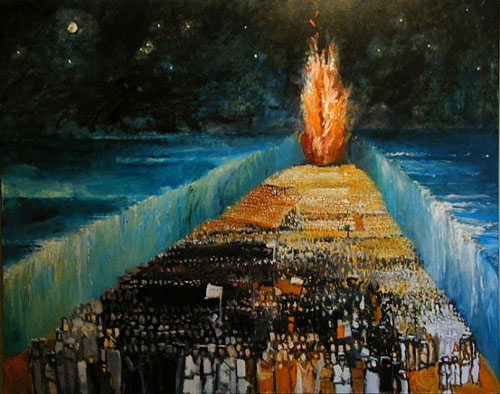
Walking TogetherIn each one of us there is an Egypt and a Pharaoh and a Moses and Freedom in a Promised Land. And every point in time is an opportunity for another Exodus.

Egypt is a place that chains you to who you are, constraining you from growth and change. And Pharaoh is that voice inside that mocks your gambit to escape, saying, “How could you attempt being today something you were not yesterday? Aren’t you good enough just as you are? Don’t you know who you are?”

Moses is the liberator, the infinite force deep within, an impetuous and all-powerful drive to break out from any bondage, to always transcend, to connect with that which has no bounds.

But Freedom and the Promised Land are not static elements that lie in wait. They are your own achievements which you may create at any moment, in any thing that you do, simply by breaking free from whoever you were the day before.

Last Passover you may not have yet begun to light a candle. Or some other mitzvah still waits for you to fulfill its full potential. This year, defy Pharaoh and light up your world. With unbounded light.

-Rabbi Tzvi Freeman
“The Inside Story on Passover”
Based on letters and talks of the Rebbe
Rabbi M. M. Schneerson
Chabad.org

But thanks be to God, that you who were once slaves of sin have become obedient from the heart to the standard of teaching to which you were committed, and, having been set free from sin, have become slaves of righteousness.

Romans 6:17-18 (ESV)

Speaking of slavery and freedom, I debated a great deal within myself whether or not to continue posting blog meditations for Tuesday and Wednesday, considering that the first two days of Passover are considered Sabbaths of complete rest. After all, I don’t post a meditation on the Saturday Shabbat (although I often write for the following days) in order to honor the Sabbath rest. And yet there is so much going on that, if I don’t write about it now, it will be lost, thanks to my failing middle-age memory.

I had a brief transaction with Derek Leman on this blog about my “adventures:”

Derek: I will be looking for the most interesting blog posts, James, which I expect will come from your Passover-and-also-Easter experience.

James: Thanks, Derek.

It’s interesting because events like this are a natural consequence behind Boaz Michael’s book Tent of David and yet no one seems to talk about them. I’m sure I can’t be the only one and in fact, I would be willing to bet (well, not literally) that there are some Christian/Jewish intermarrieds who have these experiences. You’d think they’d turn up more in the Messianic realm, since it tends to be a haven for many intermarried couples.

In a sense, I walk on both sides of the street, being a “practicing Christian” and being married to a Jewish wife. As you read this, it’s Tuesday morning and my family will have had our Passover Seder last night (it hasn’t happened yet as I’m writing this, but I promise to give you all a full report soon). Next Sunday morning, I’ll be attending sunrise services for Easter at my church. I’ll try not to feel too schizophrenic as a process both experiences inside my one and only brain.

But the reality of my life is that I’m not Jewish. As I’ve said on numerous occasions, I believe that the halachah James and the Counsel of Apostles in Jerusalem established for the Gentile disciples of the Master (i.e. Christians) does not obligate us to live our lives in precisely the same manner as the Jewish believers. I suppose if I was more closely connected to the local Jewish population or even if my wife and daughter were more observant, I might interrupt my daily meditations for the sake of the mitzvah of Pesach, but then again, they won’t be observing a full Shabbat’s rest during the festival, and on Wednesday evening, before havdalah to mark the end of the first two days of Passover, I will be meeting with Pastor Randy.
intermarriageWhat is it to be intermarried and to experience the subtle as well as the overt patterns and colors of a life in (for me, anyway) mostly Christianity with some Jewish overtones? What is freedom and what is slavery, or do we simply exchange one master for another as Paul suggests (sin to righteousness)? I’ve already said that there is ample evidence in the Bible of the Messiah’s Gentile disciples being well versed in Passover, so there’s no excuse for me to not observe it in some reasonable fashion.

But then where does that leave Easter? Are Passover and Easter mutually exclusive or can they be complementary? Or in fact, should they both be mandatory?

There’s no “point-blank” commandment to celebrate Easter or “Resurrection Day,” but there is a firm tradition in Christianity to do so. Some Christians reading this may be shocked that I call Easter a tradition, since it is arguably the single most Holy Day on the Christian calendar.

But many Jewish believers probably feel uncomfortable with Easter because historically, after every Passion Play, there’s been a pogrom. To respond to this, First Fruits of Zion (FFOZ) suggested an alternative to Easter in the Meal of the Messiah. That doesn’t do me any good because the only people I’ll be commemorating Pesach with are my immediate (non-believing) Jewish family, and the only ones I’ll be celebrating the resurrection with are the people at my church.

As I continue to process my experiences, I find that they are less “Messianic” and based more on interfaith and intermarriage issues. They are the result of my being the Gentile head of a Jewish family for nearly thirty-one years (although we’ve only been “religious” for about a third of that time).

At the first seder my father would be brief, in order to eat the afikoman before midnight. On the second night, however, he would expound at length; he began the seder before 9 p.m. and ended at about 3 or 4 in the morning, dwelling at length on the explanation of the Haggada.

The Alter Rebbe declared: The matza of the first evening of Pesach is called the Food of Faith; the matza of the second evening is called the Food of Healing. When healing brings faith (“Thank you, G-d, for healing me”) then clearly there has been illness. When faith brings healing, there is no illness to start with.

“Today’s Day”
Tuesday, Nissan 15 (1st day of chag ha’matzot – Pesach), 5703
Compiled by the Lubavitcher Rebbe
Translated by Yitschak Meir Kagan
Chabad.org

I included that last quote to shake up any Christians reading this message. I want to remind you all of the unique and special purpose and experience Passover has for the Jewish people. I want to emphasize to you all just how “Jewish” it is. I want to make sure that Christians of any sort don’t think they (we) now “own” Passover and that it is no longer Jewish. In spite of Paul teaching some of the God-fearing Gentile disciples about the Seder, I want to make sure we all understand that especially in today’s world, Christianity and Judaism stand apart, traveling two independent trajectories through history, and that a Christian attending a Seder let alone leading it, is a wonderful but also a strange thing. It would be just as strange as a religious Jew attending Easter services (and I don’t know any who are planning to do that next Sunday).

two-roads-joinI want to make sure everyone understands that we are still in the middle of an incomplete process. As believers, we may be free from sin thanks for the grace of Jesus Christ, but we are still slaves to our humanity and also to the plan of God in that the time for the Gentile disciples to return to our Jewish mentors has not yet come, although many, including me, can see the signs of an impending approach.

Israel was intended to be a light to the world, to attract and gather the people of the nations to God. That light came into the world in the form of a human being who most people call Jesus. He said he was the light of the world (John 8:12) and he has attracted millions to the God of Jacob as Israel’s firstborn Son. The Jewish and Gentile believers were added as differing members of the same Body of Messiah (Romans 12:4-5) and so there were two, parallel streams of people existing within a single, living being, the Son of David.

But then the two streams within a single container became two separate and diverging streams of humanity, growing further apart and more opposed to each other with each passing decade and century, until now, the idea of one believing person celebrating both Passover and Easter doesn’t seem just like a minor anomaly, but actually a strange and discordant event.

Except that the discordance is temporary.

So I ask, did they stumble in order that they might fall? By no means! Rather through their trespass salvation has come to the Gentiles, so as to make Israel jealous. Now if their trespass means riches for the world, and if their failure means riches for the Gentiles, how much more will their full inclusion mean!

Romans 11:11-12 (ESV)

Paul tells us how much full inclusion in the body of Messiah will mean to not just the Jewish people, but to all people. It is the completion of a dream, the healing of the horribly painful wound, and gift of the returning King.

Lest you be wise in your own sight, I do not want you to be unaware of this mystery, brothers: a partial hardening has come upon Israel, until the fullness of the Gentiles has come in.

Romans 11:25 (ESV)

I can’t summon the future but I can try to preview a tiny portion of it in the present. I can be the Christian leading a Seder in my Jewish family, and I can be the Christian who lives with a Jewish family who also attends a sunrise Easter service. As great a difficulty as intermarriage is for Judaism, perhaps there is a benefit as well. Who else but an intermarried person actually lives in both divergent worlds? And as they slowly draw closer to each other again in Messiah, who else will be able to navigate their currents and negotiate their paths than someone who already walks upon them?

sukkoth-feastLast year for Purim, I wrote Hadassah and the King, a tale of two heroes, the Jewish Queen and Gentile King of an ancient land where only an intermarried couple could save all of the Hebrews from certain destruction.

I’m not heroic but I and those like me have our parts to play out in God’s drama for humanity and his plan for the return of King Messiah. Today, as I write this, the Christian and Jewish worlds exist mainly apart, with just a few tenuous bridges connecting this bit of land and that. But days are coming when we’ll need to have greater fellowship, when we will be expected to attend the celebrations at our Monarch’s throne in Jerusalem, when believing Jew and Gentile will sit together at the Passover Seder, “and recline at table with Abraham, Isaac, and Jacob in the kingdom of heaven.” (Matthew 8:11)

On all other nights we eat while sitting upright, but on this night we eat reclining.

-from the Four Questions

We are limited by the very fact that we have human form. There is no freedom in following our whim, only further slavery to our own limited selves. Freedom can only come by connecting to something infinite and beyond us.

And so Moses was told, “When you take the people out from Egypt, you shall all serve G‑d on this mountain.”

-Rabbi Tzvi Freeman
“The Freedom Connection”
Chabad.org

…these I will bring to my holy mountain, and make them joyful in my house of prayer; their burnt offerings and their sacrifices will be accepted on my altar; for my house shall be called a house of prayer for all peoples.

Isaiah 56:7 (ESV)

May we all one day come together and as our own different and unique parts in the body of Messiah, serve our God and celebrate together in the house of prayer of our King.

A Passover Seder in Philippi

passover-artBut we went out from Pilippi after the days of the Festival of Matzot.

Ma’asei HaShlichim (Acts) 20:6

Your boasting is not good. Do you not know that a little leaven leavens the whole lump? Cleanse out the old leaven that you may be a new lump, as you really are unleavened. For Christ, our Passover lamb, has been sacrificed. Let us therefore celebrate the festival, not with the old leaven, the leaven of malice and evil, but with the unleavened bread of sincerity and truth.

1 Corinthians 5:6-8 (ESV)

For I received from the Lord what I also passed on to you: The Lord Jesus, on the night he was betrayed, took bread, and when he had given thanks, he broke it and said, “This is my body, which is for you; do this in remembrance of me.” In the same way, after supper he took the cup, saying, “This cup is the new covenant in my blood; do this, whenever you drink it, in remembrance of me.” For whenever you eat this bread and drink this cup, you proclaim the Lord’s death until he comes.

1 Corinthians 11:23-26 (ESV)

D. Thomas Lancaster, in his Torah Club Vol. 6 commentary on Acts 20-21:14 states that Paul and his party had been trying to make it to Jerusalem for Passover, but various difficulties interrupted their trip.

Paul and the delegates immediately scuttled their plans. They did not dare board any vessel departing from Cenchrea together. They gave up hope of arriving in Jerusalem for the Passover. It was too dangerous.

-Lancaster, pg 651

But apparently, even in the days of the Second Temple, Jews in the diaspora commemorated the Passover in some fashion without traveling to Jerusalem to offer the sacrifice according to the Torah of Moses. So where was Paul for Passover that year?

Paul, Timothy, and Luke made their way backwards into Macedonia. They visited Berea and came to Thessalonica by Purim. They arrived in Philippi on (sic) time for Passover.

Paul decided to spend Passover with the believers of Philippi. The Philippians had far fewer Jews in their community than Gentiles. There simply were not many Jews in Philippi, so Paul decided to use the occasion of the feast to teach the Philippians the observances of Passover. He could teach them how to conduct a Seder according to apostolic custom in remembrance of the Master.

-Lancaster, pg 652

I’m not quite sure how Lancaster draws these conclusions, but it makes a wonderful picture of the Jewish apostle to the Gentiles teaching them a precious gift from the Master.

And when the hour came, he reclined at table, and the apostles with him. And he said to them, “I have earnestly desired to eat this Passover with you before I suffer. For I tell you I will not eat it until it is fulfilled in the kingdom of God.” And he took a cup, and when he had given thanks he said, “Take this, and divide it among yourselves. For I tell you that from now on I will not drink of the fruit of the vine until the kingdom of God comes.” And he took bread, and when he had given thanks, he broke it and gave it to them, saying, “This is my body, which is given for you. Do this in remembrance of me.” And likewise the cup after they had eaten, saying, “This cup that is poured out for you is the new covenant in my blood.”

Luke 22:14-20 (ESV)

It is unlikely that what we think of today as “taking communion” actually existed as a Christian practice in the days of Paul. It is far more likely that Paul and other apostles to the Gentiles, taught the believing God-fearing people of the nations of the Passover and the covenant of the Master that is commemorated in his body and blood on Pesach. We see in Paul’s first letter to the church at Corinth, that they also knew and understood the Passover language and symbolism, supporting the idea that at some point, it was relatively common for Jewish and Gentile believers to observe Passover in the diaspora together.

One can imagine the disciples in Philippi pressed in tightly around the triklinium table of Lydia the purple dealer. Over the seven days of Passover, they celebrated the resurrection of the Master together and began to count the days of the Omer leading to Shavuot.

-Lancaster, ibid

passover-art-slavery-to-freedomA few days ago, I wrote about my personal trepidation regarding the approach of Passover and the anticipation of leading a Seder with my family. I’m proceeding a little more optimistically, especially after discovering the sudden appearance of boxes of matzah in the kitchen pantry. But it’s the renewed realization of Paul and his Passover with the Gentiles in Philippi that reminds me that a Christian commemorating the Pesach isn’t just a “nice custom” for us, it’s a responsibility.

A Jewish person in Israel offered this comment on my blog:

But you have an opportunity for a fuller appreciation of it, for its additional implications for those who remember Rav Yeshua as reflected in its symbolisms. You may indeed identify with those few Egyptians who were willing to risk censure from their own people and join with the Jews who were eating lamb and matzah, and painting blood on doorposts, in order to flee with them in a mixed multitude. You may savor the metaphor of fleeing likewise from sin, having attached yourself to follow Rav Yeshua as an exemplar of Israel. If you choose not to remain in the Israeli camp throughout 40 years of desert wandering, you may settle somewhere along the way for a separate existence that nonetheless eschews idolatry and respects Torah values. I don’t really know if it was possible in that time to be intermarried, remain among Jews, and yet remain distinct by not becoming absorbed into the Jewish commonwealth. Ignoring Torah instructions in that era as some Jews did was a recipe for being destroyed in some quite unpleasant fashion. Thankfully today a non-Jew among Jews isn’t under quite the same pressure.

And today, there are believing Gentiles not only commemorating Passover with Jewish families, but leading Seders as well. I thought it appropriate to offer up this sort of “meditation” since tonight, as you read this, is Erev Pesach, and Jewish (as well as a few Christian and intermarried) families all over the world will be sitting at their tables, reciting from haggadahs, eating bitter herbs, asking four questions, and at the end of the evening, shouting with earnest desire, “Next year in Jerusalem!”

I have desired to visit Jerusalem and particularly to pray at the Kotel during my lifetime. If God is gracious and it is within His desire, then this will occur. If not, then one day in the world to come, I will offer a sacrifice at the Temple and eat at the feast of Abraham, Isaac, and Jacob in the presence of the King.

May this Pesach meal be in honor of my Master and may I give thanks that because he gave himself, his body, his blood, his suffering, that I can turn away from sin and turn to God as a partaker of salvation and redemption, and call myself a son of the Most High.

Chag Sameach Pesach!

Paul Picks Up His Cross

pick-up-your-crossAnd when they came to him, he said to them:

“You yourselves know how I lived among you the whole time from the first day that I set foot in Asia, serving the Lord with all humility and with tears and with trials that happened to me through the plots of the Jews; how I did not shrink from declaring to you anything that was profitable, and teaching you in public and from house to house, testifying both to Jews and to Greeks of repentance toward God and of faith in our Lord Jesus Christ. And now, behold, I am going to Jerusalem, constrained by the Spirit, not knowing what will happen to me there, except that the Holy Spirit testifies to me in every city that imprisonment and afflictions await me. But I do not account my life of any value nor as precious to myself, if only I may finish my course and the ministry that I received from the Lord Jesus, to testify to the gospel of the grace of God. And now, behold, I know that none of you among whom I have gone about proclaiming the kingdom will see my face again.

Acts 20:18-25 (ESV)

While we were staying for many days, a prophet named Agabus came down from Judea. And coming to us, he took Paul’s belt and bound his own feet and hands and said, “Thus says the Holy Spirit, ‘This is how the Jews at Jerusalem will bind the man who owns this belt and deliver him into the hands of the Gentiles.’” When we heard this, we and the people there urged him not to go up to Jerusalem.

Acts 21:10-12 (ESV)

Several days ago, in my blog post about my second conversation with Pastor Randy on D. Thomas Lancaster’s Galatians book, I discussed the possibility that Paul may have lied to the Jews in Jerusalem about teaching the diaspora Jews to not circumcise their sons and not follow the Torah of Moses. Was Paul afraid for his life and out of that fear, would he have lied or “bent the truth” about any portion of his mission in order to save himself?

I gave my opinion, based on my general understanding of Paul, that he would not have lied and he would have unflinchingly told the truth about his activities among the diaspora Jews and God-fearing Gentile believers, regardless of the consequences. I found the concrete proof (blame my failing middle-age memory for not recalling these verses earlier) in the passages of scripture I quoted above. Not only would he face many hardships to serve the Master, but he had a pretty good idea that once he entered Jerusalem, he might not be leaving again alive.

But he went to Jerusalem anyway, even after repeated warnings not to go. And once he was in Jerusalem and his adversaries among the Jewish people began to respond to the false rumors about him, he followed the advice of James and the elders to quickly reassure the Jewish population, including the believing Jews who were zealous for the Torah, that he had not forsaken the customs of their fathers, the Law of Moses, and was not teaching other Jews to abandon the Torah.

What then is to be done? They will certainly hear that you have come. Do therefore what we tell you. We have four men who are under a vow; take these men and purify yourself along with them and pay their expenses, so that they may shave their heads. Thus all will know that there is nothing in what they have been told about you, but that you yourself also live in observance of the law.

Acts 21:22-24 (ESV)

Later passages in Acts 21 and beyond tell us that the rumors continued and the prophesied troubles of Paul that were a consequence of his entering Jerusalem all came to pass. But Paul went to Jerusalem with high hopes:

Paul wanted to present these [God-fearing Gentile] men to the apostles and Jewish believers in Jerusalem. He hoped that the character and quality of the delegates would silence his critics and set all fears to rest about the type of disciple he raised in the Diaspora.

-D. Thomas Lancaster
Commentary on Acts 20-21:14, read with Torah Portion Tzav (“Command”), pg 651
Torah Club Volume 6: Chronicles of the Apostles

Paul-ArrestedOne of those Gentile disciples that Paul wanted to present to the apostles was probably Trophimus the Ephesian, the man some Jews from Asia thought Paul had taken into the Temple, defiling the Holy Place. Again, this wasn’t true, but as Winston Churchill once said, “a lie gets halfway around the world before the truth has a chance to get its pants on.” Apparently that was true nearly 2,000 years before Churchill was born and I don’t doubt that it’s true today. The sad outcome is that Paul stood condemned before the Jewish population of Jerusalem based on a fabric of lies that whipped the crowds into a frenzied riot.

But Paul knew he would face hard trials before they actually happened and nevertheless, went ahead into Jerusalem to accept whatever God had planned for him.

And now, behold, I am going to Jerusalem, constrained by the Spirit, not knowing what will happen to me there, except that the Holy Spirit testifies to me in every city that imprisonment and afflictions await me.

Acts 20:22-23 (ESV)

The dedication of Paul to God was remarkable, but then again, a disciple always seeks to emulate the life of his Master, even unto death.

And I have other sheep that are not of this fold. I must bring them also, and they will listen to my voice. So there will be one flock, one shepherd. For this reason the Father loves me, because I lay down my life that I may take it up again. No one takes it from me, but I lay it down of my own accord.

John 10:16-18 (ESV)

Greater love has no one than this, that someone lay down his life for his friends.

John 15:13 (ESV)

“Father, if you are willing, remove this cup from me. Nevertheless, not my will, but yours, be done.”

Luke 22:42 (ESV)

Paul also emulated his Master by being a “good shepherd” to his own flock, and as such, Paul strived to make provisions for their continuation and guidance under other “good shepherds.”

Pay careful attention to yourselves and to all the flock, in which the Holy Spirit has made you overseers, to care for the church of God, which he obtained with his own blood. I know that after my departure fierce wolves will come in among you, not sparing the flock; and from among your own selves will arise men speaking twisted things, to draw away the disciples after them. Therefore be alert, remembering that for three years I did not cease night or day to admonish every one with tears. And now I commend you to God and to the word of his grace, which is able to build you up and to give you the inheritance among all those who are sanctified. I coveted no one’s silver or gold or apparel. You yourselves know that these hands ministered to my necessities and to those who were with me. In all things I have shown you that by working hard in this way we must help the weak and remember the words of the Lord Jesus, how he himself said, ‘It is more blessed to give than to receive.’”

Acts 20:8-35 (ESV)

Paul knew the dangers that the believing Jews and Gentiles in the diaspora were facing, particularly if Paul would no longer be alive or at least not be free to continue to visit them and support them with his letters. So he, like Moses before him, gave them a warning to watch out for apostasy and for “wolves” who would come in and surely lead them astray. He also very likely knew, just as Moses did, that apostasy was inevitable.

For I know that after my death you will surely act corruptly and turn aside from the way that I have commanded you. And in the days to come evil will befall you, because you will do what is evil in the sight of the LORD, provoking him to anger through the work of your hands.”

Deuteronomy 31:29 (ESV)

In his letter to the mixed congregation of believing Jews and Gentiles in Rome, he tried exceedingly hard to give the same warning.

So I ask, did they stumble in order that they might fall? By no means! Rather through their trespass salvation has come to the Gentiles, so as to make Israel jealous. Now if their trespass means riches for the world, and if their failure means riches for the Gentiles, how much more will their full inclusion mean!

Romans 11:11-12 (ESV)

Read the entire chapter for the full argument, but it seems apparent to me that Paul was urging the Jewish and Gentile disciples to regard each other as equal before God in salvation and access, working as different parts with different functions and responsibilities, but all operating in a single body:

For as in one body we have many members, and the members do not all have the same function, so we, though many, are one body in Christ, and individually members one of another.

Romans 12:4-5 (ESV)

So, in what he knew was his final journey to Jerusalem and possibly the last journey of his life, Paul encouraged the “shepherds” placed over the Master’s flocks, to “feed the sheep.”

When they had finished breakfast, Jesus said to Simon Peter, “Simon, son of John, do you love me more than these?” He said to him, “Yes, Lord; you know that I love you.” He said to him, “Feed my lambs.” He said to him a second time, “Simon, son of John, do you love me?” He said to him, “Yes, Lord; you know that I love you.” He said to him, “Tend my sheep.” He said to him the third time, “Simon, son of John, do you love me?” Peter was grieved because he said to him the third time, “Do you love me?” and he said to him, “Lord, you know everything; you know that I love you.” Jesus said to him, “Feed my sheep.

John 21:15-17 (ESV)

the-shepherdOther passages in the letters of Paul testify to his disregard for his own safety and even his life in the service of the Master. Consider 2 Corinthians 4:7-5:10, 6:4-10, Philippians 1:19-26, 2:17, 3:8, and 2 Timothy 4:6.

No, Paul did not lie, bend the truth, or misrepresent any of his actions in order to protect himself. The Paul we see in Acts 21 is the genuine Paul, who was given a hard task by his Master and Lord, and fulfilled it with remarkable courage in the face of overwhelming hardships. He never told the diaspora Jews to not follow the Torah of Moses or the traditions. He never encouraged Jews to not circumcise their sons. He never taught anyone against the Jewish people, against the Temple, or against the Law.

Even when he knew that disaster awaited him in Jerusalem, he did not fail, he did not shirk his responsibilities, but instead, continued to follow where Jesus the Nazarene led him.

From that time Jesus began to show his disciples that he must go to Jerusalem and suffer many things from the elders and chief priests and scribes, and be killed, and on the third day be raised. And Peter took him aside and began to rebuke him, saying, “Far be it from you, Lord! This shall never happen to you.” But he turned and said to Peter, “Get behind me, Satan! You are a hindrance to me. For you are not setting your mind on the things of God, but on the things of man.”

Then Jesus told his disciples, “If anyone would come after me, let him deny himself and take up his cross and follow me. For whoever would save his life will lose it, but whoever loses his life for my sake will find it. For what will it profit a man if he gains the whole world and forfeits his soul? Or what shall a man give in return for his soul? For the Son of Man is going to come with his angels in the glory of his Father, and then he will repay each person according to what he has done. Truly, I say to you, there are some standing here who will not taste death until they see the Son of Man coming in his kingdom.”

Matthew 16:21-28 (ESV)

Should such a time come in our lives when the Master asks us to pick up our cross and follow him, to offer more of ourselves than we would like to give, even including our lives, may we remain as steadfast in our mission as Paul, the Jew from Tarsus, the good shepherd.

The Unanticipated Passover Seder

passover-bitter-herbs-sederIf there are aspects of the Passover seder from which all people can learn, how much more so is this true for believers in Messiah? After all, our Master Yeshua chose the wine and the matzah of a Passover Seder to represent his body and blood. More than just learning about and celebrating the concept of freedom from oppression and exile, for disciples of Messiah, the seder celebrates Yeshua’s atoning death and resurrection while remaining firmly grounded and centered on God’s deliverance of the Jewish people from Egypt.

There is ample evidence that, for the earliest Gentile believers, the celebration of Passover was an important holiday celebrated by all believers in Messiah—both Jewish and Gentile. Paul wrote the book of 1 Corinthians to a predominately Gentile audience who attended both synagogue and weekly gatherings of believers. Additionally, the timing of the letter seems to have been sometime in early spring before the Passover season had begun. Many portions in the letter allude to Passover and seem to offer instructions for observing it properly with the right heart-attitude.

-Toby Janicki
“God Fearers: Passover and Non-Jews”
First Fruits of Zion (FFOZ)

Everything before the story is to prepare for the story.

Everything after the story is to celebrate the story.

The Leader is the guide on this journey. One of the challenges of the Leader is to keep the participants engaged from beginning to end. All the traditional directions (like covering and uncovering the matzah, for instance) are just devices to help participants, especially children, pay attention and ask: Why?

-Rabbi Alexander Seinfeld
“The Art of Leading an Amazing Seder”
Aish.com

I’m going to need all the advice I can get, especially Rabbi Seinfeld’s, given my memory of last year’s Passover seder. My wife reminded me that it wasn’t my fault that the seder came off so poorly. We had a relative in the hospital and our lives were at least in a mildly emotionally chaotic state. The year before that, my wife and daughter felt rather unappreciated because they believed my sons and I didn’t appropriately recognize the great effort they had put into preparing the meal. Needless to say, Passover has lost some of its appeal in my family.

This year, I promised myself I wouldn’t even bring up the topic of Passover. And since there isn’t so much as a feather in sight and sufficient amounts of rolls and bread continue to inhabit our home, I was firmly and calmly resolved to simply passing by Pesach and moving right on to Easter.

Then yesterday evening, my wife asked me to go with her to our son’s and his wife’s home for a short visit and she said on the way, we could talk about Monday. What’s Monday got to do with anything? In Boise, Idaho, Erev Pesach candlelighting is at 7:44 p.m. on this coming Monday.

Oh.

When she said that we needed to plan for Monday’s seder, it was like she suddenly said, “I’m pregnant.” Well, maybe it wasn’t quite that shocking, but it still came out of the proverbial clear, blue sky. I never saw it coming.

In a way, I was relieved that we weren’t going to celebrate Passover this year, at least as a family. In my quest to return the Torah scroll, so to speak, to my Jewish wife in particular and to the Jewish people in general, I have surrendered a number of practices and observances that I had once held dear, Passover being among them. After all, I cannot be considered as one of the members of humanity who marched out of Egypt and left behind my slavery, and certainly I cannot project myself into the masses who stood at the foot of Mount Sinai and personally received the Torah from Hashem, as does every person who is Jewish.

exodus-reed-seaSo as I processed my wife’s news about our impending family Passover seder, I found myself quickly dusting off Toby Janicki’s advice about Christians and the Passover (though he doesn’t phrase it that way).

I still feel like a fraud and I’m incredibly intimidated. I never used to feel this way, but then that’s the difference between historically celebrating Pesach among mostly non-Jews in a somewhat “Jewish-like” environment, and being the only non-Jew leading his Jewish family in the seder. Or as they say in the hood, “Sh*t just got real.”

There’s really only one difference between matzah and chametz.

They’re both made from flour and water, both baked in an oven, and both provide nourishment.

But one stays flat and humble, while the other fills itself with hot air.

That’s why matzah is a key ingredient for leaving your personal Egypt: As long as we are full of delusions of self-importance, there’s no way to break out and grow to a new level. Once we make ourselves small, we can fit through any bars and fly past any cloud.

-Rabbi Tzvi Freeman
“Between Matzah and Chametz”
Based on letters and talks of the Rebbe
Rabbi M. M. Schneerson
Chabad.org

On the other hand, as Rabbi Freeman suggests, maybe a healthy dose of humility is a good thing. But as it turns out, Rabbi Seinfeld’s advice won’t do me much good since it seems geared for a seder with lots of kids. My four-year old grandson will be the only child present (guess which child will find the afrikomen?) so the emphasis for the seder will have to go in a different direction.

Which direction I have no idea at this point. I’ll need to select a haggadah (after so many years, we have several tucked away in various drawers and cupboards around the house) and practice using it, so my leading doesn’t feel and sound so awkward and forced (and my Hebrew pronunciations are going to be traditionally poor).

I suppose if we were an actual Jewish family (in a traditional sense) and we all had grown up celebrating Passover every year, going to other homes where Passover was celebrated every year, and I, as “head of household,” had been leading family Passover seders for the past thirty years or so, it would seem like second nature by now.

But it isn’t, especially after “reinventing myself” a couple of years ago.

On the other hand, I’m approaching going to my first Easter service in well over a decade with an equal amount of dread if not horror. The one saving grace is that I won’t have to lead a thing…I just have to follow. I wonder where I’ll feel more “alien,” the seder or a sunrise Easter service? But I digress.

What am I really complaining about? Being a fish out of water? I’m certainly not afraid of co-opting Jewish identity or position since A) I’m not going to be very good at this, and B) as the husband and father in an intermarried family, it’s actually my place to lead the seder. Maybe I should play it safe and stick to the ABC’s of Passover, keep it simple (stupid), and just try to get by.

broken-matzah-passoverBut in all of my angst, I’m missing the reason for Passover. If it’s just an event and a performance, then it means nothing and all I’ll get out of it is anxiety in the anticipation and a guilty relief when it’s over. Still, it’s tough to get past what Rabbi Simmons says about “the Seder [being] designed to give each Jew the experience of “going from slavery unto freedom.”

But Christian/Jewish intermarried couples exist. We’re real. There must be some help out there for us…for me. Well, maybe not. I can find material on intermarriage and Purim, but that’s because at the heart of the Purim story is an intermarried couple. But what about intermarriage and Passover?

Shmuel Rosner at Slate Magazine says in part:

Being a pessimist on intermarriage is not easy these days. The Jewish community is tired of gloomy reports conveying what Steven Cohen titled “An Inconvenient Truth” in one of the most controversial studies of the last couple of years. The identity chasm between inmarried and intermarried is so wide, he wrote, as to suggest the imagery of “two Jewries.” One group attends Passover Seders in high percentage—namely, the inmarried—while the other, the intermarried, either refrains from doing so or attends these Seders in much lower numbers.

Rosner also says:

And there will be something different about their Seder itself, too. Passover, more than any other Jewish holy day, is the one in which Jews celebrate not their religion but this strange concept of becoming a people. This idea, of Jewish people-hood—the historic fact that Jews, for generations, didn’t see themselves as just sharing their faith, but also their national fate…

What part of that do I as a Christian share, if any?

But then, Tuvya Zaretsky writes:

“Either/or” thinking is a sadly limited perspective. For example, it sees only the Jewish religious aspects in Passover and misses the universal message of a redeemer God at the heart of Passover observance. Non-Jews who had sanctified themselves to the LORD were welcome to celebrate Passover, to eat unleavened bread and to give thanks to the LORD for His goodness. Gentiles, along with Jews, were welcome to the Lord’s table to eat the matzo and rejoice in the mercy of God. Followers of Y’shua (Jesus) see the message of the deliverer God prominently emphasized within the Passover story.

Although, by definition (my wife and children are not “believers”), our seder will not be “Messianic,” I must allow the seder to have a double meaning for me and not be solely focused on “the Seder [being] designed to give each Jew the experience of “going from slavery unto freedom.”

All this still has me feeling small and inadequate, and while not relative to Passover, I guess I’m not the only one. The following has nothing to do with Passover but everything to do with feeling small.

Blessings.

The Problem with Religious People

rob-bellThe former pastor and founder of Mars Hill Bible Church in Grandville, Mich., made the comment during a guest appearance this past Sunday at The Forum at Grace Cathedral in San Francisco to discuss his new book, What We Talk About When We Talk About God.

Grace Cathedral is the Episcopal Cathedral of the Diocese of California and describes itself as “an iconic house of prayer for all” and is home to an “inclusive congregation.” The congregation’s dean, the Very Rev. Dr. Jane Shaw, moderated The Forum discussion before a live audience.

When asked by Shaw if he was in favor of “marriage equality,” the politically-charged term used by some who want “marriage” redefined, Bell said:

“Yes, I am for marriage. I am for fidelity. I am for love, whether it’s a man and a woman, a woman and a woman, a man and a man. I think the ship has sailed and I think that the church needs to just … this is the world that we are living in and we need to affirm people wherever they are.”

-Nichola Menzie
“Rob Bell Supports Same-Sex Marriage, Says He Is for ‘Fidelity and Love'”
March 18, 2013 | 2:42 pm
ChristianPost.com

As for Acts 15, this is not a set of different instructions for Gentiles. But salvation is by faith, for Jew and Gentile alike. We believe they will be saved the same way we will be saved. The Torah is not the yoke that we nor our fathers have been able to bear, but rather, specifically, the Torah “according the custom of Moshe.” So it is that Paul recalls his words to Peter in Galatians, that Peter did not live “like a Jew.” The followers of Messiah Yeshua inherently cannot submit to all of the traditions of Judaism. To do so would be to disobey the Master and the Commandment of God. In separating himself from the Gentiles, Peter was submitting to Jewish halachic rulings that are not in step with the gospel, and requiring Gentiles to do likewise. Gentiles should start with the four prohibitions in Acts 15—which people are cut off from Israel for breaking—so that they can join the assembly and learn the Commandment of God, which is read in every city every Sabbath. They do not need to become Jewish and submit to the Oral Torah, they simply need to have faith in God and His Mashiach and let obedience to the Commandment working through love be the expression of that faith.

-Charles commenting on my blog post
Moshiach Rabbeinu

Why is everyone trying to change my mind?

I saw the news item about Rob Bell a few days ago. The link was posted by a Facebook “friend” (I put “friend” in quotes since I’ve never met the individual and know him solely through Facebook). It wasn’t directed specifically at me, though I did comment about it a few times on Facebook and then dropped the issue.

But Charles came to me or more accurately, to my blog to comment on his views and to disagree with mine. He seems like a nice guy. I don’t doubt that he’s sincere. But in reading my blog, he should have known from the start that we were coming from two different points of view.

Don’t get me wrong, I don’t expect to be universally accepted, agreed with, or liked. Especially in the world of religion, it’s almost a given that if you’re outspoken at all, people are going to “hunt you down like a duck” (to quote Buford Tanner from the third Back to the Future movie) from the four corners of the earth just to tell you that you’re not only wrong, but a total blockhead (with apologies to Charlie Brown, who’s been called a blockhead more times than I can count).

But it occurred to me to ask, and especially in the context of Charles and people like him, people who don’t know me or have any particular reason to read, let alone comment on my blog, why do they care what I think, say, and believe?

I mean, the Internet is full of bloggers. According to dazeinfo.com, by the end of 2011, there were 181 million blogs on the Internet. That was well over a year ago, and I’m sure there must be even more by now (jeffbullas.com has some interesting info on the nature of the blogosphere in 2012, but nothing relevant to the religious blog space).

So why me? Do I comment on your blogs? No, and in fact, I’ve deliberately stopped commenting on blogs where I know my opinions will cause a small and virtual riot just because I’m sick and tired of all the arguments. Discussions? OK. But why charge down my throat just because you know you can?

And it’s not just the blogosphere anymore.

a-j-jacobsMy Pastor recently loaned me a copy of A.J. Jacobs’ book The Year of Living Biblically. I’ve just started reading it and so far, find it entertaining and humorous. Jacobs is Jewish and not religious in the slightest, but he was determined, for the sake of writing a book, to live as close to a literally Biblical life as possible for an entire year.

I might have taken some sort of offense to his approach, but apparently this is the type of book Jacobs writes. He immerses himself in a subject for a significant period of time in order to learn, often with amusing results, records his experiences, and then turns all that into a book.

But then I had a thought. Is it possible that Pastor gave me this book to read for a specific reason, one particularly related to whether or not the Torah is possible to observe by Jews in today’s world? I’ll have to ask him, but I don’t see him until tonight.

I can understand why Pastor would want to instruct me, enlighten me, edify me, since we have a one-on-one, face-to-face relationship and I attend his church, but why does the Internet care?

Even the people I agree with theologically have some sort of interest in maintaining my current belief system which dovetails into their’s. I’ve made a paradigm shift before. What if I do so again? Who will be affected? How will they react? How much of other people’s emotions and interests are tied to what should be a single individual’s personal understanding of God and faith?

And then there’s political correctness to consider. Atheists and the socially and politically liberal religious individuals and movements are interested in convincing me (well, maybe not me personally, but everyone like me) that not only “gay is good” but that being gay is biblical and that I should not only adopt that belief as a matter of religion but as a matter of politics, carrying it all the way to the ballot box.

Does my personal opinion about how “marriage equality” factors into my understanding of the Bible have anything to do with anybody else? It’s not like I’m protesting at gay weddings or writing letters to the editor. I’m not even vocal about the issue except when my hand is forced. I live in a nation of laws and when (I don’t doubt that it will happen, it’s just a matter of time) marriage between same-sex couples becomes legal nationally, I won’t say “boo” about it. Actually, it’s not a law I could break, even if I wanted to, since I’m in no position to affect such a law one way or another.

But some people want or need me to agree with them anyway. Go figure.

After finishing Jacobs’ book, I plan to start reading Carlos Castaneda’s The Teachings of Don Juan: A Yaqui Way of Knowledge. No, I don’t plan to adopt it as my model for a personal spiritual journey, but Castaneda’s books are considered classics in their genre and I’ve been meaning to read at least a few of them for the past thirty years or so. I just never got around to it before.

I’m beginning to get disgusted again with all the little games that people play in the religious blogosphere. I’m really getting tired of all of the “I’m right and you’re wrong” pettiness that is going on out there. If it stayed “out there” it would be easy to ignore, but it’s invading my space. I’m not here to be a target. I want to be free of your chains. But it seems the only way to do that is to abandon contact with religious people and pursue God independently. Yes, that’s full of pitfalls and I returned to church just because of those pitfalls.

But I’m having second thoughts. If God wants me, He’s got me, but that doesn’t mean I have to join your particular club just because it makes you feel better to drag in more members, be ye “One Law,” Two House,” “Hebrew Roots” or any other “label” that comes with a dogma on a leash.

burning-the-sacredI can sort of see why Jacob Nordby wrote his book (which I’ll review shortly) The Divine Arsonist, since it’s the latest in a long line of attempts by people to reinvent God and religion in our own personal image. I can understand why concepts such as free range humans are coming to the surface. People want control of their lives and they’re tired of the environment defining the parameters by which we must live. That includes the parameters by which we must believe and have faith.

Christians like to say “God is in control” but when it comes to faith, it’s more like the religions and the people occupying their favorite religions that want to take control…of me.

OK, I’m exaggerating. I’m not that important to anyone, at least to anyone on the web. I could disappear tomorrow and probably not inspire so much as a raised eyebrow. Which makes it all the more mysterious to me why people want to control what I say, think, and believe.

If I don’t believe the same things as you and through my beliefs, I’m not harming you (I don’t visit you, yell at you, try to change your life, picket your weddings and funerals, pollute your holy water, or otherwise interfere in your life and the practice of whatever faith to which you’re attached), then why do you care about my religious convictions? Honestly, if I believe that God really doesn’t expect me to wear a tallit gadol when praying, doesn’t expect me to not mow the lawn on Saturday morning, doesn’t expect me to not eat a cheeseburger, how does that impact you even slightly?

Yes, I’m ranting. It’s my blogspot and I’m entitled to rant here. Tomorrow, I may wake up and feel better but right now, I’m a little tired of “religion” (and please, don’t drop by and tell me that Christianity “is a relationship, not a religion,” trust me, it’s a religion).

If you want to ask me a question, fine. If you want to deliver a polite and civil comment, fine. Even if you disagree with me and want to tell me why you do what you do, fine. Just don’t feel like you can tell me what I can, should, must do just because you’ve made those decisions for you.

When I refrain from eating bacon or sausage for breakfast, I’m not doing it because I think God will fry me in pork fat if I do. I’m making a personal decision based on my own convictions. Please feel free to enjoy a good pork chop or a steaming hot bowl of shrimp scampi. I won’t mind. If you’re a gay guy and want to marry your partner, fine. If you’re a through and through Gentile without a drop of Jewish blood in your veins and you feel you must pray in Hebrew facing toward Jerusalem and calling Abraham, Isaac, and Jacob your “fathers,” go for it.

But I’m not going to pretend they’re my fathers just because you want me to. My relationship with God is my relationship with God. I blog about it. So what? Deal with it. If you don’t like what I say, don’t come to my blog. I promise, I’ll never come to your blogs and I absolutely promise I’ll never comment on any of them.

I write because that’s what I do. I’m a writer. I write for my job. I write to process information. I write for fun. Maybe someday you’ll succeed in chasing me out of the blogosphere, but I don’t know what would compel me to shut up. On the other hand, there are days like today when I could happily pull the plug and just read and study by myself, no other human beings required.

Got it?

Moshiach Rabbeinu

rabbeinu1Believe it or not, this week’s message was not inspired by the fact that the Catholic Church has chosen a new Pope; it just offers a convenient contrast. As you probably know, there is, in their beliefs, a doctrine of papal infallibility. When the Pope teaches the rules, he is always right.

It is natural to assume that Judaism has something similar. This is especially true, given the Torah’s demand that we listen to the Rabbis and Judges, and not deviate “right or left” [Deut. 17:11] from what they say.

-Rabbi Yaakov Menken
“Everyone Makes Mistakes”
Commentary on Torah Portion Vayikra
Project Genesis

I’ve been hesitating about writing this particular “meditation” because it has the potential to be rather controversial. As part of my conversations with Pastor Randy, we’ve been discussing what is Torah? That’s an amazingly difficult question to answer. It’s not just the Five Books of Moses, and I believe that it should be at least the entire Tanakh (Old Testament). I believe a great deal of the New Testament and certainly the epistles of Paul should be considered midrash on Torah, specifically in relation to the teachings of Messiah.

As I’ve said before (and will say again when I publish “Four Questions, Part 4” tomorrow), Pastor Randy believes that the Torah is too difficult to observe perfectly and in fact, has always been too difficult to observe. This is pretty much what most of Christianity believes, and along with that, the church sees the primary purpose of Torah as always pointing to Jesus. Once Jesus came, the purpose of Torah expired and grace was substituted.

I don’t happen to believe this, and my understanding is that Jewish people, including those who are disciples of the Master, remain obligated to the Torah of Moses.

But I’m not here to talk about the Torah as such (I’ll do that tomorrow), but rather how it is applied through Rabbinic interpretation and authority. This is the really touchy part. As Rabbi Menken writes, there’s a tendency to view the sages in a manner similar to how Catholics view the Pope, as infallible and that all Rabbinic rulings are automatically correct. But is that really true? Rabbi Menken continues.

We see from this week’s reading, though, that this is definitely not the case. The Torah prescribes special atonement for when the High Priest, the King, or the Sanhedrin [Lev. 4: 13-21], the High Rabbinical Court, makes a mistake. In other words, the Torah highlights for us that it is possible for the Sanhedrin to be mistaken.

This is not about a small matter, either. The commentaries say that the mistake described here is one in which the Sanhedrin teaches that it is permitted to do something, and the Sanhedrin later realizes that the behavior is prohibited — so much so that a person committing the act deliberately would suffer the punishment of Kares, spiritual excision [the exact definition of this is disputed, but severe]. Even in matters of religious law, where the Sanhedrin’s supreme authority is undisputed — even there, they could make a mistake.

So why, then, does the Torah tell us to listen to them? They could, after all, be leading us in the wrong direction!

That is an extraordinarily good question. It’s also the question that comes to the minds of just about all Christians, including many people in the Hebrew Roots movement who believe that the Bible contains everything necessary for a Jew to observe Torah without relying on external interpretation or additional instructions.

Based upon a proof from a Baraisa, the Gemara had concluded that a lechi post is not valid if it is not recognizable from the inside, although it is visible from the outside. Yet, the Gemara proceeds to inform us that the halachah is that such a lechi is valid. Immediately, the Gemara asks, “We have disproven the validity of such a lechi, and yet the halachah rules that it is valid?!”

The Gemara continues to resolve this halachic conclusion, based upon yet another Baraisa which validates such a lechi.

This give and take, where the Gemara proves one point of view, and then immediately concludes the halachah according to the opposite opinion is relatively uncommon. A computer check reveals that it appears only five times in Shas (here, Kesuvos 41b-twice, Bava Kamma 15b-twice, Bava Metzia 22b).

Daf Yomi Digest
Distinctive Insight
“It is disproved – but yet it is the Halachah!”
Eruvin 10

That didn’t help. I admit, the complexities of Talmud escape me most of the time and yet religious Judaism in all of its variants, depends on these rulings, laws, and judgments for so very much.

My question is basic. Is literally every single ruling, judgment, halachah, and word of every sage everywhere across time valid and binding in religious Judiasm, or is it possible that at some point, the sages have gone too far?

Kapparot is a custom in which the sins of a person are symbolically transferred to a fowl. It is practiced by some Jews shortly before Yom Kippur. First, selections from Isaiah 11:9, Psalms 107:10, 14, and 17-21, and Job 33:23-24 are recited; then a rooster (for a male) or a hen (for a female) is held above the person’s head and swung in a circle three times, while the following is spoken: “This is my exchange, my substitute, my atonement; this rooster (or hen) shall go to its death, but I shall go to a good, long life, and to peace.” The hope is that the fowl, which is then donated to the poor for food, will take on any misfortune that might otherwise occur to the one who has taken part in the ritual, in punishment for his or her sins.

-Richard Schwartz, Ph.D.
“The Custom of Kapparot in the Jewish Tradition”
JewishVirtualLibrary.org

Solomons-TempleThe Torah, particularly the book of Leviticus, provides an extremely detailed description of the various sacrifices to be given at the Temple in Holy Jerusalem, and under what circumstances a Jew must present said-sacrifices. To the best of my knowledge, none of them involve the use of a chicken as described by the modern rite of kapparot. Dr. Schwartz details some of the Jewish objections to this practice.

Some Jewish leaders felt that people would misunderstand the significance of the ritual. The belief that the ceremony of kapparot can transfer a person’s sins to a bird, and that his or her sins would then be completely eradicated, is contrary to Jewish teachings. For, if the ritual could remove a person’s sins, what would be the need for Yom Kippur, the Day of Atonement?

The Mishneh Brurah, an eminent contemporary commentary on Rabbi Joseph Caro’s classical codification of Jewish law, explains the significance of the ritual. Judaism stresses that a person can’t obtain purity from sin, and thus obtain higher levels of perfection, without repenting. Through God’s mercy, we are given the Divine gift of repentance, so that we might abandon our corrupt ways, thereby being spared from the death that we deserve for our violation of the Divine law. By substituting the death of a fowl, one will (hopefully) appreciate G-d’s mercy and be stirred to repentance. By no means, however, does the ritual and the slaughter of the bird eradicate one’s misdeeds, even though the bird is donated to the poor.

If a Jewish person is a disciple of the Master and has studied and accepted the teachings in the Apostolic Scriptures, he or she understands that this particular ritual is not meaningful or necessary. The sins of anyone, Jew or Gentile, who has accepted Jesus (Hebrew: Yeshua) as Savior, Lord, and Messiah, have been forgiven. He died, paying the price for our sin as the ultimate atonement, and when we repent (and we must repent) of our own sins, turning away from them, and turning to God, we are forgiven once and for all without the need for further sacrifices.

So how are we to reconcile the rulings of the sages in relation to the kapparot involving chickens during Yom Kippur and the reality of the Messiah? The better question is, how are Messianic Jews to reconcile this along with any other Jewish practices that seem to contradict the teachings and life of the Master?

The Messianic Jewish Rabbinical Council has established official halachah for its member synagogues and individual members, but that’s hardly a universal standard. On the other hand, how halachah is applied across the rest of the religious Jewish landscape is not entirely consistent either. For example, we can point to the radically extreme differences between how the Haridim vs. Reform Judaism live out Jewish lives they believe are consistent with observing Torah.

It’s obvious that Messianic Judaism has to make a few “adjustments” to how some of the Rabbinic rulings are applied, but even given that, are we to understand that all of the remaining body of Mishnah is fully correct and fully valid? If we accept that the Torah doesn’t change (and there are those who debate even that), can we accept that Jewish interpretation is adaptive and evolutionary across time and culture? I had a recent Facebook conversation that included the following:

There are enduring realities in the Torah…the Shema is one…The pursuit of Justice is another…however there are changes in the way Torah is embraced…David recognizes that G-d wants a contrite and broken heart, not burnt offerings (Psalm 51) Micah gives the same notion (Micah 6)…so there is an evolutionary understanding of the nature and character of G-d that takes place…

David is specific…”burnt offerings you do not desire”…but a contrite broken heart….quite removed from the harsh Levitical code of bloody sacrifices…and those scriptures reflect evolving understanding of the nature and character of G-d…Jesus in the John 8 narrative lays aside the penalty that the Torah prescribes and challenges the lack of personal holiness/integrity of the woman’s accusers…

Part of the problem is that we can “interpret” the Bible to mean just about anything. If we give the Rabbinic sages (or anyone) carte blanche to establish binding interpretations and halachah for their specific streams of Judaism, are they always consistent with God’s intent for the Jewish observance of Torah?

There’s no way to know for sure. Well, there’s one.

Then Jesus said to the crowds and to his disciples, “The scribes and the Pharisees sit on Moses’ seat, so do and observe whatever they tell you, but not the works they do. For they preach, but do not practice. They tie up heavy burdens, hard to bear, and lay them on people’s shoulders, but they themselves are not willing to move them with their finger.

Matthew 23:1-4 (ESV)

phariseesEven as Jesus confirmed that the scribes and Pharisees did indeed have the authority to create binding halachah upon the Jewish people of his day (see the paper Matthew 23:2–4: Does Jesus Recognize the Authority of the Pharisses and Does He Endorse their Halakhah? (PDF) by Noel S. Rabbinowitz, JETS 46/3 (September 2003) 423-47 for details), he also criticized them for failing to follow their own rules. However, he didn’t agree with each and every one of their rulings.

Again he entered the synagogue, and a man was there with a withered hand. And they watched Jesus, to see whether he would heal him on the Sabbath, so that they might accuse him. And he said to the man with the withered hand, “Come here.” And he said to them, “Is it lawful on the Sabbath to do good or to do harm, to save life or to kill?” But they were silent. And he looked around at them with anger, grieved at their hardness of heart, and said to the man, “Stretch out your hand.” He stretched it out, and his hand was restored.

Mark 3:1-5 (ESV)

Now when the Pharisees gathered to him, with some of the scribes who had come from Jerusalem, they saw that some of his disciples ate with hands that were defiled, that is, unwashed. (For the Pharisees and all the Jews do not eat unless they wash their hands properly, holding to the tradition of the elders, and when they come from the marketplace, they do not eat unless they wash. And there are many other traditions that they observe, such as the washing of cups and pots and copper vessels and dining couches.) And the Pharisees and the scribes asked him, “Why do your disciples not walk according to the tradition of the elders, but eat with defiled hands?” And he said to them, “Well did Isaiah prophesy of you hypocrites, as it is written,

“‘This people honors me with their lips,
but their heart is far from me;
in vain do they worship me,
teaching as doctrines the commandments of men.’

You leave the commandment of God and hold to the tradition of men.”

Mark 7:1-8 (ESV)

So what does all this mean?

  • There are some modern Jewish rituals and customs that contradict the reality of the risen Messiah.
  • Jewish ritual and tradition is not applied with universal consistency across all religious Jewish communities and across time.
  • Historically, Jesus affirmed the right of the ancient Pharisees and scribes to establish binding halachah for Jews.
  • Historically, Jesus refuted some of the halakhic rulings by the Pharisees and scribes and offered correction and criticism when necessary.
  • At least one modern Messianic Jewish body has offered an adaptation to Jewish halachah that is more consistent with the reality of the risen Messiah.

Oh. We know one more thing:

The nations will send their emissaries to the King Messiah, and the King Messiah will teach the world how to live in peace, and how to want to live in peace. Then, everyone in the world will enjoy eternal peace, for as long as this world will last. The great Rabbi, Rav Shlomoh Freifeld, of blessed memory, said in a talk he once gave that I attended that the Messiah will be a great teacher.

-from “What is the Messiah Supposed to Do”
BeingJewish.com

He will restore the religious court system of Israel and establish Jewish law as the law of the land (Jeremiah 33:15).

-from “Mashiach: The Messiah”
Judaism 101

It is my understanding that one of the things many Jewish people believe the Messiah will do is to teach Torah, to teach the correct interpretation of Torah and how it is to be lived out. According to BeingJewish.com, as we saw above, he will even teach the Gentiles peace.

So what am I getting at?

This is Rabbi Menken’s solution to understanding the puzzle.

One answer has to do with the power of unity. Different customs and practices are wonderful, but there has to be underlying agreement on “the basics.” One of the problems with calling different Chassidic groups “sects” is that a sect is “a dissenting or schismatic religious body.” Chassidic groups may be led by different Rebbes, but they don’t rewrite the rules. The disagreements of today are disagreements about shapes of branches on individual trees within a massive, unified forest.

And there is another answer, which requires still more humility. It is all well and good to say that everyone is fallible — but who is more likely to be making a mistake? The Torah gives leadership to people who dedicate themselves completely to Torah study, to learning the Torah’s “way of thinking.” Such people are inherently less biased by the latest news reports and the wise opinions of the chattering class, as we are. We recognize that it is much less likely that they will make a mistake, and that is why we trust their guidance.

torah-tree-of-lifeIs there a “unified forest” of Torah? I think there must be, otherwise there is nothing for Jews to observe except traditions (the shapes of branches on the individual trees); there is no root, no foundation, no sense of an absolute God who has core standards that are as unchanging as He is. Beyond a certain point, we can’t simply re-invent the Bible to fit our modern sensibilities so that they agree with whatever “politically correct” causes that may be popular this week, this month, or this year. If we did, our faith (and our God) would be no more consistent or eternal than the shifting viewpoints of a political party or social agenda.

Rabbi Maurice Lamm says in “What is Torah” published at Aish.com:

In fact, far from being enslaved by the law, Jews were enamored of it. We cannot take our leave of the subject of Torah without expressing this most characteristic sentiment of Jewish literature – the love of Torah.

You may ask: can a people “love” a law? Yet, that is the exquisite paradox inherent in the concept of Torah – it is respected and studied and feared, while it is loved and embraced and kissed. All at once. There is no good in this world – no ideal, no blessing, no perfection, no glory – unless it is associated with the law.

To Jews, the Torah is “light”; it is the “glory of the sons of man”; it is the energizing sap of life for “the dry bones” (Ezekiel 37:4) which symbolize the “people in whom there is not the sap of the commandment.”

To Jews, the law is mayim chayim, refreshing, life-restoring, living waters to Jews; the sweetness of honey and milk, the joy and strength of wine, and the healing power of oil. It is an “elixir of life” that brings healing to all.

In Acts 15, Peter called the Law a burden but in Acts 21, Paul defended his observance of the Law. We also see in that same chapter that many of the Jews in Messiah were zealous for the Law.

And God, through Moses, said this about the Torah.

“For this commandment that I command you today is not too hard for you, neither is it far off. It is not in heaven, that you should say, ‘Who will ascend to heaven for us and bring it to us, that we may hear it and do it?’ Neither is it beyond the sea, that you should say, ‘Who will go over the sea for us and bring it to us, that we may hear it and do it?’ But the word is very near you. It is in your mouth and in your heart, so that you can do it.”

Deuteronomy 30:11-14

I think that for the Jewish people, there is an “ideal” Torah, a Torah that God intends for His people Israel. As we’ve seen in the record of the Bible, all things being equal, human beings will mess up a free lunch. We take everything God gives us and turn it on its side, we fold, spindle, or mutilate it, drag it through the mud, drag it through our biases, prejudices, and personalities, drag it through our theologies, our doctrines, our translations, and eventually on the other side, we come out with some approximation of what God wants us to say, do, and be.

How close are all of our approximations to the desires of God, how near is our fidelity to the original? Opinions vary widely. It’s not that we are dishonest and it’s not that we don’t want to do His will as opposed to our will (most of the time, anyway), but we are human beings. Everything we are as flawed, mortal beings gets in the way of everything He is as a perfect, immortal God.

That’s where Messiah comes in. Being human and divine, he can provide (and has provided) the correct “interface” for us. He is a teacher. When he comes, whatever we’ve gotten wrong, he’ll help us understand correctly.

If there’s an answer to how the Law is infinitely accessible, and a delight, and a light, and to be loved by those who have received it from Him, that answer comes on the clouds with Messiah. God is a teacher.