Tag Archives: community

12 Days: Staring at the Clouds

staring-at-the-clouds“On the twelfth day of Christmas, my true love gave to me…”

OK, stop right there. It’s twelve days until the end of the year and less than a week until Christmas. There are only twelve days left in my arbitrary “countdown to oblivion” (yeah, I think it’s overly dramatic, too) or at least my countdown to “church or not church.”

I still haven’t made up my mind.

I didn’t go to church last Sunday. I suppose I could have gone, but every Sunday morning, I have to get up at around 4 a.m. so I can drive my daughter to work (she has to be there by 5 a.m.). Afterwards, I get to go back to sleep and last Sunday, sleep I did. I very deliberately didn’t set my alarm so I could get up in time to make it to church. I did periodically wake up, peek at the clock, briefly have an internal dialogue about whether to get up or not, and then I went back to sleep.

And I kept doing that until I determined that it was too late to make it to church on time.

Oh sure, I could have gotten there late. It’s not like anything depends on me being at church on time. But I decided that once it was too late to make it to church before services began, it was just plain too late.

And sleeping in was glorious. I enjoyed it tremendously.

My wife didn’t realize that I wasn’t going to church at first. At about 10 a.m. she mentioned it and I said I decided not to go that morning. That was the end of the conversation.

But I’ve been feeling guilty. I’m not exactly sure why, since my connection to anyone and anything at church is so tenuous. Of course, I already found out that if I miss a Sunday at church people notice. On the other hand, I also discovered that my primary (current) motivation for going to church is a sense of obligation. It’s sort of like the obligation I feel to go to the dentist for regular teeth cleaning. In fact, I’d prefer to go to the dentist to have my teeth cleaned than go to church because I only have to go to the dentist every so many months, and I at least have a long-standing relationship with my dentist and his staff, so we are very familiar with each other.

It’s only a community if you belong and as I also said recently, I don’t have that sense of belonging at church. If predictions are correct, any sense of belonging at all will take about a year.

365 days and counting?

Twelve days left. That’s two more Sundays, one right before Christmas and one right afterward.

I know I should go, I know I should go, I know I should go.

But I don’t want to.

There’s just nothing for me to do there. There’s no one to talk to, at least beyond a friendly, casual, and superficial conversation. The one sort of transaction that would engage me is exactly what I must avoid if I am to have any hope of establishing relationships at all.

More’s the pity, because without the ability to converse and interact, going to church is a really boring way to kill three hours or so.

I’m sure there are Christians out there who are shocked and appalled to read those words.

I started this series at 78 days, made the final determination to return to church at 62 days, and had a private meeting with Pastor Randy at the church I now attend at 57 days (you can see what a cautious fellow I am, slowly sneaking up on an objective).

And it was at 57 days that I went back to church…45 days ago.

Now I only have twelve days left, unless I choose to reset the clock once I reach zero days. I was hoping that I could have a chance to review Boaz Michael’s book Tent of David within the context of a church experience, but I don’t know now. Maybe this effort represents a failure on my part or maybe getting “cold feet” is part of the developmental process of returning to church.

I don’t know.

As I see it, I have two basic choices. One: I can let the twelve days elapse, with or without returning to church for one or both of the Sundays left. Then that is that. Church is no longer an option for fellowship and community. Endgame. Two: I can let the twelve days elapse, with or without returning to church for one or both of the Sundays left, then reset the clock to 365 days. That would mean letting 2013 be “the year of church.” I’d give myself a full calendar year to explore “the church experience.”

Option one seems like a relief and option two seems like a long haul to face, particularly alone. But if I haven’t been giving church a fair chance, then option two is the only one that lets me be fair.

When I look back boy I must have been green
Bopping in the country, fishing in a stream
Looking for an answer trying to find a sign
Until I saw your city lights honey I was blind

You better get back honky cat
Living in the city ain’t where it’s at
It’s like trying to find gold in a silver mine
It’s like trying to drink whisky from a bottle of wine

from “Honky Cat” (1972)
music by Elton John
lyrics by Bernie Taupin

I’ve got a scant twelve days to make up my mind. Until then, I’m staring up at the clouds looking for an answer.

17 Days: They’re Not Me

like-a-prayerQuestion:

I’ve been repeatedly approached by Jews for Jesus guys near the campus of UCLA. The pamphlet that they hand out alleges that “Messianic Jews” are Jews who believe that Jesus was the Messiah. That didn’t make sense to me. I would label a person “Christian” if they believed Jesus was the Messiah. But my friend claimed there are a great number of Jews who believe that Jesus was the Messiah – yet do not consider themselves Christians. I had never heard of this.

The Aish Rabbi Replies:

No matter how disconnected a Jew may be from Judaism, he is still likely to be appalled by the idea of worshipping Jesus. And that poses a great problem for Christian missionaries seeking to convert Jews.

Given this, some missionaries got the idea to try a backdoor tactic. They invented “Jews for Jesus,” which uses a whole lexicon of Jewish-sounding buzz words in order to make Jesus more palatable to Jews.

For example, members of Jews for Jesus don’t go to church, they go to a “Messianic Synagogue.” Prayer is not held on Sunday, but on Saturday, the Jewish Sabbath. They say that by accepting JC, you’re not converting to Christianity, you’re instead becoming “a fulfilled Jew.” The New Testament is called “Brit Chadasha” (Hebrew for New Covenant). It’s not the cross, it’s “the tree.” Not baptism, but “the mikveh.” Not a communion wafer, but “matzah.” Congregants wear a tallit and kippah, and bring a Torah scroll out of the Holy Ark – just like every other synagogue. After all, they proudly proclaim, Jesus himself was a Jew!

These missionary campaigns are well-funded and relentless. Jews for Jesus has been spending millions of dollars in print and radio advertising, and has run a campaign of banner ads in New York City subways and on major web sites. If you see one of these ads, you should write a letter of protest to the host organization.

It is the responsibility of all Jews to take a stand. Comedienne Joan Rivers started screaming on the air after a commercial for Jews for Jesus aired on her radio show. The ad featured two Jewish men arguing over whether JC is the Jewish messiah, while the Jewish song “Hava Nagillah” played in the background. “Do not proselytize on my show,” Rivers ranted. “I was born a Jew and I plan to die a Jew. How dare you advertise on my show. I find this disgusting, I find this offensive, and I find this ridiculous!”

Jews for Jesus is a subversive organization. The missionaries’ approach to ensnare unsuspecting people includes quoting Torah verses out of context and gross mistranslations. These deceptions are most successful with Jews who have no knowledge of their own Jewish heritage. In Russia, for example, where Jewish education had been suppressed for 70 years, missionaries sponsor “Jewish revival meetings,” where a tallit-clad clergyman asks throngs of unsuspecting Russian Jews to “accept Jesus into your heart.” The sad thing is that tens of thousands of Jews (including an estimated 50,000 in Israel today) have fallen for this falsehood.

Ironically, Jews really could be called “Messianic Jews.” One of Maimonides’ classical “13 Principles of Faith” is: “I believe with complete faith in the coming of the Messiah, and even though he may delay, nevertheless I anticipate every day that he will come.” In a sense we are all “Messianic Jews” – expecting the Messiah to gather the Jews back to Israel, usher an era of world peace, and reestablish the Temple. Though Jesus achieved none of this.

There are two excellent organizations which counteracts missionary activities and have succeeded in attracting “converts” back to Judaism. You can find them online at www.jewsforjudaism.org and www.outreachjudaism.org.

“Jews-for-J”
from the “Ask the Rabbi” series
Aish.com

This is a very traditional Jewish response to any suggestion that it might be appropriate for a Jew to consider Jesus as the Messiah. It’s also typical that much of religious and secular Judaism confuses Jews for Jesus, which works to convert Jews to Christianity and then direct them to the church, and Messianic Judaism, which maintains that faith in Jesus as the Messiah is a valid expression of Judaism, much as the Chabad consider that the Rebbe will be reincarnated as Moshiach.

jewish_holocaust_childrenNevertheless, the Aish Rabbi has a point. For nearly 2,000 years, the Christian church and the world it has influenced has been working very hard to destroy Jews and Judaism, all for the glory of the Christian Jesus, trying to “save” the Jews from their “carnal religion.” If someone were trying to kill you or at least completely destroy your way of life and your unique personal and cultural identity, chances are you’d resist; you’d fight back.

So even if Messianic Judaism is a valid Judaism, and even if there is validity in considering Jesus as the Jewish Messiah, most Jews, including secular Jews who have no attachment to a Jewish religious expression, are going to act the way Joan Rivers reacted as described above.

But if I didn’t know some Jewish people who live as halalaic Jews and who are Messianic, people who are intelligent, faithful, and highly credible, I would have my doubts, too. But I also know a few of these intelligent, faithful, and highly credible Jews who have previously identified themselves as “Messianic” and who are now unsure of their faith in Messiah Yeshua. I know that my wife in particular has adopted the opinion of the Aish Rabbi regarding Messianics and believes only uneducated, secular Jews can be swayed by Christian missionaries to “fall for” Jews for Jesus/Messianic Judaism.

It’s part of what I was trying to say yesterday. It’s part of the reason why both Jews and Christians involved in the Messianic movement are forsaking Jesus and either (in the case of halalaic Jews such as my wife) adopting a traditionally Jewish cultural and religious lifestyle or (in the case of non-Jews) converting to some form of Judaism, usually Orthodox.

It removes the dissonance between attraction to a Jewish lifestyle and faith in Jesus by removing faith in Jesus. The alternative is to remove attraction to Judaism, which is disastrous for a Jew and sometimes troubling for the Judaically-aware Christian. But it does bring a sort of peace with those Jews who make a very convincing argument against “Messianic Judaism.”

Many of my critics who oppose my support of Messianic Judaism as a Judaism cite examples such as the Aish Rabbi and the anti-Messianic article written for the Atlantic, saying that it’s impossible for Messianic Judaism to be accepted as a Judaism. Paradoxically, these critics believe the valid alternative is to support a “One Law” theology that offers a manufactured “inclusiveness” of both Jews and Christians as members of the Mosaic covenant and equal citizens in Israel (thus “destroying” Israel and Jewish distinctiveness by making everybody Israel).

I can only imagine what the Aish Rabbi and Jewish reporter Sarah Posner would say to them and their suggestion. Probably nothing “inclusive.”

The sins of Israel in the time of the Greeks were: Fraternizing with the Greeks, studying their culture, profaning Shabbat and Holy Days, eating t’reifa and neglecting Jewish tahara. The punishment-tribulation was the spiritual destruction of the Sanctuary, death, and slavery in exile. Through teshuva and mesirat nefesh, that great, miraculous Divine salvation – the miracle of Chanuka – came about.

“Today’s Day”
Tuesday, Keslev 29, Fifth Day of Chanuka, 5703
Compiled by the Lubavitcher Rebbe
Translated by Yitschak Meir Kagan
Chabad.org

Add to that the fact that the Bible isn’t the simple, straightforward document we have been taught it is…that it’s not something that God just dictated to dozens of people under His Divine influence, and that it forms a perfect, flawless, inspired “Word of God.” We have complete faith in God but we shouldn’t necessarily have complete faith in the Bible because the Bible is full of flaws, is internally inconsistent, and we don’t know who wrote all of the words, verses, chapters, and books it contains.

As you can see, religious and cultural identity, let alone a simple faith, is a lot more difficult to maintain once you start reading, studying, discussing, and thinking.

You can blunder around in the dark, carefully avoiding every pit. You can grope through the murky haze for the exit, stumbling and falling in the mud, then struggling back to your feet to try again.

Or you can turn on the light.

Without a doubt, inside your heart, the light switch awaits you. Even if the light it brings is ever so faint, even that will be enough. For the smallest flame can push away the darkness of an enormous cavern. And then you will make yet more light.

-Rabbi Tzvi Freeman
“Stop Groping”
Based on letters and talks of the Rebbe
Rabbi M. M. Schneerson
Chabad.org

I can see why some Jews who formally had faith in Yeshua (Jesus) as Messiah have abandoned that position. I can see why some Judaically-aware Christians have forsaken Jesus and converted to Judaism. It can be very confusing establishing a sense of identity and belonging. A Jew is always a Jew, regardless of belief, regardless of faith, regardless of what he or she understands about the origin of the Bible. A Christian is only a Christian because of what they (we) believe. Add doubt to that mix and Christian faith dissolves like an alka seltzer in a swimming pool.
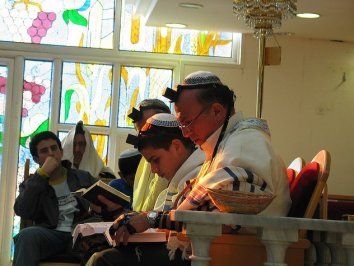
jews_praying_togetherThat’s why community is important to faith. If the world is your community, almost the entire population is going to continually challenge what you believe as a Christian. If Jews are the majority population, it’s the same thing. To some degree, faith requires that you stop listening to the world around you except for your community of “like-minded believers.” You have to ignore the atheists and if you are specifically a Judaically-aware Christian, you have to ignore Jewish anti-missionaries who define Judaism as wholly inconsistent with Jesus in any form.

The irony, besides converting to Judaism, is that the only other place for the Christian to go is back to church. Well, that’s ironic for me, anyway.

“Quitters are losers!”

This is frequently true, but not always. Of course it’s a mistake to quit prematurely. But at times, quitters will be winners since they devote their newfound time, money, and energy on a project that seems more likely to succeed.

Weigh the entire picture to figure out your best course of action. But don’t let fear of quitting lead you in the wrong direction.

-Rabbi Zelig Pliskin
“Daily Lift #668, Quitters can be Winners”
Aish.com

I can see why Pastors discourage the members of their churches from exploring Judaism. I can see why Rabbis are totally against Jews marrying non-Jews. The collision of worlds is just devastating. But when you’re intermarried, you have no choice but to be part of the mix. There is no place you can hide, no community that can shelter you. Each day is lived at the raw edge, running on a razor blade, trying to keep your balance, hoping you won’t fall, praying you can keep your balance.

sitting-on-a-razor-bladeBut each moment on the edge is cutting and there’s blood everywhere. Falling off seems like it would be so peaceful. But no one can help me with that kind of decision.

I am going in the way of all the land (all mankind), and you shall strengthen yourself and be a man.

I Kings 2:2

These were the last words of King David to his son and successor, Solomon. David is essentially saying, “I am no longer able to struggle. My strength is failing, and I must now go in the way of all humans. But you are young and vigorous. You must be strong and be a man.” Implied in this message is that Solomon was to be strong enough not to go in the way of all men, but to be his own man.

Being a non-conformist is not virtuous in itself. Behaving in a manner similar to others in our environment is not wrong, as long as we know that our behavior is right and proper. In this case, we are acting according to our conscience. What is wrong is when we abdicate our right to think, judge, and decide for ourselves. It is easy for us to allow ourselves to be dragged along by the opinions and decisions of others, and thereby fail to act according to our conscience.

The expression “I am going in the way of all mankind” does more than euphemize death; it actually defines spiritual death. It states that true life exists only when we actively determine our behavior. A totally passive existence, in which the body is active but the mind is not, may be considered life in a physical sense, but in a spiritual sense it is closer to death.

No wonder the Talmud states that “wrongdoers are considered dead even during their lifetime” (Berachos 18b). Failure to exercise our spiritual capacities and instead relegating the mind to a state of passivity, allowing our physical and social impulses to dominate our lives, is in reality death.

Today I shall…

try to engage my mind to reflect on what I do, and think things through for myself rather than submitting to a herd mentality.

-Rabbi Abraham J. Twerski
“Growing Each Day, Tevet 2”
Aish.com

If there is an answer for my life, it rests with God and hopefully, as Rabbi Twerski suggests, with me. No group, Christian or Jewish, has the answers I seek. They are within themselves and of themselves and united as completely compatible units inside their containers. They are not me, and I am not like anything I’m supposed to belong to, not the church, and not even my family.


19 Days: Church in the Short Run

symmes_chapel_churchI have seen so much good come out of the church I am in. Depending on how far you want to stretch the idiom, I have seen “the blind see, the lame walk, the lepers are cured, the deaf hear, the dead are raised to life, and the Good News is being preached to the poor.”

Have people left? Yes. Have people gotten hurt? Yes. Welcome to communal life…

Several families come here now that used to be part of tiny Hebrew Roots congregations. No one has found that they had to compromise their level of observance to go to church here. We don’t even really stand out all that much. Anything we wanted to do – starting chavurot, starting Torah study groups, keeping Sabbath and dietary laws, whatever – we could do and still come here and live under the umbrella of Christianity. Sunday worship? Of course. Come on, Shacharis is every morning. It’s not like you can take a day off.

-Pastor Jacob Fronczak
“Why I Go to Church”
Hope Abbey

I decided that I needed to review Jacob’s blog post, almost a year old now, to help bolster my own commitment (which, if you read yesterday’s extra meditation, you know is flagging). It helped, but only a little. Jacob was already well-integrated into his church and into the church culture in general as he developed a “Hebraic awareness” (for lack of a better term). I still feel like a fish out of water, desperately searching for a pond, a tide pool, or even a wee bucket of the wet stuff to hop into for the sake of survival.

After originally reading Jacob’s blog post, I responded with one of my own called Why I Don’t Go To Church. Obviously, a few things have changed since I wrote it. Of course, when I wrote my blog post last January, one of my primary concerns about returning to the church was “supersessionism.”

I admit to living with a certain amount of apprehension that if I ever started attending a church again, someone, a Pastor or Bible Teacher or just one of the parishioners, would spout off something about the church replacing Jews. Then I’d feel my blood pressure rise along with my temper, and I’d either just walk out, or I tell that person what I thought of their ill-considered “theology” (and then walk out or be thrown out).

Not that it would really be their fault. After all, the church has been teaching supersessionism as Biblical “fact” ever since the days of the early Gentile “church fathers.” That still doesn’t make it right nor does it mean I have to tolerate a way of understanding the New Testament that requires Judaism and every living, breathing Jew (including my wife and three children) to be deleted from religious, spiritual, and historical significance, not to mention permanently removing them from God’s love and, in at least a historical sense, removing the Jews from their very lives.

But none of that has happened. I haven’t encountered a single statement denigrating Judaism or Jewish people. I think some people are a little fuzzy on whether or not there’ll be a third Temple, and one gentleman made some statements regarding the specific clothing worn by Orthodox Jews and praying at the Kotel as “putting God in a box,” but by and large, active anti-Jewish and anti-Israel attitudes never appeared.

Jacob mentioned some of the concerns people have had that have resulted in them leaving the church.

I understand that a lot of Hebrew Roots people have had bad experiences in church. I have had a lot of bad experiences in church. Yet I had most of them before I became a Hebrew Roots person. When you get into a community with other living breathing people you will eventually encounter conflict and you will have to learn to deal with it.

Have people left? Yes. Have people gotten hurt? Yes. Welcome to communal life…

I had some unpleasant experiences in the first church I attended as a Christian, but that was some time ago. There were also a lot of really nice folks who attended that church at that time. However, that church isn’t the church I attend now, so my past experiences really don’t apply. I’ve heard all kinds of stories about the “bad stuff” that’s happened to some people in some churches, but it really depends on the people and the churches involved and after all, as Jacob says, communal life isn’t always a bowl of cherries.

mens-service-jewish-synagogueThat goes for synagogue life, and life in just about any group of religious people or just people in general. Your religious tradition or whatever variant movement you are attached to probably won’t see much of a difference. The fellow I had coffee with last Sunday afternoon and his wife have been “burned” by “the church” before, but they’ve been attending a church in our community for the past four years with apparently good results. The people at their church seem to be everything I’d ever want in and expect out of Christians as far as generosity, kindness, and “tzedakah.” The church community can be very good.

More recently, I’ve been vocal about the good the church does in the environment around us and in the entire world. It’s not so much the church that’s at issue, it’s just being “me” in church and trying to get used to the church venue and context.

I still feel purposeless, useless, and aimless at church. I don’t look forward to simply attending the service and then sitting in Sunday school for an hour before going back home. It’s not that I am concerned about “not getting fed,” which seems to be a complaint I’ve heard from other Christians about other churches over the years, it’s about lack of connectedness. I’ve gone back to church to try to fulfill a Biblical (Hebrews 10:25) or Christian expectation for community, it would be nice to actually have some “community.”

In his defense of the church, Jacob wrote:

God forbid that I should disparage the Internet as a means of communication; the irony would be a bit sickening. But realistically, all the activity out here is nothing – nothing! – compared to what is going on in real churches, with real people talking face to face. Real, honest dialogue with other people who bear God’s image and are trying just as hard as we are to understand and interpret the Bible.

The Internet is an amazing way to communicate information. However it is of extremely limited value in building relationships, real relationships with trust and accountability and blood and tears and the things that make us human. And it is in the context of these relationships that people change, minds change, spiritual growth happens.

Apparently, that is yet to come and the potential for that sort of relationship and dialogue is just about the only thing that’s keeping me where I am for the moment. I keep expecting someone to kick me out because I don’t celebrate Christmas (and fortunately, no one has asked what I’m doing for Christmas yet) or because I’m not doing something besides occupying space (make a suggestion…I’ll probably do it). I also keep wondering what will happen if they don’t.

Maybe, as my friend says, in a year, things will be different, perhaps even dramatically different and in a positive way. I hope so. In the short run, it’s hard to look forward to church each Sunday. It isn’t bad. But it could be a lot better.

21 Days: An Island Within an Island

waiting-in-the-antechamberAnother church report. I have to admit, this morning (as I write this), I dreaded going to church. I was afraid of what I’d find when I got there. Well, not during services since they’re rather predictable, but Sunday school. But first things first. The sermon was on Acts 8:1-8.

And Saul approved of his execution.

And there arose on that day a great persecution against the church in Jerusalem, and they were all scattered throughout the regions of Judea and Samaria, except the apostles. Devout men buried Stephen and made great lamentation over him. But Saul was ravaging the church, and entering house after house, he dragged off men and women and committed them to prison.

Now those who were scattered went about preaching the word. Philip went down to the city of Samaria and proclaimed to them the Christ. And the crowds with one accord paid attention to what was being said by Philip when they heard him and saw the signs that he did. For unclean spirits, crying out with a loud voice, came out of many who had them, and many who were paralyzed or lame were healed. So there was much joy in that city.

And so begins the great persecution of the church and the spreading of the Good News outside of Jerusalem and Judea to Samaria and eventually to the rest of the world. Pastor used these verses as a platform to encourage his audience (the people in church listening to the sermon) to preach the Good News ourselves in our environment. Since he had previously been a missionary and is the son of missionaries, he also suggested we shouldn’t consider a foreign mission trip outside of the realm of possibility for us.

I found out something interesting, at least I think I did. Pastor made it a point to say that there wasn’t a priority necessarily for the Good News to first be preached in Jerusalem, then in Judea, then in Samaria, and then in the diaspora, but rather those who were scattered preached the Gospel wherever they went. I guess a lot of Christians look at this passage and figure that you are first to preach the Gospel in your own community, which somehow translates into having no desire to go to foreign places and do God’s work there. Pastor emphasized that there are many spiritual problems in the U.S. and a great need for the Word to be spread here, but we have lots and lots of churches. There are places where there is no access to the Word of God whatsoever and those are the places that need evangelists and missionaries.

Listening to Pastor, I realized that I didn’t know how some Christians looked at the Bible at all and what they thought it was supposed to be telling them. I had no idea that this part of Acts could be interpreted relative to whether or not it encourages Christians to do missionary work.

Of course, I also encountered a significant bias toward missionary work in foreign lands, both in terms of preaching the Word and helping with physical needs, but I don’t think there’s anything wrong with that. It’s just the emphasis of the Pastor and of the church (they use a significant portion of their resources to support missionaries).

The theme continued in Sunday school. A couple who were visiting the class had spent decades as missionaries in the Congo. Interestingly, the wife had grown up there (her parents were also missionaries) and her husband had spent the last 25 years or so with her in the Congo. They told us that whatever we do or don’t see on the news isn’t like what is actually happening. Another fellow, who had just returned from Turkey (not as a missionary..his job just takes him there) said he had met a “war photographer” on the return flight who showed him his work. The photographer said that 95% of this photos would never make it into the media because Americans don’t want to know what’s really happening in the world (I tend to believe that’s the perception of a censored and biased press, but he’s probably right). There’s a lot of persecution of Christian missionaries in Muslim countries that the Western press never, ever talks about, even though there’s amble information and evidence, such as the photos in that war photographer’s camera.

walking-alone-on-frozen-lake1I was listening to all of this as an outside observer. I really didn’t have anything to contribute to the conversation and at those moments when I was tempted, I wrote in my notes “bite your tongue.” I know that missionaries living and working in the “foreign mission field” really do live in a different world from mine, but just being in that class felt like a different world too. I was sitting in class reflecting on my experience of being at church and realized that people were starting to get used to me being around. I knew that when I realized that fewer people were greeting me. A few people said “hi” but it wasn’t with the same frequency and intensity. I guess they’re probably saying, “the ball is in your court.” In other words, what am I going to do to become a member of this community?

I have no idea.

As I was going out the door to go to church, my wife said, “Have fun.” I wasn’t anticipating having fun and when she asked me why I was going, I blurted out something about a sense of obligation…that I had a responsibility to be “in community.” I go to church because I feel obligated to go, not because I get a lot of “pizzazz” out of it. I suppose I shouldn’t expect a lot of pizzazz. I managed to get through singing the Christmas hymns and listened to Pastor’s sermon which often is the highlight of my church experience. What’s “fun” or “pizzazz” got to do with it?

Charlie, the leader of the class I attend, announced that he would be leaving class at the end of December. I guess he doesn’t feel well, but I’d have to be able to read between the lines to understand more. He asked for people to volunteer to take over leading the class and if no one did, the class would disband. So one of my very tenuous holds in church, this class, is probably going “bye-bye.” There are a number of other adult classes being offered so I suppose I could attend one of them, but do I want to and what would be the point?

A Russian congregation had been using the church building for their services on Sunday afternoons but Charlie mentioned that they had disbanded last week. There are about thirty or so Russian-type congregations in the Boise area and I used to know some of the folks involved (they occasionally attended the One Law group where I used to worship). Charlie mentioned that whatever bond had held the Russians together (and they had been persecuted for their faith in their own land) had dissolved and it made me realize that “bonding” to the people at this church is a real struggle. In listening to different people in the class talk, I found out that many of these people had known each other for decades, sometimes back into childhood, and that many had an unbroken Christian faith also going back that far.

That’s one of the reasons I’ve found it difficult to “bond” with religious people in general…my being a “Johnny-come-lately” as far as my faith. In some ways, sitting there in that Sunday school class, I felt like I had just become a Christian and outside of that knowledge, was completely disconnected from whatever else it means to be a Christian. I also discovered that those people feel disconnected and isolated too, but in this case, it’s because of “rampant sin in the world” that the world “dresses up” sin to look acceptable, and the world wants the rest of us to accept it, too (they were probably talking about recent changes in the laws in some states allowing gay marriages).

A life of faith is isolating and in visiting this church it’s like I’m an island visiting a somewhat larger island. While I feel I’ve reasonably resolved my personal uncertainty about remaining online, at least here in the blogosphere, remaining at church past my deadline is still a big, fat question mark. The people and groups in the church who feel alienated from the larger culture have each other in their community, but I’m a stranger in their very strange land. You can’t get to know people at church between the service, the singing, the prayers, the sermon, the Sunday school class discussion, but I don’t know how to form connections to take it to a more meaningful level.

alone-at-churchIt wouldn’t be any different in other church and it wouldn’t be any different in a synagogue or other social setting. When my wife and I first started a church experience many years ago, we already knew some of the other families attending, so we had a way “in.” I don’t know how to do that here and I don’t know that I should. On the other hand, I’m afraid of simply giving up too soon, especially if (and I know this will sound “churchy”) God has some sort of plan for me to continue here.

I feel like a person who has been handed an anonymous note telling him to enter a room and introduce himself to the stranger he discovers inside. There’s no context, no reason, no apparent purpose to the encounter and only a minimal and mysterious set of instructions that act as guide.

Will there be church after the next three weeks? I don’t know. If there is, then I can’t imagine what I’ll be doing there. If it’s where God wants me to be, then I guess I’ll go to services, go to Sunday school, and remain a tiny island visiting a larger island for about three hours every Sunday. I’ll follow the instructions on the note, enter the room, introduce myself to the person I find inside, and then we can both wonder what we’re supposed to do next.

Reality Check: After writing all of the above, I had coffee on Sunday afternoon with a friend who has been at his current church for four years. He’s been a believer for most of his life (we’re about the same age) and he’s been through many different churches and movements over the course of a life of faith. He told me it will take at least a year for me to feel any sort of integration into church at all. A year?

36 Days: Backing Away from the High Dive

For the most part they were willing to support the state and to partake of the cultural bounty of the Hellenistic world, but they were unwilling to surrender their identity. They wished to “belong” but at the same time to remain distinct.

Shaye J.D. Cohen
Chapter 2: Jews and Gentiles
Social: Jews and Gentiles, pg 37
from the book
From the Maccabees to the Mishnah, 2nd Ed

This statement of Cohen’s describing the early diaspora Jews who were living in Greek society also reminds me of some halachically, ethnically, and cultural Jews who have come to faith in Yeshua (Jesus) as Messiah and who “belong” to the “body of believers,” “but at the same time (wish) to remain distinct” as Jews. Not an easy task, considering how both mainstream Christianity and the Christian Hebrew Roots offshoot movement want to “equalize” the Jews by making them like the rest of the Gentile community (in the former case, by making all Jews give up their Jewish religious and cultural practices, and in the latter case, by requiring all Gentiles take up Jewish religious and cultural practices).

But that’s not the main thing I want to talk about right now.

I had a most interesting dream last night. It went something like this:

I was sitting in a chair in some sort of waiting area at church with a bunch of other people. I think we were waiting to get into the Sanctuary so services could begin. I was looking through a notebook where I was trying to sort out some sort of theological puzzle. I had lots of notes written in pencil from the day before. I thought I had pretty well figured out what the answer was, but a fellow who knew what I was working on said I got it all wrong. I tried to explain my point of view, but I couldn’t find the right words.

As we were talking, another man approached me. I was still sitting down and had to look up at him. He wanted to invite me to a different Sunday school class than the one I had been attending and asked if I had a “Jesus of Nazareth Bible,” whatever that is. I looked in my right hand and was embarrassed to discover that I was holding the Jewish New Testament Commentary by David H. Stern, which I knew would never be accepted in a traditional Christian Bible study (and I thought I had given up Stern’s works many years ago).

The book was filled with a lot of loose pieces of paper that contained many of my notes. I guess it was good enough for him (though he seemed displeased), because the man told me to stand up and follow him. I looked down and discovered I was barefoot. By my feet were a pair of socks and the sandals I use to put something on my feet when I want to step out on my back patio for a few minutes (not exactly appropriate for church).

That’s when I woke up. My daughter has to be at work at 5 a.m. on Sundays, so I have to get up fairly early to drive her there.

That’s also when I knew I wouldn’t go to church today. It’s been a really active holiday week and weekend and I feel like I need just a little bit of space for a while.

But I can’t go back to sleep and I’m too tired to do much else, so I decided to write. I haven’t actually written anything for days since my family has been visiting, so I feel a little like an animal that has spent too much time in a cramped kennel. The gate has been opened and I’m able to run around in the park again. Feels good, but I wish my brain wasn’t full of cotton candy and iron filings.

In order to maintain their distinctiveness and identity, most Jews of the ancient world sought to separate themselves from their gentile neighbors. In the cities of the East, they formed their own autonomous ethnic communities, each with its own officers, institutions, and regulations. Some cities, notably Alexandria and Rome, had neighborhoods inhabited mostly by Jews. (These were not “ghettos” but “ethnic neighborhoods.”) Following the lead of Ezra, the Jews of the Second Temple period grew more and more intolerant of marriages with foreigners.

-Cohen, “Social: Jews and Gentiles”

I’ve written before that I’ve suspected the schism between Christianity and Judaism occurred fairly early, perhaps within a hundred years or less of the beginning of Paul’s “mission to the Gentiles.” But my opinion has been rudely ridiculed by members of the Hebrew Roots movement who are heavily invested in the notion that early Gentile and Jewish “Christians” were completely equal and uniform members of a single religious movement following Jesus of Nazareth, with the Gentiles adopting all of the Jewish cultural and religious practices.

But according to Cohen, particularly the Jews in the diaspora (where Paul was doing much of his work bringing the good news of the Messiah to the Gentiles) were still strongly driven to maintain their ethnic, cultural, and national identity as Jews. Thus, even the Jews who were involved in that early sect of Judaism called “the Way” were unlikely to surrender their unique identity to a non-Jewish population. In fact, the problem of how to integrate the non-Jewish people groups into a Jewish movement must have seemed an almost insurmountable task, both for the leaders of the Way (the Jerusalem Council) and for the Gentiles who were attracted to this form of Judaism. This is probably why the Acts 15 letter limited the requirements of Gentile disciples to just a few of the mitzvot.

The response of the Gentiles receiving the letter confirms that they neither needed or wanted to actually convert to Judaism (although there was an effort among other Jews to convert Gentiles to Judaism) and were overjoyed to become disciples of “the Christ” without having to be Jewish.

So when they were sent off, they went down to Antioch, and having gathered the congregation together, they delivered the letter. And when they had read it, they rejoiced because of its encouragement. And Judas and Silas, who were themselves prophets, encouraged and strengthened the brothers with many words.

Acts 15:30-32 (ESV)

Cohen comments that Judaism wasn’t something that was thought to be easily accessed, and that even the Gentiles respected its exclusiveness:

Even those Greeks and Romans who despised Judaism respected its exclusiveness as an ancestral usage that the Jews themselves were not free to change.

Immediately following the above-quoted sentence, Cohen makes a statement that seems to also confirm those Christians (non-Jewish followers of the Way) who adopted some of the Jewish practices were treated remarkably different by the Roman authorities than their Jewish counterparts.

The Christians, too, were accused of atheism, and since they could not defend their refusal by appeal to ancestral custom, they were persecuted.

I want to write more about what all this means in terms of Jewish and Christian relationships today, especially relative to Messianic Judaism and Hebrew Roots, but my main emphasis for this “meditation” is my own issues in “integration,” specifically into the church.

While my parents were visiting for Thanksgiving, my mother and I talked about this issue (she’s been trying to encourage me in going to church). She mentioned that she had been born and raised in a Lutheran family and for most of her life, she didn’t really think much about what that meant. She worshiped as a Lutheran because that’s what she had always done. She married and raised two sons as a devout Lutheran, but even after we grew up and left home, and even after she and my Dad retired and relocated to Utah, she still didn’t think much about what being a Lutheran meant.

Then, when my Dad and Mom moved to Kanab and they had to look for a church (not too many Lutherans in that part of Southwestern Utah), she got involved in different groups and started to study the Bible and consider what her faith meant, particularly in the area of religious community. The same thing happened as they got older and moved from Kanab to St. George. Mom and Dad had to visit a number of churches and attend just about every service and activity the church had to begin to discover if they “fit in.” In part, through that process, their faith and understanding grew. To become part of something, you have to dive in all the way and only when you’re drowning in it, do you find out if you are part of it and it is part of you.

Unlike the Jewish people of ancient or modern times, I don’t have a distinct cultural, ethnic, and faith identity that defines who I am in terms of God. But church is a culture and an identity and to belong to church, that’s an identity I have to adopt. To adopt it, I have to be part of it in every sense of the word, not just popping in for a few hours on Sunday morning.

Frankly, I hate the idea, primarily because I hate having to change my behavior patterns that much. Like most people, I’m a creature of habit. I go to work at the same time each morning and I come home at the same time each evening. I have my routine and my comfortable activities. Being part of a community, especially if you’re trying to “break in,” means changing all that; it means change.

I hate change.

But what happens if I don’t change?

Spiritual slumps are a natural part of spiritual growth. There is a cycle that people go through when at times they feel closer to God and at times more distant. In the words of the Kabbalists, it is “two steps forward and one step back.” So although you feel you are slipping, know that this is a natural process. The main thing is to look at your overall progress (over months or years) and be able to see how far you’ve come!

This is actually God’s ingenious way of motivating us further. The sages compare this to teaching a baby how to walk. When the parent is holding on, the baby shrieks with delight and is under the illusion that he knows how to walk. Yet suddenly, when the parent lets go, the child panics, wobbles and may even fall.

At such times when we feel spiritually “down,” that is often because God is letting go, giving us the great gift of independence. In some ways, these are the times when we can actually grow the most. For if we can move ourselves just a little bit forward, we truly acquire a level of sanctity that is ours forever.

Here is a practical tool to help pull you out of the doldrums. The Sefer HaChinuch speaks about a great principle in spiritual growth: “The external awakens the internal.” This means that although we may not experience immediate feelings of closeness to God, eventually, by continuing to conduct ourselves in such a manner, this physical behavior will have an impact on our spiritual selves and will help us succeed. (A similar idea is discussed by psychologists who say: “Smile and you will feel happy.”)

That is the power of Torah commandments. Even if we may not feel like giving charity or praying at this particular moment, by having a “mitzvah” obligation to do so, we are in a framework to become inspired. At that point we can infuse that act of charity or prayer with all the meaning and lift it can provide. But if we’d wait until being inspired, we might be waiting a very long time.

“Spiritual Slump”
Ask the Rabbi
Aish.com

stop-timeThis metaphor doesn’t completely apply to me since I’m not Jewish and don’t have the same spiritual relationship to the Torah as a Jew. One of the things I regret about Christianity is that is eliminated the structure of the mitzvot for the “freedom” of grace. More’s the pity.

Part of me wants the next five weeks or so to zip by so that January 1st will roll around and I can completely and finally spiritually “slump,” thus avoiding change altogether. Then I just pull the plug on most of my Internet presence, step out of the blogosphere, and then what happens to me is between me and God, with no accountability to or commentary by other human beings (and no one in the family is going to care if I go to church or not apart from my Mom).

However, as I’ve been reminded, self-improvement seems to be an expectation of God.

The Chazon Ish (20th century Israel) described the level a person is potentially capable of attaining if he has a long term goal for self-improvement: “If a person constantly strives to improve his character traits, it is possible he will eventually reach a level that he no longer gets angry, will not feel hatred or resentment, will not take revenge nor bear a grudge, will not have ambitions of seeking honor, and will not desire mundane pleasures.”

Today, view every person you find difficult as your partner in character development. View every encounter as an opportunity to develop your positive qualities.

-Rabbi Zelig Pliskin
“Our Potential for Self-Improvement”
Daily Lift #645
Aish.com

I keep wondering if Jewish philosophy can ever be applied to a Christian, but a recent blog post quoting Max Lucado reminded me why I prefer Jewish writings over Christian commentaries:

If God had a refrigerator, your picture would be on it.

If He had a wallet, your photo would be in it.

He sends you flowers every spring.

He sends you a sunrise every morning.

Face it, friend – He is crazy about you!

God didn’t promise days without pain, laughter without sorrow, sun without rain; but He did promise strength for the day, comfort for the tears, and light for the way.

I’m sure Lucado is a wonderful human being, but reading his stuff for more than a few seconds gives me the same type of headache I get between my eyes as the last time I swallowed a mouthful of cotton candy.

I’m taking the day off of church. I think I’ll even take a nap now since the sky is finally getting lighter and I woke up at around 3:30 a.m. (It’s coming up on eight as I write this)

I much prefer Jewish teachings and wisdom, but Judaism isn’t my identity. As a disciple of Jesus, I’m considered a Christian, but so far, the thought of jumping into the deep end of the “church swimming pool” doesn’t seem appealing. I’ll sleep on it, read the church bulletin online later on today, and see if there’s some sort of class or activity I can take a dip into later on in the week.

Maybe.

41 Days: Still Processing Sunday

“Our fathers had the tent of witness in the wilderness, just as he who spoke to Moses directed him to make it, according to the pattern that he had seen. Our fathers in turn brought it in with Joshua when they dispossessed the nations that God drove out before our fathers. So it was until the days of David, who found favor in the sight of God and asked to find a dwelling place for the God of Jacob. But it was Solomon who built a house for him. Yet the Most High does not dwell in houses made by hands, as the prophet says,

“‘Heaven is my throne,
and the earth is my footstool.
What kind of house will you build for me, says the Lord,
or what is the place of my rest?
Did not my hand make all these things?’”

Acts 7:44-50 (ESV)

Conclusions from Pastor Randy’s sermon on Acts 7:44-53:

  1. Israel’s history is one long story of their stubborn, rebellious tendency to reject God’s gracious dealings with them.
  2. Israel’s history has been characterized by limiting worship to a sacred placed, rather than a sacred person.
  3. We must take great care that we are not guilty of the same things!
  4. We should faithfully imitate Stephen’s bold witness, rather than have undue concern for our own safety or protection.

I don’t know. For the most part, what Pastor Randy said about this portion of Stephen’s defense before the Sanhedrin was supportive of the Tabernacle and the later Temples, including the idea that Ezekiel’s temple is literal and not figurative, and will someday exist in Jerusalem.

On the other hand, I’m bothered by the “either/or” concept of “Israel’s history has been characterized by limiting worship to a sacred placed, rather than a sacred person.” I think it would be valid to say that there were times in Israel’s history when they were faithless and even when offering sacrifices in the Temple, did so only to pay “lip service” to the commandments, while their hearts were far from God. But I don’t think that Israel’s temple service was always without value. Point 2 above seems to imply that rather than the Temple, the Jewish people should always have been focused on the Messiah, but didn’t God command Israel to build the Tabernacle? Didn’t the Shekhinah inhabit first the Tabernacle (Exodus 40:34-38) and later Solomon’s Temple (1 Kings 8:10-12)?

Did Jesus replace the Temple? But then Pastor believes Ezekiel’s Temple will be built, so can he believe that?

The title of the sermon was something like “Putting God in a Box.” I think the idea was that it’s a bad thing to put limits on God in any sense, but I never really got the impression that throughout the history of the Jewish people, anyone actually thought God was confined to the interior of the Mishkan (Tabernacle) or Temple. The Divine Presence, what most Christian Bibles translate as “the Glory of God,” was understood as a manifestation of God’s Presence without being perceived as anything like His totality. This is where understanding a little bit about Jewish mysticism and concepts such as the Ein Sof and Shekhinah would be helpful.

In Sunday school class, I did hear one gentlemen using examples of the specific type of clothing worn by Orthodox Jews and praying at the “wailing wall” (Kotel) as illustrations of Jews “putting God in a box.” It was one of the few times during class that I didn’t speak up, mainly because it would have taken too long to try to explain why those practices aren’t necessarily bad things (for Jews, anyway).

I was also a little disturbed about where I would lead such conversation if I allowed it to go down the predictable path. At the beginning of services, Pastor Randy reminded everyone that he would be leading a tour of Israel this coming spring and that “affordable prices” for airline tickets needed to be purchased by the end of this month. He was extremely supportive of Israel’s efforts in defending itself during the current crisis, and said that we should not let ourselves be put off in planning to visit in the spring because of what is happening right now.

As he went through the slide show of where the tour group would be visiting, the last place is to be Jerusalem, including stopping at the Kotel. How was I supposed to tell this fellow in Sunday school that when I saw the slides of the old city, that I have always desired to offer prayers to God at the Kotel? What would he say? How much more trouble would I stir up than I already had?

I know I don’t fit in to a Jewish community. I’m not Jewish and I’m not going act in such a way that pretends otherwise. But while I say that I’m a Christian because it’s the closest approximation of an accurate description of my faith, I don’t believe a Jewish devotion to the House of Prayer that God Himself requested and required of the Jewish people is a vain and empty effort, even relative to the person and power of the Jewish Messiah King.

And I don’t believe that Jews who choose to observe the mitzvot by a certain way of dress, or who honor their Creator by praying at the Kotel is “putting God in a box.”

Am I just looking for excuses for not going back to church? Maybe. I’ve already concluded that this particular church is about the closest I’ll ever come to finding what I’m looking for within the Christian world. If I blow it here, I’ve blown it completely. I knew I’d never find perfection, but then, what did I expect?

I just don’t know if I can agree with how Stephen’s defense is being interpreted. More from last Sunday’s study notes:

  1. They had accused him of reviling the Holy Place; He accused them of resisting the Holy Spirit. (vs 51)
  2. They had accused him of belittling the Law; He accused them of breaking the Law. (vs. 52a)
  3. They had accused him of making light of Moses, the man of God; He accused them of murdering Jesus, the Messiah of God. (vs. 52a-53)

Granted, Stephen was limiting his accusation to the Sanhedrin (as opposed to leveling it toward all Jews everywhere) in turning the accusations around to apply them to his accusers, but did he not defend the Temple, the Law, and Moses as well as the Messiah?

What am I doing here?

For the most part they were willing to support the state and to partake of the cultural bounty of the Hellenistic world, but they were unwilling to surrender their identity. They wished to “belong” but at the same time to remain distinct. Support for the state was not to be confused with the abnegation of nationalist dreams. Hellenization was not to be confused with assimilation. This tension is also evident in the social relations between Jews and gentiles.

-Shane J.D. Cohen
Chapter 2: Jews and Gentiles
Social: Jews and Gentiles, pg 37
From the Maccabees to the Mishnah, Second Edition

That’s not really describing me, but when I read this paragraph from Cohen’s book, I couldn’t help but think of my attempts at “belonging” in my current church context. However, at the same time do I want to remain distinct? Distinct as what?

I’ve described both Judaism and Christianity as cultures in addition to “faiths” (for lack of a better word). Judaism is notoriously difficult to define since it is a nation, a people, a faith, a culture, and an ethnicity, all rolled into one thing. Worse than that, Judaism encompasses multiple cultural and ethnic elements as well as variations on religious practices, but at its core, Jews will always be part of a single nation; Israel, because God has so ordained it.

By comparison, what is Christianity? It is primarily a religion, but it encompasses many “Christianities” and it has many different cultural and theological expressions. In the middle of all that, what identity do I have among them, and of what they teach, how much can I believe?