Tag Archives: Judaism

Broken Religious Community: The Flip Side to Hope and Chanukah

I’ve outgrown the furrowed-browed warnings of a sky that is perpetually falling.
I’ve outgrown the snarling brimstone preaching that brokers in damnation.
I’ve outgrown the vile war rhetoric that continually demands an encroaching enemy.
I’ve outgrown the expectation that my faith is the sole property of a political party.
I’ve outgrown violent bigotry and xenophobia disguised as Biblical obedience.
I’ve outgrown God wrapped in a flag and soaked in rabid nationalism.
I’ve outgrown the incessant attacks on the Gay, Muslim, and Atheist communities.
I’ve outgrown theology as a hammer always looking for a nail.
I’ve outgrown the cramped, creaky, rusting box that God never belonged in anyway.

Most of all though, I’ve outgrown something that simply no longer feels like love, something I no longer see much of Jesus in.

John Pavlovitz
“My Emancipation From American Christianity”
John Pavlovitz: Stuff That Needs To Be Said

At today’s meeting of the Cincinnati City Council law and public safety committee, Council Member Chris Seelbach “will propose an ordinance that would impose a $200-a-day fine on a therapist or counselor practicing the therapy that aims to “change” lesbians, gay men, bisexuals or transgender people from their sexual orientation or gender identity,” according to Cincinnati.com.

According to the article it will likely be a done deal on Wednesday of this week. Seelbach is confident that he has the necessary votes both to make it out of committee tonight and to pass it as law on Wednesday. Although a few states have passed similar laws, no major city has done so, and Cincinnati.com is exultant in claiming that Cincinnati is leading the way in such wickedness.

Why “wickedness”? Because this law is nothing less than a denial of the biblical doctrine of sanctification, threatening fines of $73,000 per year to a counselor that uses 1 Corinthians 6:9-11 to help those caught in sin: “Or do you not know that the unrighteous will not inherit the kingdom of God? Do not be deceived; neither fornicators, nor idolaters, nor adulterers, nor effeminate, nor homosexuals, nor thieves, nor the covetous, nor drunkards, nor revilers, nor swindlers, will inherit the kingdom of God. Such were some of you; but you were washed, but you were sanctified, but you were justified in the name of the Lord Jesus Christ and in the Spirit of our God.” (1 Corinthians 6:9-11).

Joseph Bayly
“Providing biblical counsel to homosexual youth soon illegal in Cincy…”
(originally titled “Quoting Bible illegal in Cincinnati starting this Wednesday…”)
Christ Church
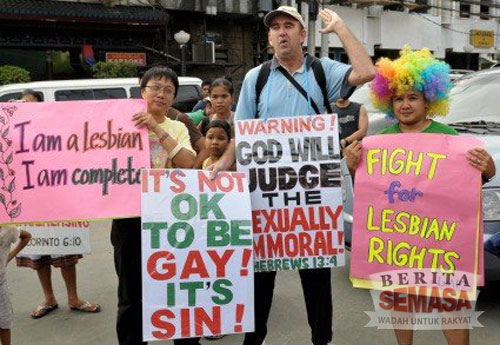
christians-vs-gaysThese two Pastors represent the opposite end of the scale along the single topic of homosexuality, specifically as applied to the presence of representatives of the LGBTQ community in the Church.

I’ve written my opinions about Pastor Pavlovitz before, particularly about the absence of the requirement of repentance, which was Jesus’s (Rav Yeshua’s) central message, relative to what he has “outgrown,” so I won’t belabor my points regarding his opinions.

As far as Pastor Bayly is concerned, he wildly misrepresents the pending law he objects to so strongly. You can click on the link to his blog post (and in my quoting him, I included a link to his source material so you can acquire further context) to see the specifics, but in short, The City of Cincinnati has proposed a law that would make it a crime for mental health professionals (religious or otherwise) to provide conversion therapy, also called “reparative therapy” or any other therapeutic model designed to change a person’s sexual orientation or gender identity, to anyone under the age of 18 (it would not be illegal to offer such therapy to adults).

Pastor Bayly states that the law specifically forbids Christian counselors from quoting the Bible, as if that’s the law’s main thrust. However, according to the news article he’s citing:

Passage apparently would make Cincinnati the first major U.S. city to ban reparative or conversion therapy. The Movement Advancement Project, an LGBT organization in Denver that tracks legislation nationwide on reparative therapy, has no record of a city passing an ordinance that would ban the practice.

And the reason Cincinnati is making such a move is because:

Nearly a year after the death by suicide of local transgender teenager Leelah Alcorn, Cincinnati again stands to become a national leader in LGBT rights, with debate scheduled Monday on a measure that would ban reparative or conversion therapy for LGBT youth.

The law, as far as I can tell, does not make it illegal to offer conversion therapy to anyone age 18 or older and does not, in general, make it illegal for Christian counselors to quote from the Bible. If it passes, it would make it illegal to offer or apply conversion therapy to anyone under the age of 18 (and presumably identifying as part of the LGBTQ community). Also as far as I can tell, there are already ethical standards in place in the various psychiatric, psychological, social work, and counseling bodies that provide state licensing for mental health professionals designed to inhibit or forbid the use of conversion therapy, so in addition to professional censure for unethical behavior (including possible lose of licensing), a therapist can also be fined by the city for violating the proposed law.

conversion therapy
Photo: soc.ucsb.edu

I’m not writing all this to complain about what Cincinnati is proposing, about the matter of the use or lack of use of conversion therapy, or to support or oppose the LGBTQ community. I’m writing this because both Pastor Pavlovitz and Pastor Bayly, from my point of view, seem to be paying more attention to their personal priorities than they are to the issues at hand, and particularly, the teaching of our Rav.

I’ve already mentioned that I’ve commented at length regarding Pastor Pavlovitz. And in response to my comment to Pastor Bayly on his blog, he stated:

“Except that, again, it has nothing to do with quoting the Bible or scripture. It has everything to do with the use of a particular type of psychotherapy”

Wrong. I changed the title, but you are just wrong about what the law says. It doesn’t limit it to a particular type of psychotherapy. Here is the applicable text from the law, which I finally have:

““Conversion therapy” means any treatment that aims to change sexual orientation from homosexual to heterosexual or to convert an individual who identifies with a gender other than the gender assigned at birth to the originally assigned gender.”

So tell me again, would a counselor be able to quote that verse?

He’s focusing on using Bible quotes during the course of conversion therapy with minors rather than on the fact that if the law passes, he wouldn’t be able to legally offer such a therapeutic model to minor children in the first place. He changed the original title of his blog post since I had pointed out it was misleading (and I wasn’t the only one), but he didn’t seem to “get it”. He can provide multiple counseling techniques to treat a wide variety of emotional and mental disorders. He can even quote the Bible in doing so. He can even offer conversion therapy. He just can’t offer it to minors.

A commentator on Bayly’s blog post had this to say to me:

Well James, I guess you seem to think that a Christian is to follow every law that is contrary to the written Word of God. I guess Peter and John thought differently and spent time in jail telling the “law makers” that they would obey God rather then man.

Actually, depending on how you interpret the Apostle Paul (Rav Shaul), maybe we should obey civil law:

Every person is to be in subjection to the governing authorities. For there is no authority except from God, and those which exist are established by God. Therefore whoever resists authority has opposed the ordinance of God; and they who have opposed will receive condemnation upon themselves.

Romans 13:1-2 (NASB)

justiceI know that New Testament scholar Mark Nanos interprets this passage as specifically directing non-Jewish believers in synagogues to obey the authority of the synagogue leaders, but more widely, the passage is understood as a directive for believers to be compliant with the laws of the nations in which we live.

Of course, this is problematic under specific circumstances. Consider those Christians who concealed Jews from their Nazi executioners during the Holocaust. The matter of obeying or disobeying civil and penal codes is certainly complex, though I don’t think it gives us license to break any law we feel like just because.

However, the person I quoted above was comparing apples and oranges.

When they had brought them, they stood them before the Council. The high priest questioned them, saying, “We gave you strict orders not to continue teaching in this name, and yet, you have filled Jerusalem with your teaching and intend to bring this man’s blood upon us.” But Peter and the apostles answered, “We must obey God rather than men.”

Acts 5:27-29

Peter wasn’t flaunting civil law in a diaspora nation or rebelling against the Roman Empire, he was engaging in a disagreement on whether or not to accept the revelation of the coming of Messiah in Rav Yeshua with Jewish religious authorities in Jerusalem. Further, the priesthood was compromised in those days and not truly representative, in many cases, of the authority of Hashem. He wasn’t issuing a blanket statement that gives modern Christians the right to disobey any law if we believe it violates the imperatives of our faith. Christian counselors can’t simply kidnap teenage gay people and compel them to admit their sin of homosexual sex, then repent, receive forgiveness, and live happily ever after.

I know that Pastor Bayly and his supporters feel their rights are being trod upon by this particular law, and that they are being inhibited from following Biblical instructions, specifically those issued in 1 Corinthians 6:9-11, however, when he misrepresents the nature of his objections, as he did with the original blog title as well as in parts of his content, and then continues to support that misrepresentation when it is pointed out to him, he not only damages the credibility of Christians and their/our faith to the general public, he desecrates the Name of Hashem (my opinion, of course).

Adding all this up, both Pastor Pavlovitz and Pastor Bayly, who together represent a large number if not the vast majority of churches in America, drive me nuts. This is largely the reason that I stopped attending a local church and have no interest in formal Christian community (I do have other reasons, though).

But it doesn’t stop there:

For this, he is subject to a very harsh bio in the Jewish Telegraph Agency, as if Thalasinos himself were the murderer, rather than the victim. The post attracted a host of hostile comments from Orthodox Jews against the very concept of a Messianic Jew, trying to argue we are all fraudsters. Meanwhile, Jewish-born Messianic Jews are pointing out that Thalasinos wasn’t born Jewish. Anti-missionary Bat Zion Susskind-Sacks wants to assure us that Thalasinos himself never claimed to be Jewish, and never claimed to convert.

-Dudi
“Let Nicholas Thalasinos’ family mourn in peace”
Rosh Pina Project

thalasinos
Photo: L.A. Times

A Chabad Rabbi states in the comments section of the Jewish Telegraph Agency (JTA) article:

So JTA is now faling for the missionary line? messianic Jew is a cover for “Christians trying to convert Jews to Christianity”. I have nobeef with christians, but if you believe in Jesus, you are a Christian, not a “Messianic Jew”. The fact that Jesus was Jewish is meaningless, so was Karl Marx and Meyer Lansky, and it does not bestow truth on their persona.

Further, some Jewish commentators on this blog post also spend a great deal of time lambasting Thalasinos for his faith and how he chose to express it.

For the record, I probably wouldn’t have agreed with at least some of Thalasinos’s beliefs, but the point is moot. The man is dead. He was murdered in a terrorist attack that took the lives of 14 people. As the folks over at the Rosh Pina Project state, let his family grieve in peace. How does it further the mission of God for human beings to repair our broken world by continuing, in our own various ways, to break it further?

Do you see why I have a problem with religious people, and why I have, for the most part, lost my faith in them?

If you happen to attend a church, synagogue, or other religious community that is filled with loving, caring people, and your Pastor or Rabbi isn’t crazy or misguided or fueled by his/her personal agenda disguised as “sound doctrine,” then I’m happy for you. But it makes my skin crawl to imagine myself sitting in a pew in either Pastor Pavlovitz’s and Pastor Bayly’s church, or for that matter, being a Gentile in that particular Chabad Rabbi’s synagogue, and being judged because I don’t conform to their particular interpretation of the intent and purpose God has for human beings, both Jews and non-Jews.

Which is why I would never enter those churches and why I’ve accepted I have no place in Jewish community either.

My wife and daughter attended the local Chabad Chanukah menorah lighting at the statehouse last night. My wife and daughter are Jewish and I’m glad they went. They’re Jewish. They need to be in Jewish community. I wasn’t invited, which is fine, even though I’m sure there were a lot of non-Jews present for the event (this is Idaho…there are only about 1,500 Jews in the entire state). There are just some places I don’t belong.

After they got home and lit our own little hanukkiyah (both of them, actually), I found myself staring at my computer monitor and pondering all of this. I have a lot of reasons for not being part of religious community, and I’ve written about them at length in various blog posts, but now I have another reason. A lot of religious communities and their leaders are either plain nuts, disingenuous, misguided, or have some sort of ax to grind, usually from the pulpit and/or in the blogosphere.

Granted, there is no such thing as a perfect congregation where everyone loves each other and even the disenfranchised outliers such as myself are tolerated if not accepted and given a voice. I know that.

abandoned churchBut it’s not a matter of religious community just being imperfect. A lot of them can be downright arrogant and even hostile given the provocation.

I used to think I could go to church and even be a small part of healing the rift between current Christian doctrine on things like Judaism and the Torah and how I understand God’s plan of redemption for Israel, even though I was afraid of church at the same time.

I was wrong.

I suppose it’s mainly my problem, since the churches and other institutions I’ve mentioned don’t seem to have a problem with themselves. I’ll never be a good Christian if it means espousing specific moral, social, and political viewpoints.

Many/most religious communities aren’t just imperfect, they’re broken. I only hope Messiah comes back in time to heal at least some of us.

End rant.

Living With God Everyday

What we are talking about here is developing Messianic Jewish Household Spirituality. At Intefaithfulness we are doing this through an initiative called HaB’er (“The Well”). As resources of time, finances, and personnel allow, we will be providing materials, instruction and encouragement to Jewish and Intermarried households who recognize the priority of developing “The Three-Stranded Cord” of ever-deepening engagement with Jewish life, Yeshua-faith, and with God’s Presence. Our mission statement is “Living well at home in Jewish life with the Messiah.”

-Rabbi Stuart Dauermann
“Toward a New Solution to Current Problems in the Messianic Jewish Religious World”
Interfaithfulness.org

In Christianity, the main location for worship and prayer is the Church. In Judaism, it’s the home. Rabbi Dauermann points out in his article that, for Yeshua-believing Jews, whether they are in the Church or in the Messianic Jewish synagogue, they were “shaped” by American evangelicalism and thus, tend to be institution-oriented rather than home-oriented as are other religious Jews.

I’m not writing to comment on Jewish religious praxis, whether in the Messianic arena or otherwise. I’m here to write about the rest of us.

Actually, I can’t count myself as one of the Gentiles I want to discuss since, for a lot of reasons, the “practice” of my faith in the home is affected by the presence of my Jewish wife and children, none of whom are “Messianic”.

But I think the points Rabbi Dauermann brings up about the Messianic Jewish movement could be adapted to Jesus-following non-Jews, whether we call ourselves Christians, believers, “Messianic Gentiles,” or anything else.

churchFor a lot of us, our faith consists of going to church on Sunday, which includes the worship service, the sermon, and Sunday school. Then, if we’re really ambitious, there are programs, usually offered on Wednesday evening, in which we can participate.

But what about the rest of the time? What about our day-to-day lives?

In this, I think particularly an Orthodox or perhaps Conservative Jew might have an advantage.

Oh, Christians wouldn’t consider it such. I recall being in a Sunday school class a few years ago and hearing the teacher remark how we are so fortunate not to be “under the law” anymore (not that we ever were), and having been freed by the grace of Jesus Christ.

But free to do what? Play a few holes of golf after leaving church services and going out to lunch? How many Christians even say grace before eating if they’re in a public place?

Jewish practice may seem cumbersome to many non-Jews, but it has the advantage of continually reminding the Jewish person that God is always present. If you wear a kippah in acknowledgement of God being above you, your awareness is a persistent as your apparel.

Add to this all of the blessings to be said on a wide variety of occasions. If you were raised in an observant Jewish home, you started learning this practice in childhood, but for a Jew who was raised secular and became religious as an adult, there is probably something of a learning curve. Nevertheless, the message seems to be that a Jew is always obligated to acknowledge God in everything.

An observant Jewish life doesn’t occur just on certain days of the week or only between the hours of such and thus, it occurs from the moment you wake up until you go to bed at night.

Modeh AniAbout the only thing I’ve allowed myself to carry over from my past is reciting the Modeh Ani (in English) when I discover I’m awake in the morning and about to get out of bed. It’s a basic confirmation that I owe each day of my life to God.

The day-to-day religious practice of a Christian or otherwise religious non-Jew is not well-defined. We don’t have the rich history of tradition of the Jewish people to draw upon. Sure, some non-Jews have chosen to adapt bits and pieces of those traditions in their lives, but we don’t share Jewish history and, in most cases, Jewish community, so it seems at least a bit out-of-place.

I should say at this point that I’ve met Christians who have fully-realized and completely integrated lives of faith. Every thought and action is directed to the service of Christ and to people around them. However, I wouldn’t consider this a very common practice, more’s the pity.

But returning to practical praxis, among the very first non-Jewish Yeshua-followers who had learned from Jewish mentors, such as the Apostle Paul, their day-by-day behavior probably looked pretty “Jewish,” since it was the only model they had available, but nearly twenty centuries have passed and that connection has long since been lost.

Some congregations and other collections of Jews and Gentiles who are devoted to Yeshua as Messiah are attempting to reinvent that relationship, but it’s pretty inconsistent. I think I recently mentioned how fragmented the body of Messiah happens to be, and I don’t see it becoming any more unified in the near future.

But regardless of our religious orientation and our access to community of any kind, we still, as individuals, have a responsibility to not only maintain our awareness of the God above our heads day-by-day, hour-by-hour, but to act out of that awareness. For the non-Jewish believer, as I’ve already said, there isn’t a well-defined set of behaviors and traditions for us to draw upon. Nevertheless, we can do something. We just need to be more deliberate and maybe more creative about it.

followIf we are walking in the dust of the footsteps of our Rav, so to speak, what should we do?

“Then the King will say to those on His right, ‘Come, you who are blessed of My Father, inherit the kingdom prepared for you from the foundation of the world. For I was hungry, and you gave Me something to eat; I was thirsty, and you gave Me something to drink; I was a stranger, and you invited Me in; naked, and you clothed Me; I was sick, and you visited Me; I was in prison, and you came to Me.’ Then the righteous will answer Him, ‘Lord, when did we see You hungry, and feed You, or thirsty, and give You something to drink? And when did we see You a stranger, and invite You in, or naked, and clothe You? When did we see You sick, or in prison, and come to You?’ The King will answer and say to them, ‘Truly I say to you, to the extent that you did it to one of these brothers of Mine, even the least of them, you did it to Me.’”

Matthew 25:34-40 (NASB)

Do kindness everyday. No, you don’t have to save the world every hour on the hour, but you can take advantage of your opportunities, even in very tiny ways. Pick up a bit of litter and throw it in the trash. Hold the door open for someone. At this time of year, there are plenty of people ringing bells in front of stores taking in donations. Drop your loose change into the bucket. The next time someone cuts you off in traffic, instead of getting mad at them or competing with them on the road, let them have their way. Maybe they have a really good reason for being in a hurry.

A few days ago, I came across a news story about a homeless Jesus statue that is being erected in numerous communities. The concept and application are controversial, and while I agree that $40,000 per statue could be better spent actually sheltering the homeless, feeding them, and clothing them, the symbolism invoked, for me, the quote from Matthew 25.

homeless Jesus
Photo: Kelly Wilkinson / The Star

Jesus is already homeless, and poor, and hungry, and needy. He is because we have homeless, poor, hungry, and needy people in our communities. If we wish to serve our Rav and to “do what Jesus would do,” then the Bible makes it abundantly clear how to respond.

But what about this?

If the world of Messianic Jewish believers is to be established, sustained, renewed and passed on from generation to generation, the efforts of religious school, seminary and congregation will fail unless we begin at the center: the home. It is for this reason that Jewish religious discourse terms the home a Mikdash M’at, a little holy sanctuary. This is the center. This is the microcosm from which blessing proceeds to the macrocosm of life, and socially, this is the seed from which the Kingdom of God will grow in the Messianic Jewish context, or not. Similarly, we find in Scripture that it is at the center, the Holy of Holies, where holiness is most concentrated and from which it radiates out into the community of the people of God and to the wider world. Think of the design of the tabernacle in the wilderness and each of the First and Second Temples, each termed a “Beit Mikdash.” In Jewish life the home, the mikdash m’at, is the Holy of Holies from which spiritual identity and vitality radiates out into the world and daily life. Apart from this center, all is empty religious noise and clamor, gongs and cymbals, and too often, as we will admit if we are honest, smoke and mirrors.

This is how Rabbi Dauermann ended his essay, with a plea to re-establish Messianic Jewish homes as Jewish homes, making them the “Holy of Holies.”

I’m not sure how this is done in non-Jewish homes. I’ve known a few Christians who make a little “altar” in their homes, putting a cross, a Bible, and other religious objects on a table to be the center of family prayer.

I’m not particularly keen on building “altars,” but the idea of family prayer and family Bible study time seems to be a good start.

Moon and StarsI don’t have any practical suggestions beyond what I just mentioned, and as I’ve already said, this isn’t an option for me personally, but if somehow it were possible to treat our own homes as sacred places, to realize that God dwells among us as we eat dinner, watch TV, help our kids with their homework, read our Bibles, read anything else, surf the web, answer text messages, then maybe, just maybe we’d act differently in our own homes…and everyplace else.

A little bit of light pushes away a lot of darkness.

-Jewish proverb

Can Messianic Judaism Directly Reach Out To Atheists?

An atheist cannot find God for the same reason a thief cannot find a policeman.

-Anonymous

Before anyone becomes upset, I am not saying that atheists are thieves. The quote simply means that an atheist cannot find God, not only because he/she isn’t looking for Him, but also because they are actively avoiding Him, just like a thief would avoid a law enforcement officer.

But it’s an interesting comparison, because if a cop did find a thief in the act of committing a crime, the thief would be “busted.” Once the thief saw the police officer and knew he/she couldn’t get away, they’d be facing the consequences for their actions.

arrestWhat happens when God “catches” an atheist? Well, this is where the metaphor starts to break down, because while God is aware of all human actions, we humans (and this is certainly true of atheists) aren’t always aware of God. Thus, although God sees our “crimes” (and any human action that opposes the will of God is the short definition of “sin,” which is analogous to “crime” in this example), we don’t see him “catching” us.

Rabbi Kalman Packouz posted the above-quoted sentence on this week’s Shabbat Shalom Weekly online column. He also said this:

Recently a friend of mine asked me, “Do you really believe in God?” When I answered “for sure” his response was “really?” Personally, I don’t find it particularly hard to believe that a rabbi believes in God. However, he seemed to be amazed that anyone believes in God.

In our experience at Aish HaTorah (a major international Jewish educational outreach organization), if you ask the young people who come through the doors of our world center in Jerusalem if they believe in God, four out of five will say “no.” What’s fascinating is that if you don’t ask the question directly, it’s possible to demonstrate to them that they do believe in God. Why? They are influenced by the society, the educational system and their friends to think that they don’t believe in God.

Do you want to demonstrate to someone that deep down they not only believe in God, but that they believe that God loves them? Here are the questions to ask…

I highly encourage you to click the link I provided above and read all of Rabbi Packouz’s discussion on how to illuminate anyone (or at least any secular Jew) to investigate their lack of belief in God. It’s really quite interesting (an equally enthralling question is if R. Packouz’s “method” were applied to non-Jews, would they become Noahides?). I’m not sure how it would play out for the rest of us, but on the surface, his arguments are compelling.

He finishes up his column with the following:

How can one intelligently deal with the question of the existence of God? Start on Aish.com and search the articles on “God” and “Evidence of God”. Go to AishAudio.com (search “evidence”) and listen to the four lectures “Evidence of God’s Existence” by Rav Noah Weinberg (the founder and head of Aish HaTorah and my teacher). Also, I highly recommend Permission to Believe by Lawrence Kelemen available at your local Jewish bookstore, at JudaicaEnterprises.com or by calling toll-free to 877-758-3242.

chabad
Credit: jewishvenice.org

I’m actually considering buying the Kelemen book (I’ve checked and it’s not available through my local library system), since it would be interesting to see how religious Jews reach out to secular Jews (besides the methods employed by Chabad).

It occurs to me that there’s a vacuum of this sort of information relative to Messianic Judaism.

Oh sure, Christianity’s efforts to evangelize the world are quite well known. If a traditional Christian wanted to know how to reach out to secular people in his/her community, all that person would have to do is approach their Pastor. I’m sure churches give classes on this sort of thing, and I know churches periodically organize their parishioners to canvas their local neighborhoods, knocking on doors, and handing out pamphlets.

But what does Messianic Judaism (and I’m using the term in the widest possible way) do to attract new members and to share their perspective on the “good news of Messiah?”

Just about anyone I’ve ever encountered, either within a Messianic Jewish (MJ) or Hebrew Roots (HR) environment, came to those venues by way of the Christian church. That is, whether they were Jew or Gentile, they first became a Christian and attended one or more churches before something happened to take them away from a particularly Christian viewpoint, and shifting them to a more Judaicly-aware perspective.

Oh, there may have been one or two exceptions, but I feel pretty confident, even based on anecdotal evidence, that most people, Jew and Gentile alike, come to a Judaic interpretation of all of the Bible, including the Apostolic Scriptures, only after converting to Christianity. I’m not saying that to be insulting. It just seems to best reflect the reality of how people come to the MJ or HR movements.

Of all of the resources available online and in brick-and-mortar stores, I can’t think of even one single book, audio, or video that teaches people like me how to share the message of Rav Yeshua (Jesus Christ) specifically from a Messianic Jewish perspective.

You may be wondering why some slight adaptation of traditional Christian evangelical methods couldn’t be used. However, Christians and religious Jews see the Bible, God, and faith in fundamentally different ways (Christians tend to be internally based, with their faith hinging on personal beliefs, while Jews tend to be externally based, with their faith being acted out through performance of the mitzvot). Messianic Judaism isn’t just Christianity wearing a kippah. It’s a Judaism that acknowledges the revelation of the Messiah as illustrated in the Apostolic Scriptures, and one that has an unusually liberal policy on Gentile admission.

With all that said, is it even possible to share a Messianic Jewish view of our Rav and what the Bible is saying about him and redemption directly with an atheist, or must Christianity and the Church always be the first step?

encounterActually some time ago, I thought I’d found one such resource. It was either a book or a lecture (or lecture series) on audio CD, but a Google search does nothing to find it. Maybe I was mistaken, or maybe whatever it was has leaked out of my memory for good.

Christians have a well-honed machine for evangelizing as many people as it can reach, and at least some corners of Orthodox Judaism understand how to communicate their faith to secular Jews, but what does Messianic Judaism bring to the table? Instead of appealing to Christians in churches to take a Messianic look at the Bible, at their faith, at their Christ, can they reach out to people who do not have faith at all?

Christians can (which is how I came to faith in the first place). Jews can (and I know of more than one religious Jew who started out as a secular adult, and then became religious). What about Messianic Judaism?

Where Would Noahides Go If There Were No Synagogues?

Messiah’s community is a single community expressed in diverse forms within the Jewish community and among the nations. All are called to a dedicated life of worship, neighborly service, and public testimony to Yeshua. Unity and love throughout the entire community confirm Yeshua’s role, as the One sent by the Father, and God’s purpose in Messiah for Israel and the Nations. (John 17:20-21; Acts 21:20; Gal. 2:7-8)

-from the Union of Messianic Jewish Congregations (UMJC) Statement of Faith

I came across this link somewhat at random, and it reminded me of a question I wanted to ask the Internet.

Typically non-Jewish believers in Rav Yeshua (i.e. Christians) become aware of movements such as Messianic Judaism or Hebrew Roots through a sense of dissatisfaction with the Church, the feeling that something is missing. I remember having that sense early on in my “Christian walk”. My wife, who is Jewish, also felt something was lacking in our church experience, and when we encountered a local Hebrew Roots group (this was many years ago), she was immediately “hooked”.

It took me longer to get onboard, but eventually, as I started learning more, I began to realize that what the Bible actually said about the Jewish people, Judaism, and Israel wasn’t what was being preached and taught in most churches.

two pathsMy wife and I have since journeyed on separate trajectories relative to our faith and I respect her decision. She’s Jewish and she needs to be in Jewish community and to embrace Jewish identity.

My identity is less traditional and I’ve gone through a sometimes convoluted developmental process, finally arriving where I am today (though I don’t think God is finished with me yet).

Someone recently said (Don’t make me regret posting this link, Peter) that “Judaism is a communal faith and not designed to be practiced in isolation.” So is Christianity. The ideal is to find a like-minded community of fellow believers and to “fellowship” with them.

Over the years, I’ve transitioned between numerous communities, starting with a Nazarene church, then a Hebrew Roots/One Law congregation, then to a Bible study/home fellowship, then (eventually) back to Hebrew Roots, and most recently, I attended a Baptist Church for two years (and have since left). There were times in that history when our family was just alone in our faith, and times, including the present, when I am alone as an individual.

No, I’m not revisiting the idea of community for myself. As nearly as I can tell, that door is closed for more reasons than I can list in this brief blog post. However, it did occur to me that there are very few paths to community for someone, particularly a non-Jew, who generally believes in the tenets of faith as described by the UMJC (no, I’m not affiliated with them, and no I’m not specifically advocating for them — they just happen to be a handy example).

Even if there were a Messianic Jewish community in my area, and even if I felt I’d be welcome there, I probably wouldn’t attend out of respect for my wife’s sensitivities on the matter.

But what about other non-Jews who have my point of view?

cross and menorahThere are plenty of Gentile-only Hebrew Roots One Law/One Torah congregations out there of various sizes and configurations. Some have a few Jewish worshipers, but they almost always were not raised in a Jewish home nor had the benefit of growing up in Jewish social and religious community. Those Hebrew Roots groups are also almost always run by non-Jews, although their leaders may wear a tallit and kippah and even call themselves “Rabbi”.

But there are also a number of non-Jews who have a more “Messianic Jewish-like” perspective on the Bible, the centrality of Israel, the primacy of the Jewish Messiah King, and how all that relates to the people of the nations. A view I advocate here on my blog.

If they don’t live within reasonable distance of a Messianic Jewish congregation established and operated by Jews as a Jewish community which graciously also admits non-Jews, where do they go?

It would be like being a traditional Noahide and not having a nearby Jewish synagogue to attend. I know of intermarried couples who attend both our local Chabad and the Conservative/Reform group here in my area, and the non-Jewish spouses are Noahides in Jewish community, not unlike how I think of non-Jews in Messianic Jewish community.

But what if there were a group of Noahides who lived nowhere near a synagogue? What if they weren’t intermarried to Jewish spouses, but through some other process, came to the realization that being a Noahide was what the Bible required of them in order to worship Hashem?

Apply those questions to those of us who are “Judaicly-aware” non-Jewish disciples of Rav Yeshua. Where would such a group of Gentiles go to find worship and community? Could a group of Gentiles band together to practice something analogous to “Messianic Judaism?” What would you call it, “Messianic Gentilism?”

Orthodox JewsI was wondering if those organizations that generally call themselves “Messianic Judaism” (such as the aforementioned UMJC) have established any guidelines for non-Jews who want to come alongside them but who geographically are too far away from a Messianic Jewish congregation to attend. For that matter, that group of Gentiles may not even have a skilled teacher or leader among them. They probably could use a lot of assistance and guidance.

Although the community in ancient Antioch (Acts 13:1; 15:1-2), to the best of my understanding, had both Jewish and non-Jewish members, the Apostle Paul (Rav Sh’aul) also founded many Gentile-only communities, the one described in his epistle to the Galatians being the one that immediately comes to mind. Paul “kept tabs” on these various groups, when he couldn’t visit them, through his correspondence, but the vast majority of the time, for day-to-day operations, they were run by the local members.

What did a Gentile-only “Messianic” community look like in those days? We don’t really know. Probably they looked at least somewhat “Jewish,” if for no other reason than because that was the only communal model available to them.

But this is nearly two-thousand years later and a lot has changed. Yes, ultimately the Gentiles broke away from their Jewish base and invented Gentile-only (unless a Jew wanted to leave Judaism and convert) Christianity, which almost completely rewrote how the Bible was to be understood.

Judaism too has gone through a great deal of development, and what we think of as Rabbinic Judaism today (which, in my opinion, includes at least some Messianic Jewish groups) is not the same as the Judaism(s) practiced during the late Second Temple period.

rainbowSo theoretically, if a collection of “Noahide” Judaicly-aware non-Jews wanted to pursue a community consistent with how we think of Gentiles coming alongside their Messianic Jewish counterparts, is there anything or anyone they could contact to help them? What resources should they consult so they wouldn’t just be “shooting from the hip?”

And no, I’m not thinking of starting such a community here, but I’m thinking that this is an area where others like me in the world are underserved and, left on their own, are perhaps forming groups and fellowships that might be less than optimal. I think they could use some help. I’m just wondering if such help exists and if it is even possible to create viable, sustainable congregations of Gentiles who worship and live consistently with how Messianic Judaism envisions Gentiles in Messiah.

How Is The World Blessed By The Offspring of Abraham?

I was sitting in the airport in Dallas reading my daily page of the Talmud when an elderly priest, readily identifiable by his collar, stopped by my seat and asked me a question. “I hope you don’t mind my interrupting you. I see you are reading a Hebrew book and you are wearing a hat. Are you by any chance a Rabbi?”

When I responded that indeed I am, he continued, “I hope you don’t think I’m out of place but all my life I’ve been hoping that someday I might meet a Rabbi. You see, although I’m a priest I’ve always felt that Jews are the people of The Book and enjoy an especially close relationship with God. You are God’s chosen people and as a Rabbi you are one of their spiritual leaders. I’ve always wanted to ask a Rabbi for a blessing. Would it be possible now for me to ask that you honor me with that favor?”

I cannot convey in words how moved I was by that request. I gave him the priestly benediction from the Torah and recited it to him in the original Hebrew. He was moved to tears. In all humility, I understood that for him I was the link to the original Torah. Whatever theological beliefs might separate us – and there are surely many – he clearly recognized the unique role of Judaism, in the words of Isaiah, to serve as “a light unto the nations.” Jews are the direct descendants of Abraham, Isaac and Jacob, the nation that stood at the foot of Mount Sinai and received the Torah to transmit from generation to generation. Jews were “chosen” not to claim superiority but to accept the responsibility to convey God’s messages to the rest of mankind.

-Rabbi Benjamin Blech
“5 Greatest Gifts of Being a Jew”
Aish.com

birchas-kohanimThere may be some of you when reading the paragraphs above who will be taken aback by a Catholic Priest (or any Christian clergy) asking a Rabbi for a blessing. There may be others among you who will cringe at the idea that Rabbi Blech not only responded to the request by conferring a blessing, but that he used the Birkat Kohanim, the priestly blessing.

Historically, Judaism and Christianity have had a somewhat “uncomfortable” relationship (I say that using tremendous understatement) and at least vestiges of that remain in the modern era.

But I found the transaction between R. Blech and the Priest to be rather heartwarming. Nearly twenty centuries of enmity between Christians and Jews was simply swept aside, a Christian (a Catholic Priest no less) openly recognized the special and unique relationship a Jew has with God, and a Jew (a Rabbi no less) blessed not just a Goy, and not just a Christian, but a Catholic Priest, and was happy to do so.

In your seed all the nations of the earth shall be blessed, because you have obeyed My voice.

Genesis 22:18 (NASB)

Indeed, the offspring of Abraham, Isaac, and Jacob are to be a blessing to the people of the nations, and in R. Blech’s case, it became both fact and truth.

But then again, we have this:

Now the promises were spoken to Abraham and to his seed. He does not say, “And to seeds,” as referring to many, but rather to one, “And to your seed,” that is, Christ.

Galatians 3:16

From a Christian point of view, that blessing from the offspring (“seed”) of Abraham could be considered specifically issuing from one Jew, our Rav Yeshua (Jesus), as opposed to Jewish people in general. However, I don’t have a problem assigning multiple meanings and applications to the aforementioned blessing.

Rabbi Benjamin Blech

Drilling down into R. Blech’s quote, let’s take a look at the following:

Whatever theological beliefs might separate us – and there are surely many – he clearly recognized the unique role of Judaism, in the words of Isaiah, to serve as “a light unto the nations.” (emph mine)

A Catholic Priest, who, by definition, believes that Jesus Christ is the Jewish Messiah King who will redeem the world, also recognized that modern Jewish people, including and especially Rabbis, have a unique role to play relative to God and to humanity.

How much more should we “Judaicly-aware” disciples of our Rav also recognize that unique role of Jews in general and Jews who share our understanding of the revelation of Rav Yeshua in particular, whether we choose to call ourselves members of Hebrew Roots, “Messianic Gentiles,” or anything else?

In his article, R. Blech listed the 5 greatest gifts of being a Jew as:

  1. Our Unique Mission
  2. The Torah
  3. Progress
  4. Optimism
  5. The Gift of Others

Although the Torah does not apply to the rest of mankind, even the Gentile disciples of our Rav, in the same way it applies to Jewish people, it does define a general pattern of ethical and moral behavior along with the establishment of monotheism, the realization of One God, Hashem, Creator of Existence. Without the Jewish people and the Torah, there would not be such revelations, and certainly, there would be no plan of redemption for our world.

JerusalemUnder “Progress,” R. Blech cites Irishman Thomas Cahill’s book The Gifts of the Jews: How a Tribe of Desert Nomads Changed the Way Everyone Thinks and Feels to illustrate the impact of Jews and Judaism on the entire planet.

In it he credits the Jews not only for monotheism and the idea of a personal relationship with God; it is these concepts, he reminds us, that led us to the understanding that we have a personal responsibility for ourselves and our relations with our neighbors, as well as to our respect for history itself.

While the Church likes to think history began with the birth of Christ, in fact, while the coming of Rav Yeshua certainly was and is an apex in human history, everything in the Torah, the Prophets and the Writings had to occur to set the stage for our Rav’s entry, including the existence of Israel and the Jewish people.

Under “Optimism,” Blech states:

To be a Jew is to know that the world has not yet reached its divinely ordained end. God has a plan for us and eventually it will be fulfilled. No matter how long it takes, Jews remain the eternal optimists.

Golda Meir put it this way: “Jews cannot afford the luxury of pessimism.” Ben Gurion reminded us that in Israel “In order to be a realist, you must believe in miracles.” And Maimonides included the belief in messianic redemption at the end of days as one of the thirteen Cardinal principles of our faith.

jerusalem dayWe non-Jewish devotees also wait for the Messiah, though some of us have a radically different idea of what that means than most Jews. Social media has made it easy to complain about practically everything, and conservative Christians complain about everything from A to Z, which is why it would be helpful if we would learn optimism as Blech describes it.

Finally, under “The Gift of Others,” while R. Blech is describing the relationship Jews have with each other, we “Judaicly-aware” Goyim might want to set aside any “Torah-envy” we may experience ,and approach our Jewish brethren in Yeshua (as well as Jewish people in general) in the same manner as the Priest who approached Rabbi Blech in a Dallas airport as described at the top of this article.

At the very start of his write-up, R. Blech said:

Albert Einstein once startled an audience when he announced, “I’m sorry I was born a Jew.” The people were shocked. How could this great man make such an outlandish statement? With a smile, Einstein then impishly continued, “Because it deprived me of the privilege of choosing to be a Jew.”

As a tenth generation Rabbi, I did not choose to become a Jew; it was my natural birthright. But with the wisdom of age and the perspective of worldly experience I have come to recognize that my identity conferred precious divine gifts that we should never take for granted.

MessiahJews, whether religious or secular, are the only people who are born into a covenant relationship with God. The rest of us have to choose to become associated with God and arguably, we have no covenant relationship (long story…start reading this five-part review for the answer, or if you’re pressed for time, this short summary) apart from the Noahide Covenant God made with all living things in Genesis 9.

But we are allowed and even encouraged to choose God. We just need to remember that it was through the Jewish people, the nation of Israel, and the (Jewish) Moshiach that we are redeemed, not through the power of our choosing alone.

“You worship what you do not know; we worship what we know, for salvation is from the Jews.”

John 4:22

What Can Non-Jews Learn From Jewish Shabbos Observance?

Shabbat is a time to re-connect with family and friends, a time to bring sanctity and peace into our lives. But the real secret of Shabbat is that we can bring its gifts into the rest of the week. Here are seven lessons Shabbat can teach us that have the power to transform our weekdays.

-Sara Debbie Gutfreund
“No More Monday Blues”
Aish.com

mondayLike a lot of people who have a traditional Monday through Friday work week, I dislike Mondays. It’s tough readjusting from being able to sleep in and having a more relaxed day on Saturday and Sunday to waking up and driving to work while it’s still dark out. So I was intrigued when I read the title of Gutfreund’s article.

Then when I started reading the content, I was confused. How can you leverage Shabbat, a unique day in the Jewish seven-day week, to do away not only with “Monday blues,” but the frustrations of all of the days of the typical work week?

After all, observant Jews refrain from many activities on Shabbat that they freely partake of the other six days of the week. You can’t have Shabbat for the full seven days, can you?

You can click the link above to read Gutfreund’s short article and see how (or if) she makes her point, but the general idea is to take elements or principles from Shabbat observance and apply them to your day-to-day life (well, Jewish day-to-day life since she’s writing to a Jewish audience).

And while we non-Jews don’t have a specific commandment to observe Shabbat (at least in the manner of Jews, depending on how you interpret certain portions of Scripture), it may not be too much of a stretch to say that some of what Gutfreund’s article suggests might have more universal applications.

First things first: If Shabbat is a time to draw closer to our family and to God, we can still do that during the rest of the week, at least at specific moments. Even if we are too busy (travel for work for example), we can still keep the importance of family and God close to our hearts and realize they are the priority…they are why we are working in the first place, so we can devote our resources to them.

Elevate the physical: This is a rather contra-Christian perspective since the Church emphasizes the Spiritual and tends to minimize the physical. On the other hand, we live in a physical world and everything we need in a material sense, comes from the hand of God. We can choose to recognize the presence and provision of God in everything around us any day of the week.

shabbosShare with others: I suppose this should be a no-brainer and certainly not limited to a single day of the week.

Be in the moment: Pay attention to what’s really important in your environment on a moment-by-moment basis. This is pretty hard to do since, during work, you have responsibilities, some important, but others you just think are important. However, we can still take breaks in our routine to re-connect with the presence of God.

Gratitude: Again, this should be a no-brainer and it goes back to the realization that everything we have at any moment issues from the Almighty. How can we not be grateful daily?

Learning: While an observant Jew may have more time for Torah study during Shabbat, many Jews study on a daily basis, when they first get up, on their lunch hour, or in the evening. Since many Christians also understand the value of daily devotionals, this shouldn’t be difficult for religious non-Jews to grasp.

Unity: Of course Gutfreund means Jewish unity, which, as non-Jews, does not include us, but we can take these principles and apply them to a sense of unity we have with all disciples of Yeshua (Jesus). We can also recognize that we can stand in solidarity with Israel and the Jewish people, and particularly Messianic Jews, since we not only share these general principles with them, but also recognize the living revelation of our Rav and anticipate the return of Moshiach.

Some non-Jews in Messiah choose to observe or guard a Saturday Shabbat in one manner or another. While we, by definition, cannot actually fulfill the mitzvah of observing Shabbos the way a Jewish person can, it is still possible to perform many of the practices associated with Shabbat and allow a measure of rest and reconnection to penetrate our lives as well.

jewish prayer shabbosIf my wife observed Shabbat in a more traditional manner in our home, then I would as well, but as the Jewish member of our marriage, she would need to take the lead. I’m very pleased that on most Saturdays, she goes to shul, even though that’s not something she chooses to share with me. I’ve said before that one of the roles of non-Jews is to assist Jewish people in performing greater levels of observance. If my not sharing her worship with her frees her to have more affiliation with local Jewish community and to draw nearer to Hashem on Shabbos, then perhaps that’s a mitzvah that I, as a non-Jew, can uniquely fulfill.

Recently, the discussion on this blog post focused on methods of deriving mitzvot for non-Jews from the Apostolic Scriptures. I don’t know if we could find a commandment directing Gentiles to facilitate greater Torah observance in Jewish friends and family members, but I’m satisfied that I am performing a duty for my spouse in accordance with Hashem’s wishes for Jews to worship on Shabbos.