Tag Archives: Messiah Journal

Acts 15 and the Didache: A Brief Exploration

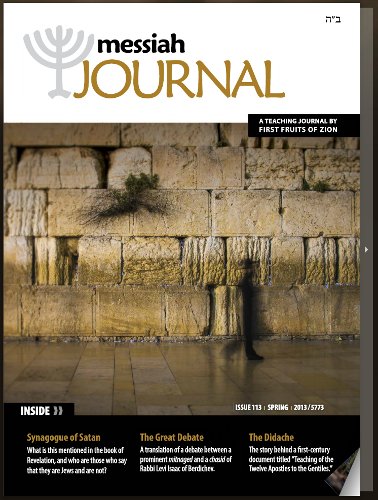
messiah-journal-113Tony Jones aptly calls the Didache “the most important book you’ve never heard of.” It offers an unparalleled look into the day-to-day community of the earliest disciples of Rabbi Yeshua. It is therefore an invaluable document for all students of the Jewish background of Christianity.

The title Didache means “teaching” and is taken from the first word of the book. The work is also known by the longer title, “Teaching of the Twelve Apostles” or the still longer “Teaching of the Lord to the Gentiles by the Twelve Apostles” which is the complete first line of the book.

-Toby Janicki
“The Didache: An Introduction”
from Messiah Journal issue 113, pg 42

I keep meaning to read the Didache, but there are so many other books around that it’s hard to find the bandwidth. Then I received an audio CD in the mail from First Fruits of Zion (FFOZ) that contained a recording of Toby reading his Didache article, published last spring in issue 113 of Messiah Journal.

My son, who is normally my commuting companion five days a week, took some time off of work, so one morning last week, I popped the CD into the player in my car and listened to Toby as I drove to my job. The recording was just the right length so that I could listen to everything Toby had to say from home to work. Then I discovered on the packaging that the content could also be found in text format in Messiah Journal. So here I am.

Most scholars generally agree that the Didache was written either in the location of Egypt, Syria, or Israel sometime between the late first to early second century. Some speculate it may have been written as early as 50 CE. This would mean that the Didache is actually older than the canonical Gospels and was written during the generation after the Master’s death.

-Janicki, pg 44

Admittedly, there’s a lot of guess-work about the Didache, who wrote it, when it was written, but generally it’s agreed that the intended audience was the newly-minted Gentile disciples of the Jewish Messiah, of Jesus. Toby paints a portrait of the Didache as a sort of “learner’s primer” presented to new Gentile disciples who needed some guidance into their day-to-day practices and responsibilities. Toby also makes a point that the style and simplicity of the text seems markedly Jewish and represents early Jewish religious instruction common in the late 1st century period.

The longest title of the Didache, “Teaching of the Lord to the Gentiles by the Twelve Apostles” would have us believe that the Didache contains instructions that were transmitted by the apostles through the halachic authority that was invested to them by the Master himself. While scholars debate which if any of these titles were originally used when the Didache was composed, this raises the question then of whether or not the Didache actually dates back to the original twelve apostles. Did the teaching of the Didache actually emerge from the oral halachah of the Jerusalem Council? The suggested early date of the compositions, coupled with their contents, makes this a high probability. Jonathan Draper writes, “The earlier the date for this text is pushed, the more likely it was associated from the beginning with, or even originated from, the twelve apostles in Jerusalem, as its title states.” As we will see, the Didache becomes a natural outgrowth of the Jerusalem Council’s rulings in Acts 15.

-ibid, pg 45

I’ve written a great deal on the impact of Acts 15 on Gentile believers in the late Second Temple period and beyond in my Return to Jerusalem series and other blog posts such as The Evidence of Acts 15. One of the criticisms leveled against the “Four Prohibitions” recorded by Luke in that chapter, is that they are woefully insufficient instructions for new Gentile disciples, especially relative to the vast compilation of mitzvot collected in the Torah of Moses and required for the Jewish people. It’s a common argument in parts of the Hebrew Roots movement supporting their belief that the full length of Torah commandments were intended to be observed by both Jewish and Gentile believers.

But what if…just what if the Didache represented the oral halachah that was to accompany the Jerusalem Letter to the Gentile disciples and that it “fleshed out” the letter’s contents.

So when they were sent away, they went down to Antioch; and having gathered the congregation together, they delivered the letter. When they had read it, they rejoiced because of its encouragement. Judas and Silas, also being prophets themselves, encouraged and strengthened the brethren with a lengthy message (emph. mine).

Acts 15:30-32 (NASB)

the-didacheIt’s very likely that there was a rather long and involved explanation about the contents of the letter delivered to the different communities of Gentile believers. Luke only hit the high points, so to speak, and didn’t write down literally everything Paul and the other Jewish apostles and disciples had to say by way of instruction to the Gentiles. What if the Didache was the written version of those instructions, at least to some degree?

No, I can’t say that it is or it isn’t. There’s a lot of mystery shrouding the Didache, and no one is able to make many definitive statements about it. However, Toby writes that it nearly was made Biblical canon and for various reasons, fell out of favor. Still, it is acknowledged that the Didache is an important written work in early Christianity, albeit obviously coming from a strong Jewish source.

Once I get the opportunity to read and study the Didache, I’ll revisit my suggestions and see if they at all seem credible. If they do, that still doesn’t mean Christians today should follow their instructions to the letter, but it may mean we already have a more complete set of documents advising us of the intent of the Apostolic Council in terms of the requirements for Gentile disciples in the body of Messiah. And remember, the Acts 15 letter wasn’t just the idea of human beings.

“Therefore we have sent Judas and Silas, who themselves will also report the same things by word of mouth. “For it seemed good to the Holy Spirit and to us to lay upon you no greater burden than these essentials… (emph mine)”

Acts 15:27-28 (NASB)

I can’t claim Divine inspiration for the Didache the way I can for canonized scripture, but it may represent an important and long absent link between the Acts 15 letter and how it was supposed to be lived out “on the ground,” so to speak, by the earliest Gentile disciples.

This may, in the end, also tell us something about who we are in Christ today.

Re’eh: Seeing to Learn

gerizim_ebalSee, this day I set before you blessing and curse: blessing, if you obey the commandments of the Lord your God that I enjoin upon you this day; and curse, if you do not obey the commandments of the Lord your God, but turn away from the path that I enjoin upon you this day and follow other gods, whom you have not experienced. When the Lord your God brings you into the land that you are about to enter and possess, you shall pronounce the blessing at Mount Gerizim and the curse at Mount Ebal.

Deuteronomy 11:26-29 (JPS Tanakh)

These words are spoken to the entire Nation of Israel, at the very end of a forty-year term in the desert. Two distinct mountains were on open display. Mount Grizim is plush, rich, and flowering with the promise of life. Mount Eivil in stark contrast is conspicuously barren and empty. This visual aid is employed to etch into the psyche of the assembled the lesson of remaining loyal to the task and mission of Torah and Mitzvos. In the recording of the event Moshe refers to that day as- “today”. What’s so special about that day? Every day he spoke was also a “today”. Why was that day worthy of a title for all time “today”?

The Ohr HaChaim answers that that day they were capable of understanding his lesson based on the statement of the sages, “A person does not stand on (truly grasp) the knowledge- opinion of his teacher until after forty years” (Avodah Zara 5B).

That means that now after forty years they can begin to truly comprehend what Moshe had told them back then. Why does it take forty years? Were these not brilliant people?

-Rabbi Label Lam
“See What Can Be Seen”
Commentary on Torah Portion Re’eh
Torah.org

Nearly a year and a half ago, I reviewed Toby Janicki’s article “The Gentile Believer’s Obligation to the Torah of Moses,” published in Messiah Journal #109/Winter 2012. I remember at the time being a little surprised at even the title, since my understanding back then was Messianic Judaism was striving for pretty much total isolation between Messianic Jewish and Christian/Messianic Gentile religious practice, at least publicly.

I happened to recall my review the other day when I noticed in the analytics for this blog that someone had viewed it.

I went through the original review and realized that my perspectives have changed in the last eighteen months or so. My fuzzy understanding of the Torah of Moses and its connection to the Gentile believers in Messiah is a little bit clearer. This isn’t to say I have everything “dialed,” so to speak, about the Bible and how it works, but I think it’s fair to say that I’m capable of learning and growing intellectually and spiritually.

While the quote from the Ohr HaChaim speaks to the necessity of the passage of time for learning, I’m not going to take it too literally (in forty years, I’ll either be nearly 100 years old or dead). But I am inspired to re-read Toby’s article and to re-review it as processed through the brain I have now vs. the one I had at the beginning of 2012 (I can only imagine that Toby will chuckle because I continue to wrestle with something he understands so clearly).

There has been a tremendous struggle between Messianic Judaism and Hebrew Roots relative to who “owns” the Torah. That’s an overly simplistic statement, of course, but the surface perception is that the Jews in Messiah get to keep the Torah for themselves while the Hebrew Roots people want them to share. On top of that, traditional Christianity says that we don’t need the Torah at all, just the grace of Jesus Christ.

Like I said, I’m being overly simplistic, so don’t take what I’ve just said too literally.

simhat-torahThe truth of the matter is that we all need the Torah. Even before the Christian Era, I believe that the Jewish people saw themselves as a “light to the nations” (Isaiah 49:6) and that we would all learn from the Torah as “the Law went forth from Zion.” (Isaiah 2:3). How does one learn the ethical, moral, and holiness standards of God apart from the Torah, the teachings of God? We don’t.

However, that concept has been misunderstood to mean (at least in certain circles), that we Christians must learn and observe every single mitzvot in the Torah (or at least the ones that can be observed without the existence of the Temple, the Priesthood, and the Sanhedrin) in exactly the same way as the Jewish people.

Acts 15 shoots that concept down in flames (I know this is debatable but then again, everything is) as I painstakingly chronicled in my review of D. Thomas Lancaster’s commentary on the matter, but Toby Janicki picks out of the ashes, the “phoenix” of Torah that applies to the non-Jewish believers.

And it’s a lot.

I don’t think we ever got a chance to really see the results of the Jerusalem Letter in action. We don’t see a detailed report in the New Testament of how those declarations were understood and practiced in early Christian congregations, the ones that would have existed during Paul’s lifetime and soon after. More’s the pity, because a document providing such details would answer a lot of questions and solve a lot of problems.

Once you rocket through history much past Paul’s death, the wedge between believing Jews and Gentiles was already being pounded into place, and by the time we get to the third and fourth centuries CE, we’ve been split apart and any recognizable form of “Torah practice” among non-Jewish believers had gone the way of the Dodo bird (I’m not quite sure how much help the Didache would be since it’s dated to the late first or early second centuries, but I guess I could buy a copy and find out).

What all this means is that you can expect my review of Toby’s 2012 article sometime next week. If anyone can suggest which copy of the Didache I should purchase from the list presented at the above-link, that would help, too.

In a way, I don’t really blame Hebrew Roots folks for finding the Torah beautiful, praiseworthy, and desirable in study and practice. I’m attracted to it as well. I really don’t understand Christian aversion to “the Law” as something horrible, and awful, and too terrible to even consider but then again, that’s what most churches teach. It isn’t that I think Christians should don tallitot and lay tefillin and try to look like Jews, far from it. But we should admit that we need the Torah for two basic reasons: The first is that it defines our relationship with Jesus and with God the Father through the Abrahamic covenant. The second is that every ethical, moral, and spiritual principle that we live by as Christians is found in the Torah. The Torah was taught by Jesus. Without an understanding of the Torah and the Prophets (and this should be huge in Christianity), we have no hope of understanding anything Jesus ever taught!

torah-what-isThat’s actually true of Paul and any of the other Apostles, so in my opinion, the first class that any newbie Christian should ever attend is Torah 101. Starting new Christians in the Gospels and the Epistles sounds nice but it’s almost next to useless. It’s like trying to teach a four-year old Calculus before they’ve even learned how to count to ten. It’s why I think First Fruits of Zion’s (FFOZ) Torah Club volumes are tremendously important. Not only do they teach Torah, but in a way that is very “Christian friendly.”

From all those who have taught me I have gained wisdom.

Psalms 119:99

The Psalmist is telling us that he learned from everyone, that everyone was his teacher. From some, he learned what to do; from others, what not to do.

If we learn from others’ mistakes, we need not make our own.

Just as we can learn from every person, we can learn from every event. Positive experiences are obvious sources of learning, because each positive act we do adds to our character and prepares us to better face the next challenge in life. Negative experiences can be valuable, too, but only if we are sufficiently alert to learn from them.

The list of lessons that we have learned the hard way may be long, but each one has taught us what not to do and thereby it becomes a positive experience. Indeed, the Talmud states that when people sincerely regret their mistakes and change themselves for the better, the wrongs that they did become actual merits (Yoma 86b). Only when we fail to learn from our mistakes and, rationalizing and justifying, obstinately insist that we were right, do our misdeeds remain deficits.

We have the capacity to make life itself a tremendous learning and growth experience.

Today I shall…

…try to look for lessons from everyone and everything, whether my teacher is positive or negative.

-Rabbi Abraham J. Twerski
“Growing Each Day, Kislev 17”
Aish.com

I don’t think the problem is dealing with positive vs. negative teachers but just with “unanticipated” teachers. For traditional Christians, I think Jewish teachers or teachers very familiar with the Jewish (especially Messianic) perspective on Torah and Messiah are important. Jewish teachers aren’t necessarily a problem for Hebrew Roots people, but often, Christian teachers are. Many people in Hebrew Roots no longer see themselves as affiliated with anything called “Christianity” and sometimes they even define themselves by a completely new religious identity in order to separate themselves from the “crimes of the church,” real and imagined. “The church” is something they’ve “come out of,” like a Jew might have escaped the Soviet Union in the 1960s or one “comes out of pagan Babylon,” a den of iniquity and sin.

Oy.

I’m hardly what you would call a traditional Christian, but I must say that I’ve learned a tremendous amount in my conversations with my Pastor. For Hebrew Roots folks, at least some of you, it might not hurt to find a Christian to connect to and even “embrace” on some level if, for no other reason, than to overcome what for davening_morningsome people I’ve personally met, is a phobic response to Christians and Christianity. Really, we’re not all that bad and in my time in church (in spite of my meditation of yesterday morning), I’ve met a few very kind, gentile, and Holy people.

Remember what Rabbi Twerski said about everyone being a teacher? That means Everyone, not just the people you are attracted to as teachers.

Whether you call yourself a Christian, a Hebrew Roots person, or something else, you…we all have a blessing and a curse set before us as well. We can accept the blessing and choose to learn the Torah as it was intended for us and to take upon ourselves teachers we never thought we’d share a classroom or corner of the blogosphere with, or we can choose to isolate ourselves in our own comfortable little silos, and learn only what we want to learn, which means in that case, very little and nothing new and illuminating.

It may take some time before it all begins to sink in. Like me, you might have to wait awhile and then rediscover something that didn’t quite make sense before but comes into crystal clarity now. That’s OK, too. Just as long as you’re willing to open your eyes and see what God has set before you this day.

Good Shabbos.

54 days.

The New Mitzvah of Christ, part 1

lovingkindness“What you dislike, do not do to your friend. That is the basis of the Torah. The rest is commentary; go and learn!”

-Shabbos 31a

“Love HaShem your God with all of your heart, with all of your soul, and with all your knowledge.” This is the greatest and first mitzvah. But the second is similar to it: “Love your fellow as yourself.” The entire Torah and the Prophets hang on these two mitzvot.

Matthew 22:37-40 (DHE Gospels)

The Shema (Deuteronomy 6:4-9) is above all else a commandment, a mitzvah that we are to obey. When Messiah Yeshua comments on the Shema, he joins it with another commandment to reveal deeper implications hidden within both…

As the greatest of the commandments, the Shema is tied to this second commandment, which “is similar to it: ‘Love your fellow as yourself'” (Leviticus 19:18). This linkage is integral to the Shema, because one cannot love God in the way that the Shema defines love without loving one’s neighbor.

As we have seen, we cannot reduce the love of God to a mystical or pietistic encounter; it must be acted out in a walk of obedience.

Rabbi Russ Resnik
“‘Shema:’ Living the Great Commandment,” pg 71
Messiah Journal, Issue 112
Published by First Fruits of Zion (FFOZ)

Yesterday (and actually before that in a more general sense), I was talking about love within the context of both the very famous words of the ancient sage Hillel and Yeshua’s (Jesus’) two greatest commandments. Of course, the Master was referencing the Shema, which every Jewish person will immediately recognize (I don’t know if the Shema was formalized in the late second Temple period, but certainly, the Messiah’s Jewish audience would have immediately recognized the source of his lesson). Rabbi Resnik is also addressing primarily a Jewish audience and more specifically Jews who are Messianic, but his article in Messiah Journal brings up questions involving Gentile Christians and the application of Torah. After all, we are disciples of Christ as well, and thus under his authority and teaching. But how far do the Master’s lessons to his Jewish followers extend to the disciples of the nations?

Yeshua’s second point is, “On these two commandments hang all the Torah and the Prophets.” This doesn’t mean that they render the rest of the Torah and the Prophets irrelevant, God forbid, but that they provide the framework for understanding, interpreting, and applying all of Torah and the words of the prophets. As Hillel says, “All the rest [of Torah] is commentary: now go learn it.” (b.Shabbat 31a). The two-fold commandment doesn’t supersede Torah. Rather, it provides the framework for the proper interpretation of the whole.

-Resnik, pg 73

Thus Rabbi Resnik dispenses with supersessionism, but he made me think of something else.

Therefore my judgment is that we should not trouble those of the Gentiles who turn to God, but should write to them to abstain from the things polluted by idols, and from sexual immorality, and from what has been strangled, and from blood. For from ancient generations Moses has had in every city those who proclaim him, for he is read every Sabbath in the synagogues.”

Acts 15:19-21 (ESV)

These are some of the most misunderstood words we find in the New Testament, at least by some variant Christian faith groups. The majority of Christian churches believe that the “Jerusalem letter” was a ruling of James and the Council of Apostles stating that the practice of the Torah mitzvot as applied to the Jewish people, should not also be imposed on the body of Gentile disciples, but rather only certain specific standards. However, verse 21 seems to indicate some sort of connection between the Council’s pronouncement to the Gentiles and Moses being proclaimed and the Torah being read every Sabbath in the synagogues.

Some suggest that James’ intent was that the Gentiles should learn Torah and learn to obey it in the identical manner of the Jews as an obligation. If we marry this idea back to Rabbi Resnik’s commentary on Christ’s two greatest commandments, it seems to fit, but then, I can hardly believe that the esteemed Rabbi meant to communicate that idea. But if he didn’t, what are he, and Jesus and James, saying?

One of the topics I’ve been discussing with Pastor Randy at my church is what “Torah” means within a Messianic context, and how (or if) Torah is applied to the non-Jewish disciples of the Master (i.e. Christians). It’s a difficult question to answer, especially if part of what you mean by “Torah” involves Talmud and how the rulings and opinions of the ancient Jewish sages are applied to the various normative Judaisms in our day.

Frankly, I believe that Christians should learn Torah. In fact, I believe that Christians do learn Torah. We just don’t call it that. We call it “Bible Study” or “Sunday School.”

What would the early Gentile Christians have learned by going to the synagogues and listening to the Torah portions being read every Shabbat?

They would have learned Torah.

Why?

And you, go to all the nations. Make disciples; immerse them for the name of the Father, and the Son, and the Holy Spirit, and teach them to keep all that I have commanded you.

Matthew 28:19-20 (DHE Gospels)

Again, especially using the Delitzsch translation, it certainly seems as if Jesus meant for the disciples of the nations to “keep” what he taught, if we can assume what he taught was “Torah,” and given his two greatest commandments, that is indeed what he was teaching.

Jewish_men_praying2But he wasn’t teaching his Jewish disciples to be Jews; they already knew about that…being Jewish as a lifestyle, was fully integrated into the Israeli Jewish existence. Religion in ancient times wasn’t separated from any other part of life, so to observe the mitzvot for a Jew was just part of normal living.

But then, what was Jesus teaching them that he also wanted to be taught to we Christians if not how to live as a Jew? What was being read in the synagogues every Shabbat that James wanted the Gentile disciples to hear? The Torah and the Prophets.

But if all Christians are supposed to learn and obey the Torah in the manner of the Jews, why did Paul say this?

Look: I, Paul, say to you that if you accept circumcision, Christ will be of no advantage to you. I testify again to every man who accepts circumcision that he is obligated to keep the whole law. You are severed from Christ, you who would be justified by the law; you have fallen away from grace.

Galatians 5:2-4 (ESV)

Paul is communicating to his Gentile Christian audience with a very simple “if/then” statement: If you accept circumcision (convert to Judaism), then you are obligated to keep the whole law (Torah). The implication is made obvious by turning the positive statement into a negative. If you do not convert to Judaism (remain a Gentile Christian), then you are not obligated to keep the whole law (Torah).

So far, as nearly as I can tell, Jesus and James wanted the Gentile disciples to learn the Torah but not be obligated to it in the manner of the Jewish people. But then why does Jesus in stating “the great commission” tell the Jewish disciples to “keep all that I have commanded you?” Something is missing. What were the Gentiles supposed to learn from the Torah by hearing it (and no doubt observing their Jewish mentors performing the mitzvot), and then what were they supposed to keep that Jesus taught?

I first want to mention that in Galatians, Paul is indeed saying that keeping the Law does not justify anyone before God, neither Jew nor Gentile. It is Christ who is our sole justification before the Father. A Jew observing the mitzvot isn’t justified simply by observing the mitzvot, and I’ve never heard a Messianic Jew say anything different. Nevertheless, Paul certainly expected Jews to be obligated to the Law, otherwise, he wouldn’t have said that righteous Gentile converts were also obligated. No, the application of the Sinai covenant was not done away with by Jesus or by Paul. However, we see that it wasn’t applied to the Gentiles, at least not in the way we see it applied to the Jews.

So how is there a difference between Torah being applied to Jewish and Gentile disciples of Jesus Christ? That’s where we’ll begin in part 2 of this two-part article.

Peace.

Intersection

Due to the sin of murder the Beis HaMikdash was destroyed.

Shabbos 33a

Maharal points out that man is distinct and loftier than all other creations. Only man is infused with a heavenly spirit from above. Similarly, the Beis HaMikdash is on a separate plateau in function and purpose above all other places on Earth.

Furthermore, man himself functions as a type of Beis HaMikdash, in that he carries the shechinah with him, and he serves as a vehicle from which kedushah emanates and spreads throughout the world.

This is the underlying principle which our Gemara is presenting. The taking of human life, aside from the tragic aspect of the personal loss, also represents a destruction of a human Beis HaMikdash. A person, while he lives, has the ability to accomplish worlds of achievement in the realm of kedushah and in the service of Hashem. With the loss of this life, this person’s contribution to the world in this regard has been ended.

Daf Yomi Digest
Gemara Gem
“The holy human”
Commentary on Shabbos 33a

This is a rather remarkable Jewish commentary from a Christian point of view. We Christians tend to believe that only we possess the “indwelling of the Holy Spirit” as a consequence of our faith in Jesus Christ. We tend to believe that no other people group or religious tradition, especially Judaism, has this concept, let alone possesses this reality.

But what if we’re wrong?

Here we see that the Jewish sage writing this believes that “only man is infused with a heavenly spirit from above.” And just as Christians believe that each of us is a Temple housing the Spirit of God, (see 1 Corinthians 6:19 and 1 Peter 2:5) the Rabbinic commentator states, “man himself functions as a type of Beis HaMikdash, in that he carries the shechinah with him, and he serves as a vehicle.”

For those among you who may not know, the Beis HaMikdash can refer to the Temple in Jerusalem (which currently doesn’t exist) or the Heavenly Temple.  In the days of Solomon,  the Temple housed the shechinah or the Divine Presence, which Christian Bibles call “the glory of God” (this is also true of the Tabernacle in the days of Moses). While we can’t make a direct comparison between the shechinah and the Holy Spirit, we see that both Christian and Jewish concepts of how God “indwells” the faithful are all but identical.

Imagine that.

But why do I say such a thing and why should you care?

Shmuel only crossed a river on a bridge together with a gentile. He said that misfortune would not occur to two nations simultaneously.

Shabbos 32a

Shmuel crossed the river only on a ferry boat upon which gentiles were riding with him. He determined that the Destroyer cannot punish Jew and gentile together, so he would be safe and secure that the boat would not capsize.

-Daf Yomi Digest commentary

This is a less than complimentary Jewish commentary about we Gentiles, since it implies God will not visit a tragedy upon the Jew that is going to occur to the non-Jew for the sake of the holiness of the Jewish people. It elevates the Jewish people above the other peoples of the earth in a spiritual way due to the perception of a Jew’s higher awareness of God. Actually, the commentary may well be true of many non-Jewish nations and people who neither fear Hashem nor honor the God of Israel.

But what about Christians? Can’t we be said to have an awareness of God through our devotion to Jesus, the Jewish Messiah? I would say “yes,” but we must remember that said-awareness and devotion originated with the Jewish people, and did not spring forth fully grown among the Gentiles, independent of Israel.

Many Christians reading this may get the wrong idea about what I’m trying to say. Some may even feel threatened, as if I’m subordinating Christianity to Judaism in a manner that makes we non-Jewish believers into “second-class citizens” in the Kingdom of God.

I’m not saying that at all.

But I do want to say that the church has a tendency to reverse causality. We often view Jesus as wholly owned and operated by Gentile Christianity and completely divorced from (if he was ever “married” to) Judaism in any way or form. That’s pretty tough to do since Jesus was born to a Jewish mother, was circumcised on the eighth day, was raised as a Jew, was granted the power of the Spirit as the Jewish Messiah, walked like a Jew, talked like a Jew, only had Jewish disciples, ordered his Jewish disciples to only minister to the “lost sheep of Israel” in only Jewish communities, barely spoke to a Gentile, and after death and resurrection, promised to return to establish Jewish self-rule of Israel and over the nations.

Tsvi Sadan, who authored what I consider a landmark book, The Concealed Light: Names of Messiah in Jewish Sources, wrote an article recently published in Messiah Journal, issue 111 called “You Have Not Obeyed Me in Proclaiming Liberty.” It’s a unique article in that it takes to task the missionary efforts of the church to convert Jews to Christianity. But Sadan is a “Jewish believer.” More accurately, he’s a “Messianic Jew” living in Israel, and that makes all the difference in the world.

What I have described up to this point means that much of what calls itself Messianic Judaism is in fact an exotic Christian sect. One can argue until blue in the face that the Israeli Supreme Court was wrong when in 1989 it ruled that Messianic Jews are people who belong to “another religion.”

I imagine that there are more than a few Christians reading this who are quite puzzled. After all, isn’t Messianic Judaism just another form of Christianity? What’s wrong with Jews converting to Christianity? Jesus is “Jewish,” isn’t he?

Of course, when most Christians say that “Jesus is Jewish,” it’s like how they view the occasional Jewish Christian in their church…someone who is Jewish in name only and who, in terms of any identity markers, has surrendered cultural, ethnic, experiential, and halalaic Judaism for a completely Gentile Christian identity and lifestyle. This is what I mean by reversing causality. In the early days of the ministries of Peter and Paul, masses of non-Jewish people came to be reconciled with the God of Israel through the Jewish Messiah, embracing religious practices and concepts that were completely Jewish and totally foreign to them. Today, we in the church expect Jews to abandon all of their Judaism and to worship a Lord and Savior who, from our point of view, is totally foreign to Jews.

But Sadan has more to say:

Yet the judges were no fools. Long ago the Jewish people reached a firm decision to reject the kind of good news described above. The refused the gospel which in the name of Jesus called them to convert to another religion. They refused the gospel which in the name of Jesus called them to break their unique covenant with God. They refused the gospel which forced them to identify with the culture of their oppressors. They refused the gospel which called them to compromise Jewish monotheism and reject the Talmud, their tradition, and their cherished customs.

That’s got to be a tough paragraph for most Christians to read and accept, but remember that I’m pulling it out of the context of the entire article. Sadan is criticising what I call “reversing causality.” Why should Jews have to stop being Jewish and join “another religion” (other than Judaism) in order to become disciples of the Jewish Messiah and to worship the God of Israel; a God they have been worshiping since the days of Abraham, Isaac, Jacob, and Moses?

You’ll have to pick up a copy of Messiah Journal (and I highly encourage you to do so) and read Sadan’s entire write-up in order to fully comprehend where he’s coming from, but he does have a “happy ending” for how Jews can be authentically approached in order to be brought near to Moshiach and to return to the Torah.

For the sake of we Christian readers, he does quote from New Testament scholar Scot McKnight’s little-known book A New Vision for Israel (1999) in order to substantiate Sadan’s viewpoint from a Christian perspective.

The most important context in which modern interpreters should situate Jesus is that of ancient Jewish nationalism and Jesus’ conviction that Israel had to repent to avoid national disaster. Jesus’ hope was not so much the “Church” as the restoration of the twelve tribes…the fulfillment of the promises of Moses to national Israel, and the hope of God’s kingdom. (pg 10)

Definitely a book I need to read.

I don’t blame you if you think I’ve gone off the deep end or have lost my mind as a Christian. It’s taken me a very long time to see from this particular vantage point and it may take “the church” just as long or longer to reach the same spot. But I believe we’re all getting there. I know several Christian pastors who share my vision about the relationship between Jews and Christians. I believe that God is involved and guiding us along a series of paths on journeys that will finally intersect.

Jews and Christians have interactive purposes in relation to each other whereby, as children of God, we are interdependent. The Jewish role is to return to the Torah and to embrace the holiness of God and we in the church are responsible for standing alongside the Jew and supporting that…not “mission” but “keruv,” bringing Jews near “to God and to one another, first and foremost through familiarity with their own religion and tradition…the Jewish people, as taught be Jesus, cannot comprehend his message apart from Moses (John 5:46)…Keruv is all about reassuring the Jewish people that Jesus came to reinforce the hope for Jews as a people under a unique covenant.”

For hundreds of years, perhaps since the beginning of Creation, a piece of the world has been waiting for your soul to purify and repair it.

And your soul, from the time it was first emanated and conceived, waited above to descend to this world and carry out that mission.

And your footsteps were guided to reach that place.

And you are there now.

-Rabbi Tzvi Freeman
“Now”
Based on letters and talks of the Rebbe
Rabbi M. M. Schneerson
Chabad.org

The Christian “mission” isn’t just to “get saved” and then wait for the “bus to Heaven.” Although vitally important, it isn’t just spreading the Gospel of Jesus Christ to an unbelieving world, to give everyone, everywhere hope that God loves them and will never forsake them, even in the darkest nights of our souls. The Christian mission is also one of “keruv,” of bringing Jews to the Messiah in a way that is Jewish and in a way that would be completely recognizable to the apostles as they began their message to the Jewish people after the events recorded in Acts 2.

Keruv is probably not a task for all Christians. It’s probably not a task for me, at least not in a direct sense. But we can all participate by recognizing our role and the role of Israel and by welcoming and espousing the unique purpose, identity, and lives of Jewish Israel under their King and ours, Yeshua HaMashiach..Jesus the Christ.

For nearly twenty centuries, the people who Jesus drew to him, either directly or through the apostles, the Jewish people and the people of the nations, were first torn apart through much strife, and then continued to drift away from each other, one treating the other as strangers and aliens. While we may not experience it overtly today, the church and the synagogue in relation to each other are so wounded and isolated. Only by each one finding our true and unique purposes and roles in the kingdom of God can we both be healed, can we both be granted the gift of transmuting grief into joy, can we both have our loneliness be turned into joy and fellowship.

Asking the Right Questions: A Brief Review of Messiah Journal 110

Gateway to Eden“A river went out from Eden to water the garden.”

There is Eden, and there is the garden.

Eden is a place of delight, far beyond the garden, beyond all created things. Yet its river nurtures all that grows in that garden.

The garden is wisdom, understanding, knowing—where all of creation begins.

Adam is placed in the garden, to work with his mind, and to discover the transcendent Eden flowing within.

The objective of all man’s toil in this world is to work to reach beyond his own mind, higher than mind at all. Not to a place where the mind is ignored, but rather, to its essence, to the inner sense of beauty and wonder that guides it. To Eden.

-Rabbi Tzvi Freeman
“The River from Eden”
Based on letters and talks of the Rebbe
Rabbi M. M. Schneerson
Chabad.org

I get tired.

Yes, I know. We all get tired, but I don’t mean just that. For the past several days, my “meditations” have been anything but peaceful, reflective missives. They’ve been firestorms of controversy which have inspired debates on hotly contested subjects, such as the nature of Christian obligation to Judaism and whether or not the Jews will ever be “saved.”

I’m reminded that at the end of all things, “they shall sit every man under his vine and under his fig tree, and no one shall make them afraid, for the mouth of the Lord of hosts has spoken” (Micah 4:4).

I’m kind of looking forward to that.

I’ve been reading over the latest issue (110) of Messiah Journal (MJ) published by First Fruits of Zion (FFOZ). Normally, I select a few articles from any given issue and review them one at a time. This issue hit me differently.

It’s probably because I was at FFOZ’s recent Shavuot conference which was hosted at Beth Immanuel Sabbath Fellowship in Hudson, Wisconsin. As I was reading a number of the various articles in the magazine, I was reminded of similar content that was presented in different teachings at the conference.

For instance, Aaron Eby’s article “Exile and Redemption in Genesis” seems to be closely related to a number of things I heard Boaz Michael discuss and which I chronicled in Redeeming the Heart of Israel, Part 1 and Part 2. Aaron references the article he wrote for MJ issue 109 called “The Writing on the Wall” in which he discussed the sins that traditional Judaism believes contributed to the destruction of the Second Temple. He alludes to the idea that Christ’s teachings may have specifically been targeting the sins in Israel that resulted in the Temple’s destruction and the exile of the Jewish people, but “Exile and Redemption in Genesis” doesn’t actually go that far. This is obviously a “part 2” of a larger series and I suspect that Aaron will revisit Yeshua’s teachings in the next edition of MJ which will come out in late August or early September. Too bad, because I’d like to see this concept fleshed out a little more right now, particularly with related scriptural verses.

Toby Janicki wrote an article for MJ 110 called Rebbe Nachman on The Suffering Tzaddik.” He tells us that the concept of the death of a tzaddik (righteous one) being able to bring atonement for others, goes back to D. Thomas Lancaster’s article “Suffering Tzaddik” which came out in MJ 107. Toby focuses on the specific experiences and stories related to Rebbe Nachman as they apply to the wider Jewish concept and of course, as they apply to our own great tzaddik, Moshiach Yeshua, and how his death atoned for the sins, not just of his generation, but of all humanity.

(Last September, I wrote my own humble missive on this topic called The Death of the Tzaddik, but my limited research couldn’t possibly be compared to the scholarship of Lancaster or Janicki. Still, you might want to give it a read.)

At the end of reading Toby’s article, I wrote myself a note that said:

Can any of these writings reach Christians who will rely solely on the Bible for evidence?

I was thinking of an email I’d received from a very kind and knowledgable gentleman that morning in response to my “meditation” A Few Thoughts on a General Soul. In part, he wrote:

As you know, the “general soul” business is found in Chassidic thought. It is an extravagant claim and cries out for asmachta (scriptural support). You offer none because, IMHO, there is none to be found.

That certainly strikes home and as fond as I am of the midrashim and Chassidic writings, it is very unlikely that they can be mapped directly back to specific scriptures in the Bible. Near the climax of his article, Toby even says:

So what, if anything, can Rebbe Nachman’s teachings on tikkun and the Master of the Field teach us about the Gospels? It’s important before we answer that question that we realize that the Master and Rebbe Nachman were separated by almost 1,800 years. Much in Judaism changed during those years, and theologies that did not yet exist in the first century had had centuries to develop. Rebbe Nachman based much of his teachings on texts and ideas that were completely foreign to Yeshua.

Don’t get me wrong, I’m completely delighted with this issue of MJ and the scholarly papers presented within, but given recent experiences, I was also reminded of the limitations of said-information, particularly when presented to a crowd of  traditional Christians. It’s like facing an audience of “Joe Fridays” from the old TV show Dragnet (1951-59) with Sgt. Friday interviewing a witness and insisting, “The facts, Ma’am. Just the facts.” In the case of a Christian audience, the phrase might be something like, “The Scriptures, Jim. Just the Scriptures.”

My perspective on my faith allows me to include extra-Biblical sources into my database and I don’t believe you can wholly separate the Judaism of Jesus, Peter, and Paul, from the subsequent Judaisms that have developed across the centuries between the time of Christ and now. That sort of goes along with something else Toby wrote about in his article:

With that said, as my colleague D. Thomas Lancaster likes to point out, “even the work of a Chasidic teacher from a century ago is closer to the world of Yeshua and the disciples than church literature of the second century CE.”

I suppose I’m going to be criticized for including that quote, too.

Russ Resnik in his Messiah Journal article “‘Shema’ Living the Great Commandment: Part 2: ‘Listen’ – The First Imperative” said in part:

Note Yeshua’s emphasis again on hearing, which leads to understanding and bearing fruit. To obey the second line of the Shema and love HaShem wholeheartedly, we must obey the first line and truly “hear.”

The response I wrote in a note to myself says:

And yet, despite the fact that we all want to hear and to obey, what many of us hear seems radically different from all of the others in the body of faith in Messiah, as the comments section of my different blog posts can attest.

Conversations can get very passionate and even unfriendly at times, and yet as we push each other around in the virtual world of the religious blogosphere, we are all striving to achieve essentially the same goal: to uphold and honor God. It’s just that our understanding of what that’s supposed to mean differs greatly from one person to the next and one tradition to the next, and we are all convinced that our tradition is the best and must be defended against all others.

At the Shavuot conference, Boaz mentioned to me that groups often define themselves by their opposition to other groups and that can’t be more clearly illustrated than on the Internet. Even as I’m writing this blog post on Tuesday night, the comments in my blog are continuing to accrue and some part of me isn’t looking forward to reading them. It’s one thing to inspire spirited debate and another thing entirely to be nearly branded “public enemy number one” because I make statements that disagree with someone else’s theology and philosophy.

But in all of these arguments on topics which I really love exploring, I must admit that a number of the points I’ve addressed lately need to be researched much more thoroughly and to be examined through the lens of scripture, before we hitch our wagon to them and start driving them down the road.

On the other hand, if reading articles written by Russ Resnik, Aaron Eby, and Toby Janicki can inspire this much of a response in me, imagine what they might inspire in you. Faith isn’t just about having the answers, it’s about knowing how to ask the right questions. Joe Friday wanted answers that were facts. Another fictional police officer was rewarded for how he asked questions.

Dr. Alfred Lanning: “Good to see you again, son.”

Detective Del Spooner: “Hello, doctor.”

Dr. Alfred Lanning: “Everything that follows is a result of what you see here.”

Detective Del Spooner: “Is there something you want to tell me?”

Dr. Alfred Lanning: “I’m sorry. My responses are limited. You must ask the right questions.”

Detective Del Spooner: “Why did you call me?”

Dr. Alfred Lanning: “I trust your judgement.”

Detective Del Spooner: “Normally, these circumstances wouldn’t require a homicide detective.”

Dr. Alfred Lanning: “But then our interactions have never been entirely normal. Wouldn’t you agree?”

Detective Del Spooner: “You got that right… Is there something you want to say to me?”

Dr. Alfred Lanning: “I’m sorry. My responses are limited. You must ask the right questions.”

Detective Del Spooner: “Why would you kill yourself?”

Dr. Alfred Lanning: “That, detective, is the right question. Program terminated.”

from I, Robot (2004)

Understanding God and the mystery He’s presented us with in the Bible is not just a matter of having the right answers, but of asking the right questions. These can be questions as startling as, “Why would you kill yourself?” We can’t afraid…I can’t be afraid to raise startling questions or to broach sensitive topics of discussion. As tiring as it can be to continually respond to my critics, I have to keep asking those questions.

The questions are bread crumbs. This is where they’re supposed to lead to someday.

Then the angel showed me the river of the water of life, bright as crystal, flowing from the throne of God and of the Lamb through the middle of the street of the city; also, on either side of the river, the tree of life with its twelve kinds of fruit, yielding its fruit each month. The leaves of the tree were for the healing of the nations. No longer will there be anything accursed, but the throne of God and of the Lamb will be in it, and his servants will worship him. They will see his face, and his name will be on their foreheads. And night will be no more. They will need no light of lamp or sun, for the Lord God will be their light, and they will reign forever and ever. –Revelation 22:1-5 (ESV)

Messiah Journal: Excerpt from “Origins of Supersessionism in the Church, Part 2”

Before I launch into the second part of my series on supersessionism in the church, I want to make a point of saying that I am not hanging the full weight of replacement theology of all Christian churches everywhere. I know, especially from my comments in Part 1, that it appears as if Christianity has much to answer for in its treatment of the Jews across history, but I haven’t forgotten that the church has also done an enormous amount of good in the world as the representatives of the Messiah for nearly 2,000 years. The specific scholars and theologians I’ve selected who represent supersessionism don’t represent all of Christianity. I’m not writing this series to drive a wedge between Christians and Jews (and since I’m a Christian, I have no motivation to do so), but to point out a legacy that we have inherited from our fathers and that we need to search out and continue to correct. To any Christian who feels I have treated them unfairly in my previous article, I apologize. Unfortunately, I have to point out some uncomfortable facts, so that we can recognize them for what they are. Once we’ve done that, we can move forward as disciples of the Master and stand side-by-side with our Jewish brothers in the faith before the throne of God.

-from the introduction to
“Origins of Supersessionism in the Church, Part 2”
by James Pyles
Messiah Journal, issue 110, pg 13

I sometimes “accuse” First Fruits of Zion (FFOZ) of “stealth marketing.” Issue 110 of Messiah Journal (MJ) was on display last week at FFOZ’s product table at the Shavuot conference I attended. Several other attendees told me they had already received the current issue in the mail before the conference. By the time I got home after the conference, my copy had arrived in the mail. But on FFOZ’s most recent issues web page for MJ, Issue 109 is listed as the current issue.

I love the people at FFOZ a lot but…Oy.

As you may recall, Part 1 of my Supersessionism series covered the historical origins of supersessionism from Biblical times to the present or at least the “near-past.” Part 2 covers the theological underpinnings of supersessionism in the church as it applies to three critical areas:

  1. Salvation
  2. Eschatology
  3. Religious Festivals

I know that there’s a lot more I could have written about, but when I was discussing how best to approach this part of the series with Boaz Michael, he suggested that these three areas were the most important. Also, I have a word count limit to observe, so I have to zero in on the most informative areas of each article’s main topic.

Salvation, relative to supersessionism, addresses the mechanism by which Jews must be saved. Christianity not only requires that a Jew come to faith in the Jewish Messiah, but that he or she completely give up any Jewish lifestyle or religious observance as a condition of that salvation.

Eschatology involves what most people think of as “the end times” (cue scary thunder and lightning noises, please). First of all, will Jews even be there and second of all, what will be their role? Who are the “144,000 sealed from every tribe of the sons of Israel?” (Revelation 7:4 ESV). Many Christians aren’t convinced they are literally members of the twelve tribes but some spiritual representation of Israel held by (Gentile) Christians.

Religious Festivals has to do with what Jews celebrate vs. what the church celebrates. Why was Easter created as a Christian observance and were Christians actually barred from any observance of Passover by the early church? Were all Jewish festivals considered invalid for Christians and how does that affect church celebrations today?

How conscious are these ideas in the church today? Do people actually think about the role (or lack thereof) of Jews in their relationship with God and in terms of these three topic areas, or are these wholly assumed and therefore beneath the lived Christian awareness?

To find out the answers to these questions and more, contact First Fruits of Zion and ask to purchase a copy of issue 110 of Messiah Journal.

Oh, and by the by, I’ll be reviewing other selected articles from this same issue, so you’ll get an inside glimpse of what writers such as Russ Resnik, Aaron Eby, and Toby Janicki have to say about a number of interesting and even critical subjects in the realm of Messianic Judaism.

Stay tuned.