Tag Archives: Messiah

Converging On the House of Prayer

Walking TogetherIn each one of us there is an Egypt and a Pharaoh and a Moses and Freedom in a Promised Land. And every point in time is an opportunity for another Exodus.

Egypt is a place that chains you to who you are, constraining you from growth and change. And Pharaoh is that voice inside that mocks your gambit to escape, saying, “How could you attempt being today something you were not yesterday? Aren’t you good enough just as you are? Don’t you know who you are?”

Moses is the liberator, the infinite force deep within, an impetuous and all-powerful drive to break out from any bondage, to always transcend, to connect with that which has no bounds.

But Freedom and the Promised Land are not static elements that lie in wait. They are your own achievements which you may create at any moment, in any thing that you do, simply by breaking free from whoever you were the day before.

Last Passover you may not have yet begun to light a candle. Or some other mitzvah still waits for you to fulfill its full potential. This year, defy Pharaoh and light up your world. With unbounded light.

-Rabbi Tzvi Freeman
“The Inside Story on Passover”
Based on letters and talks of the Rebbe
Rabbi M. M. Schneerson
Chabad.org

But thanks be to God, that you who were once slaves of sin have become obedient from the heart to the standard of teaching to which you were committed, and, having been set free from sin, have become slaves of righteousness.

Romans 6:17-18 (ESV)

Speaking of slavery and freedom, I debated a great deal within myself whether or not to continue posting blog meditations for Tuesday and Wednesday, considering that the first two days of Passover are considered Sabbaths of complete rest. After all, I don’t post a meditation on the Saturday Shabbat (although I often write for the following days) in order to honor the Sabbath rest. And yet there is so much going on that, if I don’t write about it now, it will be lost, thanks to my failing middle-age memory.

I had a brief transaction with Derek Leman on this blog about my “adventures:”

Derek: I will be looking for the most interesting blog posts, James, which I expect will come from your Passover-and-also-Easter experience.

James: Thanks, Derek.

It’s interesting because events like this are a natural consequence behind Boaz Michael’s book Tent of David and yet no one seems to talk about them. I’m sure I can’t be the only one and in fact, I would be willing to bet (well, not literally) that there are some Christian/Jewish intermarrieds who have these experiences. You’d think they’d turn up more in the Messianic realm, since it tends to be a haven for many intermarried couples.

In a sense, I walk on both sides of the street, being a “practicing Christian” and being married to a Jewish wife. As you read this, it’s Tuesday morning and my family will have had our Passover Seder last night (it hasn’t happened yet as I’m writing this, but I promise to give you all a full report soon). Next Sunday morning, I’ll be attending sunrise services for Easter at my church. I’ll try not to feel too schizophrenic as a process both experiences inside my one and only brain.

But the reality of my life is that I’m not Jewish. As I’ve said on numerous occasions, I believe that the halachah James and the Counsel of Apostles in Jerusalem established for the Gentile disciples of the Master (i.e. Christians) does not obligate us to live our lives in precisely the same manner as the Jewish believers. I suppose if I was more closely connected to the local Jewish population or even if my wife and daughter were more observant, I might interrupt my daily meditations for the sake of the mitzvah of Pesach, but then again, they won’t be observing a full Shabbat’s rest during the festival, and on Wednesday evening, before havdalah to mark the end of the first two days of Passover, I will be meeting with Pastor Randy.
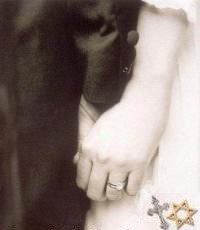
intermarriageWhat is it to be intermarried and to experience the subtle as well as the overt patterns and colors of a life in (for me, anyway) mostly Christianity with some Jewish overtones? What is freedom and what is slavery, or do we simply exchange one master for another as Paul suggests (sin to righteousness)? I’ve already said that there is ample evidence in the Bible of the Messiah’s Gentile disciples being well versed in Passover, so there’s no excuse for me to not observe it in some reasonable fashion.

But then where does that leave Easter? Are Passover and Easter mutually exclusive or can they be complementary? Or in fact, should they both be mandatory?

There’s no “point-blank” commandment to celebrate Easter or “Resurrection Day,” but there is a firm tradition in Christianity to do so. Some Christians reading this may be shocked that I call Easter a tradition, since it is arguably the single most Holy Day on the Christian calendar.

But many Jewish believers probably feel uncomfortable with Easter because historically, after every Passion Play, there’s been a pogrom. To respond to this, First Fruits of Zion (FFOZ) suggested an alternative to Easter in the Meal of the Messiah. That doesn’t do me any good because the only people I’ll be commemorating Pesach with are my immediate (non-believing) Jewish family, and the only ones I’ll be celebrating the resurrection with are the people at my church.

As I continue to process my experiences, I find that they are less “Messianic” and based more on interfaith and intermarriage issues. They are the result of my being the Gentile head of a Jewish family for nearly thirty-one years (although we’ve only been “religious” for about a third of that time).

At the first seder my father would be brief, in order to eat the afikoman before midnight. On the second night, however, he would expound at length; he began the seder before 9 p.m. and ended at about 3 or 4 in the morning, dwelling at length on the explanation of the Haggada.

The Alter Rebbe declared: The matza of the first evening of Pesach is called the Food of Faith; the matza of the second evening is called the Food of Healing. When healing brings faith (“Thank you, G-d, for healing me”) then clearly there has been illness. When faith brings healing, there is no illness to start with.

“Today’s Day”
Tuesday, Nissan 15 (1st day of chag ha’matzot – Pesach), 5703
Compiled by the Lubavitcher Rebbe
Translated by Yitschak Meir Kagan
Chabad.org

I included that last quote to shake up any Christians reading this message. I want to remind you all of the unique and special purpose and experience Passover has for the Jewish people. I want to emphasize to you all just how “Jewish” it is. I want to make sure that Christians of any sort don’t think they (we) now “own” Passover and that it is no longer Jewish. In spite of Paul teaching some of the God-fearing Gentile disciples about the Seder, I want to make sure we all understand that especially in today’s world, Christianity and Judaism stand apart, traveling two independent trajectories through history, and that a Christian attending a Seder let alone leading it, is a wonderful but also a strange thing. It would be just as strange as a religious Jew attending Easter services (and I don’t know any who are planning to do that next Sunday).

two-roads-joinI want to make sure everyone understands that we are still in the middle of an incomplete process. As believers, we may be free from sin thanks for the grace of Jesus Christ, but we are still slaves to our humanity and also to the plan of God in that the time for the Gentile disciples to return to our Jewish mentors has not yet come, although many, including me, can see the signs of an impending approach.

Israel was intended to be a light to the world, to attract and gather the people of the nations to God. That light came into the world in the form of a human being who most people call Jesus. He said he was the light of the world (John 8:12) and he has attracted millions to the God of Jacob as Israel’s firstborn Son. The Jewish and Gentile believers were added as differing members of the same Body of Messiah (Romans 12:4-5) and so there were two, parallel streams of people existing within a single, living being, the Son of David.

But then the two streams within a single container became two separate and diverging streams of humanity, growing further apart and more opposed to each other with each passing decade and century, until now, the idea of one believing person celebrating both Passover and Easter doesn’t seem just like a minor anomaly, but actually a strange and discordant event.

Except that the discordance is temporary.

So I ask, did they stumble in order that they might fall? By no means! Rather through their trespass salvation has come to the Gentiles, so as to make Israel jealous. Now if their trespass means riches for the world, and if their failure means riches for the Gentiles, how much more will their full inclusion mean!

Romans 11:11-12 (ESV)

Paul tells us how much full inclusion in the body of Messiah will mean to not just the Jewish people, but to all people. It is the completion of a dream, the healing of the horribly painful wound, and gift of the returning King.

Lest you be wise in your own sight, I do not want you to be unaware of this mystery, brothers: a partial hardening has come upon Israel, until the fullness of the Gentiles has come in.

Romans 11:25 (ESV)

I can’t summon the future but I can try to preview a tiny portion of it in the present. I can be the Christian leading a Seder in my Jewish family, and I can be the Christian who lives with a Jewish family who also attends a sunrise Easter service. As great a difficulty as intermarriage is for Judaism, perhaps there is a benefit as well. Who else but an intermarried person actually lives in both divergent worlds? And as they slowly draw closer to each other again in Messiah, who else will be able to navigate their currents and negotiate their paths than someone who already walks upon them?

sukkoth-feastLast year for Purim, I wrote Hadassah and the King, a tale of two heroes, the Jewish Queen and Gentile King of an ancient land where only an intermarried couple could save all of the Hebrews from certain destruction.

I’m not heroic but I and those like me have our parts to play out in God’s drama for humanity and his plan for the return of King Messiah. Today, as I write this, the Christian and Jewish worlds exist mainly apart, with just a few tenuous bridges connecting this bit of land and that. But days are coming when we’ll need to have greater fellowship, when we will be expected to attend the celebrations at our Monarch’s throne in Jerusalem, when believing Jew and Gentile will sit together at the Passover Seder, “and recline at table with Abraham, Isaac, and Jacob in the kingdom of heaven.” (Matthew 8:11)

On all other nights we eat while sitting upright, but on this night we eat reclining.

-from the Four Questions

We are limited by the very fact that we have human form. There is no freedom in following our whim, only further slavery to our own limited selves. Freedom can only come by connecting to something infinite and beyond us.

And so Moses was told, “When you take the people out from Egypt, you shall all serve G‑d on this mountain.”

-Rabbi Tzvi Freeman
“The Freedom Connection”
Chabad.org

…these I will bring to my holy mountain, and make them joyful in my house of prayer; their burnt offerings and their sacrifices will be accepted on my altar; for my house shall be called a house of prayer for all peoples.

Isaiah 56:7 (ESV)

May we all one day come together and as our own different and unique parts in the body of Messiah, serve our God and celebrate together in the house of prayer of our King.

Four Questions, Part 4

tallit_templeThis is a continuation on the topic I started discussing in Lancaster’s Galatians: Introduction, Audience, and What Happened to the Torah? and continued in Broad Strokes. I asked the first three of these four questions in Part 1, Part 2, and Part 3 of this series. Part 4 presents the fourth and final question. Hopefully, the answer will be illuminating.

Just a reminder, all quotes from scripture will be from the ESV Bible unless otherwise stated.

Belief in the coming of the Messiah has always been a fundamental part of both Judaism and Christianity. The Hebrew word for Messiah, Mashiach or Moshiach, means anointed, as does the Greek word, christos. Thus in Christianity, Christ is just another word for the Messiah. Much has been written about Jesus as the Messiah within the Christian realm, but little information has been publicized to the uninformed Jewish community concerning the coming of a Messiah, whom all we know about is that he will be a direct descendant of king David. Although Jesus has been proposed by Christianity to be such a descendant, Judaism does not accept Christ as their savior or king. Because the Messiah cannot be separated from God’s Third Temple and because God’s Third Temple is destined for all people…

“Coming of the Messiah”
ThirdTempleInfo.org

“For thus says the Lord: David shall never lack a man to sit on the throne of the house of Israel, and the Levitical priests shall never lack a man in my presence to offer burnt offerings, to burn grain offerings, and to make sacrifices forever.”

Jeremiah 33:17-18

I’ve written about the Messiah and the Third Temple before, but this is a slightly different approach because of the fourth and last question.

What is the Future of the Torah and the Temple?

Pastor Randy and I both agree that there will be another Temple built in Jerusalem, and if the Jewish understandings of the prophesies about Messiah are accurate, then we know that Messiah will build the Temple.

Here’s a brief refresher about the Messianic prophesies courtesy of Judaism 101:

The mashiach will bring about the political and spiritual redemption of the Jewish people by bringing us back to Israel and restoring Jerusalem (Isaiah 11:11-12; Jeremiah 23:8; 30:3; Hosea 3:4-5). He will establish a government in Israel that will be the center of all world government, both for Jews and gentiles (Isaiah 2:2-4; 11:10; 42:1). He will rebuild the Temple and re-establish its worship (Jeremiah 33:18). He will restore the religious court system of Israel and establish Jewish law as the law of the land (Jeremiah 33:15).

The idea of a Third Temple gets a bad rap from a lot of Christians because it begs the question about future sacrifices. If the sacrificial system only existed to point to Jesus and Jesus has come, gone, and will come again, why would Jesus, upon his return, build another Temple and (supposedly) restart the sacrificial system? Weren’t our sins already paid for once and for all by Christ’s death on the cross?

What makes you think that the only sacrifices made in the Temple were for sin? Also, what makes you think that only Jews made sacrifices in the Jerusalem Temple of the past or that Gentiles won’t make sacrifices in the Third Temple?

That Gentiles as well as Jews brought sacrifices to the Temple is implied in the prayer of Solomon when he dedicated the Temple (I Kings 8:41-3) and in the declaration by the prophet that the Temple will be a house of prayer for all peoples (Isaiah 56:7).

-Rabbi Louis Jacobs
“Sacrifice”
MyJewishLearning.com

Within the Books of the Prophets, we find that in the past, Gentiles were welcomed to the First and Second Temples, and that they will participate even more at the Third Temple.

In his commentary on the Torah section beginning with Gen. 12:1, Ramban (Nachmanides) wrote:

“Even in the time of Joshua, … the Gentiles knew that this place was the most august of all, that it was at the center of the inhabited world; and Tradition had taught them that it corresponds in this world to the celestial Temple where Divine Majesty, called (righteousness), resides.”

When the First Temple was inaugurated by King Solomon, he beseeched G-d with an eloquent prayer that included the following words (Kings I, 8:41-43) (which show that in the past, Gentiles were welcomed to the First and Second Temples, and that they will participate even more in the Third Temple):

“If a foreigner who is not of Your people Israel comes from a distant land for the sake of Your name – for they shall hear about Your great name and Your mighty hand and Your outstretched arm – when he comes to pray toward this House, oh, hear in Your heavenly abode and grant all [!] that the foreigner asks You for. Thus all the peoples of the earth will know Your name and revere You, as does Your people Israel; and they will recognize that Your name is attached to this House that I have built.”

Torah Law holds that Gentiles are allowed to bring burnt offerings to G-d in the Temple when it is standing in Jerusalem. There is a specific commandment to let us know that an animal (sheep, goat or bullock) offered in the Temple by a Gentile must be unblemished, to the same degree as the offering of a Jew. (Leviticus 22:25)

-from “Will Gentiles be permitted to worship at the Third Temple in Jerusalem?”
AskNoah.org

messiah-prayerI know I’m borrowing heavily from my previous blog post and you may be wondering why I just didn’t reblog it as the answer to this fourth question. But here’s the new thought.

If there indeed will be a Third Temple that Messiah will build and if part, most, or all of the sacrificial system will be reinstated, then what is the role of the Torah in Messianic Days?

Pastor Randy and I talk a lot about what the role of Torah was in the days before the destruction of Jerusalem in 70 CE and what the role of Torah is now. He believes, using Orthodox Jewish halachah as a guide, that the Torah is too difficult to keep and has always been too difficult to keep. I’m pretty sure I spelled a lot of that out in my blog post about my last conversation with him a week ago.

“For this commandment that I command you today is not too hard for you, neither is it far off. It is not in heaven, that you should say, ‘Who will ascend to heaven for us and bring it to us, that we may hear it and do it?’ Neither is it beyond the sea, that you should say, ‘Who will go over the sea for us and bring it to us, that we may hear it and do it?’ But the word is very near you. It is in your mouth and in your heart, so that you can do it.”

Deuteronomy 30:11-14

Doesn’t sound like Moses (or God) intended the Torah to be too difficult to obey or too hard to access.

Here’s another reason why the Torah has a future in the days of Messiah.

Then everyone who survives of all the nations that have come against Jerusalem shall go up year after year to worship the King, the Lord of hosts, and to keep the Feast of Booths. And if any of the families of the earth do not go up to Jerusalem to worship the King, the Lord of hosts, there will be no rain on them. And if the family of Egypt does not go up and present themselves, then on them there shall be no rain; there shall be the plague with which the Lord afflicts the nations that do not go up to keep the Feast of Booths. This shall be the punishment to Egypt and the punishment to all the nations that do not go up to keep the Feast of Booths.

Zechariah 14:16-19

I could draw from more scriptural quotes but chances are you know them all and they’re referenced above anyway. If a Third Temple will be built by Messiah, and if sacrifices and festivals that require sacrifices will be reinstated, and if Gentiles will not only be allowed to worship at the Temple and make sacrifices but in some cases, required to do so, then how will all that be possible if the Torah is not observed, at least as far as the Temple is concerned?

It seems clear that the Torah had a vital role in the existence of the Jews of ancient Israel and it will have a vital role in future, Messianic Israel. But what happens to Torah in the meantime? Does it just vanish temporarily from existence, put in cold storage until it’s needed, and then brought out, thawed out, and then be put back into service when Messiah starts his construction work?

Well, no. First of all, religious Jews observe the Torah every day. For that matter, Christians observe substantial portions of the Torah (ideally) every day. Every time a Christian performs any act of kindness in the name of Jesus, he or she is observing one of the mitzvot. They (we) just don’t call it that. Every time a Christian donates money, food, or some other good or service to the poor, they are observing a mitzvah (probably more than one). Every time a Christian comforts a person who is grief-stricken at the loss of a loved one, performs an act of kindness that assists the successful wedding of a bride, visits a sick person in the hospital, visits someone in jail, shovels snow off of a neighbor’s driveway and sidewalk unasked…they are performing Torah mitzvot.

The Torah is hardly obsolete. The Law isn’t dead. In fact, if Christians and Christianity are functioning properly, the Torah is alive and well and being performed in churches around the world and in the lives of Christians and their neighbors every day. The Torah is also alive and well and being performed in synagogues around the world and in the lives of Jews and their neighbors every day. No, not all Christians and not all Jews are doing what God expects of them (us), but some are. Not everything that some Christians think of as “the Word of God” and not everything that some Jews think of as “Torah” is really God’s Word and Torah.

Some Christians have some pretty funny ideas about how they’re supposed to judge people who don’t comply with their personal political and social agenda, and some Jews have some pretty funny ideas about how far to take all of the massive compilation of halachah that has become attached to Torah. I suspect when Messiah returns, he’s going to help us all out by teaching us what God’s expectations are really all about and what the Torah is supposed to mean as applied to Gentile Christians and as applied to Jews.

But be that as it may, the Torah has a past, a present, and a future. It has to, otherwise what even traditional Christians understand about the Bible doesn’t make sense, and many specific passages of scripture don’t make sense.

I have no idea exactly how we are to apply the Torah in the lives of Jews or Christians today except in a general, common sense way. As I’ve said numerous times before, based on Acts 15, Acts 21 and various other scriptures, I don’t believe that Gentile, God-fearing believers in Messiah are expected to observe the mitzvot in the manner of the Jews. I do believe we are to observe it as taught by Messiah, and what he taught focused on the acts of kindness and charity I mentioned above. I also believe that Jewish people, believers in Messiah Yeshua and otherwise, remain under all of the covenants that God made with Israel. The New Covenant extends the part of the Abrahamic covenant that allows the Messiah to bless the nations to the rest of us, providing salvation and relationship to God for the Gentiles who are called by Messiah’s name, and providing reaffirmation of all of the previous covenants to the Jewish people.

renewalWhat’s New about the New Covenant, as I was recently reminded, is that it will be written on our hearts. The actual content of the writing won’t change but how we will perceive it and live it out will be different. I say “will be” as opposed to “is” because if the “writing” were a done deal, we all would be leading very different lives, rising above sin, rising above the cares of the world, all “knowing God” in a way that currently escapes us.

Messiah opened the door and he holds all the keys, but he’s not done yet and until he is, the finger of God is still in motion, slowly inscribing “Torah” on the hearts of Christians and Jews everywhere.

But that Torah is and will be about the Temple, Sukkot, Pesach, Shavuot, and many more things most Christians don’t consider important anymore. That Torah will be a pure product, freed from our biases, our interpretations, our confusion, and our controversies.

But there was a Torah. There is a Torah. And there will be a Torah. Our current understanding is not very good, and like Paul said, we are seeing the Bible and the things of God as through a mirror dimly (1 Corinthians 13:12). We’re all still going to mess up a “free lunch” until Messiah returns. Until then, we still have to eat that lunch, so to speak, even if we do so poorly. At least we’re mindful of God and His will and His Word.

For truly, I say to you, until heaven and earth pass away, not an iota, not a dot, will pass from the Law until all is accomplished.

Matthew 5:18

Do we then overthrow the law by this faith? By no means! On the contrary, we uphold the law.

Romans 3:31

I hope you enjoyed going over these four questions with me. As you read this, it is Wednesday morning, and tonight, I’ll have another conversation with Pastor on Lancaster’s “Galatians” book. May I continue to be inspired and illuminated by my relationship with Pastor Randy and may God grant both of us the eyes to see and the ears to hear what our Master is teaching us all.

Addendum, March 21: My wife emailed me a link to Rabbi Shlomo Yaffe’s article The Dynamic of Sacrifices. Rabbi Yaffe tells a wonderful story about the meaning of the Olah offering, the fire from God, and how the sacrifices in the Third Temple, built by Messiah, will provide the means for a unity between all people.

“I will bring them to My holy mount, and I will cause them to rejoice in My house of prayer; their burnt offerings and their sacrifices shall be acceptable upon My altar, for My house shall be called a house of prayer for all peoples.”

Isaiah 56:7

Amen and may it come soon and in our days.

Moshiach Rabbeinu

rabbeinu1Believe it or not, this week’s message was not inspired by the fact that the Catholic Church has chosen a new Pope; it just offers a convenient contrast. As you probably know, there is, in their beliefs, a doctrine of papal infallibility. When the Pope teaches the rules, he is always right.

It is natural to assume that Judaism has something similar. This is especially true, given the Torah’s demand that we listen to the Rabbis and Judges, and not deviate “right or left” [Deut. 17:11] from what they say.

-Rabbi Yaakov Menken
“Everyone Makes Mistakes”
Commentary on Torah Portion Vayikra
Project Genesis

I’ve been hesitating about writing this particular “meditation” because it has the potential to be rather controversial. As part of my conversations with Pastor Randy, we’ve been discussing what is Torah? That’s an amazingly difficult question to answer. It’s not just the Five Books of Moses, and I believe that it should be at least the entire Tanakh (Old Testament). I believe a great deal of the New Testament and certainly the epistles of Paul should be considered midrash on Torah, specifically in relation to the teachings of Messiah.

As I’ve said before (and will say again when I publish “Four Questions, Part 4” tomorrow), Pastor Randy believes that the Torah is too difficult to observe perfectly and in fact, has always been too difficult to observe. This is pretty much what most of Christianity believes, and along with that, the church sees the primary purpose of Torah as always pointing to Jesus. Once Jesus came, the purpose of Torah expired and grace was substituted.

I don’t happen to believe this, and my understanding is that Jewish people, including those who are disciples of the Master, remain obligated to the Torah of Moses.

But I’m not here to talk about the Torah as such (I’ll do that tomorrow), but rather how it is applied through Rabbinic interpretation and authority. This is the really touchy part. As Rabbi Menken writes, there’s a tendency to view the sages in a manner similar to how Catholics view the Pope, as infallible and that all Rabbinic rulings are automatically correct. But is that really true? Rabbi Menken continues.

We see from this week’s reading, though, that this is definitely not the case. The Torah prescribes special atonement for when the High Priest, the King, or the Sanhedrin [Lev. 4: 13-21], the High Rabbinical Court, makes a mistake. In other words, the Torah highlights for us that it is possible for the Sanhedrin to be mistaken.

This is not about a small matter, either. The commentaries say that the mistake described here is one in which the Sanhedrin teaches that it is permitted to do something, and the Sanhedrin later realizes that the behavior is prohibited — so much so that a person committing the act deliberately would suffer the punishment of Kares, spiritual excision [the exact definition of this is disputed, but severe]. Even in matters of religious law, where the Sanhedrin’s supreme authority is undisputed — even there, they could make a mistake.

So why, then, does the Torah tell us to listen to them? They could, after all, be leading us in the wrong direction!

That is an extraordinarily good question. It’s also the question that comes to the minds of just about all Christians, including many people in the Hebrew Roots movement who believe that the Bible contains everything necessary for a Jew to observe Torah without relying on external interpretation or additional instructions.

Based upon a proof from a Baraisa, the Gemara had concluded that a lechi post is not valid if it is not recognizable from the inside, although it is visible from the outside. Yet, the Gemara proceeds to inform us that the halachah is that such a lechi is valid. Immediately, the Gemara asks, “We have disproven the validity of such a lechi, and yet the halachah rules that it is valid?!”

The Gemara continues to resolve this halachic conclusion, based upon yet another Baraisa which validates such a lechi.

This give and take, where the Gemara proves one point of view, and then immediately concludes the halachah according to the opposite opinion is relatively uncommon. A computer check reveals that it appears only five times in Shas (here, Kesuvos 41b-twice, Bava Kamma 15b-twice, Bava Metzia 22b).

Daf Yomi Digest
Distinctive Insight
“It is disproved – but yet it is the Halachah!”
Eruvin 10

That didn’t help. I admit, the complexities of Talmud escape me most of the time and yet religious Judaism in all of its variants, depends on these rulings, laws, and judgments for so very much.

My question is basic. Is literally every single ruling, judgment, halachah, and word of every sage everywhere across time valid and binding in religious Judiasm, or is it possible that at some point, the sages have gone too far?

Kapparot is a custom in which the sins of a person are symbolically transferred to a fowl. It is practiced by some Jews shortly before Yom Kippur. First, selections from Isaiah 11:9, Psalms 107:10, 14, and 17-21, and Job 33:23-24 are recited; then a rooster (for a male) or a hen (for a female) is held above the person’s head and swung in a circle three times, while the following is spoken: “This is my exchange, my substitute, my atonement; this rooster (or hen) shall go to its death, but I shall go to a good, long life, and to peace.” The hope is that the fowl, which is then donated to the poor for food, will take on any misfortune that might otherwise occur to the one who has taken part in the ritual, in punishment for his or her sins.

-Richard Schwartz, Ph.D.
“The Custom of Kapparot in the Jewish Tradition”
JewishVirtualLibrary.org

Solomons-TempleThe Torah, particularly the book of Leviticus, provides an extremely detailed description of the various sacrifices to be given at the Temple in Holy Jerusalem, and under what circumstances a Jew must present said-sacrifices. To the best of my knowledge, none of them involve the use of a chicken as described by the modern rite of kapparot. Dr. Schwartz details some of the Jewish objections to this practice.

Some Jewish leaders felt that people would misunderstand the significance of the ritual. The belief that the ceremony of kapparot can transfer a person’s sins to a bird, and that his or her sins would then be completely eradicated, is contrary to Jewish teachings. For, if the ritual could remove a person’s sins, what would be the need for Yom Kippur, the Day of Atonement?

The Mishneh Brurah, an eminent contemporary commentary on Rabbi Joseph Caro’s classical codification of Jewish law, explains the significance of the ritual. Judaism stresses that a person can’t obtain purity from sin, and thus obtain higher levels of perfection, without repenting. Through God’s mercy, we are given the Divine gift of repentance, so that we might abandon our corrupt ways, thereby being spared from the death that we deserve for our violation of the Divine law. By substituting the death of a fowl, one will (hopefully) appreciate G-d’s mercy and be stirred to repentance. By no means, however, does the ritual and the slaughter of the bird eradicate one’s misdeeds, even though the bird is donated to the poor.

If a Jewish person is a disciple of the Master and has studied and accepted the teachings in the Apostolic Scriptures, he or she understands that this particular ritual is not meaningful or necessary. The sins of anyone, Jew or Gentile, who has accepted Jesus (Hebrew: Yeshua) as Savior, Lord, and Messiah, have been forgiven. He died, paying the price for our sin as the ultimate atonement, and when we repent (and we must repent) of our own sins, turning away from them, and turning to God, we are forgiven once and for all without the need for further sacrifices.

So how are we to reconcile the rulings of the sages in relation to the kapparot involving chickens during Yom Kippur and the reality of the Messiah? The better question is, how are Messianic Jews to reconcile this along with any other Jewish practices that seem to contradict the teachings and life of the Master?

The Messianic Jewish Rabbinical Council has established official halachah for its member synagogues and individual members, but that’s hardly a universal standard. On the other hand, how halachah is applied across the rest of the religious Jewish landscape is not entirely consistent either. For example, we can point to the radically extreme differences between how the Haridim vs. Reform Judaism live out Jewish lives they believe are consistent with observing Torah.

It’s obvious that Messianic Judaism has to make a few “adjustments” to how some of the Rabbinic rulings are applied, but even given that, are we to understand that all of the remaining body of Mishnah is fully correct and fully valid? If we accept that the Torah doesn’t change (and there are those who debate even that), can we accept that Jewish interpretation is adaptive and evolutionary across time and culture? I had a recent Facebook conversation that included the following:

There are enduring realities in the Torah…the Shema is one…The pursuit of Justice is another…however there are changes in the way Torah is embraced…David recognizes that G-d wants a contrite and broken heart, not burnt offerings (Psalm 51) Micah gives the same notion (Micah 6)…so there is an evolutionary understanding of the nature and character of G-d that takes place…

David is specific…”burnt offerings you do not desire”…but a contrite broken heart….quite removed from the harsh Levitical code of bloody sacrifices…and those scriptures reflect evolving understanding of the nature and character of G-d…Jesus in the John 8 narrative lays aside the penalty that the Torah prescribes and challenges the lack of personal holiness/integrity of the woman’s accusers…

Part of the problem is that we can “interpret” the Bible to mean just about anything. If we give the Rabbinic sages (or anyone) carte blanche to establish binding interpretations and halachah for their specific streams of Judaism, are they always consistent with God’s intent for the Jewish observance of Torah?

There’s no way to know for sure. Well, there’s one.

Then Jesus said to the crowds and to his disciples, “The scribes and the Pharisees sit on Moses’ seat, so do and observe whatever they tell you, but not the works they do. For they preach, but do not practice. They tie up heavy burdens, hard to bear, and lay them on people’s shoulders, but they themselves are not willing to move them with their finger.

Matthew 23:1-4 (ESV)

phariseesEven as Jesus confirmed that the scribes and Pharisees did indeed have the authority to create binding halachah upon the Jewish people of his day (see the paper Matthew 23:2–4: Does Jesus Recognize the Authority of the Pharisses and Does He Endorse their Halakhah? (PDF) by Noel S. Rabbinowitz, JETS 46/3 (September 2003) 423-47 for details), he also criticized them for failing to follow their own rules. However, he didn’t agree with each and every one of their rulings.

Again he entered the synagogue, and a man was there with a withered hand. And they watched Jesus, to see whether he would heal him on the Sabbath, so that they might accuse him. And he said to the man with the withered hand, “Come here.” And he said to them, “Is it lawful on the Sabbath to do good or to do harm, to save life or to kill?” But they were silent. And he looked around at them with anger, grieved at their hardness of heart, and said to the man, “Stretch out your hand.” He stretched it out, and his hand was restored.

Mark 3:1-5 (ESV)

Now when the Pharisees gathered to him, with some of the scribes who had come from Jerusalem, they saw that some of his disciples ate with hands that were defiled, that is, unwashed. (For the Pharisees and all the Jews do not eat unless they wash their hands properly, holding to the tradition of the elders, and when they come from the marketplace, they do not eat unless they wash. And there are many other traditions that they observe, such as the washing of cups and pots and copper vessels and dining couches.) And the Pharisees and the scribes asked him, “Why do your disciples not walk according to the tradition of the elders, but eat with defiled hands?” And he said to them, “Well did Isaiah prophesy of you hypocrites, as it is written,

“‘This people honors me with their lips,
but their heart is far from me;
in vain do they worship me,
teaching as doctrines the commandments of men.’

You leave the commandment of God and hold to the tradition of men.”

Mark 7:1-8 (ESV)

So what does all this mean?

  • There are some modern Jewish rituals and customs that contradict the reality of the risen Messiah.
  • Jewish ritual and tradition is not applied with universal consistency across all religious Jewish communities and across time.
  • Historically, Jesus affirmed the right of the ancient Pharisees and scribes to establish binding halachah for Jews.
  • Historically, Jesus refuted some of the halakhic rulings by the Pharisees and scribes and offered correction and criticism when necessary.
  • At least one modern Messianic Jewish body has offered an adaptation to Jewish halachah that is more consistent with the reality of the risen Messiah.

Oh. We know one more thing:

The nations will send their emissaries to the King Messiah, and the King Messiah will teach the world how to live in peace, and how to want to live in peace. Then, everyone in the world will enjoy eternal peace, for as long as this world will last. The great Rabbi, Rav Shlomoh Freifeld, of blessed memory, said in a talk he once gave that I attended that the Messiah will be a great teacher.

-from “What is the Messiah Supposed to Do”
BeingJewish.com

He will restore the religious court system of Israel and establish Jewish law as the law of the land (Jeremiah 33:15).

-from “Mashiach: The Messiah”
Judaism 101

It is my understanding that one of the things many Jewish people believe the Messiah will do is to teach Torah, to teach the correct interpretation of Torah and how it is to be lived out. According to BeingJewish.com, as we saw above, he will even teach the Gentiles peace.

So what am I getting at?

This is Rabbi Menken’s solution to understanding the puzzle.

One answer has to do with the power of unity. Different customs and practices are wonderful, but there has to be underlying agreement on “the basics.” One of the problems with calling different Chassidic groups “sects” is that a sect is “a dissenting or schismatic religious body.” Chassidic groups may be led by different Rebbes, but they don’t rewrite the rules. The disagreements of today are disagreements about shapes of branches on individual trees within a massive, unified forest.

And there is another answer, which requires still more humility. It is all well and good to say that everyone is fallible — but who is more likely to be making a mistake? The Torah gives leadership to people who dedicate themselves completely to Torah study, to learning the Torah’s “way of thinking.” Such people are inherently less biased by the latest news reports and the wise opinions of the chattering class, as we are. We recognize that it is much less likely that they will make a mistake, and that is why we trust their guidance.

torah-tree-of-lifeIs there a “unified forest” of Torah? I think there must be, otherwise there is nothing for Jews to observe except traditions (the shapes of branches on the individual trees); there is no root, no foundation, no sense of an absolute God who has core standards that are as unchanging as He is. Beyond a certain point, we can’t simply re-invent the Bible to fit our modern sensibilities so that they agree with whatever “politically correct” causes that may be popular this week, this month, or this year. If we did, our faith (and our God) would be no more consistent or eternal than the shifting viewpoints of a political party or social agenda.

Rabbi Maurice Lamm says in “What is Torah” published at Aish.com:

In fact, far from being enslaved by the law, Jews were enamored of it. We cannot take our leave of the subject of Torah without expressing this most characteristic sentiment of Jewish literature – the love of Torah.

You may ask: can a people “love” a law? Yet, that is the exquisite paradox inherent in the concept of Torah – it is respected and studied and feared, while it is loved and embraced and kissed. All at once. There is no good in this world – no ideal, no blessing, no perfection, no glory – unless it is associated with the law.

To Jews, the Torah is “light”; it is the “glory of the sons of man”; it is the energizing sap of life for “the dry bones” (Ezekiel 37:4) which symbolize the “people in whom there is not the sap of the commandment.”

To Jews, the law is mayim chayim, refreshing, life-restoring, living waters to Jews; the sweetness of honey and milk, the joy and strength of wine, and the healing power of oil. It is an “elixir of life” that brings healing to all.

In Acts 15, Peter called the Law a burden but in Acts 21, Paul defended his observance of the Law. We also see in that same chapter that many of the Jews in Messiah were zealous for the Law.

And God, through Moses, said this about the Torah.

“For this commandment that I command you today is not too hard for you, neither is it far off. It is not in heaven, that you should say, ‘Who will ascend to heaven for us and bring it to us, that we may hear it and do it?’ Neither is it beyond the sea, that you should say, ‘Who will go over the sea for us and bring it to us, that we may hear it and do it?’ But the word is very near you. It is in your mouth and in your heart, so that you can do it.”

Deuteronomy 30:11-14

I think that for the Jewish people, there is an “ideal” Torah, a Torah that God intends for His people Israel. As we’ve seen in the record of the Bible, all things being equal, human beings will mess up a free lunch. We take everything God gives us and turn it on its side, we fold, spindle, or mutilate it, drag it through the mud, drag it through our biases, prejudices, and personalities, drag it through our theologies, our doctrines, our translations, and eventually on the other side, we come out with some approximation of what God wants us to say, do, and be.

How close are all of our approximations to the desires of God, how near is our fidelity to the original? Opinions vary widely. It’s not that we are dishonest and it’s not that we don’t want to do His will as opposed to our will (most of the time, anyway), but we are human beings. Everything we are as flawed, mortal beings gets in the way of everything He is as a perfect, immortal God.

That’s where Messiah comes in. Being human and divine, he can provide (and has provided) the correct “interface” for us. He is a teacher. When he comes, whatever we’ve gotten wrong, he’ll help us understand correctly.

If there’s an answer to how the Law is infinitely accessible, and a delight, and a light, and to be loved by those who have received it from Him, that answer comes on the clouds with Messiah. God is a teacher.

Four Questions, Part 3

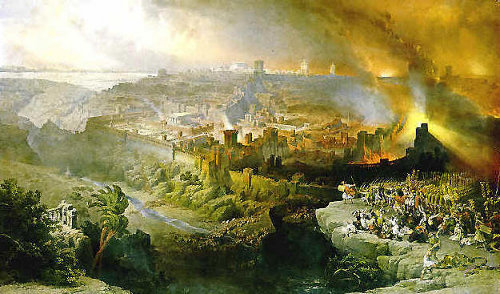
fall-of-jerusalemThis is a continuation on the topic I started discussing in Lancaster’s Galatians: Introduction, Audience, and What Happened to the Torah? and continued in Broad Strokes. I asked the first two of these four questions in Part 1 and Part 2 of this series. Part 3 presents the third question. Hopefully, the answer will be illuminating.

Just a reminder, all quotes from scripture will be from the ESV Bible unless otherwise stated.

Were the Jewish Apostles of Jesus Supposed to Remain in Jerusalem During the Fall?

History records that the Romans destroyed Herod’s Temple and exiled the Jews from Israel in the year 70 of the Common Era (CE). Israel was renamed “Palestine” by the Romans as in insult to the Jews. We also know that there was always a small remnant of Jewish people in “Palestine” from that time until the formation of the modern state of Israel in 1948. But of those who remained in Jerusalem and in the Land during and just after the destruction of the Temple, how many were disciples of the Master?

The destruction of the Second Temple in 70 CE and the subsequent expulsion of the majority of Jews from what would be called Palestine marked a disastrous shift in the Jewish authority over the Messianic community. Up until that time, the head of the Jerusalem leadership of the Messianic community, otherwise referred to as “the bishop of the church”, had always been Jewish. Once the Jews were expelled from Jerusalem by Hadrian, for the first time a Gentile had to be elected into the role. As events moved forward from that point in time, the Gentile presence in the Messianic community grew dramatically while the Jewish leaders and worshipers of Yeshua struggled under the heartbreak of the loss of the Temple and the ejection from their land.

-James Pyles
“Origins of Supersessionism in the Church”
Part one in a four-part series
published in Messiah Journal
Issue 109/Winter 2012

I bring all this up because one of the topics Pastor Randy and I discussed was whether or not the Jewish disciples of the Way “abandoned ship,” so to speak, when the rest of the Jews were expelled from Israel at this point in history. It’s Pastor’s opinion that they did and that it was definitely the wrong thing for them to do. In his opinion, they should have stayed.

Should they have fought the Romans like the zealots? Should they have died like the Jews at Masada?

I don’t know if Pastor is suggesting such a thing. Dying, down to the last man as martyrs, may have been a dramatic move and even a faithful one, but it would not have allowed the apostles to survive and to spread the word of Moshiach to the Jews and Gentiles of the diaspora.

I remember when Pastor was delivering a sermon on the death of Stephen (see Acts 7:54-60) and the consequences that followed his demise.

And there arose on that day a great persecution against the church in Jerusalem, and they were all scattered throughout the regions of Judea and Samaria, except the apostles.

Acts 8:1

According to Pastor, one of the effects of the scattering of devout Jewish believers away from Jerusalem was to allow the spreading of the gospel message throughout Judea and Samaria. This is how I see one of the results of the destruction of Jerusalem and the great exile of the Jews to the diaspora. Not that Paul had been unsuccessful in taking the message of the Messiah to much of the then civilized world, but this “allowed” (though it was a terrible thing) all or most of the believing Jews in the Land to take who they were and extend that into the galut to other Jewish and probably Gentile communities.

That’s one thought, anyway.

Did Jesus ask or require the believing Jews to stay in Jerusalem during this time of great tragedy?

“But when you see Jerusalem surrounded by armies, then know that its desolation has come near. Then let those who are in Judea flee to the mountains, and let those who are inside the city depart, and let not those who are out in the country enter it, for these are days of vengeance, to fulfill all that is written. Alas for women who are pregnant and for those who are nursing infants in those days! For there will be great distress upon the earth and wrath against this people. They will fall by the edge of the sword and be led captive among all nations, and Jerusalem will be trampled underfoot by the Gentiles, until the times of the Gentiles are fulfilled.

Luke 21:20-24

It seems clear that Jesus was telling those who are in Judea to flee to the mountains. Also, those who are inside the city depart, and let not those who are out in the country enter it. He knew that many [would] fall by the edge of the sword and be led captive among all nations. Nowhere in that short narrative do I hear the Master telling anyone to stay and die. In fact, it was necessary for Jerusalem to be trampled underfoot by the Gentiles, until the times of the Gentiles [were] fulfilled.

I don’t know if the times of the Gentiles are fulfilled yet, but the modern nation of Israel has been in existence for over sixty years now, so if our time isn’t yet up, it soon will be.

I mentioned before, in quoting from my “supersessionism” article, that up until the destruction of Jerusalem, every leader of the Council of Apostles had been Jewish. When the Jews were expelled, the first “bishop of the church” had to be a non-Jew since at that time, they were “flying below the radar” of the Romans, so to speak. It’s not unlike the situation with Lydia and the devout God-fearing women in Philippi.

So, setting sail from Troas, we made a direct voyage to Samothrace, and the following day to Neapolis, and from there to Philippi, which is a leading city of the district of Macedonia and a Roman colony. We remained in this city some days. And on the Sabbath day we went outside the gate to the riverside, where we supposed there was a place of prayer, and we sat down and spoke to the women who had come together. One who heard us was a woman named Lydia, from the city of Thyatira, a seller of purple goods, who was a worshiper of God. The Lord opened her heart to pay attention to what was said by Paul. And after she was baptized, and her household as well, she urged us, saying, “If you have judged me to be faithful to the Lord, come to my house and stay.” And she prevailed upon us.

Acts 16:11-15

jerusalem-at-nightThe Jewish population in that area had been expelled at some earlier point, but the God-fearing Gentiles were “under the radar,” and not included in the exile from Philippi because they had not been counted as Jews, even through they had been worshipping in the synagogue with Jews, praying with Jews, discussing Torah with Jews, and otherwise having fellowship with Jews. When Paul and his party came upon Lydia and her companions by the river, he must have understood that these Gentile women were all who were left of those devoted to Hashem to keep the worship of the God of Israel alive in that community. Perhaps the same can be said of the Gentile believers in Jerusalem after 70 CE, but it’s hard to tell.

There has always been a Jewish remnant in Israel for the past 2,000 years. When the Temple was utterly destroyed, when the golden menorah melted and flowed like water, when Jerusalem herself moaned in agony like a woman in hard labor, after all these things, who is to say if, among the Jewish remnant, there were followers of Yeshua HaMashiach or not. There’s no way to know.

I don’t think the Messianic Jews had a specific mandate to stay and endure the incredible suffering of Israel’s downfall under the Romans. If some did stay, so much the better, but I believe what happened was supposed to happen. I think God knew. I think the words of Jesus tell us that he expected it and expected those who listened to him to flee. The time of the Gentiles was upon them.

But that time is running out fast.

Only one more question left. Be here for Part 4 in the conclusion of this series in tomorrow’s “morning meditation.

Four Questions, Part 2

Apostle-PaulThis is a continuation on the topic I started discussing in Lancaster’s Galatians: Introduction, Audience, and What Happened to the Torah? and continued in Broad Strokes. I asked the first of these four questions in Part 1 of this series (please read it if you haven’t yet) but quickly discovered that I’d never get all four questions and their answers in a single blog post. Hence, Part 2 presents the second question. Hopefully, the answer will be illuminating.

Why Did Many Jewish People Reject Paul and the Message of the Messiah?

Let’s face it. Paul received a tremendous amount of opposition during his journeys as he spoke of Christ, not only from the Greeks and Romans, but from many individual Jews and Jewish communities as well. This is exquisitely documented in Luke’s Book of Acts and often gives support to the traditional Christian doctrine that the Jews rejected Jesus but the Gentiles accepted him, thus Jews are now universally without salvation and a place in Heaven, and the Gentile Christians have inherited all of the covenant promises that once belonged to the Jews, replacing them as God’s chosen, splendourous people.

Did the Jews reject Jesus? We’ve already seen in Part 1 of this series (link above) that not all of them did and actually, thousands upon thousands of Jews completely accepted the Christ and were devoted disciples of the Messiah. In fact, in one of my conversations with Pastor Randy, he said he believes that the Jewish population of “the Way” very likely outnumbered, and by a substantial amount, the population of any of the other sects of Judaism, most principally, the Pharisees. This is just conjecture on my part, but as Pastor Randy mentioned this, I couldn’t help but wonder if the Pharisaic sect as well as the Essenes, Sadducees and others, saw that their power bases would erode into eventual extinction should “the Way” take over the Jewish religious landscape by sheer weight of numbers in Jewish membership.

We’ve also seen within the borders of ancient Israel that the apostles and disciples of Messiah were considered a threat to the corrupt and compromised Jewish religious leadership streams (particularly the Priesthood) that were firmly in the pocket of the occupying Romans. Herodian rule was also threatened for similar reasons. The Son of God accused them all of falsehood and usurping the rightful place of the valid Priests and Kings of Israel. These false rulers had every reason to want to silence a small but rapidly growing group who might one day soon incite the people to overthrow them.

But that doesn’t explain the immense amount of resistance Paul experienced in the Jewish synagogues of the diaspora, who were outside the flow of those political currents.

And he entered the synagogue and for three months spoke boldly, reasoning and persuading them about the kingdom of God. But when some became stubborn and continued in unbelief, speaking evil of the Way before the congregation, he withdrew from them and took the disciples with him, reasoning daily in the hall of Tyrannus.

Acts 19:8-9

After three months, opposition to Paul’s message surfaced. It may have taken that long for the Jews of Ephesus to realize that Paul’s gospel invited Gentiles into the fold.

-Lancaster, Torah Club Vol 6, pg 620

This, I think, is the key to much (but not all) of the Jewish opposition to Paul and the Way. Besides announcing the salvation from sin and the life in the world to come promised through the Messiah, the number one thing that set Paul’s sect apart from all of the other Judaisms of that day was the inclusion of Gentiles as equal covenant members without the requirement that Gentiles undergo circumcision and convert to Judaism. This was unprecedented in ancient Judaism and in my opinion, the single largest stumbling block for Jews hearing the Messianic message of Paul and the other apostles.

Remember the Jews of Pisidian Antioch who, in Acts 13:42-43 couldn’t get enough of Paul, Barnabas, and the message of Messiah, and begged them to return to their synagogue on the following Shabbat to speak more about the Kingdom and the Son of David?

The next Sabbath almost the whole city gathered to hear the word of the Lord. But when the Jews saw the crowds, they were filled with jealousy and began to contradict what was spoken by Paul, reviling him. And Paul and Barnabas spoke out boldly, saying, “It was necessary that the word of God be spoken first to you. Since you thrust it aside and judge yourselves unworthy of eternal life, behold, we are turning to the Gentiles.

Acts 13:44-46

This doesn’t mean, as we saw in Part 1 of this series, that Paul never again preached the good news to the Jews, but only on that occasion, when the Jewish leadership of the Pisidian Antioch synagogue spoke against him and reviled him. So what happened? On one Shabbat, the Jews couldn’t get enough of Paul and his teaching and exactly one week later, they can’t wait to shut him up and get rid of him. What changed?

But when the Jews saw the crowds, they were filled with jealousy…

Crowds? Crowds of who?

The Jews of Antioch were not jealous that Paul and Barnabas has such appeal or that their message was so popular. They were jealous that the message of the apostles compromised theological ethnocentrism. The message of the apostles seemed to throw the doors of Judaism wide open to the Gentile world.

This is the “jealousy” to which Paul referred in his epistle to the Romans.

-D. Thomas Lancaster’s commentary on Acts 13:1-51 read with Torah Portion Bo (“Come”) Torah Club 6: Chronicles of the Apostles, pg 394

prayer-synagogue-riga-latviaI commented extensively in a previous meditation regarding this “jealousy” that the huge influx of Gentile God-fearers and pagans elicited from the Jewish synagogue leaders in Pisidian Antioch and you are invited to click the link above and read the full analysis of that event. Lancaster supports my understanding that the thing about the Way that summoned such a passionate and even hostile response from some Jewish communities was the unfettered admittance of non-Jews into what was once a wholly Jewish religious and community space.

Here’s more.

When the seven days were almost completed, the Jews from Asia, seeing him in the temple, stirred up the whole crowd and laid hands on him, crying out, “Men of Israel, help! This is the man who is teaching everyone everywhere against the people and the law and this place. Moreover, he even brought Greeks into the temple and has defiled this holy place.” For they had previously seen Trophimus the Ephesian with him in the city, and they supposed that Paul had brought him into the temple. Then all the city was stirred up, and the people ran together. They seized Paul and dragged him out of the temple, and at once the gates were shut. And as they were seeking to kill him, word came to the tribune of the cohort that all Jerusalem was in confusion.

Acts 21:27-31

Two major points must be considered here. The first is the fear and hostility elicited at the very thought that Paul would allow admission of a non-Jew into the Temple past the court of the Gentiles. After all, such a thing was not done. True, Paul hadn’t actually taken Trophimus into the Temple, but just seeing the two of them together inspired all sorts of terrifying fantasies in many of the Jerusalem Jews. The very thought of Gentiles having full and equal membership into a Jewish religious sect without first having to convert to Judaism and being compelled to obey the complete body of Torah mitzvot and halachah was unthinkable. For many Jews, access to the God of Israel was located in a “Jews-only” zone, which is understandable, given that Israel was a nation then occupied by a brutal Gentile army. Only the apostles and disciples of Jesus understood differently and even some of them would never completely reconcile themselves to Gentile admission.

Here’s the second major speed bump.

And when they heard it, they glorified God. And they said to him, “You see, brother, how many thousands there are among the Jews of those who have believed. They are all zealous for the law, and they have been told about you that you teach all the Jews who are among the Gentiles to forsake Moses, telling them not to circumcise their children or walk according to our customs.

Acts 21:20-21

To the Jews in Jerusalem who were both devout disciples of Jesus the Messiah and zealous for the law, even the rumor that Paul was teaching the Jews in the diaspora, who were living among and worshiping with the Gentile God-fearing disciples, to forsake Moses, telling them not to circumcise their children or walk according to [their] customs was a horrible and virtually unthinkable idea. It was completely and totally against everything the Messianic Jews in the Land understood about the life and character of a devout Jew.

Again, this rumor was completely untrue. Paul totally denied ever teaching such a thing to the Jews in the diaspora, so we can believe that Paul and the other devoted Jewish disciples of Messiah fully understood that there was no contradiction between their faith in Jesus and their lives as Torah-obedient Jews. The only thing that may have given the Jerusalem Jews the idea that Paul was teaching against the Torah to diaspora Jews is this.

Thus all will know that there is nothing in what they have been told about you, but that you yourself also live in observance of the law. But as for the Gentiles who have believed, we have sent a letter with our judgment that they should abstain from what has been sacrificed to idols, and from blood, and from what has been strangled, and from sexual immorality.

Acts 21:24-25

Paul-ArrestedApparently, there was some confusion about the instructions James and the Council of Apostles issued to the believing Gentiles (see Acts 15) involving the limits of their obligation to the Torah as opposed to what Paul was and wasn’t saying to his Jewish audience. If word got back how Paul was instructing the Gentile disciples within the context of the “Jerusalem Letter,” it may have been assumed that such was Paul’s general message to everyone he encountered, including diaspora Jews (for a more complete treatment of the Council’s ruling of “Gentile halachah,” see my six-part series on Lancaster’s Acts 15 commentary, Return to Jerusalem).

I’m firmly convinced that among all the various reasons why individual Jews and Jewish communities rejected Paul’s message of Messiah, the number one “biggie” was the admission of unconverted Gentiles. Sadly, this was a problem that was never resolved and the cracks and fissures that developed between the Jewish Way and the rest of the Jewish sects eventually spawned a total split, ultimately resulting in a Gentile Christianity, and a stream of Judaisms moving forward in history that, by definition, were compelled to consider just about anyone a possible Messiah except Jesus Christ.

Rabbinic literature also reluctantly admits the reality of the miracles performed in Yeshua’s name but forbids it all the same. Some sages maligned the Master as a sorcerer, and they accused him of using a secret name of God to perform His miracles. By the second century, the sages forbade using the Master’s name for healing. They also forbade Jews from accepting the prayers of Yeshua’s disciples (b. Avodah Zarah 27b.)

-Lancaster on Acts 19:13-14, Torah Club Vol. 6, pg 623

Happily, there is a small but growing movement of Jewish people today who are rediscovering the Messiah Yeshua and who are devoted disciples of the Master within a completely Jewish worship, cultural, and lifestyle context. It is my belief that Messiah will continue to call the Jewish people who are his own back to him and back to the Gospel promise of personal salvation and national redemption of Israel.

Part 3 of this meditation will address the third question that came up as a result of my “Pastor Randy conversations” and I encourage you to return here and read the continuation of this series in tomorrow’s “morning meditation.”

Four Questions, Part 1

jerusalem_templeA song of Asaph; God, God the Lord, spoke and called to the earth, from the rising of the sun until its setting. From Zion, the finery of beauty, God appeared. Our God shall come and not be silent; fire shall devour before Him, and around Him it storms furiously. He shall call to the heavens above and to the earth to avenge His people. Gather to Me My devoted ones, who made a covenant with Me over a sacrifice. And the heavens will tell His righteousness, for He is a God Who judges forever.

Hearken, My people, and I will speak, Israel, and I will admonish you; God, even your God am I. I will not reprove you concerning your sacrifices, neither are your burnt offerings before Me constantly. I will not take from your household a bull, from your pens any goats. For all the beasts of the forest are Mine, the behemoth of the thousand mountains. I know all the fowl of the mountains, and the creeping things of the field are with Me. If I were hungry I would not tell you, for the world and its fullness are Mine. Will I eat the flesh of bulls or do I drink the blood of he-goats? Slaughter for God a confession and pay the Most High your vows. And call to Me on a day of distress; I will rescue you and you will honor Me…One who slaughters a confession sacrifice honors Me, and [I will] prepare the way; I will show him the salvation of God.

Psalm 50:1-15,23 (JPS Tanakh)

This is a continuation on the topic I started discussing in Lancaster’s Galatians: Introduction, Audience, and What Happened to the Torah? and continued in Broad Strokes. These blogs were created as a reflection of my conversation with Pastor Randy in his church office on the evening of Wednesday, March 13th as we discussed the Introduction and Sermon One of D. Thomas Lancaster’s book The Holy Epistle to the Galatians: Sermons on a Messianic Jewish Approach (First Fruits of Zion, 2011).

I mentioned in Broad Strokes that it was impossible to include the entire content of Pastor Randy’s and my conversation in a single blog post, and now I find that it has been impossible to include it in only two. However, this third “meditation” (and what has developed into a series) is also an extension of topics Pastor and I have talked about during previous Wednesday night visits, and I find that the questions and comments continue to circulate through my thoughts as I read the Bible, ponder the Acts of the Apostles, and consider the past, present, and future of Jews and Judaism in the plan of the Kingdom of God, including the nature and continuation of Torah, and the future Temple and the sacrifices.

Four questions have come up (no, not those four questions, although Passover is rapidly approaching) that encapsulate what I’ve been thinking about and hopefully and prayerfully, I think I’ve come up with four satisfactory answers. Question one:

Did All Jews Reject Paul’s Message of the Gospel and Jesus Christ?

One of the issues that has come up more than once in my conversations with Pastor Randy is how quickly and thoroughly the Jewish people rejected Jesus as the Messiah during Paul’s “missionary journeys.” It is completely true that Paul received a “mixed response” from both the Jews and Gentiles he encountered, but I sometimes get the impression that Pastor believes the Jews almost universally rejected the teachings of the risen Messiah simply because they spoke of the risen Messiah (and Easter is fast approaching, too), and that almost no Jewish people anywhere actually embraced the knowledge of and teachings of Christ and became devoted disciples of the Master.

In an effort to counterbalance this opinion, I’m going to provide a series of quotes from scripture, exclusively from Acts, that indicates how many Jewish people did indeed accept the words of hope and salvation about the Messiah who came and died, who rose, and who will one day return as King. Note that this list is not comprehensive and yes, I acknowledge that I am deliberately not including an equal number of quotes regarding how many Jewish people and synagogues also rejected Paul and faith in Messiah. All quotes, unless otherwise stated, are from the ESV Bible.

All these with one accord were devoting themselves to prayer, together with the women and Mary the mother of Jesus, and his brothers.

Acts 1:14

Let all the house of Israel therefore know for certain that God has made him both Lord and Christ, this Jesus whom you crucified.”

Now when they heard this they were cut to the heart, and said to Peter and the rest of the apostles, “Brothers, what shall we do?” And Peter said to them, “Repent and be baptized every one of you in the name of Jesus Christ for the forgiveness of your sins, and you will receive the gift of the Holy Spirit. For the promise is for you and for your children and for all who are far off, everyone whom the Lord our God calls to himself.” And with many other words he bore witness and continued to exhort them, saying, “Save yourselves from this crooked generation.” So those who received his word were baptized, and there were added that day about three thousand souls.

Acts 2:36-41

Now the full number of those who believed were of one heart and soul, and no one said that any of the things that belonged to him was his own, but they had everything in common.

Acts 4:32

Now many signs and wonders were regularly done among the people by the hands of the apostles. And they were all together in Solomon’s Portico. None of the rest dared join them, but the people held them in high esteem. And more than ever believers were added to the Lord, multitudes of both men and women, so that they even carried out the sick into the streets and laid them on cots and mats, that as Peter came by at least his shadow might fall on some of them. The people also gathered from the towns around Jerusalem, bringing the sick and those afflicted with unclean spirits, and they were all healed.

Acts 5:12-16

And he gave her his hand and raised her up. Then calling the saints and widows, he presented her alive. And it became known throughout all Joppa, and many believed in the Lord. And he stayed in Joppa for many days with one Simon, a tanner.

Acts 9:41-42

As they went out, the people begged that these things might be told them the next Sabbath. And after the meeting of the synagogue broke up, many Jews and devout converts to Judaism followed Paul and Barnabas, who, as they spoke with them, urged them to continue in the grace of God.

Acts 13:42-43

Now these Jews were more noble than those in Thessalonica; they received the word with all eagerness, examining the Scriptures daily to see if these things were so. Many of them therefore believed, with not a few Greek women of high standing as well as men.

Acts 17:11-12

And he entered the synagogue and for three months spoke boldly, reasoning and persuading them about the kingdom of God.

Acts 19:8

Apostle-Paul-PreachesAs I mentioned, this is only a partial list. You can also consider Acts 17:1-4, 18:7-8, 19:17, and 21:20. I only read up through Acts 21 in my inventory, so I imagine there are more examples of Jewish people enthusiastically accepting Paul and his message. D.Thomas Lancaster in his commentary on Acts 19:8 from Torah Club Volume 6: Chronicles of the Apostles for Torah Portion Vayikra (pp 619-20) says this:

He (Paul) spent three months in the synagogue, every Sabbath arguing persuasively about the kingdom. When Luke says Paul was “reasoning and persuading,” he refers to the standard rabbinic mode of teaching. The rabbis framed their discourses as arguments. Rabbinic argumentation does not imply acrimony or hostility toward opponents. It employs a legal discussion of proof-texts with back-and-forth dialogue, questions, counter-arguments, and logical deductions driving toward a conclusion. The mere fact that an Ephesian synagogue gave Paul a platform for his teaching for three months implies tht the congregation received his message and respected his opinions.

So did virtually all Jews everywhere who Paul came in contact with dismiss him and the Gospel message of Jesus Christ out of hand; the Jews rejecting their own Messiah so that Paul had no choice but to cut loose his own people from the words of salvation and give them only to the Gentiles? No. Of course not. A more complete reading of Acts reveals that Paul’s message almost always received a “mixed response” from both Jews and Gentiles, with some accepting it and some violently opposing it. I’ll address some of the reasons why Jewish populations may have experienced “the offense of the cross” in my next question, but I think we see that “the Jews” did not universally reject Moshiach and in fact, many came to accept and love the Messiah to the point of great suffering and death.

I foolishly thought I could “shoehorn” two questions into a single blog post but that would have made this missive well over 3,000 words long. To make these questions and answers more digestible, I’m creating this as yet another series. Thus Part 2 of this meditation will address the second question that came up as a result of my “Pastor Randy conversations,” and I encourage you to return here and read the continuation of this series in tomorrow’s “morning meditation.”