Tag Archives: Messiah

Seeking Treasure and Pearls

“The kingdom of heaven is like a treasure hidden in the field, which a man found and hid again; and from joy over it he goes and sells all that he has and buys that field. Again, the kingdom of heaven is like a merchant seeking fine pearls, and upon finding one pearl of great value, he went and sold all that he had and bought it.”

Matthew 13:44-46 (NASB)

Are the parables concerned about the cost of discipleship or the cost of the kingdom? This is one of the most complex and difficult questions of Gospel scholarship. It is a crucial issue that must be resolved in order to understand the teachings of Jesus.

-Brad H. Young
“Chapter 11: The Find,” pp 220-1
The Parables: Jewish Tradition and Christian Interpretation

I didn’t want to review Young’s book piece by piece, but taking each of the parables in turn, something new keeps turning up in my perception of the Master’s teachings and I feel compelled to share.

The scripture from which I quoted above is actually considered two separate but related parables: The Parable of the Hidden Treasure and the Parable of the Pearl of Great Price. Christian commentators, theologians, clergy, and the average “believer in the pews” believe they have this one figured out.

Christian interpretations of the parables of the Hidden Treasure and the Pearl of Great Price show a strong christological interest. Irenaeus taught that the treasure is Christ. Such an allegorical approach has been rejected, however, by the consensus of modern scholars.

To imagine that the historical Jesus told a parable in which he himself appears as the great treasure accidentally discovered…is nonsense. Even though Matthew suggests that these parables were taught to the disciples in private, the Jesus of history did not ordinarily speak about his person in such a way…

Origen, too, understood the treasure and the pearl as referring to Christ, but took the allegorical method one step further when he discussed the meaning of the field in light of salvation history. The field represents the Scriptures and the treasure is Christ. The Jews rejected him, hence the treasure has been passed on to the Christians.

-Young, pp 200-1

Frankly, that all sounds horrible. I know from a 21st century church perspective, it may seem “obvious” and easy to come to such conclusions, but when you fit these words back into their original context, coming out of the Master’s mouth, and that his audience was his Jewish inner-circle of disciples, then it seems ridiculous to believe he was teaching such supersessionism.

Young goes on:

As a kingdom parable, its message is closely tied to other teachings of Jesus in the Gospels. For instance, Flusser properly understands “selling all” as an allusion to “seeking first the Kingdom,” which means that these illustrations are connected to Jesus’ teachings concerning the reign of God (Flusser, “Gleichmisse,” 129-33).

-ibid, pg 202
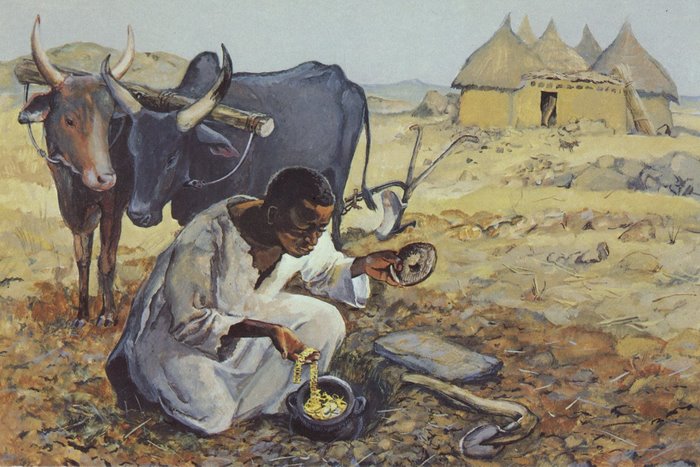
treasureNow, at least for me, things are starting to make sense. If the “hidden treasure” and the “costly pearl” represent the coming Kingdom of God, then “seeking first the kingdom” can be linked to searching for that “treasure” and selling all we own, that is, making all of our other priorities and concerns subordinate to the Kingdom.

However, Young also compares the treasure and the pearl to the cost of being a disciple, although, as we see, he believes we must make a choice between the two interpretations:

The cost of discipleship is actually a secondary theme supporting the theme of overriding passion for God’s reign. Jesus is consumed with a passion to see God’s rule realized. The kingdom is above all.

-ibid, pg 221

As a brief aside, I should mention that in Young’s opinion, it is the Kingdom, not the Church that is Christ’s “overriding passion” and the Kingdom is inexorably tied to the primacy of Israel in the redemptive and salvational plan of God.

So we must choose an interpretation for these parables: the value of the Kingdom or the cost of discipleship. Young has come to his conclusion but in the immortal words of Yogi Berra, “When you come to a fork in the road, take it.” In other words, is it too much to ask for both?

Yes, I’m suggesting (though not demanding) that Jesus could have inserted more than one meaning into his parables. However, based on other material Young included in his chapter, there may be even more going on in these parables.

The parables of the Hidden Treasure and the Pearl of Great Price have a rich background in Jewish tradition when viewed in the context of Torah learning. Accepting the kingdom meant entering into obedience to God and searching the deeper meaning of his revelation in Torah. The Gospels portray Jesus as a dynamic teacher; who raises up his disciples for total commitment in the kingdom of heaven. In Jewish thought, the recital of the Shema was the acceptance of the yoke of the kingdom, because one was making a declaration that one has chosen the LORD to the exclusion of all other gods, and God’s way of living life. Praying the Shema opened up communion with the one true God. Such devotion to God and God’s revelation in Torah was not without sacrifices.

-ibid, pg 206

ShemaThis paragraph is pregnant with possibilities. The plain meaning, as I take it, is that we can find both the value in Torah study as a means of learning obedience to God’s commandments and by performing them, gain entry into the kingdom, and the cost of discipleship and Torah study relative to the sacrifices one makes as a student of the Master and a servant of God.

In this regard, the story of R. Johanan is of interest, even though it first appears in sources from the Amoraic period. Rabbi Johanan and R. Chaya bar Abba were traveling from Tiberias to Sepphoris. As they passed through some of the most fertile land in the entire country, R. Johanan began to recall how he sold certain plots of land in order to finance his studies. The talmudic legend stresses R. Johanan’s sacrifice for Torah. Rabbi Chaya bar Abba is concerned that his friend will not have the resources necessary for his old age. But R. Johanan is filled with joy because he learned Torah. The exchange was well worth the sacrifice.

-ibid, pg 208

Rabbinic commentary is replete with examples of self-sacrifice for Torah study, with revered sages being depicted as living frugally if not in abject poverty, all for the sake of studying Torah. But these tales tend to give the impression, at least to the outsider, that Torah study was for its own sake rather than for the higher purpose of performing the mitzvot which would be pleasing to God. After all, if all one did was study without putting their knowledge into practice, is a person complete?

While I think we can reasonably infer that Jesus, as a teacher, expected his students to study and learn his teachings within the larger context of the Torah, he also expected them to go and do, spreading knowledge of the Kingdom of God among the lost sheep of Israel and afterward, the nations of the world (Matthew 28:19-20).

I know this once again brings up the question of Gentile disciples and the Torah. Certainly we are not forbidden study of the Torah nor even obligation to the mitzvot, but it is an obligation that has its own distinctive nature and indeed, we Gentiles in the ekklesia of Messiah have a distinct role that we must not abandon if the purposes of God are to be fulfilled through us.

I recently read an article that stated in part, “My friend Aaron just called “Messianic”, Messi-Antics. When I have said Messianic in the past, I mean someone that (sic) believes the Torah is God’s way of sanctifying His elect unto Himself, whether Jew or Gentile,” implying that there is only a single method of obedience to God through the Torah, and that Jew and Gentile were offered the self-same behavioral path of sanctification.

But it’s not performance of the mitzvot that makes us holy, especially mitzvot that are not apportioned to us. Above all else, if we don’t consider ourselves as separated from the values of the world by our faith, our repentance, our turning to God with a pure heart, our steadfast walk in continually desiring an encounter with God in prayer, then donning a tallit and laying tefillin won’t make much of a difference, even for a Jew. Nor will it matter if we call ourselves a “Messianic,” a “Christian,” or anything else. What we value isn’t a name, a label, or a brand, but rather sanctifying the Name of God.

Helping the HomelessYes, obedience, as I said above, is part and parcel with that sanctification of God’s Name and seeking first His kingdom, but obedience isn’t complicated. Most of the  time, it’s not even specific to role:

As a person who wants for nothing, it hit me pretty hard this morning to hear Homeless Shelter’s (name changed for privacy) plea for donations to help the homeless beat the heat. The Shelter believes that every person has a right to safe and adequate shelter and they’ve been sheltering, supporting, and advocating for homeless adults and children since 2005.

Donations are down this time of year because people think, “Hey, it’s warm out. They’re fine.” But as you know, triple-digit temperatures cause many problems. That is especially true for homeless adults and children. And it’s not just discomfort, but heat exhaustion and other serious illnesses.

So because we are a responsible company who likes to give back to our community, we’re collecting donations to help the Sanctuary help those in need.

By next Friday, July 18, please leave with the receptionist any of these much-needed supplies that we may take for granted.

I received that in a company email at my “day job” yesterday as a request for donations to a local homeless shelter. The person who wrote it wasn’t a manager but a regular employee who approached the charitable contributions committee where I work and asked if they would help her in fulfilling what she felt was a personal commitment to help the homeless. Fortunately, my employer is very community minded and thus, we’ve all been prompted to make various donations in cash or goods for the sake of people who have far less than we.

For when Gentiles who do not have the Law do instinctively the things of the Law, these, not having the Law, are a law to themselves, in that they show the work of the Law written in their hearts…

Romans 2:14-15 (NASB)

What is of value to God? Don’t we in some ways already know what to do to please Him, to obey Him?

This isn’t to negate Torah (Bible) study, since it is by study that our “instincts” to do good are refined and honed and we can not only feel but know what is right to do.

jewsSo far, all of the “different” interpretations of the parables in question seem to fit together. If the overarching commitment is to seek first the kingdom, that hidden treasure, that pearl of great price, then the means to do so is to study the Bible, to enter into discipleship, to subordinate all of our wants and needs to those goals, to perform acts of lovingkindness and mercy to our fellow human beings, even as God has been abundantly gracious and merciful to us. I’m less concerned about “looking Jewish” or having the wrong “religious label” than I am with buying a case of bottled water and various sun protection products and donating them to my local homeless shelter.

But beyond all of that, there is still another treasure to consider.

Clearly, these two parables (See Mekilta Derabbi Yishmael on Exod. 14:5) have a different reality behind their word-pictures than the Gospel parables of the Hidden Treasure and the Pearl of Great Price. Nevertheless, the images used in the colorful dramas as well as the action of the plot in each story are quite similar. The rabbinic parables illustrate the undiscovered treasure of the people of Israel, while the Gospel texts portray the intrinsic value of the kingdom and the cost associated with obtaining it.

The people of Israel became the precious treasure of God while the pharaoh of Egypt failed to comprehend the intrinsic value of the great nation he had released. By the same token, the disciple should recognize the intrinsic worth of the incomparable kingdom of God as he or she surrenders all to obtain it.

-Young, pp 212-13

Young compares the more traditional rabbinic parable of the treasure as the people/nation of Israel to the value of the kingdom of God and the cost of discipleship, but I want to take that comparison a step further. I want to say that we can bind these interpretations of value together, seeking first the kingdom, study of Torah, the cost of discipleship, and the preciousness of Israel. I think they’re interdependent. I don’t think you can separate them out into self-sustaining components.

For if you toss even one of those elements onto the trash heap, the rest will go with it.

Consider the recent abandonment of Israel by Evangelicals. Consider what I wrote about Yom Hashoah in the church. There is more than just human compassion in praying for the peace of Jerusalem. Even the Master said, “Salvation comes from the Jews” (John 4:22).

How can we seek first the kingdom? How can we search out the hidden treasure and then sell all we own to possess the pearl of great price? The kingdom isn’t just Torah study, nor is it just performance of the mitzvot (however we choose to interpret what “performance” means). It is also loving your fellow human beings and particularly loving and supporting your Jewish fellow human beings and the Jewish nation of Israel. That is the physical seat of the Throne of David and the center of Messiah’s Kingdom.

In order to assert that value, we “join the army,” so to speak, by making a commitment to Messiah as his disciples. We are students who learn by studying and by doing. We apply what we have learned by showing to others the mercy and kindness God has shown to us. Above all other nations, God has chosen to love Israel, so in that too, we must emulate the Almighty.

We are partisans or freedom fighters, declaring fealty to our Lord, holding our ground, defending his Land as he even now is on the journey to return and to re-claim that which is his own.

hopeAll of this constitutes the hidden treasure, the costly pearl. Am I saying in absolute terms that Jesus meant to imbue his two parables with the meaning I am assigning to them? No, of course not. How could I?

I am saying that a parable can contain more than one literal meaning. I am also saying that parables can be inspirational. Interpreting a parable is like interpreting a poem or an artistic painting. The reader or observer can often extract meaning from these works that the writer or painter never meant to convey. But the meaning is just as real and, in this case, I think, just as Biblical.

It’s what I hope to do with these “meditations” I write. I’m not just out to make some sort of theological point. I want what I write to inspire someone to do what they might not have done before, to entertain a thought that had never occurred to them before.

It’s quite possible that the Bible contains far more than we’ve given it credit for. I don’t mean to manufacture false interpretations or to add my own words to the Bible. However, I believe that the Spirit is with us when we read the parables of Jesus and the inspiration we feel when we consume his teachings goes far beyond just a series of words printed on paper, which is what they are without the Spirit.

Seek first the kingdom by seeking first the treasure beyond which all other treasures pale by comparison. Seek first God. His Spirit will provide all the wealth we will ever need.

Pray for the peace of Jerusalem and learn the true origins of the current (and historic) conflict between Jewish Israel and the Palestinian Arabs.

When Israel Asked for a King

“When Jacob came to Egypt, … your fathers cried out to the Lord, and the Lord sent Moses and Aaron, who brought your fathers out of Egypt and settled them in this place. But they forgot the Lord their God; so He delivered them into the hands of the Philistines, and into the hands of the king of Moab; and these made war upon them. They cried to the Lord, ‘We are guilty, for we have forsaken the Lord and worshiped the Baalim and the Ashtaroth. Oh, deliver us from our enemies and we will serve You.’ And the Lord sent Jerubbaal and Bedan and Jephthah and Samuel, and delivered you from the enemies around you; and you dwelt in security. But when you saw that Nahash king of the Ammonites was advancing against you, you said to me, ‘No, we must have a king reigning over us’ — though the Lord your God is your King.

“Well, the Lord has set a king over you! Here is the king that you have chosen, that you have asked for.

“If you will revere the Lord, worship Him, and obey Him, and will not flout the Lord’s command, if both you and the king who reigns over you will follow the Lord your God, [well and good]. But if you do not obey the Lord and you flout the Lord’s command, the hand of the Lord will strike you as it did your fathers.

1 Samuel 12:8-15 (JPS Tanakh)

A few days ago, I was studying Torah Portion Chukat on Shabbat. After finishing with the parashah, I turned in my Chumash to the Haftarah for Chukat, or so I thought. But instead of reading Judges 11:1-33, I inadvertently turned to the Haftarah for Torah Portion Korach, last week’s reading. You’d think I would have noticed reading the same Haftarah twice in a row but somehow I didn’t. I remarked to myself how interesting it was that we see the rise of the first (human) King over Israel in the Haftarah, and the fall of her greatest prophet and leader in the Torah reading.

Moses took the rod from before the Lord, as He had commanded him. Moses and Aaron assembled the congregation in front of the rock; and he said to them, “Listen, you rebels, shall we get water for you out of this rock?” And Moses raised his hand and struck the rock twice with his rod. Out came copious water, and the community and their beasts drank.

But the Lord said to Moses and Aaron, “Because you did not trust Me enough to affirm My sanctity in the sight of the Israelite people, therefore you shall not lead this congregation into the land that I have given them.” Those are the Waters of Meribah—meaning that the Israelites quarrelled with the Lord—through which He affirmed His sanctity.

Numbers 20:9-13 (JPS Tanakh)

King SaulOf course the connection I made between the two events was the result of a mistake, but it got me to thinking. Although God was to always be King of Israel, He did create a provision, should Israel “reject” Him as King, to place a human being, an Israelite, on the throne of the nation.

If, after you have entered the land that the Lord your God has assigned to you, and taken possession of it and settled in it, you decide, “I will set a king over me, as do all the nations about me,” you shall be free to set a king over yourself, one chosen by the Lord your God. Be sure to set as king over yourself one of your own people; you must not set a foreigner over you, one who is not your kinsman.

Deuteronomy 17:14-15 (JPS Tanakh)

But think about it. If Israel had been completely obedient to God in all things, they would never have asked for a man to be set over them as King and God would always have been (and would always be) King of Israel, making it the only fully functional theocracy ever to exist.

But without Saul being set over Israel as King, there would have been no King David, King Solomon, or a dynasty of Kings of the tribe of Judah and of David’s house.

And there would be no King Messiah.

Of course, if Israel had been obedient in all things, I suppose there’d be no need for a Messiah to return the exiled Jews to their Land, to rebuild the Temple, to restore the nation, and to defeat Israel’s enemies, since Israel would never have fallen and God would have always granted her great success, and she would have truly been a light to the nations.

But then what would have happened to Christianity? The Church wouldn’t exist at all. What would have happened to the Gentiles? Without Jesus, how could we be saved?

Interesting question.

I suppose this is where you get to say that God knew Israel would fall and fail and that the world would need a Savior, but what about free will? I mean, free will at least gave Israel a chance at succeeding. They made choices, and they certainly could have chosen to continually accept God as King.

But Christianity doesn’t believe in free will, at least the Calvinists don’t, so Calvinists would say that God programmed everything into the universe before He created it, thus mankind’s destiny was sealed before the creation of Adam and Havah (Eve) and before she ever gave birth to the first human to actually be born of woman.

lightBut in Orthodox Judaism, free will is accepted as the norm, and that humanity has free will in no way abrogates God’s absolute sovereignty over the universe.

So in Judaism, it was quite possible that Israel could have chosen continually to have God as King and not to demand a human King.

But as I asked before, if Israel had been obedient and remained obedient in not requiring a human being to be set as King over them, we would have no line of Israelite Kings, no King of the tribe of Judah and the house of David, which the Bible says the Messiah must come from.

There would have been (and would not be) no Messiah, at least in the body of Jesus Christ as lived, died, and lived in the first century CE. So what would have happened to us, to the Gentiles, if Israel never sinned?

Probably all of those New Covenant prophesies I’ve been talking about the past couple of weeks, such as the following.

Thus says the Lord,
“Preserve justice and do righteousness,
For My salvation is about to come
And My righteousness to be revealed.
“How blessed is the man who does this,
And the son of man who takes hold of it;
Who keeps from profaning the sabbath,
And keeps his hand from doing any evil.”
Let not the foreigner who has joined himself to the Lord say,
“The Lord will surely separate me from His people.”
Nor let the eunuch say, “Behold, I am a dry tree.”
For thus says the Lord,

“To the eunuchs who keep My sabbaths,
And choose what pleases Me,
And hold fast My covenant,
To them I will give in My house and within My walls a memorial,
And a name better than that of sons and daughters;
I will give them an everlasting name which will not be cut off.
“Also the foreigners who join themselves to the Lord,
To minister to Him, and to love the name of the Lord,
To be His servants, every one who keeps from profaning the Sabbath and holds fast My covenant;
Even those I will bring to My holy mountain
And make them joyful in My house of prayer.
Their burnt offerings and their sacrifices will be acceptable on My altar; For My house will be called a house of prayer for all the peoples.” The Lord God, who gathers the dispersed of Israel, declares, “Yet others I will gather to them, to those already gathered.”

Isaiah 56:1-8 (NASB)

“For I know their works and their thoughts; the time is coming to gather all nations and tongues. And they shall come and see My glory. I will set a sign among them and will send survivors from them to the nations: Tarshish, Put, Lud, Meshech, Tubal and Javan, to the distant coastlands that have neither heard My fame nor seen My glory. And they will declare My glory among the nations. Then they shall bring all your brethren from all the nations as a grain offering to the Lord, on horses, in chariots, in litters, on mules and on camels, to My holy mountain Jerusalem,” says the Lord, “just as the sons of Israel bring their grain offering in a clean vessel to the house of the Lord. I will also take some of them for priests and for Levites,” says the Lord.

Isaiah 66:18-21 (NASB)

“Thus says the Lord of hosts, ‘It will yet be that peoples will come, even the inhabitants of many cities. The inhabitants of one will go to another, saying, “Let us go at once to entreat the favor of the Lord, and to seek the Lord of hosts; I will also go.” So many peoples and mighty nations will come to seek the Lord of hosts in Jerusalem and to entreat the favor of the Lord.’ Thus says the Lord of hosts, ‘In those days ten men from all the nations will grasp the garment of a Jew, saying, “Let us go with you, for we have heard that God is with you.”’”

Zechariah 8:20-23 (NASB)

These are only a few examples of the aforementioned prophecies, but you get the idea. There’s no reason why they couldn’t have applied to the nations of the world coming alongside Israel without the existence of Messiah. We Gentiles would simply do what Israel did, worship Hashem, God of Heaven, praying directly to Him.

Up to JerusalemThe present and the future era of peace would look a lot more like how my friend Gene Shlomovich describes it.

Why is this important? Why am I (seemingly) playing a useless game of “what if”? Events occurred as they occurred, not as I’m supposing them to be. Israel did ask for a man to be placed over them as King, there was a King David who created, by the blessings of God, the Davidic dynasty of Kings of the tribe of Judah, and from whom Messiah, the righteous branch, has emerged.

Thus Christianity was created, separated from Judaism at an “early age,” and took off on a totally divergent course from its original path, the Jewish path.

I’ll give you another “what if”.

Yerushalayim, Yerushalayim, who kills the prophets and stones those who are sent to her! How many times I have desired to gather your sons like a hen gathers her chicks under her wings, but you were unwilling! Listen: your house will be abandoned for you, desolate. For I say to you, from now on you will not see me until you say, “Blessed is the one who comes in the name of HaShem!”

Matthew 23:37-39 (DHE Gospels)

A few years back, a fellow I admire and respect told me that up until the moment when Yeshua (Jesus) said these words, if Israel had repented of her sins, Yeshua would have initiated the Messianic Age right then and there, leading Heavens armies to defeat the Roman occupation and fulfilling all of the New Covenant prophecies, establishing the final Davidic Kingdom in the first century.

For the longest time, I didn’t believe him. I couldn’t imagine how the coming of the Messianic Kingdom nearly two-thousand years ago would work without the Gospel message first being spread throughout the nations of the world, allowing the Gentiles to repent and be saved.

Then, when I was studying on Shabbat, it hit me. There’s nothing in the Bible, the Tanakh (Old Testament) that presupposes Messiah must come once and then come again. That’s why we don’t see a stronger picture of the Messiah in the Torah and the Prophets (although he is certainly there). That’s why it isn’t abundantly obvious to all Jewish people who study the Torah and the Prophets that Jesus is the Messiah and that the Messiah must come twice.

That’s why it isn’t spelled out in the Old Testament that we must believe in the Messiah for our salvation.

This brings disturbing notions into the light, such as the idea that history is variable and could describe any number of different courses and still fulfill the plan of God for Creation. It also means we have a great deal more to do with what happens to us, not just as individuals, but as an entire species, than we’ve been led to believe in Christian theology and doctrine.

ancient_jerusalemI’ve heard it said that if all of Israel, each and every Jew, were to perfectly observe even a single Shabbat together, then the Messiah would come. Of course, I’ve also heard it said that Messiah will not come until Israel and mankind have reached the fullness of rebellion against God, but is it too much to believe that either situation could be true?

Regardless of the different roads through time I’ve suggested, the destination is the same. God will redeem His people, restore His nation Israel, and elevate Israel as sovereign over all of the other (Gentile) nations of the world. That part is a given.

This is the Torah, if a person dies in a tent…

Numbers 19:14

In old age, we continue to seek wisdom and comfort in study. I fondly remember visiting Dr. Louis Finkelstein, the Seminary’s fourth chancellor, in his final years. By then he had long been confined to his apartment by Parkinson’s. Each time, I found him sitting at his dining room table with a folio volume of Talmud open before him. He often quipped that he was grateful to God for letting him go from the bottom up, rather than from the top down. And when he died in his nineties, it was mainly because his infirmities had finally severed him from the elixir of his life. I loved his ever-radiant eyes. He personified for me the conviction of the Mishnah that as students of Torah age, their minds do not unravel. A life of the mind sustains our engagement and growth.

-Ismar Schorsch
“Torah Study — The Bedrock of Judaism,” pg 548, June 30, 2001
Commentary on Torah Portion Chukat
Canon Without Closure: Torah Commentaries

The Sages (Brochos 63b) state that the Torah only lasts with those who die over it. This seems very puzzling since the Torah is for living, as it states (Vayikra 18:5), “And you shall live with them (the commandments).”

When doctors told Rabbi Akiva Eger that he might not live much longer if he continued his intensive study of Torah, he replied, “If I study Torah, I may not live much longer; if I discontinue my studies of Torah, I certainly will not live much longer. Doubt must not prevail against certainty!” (Jewish Leaders, p. 111)

-Rabbi Zelig Pliskin
“Always find time to study Torah,” pp 343, 344
Commentary on Torah Portion Chukat
Growth Through Torah

I think this is one of the blessings of studying the Torah (the whole Bible, really) from my current perspective: being granted the ability to see God peeking out from behind the pages, peering through the spaces between the letters, and carefully revealing little bits and pieces not only of what could have been, but what actually will be.

I’ve asked before when Jesus returns, will we go to church as a way of really asking, when Jesus returns will there even be a church?

My answer, both then and now is “no.” “The Church” as it conceives of itself, especially in Evangelicalism, will not exist because it imagines itself as an entity directly in opposition to prophesy. All New Covenant prophesies describe Israel as the center of God’s vision and purpose in the final age, not a collection of (mostly) Gentiles ruling over the world, or worse, a bunch of (mostly) Gentile “floaty ghosts” (to paraphrase D. Thomas Lancaster) playing harps in an endless worship service in Heaven.

Of all the different ways Israel could have selected to respond to God, they all have a single result. God will restore Israel and consequently, the people of the nations (i.e. Gentile Christians) will come alongside Israel in obedience to God, in response to Israel’s King Messiah, and pay homage as vassal nations to the Sovereign Lord who will sit enthroned in Jerusalem.

The RabbiSelfishly, I look forward to that day, whether I see it in my mortal lifetime or in the resurrection, because I long for the days when a simple Gentile believer like me will have the opportunity to study Mishnah without it raising eyebrows (I wouldn’t even know how to go about it right now), when all of God’s servants will be able to find our lives in a “folio volume of Talmud open” before us. May that day come when King Messiah brings restoration and peace to Israel, and through his nation, peace for us all.

When Jesus Returns, Will We Go To Church?

Let us rejoice and be glad and give the glory to Him, for the marriage of the Lamb has come and His bride has made herself ready.” It was given to her to clothe herself in fine linen, bright and clean; for the fine linen is the righteous acts of the saints.

Revelation 19:7-8 (NASB)

Who or what exactly is the “bride” of “the Lamb”? It’s presumed to be “the Church,” that is, the collection of individual Jews and Gentiles who came to faith in Jesus (i.e. converted to Christianity) prior to the great tribulation and the rapture to Heaven. Under this presumption, anyone converting to Christianity after the rapture is considered a believer, but not part of the Church. They can never be part of the Church. Only the Church goes up to Heaven with Jesus and only the Church returns with him.

And I saw heaven opened, and behold, a white horse, and He who sat on it is called Faithful and True, and in righteousness He judges and wages war. His eyes are a flame of fire, and on His head are many diadems; and He has a name written on Him which no one knows except Himself. He is clothed with a robe dipped in blood, and His name is called The Word of God. And the armies which are in heaven, clothed in fine linen, white and clean, were following Him on white horses.

Revelation 19:11-14 (NASB)

According to Pastor Randy, the head Pastor at the church I attend (and if I’m remembering this wrong, I hope he’ll let me know), the “armies” returning with Jesus is the Church, who becomes the bride of Christ (“the Lamb”).

The idea of “the Church” has bothered me for quite some time. I finally gave my concerns a voice last April in a “meditation” called Notes on the Church from an Insomniac and followed it up with When is Church not Church, based on D. Thomas Lancaster’s article “Before the Church Was Called the Church”, published in the Spring 2014 issue of Messiah Magazine.

In the first century CE, faith in and worship of Jesus of Nazareth, Yeshua ben Yosef, HaMoshiach, was a fully recognized branch of Judaism along with other branches such as the Pharisees, Sadducees, Essenes, and so forth (although “the Way” was most closely related to Pharisaism, and except for the realization of Yeshua as Messiah and it’s rather liberal attitude toward admitting Gentiles, was likely indistinguishable from Pharisaism).

Obviously, much has changed in the intervening twenty centuries or so, especially starting in the second century when Gentile Jesus-believers radically separated from their Jewish mentors and any Jewish practice, in order to form a completely divergent religion for Gentiles called “Christianity”.

But now that the Church has been created, has it replaced Judaism in all of the New Covenant promises God made with Israel (for instance, in Jeremiah 31:27-40)? With the Church as the “Bride of Christ,” what becomes of Israel and the Jewish people?

Let’s take a giant step backward. First of all, the concept of “the Church” isn’t presupposed in the Bible. Did I just shock you? What about all of those references to “the Church” in the New Testament? Did I just miss all of the times the word “church” is printed (in English) in my Bible?

synagogue_arkAs I’ve mentioned before, the Greek word “ekklesia” cannot directly be translated as “church”. In fact, the word “church” didn’t really come into being until many centuries after the New Testament canonization. Generations of Jesus-believers lived and died before anyone actually thought of or said the word “church”.

So, does “ekklesia” mean the same thing theologically and conceptually as “church”? That’s the $64,000 question and the answer might not be in the New Testament.

Thus says the Lord,
“Preserve justice and do righteousness,
For My salvation is about to come
And My righteousness to be revealed.
“How blessed is the man who does this,
And the son of man who takes hold of it;
Who keeps from profaning the sabbath,
And keeps his hand from doing any evil.”
Let not the foreigner who has joined himself to the Lord say,
“The Lord will surely separate me from His people.”
Nor let the eunuch say, “Behold, I am a dry tree.”
For thus says the Lord,

“To the eunuchs who keep My sabbaths,
And choose what pleases Me,
And hold fast My covenant,
To them I will give in My house and within My walls a memorial,
And a name better than that of sons and daughters;
I will give them an everlasting name which will not be cut off.
“Also the foreigners who join themselves to the Lord,
To minister to Him, and to love the name of the Lord,
To be His servants, every one who keeps from profaning the sabbath
And holds fast My covenant;
Even those I will bring to My holy mountain
And make them joyful in My house of prayer.
Their burnt offerings and their sacrifices will be acceptable on My altar;
For My house will be called a house of prayer for all the peoples.”
The Lord God, who gathers the dispersed of Israel, declares,
“Yet others I will gather to them, to those already gathered.”

Isaiah 56:1-8 (NASB)

“For I know their works and their thoughts; the time is coming to gather all nations and tongues. And they shall come and see My glory. I will set a sign among them and will send survivors from them to the nations: Tarshish, Put, Lud, Meshech, Tubal and Javan, to the distant coastlands that have neither heard My fame nor seen My glory. And they will declare My glory among the nations. Then they shall bring all your brethren from all the nations as a grain offering to the Lord, on horses, in chariots, in litters, on mules and on camels, to My holy mountain Jerusalem,” says the Lord, “just as the sons of Israel bring their grain offering in a clean vessel to the house of the Lord. I will also take some of them for priests and for Levites,” says the Lord.

Isaiah 66:18-21 (NASB)

“Thus says the Lord of hosts, ‘It will yet be that peoples will come, even the inhabitants of many cities. The inhabitants of one will go to another, saying, “Let us go at once to entreat the favor of the Lord, and to seek the Lord of hosts; I will also go.” So many peoples and mighty nations will come to seek the Lord of hosts in Jerusalem and to entreat the favor of the Lord.’ Thus says the Lord of hosts, ‘In those days ten men from all the nations will grasp the garment of a Jew, saying, “Let us go with you, for we have heard that God is with you.”’”

Zechariah 8:20-23 (NASB)

Then it will come about that any who are left of all the nations that went against Jerusalem will go up from year to year to worship the King, the Lord of hosts, and to celebrate the Feast of Booths. And it will be that whichever of the families of the earth does not go up to Jerusalem to worship the King, the Lord of hosts, there will be no rain on them. If the family of Egypt does not go up or enter, then no rain will fall on them; it will be the plague with which the Lord smites the nations who do not go up to celebrate the Feast of Booths. This will be the punishment of Egypt, and the punishment of all the nations who do not go up to celebrate the Feast of Booths.

Zechariah 14:16-19 (NASB)

“It will come about after this
That I will pour out My Spirit on all mankind;
And your sons and daughters will prophesy,
Your old men will dream dreams,
Your young men will see visions.
“Even on the male and female servants
I will pour out My Spirit in those days.

“I will display wonders in the sky and on the earth,
Blood, fire and columns of smoke.
“The sun will be turned into darkness
And the moon into blood
Before the great and awesome day of the Lord comes.
“And it will come about that whoever calls on the name of the Lord
Will be delivered;
For on Mount Zion and in Jerusalem
There will be those who escape,
As the Lord has said,
Even among the survivors whom the Lord calls.”

Joel 2:28-32 (NASB)

Sorry for the lengthy series of quotes. I wanted to present a representative collection of scriptures (though hardly exhaustive) illustrating how the Old Testament depicts Gentile involvement in the “end times” and/or Messianic Age, coming alongside Israel and turning toward God.

RestorationIf I were to set aside the New Testament and concentrate on the scriptures in the Prophets, the image of Gentile worship of God becomes radically different from what we’ve been typically taught by the Church. There are a number of references to “survivors” of the Gentile nations who went up against Israel and who were defeated. There’s at least the suggestion of some sort of judgment against these Gentile nations and consequences for their behavior.

We also see Gentiles being gathered to witness the glory God bestows upon Israel and particularly Jerusalem, as well as statements illustrating Gentile observance of a weekly Shabbat, New Moon Festivals, and the Moadim (appointed times, sometimes referred to as the “Jewish festivals”) for those of us who have held tightly to His Covenant.

But where is “the Church?”

The Christian theology of Progressive Revelation states that from the past to the future in Biblical history, God revealed progressively more about Himself. This means the newer sections of the Bible contain much more information about God and His plan for Israel and humanity than earlier sections. This would lead most of us to conclude that we can “trust” the New Testament more than the Old, thus as Christians, our primary source of information about what to expect from God in the present and future should be the apostolic scriptures.

And yet, just yesterday, I reviewed an article written by Paul Meier called “Christian Theology and the Old Testament” published in Messiah Journal which solemnly described the severe dangers of taking a low view of the Old Testament and relying on the New Testament as our primary source for theology and doctrine. A low view of the Old Testament results in a low view of the Jewish people and the Jewish nation, Israel.

And yet, we rely a great deal on the New Testament to help us interpret and clarify many things we don’t understand about the Old Testament, including our understanding of how the New Covenant is being and will be applied to Israel and the nations. But are the New Testament scriptures really the problem, or is it merely how we choose to treat them relative to the Old Testament and the overarching message of the entire, unified Bible?

Progressive revelation teaches us that later parts of the Bible are more important, clearer, and better than the Older scriptures, but they are all Hebrew scriptures and the later parts cannot stand alone. They must be supported on the foundation of the earlier scriptures and later writings cannot and must not contradict earlier parts.

That’s where we have our problem.

The Old Testament is unequivocally clear that God has had a covenant relationship with Israel for many thousands of years and never has intended to abrogate that relationship. God may discipline Israel from time to time for disobedience, but the New Covenant language is extremely plain in its intent to create an environment within the Jewish heart and spirit that will result in individual Jews and corporate Israel being able to perfectly obey God through the Torah mitzvot and to know God, from the lowest to the highest Jewish person, in the manner of the Biblical prophets.

Unless God changed His mind or He’s a duplicitous liar (and God doesn’t change and doesn’t lie for He is truth), then anything in the New Testament that contradicts what I said in the previous paragraph must be erroneous interpretation on the part of the Church.

prayingSo what do we have? In the Old Testament, we have many, many examples of Gentiles from the nations choosing to join alongside Israel to go up to Jerusalem because the Jewish people are well-known to be close to God. Therefore, a Gentile can also become close to God by attaching themselves to Israel (which makes us “attached” or “grafted in” but not Israel itself).

But how do we do that and why does it work?

We know that based on one particular aspect of the Abrahamic covenant (Genesis 12:1-3, Galatians 3:15-16, Ephesians 3:1-13), by faith in the “seed of Abraham,” that is Messiah, Son of David, the people of the nations can also benefit from the New Covenant blessings (holding fast to the Covenant), and through adoption, be called “Sons”, and enjoy forgiveness of sins, redemption, salvation, entrance into the Kingdom of God, resurrection, and life-everlasting in the World to Come at the end of all things.

That’s pretty terrific.

However, if you’re a Christian, there’s a problem. Where does “the Church” come in?

What is the Church, or more to the point, what is the ekklesia of Messiah? In the first century, it was a Jewish religious stream whereby, through the inauguration of the New Covenant era by the death (blood) and resurrection of Jesus (Yeshua), as a promise of things to come, Gentiles who came to faith in the God of Israel through discipleship in Messiah, were able to receive the Spirit of God (starting in Acts 10) as did the Jewish disciples and apostles (Acts 2), receive legal standing as equal co-participants in the Jewish stream of “the Way” (Acts 15) and in this ekklesia, form “one new man” (Ephesians 2) made up of Israel, the Jewish people, and the “people of the nations who are called by My name” (Amos 9:12).

It is said that in Messianic days, God will establish a reign of peace and that the whole world will be united together, Jew and Gentile alike (Micah 4:1-5, Isaiah 11:1-10). I see the ekklesia of Messiah, especially in the first century, as an example of that Kingdom of unity and peace in microcosm. The so-called “Church” was supposed to be an example, a picture, and foretelling of what is to come in the Age of Messiah, when Jews and Gentiles really will have peace with one another under the rule of King Messiah, with Israel as the head of all the nations, and Jerusalem as the Holy City, raised high above all other cities and nations (so imagine how I see true Messianic Jewish synagogues, such as Beth Immanuel, with Jewish and Gentile members worshiping together, relative to a prophetic, Messianic future).

Thus the first century ekklesia wasn’t just another Judaism or some sort of expression of a new theology, it was, and I think will be again, the ultimate realization of God’s overarching plan for Israel and the entire world, to return the planet and everyone and everything on it to complete obedience and consistency with the nature and character of the God of Creation, the way it was in Gan Eden (the Garden of Eden) before the fall.

That means it is impossible for “the Church” to represent a subset of humanity all sanitized of their distinctions, especially distinctions that define Jewish Israel, because in the end, there will only be one body of people: Jews and Gentiles, one-hundred percent of humanity, all devoted to God.

But wait a minute. What about “survivors” and those people who went up against Israel and God, who are to be judged, and who will have consequences delivered upon them? That hardly describes “one humanity” under God.

True. There will be many, many Gentiles (or maybe just a few considering they’re called “survivors”) who up until the point where Messiah and Israel win and the rest of the world is subjugated under an Israel ruled by Messiah, are not of God’s people. They have chosen to be apart. But does that mean they can never join the ekklesia, the vast collection of Jews (Israel) and Gentiles (the rest of the nations everywhere on Earth)?

Why would it mean that? Is teshuvah limited? Under Messiah’s rule, can no one repent? Is that the hard line in the sand?

praying at the kotelAnd what will that world-wide ekklesia look like? It makes sense, based on more prophecies in the Tanakh than I can count, that the Jewish people still in exile will all be returned to and live in the physical nation of Israel. The majority of the human race who are also part of the ekklesia, the vassal nations all aligned with Israel as their head, will periodically go up to Jerusalem for festivals, to pay homage to the King, to pray at the Temple, but we’ll still live in our homes in the nations of the world.

How many religions will there be? If it’s still possible for people to willfully disobey God, there could still be a lot of religions and a lot of denominations within individual religious, but there will be one and only one way to worship God. It is said that one of the things Messiah will do in the Messianic Age is to teach the correct interpretation of Torah and even teach the hidden things of Torah, that which we cannot perceive or understand in the present age. I conclude based on that understanding, that Messiah will show Jews and Gentiles the proper way of prayer, worship, and devotion for Jews and for Gentiles.

I imagine there’ll be a lot of overlap between those two general populations who are under Israel’s God, but I also imagine that there will be distinctions, not the least of which is the fact that Israel will finally, truly be a wholly Jewish nation.

What will that body or religion (or will the term “religion” have much meaning when Messiah is King and we all “know God” because the Spirit has been fully “poured out on all flesh”?) look like? My personal opinion is that it will not be called “Church,” crosses will no longer be prominently displayed by Gentile devotees of God, Sunday will no longer be the primary day of worship, and if I read the Tanakh correctly, pork and shellfish will no longer be on our menus, we all will rest on Shabbos, observe New Moon festivals, and plan our vacations around the Moadim so we can present sacrifices and pray at the Temple in Jerusalem.

That sounds a lot more like a Judaism than any form of Christianity.

I’ve been planning on writing something like this for quite some time, but got a little push yesterday (today, as I write this), by reading an article written by Caleb Hegg at the TorahResource Blog and reblogged by Judah Himango at Kineti L’Tziyon called “Is Messianic Judaism Really a Part of Modern Judaism?”

I tend to take a different view on things than Mr. Hegg, and although I don’t possess the same background as he does, I must disagree regarding whether or not Messianic Judaism can be qualified as a modern Judaism. I know. A lot of people, both Christians like Mr. Hegg and most Jewish people, religious and otherwise, disagree with me. That’s to be expected. I haven’t done much in the way of research on this topic, so I can only guess folks will come along and attempt to poke holes in my arguments.

shabbosBut I’ve written not of what Messianic Judaism is today, but what I believe the world-wide, multi-national ekklesia will be in the days of King Messiah. As I mentioned above, if you have to assign a “religious” designation to that future ekklesia, given the Biblical prophetic record of the Messianic Age and the realization of the New Covenant as it reaches fruition, it will not be the Church. If we have to call it anything at all, it will be a Judaism.

The word “Messianic” is not simply a Hebrew-based way to say “Christian.” Messianic Judaism is the Judaism of the Messianic Era, practiced today.

-Aaron Eby
as quoted from Facebook

As a non-Jewish member of the ekklesia of Messiah, and summoning the future Kingdom of God, at least a little bit, into our present world, I wish you all a Good Shabbos, which also foreshadows the Kingdom to come.

Addendum: A few months ago, I wrote a blog post somewhat similar to this one called The Church When Jesus Returns, but I didn’t take my point as far as I have on the current “meditation.” I still think they “fit” together, though.

Briefly Revisiting Gentiles and the New Covenant

I see this has gotten out of hand.

I debated a long time before putting my fingers on the keyboard, but in the end, I can’t allow this misunderstanding to go unanswered.

It has been said by one individual that I believe Gentiles (i.e. Christians) are excluded from the New Covenant. Frankly, as the kids say, “that’s crazy talk.” Nevertheless, my recent blog posts Unity in Messiah: A Commentary on One Law and the Gentiles and Walking in the Dust of the Footsteps of Moshiach have inadvertently made me and my blog something of a minor lightning rod. That was hardly my intent.

I wrote these blogs, first of all, to speak of and expand upon some of the concepts behind a recent commentary on Torah Portion Shelach published online by First Fruits of Zion (FFOZ). Actually, that was the motivation for the first blog post. I wrote the second in response to some online misinterpretation of my intent and motives, but that only made things worse.

It seems I need to restate my beliefs about the New Covenant and the place of the nations in relation to Israel. That won’t be easy to contain in a single blog post, since the information is vast. It took me eleven or twelve blog posts to work through my original investigation and D. Thomas Lancaster covered the New Covenant material in five sermons on four CDs in his What About the New Covenant series.

Here’s the “Reader’s Digest” version:

“Behold, days are coming,” declares the Lord, “when I will make a new covenant with the house of Israel and with the house of Judah, not like the covenant which I made with their fathers in the day I took them by the hand to bring them out of the land of Egypt, My covenant which they broke, although I was a husband to them,” declares the Lord. “But this is the covenant which I will make with the house of Israel after those days,” declares the Lord, “I will put My law within them and on their heart I will write it; and I will be their God, and they shall be My people. They will not teach again, each man his neighbor and each man his brother, saying, ‘Know the Lord,’ for they will all know Me, from the least of them to the greatest of them,” declares the Lord, “for I will forgive their iniquity, and their sin I will remember no more.” (emph. mine)

Jeremiah 31:31-34 (NASB)

The direct objects of the New Covenant are the House of Judah and the House of Israel, the descendants of the object of the Sinai Covenant, the Israelites. The nations are not mentioned in the New Covenant language so they (we) are not directly connected. Then how are we involved at all? Consider the Abrahamic Covenant:

  1. Genesis 12:1-3 – God promises to make Abraham into great nation, bless those who bless him and curse those who curse him, and all peoples on earth would be blessed through Abraham.
  2. Genesis 15:18–21 – God promises to give Abraham’s descendants all the land from the river of Egypt to the Euphrates, and this area is later referred to as the Promised Land or the Land of Israel.
  3. Genesis 17:2–9 – God promises to make Abraham a father of many nations and of many descendants and the land of Canaan as well as other parts of Middle East will go to his descendants.
  4. Genesis 17:9-14 – God declares that circumcision is to be the sign of the covenant for Abraham and all his male descendants and that this will be an eternal covenant.

Abraham and the starsNotice that only portions of the first and third condition have anything to do with any other people besides Abraham’s descendants through Isaac and Jacob. The first condition promises that “all peoples on earth” will be blessed through Abraham, and the third condition states that Abraham would be a father of many nations. Of course that last part speaks to the wives of Abraham and the children he had with them after Sarah died, so that condition doesn’t really figure into how all of earth’s people will be blessed.

Brethren, I speak in terms of human relations: even though it is only a man’s covenant, yet when it has been ratified, no one sets it aside or adds conditions to it. Now the promises were spoken to Abraham and to his seed. He does not say, “And to seeds,” as referring to many, but rather to one, “And to your seed,” that is, Christ.

Galatians 3:15-16 (NASB)

We have to go to the apostolic scriptures and Paul’s epistle to the Galatians to understand how to interpret Genesis 12:1-3, but we see that the blessing to the nations comes through Messiah. He is the “mechanism” by which we Gentiles may be “grafted in” to the promises, not making us Jewish converts without a bris, but beneficiaries of the blessings such that we too can approach God as sons and not strangers (Ephesians 1:4-5).

lightSome things have been said about me ignoring that Israel is to be a light to the nations (Isaiah 49:6). The idea is that the Gentiles were to be attracted to that light (Deuteronomy 4:6) and then be prompted to join the nation, assimilating into the tribes and clans and becoming one with Israel.

I refer you back to FFOZ’s One Law and the Gentiles article for the details about what it was to be a “Ger” both in the days of Moses and in the time of the apostles.

Well over a year ago, I wrote Building My Model, which was my prior attempt at summarizing Gentile inclusion in the New Covenant. I reduced everything down to five points:

  1. God creates a provision in his covenant with Abraham that allows the Gentiles to be blessed through Messiah (Abraham 12:1-3).
  2. The New Covenant (Jer. 31, Ezek. 36) renews, affirms, and amplifies all of the previous covenants God made with the people of Israel and the people of Judah which, by definition, includes the Abrahamic covenant.
  3. Messiah alludes that the (new) covenant is poured out in his blood (death), (see Mark 14:22-24, Luke 22:19-20) for all people.
  4. Paul interprets the Abrahamic covenant provision referring to Gentiles as Messiah being our connection to God (see Galatians 3:15-16).
  5. Paul describes the process of Gentiles being made co-heirs to the Messianic promises through Messiah as a mystery (Ephesians 3:1-13).

There are multiple portions of the Prophets that mention Gentiles, the Temple being a house of prayer for all peoples, Gentiles holding fast to observing the Shabbat and the Festivals, and ten men of the nations taking hold of the fringes of a Jewish man’s clothing to go with him and to be near to God.

All of those passages speak to Gentile involvement alongside Israel in being devoted to God in the future Messianic Age, but in sending the Messiah the first time, God sent a message and a gift, a foreknowledge and guarantee of the coming Kingdom and confirmation that God will fulfill all of the New Covenant promises.

The coming of the first Gentiles into relationship with God by receiving the Spirit (Acts 10) just as the Jews did (Acts 2) is one of the signs of that promise and guarantee. The prophesies of Joel (Joel 2:28) must have come to Peter’s mind as he saw Cornelius and his household receive the Spirit, and when Paul, as Messiah’s emissary to the Gentiles, brought vast numbers of former goyishe idol worshipers to the God of Israel through faith in Yeshua, it must have seemed as if the Messianic Age was close to fruition, and that the New Covenant times were about to burst into completion.

That hasn’t happened yet, but we are in the midst of that process. The fact that Gentiles continue to be drawn to Messiah by the Spirit and to desire to learn about the Jesus of the Jewish scriptures is clearly a sign. Of course, we Gentiles are involved in the New Covenant, but only through Israel for the Master said “salvation comes from the Jews,” (John 4:22).

I’ve tried to compress a great deal of information about a very complex topic into one short article and I hope I’ve been successful. For a more complete picture of my understanding of the New Covenant, go through my eleven part series, starting with part one: The Jesus Covenant: The Foundation, and then click through the subsequent parts until you get to the end. Afterward, you should also read Gifts of the Spirit Poured Out on all Flesh which filled in one last piece of my investigative puzzle.

early_morning_skyI hope this puts a few frenzied souls to rest. I also want to remind everyone reading my blog that my opinions are solely my own. I may quote from First Fruits of Zion and similar resources, but that doesn’t mean I work for them or am their “mouthpiece.” I also quote from Aish.com and Chabad.org but that doesn’t make me an Orthodox Jew or Chabadnik. Like any researcher, I utilize different sources to support my commentaries. You can bug organizations like the UMJC if you want, but I am not affiliated with them in any way so my comments should not be taken as representing them. Nor do they (or any other organization) have the ability to censor or repudiate me.

Now will people please calm down? It’s OK to disagree, but any level of adult emotional maturity should enable a person to have differences of opinion with others without personalizing conflict. Otherwise, all we’re doing is engaging in “spitting contest” and I hardly think that sort of behavior is for the sake of Heaven.

“The world doesn’t care how many times you fall down, as long as it’s one fewer than the number of times you get back up.”

-Aaron Sorkin, American screenwriter

Thanks.

Unity in Messiah: A Commentary on One Law and Gentiles

As for the assembly, there shall be one statute for you and for the alien who sojourns with you, a perpetual statute throughout your generations; as you are, so shall the alien be before the LORD. There is to be one Torah and one ordinance for you and for the alien who sojourns with you.

Numbers 15:15–16

But does the Torah really make different laws for Jews and Gentiles? According to Numbers 15:15–16, there is to be only one law for both Jews and Gentiles.

This seems simple enough. According to these verses, there is one law for both Jews and Gentiles. Therefore, Gentile believers should keep the whole Torah.

But wait. It’s not that clear.

“One Law and the Gentiles”
Commentary on Torah Portion Shelach
First Fruits of Zion (FFOZ)

I quoted from this article just the other day as an example of what sometimes provokes other believers to anger and how I want to avoid being excessively and needlessly provocative. While the “One Law” issue is a “non-event” for the vast majority of the Christian world, this is a “hot button” issue in certain small (relative to the overall body of believers worldwide) religious circles in the blogosphere.

But then, I’ve been thinking about an ad I received by email recently. Eichers.com has extended its annual Talis and Tzitzit sale to June 24th. As I read the advert, I found myself involuntarily pining for the days when I used to actually don a tallit to pray.

Then my reality check came in and I closed the ad, but not before I started pricing tallit gadolim (just “window shopping”).

Many years ago, my wife arranged for a friend who was visiting Israel, to purchase my first tallit at the Galilee Experience. It was a total surprise when it arrived from Israel by mail and my wife presented it to me.

But that was a long time ago, and to put it mildly, my wife’s attitude about Christians and tallitot has changed considerably. For that matter, so has mine.

I don’t really regret the “course correction” I’ve instituted in my life, but I do need periodic reminders of who I am and what I need to be doing that’s important to God in order to counterbalance my attraction to various aspects of Judaism as a worship practice. Really, if I had my “druthers” and it didn’t matter to God (or anyone else, especially the Missus) one way or the other, comparing evangelical Christian worship and study to a (Messianic) Jewish template, I’d probably choose Jewish practice.

In any conceivable way, nothing would be removed from my devotion to Yeshua (Jesus), but a richness in spiritual texture and connectedness to the people of God that extends all the way back to Sinai would be the platform and environment for that devotion.

I know that if any Hebrew Roots people with a bent for “One Law” ever read this, they’d probably say, “go for it!”

But, no. I have good reasons not to. It’s not my world and my practice. God chose the Jewish people for a reason and He gave them the Torah as the conditions of the Sinai covenant for a reason. Then He made it possible through the emergence of the New Covenant for Gentiles to be grafted in, and provided conditions for we grafted in Gentiles in a binding legal ruling that outlines a distinction in how Gentile disciples are obligated to the Torah.

I can live with that, knowing that we Gentiles have a unique role in supporting Messianic Jewish return to Torah and in perfecting the world in preparation of Messiah’s return.

women_praying_at_the_wallAlso, living with a Jewish wife and daughter, I have a special appreciation for their own uniqueness as Jews and how my mimicking Jewish behavior in some sort of evangelical Jewish cosplay cheapens who they are and totally misrepresents me and all other Gentile disciples of the Master.

It was also no coincidence (in my opinion) that Chabad.org’s “mitzvah minute” email was on Tzitzit: Fringe Judaism this past week.

Most people don’t think of Judaism as a fringe religion. Yet that’s our uniform. Under their shirts, Jewish men and boys wear a poncho called a tallit katan (literally: small cloak), with fringes hanging from each corner, just as the Torah prescribes (Numbers 15:37–40), “They shall make fringes on the corners of their garments . . .”

That’s “Judaism,” not Christianity that wears the fringes. I’m not a thief. I don’t take things that belong to someone else. Donning a Tallit Gadol for prayer belongs to someone else…Jewish people.

Jacob Milgrom contends that in the ancient Near East the ornateness of the hem was a mark of nobility. Hence the wearing of tzitzit denoted that all Israelites were members of a priestly nation with a universal mission. That status and its attendant obligations rest on God’s deliverance of Israel from slavery, as the passage makes clear at the end: “I the Lord am your God who brought you out of the land of Egypt to be your God: I, the Lord your God.” (Numbers 15:41)

-Ismar Schorsch
“The Distinction between History and Memory,” pg 522 (June 16, 2001)
Commentary on Torah Portion Shelach
Canon Without Closure: Torah Commentaries

I assume D. Thomas Lancaster wrote the small article on “One Law and the Gentiles” and in referencing Numbers 15:15-16, he says:

First of all, the context deals not with the application of Torah as a whole, but specifically with the sacrifices. In other words, if an alien wanted to offer a sacrifice in the Temple he needed to follow the same Torah guidelines as the Israelite. The passage is not saying that all the laws of Torah apply equally to Jews and Gentiles.

Second, by the time of the apostles, the word translated as “alien” (ger, גר) was no longer understood as just a Gentile non-Jew. The Hebrew word had shifted its semantic value to refer specifically to a Gentile who had gone through a full, legal conversion to become Jewish, i.e., a proselyte. That conversion process included circumcision, immersion, and a sacrifice. That’s how the Greek version of the Torah (lxx) translates the word too. That’s probably how the apostles would have understood it.

Interestingly enough, Lancaster (I presume) says the Didache actually agrees with the surface reading of Numbers 15:15-16:

If you are able to bear all the yoke of the Lord [i.e., Torah], you will be perfect; but if you are not able, do as much as you are able to do. (Didache 6:2)

Wait a minute! What just happened? Did Lancaster say that the Didache supports an identical application of the Torah mitzvot on both Jewish and Gentile disciples of Jesus?

The Didache agrees with Numbers 15:15–16. There is not supposed to be a different Torah for Gentile believers. The Gentile believers are not supposed to have a different type of worship or religion. There is only one Torah for God’s people. The only question left open is to what extent the Gentile believer is obligated. Most of the laws of the Torah apply equally to Jewish and Gentile disciples of Yeshua.

On the other hand, Gentile believers are not obligated to keep all of the ceremonial laws as the Jewish believers such as circumcision and other distinct markers of Jewish identity like the calendar, the holy days, the dietary laws, and so forth. Despite that, the Bible does not create alternative Gentile versions of these institutions.

In the days of the apostles, the Gentile believers kept most of those things along with the Jewish believers as part of their participation in their shared religion.

The Torah, the conditions for the Sinai covenant, are the same conditions for the New Covenant. God didn’t re-write the conditions, just the material upon which they are written, on paper and tablets formerly, but later, on the human heart.

sefer-torahSo Torah applies to all who come under the New Covenant. The only question is how the roles and applications differ between those who entered into covenant with God at Sinai vs. those of us who were later grafted in, that is, between Jews and Gentiles.

Lancaster ended his small write-up by saying that in the apostolic era, it was likely the Gentile disciples, especially those embedded in Messianic Jewish synagogues in the diaspora, would have appeared much more Jewish than we Christians do today. Their practice and observance would have been modeled on their mentors, and as Lancaster mentioned, the Didache seems to support this view and was formally taught to newly-minted non-Jewish disciples.

So where does that leave me? Right where I am.

If I lived in a different environment, if my wife was Messianic, if a thousand other things were changed, how I outwardly worship God would probably not look the same as it does now. But there are no “what ifs” in God’s creation, there is only here and now and what is real.

What matters about discipleship and devotion to the Master is doing the will of God. I pray. I study. I worship in fellowship. I perform many of the mitzvot in the Torah such as giving charity to the poor, providing food for the hungry, visiting the sick, comforting those who grieve.

The message of the Good News of Messiah changes not at all for the Jew or the Gentile, and the coming of the Kingdom alters not one little bit for the descendants of Israel or the people of the nations. In fact, being a devoted Gentile who has fully apprehended a Messianic world view and perception of the Bible makes me a lot more valuable to the cause of Christ for Jewish and Christian people than if I felt that I would only be on God’s “approved list” if I looked and acted “Jewish”.

I know parts of what I’ve written will make certain people unhappy, but please remember, I’m not telling you or anyone else what to do, I’m just talking about who I am and what I need to do. I can’t allow how others view me to affect what I must do and refrain from doing before God.

The Kotzker Rebbe said that the mistake of the spies was in the words “and so we were in their sight.” It should not bother a person how others view him. (Otzer Chayim)

A person who worries about how others view him will have no rest. Regardless of what he does or does not do he will always be anxious about receiving the approval of others. Such a person makes his self-esteem dependent on the whims of others. It is a mistake to give others so much control over you. Keep your focus on doing what is right and proper.

-Rabbi Zelig Pliskin
from his commentary on Torah Portion Shelach (pg 330)
Growth Through Torah

There is “one law” but it is applied differently, even within formal Judaism, depending on who you are. It’s applied differently also for the Gentile. There is One God who is God of all. There is one Messiah who brings salvation to the world. There is one Kingdom waiting for the devoted to enter. There is one world to come where we will return to the Garden, because that’s where it all began.

If that’s not unity in Messiah, what is?

intermarriageFinal note: distinctiveness in identity and practice does not mean dissolution, disagreement, or disconnection. My wife and I are obviously different as man and woman, and we are different as Christian and Jew. Nevertheless, we are a family together with our children and grandson, and we share strong connections within that context. The same can be said for the Messianic community of Jews and Gentiles. We form a unity not in spite of our differences, but because of them. That is the beauty of “one new man” (Ephesians 2:15). You are changed, not in terms of ethnicity, nationality, or obligation, but because, men and women, Jew and Gentile, no matter how one differs from another, we are all interconnected in Messiah, may he come soon and in our day.

Addendum: See the “sequel” to this “meditation”: Walking in the Dust of the Footsteps of Moshiach.

Sermon Review of the Holy Epistle to the Hebrews: Faith Toward God

Therefore leaving the elementary teaching about the Christ, let us press on to maturity, not laying again a foundation of repentance from dead works and of faith toward God, of instruction about washings and laying on of hands, and the resurrection of the dead and eternal judgment.

Hebrews 6:1-2 (NASB)

The second elementary teaching of the Messiah in Hebrews 6:12 is called “faith toward God,” but how is this distinct from other first-century sects of Judaism? Even the Sadducees believed in God. Find out how Yeshua transformed the faith of his followers, and get a fresh handle on what it means to “believe in Jesus” and to be “born again.”

-D. Thomas Lancaster
Sermon Twenty: Faith Toward God
Originally presented on June 15, 2013
from the Holy Epistle to the Hebrews sermon series

Apparently I was premature last week in writing No One Comes to the Father Except Through the Son, because Lancaster tells the same parable I referenced in that blog post in today’s sermon. I should have guessed when the chapter of Elementary Principles I quoted from was called “Faith Toward God”.

Fortunately, there are many other details revealed by Lancaster within the context of his “Faith Toward God” lecture. Here’s what I mean.

Remember, we’re studying the elementary principles of the faith, the very first things one must absolutely grasp as disciples of Jesus, the “milk,” the really simple stuff, the basic “food” you must consume and get used to before you’re ready for “meat.”

But doesn’t “faith toward God” seem a little too elemental? I mean saying “have faith in God” is like saying “God made the Earth” or “the Torah was given through Moses.” How did having faith in God distinguish the Jewish religious stream of “the Way” from all the other Judaisms of their day? All of the Judaisms, no matter how they otherwise differed, had faith in the existence of God.

In fact, the Way and the Pharisees had almost identical beliefs. They both believed in the resurrection, they both believed that God rewards good and punishes evil in this life and the life to come, they both believed that you had to repent to be forgiven of sins.

Apparently though, the Greek we translate as “faith in God” or “faith toward God” is better rendered “faith ON God” or “faith UPON God,” implying a sort of reliance.

Later in the epistle, the writer of Hebrews defines faith, which should help us solve our small mystery:

Now faith is the assurance of things hoped for, the conviction of things not seen. For by it the men of old gained approval.

Hebrews 11:1-2 (NASB)

faithYou probably have that one memorized. But although I’ve read it many times, the meaning of these two verses seems rather vague, or they did until I heard Lancaster’s explanation.

Here’s the key to understanding how a Messianic faith on God would be different from that of a Pharisaic faith or the faith of any other branch of first century Judaism:

And without faith it is impossible to please Him, for he who comes to God must believe that He is and that He is a rewarder of those who seek Him.

And all these, having gained approval through their faith, did not receive what was promised, because God had provided something better for us, so that apart from us they would not be made perfect.

Hebrews 11:6, 39-40 (NASB)

In case you’re still wondering what all that means, here’s Lancaster’s parable, which I referenced last week, to provide clarification:

Once, a man who had two daughters went off to war. Before he left, he promised to return to them, and he also promised them, “When I return, I will bring you each a fine string of pearls and a summer dress.” No one except the two girls knew about the promise. After many years, the man had not returned, and everyone presumed him dead. His daughters, however, continued to hope, believe, and wait. A decade passed, and they grew to become adult women, but neither of them forgot their father or his promises. Deep in their hearts, they continued to hope and to believe. One day a messenger came seeking the girls. Finding only one daughter, he told her, “I have news of your father. He is returning, and he sends you this gift.” The messenger presented her with a fine string of pearls.

Now both girls still believed in the promise of the father, but one had received a token of the promise, and the other had not. One had faith in the father’s promise on the basis of her hope and confidence in the father’s promise, but the other had faith in the father’s promise on the basis of the good news that she had already received and on the basis of the partial fulfillment of her father’s promise. She already had the pearls. She had no question in her mind that she would soon see her father face to face. Think of that girl’s confidence, certainty, and joy. She no longer had any doubt that her father was coming. She knew that he would bring the summer dress because she had already received the pearls.

-Lancaster,
“Chapter 4: Faith Toward God,” pg 56
Elementary Principles

prayingA Messianic faith upon God isn’t just believing in God’s existence and it isn’t just believing that somehow, someday, God will keep all of His promises, the promise to redeem all of Israel, to return all of the exiles to their Land, to elevate the nation of Israel above all the nations, that there will be a resurrection of the dead, that God will punish the evil and reward the righteous. It’s not just believing in all that. It’s knowing that there’s actual proof, evidence witnessed by the apostles that God was beginning to keep His promises starting in their day.

Remember, the writer of Hebrews said that Abraham, the patriarchs, and all of the Jewish people came before Yeshua (Jesus) also had great faith in God but “did not receive what was promised.”
But the apostles saw the resurrected Jesus as proof of the promise of the resurrection because he was the first fruits from the dead (1 Corinthians 15:20).

A Messianic faith includes believing not just that God exists but that He is just and that He keeps His promises and that He gave proof of this through the Messiah, through Jesus. The Messianic Jewish disciples did not just believe by faith that there would be a redemption, that the Kingdom of Heaven would come, and that King Messiah would ascend to the throne in Jerusalem, as the Pharisees did. They had direct evidence that the promises were starting to be fulfilled. The apostles were witnesses to this evidence and they passed their testimony to many others, both in the Land of Israel and beyond, both to the Jews but also to the Gentiles.

But blessed are your eyes, because they see; and your ears, because they hear. For truly I say to you that many prophets and righteous men desired to see what you see, and did not see it, and to hear what you hear, and did not hear it.

Matthew 13:16-17 (NASB)

That maps right back to Hebrews 11:39-40. Many great men and women of faith in the history of the Bible longed to see the beginning of the fulfillment of all of God’s promises to Israel but they died and did not see. Yet all those who lived in the time of Yeshua did see and not only did they believe, they believed by faith in the evidence and what they saw with their own eyes.

Paul, a bond-servant of Christ Jesus, called as an apostle, set apart for the gospel of God…

Romans 1:1 (NASB)

Paul, called as an apostle of Jesus Christ by the will of God, and Sosthenes our brother…

1 Corinthians 1:1 (NASB)

Paul, an apostle of Christ Jesus by the will of God…

Ephesians 1 (NASB)

I said last week that Jesus was the messenger bringing evidence as a gift that God would do all that He said He would do. The importance of this role of Jesus was (and is) incredible, and we see how the apostles, particularly Paul, responded by inexorably linking Jesus and God, for example, in each of the salutations of his letters.

For I am not ashamed of the gospel, for it is the power of God for salvation to everyone who believes, to the Jew first and also to the Greek. For in it the righteousness of God is revealed from faith to faith; as it is written, “But the righteous man shall live by faith.”

Romans 1:16-17 (NASB)

PrayerI’ve wondered what “faith to faith” meant, but in this case, it’s the distinction between one’s faith being through Messiah and any other faith in God, just like the difference between the two sisters in Lancaster’s parable. Faith in God, which is good and which the Jewish people have always had, when viewed and apprehended through the revelation of the Messiah and through his resurrection, becomes more than longing and is transformed into confidence and a lived hope. It’s not just “how long Moshiach, how long,” but “I have faith because I’ve seen.” The one sister in the parable held the pearls in her hands. She could see them, touch them, wear them, and she knew they came from her father and were evidence that he would return bearing his other gift. She knew that not only would he come bringing gifts for her but that he would return to both of his daughters and reward them both with his gifts, just as he promised.

Paul too desired this for both believing and unbelieving Jews.

For I could wish that I myself were accursed, separated from Christ for the sake of my brethren, my kinsmen according to the flesh, who are Israelites, to whom belongs the adoption as sons, and the glory and the covenants and the giving of the Law and the temple service and the promises, whose are the fathers, and from whom is the Christ according to the flesh, who is over all, God blessed forever. Amen.

Romans 9:3-5 (NASB)

Paul would have given up his “gift” to the other “sister” if only she would believe and have the confidence that Paul possessed in God, through Messiah, that all of the New Covenant promises would be fulfilled and were in the beginning process of being fulfilled, having believed from faith to faith.

It was this confidence, through Messiah, that was the only real difference between the Messianic believers and the Pharisees, and it should foreshadow the relationship between observant Messianic Jews and other observant Jews in the modern era. Grasping this Messianic faith and knowing by evidence that it is true is like being born again, like dying and being resurrected, like submerging below the waters of the mikvah and rising again into the air.

Now to Him who is able to establish you according to my gospel and the preaching of Jesus Christ, according to the revelation of the mystery which has been kept secret for long ages past, but now is manifested, and by the Scriptures of the prophets, according to the commandment of the eternal God, has been made known to all the nations, leading to obedience of faith…

Romans 16:25-26 (NASB)

“Obedience of faith.” This Messianic faith isn’t just belief, it’s a lifestyle based on the actual knowledge that God keeps His promises, that God is just, that God rewards the righteous and punishes the wicked, that God requires repentance for the forgiveness of sins, that God requires we turn from sin and back to Him, transforming and conforming our lives to the will of God by the power of the Holy Spirit and faith in the Gospel message of Jesus Christ, who is the “Gospel messenger” who delivered evidence that the promises are going to happen and are beginning to happen right now.

What Did I Learn?

This pretty much reinforces what I wrote about last week and further confirms why having faith in Yeshua as Messiah was and is the next logical step in the progression of a Jewish person’s (as well as a Gentile’s) devotion to the One God. If you do believe that Jesus is the Messiah and that his message is Good News to Israel and also to the Gentile nations, that he brought evidence as to his identity but more, that he brought evidence of God’s gifts through the revelation of his resurrection, then you have not just hope in the unseen, but a sure confidence in what has happened and in what has not yet happened but what will indeed occur. You have the pearls in your hands and believe, by faith, they came from the Father. You don’t just have to believe they will arrive someday by faith. You know they will because part of the promised gift is already with us.

MessiahIf you don’t accept what the messenger said was true and you do not believe the pearls came from your Father, you still have faith, as did the Pharisees, and as many observant and faithful Jews today have, that God will keep His promises, that a Messiah will ascend the throne, that the Temple will be rebuilt, that Israel will be elevated to the head of the nations, and that the exiles will be returned to their Land, but…

…but you have set aside God’s assurances. Even though you have faith and even though you believe very, very strongly that you are doing the right thing, you still are denying something precious that God gave to you. This is what broke Yeshua’s heart (Matthew 27:37-39) and Paul’s (Romans 9:3-5). This is what makes the difference. Denying Yeshua as the Messiah is denying that God gave evidence of His promises through His revelation.

For nearly two-thousand years, Gentile Christianity has been beating up the Jewish people, calling them vile and horrible names, persecuting them, torturing and maiming them, even killing them in the name of Jesus, all because the Jewish people continually refused to accept Jesus as the Messiah. But the “Messiah” that the Gentile Christians offered the Jews was not the Yeshua that the apostles knew. The Church, in splitting from the Jesus-believing Jewish ekkelsia in the early second century and later, rewrote the Gospels and reinterpreted the entire Bible to the point where Yeshua became “Jesus” and Messiah became “Christ”. All of the “good news” that would have been seen as good for the Jews now seemed like poison.

I mentioned last week that the Church is its own worst enemy, but it also has historically been the enemy of the Jews.

Messianic Judaism has come to take back their history, their Messiah, and their Bible and to say, “this belonged to us first.” Jews in Messiah have come to take back their faith toward God through the revelation of Yeshua and his resurrection. These Jews are not only like their distant ancestors, the readers of the Epistle to the Hebrews, but they are the first fruits of the Jewish Messianic Kingdom, the citizens of Israel, the subjects of the King. It is only through them that we Gentiles too may be saved, through the same faith they have, the faith toward God, the faith upon God, the faith Abraham had when he was called righteous (Genesis 15:6, Galatians 3:6).

“A brilliant mind without faith is like a beautiful face without eyes.”

-Shalom Cohen

May the hearts of all those who do not know Yeshua turn to God through Messiah’s revelation, first the Jew and also the Gentile, in the name of my Master and my King, I pray.