Tag Archives: messianic judaism

A Review of David Hall’s “Homosexuality and the Torah”

I have experienced same-sex attraction for most of my life. When I was seventeen years old, I embraced a gay identity. Almost ten years after I came out, I saw the pain that this addiction was working in my life. I sought help from Outpost Ministries, a Minneapolis-based ministry that helps men and women find freedom from unwanted same-sex attraction.

-David Hall
“Homosexuality and the Torah,” p.59
Messiah Journal, Issue 117/Fall 2014

This is something of an interlude between my first and second review of Jay Michaelson’s book God vs. Gay: The Religious Case for Equality. I’ve still got about sixty pages to go (as I write this) in the Michaelson book, but Hall’s article is only eight pages long (nine if you include the endnotes) so I shot through it a few days ago. As it turns out, Hall answers many of Michaelson’s points on homosexuality and the intent of scripture. It’s not a complete hand-and-glove fit, but it’s close. And Hall’s commentary has the advantage of being written by a person who has “been there,” meaning his opinions should have greater credibility than mine since I’ve never experienced “being gay.”

In his article, Hall uses the acronym “SSA” for “same-sex attraction” rather than the more “socially licensed” labels for the LGBTQ community. His footnote for the term (p. 67) states:

I use “SSA” to describe the emotional and physical attraction to members of the same sex. The term “homosexuality” includes the socio-political self-identification as gay or lesbian predicated on those attractions.

Hall says that two years after seeking help, he was “reasonably healed” to where he could begin working for Outpost Ministries and continued for six years to work on his own healing while helping others seeking help from the ministry to do the same.

I know this is going to push a lot of noses out of joint, particularly those advocates for full inclusion of the LGBTQ community into the church and synagogue, but this is the other side of the coin, so to speak, this is the life that stands opposite those such as Jay Michaelson and Matthew Vines.

I can’t speak for Hall and certainly not for Michaelson and Vines. As I said above, I don’t have a “gay experience”. I don’t know what it’s like to have those feelings or to live that life, in or out of the closet. Like Hall, I don’t have all the answers (p.60), but maybe there is an answer, even if it’s not the one that sells books and makes popular stories in social and news media.

One difference between Hall and other, similar commentators is that he’s addressing this topic from a Messianic Jewish perspective, rather than a traditional Christian viewpoint. The key in all this is that Christianity generally dismisses the Law but in doing so, has also done away with obeying God from a physical/bodily as well as spiritual manner.

I don’t know if I entirely agree since Christians, at least in more conservative denominations, tend to provide strong support for physical purity and marital fidelity, at least on the surface. I don’t see why that wouldn’t extend to purity in the sense of not only marital fidelity but exclusively heterosexual romantic/erotic relations.

However…

I have seen that the church suffers profound confusion about what it means when the Bible says that God created us male and female. I have seen the ramifications of a “freedom from the law” theology.

-ibid, p.66

But the churches Hall seems to be referencing are those on the more socially and politically liberal end of the spectrum.

The ELCA and PC-USA recently approved ordaining openly gay clergy and affirming same-sex marriages. In their debates I saw that the discussions never focused on what the Word says but on the feelings of various groups: “Don’t make people feel unwelcome in the PC-USA” or “I love being Lutheran, but I’m gay — don’t kick me out” were common refrains.

-ibid
DHE GospelsThis is more or less the argument in Part One of Michaelson’s book, a focus on feeling rather than the Word. Of course, Part Two of the book does address “what the Word says”, both from a Christian and Jewish point of view, but Hall addresses that as well.

I consider the following paragraph to be the core of Hall’s article:

You may have noticed that in our discussion of homosexuality, I did not mention the Torah’s prohibitions against the behavior in Leviticus 18. I made my appeal not from prohibition but from created intent. This approach helps us see that God’s law is not simply a list of cold rules but boundaries directing us into holiness, righteousness, and life. Why does God prohibit homosexual behavior? Because he is jealous for his image on the earth as reflected in male and female.

-ibid, p.64

Hall’s opinion is similar to my own. Even if we were to completely dismiss all of the apparent Biblical prohibitions against homosexual behavior, we absolutely do not see a normalization of “loving, monogamous same-sex romantic/erotic relationships” in the Bible. In one of the chapters in Part Two of his book, Michaelson attempts to make a case for such a “normalization,” at least to a degree by citing not only David and Jonathan’s friendship but the relationship between Ruth and her mother-in-law Naomi. I’ll issue my response in more detail in a later review, but even Michaelson admits that “sexual orientation” as such was not understood (or experienced) in ancient times, thus using those friendships (and any sexual component implied is highly questionable) in support of normalization of gay relationships in the church and synagogue today is sketchy at best.

Hall continues:

Have we then implied that a person experiencing same-sex attraction is condemned by God? Absolutely not! We have, I hope, shown that there is more going on underneath same-sex attraction than either rebellion or genetic predisposition…

…The opposite of homosexuality is thus not heterosexuality but righteousness. The question regarding SSA is not “Can I be gay and a follower of Yeshua?” but rather “Can I disagree with God about who he made me to be and still truly be Yeshua’s disciple?”

-ibid

So why do gay people experience their sexual orientation/identity as such an immutable quality? From Hall’s viewpoint, it’s just another sign of “brokenness” in the world and in human beings among all the other ways people are broken spiritually. The very concepts, as Michaelson has confirmed in his book, of sexual orientation and sexual identity have been created quite recently in human history. While we have a long record of homosexual sex, what it meant “back in the day” can’t be compared to what we call it in the modern world.

gay marriageWhat if we’re seeing a “power surge” of “sexual diversity” not because the people who once would have hidden who they were, maybe for all their lives, are being given permission to “come out of the closet” by an increasingly “progressive” society, but because our world is becoming increasingly permissive of many sins once treated as strict taboos, including sexual sins, and including those sexual sins (at least in their physical expression) identified as sexual “orientation” and “identity”?

Like Michaelson, I can’t really prove my points, but if looked at through a spiritual and Biblical lens rather than with what Hall calls “the fruit of cheap grace,” it makes more sense.

Like I said, it’s not a perfect fit. There are men and women who try for years to change, to become attracted to the opposite sex as their primary or exclusive object of romantic and erotic love, but who continue to fail. For many, that is proof that sexual orientation is innate and immutable in human beings, with some minority human population being same-sex attracted. For others, it’s a sign of just how far we have morally fallen, and perhaps a sign of the “spiritual warfare” being directed at the world as the time of Messiah’s return draws near. The spirit of humanity is so wide open to all manner of injury and damage, that it never occurs to us (and in some circles it is forbidden to mention it) these so-called “normal” and “natural” attractions and behaviors are a sign that something is seriously wrong.

After seven years of working through my issues, choosing to live beyond my same-sex attraction, I do not see myself as a gay man anymore. God brought enough healing to my life that, in September 2013, I was married to a beautifully feminine woman who does not see me through the lens of same-sex attraction. She sees me as a man perfectly made for her.

-ibid, p.65

Hall makes many good points in his small article and I’ve only touched on a few of them here. If you are convinced that the LGBTQ community should be fully included in the body of faith, then nothing in Hall’s article is likely to change your mind and you probably will just become angry at Hall and at me. If you are a traditional Christian or devout Jew, you are likely to praise Hall and continue to condemn Michaelson, Vines and others, even though Hall says God does not condemn them, at least not any more than anyone else trapped in a life that God did not choose for them. I’m not writing this to beat up gay people, whether they’re in religious community or not. I’m trying to understand what God is really saying and doing, and since I’m only human, that isn’t always easy for me.

I’ve struggled with the inherit nature of humans being created as Male and Female, as complementary physically and in many other ways, as helpmates standing opposite one another, and also having a long line of gay people saying that they were born that way, that being gay is natural, normal, and part of God’s plan, and that it’s cruel and bigoted to ask them to change what is unchangeable.

But if they weren’t “born that way,” at least as part of a God-sanctioned process, then what?

How much pain, suffering, and injustice exists in the world today that we seem helpless to change? The list is endless. What’s the cause in a God-created world? Man’s fall from grace at Eden. The world changed in a fundamental way such that the universe actually started operating differently, where disobedience became possible and much more likely than it was previously, and where even death existed in a way that was previously impossible.

What if one of the things that changed is the fundamental way that sex and attraction works? I agree, I’m proposing a big of “what if,” but it makes more sense than God forbidding same-sex sex and then creating human beings who are designed to desire same-sex sex/love. The way people experience sex and love has been twisted into just about anything you can imagine. The list of sexual fetishes we have categorized is astounding. But God also gave the Torah and the whole of His Word, the Bible, not as a cold list of “do’s and “don’ts” but as boundaries and expectations, a plan of God for human beings and specifically human coupling, of being created male and female.

jewish weddingThe Bible in no way presupposes the normalization of same-sex love/sex in the community of faith. I’m sure many will disagree with me, particularly because I lack a rock solid alternative for addressing what Hall calls SSA. But I can’t “interpret” the Bible so radically that I see something that is not written on any of its pages. I don’t see modern homosexual relationships, let alone marriages, sanctioned and sanctified by God. I don’t see a path to making them sanctioned and sanctified that can be derived or inferred from the scriptural text.

That’s as far as I can take this little interlude. I’ll publish my review of Part Two in tomorrow’s “morning meditation” and then on Tuesday, will publish Part Three’s “unofficial” review, and later on, a final conclusion based on Torah study.

Messianic Jewish Shabbat Observance and the Gentile

It is appropriate for Gentile disciples of Yeshua to participate in Jewish prayer. After all, the Temple in Jerusalem is to be called “a house of prayer for all peoples” (Isaiah 56:7). Yeshua did not come to create a separate religion for Gentiles with different prayers.

-Aaron Eby
Chapter 2: Prayer in Jewish Space, p.33
First Steps in Messianic Jewish Prayer

I mentioned in my previous blog post My Personal Shabbos Project that I was planning an undertaking for two Sabbaths in November (the first is just a week away as you read this) to actually do my best to authentically observe Shabbos. The family will be away, so I’ll have the ability to construct my observance without offending anyone or intruding on “Jewish space” as a goy.

To that end, I mentioned a couple of resources I’d be studying: The Sabbath Table and Aaron Eby’s aforementioned First Steps in Messianic Jewish Prayer.

I’ve been looking through Eby’s book and in the second chapter, I came across a section called “Gentiles and Jewish Prayer”. The quote at the top of the page is taken from the first paragraph in that section. It sounds very supportive, encouraging, and inclusive. This is the second paragraph:

Nonetheless, there are issues and boundaries that must be considered when a Gentile chooses to participate in Jewish prayer services. In the same way, the “house of prayer for all peoples” had distinct areas through which men, women, Jews, Gentiles, and priests could enter and different ways in which they could participate.

-ibid

This was certainly true in the time of Herod’s Temple, and I can imagine, relative to Gentiles, it was also true in the time of Solomon:

Also a gentile who is not of Your people Israel, but will come from a distant land, for Your Name’s sake — for they will hear of Your great Name and Your strong hand and Your outstretched arm — and will come and pray toward this Temple — may You hear from Heaven, the foundation of Your abode, and act accordingly to all that the gentile calls out to You…

1 Kings 8:41-43 (Stone Edition Tanakh)

The key phrase for me is “and will come and pray toward this Temple…” I don’t have any command of the Hebrew, so I don’t know really what “toward this Temple” is supposed to indicate. Were the gentiles to stand outside the Temple and pray in its direction? King Solomon doesn’t seem to be saying that gentiles anywhere on earth could just face Jerusalem, because he speaks of gentiles traveling to Israel because of God’s great reputation.

Most Christian English language Bibles use the word “toward” although the International Standard Version says “facing,” and both the Jubilee Bible 2000 and the Douay-Rheims Bible say “in this house” and “in this place” respectively. Put together, I get the definite impression that gentiles weren’t expected to enter any part of the Temple’s grounds when Solomon was King. At least in Herod’s Temple, there was a court of the Gentiles.

About the ninth hour of the day he clearly saw in a vision an angel of God…

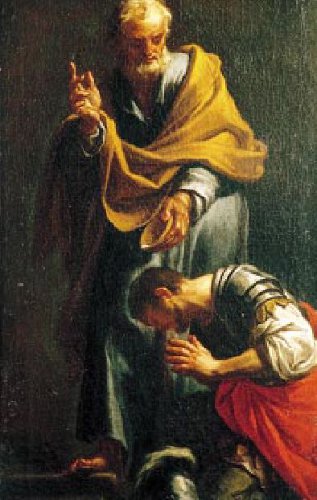
Cornelius said, “Four days ago to this hour, I was praying in my house during the ninth hour; and behold, a man stood before me in shining garments…

Acts 10:3, 30 (NASB)

Cornelius the centurion was the quintessential God-fearer. Luke says that he was a “devout” man, indicating some level of Torah observance.

-D. Thomas Lancaster
“Cornelius, the God-Fearer of Caesarea,” p.18
Messiah Magazine, Fall 2014 edition

cornelius
Peter and Cornelius

Clearly in the days of the apostles, the God-fearing Roman Cornelius had taken it upon himself to observe some of the mitzvot including the set times of prayer. Luke places the centurion praying at the ninth hour which corresponds to between two to three p.m., a time in both the ancient and modern worlds when devout Jews pray the Minchah or afternoon prayers. Exactly what and how Cornelius was praying we’ll never know, but his devotion to God and to the Jewish people got the attention of an angel and subsequently the apostle Peter.

So I agree that Gentiles were always meant to participate in the prayers, and both in the days of Solomon and Herod, we have indications that, as Eby says, there were distinctions regarding the placement of Gentiles in Jewish space, specifically the Temple.

I find this promising and more than a little daunting, which is why, even though ideally Shabbat observance is done in community, it is better for me to observe Shabbos alone, and particularly outside of Jewish space. Frankly, for me to have any sort of “thumbprint” placed upon my Sabbath practice, it’s just easier to do so in my own home.

Not that my home isn’t “Jewish space” since I live with a Jewish wife and daughter, but one of the requirements of my project is that I be alone so that, among other things, I don’t (metaphorically speaking) stomp all over their Jewish space with my big, fat feet. I have no desire to appear more “observant” than the Jewish people I live with, Heaven forbid. My role is supposed to be to encourage them to be more Torah observant.

It should be noted that until Peter and his party of Jewish companions entered Cornelius’s home, the centurion’s environment was composed exclusively of gentiles, so whatever Jewish observances he employed were not impinging on Jewish space. Of course God-fearing Gentiles regularly attended synagogue, but I can only imagine that they didn’t simply just “mix in” with the Jewish crowd but instead, had specific seating arrangements.

Eby in his book agrees with Lancaster and believes the “text implies that Cornelius prayed in what seemed to be a Jewish way” (p.33). Further, Eby says:

There is a delicate balance when it comes to the relationship of Gentiles to Jewish prayer. If the prayer of Messianic Gentiles is to be identical to Jewish prayer, it implies that these Gentiles have become Jews or that they fit into the same legal category as Jews. This is a type of replacement theology. On the other hand, if Messianic Gentile prayer is to be completely different from Jewish prayer, it denies the concept that it is through Israel that all nations connect with God.

-Eby, pp.33-4

Next, Eby speaks of “Blessings in Vain” and “Misappropriation of Identity,” both of which the Gentile (me) encounters in many of the blessings in a standard siddur, which, as Eby states, is “written from a first-person Jewish perspective.”

Fortunately, though I’m not terribly familiar with it yet, The Sabbath Table is written in such a way that it guides the Jewish and Gentile disciples along slightly different paths in the traditional liturgy, so the Gentile doesn’t have to “think fast on his/her feet,” so to speak, when reaching a part of the prayers where the reader is identified as Israel.

I remember encountering this issue in my “Hebrew Roots” days and I eventually learned to either avoid certain “problematic” areas of the siddur, or to broadly re-interpret them as meaning I supported Israel and her people rather than I was Israel.

Aaron Eby
Aaron Eby

Eby also suggests substituting “us” with “your people Israel” as a plea for Israel rather than as a request from Israel.

I know all this is going to rub some people the wrong way, but prior to the apostolic era, it was relatively rare for Gentiles to be in Jewish space and particularly to keep the Shabbat unless they were in the process of converting to Judaism or represented that equally rare phenomena (in those days) of being a Gentile married to a Jew.

Going back much further and into the time of Moses, any Gentile who wished to become attached to Israel and be considered a “resident alien” was actually obligated to a significant number of the mitzvot, including Shabbat observance, with the understanding that they would become permanent members of the community as Gentiles and that their descendents, starting at the third generation (grandchildren), would be absorbed into an Israelite tribe and clan (probably through intermarriage) and be considered Israelites; their ties to their Gentile ancestors obliterated.

But as Gentile disciples of Yeshua, we are not considered gerim as such (since Israel is no longer tribal), nor God-fearing Noahides, since all the nations of the earth are obligated to the basic laws of Noah, but we benefit from the blessings of the New Covenant, the promise of the resurrection, the giving of the Spirit (see Acts 10), and the life in the world to come.

Paul’s vision, his “gospel” included Gentiles in Jewish social and religious space and he staunchly defended his position, even in the face of James and the Apostolic Council (see Acts 15), and while his vision died with him, it has been reborn in modern Messianic Judaism.

Boaz Michael, President and Founder of First Fruits of Zion (FFOZ), defines Messianic Judaism in part by saying:

To me, Messianic Judaism is not just a Jewish-flavored version of Christianity. If I was asked to define Messianic Judaism, I would say, “Messianic Judaism is the practice of Judaism coupled with the realization that Yeshua of Nazareth is the Messiah, the New Testament is true, and the kingdom is at hand.”

-Boaz Michael
“Defining Messianic Judaism”
from the Director’s Letter, p.10
Messiah Journal, issue 117, Fall 2014

Boaz didn’t mention Gentiles in his definition of Messianic Judaism, but on pages 7 and 8, he states:

In many ways, the Messianic movement seems to be stuck in a rut, unable to resolve its most basic identity questions. Like one of those endless Messianic circle-dances, we are continually circling around the same sets of questions: Jewish identity, effective evangelism strategies, the role of tradition, the role of liturgy…and especially the role of Gentiles in the Messianic Jewish movement. (emph. mine)

I don’t know if the question of the role of the “Messianic Gentile” in Messianic Judaism is a problem in Messianic Judaism or just my own personal issue. I suppose I’m more sensitive to these matters than most because I’m intermarried, and particularly to a non-Messianic Jew. The divide between me being a Christian and her being Jewish is a well-defined line of demarcation.

Which brings me back to observing Shabbat individually and the “problem” of me being a Gentile and the Shabbat prayers being Jewish.

For example, one line in the traditional after-meal blessing offers thanks to God “for the covenant that [he] sealed in our flesh.” It seems problematic for a Messianic Gentile to say this. But should someone who is not Jewish then say “for the covenant that you have written on our hearts?” To do so would imply that Messianic Jews have only a fleshly covenant, whereas the new covenant that is written on hearts belongs only to Messianic Gentiles, God forbid.

-Eby, p.36

As my long-suffering wife would say, “Oy!”

Eby goes on to say that prayers in a Messianic Jewish synagogue should not be homogenized across the Jewish and Gentile population, and I agree, but that also would introduce a certain amount of “clashing” with one group saying one thing and another saying something completely different at the same time.

I can see the attraction of church only because it is homogenized. Everyone is the same, though I feel sorry for the “Christian Hebrews” in attendance since it is my firm belief that they aren’t “cookie cutter identical” to the Gentile Christian congregation in which they are embedded (I also can see the attraction of a homogenized [Jewish] synagogue environment for Messianic Jews and for the same reasons).

I don’t know how Paul did it. I wish he’d left more detailed instructions.

beth immanuel
Beth Immanuel Sabbath Fellowship

I remember feeling this sense of dissonance the second time I attended the Shavuot conference at Beth Immanuel Sabbath Fellowship. Although it advertises itself as “Messianic Judaism for the Nations,” within its walls, I experienced a severe case of identity confusion, probably because at that time, I had returned to regular church attendance and didn’t know if I was “fish or fowl”. How could I totally commit to church and still “feel” like a “Messianic Gentile?”

The dissonance damaged my Shavout experience and a few relationships along with it, much to my regret, and ultimately resulted in me bouncing back out of church since in the end, I didn’t have a single thing in common with the people there, at least in terms of theology and doctrine.

But “shoehorning” my way back into Messianic Judaism hasn’t proven particularly easy, either. When I’m just me, studying alone, praying alone (though I haven’t touched my siddur for months now), it’s just me and God and problems of identity and relationship aren’t a problem. God knows who I am and who I am created to be. I don’t know what He’ll think of all my preparations for Shabbat. Maybe He thinks they’re all foolish. I don’t know. If I’m doing this just for me, then I’m doing it in vain. Shabbat only means something if my intent is to honor God.

But dodging through this minefield of a Gentile and Jewish prayer and a Gentile and Jewish Shabbat observance makes me glad I’m doing all this in the privacy of my own home. If I slip or, Heaven forbid, get a little bit to “liberal” with the prayers, the only person who’ll be offended is God, and I’m hoping He’s more forgiving of me than I am of myself.

The Shabbat is supposed to be a delight. So why do I have a feeling of impending dread?

Actually, here’s part of the answer:

Don’t confuse God’s commandments with the traditions of men. Does God actually want such “extra effort” to do things He has never commanded?

Why was Jesus challenged so many times about what He did on the Sabbath? Was it because He was breaking God’s law? Or was it because His actions contravened the traditions men had ADDED to God’s commandments about the Sabbath?

What did Jesus actually mean by “The Sabbath was made for man, not man for the Sabbath”.

I just find something ludicrous in the fact that a refrigerator light can cause such concern and is that kind of thing REALLY what the Sabbath is about? Would applying duct tape to the switch (or disconnecting the light some other way) be pleasing to God or would leaving the light to shine displease Him ?

This is a recent comment on another blog post and it highlights one side of the argument. The other side is me trying to be sensitive to Jewish requirements as a non-Jew choosing to observe one or two Sabbaths using the only template I have available: a Jewish template. In trying to navigate the competing priorities of human beings, I’m letting them suck the joy out of what should be a joyous occasion. Really guys, I’m going to be alone so how I choose to observe Shabbos should be between me and God.

If I were in someone else’s house or in someone’s synagogue, I’d follow the requirements of my host, but in any real sense, my “host” will be God. Like I said, I’m following Jewish tradition to some degree because it’s the template I have available to me, and frankly, Jews have been observing the Shabbat for untold centuries before there were any Christians. You’d think we goyim would recognize by now that the Jewish people are the experts on Shabbat.

I probably won’t be perfect in my observance or meet everyone’s expectations, Jewish or Christian, but why should this be any different than anything else I’ve done or written about?

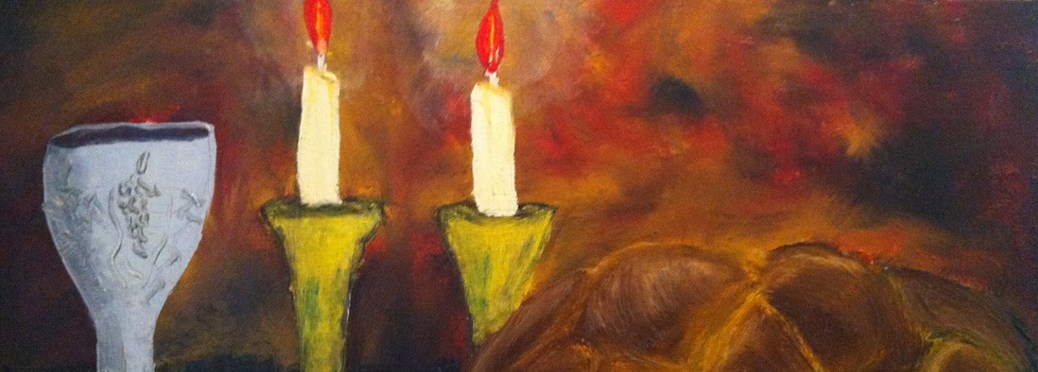
shabbos-candles-banner

My Personal Shabbos Project

This past Shabbat, thousands of people experienced the beauty of Shabbat for their first time. I’m sure many were touched, perhaps transformed by the experience. But it will fade unless we transform the inspiration into action.

-Sara Debbie Gutfreund
“After the Shabbat Project”
Aish.com

My husband and I spent the Shabbos Project in Venice. It was great to see a different community. Tali’s enthusiasm was great. Attached is a picture from candle lighting…

-Batsheva Jassinowsky, Johannesburg
from the Shabbos Project’s website

This is just a sample of the many commentaries available about last weekend’s Shabbos Project which I previously blogged about. I took some online criticism from well-meaning but less than compassionate individuals who believe that everything in the covenant conditions God gave to Israel at Sinai now belongs to any non-Jew who is a disciple of Yeshua (Jesus), including the Shabbat.

Of course, as I said before, I think there’s a certain amount of justification for non-Jews observing the Shabbat in some fashion based both on Genesis 2 in honoring God as Creator, and Isaiah 56 which predicts world-wide Shabbat observance in the Messianic Kingdom. Additionally, based on D. Thomas Lancaster’s interpretation of The Holy Epistle to the Hebrews, we disciples of the Master can and perhaps should behave as if the Messianic Era is already upon us, even though our world is still ruled by darkness; we can behave as partisans or freedom fighters, holding onto our own until the return of the King.

Thus there seems to be more than sufficient support for Gentiles in the present world participating in Sabbath observance. My personal caveat is that if you are not observing Shabbat in a Jewish environment by invitation or are not part of a Jewish family, as a Gentiles, please try not to behave in a heavy-handed manner and claim “all your Sabbaths belong to us,” to borrow from a popular meme.

I know a convenient excuse for anti-Semitism used by some folks is that the Bible says we don’t have to be respecters of men but only of God (Acts 4:19, 5:29). But we also know from the Master’s teaching not to usurp the place of honor at the banquet, but rather, we should wait to be invited before we are elevated and esteemed (Luke 14:7-15).

However, I’m not writing this to be (deliberately) provocative today. I have a unique opportunity in early November when I will be “home alone” for two Sabbaths. That means, among other things, that I can make 100% of the decisions about how I spend my time on those occasions, and I’ve decided to conduct a small, personal, “Shabbos Project” of my very own.

shabbatIt may surprise you to know that I’ve never really observed a proper Shabbat sundown to sundown, Friday to Saturday. My (Jewish) family has never been very observant, so about the best they do is lighting the Shabbos candles and even that doesn’t happen every week.

When we were all doing “Hebrew Roots” many years ago, even then, none of us were as observant as we liked to believe. We drove to the Hebrew Roots congregation, and while we often used crock pots for our food, a certain amount of turning on electrical devices occurred. Naturally, we turned lights on and off, we opened and closed refrigerator doors (causing the light to go on and off), we wrote, and no doubt we participated in some or most of the other thirty-nine melachah or types of work forbidden on the Shabbat.

It’s sort of like our “keeping kosher” was. We avoided specific types of food but that was that. The so-called “Biblical commandments” without the “man-made” interpretations of said-commandments.

But I wonder what it would be like, for me, the goy, to actually attempt to approach observing Shabbat for real. I have two weekends to try it out. I won’t be part of a “project” and in fact, I’ll be the opposite. Where the Shabbos Project attempted to bring together as many Jews as possible from all over the world, I’ll be flying solo, just me and the Shabbat.

I’m not a baker, so Challah will have to be purchased, and I think there’s a couple of local stores that sell it. Wine is not problem obviously since I can buy that anywhere. We’ve got plenty of Shabbat candles and the candlesticks on hand, and I have copies of The Sabbath Table and First Steps in Messianic Jewish Prayer to study in preparation.

This means no driving, no cooking, no watching TV, no using the computer (thus, no Internet), no opening the fridge (which will be interesting since I’ll probably need to keep some of the food I plan on eating cold), timing whatever cooking I do for Friday night such that it’s all done in time and there’s no clean up (or I can tolerate a mess until Saturday night).

It also means planning out my Friday night and Saturday. There are no services within walking distance of my house and in any event, I don’t think it would be appropriate to inflict myself on one of the two synagogues in town. That means I can stay at home and still pray the Sabbath prayers, read the Torah portion (which I do anyway), read Torah commentaries (which I do anyway) and so on.

I don’t read Hebrew and I sing like a cement mixer, so the prayers will be in English and I won’t be singing Shabbos songs after Erev Shabbat dinner.

Then there’s Havdalah to consider. I don’t have one of “those” candles lying around but I guess I can perform the rest of the rituals (assuming I can remember them, it’s been years).

I’m probably missing a lot. I could “Google” something like “how to observe Shabbos” and come up with the basics. In reading A Daily Dose of Torah, some sections mention the melachah, but the commentary seems so involved that I don’t think I could memorize all of the specifics. I think you have to live a lifetime of that level of observance to really “get it down” and as far as I know, there may be times when even a highly observant Jew misses a step or two.

Shabbat candlesOf course, as a goy, I don’t have to observe Shabbat to the level of an Orthodox Jew, so there’s no real pressure to do so. On the other hand, I would like to approach this and accomplish something I’ve never done before, not because I think it would make me a “big deal” and not because I’m somehow claiming my “rights” or “heritage,” but for the reasons I mentioned before, because I want to spend at least one Shabbat honoring God as Creator and summoning, at least in some tiny fashion, a taste of the Messianic future.

If you’ve got any ideas, now’s the time. I’ll have two shots at this. The first can be a trial run to help me work out all the kinks, so I can have a better Shabbat a week later. As you read this, I have about ten days until my first go at it. Suggestions?

Addendum: Relative to the differences in obligation to the mitzvot of Jews and non-Jews in Messiah (and this seems relevant given the topic is Shabbat observance), I found this excellent commentary at Aish.com:

Imagine two people who are very different from each other. This needn’t be a source of conflict. Rather, if each one focuses on how to help the other, then the differences between them will actually make their personalities complementary.

Not only will they like each other despite their differences, but rather, because of them. They will even become closer, because their differences provide more opportunities to be of service to each other.

Contrast this to those who focus on what he can take from the other. They will quarrel frequently and eventually end up hating one another.

(see Rabbi Eliyahu Eliezer Dessler – Michtav MaiEliyahu, vol.3, pp.33-4; Rabbi Pliskin’s “Consulting the Wise”)

Sermon Review of the Holy Epistle to the Hebrews: Ani Ma’amin (I believe)

What do Maimonides and the book of Hebrews have in common? Find out how the Talmud and the book of Hebrews intersect when it comes to the question of faith in Messiah. The book of Hebrews continues with a call to hold fast to faith in the coming of the Messiah.

References Hebrews 10:32-39; Isaiah 30:18; Habakkuk 2:3-4.

-D. Thomas Lancaster
Sermon Forty: Ani Ma’amin (I believe)
Originally presented on January 25, 2014
from the Holy Epistle to the Hebrews sermon series

Therefore the Lord longs to be gracious to you,
And therefore He waits on high to have compassion on you.
For the Lord is a God of justice;
How blessed are all those who long for Him.

Isaiah 30:18 (NASB)

Lancaster’s sermon took a different route this week, the long way around to Hebrews 10:32-39 through the above-referenced prophets, the Talmudic writings, and Mosheh ben Maimon otherwise known as Moses Maimonides or the Rambam.

Lancaster states that the above verse from the prophet Isaiah is very important as a Messianic prophesy. The Talmud interprets “How blessed are all those who long for Him” or “wait for Him” as those among the righteous waiting for the redemption of the Messiah.

Verse 20 says “your Teacher will no longer hide Himself, but your eyes will behold your Teacher,” indicating that our Teacher, that is, Messiah, is currently hidden from us (or from Isaiah’s audience, the Jewish people) but that in the coming age, he will be revealed. Verse 21 continues “Your ears will hear a word behind you, ‘This is the way, walk in it,’ whenever you turn to the right or to the left,” speaking of walking in the Holy Spirit (the “word behind you”).

But when it says “therefore He waits on high to have compassion on you,” this isn’t speaking of Messiah, but of Hashem, of the God of Israel, for He waits for the Messiah, too…at least according to the Talmud.

Why would God have to wait? You’ll see in a bit.

Lancaster then shifted gears and started quoting from Tractate Sanhedrin about a 3rd century CE Rabbi who came across a Gentile who had discovered a scroll in the Roman treasury. Without going into all the details, the scroll seemed to likely have been looted from Jerusalem by the Romans, perhaps from the Temple itself.

The Rabbi, who believed the scroll to be an authentic Jewish Holy writing, purchased the scroll and discovered it predicted the end of the world and the coming of the Messiah in the year 4291 from Creation, with the final renewal of the world being accomplished in the year 7000.

ancient scrollsProblem is, the Jewish year 4291 corresponds to 531 C.E. which has long since come and gone.

The Talmud uses this story to issue a stern warning against attempting to calculate the dates related to Messiah coming and an admonition against those who insist on calculating such dates. Thus far, everyone who has attempted to predict the return (or coming) of Messiah has been wrong.

This is where Habakkuk comes in:

I will stand on my guard post
And station myself on the rampart;
And I will keep watch to see what He will speak to me,
And how I may reply when I am reproved.
Then the Lord answered me and said,
“Record the vision
And inscribe it on tablets,
That the one who reads it may run.
“For the vision is yet for the appointed time;
It hastens toward the goal and it will not fail.
Though it tarries, wait for it;
For it will certainly come, it will not delay.
“Behold, as for the proud one,
His soul is not right within him;
But the righteous will live by his faith.”

Habakkuk 2:1-4

Within the context of Habakkuk, this does not seem to have anything to do with Messiah. Habakkuk had just heard from God that the destruction of Judah and Jerusalem was at hand because of their many sins. Habakkuk was upset, not that God had ordered the destruction, but that He had chosen an instrument for that destruction much more evil than Judah and Jerusalem. So he sat in a guard post and waited (probably for a long time) for God to answer his objection.

That said, the Talmudic sages interpret, especially verses 3 and 4, as very much having a Messianic application, and Lancaster agrees, specifically since the Talmud interprets this portion of scripture as stating the date of Messiah’s coming is hidden. I won’t go into the nuts and bolts of Lancaster’s explanation. The link to the recording is at the top of this missive so you can listen to the forty minute sermon for yourself.

But then we get back to why is even God waiting for Messiah? Why should God wait? Why not send Messiah now?

The Lord is not slow about His promise, as some count slowness, but is patient toward you, not wishing for any to perish but for all to come to repentance.

2 Peter 3:9

God’s justice (and I believe mercy as well) demands that He wait because those of us who also wait receive a blessing by the merit of the act of waiting, for as it says “Though he tarries, wait for it” (the Hebrew pronoun can also be “him”), and again, “the righteous will live by faith”, and as it says in Isaiah, “Blessed are all those who wait for Him” (Isaiah 30:18 NKJV).

Rambam
Mosheh ben Maimon, the Rambam

Many have been born, lived, and died waiting for Messiah and he didn’t come, yet their waiting wasn’t in vain, for by the merit of their faith, they gained eternal life in the resurrection.

I mentioned the Rambam above. He codified what is known as The Thirteen Principles of Faith, the twelfth of which states:

I believe with a complete faith in the coming of Messiah, and even though he may delay, nevertheless every day I believe that he will come.

This is also known as Ani Ma’amin (I believe) and is traditionally sung at the conclusion of the Shacharit or Morning prayers. The Talmud states that such a lived faith in the coming of the Messiah equals performing all of the 613 commandments (and the version we have today was also organized by Rambam). Yes, it’s that important.

However, when Habakkuk says that “the righteous will live by faith,” he doesn’t just mean that they live a life of faith, but that they will merit life, eternal life in the resurrection, by clinging to their faith in the coming redemption of Messiah. This is an essential principle in Judaism, according to Lancaster, and not only do we see it in the prophets and the Talmud (and Hebrews), but the Apostle Paul referenced it in Romans 1 and Galatians 3. Instead of trying to figure out when Messiah will come (return) and only expecting him then, always expect him today and every day; always live a life of daily expectancy.

Then Lancaster (apparently) switches tracks and talks about how the passage from Habakkuk is very different in the Greek. Why is that important? Because Jewish teachers used the Greek translation of the Tanakh (Old Testament) or Septuagint, when teaching Greek-speaking Jews and Gentiles. The writer of Hebrews was addressing Greek-speaking Jews living in or near Jerusalem.

For yet in a very little while,
He who is coming will come, and will not delay.
But My righteous one shall live by faith;
And if he shrinks back, My soul has no pleasure in him.

Hebrews 10:37-38 quoting Habakkuk 2:3-4

Especially the last line seems quite odd: And if he shrinks back, My soul has no pleasure in him.” Lancaster says this speaks of one who shrinks back or loses his faith, specifically in the coming of Messiah, for if one loses his faith in Messiah, he loses God’s favor.

But “My righteous one shall live by faith” in that even if Messiah does not come when expected or even in your lifetime or mine, we must live by faith so that we will live in the resurrection and not lose our place in the world to come. We must seek first the Kingdom as our focus.

Now (finally) Lancaster turns to Hebrews 10:32-39.

He gives a very brief summary of the Hebrews epistle, an exhortation to Jewish believers who because of their faith in Messiah, have been denied access to the Temple and the Priesthood, and who, for that reason, are strongly tempted to renounce their Messianic faith. The Hebrews writer is encouraging them to remain faithful because they always have access to the Heavenly Temple and Priesthood through Messiah as High Priest, and warning them of the consequences of losing faith.

“But remember in former days” is a reference to the early persecutions (read the beginning chapters of Luke’s Book of Acts including the stoning of Stephen (Acts 8) and the “murderous threats” of Saul (the beginning of Acts 9). They were persecuted in many ways and yet “accepted joyfully” those hardships, enduring in the faith. “Therefore, do not throw away your confidence” for in doing so, they would also throw away their reward. They needed to endure as they did before.

Hebrews then quotes the Greek version of Habakkuk, and you should see at this point how well it fits the flow of this part of the letter, and concludes (well, not really…it just concludes the artificial division of chapters):

But we are not of those who shrink back to destruction, but of those who have faith to the preserving of the soul.

Hebrews 10:39

But there’s more. I didn’t expect Lancaster to cover Chapter 11 as well, but when he did, it clicked right into place:

Now faith is the assurance of things hoped for, the conviction of things not seen. For by it the men of old gained approval.

Hebrews 11:1-2

faithThis is the so-called “faith chapter” of the Apostolic Scriptures and Christians often cite it as a “stand alone” definition of what “faith” is, without considering how it fits into the overall message of the epistle.

The writer of the epistle has been encouraging his readers to maintain their faith in the Messiah’s coming, to not abandon that faith, even under the tremendous pressure of not being able to offer korban in obedience to the commandments, for in renouncing Messiah, they would also be renouncing their reward in the Kingdom.

The rest of chapter 11 is a list of examples of people of faith who maintained that faith even though they never saw the promised rewards in their lifetimes. Abraham was promised the Land but died never receiving the promise. So too did Isaac and Jacob. Read the chapter for yourself and see what it looks like now that you have the context Lancaster constructed around it.

Lancaster concludes his sermon by reading verses 32 through 40, but I’ll just quote a portion:

And what more shall I say? For time will fail me if I tell of Gideon, Barak, Samson, Jephthah, of David and Samuel and the prophets, who by faith conquered kingdoms, performed acts of righteousness, obtained promises, shut the mouths of lions, quenched the power of fire, escaped the edge of the sword, from weakness were made strong, became mighty in war, put foreign armies to flight.

Hebrews 11:32-34

“And what more shall I say? For time will fail me…” The list of the faithful is endless, or seemingly so. It’s not like the writer of Hebrews is asking for the impossible, as if no one who came before ever exhibited such a faith, maintaining it even to the death. While modern religious Judaism doesn’t emphasize the Messiah’s coming all that much, in ancient days, the days of the prophets, the days of the apostles, and the days of the writers of the Talmud, it was much clearer that faith in the coming (return) of Messiah was the lynchpin of Jewish faith in God and the coming New Covenant times.

What Did I Learn?

I’ll never be a Talmud scholar, so all of the tie-ins from Talmud back into scripture are a revelation to me. Lancaster said that the writer of Hebrews and the other apostles read Habakkuk exactly the same way as the sages of the Talmud. This is a very important point because it re-enforces my emphasis that you cannot know or understand having faith in the Messiah unless you study Judaism! This is why I study from within a Messianic Jewish framework.

I hate to slam Christian studies and teachings because I have high regard for those people I know in the Church, but traditional Christian doctrine compared to Messianic Jewish (and other Jewish) studies is like the difference between an eighty-year old frayed black and white still photo and the latest vibrantly colored 3D motion picture in surround sound.

I hope I’m not overstating the metaphor, but a lot of these teachings in Messianic Judaism hit me like someone opened up my skull and poured in a couple of quarts of “Ah Ha! That’s what that means!”

I was also pleasantly surprised when Lancaster mentioned having read the biography of Brother Yun, an evangelist in Communist China who suffered terribly for his faith. I also read the book at the urging of a friend, and as a reminder that I can get tremendously caught up in the “head knowledge” of the Bible at the expense of a living faith in Messiah.

The message of the epistle to the Hebrews is also a message to us nearly two-thousand years later. The Jewish believers reading this letter had a faith in the return of the Messiah who had died, was resurrected, and ascended to Heaven about thirty years prior, within the living memory of a generation, and yet they were tempted to abandon that faith. We have possession of the same faith almost twenty-centuries after the event, and no one alive on earth is a direct witness today. If they were tempted living so close in time to the flesh and blood Jesus, how much more so will we be tempted, especially in a culture of atheism, humanism, and progressiveness, to be lured into abandoning our faith in the return of Messiah?

Which is why we can’t. Which is why Hebrews 11 is so important to us as an example of living and dying and yet not receiving the promise of his return.

For if their being cast away is the reconciling of the world, what will their acceptance be but life from the dead?

Romans 11:15

lightIf some of the Jews in Paul’s generation not coming to faith in Messiah is compared to death, but their coming to faith is compared to the resurrection. So it is with us. For those who have never come to faith and possibly never will, we can have pity, but we must mourn tragically for those who once had faith and deliberately set it aside for whatever they thought was better, perhaps under some form of social pressure to do so.

I mourn for those every day and I know more than one. Pray that they haven’t shut up their ears permanently, and that they will go from being “cast away” by their own decision, to “acceptance” once again and “life from the dead.”

Israel and the Nations in the House of God

True, that particular parcel of land was later named Eretz Yisrael, but even then we saw not a small piece of land, but a polished mirror, reflecting the entire world. In this land will rise up the mount of the Lord “and to it shall flow all to the nations.” On this mount will stand the House of the Lord, “it shall be called a house of prayer for all the nations.”

-Rabbi Moshe Avigdor Amiel
Commentary on Lekh Lekha
Chapter 1: Abraham Recognized His Creator, p.135
Translated by Kadish Goldberg
Jews, Judaism, & Genesis: Living in His Image According to the Torah

As Christians (or “Messianic Gentiles” if you prefer), we have our own ideas of how God’s covenant promises to Abraham, Isaac, and Jacob somehow play in to attaching the non-Jewish people groups of the world to the God of Israel. It’s true that we disagree on many of the specifics of the New Covenant and how faith in the accomplished work of Messiah grafts us into the root, and we argue about those opinions day and night, typically by blogging.

Every so often, we employ the classic Jewish writings, not those found in the Bible, but those written afterward, sometimes many centuries afterward, to somehow prove our point. We conveniently forget that these Jewish sages and teachers would not have said or done anything they thought might give credence to the idea that the “founder of the Christian religion,” that is to say “Jesus” (Yeshua) could possibly be the Messiah, let alone of a Divine nature.

However, I believe that only by viewing the Bible through a “Jewish lens” and reading the sacred writings in as close an approximation as possible to how the original audience would have understood them, will we ever come close to capturing the true intent of not only the human writers, but of the Holy Spirit that inspired them. Thus, when I read Rabbi Amiel’s commentaries, which include his insights as to just how the rest of the world was supposed to be attracted to the God of Israel, I become interested.

amiel
Rabbi Moshe Avigdor Amiel

One caveat, though. We can’t read too much into these commentaries for, as I said above, R. Amiel and the sources he quotes would not be considering Jesus in any favorable light, given the long history of enmity that existed between our two faith groups. Nevertheless,I think by examining the Jewish perception of drawing the Gentiles near, we might gain some insights into how we Gentiles might better approach Hashem, God of the Hebrews.

“The Holy One, blessed be He, exiled Israel among the nations so that they would attract converts, as it is said, ‘and I shall plant her in the land’ — does one sow a se’ah unless he expects to reap several koor?” (Tractate Pesachim 87b.)

So it was with the first Jew, our father Abraham. His history, as described in the portion of Lekh Lekha, began in Galut, outside the Land of Israel. He, too, was exiled from his land and birthplace only in order to increase proselytes, as is written ‘and all the families on earth will be blessed through you.’

-Amiel
Chapter 2: Our Father Abraham’s Mission, p.141

Of course in Abraham’s day, Judaism, as such, did not exist. Abraham is noteworthy for coming to faith in the One God of all and acknowledging Him as his personal God. We do know from the Bible and midrash, that Abraham did “make souls” or taught his servants and others the ways of God, but would these people have “converted” to anything and if so, what?

His “converts” were not formally converted. Among the seventy souls who went down to Egypt, no mention is made of any converts. They were converted ideologically. They were influenced by Abraham’s noble spirit…

…Thus, the converts whom we are to attract through our exile among the nations are not formal converts — for “converts are as troublesome for Israel as is a skin affliction.” The converts referred to by the Rabbis are persons who are influenced in varying degrees by our sublime fragrance.

-ibid, pp.141-2

With the caveat I mentioned above in mind, how can we compare this to the actual result of the people of the nations being drawn to the God of Israel in the days of Messiah and afterward?

Go therefore and make disciples of all the nations, baptizing them in the name of the Father and the Son and the Holy Spirit, teaching them to observe all that I commanded you; and lo, I am with you always, even to the end of the age.”

Matthew 28:19-20 (NASB)

“You see, brother, how many thousands there are among the Jews of those who have believed, and they are all zealous for the Law…

…But concerning the Gentiles who have believed, we wrote, having decided that they should abstain from meat sacrificed to idols and from blood and from what is strangled and from fornication.”

Acts 21:20, 25

AbrahamSeemingly, there is a parallel between R. Amiel’s interpretation of the “mission of Abraham” to the nations and the mission to the Gentiles initiated by Yeshua and acted upon by Paul, James, and the Apostles. There’s a conversion without a conversion happening. Gentiles are added to the ranks of the ekklesia of Messiah without any formal conversion such as was typical of the proselyte rite in the late Second Temple period.

But how does R. Amiel and the Judaism he represents imagine this was to be done? Certainly not in the matter that the Christian believes.

“‘And I will make you into a great nation’ — therefore we say ‘God of Abraham.’ ‘And I will bless you’ — therefore we say ‘God of Isaac.’ ‘And I will make your name famous’ — therefore we say ‘God of Jacob.’ Are we then to conclude [the first blessing of the Amidah prayer] with all three? The verse specifies, ‘And you will be a blessing’ — we conclude with ‘you’ (singular), not with all three.

-Tractate Pesachim

Not only do the world’s three major faiths, our holy faith and those of the Christians and the Moslems, base themselves theologically upon our Holy Torah. Not only do they draw life-giving waters from our fountainhead, they also relate to us genealogically.

-Amiel
Chapter 3: God of Abraham, Isaac and Jacob, p.145

You may be aware that Abraham fathered both Ishmael, who became the father of the Arabs and is claimed by Islam, and Isaac, who, through his son Jacob, became the scion of the twelve tribes and finally the Jewish people. But how do Christians derive a genealogical connection to Abraham?

Esau, as you may have read, is Edom, a people who are thought to be the distant ancestors of the Romans, these are the Gentile nations from R. Amiel’s point of view, and thus the Christians, since Christians, by definition, are not Jewish (if that statement makes you uncomfortable when you think of “Hebrew Christians,” remember the Rav’s perspective on the matter is thoroughly Jewish and not easily adapted to Christianity’s framework of conceptualization).

But wait a minute. If both Islam and Christianity can be considered in some manner as physical descendants of Abraham, do we Christians then inherit all of the promises God made to Abraham including possession of the Land of Israel?

Hold your horses and remember your Bible. Even if the Gentile Christians are both “spiritual” and physical descendants of Abraham, there is this:

But God said to Abraham, “Do not be distressed because of the lad and your maid; whatever Sarah tells you, listen to her, for through Isaac your descendants shall be named.”

Genesis 21:12

Now Abraham gave all that he had to Isaac; but to the sons of his concubines, Abraham gave gifts while he was still living, and sent them away from his son Isaac eastward, to the land of the east.

Genesis 25:5-6

interfaithIt is only through Isaac that the promises of God are carried on to the next generation and beyond, not through Ishmael or any of Abraham’s other children. Furthermore, of Isaac’s sons, only Jacob inherits both the birthright and the blessing of the first-born.

As it is written, God spoke to Jacob:

And behold, the Lord stood above it and said, “I am the Lord, the God of your father Abraham and the God of Isaac; the land on which you lie, I will give it to you and to your descendants. Your descendants will also be like the dust of the earth, and you will spread out to the west and to the east and to the north and to the south; and in you and in your descendants shall all the families of the earth be blessed. Behold, I am with you and will keep you wherever you go, and will bring you back to this land; for I will not leave you until I have done what I have promised you.”

Genesis 28:13-15

Thus as we see in Tractate Pesachim, it is only through Abraham and through Isaac, and through Jacob that all of God’s promises are carried out. It is true that based on the commentary, we can consider Abraham the father to other nations, physically the Arab people, and midrashically the Christians, but that makes neither people or religion Jewish.

Expanding on his point, R. Amiel writes:

‘And all the families of the earth will be blessed through you.’ Of the End of Days, when ‘the Temple Mount shall be the highest of all, towering above the hills,’ it is written that ‘many nations will come streaming to it.’ This is to say that even though ‘the Lord shall be one and His name shall be One,’ all the nations of the world will not fuse into one nation. There will remain diverse peoples. National differentiation actually contributes significantly to human development, bringing not curses but blessings. But ‘many nations will come streaming to it,’ — all will flow to one central point, to the Mountain of the Lord which ‘shall be the highest of all, towering above the hills.’ Or, as the Torah says, ‘through you will be blessed all the families [plural!] of the earth.’ (emph. mine)

-Amiel, p.147

Up to JerusalemAs I said, the Rav isn’t going to take any Christian innovations regarding Biblical interpretation into account, so it would be easy to discount his comment above based on that. On the other hand, I think there’s some merit to the idea that, by viewing the Bible a bit more “Judaically,” we can get a more accurate picture not only of how Judaism sees the final resolution of the Gentiles to God, but perhaps how the original Jewish writers of the Bible saw this conclusion of human history.

For me, this does re-enforce my currently held belief that the peoples of all the nations remain distinct national groups differentiated from Israel and from each other, and yet all drawn to One God and One place, the Temple, to worship Him in the “House of Prayer for all peoples”.

I’ve said before that it is at least plausible to consider that when the Master issued his Matthew 28:19-20 directive, the Apostles likely believed they would comply by employing the traditional proselyte rite, bringing the Gentiles into discipleship by converting them to Judaism. This, though, violates prophesy as R. Amiel has pointed out. It is clear that the Gentiles were to be drawn near to God as Gentiles.

The Apostle Paul was the one to see this most clearly, but how does Judaism see it standing on the outside of the Apostolic Scriptures and looking in, so to speak?

What prevented their mass conversion was the law of brit milah, ritual circumcision, for they found that particular commandment to be the most difficult of all. The founder of the faith of the “New Testament” exploited this fear of circumcision and prevented the fulfillment of the promise ‘and I will make you a great nation.” Thus Israel is ‘the smallest of nations.”

-ibid, p.148

This is the Rav’s explanation for how Christianity “morphed” into its own, separate religious expression. Like the ancient Apostles, he believes the proper way to fulfill the prophesies is to convert Gentiles into Judaism, making Abraham’s descendants as numerous than the stars (Genesis 15:5). But this contradicts his view that the people of the nations will draw near to God as people of the nations and not as proselytes. R. Amiel’s only apparent option within his contextual framework, is to have the Gentiles “convert” in the sense of becoming Noahides, righteous Gentiles, which would satisfy the requirement of them retaining their national identity while still honoring the One God of Israel.

R. Amiel acknowledges that Abraham is the father of many nations and that the people of the nations are blessed through him, but the “nations inherited the legacy only partially; we (Jews) inherited it in its entirety.” (p.149)

My respectful response to the esteemed Rav is “yes and no.” I agree that we Gentile believers are not Israel and yet, we are not to be compared to the generic nations of the earth. Even if those nations comply with the Noahide Laws, that doesn’t provide those of us who are grafted in to the root through our faith in Messiah access to the New Covenant blessings. This is something that Rabbi Amiel could not anticipate, but we can. We can take what is valuable from the esteemed and honored sages, and in this case, look at it through a New Covenant lens in order to glean what is of value there.

Restoration
Photo: First Fruits of Zion

I mean no disrespect to Rabbi Amiel, those other Rabbis who contributed to the publication of his book, or the long history of the Sages in Judaism, but even as they were inspired and even as they possess authority from God to make halachah for their generations, they were also men, and as men, given the struggles of the last twenty centuries, there were places they just could not see and knowledge they couldn’t assimilate. No one comes to God without the involvement of the Holy Spirit. To everyone else, the good news of the Messiah doesn’t make a lot of sense:

For indeed Jews ask for signs and Greeks search for wisdom; but we preach Christ crucified, to Jews a stumbling block and to Gentiles foolishness, but to those who are the called, both Jews and Greeks, Christ the power of God and the wisdom of God. Because the foolishness of God is wiser than men, and the weakness of God is stronger than men.

1 Corinthians 1:22-25

All people, Jewish and non-Jewish, come with blind spots that can only be clarified through the Spirit of God. I suppose God could just re-write our programming and the entire world could wake up one morning all declaring faith in Christ and him crucified, but that’s not God’s plan. It would be easier if it were, but God left human free will intact. We have to be willing to hear the messages of the Gospel, and having heard them, we have to be willing to believe and then act on that belief.

The call of the Master is like hearing a knock on your front door. Is it a thief or a benefactor? We won’t know until we open the door, but if we’re wrong, then it’s too late to save ourselves of any threat that might enter. But if we take the risk and open the door, he will come in and with him…freedom.

May we all meet together one day on the Mountain of God, and may we join in prayer in His House.

‘And the souls which they had made in Charan.’

Reish Lakish said, “Whoever teaches his friend’s son Torah is considered by Scripture as though he himself had made [created] him, for it is said, ‘And the souls which they had made…'”

-Amiel
Chapter 4: Flesh and Soul, p.151

Who is Honored on Sukkot?

Epicurus used to say, “Were the gods to answer the people’s prayers, people would deteriorate and die, for so multitudinous are the tribulations which each one wishes upon his fellow.”

Epicurus may be right as regards the prayers of the nations, but not as regards our prayers. We well know “This is the book of the generations of man,” and every year we begin our supplications with “And now, Lord our God, place Your awe upon all whom You have made, Your dread upon all whom You have created…”

-Rabbi Moshe Avigdor Amiel
Chapter 13: The First Man and the Jewish Nation, p.75
Translated by Kadish Goldberg
Jews, Judaism, & Genesis: Living in His Image According to the Torah

Last week, I spent some time writing about those things that make Jewish people unique and distinct from the people of all the other nations, including Gentile Christians, in three blog posts: Upon Reading a Rant About “Messianic Jewishism”, Diminishing the Moon and Israel, and Are Messianic Jews Not Expected to Practice Judaism?. I suppose I could be accused of fomenting discord between Jewish and Gentile members of the ekklesia of Messiah, or to put it in more Christian-friendly terms, the members of the “body of Christ”.

In the spirit of unity which is aptly expressed during this time of Sukkot, I thought I’d take a different tack.

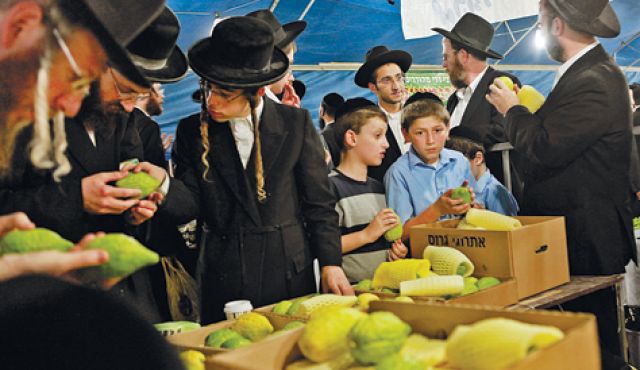
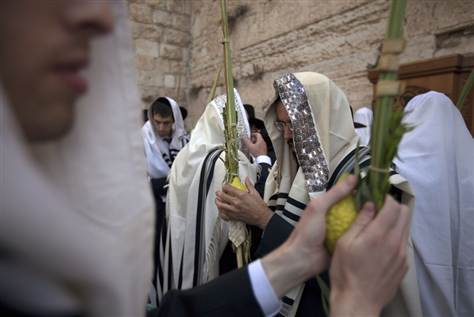
As we discussed last year, the fruit symbolizes the Torah inside a person, while the fragrance represents the Mitzvos, the deeds a person does which affect those around him or her. The four species represent those who have both Torah and good deeds, those who have one but not the other, and even those who have neither.

And what are we told to do? We bind them together! Every Jew is a unique and essential part of our nation.

from “Note from the Director”
News from Project Genesis and Torah.org for Sukkot
Torah.org

Unfortunately, I can’t find this note from Rabbi Yaakov Menken on the Project Genesis website which would allow you to read all of the Rabbi’s comment, but as you might imagine, he is specifically addressing unity among Jewish people and not including non-Jewish believers in Jesus (Yeshua). However, giving Rabbi Menken’s words a “Messianic spin,” I think we can include the entire population within the ekklesia of Messiah, the Jews and the Gentiles, at least for the sake of my example. While unity doesn’t require uniformity, we still are united with each other by love of the Moshiach, may he come swiftly and in our day.

Earlier in his email newsletter, the Rabbi wrote:

The Torah tells us to take four species: the Esrog, a citrus fruit with a pleasant taste and smell; the Lulav from a Date Palm which produces fruit but is not fragrant; Hadasim, myrtle branches which are aromatic but does not provide edible fruit; and aravos, from the willow, which has neither taste nor smell.

Consider the differences and the distinctions involved in each of the four species. What does a citrus fruit, a lulav, myrtle branches, and aravos from a willow have in common?

Not much apparently.

And yet all four of these highly different items are absolutely required for the observance of Sukkot as it is written:

Now on the first day you shall take for yourselves the foliage of beautiful trees, palm branches and boughs of leafy trees and willows of the brook, and you shall rejoice before the Lord your God for seven days.

Leviticus 23:40 (NASB)

four species
Photo by Gili Cohen Magen

Those distinctively different objects are required to be bound together and, in essence, to “work together,” in order for Sukkot to be observed properly. While it’s impossible to offer the appropriate sacrifices related to Sukkot today due to a lack of the Temple and the Priesthood, the celebration is nevertheless observed by religious Jews and not a few believing Gentiles as well.

In a recent comment on one of my blog posts and then again in commenting on a different blog post, I said:

According to Jewish tradition, on the first seven of the eight days of the festival, we are to extend a special invitation to a specific guest in this order:

  1. Abraham, who represents love and kindness
  2. Isaac, who represents restraint and personal strength
  3. Jacob, who represents beauty and truth
  4. Moses, who represents eternality and dominance through Torah
  5. Aaron, who represents empathy and receptivity to divine splendor
  6. Joseph, who represents holiness and the spiritual foundation
  7. David, who represents the establishment of the kingdom of Heaven on Earth

Now before you think I’ve flipped for considering something so far-fetched, look at this:

“I say to you that many (Gentiles) will come from east and west, and recline at the table with Abraham, Isaac and Jacob in the kingdom of heaven (meaning the Messianic Kingdom here on Earth established by Jesus upon his return)…”

Matthew 8:11

This at least suggests a sort of feast occurring during Sukkot in which we non-Jewish disciples of Christ will join the Jewish disciples in participating in the Sukkot festival with the greatest prophets, priests, and kings in the Bible, all in honor of King Messiah.

While I crafted the above quoted-statement to be easier for a traditional Christian to comprehend, I want all of us to understand that Jews and Gentiles will be together at the feast with Abraham, Isaac, and Jacob (and perhaps Moses, Aaron, Joseph, and David) to give glory and honor to King Messiah upon the establishment of his Kingdom. Maybe this will even happen on Sukkot, although of course, I can say that for sure.

Certainly the Prophets, Priests, and Kings represented by the Seven Ushpizin guests are not exactly alike, and although they exist within the unity of the Jewish people, they are not identical in type or function. So too it can be said that even though Jew and Gentile in the ekklesia of Messiah and as citizens in the Kingdom of Heaven have unity within that assembly, they also are not identical in type and function.

sukkotBut you won’t see Abraham, Moses, and David arguing about it, so why should we?

About twelve years ago, Rabbi Eliyahu Hoffman wrote a Sukkot commentary called “Shaking Up Our Priorities” which you can find at Torah.org. It’s worth the read and won’t take much of your time, but I’d like to quote just a part of it here:

One year, as he always did before Sukkos, R’ Yitzchak gathered his belongings, including all the rubles that he had put aside, and left home to travel to a nearby town where the Four Species could be bought. Travelling along the roadside, he stopped suddenly when he heard the sound of someone crying. Indeed, a Jewish man sat in a nearby field, head in his knees, crying and moaning bitterly. R’ Yitzchak approached him. “Reb Yid, what’s the matter?”

“Don’t even ask,” the Jew said, “a bittere pekel tzures – what a bitter portion the Almighty has dealt me! Woe is to me. I had one horse. That might not seem like much, but it was enough to support my family. It was a good horse. I rode it from town to town, delivering people’s mail, parcels – whatever they needed. I didn’t make a fortune, but we had what to eat, and we were happy. But today I awoke, and – woe is me – I found her dead. She must have passed away overnight. As it is, we live from hand to mouth. If I have to deliver by foot, I don’t stand a chance of making a living. Woe is me!”

“Tell me,” asked R’ Yitzchak, “what would a new horse cost you. I’m sure she was a good horse, but there are other horses out there.”

“Of course there are other horses, for someone who has 300 rubles to spend! It would take me almost a year to earn that kind of money! So you see, all is lost!”

Without further ado, R’ Yitzchak took out his wallet and counted out 300 rubles, leaving for himself only the smallest sum from all the money he had so carefully put aside. He placed it in the pocket of the forlorn Jew, who had all the while never taken his head out from between his knees. Sticking his hand into his pocket, he was flabbergasted to find the entire sum he needed to buy himself a new horse. “What… What have you done. I… I never expected.” Completely choked up with emotion, he barely managed to thank R’ Yitzchak for his magnanimity. Little did he know, R’ Yitzchak himself was not a rich man, and that he had just parted with the lion’s share of his own savings.

That year R’ Yitzchak had to settle for the plainest of Esrogim, much to the surprise and wonder of his friends and family. Despite their best attempts to find out, he told no one of what had come of his plans to purchase the most beautiful Esrog, nor of his savings, except to say, cryptically, that “the money was not lost – in fact it had just galloped off and was being put to very good use.”

If you are a (non-Jewish) Christian or otherwise are a person who does not observe Sukkot (or who does so in a rather casual manner), you won’t understand the tremendous significance involved in R’ Yitzchak’s generosity. In a sense, he had before him two apparently conflicting mitzvot. He could do as he had done every year and dedicate the more than 300 rubles it had taken him all year to save for the purchase of the most beautiful Esrog he could find in honor of the festival and God, or he could alleviate the sorrow of a Jew even poorer than he was by freely handing over his money for the purchase of a horse, and settle for the plainest Esrog he could still afford.

Again, from a Christian point of view (and probably the viewpoint of most people), the decision to help his fellow Jew seems clear, but remember, what is at stake is the honor of both God and of human beings at this Holy time of year.

Perhaps, even after performing tzedakah (charity) by giving up his Esrog money, R’ Yitzchak was still unsure that he did the right thing, for we find:

During Chol Ha-Moed (the Intermediate Days of Sukkos), R’ Yitzchak travelled to Lublin to visit his Rebbe, the famed Choize (Seer) of Lublin. At the festive Yom Tov meal, the Choize remarked to his disciples, “The mitzvah of Arba Minim must be performed with great joy. We must thank Hashem that we all managed to perform the mitzvah of waving the Lulav and Esrog. When we wave the mitzvos, all the Heavenly spheres and realms are awakened, and much joy and goodness permeate the upper realms, ultimately reflecting that joy and goodness back down to this world where we can reap its benefits. We all shook the Lulav and Esrog, but, R’ Yitzchak,” he said, turing as he did so to face him, “to wave a horse – now that is a truly original and exceptional way to perform a mitzvah!”

davening_morningChristians, most other non-Jews, and even some Jewish people often think of the Rabbinic Sages as inflexible, rule-bound, and even “anti-Bible” in considering halachah and Talmud as having any sort of authority when compared to the commandments clearly written in the Bible, but here we see that kindness, mercy, and “waving a horse” for Sukkot are not only original and exceptional ways to perform a mitzvah,” but deserving of special honor as expressing the heart of God.

In one of the commentaries for Tractate Yevamos 5 as collected and distributed in the Daf Yomi Digest by the Chicago Center for Torah & Chesed, we find the following based on “Each person shall fear his mother and father, and guard my Shabboses…”:

On today’s daf, we find that the Beraisa proposes that were it not for the verse, one might think that honoring parents overrides the Shabbos!

The famous Yehudi HaKadosh, zt”l, would deliver a regular Gemara shiur to his students that explored the commentary of Tosfos. One of his students was an extremely talented local boy who was unfortunately orphaned of his father. Once, the Rebbe interrupted their learning so that he could concentrate deeply on a certain subject. His young student knew well that such a break could last an hour or more, so he took advantage of the pause to go home and eat.

The boy ate a quick meal and hurried out back to his Rebbe’s home, but his mother called out after him that she wanted him to go up to the attic and bring something down for her. In his rush to return to study, he ignored her call, but half-way back the boy had second thoughts. “Isn’t the whole purpose of study to fulfill the mitzvos? Shouldn’t I honor my mother instead?” he asked himself. So he ran home and did as he was bid.

Afterward he returned to his studies, and as he opened the door to the Rebbe’s house, the Yehudi HaKadosh snapped out of his reverie and rose to his full height as a sign of respect. Beaming, the Yehudi HaKadosh asked, “What mitzvah have you just performed, because it has brought the spirit of the great Amorah Abaye with you into my house.”

The student told his story, and the Rebbe explained to the rest of the students: “It is well known that Abaye was an orphan—his name is an acronym of the verse, ‘For in You does the orphan find mercy.’ This is why his spirit accompanies a person who fulfills the mitzvah of honoring his parents—so that he should have a part in a mitzvah that was denied to him. You want to know why am I smiling? Because Abaye came and answered my question on the Tosafos!”

Again, this may not resonate with most people, including many Jews, but we see a comparison between the authority of a Rebbe over his young students and the mitzvah of honoring parents. It is said that a Rebbe is to be considered greater than one’s own father, so you can see that the young student put himself in a bind by going home to eat and then having to decide between his mother’s request and his obligation to promptly return to the Rebbe’s home.

MidrashIn choosing to honor his mother, he not only did the right thing from a human point of view, but he achieved a certain amount of respect from his Rebbe. Did “the spirit of the great Amorah Abaye” really accompany the boy to the Rebbe’s house and answer the Rebbe’s question on the Tosafos he had been pondering?

There’s no way to know for sure and probably no way to know if any of these events ever actually occurred. But whether or not they did, there’s a principle being taught here, the same principle as was taught in the previous Rabbinic story.

Even if we know nothing of the Torah, the mitzvot, or anything else, we know, or we should know as disciples of Rav Yeshua, our Rebbe, that extending mercy, kindness, compassion, and respect are the greater and loftier mitzvot, the acts of obedience and response to God that, even in moments of doubt, cannot fail.

I said in a comment last week that “if I’m going to err, I’d rather err on the side of humility”. I also quoted one of the Master’s parables:

And He began speaking a parable to the invited guests when He noticed how they had been picking out the places of honor at the table, saying to them, “When you are invited by someone to a wedding feast, do not take the place of honor, for someone more distinguished than you may have been invited by him, and he who invited you both will come and say to you, ‘Give your place to this man,’ and then in disgrace you proceed to occupy the last place. But when you are invited, go and recline at the last place, so that when the one who has invited you comes, he may say to you, ‘Friend, move up higher’; then you will have honor in the sight of all who are at the table with you. For everyone who exalts himself will be humbled, and he who humbles himself will be exalted.”

Luke 14:7-11

When we finally attend the “feast of Abraham, Isaac, and Jacob,” and it will be a massive affair no doubt, I suppose seating arrangements will be a big problem. What are you going to do with all of the people who show up from all over the world to honor King Messiah and to actually recline at the table with men like Jacob and Joseph? Where should we sit?

In retrospect, and considering the example the Master laid out for us, the answer should be obvious. We should consider ourselves as having no honor of our own, but only seek to honor the King and those Seven Ushpizin guests who represent the Prophets, Priests, and Kings of Israel, and indeed, all the Jewish people. If we mistakenly think we are greater than they, won’t our host, Yeshua, be forced to embarrass us by asking us to take the last place at the table?

Ben Zoma says: Who is honored? The one who gives honor to others…

(Talmud – Avot 4:1)

As non-Jewish disciples of the Jewish Messiah King, if we seek to honor him and believe we are worthy of honor, respect, equality, and inclusion within the ekklesia, then both the teachings of the Master and of the great Sages are clear that to be honored, we must honor others, and not deliberately strive to honor ourselves.

UnityThe Master also teaches:

Jesus answered, “If I glorify Myself, My glory is nothing; it is My Father who glorifies Me, of whom you say, ‘He is our God'”

John 8:54

If our Rebbe and Master did not glorify himself, should we not follow his example? Will he not take the different “species” within the body and unite us, regardless of our extreme differences…or perhaps because of them, and in our honoring him, won’t he honor us?

Chag Sameach Sukkot.