Tag Archives: messianic judaism

Loving Yourself: A High Holidays Primer for Non-Jews

There is a Midrash (a commentary on the Five Books of Moses in the form of a parable) about a successful businessman who meets a former colleague down on his luck. The colleague begs the successful business man for a substantial loan to turn around his circumstances. Eventually, the businessman agrees to a 6 month loan and gives his former colleague the money. At the end of the 6 months, the businessman goes to collect his loan. The former colleague gives him every last penny. However, the businessman notices that the money is the exact same coins he loaned the man. He was furious! “How dare you borrow such a huge amount and not even use it? I gave this to you to better your life!” The man was speechless.

Likewise, the Almighty gives each of us a soul. He doesn’t want us to return it to Him at the end of our days in the same condition that we received it. He wants us to better ourselves, to enhance our souls by doing the mitzvot (613 commandments). It is up to us to sit down before Rosh Hashana and make a list of what we need to correct in our lives between us and our fellow beings, us and God and us and ourselves!

-Rabbi Kalman Packouz
Shabbat Shalom Weekly for Nitzavimm (Deut. 29:9-30:20)
Aish.com

shofar-rosh-hashanahRosh Hashanah begins Sunday evening, October 2nd, which is only a few days away. This has pretty much zero meaning in normative Christianity and immense meaning in normative Judaism, as well as in Messianic Judaism and some corners of the Hebrew Roots movement.

One of my readers, ProclaimLiberty, who is a Messianic Jew living in Israel, has suggested that Sukkot might serve for Gentile Messianic believers as a better holiday to observe what Jews typically practice during the High Holidays. Perhaps he’s right. Certainly Zechariah 14:16-19 has much to say about this.

In my own circumstance, I don’t plan to commemorate the High Holidays. I don’t doubt my wife will attend synagogue, but for personal reasons, I choose to make those observances within myself.

I hadn’t planned to blog again on this topic. My previous blog post The Month of Elul and the Gentile Christian has gained a lot of traction and the conversation is up to 53 comments as of this writing. But then I saw the quote from Rabbi Packouz’s recent article and was reminded of the “Parable of the Talents” we find in Matthew 25:14-30. I’m certainly not suggesting a direct parallel. Rabbi Packouz would not have considered referencing the Apostolic Scriptures, and the classic Christian interpretation of the parable doesn’t touch upon the above-quoted midrash, but I want to play a game.

Specifically, I want to play a game of pretend. I want to pretend that the parable can have multiple, metaphorical meanings. Let’s just pretend that we can apply the commentary by Rabbi Packouz to the Parable of the Talents and say one of the things God does not want is for us to waste our very lives.

Let’s just say that one of the things that Yeshua wants us to make use of is God’s investment in our own personal value.

In the comments section of my blog post on Elul, it has come up multiple times that Gentiles in God’s economy have less value, perhaps much less value than Jews. I don’t necessarily believe this, but any non-Jew who has been around the Messianic Jewish community long enough can get the impression that, based on the centrality of Israel and the Jewish people in all of the covenant promises of God, including the New Covenant, we don’t count for much.

So, to again quote R. Packouz, let’s just pretend that relative to being human, whether we are Jewish or Gentile, “the Almighty gives each of us a soul. He doesn’t want us to return it to Him at the end of our days in the same condition that we received it. He wants us to better ourselves…”

Since the 613 commandments aren’t applicable to us, it becomes a bit if a head-scratcher as to what we are supposed to do to improve ourselves, but that’s only if we aren’t paying attention. Many of the things that Jews do to improve themselves are available to everyone.

tzedakahGive to charity, pray, volunteer your time at a local foodbank, and generally act toward others in a kind manner, even when you have to go out of your way to do it.

It is said that the two greatest commandments (Matthew 22:36-40) are to love the Lord your God with all of your resources and to love your neighbor as yourself. These two commandments are just big containers that hold lots of other commandments, some having to do with your relationship with God and others with your relationship with human beings.

The point is, God gave each and every one of us our lives and He expects us to do something with those lives. Not just with specific talents or gifts, and not just with money, but with all that we are. Going out, we should be better people than we were when we came into this world.

We Gentiles who are in some manner associated with the Messianic movement or at least the Messianic perspective often complain about our status, as if the Jewish people have it all sewn up. I don’t think that’s the case. I think we get so busy being involved in our own angst, that we can’t see beyond it.

I read an article in the “Ask the Rabbi” column at Aish called Synagogue Dues: Pay to Pray? The Jewish person asking the question is upset that Jews should have to buy a ticket or a membership to a synagogue in order to enter and pray on the High Holidays. He’s so upset that he’s deliberately boycotting the holidays.

The Aish Rabbi responds in part with this:

I must say, however, I’m surprised by your reaction to this whole situation. Who are you ultimately hurting by boycotting the holidays? Instead of saying: “That blasted synagogue! I’ll teach them a lesson and defile my soul with some bacon!” Why not say: “I’ll start my own synagogue and the policy will be free seating on High Holidays for those who can’t afford tickets.”

It’s the difference between being proactive and reactive. Proactive means making your own reality happen. Reactive is allowing other people’s shortcomings to hurt you. Judaism is a religion of action. So let me know when you start that synagogue. It’ll be my honor to pray with you there!

There may be some difficulty in defining the roles and duties of Gentiles who have chosen to become part of a Messianic Jewish community, but make no mistake, no Messianic Jewish person, no matter what their position or education, can interfere with your relationship with God.

If you feel there’s something about Messianic Judaism or some Messianic Jews that devalues you as a creation of God and a devotee of Yeshua, that may be your problem and not their’s. Even if an individual Messianic Jew (or anyone else) attempted to persuade you that God thinks of you as sloppy left overs compared to Jewish people, that simply is not true.
awareness-of-godA friend of mine is fond of saying, “Do not seek out Christianity, and do not seek out Judaism. Seek out an encounter with the Living God.”

If you’re here, that means God wants you here, and he expects you to fulfill whatever roles and tasks He has assigned you. Your job, our job, all of us, Jews and Gentiles alike, is to seek out what we are supposed to do and then to do it.

I believe the first task is to truly embrace the fact that God loves us and wants us to appreciate that love, not only by loving God but by loving ourselves. How can we love our neighbors as ourselves if we don’t love and value our own existence first?

Renewing the Lone Messianic Gentile

I came across a brief article on Rabbi Daniel Siegel’s blog called “When the Rebbe Asks: Renewing Ger Toshav,” which apparently is the topic of a soon to be published book. Actually, I found it posted on a closed Facebook group for “Messianic Gentiles”. This is the same group that has historically drawn a parallel between the Ger Toshav (“resident alien” in Jewish community) and the Messianic Gentile. I chronicled their perspective in a number of my blog posts including Not a Noahide (which I was subsequently reminded would better have been called “More than a Noahide”).

Although I no longer fret so much over issues of identity or praxis, there was something that caught my attention:

Reb Zalman favoured the renewal of the Ger Toshav as an alternative to a full conversion where it was clear that the person did not really want to become a fully practicing Jew. He wanted to see an alternative which honoured the person’s desire to be part of a local Jewish community at arm’s length.

This was a response to a problem noted in Judaism. When a Jew is married to a non-Jew, there traditionally has been two responses. The non-Jew converts to Judaism or the Jew ignores any Rabbinic direction and most likely falls away from Jewish community and practice.

An additional problem is noted in terms of the standards for practice that Jewish community holds for the Jewish convert. Often, in the author’s opinion and referencing Reb Zalman, said-observance of the convert is more lax, certainly not up to the standard of the presiding Rabbinic court. One example of this mentioned in the article is:

Some years ago, Reb Zalman challenged what he saw as too much leniency in our conversion process, to the point where he said that if we did not put a tallit kattan on a Jew by choice as he (in this case) emerged from the mikveh, then we had done nothing.

It was suggested that at least some of the converts did not truly desire to follow all of the mitzvot and converted for the sake of their Jewish spouse.

IntermarriageSo is there an alternative?

There is.

Supporting the renewal of the Ger Toshav, a non-Jew who is already married to a Jew, who does not want to follow the mitzvot as a Jew, but who is in full support of their spouse’s involvement in Jewish community and praxis.

How does this apply to the aforementioned comparison between the Ger Toshav and the Messianic Gentile?

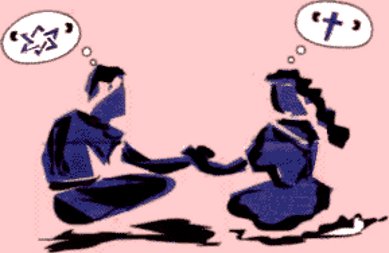
Well, in normative Jewish community, a Messianic Gentile would in no way be considered to map to a Ger Toshav. In fact, a union between a Jew and a Messianic Gentile would be viewed as an intermarriage between a Jew and a Christian, something not in any way seen as desirable in Jewish community.

In my own small experience in Messianic Jewish and Hebrew Roots groups, it is fairly common for Jews and non-Jews to be intermarried. In fact, again in my experience, the sort of Jews attracted to Messianic Judaism or Hebrew Roots are either secular Jews or Jews who have adopted Christian practice and identity, and yet who also have a desire to reconnect to being a Jew.

The participation for many intermarried couples in Messianic Judaism or Hebrew Roots then, could be seen as a sort of synthesis between Christian and Jewish values and lifestyle.

Of course, I can’t speak for every intermarried couple involved in those movements, but when I was associated with those communities, that was what I saw.

Turning to my own situation as a non-Jew married to a Jew, in my case, my spouse is affiliated with normative Jewish community, specifically the Chabad and the local combined Reform/Conservative shul. She in no way can be considered as having any sort of association with Yeshua-worshippers or Christians (which is what she considers me).

synagogueSo we come back to the definition of a Ger Toshav as a person who is part of a local Jewish community at arm’s length. Well, that’s not exactly me, since I’m not part of a Jewish community at all. In fact, I’m not currently part of any worship or faith community.

However, as quoted from the Preface of the Ger Toshav book (PDF), am I a member of this “community”?

There, almost the entire Jewish leadership was married to non-Jews whose spouses, in turn, were full contributors to the community’s life and supporters of their spouses’ involvement, yet choosing not to become Jews themselves.

Nope. That would imply that I’m involved in synagogue life with my wife and support her involvement from that platform.

However, combining “at arm’s length” with supporting my spouse’s involvement in Jewish life, I find a definition of myself, and by “arm’s length” I mean I stay away from her Jewish community completely.

This isn’t news to me. It’s just interesting to find this sort of thing recorded in modern Jewish literature.

In Messianic Judaism, you can probably find many non-Jews married to Jews who are part of Jewish community and support their spouse’s full observance of the mitzvot (keeping in mind that depending on which Messianic Jewish community you sample, the level of observance will vary).

As far as my wife’s level of observance, that’s entirely up to her. Frankly, I wish she were more observant, but as she once said to me (and rather pointedly at that), she doesn’t need my permission to be Jewish.

So I keep my nose out of her business in that arena. I also have surrendered anything that even resembles Jewish praxis since she would no doubt see it as “Evangelical Jewish Cosplay”. She even wonders why, outside the home, I still avoid bacon, shrimp, and other trief, which is just about my only remaining concession to my former lifestyle.

generic white guy
Image: Cafepress.com

I’m sure a number of my former associates would be aghast to read those words (or perhaps they wouldn’t), but in some sense they were also the prompt, or part of it anyway.

The missus is my main motivation for the decisions that I’ve made, but I’m also mindful that the Messianic Jewish community in all its forms and associations, continues to struggle with just how to implement Gentile involvement in their Jewish community, keeping in mind that at least in the western nations, most Messianic Jewish communities are made up of mostly non-Jews.

I know the ideal is to create Messianic Jewish community by Jews and for Jews, and I continue to support that ideal, but it is my belief that the dream will not be realized until Messiah returns and draws his people Israel to him.

So where does that lead us?

For those non-Jews out there who adhere to the values and practices of being involved in Messianic Jewish or Hebrew Roots communities and who are not intermarried, not a lot. I’m sure your congregation has standards of behavior and practice for the non-Jews among them, so like any member of a congregation, you adhere to those standards or find someplace else to worship.

For non-Jews married to Jews and part of the previously referenced communities, it is likely you and your spouse share the same values and beliefs, and so there is little or no dissonance between you. Only in Messianic Jewish groups with a Jewish praxis approaching Conservative or Orthodox would there be any noticeable distinction between the observance of the Jewish and non-Jewish spouse (again, this is my opinion, your mileage may vary).

For you non-Jews who have community within a Christian setting and your beliefs are not widely accepted by your peers, you have a tough road to travel. I tried that for two years and ultimately got nowhere, though I learned a lot along the way.

If you are married to a more traditionally Christian partner, then what you experience may be similar to my own marital situation. You may share the vast majority of your lives with each other but there will always be a line neither of you may cross. The most important part of you becomes isolated from your marriage.

risk
Image: mirror.co.uk

It’s a very dicey place to live. I know. I live there.

With neither support at home or community, you depend on the Holy Spirit alone to get to through each day while maintaining a relationship with God. If you’re married to a normative Christian, renouncing a Messianic perspective and taking up the mantle of traditional Christianity becomes the temptation.

For folks like me, it’s renouncing Yeshua entirely. Even if I did that, I doubt the missus would accept my adopting the Ger Toshav identity, so I’d still be alone in belief or disbelief as the case may be.

Assuming Hashem has control of all things, I wonder why He would sanction this perpetual walk along a sheer cliff. Or perhaps like the question, “why do bad things happen to good people,” it’s simply a matter of living in a broken world fallen far from God. These events occur because the King has yet to assume his throne in Jerusalem and take up his reign.

So like the rest of humanity living precariously and dancing madly on the edge of a razor blade, I and those like me just have to keep hanging in there.

Finding God on the Slopes of Kilimanjaro

Margareth said:

Like you, I have found Aish articles really uplifting. It has really made me respectful for the profound wisdom I see in the articles there.

There are people like this I have met on the slopes of mount Kilimanjaro where my mother comes from. Their lives are hard and yet when you make an impromptu visit, their lined faces literally beam with happiness and they make sure they give a prayer of thanks before you are invited to eat and before you go. They put me to quite to shame in their faith and hope and joyfulness of attitude. Maybe the city life is what is destroying me…I do love being up there on the mountain. The missionaries outdid themselves up there.

I trust your day has gone well.

To which I replied:

My day is fine, Margareth. Thank you.

I know you’ve described the hardships of your life, but from my point of view living in southwestern Idaho, it seems incredible to be able to say you met people living on the slopes of Mt Kilimanjaro. It illustrates that no matter who we are or where we live, no matter how far apart we are in terms of geography, nationality, language, and culture, we are all one in the Lord God. Most of us, we believers in the United States, tend to believe our problems and lives here are the only problems and lives. We rarely pull out heads out of the sand to realize how truly diverse are the people of God, how different our experiences, our very lives are from one another. And yet we are all brothers and sisters through our faith in Messiah. May he return soon and in our day.

I’d like to pull this brief transaction from the comments here and make it a blog post all it’s own. This realization, which escapes most of the Church in the west, needs to be pointed out and brought to light. I only wish I could bring these words to every Christian, Hebrew Roots person, and everyone attached to Messianic Judaism in any way, so we could all open our eyes and see that our struggles aren’t the only struggles, and that people of deep faith live all across the face of the Earth. It is God’s world and He will one day come back to live among us, in His Temple in Jerusalem, and the King will once again rule with Justice and Righteousness.

kilimanjaroThe first time I ever heard of Mt. Kilimanjaro was when I became aware of Ernest Hemingway’s short story The Snows of Kilimanjaro, and much to my chagrin, I must admit to never having read it. But Hemingway isn’t the point. What Margareth said is.

I know when she mentioned visiting the people who live on the mountain’s slopes, and saying that’s where her mother comes from, they were simply statements of fact. But for someone like me, someone who is not all that well-travelled, and someone who pays far too much attention than I should to the “first world problems” declared by the news and social media pundits, it brought my own staggering ignorance into stark relief.

It also reminded me of just how ignorant most of us are in the United States of America, and probably many other western nations, to the true, vast expanse of the presence of the people of God in our world, all over the world.

In her brief descriptions of her life in the comments sections of Blessing God in a Dark World and Finding What’s Most Important, she has shown me a world I am completely unfamiliar with. And yet it is also a world where all we people of faith have a common mission and purpose. That mission and purpose is to bring the light of Messiah to others, in whatever we do, no matter who we are, no matter what language(s) we speak, no matter our nationality, history, culture, or personal experiences.

We have our master and teacher, Rav Yeshua, Jesus Christ in common. I know when our Rav walked this Earth, he came “for the lost sheep of Israel” (Matthew 15:24), and yet, he commissioned his disciples to make disciples of all the people of the Earth (Matthew 28:16-20), and assigned Rav Shaul, the Apostle Paul, the responsibility of being his special emissary to the Gentiles (Acts 9:1-18).

To the best of his ability, and given the available modes of transportation of his day, Paul carried out his mission of bringing the good news of the Messiah, both to the Jews and the Gentiles living in the diaspora.

For the past nearly two-thousand years, others have taken up the mantle of the Apostle in bringing the good news to all the people of all the nations of the Earth. A lot of those missionaries have also caused a great deal of harm, destroyed the unique language of culture of many indigenous peoples, tortured, and even murdered people, Jews particularly, who would not convert to goyim Christianity, and committed many other acts that God condemns.

faithAnd yet, some remnant of the true intent of what Christians call “the Great Commission” survived. According to Margareth, the evidence of that lives on the slopes of Mt. Kilimanjaro where her mother comes from.

I am amazed and pleased to pull my own head out of the sand and realize that I have something in common with people who live halfway around the world from me, people I’ll never meet, people, quite frankly, whose faith far outshines my own.

On the slopes of Mt. Kilimanjaro, in the nation of Tanzania, on the continent of Africa, lives a people who have the same Messiah I do. They pray in his name. They greet visitors and travelers in the best tradition of Abraham (Genesis 18:1-8). Maybe the missionaries outdid themselves up on the mountain.

Or maybe the Spirit of God was exceedingly welcomed and has since resided with those humble people. The Church in America could learn a lot from them.

Thanks, Margareth. May God bless you and keep you forever in His Hand.

Conversions in Madagascar: A Cautionary Tale

Yeah, I know. Two blog posts in one day. I was inspired.

A nascent Jewish community was officially born in Madagascar last month when 121 men, women and children underwent Orthodox conversions on the remote Indian Ocean island nation better known for lemurs, chameleons, dense rain forests and vanilla.

The conversions, which took place over a 10-day period, were the climax of a process that arose organically five to six years ago when followers of various messianic Christian sects became disillusioned with their churches and began to study Torah.

-Deborah Josefson, June 5, 2016
“In remote Madagascar, a new community chooses to be Jewish”
Arutz Sheva

mikvahTo me, the news here isn’t that 121 people in Madagascar chose to participate in a mass conversion to Judaism, it’s that they (if I’m reading this right) converted after becoming disillusioned with their various messianic Christian sects.”

The article doesn’t provide the details about the former churches involved, but it does say:

While many Malagasies were brought to Judaism through study of the Old Testament and a sincere effort to get closer to God, some see the practice of Judaism as a return to their roots and an overthrowing of the last vestiges of colonialism.

“I was a victim of the colonizers, as you know we had the French here, and then the communists and then the socialists … so I didn’t have any roots anymore,” said Mija Rasolo, an actor who hosts his own late night talk show on Madagascar TV and took the Hebrew name David Mazal.

There are two things here. The first is more applicable to “Messianic Gentiles” and Messianic Jewish congregations in general.

As I’ve said numerous times before, the majority of people I know involved in either Messianic Judaism or Hebrew Roots became disillusioned with their churches and with normative Christianity in general and sought out an alternative. They too studied the scriptures and particularly the interconnectedness of the Old and New Testaments.

One of the things that comes along with such study is an introduction to the “Jewish stuff,” the materials and praxis associated with Jewish theology, worship, and lifestyle.

And that’s where the problem lies.

It’s easy to get caught up in the beauty of the Jewish traditions, the celebrations, the Festivals. It’s easy to get confused between the “Jewish stuff” and the meaning and role of non-Jews within a Jewish-oriented understanding of the Tanakh and the Apostolic scriptures.

Sometimes people zig when they should have zagged. Sometimes people think the only way to worship God is the Jewish way, and you can only do that by converting to Judaism (the Apostle Paul had a lot to say about that in his Epistle to the Galatians and in Acts 15).

Lacking a proper understanding of the Apostolic scriptures and especially the Apostle Paul (called Rav Shaul in some circles), it’s easy to see that Judaism makes so much sense but Christianity, not so much (although I’m sure I have some Christian readers who would be confused by that statement).

That’s one of the big reasons (but not the only one) why I’ve dispensed with Jewish praxis, although I adhere to a Jewish-oriented interpretation of the Bible, one that favors the centrality of national Israel, the New Covenant promises of God to the Jews, and the subordinate role of the nations to Israel’s Messiah King.

Of course, having a Jewish wife, one who is not the least bit “Messianic,” and one who calls me a Christian, also has a lot to do with me keeping my head above water.

However, the Arutz Sheva article also mentioned an indigenous person’s faith in Jesus being part of colonialism.

ChristianI belong to a closed Facebook group for indigenous people (no, I’m not indigenous). I was added some years ago due to my association with a native artist I’ve exchanged emails (and one phone call) with. One of the recurring themes I see in this group is a disdain for Christianity, not for theological purposes as such, but because conversion to Christianity was historically used as a tool of colonialism to destroy the language, customs, and practices of the first nations. For them, the theft of their land and their culture by Europe and forced conversion to Christianity was the same injury.

Jews should be all too sensitive to such sentiments, having been the victim of forced conversations and assimilation for centuries. We see evidence of that heritage being lived out in Israel and elsewhere today. The Arutz Sheva article celebrates the conversion of 121 Malagasies during a single event as a victory. For many of them, conversion to Judaism was a return to their roots.

For them, maybe it was, but it was also something else.

If you are a disciple of Rav Yeshua (Jesus Christ) and you are firm in your faith, particularly from a pro-Israel, pro-Judaism viewpoint, you realize one does not have to lose that perspective in order to maintain steadfast faith in our Rav. For the people in this article, they traded one for the other.

More’s the pity. Consider this a cautionary tale.

More Than Two Chances

What does being “contaminated by death,” and a traveling on a “distant road” have to do with us?

These terms point to deeper concepts. A state of disconnection from God is a type of death. A distant road is place where we are far away from who we really are supposed to be. This is something most of us can identify with.

-Kareb Wolfers Rapaport
“Pesach Sheni: The Holiday of Second Chances”
Aish.com

Second chances.

Any person of faith who believes Hashem grants us only two chances in life is sadly delusional. As far as my life goes, I can’t count the number of “chances” God has given me (and is still giving me) to pull my head out of that hole in the ground and get back into the game.

I don’t know about you, but I sometimes find it disheartening to blog in the religious space, particularly in the realm Messianic Judaism and Hebrew Roots.

While I’ve been told repeatedly that my blog speaks for a certain number of people out there, people like me, non-Jews who have discovered that a particularly Jewish interpretation of the scriptures, of the New Covenant, of God’s intent for not only Israel but the rest of humanity, of the meaning and purpose of Messiah, is the best and most accurate way to understand all of that and who we are because of it, what I write doesn’t speak for a much, much larger segment of both Christianity and Judaism.

I’ve received criticisms and complaints, both on my blog and via email, from mainstream religious Jews, from Messianic Jews, from Messianic Gentiles, from mainstream Christians, and just about anyone and everyone who identifies with what we call Hebrew Roots.

Some of these folks are Internet trolls, but many of them are good, kind, well-meaning people who I’ve managed to inadvertently offend in one way or another.

I’ve stopped going to church, in part, because what I believe and who I am is fundamentally incompatible with traditional Christian theology and doctrine (and not being one who tends to keep his mouth shut when asked for an opinion, I became quite a pain in the neck).

I don’t deliberately stick my nose into online and actual mainstream Jewish venues, already knowing what they would think of someone like me (apart from quoting sources such as Aish).

I have increasingly separated myself from a number of Messianic Jewish organizations for similar reasons.

Only God is silent about what I write. I suspect He’s waiting for me to make up my mind about what I’m supposed to be doing.

So you see, I believe that if people were only given two chances, me included, the vast majority of us would already be toast.

According to Karen Wolfers Rapaport’s article:

Pesach Sheni, the holiday of second chances, reminds us that we can always change our steps and return home.

The question for someone like me is where exactly is “home,” at least in the material sense?

Of course Pesach Sheni has little or nothing to do with me since I’m not Jewish. In any event, its applicability in the current Jewish world is stifled by the absence of the Temple and the Priesthood.

The holiday only tangentially speaks to the non-Jewish world that God offers such “second chances” to us, too, and it begs the question, what do I do with the chance I hold in my hands now? What are you going to do with yours?

When Israel Conquers the World

Nistell
Rabbi Jacoob Ben Nistell (Times of Israel)

Taking a glass half-full approach to the extraordinary saga of the “rabbi” who duped a Polish community for years about his Orthodox credentials, but who turned out to have been a Catholic ex-cook, Poland’s chief rabbi noted endearingly Thursday that nobody in Poland would have pretended to be a Jewish religious leader just a few decades ago.

The deception achieved by Ciechanow-born Jacek Niszczota — who passed himself off as Israel-born Rabbi Jacoob Ben Nistell to the satisfaction of the Poznan Jewish community that utilized his volunteer services — is indicative of a growing interest within Poland in its once-large Jewish community, which was almost completely destroyed in the Holocaust, Chief Rabbi Michael Schudrich said.

“Who, 30 years ago in this country, would have pretended to be a rabbi, to say nothing of 70 years ago?” Schudrich asked.

Schudrich added that he had met Niszczota/Nistell a few times, and always found him to be “very sweet and smiley.” Still, he stressed, it was not good that the man misrepresented himself…

-from “Poland’s chief rabbi finds comfort in saga of Catholic impostor who fooled community”
The Times of Israel

I actually lifted this quote from the Rosh Pina Project (RPP) which was quoting from the “Times,” and as far as I understand it, RPP meant the reference to be a criticism of Messianic Judaism, or at least those portions of the movement (perhaps One Law/Hebrew Roots) that allow non-Jews to function as “Rabbis”.

But I saw something different here. Just as Chief Rabbi Michael Schudrich suggested, why would a non-Jew, a Catholic, pretend to be a Rabbi?

The article doesn’t describe Niszczota’s motivation, but I wonder if it’s the same one that, to a much lesser degree, attracts Christians out of their churches and into the Noahide, Messianic Jewish, or One Law/Hebrew Roots movements?

There seems to be something about Judaism that a significant subset of Christians find more attractive than their own faith.

As far as many Noahides are concerned, the disconnect between how the Church interprets the Old and New Testaments results in their rejection of Christianity and Jesus Christ altogether, and pulls them into an Orthodox Jewish understanding of the role of Gentiles in a world created by God.

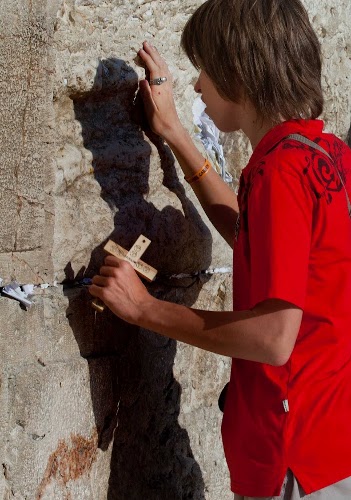
christian at kotelTo one degree or another, Messianic Gentiles and One Law Gentiles “split the difference,” so to speak, and find a way to integrate the Old Testament (Tanakh) and New Testament (Apostolic Scriptures) within a more “Judaic” framework. The type and degree of Jewish praxis varies quite a bit among these populations, since there’s no one external standard defining who we are and what we’re supposed to do within any sort of “Jewish” community space.

However, I did find another opinion, or rather a link to that opinion, that was posted in a closed Facebook group for Messianic Gentiles:

With children, at least someone was already obligated to foster their growth in Torah and observance. R. Auerbach now extends this idea to non-Jews. Beyond specific Noahide laws, he assumes all non-Jews are obligated to accept the fact that the world was created for the Jewish people [he does not explain further: I think he might have meant only that the Jewish people set the tone for the world, not that we’re the central purpose of existence. To me, that’s the implication of his following comments].

Recognizing Jews’ role in Hashem’s world means recognizing that Torah scholars, and especially a consensus of Torah scholars, are our best way of knowing what Hashem wants us to do. That’s as true for non-Jews as for Jews, so that a decree by Torah scholars should sound to them as if they’ve been told the Will of Hashem.

Technical questions of lo tasur as a Biblical obligation aside, non-Jews have to listen to the Torah leaders of the Jewish people for this reason [that might be only when there’s a formal body of Torah scholars, debating and voting on their decisions]. Such powers should extend to confiscating money and making decrees, as it does for Jews. Although in the non-Jews’ case, they’d be listening out of their own awareness that they are required to, not (again) a formal halachic obligation.

-R. Gidon Rothstein
“Children and Non-Jews’ Personal Obligations”
TorahMusings.com

Granted, this is a minority viewpoint within Orthodox Judaism, but it does exist. It also presupposes Gentile recognition of Rabbinic authority, which must be something of a rarity. I can’t imagine in my wildest fantasies, for example, the Head Pastor of the little Baptist church I used to attend going along with any of the above.

And yet, whether you’re a Noahide or Messianic Gentile in Jewish community, to one degree or another, you are accepting Jewish Rabbinic authority (One Law Gentiles, not so much).

For the Noahide, it’s a foregone conclusion that whether in the synagogue or their own communities of non-Jews, they must accept Rabbinic authority because it is the only thing that defines them.

Who am IFor Messianic Gentiles, it’s a lot more “messy”. First of all, there is no one definition of what it is to be a “Messianic Gentile” among Messianic (or other) Jews. Secondly, a lot of us don’t live anywhere near a Messianic Jewish community (at least an authentic one), so we lack an actual Jewish lived context in which to operate. Finally, depending on who you are and how you understand what “Messianic Judaism” means, your acceptance or rejection of various areas of Jewish authority and Rabbinic legal rulings will flex quite a bit.

There is one final thing to consider. In the Messianic Age, when King Messiah is on his throne in Jerusalem, and the peoples of the world live in nations that are all servants of Israel, we will indeed be under Jewish authority. I don’t know what that will look like relative to Orthodox Judaism, but my guess is that said-Jewish authority will look more Jewish than most Gentiles would be comfortable with, especially more traditional Christians.

Something to consider as Pesach (Passover) approaches.