Tag Archives: messianic judaism

Straightening the Road of the King

what-is-the-churchWhat is the “church?” Who belongs to the church? How is the church related to Judaism or is the church related to Judaism in the current age? These are the questions my Pastor and I discussed last Wednesday night. Sometimes, when we talk of these puzzling subjects, I have a difficult time conceptualizing my thoughts and feelings and articulating them while I’m with him in his office. So I ponder, and think, and occasionally, I draw (you’ll see what I mean as you scroll down while reading).

I think I’ve come up with a “vision” of Pastor’s understanding of the evolution of the church from its beginnings in Judaism as well as my own “vision.” I apologize to Pastor and to you in advance for any misunderstanding I have of his point of view. He recently pointed out to me how I didn’t have a correct understanding of his view of the “end times” (which I blogged about) and sometime soon, I’ll need to post a retraction (he told me he doesn’t find a retraction or correction necessary, but I find it necessary if I intend to be honest in my transactions with him and everyone else).

First things first. There are some areas we necessarily agree upon. God made a covenant with Abraham, with Isaac, and with Jacob involving promises relating to the Land of Israel, making their descendants very numerous, promises that they would be a blessing to all nations (through Messiah), and that circumcision would be the physical sign between God and the specific, biological descendants of Abraham and Isaac, and Jacob that their descendants would be the inheritors of these covenant promises.

The patriarchs came from Jacob and the twelve tribes of Israel came from the patriarchs. Moses led the twelve tribes out of slavery in Egypt and God redeemed them as His special people, as per the promises made to Abraham and his descendants. God then added to His promises at Sinai and gave the Torah, the teaching and instruction for righteous living to the physical descendants of Abraham, Isaac, and Jacob. This also functions as the national constitution of Israel, and has multiple other purposes.

At this point in history, Gentiles can only join Israel as gerim, which isn’t exactly conversion. The idea is that a Gentile would do what the Israelites would do in terms of the mitzvot, but the Gentiles would never become Israelites in their generation. More like resident aliens. No one can convert to a tribe or a family clan. Only after the third generation, would the ger’s children have intermarried into tribal Israel and ultimately assimilate into the Israelites. This was the only path for a Gentile to join the covenant people of God.

After the Babylonian exile and a lot of history passed by, tribal and clan affiliations were all but lost. The Jewish religious authorities instituted what we understand as the ritual of conversion. Now, if a Gentile wants to join national Israel and the Jewish people, they must undergo a process supervised by Jewish religious authorities (in modern Orthodox Judaism, it is a group of three Rabbis who form a Beit Din). The men are circumcised and both men and women are “mikvahed” as the final act of conversion. They go down into the water as a Gentile and come up as a Jew. There is no multi-generational “delay” and the individual Gentile who desires to be Jewish can become Jewish and thereafter, they and all of their descendants are considered Jews.
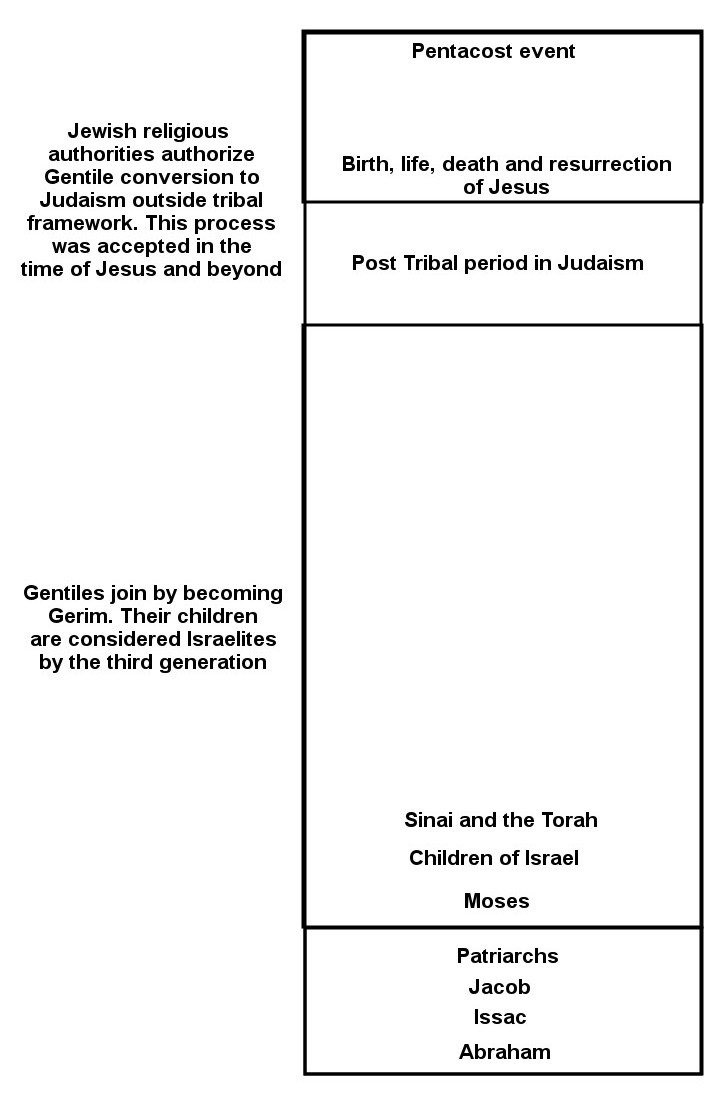
stream1Then Jesus comes. At this point, there are born Jews and there are Jewish converts or proselytes to Judaism. Jesus doesn’t speak against the ritual of the proselytes and does not overturn this institution, even though it is not directly found in the Torah. Remember, Jesus wasn’t adverse to opposing Jewish traditions and he did overturn or object to other halachah of the scribes and Pharisees on occasion (Matthew 15:1-14 for example). We also see that Paul encountered Jewish proselytes (Acts 13:43 for instance) and he too never said a cross word about the Jewish converts or the practice of converting Gentiles to Judaism (though in Galatians, he spoke strongly against Gentiles converting to Judaism as the only way to be justified before God). Both Jesus and Paul were very direct about expressing their thoughts and feelings and if either one had a problem with the Jewish conversion process, they would have said so…but they never did.

But something new happened after the death and resurrection of Jesus.

And Jesus came up and spoke to them, saying, “All authority has been given to Me in heaven and on earth. Go therefore and make disciples of all the nations, baptizing them in the name of the Father and the Son and the Holy Spirit, teaching them to observe all that I commanded you; and lo, I am with you always, even to the end of the age.”

Matthew 28:18-20 (NASB)

I wonder if the Jewish apostles truly understood the implications of Messiah’s words. Did they believe he wanted them to make converts of the Gentiles, “mikvahing” them into Judaism? All of the other streams of Judaism accepted Gentile converts, why should “the Way” be any different?

But it was and is.

While Peter was still speaking these words, the Holy Spirit fell upon all those who were listening to the message. All the circumcised believers who came with Peter were amazed, because the gift of the Holy Spirit had been poured out on the Gentiles also. For they were hearing them speaking with tongues and exalting God. Then Peter answered, “Surely no one can refuse the water for these to be baptized who have received the Holy Spirit just as we did, can he?” And he ordered them to be baptized in the name of Jesus Christ.

Acts 10:44-48 (NASB)

stream2Here we see our answer. Gentile believers, like the Jewish believers, received the Holy Spirit and were baptized by water without being circumcised and converting to Judaism! This was revolutionary. This was astounding. This had never, ever happened before. It was without compare. Paul perceived this vision clearly in his subsequent work with Gentiles, but it wasn’t until the matter was brought before the council of apostles and elders of the Way in Jerusalem that a formal, legal status was granted to the Gentiles entering into a wholly Jewish religious stream (see my Return to Jerusalem series for a detailed analysis of this process).

But it’s at Acts 2 that Pastor and I disagree. He believes that Pentecost is the “Birthday of the Church” and that sometime remarkable happened. Something remarkable did happen, but we don’t agree on exactly what it is. To the best of my ability to relate (and again, I apologize in advance if I mess any of this up), Pastor believes that an entirely new entity, “the Church” emerged from a Jewish religious stream and although it is made up of both Jewish and Gentile members, the members all form a single, uniform body of Messiah. At this point, the Torah is “fulfilled” and is no longer a set of commandments or obligations for the Jewish Christians. Jewish and Gentile Christians share a single set of obligations under the grace of Jesus Christ.

This effectively separates the Jewish members in the Church from larger Israel and the Jewish people. Pastor says that all Jews share in the covenant promises of God, particularly possession of the Land of Israel in perpetuity, but that only the Jewish Christians are saved.

My point of view is different.

I see the creation of the Body of Messiah (I’m not going to call it “the Church” in order to distinguish Pastor’s perspective from mine) as the natural and logical extension of everything that happened in Biblical and historical Judaism before it. The entire stream of history and prophesy for Israel pointed inevitably to the Jewish Messiah, so when Jesus came, it was the pinnacle, the focal point, the historical hinge upon which everything in Judaism was aimed at and upon which it turned.

But while it was revolutionary for Gentiles to be allowed to enter a stream of Judaism without converting to Judaism and being considered Jewish, their admittance wasn’t the end of the Jewish stream that accepted Jesus as Messiah as a Judaism, nor was it replaced by another religion or religious entity. It was a Judaism that had Gentiles admitted as equal members in relation to salvation and access to God, but it didn’t turn “the Way” or “Messianic Judaism” into “the Church.”

That happened unfortunately, after the Jewish/Gentile schism in the movement (and there’s a lot of history available to describe the details, so I won’t replicate it here) and in my opinion, the “Gentile Church” was born when the Gentile Church leadership agreed that it was no longer a Judaism and that Jews were not welcome unless they converted to Christianity!

If Pastor is right, then we have to consider the Jews in the Church as irrevocably separated from their Jewish brothers and sisters and perhaps even national Israel, since they no longer can identify with Israel, the Torah, and the connection the Torah provides a Jew with his nation and his God. If I’m right, then we have to consider the Body of Believers in Messiah as a Jewish stream, albeit a somewhat unique one because of such a large Gentile membership, that runs parallel to all other Jewish religious streams pointing toward the future and the eventual return of the King. We also have to admit that the Torah is not canceled and that Messianic Jews share an equal obligation to the mitzvot as all other Jewish people.

stream3Again, I sincerely apologize to my Pastor and to everyone reading this if I got his perspective on these matters wrong, in even the slightest detail. It is not my intention to misrepresent anyone, but it is my intention to draw a distinction between our two viewpoints.

Does it matter who is right? Is my purpose in the church, let alone the reason for my existence, simply to be right? As I’ve discovered (or re-discovered) recently, the answer is yes and no. No, it doesn’t matter if I personally am right. The world doesn’t depend on my one, small opinion. Statistics vary, but recent research indicates that there are anywhere between one and three-quarter million blogs to perhaps up to 164 million blogs in existence, and even the people compiling these numbers admit the list is incomplete. The number of individual blog posts goes into the billions and billions. Compared to all that, my one little blog can hardly matter, even in the human realm, let alone God’s. Any religious blogger who thinks they’re “all that and a bag of chips” can only make me laugh.

On the other hand, it’s vitally important to examine the question “who is the Church” and especially “what is the Church”. If “the Church” turns out to be a terribly misguided Judaism that has wildly deviated from its original course, then we require an exceptionally radical “course correction.” No, I’m not suggesting a revolution in the Church as such, where we strip away 100% of church culture as it has evolved over the past twenty centuries, but I am suggesting some form of change.

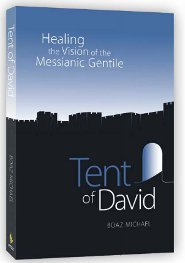
This is exactly the sort of process described by First Fruits of Zion (FFOZ) Founder and President Boaz Michael in his book Tent of David. The answer to the question of who and what “the Church” is has profound implications if we believe that the modern Messianic Jewish opinion is correct and that “the Church” was never intended to be a totally unique religious unit, disconnected forever from Israel, the Torah, and the Jewish people.

In my opinion, everything God did across human history was ultimately additive, no replacements or substitutions accepted. Abraham and God make a covenant, and as part of the conditions of that covenant, Isaac is added, then Jacob is added, then Jacob’s children are added as the patriarchs, and then their descendants, the Children of Israel are added, and they are made into a nation and the Torah is added, and possessing the Land of Israel is added, and all of the prophesies by all of the prophets pointing to the Messiah and the Kingdom of Heaven are added, and the birth of Messiah is added, and the death and resurrection of Messiah are added, and the Jewish religious stream that is identified by faith in Messiah is added, which includes the Gentiles entering this Jewish stream being recipients of the blessings of the covenant God made with Abraham…all in one, nice, neat, straight line across history as drawn on the canvas of time by God.

What we have now in the 21st century is something of a mess, but that’s what happens when God gives us a gift and then lets us play with it for 2,000 years. We’ve bent, folded, spindled, and mutilated it, but not beyond repair. Repair is what I think Messianic Judaism is all about. It’s tikkun olam or repairing the world with a Messianic twist. It’s a voice in the wilderness calling out to the synagogue and the church saying, “It’s time to take a fresh look at all this so we can clean the place up and get ready for the King’s return.”

The roadOne nice, neat, straight line from Abraham to Moshiach. Any bends in the road, any wrinkles in the asphalt, any potholes, any mudslides, any detours, have nothing to do with God and His intent. We’re the ones with the jack hammers and sledge hammers pounding away at that line, making it crooked and not straight. But we’re the ones who were charged with caring for the road, just as Adam was charged with caring for the Garden (and look how that one turned out).

I’m not in charge with being “right” but God did say that I’m supposed to take care of my little section of the road upon which the King will walk as he returns. I can’t fix it all, but I have to do something. He’s coming soon. I can’t just lie down on the job and call it good. He’s coming soon. I’ve got to do my best, with the help and by the will and grace of God, to make and keep my little piece of the road of the King straight.

For more about the relationship between Jewish and Gentile believers in the Body of Messiah, see Derek Leman’s short article, Citizens, Not Natives.

Returning to the Tent of David: An Introduction

serpentThe serpent enticed Chavah by predicting beneficial outcomes. “Your eyes will be opened… The fruit will awaken a new desire and appreciation for the pleasures around you. It will be a source of intellectual benefit.”

Chavah longed for this new knowledge and exciting awakening, and she ate the forbidden fruit. She then used her persuasive powers to convince her husband to eat it as well.

Chavah’s downfall began when she expanded upon and distorted G-d’s command, which she did not personally hear.

-Chana Weisberg
“Woman and the Forbidden Fruit”
Chabad.org

Beginning the Returning to the Tent of David series

This depiction of Chavah (Eve) and her interaction with the serpent casts her in a more favorable light than we typically see her by in Christianity. Rather than being disobedient and rebellious, she is either a bold explorer of new knowledge, or an innocent dupe of the serpent who physically pushed her in to the tree of the knowledge of good and evil and after all, it’s not her fault because God did not tell Chavah directly not to touch the tree or to eat from it.

Chavah added the prohibition of touching the Tree of Knowledge. The serpent then forcibly pushed Chavah against the tree, and victoriously claimed, “See, just as death did not ensue from touching, so it will not follow from eating.”

In this way, the serpent introduced doubt into Chavah’s mind. It now became easier to dare Chavah to taste the forbidden fruit. He convinced her that G-d did not actually intend to kill her and Adam, but merely threatened them to intimidate them.

I know, I know. The Torah reading for Beresheet (Genesis) is behind us. Why do I continue to write about it now? Shouldn’t I be preparing my commentary on Noah? Be patient. There’s a reason.

That’s my ministry in a nutshell; it’s a not-so-interesting and rather Baptist-intensive story. I am eternally grateful for my family and for my Baptist heritage. God has used both to lead me to commit my life to Christ, to follow him with my life and to serve him through the church. However, the past eighteen months have opened up for me a more complete picture of who I am and where I came from. Through a series of circumstances, curiosity, and new friendships, I am being exposed to my Jewish roots. I have no doubt that all of these circumstances and friendships, and even my own curiosity that opened me up to the Jewish roots movement, are all God-ordained.

-Durwin Kicker
Senior Pastor at Marshfield First Baptist
From the Foreword (pg 10) of Boaz Michael’s book
Tent of David: Healing the Vision of the Messianic Gentile

tent-of-davidYou may think it’s terrifically unfair of me to compare Chavah’s situation to Pastor Kicker’s. I’m not really, but it occurs to me that, at least in midrash, we all have something in common with the wife of the first man. When exposed to be brand-new world with seemingly endless possibilities, we want to explore. However, like Chavah, we may also have reservations, since some of the things that we are tempted to explore may not be what God wants us to investigate, even when we get a “helpful” shove.

God has used Boaz Michael and the ministry of First Fruits of Zion to impact my life in a profound way in a very short amount of time. It is my great honor and privilege to call Boaz my friend. His passion and love for Messiah and his gentle spirit have struck a chord in our church family which has served to open many of our people to our Jewish roots, God’s everlasting covenants with his people, and our place as Gentiles in God’s family through our Jewish Messiah.

Boaz’s desire is that this kind of loving impact will be repeated over and over again in church after church. I join with Boaz in saying, the church needs you! The church is good, yet the church needs to change. Each individual who comes to know our Jewish Messiah in his Jewish context can play a part in lovingly and patiently helping brothers and sisters in Messiah come to know him in this way as well.

-Kicker, pg 12

I reviewed Boaz’s book about nine months ago in several blog posts, the two most notable being Return of the Christian and Returning to Faith. I had read an advanced copy of the book months previously, and it was instrumental in overcoming my inertia and inspiring my own return to a local church.

And now it’s been nearly a year later. The progression through the Jewish holiday season and the beginning of a new Torah cycle seem a very good time to review my own “Tent of David” experience and to see how things actually have ended up (not that anything has really ended yet).

Pastor Kicker seems enthusiastic about pursuing the vision of the “Messianic Gentile” in the church by way of his friendship with Boaz but of course, he’s been in the church for quite some time and as Pastor, he is a fully integrated unit within that cultural, social, and theological construct. In other words, he “fits.” Boaz’s book speaks of “Healing the Vision of the Messianic Gentile.” For me as a recent “returnee,” what has been healed, if anything?

My perception of Boaz’s book (I can’t speak directly to his intent, nor would I ever try…this is my own opinion) is that there are two kinds of healing going on, at least in theory.

There’s the healing of the “Messianic Gentile,” the Christian (non-Jewish disciple of Jesus Christ) who often has left the church because of some emotional or spiritual injury or hurt (real or perceived) caused somehow by the Christian church or some of its members. Many people in Hebrew or Jewish roots congregations believe they have sought refuge in a “safe place” outside of “the Church” and continue to view church and people who identify as Christians as adversaries. Finding a mechanism to have the Hebrew/Jewish roots Gentile return to church in a safe manner and to share who they are with their fellow Christians certainly opens the avenue for healing between the parties involved.

Then there’s the more historic healing between the traditional church of Jesus Christ and the historic and Biblical Jewish Jesus and the Jewish and Gentile body of Messiah. A great deal of damage has been done to Jewish and Christian hearts, and that has sustained the separate trajectories believing Gentiles and the Jewish community (including Messianic Jews) have been traveling for twenty centuries.

church-and-crossA non-Jewish believer possessing a Hebraic view and even a passion for the “Jewishness” of Jesus, and one willing to communicate that with his or her Christian counterparts in a church community could facilitate a great deal of healing, ultimately between Christianity and Judaism. Certainly, great strides have already been made in this area between some churches and various expressions of Messianic Judaism, although a lot of work still needs to be done.

But what about me and what I’m doing in the small church I attend? I’d like to completely re-read Boaz’s book before venturing to answer that question in full, but I did want to keep my promise and at least introduce the journey I’m taking in returning to the Tent of David and Boaz’s vision of the healing of Christian and Jewish communities. His book speaks on a larger scope by necessity, but nearly a year down the road,  how has Boaz’s vision worked “on the ground,” so to speak. I can only lend my own single, small voice and my individual experience. As this series progresses, I’ll share my insights with you. Perhaps you will return the favor.

Trouble Breaking Into Church With Messianic Prophesy

daniel“Seventy weeks have been decreed for your people and your holy city, to finish the transgression, to make an end of sin, to make atonement for iniquity, to bring in everlasting righteousness, to seal up vision and prophecy and to anoint the most holy place. So you are to know and discern that from the issuing of a decree to restore and rebuild Jerusalem until Messiah the Prince there will be seven weeks and sixty-two weeks; it will be built again, with plaza and moat, even in times of distress. Then after the sixty-two weeks the Messiah will be cut off and have nothing, and the people of the prince who is to come will destroy the city and the sanctuary. And its end will come with a flood; even to the end there will be war; desolations are determined. And he will make a firm covenant with the many for one week, but in the middle of the week he will put a stop to sacrifice and grain offering; and on the wing of abominations will come one who makes desolate, even until a complete destruction, one that is decreed, is poured out on the one who makes desolate.”

Daniel 9:24-27 (NASB)

Then I saw thrones, and they sat on them, and judgment was given to them. And I saw the souls of those who had been beheaded because of their testimony of Jesus and because of the word of God, and those who had not worshiped the beast or his image, and had not received the mark on their forehead and on their hand; and they came to life and reigned with Christ for a thousand years. The rest of the dead did not come to life until the thousand years were completed. This is the first resurrection. Blessed and holy is the one who has a part in the first resurrection; over these the second death has no power, but they will be priests of God and of Christ and will reign with Him for a thousand years.

Revelation 20:4-6 (NASB)

Tales of the Messianic Era series

The previous entry is The Obscured Messiah in the Bible.

Last Wednesday night, my Pastor and I got through the majority of Chapter 8 (it’s not a long chapter and only covers Galatians 2:11-14) in D. Thomas Lancaster’s book The Holy Epistle of the Galatians. We disagreed so much about the content, that I apologized for seeming so oppositional. We continue to “butt heads” over the purpose and function of the Torah in the lives of the Jewish disciples of the Jewish Messiah in the Apostolic age and beyond.

But we got sidetracked again. Pastor asked me about the nature and function of “the Church,” the collection of Jewish and Gentile disciples of Messiah. I knew Pastor saw the Church as separate from Judaism…well, sort of, but I had no idea how separate it was supposed to be.

From my point of view, “the Church,” the body of Jewish and Gentile disciples of Messiah, is the logical extension of Biblical and historic Judaism that began with Abraham and was formalized in law at Sinai. Judaism has always looked forward to Messiah, so when Jesus was revealed as Moshiach, it wasn’t a departure from Jewish history but rather, the fulfillment of Jewish hopes and dreams. Of course, that fulfillment isn’t really filled full and it won’t be until his second advent when he will establish his reign of peace in Israel and across the entire world.

messiah-prayerSo if Jewish discipleship in Messiah is the natural and logical extension of Jewish history in the first century CE, then what was Gentile discipleship? I’ve said over and over that it was a major chore for Paul and the other Apostles to figure out a way to legally include Gentile disciples into the community of Jewish faith in Messiah without requiring that they convert to Judaism through the ritual of the proselyte and become obligated to the full yoke of Torah (and my Pastor and I also continue to debate what the Torah is and what purpose it has in Judaism) in the manner of the Jews.

It’s like Israel is the main event and enters through the front door of the mansion, while Gentiles get to come in but have to be admitted through the side entrance near the kitchen (but once we’re in, we’re in). I know that’s an unflattering image for most Christians, but that’s how the Bible reads. Going to the Old Testament (Tanakh), all of the prophesies about Messiah and what he will do emphasize blessings for Israel, not particularly for “the Church” (since “the Church” isn’t even a glimmer in any prophet’s eye in the Tanakh), but thanks to a single line in the Abrahamic covenant, the Gentiles in the world will receive blessings as well.

Did you get that? Israel is the main beneficiary of the blessings of the Messiah and the rest of the world benefits from the “spillover,” so to speak.

“Arise, shine; for your light has come,
And the glory of the Lord has risen upon you.
“For behold, darkness will cover the earth
And deep darkness the peoples;
But the Lord will rise upon you
And His glory will appear upon you.
“Nations will come to your light,
And kings to the brightness of your rising.”

Isaiah 60:1-3 (NASB)

I’ve said before that only a single verse in Genesis 12 links the people of the nations to the Abrahamic covenant, and it is only that verse that allows us to have a connection with God at all, through our faith in Messiah. All of the conditions of all of the covenants God made with Israel continue forward in time and, although major sections of the Torah are held in abeyance until such time as the Messiah comes, rebuilds the Temple, re-establishes the priesthood and the Sanhedrin, and ascends the Throne of David, everything else that God “covenanted” with the Jewish people remains in effect.

So how did the tail end up being the head? How did the Church get to think of itself as first and the Jewish people second.

Here, I’ll give you an example. Let’s go back to my conversation with Pastor about the Church and all that must occur when Messiah returns.

rapturePastor, like most Christians, believes that when Messiah comes, all members of the Church, Jews and Gentiles alike, will be taken up into the air with him and be raptured to Heaven. And there we’ll stay. Meanwhile, a lot of bad, ugly things will be happening on the earth. Lots of people will be “left behind” and many will come to faith at that time. But they won’t be “the Church”. According to Pastor, they’ll be believers, but they’ll form a distinct group outside of the Church. The Church at that time will be in Heaven with Christ. Only believers and non-believers will be on earth enduring the tribulation.

Pastor said he wasn’t sure of the timing, but that all of the Israelites, the ancient Jewish people who lived and died before the first advent of Christ, will be resurrected and they will stay on earth. They are “believers” but not the Church. They will have a special and unique role as the 144,000 (Revelation 7:4-8), but the Church disappears from the face of the planet with Jesus and they (we?) don’t return until Jesus returns, all the way down into Revelation 20. But how can Israel, the Jewish people, be fractured into two groups: those who are in the Church in Heaven, and those who are “mere” believers on earth? Abraham saw Messiah’s day (John 8:56) but he lived before the first advent. Does that mean Abraham is in Heaven as part of the Church or on earth as a “believer?” It all doesn’t make sense.

No wonder my Sunday school teacher balked when I said his calling the people of the nations in Zechariah 14:16 “unsaved Gentiles” was anachronistically projecting a “Christianism” into the Jewish text. But then again, I still think my teacher was wrong, because according to both him and Pastor, it is possible for people to come to faith during the Messianic reign, although they won’t be part of “the Church,” they will still be “saved.”

But I’ve got a problem. Whenever I read Isaiah, Jeremiah, Ezekiel, and the other prophets who speak of Messiah, I get one picture. But when I read Revelation and the sections of the Gospels and Epistles that mention the second coming of Jesus, I get a faintly related but mainly different picture.

I’ve avoided the whole issue of the second coming and the “end times” for most of my “career” as a believer because, frankly, I’ve met so many “nuts” in the Hebrew Roots movement who were incredibly obsessed about “the end times” and who weaved all kinds of bizarre scenarios around it. However, if I ever hope to understand the past, present, and future of the Jewish Messiah King, I’m going to have to take all this head on.

My Sunday school class just finished a multi-week inventory of the end times, the Messianic age, and the final events leading into eternity, but I prefer a fresh look at the material. I’m probably not going to throw myself headlong into the subject if, for no other reason, than the only information sources I have immediately handy are Christian sources (I know that sounds strange, but how does Judaism in general and Messianic Judaism in particular treat this topic?).

walking-into-churchAfter nearly a year of going back to church (although I guess I’ve been a part of “the Church” all along), I still find it hard to break into the church. Break into the church? I mean I still lack the ability to take on traditionally Christian concepts and doctrines with any amount of ease. I question everything. Everything seems strange or at least unanticipated. Is it just my ignorance of the Bible and how to interpret it, or has the Church become so comfortable with its historic perspectives that it has lost the ability (or the will) to ask itself if it could possibly be wrong?

I’m going to have to “cut and paste” everything the Bible says about the future Messianic age together on one page to even begin to make sense of it. Is there any hope of reconciling the prophesies of the Jewish Messiah in the Tanakh with the prophesies about the risen Christ in the New Testament?

“Every day people are straying away from the church and going back to God.”

Lenny Bruce

Christianity Today and Why Paul is Not Anti-Judaism

paul-on-the-road-to-damascusThe misconception about Paul with the longest historical pedigree is that he was anti-Jewish. Many imagine that after his Damascus Road experience, Paul immediately rejected Judaism and embraced Christianity. They assume that in the first century these were two clearly distinguishable religions. Before his encounter with Christ, the thinking goes, Paul was wrapped up in a legalistic pursuit of salvation and was teaching others a similar philosophy. So great was his passion that he persecuted the Christians who taught salvation by grace through faith. After his conversion, everything changed. He embraced God’s gracious salvation by faith in Christ and rejected the system of dead rituals bound up in Judaism. Paul left Judaism, therefore, and turned to Christianity.

-Timothy Gombis
“The Paul We Think We Know” (originally published 7-22-2011)
Christianity Today

Someone posted this on Facebook today and as I was reading it, I wanted to jump up out of my chair and scream YES! YES! Someone finally GETS IT!

OK, I’m not really that emphatic in my behavior but it does excite me that someone writing for a traditional Christian publication understands what I understand and what I’ve been trying to communicate in the church I attend for nearly a year.

Let’s cut to the chase. What does Gombis really think about Paul and more importantly, Paul’s struggle to integrate non-Jewish disciples into a Jewish religious stream?

The problem in the early church, therefore, was not the temptation toward legalistic works righteousness. They faced the communal challenge of incorporating non-Jewish converts into the historically Jewish people of God. First-century Judaism didn’t have a legalism problem; it had an ethnocentrism problem. The first followers of Jesus were all Jewish, and had difficulty imagining that the God of Israel who sent Jesus Christ as their Savior could possibly save non-Jews without requiring them to convert to Judaism. This is the issue in Acts 15, when Christian Jews from Judea urged the Gentiles in Antioch, “Unless you are circumcised, according to the custom taught by Moses, you cannot be saved” (Acts 15:1).

While the early church leaders decided in theory that non-Jewish believers in Jesus were not required to become Jews (Acts 15:13-21), many churches struggled with the practical challenges of becoming healthy multiethnic communities. Paul, as pastor and theologian, addresses these challenges by claiming that “no one will be declared righteous in God’s sight by the works of the law” (Rom. 3:20). This is not a condemnation of Judaism as inherently legalistic, but an affirmation that God does not justify a person merely because he is ethnically Jewish. Jews and non-Jews approach God on equal terms when it comes to salvation (emph. mine). All have sinned and all stand in need of God’s redeeming grace in Christ (Rom. 3:23-24). Therefore all who are in Christ are equal siblings in God’s new family (Gal. 3:26-28).

The “in theory” comment seems to relate to the ongoing struggle to integrate, with anything approaching seamlessness, Jewish and Gentile disciples within a single religious and social framework, but I’ll return to that issue in a moment. The main point here is that Paul did not reject Judaism for Christianity, supported continued Judaism and Torah observance for Jews, and identified the primary problem among Jewish believers and their difficulty in accepting Gentle disciples not as legalism but ethnocentrism. Many of the believing and non-believing Jews could not accept Gentiles as equal participants of a Jewish religious branch without requiring that they convert to Judaism. After all, whoever heard of Jews and Goyim being equal in the sight of God? Gombis already quoted this verse, but it should be repeated.

Some men came down from Judea and began teaching the brethren, “Unless you are circumcised according to the custom of Moses, you cannot be saved.”

Acts 15:1 (NASB)

PaulThis was the core problem Paul faced in his mission to the Gentiles and it would always haunt him. It was the cause of most of his major problems with the various Jewish communities in Israel and the diaspora. He would never see a day when this conflict was ultimately resolved and the echo of his struggle still rings in our ears. That is, if we’ll actually let ourselves listen.

But what about Paul, Judaism, and his relationship with Jewish disciples?

A second reason why we cannot envision Paul as anti-Jewish is that even after his conversion, Paul remained a Jew. He did not imagine that he was inventing a new religion, nor did he leave Judaism to join the Christian church. At the end of his third missionary journey, Paul arrived in Jerusalem and, at the suggestion of James, went through purification rituals at the temple (Acts 21:23-26). Paul saw no contradiction at all between his commitment to Christ and his faithful participation in Jewish practices. Explaining his ministry before a variety of audiences, Paul emphasized his Jewish identity and claimed to be acting in faithfulness to the God of Israel. Before the Jewish Council in Jerusalem, he declared, “My brothers, I am a Pharisee, descended from Pharisees. I stand on trial because of the hope of the resurrection of the dead!” (Acts 23:6, emphasis added). And to King Agrippa, he again claims to be a Pharisee whose hope is in the promises of God to Israel (Acts 26:4-6).

Third, Paul never calls upon Jews to reject Judaism. Instead, he exhorts them to recognize Jesus as their Messiah and welcome his non-Jewish followers as siblings in God’s new family. We get a glimpse of his preaching to Jews in Acts 17:1-3: “When Paul and his companions had passed through Amphipolis and Apollonia, they came to Thessalonica, where there was a Jewish synagogue. As was his custom, Paul went into the synagogue, and on three Sabbath days he reasoned with them from the Scriptures, explaining and proving that the Messiah had to suffer and rise from the dead. ‘This Jesus I am proclaiming to you is the Messiah,’ he said.”

The Paul of the New Testament, therefore, is not anti-Jewish. He was faithful both to the Scriptures and to his Jewish heritage. He preached Jesus as the promised Messiah of Israel, but was insistent that salvation in Christ was not limited to ethnic Jews. According to his gospel, all Jews needed to receive Jesus as Messiah, and all followers of Jesus—Jewish and non-Jewish—needed to embrace one another as siblings in God’s global family in Christ.

I’m stunned that this is being published in an online Christian venue. I’m absolutely shocked. I’m pleased beyond wonder. Paul never stopped being a Jew, never stopped Jewish observances, and absolutely never, ever encouraged any Jew to abandon Jewish practice, lifestyle, and faith. Turning to Messiah is a completely Jewish act and does not require the slightest deviation from Jewish Torah observance.

But what about “in theory?”

Gombis isn’t suggesting that in theory, the Gentiles became Jews either by formal conversation (which Paul opposed) or in action but not name by observing the mitzvot in a manner identical to the Jewish disciples. The author is only acknowledging what I have been saying all along: that in principle, the requirement was to unite Jewish and Gentile disciples of the Master within a multiethnic, multinational framework where all could share in the grace and salvation of God without anyone being compelled to surrender their unique and individual national and ethnic identity.  In practice, this was never accomplished and ultimately, both populations pursued wildly different trajectories. Their struggles are what we see in the Messianic Jewish and Hebrew Roots movements today.

walking_discipleEarlier, I posted my review of the First Fruits of Zion television series episode Raising Disciples. This is particularly relevant to today’s “extra meditation” because we encounter the topic of disciples as imitators. What did Paul say to the Gentile disciples he was raising up about imitating their Master?

In 1 Corinthians 11:1, he told them to “be imitators of me, just as I also am of Christ.” but we don’t know what they are supposed to imitate. My suggestion is that the manner of Jewish and Gentile imitation is not identical across the board, since it would obliterate Jewish and Gentile distinction in the body of disciples and thus eliminate the problem of Gentile integration. If Jewish and Gentile disciples were identical and homogenous, the basis for schism would have been severely blunted if not done away with entirely.

However, it was a given that Jewish disciples were intended to continue Jewish practice according to Gombis and the legal decision rendered by James and the Council was that the Gentiles had no identical obligation. By common association, the Gentile disciples might have acted very similarly to their Jewish counterparts, at least to an outside observer, but there remained a difference in obligation between the Jewish and non-Jewish disciples within the body of Messiah.

That probably isn’t a very satisfying answer, but I’m still thrilled that a Christian online magazine is promoting a view of Paul that is so close to my own. Now if I could just send this link to every church Pastor in the country with a note saying “READ THIS!” and if they’d keep an open mind while doing so, I’d consider it a step forward.

Interestingly enough, today is Hoshana Rabbah, the traditional day of judgment for the nations of the world. How will God and Israel judge us if we do not learn to see Paul and the Messiah in the manner Timothy Gombis suggests?

The Obscured Messiah in the Bible

tallit-prayer“My servant David will be king over them, and they will all have one shepherd; and they will walk in My ordinances and keep My statutes and observe them. They will live on the land that I gave to Jacob My servant, in which your fathers lived; and they will live on it, they, and their sons and their sons’ sons, forever; and David My servant will be their prince forever. I will make a covenant of peace with them; it will be an everlasting covenant with them. And I will place them and multiply them, and will set My sanctuary in their midst forever. My dwelling place also will be with them; and I will be their God, and they will be My people. And the nations will know that I am the Lord who sanctifies Israel, when My sanctuary is in their midst forever.”’”

Ezekiel 37:24-28 (NASB)

Tales of the Messianic Era series

I think most Christians and Jews would agree that this passage of scripture is referring to the Messianic age when David, King Messiah, will rule as Israel’s “prince” forever. Jews believe this text also confirms that Messiah will build the Temple in Holy Jerusalem, while some Christians believe the Temple is only a spiritual manifestation rather than a physical structure.

In the past several weeks, I’ve been challenged by a Jewish friend of mine to see if I can (or can’t) find Jesus in the Old Testament (Tanakh). Like most Christians, it’s difficult for me not to see Jesus in the Torah and the Prophets, but I want to be honest and actually make as much of an unbiased examination as I can. Interestingly enough, it was in last Sunday’s Bible study at church where some serious questions about Christian hermeneutics came up for me. I listened to my teacher explain some of the Jewish texts in a way that didn’t make sense. On the other hand, he had to interpret the scriptures in this manner if he was to locate Jesus there.

‘Behold, days are coming,’ declares the Lord, ‘when I will fulfill the good word which I have spoken concerning the house of Israel and the house of Judah. In those days and at that time I will cause a righteous Branch of David to spring forth; and He shall execute justice and righteousness on the earth. In those days Judah will be saved and Jerusalem will dwell in safety; and this is the name by which she will be called: the Lord is our righteousness.’ For thus says the Lord, ‘David shall never lack a man to sit on the throne of the house of Israel; and the Levitical priests shall never lack a man before Me to offer burnt offerings, to burn grain offerings and to prepare sacrifices continually.’”

The word of the Lord came to Jeremiah, saying, “Thus says the Lord, ‘If you can break My covenant for the day and My covenant for the night, so that day and night will not be at their appointed time, then My covenant may also be broken with David My servant so that he will not have a son to reign on his throne, and with the Levitical priests, My ministers. As the host of heaven cannot be counted and the sand of the sea cannot be measured, so I will multiply the descendants of David My servant and the Levites who minister to Me.’”

Jeremiah 33:14-22 (NASB)

This passage from Jeremiah 33 says several important things:

  1. In the Messianic Kingdom, God will fulfill the good news he has announced to Israel and Judah, in other words, the Jewish people.
  2. Messiah, a descendent of David, will be raised up as a “righteous branch.”
  3. Peace will be established for Israel and there will be safety in Jerusalem.
  4. Messiah, a descendant of David, will sit on the throne of Israel forever and the Levitical priests will once again offer sacrifices in the rebuilt Temple.
  5. The descendants of David and the Levitical priests will be multiplied to a number that cannot be counted.

temple-prayersSome Christians believe there will be a Temple and that sacrifices will be offered, but they believe Jesus, the Messiah, will be offering those sacrifices as a memorial (as opposed to an actual, functioning, sacrificial system). And yet, we see it is the Levites who will be sacrificing, not Messiah as a King-Priest. It’s understandable that the Priests would have families, children, and grandchildren across the future years but is this saying that Messiah also marries and has children (descendants)? Interesting, but I suppose you could also say that’s metaphorical and “David’s descendants” are the Jewish people.

“In the first month, on the fourteenth day of the month, you shall have the Passover, a feast of seven days; unleavened bread shall be eaten. On that day the prince shall provide for himself and all the people of the land a bull for a sin offering.”

Ezekiel 45:21-22 (NASB)

Waitaminute? What? Who makes an offering for his sins and the sins of the people? The prince? Who’s the prince? It can’t be Jesus because Jesus never sins.

My Bible teacher says that the prince is David not Christ. Matthew Henry’s Concise Commentary treats this concept a little differently:

In the period here foretold, the worship and the ministers of God will be provided for; the princes will rule with justice, as holding their power under Christ; the people will live in peace, ease, and godliness. These things seem to be represented in language taken from the customs of the times in which the prophet wrote. Christ is our Passover that is sacrificed for us: we celebrate the memorial of that sacrifice, and feast upon it, triumphing in our deliverance out of the Egyptian slavery of sin, and our preservation from the destroying sword of Divine justice, in the Lord’s supper, which is our passover feast; as the whole Christian life is, and must be, the feast of the unleavened bread of sincerity and truth.

My teacher didn’t see these verses the same way and used the following to establish that the prince must be literally David:

“Then I will set over them one shepherd, My servant David, and he will feed them; he will feed them himself and be their shepherd. And I, the Lord, will be their God, and My servant David will be prince among them; I the Lord have spoken.

Ezekiel 34:23-24

“My servant David will be king over them, and they will all have one shepherd; and they will walk in My ordinances and keep My statutes and observe them. They will live on the land that I gave to Jacob My servant, in which your fathers lived; and they will live on it, they, and their sons and their sons’ sons, forever; and David My servant will be their prince forever. I will make a covenant of peace with them; it will be an everlasting covenant with them. And I will place them and multiply them, and will set My sanctuary in their midst forever. My dwelling place also will be with them; and I will be their God, and they will be My people. And the nations will know that I am the Lord who sanctifies Israel, when My sanctuary is in their midst forever.”’”

Ezekiel 37:24-28

messiah-prayerBut we are presented with a problem. The term “David” in Messianic prophesy, almost assuredly refers to Messiah, not literally David. Also, Ezekiel 37:24 refers to David as “king” and “one shepherd” which must certainly be Messiah. It also describes this figure as walking in God’s “ordinances and statues to observe them,” which can’t mean anything else other than Torah, which means for the Jewish Messiah and the Jewish people, the Torah of Sinai will still be in effect in the Messianic era and apply to all Israel.

If we believe that the “prince” is the Davidic Messiah, that is to say, Christ, then Christians have a serious problem. How can a future Jesus Christ as King of Israel offer sacrifices for sin? Christians have to assign the identity of the “prince” either to another individual such as David or to a set of generic princes (who do sin), then it would be more appropriate for them to offer such sacrifices. But given what I said above, the prince can be none other than Messiah, at least if my teacher’s “proof texts” are really proof.

Additionally, we have the matter of whether or not this is a “real” sin offering or simply a memorial, harkening back to days of old, and reminding us that Christ made the offering for sin once and for all with his body on the cross.

Going back to some more traditional interpretations, we find that Jeremiah 23:3-6 also describes a righteous branch rising up, but we find something interesting in Zechariah 6:11-13:

Take silver and gold, make an ornate crown and set it on the head of Joshua the son of Jehozadak, the high priest. Then say to him, ‘Thus says the Lord of hosts, “Behold, a man whose name is Branch, for He will branch out from where He is; and He will build the temple of the Lord. Yes, it is He who will build the temple of the Lord, and He who will bear the honor and sit and rule on His throne. Thus, He will be a priest on His throne, and the counsel of peace will be between the two offices.”’

If “Branch” is a name for the Messiah, then we seem to see him sitting on the throne as both King and Priest. Since Messiah is of the house of David and the tribe of Judah, where does this leave the Levitical Priests? Or does the Priesthood of Melchizedek (Hebrews 7) trump the Levitical priests both in the Heavenly Court and on earth?

Ezekiel 43:2-7 was used by my teacher to describe the Divine Presence inhabiting the Temple in the future Messianic age but that creates an interesting situation for Christians. If the Divine Presence is God and Jesus is God and they’re both in the Temple how are we to understand this? How do they co-exist as two, separate physical entities within a single structure (the Temple)?

These are just the examples that came to mind and that I took notes on during my Sunday school class (no, I didn’t breathe a word to anyone about what I was thinking). But can we prove, just from the Old Testament scriptures, that Jesus is Messiah and God? I’m not sure we can without factoring in the New Testament record and lots and lots of Christian theology and doctrine.

No, I’m not going to throw my faith out the window, but try to look at all of this from a religious Jewish person’s point of view. In order to establish Jesus as Messiah King, we need to seriously morph the original meaning of the ancient scriptures that point to Messiah, the Temple, and the Priesthood. I don’t know that Occam’s Razor is the best hermeneutic tool to use, but if we accept that the most succinct and straightforward explanation in the bunch is probably the correct one, then Christians are obviously jumping through a few extra hoops to get Jesus to fit in all of the Messianic prophesies, at least Jesus as he’s understood in the modern Protestant church.

up_to_jerusalem

The Tanakh doesn’t speak of the sacrifices in the Messianic era as being memorials, but indicate they are the sacrifices that would have been familiar to any Israelite in the days of the Tabernacle or Solomon’s Temple. Also, the same ancient Israelites wouldn’t have had a problem with King Messiah offering sacrifices for his own sins, since they would have believed any descendant of David would be as human as David and would thus have sin. Even the greatest tzaddik who ever lived wouldn’t be completely sinless, but given that Jesus is sinless, how are we to reconcile these differences?

Obviously I’m playing, you should pardon the expression, “devil’s advocate” in this situation, but as I said before, I want to give this challenge an honest examination. I believe there are answers to all these questions, but I don’t think we can always rely on traditional Christian thought to provide those answers.

One of the messages presented by the First Fruits of Zion (FFOZ) television series, A Promise of What is to Come, is that the Bible and especially what we read about the coming Messianic age, the Kingdom of Heaven, seems to make a lot more sense when we look at the information from a more Jewish perspective. That’s the whole point of the television show.

I will probably get some pushback from my Christian readers, but one of the reasons I can’t simply walk away from Messianic Judaism is that nearly twenty centuries of Christian reinvention of the Jewish Messiah and Jewish history has obscured much of the original interpretation and meaning to the Biblical text, both in the Tanakh and the Apostolic Scriptures.

I will be honest and say that I have learned much from my Sunday school classes, but I’ve also been exposed to material that is hardly sustainable (if it’s sustainable at all) based on my reading of the Bible. I know we can’t always get the full meaning of what the Word is saying by relying on just the plain meaning, but how many knots do we have to tie in the string, and how many twists do we bend the pretzel in, before we divorce the Word of God from the “lips” of God?

The next part of this series is: Trouble Breaking into Church with Messianic Prophesy.

Finding the Path

Jewish_men_praying2That God is a redeeming God is a testament to God’s power, but that redemptive power is strangely ambiguous, for if God’s redemptive power will be manifest only at the end of days, then the inescapable implication is that in the here and now God’s power is not fully manifest. The final verse from the prophet Zechariah (14:9), with which we conclude every formal Jewish service of worship…has a significant implication here. The context is a vivid description of “the day of the Lord,” a common prophetic characterization for the age that will mark the culmination of history as we know it. The vision is apocalyptic: the familiar structures of nature will be overturned; there will be neither sunlight nor moonlight, just one continuous day; God will wage war against the evil nations and smite them with a plague. All who survive will make a pilgrimage to Jerusalem to worship the God of Israel. And then “the Lord will be king over all the earth; on that day there shall be one Lord with one name,” or as other translations would have it, on that day, “the Lord alone shall be worshiped and shall be invoked by His true name.”

-Rabbi Neil Gillman
“Chapter 9: God Redeems,” pg 139
The Jewish Approach to God: A Brief Introduction for Christians

I, John, your brother and fellow partaker in the tribulation and kingdom and perseverance, which are in Jesus, was on the island called Patmos because of the word of God and the testimony of Jesus. I was in the Spirit on the Lord’s day…

Revelation 1:9-10 (NASB)

If you’re at all familiar with the imagery presented in John’s Revelation, you’ll notice a number of similarities to my quote from Rabbi Gillman above. Of course, this imagery is also available in several sections of the Tanakh (Old Testament), so it’s not unreasonable or unanticipated that Rabbi Gillman should sound as if he’s channeling the words of the apostle. What may seem strange to some Christians is the idea that Israel is not only involved in the apocalyptic future, but that it is (they are) the conduit by which the rest of the world approaches redemptive history.

If you have been reading my blog for any length of time, this bit of news shouldn’t be completely unfamiliar. A number of my reviews of episodes of the FFOZ TV: The Promise of What is to Come television show have touched on this history. These include the topics exile and redemption, the ingathering of Israel, the Gospel message, Jewish repentance and the Kingdom being now. If you put all of this information together, you come up with a startling picture….well, startling if you are traditionally Christian.

Most of the time, in the church, we are taught that if anyone, including Jewish people, want to be reconciled with God, they must convert to Christianity and start worshiping Jesus Christ. Almost no one is teaching that in order to be saved by God, we have to go through Israel.

What? Am I saying we all have to convert to Judaism? Not at all. But we have tended to reverse causality as Christians, believing that Israel has lost significance with God and that the Church (big “C”) has overshadowed if not replaced her in God’s covenant promises. But if you read this blog post and especially the comments section, you’ll see there’s a strong indication that the return of Messiah and the final acts of redemptive history will only occur when Israel corporately repents and returns to God and the Torah! To that end, we in the Church (big “C”, all of us) have a responsibility and a duty to encourage Jewish Torah observance and repentance.

Yom-KippurThere was nothing preventing me from observing Yom Kippur in a traditionally Jewish fashion, but I chose not to fast this year. I know some of you will think I’m terrible for abstaining from “the fast,” and others will think not a thing about it. I suppose I could have fasted in order to encourage my wife and daughter, but it’s like the reason I stopped lighting the Shabbos candles. There’s little point in the only Goy in the home acting more “Jewish” than the Jewish people in the home.

Fortunately, my wife has started lighting the candles again, so there’s hope that she is participating in the forward flow of Jewish history that will culminate in the return of the Jewish King.

I feel a little guilty anyway, but if I believe that it is Jewish Torah observance that is the key to the coming of Moshiach, then shouldn’t I draw the distinction in my family? After all, my wife always thinks it’s strange of me when I avoid a pork chop or a plate of hot, buttery shrimp (not that such food would ever be found in our home). She’d no doubt have wondered why I was fasting on Yom Kippur (and I’m encouraged because for the first time in years, she fasted on Yom Kippur).

I’m meeting with my Pastor this week for our usual Wednesday night talk. I noticed on my calendar that our 7:30 meeting will also be the candle lighting time for Erev Sukkot. I experienced momentary guilt at this, and then regret that I’d miss my wife lighting the candles again. Fortunately, I just finished building and decorating our sukkah, so it’s all ready for the festival.

I must admit, Sukkot is one of my favorite holidays. Am I being a hypocrite by not fasting on Yom Kippur but building a sukkah in my backyard? I hope not. My wife and daughter won’t be building anything very soon, so it’s one of those gender-specific activities that lands on my side of the fence. I also find that the image of the Word which became flesh and “sukkahed” among us (John 1:14) is eminently portrayed at this time of year, so building a sukkah is my way of participating in the commemoration of the first Advent.

I have to admit that as the Days of Awe draw to a close and the next Torah cycle is poised to launch, I’m not sure what I’m supposed to do. Old friends in the Messianic movement have pulled away from me. Maybe I should have repented to them before Yom Kippur. Maybe I’m becoming too “Christian”. Maybe I just don’t matter in that world anymore. Who knows?

If Judaism is accelerating toward its own redemptive history, what future should I, a Goyishe Christian, anticipate? I believe the Jewish people and Israel (and especially Israel’s firstborn son, Messiah) are the doorway into redemption for the rest of the human race, but is viewing the world of faith through a Jewish lens becoming a closed door for me ? I don’t know.

God’s choosing is beyond our ability to understand. The Hebrew prophet, Amos put it this way:

To Me, O Israelites, you are
Just like the Ethiopians, declares the Lord.

True, I brought Israel up
From the land of Egypt,
But also the Philistines from Caphtor
And the Arameans from Kir.

-Amos 9:7

To equate God’s redemption of Israel from Egyptian bondage with God’s redemption of other nations — indeed, a nation such as the Philistines, one of ancient Israel’s enemies — is a striking acknowledgment that God loves all peoples equally.

-Gillman, “Chapter 8 God Reveals,” pg 119

Children of GodRabbi Gillman is observing Jewish “chosenness” from the point of view of Reform Judaism. I don’t think an Orthodox Rabbi would hold such an opinion. Nevertheless, Rabbi Gillman hits on something important, especially for Christians. God doesn’t just love Israel and He may not even bathe Israel with more love than any other nation. God may love all of humanity in exactly the same way, even as He has chosen Israel for a specific and special purpose that is separate from the nations of the world, including the people of the nations who are called by His Name (Amos 9:11).

For Jews, what precisely was the “content,” the substance, of God’s revelation to our ancestors? Torah can be defined in many ways. It can be understood as (1) the first five books of the Bible (the Chumash, or Pentateuch, both referring to “five”); (2) the entirety of Hebrew Scripture, from Genesis to 2 Chronicles; (3) all of Scripture plus the body of rabbinic interpretation that emerged in the talmudic era (from the first to the seventh centuries C.E.); or, even more broadly, (4) the ongoing interpretation of that material through our very own day. However we define it, Torah is a complex body of doctrines, history, narratives, prayers, and legal codes. It constitutes the entire body of Judaism’s distinctive religious message.

What authority does this body of teaching have for us? Are we to accept the entire body of tradition as absolutely binding on all Jews for eternity? How free are we to depart from it, and how do we decide? The different answers to these questions account for the denominational structures that characterize the Jewish community today, from right-wing Orthodoxy to left-wing Reform and everything in between.

-Gillman, pg 120

If we are all loved and we are all invited by God to participate in His redemption through the history and future of Israel, what then is the Torah to the faithful among the nations? Of course, being loved identically and even having identical access to salvation through faith and grace does not make Jews and Christians functionally identical in terms of all the covenants. As we see from the above-quoted statement, even among collective Judaism, how Jewish authority, teaching, and obedience to God is understood is highly variable. How much more variable should it be when Gentiles are thrown into the mix by our faith in Jesus through a single condition in the Abrahamic covenant?

In addition, Israel’s “daughter religions” inherited the notion of redemptive history, which led them to believe that God’s choice had passed to another, different community. The first Christians understood that God’s revelation in and through Jesus of Nazareth superseded the Sinai covenant with “the old Israel.” (In this post-Holocaust age, however, many Christians have come to question the accuracy of this reading of Christian Scripture and to abandon it.) Islam claimed that God’s revelation to Mohammed in the Arabian desert in the seventh century C.E. constituted the seal of prophecy, God’s final revelation.

-Gillman, pg 118

path-to-godChristianity tends to believe it is the “lead dog” in the pack, so to speak, so being referred to as a “daughter religion” may be a little disconcerting. However, invoking the perspective of Messianic Judaism, at least as I understand the movement, it’s certainly an appropriate term, as it fixes us in place in terms of sequence, not only regarding where we’re coming from, but in some sense, where we have to return to in order to fulfill prophesy and take our place as the crown jewels of the nations.

Even had he remained a tzaddik, the descent would still have been worthwhile; all the more so now that he has sinned.

He was meant to have confined himself to the permissible; he would have enlightened that portion of the world, healed it and carried it upward. He was meant to remain there, for if he would break out, intending to return, who knows that he could ever succeed in his gambit?

But now that he has fallen, let him return, and in doing so he will transform to light that which the tzaddik could never have touched.

-Rabbi Tzvi Freeman
“Even Better”
Based on letters and talks of the Rebbe, Rabbi M. M. Schneerson
Chabad.org

I know Rabbi Freeman never intended this, but I cannot help but be somewhat reminded of Messiah, of Yeshua (Jesus), the tzaddik who had fallen but who rose and who will return greater than ever. I’m also reminded that it is not me and it’s not Christianity or even Judaism that means anything to the future and to God. It’s the human desire to encounter God through the doorway of a broken and bleeding heart and spirit. From that encounter, we may not learn everything, but we learn where we are on the path He has placed before each of us.

I will educate you and enlighten you in which path to go…many are the agonies of the wicked, but as for one who trusts in Hashem, kindness surrounds him.

Psalm 32:8, 10 (Stone Edition Tanakh)

Whatever I end up doing in the coming year must conform to the path that God has designated for me, not the one being walked by anyone else.