Tag Archives: messianic judaism

Practicing Messianic What?

studying_tanakh_messiahBy now, most Christians have at least heard of “Messianic Jews,” that is, Jewish believers in Yeshua of Nazareth who have retained their Jewish identity and continue to observe the Torah and practice Judaism in loyalty to Yeshua and their biblical heritage.

Less well known and less understood are what we can call “Messianic Gentiles.” I identify myself as a Messianic Gentile, and I am not alone. There are a lot of us, and our numbers are growing, but what exactly is a Messianic Gentile?

The Messianic Gentile is a Sabbatarian and Torah-keeper practicing Messianic Judaism, not as a wanna-be Jew, but as a Gentile. The holy Torah of Moses has commandments for both Jews and Gentiles. Judaism is a universal religion. It is naturally centered around the Jewish people (and the Jewish Messiah), but its scriptures and practices extend out to all nations, encompassing all of us in the final consummation of the Messianic Era. A Messianic Gentile lives for the Messianic Era, an idea that our Master called “the kingdom of heaven.”

-D Thomas Lancaster
“I’m a Messianic Gentile” (June 26, 2011)
FFOZ Blogs

You probably think I’m crazy even asking if Christians practice any form of Judaism. The vast, vast majority of both Christians and Jews would answer a resounding “no.” Only a tiny population of Jews and non-Jews in what is referred to as the Messianic Jewish and Hebrew Roots movements (they overlap somewhat but are hardly the same thing) even ask such a question. Moreover, only some of the people inside of those movements are considering or confused by the answer.

But why even ask such a ridiculous question? First of all, I recently read such a question as it was floating by in the blogoverse and was intrigued by its audacity. One such church-going (non-Jewish) Christian says he regularly tells other people in his church that he practices “Messianic Judaism”. This is just a hair off from his possibly telling other Christians that he’s a “Messianic Jew”. I don’t want to be unfair or inaccurate, and this person did not refer to himself as a Jew, Messianic or any other kind.

-from my blog post
Do Christians Practice Judaism (October 17, 2012)

Well, color me chagrined. I seem to have run headlong into a contradiction. Boaz Michael, President and Founder of First Fruits of Zion (FFOZ) posted a link to Lancaster’s “Messianic Gentile” blog on Facebook recently (though I can’t seem to find it on Facebook again), and I registered my embarrassment in a comment there as well (this is related to Michael’s recently published book, Tent of David: Healing the Vision of the Messianic Gentile).

But I felt the issue needed more exposure so of course, I’m blogging about it.

I really don’t think that a Christian can practice Judaism as such because it seems to muddy the waters between practicing Judaism and being a Jew. Don’t only Jews practice Judaism? It’s confusing because Judaism is more than just a religious movement (Christianity is a religious movement). It’s a people group, a culture or collection of related cultures, a lifestyle, and when factoring in Israel, it’s not just a piece of geography, but the Jewish people and the Jewish nation as well.

If you’re not Jewish, how do you “practice” all that?

According to Lancaster, a “Messianic Gentile” such as he, practices Messianic Judaism by keeping the Shabbat and keeping Torah, “not as a wanna-be-Jew, but as a Gentile.”

My Jewish wife once called me a “Jewish wannabe” in the heat of a discussion and among many other events, it has “inspired” me to attempt to embrace my identity as a Christian for the sake of clarity and as a sign that I’m “backing away from her turf.” That Lancaster calls Judaism a “universal religion” doesn’t mean (in my opinion, but I don’t have even the beginnings of the educational and experiential background in religious and Bible studies that Lancaster possesses) that it can be universally appropriated and practiced by anyone anywhere.

There’s a fine line to be drawn here. On the one hand, Gentiles dressing frum and wearing payot would be offensive to Jews and even look kind of crazy, but on the other hand, Isaiah did relate the words of God when he said:

“It is too light a thing that you should be my servant to raise up the tribes of Jacob and to bring back the preserved of Israel; I will make you as a light for the nations, that my salvation may reach to the end of the earth.”

Isaiah 49:6 ESV

Jewish in JerusalemThis goes back to something more basic we find in the Torah:

See, I have taught you statutes and rules, as the Lord my God commanded me, that you should do them in the land that you are entering to take possession of it. Keep them and do them, for that will be your wisdom and your understanding in the sight of the peoples, who, when they hear all these statutes, will say, ‘Surely this great nation is a wise and understanding people.’ For what great nation is there that has a god so near to it as the Lord our God is to us, whenever we call upon him? And what great nation is there, that has statutes and rules so righteous as all this law that I set before you today?

Deuteronomy 4:5-8 (ESV)

Israel, in a sense, was supposed to be an example to the rest of the world by how it obeyed God and adhered to the standards of the Torah mitzvot. The rest of us were and are supposed to observe, be really impressed, and allow Israel’s idealized example influence our nations to become more just, more compassionate, and for all of us to leave our “idols” behind and embrace ethical monotheism.

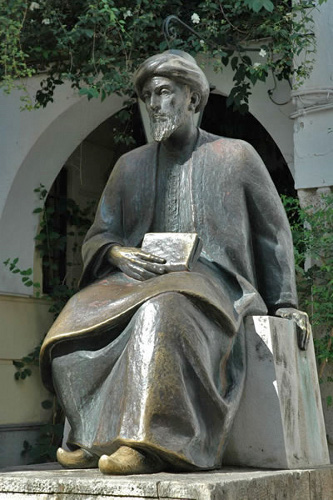
Maimonidies (Moshe Ben-Chaim) Laws of Kings, Laws 11:10-12 (Capach Edition): “[10] …Can there be a greater stumbling block than this (Christianity)? That all the prophets spoke that the Messiah will redeem Israel and save them, and gather their dispersed and strengthen their Mitzvot, and this (one, i.e., Jesus) caused the Jews to be destroyed by the sword, and scattered their remnants and humbled them, and exchanged the Torah, and caused the majority of the world to err to serve a god other than the Lord. [11] Nevertheless, the thoughts of the Creator of the world are not within the power of man to reach them, ‘for our ways are not His ways, nor are our thoughts His thoughts.’ And all these matters of Jesus of Nazareth and that of the Ishmaelite who arose after him are only to straighten the way of the king Messiah and to fix the entire world, to serve God as one, as it is stated (Zephaniah 3:9), “For then I will turn to the peoples (into) clear speech, to all call in the name of G-d and serve Him unanimously. [12] How (will this come about)? The entire world has already become filled with the mention of the Messiah, with words of Torah and words of mitzvos and these matters have spread to the furthermost isles, to many nations of uncircumcised hearts, and they discuss these matters and the mitzvot of the Torah. Some say: “These mitzvoth are true, but were already nullified in the present age and are not applicable for all time.” Others say: “Hidden matters are in them (mitzvos) and they are not to be taken literally, and the messiah has already come and revealed their hidden (meanings). And when the true Messiah stands, and he is successful and is raised and exalted, immediately they all will retract and will know that fallacy they inherited from their fathers, and that their prophets and fathers caused them to err.”

-quoted from mesora.org
maimoCommentary on this quote found at mesora follows:

With respect, the point is, I think, that although Christianity and Islam are not true, they have played a part in the Divine scheme for the redemption of the whole of humanity by spreading some sort of ethical monotheism involving an albeit incorrect idea of Messiah, Torah and Mitzvot. Although Islam and Christianity are part of the overall process leading to the redemption their imperfect ethical monotheism will be rectified through the adoption of the seven laws.

Naturally, neither Judaism in general nor Maimonides in specific, support Christianity nor the idea that God intended our faith as a mechanism for spreading knowledge of God, and the opinions expressed at the mesora website reflect this. Nevertheless, we can see that Judaism has had a great influence on the world (like it or not) as expressed through Christianity and Islam.

But does “influence” equal “practicing Judaism?” Again, most Christians and certainly most if not all Muslims will strongly deny practicing Judaism in any way or form, but returning to the Messianic Gentile, what about them?

I mainly see “Messianic Gentiles” as having a different perspective than more traditional Christians (which isn’t to say that a self-identified Christian in a church couldn’t have the same point of view). As Lancaster says, they “believe that the Torah is not cancelled, and it contains laws and commandments that apply to both Jews and Gentiles. We keep those laws and commandments as we seek the kingdom.” He further states that:

The idea of practicing Messianic Judaism as a Gentile is not a new thing. Paul’s readers were doing it almost 2000 years ago.

However, in my reading of many of Lancaster’s other works, I don’t believe he is saying that we Christians are all obligated to practice Judaism nor commanded to imitate Jews in every detail in their halalach lifestyle. I don’t think you can find the early Christians who were established by Paul living in such a manner, although I admit that they did live more like the Jews of their day than we Gentile believers do today. I don’t doubt they kept a kind of kosher for table fellowship with Jews, perhaps kept Shabbos as they were able (early Gentile Christianity, unlike Judaism, was not a recognized religion by the Roman empire and Gentiles would not have been absolved from working on Shabbos as the Jews were), davened at the set times of prayer, and even observed some of the festivals (Passover would have been particularly meaningful).

But were even the ancient Christians at the end of the Second Temple era “practicing Judaism?”

A few days ago, I wrote a meditation that outlined the struggles Jewish and Gentile believers had with each other in the days of James, Peter, and Paul due to conflicts in what the Gentiles should and shouldn’t be practicing, and what sort of social bonds (if any) should form between Jewish and non-Jewish disciples of the Master…all based on Lancaster’s commentaries.

I don’t think this is an easy issue to deal with. It wasn’t 2,000 years ago, and it doesn’t seem to be in the present. But if the early Christians in their religious life weren’t “practicing Judaism,” what were they doing? “Christianity” as a discrete entity did not yet exist. Were these Gentiles acting as some sort of “quasi-converts” or “amplified God-fearers?” I think the New Testament was struggling with trying to identify who and what the Gentiles were as they entered into “the Way” and never got around to answering the question.

I’m not sure the question has been answered today, either. Some Hebrew Roots supporters have jumped from A to Z and declared that Messianic Judaism is (supposed to be) all-inclusive and there are no distinctions allowed. Gentiles entering the movement acquire a covenant status that’s not only equal to the Jews in the movement, but identical to them in every conceivable detail. A “Messianic Gentile” is just a “Messianic Jew” without a particular string of DNA and (in the case of males) a circumcision.

I’m not trying to be disagreeable to Lancaster, Boaz, or anyone else, but my opinion is that we use the phrase “Messianic Gentile” as a way to describe a Christian who has a very specific view of Jews, Judaism, the Torah, and God, all relating back to what the movement teaches. But does that mean whatever Messianic Judaism is allows both Jews and Gentiles to practice Judaism as a religious or worship form? If my wife and I go to one of the local synagogues and worship together, am I practicing Judaism?

D.T. LancasterWhile my viewpoints and attitudes probably identify me as a “Messianic Gentile” by Lancaster’s definition, I tend not to use the label for a variety of personal reasons. My wife thinks of me as a Christian and I can only imagine that everyone who sees me at church doesn’t give my being a Christian (as opposed to being a Messianic Gentile) a second thought. Of course, at this stage of my life, I don’t observe anything that even resembles a Shabbat and my level of kashrut is what the Chabad Rabbi in our community would call “kosher style.” If I wanted to truly be “Messianic,” I’d have a long way to go.

I don’t lay tefillin, I don’t pray while wearing a tallit gadol, I only wear a kippah if I’m actually going to shul (since all men are required to, Jewish or not), I pray with a siddur very sparingly, I can’t pray in Hebrew (languages are not one of the things I’m good at), and in many, many other ways, I’m not a “Messianic” anything. I certainly don’t practice Judaism, Messianic or otherwise.

I can’t tell D. Thomas Lancaster or anyone else that they aren’t practicing Messianic Judaism, but on the other hand, in my own life, I can’t see how a Christian like me could ever do such a thing. I suppose this is where opinions differ and possibilities for some of us are yet to be realized. Even if my wife and daughter were to suddenly become shomer shabbos and kasher our kitchen, and I were to daven at the set times of prayer, who would I be and what would I be practicing?

I tend not to think that it’s any form of Judaism, in spite of the obvious similarities, but on the other hand, I don’t really know what to call it. One thing’s for sure, especially with the recent issues involving Gentiles at the Kotel and the lack of respect we’ve been showing at this most Holy site, I feel once again diminished (it’s so sad some Christians can’t treat Jews with respect) and I know for certain that we sure aren’t Jews.

Distinctions

distinctionsFor before certain men came from James, he was eating with the Gentiles; but when they came he drew back and separated himself, fearing the circumcision party. And the rest of the Jews acted hypocritically along with him, so that even Barnabas was led astray by their hypocrisy.

Galatians 2:12-13 (ESV)

Who were these certain men from James? In the Greek of the period, the term “a certain man” usually indicates someone of prestige. By saying that they were certain men from James, Saul (Paul) indicated that they were from the Evyoinim, the Jerusalem community fo believers. The “certain men” from James must have been prestigious members of Jerusalem’s community, perhaps apostles, members of the Twelve, or even members of the Master’s extended family such as sons of Clopas. Whoever they were, their approval or disapproval seems to have carried weight.

Luke does not tell us why they came to Antioch, but when they arrived, they expressed their disapproval about the free intermingling of Jewish and Gentile believers. Saul referred to them as “the circumcision,” a term he uses to indicate Jewish believers.

-D. Thomas Lancaster
Torah Club, Volume 6: Chronicles of the Apostles
from First Fruits of Zion (FFOZ)
Torah Portion Va’era (“and I appeared”) (pp 366)
Commentary on Galatians 2:1-18, Acts 12:25

One of the things I’ve been trying to communicate lately is that no religious or faith community is perfect and free from conflict. As we see above, that includes the early community of “the Way” as Paul was taking the message of the Jewish Messiah to the non-Jews in the diaspora. While Paul obviously felt very strongly about his mission to the goyim, there were apparent difficulties, one being the “free intermingling of Jewish and Gentile believers.” Peter himself was instrumental in bringing the first household of Gentiles into full covenant relationship with Jesus (Acts 10) and yet, when “certain men from James” came to Antioch, Peter, who had previously felt comfortable eating with the Gentile believers, suddenly became intimidated and drew back from them. According to Lancaster’s interpretation, there was a difference of opinion among the “high-ranking” Jews of the Way as to the appropriate level of contact (or lack thereof) between Jews and non-Jews who shared a faith in the Christ; the Moshiach.

One of the things I sometimes hear from folks in the Hebrew Roots movement is that there was originally a sort of “super-unity” between the First Century Jewish and Gentile believers, and that, apart from a string of DNA indicating that one had Hebrew lineage and another did not, they became identical “co-heirs” in the Kingdom, sharing everything, including covenant identity and covenant responsibilities relative to the Torah mitzvot. While I agree that the early Gentile Christians, those who lived in the day of James, Peter, and Paul, most likely did live a worship and daily lifestyle that appeared far more “Jewish” than we Christians do today, it is obvious from this section of Paul’s letter to the Galatians and Lancaster’s commentary on the matter (which he no doubt borrowed from his “must have” book on the topic The Holy Epistle to the Galatians) that there was already “trouble in paradise.”

Lancaster, referencing material from Magnus Zetterholm’s book Approaches to Paul: A Student’s Guide to Recent Scholarship (Fortress Press, 2009) states the following:

The Jewish believers from James argued that, if the Gentile believers were fellowshipping and worshipping and eating within Jewish space, they should go the full distance and become Jewish. If they chose not to do so, they should be set outside the Jewish community – quarantined, so to speak – so that the distinction between Jew and Gentile remained perfectly clear. In expressing that opinion, they may or may not have been expressing the opinion of James, the brother of the Master.

-Lancaster, pg 367

PaulNot only does Lancaster introduce the idea that representatives of James did not approve of a completely free intermingling between Jews and Gentiles in the movement and advocated for a separation between the two groups socially, we see strong signs of disagreement on this very matter between different groups of Jews in the apostolic community.

But what about Paul? According to Lancaster:

Saul saw that the separation could only result, ultimately, in two different faith communities, two different religions, and two different peoples: a Gentile ekklesia and a Jewish ekklesia, and he did not care for that prospect. He took a bold step; he even stepped out of line and rebuked Simon Peter.

-ibid

But when Cephas came to Antioch, I opposed him to his face, because he stood condemned.

Galatians 2:11 (ESV)

Paul called Peter out on his hypocrisy in having table fellowship with Gentiles when the “big wigs” weren’t around but shying away from his Gentile brothers when they were. Paul doesn’t seem to be a person who really cared about appearances and he had a lot invested in his relationship with the Gentiles he mentored.

James, Peter, Paul, and the rest of the Jewish apostles and believers were Jews who lived a halakhic Jewish lifestyle consistent with that period of time and who maintained that their faith in the God of Israel through the Jewish Messiah was wholly Jewish. Integrating non-Jews without requiring them to convert to Judaism (and Peter knew this since he deliberately did not have Cornelius and his household circumcised after receiving the Holy Spirit and before baptism by water – see Acts 10:44-47) was an amazingly difficult task. How was it to be done?

While the men from James felt that the Gentiles should either be circumcised and convert to Judaism or be completely segregated from the Jewish community, Paul had grave misgivings about the separation of believing Jews and Gentiles, and yet, this is the same Paul who likely foresaw just such an event.

Lest you be wise in your own sight, I do not want you to be unaware of this mystery, brothers: a partial hardening has come upon Israel, until the fullness of the Gentiles has come in. And in this way all Israel will be saved…

Romans 11:25-26 (ESV)

traintracksAs much as he may have resisted it and even dreaded it, Paul could very well have known that the Gentiles and Jews would ultimately travel divergent trajectories across future history and indeed, that is exactly what has happened.

After all, Paul came to forcefully realize the depth of the Jewish struggle in attempting to accept Gentiles within a Jewish religious and identity context:

When the seven days were almost completed, the Jews from Asia, seeing him in the temple, stirred up the whole crowd and laid hands on him, crying out, “Men of Israel, help! This is the man who is teaching everyone everywhere against the people and the law and this place. Moreover, he even brought Greeks into the temple and has defiled this holy place.” For they had previously seen Trophimus the Ephesian with him in the city, and they supposed that Paul had brought him into the temple.

Acts 21:27-29 (ESV)

When I was reading this part of Lancaster’s commentary on Galatians 2, I couldn’t help but think of the struggles in the modern Messianic Jewish and Hebrew Roots communities over the very same matters. How are Jews and Gentiles supposed to interact with each other within a Hebraic worship context? What role should a Gentile Christian take in a Messianic Jewish fellowship? Should Jews and Gentiles all say the same prayers? Should we all wear tzitzit? Will a Jewish Cantor or Rabbi call a Gentile worshiper up to an aliyah to read a Torah Portion during Shabbat services?

I know I mine this particular nugget of information often, but Rabbi Dr. Michael Schiffman’s article Messianic Judaism and Christianity: Two Religions With The Same Messiah speaks volumes about the current struggle that we also find in Paul’s letter to the ancient Galatians.

I’m not sure what to do about it but then again, I’m in no position to do anything about it. I’m not in charge of any aspect of any movement that would allow me to take a definitive action impacting Jewish and Gentile relationships within the Hebrew/Jewish Roots or Messianic Jewish communities (or the larger traditional Christian communities for that matter). According to Lancaster, Paul desired a unity that extended up to the level of table-fellowship, but it seems unlikely that he would have advocated for a complete fusing of Jewish/Gentile identities. He never advocated for Gentiles becoming fully Jewish:

Look: I, Paul, say to you that if you accept circumcision, Christ will be of no advantage to you. I testify again to every man who accepts circumcision that he is obligated to keep the whole law.

Galatians 5:2-3 (ESV)

On the other hand, Lancaster said this of Paul:

Saul pointed out that, if Simon Peter, of all people, built a sharp division between Jew and Gentile by removing himself from table-fellowship with Gentiles, he was rebuilding the barrier that he had originally torn down (see Galatians 2:18)…If he agreed that Jews and Gentile believers should limit their social and table interaction, then he had erred by tearing down that wall of division in the first place and proved himself to have been living in sin and transgression.

-Lancaster, pg 369

Let me tell you a story.

I heard this story very recently and I was impressed.

A certain Christian was traveling with a tour group in Israel led by a number of Jews. Each morning, the Jews would rise early and form a minyan to pray shacharit. The Christian would also rise early to pray, but never approached the Jewish minyan. He sat in the back of the room where the minyan had gathered, reading his Bible and praying. When the minyan was finished with prayers, the Christian was finished with prayers and they joined each other for breakfast. In a way you might not expect, this formed a bond between the Jewish men and the Christian, one of mutual respect and perhaps even a realization that Jew and Christian mutually shared a devotion to God.

SuccothThe Christian now lives in America and still keeps in touch with some of the Jewish men he traveled with in Israel based, in part, on what they “shared” in morning prayers.

I’m not necessarily suggesting that a complete division between believing Jews and Gentiles is the way to go. Paul seemed to believe there should be some sort of interaction between the two groups, though how far he would have taken it is questionable. Jewish believers such as Rabbi Dr Schiffman recognize that Jews and Christians must maintain separate religions, as the emissaries from James supported, to preserve Jewish covenant identity. Yet like Paul (and Lancaster), there are other groups within Messianic Judaism where Jews and Gentiles do worship together and share table-fellowship in peace.

Halalaic Jews in the movement of Messianic Judaism are still a minority population, with the majority of worshipers and leaders being non-Jews. But there are enough Jews present to beg the questions we see expressed in Galatians 2. We debate back and forth and occasionally, arguments become heated, but the struggle in which we’re engaged is very old. I don’t know if Paul ever solved his dilemma or if he and James (or the men he sent to Antioch) ever came to an agreement on the matter. I only know what Peter finally concluded as he addressed James and the Council.

And God, who knows the heart, bore witness to them, by giving them the Holy Spirit just as he did to us, and he made no distinction between us and them, having cleansed their hearts by faith.

Acts 15:8-9 (ESV)

May we who possess the Spirit of God within us and who humbly attempt to walk in the dust of the footsteps of our Master be granted wisdom and fellowship in the presence of Christ, the Messiah.

Va’eira: Is This Egypt?

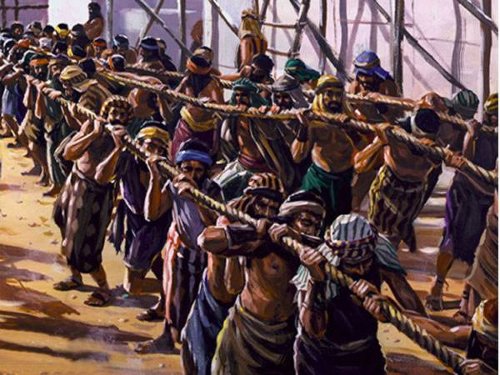
hebrew_slaves_egyptSay, therefore, to the Israelite people: I am the Lord. I will free you from the labors of the Egyptians and deliver you from their bondage. I will redeem you with an outstretched arm and through extraordinary chastisements. And I will take you to be My people, and I will be your God. And you shall know that I, the Lord, am your God who freed you from the labors of the Egyptians.

Exodus 6:6-7 (JPS Tanakh)

G‑d reveals Himself to Moses. Employing the “four expressions of redemption,” He promises to take out the Children of Israel from Egypt, deliver them from their enslavement, redeem them, and acquire them as His own chosen people at Mount Sinai; He will then bring them to the land He promised to the Patriarchs as their eternal heritage.

from “Va’eira in a Nutshell”
Commentary on Torah Portion “Va’eira
Chabad.org

I had coffee with a friend after work on Wednesday. We see each other irregularly these days, but our conversations are always good. The main reason we met was because he wanted to borrow my copy of Boaz Michael’s book Tent of David: Healing the Vision of the Messianic Gentile. This, of course, was also one of the primary topics of our talk as I sipped my coffee and he sampled his tea.

One of the things I value about our relationship is that we don’t always see eye-to-eye. We never argue and conversations never become heated, but we do see things from different points of view. I think he’s interested if not intrigued about my return to church (although this could be projection on my part) and he struggles with the implications of going back into the church after having been “redeemed” from it. It’s an interesting metaphor.

In our discussion, he likened leaving the church to the Children of Israel leaving Egypt. It’s not a complementary picture of the church that he’s painting, but it’s one that I’ve encountered on numerous occasions during my sojourn in the Hebrew Roots movement. Egypt represents nothing good spiritually and morally and leaving Egypt is always seen as a positive action on the part of God toward the Israelites. But can non-Jewish believers leaving the church be seen in the same way? If the church equals Egypt, torment, and slavery, and being released from all that means coming closer to God, then when a Christian leaves church, where do they (we) go that is better and what do they (we) do when they get there?

Let’s back up a minute. In Judaism the process of God rescuing the ancient Hebrews from their slave status in Egypt and bringing them to Himself at Sinai involves what is called the “four expressions of redemption” based on the above-quoted Exodus 6:6-7. But what are these four expressions and what do they mean?

According to the Ask the Rabbi column at Ohr Somayach, they are:

  1. “I will take you out from under Egypt’s burdens – Vehotzeiti
  2. “And I will save you from their servitude – Vehitzalti
  3. “And I will redeem you – Vega’alti
  4. “And I will take you as My nation – Velakachti

This is actually a commentary on the four cups we see during a traditional Passover seder. The Ohr Somayach Rabbi further states:

We didn’t go from a slave nation to being the Chosen People at Mount Sinai overnight. There were different stages of redemption. The above phrases described these different stages. Each cup of wine represents one of these levels.

leaving_egyptThat’s fine as far as it goes, but to me, it’s not very revealing, especially if we are trying to compare these four expressions to how we might view a non-Jewish Christian leaving the church (which is being equated to Egypt).

OU.org expands on the meaning of the four expressions thus:

According to R. Bachya (Spain, 1263-1340), the explanations of the Four Expressions are as follows:

  1. “I will take you out” – Hashem would remove the slavery even before the Jews left Egypt, from all the Tribes of Israel, because of the growing perception by Egypt of Hashem, the G-d of Israel, as the One Almighty G-d.
  2. “I shall save you” – Hashem would take the Jews out of Egypt with plagues visited upon the Egyptians, their Pharaoh and their gods, “with a strong hand and an outstretched arm.”
  3. “I shall redeem you” – Hashem would perform the miracle of “Kriat Yam Suf,” the Splitting of the waters of the “Yam Suf,” and the creation of a dry path for the Children of Israel to walk upon as they crossed the Sea of Reeds. Then Hashem caused the piled-high waters to descend in a tidal wave upon the Egyptian Army, to permanently crush the World-dominating power of Egypt.
  4. “I shall take you” – Hashem took the Jewish People to Himself as a Kingdom of Priests and a Holy Nation. This was the spiritual component of the Redemption from Egypt. In fact, the spiritual Redemption was the Reason for the Physical Redemption.

The fifth expression, “I shall bring you to the land,” refers, of course, to the Land of Israel…

I must admit, I’m having a tough time mapping what I’ve been quoting from above to any image of why Christians should leave the church and where they are supposed to go. On the other hand, I’m kind of biased and truth be told, it wasn’t that many years ago that I might have accepted my friend’s metaphor relative to the Hebrew Roots movement.

But consider this. If Hebrew Roots is supposed to be the “Sinai” for Christians leaving the church, is it an attainable goal and is it right and accurate to say the church is Egypt in a spiritual (or any other) sense?

The Christians who, throughout the ages, have propagated this message and tried to soothe the hurting, feed the hungry, and speak to social injustice have been keeping the weightier matters of the Torah. Both Yeshua (Mark 12:31) and the Sages (Rabbi Hillel in b.Shabbat 31a and Rabbi Akiva in Sifra, Kedoshim 4:12) taught that love of neighbor is the essence of Torah. These are non-trivial accomplishments which speak to the robust, biblical ethical system which many devout Christians have embraced.

-Boaz Michael
“Chapter One: The Church is Good,” pg 49
Tent of David: Healing the Vision of the Messianic Gentile

You’ll have to read all of Boaz’s book to get the full flavor of why the church is good, but I believe he paints a very convincing picture of the modern “body of Christ” as it lives and breathes within the multitude of churches in our communities and around the world. Even today in the lives of people I know, Christians are doing wonderful acts of kindness in the name and spirit of Messiah.

We are seriously getting love aimed at us by a little church nearby. Out of the blue, the pastor had contacted me wanting to know if some of their members could do anything for us and he wouldn’t take no for an answer unless it really was no.

Today some amazingly nice folks showed up and hauled off to the dump our junk too big for our own vehicle, in one of the guy’s large truck.

Meanwhile, the ladies scoot in to do some cleaning while visiting with Heidi.

And meanwhile another great guy is walking me around our deck, explaining to me how he is going to prep the bannister and then paint it for us.

And they’re coming back tomorrow!

-Joe Hendricks

I originally quoted Joe in a blog I published last June. Sadly, since that time, Joe’s wife Heidi passed on, but the church he mentions continues to be a support in his life as he grieves and as he yet looks to the future by the grace of Christ.

afraid-of-churchThe church isn’t perfect. In fact, It’s taken quite awhile for me to overcome my own misgivings about going back to church (which can be reviewed in all their glorious details in my recent “Days” series, which culminated at Day Zero). In fact, I still periodically have to review Pastor Jacob Fronczak’s blog post Why I Go to Church to remind myself that a community can be imperfect and still be the will of God for the good.

So if the church isn’t Egypt, then do we have to be delivered from it? Is there someplace better to go to and what do we call it?

I can’t answer for every person out there who has once been in the church and, for whatever reasons, left it, either for some other religious organization or to pursue God as a solidary individual or family. I can only speak for myself and how I express my evolving understanding of God’s will for my life.

I don’t think we can get back to the “root” of our faith. I know that’s disappointing and maybe some of you disagree with me, but hear me out. At some point about 2,000 years ago, a sect  called “the Way” rose among the other movements in Judaism in the late Second Temple period. The Jewish disciples were devoted to a “dead Rebbe” rather than a living teacher, one who they said not only died, but rose again. He is the Mashiach, the Son of the Living God (Matthew 16:16), who sits at the right hand of the Father (Psalm 16:8, Psalm 110:1, Acts 2:33), and who is the High Priest in the Court of Heaven (Hebrews 4:14).

The “Christianity” of that moment in history was a wholly Jewish religious movement and it co-existed with numerous other Jewish movements in Roman occupied “Palestine” in those days. Acts 10 shows the first non-Jew who came into discipleship under Messiah within this sect without converting to Judaism, and the “ministry” of Paul, who as an emissary to the Gentiles, preached a Gospel not given by men but by Jesus Christ (Galatians 1:11-12). As more and more Gentiles in the diaspora began to hear the “good news” of the Jewish Messiah and apply it to their lives, slowly the Gentiles and Jews within the “Jesus movement” began to trace somewhat divergent trajectories. Those slight deviations in trajectory would later lead them on completely different paths through the progression of history, and for centuries now, they have both identified themselves as two completely different religions that once shared a common point.

Should Christians seek to leave the church and travel backward across the timeline, trying to recapture whatever idealized or “perfected” Christianity that may (or may not) have existed somewhere around the mid 40s CE? Is it even possible?

Or does the path that God has set before us lead forward into the future…a future that will summon the risen Messiah to come out of the sky in the clouds (Revelation 1:7), who will redeem his people Israel, and who will also gather his disciples from the nations? If this future-oriented path is the true one, then perhaps there is no “perfect Christianity” to go back into upon “leaving the church.” Regardless of whatever Christian or Jewish worship venue to which you are attached (including any form of Hebrew Roots or Messianic Judaism), chances are, you don’t belong to a perfect community. Chances are people in your congregation make mistakes. Chances are, when scrutinized by the King of All Glory, your theology may not be absolutely and totally 100% “kosher.”

Chances are, there is no perfect church, synagogue, community, or congregation for you or for any of us to join upon leaving “church.” Face it. All congregations that involve human beings and human relationships are “messy.” We have to start with where we are, not where we’d like to be.

Yes, the church could be improved. That’s the other very valuable (to me) chapter in Boaz’s book, “Chapter 2: The Church Needs to Change.” Frankly, we could also probably say, relative to God’s perfect understanding, that the synagogue needs to change as well. A better way to say it is that we all need to change, to be better, to draw nearer to God, to refine our understanding of who He is and who we are in Him, Jew and Christian alike. We travel upon our divergent trajectories but we have one Shepherd and one King, and God is One. Not that our ultimate unity under Him as His “peoples” means uniformity, but it does mean unity of devotion and fealty.

The Messiah will come. He will return Israel to its place as the head of all the nations, rebuild the Temple, defeat evil, and establish a reign of peace and tranquility for all peoples of the earth. All the Jewish people will be gathered unto him in their nation Israel, and we believers who reside across the four corners of the Earth will bow our knees to him and call him Lord over all (Romans 14:11, Philippians 2:10). That is our future.

But we’re not there yet.

two-roads-joinWe have to start where we are. If we are non-Jewish Christians in church, we should stay in church. We should bring our understanding of the Jewish Messiah King to where we are, not remove it from our fellow believers and hoard it for ourselves. If we are Gentiles in a Messianic community, then we should stay there (though there may be exceptions who will also attend a church) and use other platforms for communicating our understanding to the Christians we know or will come to know (compare to 1 Corinthians 7:18). For myself, I go to church not to change anything but to encounter God and His purpose for me, whatever it may be.

We may not always see the good in the church but it’s there. We may not see it because when we were introduced to the Hebrew Roots movement (for those of you reading this who are or were involved in Hebrew Roots), we were told the “church is Egypt.” However, if it’s been awhile since you’ve taken a look at the church, at the Christians in your community, at the believers you work with, live near, and consider friends, maybe it’s time you took another look. There are indeed two paths involved, but they’re not the two you have been imagining.

There are two paths:

One: Everything is for the good. Perhaps not immediately, but eventually good will come out from it.

The other: Everything is truly good—because there is nothing else but He who is Good. It’s just a matter of holding firm a little longer, unperturbed by the phantoms of our limited vision, unimpressed by the paper tiger that calls itself a world, and eventually we will be granted a heart to understand and eyes to see.

Eventually, it will become obvious good in our world as well.

-Rabbi Tzvi Freeman
“Believing in G-d”
Based on letters and talks of the Rebbe
Rabbi M. M. Schneerson
Chabad.org

To modify Rabbi Freeman’s commentary slightly, everything we encounter is for the good, and eventually good will be demonstrated by the church. We must be patient and help as we can. Also, everything in church is truly good because nothing else exists in our world but God who is Good (Mark 10:18). It’s just a matter of us holding on a little longer where we are, not allowing our limited vision of how we see Christianity to limit God’s work in the church.

Eventually, the good of God and of the body of Christ in our world will become obvious to us as the time for the return of our Master draws near.

Good Shabbos.

Tent of David: Return of the Christian

restoring-davids-fallen-tentYet even before delving into an appraisal of the institutional church, it is important to recognize the common ground on which we stand. By any biblical definition, all believers in Yeshua the Messiah (Jesus Christ) are part of one body, the ecclesia of God. All who have made Yeshua their master are subjects of one kingdom, the kingdom of heaven.

I believe the term “Messianic” is an easy-to-understand descriptor that helps Christians who understand their Jewish roots to find a concrete identity and definition. Yet to be a “Messianic Gentile” does not make one something other than “Christian.”

-Boaz Michael
“Chapter One: The Church is Good,” pg 36
Tent of David: Healing the Vision of the Messianic Gentile

I started my somewhat unique review of Boaz’s book in yesterday’s extra meditation so you may want to go back and read it before continuing here. I’m only “sort of” reviewing the book, as I’m not presenting my assessment in a single chunk, nor am I trying to look at it with an objective eye. The book is primarily intended to impact the Christian already in the church who has become somewhat “Judaically-aware.” That doesn’t describe me, since I left the church for many years and have only recently returned, and I am writing my response to Tent of David from the viewpoint of my personal experience as a church “returnee.”

Boaz continues to talk about the definition of a Christian in relation to being a “Messianic Gentile,” which he began in the Introduction of his book. I think identity is very important because so many people have left behind the church and the identity of “Christian” out of a sense of disillusionment, seeking something more authentic in other realms, particularly that venue we tend to call Messianic Judaism.

I’ve received quite a bit of encouragement to return to the church recently, both from a friend and from my Mom (hi, Mom). I’ve concluded that God must want me in the church, regardless how I may feel about it and that there is some intended good in my returning there, and perhaps even in the particular church I currently attend. Of course it’s important, as Boaz points out in the first chapter of his book, to remember that there is much good in the Christian church, even if you’ve been told otherwise.

The first good mentioned is community, but the nature and scope of that community may not be what you expect. In the quote above, Boaz mentioned that everyone who is a believer in Jesus Christ is a member of the ecclesia of God. But just who is that exactly?

As a Messianic Jew, I am a Jewish follower of the Jewish Messiah; Gentile believers have also attached themselves to the same Messiah. So we are all Christians according to the word’s original, lexical meaning – Christ-followers. God forbid, that the term “Messianic” should foster an “us vs. them” mentality toward Christians who do not accept the Messianic viewpoint; this attitude is counterproductive, unbiblical, and unnecessary.

-Michael, pg 37

Boaz means to communicate that those Christians who consider themselves (ourselves) “Messianic” should not allow their (our) identity to separate them (us) from Christians who do not necessarily see themselves in the same light, relative to the Torah, the mitzvot, and Jewish practice. However he uses himself as a Messianic Jew in the example and that might not fit the metaphor, at least not according to Rabbi Dr. Michael Schiffman in his blog post Messianic Judaism and Christianity: Two Religions With The Same Messiah.

Messianic Judaism affirms that the Jewish people, believing in Yeshua or not, have been, are, and will always be the chosen people of God. The only nation God ever linked His name to in Scripture is Israel, calling Himself, the God of Israel. Scripture tells us His promises to Israel are eternal, and extend to the sons of Jacob, the House of Israel, known today as the Jewish People. Those leaders of the church did not affirm this. To them, 2000 years of post-Yeshua Jewish history, a history of spirituality and suffering for being Jewish, was worthless. In their view, 2000 years of Jewish unbelief in Yeshua means Twenty centuries of Jews went to hell. I have to confess that the concept doesn’t sit well with me. For Yeshua to be the Messiah of Israel, he would have to be good for the Jews. If his coming resulted in twenty centuries of Jewish people going to hell, the bottom line is, he wasn’t very good for the Jews. Either he wasn’t the Messiah, or the doctrinal understanding is wrong. I believe the latter. Yeshua brings salvation, but is that the only reason to believe in Him; for something we get? I think we should believe in Him because he is the Messiah, and being in relationship to Him brings us closer to God, and increases our kavvanah, or spiritual connection with God.

What they don’t grasp, is the idea put forth by R. Kendall Soulen in his book, The God Of Israel In Christian Theology, that after the first century, the Jewish Yeshua was virtually unrecognizable as a Jew, and therefore, as the Messiah. Jewish rejection of Yeshua was not an act of infidelity towards Yeshua, as much as it was an act of fidelity towards His Father.

infinite_pathsWhile Rabbi Dr. Schiffman has assured me that his writings were not intended to be anti-Gentile, they do draw a sharp distinction between what Jews do and who Jews are within a Messianic Jewish context, and what Gentile Christians do and who we are (Messianic Gentiles or otherwise) within a church or other primarily Gentile believing context. One God, One Messiah, two religions.

If I were to return to Boaz’s definition, then I’d have to believe that at some “meta-religious” level, both the Jewish and Gentile believers of the Jewish Messiah King must belong to the “Kingdom of God,” however you want to define it (In a recent conversation with Boaz, he talked about devoting a great deal of First Fruits of Zion’s (FFOZ’s) resources to address the nature of the Kingdom of God in the coming year. You can get a preview of what he’s talking about at tv.ffoz.org).

But now in Christ Jesus you who once were far off have been brought near by the blood of Christ. For he himself is our peace, who has made us both one and has broken down in his flesh the dividing wall of hostility by abolishing the law of commandments expressed in ordinances, that he might create in himself one new man in place of the two, so making peace, and might reconcile us both to God in one body through the cross, thereby killing the hostility. And he came and preached peace to you who were far off and peace to those who were near. For through him we both have access in one Spirit to the Father. So then you are no longer strangers and aliens, but you are fellow citizens with the saints and members of the household of God, built on the foundation of the apostles and prophets, Christ Jesus himself being the cornerstone, in whom the whole structure, being joined together, grows into a holy temple in the Lord. In him you also are being built together into a dwelling place for God by the Spirit.

Ephesians 2:13-22 (ESV)

Is this where Paul tries to describe that “meta-level” where both the Jewish and Gentile disciples of the Master exist in some sort of common framework? If so, then I have to conclude, going back to Rabbi Dr. Schiffman, that said-framework is virtual, spiritual, supernatural, or even mystical, since a united platform of Jews and Gentiles as believers cannot exist and yet maintain two separate and distinct religious identities.

In any event, that meta-level can’t really help me right now if I must adopt a specific Christian persona within a traditional church context. And yet the concept of identity gets complicated even if we just stick to Christians.

It is not anyone’s place to pass judgment on those who are infants in their faith, who have not taken on this or that mitzvah. James wrote in his epistle (4:11-12), “Do not speak evil against one another, brothers. The one who speaks against a brother or judges his brother, speaks evil against the law and judges the law. But if you judge the law, you are not a doer of the law but a judge. There is only one lawgiver and judge, he who is able to save and to destroy. But who are you to judge your neighbor?”

In essence, this passage communicates to us that the pace of someone else’s spiritual development is God’s concern alone…God has not appointed us to judge someone else based on his or her level of observance; to do so is tantamount to judging the law itself. James even goes so far as to say that one who judges another’s level of observance has ceased to observe the Torah himself.

-Michael, pg 38

I know Boaz intended to address the “Messianic Gentile” in the church or returning to the church, but that person isn’t me. In the past several weeks, Christians have shown me where I am immature in my faith. I have no judgment to offer anyone in the church, who have been performing the “weightier matters of the law” for much longer than I’ve even been considering them. Heck, on Christmas, I found out that one of the local Boise restaurants volunteered free meals to the hundreds and even thousands of homeless. My wife told me someone she works with volunteers for this project every year. Imagine that. I didn’t even know about it. Organizations such as the Boise Rescue Mission, Lighthouse Rescue Mission, City Light Home for Women and Children and Interfaith Sanctuary Housing Service, the CraftWorks Foundation, and others in the local Boise community regularly perform these “mitzvot,” so I along with many others, should be careful who we judge. I certainly have no room to say that who I am and what I do is better than any of these people and agencies.

That’s a rather humbling realization (I’ve been having a lot of them lately) when facing the daunting task of returning to God’s ecclesia and trying to find a place among them.

divergence0-3-negative_pointsBut “levels of spiritual development” aren’t always a simple set of stairs. For me, the different spiritual paths of the people around me and my own path look like a set of divergent vectors, different not only in level, but in character, trajectory, and “texture.”

In his book, Boaz says that some people who become “Judaically-aware” modify their trajectory to adapt their new experiences within the church context, but others allow it to drive their entire course, altering it so drastically, that it carries them completely out of the church and out of Christian fellowship. Of the former group, Boaz has this to say.

I know a number of Christian pastors who have seen the merit in Messianic theology and practice, and have embraced the feasts and even the dietary law on some level, but have no desire to leave their denominations, or their particular theological and cultural distinctiveness, behind. One, an Independent Fundamental Baptist, restricts himself to clean meat and attends Erev Shabbat dinners, yet still puts on his suit and tie for church every Sunday morning and evening, and goes door-to-door every Saturday. Another, a Methodist, erected a sukkah in his backyard last year, yet proudly supports his denomination at the state and national level.

-Michael pp 46-7

These people are the opposite of me. Instead of being in the church as my “home” and extending myself outward toward some modest Judaic awareness, I’m trying to reinsert my Judaically-aware self back into the church and discovering, much to my shock, that I’ve been terribly wrong about a good many things. It isn’t the church that has been resisting me, but rather me resisting the church, and from what I’ve been able to tell so far, they know a great deal more about the “weightier matters of Torah” than I do.

The Christians who, throughout the ages, have propagated this message and tried to soothe the hurting, feed the hungry, and speak to social injustice have been keeping the weightier matters of the Torah. Both Yeshua (Mark 12:31) and the Sages (Rabbi Hillel in b.Shabbat 31a and Rabbi Akiva in Sifra, Kedoshim 4:12) taught that love of neighbor is the essence of Torah. These are non-trivial accomplishments which speak to the robust, biblical ethical system which many devout Christians have embraced.

-Michael, pg 49

The one thing Boaz doesn’t do, and this is where I will have to watch my balance, is he doesn’t “chase the Gentiles back into church” with no inherit connection to the origins of our faith as it was born in ancient Judaism.

One thing Messianic Gentiles must learn is that they do not have a direct, unmediated relationship with God. Jews have many covenants with God by virtue of their very existence as descendants of the Patriarchs. In contrast, Ephesians 2:12-13 describes the state of Gentiles as “separated from Christ, alienated from the commonwealth of Israel and strangers to the covenants of promise, having no hope with out God in the world. But now in Christ Jesus you who once were far off have been brough near by the blood of Christ.”

-Michael, pg 50

I know I quoted from Ephesians 2 earlier but Boaz uses it in a different manner. He’s talking about what links the Gentile to Messiah and God and that link only exists through the covenants God established with Israel and the Jewish people. Without them, we Gentiles would have no connection to Jesus and to God. I’ve tried to explore this in my own covenants series, but it’s a very complex and elusive topic of investigation. Even trying to isolate and examine Ephesians 2 led to a divisive “discussion.”

Nevertheless, Boaz tells us that going back to the basis of our faith, the Jewish Messiah King, and his Jewish apostles, we see that we owe a debt of gratitude to them and their inheritors.

Pirkei Avot 6:3 contains a profound teaching that is particularly relevant here:

One who learns from his fellow a single chapter, or a single law, or a single verse, or a single word, or even a single letter, he must treat him with respect. For so we find with David, king of Israel, who did not learn anything from Achitofel except for two things alone, yet he called him his “master,” his “guide” and his “intimate,” as is stated, “And you are a man of my worth, my guide and intimate friend.” [Psalm 55:13] Surely we can infer a fortiori: if David, king of Israel, who learned nothing from Achitofel except for two things alone, nevertheless referred to him as his master, guide and intimate, it certainly goes without saying that one who learns from his fellow a single chapter, a law, a verse, a saying, or even a single letter, is obligated to revere him. And there is no reverence but Torah, as is stated “The sages shall inherit honor” [Proverbs 3:35] “and the integral shall inherit good” [Proverbs 28:10]; and there is no good but Torah, as is stated, “I have given you a good purchase; My Torah, do not forsake it.” [Proverbs 4:2]

Messianic Gentiles would do well to heed the teaching of this mishnah. Showing reverence towards one’s teacher, even if what they learned was small – a single letter or verse – is showing reverence toward God and the Torah. Conversely, dishonoring one’s teacher is in fact dishonoring God’s work in one’s life.

Michael, pp 51-2

Out of the darknessFor me, the door swings both ways. Not only must I maintain a sense of honoring my ancient and modern Jewish teachers (since I often quote from modern Jewish teachers and scholars), but I must also sustain my respect and honor for the Pastors and Bible teachers at the church I’m attending. That can extend to Christian friends with whom I meet and from whom I learn a great deal.

I suppose in addition to this being a commentary on one of the chapters in the Tent of David book, it could also be part of my “Days” series (though I haven’t titled it as such), but it’s pretty much a foregone conclusion at this point that I’ll be going back to church next Sunday and continuing to go in coming year. But while Tent of David may be a guide for Pastors who build a sukkah or who have decided to eat kosher meat, I don’t know if is particularly aimed at me. Boaz told me that between the preliminary drafts, which I previously reviewed, and the current, final publication, the intended audience shifted from people like me who left and are now returning (or considering returning) to church, to those Christians who are currently in the church and part of its culture, and who have also recently become aware of the Jewish origins of Christianity and the significance of Torah as the foundation of Christian faith.

It’s not like I’m without a guide and in fact, I may even have found a mentor of sorts, but I am unlikely to be able to use Boaz’s book as a direct mapping to my own, personal experience. As I continue to read what he’s written, attend services at church, and record my experiences a chapter at a time, I will share that with you and we will see together how accurate my prediction is…and where I go from here.

Inspiring Hope

moshiach-ben-yosefThe Jewish people believe in what’s called the End of Days. This isn’t the final end of the world – but merely the end of history as we know it. After the End of Days the world will continue as usual, with the big exception that there will be world peace.

As the End of the Days approach, there are two paths that the world could take. The first is filled with kindness and miracles, with the Messiah “given dominion, honor and kinship so that all peoples, nations and languages would serve him; his dominion would be an everlasting dominion that would never pass, and his kingship would never be destroyed.” (Daniel 7:13-14) This scenario could be brought at any moment, if we’d just get our act together!

The other path is described as Messiah coming “humble and riding upon a donkey” (Zechariah 9:9). In this scenario, nature will take its course, and society will undergo a slow painful deterioration, with much suffering. God’s presence will be hidden, and his guidance will not be perceivable.

According to this second path, there will be a valueless society in which religion will not only be chided, it will be used to promote immorality. Young people will not respect the old, and governments will become godless. This is why the Midrash says, “One third of the world’s woes will come in the generation preceding the Messiah.” (Rabbi Aryeh Kaplan, “Handbook of Jewish Thought”)

“End of Days”
from the “Ask the Rabbi” series
Aish.com

This probably sounds a little different than how Christians understand the “end times,” particularly the interpretation of Zechariah 9:9, but if you click the link I provided and continue to read, you’ll see there are a lot of similarities between the Jewish and Christian “end times scenario.” One thing I’m particularly interested in is that, from the Jewish perspective, the “End of Days” isn’t the end of the world. Some Christians I’ve talked to believe that when Jesus comes, and after all of the stuff that happens in the Book of Revelation, the Earth will be destroyed, all the Christians will go to Heaven, and everyone else will burn eternally in Hell.

But the Jewish point of view reads more like how I understand John’s revelation. The people of God don’t go to Heaven, “Heaven” comes down to them (us).

Another interesting thing (for me, anyway) is how we seem to have a choice as to which road to take. A world filled with kind and just people who give Messiah “dominion, honor, and kinship” and with “all peoples, nations and languages” serving him, will merit a world of everlasting dominion by the Messiah, but only “if we’d just get our act together!”

That doesn’t seem very likely. The alternate choice seems to be the one we see unfolding before us at the moment:

According to this second path, there will be a valueless society in which religion will not only be chided, it will be used to promote immorality. Young people will not respect the old, and governments will become godless. This is why the Midrash says, “One third of the world’s woes will come in the generation preceding the Messiah.”

That is a very good description of the world we live in today…and it is also the world that we merit by our action or rather, our lack of action. However, the Aish Rabbi also provides a message of hope.

Despite the gloom, the world does seem headed toward redemption. One apparent sign is that the Jewish people have returned to the Land of Israel and made it bloom again. Additionally, a major movement is afoot of young Jews returning to Torah tradition.

By the way, Maimonides states that the popularity of Christianity and Islam is part of God’s plan to spread the ideals of Torah throughout the world. This moves society closer to a perfected state of morality and toward a greater understanding of God. All this is in preparation for the Messianic age.

The Messiah can come at any moment, and it all depends on our actions. God is ready when we are. For as King David says: “Redemption will come today – if you hearken to His voice.”

We have hope for the redemption yes, but what will rouse us out of our world of darkness and despair into that light and hope?

Just as when the world was created — it was first dark, followed by light.

-Shabbos 77b

Reb Tzadok HaKohen (.‫ (צדקת הצדיק – קע‬elaborates upon the theme of this Gemara. When Hashem wants to shower a person with goodness and blessings, He waits for the person to daven and to ask for this benefit. In order to motivate the person to call out in prayer, Hashem will direct a certain element of distress or some sort of fear in his direction in order for the person to call out to Him.

light-ohrDaf Yomi Digest
Distinctive Insight
Commentary on Shabbos 77b

It would certainly seem as if Hashem, as if God were directing elements of distress or fear into our world and waiting for us to daven, to pray, to call out to Him. How can we, as people of faith, conclude otherwise?

But a word of caution.

what does pres mean Gd has called the children home. their place is w/ their parents not at the heavenly throne. we must object 2 suffering

Rabbi Shmuley Boteach
on twitter

Some Christians have given in to the temptation to use tragedies such as the Sandy Hook Elementary School shootings to say some hurtful things. They say these children were murdered to punish our nation for various sins, including some states allowing gay people to marry, that God “isn’t allowed in our schools,” and because abortion is legal in our country.

On the other hand, Rabbi Boteach is telling us that the death of innocent children makes no sense, is not desired by God, and must be resisted and objected to with every last bit of our strength, will, and compassion.

Frankly, given the choice, I’d rather go with Rabbi Boteach’s interpretation than what some of these Christians have said (including our President).

I was thrilled yesterday to get an email from my reclusive friend, Daniel Lancaster. Many of you know him from his books and especially as the author of the massively popular Torah Club volumes. He is a great writer and leader. His congregation, Beth Immanuel in Hudson, Wisconsin, has launched a new initiative acting with tangible love for Messiah to repair one broken place and assist in the lives of some people whose world is splintered and needs mending.

Beth Immanuel has adopted a worker, a Messianic Jewish woman who is putting her life on the line and her love into action in Uganda: Emily Dwyer.

They have launched a website and a plan to raise support to sustain Emily’s work in Uganda. They are baking challah bread, with Emily’s own recipe, as an ongoing fundraiser.

Recently, Emily spoke at Beth Immanuel and two of her messages are posted online. You can hear Emily Dwyer speak at this link (and be inspired — she is a speaker worth listening to).

You can see more about “Acts for Messiah,” the partnership between Beth Immanuel, some other affiliate congregations, and Emily Dwyer’s community in Uganda at ActsForMessiah.org.

-Derek Leman
“An MJ Congregation Acts for Messiah”
Messianic Jewish Musings

We can resist. We can fight back. We can strive for goodness in our world and promote hope in the people around us, regardless of where we may find ourselves. This message is also reflected in the commentary of the Aish Rabbi.

In many ways, the world is a depressing place. But life is like medicine. Imagine a person with a serious internal disease. Taking the right medication will detoxify the body by pushing all the impurities to the surface of the skin. The patient may look deathly ill – all covered in sores. But in truth, those surface sores are a positive sign of deeper healing.

The key is to maintain the hope of redemption.

How can we hasten the coming of the Messiah? The best way is to love all humanity generously, to keep the mitzvot of the Torah (as best we can), and to encourage others to do so as well.

HopeTo promote hope, we must have hope. To inspire the will to do good, we must possess that will and we must do good. This is the common heritage of Judaism and Christianity. God has allowed a world of darkness and we are responsible for lighting it up.

“Know the G-d of your fathers and serve Him with a whole heart.” (Divrei Hayamim I, 28:9) Every sort of Torah knowledge and comprehension, even the most profound, must be expressed in avoda. I.e. the intellectual attainment must bring about an actual refinement and improvement of character traits, and must be translated into a deep-rooted inward attachment (to G-d) – all of which is what the Chassidic lexicon calls”avoda”.

“Today’s Day”
Monday, Tevet 6, 5703
Compiled by the Lubavitcher Rebbe
Translated by Yitschak Meir Kagan
Chabad.org

I can’t tell you why bad things happen. Sure, sometimes God may be trying to get our attention, but my radar into God’s motivations isn’t particularly accurate or insightful. I also don’t think it’s particularly helpful to point fingers and place blame upon political parties, advocacy groups, or any other folks. Yes, I’ll probably still complain about politics and people from time to time, but when I actually want to do the will of my Father who is in Heaven, then I must actually do for other people.

James, the brother of the Master, famously said that faith without works is dead. If that’s true, then complaining about the inequities, hardships, and tragedies of life, with or without faith, is also deader than a doornail.

Choose doing. Choose life. Inspire hope. If we continue to help repair the world, the “end of days” and coming of Messiah will take care of themselves.

Bless Someone Today

ancient_journeyAnd there arose on that day a great persecution against the church in Jerusalem, and they were all scattered throughout the regions of Judea and Samaria, except the apostles. Devout men buried Stephen and made great lamentation over him. But Saul was ravaging the church, and entering house after house, he dragged off men and women and committed them to prison.

Now those who were scattered went about preaching the word. Philip went down to the city of Samaria and proclaimed to them the Christ. And the crowds with one accord paid attention to what was being said by Philip when they heard him and saw the signs that he did. For unclean spirits, crying out with a loud voice, came out of many who had them, and many who were paralyzed or lame were healed. So there was much joy in that city.

Acts 8:1-8

As I mentioned in yesterday’s extra meditation, the theme of last Sunday’s sermon and Sunday school teaching, based on the above-quoted scripture, was evangelism; the declaring of the Good News of Jesus Christ to the world around us. This is a significant mission among most churches and is carried out to one degree or another by Christians around the world. Not every Christian stands on a street corner with a Bible in one hand and a bunch of leaflets in another preaching to everyone who passes by, but based on the Master’s initial directive in Matthew 28:18-20, all believers understand that we have a mandate to, in one way or another, announce the Gospel to people in our world.

As I mentioned, this is a significant mission among the church, but there are bodies of believers where this mission isn’t apparently being enacted.

If you’ve been reading my blog for very long, you know I separate Messianic Judaism and Hebrew Roots (One Law, Two House, Sacred Name) as distinctly different religious traditions, although they have some superficial areas of overlap. And yet, these two movements seem to talk to each other quite a lot, if the blogosphere is any evidence, while all but ignoring (with certain exceptions I’ll explain in a moment) the much larger body of believers that exist on the earth today: Christians.

Beyond this, (although there may also be exceptions) there is another large population of human beings both of these movements fail to engage: everybody else.

I’ve mentioned in prior blog posts an article written by Tsvi Sadan for Messiah Journal called “You Have Not Obeyed Me in Proclaiming Liberty.” In his write up, Sadan provides a small history of how Israeli Jews have come to faith in Yeshua (Jesus) as the Messiah through the Evangelical church. That process is changing and more recently, other Messianic Jews are spreading the message of the Messiah to their fellow Jews in the Land, but these Jews continue to operate largely from an “evangelical” mindset. This has resulted in what we see described in a recent news article for the Atlantic as “Messianic Jews…assiduously attempting to, essentially, redeem Israel from its Jewishness.”

The “good news” of Jesus Christ is being preached to the Jews but with the Jewishness of their faith omitted or significantly watered down.

Fortunately, Sadan offers an alternative as I recently mentioned but that doesn’t address the issue of Gentiles. Then again, in today’s age, are Messianic Jews obligated to spread the “good news” to the nations as a duty with which they were charged in ancient days?

I asked that question, perhaps as long as two years ago, and received an answer that, in terms of the dynamics of the different believing communities today, the most reasonable response is “no.” Given Sadan’s article, I can see that it might be a better idea to allow actual Messianic Jews who live a completely halakhic, ethnic, and religious Jewish lifestyle to employ keruv as the method of bringing Jews near to the Moshiach. Does that mean only the church speaks to the Gentile unbelievers?

jewsI mentioned Hebrew Roots before, which is primarily a Christian/Gentile owned and operated movement within larger Christianity (although many Hebrew Roots congregations refuse to claim the church as their own and prefer to bill themselves as “Messianic Judaism,” though most of their groups cannot be defined as “Jewish” by any reasonable halakhic standard). Who do they talk to? Besides the inevitable debates between Hebrew Roots and Messianic Judaism, Hebrew Roots rarely if ever engages in what we would typically think of as “evangelism.”

This was a source of frustration to me when I was involved in the One Law movement, but the whole system of One Law seems to be designed to approach people who are already Christians and who are, in one way or another, disillusioned with their churches. Once accessed, One Law proceeds to convince these Christians that they must take on board the total mitzvot of Torah and redefine themselves as “Messianic.” If anything, One Law, Two House, Sacred Name, and so on, are dedicated to “evangelizing” Christians to “convert” to their particular variation of “Christianity,” rather than performing the task Jesus commissioned his Jewish disciples with in Matthew 28:18-20 and doing what the Jewish disciples were doing in Acts 8:4-8.

It’s not like this hasn’t occurred to me before and it’s not like this topic hasn’t been discussed in the blogosphere before, so why am I bringing it up now?

In my Sunday school class, we talked about the general reluctance of Christians to fulfill the evangelical mission in their (our) personal lives. Sure, not all of us are going to go into the “foreign mission field” and preach the Gospel in places like the Congo, but we all live in the world, and the world is filled with people who, while they’ve heard of Jesus Christ, do not honor God and have no real awareness of His Presence. A traditional Christian might say, the world is full of “unsaved” people, but to me, salvation is just the beginning of the journey, not the whole point of existence.

If I can accept that Messianic Jews have a specific mission to address Jewish people and not the general population, and if I can accept that the church has a specific mission to address the general population, what mission does Hebrew Roots have? Do they just “feed” their own internal desires and consume their own theology and doctrine, or should they be reaching out as well? I don’t mean necessarily reaching out to take traditional Christians and recreate them in their own image, but to actually try to communicate the core message of the Gospel (Torah or non-Torah observance aside), and to “make souls for the Kingdom,” so to speak (if you can excuse the “churchy” language here).

As much as many Hebrew Roots groups denigrate and disdain the church, they seem to have left it to the church to do the “heavy lifting” of spreading the Gospel message. After all, how many One Law or Two House groups send missionaries into the Congo, to Tonga, to the Philippines, or anywhere else? How many Hebrew Roots congregations and organizations sent relief teams to Haiti after their devastating earthquake?

OK, I understand that Hebrew Roots groups are rather small and resources are limited. For that matter, the same can be said for Messianic Jewish groups. The traditional church as a whole is much larger, more organized, and better designed to render the sorts of assistance I’m talking about. I’m sure you must also be aware that Israel traditionally renders aid to other nations when disasters occur and Jewish groups provide tzedakah as a matter of course.

making_ripplesBut rather than pick on any one religious group (as I have been up until now), I’d like to suggest that whoever you are reading this and whatever sort of context you worship in, what are you actually doing for people, both in the area of giving aid and charity, and in sharing your faith with those who have no faith and hope in the world? The church sends the members of its body to visit the sick, provide clothing, medical supplies, and food to the needy and the suffering, and to spread the good news of Jesus Christ to the four corners of the earth. Are your groups and your people doing that too? If not, why not?

Rabbi Noson Tzvi Finkel of Slobodka would sometimes sit near the window of his house and quietly bestow blessings and prayers on all those who passed by.

Once when Rabbi Finkel was walking down the street, he turned toward a house and said, “Good morning.” Rabbi Finkel explained: “Most people only wish someone a good morning when they see them face to face. But even when we do not see them, we should still develop good will toward them.”

-Rabbi Zelig Pliskin
“Daily Lift #663, Bless Others”
Aish.com

I’ve mentioned many times before that I believe we Christians have a specific responsibility to bless the Jewish people. However, I also believe that all of us are duty and honor bound to bless the world.

Bless others. Bless someone today.