Tag Archives: supersessionism

Singing the Monkey House Blues, Part 1

“They shall be holy before their L-rd, and they shall not desecrate the name of their L-rd, for the sacrifices of G-d, the bread of their L-rd do they bring, and they shall be holy.”Leviticus 21:6

Given only a shallow understanding of the laws of Kohanim, the priests, we might consider them a higher class, “creatures of privilege.” When we had our Land and our Temple, all Jews gave the Kohanim a portion of their crops. Even the children of Levi (the tribe of the Kohanim), who also were given special portions, gave the Kohanim part of what they received. Only Kohanim could enter many parts of the Temple; only they could offer sacrifices; only they could aspire to the position of High Priest, he who performed the special service of Yom Kippur.

A closer examination reveals a far more complex distinction.

-Rabbi Yaakov Menken
“Privileged People”
Commentary on Parshas Emor
Torah.org

The world of Messianic Judaism is undergoing something of a crisis and ironically, it’s something that Rabbi Menken was trying to address.

Let me explain.

Disclaimer: Before I continue, I want to let you know that I am expressing my viewpoint on Jewish uniqueness and distinctiveness in the community of Messianic believers and suggesting that Jews and non-Jews embody different, or at least, overlapping sets of responsibilities and duties to God while remaining absolutely equal in God’s love and in His salvation. Chances are, some of you reading this will not be happy with me and will disagree with my perspectives. I understood that when I started writing this blog post. Now let’s continue and see how the various parts of the Bible and the perspective of the sages can illuminate this issue.

OK, Rabbi Menken wasn’t discussing Messianic Judaism at all, but he was illustrating that the perceived “privilege” of the Priestly class in ancient Judaism was somewhat deceptive. As you may recall from Numbers 16, a number of Levites, lead by Korah, tried to rebel against the authority of Moses and Aaron because the Kohenim (Priests) were seen as seizing rights and privileges that they didn’t deserve and that were desired by all of the Levites (see Torah Portion Korah). As a result of their jealousy, things didn’t work out so well. 250 men died by fire (Numbers 16:35), 14,700 people died in a plague (Numbers 17:14) and the following happened to Korah, as well as Dathan, and Abiram, their possessions and any family who stood with them:

Scarcely had he finished speaking all these words when the ground under them burst asunder, and the earth opened its mouth and swallowed them up with their households, all Korah’s people and all their possessions. They went down alive into Sheol, with all that belonged to them; the earth closed over them and they vanished from the midst of the congregation. –Numbers 16:31-33 (JPS Tanakh)

So what’s all this got to do with Messianic Judaism?

This is an oversimplification, but imagine that the Messianic movement is made up of roughly two different groups: a group who believes that all Jews and non-Jews in the movement are equal and uniform in their practice and obligation to Torah and to God, and a group who believes that Jewish Messianics (and all Jews for that matter) exist under additional obligations and have a unique relationship with God that isn’t absolutely mirrored for non-Jewish believers. The perception of some non-Jews of the Jews in the second group, is that they are seizing rights and privileges that should belong to everyone who has been “grafted in” by the blood of the Messiah.

Wait! Sound familiar?

No, I’m not suggesting any fires or plagues or earthquakes are about to come along, but the human emotions and dynamics involved in the Korah rebellion and the current state of the Messianic movement (or in certain areas, anyway) are very much alike. The response of Aaron and Moses to the Levites is pretty much the same response of the Jews to the Gentiles in the Messianic movement, and is actually how Jews see themselves in relation to non-Jews in general.

Kohenim relative to the Levites and other Jews are not more privileged but rather, are assigned higher levels of responsibility. Rabbi Menken’s commentary continues:

A closer examination reveals a far more complex distinction. The Kohanim received their designated presents, but they did not receive a portion of land. Perhaps they were assured they would have a basic income, but the opportunity to amass individual wealth was greatly reduced. They were prohibited from numerous actions permitted to others. To be a Kohen is not simply to enjoy privileges the rest of us do not.

To shift our focus upon the Jewish people relative to Gentiles, Jews (this is a generalization and doesn’t speak to how any specific Jewish individual may feel) don’t consider themselves better or more privileged than non-Jews, but rather, they see that they have been assigned a higher level of obligation to God and to humanity than the other people groups of the earth. A great deal is permitted for the Gentile, including the Gentile Christian that is not permitted to a Jew.

Crucial to the Jewish notion of chosenness is that it creates obligations exclusive to Jews, while non-Jews receive from God other covenants and other responsibilities. Generally, it does not entail exclusive rewards for Jews. Classical rabbinic literature in the Mishnah Avot 3:14 has this teaching:

Rabbi Akiva used to say, “Beloved is man, for he was created in God’s image; and the fact that God made it known that man was created in His image is indicative of an even greater love. As the verse states [Genesis 9:6], ‘In the image of God, man was created.’)” The mishna goes on to say, “Beloved are the people Israel, for they are called children of God; it is even a greater love that it was made known to them that they are called children of God, as it said, ‘You are the children of the Lord, your God. Beloved are the people Israel, for a precious article [the Torah] was given to them …

Most Jewish texts do not state that “God chose the Jews” by itself. Rather, this is usually linked with a mission or purpose, such as proclaiming God’s message among all the nations, even though Jews cannot become “unchosen” if they shirk their mission. This implies a special duty, which evolves from the belief that Jews have been pledged by the covenant which God concluded with the biblical patriarch Abraham, their ancestor, and again with the entire Jewish nation at Mount Sinai. In this view, Jews are charged with living a holy life as God’s priest-people.

-from Rabbinic Jewish views of chosenness
Wikipedia.org

In part 2 of this “meditation,” I’ll quote a portion of Rabbi Menken’s commentary on Emor that crystallizes the core dynamics of what is occurring between some Jews and Gentiles in 21st century western Messianism.

As for the title of today’s meditation, it’s taken from an anthology of stories written by Kurt Vonnegut called Welcome to the Monkey House. You’ll find out what all that has to do with what I’ve been saying in the next part of my blog post.

Waiting in a Minefield

The words and the stories of Torah are but its clothing; the guidance within them is its body.

And, as with a body, within that guidance breathes a soul that gives life to whoever follows it.

And within that soul breathes a deeper, transcendental soul, the soul of the soul: G-d Himself within His Torah.

Grasp the clothes alone and you have an empty shell. Grasp straight for the soul—or even the body—and you will come up with nothing. They are not graspable; they are G-dly wisdom and you are a created being.

Instead, examine those words and those stories, turn them again and again. As fine clothes and jewelry can bring out the beauty of the one who wears them, so these words and stories can lead you to the G-dliness that dwells within the Torah.

-Rabbi Tzvi Freeman
“Grab the Clothing”
Based on letters and talks of the Rebbe
Rabbi M. M. Schneerson
Chabad.org

I quoted the above in today’s morning mediation but it seems this particular lesson isn’t done with me yet. The “clothing” of Torah or of God (take your pick since they’re interchangeable in one way or another) is only one aspect of who we are. We refer to Jesus as “the Word made flesh” declaring that Christianity, as well as Judaism, has a tradition of imbuing the Torah with the life of the Divine, but what about the clothing that we wear as disciples of the Master? Interestingly enough, Rabbi Freeman has something to say about our live clothing, too.

There is a suit we wear that has a life of its own.

It is knitted of the fabric of words, images and sounds, mischievous characters that no one else can see—or would care to know.

You, however, hear them day and night, chattering, buzzing, playing their games in the courtyard of your mind. They are all the threads of the garment of thought that envelops you.

Leave your thoughts to play on their own, and they will take you for a ride to places you never wanted to see.

Grab the reins, master them, direct them, flex your mind, and they will follow. Provide them a script, and they will play along.

Do something quick, because you, after all, are dressed up within them.

We seek to be clothed in the holy but all the while, we struggle with the fabric of the mundane, which is the fabric of our human lives. I suppose that’s as good a way as any of describing the struggle we go through every day as people of faith living in a broken world. It’s also more personal because the brokenness is in each of us, not just in the world we inhabit. Rabbi Freeman says that we can achieve some manner of control over this “suit” we wear by giving it a “script” to follow, but make no mistake, taking control is not the same as shedding your skin, because after all, we “are dressed up within them.” We are all trapped in the mundane while longing for the holy.

Recently, I was accused of not understanding this particular lesson and failing to have compassion for people whose life of faith competed with the demands of family. I suppose I feel that demand a bit less because my children are not adults and are responsible for their own religious existence (or lack thereof), but I still experience the push, pull, and shove between the various “words, images and sounds” that make up the different forces that struggle for control over me. I continue to be encased by the competing priorities of man and God.

Part of the interesting dilemma of asking for advice when trying to make a decision, is that you get some. I’ve been asking for advice about the future of fellowship in my life and have been receiving both public and private messages in response. I’ve been forced to consider options that had not occurred to me and avenues I previously had not considered valid. I feel like a man standing in the center of a room with blank walls and no furniture and who is told that I am surrounded by explosive mines. I’m provided with several conflicting maps showing me a safe path out of the room, but I don’t know which one to trust. I’m also told that my own plans for escaping the room are flawed and will certainly lead to destruction.

There’s a difference between asking for and receiving advice, and then taking it.

I think this is one of those times when I’m supposed to be still and quiet and I’m supposed to patiently wait. As you know, I’m not very good at being quiet, but it seems I have no choice about waiting. In real life, making a move one direction or another won’t result in an actual explosion, but a wrong step will still result in making a mistake (which I suppose is inevitable, no matter what I do). On the other hand, I can choose to grab a chair and make myself comfortable in the center of the empty room. Perhaps this is where God wants me after all…or it may be the consequence I’ve built for myself as a result of my assumptions and decisions.

Either way, I am in an empty room with no clear way out…and God is here.

So I sit and wait for God to make the next move. My only question now is, will the wait be temporary or permanent?

Shopping for a Christian Church

Likewise, Gentile Christians are in brotherhood with Jewish Christians, reckoned as spiritually circumcised in heart (Rom 2:26) and thus joined to Abraham through faith (Gal 3:29). Here then is racial diversity within spiritual unity, in the same way as a Christian man and wife are diverse in their spiritual unity (Gal 3:28). This same diversity in unity is strongly intimated in Rom 15:8-9 since “Christ has become a servant of the circumcised on behalf of the truth of God, to confirm the promises to the fathers, and so that Gentiles may glorify God for His mercy” because of their inclusion as Gentiles with the fathers.

-Pastor Barry E. Horner
“Chapter 10: Israel and a Romans 11 Synthesis” (pg 278)
Future Israel: Why Christian Anti-Judaism Must Be Challenged

Hoch also quoted A.T. Hanson on this issue. While explaining that the prevailing interpretation of Phil 3:3 identifies the “we” as all true Christians, Hanson nevertheless declared that this understanding…

…seems quite foreign to Paul’s thought and means actually reading into Philippians ideas which seem to have originated at the time of the Reformation…The Philippians, being Gentiles, would have no reason to boast in the flesh anyway. Paul goes on to describe what he means by this phrase in the ensuing verses: it is plain that he means boasting of the national and spiritual privileges peculiar to the Jews. This the Philippians could not do…It is simpler to take “we” here as “we believing Jews”, or even “we, Paul and Timothy”, in whose name the letter is written. We know that Timothy was circumcised. So there is no good reason for maintaining that the use of “the circumcision” here suggests that Paul could apply the name Israel to Gentiles.

-A.T. Hanson, The Pioneer Ministry (London: SCM, 1961), 35
as quoted in Horner, pg 277

There’s really a lot going on in this chapter of Horner’s book, but space won’t allow me to insert all of the relevant quotes. If I tried, I might as well just copy and paste the chapter in verbatim. Actually, I’m not just writing another anti-supersessionism rant. I have a different, but related purpose for this “extra meditation” today.

I don’t agree with everything each of these gentlemen says in their respective books, but they are still refreshing to me. I tend to read mostly Jewish commentaries, but I’ve been reading Horner as part of my research into superessionism relative to my ongoing series on that topic in FFOZ’s Messiah Journal. What’s really exciting is that I’m reading the works of Christian authors and Pastors who actually agree that the church has not replaced the Jews in the covenant promises. I know they’re out there somewhere. Now if only I could find them.

Let me explain.

Not long ago, I discovered that “plan A” wasn’t going to work. Plan A was my separating from active participation in Messianic Jewish worship (One Law, anyway) for the purpose (well, it’s one of the reasons) of joining my wife in classes and services at our local Reform and Chabad synagogues. It took awhile, but I eventually discovered that it wasn’t just my former association with Messianic Judaism that made my wife hesitant to include me in that part of her life. It is my active and continuing faith as a Christian.

That’s not something I’m going to walk away from, even for the slim chance that my wife would feel more comfortable including me in her Jewish communities (and I don’t think it would do any good anyway). So plan A is shot to heck. Now I can either exist in isolation as a person of faith, or I can attempt to find some sort of community in which to participate as a Christian. But that presents a problem.

I previously wrote at length regarding all the roadblocks that stand in the way of my attending a church. On the other hand, there must be some churches that aren’t dripping with supersessionist rhetoric, aren’t there? I decided to look for one by querying a Christian Discussion Group several days ago. As the saying goes, except for one person trying to convince me that the church has replaced the Jews, the silence has been deafening (a second, more helpful person, responded while I was composing this blog).

But then, you have these Christian authors that make such encouraging statements. I mean, do these guys worship in heavily anti-Jewish churches and just keep their mouths shut, or are there actual havens of sanity and brotherhood under the sign of the cross? You couldn’t prove the latter by me, but since I’m facing a move to “plan B” now, I need to start somewhere.

I haven’t the faintest idea how to “shop” for a church.

I’ve occasionally talked to people who have been around churches for decades and can go into a church and assess its theology and how it operates almost immediately. They tell me what they see and hear that convinces them that the church is this and that, but I haven’t the faintest idea what they’re talking about. I went to a Lutheran church as a kid and then, decades later, I “came to the Lord” (I hate to say it, but “Christianese” still makes me crazy) in a Nazarene church (which ultimately turned out to be a bad experience, with a few bright spots mixed in), but that’s it. I don’t know from larger “organized Christianity”. The church, as in “all churches everywhere,” is a mystery to me. Actually, given my general outlook, the idea of “church shopping” makes me nervous.

But I’m getting a little tired of only being able to talk about what I think, feel, and believe in a virtual environment. It would be nice to occasionally address human beings face to face. However, I don’t want to get into a verbal “knock down-drag out” in a church because I don’t comfortably blend in to the homogenous Christian scenery, relative to Judaism. If I encounter a supersessionist attitude or worse, an anti-Semitic one, I’m liable to take it personally since my wife and kids are Jewish.

Does anyone have any ideas as to how to proceed? I’m not necessarily in a rush, and in fact, I’d like to plot, plan, and scheme, so to speak, about my next move. I have to admit, the thought of walking into a church again is intimidating. I call myself a Christian but socially, (which is a lot of what going to church is about) I’m anything but.

If you aren’t a regular visitor on this blog, you’ll need to get some idea of who I am and where I’m coming from. Since I more or less wear my heart on my sleeve when I write, just read four or five of my blog posts (the most recent, or pick some at random), and you’ll get a pretty good idea about how I see things.

Oh, I live near Boise, Idaho if that helps any.

Thanks.

The Return of the Jewish King

PrayingAside from the vast numbers of Jews murdered during the Holocaust, the scars that the experience left on survivors was unimaginable. One of the champions of the survivors was the Beis Yisrael of Gur, zt”l. He himself had plenty to cry about—he could remember his one hundred thousand chassidim in Europe before the war, virtually all of them murdered, including many of his close relatives—yet he was a beacon of hope to survivors. He always found exactly the right approach to pull downtrodden survivors out of their despair and give them new hope.

“In Arachin 29 we find that a Jew may not be sold as a slave during times when there is no Yovel. This teaches a powerful concept. An eved ivri cannot be sold into slavery unless there is a clearly defined end to his indenture. We see that a Jew is not forced to endure a load of tests that are harder than he can bear. Even when his hardships are decreed, they must have a set end, a clear-cut time when he will be delivered from the adversity. This is the meaning of the principle that God creates the medicine before allowing the blow to fall. There is always a way for every Jew to emerge from despair and begin again, to learn how to live a positive life despite the horrors and trauma he may have experienced. Every exile must have an end!”

Daf Yomi Digest
Stories Off the Daf
“Every Exile Must Have an End”
Arachin 29

The hardships and loss suffered by the Jewish people across the long span of history is just appalling. One can hardly think of this topic and not immediately have images of the horrors of the Holocaust spring forth in our memories. The past 2,000 years of the chronicles of Judaism particularly read like a tragedy worthy of the greatest classical poets and playwrights. And yet that suffering is real. The loss of life, property, and dignity are terribly real. But because of God’s promises to the Jewish people and His graciousness and mercy, the Jews yet survive, against all odds, as a people and a faith, and continue to honor the God who created both the tormented and the tormentors.

Christianity has been hard at work taking from the Jews what does not belong to us.

To be perfectly blunt, I must say the Christians have robbed the Jews! And perhaps what is worse is that this thievery has been encouraged by theologians, pastors, and even Sunday School teachers, where small children are taught to sing the song, “Every promise in the book is mine, every chapter, every verse, every line.”

Every promise in Scripture in some way benefits Christians, but it is not all promised to Christians. Sometimes the thievery has been inadvertent and unintentional. It’s like thinking that the raincoat hanging in the office closet is yours for wearing home because of unexpected showers. Hopefully, you will discover the raincoat belongs to a fellow worker and you will restore it. It is not as if Christians do not have the greatest promise of God, which is I John 2:25: “And this is the promise that He hath promised us, even eternal life.”

-Moishe Rosen
from the Foreward to Pastor Barry Horner’s book
Future Israel: Why Christian Anti-Judaism Must Be Challenged

The irony is that we Christians have not only robbed the Jews, we have robbed ourselves. What was the Christianity taught by Paul, Peter, and the rest of the Jewish Apostles to the non-Jewish disciples of the Jewish Jesus? We don’t really know. We don’t have access to the unedited and unfiltered teachings that underlie the New Testament text we read in our Bibles today. It’s not just the words in the Bible, but what almost 2,000 years of Christian theology and doctrine has taught us what that text is supposed to mean. We take it as a foregone conclusion that “every promise in the book is mine” but we don’t really know. We are taught to believe, so that whenever our assumptions and our standard Christian traditions are challenged, we really think that what we believe is actually fact instead of interpretation.

If circumstances had been different and there hadn’t been a savage separation between Jewish Messianism and Gentile Christianity in the early, formative centuries of the church, what would things be like today? Would there be a thriving Messianic Judaism that stands alongside Reform, Conservative, and Orthodox Judaism? Would Gentile Christianity still seek to find its truth from within a Jewish interpretive context? Would we all still cease our toil on Shabbat, and would Christians along with religious Jews, pray at set times to the Maker of Heaven and Earth?

There’s no way to know, of course, and I’m forced to believe that the Christian/Jewish schism is all part of God’s plan and that the “time of the Gentiles” has to become “full” before the Jews are able to recognize the face and identity of the Moshiach. Paul lamented the suffering of his own people in Romans 11 and registered deep regret that some Jews would be temporarily separated from the Messiah for the sake of we Gentiles. I have to believe this “disconnect” was somehow necessary, and yet like so many other parts of God’s plan for humanity, I must confess a gross lack of understanding for almost everything that is going on around me in my world of faith.

And yet faith and trust are the only tools I have to sustain me and without them, I am lost, along with a disbelieving world. Where is God? Why is there such suffering? Why hasn’t Jesus returned yet? Where is the Moshiach? What is he waiting for? If not now, when?

Today is Sunday as I write these words and Christians in churches all over the world smile and sing and pat themselves on the back that they are saved by Grace and not from works. They congratulate each other over being inheritors of all of the promises in the Bible and it never occurs to them that they have missed so much.

At this point, I must stop in my “rant” and recognize the enormous good that has been done in the name of Christ throughout the world and across church history. Many have been fed and clothed. Many have heard the “good news” of salvation for the sake of Christ and the unsaved. Many churches have been built, many homes have been built, many children have received medical care, many grieving hearts have been comforted. There have always been those in the church who have learned the core lessons of the Master and performed them with unswerving love and devotion. There have always been those who have labored and suffered in anonymity, without titles, recognition, or receiving any honors, who give glory to God and not to themselves. For all of the faults in the church, there are many who, though they do not recognize the “Jewishness” of Jesus, carry on the mitzvot he commanded to always do good to others, to pick up their burdens, and to follow Christ where ever he leads them. Praise be to God for their faithfulness and trust.

And yet, the early “church fathers” took it upon themselves to reinvent history and the Bible in the image of the nations, removing any and every trace of Judaism. In spite of their efforts, the faithful in Christ have continued to work as the Master taught in the Gospels. But sadly, we have toiled under many a false teaching as we struggle to live a life, not by man’s doctrine, but in obedience to Jesus. By God’s miracles, many Christians were not blinded by the man-made theology of supersessionism. But we still see the Bible through “Christian-tinted glasses” and absolutely don’t realize that we’re wearing them, imagining instead that our vision is crystal clear and not “through a glass darkly.” (1 Corinthians 13:12) And yet, as long as a single Christian feeds even one hungry mother and heals the wounds of one injured child, there is hope.

The irony for many, is that when Jesus returns, he will not be here to inaugurate an age of Christian domination over the earth, but to restore Israel to her rightful place before the nations and before God. Only then will we all, Israel and the disciples of the nations alike, be able to have the peace that has been prophesied.

…but they shall sit every man under his vine and under his fig tree, and no one shall make them afraid, for the mouth of the LORD of hosts has spoken. –Micah 4:4

Only then will we all, Jew and Gentile alike, sit with each other in peace at the table of the patriarchs.

I tell you, many will come from east and west and recline at table with Abraham, Isaac, and Jacob in the kingdom of heaven… –Matthew 8:11

May Jesus the Messiah come soon and in our day, and may we truly be prepared to welcome him, not as we imagine him to be, but as he truly is: Yeshua HaMoshiach, the King of the Jews. Then the “exile” of both the Jew and the Gentile from the presence of our Master will come to an end.

Is God Remarried?

Our Sages identify the festival of Shavuot with the Revelation; it was at this time that the Torah was given to the people of Israel at Sinai. In our prayers, we therefore refer to Shavuot as “the season of the giving of the Torah zman matan Toratenu.” This is the source of the joy of this festival.

And Moshe brought the people out towards God from the camp, and they stood at the bottom of the mountain (Shemot 19:17).

-Rabbi Avraham Fischer
Torah Insights
“Second Day of Shavuot”
OU.org

The Talmud describes Shavuot, the day marking the giving of the Torah, as the wedding day between the Almighty and the Jewish people. The nation standing at the foot of Mount Sinai represents the couple standing under the canopy, while God’s giving the Torah to the nation represents the groom placing the ring on his bride’s finger.

What exactly is the parallel between the wedding and the giving of the Law?

Shavuot, too, marks a total commitment; the commitment between God and the Jewish people. The nation’s declaration of “Na’asaeh V’Nishma,” — “We will do and we will understand,” was a promise to follow the law under all circumstances, just as the bride pledges her faithfulness to her beloved under all circumstances. And in the same manner as the groom who accepts upon himself to love and cherish his bride forever, God committed himself not to forsake the Jewish people for all times.

-Rabbi Ephraim Nisenbaum
“Renewing your nuptial vows this Shavuot”
Aish.com

I know this is an old argument, but I don’t think it’s ever been answered, at least to my satisfaction, which is why I’ve turned it into a “meditation”. Let’s see where it leads.

According to Jewish wisdom, the giving of the Torah at Sinai to the Children of Israel is compared to a wedding ceremony between the Israelites and God. The Torah then, is compared to a ketubah or “wedding contract” which traditionally outlines the rights and responsibilities of each marriage partner. More specifically, the ketubah is “a one-way contract that formalizes the various requirements by Halakha (Jewish law) of a Jewish husband vis à vis his wife.” Applied to the Sinai event, this places the greater responsibility on fulfilling the contract on the husband; on God. Yet we see in Exodus 20 and beyond a rather lengthy set of conditions in the Torah that require compliance by the bride; by Israel.

History and the writings of the Prophets shows us that Israel was not always faithful and describes God, the “jealous husband” who responds to His bride’s infidelity by rejecting Israel.

For they have committed adultery, and blood is on their hands. With their idols they have committed adultery, and they have even offered up to them for food the children whom they had borne to me. Moreover, this they have done to me: they have defiled my sanctuary on the same day and profaned my Sabbaths. –Ezekiel 23:37-38

God tried, on numerous occasions, to “reason” with His “straying” wife, but to no avail.

“Come now, let us reason together, says the LORD:
though your sins are like scarlet,
they shall be as white as snow;
though they are red like crimson,
they shall become like wool.
If you are willing and obedient,
you shall eat the good of the land;
but if you refuse and rebel,
you shall be eaten by the sword;
for the mouth of the LORD has spoken.” –Isaiah 1:18-20

So did God “divorce” Israel because she had repeatedly violated the “marriage covenant” of Torah between them? It would appear so. From a traditional Christian viewpoint, God then “remarried” the Christian church through the (apparently) much less demanding “ketubah” of the Messianic covenant.

Matthew 9:15, Mark 2:19 and Luke 5:34 all speak of Jesus as the “bridegroom” and describe his Jewish followers as the bride:

And Jesus said to them, “Can the wedding guests mourn as long as the bridegroom is with them? The days will come when the bridegroom is taken away from them, and then they will fast. –Matthew 9:15

While it’s interesting that no where in the New Testament does it explicitly say that the Christian church is the “bride of Christ,” there are a number of “marriage metaphors” that can be found which allude to this conclusion. About the closest we come to illustrating that the church is “married” to Jesus is here.

Wives, submit to your own husbands, as to the Lord. For the husband is the head of the wife even as Christ is the head of the church, his body, and is himself its Savior. Now as the church submits to Christ, so also wives should submit in everything to their husbands.

Husbands, love your wives, as Christ loved the church and gave himself up for her, that he might sanctify her, having cleansed her by the washing of water with the word, so that he might present the church to himself in splendor, without spot or wrinkle or any such thing, that she might be holy and without blemish. In the same way husbands should love their wives as their own bodies. He who loves his wife loves himself. For no one ever hated his own flesh, but nourishes and cherishes it, just as Christ does the church, because we are members of his body. “Therefore a man shall leave his father and mother and hold fast to his wife, and the two shall become one flesh.” This mystery is profound, and I am saying that it refers to Christ and the church. However, let each one of you love his wife as himself, and let the wife see that she respects her husband. –Ephesians 5:22-33

But if we say that God divorced Israel and married the church, then we are saying a couple of things. We are saying that the church does not contain anything of Israel, since Israel and God are completely divorced, and we are saying that God has been married twice. He’s working on His second marriage. But did God really divorce Israel?

For his anger is but for a moment, and his favor is for a lifetime. Weeping may tarry for the night, but joy comes with the morning. –Psalm 30:5

“Fear not, for you will not be ashamed;
be not confounded, for you will not be disgraced;
for you will forget the shame of your youth,
and the reproach of your widowhood you will remember no more.
For your Maker is your husband,
the LORD of hosts is his name;
and the Holy One of Israel is your Redeemer,
the God of the whole earth he is called.
For the LORD has called you
like a wife deserted and grieved in spirit,
like a wife of youth when she is cast off,
says your God.
For a brief moment I deserted you,
but with great compassion I will gather you.
In overflowing anger for a moment
I hid my face from you,
but with everlasting love I will have compassion on you,”
says the LORD, your Redeemer. –Isaiah 54:4-8

That certainly sounds like any “divorce” between God and Israel was “for a brief moment” but then that God returned to Israel “with everlasting love.”

OK, so no permanent divorce between God and Israel, and they are still married as they were at Sinai, and Shavuot is still considered their “wedding anniversary.” But where does that leave the “bride of Christ”; the church? If God didn’t divorce Israel so He could marry the Christian church, then does He have two brides? Is God a “bigamist?”

I know a supersessionist point of view would be quick to dispose of the body of the first wife and have the second move in to the “marriage bed”, taking possession of the first wife’s clothes, shoes, linens, and everything else she used to own, but then how does Judaism see this? Jews do not consider themselves “divorced” from God and Judaism sees Christianity as a “wannabe” bride with no actual claim to God. God married Israel, temporarily abandoned her to teach her a lesson about faithlessness, and then returned to her and remains bonded to her.

ShekhinahIf God didn’t replace Israel with the church and God doesn’t have two wives, is there a third alternative? I suppose we could use the “one new man” argument (Ephesians 2:15) to say there is only one “Israel” and thus only one wife, but that means we have to “fuse” Israel and the church into one new element and destroy any distinctiveness between Jews and Gentiles. Is that the only answer? In Galatians 3:28, Paul said there was “neither Jew nor Greek” but he also said there was neither “male nor female”. We know for a fact that men and women didn’t stop being literally different from each other and that the “male nor female” part refers to equality in access to God and God’s love, so can we apply the same thought to the “sameness” and “differentness” between Jew and Gentile?

In other words, is there a way to see Jews and Gentiles together as a single “bride” and still see them as two distinct covenant groups?

I don’t know. The language is ambiguous. I am not writing this “meditation” to provide answers. I’m just asking questions. If you think you’ve got answers, ones that will address all of the inconsistencies and brain puzzles the Bible seems to be throwing at this issue, I’d like to hear them.

At the Table of Abraham, Isaac, and Jacob

On today’s amud we find that seeming to prefer one sefer Torah over the other is like besmirching the other sefer Torah.

Honoring the sefer Torah is a great mitzvah. Some people even purchase a special silver crown for the Torah to show honor and respect for it. In one shul they had several sifrei Torah but only one crown. Usually this was sufficient, since on most weekdays and Shabbosim only one sefer is removed from the aron hakodesh. But on days when more than one sefer was removed, they would put the crown on only one of the seforim—what choice did they have?

One talmid chacham pointed out that this may be a lack of honor to the second sefer. “The Chazon Ish told Rav Simchah Kaplan, the rav of Tzfas, that he should not allow them to make a special monument in the cemetery there for a certain tzaddik since this besmirches the many other great tzaddikim interred there. Presumably the same is true in our situation and we must either purchase another crown or refrain from putting the crown on either sefer?”

They agreed to ask Rav Chaim Kanievsky, shlit”a, and he ruled in his usual brief and to-the-point manner: “They can put the crown on whichever Torah they want.”

When this question and answer reached the author of Doleh Umashkeh, shlit”a, he explained why there is no proof from the Chazon Ish’s ruling regarding a memorial in the cemetery in Tzfas. “A special monument is a permanent way of distinguishing one tzaddik over the others, while a crown on a Torah is only worn for a short time.”

Mishna Berura Yomi Digest
Stories to Share
“The Torah’s Honor”
Siman 144, Seif 4

You may be wondering what this has to do with anything, but when I read this commentary, I couldn’t help but think of the conversation that’s been going on in another one of my “meditations” for the past week about debating fulfillment theology. Let me explain.

One of the issues regarding how we consider the “specialness” of the Jewish disciples of Jesus (or Jews in general) relative to the Gentile disciples is the concern that Gentiles will become “second-class citizens” of the Kingdom if Jews are viewed as having a different covenant relationship with God. My proposition has been that the Messianic or Davidic covenant which was initiated by the birth, death, resurrection, and ascension of Jesus Christ, did not overwrite or eliminate either the Abrahamic or Mosaic covenants that came before it, but rather, the Messianic covenant ratified the previous two covenants even as the Mosaic ratified but did not eliminate the Abrahamic covenant.

The first two covenants apply only to the Children of Israel but the third applies to Israel and to the nations. I know this is pretty confusing, and it’s probably easier for most Christians to do away with the complex nature of treaty and covenant relationships as they were understood in the ancient near east, by simply doing away with all but the most recent covenant, but that wouldn’t be accurate, fair, or Biblically honest. Yet, like the crown we see that can only be applied to a single Torah scroll, it seems as if only one scroll receives the highest honors with the other scrolls being subordinate. Just as with the concerns expressed in the commentary above, the Gentile disciples of Jesus (i.e. Christians) do not think it’s fair for the Jews to be crowned with a higher honor than the Gentiles and thus, one of the motivations for supersessionism is born. Instead of the Jews being ascendant over the Christians, the Christians become ascendant over the Jews. Using another Daf commentary, he’s a metaphor of how Christians see the Jews and the Torah.

Shulchan Aruch rules that a rented property that is used for a Beis HaKnesses does not have the sanctity of a Beis HaKnesses. The reason, explains Levush, is that although for the duration of the lease the property will be used for a Beis HaKnesses it is still considered only temporary since today or tomorrow the owner will take back the property. Only when a building was constructed in the first place to be a Beis HaKnesses or if it was purchased to be used as a Beis HaKnesses does it attain the sanctity of a Beis HaKnesses. Teshuvas Ravaz suggests that Shulchan Aruch is basing his ruling on our Gemara which states that a tenant cannot sanctify the rented property since it is not his. The rationale, suggests Teshuvas Ravaz, is that we do not find precedent that property could become sanctified for a limited period of time and then have the sanctity dissipate into nothing upon the end of the lease. As such one could assert that just as a tenant cannot sanctify the property that he is renting to the Beis HaMikdash, so too, he cannot sanctify rental property as a Beis HaKnesses for a limited period of time and then have that sanctity dissipate upon the end of the lease.

Beiur Halacha cites earlier authorities who maintain that Shulchan Aruch’s ruling is limited to the circumstances of Mahari ben Chaviv whose words are the source for Shulchan Aruch’s ruling. In the time of Mahari ben Chaviv the government did not allow property to be rented out to serve as a Beis HaKnesses. For that reason the rental of a property for a Beis HaKnesses was by nature very temporary since at any time the owner could contact the renters and inform them that they had to leave the premises. As such a property rented to be a Beis HaKnesses did not attain the sanctity of a Beis HaKnesses. In our times when it is acceptable for property to be used as a Beis HaKnesses and the owner cannot terminate the lease early a Beis HaKnesses that rents space does attain the sanctity of a Beis HaKnesses with all the halachos that go together with that.

Daf Yomi Digest
Halacha Highlight
“The sanctity of a Beis HaKnesess on leased property”
Arachin 21

The Mosaic covenant, the Torah which details its conditions, and the people who have been subject to that covenant, are all considered temporary or “placeholders” until the arrival of the Messiah. According to supersessionist thought, the Jewish people have no intrinsic value in and of themselves, to God or to the world. The Jews, the Torah, and the Mosaic covenant only existed to point to the Messiah and perhaps just to “fill up space” until Jesus was born.

Once the Messiah arrived and “completed” the work of the Law, the temporary covenant expired, according to supersessionism, and the Messianic covenant permanently replaced the Mosaic covenant, the conditions of the Torah for the Children of Israel, and the descendents of Israel, the Jewish people, forever. Any “sanctity” that the Jews possessed, like a Beis HaKnesses that is rented property, is considered temporary and perishable. In contrast, the Messianic covenant and the Gentile Christians (and any Jews who might choose to surrender their Jewish identity and succumb to becoming a Gentile by converting) rise to become the permanent inheritors of all the covenant promises God made and that were contained in the Abrahamic covenant, with the conditions of the Mosaic covenant (with minor exceptions) being swept away as inferior and even repulsive (which is probably where many Christians over the past 2,000 years got the idea that the Jews themselves were inferior and repulsive).

But is this really so? The two commentaries above do not have direct applications to the answer and I’m using them only as imperfect metaphors, but I think they’re very good imperfect metaphors. Let’s consider the “temporary” nature of Jesus Christ.

And the Word became flesh and dwelt among us… –John 1:14 (ESV)

And the Word became flesh, and did tabernacle among us… –John 1:14 (Young’s Literal Translation)

Most common English translations of John 1:14 say that the Word “dwelt among us” or “made his dwelling among us” or “lived among us”. Young’s translation implies that the “living among us” was temporary, because a tabernacle or a “tent” is not considered a permanent home (although it can be used over an extended period of time, even decades, as we see in the example of the wanderings of the Children of Israel in the wilderness). The Weymouth New Testament translates the same words as “and lived for a time in our midst”, which also emphasizes that Jesus was among us only temporarily.
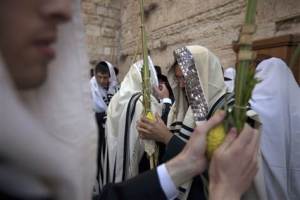
Jesus, the Word, lived among human beings but only temporarily. Did that make him any less sanctified before God? Perhaps we shouldn’t be so quick to discard things we consider temporary. They could have a much longer “shelf life” than we might imagine.

“I will make with them a covenant of peace and banish wild beasts from the land, so that they may dwell securely in the wilderness and sleep in the woods. And I will make them and the places all around my hill a blessing, and I will send down the showers in their season; they shall be showers of blessing. And the trees of the field shall yield their fruit, and the earth shall yield its increase, and they shall be secure in their land. And they shall know that I am the LORD, when I break the bars of their yoke, and deliver them from the hand of those who enslaved them. They shall no more be a prey to the nations, nor shall the beasts of the land devour them. They shall dwell securely, and none shall make them afraid. And I will provide for them renowned plantations so that they shall no more be consumed with hunger in the land, and no longer suffer the reproach of the nations. And they shall know that I am the LORD their God with them, and that they, the house of Israel, are my people, declares the Lord GOD. And you are my sheep, human sheep of my pasture, and I am your God, declares the Lord GOD.” –Ezekiel 34:25-31 (ESV)

“For behold, in those days and at that time, when I restore the fortunes of Judah and Jerusalem, I will gather all the nations and bring them down to the Valley of Jehoshaphat. And I will enter into judgment with them there, on behalf of my people and my heritage Israel, because they have scattered them among the nations and have divided up my land, and have cast lots for my people, and have traded a boy for a prostitute, and have sold a girl for wine and have drunk it. –Joel 3:1-3 (ESV)

Lest you be wise in your own sight, I do not want you to be unaware of this mystery, brothers: a partial hardening has come upon Israel, until the fullness of the Gentiles has come in. And in this way all Israel will be saved, as it is written,

“The Deliverer will come from Zion,
he will banish ungodliness from Jacob”;
“and this will be my covenant with them
when I take away their sins.” –Romans 11:25-27 (ESV)

Unless God was leaving out some important details, He never seemed to indicate that the Children of Israel would be a people before Him only up to a certain time, and then He’d toss them aside like a bowl of hummus that had been left out in the sun too long. In fact, it seems as if He plans to judge all of the nations that have treated His people Israel poorly, so perhaps the rest of us should be a little cautious when we casually claim that we have replaced “the apple of His eye.” For those Christians who are reading this who are still convinced that Jews and Judaism are “dead” in the eyes of God and as seen through the lens of the Davidic covenant, remember that God can resurrect human beings and even a nation of “dry bones” (Ezekiel 37:1-14). Israel is not “cut off.” Israel has hope. God will place flesh upon all of Israel and Israel will be restored. In fact, God is restoring Israel right now, before our very eyes.

We have a picture, based on John 1 of the Messiah temporarily dwelling among his people Israel and then leaving again. We have a picture of the Jewish people, based on Romans 11 temporarily being “hardened” against the Messiah. We also have this.

And I heard the number of the sealed, 144,000, sealed from every tribe of the sons of Israel… After this I looked, and behold, a great multitude that no one could number, from every nation, from all tribes and peoples and languages, standing before the throne and before the Lamb, clothed in white robes, with palm branches in their hands, and crying out with a loud voice, “Salvation belongs to our God who sits on the throne, and to the Lamb!” –Revelation 7:4,9-10 (ESV)

Then the angel showed me the river of the water of life, bright as crystal, flowing from the throne of God and of the Lamb through the middle of the street of the city; also, on either side of the river, the tree of life with its twelve kinds of fruit, yielding its fruit each month. The leaves of the tree were for the healing of the nations. No longer will there be anything accursed, but the throne of God and of the Lamb will be in it, and his servants will worship him. They will see his face, and his name will be on their foreheads. And night will be no more. They will need no light of lamp or sun, for the Lord God will be their light, and they will reign forever and ever. –Revelation 22:1-5 (ESV)

Here we see that the “temporary” Lamb is now permanent and the “temporary” tribes of Israel are now permanent, and we also see that “a great multitude…from every nation, from all tribes and peoples and languages” will be “standing before the throne and before the Lamb.” Jesus is permanent though he was once temporarily on the Earth. The tribes of Israel are permanent though they temporarily were hardened to the Messiah for the sake of the Gentiles. The Gentiles are there with the tribes of Israel and with the Lamb, not as second-class citizens, but co-citizens with Israel in the Kingdom, and the Lamb is the Lamb for us all.

One God, One Lamb, One throne, One Kingdom. One shepherd over two folds in one pen.

I am the good shepherd. I know my own and my own know me, just as the Father knows me and I know the Father; and I lay down my life for the sheep. And I have other sheep that are not of this fold. I must bring them also, and they will listen to my voice. So there will be one flock, one shepherd. –John 10:14-16

I don’t know how it all works or how it will all work out, but I trust that it will all work out between God and His people Israel, and we Gentile Christians, His people who were placed in His hand by Jesus. And in the end, we will all be seated together at the feast of Abraham, Isaac, and Jacob (Matthew 8:11) and we will all be at peace and none will make us afraid (Micah 4:4) “for the mouth of the LORD of hosts has spoken.”