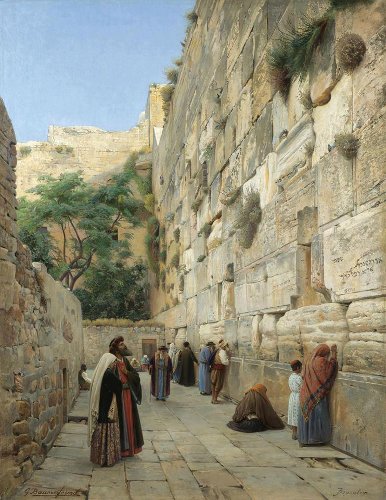
Praying Where God Has Placed His Name

ancient-kotel-prayersWhen responding to the question, “Why do Jews pray at the Western Wall in Jerusalem,” Rabbi Tzvi Freeman had this to say.

I think what you’re really asking is: If G‑d is everywhere, why should prayer be more effective in one place than another? In truth, the same can be asked regarding praying in a synagogue vs. praying at home.

The question has been asked many times before in classical Jewish literature. Since this is a Chabad site, I’ll provide the answer given by Rabbi Schneur Zalman of Liadi (1745–1812), the first rebbe of Chabad.

The essence of his answer is that although G‑d is everywhere, His light shines stronger in some places than in others. He compares this to the human body: You are everywhere in your body, yet you are far more conscious of your mind than of your toes. So too, in the universe that G‑d created, there are places, times and states of being where we are able to be more aware of Him—and it is from those places/times/states that our prayers can fly best.

Any person is able to create for himself a time of day and a special place from which he or she reaches out to G‑d. And we all should—somewhere in our homes or gardens, set aside a place of prayer and meditation, along with a time of day or week that we sit there and connect. Even more special is a place that was chosen not just by us, but by G‑d as well. And that is the Temple Mount, which G‑d chose as His dwelling place in the time of King David.

Ever since then, that specialness has never left the Western Wall, the only remnant left standing.

The Talmud tells us that every synagogue is a “minor Holy Temple.” Thus the above also applies—in smaller measure—to any location designated to be a house of worship for G‑d.

I’ve probably mentioned this before, but one item on my bucket list (not that I have a well-defined bucket list) is to pray at the Kotel, otherwise called the Western Wall. I’m not even entirely sure that, from a Jewish point of view, it would be considered appropriate for a Christian to pray at the Kotel. After all, there is a certain controversy associated with some Jewish women davening at the Kotel, and I’m not even Jewish.

On the other hand, American Presidents and Catholic Popes have prayed at the Kotel, so I suppose it could be permissible for me to do so as well.

Why do I want to?

The Jewish person querying Rabbi Freeman was confused by the significance of even Jews davening at the Kotel. What’s the difference between praying there, in synagogue, at home, or, for a Christian, in church?

Rabbi Freeman answered the question from a Jewish point of view, but can any of that be applied to someone like me?

I think so.

So Abraham rose early in the morning and saddled his donkey, and took two of his young men with him and Isaac his son; and he split wood for the burnt offering, and arose and went to the place of which God had told him. On the third day Abraham raised his eyes and saw the place from a distance.

–Genesis 22:3-4 (NASB)

So Jacob rose early in the morning, and took the stone that he had put under his head and set it up as a pillar and poured oil on its top. He called the name of that place Bethel; however, previously the name of the city had been Luz.

–Genesis 28:18-19 (NASB)

But you shall seek the Lord at the place which the Lord your God will choose from all your tribes, to establish His name there for His dwelling, and there you shall come. There you shall bring your burnt offerings, your sacrifices, your tithes, the contribution of your hand, your votive offerings, your freewill offerings, and the firstborn of your herd and of your flock. There also you and your households shall eat before the Lord your God, and rejoice in all your undertakings in which the Lord your God has blessed you.

–Deuteronomy 12:5-7 (NASB)

And every day, in the temple and from house to house, they kept right on teaching and preaching Jesus as the Christ.

–Acts 5:42 (NASB)

Jacobs_LadderIt is said in midrash that the place where the Akedah (binding of Isaac) occurred was at the future Temple Mount in what would be Jerusalem. This is also supposed to be the identical site where Jacob experienced God at Beth El (literally, “House of God” in Hebrew). We also know from the Torah, that God intended to place His Name in a specific geographic location, which is also understood as the Temple Mount. Further, we see that the early Apostles of Messiah regularly taught and prayed at the Temple, specifically at Solomon’s portico (see Acts 3:11).

All of this seems to indicate that not only Jerusalem, but the site of the Temple, has a special significance to God. Yes, God is everywhere and we are not inhibited from praying to God anywhere, but no other place on Earth seems to hold the presence of God in such a way as Jerusalem and the Holy Temple.

And the Kotel is all that is left of the Temple, at least for now.

Also, if it is true that the Temple will be rebuilt and especially if Messiah, Son of David, will rule from Jerusalem and that his throne will be placed there, then any disciple of the Master should be drawn to the Holy City and to the location where Hashem’s Temple has and will once again be established.

Christians have to be careful though, because any attachment we show to Jerusalem and the Kotel can easily be misunderstood by Jewish people as our “taking over” Jewish Holy sites. The church as a long history of supersessionism, so it’s important to respect the overwhelming Jewish history and ownership of Jerusalem and Israel. However, many religious Jews believe that the people of the nations will one day be drawn to Messiah and worship God in Jerusalem, so in that context, we can present ourselves as desiring to honor Hashem at the Kotel. Even Solomon understood this from days of old.

“Also concerning the foreigner who is not of Your people Israel, when he comes from a far country for Your name’s sake (for they will hear of Your great name and Your mighty hand, and of Your outstretched arm); when he comes and prays toward this house, hear in heaven Your dwelling place, and do according to all for which the foreigner calls to You, in order that all the peoples of the earth may know Your name, to fear You, as do Your people Israel, and that they may know that this house which I have built is called by Your name.”

–1 Kings 8:41-43 (NASB)

In desiring to pray at the Kotel, I am only responding to the prayers of the King.

I was glad when they said to me, “Let us go to the house of the Lord.”

–Psalm 122:1 (NASB)

But again, Christians must not forget that it is Jewish eyes that are constantly looking toward Jerusalem and Jewish hearts that “sigh” for Messiah.

“Notwithstanding all this, the Jew … has his heart fixed upon Jerusalem, praying and sighing a waiting, and longing for the coming of the Messiah King, the promised Redeemer of the House of David.”


–Rabbi Isaac Lichtenstein

The Evidence of Love

love-in-lightsThe Alter Rebbe repeated what the Mezritcher Maggid said quoting the Baal Shem Tov: “Love your fellow like yourself” is an interpretation of and commentary on “Love Hashem your G-d.” He who loves his fellow-Jew loves G-d, because the Jew has with in himself a “part of G-d Above.” Therefore, when one loves the Jew – i.e. his inner essence – one loves G-d.

“Today’s Day”
Friday, Menachem Av 12, 5703
Compiled by the Lubavitcher Rebbe; Translated by Yitschak Meir Kagan
Chabad.org

One of the scribes came and heard them arguing, and recognizing that He had answered them well, asked Him, “What commandment is the foremost of all?” Jesus answered, “The foremost is, ‘Hear, O Israel! The Lord our God is one Lord; and you shall love the Lord your God with all your heart, and with all your soul, and with all your mind, and with all your strength.’ The second is this, ‘You shall love your neighbor as yourself.’ There is no other commandment greater than these.”

–Mark 12:28-31 (NASB)

I would hardly suggest that the commentary I found in an email I received from Chabad.org was intended to map back to the teachings of Yeshua (Jesus), but the comparison really stands out. Perhaps it is one of those lessons that is equally apparent from a Jewish and Christian point of view, except that Jesus was a Jewish teacher talking to a Jewish scribe within a wholly Jewish context. We non-Jews get that point (or should get it) somewhat after the fact, so it would be wise of us not to do away with the Jewish framework in which the Master was teaching. That’s what gives his lessons their full meaning.

The “Today’s Day” commentary is specifically addressing a Jewish audience as well, which is obvious since it discusses one Jew loving another Jew as being equal to loving God, rather than one human being loving another. The interesting question is, when Jesus was teaching the two greatest commandments, did he mean that loving your neighbor is loving your Jewish neighbor?

That could very well have been the case, if you look at who Jesus was addressing and where this conversation was taking place. I don’t mean that Jesus was unconscious of the larger application of his teaching, but it hadn’t gotten that far yet. He came for the lost sheep of Israel not the lost sheep of planet Earth…well, not at that time. He assigned that job (gathering the lost sheep from the nations) to Paul on the road to Damascus some time later.

As impossible as it sounds, as absurd as it may seem: The mandate of darkness is to become light; the mandate of a busy, messy world is to find oneness.

-Rabbi Tzvi Freeman
“The Mandate of Darkness”
Chabad.org

It’s important to remember that Rabbi Freeman is also addressing a Jewish audience, so don’t go crazy and assume he believes that Jews and Gentiles (particularly Christians) should all be “one.” Except that in Judaism, it is believed that Messiah will unite humanity in peace, not as a homogeneous body of human beings, but as Jews and Gentiles who are all subject to the King, who will come (return) and rule with a rod of iron. We will all be “one” in the sense that we will all be subjects of the King.

Even in the Messianic age though, as I understand it, people will still have the choice as to whether or not to acknowledge and obey the King. On the other hand, it does say that every knee shall bow. But there will still be Israel that is blessed by God and the people of the nations who are blessed through Israel; the people of the nations who are called by His Name.

But what is to be learned from this? Not that those of us who put ourselves under the authority of the King will all be cookie-cutter, carbon copies of one another. What is to be learned is that we will love one another and in fact, all disciples of the Master are commanded to love one another right now.

A new commandment I give to you, that you love one another, even as I have loved you, that you also love one another.

–John 13:34 (NASB)

arguing-with-godWithin the context of being disciples of Jesus, both Jewish and non-Jewish followers are commanded to love each other, regardless of our differences. That’s a rather tall order. I once heard a retired Pastor say that he’s seen churches split over what color to paint the walls of the Fellowship Hall. We don’t get along easily, let alone love one another. But if the Baal Shem Tov is correct and loving your fellow human being (I’ll adapt his teaching to be more generalized) is equivalent to our inner essence loving God, then the reverse must be true. Hostility, envy, anger, and hatred toward our “neighbor” must also be the expression of those emotions toward God.

That’s a horrible thought.

I don’t know if it’s true or not but if we were to even pretend it is, our motivation to love should become a great deal more plain. If we say we love God with all our heart and with every fiber of our being (most people tend to exaggerate the extent of their ability to love, but let’s say we are capable of this), then the evidence of our statement is how we treat other people, particularly within the community of faith.

By this all men will know that you are My disciples, if you have love for one another.

–John 13:35 (NASB)

See? Love (or lack thereof) of our fellow believer is evidence of whether or not we actually do love God. People will know us as disciples of the Master by how we love each other. God, of course, already knows.

V’etchanan: What Comes From God

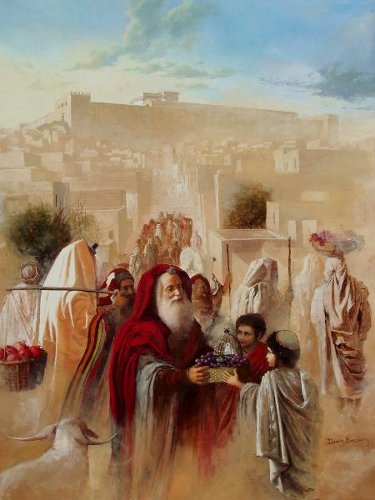
ancient_jerusalemFor what great nation is there that has a god so close at hand as is the Lord our God whenever we call upon Him?

–Deuteronomy 4:7

Should one only call out for the “big things”? To think that prayer to God is only for the “big things” is a big mistake! We must turn to God for help and understanding in everything we do.

The Chazon Ish, a great rabbi, cited the Talmud which relates that Rav Huna had 400 barrels of wine that spoiled. His colleagues told him to do some soul-searching regarding the cause of this loss. Rav Huna asked, “Do you suspect me of having done anything improper?”

The Sages responded, “Do you suspect God of doing something without just cause?” They then told him that he was not giving his sharecropper the agreed upon portion of the crop.

“But, he is a thief!” Rav Huna protested. “He steals from me. I have a right to withhold from him.”

“Not so,” the Sages said. “Stealing from a thief is still theft” (Talmud Bavli, Berachos 5b).

“Suppose,” the Chazon Ish said, “that something like this would occur today. The search for the cause would be whether the temperature in the room was improper or the humidity too high or too low. Few people would search for the cause within themselves, in their ethical behavior. We should know that God regulates everything except for our free will in moral and ethical matters. As with Rav Huna, nothing happens without a cause.”

Dvar Torah for Parashat Va’ethannan
from Twerski on Chumash, by Rabbi Abraham J. Twerski
quoted by Rabbi Kalman Packouz in “Shabbat Shalom Weekly”
Aish.com

I agree that we should turn to God with all our matters, large or small, but I wonder if every single thing that happens to us was caused by God to teach us a lesson. What can we learn from the flat tire we get while driving to an important meeting and dressed in our best clothes? What should we gather from being caught in a rainstorm without an umbrella, stubbing our toe, tripping over a crack in the sidewalk, catching a cold? Does every single event that happens, even down to the tiniest detail have to be ordained in Heaven?

I don’t know. I suppose it could. On the other hand, maybe sometimes things happen and they have no meaning. If I go down to a ridiculously small level, does it matter if I choose to wear black or white socks today? Is there going to be some consequence one way or the other? Is there a moral lesson I should learn if I get the flu or did I just get the flu? If I’m in business and should have a bad year, is that the result of some moral or ethical fault of which I’m guilty, or is it the consequence of the current economy and all businesses like mine are suffering?

Regardless of the cause of our fortunes or misfortunes (and believers are taught that everything we have comes from God), it certainly wouldn’t hurt to turn to God in good times and in bad, and call to Him for He is always near, even when we don’t feel as if He’s near.

…fervent in spirit, serving the Lord; rejoicing in hope, persevering in tribulation, devoted to prayer…

–Romans 12:11-12 (NASB)

Is anyone among you suffering? Then he must pray. Is anyone cheerful? He is to sing praises. Is anyone among you sick? Then he must call for the elders of the church and they are to pray over him, anointing him with oil in the name of the Lord; and the prayer offered in faith will restore the one who is sick, and the Lord will raise him up, and if he has committed sins, they will be forgiven him.

–James 5:13-15 (NASB)

praying-apostleThe verses in the Bible exhorting the advantages of prayer are all but endless, so I offer only a few examples. But it doesn’t answer the question about the nature and cause of each and every circumstance we find ourselves in. When raising small children, we try to make the consequence of misbehavior happen immediately after the misbehavior, so they’ll connect the two and learn to avoid the misbehavior. It’s easy to get the idea that God does the same thing. But then again…

Because the sentence against an evil deed is not executed quickly, therefore the hearts of the sons of men among them are given fully to do evil. Although a sinner does evil a hundred times and may lengthen his life, still I know that it will be well for those who fear God, who fear Him openly. But it will not be well for the evil man and he will not lengthen his days like a shadow, because he does not fear God.

–Ecclesiastes 8:11-13 (NASB)

In fact I believe that God deliberately delays providing the consequence upon the sinner, giving him or her time to repent and to change their behavior.

The Lord is not slow about His promise, as some count slowness, but is patient toward you, not wishing for any to perish but for all to come to repentance.

–2 Peter 3:9 (NASB)

In some ways, it might be more merciful of God if He was to discipline and chastise us each and every time we mess up right when we mess up, kind of like swatting a dog on the nose with a rolled up newspaper when it does its business on the living room carpet. Then, like a dog or a small child, we’d see the obvious and inescapable pattern between certain of our actions and the painful things that happen right afterward.

But unlike the commentary I quoted above, God just doesn’t seem to arrange our lives that way, at least not all the time. We are left then, wondering which consequence is a moral lesson and which is only a random event.

We don’t know.

But what if we pretended that everything we experience is an immediate communication from God to us? This could be horribly misused and sometimes people blame themselves without reason because they were the victim of a tragic accident or a terrible crime. You can’t blame a five-year old boy because he was killed in a drive-by shooting while standing on a street corner with his Dad waiting for the light to change. You can’t blame a forty-four year old woman who has lived a life of impeccable health who is diagnosed with breast cancer.

But…

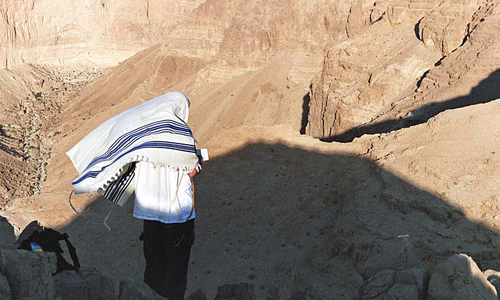
praying_at_masada…but what if regardless of whether we think an event has come from God or not, we turned to Him anyway? What if after having a productive day at work, you turned to God and thanked Him? What if after learning that the cost of repairing your car’s sudden breakdown will empty your savings account, you turned to God and begged for His help? What if, day in and day out, you turned to God, with praise and with petition, in happiness and in anguish?

What if?

Life happens. Sooner or later, something good will happen to you. Sooner or later something bad will happen to you. Sooner or later, nothing will happen to you and you’ll be really bored. You live, you laugh, you bleed, you breathe, you cry, you get angry, you get frustrated, you feel depressed, you are overjoyed, and everything else.

That’s your life. That’s from God. Talk to God about it. Ask Him Why? Ask Him How? Say “Thank you.” Say “I’m sorry.” You know your life. You know what’s happening. You know what to say. Just turn to God and say it.

And then listen.

Good Shabbos.

68 days.

What Christians See When Looking At Messianic Jews

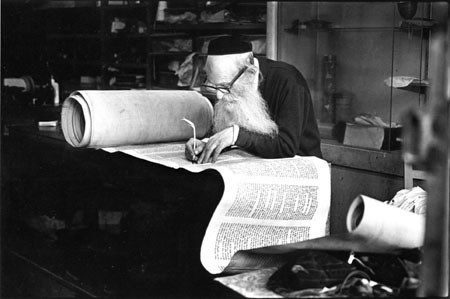
sefer-torahFor every complex question, as H.L. Mencken once put, there is usually an answer that is “clear, simple and wrong.” His observation rings true when it comes to a question I get at least once a week. What do Jews believe about Jesus?

Jews as a group rarely agree on matters of Jewish belief. How could we agree on the essence of another? Yet, we ignore the question at our own peril.

-Rabbi Evan Moffic
“5 Rabbis Explain Jesus”
Huffington Post

An MJ friend wrote me describing the resistance he has been encountering from other Messianic Jews about Torah. He gets it. Mount Sinai is an eternal covenant between God and Jewish people.

-Derek Leman
“Do Messianic Jews Really Need to Keep Torah?”
Messianic Jewish Musings

And meanwhile, the Bible from cover to cover is about God’s-plan-through-Israel-to-the-world and yet the “through Israel” part is forgotten by most. Deuteronomy 4:6 is in the Bible. Verify this for yourself.

-Derek Leman
“Why Don’t Christians Believe Deuteronomy 4:6?”
Messianic Jewish Musings

“What is the Torah?”

I’ve been blogging and blogging and reading and reading trying to come up with an answer that will work between my Pastor and me during our usual Wednesday night discussions. Pastor Randy is away for several weeks in association with his doctorate studies, but I sent him a link to Derek Leman’s blog post Do Messianic Jews Really Need to Keep Torah, since it addresses the heart of our conversations. Pastor has no spare time for a long blog post, but he did send me a brief email saying that he believes the Abrahamic covenant is eternal, but the Mosaic covenant is not.

I suppose I should have expected that response, and it surprisingly hit me in a tender spot. So when Derek wrote Why Don’t Christians Believe Deuteronomy 4:6, it did absolutely nothing to improve my disposition.

Really, is there any hope for communication across the aisle, so to speak, or are we doomed to endless discussion and endless disagreements with no middle ground between any of us?

Do I really want to live a life of faith like this, at least communal faith?

But Rabbi Moffic said that “Jews as a group rarely agree on matters of Jewish belief.” Ever since Sinai, the Jewish people have been chosen and called out to be different from all of the other peoples and nations of the Earth, but how do they stand all of the internal dissonance? My guess is that, at some core level, no matter what other disputes and disagreements one Jew has with another, at the end of the day, a Jew is always a Jew.

iron-sharpens-iron-hotOK, I know there are problems with that statement and there are all kinds of disputes between different sectors of Judaism, but when “they” come for you because you’re a Jew, those disputes vanish like a snow cone in a blast furnace. Beyond a certain point, we can even grasp hope based on a Jewish Cantor welcoming even Messianic Jews on Tisha B’Av.

But that doesn’t translate very well if at all to differing groups of Christians.

John the Baptist described himself as “the voice of one crying in the wilderness” (John 1:23), and that worked pretty well for him up until his beheading, but I’m not sure how well it’s working for me.

Iron sharpens iron, so one man sharpens another.

–Proverbs 27:17 (NASB)

OK, I get that. The constant “head-banging” is supposed to sharpen us, but it also can be painful, and frankly, I’m getting a headache.

I know, “if you can’t stand the heat…” Maybe I should get out of the kitchen.

But that’s where the food is.

For everyone who partakes only of milk is not accustomed to the word of righteousness, for he is an infant. But solid food is for the mature, who because of practice have their senses trained to discern good and evil.

–Hebrews 5:13-14 (NASB)

At the end of the day, a Jew is a Jew and like it or not, all Jewish people have been bonded together since Sinai and probably before that. Does that work for Christians, though? Are we bound together so that, when adversity strikes, we’ll join with each other based on our common identity as disciples of Christ?

I’d like to think so, but I don’t know. Jews are bound not just based on belief and theology, but by 3500 years of common experience and even down to the level of DNA. Although Jews don’t think of themselves in terms of being “tribal” anymore, it’s still there beneath the surface. Tribes and clans and families are bonded beyond any unbonding, and God drew all Jewish people to Him under the chuppah of cloud and fire at Sinai and sealed the covenant with Torah.

The Birthright program exists to encourage young Jewish people who have little or no attachment to the Land and to the Torah to experience Israel. I hear there’s something about standing on the ground and breathing the air in Israel that has an effect on Jewish people (and perhaps a few Christians as well). I can’t say from experience, but for the sake of my Jewish children, I hope so.

I can only say that for Christians, a common faith in Jesus is the lynchpin that holds us together, at least in theory. But while it is presupposed that Jews will argue with Jews as an expected behavior, how am I as a Christian supposed to explain to another Christian that being Jewish and the existence of the Torah are inexorably linked and cannot be unlinked. Even an atheist Jew will one day confront the meaning of being Jewish beyond the mere ethnic and genetic identity.

jewish-davening-by-waterI recently wrote about Jews encountering themselves through the mitzvot and some Rabbis hope that encouraging a Jewish person to experience even a single mitzvah will make a difference. At the time, I applied that hope to Christians as well, but we must face the facts that Christians don’t think of themselves in the same way as Jewish think of themselves.

No wonder that we can’t get Christians to see Jews as they want to be seen.

There are days when I just want to scream to the Church, “Just let Jews be Jews! We don’t have to agree with them! They don’t need our permission!” But I suppose that wouldn’t go over very well.

Jews rarely agree with each other on matters of belief. Christians are expected to agree with each other on matters of belief. If they don’t, then it usually means some group will split off from their church to form a different church. That’s how Christians manage the dissonance of disagreement.

I have what I think of as a unique relationship with my Pastor in that we can regularly meet every week, disagree on fundamental issues, and still be friends. Pastor lived in Israel for fifteen years and is intimately acquainted with Jewish life in Israel, so on that basis, he knows what it is like to live among lots of Jewish people. And yet, every week when we meet, I still feel like I’m facing some sort of battle for the rights of Jewish people to define their own identity as Jewish based on the Torah, especially Jews who are disciples of Messiah.

I keep thinking of the venerable 19th century Rabbi Isaac Lichtenstein who became a devotee of Yeshua past the age of sixty and yet remained wholly Jewish in his practice, observance, identity, and discipleship. His life as a devout Jew and a Messianic disciple seems so open and clear. Reading The Everlasting Jew showed me how his life made so much sense the way he lived it.

I don’t see a dissonance between what R. Lichtenstein believed and how he lived and the Biblical life of Jesus, Peter, and Paul. I just wish everyone could see what I see, not because I’m so smart, but because I believe I’m seeing what God wants all Christians to see when we look at Messianic Jews.

Why is communicating that vision so hard?

Gratitude

gratitudeAs an exercise, make a list of the ideas you regularly espouse, along with the original sources you heard them from. Think of people who gave you wisdom for living. Did a friend set you straight on something? Your brother saved you from doing some stupid things? An employer gave you good career advice?

Acknowledge that you received the gift. If someone took the blinders off your eyes, it’s fantastic, it’s a different life. Say to yourself: “I am now aware of something very important that I wasn’t paying attention to.” Say it out loud. That alone will make you feel genuine appreciation.

-Rabbi Noah Weinberg
“Way #50: Rewards of Gratitude”
Aish.com

If you ask a Christian who they are grateful to more than anyone, you’ll probably hear “Jesus” nine times out of ten, and rightfully so. Without the grace of the Jewish Messiah and our faith in God through him, we people among the nations would have no connection to the Almighty and His mercy. But Jesus doesn’t exist in isolation. He’s the Jewish Messiah, which Christians sometimes miss. Even when we know that intellectually, we don’t always fully appreciate what it means that he is the Jewish Messiah, the promised Savior of Israel.

I’ve probably said all this before, but in reading Rabbi Weinberg’s commentary, the topic resurfaced for me. Some truths are best restated periodically just to make sure they stay fresh in everyone’s mind.

Make a list of society’s treasures – monotheism, justice for all, universal education, dignity of the individual, preciousness of life. These core values of the civilized world are all from the Torah.

Before the Torah was given, people built their lives on a subjective concept of right and wrong. Then at Mount Sinai, human history underwent a dynamic shift. People understood that there is one God who has moral expectations. You can’t just live as you please; there is a higher authority you are accountable to.

Despite the fact that Jews were never more than a tiny fraction of the world’s population, these ideas became the basis for the civilized world. For example, do you know the source of the idea “Love your neighbor as yourself”?

It’s in the Five Books of Moses – Leviticus 19:18.

The Jewish people are an eminent firm, 3,500 years old. We are no fly-by-night. The world uses our products under different brand names and takes it for granted. Consider what humanity owes to the Jewish people.

If you are living with Jewish wisdom, know it, quote it, and give credit.

There is nothing in the teachings of Jesus that isn’t “Jewish wisdom.” All of Christ’s “source material” was the Torah, the Prophets, and the Writings. It’s what he quoted from. It’s what he taught from. It resonated with his Jewish audience because they had been raised on that “source material” all their lives.

Paul taught from that source material too, when teaching Messiah to Jewish and Gentile God-fearing audiences. Acts 13:13-43 is a perfect example of Paul using Jewish history to explain why Yeshua (Jesus) of Nazareth was the promised Messiah and the Jewish people in the synagogue understood and agreed, at least to the point of inviting Paul and Barnabas back to their synagogue in Pisidian Antioch on the following Shabbat to speak more.

Apostle-PaulEven the Gentiles among the Jews understood because they had been exposed each Shabbat to the teachings from the Torah and so had the basic background that allowed them to follow Paul’s arguments. They understood so well in fact, that they invited practically the whole town (of Gentiles) to hear Paul the following week (which caused problems of their own, but that’s another story).

The only time when “Jewish wisdom” broke down was when Paul and Barnabas addressed a wholly pagan Gentile audience who had absolutely no clue about Judaism and Jewish history. In that case (Acts 14:8-18), Paul had to give the crowd a crash course in Judaism 101 just to keep them from worshiping him and Barnabas as Zeus and Hermes respectively.

I say all this as a reminder (in case anyone’s forgotten) that we would have no understanding of Jesus at all unless we at least minimally understood something about “Jewish wisdom” (and we reject this line of education at our own peril).

More than all, give credit to the Almighty. He gave us a brain to understand and appreciate wisdom. Other teachers enlighten us, but the original teacher is God. He implanted within us the intuition to discover all there is to know about living.

God is showering us with gifts all the time. Food, air, eyes, teeth. Life itself. He programmed us with an antenna for wisdom. Nothing is possible without God.

This should be a no brainer, but it’s more common in Jewish prayer to praise God than in Christian prayer. It’s just my opinion, but I think there’s a definite advantage to praying with a Siddur since the blessings within greatly praise God and thank Him for His mercy and bountifulness. It takes us just a little more concentration to praise God without a prayer book, since the human tendency is to ask for what we want and need (which isn’t bad, except if that’s all we do when we pray).

The problem is that we don’t want to be indebted to Him, so we deny the gifts. We refuse to believe that He loves us.

I know I’ll probably get some static for this, but in a nutshell, I think the Rabbi has given us the reason why many people don’t come to faith. We don’t want to be indebted to Him. We’re afraid of what that means for us, what we’ll have to change about us, how we won’t fit in to the culture, that we’ll realize we aren’t perfect as self-contained human beings.

It’s probably why even a lot of religious people don’t want to thank God, at least not anywhere near as much as He deserves (and face it, He deserves infinite thanks). That may also be why Christians don’t want to thank the Jewish people and Judaism for what we have. We’re afraid of what it will mean. We’re afraid that Jewish people are still part of God’s plan, that He still loves them, maybe more than the Gentile believers. We’re afraid that Israel will be placed at the head of the nations instead of America or Canada or whatever.

raining1We want to be special because we’re Christians, including our particular denomination, branch, or sect. If Jewish Israel was chosen first, they might still be first or at least very special in God’s eyes. What does that do to we Gentiles who are called by His Name (does that make us jealous and covetous of Jews)?

God loving Israel probably does nothing to us except make us just as loved by God as the Jewish people, but also different from them, like two brothers of a King, both loved but both different.

And God loves even those who reject Him and do not want to be called “sons.”

…your Father who is in heaven; for He causes His sun to rise on the evil and the good, and sends rain on the righteous and the unrighteous.

–Matthew 5:45 (NASB)

There is no way for the unjust and the unrighteous to acknowledge God and thank Him, but we who are disciples of the Jewish Messiah have no such excuse.

In order to connect with God, you have to learn to appreciate all the good He has done for you. That means giving up the illusion that you alone are responsible for your achievements. It’s all a gift from God. Just as every stroke of Picasso’s brush has his signature on it, everything in this world has God’s signature on it. We have to learn to appreciate it.

Everything in this world has God’s signature on it. Even those people who do not believe, since all human beings have been created in God’s image. We believers know God’s signature is on us. We agreed to that when we acknowledged Messiah and came to faith through the Jewish King.

They asked Rabbi Schneur Zalman:
“Which is greater: love of G‑d,
or love of your fellow man?”

“Love of your fellow man,” he replied.
“For then you are loving the one that your Beloved loves.”

-Rabbi Tzvi Freeman
“Which is Greater”
Based on letters and talks of the Rebbe, Rabbi M. M. Schneerson
Chabad.org

Rabbi Weinberg’s point is that we should publicly give credit to the source of our blessings. Christians usually have no trouble thanking Jesus for our blessings but as I mentioned, Jesus doesn’t exist apart from his connection to Israel. Messiah descended from Heaven for the lost sheep of Israel. When he returns, he will redeem all Israel and restore her at the head of the nations.

We should also give credit to Israel, to the Torah, to the Prophets, to all the instruments God blessed the Jewish people with, because without Abraham, Isaac, and Jacob, without the twelve sons of Israel, without their descendants, without the Davidic Kings, without the Davidic King, Messiah, we would have nothing and be nothing.

Thank you.

Separating the Wheat from the Chaff: Where are the Scholars?

Separating-the-Wheat-from-ChaffLast week a friend pointed me to a web site where a guy, claiming expertise in something else (cryptography, I think, but it doesn’t matter) also claimed to have established beyond dispute and for the first time in modern scholarly studies the “true” meaning of a particular Greek word used by Paul. Moreover, on this basis the guy claims a radically different understanding of what Paul had to say on the topic with which this Greek word is associated. So, what did I think?

Well, I have to say that it’s curious that someone with no training in a given field, lacking in at least some of the linguistic competence required (both relevant classical language and key modern scholarly languages), thinks himself able to find something that has eluded the entire body of scholars in that field who labor year-upon-year to try to discover anything new and interesting. It’s also curious that, as is typical, the guy doesn’t submit his findings to scholarly review for publication in peer-reviewed journals or with a peer-reviewed publisher, but flogs his thinking straight out on his web site, complete with bold claims about its unique validity. We mere scholars in the field, by contrast, do submit our work for critique by others competent in the subject. We present at symposia and conferences where other scholars can engage our views. We strive to get published in peer-reviewed journals and with respected publishers. Even after publication, we hope for critical engagement by other scholars.

-Larry Hurtado
“Expertise and How to Detect It”
Larry Hurtado’s Blog

I was reading the various articles and blogs I use for morning studies and came across this piece by Hurtado. It brought to the forefront something that Messianic Judaism and particularly the large number of Hebrew Roots bloggers seem to struggle with. There are a great many pundits in the religious blogosphere and, as Dr. Hurtado points out, not all of them are scholars in a strictly defined sense. And yet, like the individual Hurtado describes, that doesn’t stop most people from presenting an opinion as fact without any significant scholarly or educational basis.

Before continuing, I want to say that I don’t describe myself as an expert or scholar in religious studies. The purpose of my blog is not to lay down doctrine and theology as if I’m a teacher or instructor of any kind. My blog is simply an expression of my thoughts and feelings on any given morning. I ask more questions than I provide answers and even when I seem to present conclusions, they are my opinions and often, I publish them on the web to inspire conversation so that I can learn more from my readers. I do not fit Dr. Hurtado’s definition of a scholar nor would I ever claim to.

But what about scholarship in the Messianic Jewish and Hebrew Roots spaces (I separate the two movements because to me, they don’t represent the same emphasis, at least in terms of population)?

I believe there is a growing scholarly expression existing within Messianic Judaism. Educational organizations such as The New School for Jewish Studies and The Messianic Jewish Theological Institute kinbaroffer the promise of an organized educational basis for producing scholars in this specific area of religious studies. I’ve not taken any courses from either school so I can’t personally attest to their quality, but there is at least an effort being made to build a valid, intelligent, and organized teaching framework from which to produce teachers and researchers within the Messianic Jewish space.

I’m less familiar with any organized group of teaching institutes within the wider collection of Hebrew Roots groups. The only two that immediately come to mind are TorahResource.com, which was founded by Tim Hegg and TNNOnline.net which seems to be edited by someone named J.K. McKee (I should say that I’ve met Hegg on several occasions and, while he and I may not always agree, I more than acknowledge his educational and scholarly background, however I’ve never met McKee and don’t know what he brings to the table, so to speak).

Dr. Hurtado continues:

Now, of course, I believe in freedom of speech and thought, and I wouldn’t press for a gag on the sort of dubious stuff that I criticize here. But in scholarly life the peer-testing of claims/results is absolutely crucial, and it’s really considered rather unscholarly (and so of little credibility) to present as valid/established claims that haven’t gone through such testing. People (specifically those not clearly qualified in a field) have always been able to make bold claims about a subject of course, asserting their idiosyncratic “take” over against whatever view(s) is/are dominant in the subject. But before the World Wide Web I guess it was much more difficult to get such unqualified opinion circulated. Now, however, ”the Web” and the “Blogosphere” make it so easy.

But, frankly, when I’m shown something that hasn’t been through the rigorous scholarly review process (often, it appears, peer-review deliberately avoided), and comes from someone with no prior reputation for valid contributions in the subject, I’m more than a bit skeptical. If the work is really soundly based, then why not present it for competent critique before making such claims?

Obviously, Hurtado sets some very specific standards for information he’s willing to take seriously, which makes about 99% of the blogosphere unacceptable as sources of theological scholarship. But the question we must ask ourselves is whether or not either the Messianic Jewish or Hebrew Roots movements have any process in place for a “rigorous scholarly review process” and have access to writers with “prior reputation for valid contributions in the subject(s)” being addressed in their respective areas (I’m not being snarky here, I’m asking a serious question).

I do know based on my ten plus years of history within Hebrew Roots that it tends to be a magnet for just about anyone with an opinion. Some of the individuals presenting information are well-meaning and are trying to work through both intellectual and personal issues in regard to how they see Christianity and Judaism. Others, unfortunately, have theological axes to grind and produce vast amounts of dreck designed to provide religious “thrills and chills” but which have absolutely no basis in fact or scholarly research.

For example, I’ve heard people claim that the lost ark of the covenant was hidden underneath the crucifixion site of Jesus and that his blood “anointed” it. I’ve heard people say that the “lost years of Jesus” were spent with the young Yeshua traveling through India at the side of his “uncle” Nicodemus. I’ve heard some folks claim to have possession of the lost original Hebrew manuscript of the Gospel of Matthew. I even read one individual say on a blog that the reason the Temple in Jerusalem was destroyed was that the Jewish priests failed to share the pronunciation of the Tetragrammaton with the nations of the world, thus preventing the Torah from going forth from Zion (see Isaiah 2:3 and Micah 4:2).

All of that stuff is baloney, but it’s important to remember that Hebrew Roots is an extremely wide container and its contents are enormously varied.

yeshiva1I more or less regularly read a few blogs in the Hebrew Roots space, not because I agree with their opinions but so I can be aware of them. I absolutely avoid the kind of “crazy” material posted on the web that makes claim to the sort of “hidden truths” I listed above.

Mainstream Christian and Jewish educational and research foundations have a long, world-wide history and are well established, but the Messianic Jewish and Hebrew Roots movements are in their infancy. I place Messianic Judaism as an entity in a rather narrow field in order to exclude the more “loosely defined” collections of non-Jewish folks out there who have shall we say, rather unusual and unsubstantiated statements to make. Unfortunately, that puts them in the same container as others in Hebrew Roots who are sincerely attempting to study and research the Bible in a manner that will provide illumination within their own context.

But at this point, I’m asking a question because I don’t know. Given the brief set of statements made by Dr. Hurtado (I provided a link to his blog post above), do either Messianic Judaism or Hebrew Roots in its various forms, have or are they building an educational and scholarly system that would provide the same level of peer review and well researched papers as Hurtado describes from his own experiences as an educator and researcher?

One of the books produced by those I would consider established scholars in Messianic Judaism is Introduction to Messianic Judaism. Do you think this book would meet Dr. Hurtado’s expectations for scholarly and peer-reviewed work? Are there other books and papers that would do so within Messianic Judaism? What about Hebrew Roots? Do the writings of Hegg and McKee fit the bill? Are there others doing similar work within that space?

The Internet is a wild west show with no oversight and anyone can create a blog and start publishing anything they want within minutes. It’s important to be able to separate the wheat from the chaff. In order to do so, where do we begin?

"When you awake in the morning, learn something to inspire you and mediate upon it, then plunge forward full of light with which to illuminate the darkness." -Rabbi Tzvi Freeman