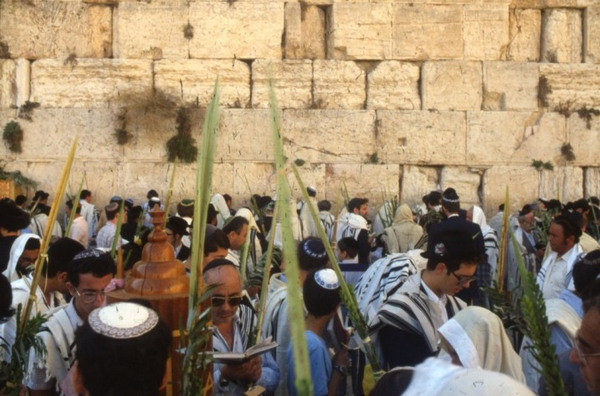
I read a story in the Jewish World Review called West Bank Jews invite Muslims over for the holidays to try for some bonding. It was published on October 21st, and describes the mayor of Efrat, a “bedroom community of 10,000 affluent Jews, including many Americans, a few miles south of Bethlehem” inviting “Palestinians from surrounding villages to come to his house and celebrate the Jewish holiday of Sukkos, the Feast of the Tabernacles.”
A few dozen Palestinians accepted the offer and came. It wasn’t perfect. The Israelis were armed and the Palestinians weren’t. It seems like a good time was to be had but rather tentatively.
I encourage you to read the story because I want to contrast it with what’s currently going on in the United States now that Donald Trump is the President-Elect.
There have been numerous protests over Trump’s win, some of them breaking into such violence that even extremely liberal Portland, Oregon has had enough.
The point is, whether you voted for Clinton or Trump, we all have to live with at least four years of a Trump Presidency. It’s one thing to ask what are we going to do with Trump as the President and another thing to ask what are we going to do with each other.
Even in my own little corner of Idaho, some people are upset, although thankfully, the are peacefully protesting rather than rioting.
But that doesn’t solve the problem of the polarization of America. For the past eight years, Barack Obama has increased the racial divide between whites and people of color dramatically. One would expect an African-American President to be ideally placed to promote racial healing, but instead, he did the opposite, and we’ve reaped the “benefits” in responses such as Black Lives Matter.
The liberal press and entertainment industry, which controls most of what we see on television, films, and other media, think that all America is or should be like them. Problem is, the real America isn’t one thing and it certainly isn’t the progressive ideal, which is how it was possible for Trump to be elected.
Of course people with different social and political views are going to disagree, but that doesn’t necessarily have to translate into violent riots, “cry-ins” on university campuses, and the wholesale belief that Trump is going to dial American law and culture back sixty years.
Trump hasn’t done anything yet except talk and the nation has already panicked. What are we all going to do on January 20th and going forward when Trump becomes the 45th President of the United States?
I don’t know.
I know we all need to see some commonality in ourselves as Americans. We’ll never be a united nation as long as any one group expects everyone else to submit to them. We’re supposed to recognize the differences between each other and accept that diversity.
Unfortunately, that’s not happening. Diversity is accepted only as long as it’s on the official “approved” list. Acceptance and unity doesn’t exist unless it includes everyone, even people we disagree with.
In the end, there will be only one King and all this petty bickering will be silenced. Until then, we have a responsiblity to promote peace with our neighbors, even if we don’t like them.
It’s the beginning of a new Torah cycle, and even though I haven’t been diligent with my studies lately, I am not unmindful of them either.
I’m recycling some older thoughts but I think they are worth the review. I came across an article from the Ask the Rabbi column at Aish called Who is a Jew?. The answer is pretty straightforward. You’re a Jew if your mother is Jewish or if you convert to Judaism. Period, end of story.
I know not everyone agrees with this definition, but it does fit the Orthodox perspective and generally, it’s one I can agree with.
Because the upcoming Torah portion for this Shabbat is Noach (Noah), Rabbi Kalman Packouz in his Shabbat Shalom Weekly column wrote about the Noahide Laws. I know this can be a controversial subject among those who read this blog, but I’m making a point. Be patient.
According to Rabbi Packouz, and you’ve heard this before, you don’t have to be a Jew to merit a place in the world to come. His article explains that even from the beginning, Hashem always intended to create the Jewish people, give them the Torah, and have them be a light to the world as the nation of Israel.
As for the rest of us, what are we to do with that light? It’s there. It’s shining. Where does it lead those of us, that is, the vast majority of the world’s population who are not Jewish?
R. Packouz’s response is predictable; the 7 Noahide Commandments.
I’ve written at length about them many times before so I won’t repeat myself here. You can search this blog and probably find a lot more information, opinions, and comments on the topic.
However, some folks who call themselves “Messianic Gentiles” have proposed that the Noahide Laws can at least be used as a guide for the halachah which applies to non-Jewish disciples of Rav Yeshua.
I don’t know if that’s true in an absolute sense, but if you have no other path, it gives you a place to start. There are plenty of Jewish sources which are instructive to Noahides, and in fact, when you go over those laws, they aren’t particularly outrageous:
Don’t murder
Don’t steal
Don’t worship false gods
Don’t be sexually immoral
Don’t eat the limb of an animal before it is killed
Don’t curse God
Set up a legal court system and do justice
Image: Cafepress.com
You can get more details by reading R. Packouz’s article or visiting sites such as Noahide.org.
Of course, these laws and the perspective of Jewish authorities found at Aish and elsewhere do not take Rav Yeshua and his teachings into consideration, and again, I’ve written a great deal about factoring in our reconciliation to Hashem through devotion to our Rav and by his merit.
According to the teachings of R. Packouz and particularly Rav Shaul (Paul, the Apostle to the Gentiles), God really did presuppose that all of humanity would be reconciled to Him, but that Jews would be Jews and the people of the nations would be the people of the nations.
Why am I writing this and why should you care?
Basically to say what I’ve said before. There’s nothing wrong with not being Jewish. I mean, most of the world isn’t Jewish and we’re still created in the image of the Almighty. We’re given a place in the world to come, the blessings of the resurrection, and even the indwelling of the Holy Spirit as disciples of our Rav.
We can even call Rav Yeshua our Rav and not feel like we’re ripping off the Jewish people.
Do we have to obey the Noahide Laws? Well, we probably do if we live generally moral lives. Even if we’d never heard of the Noahide Laws, whether we call ourselves Christians, Messianic Gentiles, or anything else, chances are we don’t murder, steal, worship false gods, or practice sexual immorality. We certainly don’t eat the limbs of a living animal, hopefully don’t curse God, and live in a nation with a system of laws and courts.
In other words, we are likely observing the Noahide Laws whether we know it or not.
What else is there? What else does there have to be?
We know in general that meeting regularly with like-minded believers to build each other up is a good thing. It’s a good thing to pray. It’s a good thing to study the Bible, both in groups and as individuals. It’s a good thing to treat others, even people we don’t like, with kindness and generosity.
All of these principles can be found in the Bible and they don’t apply just to observant Jews.
As we begin another Torah cycle and start another year, it’s good to remember that we don’t have to be Jewish in order to be close to God. However, that knowledge was brought to us in general by the Jewish people, and in specific by our Jewish Rav. After all, he specifically selected one Apostle to bring the good news of Moshiach to the goyim, that is, to the rest of us.
Seems strange, right? No sukkah this year. Let me explain.
My parents are aging and their health is none too good. My wife and I haven’t been able to visit them in a while. A window opened up in our schedules, so we took a long weekend and drove down to their place in Southwestern Utah last Friday. We stayed Saturday and drove back home Sunday.
As most of you reading this probably know, Sukkot began at Sundown last Sunday.
Now we got home at about 2:30 p.m., but I was all in from a nine-hour drive so I didn’t haul out our little sukkah kit and put it together as I usually do.
However, yesterday morning, the missus and I were up at the same time along with our son David, and I asked her if she’d like me to assemble the sukkah when I got home from work.
Her answer kind of surprised me.
She said that I built the sukkah each year because I wanted to, not because she wanted me to.
Hmmmm.
I distinctly remember one year her thanking me for remembering to put up the sukkah when she forgot.
We never have meals in it and it’s rather small, maybe fitting two or three people max.
In our marriage, she’s the Jewish spouse and I’m the goy. I suppose I could have built it anyway, but something told me that if she didn’t want to observe the mitzvah as a Jew, who am I to do so (and not being Jewish, I can’t really observe the mitzvah anyway)?
Sukkot in Jerusalem
I know some of you are going to say there is an application for Gentiles in Sukkot and I agree with you. On the other hand, without the Jewish people, without the Exodus, without the forty years in the desert, there would be no celebration of Sukkot, and none of that has to do with we goyim, even if we are disciples of Rav Yeshua.
So this year, it’s Sukkot, but without a sukkah.
Perhaps it is fitting since I have distanced myself from at least certain elements of Messianic Judaism. But while some Messianic Jews feel it’s important to separate Gentiles from Jewish praxis, they still can’t insist we distance ourselves from Hashem (and I’m not suggesting they are).
On the other hand, Judaism in general believes that the goyim can have a place in the world to come under certain circumstances (although the Noahide Laws don’t quite map to the life of a “Judaically aware” non-Jewish disciple of Yeshua), so while a Jewish celebration such as Sukkot might not be appropriate for us (again, some of you will argue against this), entering the presence of Hashem through the merit of Rav Yeshua is allowed for us.
So for me, at least for this year, the sukkah will have to exist in my imagination and in the future when we will all enter Hashem’s House of Prayer, which is a shelter for all people, Israel and the nations alike.
There is a Midrash (a commentary on the Five Books of Moses in the form of a parable) about a successful businessman who meets a former colleague down on his luck. The colleague begs the successful business man for a substantial loan to turn around his circumstances. Eventually, the businessman agrees to a 6 month loan and gives his former colleague the money. At the end of the 6 months, the businessman goes to collect his loan. The former colleague gives him every last penny. However, the businessman notices that the money is the exact same coins he loaned the man. He was furious! “How dare you borrow such a huge amount and not even use it? I gave this to you to better your life!” The man was speechless.
Likewise, the Almighty gives each of us a soul. He doesn’t want us to return it to Him at the end of our days in the same condition that we received it. He wants us to better ourselves, to enhance our souls by doing the mitzvot (613 commandments). It is up to us to sit down before Rosh Hashana and make a list of what we need to correct in our lives between us and our fellow beings, us and God and us and ourselves!
Rosh Hashanah begins Sunday evening, October 2nd, which is only a few days away. This has pretty much zero meaning in normative Christianity and immense meaning in normative Judaism, as well as in Messianic Judaism and some corners of the Hebrew Roots movement.
One of my readers, ProclaimLiberty, who is a Messianic Jew living in Israel, has suggested that Sukkot might serve for Gentile Messianic believers as a better holiday to observe what Jews typically practice during the High Holidays. Perhaps he’s right. Certainly Zechariah 14:16-19 has much to say about this.
In my own circumstance, I don’t plan to commemorate the High Holidays. I don’t doubt my wife will attend synagogue, but for personal reasons, I choose to make those observances within myself.
I hadn’t planned to blog again on this topic. My previous blog post The Month of Elul and the Gentile Christian has gained a lot of traction and the conversation is up to 53 comments as of this writing. But then I saw the quote from Rabbi Packouz’s recent article and was reminded of the “Parable of the Talents” we find in Matthew 25:14-30. I’m certainly not suggesting a direct parallel. Rabbi Packouz would not have considered referencing the Apostolic Scriptures, and the classic Christian interpretation of the parable doesn’t touch upon the above-quoted midrash, but I want to play a game.
Specifically, I want to play a game of pretend. I want to pretend that the parable can have multiple, metaphorical meanings. Let’s just pretend that we can apply the commentary by Rabbi Packouz to the Parable of the Talents and say one of the things God does not want is for us to waste our very lives.
Let’s just say that one of the things that Yeshua wants us to make use of is God’s investment in our own personal value.
In the comments section of my blog post on Elul, it has come up multiple times that Gentiles in God’s economy have less value, perhaps much less value than Jews. I don’t necessarily believe this, but any non-Jew who has been around the Messianic Jewish community long enough can get the impression that, based on the centrality of Israel and the Jewish people in all of the covenant promises of God, including the New Covenant, we don’t count for much.
So, to again quote R. Packouz, let’s just pretend that relative to being human, whether we are Jewish or Gentile, “the Almighty gives each of us a soul. He doesn’t want us to return it to Him at the end of our days in the same condition that we received it. He wants us to better ourselves…”
Since the 613 commandments aren’t applicable to us, it becomes a bit if a head-scratcher as to what we are supposed to do to improve ourselves, but that’s only if we aren’t paying attention. Many of the things that Jews do to improve themselves are available to everyone.
Give to charity, pray, volunteer your time at a local foodbank, and generally act toward others in a kind manner, even when you have to go out of your way to do it.
It is said that the two greatest commandments (Matthew 22:36-40) are to love the Lord your God with all of your resources and to love your neighbor as yourself. These two commandments are just big containers that hold lots of other commandments, some having to do with your relationship with God and others with your relationship with human beings.
The point is, God gave each and every one of us our lives and He expects us to do something with those lives. Not just with specific talents or gifts, and not just with money, but with all that we are. Going out, we should be better people than we were when we came into this world.
We Gentiles who are in some manner associated with the Messianic movement or at least the Messianic perspective often complain about our status, as if the Jewish people have it all sewn up. I don’t think that’s the case. I think we get so busy being involved in our own angst, that we can’t see beyond it.
I read an article in the “Ask the Rabbi” column at Aish called Synagogue Dues: Pay to Pray? The Jewish person asking the question is upset that Jews should have to buy a ticket or a membership to a synagogue in order to enter and pray on the High Holidays. He’s so upset that he’s deliberately boycotting the holidays.
The Aish Rabbi responds in part with this:
I must say, however, I’m surprised by your reaction to this whole situation. Who are you ultimately hurting by boycotting the holidays? Instead of saying: “That blasted synagogue! I’ll teach them a lesson and defile my soul with some bacon!” Why not say: “I’ll start my own synagogue and the policy will be free seating on High Holidays for those who can’t afford tickets.”
It’s the difference between being proactive and reactive. Proactive means making your own reality happen. Reactive is allowing other people’s shortcomings to hurt you. Judaism is a religion of action. So let me know when you start that synagogue. It’ll be my honor to pray with you there!
There may be some difficulty in defining the roles and duties of Gentiles who have chosen to become part of a Messianic Jewish community, but make no mistake, no Messianic Jewish person, no matter what their position or education, can interfere with your relationship with God.
If you feel there’s something about Messianic Judaism or some Messianic Jews that devalues you as a creation of God and a devotee of Yeshua, that may be your problem and not their’s. Even if an individual Messianic Jew (or anyone else) attempted to persuade you that God thinks of you as sloppy left overs compared to Jewish people, that simply is not true.
A friend of mine is fond of saying, “Do not seek out Christianity, and do not seek out Judaism. Seek out an encounter with the Living God.”
If you’re here, that means God wants you here, and he expects you to fulfill whatever roles and tasks He has assigned you. Your job, our job, all of us, Jews and Gentiles alike, is to seek out what we are supposed to do and then to do it.
I believe the first task is to truly embrace the fact that God loves us and wants us to appreciate that love, not only by loving God but by loving ourselves. How can we love our neighbors as ourselves if we don’t love and value our own existence first?
Elul, the last month of the Jewish year, is a time to review the past and look at where you’ve come in life. It’s a preparation for the upcoming “Days of Awe”—Rosh Hashanah and Yom Kippur—when we resolve to do better this year than last.
The theme of Elul is return to your essential self—a.k.a. teshuvah—helped along by prayer and charity. “The King is in the field,” they say, meaning that the G‑dly spark within you is much more accessible, as long as you search for it.
The month of Elul on the Jewish calendar begins this coming Sunday, September 4th. As the quote above testifies, it’s a month of preparation and personal reflection as the High Holy Days rapidly approach.
Two years ago, I wrote a rather lengthy blog post regarding the impact of Elul on both Judaism and (potentially) Christianity. Since then, things have changed a great deal.
I suppose if Christians have a “month of preparation” it occurs in the spring at the approach of Easter.
But I’ve always appreciated the formality of Judaism in endeavors of self-examination, prayer, repentance, forgiveness, and redemption.
I suppose Catholicism has its rituals and ceremonies as well, but I’ve never found them particularly Biblical or attractive (though I know some will disagree with me on this).
As non-Jews, whether we call ourselves disciples of Yeshua or Christians, we don’t really have a lot of access to the Days of Awe unless we make that access for ourselves. That requires more from us as individuals, a greater personal dedication to approaching the Throne of God, abasing ourselves, praying for the strength to turn around, to turn back toward Him.
We don’t have a community (most of us, anyway) that embraces a specific praxis focusing on the path of returning to God or trying to find Him in the first place.
A few days ago, I wrote a fictional short story about a man struggling between discovering God and hiding from life. Ultimately, it’s God who finds him, and in a rather unusual venue, certainly not in a church.
I think that’s where many of us are much of the time. If we really make the effort to connect to God what will it say about who we are? Will we even like what we discover?
In observant Judaism, every day during the month of Elul, except for Shabbat, the shofar is sounded after morning services as a sort of “wake up call” to prepare for Rosh Hashanah or the New Year. Usually when writing a message such as an email or blog post, Jews will finish with the phrase “May you be inscribed and sealed for a good year.”.
Psalm 27 is added to the morning and afternoon daily prayers.
There are other customs and the link I provided above to Chabad will render that information if you’re interested.
For a Jew, a relationship with God is personal, but it’s most often expressed in community. Christianity has community as well, but technically, it is represented by many people, by the nations, whereas Jews are a single people, a specific nation called out by God.
The Jewish religious calendar maps out the practice of a Jew and I suppose, depending on your denomination, your church has its own traditions and rituals as well. I’ve never found Christian traditions satisfying, though.
We don’t have the shofar blowing and it would probably seem strange to our friends and family if we started ending our missives to them with “May you be inscribed and sealed for a good year.”.
If any of us choose to follow the prayers, we can acquire the siddur of our choice through any online Judaica store. There are probably some Messianic siddurim available. I imagine a Google search would yield appropriate results.
Photo: bcc-la.org
Thus we could follow the tradition of adding Psalm 27 to our personal prayer time. Just be mindful of context. After all, we are not Jews and we are not Israel.
According to the Chabad, selichot are prayers asking God for forgiveness. Christians believe that once forgiven, always forgiven, so this isn’t always a common practice in many churches.
My wife, who is Jewish, says that rather than being depressing because of the emphasis on sins and judgment, the High Holidays are exhilarating. God is offering to hit the “reset button,” so to speak, to lay out a brand new, squeaky clean year for His people Israel. Jews have a unique opportunity annually, to live the next year better than they did the last.
But according to the Bible, forgiveness and redemption are available for the non-Jew as well, and from a Christian perspective, it’s our devotion to Yeshua (Jesus) that allows us to access those blessings. However for people like me, who are non-traditional and Hebraically oriented in our theology, if we choose to use the month of Elul in a manner similar to the Jews, we have to create the context and practices for ourselves.
Both Christians and Jews know they can ask for forgiveness at any time of year, however, for Jews, the month of Elul is a time to concentrate on what they’ve done for the past year, to right wrongs, ask for forgiveness from those people they have offended, and to ask for forgiveness from God.
We may not belong to Jewish community, but as private individuals, we could choose to adopt some of what the Jews do during Elul anyway, though more spiritually rather than too closely mimicking Jewish praxis.
In the past, I’ve written about community for the “Messianic Gentile,” but my experiences over the past few years have taught me it’s not really available for the vast majority of us either physically or emotionally. Sure, we can create our own groups, but anyone who’s tried to run a small congregation or even a regular home Bible fellowship can tell you how difficult it is to maintain over the long haul.
Besides, trying to figure out how to have a “Hebraic” praxis for non-Jews while avoiding treading too heavily on Jewish identity and particularity isn’t easy. I’ve fought in those wars in the past and have concluded for personal reasons that since I’m not Jewish, I shouldn’t walk that path. It’s too much like stealing another person’s clothes and then wearing them as your own.
And trying to do any of this in a traditional Christian setting in most cases won’t be practical, since the “Hebraic” praxis will be alien in that context. In fact, it might be received by Christian peers adversarially.
So more and more, this is a blogspot about the individual non-Jew who is neither fish nor fowl, who doesn’t fit in either world, and yet can’t adjust his or her perspectives on the Bible to “get along” with a more traditional congregation, whether Christian or Jewish.
From that perspective, while the month of Elul and all that it holds is communal for the religious Jews, for the rest of us, well, those few who are like us, it remains individual, at least until the Messiah returns.
I came across a brief article on Rabbi Daniel Siegel’s blog called “When the Rebbe Asks: Renewing Ger Toshav,” which apparently is the topic of a soon to be published book. Actually, I found it posted on a closed Facebook group for “Messianic Gentiles”. This is the same group that has historically drawn a parallel between the Ger Toshav (“resident alien” in Jewish community) and the Messianic Gentile. I chronicled their perspective in a number of my blog posts including Not a Noahide (which I was subsequently reminded would better have been called “More than a Noahide”).
Although I no longer fret so much over issues of identity or praxis, there was something that caught my attention:
Reb Zalman favoured the renewal of the Ger Toshav as an alternative to a full conversion where it was clear that the person did not really want to become a fully practicing Jew. He wanted to see an alternative which honoured the person’s desire to be part of a local Jewish community at arm’s length.
This was a response to a problem noted in Judaism. When a Jew is married to a non-Jew, there traditionally has been two responses. The non-Jew converts to Judaism or the Jew ignores any Rabbinic direction and most likely falls away from Jewish community and practice.
An additional problem is noted in terms of the standards for practice that Jewish community holds for the Jewish convert. Often, in the author’s opinion and referencing Reb Zalman, said-observance of the convert is more lax, certainly not up to the standard of the presiding Rabbinic court. One example of this mentioned in the article is:
Some years ago, Reb Zalman challenged what he saw as too much leniency in our conversion process, to the point where he said that if we did not put a tallit kattan on a Jew by choice as he (in this case) emerged from the mikveh, then we had done nothing.
It was suggested that at least some of the converts did not truly desire to follow all of the mitzvot and converted for the sake of their Jewish spouse.
So is there an alternative?
There is.
Supporting the renewal of the Ger Toshav, a non-Jew who is already married to a Jew, who does not want to follow the mitzvot as a Jew, but who is in full support of their spouse’s involvement in Jewish community and praxis.
How does this apply to the aforementioned comparison between the Ger Toshav and the Messianic Gentile?
Well, in normative Jewish community, a Messianic Gentile would in no way be considered to map to a Ger Toshav. In fact, a union between a Jew and a Messianic Gentile would be viewed as an intermarriage between a Jew and a Christian, something not in any way seen as desirable in Jewish community.
In my own small experience in Messianic Jewish and Hebrew Roots groups, it is fairly common for Jews and non-Jews to be intermarried. In fact, again in my experience, the sort of Jews attracted to Messianic Judaism or Hebrew Roots are either secular Jews or Jews who have adopted Christian practice and identity, and yet who also have a desire to reconnect to being a Jew.
The participation for many intermarried couples in Messianic Judaism or Hebrew Roots then, could be seen as a sort of synthesis between Christian and Jewish values and lifestyle.
Of course, I can’t speak for every intermarried couple involved in those movements, but when I was associated with those communities, that was what I saw.
Turning to my own situation as a non-Jew married to a Jew, in my case, my spouse is affiliated with normative Jewish community, specifically the Chabad and the local combined Reform/Conservative shul. She in no way can be considered as having any sort of association with Yeshua-worshippers or Christians (which is what she considers me).
So we come back to the definition of a Ger Toshav as a person who is part of a local Jewish community at arm’s length. Well, that’s not exactly me, since I’m not part of a Jewish community at all. In fact, I’m not currently part of any worship or faith community.
There, almost the entire Jewish leadership was married to non-Jews whose spouses, in turn, were full contributors to the community’s life and supporters of their spouses’ involvement, yet choosing not to become Jews themselves.
Nope. That would imply that I’m involved in synagogue life with my wife and support her involvement from that platform.
However, combining “at arm’s length” with supporting my spouse’s involvement in Jewish life, I find a definition of myself, and by “arm’s length” I mean I stay away from her Jewish community completely.
This isn’t news to me. It’s just interesting to find this sort of thing recorded in modern Jewish literature.
In Messianic Judaism, you can probably find many non-Jews married to Jews who are part of Jewish community and support their spouse’s full observance of the mitzvot (keeping in mind that depending on which Messianic Jewish community you sample, the level of observance will vary).
As far as my wife’s level of observance, that’s entirely up to her. Frankly, I wish she were more observant, but as she once said to me (and rather pointedly at that), she doesn’t need my permission to be Jewish.
So I keep my nose out of her business in that arena. I also have surrendered anything that even resembles Jewish praxis since she would no doubt see it as “Evangelical Jewish Cosplay”. She even wonders why, outside the home, I still avoid bacon, shrimp, and other trief, which is just about my only remaining concession to my former lifestyle.
Image: Cafepress.com
I’m sure a number of my former associates would be aghast to read those words (or perhaps they wouldn’t), but in some sense they were also the prompt, or part of it anyway.
The missus is my main motivation for the decisions that I’ve made, but I’m also mindful that the Messianic Jewish community in all its forms and associations, continues to struggle with just how to implement Gentile involvement in their Jewish community, keeping in mind that at least in the western nations, most Messianic Jewish communities are made up of mostly non-Jews.
I know the ideal is to create Messianic Jewish community by Jews and for Jews, and I continue to support that ideal, but it is my belief that the dream will not be realized until Messiah returns and draws his people Israel to him.
So where does that lead us?
For those non-Jews out there who adhere to the values and practices of being involved in Messianic Jewish or Hebrew Roots communities and who are not intermarried, not a lot. I’m sure your congregation has standards of behavior and practice for the non-Jews among them, so like any member of a congregation, you adhere to those standards or find someplace else to worship.
For non-Jews married to Jews and part of the previously referenced communities, it is likely you and your spouse share the same values and beliefs, and so there is little or no dissonance between you. Only in Messianic Jewish groups with a Jewish praxis approaching Conservative or Orthodox would there be any noticeable distinction between the observance of the Jewish and non-Jewish spouse (again, this is my opinion, your mileage may vary).
For you non-Jews who have community within a Christian setting and your beliefs are not widely accepted by your peers, you have a tough road to travel. I tried that for two years and ultimately got nowhere, though I learned a lot along the way.
If you are married to a more traditionally Christian partner, then what you experience may be similar to my own marital situation. You may share the vast majority of your lives with each other but there will always be a line neither of you may cross. The most important part of you becomes isolated from your marriage.
Image: mirror.co.uk
It’s a very dicey place to live. I know. I live there.
With neither support at home or community, you depend on the Holy Spirit alone to get to through each day while maintaining a relationship with God. If you’re married to a normative Christian, renouncing a Messianic perspective and taking up the mantle of traditional Christianity becomes the temptation.
For folks like me, it’s renouncing Yeshua entirely. Even if I did that, I doubt the missus would accept my adopting the Ger Toshav identity, so I’d still be alone in belief or disbelief as the case may be.
Assuming Hashem has control of all things, I wonder why He would sanction this perpetual walk along a sheer cliff. Or perhaps like the question, “why do bad things happen to good people,” it’s simply a matter of living in a broken world fallen far from God. These events occur because the King has yet to assume his throne in Jerusalem and take up his reign.
So like the rest of humanity living precariously and dancing madly on the edge of a razor blade, I and those like me just have to keep hanging in there.
"When you awake in the morning, learn something to inspire you and mediate upon it, then plunge forward full of light with which to illuminate the darkness." -Rabbi Tzvi Freeman