

Question:
I read on Aish.com that “Every Jew is equally important to our mission.” Pardon my question, but exactly what is our mission?
The Aish Rabbi Replies:
No need to apologize. The only bad question is one that remains unasked.
Rabbi Noah Weinberg zt”l wrote an article for Israel’s 50th anniversary, which was published in Azure magazine. There he writes:
“Tikkun Olam” is the basis of what drives the Jewish people to greatness. It all started back with Abraham. His business was to go out and teach what it means to be “created in the image of God.” He demonstrated how a human being has to take responsibility for the world. Abraham’s undertaking was the first progressive, liberal movement the world had ever seen. And look how it succeeded!
Tikkun Olam is the Jewish legacy. In looking back at the first 3,000 years of Jewish history, we don’t recall the names of any great entertainers or athletes or corporate executives. We recall the great teachers of the Jewish message: Moses, King David, Maimonides, the Vilna Gaon. That is the essential Jewish legacy. The message was engrained in our souls at Mount Sinai and it is the single defining characteristic of our people.
Torah methodology is universal – for Jews and non-Jews, religious and secular, Israel and the diaspora, left and right. The Torah is alive and relevant for today. And for the Jewish people, the ability to effectively communicate this message is our single most important undertaking.
I hope this helps answer your question. Though this raises a whole new question: What are you going to do about it?!
-from “Jewish Mission”
Aish.com
We don’t often think of Jews as “missionaries.” In fact, except for arguably the Chabad, religious Judaism doesn’t really practice anything we’d call “outreach. And yet we see in the above-quoted text that the Aish Rabbi, referencing Rabbi Noah Weinberg, not only believes that the “Torah methodology is universal – for Jews and non-Jews,” but that the “Torah is alive and relevant for today,” and like Abraham, it should be used to teach everyone that we were all “created in the image of God” as a responsibility the Jewish people have to the entire world.
About a year ago, Rabbi David Rudolph delivered a sermon to his congregation Tikvat Israel called Our Mission in which he outlined the specific mission for his synagogue to reach out to the larger Jewish community in Richmond, Virginia.
Others objected after listening to the recorded sermon, stating that R. Rudolph was being exclusionary and that the mission of any Messianic Jewish group should be equally to Jews and Gentiles. Interestingly enough, I find R. Rudolph’s approach to be quite Pauline in nature (Acts 3:26, 19:8-10, Romans 1:16, 2:9). Rudolph’s complementary sermon is called ”We Need Each Other” (find it by going to Sermons and then scroll down and look under the “Unity” category) illustrating that Jewish and Gentile disciples in Messiah need really do need each other.
I chronicled all of this in two blog posts: Twoness and Oneness: From the Sermons of David Rudolph and Oneness, Twoness, and Three Converts. In a sense, this mirrors the larger normative Judaisms of our day in that the mission of religious Judaism is to bring secular Jews back to the Torah and to reach out to the people of the nations of the world, teaching them (us) the lessons of ethical monotheism and our responsibilities to the world as beings created in God’s image.
 I’ve been thinking of my own “mission” (so-called) to the Christian Church to share the “good news” of the Messiah, that all of Israel will be saved (Romans 11:26), that the Gentiles who are called by His Name (Amos 9:11-12) will come alongside Israel to raise the fallen tent of David, that the Temple will be called a house of prayer for all people (Isaiah 56:7), but only if we will take hold of the tzitzit of a Jewish man (Zechariah 8:23) who I believe is a very specific Jewish man, Messiah, Son of David, whom the Church calls Jesus Christ.
It hasn’t gone so well and frankly, I’m concerned that any sort of effectiveness I may have once experienced is rapidly waning. I guess good news for the Jewish people doesn’t sound so good to Christians who are used to sitting in the Catbird seat, so to speak.
I recently read an objection to the Noahide laws that religious Judaism applies to the rest of the world as the minimum standards by which the nations are expected to live. I also recall a story Pastor Randy told me about his time in Israel. He noticed a Jewish man would sit just outside a Christian church or seminary (I can’t remember which one) and after engaging the man in conversation, Pastor realized this man was trying to live out his “mission” to be a light to the nations. I think my friend Gene Shlomovich is trying to do the same thing and for pretty much the same reason. From their point of view, the Noahide laws are incumbent for all of humanity, Jew and Gentile alike. And if we are to take the Aish Rabbi at his word, Torah, in some manner or fashion is also applicable on all of humanity, not just the Jewish people.
But it depends on what you call Torah or instruction, and it depends on how you want to apply the specifics of all those instructions on the Jewish people vs. the rest of the world.
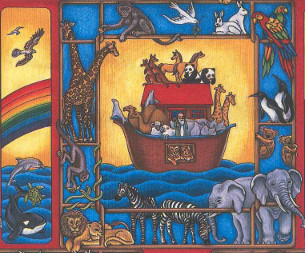
Actually, as far as people go, the Noahide laws aren’t a bad place to start. They are expressed as a list of (mostly) “negative commandments,” that is, a list of “don’t” but could easily be rephrased to be the opposite. Here’s how they’re listed at AskNoah.org:
- Do Not Worship a False Deity
- Do Not Commit Blasphemy
- Do Not Commit Murder or Injury
- Do Not Have Forbidden Sexual Relations
- Do Not Commit Theft
- Do Not Eat Meat Taken from a Live Animal
- Establish Laws and Courts of Justice
That actually doesn’t sound bad at all. Click the link I provided just above this list to read all of the explanatory text accompanying those commandments and you’ll see there’s more to them than meets the eye (the origin of the Noahide laws can be found in Genesis 9).
Here’s the list again, reworked to a list of positive commandments:
- Worship the One, true God and obey Him only.
- Sanctify the Name of God and bless Him.
- Preserve and sanctify human life.
- Cleave to and honor your spouse, forsaking all others.
- Only that which is yours may you use and consume.
- Treat the lesser beasts with compassion, committing no cruelty to them.
- Establish just laws and courts in judging your fellows because your God is lawful and just in judging mankind.
 Before complaining that you don’t have enough of God’s laws to obey, check and make sure you’re meeting even the minimum standard I’ve just listed here.
If you’ve been paying attention, you should have noticed that each of these laws is quite Biblical and expresses the desires and will of God. They read like a condensation of the laws of the Torah and each of these laws can be unpackaged to produce a lot of detail.
For instance, it would be difficult for a single individual to establish an entire court system for his or her nation, but we can take that commandment to also mean that we should treat other people in a just manner. In fact, part of the prayer Jesus taught his disciples (Matthew 6:9-13, Luke 11:2-4) includes the phrase “forgive us our debts as we also have forgiven our debtors,” implying (or outright saying) that God will forgive our transgressions in the same manner as we forgive those who have sinned against us. It is a terrible thing to fall into the hands of the living God (Hebrews 10:31).
If this is a large part of the mission of the Jewish people to the rest of the world, it’s not so bad at all. In fact, you can see the Noahide laws as the place where Jesus was starting with the non-Jewish people, principally through Paul but ultimately through all of the apostles, and then trying to elevate us, first with the four Acts 15 particulars, and then ultimately in defining how the Torah of Moses is applied to Gentile believers.
God entrusted Noah with a basic set of laws that were to be applied to all humanity. This was in the days before Abraham, and thus mankind knew or should have known what God expected of them…of us. Then, through Abraham, Isaac, and Jacob, and through Jacob’s children, the twelve tribes, the Israelites, the Jewish people, were entrusted to be a light to the nations (Isaiah 49:6).
See, just as the Lord my God has charged me, I now teach you statutes and ordinances for you to observe in the land that you are about to enter and occupy. You must observe them diligently, for this will show your wisdom and discernment to the peoples, who, when they hear all these statutes, will say, “Surely this great nation is a wise and discerning people!” For what other great nation has a god so near to it as the Lord our God is whenever we call to him? And what other great nation has statutes and ordinances as just as this entire law that I am setting before you today?
–Deuteronomy 4:7-8 (NRSV)
 As you can see, Israel was to be a light to the nations from the very beginning. It is true that Israel has had great difficulty in fulfilling that mission. The Tanakh (Old Testament) is a litany of blessings and curses God has heaped upon Israel for cycle after cycle of obedience and disobedience. And yet as we’ve seen from D. Thomas Lancaster’s New Covenant lecture series, the intent of the New Covenant was not to change the Law and how it was applied, it was and is intended to change people so that we will be able to obey the law God has given us as applied to Jews and to the Gentiles called by His Name.
Jesus was the ultimate example of Israel’s “light to the world”:
Again Jesus spoke to them, saying, “I am the light of the world. Whoever follows me will never walk in darkness but will have the light of life.”
–John 8:12 (NRSV)
And he transmitted or rather, reaffirmed Israel’s mission to be a light to the world to his Jewish disciples:
“You are the light of the world. A city built on a hill cannot be hid. No one after lighting a lamp puts it under the bushel basket, but on the lampstand, and it gives light to all in the house. In the same way, let your light shine before others, so that they may see your good works and give glory to your Father in heaven.”
–Matthew 5:14-16 (NRSV)
And that light was to be shown to everyone by the Jewish disciples:
And Jesus came and said to them, “All authority in heaven and on earth has been given to me. Go therefore and make disciples of all nations, baptizing them in the name of the Father and of the Son and of the Holy Spirit, and teaching them to obey everything that I have commanded you. And remember, I am with you always, to the end of the age.”
–Matthew 28:18-20 (NRSV)
The Master selected Paul as a special emissary to take this “good news” to the Gentiles as well as to Israel:
But the Lord said to him, “Go, for he is an instrument whom I have chosen to bring my name before Gentiles and kings and before the people of Israel…”
–Acts 9:15
And it was first revealed to Peter that even the Gentiles could receive the Holy Spirit and be saved:
While Peter was still speaking, the Holy Spirit fell upon all who heard the word. The circumcised believers who had come with Peter were astounded that the gift of the Holy Spirit had been poured out even on the Gentiles, for they heard them speaking in tongues and extolling God. Then Peter said,“Can anyone withhold the water for baptizing these people who have received the Holy Spirit just as we have?” So he ordered them to be baptized in the name of Jesus Christ. Then they invited him to stay for several days.
–Acts 10:44-48 (NRSV)
Unfortunately, the actual “good news” of the New Covenant blessings to the Gentiles has become rather warped in its meaning and in many cases, that it is good news to the Jew first has become forgotten, even though it is plain in the Biblical text (Romans 1:16 for example).
 The Jewish mission is to repair the world (Tikkun Olam) by returning the secular Jew to the Torah and to be a light to the nations, informing us of the good news of God. From a Messianic Jewish perspective (a viewpoint I have adopted), the perfect example of the “world repairer” is Messiah Yeshua (Christ Jesus). He assigned his disciples to be a light to the Jewish people and to the nations, and particularly Paul was to both return the Jewish people to a more specific observance of Torah (this was illustrated in articles written by Derek Leman and David Matthews at AncientBible.net) and to illuminate the Gentiles in the diaspora with the light of Messiah.
But while the Christian Church has done much good in the world (and sadly in its history, also great evil), it is currently suffering from mission drift and is in desperate need of what you might call a Messianic Reformation. I think that was Boaz Michael’s intent in writing Tent of David and subsequently traveling back and forth across America giving Tent Builders seminars.
And so it is now up to we Messianic Gentiles inhabiting our churches to carry that light back into the Christian community. But history teaches that we won’t always be successful and that some will reject our offer of good news, substituting what they already believe they have for what Jesus intended apostles like Paul to teach. We know from Paul’s own history that he received “mixed reviews” and that while some eagerly accepted the gospel of Messiah, others vehemently rejected it.
And so it is with us. All we can do…all I can do, is to be a voice in the wilderness, a small ship on a vast and turbulent sea, crying out, raising my sails, hoping someone will have ears to hear and eyes to see, and for those who do, it is wonderful. For those who don’t, may God send another emissary who may gain better “traction,” and if He chooses not to (for did he send someone after Paul to all those who rejected Paul?), then may he forgive me for my failure and may he forgive all of us who do not or have not listened, as the Master taught, “forgive them; for they do not know what they are doing.”
Not all Christians are going to help raise the tent of David. Sometimes, they’ll let it fall.
Addendum: since writing and publishing this blog post, I revisited something I wrote almost a year ago called Conquering Wrong with Right. It was not so much a record of my own dissonance with normative Christianity but the Church as seen through the eyes of a millennial blogger; a young woman who doesn’t want to give up on the Church but who doesn’t see Christians living up to the ideal of Christ. I thought it was a fit addition to the current message.

















 Morning Meditations