Tag Archives: FFOZ

Straightening the Road of the King

what-is-the-churchWhat is the “church?” Who belongs to the church? How is the church related to Judaism or is the church related to Judaism in the current age? These are the questions my Pastor and I discussed last Wednesday night. Sometimes, when we talk of these puzzling subjects, I have a difficult time conceptualizing my thoughts and feelings and articulating them while I’m with him in his office. So I ponder, and think, and occasionally, I draw (you’ll see what I mean as you scroll down while reading).

I think I’ve come up with a “vision” of Pastor’s understanding of the evolution of the church from its beginnings in Judaism as well as my own “vision.” I apologize to Pastor and to you in advance for any misunderstanding I have of his point of view. He recently pointed out to me how I didn’t have a correct understanding of his view of the “end times” (which I blogged about) and sometime soon, I’ll need to post a retraction (he told me he doesn’t find a retraction or correction necessary, but I find it necessary if I intend to be honest in my transactions with him and everyone else).

First things first. There are some areas we necessarily agree upon. God made a covenant with Abraham, with Isaac, and with Jacob involving promises relating to the Land of Israel, making their descendants very numerous, promises that they would be a blessing to all nations (through Messiah), and that circumcision would be the physical sign between God and the specific, biological descendants of Abraham and Isaac, and Jacob that their descendants would be the inheritors of these covenant promises.

The patriarchs came from Jacob and the twelve tribes of Israel came from the patriarchs. Moses led the twelve tribes out of slavery in Egypt and God redeemed them as His special people, as per the promises made to Abraham and his descendants. God then added to His promises at Sinai and gave the Torah, the teaching and instruction for righteous living to the physical descendants of Abraham, Isaac, and Jacob. This also functions as the national constitution of Israel, and has multiple other purposes.

At this point in history, Gentiles can only join Israel as gerim, which isn’t exactly conversion. The idea is that a Gentile would do what the Israelites would do in terms of the mitzvot, but the Gentiles would never become Israelites in their generation. More like resident aliens. No one can convert to a tribe or a family clan. Only after the third generation, would the ger’s children have intermarried into tribal Israel and ultimately assimilate into the Israelites. This was the only path for a Gentile to join the covenant people of God.

After the Babylonian exile and a lot of history passed by, tribal and clan affiliations were all but lost. The Jewish religious authorities instituted what we understand as the ritual of conversion. Now, if a Gentile wants to join national Israel and the Jewish people, they must undergo a process supervised by Jewish religious authorities (in modern Orthodox Judaism, it is a group of three Rabbis who form a Beit Din). The men are circumcised and both men and women are “mikvahed” as the final act of conversion. They go down into the water as a Gentile and come up as a Jew. There is no multi-generational “delay” and the individual Gentile who desires to be Jewish can become Jewish and thereafter, they and all of their descendants are considered Jews.
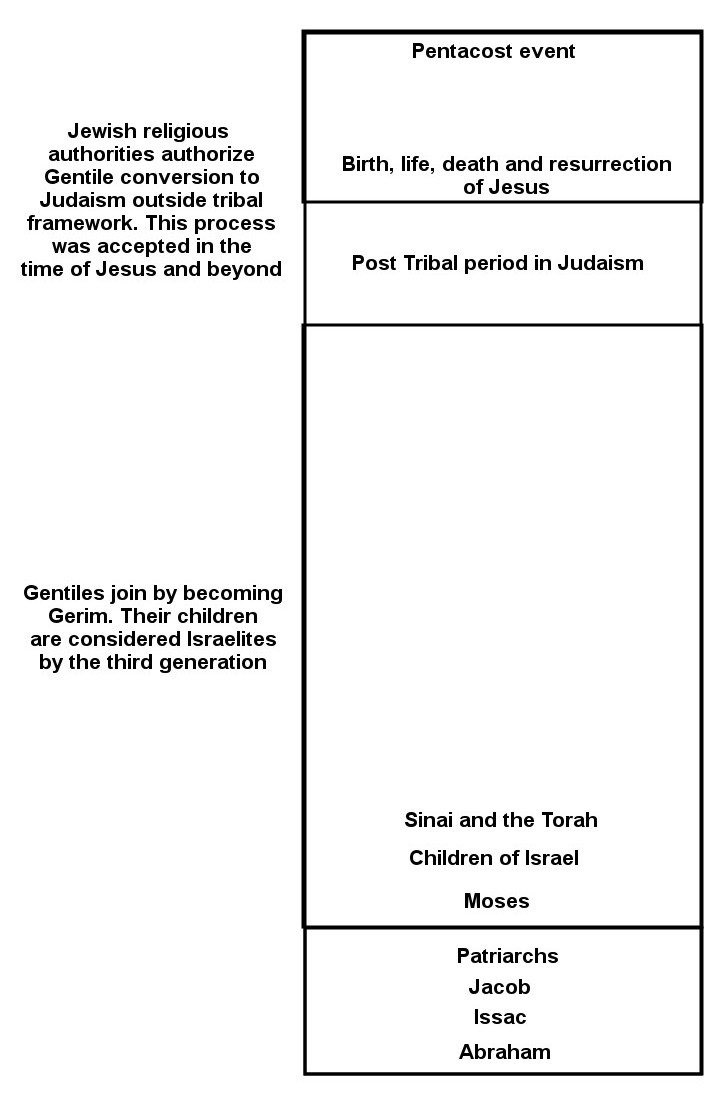
stream1Then Jesus comes. At this point, there are born Jews and there are Jewish converts or proselytes to Judaism. Jesus doesn’t speak against the ritual of the proselytes and does not overturn this institution, even though it is not directly found in the Torah. Remember, Jesus wasn’t adverse to opposing Jewish traditions and he did overturn or object to other halachah of the scribes and Pharisees on occasion (Matthew 15:1-14 for example). We also see that Paul encountered Jewish proselytes (Acts 13:43 for instance) and he too never said a cross word about the Jewish converts or the practice of converting Gentiles to Judaism (though in Galatians, he spoke strongly against Gentiles converting to Judaism as the only way to be justified before God). Both Jesus and Paul were very direct about expressing their thoughts and feelings and if either one had a problem with the Jewish conversion process, they would have said so…but they never did.

But something new happened after the death and resurrection of Jesus.

And Jesus came up and spoke to them, saying, “All authority has been given to Me in heaven and on earth. Go therefore and make disciples of all the nations, baptizing them in the name of the Father and the Son and the Holy Spirit, teaching them to observe all that I commanded you; and lo, I am with you always, even to the end of the age.”

Matthew 28:18-20 (NASB)

I wonder if the Jewish apostles truly understood the implications of Messiah’s words. Did they believe he wanted them to make converts of the Gentiles, “mikvahing” them into Judaism? All of the other streams of Judaism accepted Gentile converts, why should “the Way” be any different?

But it was and is.

While Peter was still speaking these words, the Holy Spirit fell upon all those who were listening to the message. All the circumcised believers who came with Peter were amazed, because the gift of the Holy Spirit had been poured out on the Gentiles also. For they were hearing them speaking with tongues and exalting God. Then Peter answered, “Surely no one can refuse the water for these to be baptized who have received the Holy Spirit just as we did, can he?” And he ordered them to be baptized in the name of Jesus Christ.

Acts 10:44-48 (NASB)

stream2Here we see our answer. Gentile believers, like the Jewish believers, received the Holy Spirit and were baptized by water without being circumcised and converting to Judaism! This was revolutionary. This was astounding. This had never, ever happened before. It was without compare. Paul perceived this vision clearly in his subsequent work with Gentiles, but it wasn’t until the matter was brought before the council of apostles and elders of the Way in Jerusalem that a formal, legal status was granted to the Gentiles entering into a wholly Jewish religious stream (see my Return to Jerusalem series for a detailed analysis of this process).

But it’s at Acts 2 that Pastor and I disagree. He believes that Pentecost is the “Birthday of the Church” and that sometime remarkable happened. Something remarkable did happen, but we don’t agree on exactly what it is. To the best of my ability to relate (and again, I apologize in advance if I mess any of this up), Pastor believes that an entirely new entity, “the Church” emerged from a Jewish religious stream and although it is made up of both Jewish and Gentile members, the members all form a single, uniform body of Messiah. At this point, the Torah is “fulfilled” and is no longer a set of commandments or obligations for the Jewish Christians. Jewish and Gentile Christians share a single set of obligations under the grace of Jesus Christ.

This effectively separates the Jewish members in the Church from larger Israel and the Jewish people. Pastor says that all Jews share in the covenant promises of God, particularly possession of the Land of Israel in perpetuity, but that only the Jewish Christians are saved.

My point of view is different.

I see the creation of the Body of Messiah (I’m not going to call it “the Church” in order to distinguish Pastor’s perspective from mine) as the natural and logical extension of everything that happened in Biblical and historical Judaism before it. The entire stream of history and prophesy for Israel pointed inevitably to the Jewish Messiah, so when Jesus came, it was the pinnacle, the focal point, the historical hinge upon which everything in Judaism was aimed at and upon which it turned.

But while it was revolutionary for Gentiles to be allowed to enter a stream of Judaism without converting to Judaism and being considered Jewish, their admittance wasn’t the end of the Jewish stream that accepted Jesus as Messiah as a Judaism, nor was it replaced by another religion or religious entity. It was a Judaism that had Gentiles admitted as equal members in relation to salvation and access to God, but it didn’t turn “the Way” or “Messianic Judaism” into “the Church.”

That happened unfortunately, after the Jewish/Gentile schism in the movement (and there’s a lot of history available to describe the details, so I won’t replicate it here) and in my opinion, the “Gentile Church” was born when the Gentile Church leadership agreed that it was no longer a Judaism and that Jews were not welcome unless they converted to Christianity!

If Pastor is right, then we have to consider the Jews in the Church as irrevocably separated from their Jewish brothers and sisters and perhaps even national Israel, since they no longer can identify with Israel, the Torah, and the connection the Torah provides a Jew with his nation and his God. If I’m right, then we have to consider the Body of Believers in Messiah as a Jewish stream, albeit a somewhat unique one because of such a large Gentile membership, that runs parallel to all other Jewish religious streams pointing toward the future and the eventual return of the King. We also have to admit that the Torah is not canceled and that Messianic Jews share an equal obligation to the mitzvot as all other Jewish people.

stream3Again, I sincerely apologize to my Pastor and to everyone reading this if I got his perspective on these matters wrong, in even the slightest detail. It is not my intention to misrepresent anyone, but it is my intention to draw a distinction between our two viewpoints.

Does it matter who is right? Is my purpose in the church, let alone the reason for my existence, simply to be right? As I’ve discovered (or re-discovered) recently, the answer is yes and no. No, it doesn’t matter if I personally am right. The world doesn’t depend on my one, small opinion. Statistics vary, but recent research indicates that there are anywhere between one and three-quarter million blogs to perhaps up to 164 million blogs in existence, and even the people compiling these numbers admit the list is incomplete. The number of individual blog posts goes into the billions and billions. Compared to all that, my one little blog can hardly matter, even in the human realm, let alone God’s. Any religious blogger who thinks they’re “all that and a bag of chips” can only make me laugh.

On the other hand, it’s vitally important to examine the question “who is the Church” and especially “what is the Church”. If “the Church” turns out to be a terribly misguided Judaism that has wildly deviated from its original course, then we require an exceptionally radical “course correction.” No, I’m not suggesting a revolution in the Church as such, where we strip away 100% of church culture as it has evolved over the past twenty centuries, but I am suggesting some form of change.

This is exactly the sort of process described by First Fruits of Zion (FFOZ) Founder and President Boaz Michael in his book Tent of David. The answer to the question of who and what “the Church” is has profound implications if we believe that the modern Messianic Jewish opinion is correct and that “the Church” was never intended to be a totally unique religious unit, disconnected forever from Israel, the Torah, and the Jewish people.

In my opinion, everything God did across human history was ultimately additive, no replacements or substitutions accepted. Abraham and God make a covenant, and as part of the conditions of that covenant, Isaac is added, then Jacob is added, then Jacob’s children are added as the patriarchs, and then their descendants, the Children of Israel are added, and they are made into a nation and the Torah is added, and possessing the Land of Israel is added, and all of the prophesies by all of the prophets pointing to the Messiah and the Kingdom of Heaven are added, and the birth of Messiah is added, and the death and resurrection of Messiah are added, and the Jewish religious stream that is identified by faith in Messiah is added, which includes the Gentiles entering this Jewish stream being recipients of the blessings of the covenant God made with Abraham…all in one, nice, neat, straight line across history as drawn on the canvas of time by God.

What we have now in the 21st century is something of a mess, but that’s what happens when God gives us a gift and then lets us play with it for 2,000 years. We’ve bent, folded, spindled, and mutilated it, but not beyond repair. Repair is what I think Messianic Judaism is all about. It’s tikkun olam or repairing the world with a Messianic twist. It’s a voice in the wilderness calling out to the synagogue and the church saying, “It’s time to take a fresh look at all this so we can clean the place up and get ready for the King’s return.”

The roadOne nice, neat, straight line from Abraham to Moshiach. Any bends in the road, any wrinkles in the asphalt, any potholes, any mudslides, any detours, have nothing to do with God and His intent. We’re the ones with the jack hammers and sledge hammers pounding away at that line, making it crooked and not straight. But we’re the ones who were charged with caring for the road, just as Adam was charged with caring for the Garden (and look how that one turned out).

I’m not in charge with being “right” but God did say that I’m supposed to take care of my little section of the road upon which the King will walk as he returns. I can’t fix it all, but I have to do something. He’s coming soon. I can’t just lie down on the job and call it good. He’s coming soon. I’ve got to do my best, with the help and by the will and grace of God, to make and keep my little piece of the road of the King straight.

For more about the relationship between Jewish and Gentile believers in the Body of Messiah, see Derek Leman’s short article, Citizens, Not Natives.

Returning to the Tent of David: An Introduction

serpentThe serpent enticed Chavah by predicting beneficial outcomes. “Your eyes will be opened… The fruit will awaken a new desire and appreciation for the pleasures around you. It will be a source of intellectual benefit.”

Chavah longed for this new knowledge and exciting awakening, and she ate the forbidden fruit. She then used her persuasive powers to convince her husband to eat it as well.

Chavah’s downfall began when she expanded upon and distorted G-d’s command, which she did not personally hear.

-Chana Weisberg
“Woman and the Forbidden Fruit”
Chabad.org

Beginning the Returning to the Tent of David series

This depiction of Chavah (Eve) and her interaction with the serpent casts her in a more favorable light than we typically see her by in Christianity. Rather than being disobedient and rebellious, she is either a bold explorer of new knowledge, or an innocent dupe of the serpent who physically pushed her in to the tree of the knowledge of good and evil and after all, it’s not her fault because God did not tell Chavah directly not to touch the tree or to eat from it.

Chavah added the prohibition of touching the Tree of Knowledge. The serpent then forcibly pushed Chavah against the tree, and victoriously claimed, “See, just as death did not ensue from touching, so it will not follow from eating.”

In this way, the serpent introduced doubt into Chavah’s mind. It now became easier to dare Chavah to taste the forbidden fruit. He convinced her that G-d did not actually intend to kill her and Adam, but merely threatened them to intimidate them.

I know, I know. The Torah reading for Beresheet (Genesis) is behind us. Why do I continue to write about it now? Shouldn’t I be preparing my commentary on Noah? Be patient. There’s a reason.

That’s my ministry in a nutshell; it’s a not-so-interesting and rather Baptist-intensive story. I am eternally grateful for my family and for my Baptist heritage. God has used both to lead me to commit my life to Christ, to follow him with my life and to serve him through the church. However, the past eighteen months have opened up for me a more complete picture of who I am and where I came from. Through a series of circumstances, curiosity, and new friendships, I am being exposed to my Jewish roots. I have no doubt that all of these circumstances and friendships, and even my own curiosity that opened me up to the Jewish roots movement, are all God-ordained.

-Durwin Kicker
Senior Pastor at Marshfield First Baptist
From the Foreword (pg 10) of Boaz Michael’s book
Tent of David: Healing the Vision of the Messianic Gentile

tent-of-davidYou may think it’s terrifically unfair of me to compare Chavah’s situation to Pastor Kicker’s. I’m not really, but it occurs to me that, at least in midrash, we all have something in common with the wife of the first man. When exposed to be brand-new world with seemingly endless possibilities, we want to explore. However, like Chavah, we may also have reservations, since some of the things that we are tempted to explore may not be what God wants us to investigate, even when we get a “helpful” shove.

God has used Boaz Michael and the ministry of First Fruits of Zion to impact my life in a profound way in a very short amount of time. It is my great honor and privilege to call Boaz my friend. His passion and love for Messiah and his gentle spirit have struck a chord in our church family which has served to open many of our people to our Jewish roots, God’s everlasting covenants with his people, and our place as Gentiles in God’s family through our Jewish Messiah.

Boaz’s desire is that this kind of loving impact will be repeated over and over again in church after church. I join with Boaz in saying, the church needs you! The church is good, yet the church needs to change. Each individual who comes to know our Jewish Messiah in his Jewish context can play a part in lovingly and patiently helping brothers and sisters in Messiah come to know him in this way as well.

-Kicker, pg 12

I reviewed Boaz’s book about nine months ago in several blog posts, the two most notable being Return of the Christian and Returning to Faith. I had read an advanced copy of the book months previously, and it was instrumental in overcoming my inertia and inspiring my own return to a local church.

And now it’s been nearly a year later. The progression through the Jewish holiday season and the beginning of a new Torah cycle seem a very good time to review my own “Tent of David” experience and to see how things actually have ended up (not that anything has really ended yet).

Pastor Kicker seems enthusiastic about pursuing the vision of the “Messianic Gentile” in the church by way of his friendship with Boaz but of course, he’s been in the church for quite some time and as Pastor, he is a fully integrated unit within that cultural, social, and theological construct. In other words, he “fits.” Boaz’s book speaks of “Healing the Vision of the Messianic Gentile.” For me as a recent “returnee,” what has been healed, if anything?

My perception of Boaz’s book (I can’t speak directly to his intent, nor would I ever try…this is my own opinion) is that there are two kinds of healing going on, at least in theory.

There’s the healing of the “Messianic Gentile,” the Christian (non-Jewish disciple of Jesus Christ) who often has left the church because of some emotional or spiritual injury or hurt (real or perceived) caused somehow by the Christian church or some of its members. Many people in Hebrew or Jewish roots congregations believe they have sought refuge in a “safe place” outside of “the Church” and continue to view church and people who identify as Christians as adversaries. Finding a mechanism to have the Hebrew/Jewish roots Gentile return to church in a safe manner and to share who they are with their fellow Christians certainly opens the avenue for healing between the parties involved.

Then there’s the more historic healing between the traditional church of Jesus Christ and the historic and Biblical Jewish Jesus and the Jewish and Gentile body of Messiah. A great deal of damage has been done to Jewish and Christian hearts, and that has sustained the separate trajectories believing Gentiles and the Jewish community (including Messianic Jews) have been traveling for twenty centuries.

church-and-crossA non-Jewish believer possessing a Hebraic view and even a passion for the “Jewishness” of Jesus, and one willing to communicate that with his or her Christian counterparts in a church community could facilitate a great deal of healing, ultimately between Christianity and Judaism. Certainly, great strides have already been made in this area between some churches and various expressions of Messianic Judaism, although a lot of work still needs to be done.

But what about me and what I’m doing in the small church I attend? I’d like to completely re-read Boaz’s book before venturing to answer that question in full, but I did want to keep my promise and at least introduce the journey I’m taking in returning to the Tent of David and Boaz’s vision of the healing of Christian and Jewish communities. His book speaks on a larger scope by necessity, but nearly a year down the road,  how has Boaz’s vision worked “on the ground,” so to speak. I can only lend my own single, small voice and my individual experience. As this series progresses, I’ll share my insights with you. Perhaps you will return the favor.

The Last Reading of the Chronicles of the Apostles

study-in-the-darkIn the two decades following the Bar Kochba revolt, three major personalities came to represent three different types of second-century Christianity. A philosopher named Justin Martyr championed the dominant, orthodox Christianity that would soon become the normative expression of Christian faith. A bishop named Marcion of Sinope brought anti-Jewish, Gnostic Christianity from obscurity to the mainstream where it became a serious threat to true faith. The bishop Polycarp of Smyrna continued to defend and represent the old-fashioned, Jewish, apostolic Christianity he had inherited from the disciple John. As a short epilogue to our studies, the Chronicles of the Apostles concludes with a brief look at each.

-D. Thomas Lancaster
“End of the Chronicle,” pp 1407-8
Study read with Vezot Ha’Bracha
Torah Club Volume 6, Chronicles of the Apostles

This is the last reading in my year-long study of the “Chronicles of the Apostles.” It began with Acts 1:1 and proceeded through an adventure of learning and re-learning about the life of Paul and well beyond, as recorded in scripture, historical texts, and even myth. My Torah Club readings have been a fixture of my Shabbat studies and I will miss them. It seems fitting as one Torah cycle closes and another opens, that I offer a brief review and commentary of the last Chronicle of the Apostles of D. Thomas Lancaster.

For the Law that came from Mount Horeb is now old, and it belongs to yourselves alone, but [the Law of the New Covenant] is for everyone. Law against law has abrogated the one that came before it, and a covenant which comes later cancels the previous one. (Justin Martyr, Dialogue with Trypho 11)

-quoted by Lancaster, pg 1410

Justin Martyr doesn’t sound all that different from modern Protestants, at least in some churches. Martyr was a lot closer to the original writings of the New Testament but even he seems to have forgotten something. Perhaps he didn’t have access to Paul’s letter to the churches in Galatia, written a mere century before:

What I am saying is this: the Law, which came four hundred and thirty years later, does not invalidate a covenant previously ratified by God, so as to nullify the promise.

Galatians 2:17 (NASB)

To extend Paul’s words, can we say that the New Covenant, which isn’t even fully enacted as yet, invalidates “a covenant previously ratified by God?” Justin Martyr seems to think so. So do a lot of Christians today.

In Justin Martyr’s dialogue with Trypho, they even addressed a topic on which I often write:

Trypho pressed the question further. He asked, “Are there some Christians who believe that Jewish believers will not be saved if they keep the Torah?”

Justin replied, “There are such people, Trypho. And these [Christians] refuse to have any dialogue with or to extend any hospitality to such persons, but I do not agree with them.” In other words, Justin Martyr admitted that his own opinion on the question of whether or not a Torah-observant Jewish believer could be saved represented the more liberal, broad-minded view. Other Christians in his day refused to have any interaction whatsoever with Jewish believers who still observed the Torah. Justin’s final statement on Jewish believers who still observed the Torah refers to them as “weak-minded” but probably not damned…

-Lancaster, pg 1411

Things haven’t changed very much in the past almost twenty centuries. Justin Martyr’s thoughts and opinions still seem well represented in the church today. But we can hardly say that he was completely anti-Judaic, at least not compared to Marcion the Heretic:

Marcion taught a radical dichotomy between the Jewish Scriptures and the gospels. Like other Gnostics, he believed that the Old Testament God of the Jews was a corrupt and inferior being who had marred His creation with His own imperfections. The physical matter, which He created, possessed intrinsically evil qualities. Marcion taught that the Jewish God’s own scriptures revealed His complete ignorance and incompetence.

-ibid, pg 1413

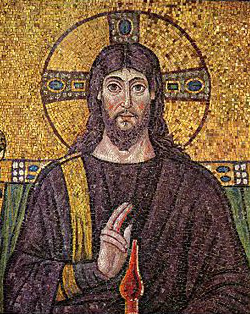
Christus_Ravenna_MosaicI suppose today, we’d call Marcion a “nut” or a “cult leader” for espousing such “fringy” beliefs, but as we know, nuts and cult leaders are able to gather followings, sometimes really large ones.

Lancaster records how Marcion created his own version of the apostolic scriptures, leaning heavily on only one gospel and ten of Paul’s epistles. He even edited out any references to anything from the Old Testament, thus building his theological house on shifting and unstable sand.

However, saying that…

Marcion’s New Testament collection spread quickly, and Marcionite churches began to flourish. Marcion’s form of Christianity was easier to understand and naturally appealed to people. It removed the inherent contradictions between Christian theology and Judaism that conventional Christians like Ignatius and Justin Martyr attempted to retain and gloss over. It seemed more logical. Marcionite Christianity assessed Judaism as the religion of legalism, laws, and concerns with the corrupt world of physical matter. According to Marcion, Judaism stood in antithesis to Christianity’s teachings about grace, love for one’s neighbor, and spiritual salvation. Marcionite Christianity instantly appealed to Gentile Christians who felt uncomfortable with their relationship with Judaism and the hated Jews who had persecuted Christ and Christians.

-ibid, pg 1414

Although the “nuts and bolts” of Marcion’s theology may no longer be with us, the “echo” of it seems to be thoroughly woven into the fabric of Christianity (if you’ll forgive the mixed metaphor), at least in terms of the dichotomy many Christians believe exists between the Torah of Moses and the Grace of Christ, as if these are two mutually exclusive concepts, wholly divorced from one another. Many Christians give intellectual assent to the idea of our faith having Jewish origins, but in the same breath, they will say that there is no valid Jewish context for Christianity. The legacy of the heretic Marcion in the twenty-first century Church.

All this while, Polycarp, the bishop of Smyrna and the last living disciple of the last living disciple of the Master, continued steadfast in the ways of the apostles. Like his teacher John, Polycarp lived to an advanced age. The Christians in Smyrna considered him to be a prophet. They said, “For every word that went out of his mouth either has been or shall yet be accomplished.”

-ibid, pg 1415

Of any of the three people presented in Lancaster’s last chronicle, this is the one I’d like to meet. If any of these three individuals had a clue as to the true intent of Messiah in how we all should live and relate to each other and to God, it was Polycarp of Smyrna.

In 154 CE, the new bishop of Rome, a man named Anicetus, attempted to force the Christians of Asia Minor to abandon their observance of Passover. Roman Christians commemorated the Master’s death by fasting from the Friday that falls during the seven days of Passover until midnight on the subsequent Saturday. They broke the fast by taking the Eucharist together in celebration of the Master’s resurrection.

Anicetus tried to force Christians everywhere to adopt the Roman custom. The Christians who refused to adopt the Roman custom were called “fourteeners” (quartodecimans) because they insisted on keeping Passover on the fourteenth of Nisan. They kept the Passover “on the fourteenth day of the month at evening” (Exodus 12:18), more precisely speaking, at the beginning of the fifteenth day.

-ibid

Polycarp’s followers seem to have adhered to more of the “Jewish” practices, but we have no clear picture of exactly how this was accomplished in a wider range of behaviors. If we understood more about Polycarp and his stream of Christianity, we might get a better idea of the nature of the relationship of Gentile and Jewish believers, especially in terms of identity and religious practice.

Here ends the Chronicles of the Apostles — men of whom the world was not worthy. I have collected these things after they had almost faded away due to the passage of time. So too, may our Master Yeshua the Messiah gather me along with His chosen ones into His kingdom.

-ibid, pg 1419

reading-torahThe last paragraph of the last page of the last teaching of the last Torah Club volume. As you read this, it is Shemini Atzeret and tomorrow is Simchat Torah. We read the final words at the end of Deuteronomy soon and immediately begin again with the reading of the first words in Genesis. My Pastor says this is a reminder that we are never done with reading the Bible. I see it as part of the lifecycle of people of faith, even as we mark the cycles of our lives each year in birthday celebrations.

But although the Torah is timeless, not so the years of man. I’m not quite the same person I was a year ago when I began this study. I’d like to think I’ve gained a bit in my studies but as with aging, there are a few things I’ve lost as well. It’s nearly time to pack up the sukkah for another year. In synagogues all over the world, it will soon be time to re-roll the Torah scrolls for another year. Many things are endless and many more are not. The future is shrouded in fog and mystery. What will the coming year bring? What will begin once again…and what will end?

FFOZ TV Review: Raising Disciples

ffoz_tv12_startEpisode 12: Everyone knows that Jesus had twelve disciples but many would be surprised to find out that the institution of discipleship existed centuries before the time of the apostles. In episode twelve viewers will gain a better understanding of what it means to be a disciple from the understanding of Judaism in the days of Messiah. Jesus tells us that “Every disciple fully trained will become like his teacher.” Indeed, to be a Christian means to be a disciple of Jesus, a student responsible for learning and becoming like one’s rabbi.

-from the Introduction to FFOZ TV: The Promise of What is to Come
Episode 12: Raising Disciples

The Lesson: The Mystery of the Meaning of Discipleship

Whenever we consider being disciples of Christ, most of us in the church probably think that means being believers in Jesus. However, according to First Fruits of Zion (FFOZ) teacher and author Toby Janicki, it’s really much more. But how much more? What does it really mean to be a disciple of Jesus?

Toby first spends a lot of time in this episode showing the audience what discipleship meant in Judaism in the late Second Temple period; during the earthly lifetime of Jesus:

The disciples of Yochanan and the disciples of the Prushim would often fast, and they came and said to him, “Why do the disciples of Yochanan and the disciples of the Prushim fast, but your disciples do not fast?”

Mark 2:18 (DHE Gospels)

Here we see that not only did Jesus have disciples but that John the Baptist and the Pharisees had disciples. In fact, all of the teachers or Rabbis in all of the streams of Judaism in that day had disciples. But we still need to understand what it is to be a disciple in general and a disciple of Jesus of Nazareth in particular.

To me, a lot of the information presented about discipleship wasn’t a great revelation since I’ve been exposed to it before, but it may be that some Christians believe only Jesus had disciples and that he only had twelve of them. This, of course, is not correct:

After this the Lord appointed seventy-two others and sent them on ahead of him, two by two, into every town and place where he himself was about to go.

Luke 1:10 (ESV)

While some translations say that seventy were sent out and others say seventy-two, Toby says that from the context in the rest of this chapter, those sent out were also disciples of Jesus. This illustrates how common disciples were in that day and age. He also cites Acts 9:36 to illustrate that women were disciples, Acts 6:1 and 6:7 to illustrate how there were many, many disciples, and Acts 11:26 to show that there were both Jewish and Gentile disciples of Jesus.

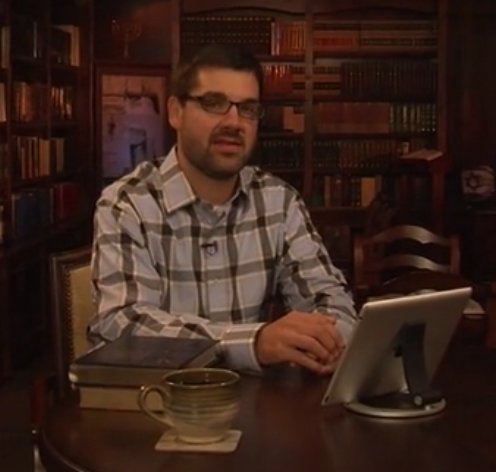
ffoz_tv12_tobyAccording to Toby, the word “Christian” is used only three times in the Bible, but the words “disciple” and “disciples” relating to followers and students of Jesus were used many times. Perhaps it’s more accurate to call ourselves disciples of Christ rather than Christians. But then again, that would depend on the meaning of disciples and discipleship. Which brings us to our first clue:

Clue 1: All early believers of Jesus were called disciples.

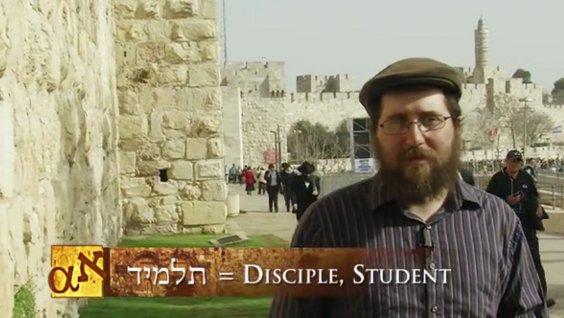
But going back to the question I just asked and the question Toby repeatedly asks, we need to understand how Christ’s original Jewish audience and the first Jewish readers of the Gospels would have understood discipleship. To get the answer, we turn to FFOZ teacher and translator Aaron Eby in Israel.

Aaron provides a great deal of background information on early Jewish discipleship including the fact that discipleship predates Jesus by quite a bit. Discipleship was considered the primary method of higher Jewish education, but it wasn’t just a matter of going to school and studying different subjects. A disciple was a student but specifically, a student of a Torah teacher. In the days of Jesus and before, when a young man thought he wanted a life of Torah learning, he would apprentice himself to a Torah master, however, this apprenticeship might not be what you imagine.

A disciple was to be a learner/imitator. He would memorize all of his Master’s teachings, learn to imitate his Master’s style of dress, mannerisms, inflections of speech. The disciple in some ways considered himself a servant or even a slave to his Rabbi, his “great one.” In some ways, he thought of himself as a son to a Father, but the Rabbi was considered greater than the disciple’s biological Father. Disciples were tremendously devoted to their Masters, more so than to their own families or even their own lives. And so it was with the disciples of Jesus, their Master and ours.

Back in the studio, Toby describes the concept of discipleship as a job description.

A pupil is not above his teacher; but everyone, after he has been fully trained, will be like his teacher.

Luke 6:40 (NASB)

That the disciples of Jesus were imitators of their Master and memorized his teachings is the reason why we have the Gospels today.

Be imitators of me, just as I also am of Christ.

1 Corinthians 11:1 (NASB)

Here we see that Paul considered himself a disciple of Christ as his imitator, and he suggests to the readers of his letter that they should imitate Paul. Were they then Paul’s disciples? I’ll answer that in a bit, but we have arrived at our second clue:

Clue 2: The primary job of a disciple was to be like his teacher.

Even the Pirkei Avot or “Ethics of our Fathers,” a set of Jewish teachings that predated Jesus says, “Raise many disciples.”

ffoz_tv12_aaronA Rabbi’s job was to create a new generation of disciples who would learn everything from the Rabbi and about the Rabbi and then, when they were fully trained, the disciples would become Rabbi’s themselves, raising up their own generation of disciples in order to preserve the Torah teaching and wisdom of their own Master. This process would be repeated from one generation to the next with the goal of creating an unbroken line of discipleship, generation by generation, that would preserve the teachings of Torah for each Teacher, often by establishing great schools such as the Houses of Study of Shammai and Hillel. This maps well to Matthew 28:19-20 where Rabbi Yeshua instructed his Jewish disciples to raise up a generation of disciples from the people of the nations, which the Church often refers to as “the great commission.” However, as we’ve seen, the idea of “the great commission” hardly does justice to what Jesus was actually commanding.

Now we have arrived at the third and final clue:

Clue 3: The job of a disciple was to raise up more disciples.

But here Toby introduces a strong caveat:

But do not be called Rabbi; for One is your Teacher, and you are all brothers. Do not call anyone on earth your father; for One is your Father, He who is in heaven. Do not be called leaders; for One is your Leader, that is, Christ. But the greatest among you shall be your servant. Whoever exalts himself shall be humbled; and whoever humbles himself shall be exalted.

Matthew 23:8-12 (NASB)

This set of verses has often been misunderstood or just not understood at all. Does this mean we shouldn’t have respect for our Bible teachers and Pastors? Here’s where having a Jewish perspective on the New Testament comes in especially handy. According to Toby, this is Jesus defining the difference between the relationship of Jewish disciples to the Sages and disciples of Jesus, our Master, to himself.

Remember, the purpose of discipleship was to learn all there was to learn from your Master and then to establish your own House of Study in your name passing on what you originally learned. Your disciples would be taught in your name, not in the name of your own Master, and your disciples would teach in their own names, not in yours (actually it was more like, “I teach you in the name of my Master, who taught in the name of his Master,” and so on).

Jesus said his disciples would be different. Each Torah Master would eventually age and die, but his teachings would be preserved in his disciples and in each generation of disciples that followed. Jesus is alive! We hear this enthusiastically declared every Easter or Resurrection Day in Church. James, Peter, and Paul were not to set up their own houses of study and teach in their own names by making their own disciples (in spite of what we saw relative to Paul in 1 Corinthians 11:1). They were not to raise up disciples for themselves but instead, they were and we are to raise up disciples for our Master, our one and only Master, Jesus the Messiah, Yeshua HaMashiach.

What Did I Learn?

I learned the meaning behind Matthew 23:8-12 which I tended to ignore in the past because I couldn’t figure it out. It makes a lot of sense now. I used to think that we inherited a broken system of discipleship since the teachings of Jesus were never transmitted generation to generation in the manner we have seen described in this FFOZ TV episode. Now I realize that it was by design, since we were never intended to be the students of any Master except Jesus. He is our only teacher, our only Torah Master. This does not mean we shouldn’t respect any Bible teacher or Pastor in our Church, but we must always remember that none of them take the place of Jesus. If we see a group of believers who esteem their Pastor or spiritual leader as anything approaching our true Master, then there is something wrong (and sadly, such situations make an appearance the news media from time to time, usually as scandals involving some highly public and popular religious leader).

ffoz_tv12_extra2I also thought of some questions as I was watching this episode and in fact, I was reminded of some of the narratives of Toby from other episodes that involve how he commonly introduces himself. He says that he isn’t Jewish but rather a Gentile who practices Messianic Judaism. It isn’t always apparent, but he usually wears a kippah while on camera (A kippah is a head covering typically worn by religious Jews either just in synagogue or during their waking hours, depending on their level of observance).

What is the difference between being a Gentile who practices Messianic Judaism and a Gentile who practices Christianity? More importantly, how do these two “states” relate to being a disciple of Christ, our Master? Since this television show was created to present the Gospels and Jesus Christ to a more traditional Christian audience by introducing a more Jewish perspective and interpretation, what does that say about the level of discipleship and imitation of our Master relative to “Messianic Gentiles” and Christians?

This question is especially important to me, since it factors into how I think of myself as a disciple of the Master by calling myself a Christian and attending Church. One of the motivations for me to return to Church after an absence of many years was the book Tent of David: Healing the Vision of the Messianic Gentile written by FFOZ president and founder Boaz Michael. Have I become a better imitator of my Master by following this template of church attendance and Christian affiliation or a worse one? At some point in the near future, as the one year anniversary of my returning to Church comes near, I plan to write one or more “meditations” on the application of Boaz’s Tent of David in my life and the results I see so far.

Closely related to this situation, Toby also didn’t drill down into something that I think it’s vital to know. When we say that a disciple of Christ is an imitator or Christ, just exactly what are we imitating? This isn’t an idle question. Many in the Hebrew Roots movement insist that discipleship means imitating the Jewish Jesus in every aspect of his Judaism, including wearing kippot (plural of kippah) and tallitot (plural of tallit) and to otherwise look and act in a manner identical to modern religious Jews (in spite of the fact that Jesus isn’t a “modern religious Jew,” but rather, he was an ancient Jewish Rabbi and he is the Jewish Messiah King).

The clue that may lead to an answer was provided at the end of this episode by Boaz Michael who appeared on camera and said that next week (episode 13), the topic would be how the Torah is the foundation of Messiah Yeshua’s instructions to his disciples. How can the Torah be applied to both the Jewish and Gentile disciples of our Master?

I’m hoping my review next week will help answer these questions.

Today is Hoshana Raba, the last day of Sukkot. Lord, please abundantly save us. Candle lighting for Shmini Atzeret is tonight at sundown. God, continue to be with us.

Day Zero.


A Question of the Division of Abijah

levites-aaronic-blessingIn the days of Herod, king of Judea, there was a priest named Zacharias, of the division of Abijah; and he had a wife from the daughters of Aaron, and her name was Elizabeth.

Luke 1:5 (NASB)

I very recently wrote a blog post called Was He Born in a Sukkah and, based on a teaching by First Fruits of Zion (FFOZ) theologian and teacher D. Thomas Lancaster, I suggested that Jesus was not born either on Christmas or on Sukkot. I received some pushback as a result and some readers provided further evidence on how the Master was very probably born on Sukkot.

My original source was an article in Messiah Journal 111 (Fall 2012 issue) called “The Birth of Yeshua at Sukkot: Evidence from an Old Source” but I later listened to an audio CD of Lancaster teaching the same material. The audio contained more information that expanded upon Lancaster’s reasons as to why we can’t really know if Jesus was or wasn’t born on Sukkot.

I just found Lancaster’s sermon online at the Beth Immanuel Sabbath Fellowship website. If you click that link, you’ll be taken to the Audio page specific to the material. To listen to the relevant recording, scroll down until you locate “Birth of Yeshua at Sukkot.” At about 8:29 on the audio, Lancaster introduces the information about Zacharias (father of John the Baptist) that I’m also going to summarize here.

The strongest evidence anyone has presented me about Yeshua (Jesus) being born on Sukkot has to do with the timing of Zacharias’ service in the Temple. But let’s take a step backward:

Now in the sixth month the angel Gabriel was sent from God to a city in Galilee called Nazareth, to a virgin engaged to a man whose name was Joseph, of the descendants of David; and the virgin’s name was Mary. And coming in, he said to her, “Greetings, favored one! The Lord is with you.” But she was very perplexed at this statement, and kept pondering what kind of salutation this was. The angel said to her, “Do not be afraid, Mary; for you have found favor with God. And behold, you will conceive in your womb and bear a son, and you shall name Him Jesus. He will be great and will be called the Son of the Most High; and the Lord God will give Him the throne of His father David; and He will reign over the house of Jacob forever, and His kingdom will have no end.” Mary said to the angel, “How can this be, since I am a virgin?” The angel answered and said to her, “The Holy Spirit will come upon you, and the power of the Most High will overshadow you; and for that reason the holy Child shall be called the Son of God. And behold, even your relative Elizabeth has also conceived a son in her old age; and she who was called barren is now in her sixth month.

Luke 1:26-36 (NASB)

Here we see the angel Gabriel announcing to Miriam (Mary) that she has been chosen to be the mother of Jesus, and popular opinion states that at this time Mary was already pregnant or would become pregnant very soon afterward. We also see that her cousin Elizabeth was six-months pregnant with her child, John the Baptist. The Priest Zacharias is John’s father.

Remember, Zacharias is a Priest in the division of Abijah and we know, based on 1 Chronicles 24, the order of the service of the Priestly divisions. We know that the division of Abijah, like the other divisions, served twice a year for a full week each time. If we could figure out when the course of Abijah was, we could figure out when Elizabeth became pregnant (since she became pregnant immediately after the end of Zacharias’ service in the Temple), count ahead six months and then nine months, and then figure out the birthdate of Jesus.

But Lancaster says it’s not that easy.

First of all, there were 24 courses which meant that each division cycled through the year twice making 48 week-long courses in a year. But in the solar calendar, there are 52 weeks in a year, so unless there was some way to compensate, each course would drift across the calendar making it very difficult to determine when a particular division was serving at any given year.

D.T. LancasterThe assumption though is that the Abijah division was serving in the spring or the fall. But Luke doesn’t tell us what season it was when describing Zacharias’ service, so we have no way of knowing if it was during springtime or autumn.

On top of that, one out of every three years in the Jewish religious calendar contains 13 months. Rabbinic sources don’t tell us how or if the priesthood compensated for an extra four weeks in their calendar every three years. We assume that they must have, but without knowing the exact method they used, we’re stuck as far as calculating the timing of the service of divisions.

And after all that, the entire priesthood was called to serve during each of the three pilgrim festivals: Pesach, Shavuot, and Sukkot, and Lancaster says we can’t rule out that it was during one of the festivals that Zacharias was serving.

The icing on the cake, so to speak, is that experts don’t agree on whether the priestly rotation began on Nisan 1 or Tishrei 1.

Add all this up, and it becomes impossible to calculate when Zacharias served in the Temple in the Luke 1 text, and thus the entire basis for calculating the birth of Messiah disintegrates like wet tissue paper.

Since this is just a summary, I encourage you to click on the link I provided above and listen to the entire recording for yourself. I can’t speak for Lancaster, but unless some additional data comes to light that modifies everything I just said, the information about Zacharias and the Abijah division of priests is a dead-end in terms of discovering the birthdate of the Master.

Was He Born in a Sukkah?

born_in_sukkahWhen was Yeshua born? The Gospel writers either did not know when the event happened or they did not feel the information was important enough to pass along. We can only speculate.

Two centuries after it happened, Clement of Alexandria discussed the dating of the Master’s birth, but he did not mention December 25 or January 6 at all. Instead, Clement reported one tradition corresponding to April 20 on our civil calendar and another tradition corresponding to May 20. By the middle of the fourth century, however, the Roman church had begun to honor December 25 while churches in the East, Asia Minor, and Egypt observed Jesus’ birth on January 6. Both are late developments and unsupported by early tradition or biblical evidence. No trace of a tradition from the early Jewish believers connects the birth of the Messiah with December 25 or January 6.

-D. Thomas Lancaster
“The Birth of Yeshua at Sukkot: Evidence from an Old Source,” pg 21
Messiah Journal, issue 111 (Fall 2012)
Published by First Fruits of Zion (FFOZ)

This is normally the sort of conversation you have in December when the vast majority of the Christian world prepares to celebrate the birth of Christ. One thing we can be certain of is that Jesus was born nowhere near December 25th. But it has been suggested that he might have been born on or near the festival of Sukkot. Could this be true?

I recently had a private request for any information I knew about this possibility. Alas, it’s not something I’ve written on before (although I’ve heard some commentaries on the topic). Fortunately, D. Thomas Lancaster has written on this in the above quoted article in Messiah Journal 111, which was published last year. Does Lancaster conclude that the Master was born during this season and if so, what is his evidence?

Other Sukkot-theory proponents claim, “Yeshua was born in a sukkah because the word ‘stable’ is sukkah in Hebrew.” These arguments are not at all convincing and fall apart under scrutiny. Is there any legitimate evidence of a Sukkot birth, or is the birth of Yeshua at Sukkot just more Hebrew roots movement apocrypha?

-Lancaster, pg 22

That doesn’t sound too encouraging. As much as the symbolism may attract us and fit into the theories and emotional dynamics of certain individuals and groups, is there any real evidence to establish the idea that Jesus was born during Sukkot? What line of reasoning and investigation could we use to support or refute this viewpoint?

Lancaster suggests that we could compare the birth narrative of John the Baptist to that of Jesus. We know, based on Luke 1:26 and 1:36 that the conception of Jesus came about six months after the conception of John, thus we can assume that Jesus was born about six months after John was. If we could determine when John was conceived and/or born, we could reasonably deduce when Jesus was born.

And now you will be silent and not able to speak until the day this happens, because you did not believe my words, which will come true at their appointed time.”

Luke 1:20 (NIV)

And now you will be dumb and unable to speak until the day when this has taken place; because you did not believe my words–words which will be fulfilled at their appointed time.”

Luke 1:20 (Weymouth New Testament)

zechariahThese are the only two translations of the New Testament where it specifically mentions “appointed time,” which is important because of the following:

“Is anything too difficult for the LORD? At the appointed time I will return to you, at this time next year, and Sarah will have a son.”

Genesis 18:14 (NASB)

But what’s “appointed time” got to do with it? Doesn’t it just mean some random date God selected for the birth of John the Baptist and Isaac, the son of Abraham and Sarah?

In the Torah, the biblical festivals are called “appointed times.” According to one Jewish interpretation, “the appointed time” at which Sarah gave birth to Isaac was the first day of Passover:

And how do we know that Isaac was born at Passover? Because it is written, “At the appointed time I will return to you […and Sarah will have a son].” (b.Rosh Hashanah 11a)

In the Gospels, John the Immerser comes in the role and spirit of Elijah. Jewish tradition maintains that Elijah will appear at Passover to announce the coming of Messiah. For that reason, we read Malachi’s prophecy about the coming of the Messiah on the Sabbath before Passover, and Jewish homes set a place at the Passover Seder table for Elijah.

-Lancaster, ibid

Lancaster covers two other traditions. One involving the Biblical record of Joseph and Mary traveling (supposedly) to Jerusalem to attend the festival of Sukkot, and they happened to be near Bethlehem when Mary went into labor. If Bethlehem were on the pilgrim trail to Jerusalem, the multitude of travelers going up to Jerusalem for the festival could account for all the “no vacancy” signs at the inns.

The other tradition has to do with assigning a double meaning to the phrase “the Eighth Day.” Of course, all Jewish boys were to be circumcised on the eighth day after birth, but the last day of Sukkot, which is actually a separate festival, Shemini Atzeret, is also referred to as the “Eighth Day.” This would mean Jesus would have been born on the first day of Sukkot and circumcised on the eighth day of the festival. Pretty neat timing.

Admittedly, this is all speculative. The Gospels do not actually indicate that John was born on the first day of Passover, that Yeshua was born on the first day of Sukkot, or that he was circumcised on the eighth day of Sukkot.

-ibid, pg 23

Lancaster’s article goes on for another page or so where he quotes from a “medieval collection of anti-Christian Jewish folklore titled The story about Shim’on Kefa (Aggadta DeShim’on Kefa),” which may offer certain hints suggesting that the early Jewish believers could have commemorated the Master’s birth at Sukkot, but all in all, support for this perspective is very thin.

Sukkah in the rainI’m not saying it couldn’t work out this way and I suppose it would be very symbolic if it did work out that Jesus was born on Sukkot, but in fact, we just don’t know. Evidence from the Gospels and from various Christian and Jewish sources simply do not provide enough light on this matter to bring it to any sort of resolution. Thus, for Christians and other Gentile believers involved in the Hebrew Roots and Messianic Jewish movements, we must find other reasons to celebrate Sukkot. Don’t worry, we have reasons enough, as one person said on my blog recently.

It is appropriate, not only that you have built the family sukkah, but also that you should participate in its celebration, as an anticipation of the prophetic fulfillment in the Messianic Era when the nations will come up to Jerusalem to celebrate this feast (or suffer drought), as described by Zacharyah. Indeed, Jewish tradition perceives reflections of a sort of Yom Kippur repentance and redemption for the non-Jewish nations in the Sukkot celebration.

As for Messiah, he temporarily lived among people once in the fragile shelter of a human body. Some day, he will return and be with us forever.

I’ve been reviewing some of my past Sukkot related blog posts and thought you’d find these interesting:

Sukkot: Drawing Water from Siloam.

Plain Clothes Sukkah.

May you drink from springs of living water. Chag Sameach Sukkot!

Addendum: This conversation is continued in A Question of the Division of Abijah.