Tag Archives: God

He Will Come

LionIn that day, the stock of Jesse that has remained standing shall become a standard to peoples — Nations shall seek his counsel and his abode shall be honored.

In that day, My Lord will apply His hand again to redeeming the other part of His people from Assyria — as also from Egypt, Pathros, Nubia, Elam, Shinar, Hamath, and the coastlands.

He will hold up a signal to the nations and assemble the banished of Israel, and gather the dispersed of Judah from the four corners of the earth.

Isaiah 11:10-12 (JPS Tanakh)

This passage from Isaiah is part of the readings for the last day of Pesach (Passover) which ends at sundown today (Tuesday). For any Christian, the imagery is immediately recognizable as describing Christ, and for a religious Jew, the Messiah is surely appearing here. We see part of the Messianic prophesy and what the King will do upon his return, such as bringing the scattered of Israel back to their nation from the four corners of the earth. He will also be a standard and a banner attracting we from the nations to seek his counsel and to honor his abode, which is the rebuilt Temple in Holy Jerusalem.

The last day of Pesach sends a message of hope to both the Jewish people and all human beings on earth that the Messiah will gather us all to him and he will be our King. Revelation 2:27 speaks of Messiah “ruling with a rod of iron,” which doesn’t sound pleasant, but it shows that King Messiah will have dominion and authority over everything and everyone. The Bible speaks at length about the Messiah and his rule.

It shall come to pass in the latter days
that the mountain of the house of the Lord
shall be established as the highest of the mountains,
and it shall be lifted up above the hills;
and peoples shall flow to it,
and many nations shall come, and say:
“Come, let us go up to the mountain of the Lord,
to the house of the God of Jacob,
that he may teach us his ways
and that we may walk in his paths.”
For out of Zion shall go forth the law,
and the word of the Lord from Jerusalem.

Micah 4:1-2

For the children of Israel shall dwell many days without king or prince, without sacrifice or pillar, without ephod or household gods. Afterward the children of Israel shall return and seek the Lord their God, and David their king, and they shall come in fear to the Lord and to his goodness in the latter days.

Hosea 3:4-5

While we in the church firmly understand and believe in the Christ, the Moshiach, in the person of Jesus; that he walked the earth once before and will dwell among us again, this has yet to be discovered by many, both Gentile and Jewish. But is can be discovered, just by watching Jesus and listening to him. Even a simple fisherman saw this.

When Jesus came to the region of Caesarea Philippi, he asked his disciples, “Who do people say the Son of Man is?”

They replied, “Some say John the Baptist; others say Elijah; and still others, Jeremiah or one of the prophets.”

“But what about you?” he asked. “Who do you say I am?”

Simon Peter answered, “You are the Messiah, the Son of the living God.”

Matthew 16:13-16

Who is Moshiach?Religious Jews all over the world desperately await Messiah, crying out to him, “How long?” In case you haven’t noticed, the world is a mess and particularly for the Jewish people, and particularly for the Jewish nation Israel, these are very hazardous times. Of course, times are always hazardous for the Jews and for Israel. It seems to be built into the very fabric of their existence that the world will always be against them. That is why it is so important for we Christians to support and uplift them. Many promises have been made about what Messiah will do for his people Israel and if the church isn’t standing for Messiah and for his nation and people Israel, then we stand against them; against Christ, very much at our own peril.

In writing about Moshiach (Messiah), the Rambam states in his Code of Law, Yad HaChazakah : “Whoever does not believe in him or does not await his coming, denies not only [the statements of] the other prophets, but also [those of] the Torah and of Moshe, our teacher, for the Torah attests to his coming, stating: ‘And the L-rd your G-d will bring back your captivity and have compassion upon you.’

-Based on the teachings of the Lubavitcher Rebbe
Rabbi Menachem M. Schneerson for Torah Portion Balak
“The Prophecies of Bilam”
Chabad.org

In honoring the week of Unleavened Bread by eating only matzoh and reading the daily readings for this season, we temporarily draw closer to Messiah and draw him closer to us. The church also celebrates Resurrection Day bringing glory to the risen King and looking to the hope of his return, even as the Jewish people look to his coming.

Our only hope is in continuing to believe that he will come, even as it says in the twelfth of Rambam’s Thirteen Principles of Faith:

I believe with complete faith in the coming of the Messiah. And even though he may delay, nevertheless, every day I anticipate that he will come.

A couple of years ago at this season, I wrote a blog post called Why Don’t Christians Count the Omer? It’s a serious question, since Jews and Christians both share Shavuot, though we in the church call it Pentecost. There’s another reason I ask the question, though. Jews and Christians also share the same desire and the same hope for Messiah, though we understand his specific identity differently. The person is the same person (most Jews will disagree with me, of course) and the hope is the same hope. Given that, why don’t we bind our anticipation together?

Could the Messiah return on Shavuot/Pentecost? There’s no way to know for sure. If he does, then counting the Omer is sort of like a “countdown” for Messiah’s appearance as we anticipate his “coming with the clouds of heaven” (Mark 14:62).

waiting-for-mannaA blogger who has asked to remain anonymous speaks of the Christian appropriation of Judaism and particularly the co-opting of the Seder for the Communion story, but while I share her desire to protect Judaism from Christian misuse, I can’t help but see the parallels. I can’t help but see my Christ and my King in the classic Jewish and Christian texts. The Messiah is there, and for those who believe, we are all waiting for him.

His “face” has been very visible and clear to me this week and I wonder, shouldn’t all Christians be celebrating Pesach, not to steal from the Jews, but to come along side them, joining our hope with theirs? Shouldn’t we also be counting the Omer, not to appear more “Jewish” but to long for the Messiah we see in the ancient Holy texts of Israel?

A bottom line requisite to bring about redemption is to eagerly “await” the Messiah with a genuine burning desire. Whether he comes in our time or, God forbid, not, we are both held accountable and credited for the quest. Nothing stands in the path of willing. We must will, long, yearn, desire, quest, beseech and pray. But as to the actualization of that long awaited promise, we must defer to the unfathomable wisdom of the Almighty.

-Rebbetzin Feige Twerski
“Bringing the Messiah”
Aish.com

Rebbetzin Twerski concludes her article by inspiring her readers to be mindful of their actions, always behaving in a manner that pursues Messiah rather than material things, to pray for others, for an end to misery in the world, and an end to the pain of God, who some Jews believe suffers right along with His Creation. And she tells us to hope, yearn, anticipate and have faith.

As it is said, “I believe with complete faith in the coming of the Messiah. And even though he may delay, nevertheless, every day I anticipate that he will come.”


“He is Risen” Day

he-is-risenBut on the first day of the week, at early dawn, they went to the tomb, taking the spices they had prepared. And they found the stone rolled away from the tomb, but when they went in they did not find the body of the Lord Jesus. While they were perplexed about this, behold, two men stood by them in dazzling apparel. And as they were frightened and bowed their faces to the ground, the men said to them, “Why do you seek the living among the dead? He is not here, but has risen. Remember how he told you, while he was still in Galilee, that the Son of Man must be delivered into the hands of sinful men and be crucified and on the third day rise.” And they remembered his words, and returning from the tomb they told all these things to the eleven and to all the rest. Now it was Mary Magdalene and Joanna and Mary the mother of James and the other women with them who told these things to the apostles, but these words seemed to them an idle tale, and they did not believe them. But Peter rose and ran to the tomb; stooping and looking in, he saw the linen cloths by themselves; and he went home marveling at what had happened.

Luke 24:1-12

I learned something new on Sunday morning. I learned that on Easter, when a Christian greets you by saying “He is risen,” the proper response is He is risen, indeed.” Seriously, I’d never heard that before Pastor Randy greeted me that way right before “sunrise services” (I say that in quotes because sunrise yesterday was at 7:27 a.m. and our “sunrise services” were scheduled to kick off at 8:30 a.m.).

I also remembered something that I had completely forgotten. Easter is usually the service which requires a multimedia program for the main event. But I didn’t remember that until the program actually started.

I did remember that church is usually packed on Easter and tried to arrive early, but the real crowds didn’t show up by 8:30 (though there was a respectable attendance). By the middle of the main service (or around 10:30 or so), people were still coming in and it was practically standing room only.

Or almost.

But the thing that struck me most of all was my lack of emotional attachment to Easter. Everyone was fairly gushing with joy and happiness over Easter and while I think it is important to commemorate the resurrection of the Master, I just didn’t “feel” it, at least not with an intense power surge.

I dunno…maybe there’s something wrong with me. As an emotional experience, it felt pretty much like any other Sunday at church. I had some friendly conversations with folks. I enjoyed Pastor Randy’s teachings. I was OK with the music and the Easter program.

But it wasn’t like the day was incredibly, amazingly, profoundly, special. I’m sure that after it was all over (around 11:30), families went home for a big Easter Sunday feast, but because I’m the lone Christian in my house, I went home and helped my wife pull weeds and water the new plants.

I don’t know how it happened, but I’m more attached to Passover than I am Easter. It’s probably through sheer repetition. Even when I first became a believer, I only attended a church for a few years before becoming “Messianic.” I’ve probably been to a lot more Seders than I have Easter Sunday sunrise services. In fact, this was the first early morning service I’ve ever attended for “Resurrection Day.”

Actually, besides Pastor Randy’s teaching on Luke 24, I’d have to say that the early morning outdoor service was my favorite part. I learned that even when the high for the day is projected to be about 70 degrees F, it’s still quite cold outside at 8:30 in the morning. I’m glad I wore a sweater, but people brought blankets, and when I first sat down, that chair seat was freezing!

Boise-SunriseThe outdoor service was simple.

Someone reads a section of Luke spanning chapters 22 through 24 and we sing a little bit. Back and forth, back and forth. Three stanzas and five readers. Sing a stanza, a reader reads. I like having the Bible read to me. It sort of reminds me of a Torah service when readers are each called up for an aliyah.

Other than that, I especially liked when, during the main service, Pastor explained what “TaNaKh” meant, including that “Law” is a poor translation of the word “Torah,” and that “Torah” comes from a Hebrew root word related to “teaching.” I did a silent little happy dance inside when he was sharing that from the pulpit.

I almost felt him chiding me when he was talking about how we need to study the scriptures, and especially on “things to come.” We had the identical conversation last Wednesday. I told him I tended to steer clear of studies and commentaries about “the end times” because I’ve encountered too many people who are just “conspiracy theory crazy” about “the end times.” He said to everyone else on Sunday what he more or less said to me last Wednesday. I doubt he was trying to “zing” me, but maybe my response to him resulted in the topic being included in his sermon.

I learned the theological use for the words “inspiration” and “illumination.” Apparently inspiration is directly related to this:

All Scripture is breathed out by God and profitable for teaching, for reproof, for correction, and for training in righteousness…

2 Timothy 3:16

“Inspiration” really means “expiration” (actually, “exhalation”) or breathing out, so imagine God exhaling and His Word leaves His lips and enters the ears of man. Pastor Randy said that each word of the Bible was written exactly as God intended it to be written and thus is perfect. I tend to think of the Bible more like a partnership between God and human beings so that something supernatural is experienced by the writer, but the vocabulary, style, syntax, and everything else about the written scriptures has the “thumbprint” of the human author. That’s why we see such variability between accounts of the same event in different Gospels, for instance.

“Illumination” is just what it sounds like, light or enlightening.

And beginning with Moses and all the Prophets, he interpreted to them in all the Scriptures the things concerning himself…They said to each other, “Did not our hearts burn within us while he talked to us on the road, while he opened to us the Scriptures?”

Luke 24:27, 32

Then he opened their minds to understand the Scriptures…

Luke 24:45

light-in-my-handsDuring his sermon, Pastor Randy said almost exactly what I often think about. He said that he would love to be able to watch and listen as Jesus opened the minds of the apostles and explained scripture. From my point of view, I would be ecstatic if Messiah would open up my rusty mind and interpret the scriptures with absolute fidelity for me.

I’ve said before that I believe one of the roles of the returned Messiah is that he will be a great teacher (the greatest) and teach what the Bible means in absolutely correct and perfectly enlightening terms to all of us.

Please, illuminate me.

But that, among many other things, is yet to come.

I wish I could get all worked up about Jesus being risen. But in my mind, he was risen a thousand years ago, he was risen the day before yesterday, and he’ll still be risen the day after tomorrow. I know Easter (interestingly, Pastor Randy referred to the day as “Resurrection Day” or “the Lord’s Day,” but he didn’t say “Easter” once…he did mention the Didache, which surprised me, since FFOZ articles refer to it with some regularity) is the Christian equivalent to Passover; a sort of “retelling” of the greatest event in the history of the church.

But like I said, I didn’t feel it. Easter Sunday didn’t resonate within me. I went to have fellowship and to worship, but the fact that it was Easter didn’t set off any bells and whistles. I wonder if it ever will?

He explained those statements, saying that it was energetically imperative for human beings to realize that the only thing that matters is their encounter with infinity.

-Carlos Castaneda
from The Author’s Commentaries on the Occasion of the Thirtieth Year of Publication of The Teachings of Don Juan: A Yaqui Way of Knowledge, pg xiii

Maybe I’m just bad at Christian traditions and culture. Or maybe I missed out on a special encounter with infinity; with the infinite One.

Moral vs. Legal Imperatives and Marriage Equality

same-sex-marriage2Supreme Court justices seemed skeptical of creating a new federal right to same-sex marriage as they grilled lawyers this morning in a potentially landmark case over California’s ban on gay marriages.

As the politics change by the day, the court heard a case — Proposition 8 — that could drastically change how states and the federal government approach one of the touchiest social issues of the past decade.

The justices today challenged lawyers on both sides on common points of contention that arise whenever gay marriage is debated.

-Chris Good, Terry Moran, Ariane DeVogue, and Sarah Parnass
“Supreme Court Justices Struggle with Federal Right to Gay Marriage”
ABC News

I shouldn’t do this. I shouldn’t write one single word about this subject. I’m going to get in trouble with just about everyone when they read this. My Pastor reads my blog. My Mother reads my blog. Boy, am I in for it.

Then why I’m I writing this? I’m tempted to write it because the news media is just plain shoving it down everyone’s throat today. I can’t get away from it. Even other religious blogs are demanding Christians support same-sex marriage. But then, this is really is big news, regardless of which side of the fence you’re on. It will affect not only the state of “marriage equality” in California as related to Prop. 8, but potentially the “rights” of same-sex couples to become married in all fifty states (I put “rights” in quotes because of the question, can something be a “right” that hasn’t been established as such yet? But I digress).

But that’s not the reason I’m writing this. I’m a Christian. I’m kind of unconventional, but my general stance on homosexuality is that the Bible doesn’t support it. However, like most Christians, I can’t always immediately point to my source data in the Bible. So I guess I’d better go looking for it.

Thanks to Google, the search is brief, if not particularly focused. I land on a site called ChristianBibleReference.org and an article called, “What Does the Bible say about Homosexuality?”

I won’t quote everything, but they provide a handy bullet point list for reference:

  • 2 refer to rape (Genesis 19:5, Judges 19:22)
  • 5 refer to cult prostitution (Deuteronomy 23:17-18, 1 Kings 14:23-24, 15:12-13, 22:46, 2 Kings 23:6-8)
  • 1 refers to prostitution and pederasty (1 Corinthians 6:9-10)
  • 4 are nonspecific (Leviticus 18:21-22, Leviticus 20:13, Romans 1:26-27, 1 Timothy 1:8-10)

OK, let’s consider a few things. Any references in the Torah or the entire Tanakh (Old Testament) that specifically prohibit homosexual behavior are within the context of the laws and statutes that apply to the Children of Israel. While God may or may not disdain homosexual behavior for all human beings in general, the Tanakh prohibitions don’t apply to all human beings in general. They apply (there may be exceptions, but for the most part) to the Jewish people; the inheritors of the Sinai covenant.

So if you’re not part of that covenant by birth or conversion, then those laws don’t apply to you.

Stay with me. I’m just getting started.

What about the New Testament?

Therefore God gave them up in the lusts of their hearts to impurity, to the dishonoring of their bodies among themselves, because they exchanged the truth about God for a lie and worshiped and served the creature rather than the Creator, who is blessed forever! Amen.

For this reason God gave them up to dishonorable passions. For their women exchanged natural relations for those that are contrary to nature; and the men likewise gave up natural relations with women and were consumed with passion for one another, men committing shameless acts with men and receiving in themselves the due penalty for their error.

Romans 1:24-27

Now we know that the law is good, if one uses it lawfully, understanding this, that the law is not laid down for the just but for the lawless and disobedient, for the ungodly and sinners, for the unholy and profane, for those who strike their fathers and mothers, for murderers, the sexually immoral, men who practice homosexuality, enslavers, liars, perjurers, and whatever else is contrary to sound doctrine,

1 Timothy 1:8-10

Christian-Campus-GayThere are other scriptures that address sexual immorality (which in some cases may or may not be specific to homosexuality) in the New Testament, but these are two of the most “damning.”

But in my brief Google search, I did find a blogger who wrote an article called Why The Bible DOES NOT Forbid Homosexuality. He provided a defense based on Romans 1 and basically ignored 1 Timothy 1 or many other NT scriptures, relying on statements citing other sources such as the following:

Homosexuality, like heterosexuality, is a sexual orientation. Sexual orientation deals with a person’s sexual attraction to another person’s sexual organs.

In first century, Roman imperial culture, homosexual sex was a fairly common practice but only as a specific, social function.

The blog author tried to link the latter quote with the “neither male nor female” portion of Galatians 3:28 but bottom line, I wasn’t convinced. He was heavy on history and social commentary but light on providing a clear illustration of how the Bible was either neutral on the topic or even “pro-gay.” The blog post is almost a year old and has 67 responding comments, all of which I have not read. I’m not interested in joining that particular debate (which ended last November with the last comment) and it’s certainly not the point of what I’m writing today.

The general moral and ethical structure of Christianity is taken largely from Judaism. How can it not, since Christianity has grown and evolved from the first century Jewish sect known as “the Way?” Therefore, I wouldn’t expect Jesus, Paul, or the rest of the apostles to teach moral and ethical principles that differed significantly from their “source material,” the Torah. Therefore, it’s unlikely that Jesus and his followers would have taught a social/sexual practice that was different and specifically not one that reversed something that appears quite plain in the Torah. Why would they?

Of course, many people are quick to point out that Christianity doesn’t follow the kosher laws either and that Jacob had twelve wives, and Solomon had more wives and concubines than you could shake a proverbial stick at, so can Christianity reasonably reach back into the Torah for its binding principles?

It gets complicated in the explanation, but Jesus was specific in saying the following:

And Pharisees came up to him and tested him by asking, “Is it lawful to divorce one’s wife for any cause?” He answered, “Have you not read that he who created them from the beginning made them male and female, and said, ‘Therefore a man shall leave his father and his mother and hold fast to his wife, and the two shall become one flesh’? So they are no longer two but one flesh. What therefore God has joined together, let not man separate.”

Matthew 19:3-6

So Jesus is defining marriage specifically between a man and woman and not allowing any “wiggle room” for two men or two women. Yes, he was talking to a Jewish audience, but this is one principle that has been extended to the non-Jewish disciples of the Master (i.e. Christians). I know there are Christians and Jews who hold religious beliefs that accept homosexual behavior and include support of “marriage equality,” but we need to be careful not to mix and match principles of faith with political correctness or even secular law.

Which brings me to a couple of points, one of which I mentioned above. If the Torah forbids homosexual behavior, it does so within the context of the covenants that apply to the Jewish people, specifically the Sinai covenant. If you are not Jewish, then the Torah doesn’t apply to you since you’re not a covenant member. End of story.

abraham-covenant-starsChristianity has a covenant relationship with God based on a portion of the Abrahamic Covenant (Genesis 12:1-3) which was extended by the New Covenant (Jeremiah 31 and Ezekiel 36) and then applied by the Messiah in the Gospels (see Luke 22:17-20 for instance). Unlike Jews, Christians are not born into a covenant relationship with God. We must choose to become Christians. Once we do, then we are bound by the covenant and all that it contains, which traditionally includes a prohibition against homosexual behavior.

But if you aren’t Jewish and you aren’t a Christian, you aren’t a covenant member and therefore, the “rules” don’t apply to you. It’s arguable that the Noahide Laws, which at least Orthodox Judaism considers binding on literally everyone, prohibits homosexuality as one of the forbidden relationships, but that definition is set by religious Judaism and if you don’t buy into that, you aren’t going to feel too “bound” just because you’re a human being.

(In the end, God has the right to judge everyone, covenant member or not, but that’s not the point of today’s missive.)

What I’m getting at is that if a person isn’t a recognized member of a covenant relationship with God, can you as a religious Jew or a Christian actually make them responsible for upholding moral and ethical behaviors defined by your beliefs? If you consider homosexual behavior a sin and there are secular gay people in the world, how are they any better or worse than say, a secular bank robber or (heterosexual) adulterer?

I suppose gay readers or readers who support gay rights might be chafing at this point in my narrative, but I’m speaking to a religious audience from within that context. I understand you do not equate a man loving another man with a man robbing a bank or a man cheating on his wife.

Now to my other point.

Whatever the Supreme Court does or doesn’t do has nothing to do with your faith.

A number of important laws in our country, and in most countries, more or less mirror what we read in the Bible. The Bible has a commandment against murder. Generally, murder is illegal in this country. The Bible is against stealing. We have laws against stealing. But we also have a lot of laws that range from morally ambiguous to just plain crazy from a Biblical point of view. What do you do about laws permitting marijuana use in some states but not others? What do you do about the legality of heterosexual marriage in general when the first man and woman in Genesis presumably weren’t married? How the U.S. Supreme Court interprets the Constitution today would probably have driven the Founding Fathers insane, so how can we reconcile the Bible to laws in the United States of America in the 21st century?

Religious Jews and Christians historically have lived in nations where the penal and civil laws did not completely (or sometimes in any sense) match up with the religious “laws” of Jews and Christians. Where do we get the idea that the Supreme Court has to interpret the Constitution in a way that makes us feel comfortable and is consistent with our definition of marriage?

My personal opinion is that it is only a matter of time until our nation permits homosexual marriage in all fifty states (whether individual states want to permit it or not). As an American citizen, I have feelings about that, but as a Christian, can I impose my morality on the law of the land? Yes, the law of the land imposes itself on me because I’m an American citizen, but if the law permits a man and a woman to live together and have a sexual relationship, and that is also against my religious beliefs, why am I not protesting or complaining about that?

I know someone is going to mention abortion which is A) legal, and B) generally against Christian moral principles, but if you believe life is sacred and you believe life begins at conception or at some point before 10 or 20 weeks gestation, then you also believe that aborting an unborn child is killing a baby.

Another “unpopular” subject to be sure but it is a subject for another time.

same-sex-marriage4If the Supreme Court rules that it is unconstitutional for the State of California (and this decision will affect all other states ultimately) to pass a law forbidding same-sex couples from marrying, what am I as a Christian supposed to do about it? Can I hold the world around me to the same moral standards to which I hold myself?

I know I’ve probably upset everyone who has managed to make it through this lengthy article. It was not my intent and I didn’t write this just to be a pest. I’m trying to process this information within myself (which is why I write most of my blogs) and I’m trying to present an alternate point of view, one that doesn’t say “all gays are good” or “all gays are bad” either because that’s how I may feel on a visceral level or because I believe that’s what the Bible is saying to me.

I have a responsibility to God to live my life in a manner consistent with my faith and my beliefs. If my brother or sister in faith appears to be stumbling, I believe I have a responsibility to gently point out that they may have a problem and to offer to help them.

But if someone outside the faith appears to be having a moral problem, what is my responsibility (however, if I see, for instance, a secular man beating his child, the state of his faith is irrelevant and I do have a responsibility to protect the innocent)? If my nation is passing laws that appear to have a moral problem but otherwise aren’t the equivalent of making it legal for adults to beat children, what is my responsibility?

I’m not an attorney, but I have racked my brain trying to look at the marriage equality issue from a strictly legal perspective, temporarily putting aside both my faith and my visceral response.

I can’t find a legal reason to forbid such unions, regardless of my moral stance. So now what do I do?

Let the “hate mail” begin.

The Unanticipated Passover Seder

passover-bitter-herbs-sederIf there are aspects of the Passover seder from which all people can learn, how much more so is this true for believers in Messiah? After all, our Master Yeshua chose the wine and the matzah of a Passover Seder to represent his body and blood. More than just learning about and celebrating the concept of freedom from oppression and exile, for disciples of Messiah, the seder celebrates Yeshua’s atoning death and resurrection while remaining firmly grounded and centered on God’s deliverance of the Jewish people from Egypt.

There is ample evidence that, for the earliest Gentile believers, the celebration of Passover was an important holiday celebrated by all believers in Messiah—both Jewish and Gentile. Paul wrote the book of 1 Corinthians to a predominately Gentile audience who attended both synagogue and weekly gatherings of believers. Additionally, the timing of the letter seems to have been sometime in early spring before the Passover season had begun. Many portions in the letter allude to Passover and seem to offer instructions for observing it properly with the right heart-attitude.

-Toby Janicki
“God Fearers: Passover and Non-Jews”
First Fruits of Zion (FFOZ)

Everything before the story is to prepare for the story.

Everything after the story is to celebrate the story.

The Leader is the guide on this journey. One of the challenges of the Leader is to keep the participants engaged from beginning to end. All the traditional directions (like covering and uncovering the matzah, for instance) are just devices to help participants, especially children, pay attention and ask: Why?

-Rabbi Alexander Seinfeld
“The Art of Leading an Amazing Seder”
Aish.com

I’m going to need all the advice I can get, especially Rabbi Seinfeld’s, given my memory of last year’s Passover seder. My wife reminded me that it wasn’t my fault that the seder came off so poorly. We had a relative in the hospital and our lives were at least in a mildly emotionally chaotic state. The year before that, my wife and daughter felt rather unappreciated because they believed my sons and I didn’t appropriately recognize the great effort they had put into preparing the meal. Needless to say, Passover has lost some of its appeal in my family.

This year, I promised myself I wouldn’t even bring up the topic of Passover. And since there isn’t so much as a feather in sight and sufficient amounts of rolls and bread continue to inhabit our home, I was firmly and calmly resolved to simply passing by Pesach and moving right on to Easter.

Then yesterday evening, my wife asked me to go with her to our son’s and his wife’s home for a short visit and she said on the way, we could talk about Monday. What’s Monday got to do with anything? In Boise, Idaho, Erev Pesach candlelighting is at 7:44 p.m. on this coming Monday.

Oh.

When she said that we needed to plan for Monday’s seder, it was like she suddenly said, “I’m pregnant.” Well, maybe it wasn’t quite that shocking, but it still came out of the proverbial clear, blue sky. I never saw it coming.

In a way, I was relieved that we weren’t going to celebrate Passover this year, at least as a family. In my quest to return the Torah scroll, so to speak, to my Jewish wife in particular and to the Jewish people in general, I have surrendered a number of practices and observances that I had once held dear, Passover being among them. After all, I cannot be considered as one of the members of humanity who marched out of Egypt and left behind my slavery, and certainly I cannot project myself into the masses who stood at the foot of Mount Sinai and personally received the Torah from Hashem, as does every person who is Jewish.

exodus-reed-seaSo as I processed my wife’s news about our impending family Passover seder, I found myself quickly dusting off Toby Janicki’s advice about Christians and the Passover (though he doesn’t phrase it that way).

I still feel like a fraud and I’m incredibly intimidated. I never used to feel this way, but then that’s the difference between historically celebrating Pesach among mostly non-Jews in a somewhat “Jewish-like” environment, and being the only non-Jew leading his Jewish family in the seder. Or as they say in the hood, “Sh*t just got real.”

There’s really only one difference between matzah and chametz.

They’re both made from flour and water, both baked in an oven, and both provide nourishment.

But one stays flat and humble, while the other fills itself with hot air.

That’s why matzah is a key ingredient for leaving your personal Egypt: As long as we are full of delusions of self-importance, there’s no way to break out and grow to a new level. Once we make ourselves small, we can fit through any bars and fly past any cloud.

-Rabbi Tzvi Freeman
“Between Matzah and Chametz”
Based on letters and talks of the Rebbe
Rabbi M. M. Schneerson
Chabad.org

On the other hand, as Rabbi Freeman suggests, maybe a healthy dose of humility is a good thing. But as it turns out, Rabbi Seinfeld’s advice won’t do me much good since it seems geared for a seder with lots of kids. My four-year old grandson will be the only child present (guess which child will find the afrikomen?) so the emphasis for the seder will have to go in a different direction.

Which direction I have no idea at this point. I’ll need to select a haggadah (after so many years, we have several tucked away in various drawers and cupboards around the house) and practice using it, so my leading doesn’t feel and sound so awkward and forced (and my Hebrew pronunciations are going to be traditionally poor).

I suppose if we were an actual Jewish family (in a traditional sense) and we all had grown up celebrating Passover every year, going to other homes where Passover was celebrated every year, and I, as “head of household,” had been leading family Passover seders for the past thirty years or so, it would seem like second nature by now.

But it isn’t, especially after “reinventing myself” a couple of years ago.

On the other hand, I’m approaching going to my first Easter service in well over a decade with an equal amount of dread if not horror. The one saving grace is that I won’t have to lead a thing…I just have to follow. I wonder where I’ll feel more “alien,” the seder or a sunrise Easter service? But I digress.

What am I really complaining about? Being a fish out of water? I’m certainly not afraid of co-opting Jewish identity or position since A) I’m not going to be very good at this, and B) as the husband and father in an intermarried family, it’s actually my place to lead the seder. Maybe I should play it safe and stick to the ABC’s of Passover, keep it simple (stupid), and just try to get by.

broken-matzah-passoverBut in all of my angst, I’m missing the reason for Passover. If it’s just an event and a performance, then it means nothing and all I’ll get out of it is anxiety in the anticipation and a guilty relief when it’s over. Still, it’s tough to get past what Rabbi Simmons says about “the Seder [being] designed to give each Jew the experience of “going from slavery unto freedom.”

But Christian/Jewish intermarried couples exist. We’re real. There must be some help out there for us…for me. Well, maybe not. I can find material on intermarriage and Purim, but that’s because at the heart of the Purim story is an intermarried couple. But what about intermarriage and Passover?

Shmuel Rosner at Slate Magazine says in part:

Being a pessimist on intermarriage is not easy these days. The Jewish community is tired of gloomy reports conveying what Steven Cohen titled “An Inconvenient Truth” in one of the most controversial studies of the last couple of years. The identity chasm between inmarried and intermarried is so wide, he wrote, as to suggest the imagery of “two Jewries.” One group attends Passover Seders in high percentage—namely, the inmarried—while the other, the intermarried, either refrains from doing so or attends these Seders in much lower numbers.

Rosner also says:

And there will be something different about their Seder itself, too. Passover, more than any other Jewish holy day, is the one in which Jews celebrate not their religion but this strange concept of becoming a people. This idea, of Jewish people-hood—the historic fact that Jews, for generations, didn’t see themselves as just sharing their faith, but also their national fate…

What part of that do I as a Christian share, if any?

But then, Tuvya Zaretsky writes:

“Either/or” thinking is a sadly limited perspective. For example, it sees only the Jewish religious aspects in Passover and misses the universal message of a redeemer God at the heart of Passover observance. Non-Jews who had sanctified themselves to the LORD were welcome to celebrate Passover, to eat unleavened bread and to give thanks to the LORD for His goodness. Gentiles, along with Jews, were welcome to the Lord’s table to eat the matzo and rejoice in the mercy of God. Followers of Y’shua (Jesus) see the message of the deliverer God prominently emphasized within the Passover story.

Although, by definition (my wife and children are not “believers”), our seder will not be “Messianic,” I must allow the seder to have a double meaning for me and not be solely focused on “the Seder [being] designed to give each Jew the experience of “going from slavery unto freedom.”

All this still has me feeling small and inadequate, and while not relative to Passover, I guess I’m not the only one. The following has nothing to do with Passover but everything to do with feeling small.

Blessings.

Tzav: Ashes at Dawn

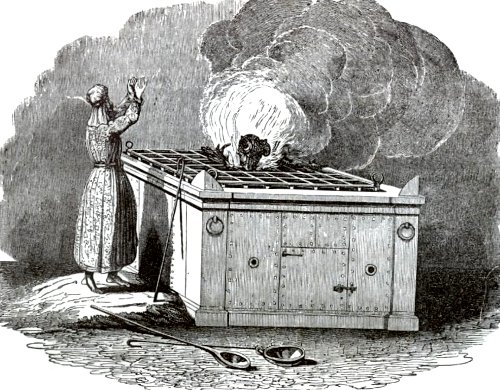
burnt-offering-altarHe shall then take off his vestments and put on other vestments, and carry the ashes outside the camp to a clean place.

Leviticus 6:4 (JPS Tanakh)

What lesson do we learn from the ceremonious taking out the ashes from the altar each morning?

Rabbi Samson Raphael Hirsch comments that the taking out of the ashes that remained on the altar from the previous day expresses the thought that with each new day, the Torah mission must be accomplished afresh, as if nothing had yet been accomplished. Every new day calls us to our mission with new devotion and sacrifice. The thought of what has already been accomplished can be the death of that which is still to be accomplished. Woe unto him who with smug self-complacency thinks he can rest on his laurels, on what he has already achieved, and who does not meet the task of every fresh day with full devotion as if it were the first day of his life’s work!

“Carry forth the ashes out of the camp.” Every trace of yesterday’s sacrifice is to be removed from the hearth on the Altar, so that the service of the new day can be started on completely fresh ground. Given these considerations, we can understand the law that prescribes the wearing of worn-out garments when one is occupied with the achievements of the previous day. The past is not to be forgotten. However, it is to be retired to the background, and is not to invest us with pride before the fresh task to which each new day calls us. (Rabbi Hirsch’s commentary)

-Rabbi Kalman Packouz
“Shabbat Shalom Weekly”
Commentary on Torah Portion Tzav
Aish.com

I have been accused of being a very simplistic, very lyrical player, and that’s okay. That just comes from the blues, which is my background. But every day you wake up and transcend. You can’t ever rest on your laurels.

Carlos Santana

I could probably find dozens of similar quotes to illustrate this single point. But it’s a difficult point. Rabbi Packouz uses this lesson to tell us that our past successes do not transfer into the present. No matter how well you’ve done in anything, even serving God, you are only as good as you are today. Serving God well yesterday and then not serving God today just means you’re not serving God. Your “laurels” are already wilting, so to speak.

Carlos Santana says that “every day you wake up and transcend.” The Rebbe, Rabbi M. M. Schneerson said this:

When you awake in the morning, learn something to inspire you and mediate upon it, then plunge forward full of light with which to illuminate the darkness.

Each day is a new opportunity to live, to serve God, to serve other people. Each day is a new opportunity to discover something new and exciting about yourself. It is why observant Jews recite the following blessing as their very first blessing to God, even before getting out of bed in the morning.

“I gratefully thank You, living and existing King
for restoring my soul to me with compassion.
Abundant is your faithfulness.”

But the sentiment works in another direction as well.

Success isn’t permanent and failure isn’t fatal.

-Mike Ditka
US football player and coach

failureI’ve noticed a good many people working in sales have that particular quote jotted on a sticky note or written on a white board in or around their work area. Success isn’t permanent. Rabbi Packouz and Carlos Santana both agree on that. But failure isn’t fatal, either. It only feels that way sometimes.

We were told to transcend limitations — but that doesn’t mean just jumping into the air with no idea of where you’re going to land!

-Rabbi Tzvi Freeman
Based on letters and talks of the Rebbe
Rabbi M. M. Schneerson
Said to one who fell into enormous debt trying to achieve miracles
Chabad.org

Adding all this up, you might say, success isn’t permanent, serve God today as well as yesterday. Failure isn’t fatal, but don’t do anything stupid that will likely result in you failing God.

And Jesus answered him, “It is said, ‘You shall not put the Lord your God to the test.’”

Luke 4:12 (ESV)

You may be eager to serve God but good intentions aside, eagerness is not enough. In fact misdirected, eagerness can get you in a lot of trouble. One horrible modern example is the “eagerness” of the Westboro Baptist Church which results only in demonstrations of bigotry and increasing the grief of the families of our fallen military personnel who gave their lives in the service of our nation.

Here’s another example of misguided eagerness and zealousness.

And there arose on that day a great persecution against the church in Jerusalem, and they were all scattered throughout the regions of Judea and Samaria, except the apostles. Devout men buried Stephen and made great lamentation over him. But Saul was ravaging the church, and entering house after house, he dragged off men and women and committed them to prison.

But Saul, still breathing threats and murder against the disciples of the Lord, went to the high priest and asked him for letters to the synagogues at Damascus, so that if he found any belonging to the Way, men or women, he might bring them bound to Jerusalem. Now as he went on his way, he approached Damascus, and suddenly a light from heaven shone around him. And falling to the ground he heard a voice saying to him, “Saul, Saul, why are you persecuting me?” And he said, “Who are you, Lord?” And he said, “I am Jesus, whom you are persecuting.

Acts 8:1-3, 9:1-5 (ESV)

Fortunately, Paul’s zealousness took a turn for the better, but he had to encounter the Master in a dramatic and startling way and be robbed of his sight before Paul could begin to see that he needed to travel in a different direction. Before that, he jumped into the air but didn’t realize where he was going to land.

Serving God is a partnership. It’s not just what you do and it’s not just what God does. We know we have a God who neither slumbers or sleeps (Psalm 121:4) and He is at work continually in the lives of human beings. But He requires that we work each day in His service, and that our work be considered and mindful, not random and reckless. This is why we not only read the Bible but study it. This is why we seek out fellowship with sober and mindful believers. This is why we pray for guidance and direction from the Holy Spirit. This is why we strive to do His will rather than our will.

“Father, if you are willing, remove this cup from me. Nevertheless, not my will, but yours, be done.”

Luke 22:42 (ESV)

Landron Paule_Histoire Sainte_Première Alliance_Droguet Ardant_Limoges 1991We don’t often think about the Master having a choice as to being crucified. It’s an uncomfortable thought that Jesus could have just said “no,” and escaped that night as he prayed in Gethsemane rather than surrender to God’s will and death.

But he had a choice. He could have said “no.” Instead, he said, “not my will, but yours, be done.”

Jesus had served God and human beings flawlessly for three years. He was without sin, so for his entire lifetime, we have to believe he never sinned. But it wasn’t about what he did yesterday. It was always about what he was going to do next with each coming dawn. So it should be with us.

Soon, Christians and believing Jews will mourn the loss of our Lamb and rejoice in the resurrection of our King. He teaches us that there are days when we dine on ashes, but then, the ashes of the offering are removed. Then it is time for us to rise from those ashes at dawn and to serve God anew. Some days we feel as if we have failed and have been burned out. But there is a new day coming, like the resurrection from the dead. If we fail to serve God today, it is as if we are still in the tomb. If we resolve to approach the service of the King as the dawning light of a new day, then we rise with him and in some small measure, share in his glory.

Remove the ashes of yesterday’s service for it is done. The sun has set and darkness is here. Then rise from the cold and dead ash and fly up like sparks into the flaming dawn. Today is bright and clear. It is life from the dead.

Good Shabbos.

Four Questions, Part 4

tallit_templeThis is a continuation on the topic I started discussing in Lancaster’s Galatians: Introduction, Audience, and What Happened to the Torah? and continued in Broad Strokes. I asked the first three of these four questions in Part 1, Part 2, and Part 3 of this series. Part 4 presents the fourth and final question. Hopefully, the answer will be illuminating.

Just a reminder, all quotes from scripture will be from the ESV Bible unless otherwise stated.

Belief in the coming of the Messiah has always been a fundamental part of both Judaism and Christianity. The Hebrew word for Messiah, Mashiach or Moshiach, means anointed, as does the Greek word, christos. Thus in Christianity, Christ is just another word for the Messiah. Much has been written about Jesus as the Messiah within the Christian realm, but little information has been publicized to the uninformed Jewish community concerning the coming of a Messiah, whom all we know about is that he will be a direct descendant of king David. Although Jesus has been proposed by Christianity to be such a descendant, Judaism does not accept Christ as their savior or king. Because the Messiah cannot be separated from God’s Third Temple and because God’s Third Temple is destined for all people…

“Coming of the Messiah”
ThirdTempleInfo.org

“For thus says the Lord: David shall never lack a man to sit on the throne of the house of Israel, and the Levitical priests shall never lack a man in my presence to offer burnt offerings, to burn grain offerings, and to make sacrifices forever.”

Jeremiah 33:17-18

I’ve written about the Messiah and the Third Temple before, but this is a slightly different approach because of the fourth and last question.

What is the Future of the Torah and the Temple?

Pastor Randy and I both agree that there will be another Temple built in Jerusalem, and if the Jewish understandings of the prophesies about Messiah are accurate, then we know that Messiah will build the Temple.

Here’s a brief refresher about the Messianic prophesies courtesy of Judaism 101:

The mashiach will bring about the political and spiritual redemption of the Jewish people by bringing us back to Israel and restoring Jerusalem (Isaiah 11:11-12; Jeremiah 23:8; 30:3; Hosea 3:4-5). He will establish a government in Israel that will be the center of all world government, both for Jews and gentiles (Isaiah 2:2-4; 11:10; 42:1). He will rebuild the Temple and re-establish its worship (Jeremiah 33:18). He will restore the religious court system of Israel and establish Jewish law as the law of the land (Jeremiah 33:15).

The idea of a Third Temple gets a bad rap from a lot of Christians because it begs the question about future sacrifices. If the sacrificial system only existed to point to Jesus and Jesus has come, gone, and will come again, why would Jesus, upon his return, build another Temple and (supposedly) restart the sacrificial system? Weren’t our sins already paid for once and for all by Christ’s death on the cross?

What makes you think that the only sacrifices made in the Temple were for sin? Also, what makes you think that only Jews made sacrifices in the Jerusalem Temple of the past or that Gentiles won’t make sacrifices in the Third Temple?

That Gentiles as well as Jews brought sacrifices to the Temple is implied in the prayer of Solomon when he dedicated the Temple (I Kings 8:41-3) and in the declaration by the prophet that the Temple will be a house of prayer for all peoples (Isaiah 56:7).

-Rabbi Louis Jacobs
“Sacrifice”
MyJewishLearning.com

Within the Books of the Prophets, we find that in the past, Gentiles were welcomed to the First and Second Temples, and that they will participate even more at the Third Temple.

In his commentary on the Torah section beginning with Gen. 12:1, Ramban (Nachmanides) wrote:

“Even in the time of Joshua, … the Gentiles knew that this place was the most august of all, that it was at the center of the inhabited world; and Tradition had taught them that it corresponds in this world to the celestial Temple where Divine Majesty, called (righteousness), resides.”

When the First Temple was inaugurated by King Solomon, he beseeched G-d with an eloquent prayer that included the following words (Kings I, 8:41-43) (which show that in the past, Gentiles were welcomed to the First and Second Temples, and that they will participate even more in the Third Temple):

“If a foreigner who is not of Your people Israel comes from a distant land for the sake of Your name – for they shall hear about Your great name and Your mighty hand and Your outstretched arm – when he comes to pray toward this House, oh, hear in Your heavenly abode and grant all [!] that the foreigner asks You for. Thus all the peoples of the earth will know Your name and revere You, as does Your people Israel; and they will recognize that Your name is attached to this House that I have built.”

Torah Law holds that Gentiles are allowed to bring burnt offerings to G-d in the Temple when it is standing in Jerusalem. There is a specific commandment to let us know that an animal (sheep, goat or bullock) offered in the Temple by a Gentile must be unblemished, to the same degree as the offering of a Jew. (Leviticus 22:25)

-from “Will Gentiles be permitted to worship at the Third Temple in Jerusalem?”
AskNoah.org

messiah-prayerI know I’m borrowing heavily from my previous blog post and you may be wondering why I just didn’t reblog it as the answer to this fourth question. But here’s the new thought.

If there indeed will be a Third Temple that Messiah will build and if part, most, or all of the sacrificial system will be reinstated, then what is the role of the Torah in Messianic Days?

Pastor Randy and I talk a lot about what the role of Torah was in the days before the destruction of Jerusalem in 70 CE and what the role of Torah is now. He believes, using Orthodox Jewish halachah as a guide, that the Torah is too difficult to keep and has always been too difficult to keep. I’m pretty sure I spelled a lot of that out in my blog post about my last conversation with him a week ago.

“For this commandment that I command you today is not too hard for you, neither is it far off. It is not in heaven, that you should say, ‘Who will ascend to heaven for us and bring it to us, that we may hear it and do it?’ Neither is it beyond the sea, that you should say, ‘Who will go over the sea for us and bring it to us, that we may hear it and do it?’ But the word is very near you. It is in your mouth and in your heart, so that you can do it.”

Deuteronomy 30:11-14

Doesn’t sound like Moses (or God) intended the Torah to be too difficult to obey or too hard to access.

Here’s another reason why the Torah has a future in the days of Messiah.

Then everyone who survives of all the nations that have come against Jerusalem shall go up year after year to worship the King, the Lord of hosts, and to keep the Feast of Booths. And if any of the families of the earth do not go up to Jerusalem to worship the King, the Lord of hosts, there will be no rain on them. And if the family of Egypt does not go up and present themselves, then on them there shall be no rain; there shall be the plague with which the Lord afflicts the nations that do not go up to keep the Feast of Booths. This shall be the punishment to Egypt and the punishment to all the nations that do not go up to keep the Feast of Booths.

Zechariah 14:16-19

I could draw from more scriptural quotes but chances are you know them all and they’re referenced above anyway. If a Third Temple will be built by Messiah, and if sacrifices and festivals that require sacrifices will be reinstated, and if Gentiles will not only be allowed to worship at the Temple and make sacrifices but in some cases, required to do so, then how will all that be possible if the Torah is not observed, at least as far as the Temple is concerned?

It seems clear that the Torah had a vital role in the existence of the Jews of ancient Israel and it will have a vital role in future, Messianic Israel. But what happens to Torah in the meantime? Does it just vanish temporarily from existence, put in cold storage until it’s needed, and then brought out, thawed out, and then be put back into service when Messiah starts his construction work?

Well, no. First of all, religious Jews observe the Torah every day. For that matter, Christians observe substantial portions of the Torah (ideally) every day. Every time a Christian performs any act of kindness in the name of Jesus, he or she is observing one of the mitzvot. They (we) just don’t call it that. Every time a Christian donates money, food, or some other good or service to the poor, they are observing a mitzvah (probably more than one). Every time a Christian comforts a person who is grief-stricken at the loss of a loved one, performs an act of kindness that assists the successful wedding of a bride, visits a sick person in the hospital, visits someone in jail, shovels snow off of a neighbor’s driveway and sidewalk unasked…they are performing Torah mitzvot.

The Torah is hardly obsolete. The Law isn’t dead. In fact, if Christians and Christianity are functioning properly, the Torah is alive and well and being performed in churches around the world and in the lives of Christians and their neighbors every day. The Torah is also alive and well and being performed in synagogues around the world and in the lives of Jews and their neighbors every day. No, not all Christians and not all Jews are doing what God expects of them (us), but some are. Not everything that some Christians think of as “the Word of God” and not everything that some Jews think of as “Torah” is really God’s Word and Torah.

Some Christians have some pretty funny ideas about how they’re supposed to judge people who don’t comply with their personal political and social agenda, and some Jews have some pretty funny ideas about how far to take all of the massive compilation of halachah that has become attached to Torah. I suspect when Messiah returns, he’s going to help us all out by teaching us what God’s expectations are really all about and what the Torah is supposed to mean as applied to Gentile Christians and as applied to Jews.

But be that as it may, the Torah has a past, a present, and a future. It has to, otherwise what even traditional Christians understand about the Bible doesn’t make sense, and many specific passages of scripture don’t make sense.

I have no idea exactly how we are to apply the Torah in the lives of Jews or Christians today except in a general, common sense way. As I’ve said numerous times before, based on Acts 15, Acts 21 and various other scriptures, I don’t believe that Gentile, God-fearing believers in Messiah are expected to observe the mitzvot in the manner of the Jews. I do believe we are to observe it as taught by Messiah, and what he taught focused on the acts of kindness and charity I mentioned above. I also believe that Jewish people, believers in Messiah Yeshua and otherwise, remain under all of the covenants that God made with Israel. The New Covenant extends the part of the Abrahamic covenant that allows the Messiah to bless the nations to the rest of us, providing salvation and relationship to God for the Gentiles who are called by Messiah’s name, and providing reaffirmation of all of the previous covenants to the Jewish people.

renewalWhat’s New about the New Covenant, as I was recently reminded, is that it will be written on our hearts. The actual content of the writing won’t change but how we will perceive it and live it out will be different. I say “will be” as opposed to “is” because if the “writing” were a done deal, we all would be leading very different lives, rising above sin, rising above the cares of the world, all “knowing God” in a way that currently escapes us.

Messiah opened the door and he holds all the keys, but he’s not done yet and until he is, the finger of God is still in motion, slowly inscribing “Torah” on the hearts of Christians and Jews everywhere.

But that Torah is and will be about the Temple, Sukkot, Pesach, Shavuot, and many more things most Christians don’t consider important anymore. That Torah will be a pure product, freed from our biases, our interpretations, our confusion, and our controversies.

But there was a Torah. There is a Torah. And there will be a Torah. Our current understanding is not very good, and like Paul said, we are seeing the Bible and the things of God as through a mirror dimly (1 Corinthians 13:12). We’re all still going to mess up a “free lunch” until Messiah returns. Until then, we still have to eat that lunch, so to speak, even if we do so poorly. At least we’re mindful of God and His will and His Word.

For truly, I say to you, until heaven and earth pass away, not an iota, not a dot, will pass from the Law until all is accomplished.

Matthew 5:18

Do we then overthrow the law by this faith? By no means! On the contrary, we uphold the law.

Romans 3:31

I hope you enjoyed going over these four questions with me. As you read this, it is Wednesday morning, and tonight, I’ll have another conversation with Pastor on Lancaster’s “Galatians” book. May I continue to be inspired and illuminated by my relationship with Pastor Randy and may God grant both of us the eyes to see and the ears to hear what our Master is teaching us all.

Addendum, March 21: My wife emailed me a link to Rabbi Shlomo Yaffe’s article The Dynamic of Sacrifices. Rabbi Yaffe tells a wonderful story about the meaning of the Olah offering, the fire from God, and how the sacrifices in the Third Temple, built by Messiah, will provide the means for a unity between all people.

“I will bring them to My holy mount, and I will cause them to rejoice in My house of prayer; their burnt offerings and their sacrifices shall be acceptable upon My altar, for My house shall be called a house of prayer for all peoples.”

Isaiah 56:7

Amen and may it come soon and in our days.