Category Archives: Uncategorized

Broken Religious Community: The Flip Side to Hope and Chanukah

I’ve outgrown the furrowed-browed warnings of a sky that is perpetually falling.
I’ve outgrown the snarling brimstone preaching that brokers in damnation.
I’ve outgrown the vile war rhetoric that continually demands an encroaching enemy.
I’ve outgrown the expectation that my faith is the sole property of a political party.
I’ve outgrown violent bigotry and xenophobia disguised as Biblical obedience.
I’ve outgrown God wrapped in a flag and soaked in rabid nationalism.
I’ve outgrown the incessant attacks on the Gay, Muslim, and Atheist communities.
I’ve outgrown theology as a hammer always looking for a nail.
I’ve outgrown the cramped, creaky, rusting box that God never belonged in anyway.

Most of all though, I’ve outgrown something that simply no longer feels like love, something I no longer see much of Jesus in.

John Pavlovitz
“My Emancipation From American Christianity”
John Pavlovitz: Stuff That Needs To Be Said

At today’s meeting of the Cincinnati City Council law and public safety committee, Council Member Chris Seelbach “will propose an ordinance that would impose a $200-a-day fine on a therapist or counselor practicing the therapy that aims to “change” lesbians, gay men, bisexuals or transgender people from their sexual orientation or gender identity,” according to Cincinnati.com.

According to the article it will likely be a done deal on Wednesday of this week. Seelbach is confident that he has the necessary votes both to make it out of committee tonight and to pass it as law on Wednesday. Although a few states have passed similar laws, no major city has done so, and Cincinnati.com is exultant in claiming that Cincinnati is leading the way in such wickedness.

Why “wickedness”? Because this law is nothing less than a denial of the biblical doctrine of sanctification, threatening fines of $73,000 per year to a counselor that uses 1 Corinthians 6:9-11 to help those caught in sin: “Or do you not know that the unrighteous will not inherit the kingdom of God? Do not be deceived; neither fornicators, nor idolaters, nor adulterers, nor effeminate, nor homosexuals, nor thieves, nor the covetous, nor drunkards, nor revilers, nor swindlers, will inherit the kingdom of God. Such were some of you; but you were washed, but you were sanctified, but you were justified in the name of the Lord Jesus Christ and in the Spirit of our God.” (1 Corinthians 6:9-11).

Joseph Bayly
“Providing biblical counsel to homosexual youth soon illegal in Cincy…”
(originally titled “Quoting Bible illegal in Cincinnati starting this Wednesday…”)
Christ Church
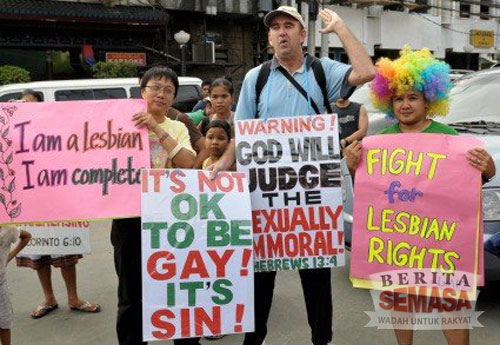
christians-vs-gaysThese two Pastors represent the opposite end of the scale along the single topic of homosexuality, specifically as applied to the presence of representatives of the LGBTQ community in the Church.

I’ve written my opinions about Pastor Pavlovitz before, particularly about the absence of the requirement of repentance, which was Jesus’s (Rav Yeshua’s) central message, relative to what he has “outgrown,” so I won’t belabor my points regarding his opinions.

As far as Pastor Bayly is concerned, he wildly misrepresents the pending law he objects to so strongly. You can click on the link to his blog post (and in my quoting him, I included a link to his source material so you can acquire further context) to see the specifics, but in short, The City of Cincinnati has proposed a law that would make it a crime for mental health professionals (religious or otherwise) to provide conversion therapy, also called “reparative therapy” or any other therapeutic model designed to change a person’s sexual orientation or gender identity, to anyone under the age of 18 (it would not be illegal to offer such therapy to adults).

Pastor Bayly states that the law specifically forbids Christian counselors from quoting the Bible, as if that’s the law’s main thrust. However, according to the news article he’s citing:

Passage apparently would make Cincinnati the first major U.S. city to ban reparative or conversion therapy. The Movement Advancement Project, an LGBT organization in Denver that tracks legislation nationwide on reparative therapy, has no record of a city passing an ordinance that would ban the practice.

And the reason Cincinnati is making such a move is because:

Nearly a year after the death by suicide of local transgender teenager Leelah Alcorn, Cincinnati again stands to become a national leader in LGBT rights, with debate scheduled Monday on a measure that would ban reparative or conversion therapy for LGBT youth.

The law, as far as I can tell, does not make it illegal to offer conversion therapy to anyone age 18 or older and does not, in general, make it illegal for Christian counselors to quote from the Bible. If it passes, it would make it illegal to offer or apply conversion therapy to anyone under the age of 18 (and presumably identifying as part of the LGBTQ community). Also as far as I can tell, there are already ethical standards in place in the various psychiatric, psychological, social work, and counseling bodies that provide state licensing for mental health professionals designed to inhibit or forbid the use of conversion therapy, so in addition to professional censure for unethical behavior (including possible lose of licensing), a therapist can also be fined by the city for violating the proposed law.

conversion therapy
Photo: soc.ucsb.edu

I’m not writing all this to complain about what Cincinnati is proposing, about the matter of the use or lack of use of conversion therapy, or to support or oppose the LGBTQ community. I’m writing this because both Pastor Pavlovitz and Pastor Bayly, from my point of view, seem to be paying more attention to their personal priorities than they are to the issues at hand, and particularly, the teaching of our Rav.

I’ve already mentioned that I’ve commented at length regarding Pastor Pavlovitz. And in response to my comment to Pastor Bayly on his blog, he stated:

“Except that, again, it has nothing to do with quoting the Bible or scripture. It has everything to do with the use of a particular type of psychotherapy”

Wrong. I changed the title, but you are just wrong about what the law says. It doesn’t limit it to a particular type of psychotherapy. Here is the applicable text from the law, which I finally have:

““Conversion therapy” means any treatment that aims to change sexual orientation from homosexual to heterosexual or to convert an individual who identifies with a gender other than the gender assigned at birth to the originally assigned gender.”

So tell me again, would a counselor be able to quote that verse?

He’s focusing on using Bible quotes during the course of conversion therapy with minors rather than on the fact that if the law passes, he wouldn’t be able to legally offer such a therapeutic model to minor children in the first place. He changed the original title of his blog post since I had pointed out it was misleading (and I wasn’t the only one), but he didn’t seem to “get it”. He can provide multiple counseling techniques to treat a wide variety of emotional and mental disorders. He can even quote the Bible in doing so. He can even offer conversion therapy. He just can’t offer it to minors.

A commentator on Bayly’s blog post had this to say to me:

Well James, I guess you seem to think that a Christian is to follow every law that is contrary to the written Word of God. I guess Peter and John thought differently and spent time in jail telling the “law makers” that they would obey God rather then man.

Actually, depending on how you interpret the Apostle Paul (Rav Shaul), maybe we should obey civil law:

Every person is to be in subjection to the governing authorities. For there is no authority except from God, and those which exist are established by God. Therefore whoever resists authority has opposed the ordinance of God; and they who have opposed will receive condemnation upon themselves.

Romans 13:1-2 (NASB)

justiceI know that New Testament scholar Mark Nanos interprets this passage as specifically directing non-Jewish believers in synagogues to obey the authority of the synagogue leaders, but more widely, the passage is understood as a directive for believers to be compliant with the laws of the nations in which we live.

Of course, this is problematic under specific circumstances. Consider those Christians who concealed Jews from their Nazi executioners during the Holocaust. The matter of obeying or disobeying civil and penal codes is certainly complex, though I don’t think it gives us license to break any law we feel like just because.

However, the person I quoted above was comparing apples and oranges.

When they had brought them, they stood them before the Council. The high priest questioned them, saying, “We gave you strict orders not to continue teaching in this name, and yet, you have filled Jerusalem with your teaching and intend to bring this man’s blood upon us.” But Peter and the apostles answered, “We must obey God rather than men.”

Acts 5:27-29

Peter wasn’t flaunting civil law in a diaspora nation or rebelling against the Roman Empire, he was engaging in a disagreement on whether or not to accept the revelation of the coming of Messiah in Rav Yeshua with Jewish religious authorities in Jerusalem. Further, the priesthood was compromised in those days and not truly representative, in many cases, of the authority of Hashem. He wasn’t issuing a blanket statement that gives modern Christians the right to disobey any law if we believe it violates the imperatives of our faith. Christian counselors can’t simply kidnap teenage gay people and compel them to admit their sin of homosexual sex, then repent, receive forgiveness, and live happily ever after.

I know that Pastor Bayly and his supporters feel their rights are being trod upon by this particular law, and that they are being inhibited from following Biblical instructions, specifically those issued in 1 Corinthians 6:9-11, however, when he misrepresents the nature of his objections, as he did with the original blog title as well as in parts of his content, and then continues to support that misrepresentation when it is pointed out to him, he not only damages the credibility of Christians and their/our faith to the general public, he desecrates the Name of Hashem (my opinion, of course).

Adding all this up, both Pastor Pavlovitz and Pastor Bayly, who together represent a large number if not the vast majority of churches in America, drive me nuts. This is largely the reason that I stopped attending a local church and have no interest in formal Christian community (I do have other reasons, though).

But it doesn’t stop there:

For this, he is subject to a very harsh bio in the Jewish Telegraph Agency, as if Thalasinos himself were the murderer, rather than the victim. The post attracted a host of hostile comments from Orthodox Jews against the very concept of a Messianic Jew, trying to argue we are all fraudsters. Meanwhile, Jewish-born Messianic Jews are pointing out that Thalasinos wasn’t born Jewish. Anti-missionary Bat Zion Susskind-Sacks wants to assure us that Thalasinos himself never claimed to be Jewish, and never claimed to convert.

-Dudi
“Let Nicholas Thalasinos’ family mourn in peace”
Rosh Pina Project

thalasinos
Photo: L.A. Times

A Chabad Rabbi states in the comments section of the Jewish Telegraph Agency (JTA) article:

So JTA is now faling for the missionary line? messianic Jew is a cover for “Christians trying to convert Jews to Christianity”. I have nobeef with christians, but if you believe in Jesus, you are a Christian, not a “Messianic Jew”. The fact that Jesus was Jewish is meaningless, so was Karl Marx and Meyer Lansky, and it does not bestow truth on their persona.

Further, some Jewish commentators on this blog post also spend a great deal of time lambasting Thalasinos for his faith and how he chose to express it.

For the record, I probably wouldn’t have agreed with at least some of Thalasinos’s beliefs, but the point is moot. The man is dead. He was murdered in a terrorist attack that took the lives of 14 people. As the folks over at the Rosh Pina Project state, let his family grieve in peace. How does it further the mission of God for human beings to repair our broken world by continuing, in our own various ways, to break it further?

Do you see why I have a problem with religious people, and why I have, for the most part, lost my faith in them?

If you happen to attend a church, synagogue, or other religious community that is filled with loving, caring people, and your Pastor or Rabbi isn’t crazy or misguided or fueled by his/her personal agenda disguised as “sound doctrine,” then I’m happy for you. But it makes my skin crawl to imagine myself sitting in a pew in either Pastor Pavlovitz’s and Pastor Bayly’s church, or for that matter, being a Gentile in that particular Chabad Rabbi’s synagogue, and being judged because I don’t conform to their particular interpretation of the intent and purpose God has for human beings, both Jews and non-Jews.

Which is why I would never enter those churches and why I’ve accepted I have no place in Jewish community either.

My wife and daughter attended the local Chabad Chanukah menorah lighting at the statehouse last night. My wife and daughter are Jewish and I’m glad they went. They’re Jewish. They need to be in Jewish community. I wasn’t invited, which is fine, even though I’m sure there were a lot of non-Jews present for the event (this is Idaho…there are only about 1,500 Jews in the entire state). There are just some places I don’t belong.

After they got home and lit our own little hanukkiyah (both of them, actually), I found myself staring at my computer monitor and pondering all of this. I have a lot of reasons for not being part of religious community, and I’ve written about them at length in various blog posts, but now I have another reason. A lot of religious communities and their leaders are either plain nuts, disingenuous, misguided, or have some sort of ax to grind, usually from the pulpit and/or in the blogosphere.

Granted, there is no such thing as a perfect congregation where everyone loves each other and even the disenfranchised outliers such as myself are tolerated if not accepted and given a voice. I know that.

abandoned churchBut it’s not a matter of religious community just being imperfect. A lot of them can be downright arrogant and even hostile given the provocation.

I used to think I could go to church and even be a small part of healing the rift between current Christian doctrine on things like Judaism and the Torah and how I understand God’s plan of redemption for Israel, even though I was afraid of church at the same time.

I was wrong.

I suppose it’s mainly my problem, since the churches and other institutions I’ve mentioned don’t seem to have a problem with themselves. I’ll never be a good Christian if it means espousing specific moral, social, and political viewpoints.

Many/most religious communities aren’t just imperfect, they’re broken. I only hope Messiah comes back in time to heal at least some of us.

End rant.

Our Hope This Chanukah: “I Got You”

As bullets rained down during the San Bernardino shooting rampage, Shannon Johnson, 45, wrapped his left arm around 27-year-old Denise Peraza and held her close.

“I got you,” Johnson told her.

Peraza was shot once in the back and survived.

Johnson died.

Peraza, who is recovering from her injuries, shared her story of survival Saturday with reporters to honor Johnson.

-Sarah Parvini and Cindy Carcamo
“‘I got you’ are man’s last words to co-worker as bullets fly in San Bernardino rampage”
The Los Angeles Times

Johnson and Peraza
Photo: L.A. Times: Shannon Johnson, 45, left, and Denise Peraza, 27, right.

I suppose a lot of you reading this have heard the story, either in the news or through social media. Shannon Johnson’s photo has been all over Facebook and probably twitter and other media outlets as well. It should be.

I know that in a week, everyone will forget about Mr. Johnson, about Denise Peraza, the young woman whose life he saved, and (tragically) even about the terrorist massacre which took the lives 14 innocent people.

That’s human nature in the digital age. Our attention and even our compassion in fleeting. Once the event has passed, we crave another thrill served up for us by CNN or MSNBC.

More’s the pity.

But what’s worse than forgetting the victims is vilifying them. You can click the link to see the details. This man’s life and the fact that he wasn’t Jewish (although the news media misidentified him as such) has brought all of the Internet trolls out in force, including people I have known (via the web) personally. People who are otherwise decent human beings who find it necessary to desecrate the dead.

And on top of all that, the so-called press, if you can imagine a person like Linda Stasi qualifying as an “unbiased” reporter, are playing the blame the victim game from a different direction.

Every time someone says it was the victim’s fault he/she was shot, killed, raped, maimed because of their politics, their religion, their gender, or anything else, when they were, by definition, not the aggressor but the target of aggression, not only do we excuse the person or people or groups who/that were actually responsible for the attack, relieving them of any blame for their actions, we reveal ourselves to be, at best, morally and ethically confused, and at worst, cowards.

HopeThis is a season of hope, or it’s supposed to be. Chanukah is a reminder that even in the face of overwhelming odds, God will help His people not only survive, but prevail against armies and evil.

Another such “morally confused” individual who also happens to “report” on television news media has expressed concern that Americans pray to an anti-Muslim God. I’ll let you readers decide how you want to interpret that sentiment, but I don’t think it’s wrong to pray, not only for mercy, but for justice. God can decide what is just, and it shouldn’t be too hard for those of us who have been studying the Bible for a while to have some idea of what Hashem considers just in the affairs of the human race.

I could go on and on quoting people I find enormously misguided and yet who much of the public seems to hang by their every word, but I came to give hope, not despair.

More than that, I came to talk about how all of us can give hope, using Chanukah as our basic template, whether we’re Jewish or not (and I’m not).

Sara Debbie Gutfreund wrote a small article for Aish called 8 Ways to Turn Darkness into Light. I’m sure we have been staring into the darkness a great deal lately. There is much darkness in the world.

Whoever fights monsters should see to it that in the process he does not become a monster. And if you gaze long enough into an abyss, the abyss will gaze back into you.

-Friedrich Nietzsche

Often, we respond to tragedy and despair with anger and outrage, and while this is perfectly understandable, it’s not always helpful.

Ms. Gutfreund’s list of eight items are:

  • Practice kindness
  • Reframe your goals
  • Living “as if”
  • Thinking creatively
  • Look through a spiritual lens
  • Embrace change
  • Connect to God
  • Love challenge

You can read her article to get the specifics, but it comes down to you and me having a personal responsibility to be the light that illuminates the darkness, to be a beacon of hope sweeping away heartache and grief.

lampThis is the same message Rabbi Benjamin Blech was explaining and why Chanukah is so important.

Not only that, our Rav taught his disciples something similar:

“No one, after lighting a lamp, puts it away in a cellar nor under a basket, but on the lampstand, so that those who enter may see the light. The eye is the lamp of your body; when your eye is clear, your whole body also is full of light; but when it is bad, your body also is full of darkness. Then watch out that the light in you is not darkness. If therefore your whole body is full of light, with no dark part in it, it will be wholly illumined, as when the lamp illumines you with its rays.”

Luke 11:33-36 (NASB)

We have a very simple choice before us…simple to understand, but not always simple to perform. We have to choose if we want to be light or darkness. Which do you want to be and moreover, which one are you, based on your words (spoken and printed) and actions (the latter being more relevant than just what you want)?

Of course, often the people who embrace darkness imagine that they are actually representatives of the light. They’re sincere about it, too. No amount of talking, convincing, or arguing will change their minds or let them see themselves as the darkness desperately in need of light.

If some of them come along (and they have visited me here before), I know I won’t be able to convince them. Hopefully, they will show themselves wise and just hold their tongues (fingertips in the case of keyboarding).

Better to remain silent and be thought a fool than to speak out and remove all doubt.

-Abraham Lincoln

Even a fool, when he keeps silent, is considered wise; When he closes his lips, he is considered prudent.

Proverbs 17:28 (NASB)

Maybe that makes me a fool for even writing all this.

Johnson was identified as “a Christian who…dabbled in Hinduism,” whatever that might mean to you who are reading this.

But this is who he was to the woman he saved, Denise Peraza:

“This amazing, selfless man who always brought a smile to everyone’s face in the office … this is Shannon Johnson, who will be deeply missed by all … my friend, my hero.”

I’ve referenced a few people who represent the darkness but I won’t name the main participants, the terrorists. They’ve received enough recognition and I won’t give them more.

Alone in silenceIf I do want to preserve a single memory of this horrible event, I want it to be of Shannon Johnson who, while probably not a perfect person, and maybe you’d disagree with is religion or something else about his life, spent the last few moments of his life being the light. He wrapped his arms about Peraza and said, “I got you.”

These were his last words before his life but not his light went out of this world.

If he was and is a light, if, as disciples of our Rav, we also are to be lights, and if our Rav is a light, He is also the Light Who made it possible for one day’s supply of oil to burn for eight, purifying the defiled, returning the Holy Temple in Jerusalem to Hashem’s service.

It’s as if He said to the aged priest Matisyahu and his five sons, “I got you.”

Is it such a leap to believe, that when our own light is being threatened by the darkness, it can be reignited by those same words spoken to us?

When we cry, when our hearts are crushed, when we are overwhelmed by this nightmarish world, by overt evil that shoots a gun, and covert evil that kills with words, God whispers to each one of us out of the darkness, “I got you.”

Let your flame illuminate the abyss, banish the demons, and declare righteousness and justice for the oppressed and the grieving.

“Blessed are the poor in spirit, for theirs is the kingdom of heaven.

“Blessed are those who mourn, for they shall be comforted.

“Blessed are the gentle, for they shall inherit the earth.

“Blessed are those who hunger and thirst for righteousness, for they shall be satisfied.

“Blessed are the merciful, for they shall receive mercy.

“Blessed are the pure in heart, for they shall see God.

“Blessed are the peacemakers, for they shall be called sons of God.

“Blessed are those who have been persecuted for the sake of righteousness, for theirs is the kingdom of heaven.

light“Blessed are you when people insult you and persecute you, and falsely say all kinds of evil against you because of Me. Rejoice and be glad, for your reward in heaven is great; for in the same way they persecuted the prophets who were before you.”

Matthew 5:3-12 (NASB)

“When you awake in the morning, learn something to inspire you and mediate upon it, then plunge forward full of light with which to illuminate the darkness.”

-Rabbi Tzvi Freeman

Living With God Everyday

What we are talking about here is developing Messianic Jewish Household Spirituality. At Intefaithfulness we are doing this through an initiative called HaB’er (“The Well”). As resources of time, finances, and personnel allow, we will be providing materials, instruction and encouragement to Jewish and Intermarried households who recognize the priority of developing “The Three-Stranded Cord” of ever-deepening engagement with Jewish life, Yeshua-faith, and with God’s Presence. Our mission statement is “Living well at home in Jewish life with the Messiah.”

-Rabbi Stuart Dauermann
“Toward a New Solution to Current Problems in the Messianic Jewish Religious World”
Interfaithfulness.org

In Christianity, the main location for worship and prayer is the Church. In Judaism, it’s the home. Rabbi Dauermann points out in his article that, for Yeshua-believing Jews, whether they are in the Church or in the Messianic Jewish synagogue, they were “shaped” by American evangelicalism and thus, tend to be institution-oriented rather than home-oriented as are other religious Jews.

I’m not writing to comment on Jewish religious praxis, whether in the Messianic arena or otherwise. I’m here to write about the rest of us.

Actually, I can’t count myself as one of the Gentiles I want to discuss since, for a lot of reasons, the “practice” of my faith in the home is affected by the presence of my Jewish wife and children, none of whom are “Messianic”.

But I think the points Rabbi Dauermann brings up about the Messianic Jewish movement could be adapted to Jesus-following non-Jews, whether we call ourselves Christians, believers, “Messianic Gentiles,” or anything else.

churchFor a lot of us, our faith consists of going to church on Sunday, which includes the worship service, the sermon, and Sunday school. Then, if we’re really ambitious, there are programs, usually offered on Wednesday evening, in which we can participate.

But what about the rest of the time? What about our day-to-day lives?

In this, I think particularly an Orthodox or perhaps Conservative Jew might have an advantage.

Oh, Christians wouldn’t consider it such. I recall being in a Sunday school class a few years ago and hearing the teacher remark how we are so fortunate not to be “under the law” anymore (not that we ever were), and having been freed by the grace of Jesus Christ.

But free to do what? Play a few holes of golf after leaving church services and going out to lunch? How many Christians even say grace before eating if they’re in a public place?

Jewish practice may seem cumbersome to many non-Jews, but it has the advantage of continually reminding the Jewish person that God is always present. If you wear a kippah in acknowledgement of God being above you, your awareness is a persistent as your apparel.

Add to this all of the blessings to be said on a wide variety of occasions. If you were raised in an observant Jewish home, you started learning this practice in childhood, but for a Jew who was raised secular and became religious as an adult, there is probably something of a learning curve. Nevertheless, the message seems to be that a Jew is always obligated to acknowledge God in everything.

An observant Jewish life doesn’t occur just on certain days of the week or only between the hours of such and thus, it occurs from the moment you wake up until you go to bed at night.

Modeh AniAbout the only thing I’ve allowed myself to carry over from my past is reciting the Modeh Ani (in English) when I discover I’m awake in the morning and about to get out of bed. It’s a basic confirmation that I owe each day of my life to God.

The day-to-day religious practice of a Christian or otherwise religious non-Jew is not well-defined. We don’t have the rich history of tradition of the Jewish people to draw upon. Sure, some non-Jews have chosen to adapt bits and pieces of those traditions in their lives, but we don’t share Jewish history and, in most cases, Jewish community, so it seems at least a bit out-of-place.

I should say at this point that I’ve met Christians who have fully-realized and completely integrated lives of faith. Every thought and action is directed to the service of Christ and to people around them. However, I wouldn’t consider this a very common practice, more’s the pity.

But returning to practical praxis, among the very first non-Jewish Yeshua-followers who had learned from Jewish mentors, such as the Apostle Paul, their day-by-day behavior probably looked pretty “Jewish,” since it was the only model they had available, but nearly twenty centuries have passed and that connection has long since been lost.

Some congregations and other collections of Jews and Gentiles who are devoted to Yeshua as Messiah are attempting to reinvent that relationship, but it’s pretty inconsistent. I think I recently mentioned how fragmented the body of Messiah happens to be, and I don’t see it becoming any more unified in the near future.

But regardless of our religious orientation and our access to community of any kind, we still, as individuals, have a responsibility to not only maintain our awareness of the God above our heads day-by-day, hour-by-hour, but to act out of that awareness. For the non-Jewish believer, as I’ve already said, there isn’t a well-defined set of behaviors and traditions for us to draw upon. Nevertheless, we can do something. We just need to be more deliberate and maybe more creative about it.

followIf we are walking in the dust of the footsteps of our Rav, so to speak, what should we do?

“Then the King will say to those on His right, ‘Come, you who are blessed of My Father, inherit the kingdom prepared for you from the foundation of the world. For I was hungry, and you gave Me something to eat; I was thirsty, and you gave Me something to drink; I was a stranger, and you invited Me in; naked, and you clothed Me; I was sick, and you visited Me; I was in prison, and you came to Me.’ Then the righteous will answer Him, ‘Lord, when did we see You hungry, and feed You, or thirsty, and give You something to drink? And when did we see You a stranger, and invite You in, or naked, and clothe You? When did we see You sick, or in prison, and come to You?’ The King will answer and say to them, ‘Truly I say to you, to the extent that you did it to one of these brothers of Mine, even the least of them, you did it to Me.’”

Matthew 25:34-40 (NASB)

Do kindness everyday. No, you don’t have to save the world every hour on the hour, but you can take advantage of your opportunities, even in very tiny ways. Pick up a bit of litter and throw it in the trash. Hold the door open for someone. At this time of year, there are plenty of people ringing bells in front of stores taking in donations. Drop your loose change into the bucket. The next time someone cuts you off in traffic, instead of getting mad at them or competing with them on the road, let them have their way. Maybe they have a really good reason for being in a hurry.

A few days ago, I came across a news story about a homeless Jesus statue that is being erected in numerous communities. The concept and application are controversial, and while I agree that $40,000 per statue could be better spent actually sheltering the homeless, feeding them, and clothing them, the symbolism invoked, for me, the quote from Matthew 25.

homeless Jesus
Photo: Kelly Wilkinson / The Star

Jesus is already homeless, and poor, and hungry, and needy. He is because we have homeless, poor, hungry, and needy people in our communities. If we wish to serve our Rav and to “do what Jesus would do,” then the Bible makes it abundantly clear how to respond.

But what about this?

If the world of Messianic Jewish believers is to be established, sustained, renewed and passed on from generation to generation, the efforts of religious school, seminary and congregation will fail unless we begin at the center: the home. It is for this reason that Jewish religious discourse terms the home a Mikdash M’at, a little holy sanctuary. This is the center. This is the microcosm from which blessing proceeds to the macrocosm of life, and socially, this is the seed from which the Kingdom of God will grow in the Messianic Jewish context, or not. Similarly, we find in Scripture that it is at the center, the Holy of Holies, where holiness is most concentrated and from which it radiates out into the community of the people of God and to the wider world. Think of the design of the tabernacle in the wilderness and each of the First and Second Temples, each termed a “Beit Mikdash.” In Jewish life the home, the mikdash m’at, is the Holy of Holies from which spiritual identity and vitality radiates out into the world and daily life. Apart from this center, all is empty religious noise and clamor, gongs and cymbals, and too often, as we will admit if we are honest, smoke and mirrors.

This is how Rabbi Dauermann ended his essay, with a plea to re-establish Messianic Jewish homes as Jewish homes, making them the “Holy of Holies.”

I’m not sure how this is done in non-Jewish homes. I’ve known a few Christians who make a little “altar” in their homes, putting a cross, a Bible, and other religious objects on a table to be the center of family prayer.

I’m not particularly keen on building “altars,” but the idea of family prayer and family Bible study time seems to be a good start.

Moon and StarsI don’t have any practical suggestions beyond what I just mentioned, and as I’ve already said, this isn’t an option for me personally, but if somehow it were possible to treat our own homes as sacred places, to realize that God dwells among us as we eat dinner, watch TV, help our kids with their homework, read our Bibles, read anything else, surf the web, answer text messages, then maybe, just maybe we’d act differently in our own homes…and everyplace else.

A little bit of light pushes away a lot of darkness.

-Jewish proverb

The Illusion of the Unified Body of Messiah

In the article, I tackled the now-familiar “trajectories” model of early Christian developments proposed influentially by James Robinson and Helmut Koester, showing examples of how it has involved dubious results. The trajectories model does reflect the sense of diversity in early Christianity, but I contend that it is inadequate as a model in allowing for the complexity of that diversity. For it seems to me that all our evidence points to a rich and vibrant interaction of the various early Christian groups.

Sometimes this was of a hostile nature, as in the well-known conflict of Paul and certain other Jewish Christians whom Paul refers to as “false brothers,” and even agents of Satan. Sometimes, however, perhaps more typically, this interaction was of a more positive nature, as reflected in the appropriation of “Q material” in the Gospels of Matthew and Luke, or the implicit affirmation of Peter in John 21.

-Dr. Larry Hurtado
discussing the presentation of his paper,
Interactive Diversity: A Proposed Model of Christian Origins,” Journal of Theological Studies 64 (2013): 445-62
on his blog post “Interactive Diversity SBL Session”
Larry Hurtado’s Blog

I suppose it would be naive to consider that there was a single, uniform expression of Christianity in the mid-to-late first century CE. As Dr. Hurtado points out, both on this blog and in his paper, there are multiple different theories to describe these varying expressions including the “trajectories model.”

However, in his paper, Dr. Hurtado suggests a different viewpoint he calls “Interactive-Diversity”.

As early as the Jerusalem church, there was linguistic diversity, as likely reflected in the Acts depiction of ‘Hebrews’ and ‘Hellenists,’ terms which probably designate respectively those Jews in the Jerusalem church whose first language was Aramaic and those whose first/primary language was Greek. Also, Paul’s deployment of the little ‘Marana tha’ formula in 1 Corinthians 16:22 is commonly taken as reflecting his acquaintance with Aramaic-speaking circles of Jewish believers, as distinguished from the Greek-speaking (gentile) congregations to whom he wrote.

I should note that regardless of believers being Jewish or Gentile, Dr. Hurtado refers to them as Christians.

In this first example, the diversity is linguistic and between Greek speaking and Aramaoic speaking Jewish disciples of Rav Yeshua (Jesus), as well as distinguishing them from the Greek speaking Gentiles.

However…

Moreover, remarkably early there was also a trans-local diversity. In Acts we have reports of the young Christian movement quickly spreading from Jerusalem and other sites in Jewish Palestine, to Damascus, Antioch and Samaria, and through the activities of Paul and others (often anonymous) spreading through various locations in Asia Minor, Greece, Rome and elsewhere. Though the historicity of some features of
Acts has been challenged, it is commonly accepted that there was an early and rapid trans-local spread of the young Christian movement to locations such as these. It is to
be expected that this remarkably rapid spread of the Christian movement would have been accompanied by diversity, Christian circles taking on something of the character of
the various locales, and also the varying ethnic groups and social classes from which converts came.

Larry Hurtado
Larry Hurtado

There was, as we might expect, also diversity among the Gentiles based on “trans-local diversity,” or distinctions of geography, nationality, ethnicity, and custom.

All this seems to suggest that there were different interpretive traditions of not only the Jewish scriptures (remember, at this time there was no such thing as the “New Testament”) but how these differing groups understood the letters of Paul as well.

The different attitudes toward ‘food sacrificed to idols’ (8:1-13) comprised another potentially serious difference in Corinth that may well have reflected different social groups. Likewise, Paul’s exhortations in Romans 14:1—15:6 are widely thought to address differences that likely reflect a diversity of a social or ethnic nature.

But along with the evident diversity, a well-attested ‘networking’ was another feature of early Christianity. This involved various activities, among them the sending
and exchange of texts, believers travelling for trans-local promotion of their views (as, e.g., the ‘men from James’ in Gal 2:11, or Apollos’ travels to Corinth in 1 Cor 1:12; 3:5-
9; 16:12), representatives sent for conferral with believers elsewhere (as depicted, e.g., Acts 15:1-35), or sent to express solidarity with other circles of believers (as, e.g., those accompanying the Jerusalem offering in 1 Cor 16:3-4).

For that matter, Paul wasn’t the only one establishing “churches” in the diaspora. There were others, most or all of whom were anonymous, who were also “planting” faith communities and apparently establishing differences in teaching and praxis.

However, it wasn’t because these communities were isolated from each other geographically that allowed the rise of diversity. In fact, according to Hurtado’s paper, they were quite interactive, sometimes uncomfortably so.

On the other hand, there are also indications of far more adversarial interactions as well, and at a very early date. Paul’s letter to the Galatians will serve to illustrate this. Exegetes are agreed that this epistle reflects Paul’s exasperation over unidentified other Christians (probably Jewish) who have visited the Galatian churches calling into question the adequacy of Paul’s gospel and urging his gentile converts to complete their conversion by circumcision and a commitment to Torah-observance. Paul represents these people as proclaiming ‘a different gospel . . . confusing you and seeking to pervert the gospel of Christ’ (Gal 1:6-7), and he thunders an anathema on anyone who proclaims a gospel contrary to that which he preached (1:9).

And…

This is rather clearly an example of early Christian diversity of a more hostile variety! But it is also indication of the interaction that I emphasize here, with non-Pauline teachers visiting Corinth (with intent!) and Paul reacting with an uncompromising vigour.

It can result in some exchange and adaptation or in a hardening of previous positions. But my point is that early Christian diversity was often (even typically?) of a highly interactive nature.

Apostle Paul preachingDoesn’t sound terrifically different than how different Christian denominations “get along” in the 21st century CE.

You can read the full 16 page document as a PDF to get all of Dr. Hurtado’s message on this topic. My point in bringing all this out on my own blog is somewhat similar to what I pointed out in one of my reviews of the Nanos and Zetterholm volume Paul within Judaism: Restoring the First-Century Context to the Apostle.

Various articles within “Paul within Judaism” put forth the idea that Jews and Gentiles “in Christ” not only did not share a single, uniform identity and role within the faith, but that the identity and role of the Gentile within the first century Jewish movement of “the Way,” was ill defined and incomplete.

Paul and others may not have thought this was a problem if they believed that the Messiah’s return was imminent. If Messiah was coming back in a year or two, or a decade or two, he would straighten things out as he completed establishing his Kingdom.

That may also be one way to view the diversity between various diaspora congregations and their differences in interpretation, doctrine, and praxis. While it’s compelling to imagine that in the beginning of the Yeshua movement within Judaism, and as it was being exported to the diaspora Gentiles, the conditions operating within the overall movement and trickling down to specific “churches” were uniform, representing a single, complete unity, perspectives such as “Interactive-Diversity” paint a much different portrait.

What we think of may never have been unified, at least not since Rav Yeshua lead his small inner circle of apostles and disciples through the Galilee or taught from Solomon’s Portico at the Holy Temple in Jerusalem. His teachings wouldn’t be documented and widely disseminated for decades, and even then, they would likely have been interpreted differently by the numerous congregations and house fellowships of Jews and Gentiles in both Israel and the diaspora nations.

I remember during my early days in the Hebrew Roots movement (some fifteen years ago or more) I thought what I was experiencing in my local, little “One Law” group was something akin to what the Gentiles experienced in their congregations in the days of Paul.

I was really inexperienced and unstudied.

I’m not exactly a genius now, but as time has passed and I’ve accessed a wider variety of information sources, I’ve come to realize that we aren’t particularly certain of what was normative practice for Gentiles in Messiah while Paul was on his journeys and writing his letters. Here we see that there probably was no one normative practice, but that not only were the teachings and praxis of the different groups of Gentiles highly variable and even competitive, but that their very identities and roles as disciples of our Rav were probably indistinct and variable as well.

Granted, I’m drawing a great deal out of a few small examples, but it does possibly mean we do have one thing in common with the earliest non-Jewish followers of Yeshua. Our variability or interpretation and practice and even the competition and (sometimes) hostility between differing factions within both the Hebrew Roots and Messianic Jewish movements is normal.

Like Paul, we too may have to wait until Messiah comes so he can sort everything out.

Christian CoffeeAlmost a week ago, I had coffee with a friend, and we were discussing this topic. He believes that as the time of Messiah’s return draws near, the variability between all the denominations of Christianity, let alone those of us who, at least in name, don’t call ourselves “Christians” (well, we do and don’t…long story), will begin to erode and a clearer vision and more stable platform will emerge for Messiah’s disciples.

I disagree.

In fact, I think the opposite will happen. I think we’ll all become increasingly fragmented and confused. Sure, there will be a remnant that will maintain a stable perception of God, Messiah, Israel, and the Bible consistent with God’s redemptive plan for His Jewish nation, and through them, the people of the nations, but a lot of “nutsiness” will emerge and thrive as well.

I even think there will be scores of churches that will reject the resurrected Messiah and ascended King because he’s too Jewish, because he rebuilds the Temple in Jerusalem, because he rules from Jerusalem instead of Heaven, and because the “raptured” will join him in Jerusalem instead of Heaven…

…and because Israel will rule the nations of the world with King Messiah instead of “the Church”.

I’m not saying we should just sit on our laurels and wait around for Messiah to come back. I’m not saying we shouldn’t continue to study the scriptures, to teach, to go to teachings, to seek out greater truth, to improve our walk, or any of that.

I’m saying it’s expected if we don’t know everything right now. It’s normal not to get everything right. We should accept that, when Messiah does come and when he teaches, that he will point out where we made mistakes, even as we were (and are) sincerely seeking him and searching out the face of God.

Fortunately, Hashem is patient. He understands us, even though we don’t always understand Him or what He’s trying to tell us. We may have the Spirit of God, but that doesn’t mean we always listen to the Spirit either, no matter how much we think we want to.

We aren’t one candle, but many, yet all burning for our God.

Paul and Israel: This Year’s SBL Meeting Session

I rarely reblog what another blogger has written. It’s more typical for me to take source material and craft a commentary on my own blogspot. But in this case, I find what Dr. Hurtado has authored very much in keeping with the interests of those to regularly read what I craft here. Enjoy.

larryhurtado's avatarLarry Hurtado's Blog

In this year’s Society of Biblical Literature annual meeting I took part in a session focused on the question of whether Paul believed that fellow Jews should put faith in Jesus.  Three scholars gave three quite different views of the matter, and I was the designated respondent to their presentations.  The textual focus was obviously Paul’s epistle to the Romans, chapters 9-11.

John Marshall (University of Toronto) contended that Paul’s promotion of faith-in-Jesus was solely intended for non-Jews (“Gentiles”).  So he took Romans 10:9-13, where Paul urges confession of Jesus as “Lord” and faith that God has raised him from death, as having to do with Gentiles making these steps.  Noting that Romans seems to have Gentile Jesus-followers (“Christians”) as the addressees (or at least the primary/main addressees), Marshall contended that this should dispose us to read such passages as really about Gentile believers.  In Marshall’s view, Paul’s anxiety about…

View original post 898 more words

Minor Convergence

I just returned from the Society of Biblical Literature conference in Atlanta and was flipping through a new book by James Dunn when I noticed the below discussion of Messianic Jews and footnote. Little by little, our little community is being recognized and appreciated.

-David Rudolph on Facebook

dunn rudolph

Although it’s more or less common for people writing from within the Messianic Jewish and Hebrew Roots movements to cite Christian scholarly sources, you don’t often find those sources acknowledging the existence, let alone referencing Messianic Judaism, and scholarly volumes written and edited by Messianic Jews. On the other hand, James D. G. Dunn has written on The New Perspective on Paul, so I would expect some overlap on viewpoint.

Today’s missive is intended to be brief. I just wanted to share this small mention of the Rudolph and Willitts volume in Dunn’s latest book, a volume which I reviewed in-depth (just search this blog for “Introduction to Messianic Judaism” to find all of my review articles).

Messianic Judaism is gaining some credibility, if not within the “average church,” then at least from one Christian scholar and researcher.