Tag Archives: Christianity

Gifts of the Spirit in Review, Part 1

D. Thomas LancasterOn the last, great day of the festival, Yeshua stood and called out, saying “If anyone thirsts, let him come to me and drink. One who believes in me, as the word is written, from his belly will flow rivers of living water.” He said this about the spirit that those who believe in him would receive, because the Holy Spirit was not given before Yeshua was glorified.”

John 7:37-39 (DHE Gospels)

We confuse ourselves regarding the giving of the Holy Spirit when we assume that, prior to the Shavu’ot event described in Acts 2, Jewish people did not have the Holy Spirit. That assumption also leads us to believe that non-Messianic religious Jews after that could not possibly receive inspiration from the Holy Spirit, act in any capacity of the Holy Spirit, or perform miracles by the Holy Spirit. These assumptions, I believe, are based squarely upon a misunderstanding of John 7:39 where it says, “He said this about the spirit that those who believe in him would receive, because the Holy Spirit was not given before Yeshua was glorified.”

-D. Thomas Lancaster
“Chapter 3: A Pledge of What is to Come,” pg 39
Gifts of the Spirit

I so agreed with Lancaster’s statements in the third chapter of this book, and as originally presented at the First Fruits of Zion (FFOZ) Shavuot Conference “Gifts of the Spirit” last May at Beth Immanuel Sabbath Fellowship in Hudson, Wisconsin, that as I was mentally planning to write this blog post, I couldn’t imagine it being something that John MacArthur and the other presenters at last October’s Strange Fire conference would criticize. Then I re-read the opening of the chapter again and realized they would not only be dismayed, they would be startled. I mean, how could any “normative” Christian believe that “non-Christian” Jewish people would have any access at all to the Holy Spirit post-Acts 2?

But what I was considering was that Lancaster didn’t offer any commentary on the “gifts of the spirit” as being apprehended by the faithful in the modern era. His entire talk centered about “the ministry of Jesus” and the Messianic promises presented in the gospels and other areas of the Bible that involve the Spirit of God.

Consider Ezekiel 45:4-5 and the filling of the Third Temple by the Divine Presence, or Joel 2:28 where God’s Spirit will be “poured out on all flesh.”

But there is no Third Temple containing the Shechinah, and the Holy Spirit has yet to be poured out on all living beings of flesh, so obviously, the work of the Spirit and of Messiah is not complete. Not by a long shot. In fact, Lancaster considers the giving of the Spirit as we see it in Acts 2 and subsequently in the New Testament as a down payment on the future, and a promise of what is to come.

Where both Boaz Michael and Rabbi Carl Kinbar linked the Holy Spirit with the Torah, Lancaster associates the Spirit with the Temple.

The whole structure, being joined together, grows into a holy Temple of the Lord. In him you are also being built together into a dwelling place for God by the Spirit. (emph. Lancaster)

Ephesians 2:21-22

Lancaster employs a play on the words “mishkan” and “mashkon”, but for the sake of brevity, I’ll have to refer you to the book for the details.

When we think of gifts of the Spirit, our mental image naturally reflects Pentecostal Christianity, since this is the denomination and movement that sought to restore the spiritual gifts of the church. And as we in the Messianic Jewish movement seek to objectively analyze and possibly incorporate the gifts of the Spirit, it is natural that we would begin by looking at Pentecostalism. But we should at least understand what Pentecostalism is and the mind-set that results in the outward expressions that we associate with the gifts of the Spirit. If we accurately understand Pentecostalism’s attitude toward the implementation of the gifts, then we can evaluate that viewpoint fairly and can determine which aspects of it are in line with a Messianic Jewish worldview and which are not.

-Aaron Eby
“Chapter 4: The Pentecostal Experience,” pg 53
Gifts of the Spirit

The first sentence Aaron uttered when he began this presentation was, “I spent most of my childhood years and my early adulthood in an Assemblies of God church.” Aaron brought a wealth of history and personal experience in describing how the “gifts of the Spirit” were practiced within his early church experience and then offered the counterpoint from a Messianic Jewish perspective. He was fair and honest in his appraisal of both without at any time denigrating or belittling anyone else’s religious orientation or perspective.

He did have this to say, which I tend to apply to the aforementioned “Strange Fire” conference, even though the “Gifts of the Spirit” Shavuot conference occurred a full five months before MacArthur’s gathering:

I saw another category of responders to Pentecostalism as well: the detractors, who thought we were either insane, demonic, or charlatans. That mind-set always offended me, and it still offends me to hear people speak of charismatics that way. There are probably all three kinds of people in the charismatic movement, but in my experience most of us were sincere, intelligent, sane, and spiritually healthy people who loved God.

-Eby, pg 54

To which any “Strange Fire” speaker would probably add, “…and you were also wrong.”

Aaron EbyI think what I took away from reading Aaron’s presentation and the very well-balanced nature of it, was how the focus between “Gifts of the Spirit” and “Strange Fire” were so different. Basically, they were addressing the same topic: the nature of the work of the Holy Spirit in our world today, but while MacArthur and Strange Fire defined itself as who and what they were against, FFOZ and Gifts of the Spirit defined themselves by who and what they were for.

That didn’t mean they didn’t tell the truth or watered down criticism. It meant that they did what Aaron said he wanted to do. They were fair.

I find that’s what attracts me to FFOZ and certain other individuals, organizations, and books: the desire to be fair and to be defined by what they believe in rather than who their “enemies” or “opponents” are. I can only imagine that if I were a Pentecostal sitting in a pew at Beth Immanuel and listening to these presentations (and I know some Pentecostals were present), I would be more inclined to listen and take note of what was being said, even when it contradicted my stated beliefs, than if I attended or listened to the podcasts of the Strange Fire conference.

Wearing a bow tie and jacket that clearly indicated that he was channeling his inner “Dr. Who,” Jacob Fronczak began his presentation “The Historical Context of Pentecostalism” (Chapter 5) with the words, “I love history.”

Though actually a Pastor, Jacob looks the part of the young history instructor at a liberal arts college who has just started teaching after receiving his degree. He did take the historical approach to Pentecostalism by way of nineteenth-century evangelicalism, enlightenment and post-enlightenment, heresy trials, modernism, fundamentalism, and finally, “Azusa Street.”

The “Strange Fire” conference also provided a historical approach, specifically with Steve Lawson’s presentation on Charismatic Calvinists, as well as Lawson’s commentary on Puritans vs. Quakers, but the difference was that Fronczak refused to take any sides, presenting history as history, a series of influential events that shape our understanding of both the past and the present, in an attempt to discover why “do some (churches) believe that these gifts were temporary means to grow the church in the first century while others believe that they are valid expressions of faith today” (pg 76).

There was also a more pointed reason for Fronczak reviewing the history as he did (pg 89):

Understanding how and why these movements came to be is a prerequisite to fully understanding their traditions — why their adherents practice the way they do. Once they are understood, these traditions can be analyzed, sorted through, and brought into line with the Scripture and with the emerging Messianic Jewish corpus of tradition.

He further said that we “must have a balanced, historical perspective on our own faith as well as on the faith of those who do not share our convictions.” Yet another piece of evidence that trying to authentically understand even those with whom we do not agree is a better and more noble road to communication and promoting healthy change (in my opinion, anyway) than wholesale “demonizing” of Pentecostals and Charismatics.

Aaron Eby returned to the podium for his presentation “The Miracles of Yeshua” (Chapter 6) to explain the relationship between Jesus and the Holy Spirit relative to the miracles of Christ.

John MacArthurThat Jesus had the Holy Spirit rest upon him is not in dispute (Matthew 3:16, Luke 3:22) as well as the fact that he performed many miracles in the three years of his ministry, but the question Aaron raised at the conference and in the pages of this chapter is the purpose of those miracles.

Somewhere in my “Challies Chronicles” notes, there is a reference to one presenter (it may have even been John MacArthur) stating that miracles were to validate the message of the gospel and that the speaker was an apostle (this also presumably applies to validating Jesus as “the Christ”). Once that need was fulfilled, according to cessationists, the “gifts of the spirit” stopped.

Aaron disputes that the miracles of Jesus were to validate the authenticity of his teachings or his identity as Messiah or Divine.

If a prophet or a dreamer of dreams arises among you and gives you a sign or a wonder, and the sign or the wonder that he tells you comes to pass, and if he says, “Let us go after other gods,” which you have not known, “and let us serve them,” you shall not listen to the words of that prophet or that dreamer of dreams.

Deuteronomy 13:1-3

The Bible is replete with tales of prophets and magicians who did not serve God and who were able to perform miraculous signs and wonders, so the fact that someone can perform miracles is no indication at all that they must be a servant of God. So much for the cessationist rationale for the purpose of miracles in the New Testament.

There were a number of episodes in the FFOZ television series A Promise of What is to Come that touched on what the miracles of Jesus and the apostles were supposed to communicate: the Gospel message of the coming Kingdom of God. If you followed my reviews of the show, you’ll likely see the connection.

That said, Aaron concluded (pg 110):

There are a few things that we can take away from this. First of all, miracles and signs should not be our primary focus. If they are, we place the cart before the horse, since miracles are simply the byproduct of the nearness of the kingdom. It is not for us to decide whether or not miracles should be happening in our day and age. Our particular beliefs on the matter do not dictate to God whether he will or will not do miracles for us. Rather, our Master taught us, “But seek first the kingdom of God and his righteousness, and all these things will be added to you” (Matthew 6:33). Thus, our goal should be to bring the kingdom nearer and to bring ourselves nearer to the kingdom.

What we believe, the theology to which we cling, and the doctrine we espouse, does not define God to God, it only helps define God to flawed and imperfect human beings.

In “Chapter 7, The Age of Miracles,” Toby Janicki asks if the age of miracles ended with the closure of canon or the death of the last apostle. And if miracles are happening today, where are they? Why don’t we see them?

Toby didn’t use the terms “cessationist” or “continualist” but he did say that the proponents of the end of the age of miracles often use 1 Corinthians 13:8-10 to justify their point of view. The problem is that “when the perfect comes” is up for grabs. How could “the perfect” be the death of the last apostle or the canonization of scripture (it wasn’t finally canonized for several centuries after John, the last of original apostles, died)?

From Toby’s point of view, “the perfect” can only mean the Messianic Age (see Jeremiah 31:34 and Joel 2:28-29 for instance).

Cessationists say that miracles were only to get the Church “off the ground,” so to speak. If that’s true, what about all of the miracles in the Old Testament (Tanakh)?

toby_janicki_vimeoOf course, it depends on what you define as a miracle. I just read about a miraculous healing of a Christian woman being treated for a cancerous tumor in Israel in the Israel Today online magazine. No special “faith healer” was involved, nor did anyone claim they utilized a “gift of the spirit” in her healing. It was just God. Her doctors had no explanation for why her tumor so dramatically reduced in size.

Toby says that a miracle doesn’t have to break the laws of physics. First off, our physical laws just describe what we observe about the usual behavior of the universe, it’s not a law code like the Torah. Toby pointed out that famed Christian theologian C.S. Lewis had much to say about miracles and their continuation in our world.

Of course, we’re not apostles, who were unique witnesses to Messiah, and so we shouldn’t expect to operate at their lofty spiritual level, but that doesn’t prohibit God from acting supernaturally, even today. In fact, if the Holy Spirit wasn’t active, no one would ever come to faith, which I consider a miracle. Toby also mentioned, that it doesn’t matter what a person does or doesn’t believe (relative to cessationism or continualism), since God acts according to His own will, not ours.

He made a number of other good points (buy the book if you want to find out what they are) but I thought this part of his conclusion was important (pg 131-2):

Miracles, as we have said, are not an end in themselves; they are not the goal for which the disciple labors. They are evidence of the Holy Spirit working among us, and they should, as they did with the apostles in Acts, instill in us the fear of the Lord. Miracles should cause us to tremble as we realize that God is among us and we become aware of his presence.

If the goal of our faith is receiving spiritual gifts of supernatural powers for healing or whatever, then we are nothing more than “spiritual thrillseekers.” Toby’s right. Seek first the Kingdom of God. God will take care of the rest.

There are four more chapters in this book and for the sake of length, I’ll cover them in Part 2 of this review.


Christianity’s Love for Israel and Other Pretty Lies

Christians love IsraelI just read a profound essay on the relations between Christians and Jews in America, Why Don’t Jews Like the Christians Who Like Them? by James Q. Wilson. It’s deep, thoughtful, intriguing and asks a very legitimate, even existential question.

Wilson, who passed away in 2012, was a favorite of American conservatives, especially since he is considered the father of the “broken windows theory.” On the unusual relationship between evangelicals and Jews he wrote:

Evangelical Christians have a high opinion not just of the Jewish state but of Jews as people. That Jewish voters are overwhelmingly liberal doesn’t seem to bother evangelicals, despite their own conservative politics. Yet Jews don’t return the favor: in one Pew survey, 42 percent of Jewish respondents expressed hostility to evangelicals and fundamentalists. As two scholars from Baruch College have shown, a much smaller fraction—about 16 percent—of the American public has similarly antagonistic feelings toward Christian fundamentalists.

While conceding that “it is quite possible that Orthodox Jews welcome evangelical support while Reform and secular ones oppose it,” Wilson nevertheless tries to explain this phenomenon from conservative eyes…

-Yori Hanover
“Must Jews Dislike the Christians who like Them?”
JewishPress.com, Originally published Jan. 7, 2014

I read this article with interest mixed with a dash of dismay. It’s the Jewish voice saying to evangelicals, “Yes, like us, love us, just keep your Christianity to yourselves.” That’s actually a reasonable request from a Jewish point of view. To punctuate that statement, here’s more of Hanover’s commentary:

As an observant Jew, I endorse all the facts in Wilson’s article, and offer an honest, heartfelt response. Accounting only for my own feelings, but certain they are common to many Jews like myself, I must tell Evangelicals: You annoy the goal post hockey stick hockey stick out of us.

For a Christian, to love someone is inseparable from sharing with that person (or group) the gospel message of Jesus Christ, the message of personal salvation, the invitation to convert to Christianity and to share the blessings of a risen Jesus.

But for nearly two thousand years, that invitation of Christians to Jews has been seen by Jewish populations as an extreme threat, in many cases resulting in pogroms, torture, maimings, and murder. While such violent means are not currently employed against Jews (and others) by “the Church,” the “racial memory” in Jewry is long and intransigent. Most Christians are so inured, so hopelessly devoted to the system of the “salvation plan” for everyone (especially Jews), that they can’t see why Jewish people feel so threatened by the “love” of Jesus Christ.

Hanover goes on to say:

I have no problem with your discovering Jesus and embracing Jesus and putting your faith in Jesus – I actually support that.

But why can’t you keep it to yourselves? Why must you insist that I, too, reject my grandfather’s Torah, stop praying the way my family has done since the minus fifteen hundreds, and accept your Jesus, and in my heart, no less?

I suppose I could invoke the modern Messianic Jewish movement and the Messianic Jewish luminaries of the 19th century, but it would still be difficult to break through the preconceptions most Jewish people have about Jews who actually have come to faith in Jesus as the Messiah, as Hanover describes:

The majority of you don’t speak Hebrew well enough to even understand my Bible, never mind assert foolish things about prophecies predicting Jesus. And those of you who do have a half decent command of Biblical Hebrew either lack the scholarship to understand why those “proofs” are idiotic, or are outright swindlers, looking to mislead innocent, ignorant Jews.

judeo-christianFrom necessity, normative religious Jews must believe that any Jewish person who has converted to Christianity is ignorant of the truth of the Jewish scriptures, and thus easily swayed by the inaccurate Christian interpretation of said-scriptures. Worse, some Christians are characterized as “outright swindlers,” wolves in sheep’s clothing, out to do what the Holocaust started, destroy Jews and Judaism, not by murdering Jewish people in gas chambers, but turning them from Jews into Goyishe Christians, effectively reducing or eliminating the remaining Jewish population of our planet.

In other words, while I and my fellow faithful Jews like the fact that the next pogrom will not come from an Evangelical torch and pitchfork crowd, we still don’t trust you. You can’t say you love me for who I am, because who I am includes a thorough rejection of the essence of your ideology, all of it, completely, I hold that there’s no truth to it whatsoever.

I’m sure it must be painful for many Christians who authentically love Israel and the Jewish people to discover that you (we) are not trusted by the objects of your (our) love for the reasons I’ve stated above and for the reasons Hanover outlines.

And this is an amazing follow-up question:

Now do you love me? Do you love me in a future in which Jesus doesn’t come, and you continue to hold on to your faith, and I to mine?

Christianity, and I include the Hebrew Roots movement and all of its divisions here, loves the Jewish people only as long as the Jewish people are Christians/Messianics. We talk about love of Jews but those are only the Jewish people we know and who we imagine believe and think about God, Messiah, and the Bible the same way we do.

But what if they don’t or worse, what if Jewish people who were once Christians or Messianics leave the fold?

I previously wrote a blog post on this topic called Apostasy, Pentecostalism, and Other Things That Go “Bump” in the Night that took heavy criticism in multiple arenas of the “believing” world. One reason I was criticized was because the author of a blog significantly disapproving of Jewish “apostates” (from Christianity) said he was only looking “at several examples of apostasy among friends and family, and what steps we can take to strengthen faith.”

However, that can be taken as, “I love the Jewish people and Israel only as long as they profess faith in Jesus Christ, and the minute they undergo a crisis of faith, and for any reason whatsoever leave the faith (in Christ), I will publicly brand them with a scarlet letter ‘A’ and make an already agonizing personal and spiritual situation and decision more difficult and embarrassing for each and every one of them.”

I included commentary on John MacArthur and his Strange Fire conference in my previous blog post because I believe MacArthur’s approach to Charismatics/Pentecostals was in the same vein, as if he were saying, “I love you but if you fail to accept my interpretation of your religious practices, I will ‘demonize’ the whole lot of you as publicly as possible.”

I consider the conference and book, Gifts of the Spirit produced by First Fruits of Zion to be a much more measured and reasonable approach to the issues raised in an examination of those “gifts of the spirit,” but where is the more reasonable Christian/Hebrew Roots approach to the world of non-Messianic Jews?

Stuart DauermannDo we love those Jewish people and that Israel? Is our “love” so conditional that we automatically condemn and defame the majority of Jewish people living on the earth? Do we defame and humiliate their ancestors, from the great Rabbinic sages to the lowly Jewish farmers or shepherds who were struggling to barely support their families in some part of Eastern Europe or Russia while, Tevye-like, they all opened their hearts to the God of their fathers?

I previously reviewed Dr. Stuart Dauermann’s article “The Jewish People are Us — not Them,” written for the Fall 2013 issue of Messiah Journal where part of this concern is addressed.

It’s tragic to imagine that Jews who have come to faith in Jesus within a traditional Evangelical or Pentecostal framework assign the identity of “otherness” to their Jewish brothers and sisters who are not Christian/Messianic. It’s as if, even from a believing Jewish perspective, faith in Jesus Christ separates a Jew from the larger Jewish community and Judaism rather than expressing the height of what it is to be a Jew.

Of course, Christianity and Judaism have traveled wildly differing trajectories over the past twenty centuries or so, but if Gentile and Jewish disciples of the Jewish Messiah are ever to experience any unity before the throne of the King of the Jews in the Messianic Era, then those trajectories must be reunited.

In reading Hanover’s article, I couldn’t help but be reminded of the different spiritual trajectories traveled by me, a Christian husband, and my spouse, a Jewish wife. For her, like Hanover, any overt “Christianity” must “annoy the goal post hockey stick hockey stick out of” her.

If it were just a matter of me being “annoying” to Jewish people because I’m a Christian, I could cure that in an instant by withdrawing from any contact with the Jewish community (although I must say that currently, I am not involved in any sense), but this is personal and this is family.

To be fair, my wife accepts and shares my viewpoint on supporting Israel and sends me emails and even the occasional religious/rabbinic commentary if she thinks I’ll find it interesting. But I can’t get past the idea that she must think she’s “sleeping with the enemy,” so to speak.

I don’t know. My faith says that I must share the truth of the good news of the Messiah with everyone. Further, as I’ve stated many times on this blog, I believe the good news is actually good news to the Jews first, and then also to the Gentiles (though “the Church” has this completely backward).

If I were to follow the “apostasy police” model, I’d have to offer my wife a divorce since she refused to “convert to Christianity,” as well and embarrass her in as public a manner as possible, all for the sake of “love” and “strengthening the faith” of my fellow Gentile and Jewish believers.

But I’m not going to do that, not to Jewish friends and absolutely not to my Jewish family. I’ve already said that if the Apostle Paul never abandoned his unbelieving brothers and sisters, I certainly don’t think God left them in the dust either:

I am telling the truth in Christ, I am not lying, my conscience testifies with me in the Holy Spirit, that I have great sorrow and unceasing grief in my heart. For I could wish that I myself were accursed, separated from Christ for the sake of my brethren, my kinsmen according to the flesh, who are Israelites, to whom belongs the adoption as sons, and the glory and the covenants and the giving of the Law and the temple service and the promises, whose are the fathers, and from whom is the Christ according to the flesh, who is over all, God blessed forever. Amen.

Romans 9:1-5 (NASB)

But intermarriage, just like an “interfaith” community, doesn’t come without strings attached, as Hanover concludes:

But you must keep your missionary urges to yourselves. You can even lie to me and say you don’t have them – I’ll accept it. I’ll lie to you in return and say that my tradition says your teachings have value. We can co-exist this way for generations, bettering our societies and contributing good to the world. (emph. mine)

Just do something about your impulse to convert me.

In 1970, singer Joni Mitchell wrote a song called The Last Time I Saw Richard which includes the lyrics:

You like roses and kisses and pretty men to tell you
All those pretty lies pretty lies

Joni MitchellI can’t stop being who I am and that’s a disciple of the Master, King of the Jews, and I can’t stop walking the path that the Master has set before me, but I won’t let that path take me into the fork in the road that leads to “crypto-anti-Semitism,” either. So what’s left? Unlike the person in Mitchell’s song, I can’t shut out reality and listen to “pretty lies” about the peaceful co-existence between Christians and Jews, and I do believe there will be a co-participation between Jews and Gentiles in the future Messianic Kingdom (and if it be Hashem’s will, before).

Maybe the modern Messianic Jewish movement is the “first fruits” of that “re-unity,” but I have to believe that, both personally and corporately, we still have a long way to go before the love of many Christian/Hebrew Roots folks for the Jewish people and Israel is more than just a “pretty lie” with strings attached.

I know this all sounds very cynical, but if you are a non-Jewish believer who says you love the Jewish people and Israel, remember that for the most part, those people and that nation may not love you in return and may never desire to hear the “good news of Jesus Christ.”

Tell me, do you still love them? Do you still accept them unconditionally as who they are, knowing they believe that Jesus could never, ever be the Messiah?

I didn’t plan on writing this “meditation.” I didn’t want to open up wounds that never seem to quite heal, especially in public. But the scabs keep getting picked at whether I want them to be or not.

God Was In Church Today

ChurchI went back to church today after a three-week absence. I’ll admit that I was avoiding Christmas. I’m OK with people in the general public wishing me a “Merry Christmas” but knowing the additional meaning those two words carry in Christianity, I thought it best to keep a low profile. No one mentioned my not being around and they probably just assumed I was spending the holidays out-of-town with relatives.

God reminded me that He is still in church today. No, I didn’t have a vision or hear a loud, booming voice or anything like that. Three things happened.

The first was a missionary to Ireland (I never heard of such a thing before) who was diagnosed with cancer back in August while serving on his mission, was in our church with his wife today (they attended our church until leaving for Ireland on their mission in 2005). He still walks with a limp and a cane, but the tumor was removed from the bone in his leg and the radiation treatments are done, so he’s finally beginning to heal and go into physical therapy.

I was surprised how young Dean (the missionary) was. Not a grey hair in his head. For some reason, I expected him to be older. He also was very gracious about having cancer. He said it opened up opportunities while in Ireland once word got around. People approached him with their own physical or medical difficulties or crises in relation to faith and their spiritual lives. Sure, maybe between him, his wife, and God, Dean had a lot of hurt and angry things to say, but you’d never know it by listening to him in church this Sunday.

The second thing that happened was Pastor Dave leading prayer. No, that’s not unusual of course, but he’s going in for some surgery tomorrow (three people in church are all having surgery on Monday). Dave is also a young guy, in his 40s but he looks younger to me (I guess that doesn’t hurt when you’re the youth Pastor). I didn’t write down the prayer and I don’t remember the words, but the “feeling” of graciousness is what sticks with me. I know that some people in Hebrew Roots and related movements have left “the Church” because of some harm (real or perceived) they endured at the hands of Christians, but even though I don’t always agree with the standard theology and doctrine, I will never criticize the people I worshiped with today for a lack of compassion and love of God and each other.

The third thing that happened was during the music. Pastor Bill (who is an older gentleman) sometimes leads the singing when the usual people who are more “officially” musical are unavailable. There are hymn books, but most people use the projection of the lyrics on the screen at the front of the room. At one point early in the first hymn, Pastor Bill stopped the singing. There was a lyric about surrendering everything to Jesus. He pointed out that it doesn’t mean just “Sundays” or just a few things, but everything. I wonder how many of us really, really have surrendered everything? I know I have a long way to go in working through my imperfections as a human being who purports to be a disciple of Messiah.

God was in church today.

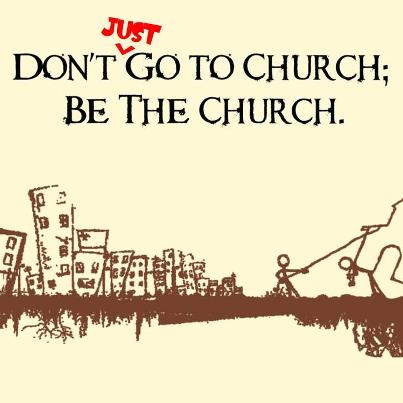
Be the ChurchTrue, I felt a few disturbing tremors in Pastor Randy’s sermon, reminding me that he still reads my blog (though I could be reading too much between the lines of his message) and doesn’t always agree with my opinions, but his grasp of history related to scripture always opens up new worlds in the Bible for me. It’s also true that when I got to the Sunday school class, it was uncharacteristically dark, with no indication that the teacher or anyone else had set the room up for us. Since we have a “guest missionary” with us today, and since plans change at church quickly sometimes, I figured we weren’t having class after all, so I turned around and headed on home. I was disappointed, but things happen.

Pastor Randy’s been out-of-town for a few weeks for a family reunion, and I just found out that he’s going to be gone in relation to his doctorate program for most of January, so I guess our conversations are on an extended hiatus. Another disappointment.

But God was in church today, so that makes up for those few things that didn’t quite work out.

I’ve been struggling with church for a while now and being out for three weeks only made it that much more difficult to go back today. But instead of focusing on the differences I experience between my viewpoint and the “official story” of doctrine and dogma, I need to look at what we all have in common and what I am learning about God, the Bible, and myself.

God was in church today. Maybe He’ll be there next Sunday, too.

The Consequences of Gentile Identity in Messiah

Soon after, Minister Flores made the decision to convert to Judaism. But he struggled to find a way to tell us, as he didn’t want to tear down Christianity without being able to offer us an alternative. So he kept teaching Torah, but in a way that was as subtle as possible. He gradually peeled away the things that were wrong and got us closer to Torah. Our church started replacing Jesus’ name with Jewish, Hebrew names of God, and the songs became Hebrew songs. We began to incorporate real Jewish traditions into our festivals, and we even got a Torah scroll for the church.

At that point we resembled more of a Jews for Jesus group, in the sense that we were Christians with a lot of Jewish traditions. The difference, of course, was that we were moving in the direction toward authentic Judaism, not the other way around.

-Yosef Juarez
“The Torah in Our Church”
Aish.com

Ever since I published Nanos, Paul, and the Consequences of Jewish Identity in Messiah as well as witnessed/participated in the subsequent online discussion, I’ve spent a great deal of time pondering the idea of exactly how the early non-Jewish disciples of the Messiah entered into what was originally a wholly Jewish religious stream. Up to the time of Paul, the only way for a non-Jew to formally enter into any form of religious Judaism was to convert via the proselyte process and become “a Jew by choice,” to use the modern parlance.

In the aforementioned blog post inspired by an article written by New Testament scholar and historian Mark Nanos, one blog commenter asked (tongue-in-cheek):

Then what were gentiles converting to? Christianity?

No, of course not. Christianity, as we understand it today, did not exist when Paul walked the earth. But the Gentiles were not converting to Judaism either…well, not exactly.

Or were they?

No, I’m not suggesting that the early Gentile believers actually converted to Judaism and took on all of the obligations and identity markers of their Jewish mentors, but they did join “the Way” as fully equal co-participants in Yeshua-faith with the Jewish disciples.

But how can you convert to Judaism and not be a Jew?

It gets complicated from here on in, but that’s the mystery we struggle with twenty centuries later as we look through the lens of scripture, history, archeology, and any other tool at our disposal, and try to apprehend not only the intent of Paul and the Council of Apostles in Jerusalem, but of Messiah and God the Father.

That Gentiles were always intended to be reconciled with the Creator and to worship the One God alongside Israel is a foregone conclusion based on many of the Messianic prophesies chronicled in the Tanakh (Old Testament), but exactly how it was to happen is still somewhat hidden in the shadows of time.

Well, maybe.

The only conclusion I can come to with my present understanding of Paul is that he did “convert” non-Jews into a Jewish religious space, not by the proselyte rites, or as “guests” in the manner of the God-fearers, but into a life within Judaism specifically developed for Gentiles in Messiah, and lived out as non-Jewish co-participants, equal in the blessings of reconciliation, justification, and salvation, but not identical to Jewish participants in identity or responsibility.

Not that the Gentiles didn’t have responsibilities. We can start to see the skeleton of their (our) duties in the apostolic decrees (see Acts 15) and fleshed out just a bit more in many of Paul’s letters.

I wrote a number of detailed reviews of the Nanos book The Mystery of Romans including this one that described a sort of mutual dependency Paul characterized between the believing Gentiles and believing and non-believing Jews in Rome.

For the believing Gentiles, their duties to their Jewish hosts did not end at complying with principles designed to avoid offending Jewish sensitivities and facilitating fellowship, but also included provoking jealousy by showing themselves to be the first fruits of the prophecies of the Tanakh that speak of Gentiles “taking hold” of Jews, and going up to the House of the Lord, the House of Prayer, with the devout Jewish people in order to worship the God of Jacob.

That would mean separating from their former lifestyle, from paganism, and in most cases from family, leaving civic cult practice to honor God within the context of a Jewish worship designed for Gentile identity and legal status, but remaining non-Jews in order to clearly show themselves to be the fulfillment of prophesy rather than proselytes or some form of “pseudo-proselytes”.

Mark NanosIn my previous blog post, I characterized Nanos’ opinion on Paul relative to Gentile conversion to Judaism within the framework of “the Way” as being firmly against such a proselyte conversion, but subsequent reading has brought up some questions. It’s very possible Paul was convinced that the Messianic return was only decades away and as such, he felt there just wasn’t time to do anything but spread the gospel message to the rest of the known world as quickly as possible. He may have thought that issues of conversion or even marital status (1 Corinthians 7:8 for example) were of a lesser priority than the imminent return of the Moshiach, so there was no need to develop rulings that would cover the requirements of later generations of Gentile believers.

However, history as shown us that the window for Messiah’s return is a rather lengthy corridor and we still have yet to reach the end. That being said, and keeping a Jewish perspective in mind, since Judaism is adaptive and halachah is continually or at least periodically in a state of development, is the issue of Gentile conversion to Judaism within the modern Messianic Jewish movement something that is, while Paul may not have pre-supposed it, nevertheless completely valid in the present, given the requirements of Jewish and non-Jewish disciples within the context of a Jewish faith in Yeshua the Messiah some two-thousand years down the road?

That question (and it was a long one) might not make sense to Christians who state they observe the “commandments” of the New Testament as a closed canon and an unchangeable decree, but that actually isn’t the case. While Christians sometimes criticize the various modern streams of Judaism for maintaining a quasi-open canon via the Talmudic rulings of the Rabbinic sages, in reality, the Protestant church in all its incarnations, more closely follows a 16th century (and even later) set of interpretations of the New Testament, rather than the original, apostolic understandings and teachings of the people who participated in spreading the good news from Jerusalem to Judea, Samaria, and to the diaspora nations of the first century of the common era.

Both Christianity and Judaism have their own methods of keeping one foot firmly rooted in the Bible and the other one wandering up and down the passageways of time.

This idea of how Paul, James, and the apostles of the council conceptualized the role of Gentiles in their Jewish religious world has profound implications, not only on how we read and understand the New Testament, but how we view the role of the Church today, as well as modern Christian/Jewish relations.

We may have it all wrong when we think of the exact mechanism by which Gentiles entered “the Way,” and that, in a sense, they were not “converted” to Judaism or became citizens of Israel (and thus “Israelites” as opposed to “Jews”), but entered a unique legal status that at once made them equal relative to certain covenantal blessings without being identical, for the sake of fulfilling Messianic promises, to the Jewish people in identity and obligation, but still actually practicing Judaism as a way of life specifically crafted for the Gentiles by legal decree and the will of the Holy Spirit. I’ve heard it said that the short definition of a Jew is one who has rejected idolatry (obviously the long definition contains a lot more details). In that manner, while we can’t count the Gentiles in Messiah as Jews, they (we) are practicing a form of Judaism styled for them (us), at least within the ancient “Way” and in modern Messianic Judaism.

Although Christianity and Judaism (in all their various flavors) have described quite different trajectories across history, it is foolish to imagine that One God and a returning Messiah King will allow such a state to remain as we have constructed it, through it’s within the realm of possibility (considering the beginning verses of Matthew 23), that Messiah may allow a certain amount “halachah” to remain in place based on his giving the apostles the authority to make binding rulings in his name (assuming any of that trickled down to the Christian or Messianic movements of today as we imagine it has in parallel process to the modern, normative Judaisms).

Prophesy states that Messiah will return all of the Jewish exiles to their Land and their place, but it may be that he will also return the Gentile disciples to an understanding of who we are and where our duties lie in relation to the King of Israel, the nation of Israel, and the Jewish people.

I have a lot more reading to do in order to more completely explore this concept, but it’s heading in a direction I’ve been approaching for a while now.

jewish-traditionI think there are a number of Christians and Christian groups who are feeling the pull of prophesy, but in most cases, such as in the above-quoted article written by Yosef Juarez, there’s been a terrible misunderstanding. Messiah never meant for us to believe that we had to choose between him and our devotion to Jewish people and Israel, rather he desires that we arrive at a proper understanding of our role in relation to Israel and her King, where King and Country are not mutually exclusive as most people believe is true of Jesus and Israel.

While we don’t see entire church groups converting to Judaism en masse very often (as Yosef Juarez describes in his article), we do see Gentile Christians entering into Hebrew Roots congregations and attempting to fulfill their roles (mistakenly in my opinion) by apprehending Jewish identity rather than their (our) own, or even more tragically, Gentiles in Hebrew Roots and Messianic Judaism leaving Messiah Yeshua behind and converting to one of the modern Judaisms of our day.

There are few things sadder than seeing a Christian begin to develop a sincere love of Israel and the Jewish people and then to allow misunderstanding and a misguided sense of purpose to cause them to completely overshoot the target, missing the point and mistaking the background for the goal.

“One who romanticizes over Judaism and loses focus of the kingdom of Heaven can be compared to a carpenter who is infatuated with the hammer, rather than the house it was meant to build.”

Troy Mitchell

It may not be entirely inappropriate to consider, under certain specific circumstances, Gentile conversion to Judaism within a Messianic Jewish venue, but again, in my opinion, this should be a rare occasion. Gentiles will never be able to take their (our) place in God’s Kingdom as the crowning jewels of the nations if we convert or quasi-convert to Judaism in significant numbers. To be “crowning jewels” we must remain among “the nations” or fail prophesy, Messiah, and God.

One of These Things is Not Like the Others

One of these things is not like the othersCommunity. It’s that thing, the way of life, that we all want but we’re just not quite sure how to pull it off successfully. It’s that tantalizing concept that promises so much reward, and yet it seems so elusive. Its promise sometimes causes us to cut ties where we are and move somewhere else where we hope to find greener pastures, better friends, and/or become part of a different community. Then when we do get a taste of real community, it’s only a matter of time before our hearts are stunned with hurt or insult. But a lack of community causes us to feel despondent, alone, and often times as if we’re missing out on something significant that was intended for us all along. This community thing can really be disappointing!

-Lisa
“Community Disappointment”
Following the Ancient Paths

I wrote a lengthy response to this blog post, but when I pushed “Post Comment,” I received an error message and my comment was lost forever. It was a rather lengthy comment (go figure) and I suspect the blog application was complaining to me about it. I thought about re-writing the comment but decided to blog instead.

Lisa’s blog post addresses what we should already know. Being part of any group or community is hard work. It’s hard to join, it’s hard to sustain, it’s hard to adapt over time. This includes families, employers, and Lisa’s specific topic, religious organizations.

I can sympathize. A little over a year ago I “went back to church” and in that time have had many interesting, educational, and dismaying “adventures.” But as Lisa’s blog post suggests, this is to be expected. No group that involves multiple human beings is always going to run smoothly.

Over a year apart, I wrote the blog posts Why I Don’t Go to Church and Why I Go to Church, chronicling my internal struggle, the same one Lisa seems to be describing.

We live in a world that seems to praise isolationism, yet we instinctively know that we weren’t created to be loaners (sic). Somehow it’s considered a good thing when we can handle things alone, when we can appear stand tall with a backbreaking burden strapped to our backs, when we live such private lives that nobody knows what is really going on with us. Deep inside we know that it isn’t right to go through life all alone. We wrestle with wanting something yet not wanting the very same thing, pursuing it and rejecting it all at the same time.

-Lisa

As Lisa says, we want to go it alone to avoid all of the messiness of being part of a community, but when alone, we know that being isolated from community isn’t right, either. Sort of a “can’t live with ’em, can’t live without ’em” situation.

The main point of my lost comment was the issue of competing interests. Affiliation with one community may conflict with another affiliation. In my case, I’m a Christian living with Jewish family members while attending a Christian church. How does that work?

Another set of competing interests has to do with entering into and finding a niche within a community. I recently declared that I’m a Christian who studies Messianic Judaism, and yet I attend a very fundamentalist Baptist church in Southwestern Idaho. If you’ve read any of my blog posts about my conversations with my Pastor, you know that although we get along, we disagree on a number of fundamental (no pun intended) elements of what faith in Messiah means, particularly to the Jewish people.

Can a square peg successfully integrate into a church of round holes? Good question.

I recently finished the book Life of Pi by Yann Martel. It tells the story of Pi, born and raised in India, from childhood to adulthood through a series of flashbacks, with the main action taking place aboard a lifeboat shortly after Pi’s family died in a shipwreck in the middle of the Pacific Ocean. Pi is the only human survivor, but finds that he must share the lifeboat with an injured Zebra, an Orangutan, a Hyena, and a 450 pound, male adult Bengal Tiger named Richard Parker (Pi’s father was a zookeeper and they were transporting a number of their animals from India to their new home in Canada).

life_of_pi_by_megatruh-d5noigdThe other interesting thing besides how Pi manages to survive seven months adrift at sea sharing a lifeboat with a Tiger (the other animals didn’t make it), is that as a child, Pi adopted three religious traditions, first Hinduism, then Christianity (Catholicism), and finally Islam. Pi practiced all three religions simultaneously, ignoring the basic tenet of each that these religions are exclusivist. That is, if you belong to one, you cannot also belong to any other religion.

Pi managed to observe each religious tradition in parallel without arousing suspicion for a while, but eventually it caught up with him, and he was finally confronted by all three congregational leaders at the same time in a public place in front of his parents.

When questioned about why he thought he could be a Hindu, a Christian, and a Muslim all at the same time, he responds by saying that he “just wants to love God.” (Martel, pg 69)

The book follows Pi’s life into adulthood and middle age where he is married with two children and a small dog and living in Toronto. He still practices all three religions, with no mention of any conflict in his family or in any of the involved congregations, but “Life of Pi” is a work of fiction and operates often at the level of religious allegory (I still haven’t figured out what the carnivorous island is supposed to mean).

In real life, Pi would never be able to successfully manage practicing all three religions, not only because of the conflicts between those communities, but the likely conflict with his own family, particularly his wife, who almost certainly had formed her religious or irreligious affiliations before she ever met and married Pi.

I have to admit, when I read about the sheer audacity and innocence of Pi’s devotion to three different religious branches, cherishing the best in all three, I felt a moment of admiration and even envy. What would it be like to open your arms wide and to take in and accept humanity’s vast range of traditions in worshiping God just for the sheer love of God?

It isn’t practical, which I suspect is one of the reasons why Martel’s novel is called a fantasy.

But Interfaith communities aren’t unheard of in our world. Author Susan Katz Miller maintains the On Being Both blog which celebrates a variety of interfaith families and communities, but such celebrations aside, one does not easily navigate the stormy seas that occur when theologies, doctrines, and dogmas clash in the narrow straits between one religion and another.

The solution in my own family, as it stands now, is something of a compartmentalization of each religion. In my home, Christianity and Judaism exist in separate silos, rarely communicating across the gap between them for the sake of peace. I do occasionally get emails from my wife containing links to news or information items on Israel or Judaism but I’m very careful not to bring up Christianity.

The ugly times is where our communities can grow stronger, more dedicated to one another, where each member grows in righteousness and in the image of our Master. The challenge is on the table. Are we ready to accept it?

-Lisa

Sesame StreetIt is true that adversity can produce stronger communities, but there’s a line that, if crossed, means that adversity has exceeded manageable limits and is destructive, not constructive. Sort of like lifting weights at a gym to build strength but overtraining resulting in injury, sometimes serious injury.

The television show “Sesame Street” sometimes has a lesson in the form of a song called One of these things is not like the others and I know what that experience is like in spades. There are interfaith communities that (seemingly) successfully co-exist within the same larger group, and there are interfaith families that are created and thrive for decades (such as my own), but that doesn’t mean it’s easy (which is what Lisa’s blog is all about).

But beyond being “not easy,” there are times when “not easy” becomes impossible or at least highly improbable, like a fourteen-year old boy from India who is a practicing Hindu, Christian, and Muslim, or the same boy two years later who manages to survive for seven months in the Pacific Ocean sharing a lifeboat with a large Bengal Tiger. How long can such a relationship between communities last before something gives?

FFOZ TV Review: The Restoring the Kingdom

A promise of what is to comeEpisode 26: The disciples ask Jesus “Are you at this time going to restore the kingdom to Israel?” They were looking for a physical kingdom. Was the kingdom only spiritual, or were the disciples right to expect a physical, future kingdom? Episode Twenty-six will show the viewers that the kingdom of Messiah is not just spiritual. There is a literal, coming, restoration of the kingdom of Israel. Although we believers have laid hold of the kingdom and enjoy a foretaste of it, we have not entered the kingdom yet. It’s still ahead.

-from the Introduction to FFOZ TV: The Promise of What is to Come
Episode 26: Restoring the Kingdom (click this link to watch video, not the image above)

The Lesson: The Mystery of Restoring the Kingdom

In this final episode of the first season of A Promise of What is to Come, First Fruits of Zion (FFOZ) teachers Toby Janicki and Aaron Eby address the question of exactly what is the restoration of the Kingdom of God. From traditional Christianity’s point of view, the Kingdom has often been described as being Heaven, or being the Church, or being an invisible, spiritual Kingdom, the spirit that is in our hearts.

But this show uses a specifically Jewish perspective to read the Bible and understand how to interpret ancient prophesies. We can’t go only by what the words say themselves. We need to know how the original speakers and audiences in the Bible would have comprehended what was said. What did the disciples mean when they asked the following question to Jesus?

So when they had come together, they were asking Him, saying, “Lord, is it at this time You are restoring the kingdom to Israel?”

Acts 1:6 (NASB)

It was at this point that Jesus was about to ascend into Heaven to take his place at the right hand of the Father. He was leaving his disciples on Earth. They must have been puzzled that Jesus was leaving without finishing his work. Where was the Kingdom? Why hadn’t he established it? How could he depart when there was so much left for him to do?

Christian Pastors often criticize the ancient Jewish disciples for misunderstanding what Jesus taught. In the eyes of many modern believers, the Kingdom is a spiritual Kingdom, not a physical reality. But even today, devout Jews believe that one of Messiah’s major tasks is to restore the nation of Israel as a physical Kingdom on Earth, return all of the exiled Jews to their Land, and elevate Israel as the head of all the nations.

This is one of the reasons why most Jewish people don’t believe Jesus could have been the Messiah. They don’t believe he was resurrected and that he died without restoring and redeeming physical Israel. Even from a believing Jew’s point of view, Jesus as Messiah left before completing his work. That means he must come back at some point to finish the job. Otherwise, he can’t be Messiah.

Toby suggested at this point in the program, that it would be a good time to review some of the information about the Kingdom presented in previous episodes of the series. To this end, he quoted:

After Yochanan was arrested, Yeshua came to the Galil and proclaimed the good news of the kingdom of God. He said, “The time is fulfilled, and the kingdom of God has drawn near. Repent and believe the good news.”

Mark 1:14-15 (DHE Gospels)

As you may recall, the Kingdom being “drawn near” or “at hand” meant that it was something that had arrived and could be appropriated at any time. It’s like standing at a doorway of a house. All you have to do is open the door and walk inside. In this case, the message was to repent, which was what Jesus was telling national Israel to do, in order to enter the Kingdom, the restoration of Israel to be accomplished by the Messiah.

Toby JanickiThe Torah, many of the Prophets, and even the Psalms, all speak of these Messianic promises, of a nation restored, a Holy people redeemed, a Land flourishing, the world at peace, all under the rule of King Messiah, Son of David. Here Toby paints a portrait of the prophesies that are continually additive, one linking to another, and to another, and to another, through the Tanakh (Jewish Bible) and across the so-called barrier between the Old and New Testaments, describing in a single, unbroken thread in the tapestry of God’s restorative and salvational plan.

It was this Jewish and Biblical understanding that told the disciples of the Master what to expect and led to the question we read in Acts 1:6. The Church says the ancient and modern Jews are all wrong and that no physical Kingdom was ever planned by God, in spite of the overwhelming evidence otherwise stated in prophesy. But what did Jesus say?

He said to them, “It is not for you to know times or epochs which the Father has fixed by His own authority…”

Acts 1:7 (NASB)

Here, Jesus isn’t saying that they’ve misunderstood him, or that there would never be a physical restoration, or that his Kingdom is purely spiritual. He’s saying that he wasn’t going to tell them when the Kingdom would be restored, only that it would be restored at a time fixed by God’s own authority.

In other words, Jesus didn’t contradict the expectations of his disciples, he only said he wasn’t going to restore the Kingdom of Israel at that very moment and that they had to wait. He also said this:

“…but you will receive power when the Holy Spirit has come upon you; and you shall be My witnesses both in Jerusalem, and in all Judea and Samaria, and even to the remotest part of the earth.”

Acts 1:8 (NASB)

The Kingdom of Israel would be restored, but before that was going to happen, Jesus said they would receive power when the Holy Spirit came upon them, and with that power, they were to be Messiah’s witnesses in Jerusalem, Judea, Samaria, and to the four corners of all the Earth.

It’s not that Messiah won’t restore physical, literal Israel as a Kingdom; the Kingdom above all nations, it’s only a matter of when.

Clue 1: Jesus taught that the Kingdom has not yet happened.

If you were to ask a room full of Christians if Jesus had finished his work in the first coming, most of them would say “yes” based on this:

Therefore when Jesus had received the sour wine, He said, “It is finished!” And He bowed His head and gave up His spirit.

John 19:30 (NASB)

But Toby says Jesus was most likely speaking of his suffering and the atonement of sins, not his entire mission as a Messiah. I agree. If Messiah’s work was finished, then where is the world at total peace? Why don’t we all act as we should? Why is there still sin? And why is there a predicted second coming of Jesus?

Aaron EbyBoth Jews and Gentiles say today “Maranatha,” which means “O’ Lord, come.” Why do we say this if he has already finished everything he was supposed to do?

The scene shifts to Israel and FFOZ teacher and translator Aaron Eby for a brief word study of “Maranatha.” As it turns out, in the Church, we get this word from two words in Aramaic Paul inserted at the end of 1 Corinthians. Aaron said, and I learned recently, that there were no spaces between words in the Bible. For instance, if we were to translate a portion of Romans 1:32 into English but not insert spaces between the words, it would look something like:

thoughtheyknowgodsrighteousdecreethatthosewhopracticesuchthingsdeservetodie

What a mess. No wonder Biblical translation is so challenging. No wonder there is such a great difficulty in organizing the context of the Bible and how creating chapters and verses can lead to misunderstanding of the original message.

But Aaron says that even though we don’t know how the Aramaic word “Maranatha” is separated, it still means the same thing: “O’ Lord, come.” Aaron believes that Paul not only acknowledged and preached about the great accomplishments of Messiah during the first advent, but longed for the Messiah’s return and all that he would do at that future time.

Hear the word of the Lord, O nations,
And declare in the coastlands afar off,
And say, “He who scattered Israel will gather him
And keep him as a shepherd keeps his flock.”
For the Lord has ransomed Jacob.

Jeremiah 31:10-11 (NASB)

This is a key Messianic prophesy describing what Messiah will do for the Jewish people and for Israel, and describes the responsiblity of the nations to listen (and obey) the words of Israel’s King.

Aaron pointed to the miracle of modern Israel’s very existence and the restoration of the Hebrew language, which had vanished for many centuries. He used Zephaniah 3:9 as a prophesy of the restoration of Hebrew, and expressed what a miracle it is for even an Israeli child to be able to read from an ancient Torah scroll and grasp its meaning.

But as exciting as this all is, Israel is still in exile as long as even a single Jew does not live within her borders, and as long as it is still threatened by its enemies, and as long as it is still largely secular, and as long as there are still two foreign Mosques on the Temple Mount in Jerusalem, the most Holy place on Earth.

Believing and non-believing Jews all still cling to the twelfth of the Rambam’s thirteen principles of faith:

I believe with a perfect faith in the coming of the Messiah, and even though he may delay, still everyday I pray that he will come.

The modern state of Israel is a good start, but it is hardly finished. There is so much more left to do.

Back in the studio, Toby gives us the second clue:

Clue 2: Jesus had not yet fulfilled all of the Messianic prophecies.

RestorationWe may not know when the Messianic Kingdom will come, but we know what it will be like. Toby links a number of passages in scripture together including Matthew 16:27, Isaiah 40:10, and Revelation 22:12. And Jesus himself said he had much work left to do. We read in Matthew’s gospel how he described his own return:

Then the son of man will appear in heaven, and all the families of the earth will mourn, as they will see the son of man coming with the clouds of heaven in power and great glory. He will send forth his angels with the sound of the great shofar; they will gather his chosen ones from the four winds, and from one end of heaven to the other.

Matthew 24:30-31 (DHE Gospels)

Jesus was referring to this prophesy:

It shall be on that day that a great shofar will be blown, and those who are lost in the land of Assyria and those cast away in the land of Egypt will come [together], and they will prostrate themselves to Hashem on the holy mountain in Jerusalem.

Isaiah 27:13 (Stone Edition Tanakh)

Jesus was speaking of what he had yet to do beyond his first coming, and that renders the third and final clue:

Clue 3: Jesus did not think his work was finished.

Unless you think the world is as it should be and that we have peace among the nations and kindness between human beings, then you must believe his work isn’t finished either.

What Did I Learn?

In this final episode of the first season of The Promise of What is to Come series, I learned pretty much what I already knew. It seems silly to imagine that Jesus had fulfilled all that he was supposed to do in his first coming. The world is still a mess and still needs a lot of fixing. Unless you are prepared to throw out large portions of the Tanakh (Old Testament) and replace the content with how the Church understands the apostolic scriptures, you must believe that the life, death, resurrection, and ascension of Jesus does not fulfill all of the Messianic promises we see in the Bible.

This is also where I believe embracing a Jewish understanding of those scriptures is handy. It does not require that we refactor what Jews believe as a physical Kingdom of God in Israel into some sort of spiritual environment we enter when we die. Jewish and Gentile disciples of Jesus the Messiah can all believe that what God said through Isaiah and Jeremiah and how it was understood was still true in the world of Jesus, Peter, and Paul and still is true in our world of the 21st Century of the Common Era.

As I’ve said before, many of the beliefs in the modern Christian Church have their origins in the earliest expressions of anti-Semitism and supersessionism created by our so-called “Church Fathers,” and preserved by the men of the Reformation many centuries later. What was once invention and tradition created to separate a nascent Gentile Christianity from normative Judaism (that is, how the Church sees the Jewish people, modern Israel, and the ancient Messianic prophesies), is now believed to be rock solid fact. It doesn’t occur to many Christians to question any of these assumptions.

The FFOZ TV show is dedicated to thoughtfully suggesting to its Christian audience that its assumptions be questioned in the light of a Jewish interpretation of Biblical truth. The numerous other resources offered at First Fruits of Zion and her sister organization Vine of David are designed to provide that perspective and expand upon it for both traditional Christians and the Jewish people who have yet to recognize the face of the Messiah as the Jewish face of Rabbi Yeshua in the Gospels.

Modern IsraelBut even learning this does not summon the Promise of the Messiah to our world. In order to finish our own work so that he may come, we must live out those truths that have been revealed to us. Visit the sick, give charity to the poor, donate food to the hungry, act only with kindness to any person that you encounter, speak of the good news of the Messiah to a damaged and dying humanity.

Only then will we be pursuing the path of our Master by participating in tikkun olam, repairing our desperately broken world.

It is said that the Messiah will return only when all of Israel, all the Jewish people, keep the Shabbat as one. It is also said that the Messiah will return only when all of Israel and the world has reached a level of deepest depravity.

I don’t know what to think. I only know that we introduce a tiny bit of the Messianic Kingdom into our world every time we extend a helping hand to another person. If we all committed one unasked act of kindness each day, then how Messiah-like would the world begin to appear? We wait for Messiah to return to finish what he started, but in the mean time, we can all do what we can, as we have faith in the promise.